AI Summary Powered by PixelBrainy
Imagine giving your buyers the power to step inside a property without traveling, explore every corner in 360 degrees, customize interiors with a tap, or walk through a home that has not been built yet. This level of immersive selling is no longer a futuristic dream. It is the new reality shaped by AR/VR in real estate apps. As the industry shifts toward digital-first experiences, Real Estate AR/VR App Development has become one of the most impactful transformations in proptech.
More real estate developers, agents, builders, and property marketing firms are now investing in creating a real estate AR/VR App to offer an unmatched customer experience. These immersive applications remove traditional barriers in the buying process and build deeper engagement with prospective buyers. Trends like remote property visits, virtual home customization, and 3D walkthroughs are no longer optional. They have become essential for modern real estate businesses that want to stay competitive in 2026.
If you are researching how to build AR/VR App Development for Real Estate, this guide will help you navigate the entire ecosystem. Whether you are developing an AR/VR application for real estate for the first time or planning to upgrade your existing digital tools, you will learn the complete process, required technologies, key features, cost structure, challenges, and long-term ROI.
By the end of this guide, you will understand exactly what goes into developing AR/VR Application for real estate and how these immersive technologies are revolutionizing the entire property buying experience worldwide.
Real estate is entering a new era where traditional marketing tools simply don’t impress buyers the way they used to. People want more than photos and walkthrough videos. They want to experience a property, understand its flow, see how the sunlight enters the rooms, and visualize how their own furniture might look inside. This shift in expectations is the reason AR and VR technology has become one of the most powerful forces in proptech today.
What was once considered futuristic is now becoming mainstream. Investing in AR/VR App Development for Real Estate is no longer a luxury reserved for big developers. It’s becoming a practical requirement for businesses that want to stay competitive and deliver the kind of immersive experience modern buyers expect.
As we move deeper into 2026, buyers expect this level of immersion. They want to roam through properties on their phones, tablets, or VR headsets before ever stepping foot on-site. For developers, this means faster pre-sales. For agents, it means higher-quality leads. And for investors, it means better decision-making with more accurate, lifelike visualizations.
This is why developing Real Estate AR/VR App solutions is becoming a central strategy for forward-thinking real estate brands. These apps transform the way properties are showcased, create meaningful engagement, and give businesses a clear competitive edge. AR/VR isn’t just enhancing the buying experience; it’s reshaping the entire real estate journey from discovery to decision.
Also Read: How Real Estate Companies Are Adding 37% More Qualified Leads Using AI Automation?
AR and VR are reshaping how real estate professionals present, market, and sell properties. These technologies are no longer optional upgrades. They are becoming essential tools for enhancing buyer experience and improving business performance. For companies exploring the advantages of building AR/VR App Development for Real Estate, the benefits extend far beyond visuals. They impact sales, marketing, customer engagement, and overall operational efficiency.
Below are six major benefits of creating real estate AR/VR App solutions that every developer and agent should consider.
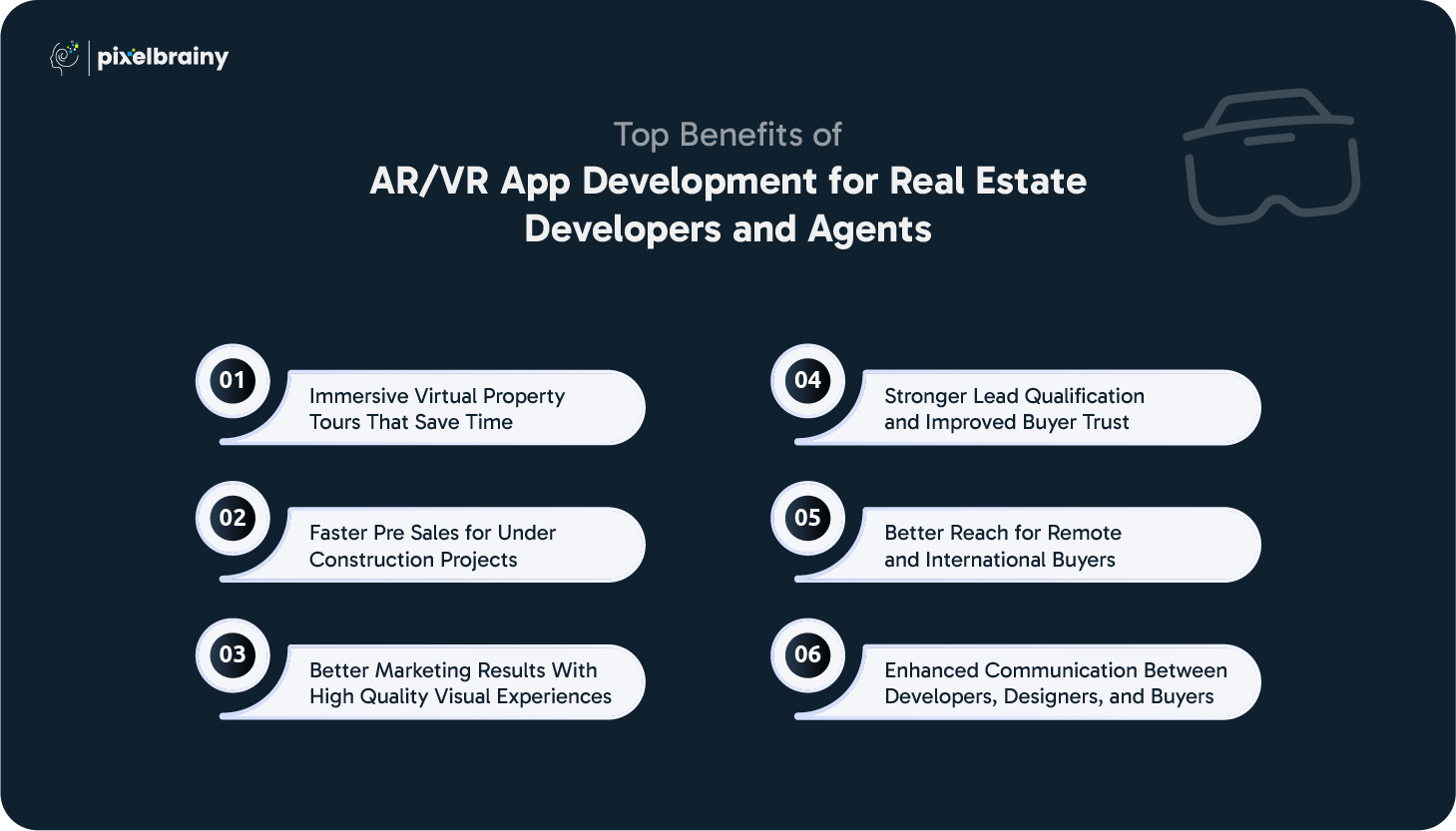
One of the most valuable advantages of building AR/VR App Development for Real Estate is the ability to offer immersive virtual property tours. These tours allow buyers to walk through a home as if they were physically present. They can move from room to room, examine the layout, understand the proportions, and get a feel for the overall ambiance without needing to schedule a single visit.
For agents, this significantly reduces the time spent on repetitive showings to casual or uncertain buyers. Instead of coordinating multiple visits per day, they can simply share a virtual tour link. Buyers can explore the property at their convenience, narrowing down their choices before ever stepping inside.
This creates a smoother, more efficient viewing process for both parties and helps agents focus their energy on serious clients who have already engaged with the property virtually.
Developers often struggle to sell units in projects that are still under construction because buyers find it difficult to visualize the final outcome. With AR/VR, this challenge is solved completely. Virtual walkthroughs allow buyers to experience the future property long before it physically exists.
Through Real Estate AR/VR App Development, developers can showcase completed interiors, floor plans, balcony views, furniture arrangements, and even lighting conditions at different times of the day. This immersive preview builds a strong emotional connection and helps buyers imagine their lifestyle in the space.
As buyers gain more confidence in what they are investing in, developers see an increase in early bookings and pre launch sales. This directly accelerates revenue flow and improves overall project profitability.
Modern buyers respond more to immersive visuals than static images. AR/VR content elevates property marketing by making it more interactive, memorable, and emotionally engaging. When real estate companies choose to make AR/VR App for real estate marketing, they create standout experiences that easily capture attention.
These immersive visuals perform extremely well on websites, listing portals, and social media platforms. Potential buyers spend more time exploring such content, which increases brand visibility and boosts conversion rates. Properties showcased with AR/VR often generate higher engagement and receive more inquiries compared to traditional marketing methods.
This improved engagement translates directly into better-quality leads and more effective marketing campaigns.
When buyers can explore a property virtually before scheduling a physical visit, they make more informed decisions. They understand the size, layout, flow, and overall feel of the home without relying solely on photographs or descriptions. This level of transparency builds trust much earlier in the buying journey.
For agents, this also acts as a powerful lead qualification tool. Instead of spending hours on site visits for every interested lead, they only meet clients who have already explored the property virtually and are likely to take the next steps.
By reducing misunderstandings and setting clear expectations from the start, AR/VR helps buyers feel more confident, resulting in smoother negotiations and quicker closures.
Many real estate buyers now prefer evaluating properties remotely due to schedule constraints, relocation, or living in another country. AR/VR makes remote property exploration not only possible but incredibly convenient.
By creating real estate AR/VR App solutions, agents can offer lifelike tours to buyers who may never physically visit the property until closing day. These tours provide enough clarity and detail for buyers to make serious decisions, which opens up new opportunities for agents to tap into global markets.
This expanded reach allows developers and agents to connect with a much larger audience and improve sales opportunities beyond local boundaries.
Miscommunication is common in real estate projects, especially when it comes to interior finishes, layout changes, or material selections. AR/VR helps eliminate these problems by providing a shared, highly visual platform where everyone can see the same information in real time.
Developers can use AR/VR to illustrate design concepts clearly. Designers can display variations of materials, wallpapers, textures, and color schemes with accuracy. Buyers can request changes confidently because they can visualize exactly how the final result will appear.
This reduces costly revisions, improves collaboration, and speeds up the approval process for customizations and design changes.
In short, AR/VR App Development empowers real estate professionals with tools that create clarity, improve efficiency, and deliver unforgettable buying experiences.
Also Read: AI Real Estate App MVP Development: A Guide for Real Estate Startups
AR/VR technology is redefining how buyers interact with properties by introducing new, practical, real-world applications that simplify decision making and elevate the overall experience. When developers and agencies start creating real estate AR/VR App solutions, the focus shifts toward enabling smarter property exploration and clearer visualization.
Below are the most powerful and widely adopted real estate AR/VR use cases that have become core to modern property selling.
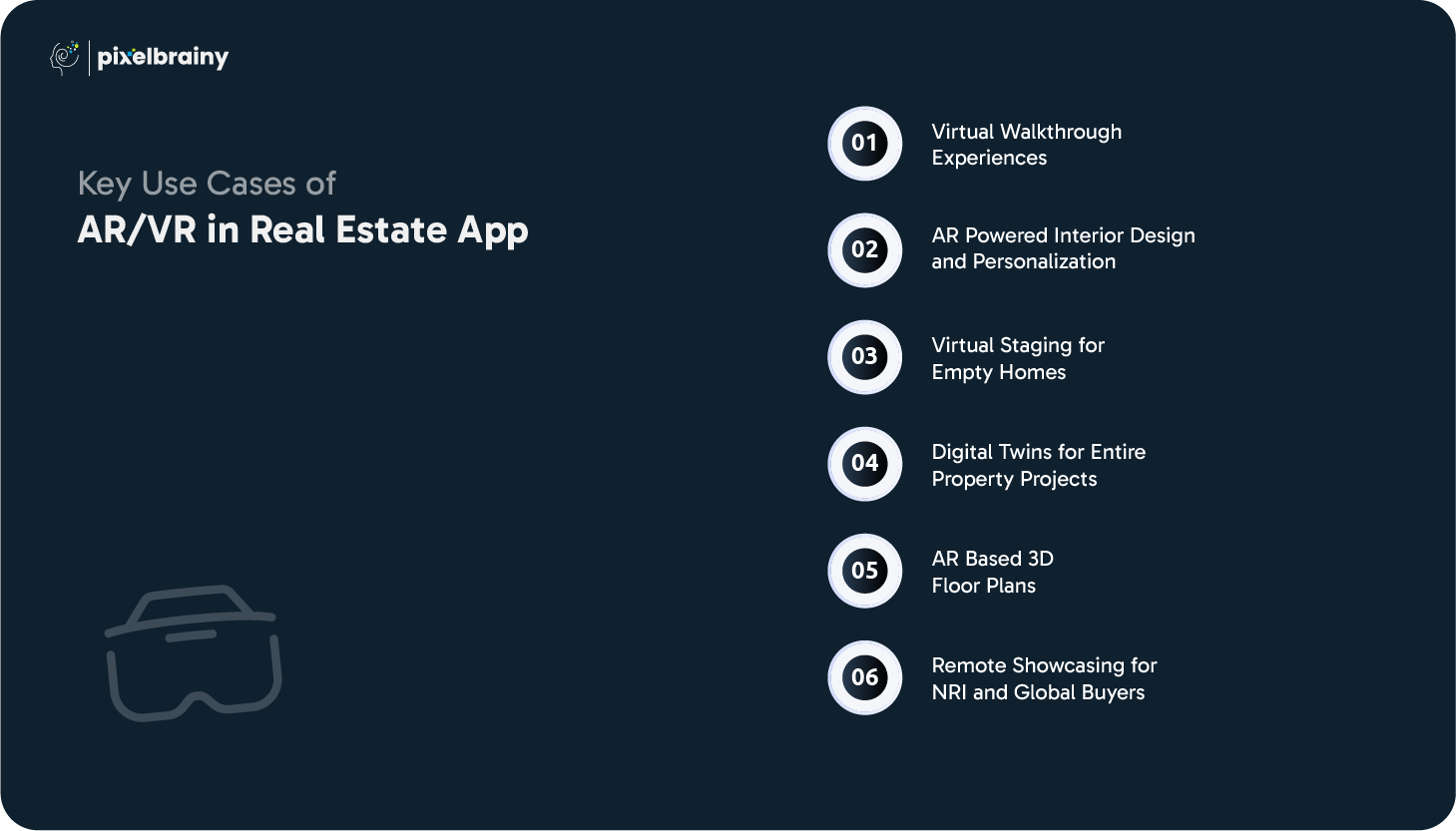
What it is: Virtual walkthroughs create a full-scale 3D simulation of a property that buyers can explore as if they were physically present. This includes every room, corner, balcony view, and interior element, all rendered with realistic lighting and textures.
How it’s used: Buyers can move freely through the property using their phone, tablet, or VR headset. They can check room proportions, understand the layout flow, and get a true sense of space without scheduling a visit. Developers often use this feature for showcasing sample flats and luxury units, while agents use it to present multiple homes in one meeting.
Why it matters: For many real estate companies, this is one of the strongest use cases of AR/VR in real estate because it creates clarity, saves time, and builds trust long before the buyer arrives on-site. It turns the property tour into a flexible, on-demand experience.
What it is: AR-based interior visualization allows buyers to digitally place furniture, décor, color themes, flooring, lighting, and appliances within their real environment. It merges the physical room with digital assets, creating a true-to-life preview.
How it’s used: Buyers simply point their smartphone at a room and begin customizing. They can try different sofa styles, switch wall colors, move dining tables, or preview finishes instantly. Developers and interior designers often use this tool during project walkthroughs or client discussions to present multiple design options quickly.
Why it matters: This use case removes the guesswork that often delays decisions. Buyers gain confidence because they can see how their future home will look, while developers reduce redesign requests and improve user satisfaction during the selection process.
What it is: Virtual staging uses AR/VR technology to digitally furnish and decorate properties that are unfurnished or newly constructed. Instead of showing empty spaces, agents can present well-designed interiors that highlight the property’s potential.
How it’s used: Agents upload images or scans of empty rooms and apply ready-made interior themes such as modern, minimal, luxury, or traditional. Buyers then view the staged version through the app or virtual tour, helping them connect emotionally with the space.
Why it matters: Staged homes sell faster and appear more attractive online. Virtual staging eliminates the cost, time, and effort of physical staging while delivering the same aesthetic appeal. For large real estate inventories, this is an unbeatable advantage.
What it is: A digital twin is a hyper realistic 3D replica of an entire real estate project. This can include entire towers, villas, clubhouses, landscapes, parking areas, and even neighborhood surroundings.
How it’s used: Developers use digital twins during launch events, presentations, and site visits to give buyers a complete understanding of the project scale. Buyers can view the apartments, amenities, and community layout, and even explore how the property will look during different times of the day.
Why it matters: Digital twins offer unmatched clarity for large projects, especially when nothing has been built yet. They help buyers understand the project’s vision, quality, and design direction better than brochures or 2D plans ever could.
What it is: AR transforms 2D floor plans into dynamic 3D models that appear on any flat surface through a smartphone. It brings the floor plan to life by showing room connections, furniture placement, and functional flow.
How it’s used: Users place their phone over a printed plan or a blank surface, and the AR app generates a detailed 3D model of the unit. They can rotate, zoom, examine entrances, and get a realistic idea of how the space will feel once completed.
Why it matters: Floor plans are often difficult for buyers to interpret. AR solves this by giving them a clear and interactive way to understand dimensions and layout, making property evaluation faster and more intuitive.
What it is: Remote showcasing uses AR/VR real estate applications to allow buyers across the world to explore properties without needing to travel.
How it’s used: Agents can share virtual tours, digital twins, or AR visualizations with clients anywhere. Buyers can explore multiple units, compare options, and even finalize choices remotely. This is widely used for international sales, relocation buyers, and NRI investments.
Why it matters: It opens access to a global market and allows buyers to make informed decisions even from another country. This is especially valuable for developers selling to international investors or agents working with clients who cannot visit in person.
These use cases highlight how AR/VR transforms the real estate journey from simple property viewing into a fully immersive, interactive, and confidence-driven experience.
Also Read: How To Develop AI Property Investment App: Features and Cost
AR/VR real estate apps are becoming essential tools for developers, agents, and property marketers. To make an AR/VR app for real estate truly effective, it must include features that enhance visualization, simplify decision making, and improve the overall user experience.
The table below highlights the must have features that should be included when creating real estate AR/VR app solutions.
| Feature Name | Explanation |
| 360 degree virtual tours | Allows users to explore the property in a fully immersive environment. Helps buyers understand the true layout and flow of the home without visiting. Boosts early decision making. |
| Photorealistic 3D models | Provides high quality visuals of interiors and exteriors. Helps buyers see realistic textures, lighting, and finishes. Enhances overall presentation quality. |
| AR furniture placement | Lets users place digital furniture into real spaces through their smartphone. Helps envision room design and décor options easily. Makes interior decisions simpler. |
| Live material and color customization | Users can switch wall paints, floor materials, tiles, and cabinet finishes. Helps personalize the property instantly. Reduces uncertainty during selection. |
| Virtual staging options | Turns empty rooms into beautifully furnished spaces. Increases buyer engagement on listing pages. Eliminates costs of physical staging. |
| Interactive floor plans | Converts traditional 2D plans into 3D models with clickable hotspots. Helps users understand room sizes and connections clearly. Improves layout clarity. |
| Accurate room measurement tool | Allows buyers to measure walls, windows, and spaces in real time. Helps them check furniture placements. Ensures dimensional clarity. |
| Lighting and ambiance controls | Lets users see how the property looks in daylight, evening, or night mode. Shows realistic ambiance variations. Enhances space visualization. |
| Guided narration or voice tours | Provides voice based explanations during the virtual tour. Makes the experience more interactive and informative. Helps buyers understand key highlights. |
| Map and neighborhood integration | Shows nearby schools, malls, hospitals, and transport routes. Helps users evaluate the property location better. Encourages confident decision making. |
| Booking and appointment scheduling | Allows users to schedule site visits or virtual meetings instantly. Makes the app more action oriented. Simplifies the buyer journey. |
| Mortgage and EMI calculator | Helps users calculate monthly payments and affordability. Offers financial clarity during browsing. Encourages quicker commitments. |
| Property comparison tool | Lets users compare layouts, sizes, interior styles, and budgets. Makes evaluation easier for multi property buyers. Enhances decision confidence. |
| Multi device compatibility | Ensures the app works across mobile, tablets, desktops, and VR headsets. Increases accessibility for all types of users. Improves reach and engagement. |
| CRM integration for agents | Connects leads directly to the agent’s CRM platform. Helps track interactions and follow ups. Improves sales management efficiency. |
These features ensure your AR/VR real estate app delivers a highly immersive, informative, and conversion focused property experience.
While essential features create a strong foundation, advanced capabilities can take your AR/VR real estate app to a completely new level. These non ordinary features offer deeper engagement, intelligent automation, and futuristic interactions that elevate your platform above competitors.
The table below highlights the most powerful innovations to consider when developing real estate AR/VR app solutions.
| Advanced Feature | Explanation |
| AI powered property recommendations | Uses user behavior and preferences to suggest the best matching properties. Improves personalization dramatically. Helps increase overall conversion rates. |
| Digital twin automation | Creates intelligent replicas of buildings that sync with real world updates. Allows users to view progress and future projections. Ideal for large scale developments. |
| Metaverse enabled property experiences | Offers virtual worlds where buyers can explore entire communities. Allows interactive property showcasing. Enhances brand presence in digital ecosystems. |
| Holographic property models | Displays 3D hologram style views through AR. Helps during sales events and presentations. Creates a futuristic and memorable impression. |
| Real time co viewing sessions | Allows multiple users to explore a property together in VR. Helps agents guide buyers remotely. Improves communication during evaluations. |
| Smart home simulation | Shows users how future smart devices will work in the property. Demonstrates automation, lighting, and appliance controls. Enhances modern living appeal. |
| Photogrammetry based 3D capture | Converts real spaces into detailed 3D scenes instantly. Useful for documenting existing homes. Saves time in creating realistic property models. |
| Emotional analytics tracking | Tracks user reactions during virtual tours using AI. Helps agents understand interest levels. Supports data driven sales strategies. |
| Drone integrated VR views | Combines aerial drone footage with virtual walkthroughs. Helps buyers understand surroundings and landscapes. Offers unmatched outdoor visualization. |
| Real time construction progress VR | Lets users view ongoing site progress inside VR. Adds transparency to under construction project tracking. Strengthens buyer confidence. |
These advanced AR/VR features give your real estate app a futuristic edge, making the property experience more intelligent, interactive, and visually impressive.
Also Read: AI Real Estate Software Development Cost
Building an effective AR/VR real estate application requires the right mix of strategy, design, technology, and user understanding. Whether the aim is to Develop Real Estate AR/VR App solutions for large developers or focus on creating AR/VR app for Real estate broker and agents, the process should move in clear, manageable stages.
Below is a practical, human friendly guide that explains how to make AR/VR App for real estate from concept to launch.
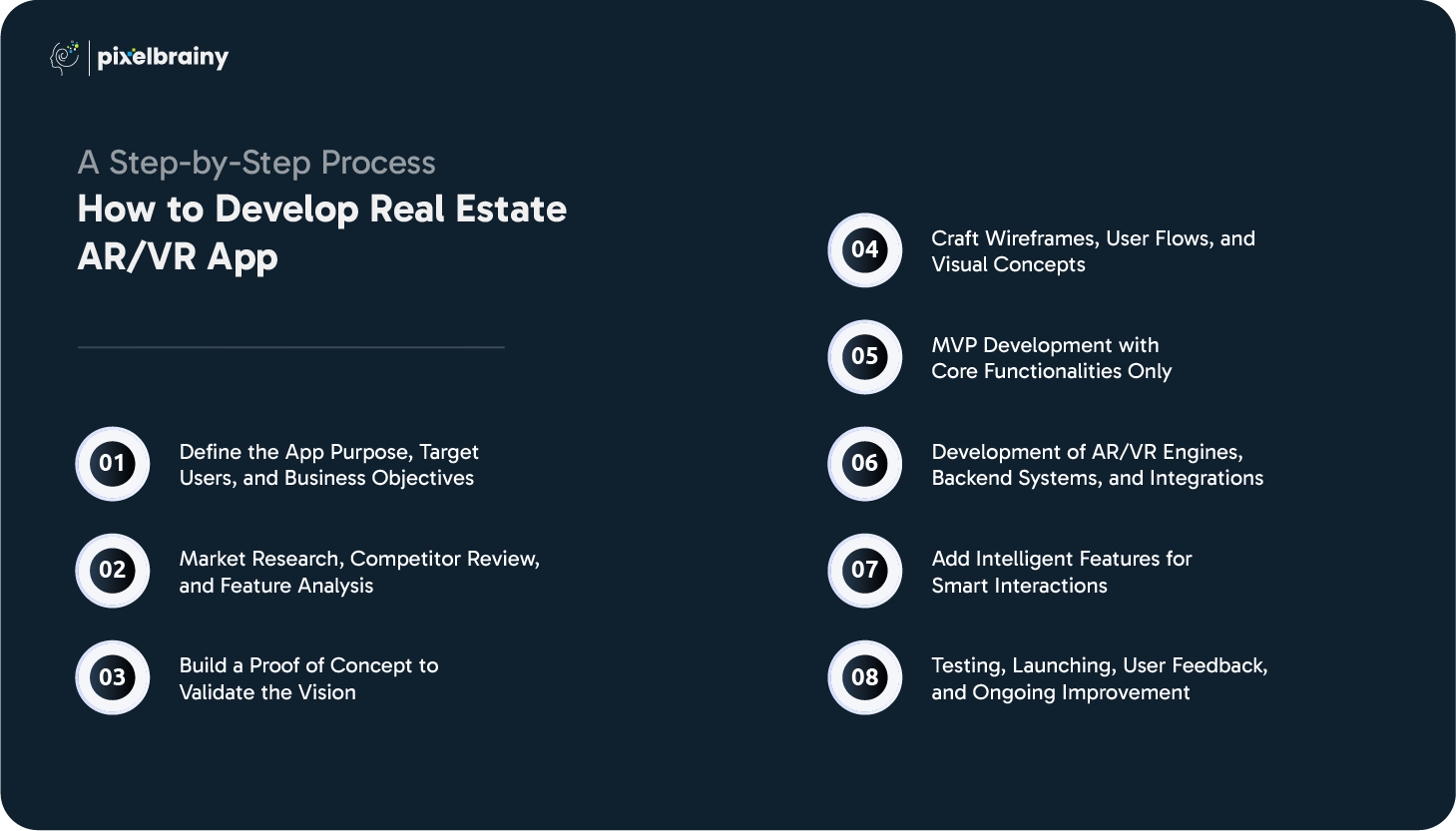
Aim of this step: To establish the foundation of the project and ensure every feature aligns with user needs and business goals.
This stage begins with identifying the exact purpose of your platform. Some real estate companies want a virtual tour app for showcasing ready properties, while others focus on visualizing under construction projects or offering interior customization tools. Defining the intent helps avoid confusion later and prevents the app from becoming too cluttered too early.
You also need to identify who will use the app. For example, brokers may need simple showcasing tools, while developers may require digital twins or VR walk-throughs. By understanding the audience deeply, you can shape the tone, layout, features, and navigation of the application from day one.
A well-defined purpose helps the team stay aligned throughout the development of Real Estate AR/VR App, leading to better decision making at every stage.
Aim of this step: To decide what the app must include, what users expect, and what gaps exist in the current market.
In this step, the goal is to study how existing real estate AR/VR platforms work, which features they prioritize, and what users appreciate or find confusing. This ensures you do not repeat competitor mistakes and instead build something stronger and more engaging.
User behavior analysis also plays a major role. The research should uncover what buyers struggle with during property exploration, what developers want to show more effectively, and what type of immersive features generate the highest conversion rates.
This step ultimately helps you choose which elements belong in the first version of the app and which advanced features can be added later to improve scalability.
Aim of this step: To test core ideas early and confirm the chosen technical direction before investing in full development.
A PoC is a small, functional test of one or two features that represent the heart of your AR/VR capability. It can be something as simple as creating a sample 360 degree tour or a miniature AR model of a single room.
The purpose is to ensure that the technology you plan to use will work properly once you scale. This step helps identify technical limitations, performance issues, or content challenges early in the journey.
By validating your ideas with a PoC, you reduce risk, save development budget, and gain confidence in moving forward with the larger project.
Aim of this step: To create a smooth and intuitive user experience that makes the app easy and enjoyable to use.
Once the concept is validated, the next step is to design the structure of the entire application. This involves developing wireframes, layout maps, and page-by-page interactions that define exactly how users will explore properties.
A UI/UX design company can help create clear navigation patterns, simple visual elements, and a layout that feels natural for users who may not be tech savvy. It also ensures that the AR and VR interactions remain smooth and do not overwhelm the user.
This stage transforms loose ideas into a structured blueprint that guides the development team toward a unified visual direction.
Aim of this step: To build the first functional version of the app and test it with real users as quickly as possible.
MVP Development focuses on releasing the essential features instead of building everything at once. For example, you may begin with virtual tours, basic AR visualization, and property browsing. The goal is to understand how users interact with these features and gather feedback early.
An MVP also allows real estate companies to test the concept in the market without spending the full budget immediately. This makes it easier to adapt quickly based on user behavior and avoid wasting resources on features that are not needed.
Launching a solid MVP sets the stage for building a more refined and complete product afterward.
Also Read: Top 10 AI MVP Development Companies in USA
Aim of this step: To bring the visual experience to life and ensure the app performs smoothly across devices.
This stage includes integrating AR or VR engines, setting up backend servers, connecting property databases, and creating APIs for storing and retrieving project models. The technical team ensures that the app loads quickly, runs smoothly, and handles large 3D assets without lag.
If the app includes features like virtual staging or interior customization, those modules are developed here as well. Performance optimization is crucial, especially for VR environments where frame rate impacts the entire experience.
This is the step where your idea becomes a functional reality with the immersive visuals and interactions your users expect.
Aim of this step: To make the app more engaging, personalized, and future ready using advanced enhancements.
This step involves integrating AI powered recommendations, property suggestions, smart finishing previews, and automated interior styles. Many companies collaborate with AI development companies in USA to implement features like conversational assistance or predictive analytics.
These additions elevate the app from a basic visualization platform to an intelligent digital assistant that helps both agents and buyers make faster decisions.
By enhancing engagement and personalization, this stage significantly boosts the quality of the overall property experience.
Aim of this step: To ensure long term success by refining the app continuously based on user insights.
Before launch, the entire app is tested across mobile devices, tablets, desktops, and VR headsets. Real users are invited to report friction points, confusing elements, or performance issues. This step helps ensure the product feels polished and reliable.
Once the app goes live, feedback becomes an essential guide for planning the next round of improvements. Continuous updates keep the platform relevant and aligned with market expectations.
This final stage turns your platform into a long-term asset that grows smarter and stronger with every iteration.
A well structured development process ensures your real estate AR/VR app grows from a simple idea into a powerful, immersive tool that delivers real value to buyers, agents, and developers.
When real estate companies explore the Real estate AR/VR App development cost, the first question is usually how much will it cost to develop AR/VR App for real estate. Since every project carries its own level of complexity, content requirements, and platform choices, pricing can vary widely. An average cost to build Real estate AR/VR App ranges from $20,000 to $300,000+, depending on the scale and the type of experience you want to deliver.
To make planning easier, the table below breaks down the three main categories of AR/VR real estate applications along with their estimated costs, timelines, and inclusions.
| App Category | Estimated Cost | Timeline | What You Get |
| Basic Real estate AR/VR App | $20,000 to $40,000 | 6 to 10 weeks | A simple yet functional app offering basic AR visualization or 3D floor plan experiences. Suitable for small real estate agencies starting with immersive property showcasing. Great for early stage testing and minimal feature requirements. |
| Medium Real estate AR/VR App | $40,000 to $120,000 | 12 to 22 weeks | More advanced features such as 360 degree property tours, interactive 3D models, and AR furniture placement. Ideal for growing real estate firms looking for polished interactions and stronger buyer engagement. Offers good balance of performance and customization. |
| Advanced Real estate AR/VR App | $150,000 to $500,000+ | 6 to 12 months | A premium solution designed for enterprises with digital twins, VR environments, AI powered features, large 3D catalogs, and multi platform support. Perfect for developers who need high realism, scalable architecture, and fully immersive sales experiences. |
The price of Real estate AR/VR App development depends heavily on the depth of visuals, interaction levels, and technical architecture required. Below are the core factors that influence the development budget of Real estate AR/VR Application projects.
Every property, room, or amenity must be modeled in 3D. The more models you need and the higher the realism required, the more production time and cost will increase.
A larger catalog means more properties to model, render, and upload. Apps with 1 to 10 units are cheaper, but apps with entire townships or multiple projects require larger budgets.
Basic AR overlays cost less, while advanced VR rooms, digital twins, real time customization, or multi user interaction raise the complexity and therefore the cost.
Supporting mobile apps, web apps, tablets, iOS, Android, and VR headsets requires optimization for each platform. More platforms equal more development effort.
Connecting with CRM systems, AI recommendation engines, cloud servers, or payment gateways adds backend development time and increases the overall cost.
Features such as AR furniture placement, virtual staging, interior customization, or digital twin navigation require deeper programming and detailed 3D assets, which significantly impact pricing.
Planning your AR/VR real estate app with a clear scope and realistic budget helps ensure you invest in the features that matter most while building an immersive experience that delivers real business value.
Also Read: AI Real Estate App Development Cost: Factors and Examples
Developing an AR/VR real estate app requires the right combination of 3D modeling tools, development engines, hardware devices, and backend technologies. Since AR and VR experiences rely heavily on visual accuracy and smooth performance, choosing the correct tech stack plays a major role in the overall success of the application.
Below is a breakdown of the tools and technologies commonly used to build high quality, immersive real estate AR/VR applications.
| Category | Tools / Technologies | Explanation |
| AR Development Frameworks | ARKit (iOS), ARCore (Android), WebAR SDKs | Used to create augmented reality experiences such as AR furniture placement and 3D floor plan visualization. Helps the app detect surfaces, measure spaces, and overlay digital objects in real environments. Supports smooth AR interactions across devices. |
| VR Development Engines | Unity 3D, Unreal Engine | These engines power immersive VR walkthroughs, digital twins, and 3D environments. Unity is ideal for multi platform development, while Unreal Engine is chosen for high quality visualization. Both enable realistic lighting, textures, and smooth VR movement. |
| 3D Modeling and Rendering Tools | Blender, Autodesk 3ds Max, Maya, SketchUp | Used to design interiors, exteriors, furniture, textures, and full architectural environments. High quality models make the experience more lifelike. Rendering tools also help achieve photorealistic lighting and surface detail for luxury real estate projects. |
| AR/VR Compatible Hardware | iOS and Android devices, Meta Quest, HTC Vive, Apple Vision Pro | Smartphones and tablets are used for AR experiences, while VR headsets offer full scale immersive walkthroughs. These devices determine how smooth and realistic the final app feels to the end user. |
| Spatial Capture Tools | 360 degree cameras, LiDAR scanners | Cameras like Insta360 and Ricoh Theta capture real spaces for 360 tours. LiDAR enables accurate room scanning and depth sensing, which improves AR object placement and layout understanding. |
| Backend and Cloud Infrastructure | Firebase, AWS, Azure | Used to store property data, user information, media files, and analytics. These platforms ensure the app loads quickly, remains secure, and manages user traffic without issues. |
| Integration Technologies | CRM APIs, AI recommendation engines, payment gateways | CRM connects agent workflows directly to the app. AI tools help personalize recommendations and staging ideas. Payment gateways allow users to reserve units or book visits digitally. |
With the right combination of tools and technologies, your AR/VR real estate app can deliver a powerful, visually stunning, and reliable property experience for every buyer.
AR and VR technologies are proving to be powerful revenue drivers in the real estate industry. By offering immersive and interactive experiences, these applications help buyers make faster decisions and help companies streamline their sales process.
Below are six practical ways AR/VR apps deliver strong ROI and boost property sales.
AR/VR apps give buyers a clear sense of space, layout, and design long before they visit physically. This reduces confusion and speeds up decision making. A clearer experience means fewer objections and more confident commitments.
Key impacts:
Showing unbuilt spaces is usually challenging, but VR removes that barrier by presenting complete walk-throughs of future homes. This builds trust early and increases pre-launch sales significantly.
Key impacts:
AR/VR real estate apps allow buyers to explore multiple properties from anywhere. This reduces the number of unqualified physical visits, saving time for buyers and agents.
Key impacts:
AR/VR apps allow real estate companies to present properties to clients across countries without travel. This opens up new markets and unlocks international sales opportunities.
Key impacts:
Immersive tours, interior customization, and virtual staging help buyers imagine their future lifestyle inside the property. When emotion is involved, the likelihood of closing a sale increases.
Key impacts:
AR/VR helps identify serious buyers early by allowing them to explore details before contacting an agent. This means sales teams focus on high quality leads who already understand the property well.
Key impacts:
AR/VR real estate apps not only impress buyers but also deliver measurable returns by improving efficiency, boosting conversions, and creating unforgettable property experiences.
AR and VR are being adopted rapidly across the global real estate market. Many well known companies now rely on immersive technology for property showcasing, virtual staging, digital twins, and interactive walkthroughs. Below are real-world examples presented in a clearer category-based format to show how different brands use AR/VR in practical scenarios.
Companies using this: Matterport, Zillow
What they do:
Real impact: These platforms make remote and early-stage property exploration easy, reducing unnecessary site visits and helping buyers shortlist homes faster.
Companies using this: iStaging, Walkthru
What they do:
Real impact: Virtual staging helps buyers emotionally connect with the property and better understand how empty spaces can look once furnished.
Companies using this: NS Ventures
What they do:
Real impact: Buyers can evaluate not just the home but the lifestyle, environment, and neighborhood experience, which improves decision making for township projects.
Companies using this: X-Byte, Matterport Enterprise Users
What they do:
Real impact: Developers are able to pre sell units long before construction completes using realistic virtual environments.
Companies using this: Zillow, iStaging, global AR/VR enabled real estate firms
What they do:
Real impact: Improves global reach, reduces friction for long-distance buyers, and helps agents convert more international leads.
The real estate industry in 2026 shows clear evidence that AR and VR are not future ideas but active selling tools used by leading companies to boost engagement and increase buyer confidence.
Creating an AR/VR real estate application brings powerful opportunities, but it also comes with practical challenges that businesses must understand before starting development. These challenges influence cost, performance, scalability, user experience, and long term maintenance. By being aware of them early, real estate companies can plan smarter and ensure a smooth development journey from concept to deployment.
Below are the six most significant challenges real estate businesses face when developing AR/VR applications.
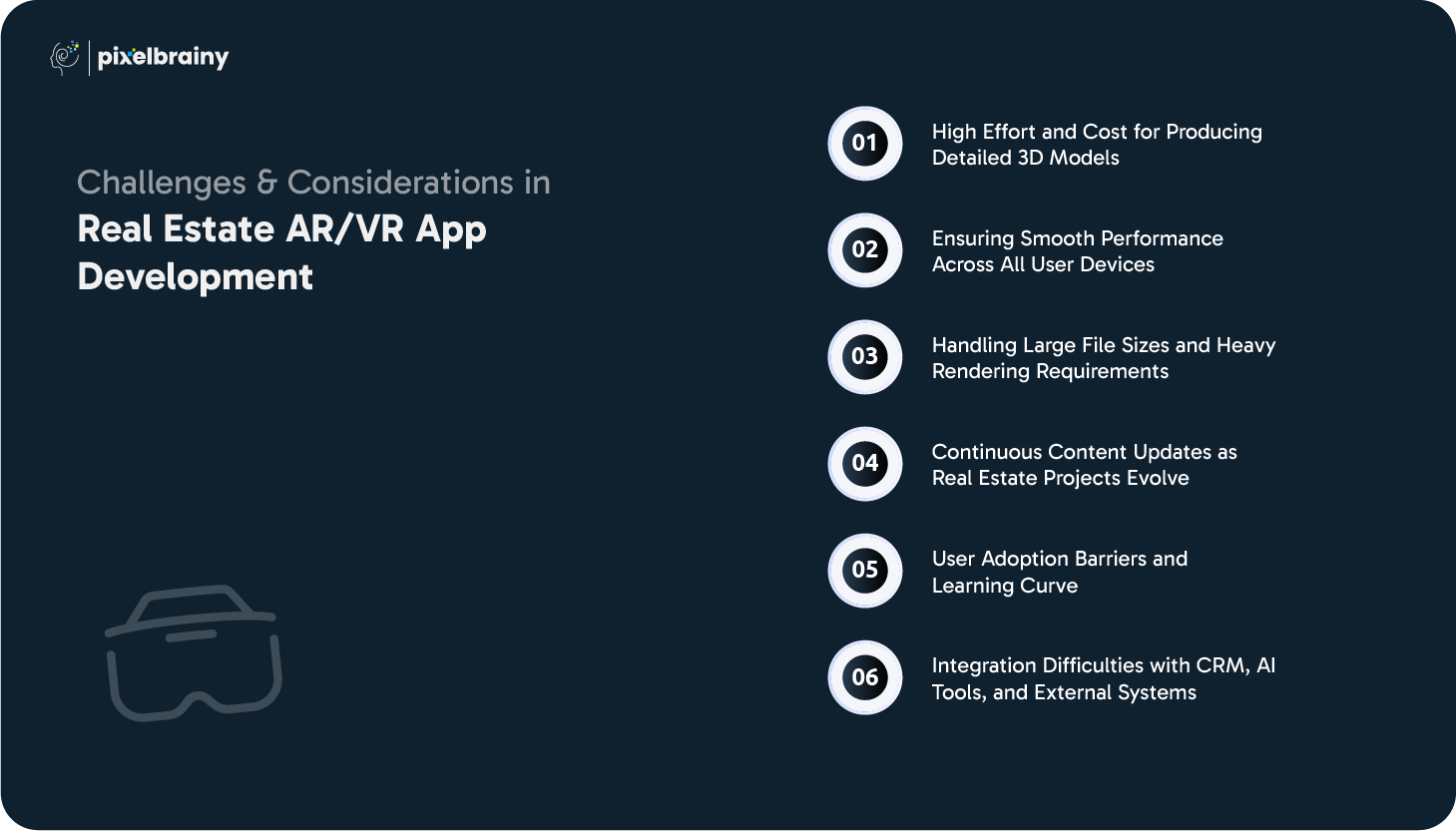
One of the biggest challenges in AR/VR development is creating accurate, high quality 3D models of properties. Every room, interior finish, structural element, window frame, tile pattern, and lighting condition must be carefully designed.
For under construction properties or large township projects, modeling entire buildings or landscapes becomes even more demanding.
The more detailed and photorealistic the visuals need to be, the higher the time, cost, and expertise required.
Real estate buyers may use a wide range of devices, from budget smartphones to high end VR headsets. Ensuring the app performs consistently on all devices is a major challenge.
AR/VR apps are resource heavy and require strong processing power, stable frame rates, and optimized rendering to deliver a smooth experience.
Without thoughtful optimization, users may experience lag, slow loading, overheating issues, or even app crashes.
AR/VR applications often include high resolution textures, complex environments, and multiple interactive elements. These assets can significantly increase file sizes and strain the device’s storage and memory.
Large files can slow down the app, create loading delays, or require high bandwidth for streaming content.
Developers must balance quality and file size using compression techniques, cloud hosting, and performance tuning to maintain good user experience.
Real estate projects rarely remain static. Floor plans may change, interior designs may be updated, or building structures may be modified as construction progresses.
This means AR/VR content must be updated regularly to maintain accuracy. Outdated visuals can confuse buyers or create a gap between expectations and reality.
Ongoing updates require additional development time and a long term content management strategy.
Not all buyers are familiar with AR or VR interactions. Some users may find it difficult to navigate virtual spaces, use gesture controls, or understand how to interact with 3D objects.
An overly complex interface may cause users to lose interest quickly.
To overcome this, the app must include simple onboarding screens, guided tutorials, intuitive navigation patterns, and a clean, user friendly design.
Most real estate businesses rely on external systems such as CRM platforms, booking tools, payment gateways, and cloud data storage.
Integrating these systems with an AR/VR app is often complex, especially when APIs are outdated or incompatible.
Smooth integration is essential for workflows like lead tracking, appointment booking, data syncing, and personalized recommendations, but it requires additional development effort and technical planning.
Addressing these challenges early ensures your AR/VR real estate app is built on a strong foundation, delivers a reliable experience, and supports long term scalability and growth.
Real estate companies today want more than just attractive visuals. They want immersive products that boost buyer confidence, support remote selling, and deliver a measurable impact on sales. PixelBrainy has become a preferred partner for real estate AR/VR App Development because the team combines deep industry experience with strong technical capabilities in both immersive technology and next generation AI development solutions.
As a Real estate AI software development company, PixelBrainy understands how buyers think, how developers sell, and how AR, VR, and AI can work together to create a complete digital ecosystem. Whether brands want to make AR/VR App for real estate or build advanced digital twin environments for under construction properties, PixelBrainy delivers solutions that feel realistic, intuitive, and business focused.
PixelBrainy is also appreciated for its complete end to end approach. From planning and wireframing to 3D modeling, UI and UX, coding, testing, deployment, and long term maintenance, every step is handled with precision. This allows real estate businesses to rely on a single expert partner instead of juggling multiple vendors. The team ensures that every project is optimized, smooth on all devices, and aligned with modern real estate buying behavior.
Below is a quick highlight of PixelBrainy’s core strengths that leading brands value.
PixelBrainy specializes in building AR/VR App for real estate that look stunning and perform smoothly. The team focuses on realistic visuals, clean navigation, and immersive interactions that allow buyers to fully understand a property before visiting.
As a Real estate AI software development company, PixelBrainy integrates AI to power features like smart recommendations, virtual staging automation, and predictive buyer insights. This allows real estate apps to feel intelligent and personalized.
Real estate brands choose PixelBrainy because everything is handled under one framework, from design and 3D art to development and deployment. This offers consistency, faster delivery, and reliable quality control.
Every real estate project is unique. PixelBrainy builds solutions that match the developer’s brand positioning, market category, and buyer segment, whether it is mass housing, premium apartments, or luxury properties.
PixelBrainy ensures the apps run seamlessly on iOS, Android, web browsers, and VR headsets. The systems are built to scale as property catalogs grow or as new immersive features are added.
Clients appreciate PixelBrainy’s clarity, milestone based execution, and reliable post launch support. This makes long term collaboration smooth and predictable.
To illustrate the capability without revealing the client's identity, here is one highlighted project PixelBrainy delivered:
Project Type: Fully immersive VR and AR property walkthrough for a multi-tower residential project
What PixelBrainy Delivered:
Outcome: The developer achieved faster pre-sales, improved buyer engagement, and more qualified inquiries from NRI investors.
Real estate companies choose PixelBrainy because they want a partner who understands technology, understands property buying behavior, and delivers solutions that truly elevate the way homes are marketed and sold.

Above all, AR/VR App Development for Real Estate is no longer an optional upgrade. It has become a powerful tool that allows developers, agents, and property marketers to present projects with clarity, accuracy, and a sense of immersion that traditional methods cannot match. These technologies help businesses stay ahead, communicate better with buyers, and build trust throughout the property journey.
Real estate AR/VR App Development also integrates well with modern digital trends, making it easier to explain under construction projects, attract remote buyers, and increase pre sales. Companies that focus on building AR/VR App for real estate now are positioning themselves for long term success.
If you want to explore how immersive technology can transform your business, now is the time to act.
Book an appointment with PixelBrainy to get started.
AR and VR help buyers experience properties virtually with realistic detail, which removes confusion and speeds up decision making. Instead of relying on photos or visiting multiple sites, buyers can explore full walk-throughs, visualize interiors, change finishes, and understand layouts instantly. This level of clarity increases trust, improves engagement, and leads to faster bookings for real estate developers and agents.
The cost typically ranges from $20,000 to $300,000+, depending on features, 3D model quality, interactions, platform support, and integrations. Basic apps are more affordable, while digital twins or VR headset experiences require a higher investment.
Yes. AR/VR apps are extremely effective for under-construction and pre-launch projects. Developers can showcase future homes through virtual walkthroughs, digital twins, and AR visualizations that help buyers see the final project before it is built.
Absolutely. Most AR/VR real estate applications are built with simple navigation, guided tours, and user-friendly interfaces. Agents only need basic app usage skills to showcase properties, arrange virtual tours, or share interactive links with clients.
Yes. Remote buyers can explore entire properties through virtual tours without traveling. This helps NRIs and international investors evaluate multiple units quickly, shortlist options, and make better decisions from anywhere in the world.
A strong AR/VR real estate app should offer 360 degree tours, photorealistic 3D models, AR furniture placement, interactive floor plans, virtual staging, customization tools, location mapping, and CRM integrations. Advanced apps may also include digital twins, AI recommendations, and VR headset support.

About The Author
Sagar Bhatnagar
Sagar Sahay Bhatnagar brings over a decade of IT industry experience to his role as Marketing Head at PixelBrainy. He's known for his knack in devising creative marketing strategies that boost brand visibility and market influence. Sagar's strategic thinking, coupled with his innovative vision and focus on results, sets him apart. His track record of successful campaigns proves his ability to utilize digital platforms effectively for impactful marketing efforts. With a genuine passion for both technology and marketing, Sagar continuously pushes PixelBrainy's marketing initiatives to greater success.

Working with the PixelBrainy team has been a highly positive experience. They understand the design requirements and create beautiful UX elements to meet the application needs. The dev team did an excellent job bringing my vision to life. We discussed usability and flow. Sagar worked with his team to design the database and begin coding. Working with Sagar was easy. He has the knowledge to create robust apps, including multi-language support, Google and Apple ID login options, Ad-enabled integrations, Stripe payment processing, and a Web Admin site for maintaining support data. I'm extremely satisfied with the services provided, the quality of the final product, and the professionalism of the entire process. I highly recommend them for Android and iOS Mobile Application Design and Development.

Great experience working with them. Had a lot of feedback and I found that unlike most contractors they were bugging me for updates instead of the other way around. They were extremely time conscience and great at communicating! All work was done extremely high quality and if not on time, early! They were always proactive when it comes to communication and the work is great/above par always. Very flexible and a great team to work with! Goes above and beyond to present us with multiple options and always provides quality. Amazing work per usual with Chitra. If you have UI/UX or branding design needs I recommend you go to them! Will likely work with them in the future as well, definitely recommended!

PixelBrainy is a joy to work with and is a great partner when thinking through branding, logo, and website layout. I appreciate that they spend time going into the "why" behind their decisions to help inform me and others about industry best practices and their expertise.

I hired them to design our software apps. Things I really like about them are excellent communication skills, they answer all project suggestions and collaborate right away, and their input on design and colors is amazing. This project was complex and needed patience and creativity. The team is amazing to do business with. I will be using them long-term. Glad to see there are some good people out there. I was afraid to try and outsource my project to someone but I am glad I met them! I really can't say enough. They went above and beyond on this project. I am very happy with everything they have done to make my business stand out from the competition.

It was great working with PixelBrainy and the team. They were very responsive and really owned the project. We'll definitely work with them again!

I recently worked with the PixelBrainy team on a project and I was blown away by their communication skills. They were prompt, clear, and articulate in all of our interactions. They listened and provided valuable feedback and suggestions to help make the project a success. They also kept me updated throughout the entire process, which made the experience stress-free and enjoyable.

PixelBrainy is very good at what it does. The team also presents themselves very professionally and takes care of their side of things very well. I could fully trust them taking up the design work in a timely and organised manner and their attention to detail saved us lots of effort and time. This particular project was quite intense and the team showed that they function very well under pressure. Very much looking forward to working with her again!

It's always an absolute pleasure working with them. They completed all of my requests quickly and followed every note I had for them to a T, which made our process go smoothly from start to finish. Everything was completed fast and following all of the guidelines. And I would recommend their services to anyone. If you need any design work done in the future, PixelBrainy should be your first call!

They took ownership of our requirements and designed and proposed multiple beautiful variants. The team is self-motivated, requires minimum supervision, committed to see-through designs with quality and delivering them on time. We would definitely love to work with PixelBrainy again when we have any requirements.

PixelBrainy was a big help with our SaaS application. We've been hard at work with a new UI/UX and they provided a lot of help with the designs. If you're looking for assistance with your website, software, or mobile application designs, PixelBrainy and the team is a great recommendation.

PixelBrainy designers are amazing. They are responsive, talented, and always willing to help craft the design until it matches your vision. I would recommend them and plan to continue them for my future projects and more!!!

They were awesome! Did a good job fast, and good communication. Will work with them again. Thank you

Creative, detail-oriented, and talented designers who take direction well and implement changes quickly and accurately. They consistently over-delivered for us.

PixelBrainy team is very talented and creative. Great designers and a pleasure to work with. PixelBrainy is an excellent communicator and I look forward to working with them again.

PixelBrainy has a very talented design team. Their work is excellent and they are very responsive. I enjoy working with them and hope to continue on all of our future projects.


Transform your ideas into reality with us.
Across these industries, each engagement brings unique challenges, from early-stage product development to scaling complex systems, helping us build a practical understanding of real-world product environments.