
 AI Summary Powered by PixelBrainy
What if your customer support team could resolve most support tickets instantly without hiring additional agents or increasing operational costs?
For many businesses, customer support has become a growing challenge. Support teams are overwhelmed with repetitive questions, ticket backlogs continue to expand, and customers increasingly expect immediate responses. When customers are forced to wait hours or even days for answers, frustration rises, satisfaction drops, and many choose to switch to competitors that offer faster support experiences.
This challenge is pushing organizations toward a new approach: AI customer service agent development. Instead of relying solely on human representatives, businesses are now building intelligent AI-powered agents that can understand customer intent, answer common questions, retrieve information from company knowledge bases, process requests, and resolve issues automatically.
The results are significant. Many modern AI customer service implementations are already capable of handling and resolving around 70% of customer inquiries without human intervention, while some organizations report even higher automation rates. For example, Salesforce CEO Marc Benioff stated that AI now resolves approximately 85% of Salesforce customer service interactions, demonstrating how rapidly AI-driven support is transforming customer operations.
Businesses searching for solutions often ask:
The answer lies in strategic AI customer service agent development, combining advanced language models, automation workflows, knowledge retrieval systems, and seamless human handoff mechanisms.
In this blog, you'll learn how businesses can build AI customer service agents, the technologies involved, development costs, key features, implementation challenges, and the exact process required to develop AI support agents capable of automating customer service at scale.
As customer expectations continue to rise, businesses are looking beyond basic automation tools and adopting more advanced support technologies. This shift has led many organizations to ask: what is an AI customer service agent?
An AI customer service agent is an intelligent digital support system that can understand, process, and respond to customer inquiries with minimal or no human intervention. Powered by technologies such as Natural Language Processing (NLP), Machine Learning (ML), Large Language Models (LLMs), and contextual reasoning, these agents can engage in meaningful conversations while understanding the intent behind customer requests.
Think of an AI customer service agent as a virtual support representative that works around the clock. Instead of simply following predefined scripts, it can interpret customer questions, access relevant information, evaluate context, and provide accurate responses in real time across multiple communication channels.
One of the most common misconceptions is that AI customer service agents and chatbots are the same. While both are used for customer support automation, their capabilities differ significantly.
| Traditional Chatbot | AI Customer Service Agent |
|---|---|
| Follows predefined rules and scripts | Understands natural language and context |
| Responds to specific keywords | Interprets customer intent |
| Limited conversation flexibility | Handles dynamic conversations |
| Requires manual updates | Learns and improves over time |
| Primarily reactive | Can make decisions and take actions |
This distinction is important for businesses evaluating AI customer service agent vs chatbot solutions. Traditional chatbots are useful for answering simple FAQs, whereas AI agents are designed to support complex customer service operations at scale.
In the context of modern conversational AI for customer service, an AI customer service agent acts as a digital workforce member capable of understanding customers, interacting naturally, and supporting business processes intelligently. This is why organizations investing in AI support agent development increasingly view AI agents as the evolution of customer support automation rather than just another chatbot technology.
When businesses explore building AI-powered customer support agents, one of the most common questions is: What happens behind the scenes when an AI support agent receives a customer query?
The answer lies in a structured AI support agent workflow that processes customer requests, understands intent, retrieves information, and delivers resolutions in real time.
The process starts when a customer reaches out through a support channel. This could be a website chatbot, mobile app, email, WhatsApp, social media platform, voice assistant, or help desk portal.
Modern AI agents are designed for omnichannel support, allowing customers to receive consistent assistance regardless of where they contact the business.
Once the query is received, the AI analyzes the message using Natural Language Processing (NLP). Instead of simply scanning for keywords, it interprets the meaning behind the customer's words and understands the context of the request.
For example, the AI can recognize whether a customer is asking about an order status, requesting a refund, reporting a technical issue, or seeking product information.
After understanding the message, the system classifies the customer's intent.
This step helps the AI determine the most appropriate action. Whether the request involves account access, billing support, product recommendations, or troubleshooting, intent recognition ensures the conversation moves in the right direction.
The AI then analyzes the customer's tone and urgency level.
If the system detects frustration, dissatisfaction, or urgency, it can prioritize the request, modify its response style, or prepare for human intervention if necessary.
To generate an accurate answer, the AI accesses relevant business resources such as:
This enables the agent to provide responses based on real business data rather than generic answers.
Using the information gathered, the agent creates a contextual response and sends it back to the customer within seconds.
This stage powers the core AI customer service automation process, allowing businesses to resolve large volumes of repetitive support requests without human involvement.
Not every issue can or should be handled by AI.
When the system encounters complex cases, policy exceptions, low-confidence responses, or highly sensitive situations, it automatically routes the conversation to a human support representative along with the complete interaction history.
Each conversation generates valuable data that helps the system learn over time. Resolution outcomes, customer feedback, and escalation patterns are used to refine accuracy and improve future responses.
This continuous optimization is a key reason why organizations investing in AI customer service agent development achieve increasingly higher automation rates as their systems mature.
The complete AI support agent workflow combines language understanding, intent detection, sentiment analysis, knowledge retrieval, response generation, and intelligent escalation. Together, these capabilities enable businesses to deliver faster support, reduce operational costs, and resolve customer issues at scale.
The success of any AI customer service initiative depends on the capabilities built into the system. While basic chatbots can answer simple FAQs, a modern AI customer service agent must possess advanced intelligence, contextual understanding, and automation capabilities to resolve customer queries independently.
If your goal is to automate 70% or more of support interactions, these are the key capabilities of AI customer service agent platforms that should be prioritized during development.
The foundation of any intelligent support system is its ability to understand human language.
Customers rarely ask questions in the same way. Some may type, "Where is my order?" while others might say, "I haven't received my package yet." An AI agent equipped with strong Natural Language Understanding can accurately identify customer intent regardless of phrasing, grammar, spelling errors, or communication style.
This capability is essential when building an AI customer service agent with NLP capabilities.
Customers expect seamless conversations without repeating information.
A modern AI agent should maintain context throughout multi-turn interactions, remembering previous questions, customer preferences, account details, and conversation history. This enables more natural and efficient support experiences.
Understanding what customers say is important. Understanding how they feel is equally valuable.
By creating AI customer service agent with sentiment analysis, businesses can detect frustration, confusion, urgency, or satisfaction during conversations. The system can then adapt its response style, prioritize requests, or trigger escalation workflows when needed.
Advanced AI agents do more than answer questions. They anticipate them.
For example, if a customer asks about an order shipment, the AI can proactively provide delivery timelines, tracking links, and return policies before the customer asks follow-up questions. This reduces conversation length and improves resolution rates.
Customers interact with businesses across multiple communication channels.
An effective AI customer service agent with omnichannel support should operate consistently across:
This ensures customers receive the same experience regardless of the channel they choose.
The most effective AI agents improve over time.
Through continuous analysis of customer interactions, feedback, resolutions, and escalation patterns, self-learning models become more accurate, personalized, and efficient with every conversation.
Even the most advanced AI cannot resolve every issue.
A high-performing AI customer service agent should recognize situations that require human expertise, such as sensitive complaints, policy exceptions, or complex technical issues. Intelligent routing ensures customers are transferred to the right agent with complete conversation context.
Global businesses need support systems that can serve customers in multiple languages.
Multilingual AI agents eliminate language barriers, deliver localized customer experiences, and help organizations expand support operations without building separate regional teams.
These capabilities are what separate an intelligent AI customer service agent from a traditional chatbot. Together, they enable businesses to automate support at scale, improve customer satisfaction, and achieve significantly higher resolution rates with minimal human intervention.
The demand for AI-powered support is growing across industries, but some sectors gain significantly greater value due to high customer interaction volumes, repetitive service requests, and increasing expectations for 24/7 support. For these businesses, AI customer service agent development is not simply about reducing costs. It is about improving customer experience, increasing operational efficiency, and scaling support without continuously expanding support teams.
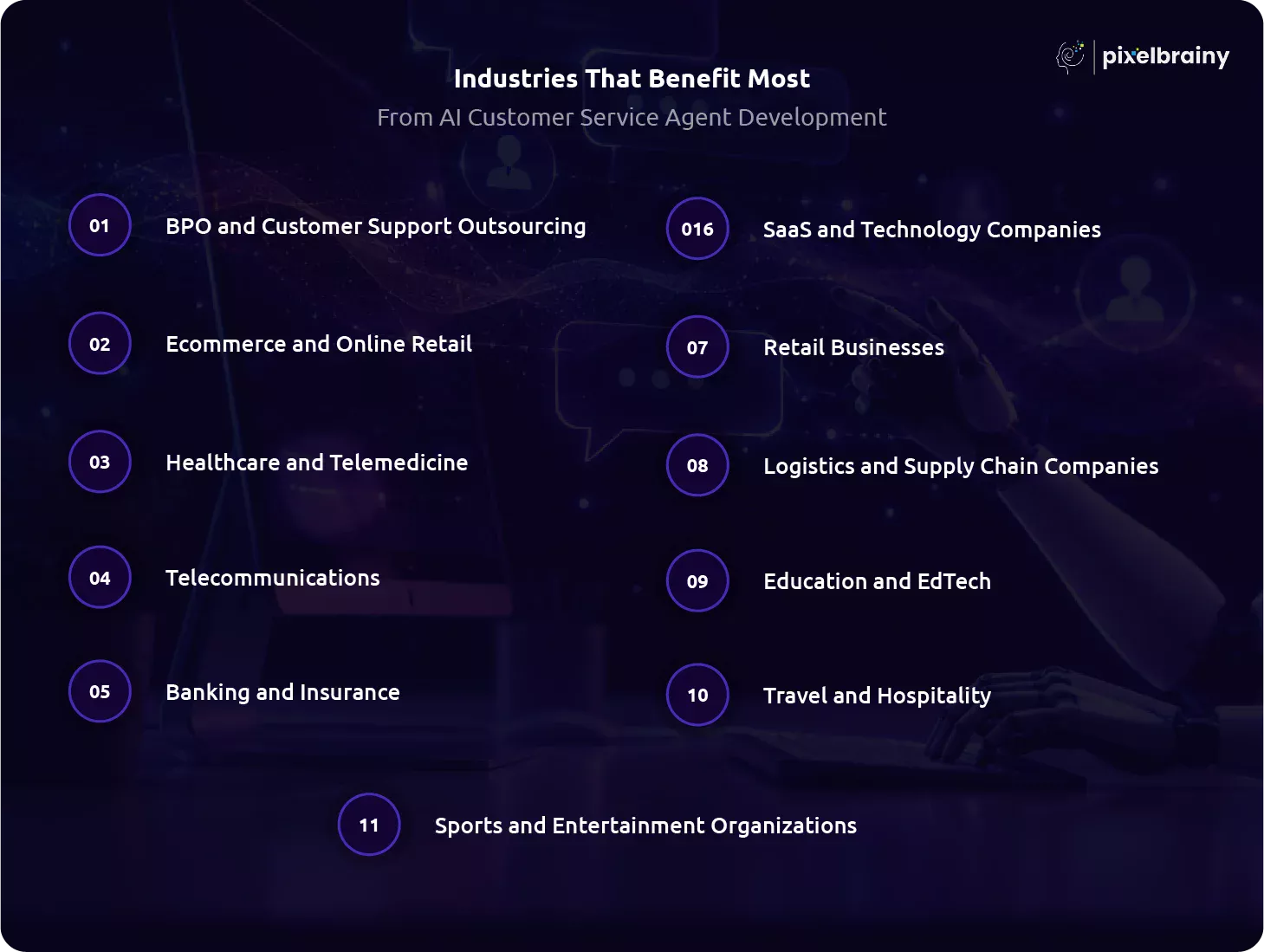
Business Process Outsourcing (BPO) companies handle thousands or even millions of customer interactions every month. Managing this scale with human agents alone often results in rising operational expenses, longer wait times, and inconsistent service quality.
This is why AI customer service agent development for BPO companies has become a strategic investment. AI agents can automate repetitive customer inquiries such as account-related questions, password resets, billing requests, service activation, appointment scheduling, and order status updates. They can also intelligently route conversations to the appropriate department when escalation is required.
By automating high-volume interactions, BPO providers can reduce cost per interaction, improve service-level agreements, and handle larger client workloads without significantly increasing staffing requirements.
Ecommerce businesses receive customer inquiries throughout the entire buying journey, from product discovery and purchasing decisions to post-purchase support and returns.
Companies exploring how to make an AI customer service agent for ecommerce support commonly use AI to automate order tracking, delivery updates, refund requests, return processing, payment inquiries, product recommendations, and abandoned cart assistance. AI agents can also provide personalized shopping suggestions based on customer behavior, browsing history, and purchase patterns. This not only improves customer satisfaction but also increases conversion rates and average order value while reducing pressure on support teams.
Healthcare organizations require around-the-clock support while maintaining strict compliance with data privacy regulations and healthcare standards.
When developing an AI customer service agent for healthcare, providers often automate appointment scheduling, patient intake processes, insurance verification, prescription refill requests, follow-up reminders, and answers to frequently asked questions. AI agents help patients access information quickly while reducing administrative workloads for healthcare staff. This allows doctors, nurses, and support teams to focus more on patient care while ensuring patients receive assistance whenever they need it.
Also Read: AI Agent Development for Healthcare
Telecommunications companies process enormous volumes of customer support requests related to network issues, billing disputes, service outages, account management, and plan upgrades.
AI customer service agents can troubleshoot common technical problems, provide real-time service updates, explain billing charges, recommend suitable plans, and guide customers through account-related tasks. By automating routine interactions, telecom providers can reduce call center workloads, improve first-contact resolution rates, and deliver faster customer experiences across multiple support channels.
Financial institutions must balance customer convenience with strict security, compliance, and risk management requirements.
AI support agent development for banking and insurance enables organizations to automate account inquiries, claims tracking, policy information requests, premium payment reminders, loan application updates, and fraud alert notifications. AI agents can also support customer verification workflows before sharing sensitive information. This helps financial institutions improve service efficiency while maintaining high levels of security and regulatory compliance.
Software companies often struggle with growing support demands as their customer base expands. New users frequently require onboarding assistance, feature guidance, troubleshooting support, and subscription management help.
AI customer service agents can guide users through onboarding processes, explain platform features, recommend relevant documentation, answer technical questions, and provide proactive assistance within the application itself. This reduces support ticket volumes while improving user adoption, customer retention, and overall product experience.
Retail brands face constant customer inquiries regarding product availability, order status, exchanges, returns, warranties, and after-sales support.
AI-powered support agents can instantly answer product-related questions, check inventory levels, process return requests, provide warranty information, and assist customers after purchase. During peak shopping seasons and promotional campaigns, AI agents help retailers maintain consistent service quality without overwhelming support teams.
Customers expect complete visibility into shipment status and delivery timelines. As a result, logistics providers receive large numbers of support requests related to tracking, delays, damaged packages, and delivery concerns.
AI customer service agents can provide real-time shipment tracking, proactive delivery notifications, delay alerts, complaint handling, and pickup scheduling support. This reduces inbound support requests while improving transparency and customer satisfaction throughout the delivery process.
Educational institutions and online learning platforms manage thousands of inquiries from students, parents, and learners regarding admissions, enrollment, courses, schedules, certifications, and technical support.
AI agents can automate admission inquiries, student onboarding, course recommendations, fee-related questions, learning support, and academic information requests. This enables educational organizations to provide timely assistance while improving the student experience.
Hotels, airlines, travel agencies, and tourism businesses operate in an environment where customers expect immediate support at any time of day.
AI customer service agents can assist with reservations, booking modifications, check-in support, travel updates, cancellation requests, loyalty program inquiries, and local travel recommendations. By providing 24/7 support, travel businesses can improve customer satisfaction while reducing operational costs and support team workloads.
Sports teams, leagues, event organizers, streaming platforms, and entertainment companies experience significant spikes in customer inquiries before, during, and after events.
AI agents can automate ticket booking assistance, event schedules, membership inquiries, merchandise support, venue information requests, subscription management, and fan engagement activities. This ensures that supporters receive immediate assistance even during high-demand periods when traditional support channels may become overloaded.
Organizations across BPO, ecommerce, healthcare, telecommunications, banking, SaaS, retail, logistics, sports, travel, and education are increasingly investing in AI customer service agent development to improve support efficiency, reduce operational costs, and deliver faster customer experiences. The industries that gain the most value are those handling large volumes of repetitive customer interactions where automation can significantly improve both customer satisfaction and business performance.
When businesses evaluate AI-powered support solutions, they often focus on customer-facing capabilities such as natural language understanding, multilingual support, or sentiment analysis. However, successful AI customer service agent development requires much more than intelligent conversations.
From a development perspective, the focus shifts toward scalability, integrations, security, analytics, workflow automation, and long-term maintainability. These technical and operational features determine whether an AI agent can reliably support thousands of customers, integrate with existing business systems, and continuously improve over time.
For organizations wondering what features should I prioritize when developing an AI customer service agent for my business, the following are the most important considerations during architecture planning and implementation.
| Feature | Why It Matters? |
|---|---|
| High Volume Query Management | The system architecture should support thousands of simultaneous customer interactions without performance degradation, ensuring consistent response times during peak support periods, seasonal spikes, or large-scale customer service operations. |
| Ticket Auto-Classification and Routing | AI automatically categorizes incoming tickets based on intent, urgency, and topic, then routes them to the correct department, team, or workflow without requiring manual intervention from support staff. |
| CRM Integration | An AI customer service agent with CRM integration can access customer profiles, purchase history, support records, and account information directly from platforms such as Salesforce and HubSpot. |
| Helpdesk Platform Integration | Native integration with Zendesk, Freshdesk, ServiceNow, and similar platforms ensures seamless ticket management, automated updates, status synchronization, and streamlined support workflows across teams. |
| Knowledge Base Access | The agent should retrieve accurate information from structured and unstructured sources including FAQs, product documentation, policies, internal manuals, and support articles to deliver reliable responses. |
| Real-Time Analytics Dashboard | When building AI customer support agent with real-time analytics, organizations gain visibility into resolution rates, customer satisfaction trends, escalations, response quality, and support performance metrics. |
| Data Security and Privacy Compliance | An AI support agent with data security compliance should support encrypted data handling, access controls, audit logs, and regulatory frameworks such as GDPR, HIPAA, and SOC 2. |
| Voice Agent Support | Beyond chat and messaging, the platform should support voice-based interactions, allowing customers to communicate through phone systems, IVR platforms, and AI-powered voice assistants. |
| Feedback Loop Mechanism | Customer ratings, escalation outcomes, correction logs, and negative feedback should automatically feed into model optimization workflows to continuously improve response quality and accuracy. |
| Customizable Conversation Flows | Businesses should be able to modify conversation paths, approval workflows, and response logic without rebuilding or redeploying the entire AI customer service agent. |
| Omnichannel Communication Engine | The AI agent should operate consistently across websites, mobile apps, email, WhatsApp, Messenger, social media platforms, and voice channels while maintaining conversation continuity. |
| Human Handoff and Escalation Framework | A robust escalation system ensures complex cases are transferred to human agents along with conversation history, customer context, and interaction details for faster resolution. |
| Workflow Automation Engine | The platform should automate operational tasks such as refund processing, appointment scheduling, order tracking, account updates, and ticket creation through connected business systems. |
| Multilingual Language Management | Built-in multilingual capabilities allow organizations to serve global customers while maintaining response consistency, localized communication, and accurate language understanding across regions. |
| API and Third-Party Integration Framework | Flexible APIs enable connections with ERP systems, payment gateways, inventory platforms, logistics software, marketing tools, and other enterprise applications required for customer support operations. |
That's why selecting these above right must-have features for AI customer service agent development directly impacts automation success, scalability, and long-term ROI. Businesses that prioritize integration capabilities, security, analytics, workflow automation, and operational flexibility are far more likely to build AI support systems that resolve customer queries efficiently while supporting future growth.
Also Read: Top 15+ AI Agent Development Companies In USA
Building an AI customer service agent that can automatically resolve customer inquiries requires far more than connecting a chatbot to a website. It involves a structured development methodology that combines business analysis, conversational design, AI engineering, system integrations, testing, and ongoing optimization.
For businesses searching for how to build an AI customer service agent from scratch, the process typically follows six critical stages. Whether you are a growing startup, a mid-sized company managing high support volumes, or an enterprise looking to automate customer service across multiple channels, following a proven framework significantly increases the chances of success.
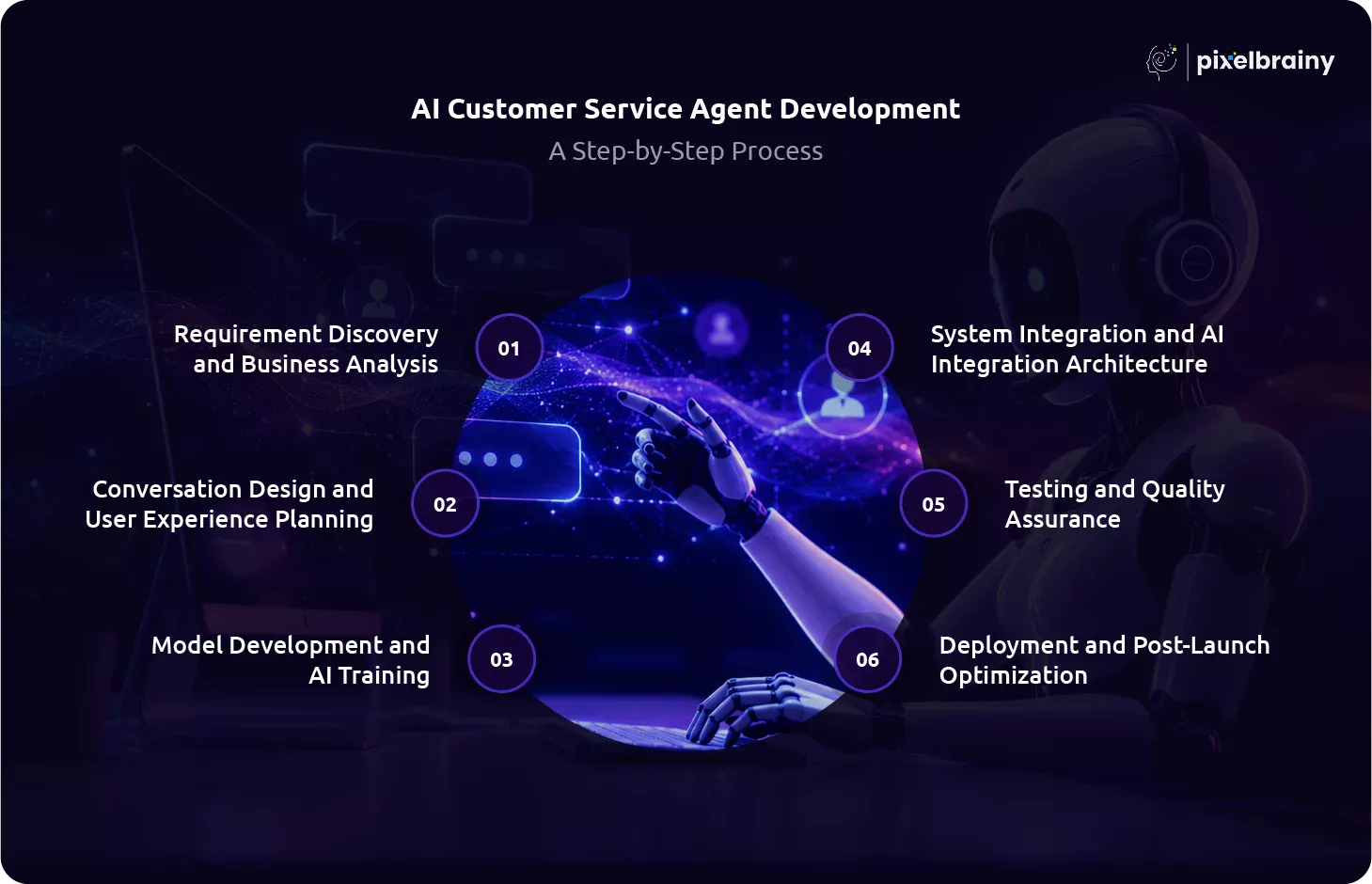
Every successful AI initiative begins with understanding the existing customer support environment. Before development starts, businesses must analyze their current workflows, support channels, customer pain points, and operational bottlenecks.
This phase focuses on identifying which support processes can be automated and where AI can deliver the highest business value.
Key activities include:
Many organizations begin with PoC development (Proof of Concept) to validate technical feasibility, estimate automation potential, and assess business impact before committing to full-scale implementation. This approach is widely recommended by leading AI consultants and several top AI agent development companies in USA because it minimizes project risk and improves investment decisions.
Once requirements are finalized, the next stage focuses on designing how customers will interact with the AI agent.
This phase combines conversational architecture with customer experience principles often implemented by a professional UI/UX design company. The objective is to create intuitive, natural, and efficient support experiences that guide users toward successful resolutions.
Key activities include:
During this stage, development teams carefully determine how the AI should respond to different customer situations while maintaining consistency across support channels.
This stage forms the intelligence layer of the entire system.
The development team selects an appropriate Large Language Model (LLM) foundation and builds the Natural Language Processing framework that powers customer interactions.
Core development activities include:
Modern AI customer service agent development process step by step increasingly relies on Retrieval-Augmented Generation (RAG) architecture. Instead of depending solely on model training, RAG enables the AI agent to retrieve accurate information directly from company knowledge bases, product documentation, FAQs, support articles, and internal databases in real time.
Feedback loop mechanisms are also integrated during this phase to ensure the model continuously improves through customer interactions, support outcomes, and human corrections.
One of the most important phases of the project is AI integration.
An AI customer service agent becomes truly valuable only when it can securely connect with existing business systems, access customer information, and perform operational tasks in real time.
This stage focuses on integrating the AI agent with:
Custom APIs are often developed to facilitate seamless data exchange between the AI agent and internal business applications. Proper integration ensures the agent can provide personalized responses, automate workflows, and retrieve accurate information without requiring manual intervention.
Before deployment, the AI customer service agent must undergo extensive testing to ensure reliability, accuracy, and performance.
Testing typically occurs at multiple levels, including:
Each customer intent is validated individually to ensure the AI correctly understands requests and provides appropriate responses.
All connected systems, APIs, databases, and third-party platforms are tested to verify smooth communication and data synchronization.
Real customer scenarios are simulated to evaluate how the AI performs in practical support situations.
The development team measures critical metrics such as:
This stage helps identify weaknesses before the AI agent is exposed to live customer interactions.
After successful testing, the AI agent is deployed gradually rather than being launched across all channels simultaneously.
Many businesses begin with MVP development, introducing the AI agent within a limited environment such as website chat support before expanding to email, voice, mobile applications, messaging platforms, and social channels. This phased rollout allows teams to validate performance, gather customer feedback, and optimize workflows before enterprise-wide deployment.
Following launch, continuous optimization becomes essential.
Key monitoring activities include:
These ongoing improvements ensure the AI agent continues delivering accurate, relevant, and high-quality customer support as business requirements evolve.
Businesses evaluating how to build an AI customer service agent from scratch often partner with experienced AI development specialists to accelerate implementation and reduce project complexity. Many of the top AI agent development companies in USA follow a structured methodology that combines PoC development, conversation design, AI integration, MVP development, enterprise testing, and continuous optimization to maximize long-term ROI.
By following this structured AI support agent development workflow, businesses can build scalable AI customer service agents capable of handling high support volumes across chat, email, voice, and social channels while improving response times, reducing operational costs, and increasing customer satisfaction.
One of the first questions businesses ask before investing in automation is: how much does it cost to develop a custom AI support agent? The answer depends on several technical and business factors, including the complexity of the solution, integration requirements, communication channels, and long-term scalability goals.
In general, the cost of building an AI customer service agent can range anywhere from $20,000 to $150,000+, depending on the scope of development and level of customization required.
Several variables directly impact project pricing:
The more advanced the functionality, the higher the development investment.
| Project Type | Estimated Cost Range | Typical Scope |
|---|---|---|
| Basic AI Customer Service Agent | $20,000 – $40,000 | Single support channel, limited intents, FAQ automation, basic integrations, simple reporting. |
| Mid-Tier Custom AI Agent | $40,000 – $80,000 | Multi-channel support, CRM integration, helpdesk connectivity, custom workflows, advanced NLP capabilities. |
| Enterprise AI Customer Service Agent | $80,000 – $150,000+ | Omnichannel support, voice AI, advanced analytics, self-learning models, enterprise integrations, compliance features, and custom automation workflows. |
For many growing companies, the most common investment falls within the mid-tier range because it balances functionality, scalability, and budget requirements.
Development is only part of the investment. Businesses should also budget for operational expenses after launch.
Typical ongoing costs include:
Depending on usage volume and complexity, ongoing costs can range from a few hundred dollars to several thousand dollars per month.
The ROI of AI customer service agent development often becomes clear within the first year of deployment.
Consider a support team handling 50,000 monthly tickets. If an AI agent automatically resolves 70% of inquiries, the organization can significantly reduce agent workload, lower operational expenses, and improve response times.
Key ROI drivers include:
For businesses evaluating whether AI customer service agent development cost for startups or mid-sized organizations is justified, the answer often depends on support volume. The higher the number of repetitive customer inquiries, the faster the investment pays for itself through automation savings and operational efficiency gains.
It's also important to note that development costs vary significantly between building an AI solution in-house and outsourcing development to a specialized AI partner. While in-house development offers greater control, outsourcing can reduce time-to-market, lower hiring costs, and provide access to experienced AI engineers and implementation specialists.
Building an intelligent AI customer service agent requires more than just a large language model. To achieve high resolution rates, seamless integrations, real-time responses, and enterprise-grade scalability, developers must combine multiple technologies into a unified architecture.
For businesses researching tools for AI customer service agent development, understanding the role of each technology layer is essential. From language understanding and knowledge retrieval to cloud deployment and security, every component contributes to the overall performance of the AI system.
The following table outlines the most important technologies used to build AI customer service agent solutions and their role within the development process.
| Technology Category | Popular Tools & Platforms | Purpose in AI Customer Service Agent Development |
|---|---|---|
| Large Language Models (LLMs) | GPT, Claude, Gemini | Serve as the intelligence layer of the agent, enabling natural conversations, reasoning, contextual understanding, and response generation. Modern LLM-powered customer service agent development relies heavily on these foundation models. |
| NLP Frameworks | spaCy, Hugging Face Transformers, Rasa | Power intent detection, entity recognition, text classification, sentiment analysis, and language understanding. These are among the most widely used NLP tools for building AI support agent solutions. |
| RAG Frameworks | LangChain, LlamaIndex | Enable Retrieval-Augmented Generation (RAG), allowing the AI agent to retrieve information from company knowledge bases instead of relying solely on model memory. |
| Vector Databases | Pinecone, Weaviate, Qdrant | Store and retrieve semantic embeddings, helping AI agents perform accurate contextual searches across documentation, FAQs, support articles, and internal databases. |
| Speech Recognition Tools | OpenAI Whisper, Google Speech-to-Text | Convert spoken customer conversations into text, enabling voice-enabled customer service agents and automated phone support systems. |
| CRM and Helpdesk Connectors | Salesforce API, HubSpot API, Zendesk SDK, Freshdesk API | Connect the AI agent with customer records, ticketing systems, support history, and business workflows to deliver personalized support experiences. |
| Cloud Infrastructure Platforms | AWS, Google Cloud Platform (GCP), Microsoft Azure | Provide scalable hosting, data storage, model deployment, load balancing, and infrastructure management for enterprise-grade AI systems. |
| Analytics and Monitoring Tools | Datadog, Grafana, Kibana, Custom Dashboards | Monitor response quality, system performance, escalation rates, customer satisfaction metrics, and operational health in real time. |
| Security and Compliance Technologies | Encryption Frameworks, IAM Systems, GDPR Compliance Tools, HIPAA Compliance Solutions | Protect customer data through encryption, access controls, audit logging, and regulatory compliance mechanisms. |
| API Management and Integration Platforms | REST APIs, GraphQL, MuleSoft, Postman | Facilitate communication between the AI agent and business systems such as ERPs, payment gateways, inventory platforms, and internal applications |
A modern AI customer service agent combines these technologies into a single ecosystem. The LLM processes customer conversations, NLP frameworks identify intent, RAG systems retrieve accurate information, vector databases power semantic search, and CRM integrations provide customer-specific context. Meanwhile, cloud infrastructure ensures scalability, monitoring tools track performance, and security frameworks protect sensitive data.
The ideal technology stack depends on business requirements, support volume, compliance needs, and deployment goals. For example, a startup may choose GPT-4 with LangChain and Pinecone for rapid implementation, while enterprise organizations often build more sophisticated architectures combining multiple models, advanced monitoring systems, and custom integrations.
Ultimately, successful AI customer service agent development depends on selecting the right combination of tools rather than relying on a single technology. When properly integrated, these technologies create a scalable, intelligent, and highly accurate support system capable of automating customer service across chat, email, voice, and social channels.
As businesses increasingly adopt AI-powered customer support, one of the most important decisions they face is whether to invest in a custom-built solution or purchase an existing platform. This is the core of the custom AI customer service agent development vs off the shelf debate.
While both approaches can automate customer interactions, they differ significantly in flexibility, scalability, customization, and long-term business value. The right choice depends on your support volume, operational complexity, budget, and growth objectives.
| Factor | Off-the-Shelf AI Solutions | Custom AI Customer Service Agent Development |
|---|---|---|
| Deployment Speed | Can be deployed within days or weeks using pre-built templates and workflows. | Requires dedicated development, testing, and deployment phases but delivers a tailored solution. |
| Customization | Limited customization options and predefined workflows. | Fully customized around business processes, customer journeys, and support requirements. |
| Training Data | Uses generic training models designed for broad use cases. | Trained using company-specific support tickets, CRM records, documentation, and knowledge bases. |
| Conversation Design | Limited control over dialogue flows and response behavior. | Complete control over conversation logic, tone, escalation rules, and customer experience. |
| System Integrations | Supports common integrations but may struggle with legacy systems and custom applications. | Enables deep integration with CRM, ERP, helpdesk platforms, internal databases, and proprietary systems. |
| Scalability | Subscription costs often increase significantly as usage grows. | More cost-efficient for organizations managing large volumes of customer interactions. |
| Compliance and Security | Standard security features with limited customization options. | Custom security architecture built around industry-specific compliance requirements. |
| Long-Term ROI | Suitable for short-term needs but can become expensive as operations scale. | Typically provides stronger long-term ROI for high-volume support environments. |
Platforms such as Intercom, Zendesk AI, and Freshdesk Freddy AI are often a good fit for businesses that need rapid implementation with minimal upfront investment.
An off-the-shelf solution is typically the right choice when:
For organizations seeking immediate automation without significant development effort, these platforms provide a practical starting point.
Custom AI support agent development for enterprise organizations becomes increasingly valuable as support operations grow in complexity.
A custom solution is generally the better option when:
Because the system is designed around your business processes, a custom AI agent can automate more complex interactions and achieve higher resolution rates than generic platforms.
The decision ultimately comes down to business maturity and operational complexity.
For startups and small businesses, the build vs buy AI customer service agent decision often favors off-the-shelf solutions because they provide faster deployment and lower initial costs. However, as customer interactions increase and support requirements become more sophisticated, many organizations eventually outgrow these platforms.
Mid-sized and enterprise businesses typically gain greater value from off the shelf vs custom AI customer service solution evaluations that prioritize scalability, flexibility, compliance, and integration capabilities. While custom development requires a larger upfront investment, it often delivers stronger automation performance, lower long-term costs, and a significantly higher return on investment.
If your goal is simply to automate basic support requests quickly, an off-the-shelf platform may be sufficient. But if you want an AI customer service agent capable of resolving a large percentage of support queries while aligning with your unique business processes, custom development is usually the more strategic long-term investment.
Once a business decides to invest in AI-powered support automation, the next major decision is determining who should build it. Should you assemble an internal team and develop the solution yourself, or should you partner with an experienced AI development company?
The debate around in-house AI customer service agent development vs hiring development company is becoming increasingly relevant as organizations seek to balance cost, speed, expertise, and long-term ROI. While both approaches can deliver a successful AI solution, they differ significantly in terms of resources, implementation timelines, and business risk.
| Comparison Factor | In-House Development | Hiring an AI Development Company |
|---|---|---|
| Initial Cost | High recruitment, infrastructure, software licensing, and training expenses. | Predictable project-based pricing with no need to build an internal AI team. |
| Development Timeline | Typically 6 to 12 months to build, test, and deploy a production-ready solution. | Often 6 to 12 weeks using proven frameworks, accelerators, and experienced teams. |
| Technical Expertise | Requires hiring ML engineers, NLP specialists, AI architects, DevOps engineers, and QA professionals. | Immediate access to multidisciplinary AI experts with proven implementation experience. |
| Project Risk | Higher risk due to learning curves, technical challenges, and limited internal experience. | Lower risk through established processes, tested methodologies, and industry best practices. |
| Scalability | Scaling requires additional hiring and infrastructure investment. | Easier scaling through dedicated teams and flexible engagement models. |
| Post-Launch Support | Internal teams manage maintenance, monitoring, retraining, and updates. | Ongoing optimization, support, and performance improvements are typically included. |
Building internally provides complete ownership over technology, architecture, and development decisions. Organizations with mature engineering teams may prefer this approach because it offers maximum control over intellectual property, security policies, and future enhancements.
However, developing an AI customer service agent in-house requires significant investment in talent acquisition.
Businesses typically need:
Beyond hiring costs, organizations must also invest in cloud infrastructure, development tools, AI platforms, model monitoring systems, and ongoing maintenance resources.
The biggest challenge is often not building the system itself but maintaining it. Talent shortages, employee turnover, and evolving AI technologies can create long-term operational burdens for internal teams.
For organizations seeking faster implementation and lower execution risk, many choose to outsource AI customer service agent development to specialized AI partners.
When you hire AI customer service agent development company, you gain access to a ready-made team with expertise in AI architecture, NLP, LLM implementation, CRM integrations, conversation design, testing, deployment, and post-launch optimization.
Because these companies have experience delivering projects across multiple industries, they can often identify challenges early, accelerate development, and implement proven best practices. This allows businesses to focus on customer experience and operational outcomes rather than building internal AI capabilities from scratch.
This approach is particularly valuable for companies that need enterprise-grade AI solutions but do not want to invest heavily in creating and managing an internal AI department.
The answer depends on business goals, available resources, and long-term strategy.
For organizations with large engineering budgets and existing AI expertise, in-house development may provide greater control. However, for most businesses, the AI support agent development outsourcing ROI is often stronger because deployment is faster, project risk is lower, and ongoing support is included.
Companies frequently choose outsourcing when they need rapid results, predictable costs, and access to specialized expertise. This is especially true for businesses searching for a trusted US-based partner capable of designing, deploying, and continuously optimizing an AI customer service agent from scratch.
In most cases, if speed, expertise, scalability, and cost efficiency are priorities, partnering with an experienced AI development company offers a faster path to achieving meaningful automation and long-term business value.
While AI-powered customer support can dramatically improve efficiency and reduce operational costs, building a high-performing solution is not without challenges. Many organizations invest in AI automation only to discover issues related to data quality, integrations, model accuracy, and compliance.
Understanding these challenges in AI customer service agent development early helps businesses design more reliable, scalable, and effective support systems from the start.
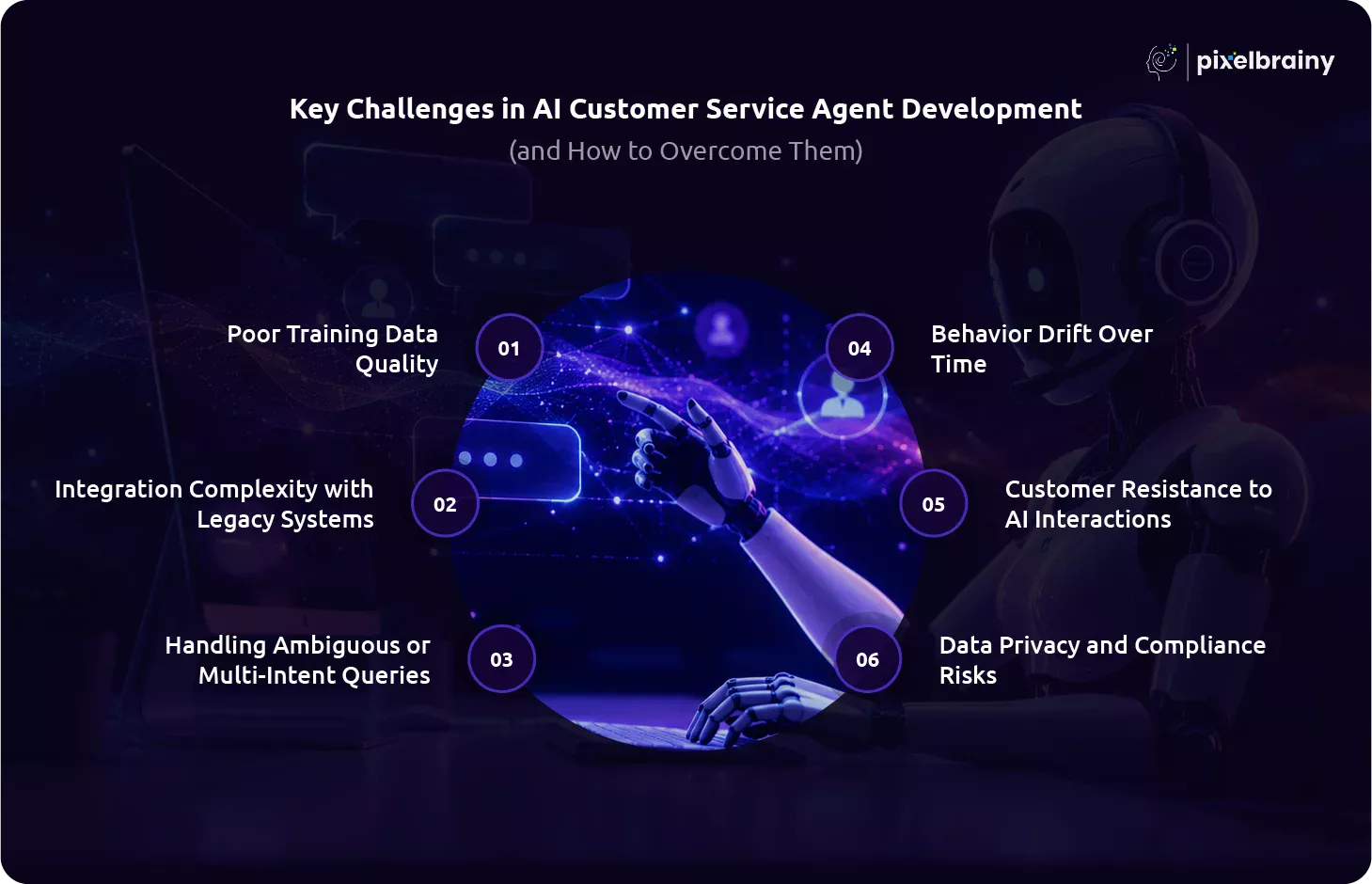
The performance of an AI customer service agent depends heavily on the quality of data used during training. Incomplete, outdated, or inconsistent data often leads to inaccurate responses and poor customer experiences.
How to Overcome It: Use real historical support tickets, chat transcripts, customer interactions, and well-structured knowledge bases to train the model. Regularly review and update training data to ensure the AI reflects current products, policies, and customer needs.
Many organizations operate with multiple legacy systems that were not designed to work with modern AI technologies. Integrating customer data, ticketing platforms, and internal applications can become a significant obstacle.
How to Overcome It: Adopt an API-first development strategy and implement a flexible connector architecture. This approach simplifies integrations with CRM platforms, helpdesk systems, ERP software, payment gateways, and other business-critical applications.
Customers often ask complex questions that contain multiple requests within a single message. Traditional automation systems frequently struggle with these scenarios.
How to Overcome It: Use context-aware NLP models capable of understanding intent across entire conversations rather than individual messages. Incorporate clarification prompts, fallback responses, and confidence-based routing to improve resolution accuracy.
Customer language, product offerings, and business processes continuously evolve. As a result, AI agents can become less accurate over time if not properly maintained.
How to Overcome It: Implement continuous retraining cycles, performance monitoring, and feedback-loop mechanisms. Monitoring escalation trends, customer feedback, and resolution outcomes helps identify performance degradation before it impacts customer experience.
Some customers still prefer human support and may become frustrated if they feel trapped in automated conversations.
How to Overcome It: Focus on human-like conversation design, clear communication, and fast escalation pathways. Customers should always have an easy option to connect with a live representative when needed. Transparency about interacting with AI also helps build trust and improve user acceptance.
For industries such as healthcare, banking, insurance, and financial services, data security is one of the most critical concerns during AI implementation.
How to Overcome It: Build AI customer service agent data privacy compliance requirements into the architecture from the beginning. This includes encryption, role-based access controls, audit logging, secure data storage, and adherence to regulations such as GDPR, HIPAA, and industry-specific compliance standards.
Successfully building reliable AI customer service agent solutions requires more than advanced technology. Organizations must continuously address data quality, integration challenges, evolving customer behavior, compliance requirements, and customer trust. By proactively tackling these issues, businesses can overcome AI support agent development challenges and create customer service systems that remain accurate, secure, and effective over the long term.
Businesses investing in AI-powered customer support need more than just a development vendor. They need a technology partner that understands customer service operations, AI implementation challenges, system integrations, and long-term optimization. PixelBrainy has established itself as a trusted AI agent development company for customer service by helping organizations build intelligent support solutions that improve efficiency, reduce operational costs, and enhance customer experiences.
At PixelBrainy, we provide end-to-end AI customer service agent development services tailored to each client's unique business requirements. Our team manages the complete development lifecycle, ensuring every solution is designed to align with operational goals, customer expectations, and existing technology ecosystems.
Our service capabilities include:
As a US based AI customer service agent development company, PixelBrainy develops advanced support agents equipped with Natural Language Processing, omnichannel communication capabilities, self-learning mechanisms, sentiment analysis, voice agent support, intelligent ticket routing, and deep CRM integration.
Our experience spans multiple industries, including:
What makes PixelBrainy a trusted AI support agent development partner is our commitment to delivering secure, scalable, and business-focused AI solutions. We follow industry best practices for data security, compliance, performance optimization, and enterprise integration while maintaining transparent communication throughout the project lifecycle.
Whether your objective is to automate customer inquiries, reduce support workloads, improve response times, or build an AI agent capable of resolving a significant percentage of customer requests automatically, our team has the expertise to help you achieve those goals.
If you're planning to hire AI customer service agent developer experts for your next project, connect with the PixelBrainy team to discuss your requirements and explore how a custom AI customer service agent can transform your support operations.
Building an AI customer service agent is one of the most effective ways to improve support efficiency, reduce operational costs, and deliver faster customer experiences at scale. Throughout this guide, we've explored the technologies, development process, features, costs, challenges, and strategic decisions involved in successful AI customer service agent development.
The biggest takeaway is that automation success depends on more than selecting an AI model or platform. It requires the right combination of business requirements, conversation design, system integrations, training data, and continuous optimization. When implemented correctly, businesses can realistically automate up to 70% of support queries, allowing support teams to focus on high-value and complex customer interactions.
Before you develop AI customer service agent solutions for your organization, start with a thorough requirement discovery phase to identify automation opportunities, integration needs, and measurable business goals.
If you're looking to build AI support automation tailored to your workflows, PixelBrainy can help. As an experienced AI customer service agent development company, we help businesses design, develop, and deploy intelligent support agents that drive measurable results.
Ready to explore your project? Connect with the PixelBrainy team for a free consultation and discuss your AI customer service roadmap with our experts.
The timeline depends on complexity, number of channels, and integration requirements. A basic single-channel AI customer service agent can be developed and deployed in 4 to 6 weeks. A mid-tier multichannel agent with CRM integration typically takes 8 to 12 weeks. An enterprise-grade agent with voice support, omnichannel deployment, and self-learning models can take 3 to 5 months. Hiring an experienced AI development company significantly reduces this timeline compared to building in-house.
The cost of building a custom AI customer service agent varies based on features, integrations, channels, and data complexity. A basic agent starts from $20,000 to $35,000. A mid-tier custom agent with CRM integration and multichannel support typically ranges from $35,000 to $60,000. Enterprise-grade agents with voice, analytics, and self-learning capabilities can go beyond $60,000 to $150,000. Ongoing maintenance, model retraining, and hosting add to operational costs monthly.
Modern AI customer service agents go far beyond basic FAQ responses. When built with advanced NLP, contextual memory, and RAG pipelines, they can handle multi-turn conversations, resolve account issues, process complaints, assist with purchase decisions, and manage after-sales support. For queries beyond the agent's scope, smart escalation logic routes the interaction to a human agent instantly without the customer needing to repeat themselves.
Yes, provided the agent is developed with a security-first architecture. A well-built AI customer service agent includes end-to-end data encryption, role-based access controls, and compliance with GDPR, HIPAA, or other relevant regional data protection regulations. Businesses in healthcare, banking, and insurance should ensure their development partner builds compliance into the architecture from day one rather than treating it as an afterthought.
A regular chatbot follows pre-written scripts and decision trees, giving fixed responses to specific inputs. An AI customer service agent uses natural language understanding, machine learning, and contextual reasoning to interpret intent, maintain conversation context, detect sentiment, access live data from CRM and knowledge bases, and improve through every interaction. The key difference is intelligence and autonomy. An AI agent resolves problems; a chatbot mostly redirects them.
Not necessarily. If developed by an experienced AI development company, the agent comes with a management dashboard, performance monitoring tools, and post-launch support that allow non-technical teams to track resolution rates, update knowledge bases, and adjust conversation flows without engineering involvement. Most businesses partner with their development company for ongoing optimization, model retraining, and feature updates rather than managing it fully in-house.

About The Author
Sagar Bhatnagar
Sagar Sahay Bhatnagar brings over a decade of IT industry experience to his role as Marketing Head at PixelBrainy. He's known for his knack in devising creative marketing strategies that boost brand visibility and market influence. Sagar's strategic thinking, coupled with his innovative vision and focus on results, sets him apart. His track record of successful campaigns proves his ability to utilize digital platforms effectively for impactful marketing efforts. With a genuine passion for both technology and marketing, Sagar continuously pushes PixelBrainy's marketing initiatives to greater success.


Transform your ideas into reality with us.
Working with the PixelBrainy team has been a highly positive experience. They understand the design requirements and create beautiful UX elements to meet the application needs. The dev team did an excellent job bringing my vision to life. We discussed usability and flow. Sagar worked with his team to design the database and begin coding. Working with Sagar was easy. He has the knowledge to create robust apps, including multi-language support, Google and Apple ID login options, Ad-enabled integrations, Stripe payment processing, and a Web Admin site for maintaining support data. I'm extremely satisfied with the services provided, the quality of the final product, and the professionalism of the entire process. I highly recommend them for Android and iOS Mobile Application Design and Development.

Great experience working with them. Had a lot of feedback and I found that unlike most contractors they were bugging me for updates instead of the other way around. They were extremely time conscience and great at communicating! All work was done extremely high quality and if not on time, early! They were always proactive when it comes to communication and the work is great/above par always. Very flexible and a great team to work with! Goes above and beyond to present us with multiple options and always provides quality. Amazing work per usual with Chitra. If you have UI/UX or branding design needs I recommend you go to them! Will likely work with them in the future as well, definitely recommended!

PixelBrainy is a joy to work with and is a great partner when thinking through branding, logo, and website layout. I appreciate that they spend time going into the "why" behind their decisions to help inform me and others about industry best practices and their expertise.

I hired them to design our software apps. Things I really like about them are excellent communication skills, they answer all project suggestions and collaborate right away, and their input on design and colors is amazing. This project was complex and needed patience and creativity. The team is amazing to do business with. I will be using them long-term. Glad to see there are some good people out there. I was afraid to try and outsource my project to someone but I am glad I met them! I really can't say enough. They went above and beyond on this project. I am very happy with everything they have done to make my business stand out from the competition.

It was great working with PixelBrainy and the team. They were very responsive and really owned the project. We'll definitely work with them again!

I recently worked with the PixelBrainy team on a project and I was blown away by their communication skills. They were prompt, clear, and articulate in all of our interactions. They listened and provided valuable feedback and suggestions to help make the project a success. They also kept me updated throughout the entire process, which made the experience stress-free and enjoyable.

PixelBrainy is very good at what it does. The team also presents themselves very professionally and takes care of their side of things very well. I could fully trust them taking up the design work in a timely and organised manner and their attention to detail saved us lots of effort and time. This particular project was quite intense and the team showed that they function very well under pressure. Very much looking forward to working with her again!

It's always an absolute pleasure working with them. They completed all of my requests quickly and followed every note I had for them to a T, which made our process go smoothly from start to finish. Everything was completed fast and following all of the guidelines. And I would recommend their services to anyone. If you need any design work done in the future, PixelBrainy should be your first call!

They took ownership of our requirements and designed and proposed multiple beautiful variants. The team is self-motivated, requires minimum supervision, committed to see-through designs with quality and delivering them on time. We would definitely love to work with PixelBrainy again when we have any requirements.

PixelBrainy was a big help with our SaaS application. We've been hard at work with a new UI/UX and they provided a lot of help with the designs. If you're looking for assistance with your website, software, or mobile application designs, PixelBrainy and the team is a great recommendation.

PixelBrainy designers are amazing. They are responsive, talented, and always willing to help craft the design until it matches your vision. I would recommend them and plan to continue them for my future projects and more!!!

They were awesome! Did a good job fast, and good communication. Will work with them again. Thank you

Creative, detail-oriented, and talented designers who take direction well and implement changes quickly and accurately. They consistently over-delivered for us.

PixelBrainy team is very talented and creative. Great designers and a pleasure to work with. PixelBrainy is an excellent communicator and I look forward to working with them again.

PixelBrainy has a very talented design team. Their work is excellent and they are very responsive. I enjoy working with them and hope to continue on all of our future projects.


