AI Summary Powered by PixelBrainy
Could your healthcare organization be losing millions in legitimate reimbursement simply because your systems cannot automatically compare what a payer should have paid with what it actually paid?
For a hospital network operating across multiple EHRs, billing platforms, clearinghouses, payer systems, and payment applications, revenue recovery is rarely a single-system problem. Payment information can be fragmented across disconnected databases, payer contracts can contain complex reimbursement terms, and revenue cycle teams may still depend on spreadsheets, manual audits, and sampling to identify underpayments. This creates a critical development challenge: how can organizations develop an AI healthcare revenue recovery platform for automated underpayment detection without replacing the infrastructure they already depend on?
The answer starts with a well-designed AI healthcare revenue recovery software development strategy that connects existing healthcare data sources, structures payer and reimbursement information, calculates expected payments, and uses AI to identify discrepancies at scale.
Organizations exploring how to create an AI healthcare revenue recovery platform should think beyond a simple anomaly detection dashboard. A production-ready solution needs data ingestion, contract intelligence, reimbursement calculation, AI-based detection, workflow automation, explainability, security, and interoperability.
The market momentum also supports this direction. Grand View Research estimates that the global AI in healthcare market will reach $50.7 billion in 2026, up from $36.7 billion in 2025, and projects it to reach $505.6 billion by 2033 at a 38.9% CAGR.
For healthcare providers, RCM companies, healthcare SaaS businesses, and technology leaders, this creates a strong opportunity to develop an AI healthcare revenue recovery platform that turns fragmented payment data into actionable recovery opportunities.
This article provides a step-by-step guide to building an AI healthcare revenue recovery software, covering platform architecture, features, AI technologies, integrations, compliance, development costs, build-vs-buy decisions, and implementation best practices.
An AI healthcare revenue recovery platform is a software system that uses artificial intelligence, healthcare data, payer contract intelligence, reimbursement rules, and workflow automation to identify revenue that healthcare organizations may have earned but failed to collect. One of its key applications is automated underpayment detection, where the platform compares the amount a payer actually paid with the amount the healthcare provider was contractually expected to receive.
Unlike traditional revenue cycle tools that primarily support claims submission, payment posting, or denial management, a revenue recovery platform focuses on finding discrepancies after payment has been processed. Current healthcare technology platforms are increasingly combining claims, remittance, contract, and payer data with AI or machine learning to identify and prioritize underpayment opportunities.
The platform typically works through a connected data and decision-making workflow:
Healthcare systems → data ingestion → data normalization → contract intelligence → expected reimbursement calculation → payment comparison → AI underpayment detection → prioritization → recovery workflow
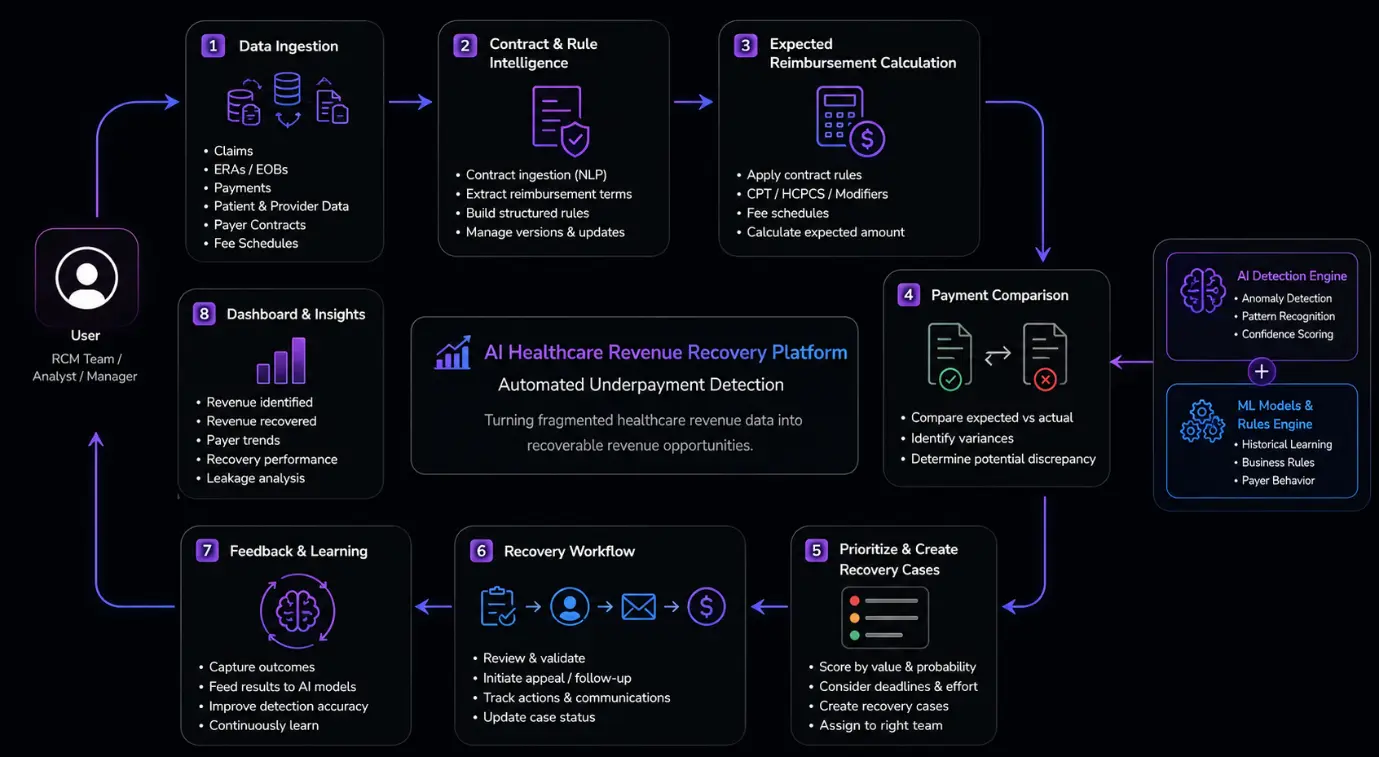
The platform first connects with the organization's existing infrastructure instead of requiring replacement of core systems. Data can come from EHRs, billing platforms, RCM systems, clearinghouses, payer systems, ERAs, EOBs, and payment databases.
Depending on the environment, integrations can use APIs, FHIR, HL7, EDI, SFTP, or secure database connections.
Healthcare data often exists in different formats. The platform standardizes claim numbers, payer identifiers, procedure codes, payment amounts, adjustment codes, provider information, and other relevant fields so that they can be analyzed consistently.
AI and natural language processing can extract reimbursement terms from payer contracts and convert relevant information into structured rules. These rules can include negotiated rates, percentage-based reimbursement, modifiers, exclusions, effective dates, and other contractual conditions.
The platform determines how much the payer should have paid based on the applicable contract, procedure, payer rules, and claim details.
The system compares the calculated expected reimbursement with the actual payment received. If the difference meets the platform's detection criteria, the claim can be flagged for further investigation.
AI can identify payment patterns, unusual variances, payer-specific behavior, and high-value recovery opportunities. Machine learning can also help prioritize claims based on financial impact, recovery likelihood, and historical outcomes.
Once an opportunity is identified, the platform can create a recovery case, provide supporting evidence, assign it to the appropriate team, and track the outcome.
The most effective architecture combines AI for detection and prioritization with deterministic reimbursement rules and human validation for complex financial decisions.
In short, an AI healthcare revenue recovery platform turns fragmented claims and payment data into actionable, explainable, and prioritized revenue recovery opportunities.
Healthcare organizations can successfully process and receive payment for claims while still losing revenue through reimbursement discrepancies. The challenge becomes more complex when revenue information is distributed across multiple EHRs, billing platforms, RCM systems, clearinghouses, payer systems, and payment applications. Manually bringing this information together and checking every payment against contractual reimbursement rules can consume significant time and limit how many claims revenue teams can review.
This creates a strong business case for AI healthcare revenue recovery software development. An AI healthcare revenue recovery platform for automated underpayment detection can connect existing healthcare systems, analyze payment data, calculate expected reimbursement, identify discrepancies, and prioritize recovery opportunities without requiring organizations to replace their existing infrastructure.
The direction of healthcare interoperability also makes this approach increasingly practical. As of July, 2026, CMS requires participating networks in its Interoperability Framework to provide or facilitate access to data through FHIR APIs and encourages the use of FHIR Bulk Data Exchange. CMS also identifies FHIR, SMART/OAuth 2, OpenID Connect, and USCDI among its interoperability standards and technologies.
For healthcare providers, hospital networks, RCM companies, and healthcare technology businesses, this creates an opportunity to develop an AI healthcare revenue recovery platform as an intelligent layer across existing revenue infrastructure.
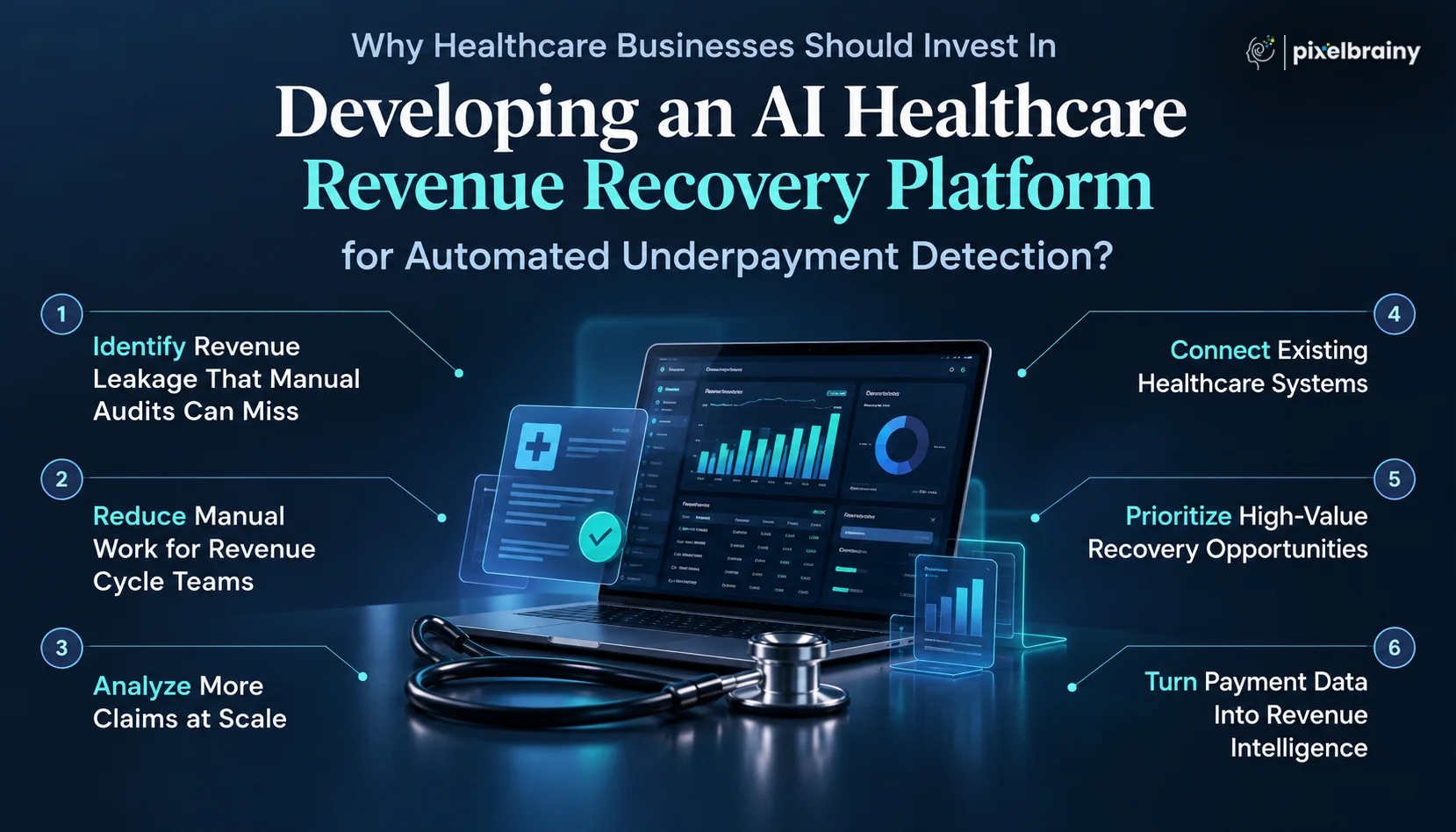
Manual underpayment audits are difficult to scale when organizations process thousands or millions of claims.
Revenue teams may review only a portion of paid claims because every investigation can require analysts to:
An AI platform can automate much of this analysis and continuously scan eligible claims for potential underpayments.
This allows organizations to move from limited sample-based auditing toward broader, data-driven payment analysis.
Underpayment investigation often involves repetitive administrative work before an analyst can determine whether a claim represents a legitimate recovery opportunity.
An AI healthcare revenue recovery platform can help automate:
Instead of spending most of their time searching for information, analysts can focus on validating complex cases and pursuing legitimate recovery opportunities.
Scale is one of the strongest reasons to invest in automated underpayment detection.
A large hospital network may have multiple facilities, payers, contracts, reimbursement models, and payment systems. Reviewing every paid claim manually becomes increasingly difficult as claim volume grows.
AI can analyze large datasets across:
This makes continuous payment monitoring more achievable.
Healthcare businesses typically do not want to replace their existing EHR, billing, RCM, clearinghouse, or payment infrastructure simply to introduce AI-powered revenue recovery.
A better approach is to develop an integration layer that connects existing systems through appropriate APIs and data exchange technologies.
CMS's current interoperability direction further supports this approach. Its framework requires FHIR API support for participating networks, while CMS also identifies standards such as FHIR, SMART/OAuth 2, OpenID Connect, and USCDI as part of its interoperability technology landscape.
For a hospital network asking, “What APIs, integrations, data architecture, and security requirements should we plan for?”, interoperability should therefore be treated as a foundational part of the platform architecture rather than a later integration task.
Identifying a potential underpayment is only the first step. Revenue teams also need to determine which cases deserve immediate attention.
AI can prioritize recovery opportunities based on:
For example, instead of presenting analysts with thousands of unranked payment discrepancies, the platform can create a prioritized recovery queue.
This helps teams focus their resources on opportunities with greater financial potential.
The value of an AI healthcare revenue recovery platform extends beyond individual claim detection.
When historical claims and payment information are analyzed together, the platform can uncover recurring revenue leakage patterns across payers, procedures, facilities, and contracts.
Healthcare organizations can use these insights to identify:
This transforms the platform from a simple underpayment detection tool into a broader healthcare revenue intelligence and recovery system.
By combining AI-driven analysis, healthcare interoperability, reimbursement intelligence, and automated workflows, businesses can turn fragmented payment data into a scalable system for identifying, prioritizing, and recovering missed revenue.
Also Read: AI Agent Development for Healthcare: Use Cases, Benefits & Cost
An effective AI healthcare revenue recovery platform needs to solve the operational problems revenue cycle teams face every day. Simply adding an AI model that flags unusual payments is not enough. The platform should connect claims and payment data, understand reimbursement agreements, calculate expected payments, detect variances, support recovery actions, and provide different users with the information they need.
For organizations planning AI healthcare revenue recovery software development, the core product should be designed around a complete workflow: data ingestion → reimbursement analysis → variance detection → recovery case creation → appeal management → revenue reporting.
A practical buyer requirement behind this approach is: “Our RCM analysts are spending too much time manually comparing expected reimbursement with actual payer payments, and we cannot review every paid claim. We want an AI platform that can automatically detect payment variances, explain why a claim was flagged, generate appeal drafts, and track each recovery case from identification through resolution. What core features should we include in the first version?”
The following features should form the foundation of an automated underpayment detection platform, while more advanced capabilities can be introduced as the product matures.
| Feature | What It Should Do |
|---|---|
| AI-Powered Contract Intel | AI-powered contract intelligence should extract reimbursement rates, payment terms, exclusions, modifiers, effective dates, and payer-specific conditions from contracts and convert relevant information into structured data for reimbursement analysis. |
| Claims & Variance Amount Detection Using AI | AI should analyze claims, payment records, and remittance information to compare expected and actual reimbursement, identify meaningful variance amounts, recognize unusual payment patterns, and flag potential underpayments for review. |
| Automated Claims Data Ingestion | The platform should securely ingest claims, ERAs, EOBs, payment records, adjustments, and related revenue information from healthcare systems through APIs, EDI, SFTP, database connections, or other supported integration methods. |
| Healthcare Data Normalization | Data normalization should standardize payer identifiers, claim numbers, procedure codes, payment amounts, adjustment codes, provider information, and dates from multiple sources to create consistent datasets for accurate revenue recovery analysis. |
| Expected Reimbursement Calculation | The reimbursement engine should calculate expected payment using applicable payer contracts, fee schedules, procedure codes, modifiers, negotiated rates, reimbursement percentages, and other contractual conditions relevant to each individual claim. |
| Actual Payment Reconciliation | The platform should match payments with corresponding claims and compare received amounts against calculated reimbursement, helping revenue teams identify discrepancies without manually searching through multiple financial and billing applications. |
| Automated Underpayment Detection | The detection engine should evaluate payment differences against reimbursement rules, configurable thresholds, and historical patterns to identify potential underpayments consistently while reducing dependence on manual claim-by-claim payment audits. |
| Payer-Specific Rules Management | A centralized rules engine should maintain payer-specific reimbursement requirements, calculation logic, exclusions, thresholds, and contractual conditions so that payment analysis can accurately reflect different payer agreements and reimbursement methodologies. |
| Underpayment Reason Classification | The platform should classify detected discrepancies according to relevant reasons, such as incorrect rates, contractual calculation differences, missing adjustments, modifier issues, or other configurable variance categories, giving analysts clear investigation starting points. |
| Recovery Opportunity Management | Every validated discrepancy should become a structured recovery case containing claim details, payer information, expected payment, actual payment, potential recovery value, supporting evidence, assigned owner, priority, deadline, and current status. |
| Recovery Case Prioritization | The platform should rank recovery opportunities according to financial value, recovery probability, filing deadlines, payer behavior, historical outcomes, and investigation effort so analysts can focus on cases with stronger potential returns. |
| One-Click Appeal Generation | One-click appeal generation should use claim information, detected discrepancies, applicable contract terms, and supporting evidence to prepare structured appeal drafts, reducing repetitive documentation work while keeping final review and submission under human control. |
| Appeal Lifecycle Tracking | Appeal lifecycle tracking should provide a centralized view of submitted, pending, responded, escalated, recovered, and closed cases while monitoring follow-ups, payer responses, deadlines, recovery amounts, and unresolved opportunities. |
| Role-Separated Dashboards | Role-separated dashboards should provide executives with financial performance, managers with operational metrics, analysts with detailed recovery cases, and administrators with configuration and access controls appropriate to their responsibilities. |
| Revenue Recovery Analytics and Reporting | Revenue recovery analytics should show identified underpayments, recovered revenue, outstanding opportunities, payer trends, recovery performance, claim volumes, and financial outcomes so organizations can measure the platform's operational and financial impact. |
These features create the core foundation for AI healthcare revenue recovery platform development. They establish the essential capabilities needed to move from manual payment review toward automated detection, structured recovery management, and measurable financial outcomes.
A strong first version should make it easier to detect payment variances, understand why they occurred, act on legitimate recovery opportunities, and measure the revenue recovered.
Once the core functionality of an AI healthcare revenue recovery platform is established, advanced capabilities can make the system more predictive, intelligent, and scalable. These features can help healthcare organizations move beyond basic underpayment detection toward proactive revenue intelligence, automated decision support, and continuous optimization.
For businesses investing in AI healthcare revenue recovery software development, advanced features should be introduced after the foundational claims, payment, contract, reimbursement, and recovery workflows are reliable. They should enhance the platform's ability to identify patterns, predict outcomes, assist analysts, and improve recovery performance over time.
A relevant buyer query for this stage is: “We already have an underpayment detection system, but our team still spends too much time deciding which cases are worth pursuing. We want AI to predict recovery probability, identify recurring payer behavior, explain its recommendations, and continuously learn from our recovery outcomes. Which advanced features should we add?”
The following capabilities can help transform a basic automated underpayment detection product into a more intelligent AI-powered healthcare revenue recovery platform.
| Advanced Feature | What It Should Do |
|---|---|
| Predictive Recovery Scoring | Predictive recovery scoring can evaluate historical payment and recovery outcomes to estimate which underpayment cases have the strongest likelihood of successful recovery, helping teams allocate resources toward higher-value opportunities. |
| AI-Powered Payer Behavior Analytics | AI-powered payer behavior analytics can identify recurring payment patterns across claims, procedures, contracts, and facilities, helping organizations recognize payers or reimbursement scenarios associated with repeated underpayment activity. |
| Intelligent Recovery Recommendations | Intelligent recommendations can analyze claim characteristics, contract information, payer behavior, previous outcomes, and recovery history to suggest appropriate next actions, such as investigation, appeal, follow-up, or additional validation. |
| Generative AI Revenue Recovery Assistant | A generative AI assistant can help analysts investigate claims, summarize payment discrepancies, explain relevant contract information, answer recovery-related questions, and surface supporting evidence while keeping financial decisions under appropriate human review. |
| AI-Powered Contract Change Detection | Contract change detection can compare new and previous payer agreements to identify changes in reimbursement rates, conditions, exclusions, effective dates, and other terms that could affect expected payment calculations. |
| Continuous AI Learning From Recovery Outcomes | The platform can use analyst decisions and historical recovery results as feedback to improve detection, classification, prioritization, and prediction models while monitoring model performance and data quality over time. |
| Revenue Leakage Prediction | Revenue leakage prediction can analyze historical claims, payment behavior, payer trends, and reimbursement patterns to identify areas where future underpayments or revenue discrepancies may be more likely to occur. |
| AI-Powered Root Cause Analysis | Root cause analysis can examine multiple claims and payment records to determine whether recurring discrepancies are associated with payer rules, contract terms, procedures, coding patterns, payment processes, or other operational factors. |
| Autonomous Recovery Workflow Orchestration | Intelligent workflow orchestration can automatically route validated cases, assign tasks, trigger follow-ups, monitor deadlines, and update recovery statuses according to configurable business rules and AI-supported recommendations. |
| Enterprise Revenue Recovery Forecasting | Revenue recovery forecasting can use current opportunities, historical recovery rates, payer behavior, outstanding cases, and financial trends to estimate future recovery potential and provide finance leaders with forward-looking revenue insights. |
These advanced capabilities can help organizations progress from automated underpayment detection toward a more predictive and intelligent revenue recovery environment. However, they should be introduced progressively, with appropriate validation, explainability, human oversight, and performance monitoring.
The right advanced features can turn an AI healthcare revenue recovery platform from a system that finds underpayments into an intelligent system that predicts, prioritizes, explains, and continuously improves revenue recovery decisions.
Building an AI healthcare revenue recovery platform requires more than developing an AI model and connecting it to a claims database. The platform must combine healthcare data integration, payer contract intelligence, reimbursement calculations, AI-based variance detection, recovery workflows, security, and user-friendly interfaces.
For healthcare organizations and startups, having a structured development process of AI healthcare revenue recovery platform can reduce technical risk and prevent expensive changes later. The right approach is to move progressively from business requirements and data assessment to validation, product development, deployment, and continuous optimization.
A practical buyer query behind this process is: “We have validated that automated underpayment detection could improve our revenue recovery, but we are unsure how to move from the initial idea to a production-ready platform. What development stages should we follow, what should we build first, and when should AI be introduced?”
The following steps to build AI healthcare revenue recovery platform from idea to launch provide a practical roadmap for organizations planning to develop AI healthcare revenue recovery platform capabilities.
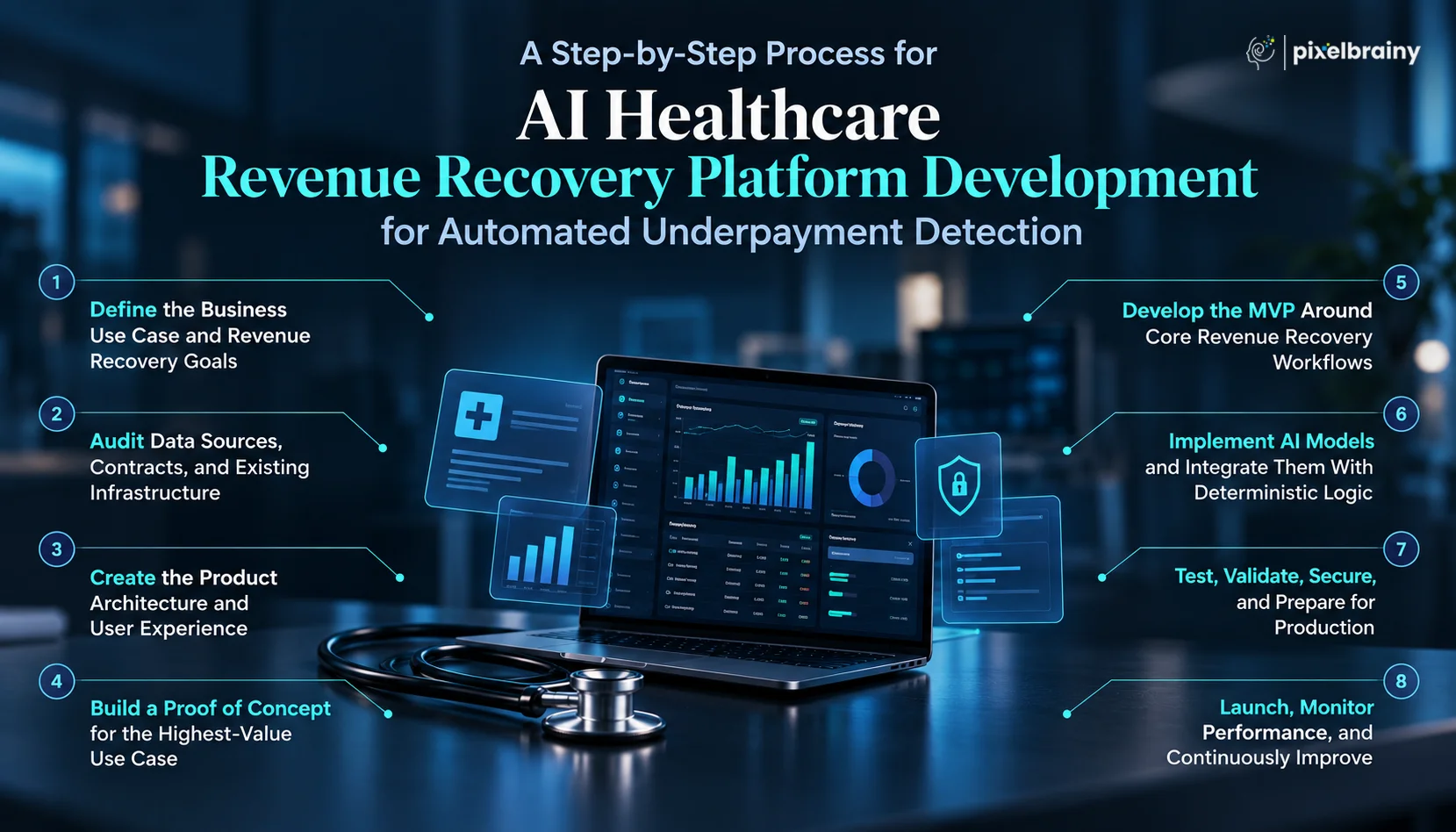
The first stage is defining exactly what the platform needs to solve. Identify the types of underpayments you want to detect, target payers, claim categories, reimbursement models, users, and expected recovery outcomes. Document how revenue teams currently identify and investigate payment discrepancies.
During this stage, define measurable objectives such as detection accuracy, potential recovery value, analyst productivity, processing volume, and case resolution time. For AI healthcare revenue recovery platform development for healthcare startups, keeping the initial scope focused is especially important because attempting to support every payer and reimbursement methodology immediately can increase development complexity.
The output should be a clear product scope, user requirements, workflow map, and measurable success criteria.
Before building an AI healthcare revenue recovery software, evaluate the data required to calculate expected reimbursement and detect discrepancies. Map available information across EHRs, billing platforms, RCM systems, clearinghouses, payment systems, ERAs, EOBs, payer contracts, and internal databases.
Assess data formats, completeness, quality, update frequency, access methods, and ownership. Identify whether information is available through APIs, FHIR, EDI, SFTP, or other secure channels.
At this stage, review payer contracts and reimbursement methodologies to understand how expected payment will be calculated.
The objective is to create a reliable data map before development begins, because AI accuracy depends heavily on the quality and consistency of underlying healthcare revenue data.
The next stage is designing the technical architecture and user experience that will support the entire recovery workflow. Define how claims enter the platform, where normalized data is stored, how contracts are interpreted, where reimbursement calculations occur, and how detected opportunities move into recovery workflows.
The interface should be designed around the daily activities of revenue analysts, managers, and executives. A specialized UI/UX design company can help structure dashboards, claim investigation screens, recovery queues, and reporting interfaces around these workflows.
The architecture should also account for scalability, security, auditability, integration requirements, role-based access, and future AI capabilities from the beginning.
Before committing to full-scale AI product development, validate the most important technical assumption with a focused PoC development phase.
For example, the proof of concept could take a defined dataset containing claims, payer contracts, expected reimbursement rules, and actual payment records. The goal could be to determine whether the proposed system can accurately identify specific types of underpayments.
Measure precision, recall, false positives, false negatives, calculation accuracy, and processing performance.
A successful proof of concept provides evidence that the data, reimbursement logic, and AI approach are viable. It also helps identify gaps before substantial production development investment is made.
After validating the concept, build the first production-oriented version through focused MVP development. The MVP should prioritize essential functionality rather than attempting to include every advanced AI capability.
Core functionality can include:
For startups, this approach supports faster market validation. For healthcare providers, it allows internal teams to test the workflow using real operational requirements before expanding platform capabilities.
Also Read: Top 10 AI MVP Development Companies in USA
Once the data and core workflows are stable, introduce AI model development for tasks where machine learning or language models provide meaningful value.
Potential applications include:
The AI layer should work alongside deterministic reimbursement calculations rather than replacing them. Contractual payment calculations need predictable and auditable logic, while AI can support pattern recognition, classification, prioritization, and document intelligence.
The next stage is AI integration, where validated models are connected to the production data pipelines and recovery workflows.
Also Read: Top AI Model Development Companies in the USA
Before launching the platform, conduct comprehensive functional, integration, security, performance, data quality, and AI validation testing.
Test whether the system:
Security and compliance requirements should be validated before production deployment rather than treated as post-launch improvements.
Organizations can also work with top AI healthcare software development companies when specialized healthcare interoperability, AI validation, security, and enterprise deployment expertise is required.
The final stage is launching the platform in a controlled production environment and monitoring both technical and financial performance. Start with a defined payer group, facility, claim category, or business unit where outcomes can be measured clearly.
Track:
Collect analyst feedback and recovery outcomes to improve rules, workflows, and AI models.
For organizations seeking how to build AI healthcare revenue recovery software from scratch, launch should be treated as the beginning of continuous optimization rather than the end of development.
A structured development journey helps businesses create an AI healthcare revenue recovery platform that moves from a validated revenue recovery idea to a secure, scalable, and continuously improving production system.
Also Read: How to Develop HIPAA-Compliant AI Healthcare Software
The cost to develop an AI healthcare revenue recovery platform can range from $50,000 to $350,000+ depending on the platform's complexity, healthcare integrations, AI capabilities, security requirements, reimbursement logic, and development team location. A basic platform focused on claims ingestion and underpayment detection requires a significantly smaller AI healthcare revenue recovery platform development cost than an enterprise solution supporting multiple EHRs, payer contracts, facilities, advanced AI models, and large-scale revenue data.
When estimating the development budget of an AI healthcare revenue recovery platform, businesses should avoid looking only at the cost of coding the application. The cost estimation of an AI healthcare revenue recovery platform should include product discovery, UI/UX, backend development, healthcare interoperability, AI model development, contract intelligence, cloud infrastructure, security, testing, deployment, and ongoing maintenance.
A real buyer query is: “We are evaluating whether to build our own AI healthcare revenue recovery platform for a hospital network. What development pricing should we expect if we need automated underpayment detection, payer contract analysis, EHR and billing integrations, AI-powered recovery prioritization, dashboards, and enterprise-grade security?”
For planning purposes, the AI healthcare revenue recovery platform development cost can be divided into three broad levels.
| Platform Type | Estimated Development Cost | Typical Scope |
|---|---|---|
| Basic AI Healthcare Revenue Recovery Platform | $50,000 to $100,000 | Core claims and payment ingestion, basic reimbursement rules, automated underpayment detection, recovery case management, basic dashboard, user authentication, and limited integrations. |
| Advanced AI Healthcare Revenue Recovery Platform | $100,000 to $200,000 | Multiple healthcare integrations, AI-based variance detection, contract intelligence, expected reimbursement engine, recovery prioritization, appeal workflows, advanced dashboards, analytics, role-based access, and stronger automation. |
| Enterprise AI Healthcare Revenue Recovery Platform | $200,000 to $350,000+ | Multi-system and multi-payer architecture, advanced AI, large-scale data processing, sophisticated contract intelligence, predictive recovery, enterprise workflows, extensive integrations, advanced security, compliance controls, multi-tenancy, and scalable cloud infrastructure. |
The final development pricing of an AI healthcare revenue recovery platform depends on several variables. Each factor can increase or decrease the overall budget.
A basic application with limited workflows costs less than a platform supporting complex reimbursement methodologies, multiple user roles, recovery workflows, analytics, contract management, and enterprise automation.
The more business rules and workflows the product supports, the greater the development effort.
Integrating EHRs, billing systems, RCM platforms, clearinghouses, payer systems, payment platforms, and other healthcare applications can become a major cost component.
The final cost depends on the number of systems, available APIs, data formats, integration complexity, testing requirements, and ongoing maintenance.
AI requirements can range from basic anomaly detection to sophisticated models for contract intelligence, variance detection, recovery scoring, payer behavior analysis, and predictive revenue recovery.
Custom model development, training data preparation, evaluation, deployment, and monitoring can significantly increase the budget.
If the platform needs to extract reimbursement terms from payer contracts, additional development may be required for document processing, OCR, NLP, structured contract rules, validation workflows, and contract version management.
The complexity increases when contracts contain numerous exceptions, reimbursement methodologies, and payer-specific conditions.
Developing an accurate expected reimbursement engine requires implementation of contractual rates, fee schedules, modifiers, reimbursement percentages, exclusions, case rates, and other payment conditions.
More reimbursement methodologies and payer-specific rules generally increase development effort.
The platform may require separate interfaces for executives, revenue cycle managers, analysts, administrators, and other users.
Costs increase when the product needs advanced claim investigation screens, interactive analytics, recovery queues, custom reports, and highly specialized workflows.
Healthcare platforms require strong security architecture, including encryption, identity management, role-based access, audit logging, secure integrations, monitoring, and appropriate compliance controls.
Enterprise deployments may require additional security validation, documentation, testing, and third-party assessments.
Cloud infrastructure costs depend on data volume, claim processing frequency, storage requirements, AI workloads, backup requirements, availability targets, and scaling needs.
A platform processing millions of claims requires substantially different infrastructure from an early-stage MVP.
Healthcare revenue recovery software requires extensive testing because inaccurate reimbursement calculations or incorrect underpayment detection can directly affect financial decisions.
Testing may cover functional workflows, integrations, security, performance, data quality, AI accuracy, edge cases, and regression testing.
The development budget should also account for post-launch expenses.
Ongoing costs may include:
Businesses can control their initial budget by starting with a focused MVP rather than developing every capability simultaneously.
A practical approach is to begin with:
Claims ingestion → payment reconciliation → expected reimbursement → basic underpayment detection → recovery case management → dashboard
Once the MVP demonstrates measurable recovery value, advanced contract intelligence, predictive recovery scoring, generative AI, additional payer integrations, and enterprise analytics can be introduced progressively.
For organizations asking “What is the development pricing of AI healthcare revenue recovery platform?”, a realistic planning range is $50,000 to $350,000+, with the final investment determined primarily by integration complexity, AI sophistication, healthcare workflows, security requirements, and platform scale.
Ultimately, the right AI healthcare revenue recovery platform development budget should be based on the recovery opportunity and technical scope rather than choosing a fixed development price alone.
Also Read: AI Medical Diagnosis App Development: Features & Cost
An AI healthcare revenue recovery platform needs a technology stack that can process large healthcare datasets, connect with existing clinical and financial systems, calculate expected reimbursement, detect payment discrepancies, and support secure revenue recovery workflows. The tools and technologies for AI healthcare revenue recovery platform development should therefore cover frontend development, backend services, healthcare interoperability, databases, AI and machine learning, cloud infrastructure, security, APIs, and monitoring.
The technology architecture also needs to support the real-world environment of healthcare organizations. A relevant buyer query is: “We are building an AI healthcare revenue recovery platform that needs to process claims and payment data from multiple systems. Which programming languages, databases, AI frameworks, healthcare APIs, cloud services, and security technologies should we use to make the platform scalable and production ready?”
A well-planned technology stack for AI healthcare revenue recovery software development can help the platform handle growing claim volumes, complex payer contracts, AI workloads, and enterprise integrations without requiring a complete redesign as the product scales.
| Technology Layer | Recommended Tools and Technologies | Role in the Platform |
|---|---|---|
| Frontend Development | React, Next.js, TypeScript | Used to build analyst workspaces, recovery queues, dashboards, claim investigation screens, reports, and administrative interfaces. |
| Backend Development | Python, FastAPI, Node.js, Java, .NET | Supports APIs, reimbursement logic, workflow automation, authentication, business rules, integrations, and communication between platform components. |
| AI and Machine Learning | Python, PyTorch, TensorFlow, scikit-learn | Supports anomaly detection, classification, predictive recovery scoring, payer behavior analysis, and other machine learning capabilities. |
| Generative AI and NLP | LLM APIs, Hugging Face, spaCy, LangChain | Supports contract analysis, document understanding, case summarization, AI assistants, and natural language processing workflows. |
| Healthcare Interoperability | FHIR, HL7, EDI, REST APIs, SFTP | Enables the platform to exchange healthcare, claims, payment, and administrative data with existing systems and external partners. |
| Healthcare Data Standards | FHIR R4/R5, USCDI, X12 | Provides standardized structures and exchange mechanisms for healthcare information and administrative transaction data where applicable. |
| Relational Database | PostgreSQL, MySQL | Stores structured claims, payment records, users, contracts, recovery cases, reimbursement rules, and transactional platform data. |
| NoSQL Database | MongoDB, DynamoDB | Can support flexible document-oriented data such as contract documents, extracted metadata, logs, or other less structured information. |
| Data Warehouse | Snowflake, BigQuery, Amazon Redshift | Supports large-scale analytics, historical revenue analysis, payer trends, reporting, and business intelligence workloads. |
| Data Processing | Apache Spark, Python, Apache Kafka | Handles large healthcare datasets, distributed processing, event streams, and high-volume data pipelines when required. |
| Cloud Infrastructure | AWS, Microsoft Azure, Google Cloud | Provides scalable computing, storage, networking, databases, AI infrastructure, backup, monitoring, and enterprise deployment capabilities. |
| API Management | Amazon API Gateway, Azure API Management, Kong | Helps manage healthcare and third-party APIs, authentication, traffic, rate limits, monitoring, and integration security. |
| Authentication and Access Control | OAuth 2.0, OpenID Connect, JWT, IAM | Supports secure authentication, authorization, role-based access, and controlled access to sensitive healthcare and financial information. |
| Containerization and Orchestration | Docker, Kubernetes | Supports consistent application deployment, scalability, service isolation, and management of production workloads. |
| DevOps and CI/CD | GitHub Actions, GitLab CI/CD, Jenkins | Automates testing, code validation, deployment pipelines, infrastructure updates, and release management. |
| Monitoring and Observability | Prometheus, Grafana, OpenTelemetry, CloudWatch | Tracks application performance, infrastructure health, integration failures, processing jobs, and system availability. |
| Security and Encryption | TLS, AES-256, cloud KMS, secrets management | Protects sensitive healthcare and financial information during transmission and storage while supporting secure key and credential management. |
| Search and Analytics | Elasticsearch, OpenSearch | Enables fast searching across claims, recovery cases, contract information, logs, and other high-volume platform data. |
| Vector Database | Pinecone, pgvector, Weaviate | Supports semantic search and retrieval for contract documents, recovery knowledge bases, and AI-powered analyst assistance where required. |
| Testing Frameworks | PyTest, Jest, Playwright, Postman | Supports unit, API, integration, end-to-end, and regression testing across healthcare workflows and AI-enabled platform components. |
The right technology stack gives an AI healthcare revenue recovery platform the foundation required to securely connect healthcare systems, process complex revenue data, apply AI, and scale automated underpayment detection as claim volumes grow.
An AI healthcare revenue recovery platform can process claims, payment records, payer contracts, patient information, provider data, and other sensitive healthcare information. Therefore, compliance cannot be added as a final step after development. It should be incorporated into the architecture, data workflows, AI implementation, integrations, and security controls from the beginning.
For organizations planning AI healthcare revenue recovery platform development, regulatory readiness is especially important because the platform may connect multiple healthcare systems and use AI to identify financially significant payment discrepancies.
A practical buyer query is: “We are building an AI healthcare revenue recovery platform that will process claims, payment records, payer contracts, and PHI. What compliance, security, AI governance, and data protection requirements should we address before launching the platform?”
The following eight areas should be prioritized when businesses develop an AI healthcare revenue recovery platform for production use.
If the platform handles protected health information on behalf of a covered entity or business associate, HIPAA requirements should be incorporated into the technical architecture and operating processes.
The platform should address administrative, physical, and technical safeguards covering:
The HHS HIPAA Security Rule establishes national standards for protecting electronic protected health information through administrative, physical, and technical safeguards.
Security should protect healthcare and financial data throughout its lifecycle.
An AI healthcare revenue recovery software development project should consider encryption for:
Access should follow least-privilege principles using role-based access control, multi-factor authentication, secure session management, OAuth 2.0, OpenID Connect, and appropriate identity management.
This ensures analysts, managers, executives, administrators, and integration users only access information required for their responsibilities.
Revenue recovery decisions need to be traceable. The platform should maintain detailed audit records showing what happened, when it happened, and who performed the action.
Audit logs can capture:
For development of AI healthcare revenue recovery platform, auditability also helps organizations investigate security incidents and understand how financial recovery decisions were reached.
AI-powered underpayment detection should not operate as an unexplained black box. Revenue teams need to understand why the system flagged a claim and what evidence supports the recommendation.
For example, the platform could show:
Expected payment: $5,000
Actual payment: $4,300
Potential variance: $700
Detection reason: Contractual reimbursement discrepancy
Confidence: High
AI governance should also monitor model accuracy, false positives, false negatives, data drift, model drift, and unexpected outputs.
This makes developing an AI healthcare revenue recovery platform more transparent and suitable for human-reviewed financial workflows.
Revenue recovery platforms often connect with EHRs, billing systems, RCM platforms, clearinghouses, payer systems, and payment applications.
Each integration needs appropriate:
FHIR, HL7, EDI, REST APIs, and SFTP may be used depending on the systems involved.
CMS's 2026 Interoperability Framework emphasizes FHIR APIs and related standards for standards-based healthcare data exchange.
Many AI healthcare revenue recovery platforms rely on external cloud infrastructure, LLM providers, analytics services, monitoring platforms, or integration vendors.
Before sensitive data is sent to a third-party service, organizations should evaluate:
The platform architecture should clearly identify which vendors can access sensitive information and under what conditions.
Healthcare revenue data can be operationally and financially critical. A production platform should therefore have defined policies for data retention, backup, recovery, archiving, and secure deletion.
Important capabilities include:
Retention requirements should be determined according to applicable laws, contracts, organizational policies, and customer requirements.
Compliance readiness should continue after the initial launch. The platform should undergo regular security and technical validation to identify vulnerabilities before they become production risks.
Testing can include:
For organizations investing in AI healthcare revenue recovery platform development, continuous monitoring is essential because healthcare integrations, AI models, payer contracts, infrastructure, and security threats can change over time.
Building compliance into every stage of AI healthcare revenue recovery platform development helps create a secure, auditable, and trustworthy system capable of handling sensitive healthcare data and AI-driven financial workflows.
The decision to develop an AI healthcare revenue recovery platform or purchase an existing solution depends on the organization's recovery workflows, integration requirements, AI objectives, budget, internal engineering capabilities, and long-term product strategy. A healthcare provider with standard revenue recovery requirements may benefit from an existing product, while an RCM company or healthcare technology business with proprietary workflows may gain more value from AI healthcare revenue recovery platform development.
The decision is particularly important because revenue recovery platforms need to work with complex healthcare data environments. CMS's 2026 Interoperability Framework emphasizes standards-based data exchange, including FHIR APIs, while also addressing security, access control, and audit requirements.
A real buyer query is: “We can purchase an existing revenue recovery solution, but our payer contracts, reimbursement rules, recovery workflows, and healthcare integrations are highly customized. Should we buy an existing platform, develop our own AI healthcare revenue recovery software, or take a hybrid approach?”
There is no universal answer. The right decision depends on how strategically important revenue recovery is to the organization and how closely existing products match its requirements.
| Factor | Build an AI Healthcare Revenue Recovery Platform | Buy an Existing Platform |
|---|---|---|
| Customization | Provides greater control over reimbursement logic, workflows, dashboards, AI functionality, and integrations. | Organizations generally need to adapt existing workflows to the vendor's capabilities and configuration options. |
| Initial Investment | Requires a larger upfront investment for product development, infrastructure, integrations, AI, testing, and security. | Usually requires lower initial development investment, although licensing, implementation, integration, and customization costs still apply. |
| Time to Market | Development and validation can take longer because the platform needs to be designed, built, tested, and deployed. | Can provide faster access to established functionality when the vendor already supports required workflows and integrations. |
| Healthcare Integrations | Integrations can be designed specifically around the organization's EHR, billing, RCM, clearinghouse, and payment environment. | Existing integrations can accelerate deployment, but unsupported systems may require custom vendor work or additional integration projects. |
| AI Capabilities | AI models, detection logic, contract intelligence, and recovery prioritization can be designed around proprietary requirements. | AI capabilities depend on the vendor's existing roadmap, models, configuration options, and data access. |
| Data and Product Control | Provides greater control over architecture, data workflows, product roadmap, and intellectual property. | The organization depends more heavily on vendor architecture, policies, roadmap, and service agreements. |
| Scalability | Architecture can be designed specifically for projected claim volumes, facilities, payers, and future product requirements. | Scalability depends on the vendor's infrastructure, product architecture, service limits, and commercial model. |
| Maintenance | The organization is responsible for updates, security, infrastructure, integrations, and AI model improvements. | The vendor typically manages core maintenance, product updates, and infrastructure, reducing internal engineering responsibility. |
| Long-Term Strategy | Strong option when revenue recovery is a strategic capability or commercial product that requires differentiation. | Strong option when revenue recovery is primarily an operational requirement and existing functionality meets business needs. |
Custom AI healthcare revenue recovery software development can make sense when existing products cannot adequately support the organization's requirements.
Consider building when:
For example, an RCM company serving multiple healthcare organizations may want to create an AI healthcare revenue recovery platform that supports its proprietary recovery methodology rather than adapting its business process to an existing product.
Buying can be more practical when the organization's requirements are relatively standardized.
An existing platform may be preferable when:
This approach can reduce the initial development burden and allow teams to focus on operational adoption.
A hybrid strategy can provide a middle ground between building everything internally and purchasing an entirely external platform.
For example, an organization could use an existing RCM or payment platform for core revenue workflows while developing an AI healthcare revenue recovery platform as a specialized intelligence layer.
The custom layer could handle:
The existing infrastructure could continue handling claims, payments, billing, and other established processes.
This approach can be particularly useful when organizations want custom AI capabilities without rebuilding their entire revenue cycle technology stack.
Before making the decision, evaluate these questions:
1. How unique are our reimbursement rules?
If your payment logic is highly customized, building may provide greater flexibility.
2. How many systems need integration?
Complex integration requirements can favor custom development.
3. Is revenue recovery a strategic capability?
If it directly contributes to competitive differentiation, building can provide stronger long-term control.
4. How quickly do we need deployment?
If rapid implementation is critical, buying may provide a faster route.
5. What is our available development budget?
Compare the cost of custom development with licensing, implementation, integration, customization, and long-term vendor costs.
6. Do we have internal technical expertise?
Building requires capabilities across healthcare software, data engineering, AI, security, interoperability, and DevOps.
7. What happens when our requirements change?
Custom development provides greater control over future functionality, while purchased software depends on the vendor's roadmap.
For many organizations, the decision does not have to be completely binary. A hybrid approach can be practical when the organization already has substantial healthcare infrastructure but needs specialized AI revenue recovery capabilities.
The broader 2026 healthcare AI build-versus-buy discussion also identifies in-house development, specialist development partnerships, and off-the-shelf software as distinct approaches, with the appropriate choice depending on the organization's use case and strategic requirements.
For a hospital network, buying may make sense if existing functionality meets most requirements. For an RCM company developing a differentiated product, custom development may provide greater strategic value. For organizations that want specialized AI while retaining their existing revenue infrastructure, the hybrid approach can be especially attractive.
Buy when your requirements are standard and speed is the priority.
Build when customization, proprietary AI, integrations, and long-term product ownership are strategically important.
Choose hybrid development when you want to preserve existing healthcare infrastructure while adding a specialized AI revenue recovery layer.
Ultimately, the right build-versus-buy decision depends on whether your priority is faster access to existing capabilities or greater control over the AI healthcare revenue recovery platform, integrations, workflows, and long-term product strategy.
Reliable revenue recovery depends on more than detecting differences between expected and actual payments. An AI healthcare revenue recovery platform must produce accurate results, explain why a claim has been flagged, protect sensitive healthcare data, integrate with existing revenue cycle infrastructure, and support the way analysts actually investigate recovery opportunities.
For organizations investing in AI healthcare revenue recovery platform development, following proven practices from the beginning can reduce false positives, improve user adoption, control infrastructure costs, and create a stronger foundation for future AI capabilities.
A relevant buyer query is: “We are planning an AI healthcare revenue recovery platform and want to avoid expensive rework or unreliable underpayment alerts. What best practices should we follow to make the platform accurate, secure, scalable, explainable, and useful for our revenue cycle team?”
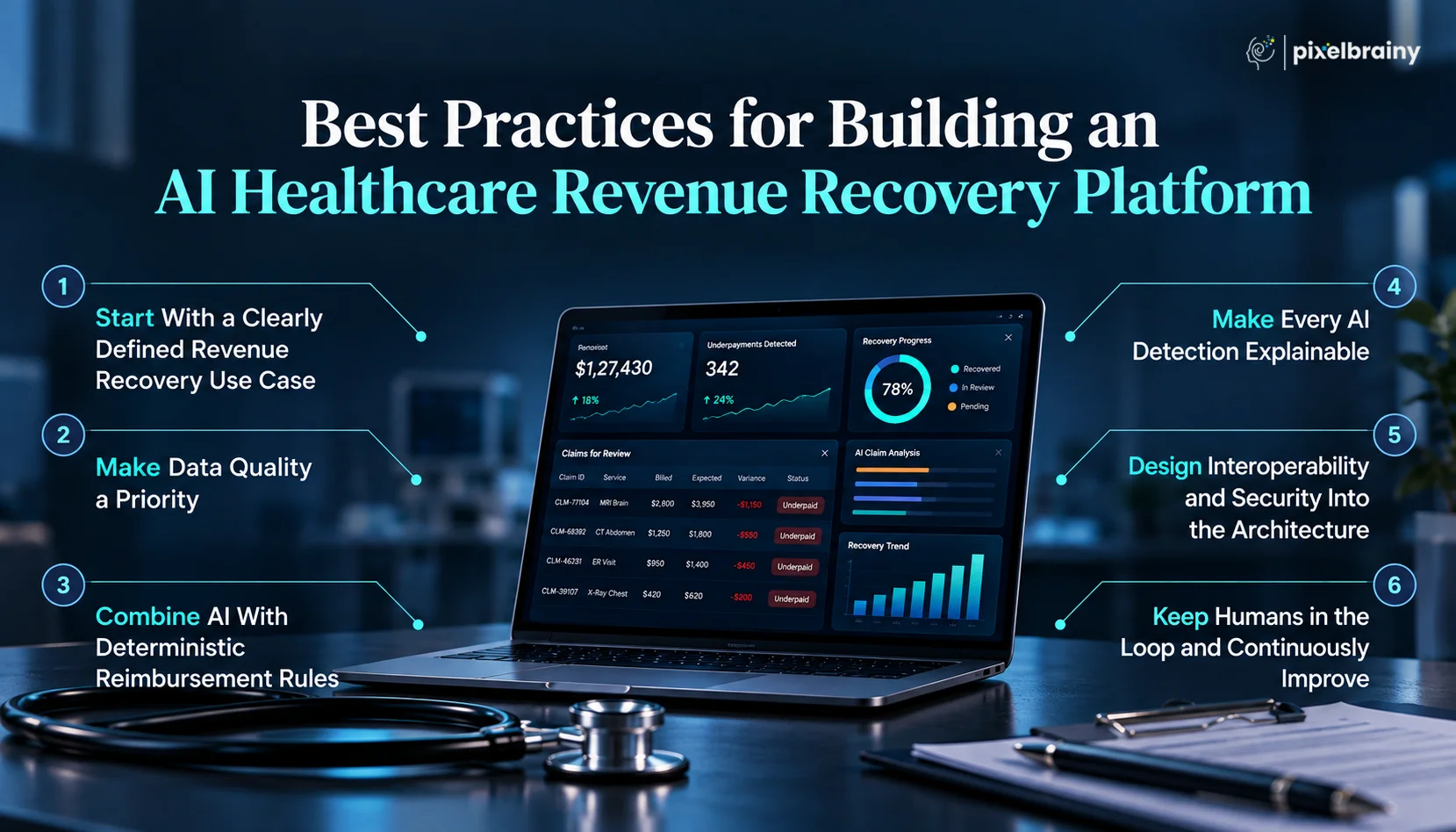
A focused initial use case makes AI healthcare revenue recovery software development more manageable.
Instead of attempting to automate every revenue cycle activity, begin with a defined area such as underpayment detection for specific payers, procedures, facilities, or reimbursement models.
Establish:
A focused scope makes it easier to validate the platform and expand capabilities based on measurable results.
Accurate AI results depend on accurate healthcare revenue data. Claims, payment records, contracts, remittance information, provider details, and procedure data should be standardized before being processed by detection models.
The platform should identify:
Data validation pipelines should operate continuously so poor-quality information does not create unnecessary underpayment alerts.
AI should not replace exact contractual calculations when those calculations can be represented through deterministic rules.
A reliable AI healthcare revenue recovery platform can use traditional rules for expected reimbursement calculations while applying AI to:
This combination provides greater consistency while still allowing AI to handle complex patterns and unstructured information.
Revenue analysts need to understand why the system identified a potential underpayment.
Each flagged claim should ideally show:
Expected reimbursement: $8,000
Actual payment: $7,250
Potential variance: $750
Detection reason: Contractual payment discrepancy
Supporting rule: Applicable payer reimbursement term
AI confidence: High
This approach allows analysts to validate findings faster and creates greater trust in AI-powered underpayment detection.
Healthcare organizations commonly operate multiple EHR, billing, RCM, clearinghouse, payer, and payment systems. The platform should therefore be designed to work with existing infrastructure rather than assuming that organizations will replace their current systems.
Appropriate technologies may include FHIR, HL7, EDI, REST APIs, and secure file exchange, depending on the integration requirements.
CMS's 2026 Interoperability Framework emphasizes standards-based exchange, including FHIR APIs, along with security and access considerations. (cms.gov)
Security should cover encryption, authentication, role-based access, audit logging, secrets management, monitoring, and appropriate PHI protection.
AI should support revenue cycle professionals rather than automatically making every financially significant recovery decision.
Give analysts the ability to:
These human decisions can provide valuable feedback for improving rules and AI models.
Track metrics such as detection precision, false-positive rates, recovery success, recovered revenue, analyst acceptance, processing volume, and model performance.
Following these practices can help create an AI healthcare revenue recovery platform that delivers accurate detection, stronger security, explainable results, and measurable revenue recovery outcomes.
When you build an AI-powered healthcare revenue recovery platform, the development process can encounter challenges across data quality, payer contracts, AI accuracy, healthcare integrations, security, and scalability. Each challenge can directly affect the platform's ability to detect underpayments accurately and help revenue cycle teams recover missed revenue.
For organizations investing in AI healthcare revenue recovery software development, identifying these challenges early and planning practical solutions can reduce development risks, improve system reliability, and increase user trust.
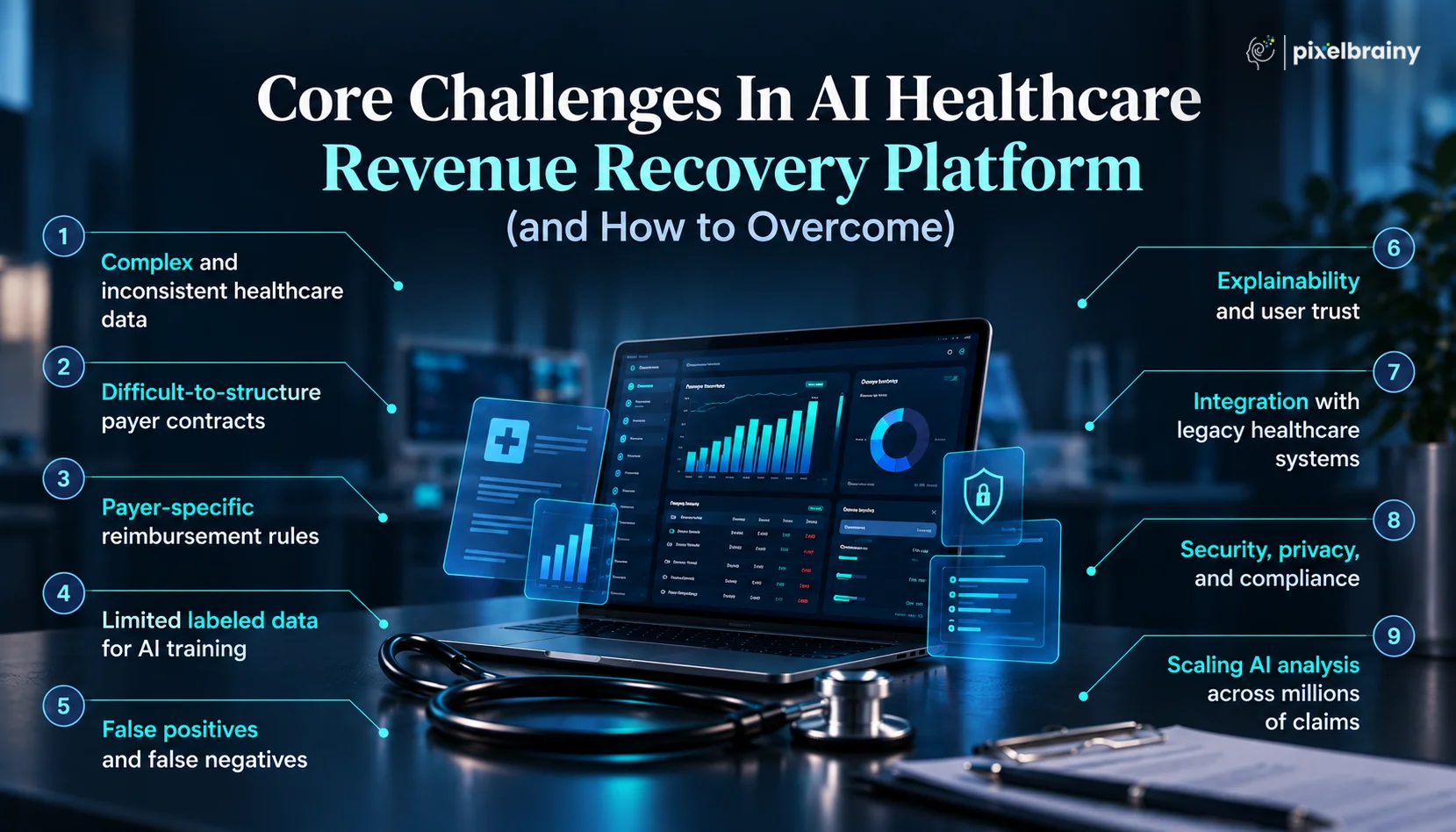
Challenge: When you connect claims, payment, EHR, billing, RCM, clearinghouse, ERA, and EOB data, you may encounter different formats, identifiers, coding structures, and data quality issues. Missing information, duplicate claims, inconsistent payer identifiers, and mismatched payment records can negatively affect AI analysis.
Solution: Build a centralized data normalization and validation layer that standardizes incoming information before it reaches the AI models. Include deduplication, data-quality checks, standardized identifiers, validation rules, and continuous monitoring to improve the reliability of the AI healthcare revenue recovery platform.
Challenge: When you analyze payer contracts, reimbursement rates, exclusions, modifiers, effective dates, amendments, exceptions, and payment conditions may be distributed across lengthy documents. Converting these terms into reliable machine-readable rules can be difficult.
Solution: Implement AI-powered contract intelligence supported by structured validation workflows. Use document processing and NLP to extract relevant terms, then validate important reimbursement rules before using them for payment calculations. Contract version control should also ensure that outdated terms do not influence current analysis.
Challenge: When you work with multiple payers, similar procedures can have different reimbursement conditions. Rules may vary according to payer, contract, provider, facility, procedure, modifier, effective date, and reimbursement methodology.
Solution: Create a flexible reimbursement rules engine that supports payer-specific logic, effective dates, exceptions, and contract versions. This allows AI healthcare revenue recovery software to adapt to different reimbursement environments without requiring major changes to the entire platform.
Challenge: When you prepare AI models for automated underpayment detection, obtaining sufficient labeled examples can be difficult. Healthcare organizations typically have far more paid claims than confirmed underpayment cases, while manual labeling requires considerable revenue cycle expertise.
Solution: Combine historical recovery cases, expert annotations, rules-based detection, human feedback, and carefully constructed validation datasets. Continuously collect confirmed recovery outcomes so the AI system has better-quality feedback for future model improvement.
Challenge: When an AI system analyzes thousands or millions of claims, inaccurate detection can become a major operational problem. False positives create unnecessary investigations, while false negatives can cause legitimate recovery opportunities to remain unidentified.
Solution: Monitor precision, recall, false-positive rates, false-negative rates, recovery outcomes, and analyst feedback. Use configurable thresholds and payer-specific detection strategies to improve accuracy while allowing revenue teams to review financially significant cases before taking recovery action.
Challenge: When revenue analysts receive an AI-generated underpayment alert, they need to understand why the claim was flagged. An unexplained prediction can make users reluctant to trust the system.
Solution: Provide an explainable detection view showing expected reimbursement, actual payment, variance amount, relevant contract terms, detection reason, supporting claim information, and AI confidence. This makes the AI healthcare revenue recovery platform easier for analysts to validate and use.
Challenge: When you integrate a revenue recovery solution with existing healthcare infrastructure, legacy systems can create significant technical obstacles. Organizations may use combinations of APIs, FHIR, HL7, EDI, SFTP, databases, and proprietary interfaces.
Solution: Develop a flexible integration layer capable of supporting multiple healthcare data exchange methods. Use standardized APIs and healthcare interoperability technologies where available, while creating secure adapters for older systems. This allows organizations to add AI capabilities without replacing their existing EHR, billing, RCM, or payment infrastructure.
Challenge: When your platform processes healthcare revenue information, it may handle PHI alongside sensitive financial and contractual information. Unauthorized access, insecure integrations, poor access controls, or inappropriate data handling can create significant security and compliance risks.
Solution: Incorporate security into the architecture from the beginning. Use encryption, role-based access, multi-factor authentication, secure APIs, audit logging, secrets management, data retention controls, and incident response processes. Applicable HIPAA and contractual requirements should also be evaluated according to the platform's specific data flows.
Challenge: When an enterprise healthcare organization needs to analyze millions of claims, processing every record through resource-intensive AI models can increase infrastructure costs, latency, and operational complexity.
Solution: Use scalable cloud infrastructure, distributed processing, batch workflows, asynchronous processing, efficient data pipelines, and optimized model serving. Rules-based pre-filtering can identify claims with a higher probability of discrepancies before deeper AI analysis is performed, helping control processing costs while maintaining broad claim coverage.
Addressing each challenge with a practical solution can help create an AI-powered healthcare revenue recovery platform that delivers accurate detection, secure data processing, scalable performance, and greater confidence among revenue cycle teams.
From the above discussion, it is now time to identify the right technology partner that can turn a healthcare revenue recovery concept into a secure, scalable, and commercially viable product. PixelBrainy works as an AI healthcare software development company, helping businesses translate complex healthcare workflows into intelligent digital solutions.
PixelBrainy approaches healthcare product development by first understanding the business problem, data environment, user workflows, and integration requirements. This is particularly important for organizations dealing with fragmented claims data, payer contracts, reimbursement rules, legacy systems, and complex revenue cycle operations.
PixelBrainy can support the complete product journey, from initial AI consultation and technical planning through architecture, development, integrations, testing, deployment, and ongoing optimization.
Its capabilities can support AI healthcare revenue recovery platform development services around requirements such as:
A relevant buyer query for this stage is: “We already have EHR, billing, and payment systems, but our revenue teams still manually identify underpayments. Can a technology partner create an AI layer that works with our existing infrastructure and automates detection, prioritization, and recovery workflows?”
For this type of requirement, the technology partner needs to understand both healthcare revenue operations and AI implementation, rather than treating the project as a conventional software application.
PixelBrainy has experience working on confidential healthcare technology initiatives involving revenue-focused AI workflows. Due to client confidentiality, specific organization details and sensitive business information cannot be disclosed. However, the project involved capabilities relevant to an automated revenue recovery environment:
This experience provides a practical foundation for organizations looking to build AI healthcare revenue recovery software around complex healthcare data and operational workflows.
For companies seeking to develop AI healthcare revenue recovery platform capabilities or pursue healthcare revenue recovery platform development integrating AI, PixelBrainy can help translate the business concept into a structured product roadmap and scalable technology solution.
Ready to turn your healthcare revenue recovery idea into an AI-powered platform? Connect with PixelBrainy today.
An AI healthcare revenue recovery platform can help healthcare organizations move from manual payment audits toward continuous, intelligent, and scalable underpayment detection. As discussed throughout this guide, successful AI healthcare revenue recovery platform development requires more than implementing an AI model. It involves reliable healthcare data integration, payer contract intelligence, accurate reimbursement calculations, automated variance detection, recovery workflows, security, compliance, and human oversight.
Organizations planning to develop an AI healthcare revenue recovery platform should begin with a focused use case, validate the concept through a PoC, establish strong data and integration foundations, and gradually introduce advanced AI capabilities. The right technology architecture can also allow existing EHR, billing, RCM, clearinghouse, and payment systems to remain in place.
Whether the goal is to build AI healthcare revenue recovery software for internal operations or create a scalable commercial product, a structured development strategy can turn fragmented payment data into actionable recovery opportunities and measurable financial outcomes.
Ready to turn your healthcare revenue recovery idea into reality? Book an appointment with our experts today.
Yes. AI healthcare revenue recovery platform development can be designed as an intelligence layer that integrates with your existing EHR, billing, RCM, clearinghouse, payer, and payment systems. APIs, FHIR, HL7, EDI 835/837, SFTP, and other integration methods can be used depending on your infrastructure. This approach allows organizations to develop an AI healthcare revenue recovery platform without rebuilding their entire revenue cycle environment.
During AI healthcare revenue recovery software development, the platform can process payer contracts, reimbursement schedules, claims, and 835 ERA data to calculate expected versus actual reimbursement. AI-powered contract intelligence can extract relevant payment terms, while a reimbursement rules engine applies payer-specific conditions. The system can then flag potential variances for automated underpayment detection and human review.
When organizations build AI healthcare revenue recovery software, they can use AI-based recovery scoring to rank potential opportunities according to variance amount, payer behavior, confidence, historical recovery rates, and estimated recovery value. This allows revenue cycle teams to focus on high-value opportunities instead of manually reviewing every claim.
For AI healthcare revenue recovery platform development, organizations may need 835 ERA files, 837 claims, payer contracts, fee schedules, reimbursement rules, CPT/HCPCS information, modifiers, provider data, facility information, and historical recovery outcomes. Standardizing these sources helps the platform compare actual payments with expected reimbursement and identify potential underpayments more accurately.
When you develop an AI healthcare revenue recovery platform, combine AI models with deterministic reimbursement rules, configurable thresholds, data validation, and human feedback. The platform should continuously monitor precision, recall, false-positive rates, false-negative rates, analyst acceptance, and actual recovery outcomes. This helps improve automated underpayment detection without overwhelming revenue cycle teams with unnecessary alerts.
Yes. Explainability should be incorporated into AI healthcare revenue recovery software development from the beginning. Each flagged claim can display expected reimbursement, actual payment, variance amount, applicable payer contract term, reimbursement rule, detection reason, and AI confidence. This gives analysts the evidence required to validate a potential underpayment before beginning recovery or appeal workflows.
The right decision depends on your requirements. Buying can be suitable when existing solutions provide the required integrations, detection capabilities, contract intelligence, and recovery workflows. Custom AI healthcare revenue recovery platform development may be better when you need proprietary reimbursement logic, specialized integrations, customized AI capabilities, or complete control over the product roadmap. A hybrid approach can also combine existing RCM infrastructure with custom AI capabilities.
Yes. An advanced AI healthcare revenue recovery platform can use detected payment variances, contract terms, claim information, and supporting evidence to generate draft appeals. The platform can also manage appeal submission, review, follow-up, payer responses, resolution status, and recovered amounts. Human approval can remain part of the workflow before an appeal is submitted, particularly for financially significant recovery cases.

About The Author
Sagar Bhatnagar
Sagar Sahay Bhatnagar brings over a decade of IT industry experience to his role as Marketing Head at PixelBrainy. He's known for his knack in devising creative marketing strategies that boost brand visibility and market influence. Sagar's strategic thinking, coupled with his innovative vision and focus on results, sets him apart. His track record of successful campaigns proves his ability to utilize digital platforms effectively for impactful marketing efforts. With a genuine passion for both technology and marketing, Sagar continuously pushes PixelBrainy's marketing initiatives to greater success.

Working with the PixelBrainy team has been a highly positive experience. They understand the design requirements and create beautiful UX elements to meet the application needs. The dev team did an excellent job bringing my vision to life. We discussed usability and flow. Sagar worked with his team to design the database and begin coding. Working with Sagar was easy. He has the knowledge to create robust apps, including multi-language support, Google and Apple ID login options, Ad-enabled integrations, Stripe payment processing, and a Web Admin site for maintaining support data. I'm extremely satisfied with the services provided, the quality of the final product, and the professionalism of the entire process. I highly recommend them for Android and iOS Mobile Application Design and Development.

Great experience working with them. Had a lot of feedback and I found that unlike most contractors they were bugging me for updates instead of the other way around. They were extremely time conscience and great at communicating! All work was done extremely high quality and if not on time, early! They were always proactive when it comes to communication and the work is great/above par always. Very flexible and a great team to work with! Goes above and beyond to present us with multiple options and always provides quality. Amazing work per usual with Chitra. If you have UI/UX or branding design needs I recommend you go to them! Will likely work with them in the future as well, definitely recommended!

PixelBrainy is a joy to work with and is a great partner when thinking through branding, logo, and website layout. I appreciate that they spend time going into the "why" behind their decisions to help inform me and others about industry best practices and their expertise.

I hired them to design our software apps. Things I really like about them are excellent communication skills, they answer all project suggestions and collaborate right away, and their input on design and colors is amazing. This project was complex and needed patience and creativity. The team is amazing to do business with. I will be using them long-term. Glad to see there are some good people out there. I was afraid to try and outsource my project to someone but I am glad I met them! I really can't say enough. They went above and beyond on this project. I am very happy with everything they have done to make my business stand out from the competition.

It was great working with PixelBrainy and the team. They were very responsive and really owned the project. We'll definitely work with them again!

I recently worked with the PixelBrainy team on a project and I was blown away by their communication skills. They were prompt, clear, and articulate in all of our interactions. They listened and provided valuable feedback and suggestions to help make the project a success. They also kept me updated throughout the entire process, which made the experience stress-free and enjoyable.

PixelBrainy is very good at what it does. The team also presents themselves very professionally and takes care of their side of things very well. I could fully trust them taking up the design work in a timely and organised manner and their attention to detail saved us lots of effort and time. This particular project was quite intense and the team showed that they function very well under pressure. Very much looking forward to working with her again!

It's always an absolute pleasure working with them. They completed all of my requests quickly and followed every note I had for them to a T, which made our process go smoothly from start to finish. Everything was completed fast and following all of the guidelines. And I would recommend their services to anyone. If you need any design work done in the future, PixelBrainy should be your first call!

They took ownership of our requirements and designed and proposed multiple beautiful variants. The team is self-motivated, requires minimum supervision, committed to see-through designs with quality and delivering them on time. We would definitely love to work with PixelBrainy again when we have any requirements.

PixelBrainy was a big help with our SaaS application. We've been hard at work with a new UI/UX and they provided a lot of help with the designs. If you're looking for assistance with your website, software, or mobile application designs, PixelBrainy and the team is a great recommendation.

PixelBrainy designers are amazing. They are responsive, talented, and always willing to help craft the design until it matches your vision. I would recommend them and plan to continue them for my future projects and more!!!

They were awesome! Did a good job fast, and good communication. Will work with them again. Thank you

Creative, detail-oriented, and talented designers who take direction well and implement changes quickly and accurately. They consistently over-delivered for us.

PixelBrainy team is very talented and creative. Great designers and a pleasure to work with. PixelBrainy is an excellent communicator and I look forward to working with them again.

PixelBrainy has a very talented design team. Their work is excellent and they are very responsive. I enjoy working with them and hope to continue on all of our future projects.


Transform your ideas into reality with us.
Across these industries, each engagement brings unique challenges, from early-stage product development to scaling complex systems, helping us build a practical understanding of real-world product environments.