AI Summary Powered by PixelBrainy
What happens when two humanoid robot vendors enter one warehouse, but your operations team still has to manage them through two disconnected dashboards?
A logistics operator piloting humanoid robots for tote handling quickly encounters a problem that hardware demonstrations rarely show. One vendor reports battery health in its portal. Another exposes task status through a separate interface. Supervisors cannot see a shared queue, compare uptime consistently, or understand which robot should receive the next tote movement. When a robot pauses, the team must determine whether the cause is a blocked aisle, a gripper fault, a low battery, a network interruption, or a vendor-side software issue. The result is fragmented oversight rather than a coordinated robotic workforce.
AI humanoid robot management platforms address this operational gap. They provide a centralized software layer for registering robots, translating vendor-specific commands, assigning work, monitoring health, enforcing site rules, and reporting performance across a mixed fleet. A well-designed AI humanoid robot management platform connects warehouse management systems, execution software, robot control interfaces, maintenance workflows, and human supervisors without assuming every robot uses the same hardware or autonomy stack.
The commercial opportunity is growing, but adoption figures need context. MarketsandMarkets estimated the humanoid robot market at $5.41 billion in 2026 and projected $50.27 billion by 2035, a forecast rather than confirmed revenue. Read the original market estimate. This growth outlook makes AI humanoid robot management platform development relevant to businesses preparing for larger, more diverse robot fleets.
Existing products show parts of the model. Agility Robotics’ Arc manages Digit workflows and fleet metrics, while OdinFleet demonstrates vendor-agnostic coordination across heterogeneous robot fleets. Neither should be mistaken for a universal plug-and-play layer for every humanoid.
This guide explains humanoid robot management platform development with AI, including architecture, digital twin simulation, features, implementation stages, technology choices, costs, and safety controls. The goal is practical: one governed operating picture for every robot, every task, every shift, and every facility.

An AI humanoid robot management platform is an enterprise software solution that enables businesses to manage, monitor, coordinate, and optimize multiple humanoid robots through a centralized interface.
Instead of operating each robot through an individual manufacturer's dashboard, businesses can use one management environment to oversee their robotic workforce.
The platform connects humanoid robots with enterprise applications, operational databases, AI services, digital twins, and human supervisors. It collects information from different robot models, standardizes operational data, and uses intelligent automation to coordinate activities.
For example, consider a distribution center operating 15 humanoid robots from three manufacturers.
The management platform can:
Traditional robot management software primarily focuses on monitoring, scheduling, and controlling robot activities through predefined rules.
AI introduces additional intelligence by helping the platform interpret operational information, identify patterns, predict potential problems, and improve task allocation.
Some important AI capabilities include:
| AI Capability | Business Application |
|---|---|
| Predictive analytics | Identifies potential robot failures before they interrupt operations. |
| Intelligent task allocation | Assigns work based on availability, capabilities, and workload. |
| Computer vision integration | Helps interpret visual information and recognize operational conditions. |
| Anomaly detection | Identifies unusual movements, sensor readings, or performance changes. |
| Natural language processing | Allows supervisors to interact with operational data through conversational queries. |
| Reinforcement learning | Supports controlled optimization of robot behavior within validated environments. |
| Predictive maintenance | Estimates maintenance requirements using historical telemetry and component health. |
It is important to distinguish between fleet-level AI and robot-level autonomy. The management platform does not necessarily control every joint movement or grasp. Those functions usually remain within the robot's onboard controllers and vendor-specific autonomy systems.
The management platform coordinates higher-level activities, while individual robots execute approved actions through their supported interfaces.
Therefore, an AI humanoid robot management platform acts as the central operating system for a business's humanoid robot workforce.
Building a scalable AI humanoid robot management platform requires an architecture that connects robots from different manufacturers, processes real-time data, coordinates tasks, and maintains operational safety.
For businesses managing humanoid robots across warehouses, manufacturing facilities, and logistics operations, the platform should support vendor-agnostic integration, AI-powered task orchestration, digital twin simulation, and enterprise-level security.
A modular, API-first, cloud-edge architecture is a strong approach to AI humanoid robot management platform development. It allows businesses to add new robots, integrate enterprise applications, and expand their robotic workforce without rebuilding the entire system.
A practical architecture consists of eight interconnected layers.
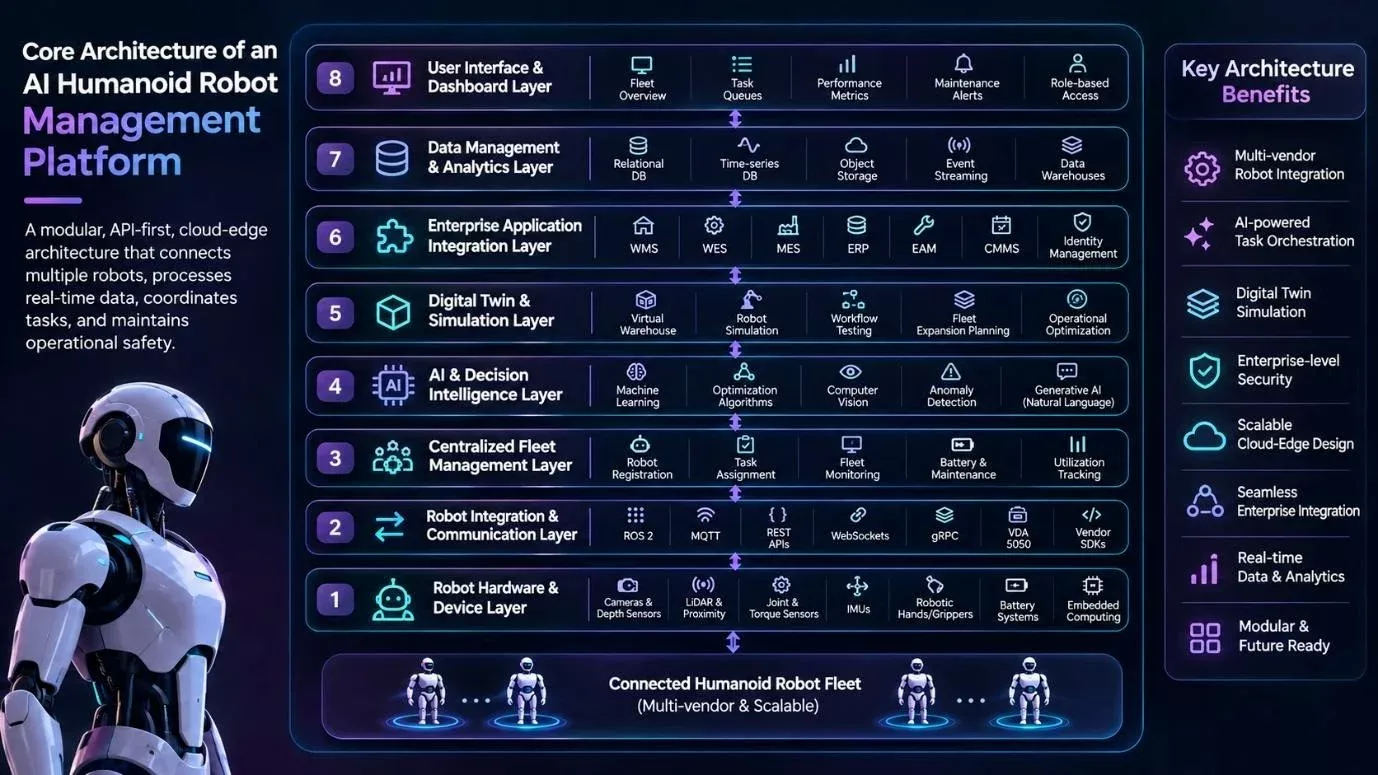
This layer represents the physical humanoid robots deployed across business facilities. It includes their sensors, actuators, embedded computers, and communication components.
Each robot may have different hardware specifications, such as:
During AI humanoid robot management platform development, create a standardized robot registry containing manufacturer, model, serial number, firmware version, supported capabilities, and operational status.
For example, one warehouse robot may support tote handling, while another is designed for lightweight material transportation. The platform must identify these differences before assigning tasks.
This layer connects humanoid robots from different manufacturers to the centralized management platform.
Since vendors use different APIs, SDKs, communication protocols, and data formats, developers need a vendor-agnostic integration layer with standardized adapters and connectors.
Recommended technologies include:
For example, a common platform command such as execute_tote_transfer may need to be translated into different vendor-specific workflows.
The integration layer should also standardize task progress, error codes, completion reports, and available safety-state information.
The fleet management layer acts as the central coordination engine of the AI humanoid robot management platform.
It enables businesses to monitor and manage all connected robots through one interface.
Its main responsibilities include:
For example, when a warehouse receives 100 tote movement requests, the fleet manager checks robot availability, capabilities, location, battery levels, and workload before assigning tasks.
If one robot becomes unavailable, the platform can identify another eligible robot for reassignment, subject to operational and safety restrictions.
The AI layer improves fleet coordination by analyzing robot telemetry, task history, and operational data.
For AI-powered humanoid robot management software development, this layer can include:
For example, an operations manager could ask, "Which robots experienced the highest downtime during the night shift?"
The AI assistant can retrieve relevant information and generate a report. However, AI recommendations should follow business policies, and generative AI should never bypass robot safety controls.
The digital twin layer is an important component of how to build an AI humanoid robot management platform with digital twin simulation.
It creates a virtual representation of the warehouse, robots, equipment, and operational workflows.
The simulation environment can represent:
For example, a logistics company planning to expand its fleet from 10 to 30 robots can simulate the deployment before purchasing additional hardware.
The simulation can help identify warehouse congestion, charging bottlenecks, inefficient task allocation, and potential workflow problems.
Technologies such as NVIDIA Isaac Sim, Gazebo, and OpenUSD can support digital twin development and virtual testing.
This layer connects the robot management platform with existing business applications, preventing another isolated software ecosystem.
Important integrations include:
For example, a WMS can generate a tote movement request, the robot management platform assigns it to a suitable humanoid, and the WMS receives confirmation after task completion.
This creates a connected workflow between enterprise operations and robotic workforce management.
The data management layer collects, stores, and processes information generated by connected humanoid robots.
It supports real-time monitoring, predictive maintenance, AI model development, and performance reporting.
Recommended components include:
The platform should maintain consistent robot IDs, task IDs, timestamps, and operational status definitions.
This allows businesses to compare uptime, task completion, and maintenance performance across different robot manufacturers.
The final layer provides a centralized workspace for managing the robotic workforce.
The dashboard should display fleet status, task queues, performance metrics, maintenance alerts, and operational reports.
Different users require different dashboard permissions.
| User role | Dashboard requirements |
|---|---|
| Operations manager | Fleet productivity, uptime, task completion, and utilization. |
| Warehouse supervisor | Live robot status, task queues, and alerts. |
| Maintenance engineer | Robot diagnostics, component health, and maintenance schedules. |
| Safety officer | Safety incidents, restricted zones, and intervention records. |
| System administrator | User access, integrations, permissions, and configurations. |
For example, a warehouse supervisor should be able to view all connected robots, check availability, assign tote-handling tasks, and monitor execution without switching between vendor dashboards.
During humanoid robot management platform development with AI, separate fleet-level coordination from safety-critical robot control.
The central platform should manage task assignments, analytics, and operational monitoring. However, emergency stops, collision prevention, and other safety-critical functions should remain within appropriate independent robot-level and facility-level safety systems.
Implement authenticated commands, role-based permissions, restricted operating zones, and audit logs.
All eight architectural layers should work together to create a secure, scalable, and intelligent platform that manages different humanoid robots through one centralized operating environment.
The growing adoption of humanoid robots across logistics, manufacturing, warehousing, and industrial operations is creating demand for centralized robot management software. As enterprises introduce robots from multiple manufacturers, managing individual machines through separate vendor dashboards becomes increasingly complicated. Businesses need a unified platform to coordinate robot activities, manage shared task queues, monitor fleet operations, and analyze performance.
This creates a strong opportunity for AI humanoid robot management software development. A centralized platform provides the software infrastructure needed to manage heterogeneous robot fleets, integrate enterprise applications, and support future automation requirements.
According to MarketsandMarkets, the global humanoid robot market is estimated to reach $5.41 billion in 2026 and is projected to grow to $50.27 billion by 2035.
Here are six major reasons businesses should consider investing in this technology.
The humanoid robotics industry is moving beyond research laboratories toward commercial applications in warehouses, manufacturing facilities, and logistics operations. As more enterprises explore humanoid robot deployments, demand for software to manage, monitor, and coordinate these machines is also expected to increase.
This creates an opportunity to invest in AI humanoid robot management platforms that support fleet operations, robot integrations, centralized monitoring, and enterprise automation workflows. Businesses entering this space can develop software infrastructure that supports the growing commercial humanoid robotics ecosystem.
Large enterprises are exploring humanoid robots for material handling, repetitive industrial activities, and warehouse operations. According to Bank of America Global Research, investment in humanoid robotics increased from approximately $700 million in 2018 to $4.3 billion in 2025.
As investment increases, businesses will require supporting software to manage their robotic assets. This creates demand for customized AI humanoid robot management software development, particularly platforms that connect different manufacturers, standardize operational data, and coordinate enterprise-wide robotic deployments.
Enterprises may purchase humanoid robots from different manufacturers depending on hardware capabilities, payload requirements, manipulation skills, and operational applications. However, each manufacturer may provide its own dashboard, communication interface, and task management system.
Managing these disconnected environments becomes difficult as the fleet expands. Businesses therefore need humanoid robot management platform development with AI to establish a common task queue, unified monitoring environment, and standardized reporting system.
For example, a logistics company operating robots from two vendors can use one platform to assign tote-handling tasks, monitor uptime, and compare fleet performance.
The wider industrial robotics ecosystem is creating opportunities for advanced robot management solutions. According to the International Federation of Robotics (IFR), approximately 5 million industrial robots were operating in factories worldwide in 2025. IFR forecasts annual installations of approximately 655,000 industrial robots in 2026.
Although these figures cover industrial robots broadly rather than humanoids specifically, they demonstrate the scale of enterprise robotics adoption. Businesses developing humanoid robot management platforms can build on this automation ecosystem through integrations with existing WMS, MES, ERP, and industrial infrastructure.
As businesses deploy more humanoid robots, manually assigning tasks and monitoring individual machines becomes increasingly difficult. Enterprises need intelligent software to evaluate robot availability, task priorities, capabilities, battery conditions, and operational restrictions before allocating work.
Investing in AI-powered humanoid robot management software creates opportunities to introduce predictive maintenance, intelligent task scheduling, anomaly detection, and performance forecasting. Digital twin simulation can also help businesses evaluate deployment strategies and operational scenarios before implementing changes in physical facilities.
The growing humanoid robotics ecosystem creates opportunities for robotics manufacturers, system integrators, and Robotics-as-a-Service (RaaS) providers to develop their own management platforms.
Through AI humanoid robot management platform development, businesses can create software products supporting multiple manufacturers, customer deployments, and geographically distributed facilities.
Potential commercial models include SaaS subscriptions, enterprise licensing, custom integrations, and usage-based fleet management services. This allows companies to build recurring-revenue software products alongside their robotics hardware and automation offerings.
Investing in AI humanoid robot management software development provides an opportunity to establish the digital infrastructure required for enterprise-scale robotic operations. As humanoid deployments expand, centralized fleet management and intelligent robot orchestration will become increasingly important to business automation strategies.
An AI humanoid robot management platform is suitable for businesses that manufacture, operate, integrate, or provide robotic automation services. As organizations introduce humanoid robots into commercial environments, they need centralized software to manage different robot models, coordinate operational tasks, and monitor fleet performance.
But which businesses should invest in AI humanoid robot management platform development? The strongest opportunities exist for organizations managing multiple robots, complex workflows, or geographically distributed operations.
Here are seven business categories that can benefit from developing a customized humanoid robot management platform.
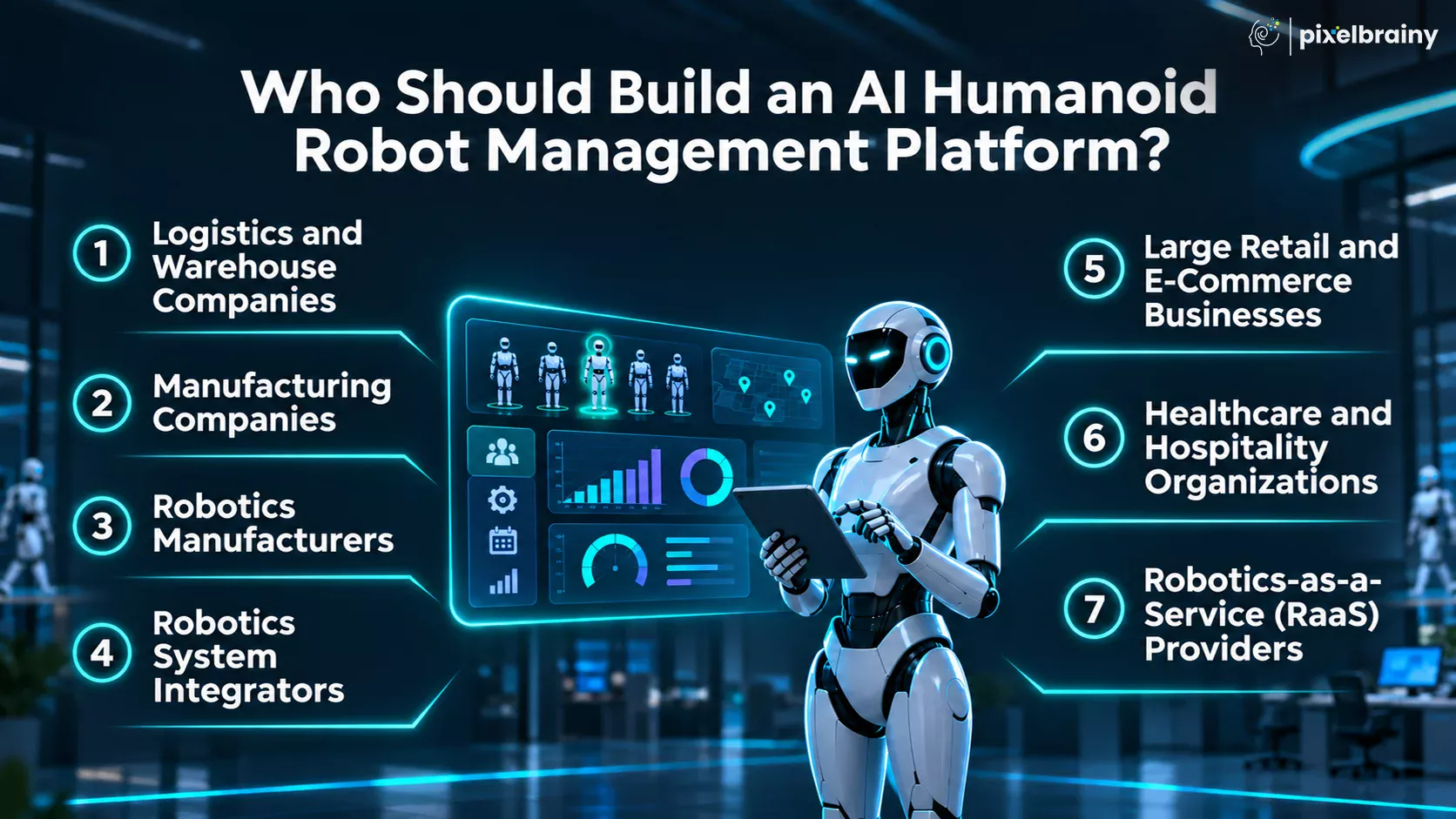
Logistics and warehouse businesses can use humanoid robots for tote handling, material transportation, inventory movement, picking assistance, and other repetitive warehouse activities.
As robot deployments increase, managing different machines through separate vendor dashboards can create operational difficulties. A centralized management platform helps logistics companies coordinate robot fleets, assign tasks, monitor uptime, and integrate robotic activities with existing WMS and WES applications.
Example use case: A third-party logistics company operates humanoid robots from two manufacturers across multiple distribution centers. It develops a centralized platform to manage shared task queues, assign tote-handling activities, and monitor performance across all locations.
Manufacturing businesses can explore humanoid robots for component transportation, material handling, machine tending, workstation support, and other validated industrial workflows.
An AI-powered robot management platform allows manufacturers to coordinate robot activities with production schedules, monitor machine availability, and manage operational tasks across different production areas.
Example use case: An automotive manufacturer uses a centralized robot management system to assign component transportation tasks between workstations based on production requirements and robot availability.
Humanoid robot manufacturers can develop customized fleet management software alongside their physical robot products.
Instead of providing customers with hardware and basic monitoring tools, manufacturers can offer an integrated software environment for robot registration, deployment, task management, maintenance, and performance analytics.
Example use case: A humanoid robot manufacturer develops an enterprise management dashboard that allows customers to monitor deployed robots, track operational health, manage software configurations, and access maintenance reports.
This also creates opportunities for recurring revenue through software subscriptions, enterprise licensing, and technical support services.
Robotics system integrators connect robotic hardware with enterprise applications, industrial infrastructure, and business workflows.
They can invest in vendor-agnostic humanoid robot management platform development to deliver centralized management solutions instead of building separate interfaces for every robot manufacturer.
Example use case: A robotics integration company develops a unified platform that connects humanoid robots from different vendors with a customer's WMS, ERP, and manufacturing systems.
Retailers and e-commerce companies can explore humanoid robots for inventory movement, stock transportation, backroom operations, and other suitable store and warehouse activities.
A centralized robot management platform helps these businesses coordinate deployments across multiple stores, fulfillment centers, and distribution facilities.
Example use case: An e-commerce company manages humanoid robots across several fulfillment centers through one platform to monitor availability, assign inventory movement tasks, and track operational performance.
Healthcare and hospitality organizations can explore humanoid robots for approved material transportation, internal logistics, reception assistance, and service-support activities.
A dedicated management platform helps coordinate robot assignments, monitor operational status, and maintain human supervision.
Example use case: A hospital manages service-support robots through a centralized dashboard to coordinate approved supply transportation between designated departments.
In these environments, platform development must prioritize patient and customer privacy, access restrictions, human oversight, and workplace safety.
Robotics-as-a-Service providers offer robotic hardware and automation capabilities through subscription-based or usage-based commercial models.
These businesses need centralized software to manage robots deployed across different customer locations.
An AI humanoid robot management platform can help RaaS providers monitor:
Example use case: A RaaS provider manages humanoid robots deployed across 20 customer warehouses through one enterprise platform, with separate dashboards, permissions, and performance reports for each customer.
Whether you are a logistics operator, humanoid robot manufacturer, system integrator, or RaaS provider, investing in a customized AI humanoid robot management platform can help establish the software foundation for managing increasingly complex robotic operations.
Developing an AI humanoid robot management platform offers businesses more than a centralized dashboard for monitoring robotic activities. It creates a structured environment to manage robot fleets, coordinate tasks, analyze operational data, and maintain control over increasingly complex automation workflows.
As organizations deploy humanoid robots across warehouses, manufacturing facilities, and industrial environments, managing their performance, safety, and accountability becomes increasingly important.
Consider a real operational requirement: As a safety manager, I need to know how humanoid robots sharing floor space with workers are governed. I want software that enforces zones, logs incidents, records interventions, and produces audit records for our insurers and regulators.
This is where AI humanoid robot management software development becomes valuable. A centralized platform can support safety governance alongside fleet coordination, performance monitoring, and operational management.
Here are six major benefits of developing an AI-powered humanoid robot management platform.
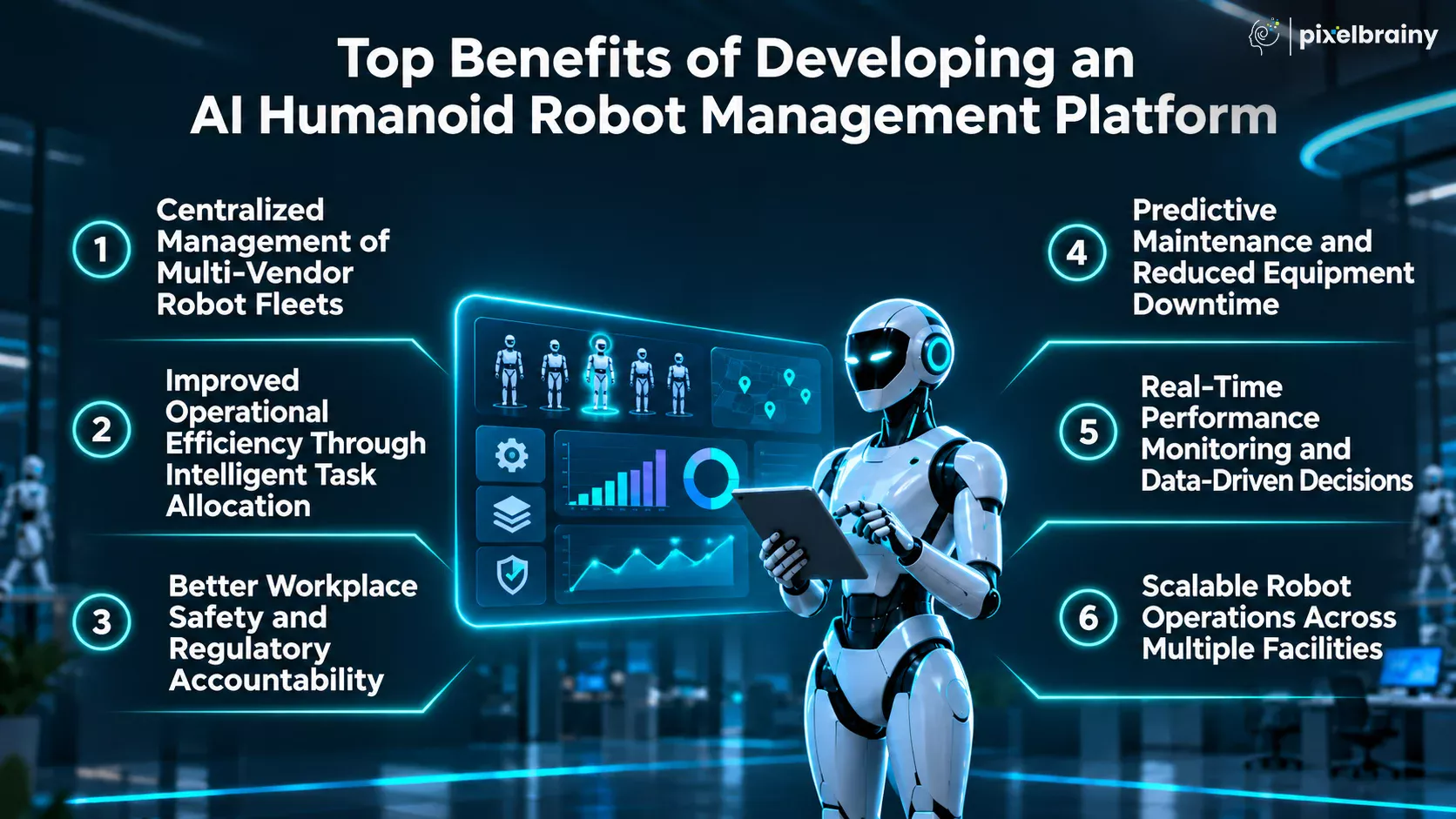
Managing humanoid robots from different manufacturers through separate dashboards creates operational complexity. A centralized management platform brings robot registration, monitoring, task assignment, and fleet reporting into one interface.
Businesses can view robot availability, battery levels, operational status, and task progress without switching between vendor applications. This makes AI humanoid robot management platforms particularly valuable for enterprises operating heterogeneous robot fleets across multiple facilities.
AI-powered task allocation helps businesses distribute work according to robot availability, location, capabilities, battery conditions, and task priorities.
Instead of manually assigning every activity, the platform can recommend suitable robots for incoming requests. For example, a warehouse can automatically identify an eligible humanoid robot for tote transportation based on its registered manipulation capabilities.
This supports more organized workflows and reduces unnecessary manual coordination.
Humanoid robots often operate in environments shared with human employees. Businesses therefore need software that supports operational restrictions, safety monitoring, and incident accountability.
A management platform can enforce configured operating zones, record safety incidents, log human interventions, and maintain audit trails. Safety-rated protective functions must remain independently implemented, but centralized software provides valuable governance and reporting capabilities.
This is particularly important for businesses managing industrial robot deployments and regulatory documentation.
Unexpected equipment failures can interrupt warehouse and manufacturing operations. AI-powered predictive maintenance helps businesses identify unusual patterns in robot telemetry before they develop into serious operational problems.
The platform can analyze battery degradation, actuator temperatures, sensor readings, and historical fault records to generate maintenance alerts.
Maintenance teams can use these insights to schedule inspections, prioritize repairs, and maintain more consistent robot availability.
A centralized AI humanoid robot management platform provides managers with operational information across their entire robotic workforce.
They can monitor fleet uptime, task completion rates, utilization, intervention frequency, and maintenance expenses through consolidated dashboards.
These insights help businesses compare robot performance, identify recurring operational bottlenecks, and evaluate whether their automation investments are delivering the expected results.
As businesses expand their humanoid robot deployments, managing additional machines and locations through disconnected systems becomes increasingly difficult.
A modular management platform allows enterprises to add new robot manufacturers, facilities, users, and operational workflows without rebuilding the complete application.
It also supports centralized administration with location-specific permissions, configurations, and performance reporting.
This makes humanoid robot management platform development with AI a strategic investment for businesses planning long-term robotic workforce expansion.
Overall, an AI-powered humanoid robot management platform helps businesses move beyond individual robot monitoring toward coordinated, accountable, and scalable robotic workforce management. Its real value lies in combining operational intelligence, safety governance, and enterprise-wide visibility within one software ecosystem.
An effective AI humanoid robot management platform needs more than a dashboard to display robot status. It requires a complete set of operational features that help businesses register robots, coordinate tasks, monitor fleet performance, manage maintenance, and maintain control over daily robotic activities.
Consider this real business requirement: As a warehouse operations manager, I need one dashboard to monitor robots from multiple vendors, assign tote-handling tasks, check battery levels, track task completion, and receive alerts whenever a robot becomes unavailable. Which essential features should my robot management software include?
To address these requirements, AI humanoid robot management platform development should focus on practical fleet management capabilities that simplify everyday operations and support different robot manufacturers.
Here are 15 must-have features to include in an enterprise-ready humanoid robot management platform.
| Must-have feature | Description and functionality |
|---|---|
| Centralized Robot Fleet Dashboard | A unified dashboard allows businesses to monitor all connected humanoid robots through one interface. It displays robot availability, operational status, battery levels, active tasks, and fleet performance, eliminating the need to switch between different vendor dashboards. |
| Robot Registration and Profile Management | This feature allows administrators to register robots from different manufacturers and maintain individual profiles. Each profile stores robot IDs, manufacturer details, model information, firmware versions, hardware specifications, deployment locations, and supported operational capabilities. |
| Real-Time Robot Status Monitoring | Real-time monitoring provides continuous visibility into robot connectivity, battery levels, current tasks, sensor status, and operational conditions. Supervisors can identify unavailable robots, communication interruptions, and unexpected status changes through centralized monitoring. |
| Centralized Task Queue Management | A shared task queue enables supervisors to create, prioritize, assign, pause, and track operational requests. Businesses can manage tote transfers, material transportation, and other approved workflows without maintaining separate task queues for different robot manufacturers. |
| Vendor API Integration | Vendor API integration connects robots from different manufacturers with the central management platform. Custom connectors translate supported vendor-specific commands and telemetry into standardized platform formats, enabling consistent fleet monitoring and task coordination. |
| Robot Capability Management | This feature maintains information about the tasks each humanoid robot can perform. Administrators can define supported activities, payload limits, gripper configurations, and operational restrictions to prevent incompatible task assignments across different robot models. |
| AI-Assisted Task Assignment | AI-assisted task assignment evaluates robot availability, location, capabilities, battery conditions, and workload before recommending suitable machines for incoming requests. Businesses can combine optimization algorithms with predefined operational rules to coordinate daily activities. |
| Battery and Power Monitoring | Battery monitoring tracks power levels, charging status, and battery-related operational alerts. Supervisors can identify robots requiring charging and manage availability according to configured power thresholds, reducing unexpected interruptions during scheduled operations. |
| Maintenance Management | The maintenance module records robot faults, inspection schedules, service history, repair activities, and maintenance requirements. It helps engineering teams organize servicing activities and maintain accurate records of robot maintenance across different facilities. |
| Alerts and Notification Management | Automated notifications inform relevant employees about disconnected robots, low battery levels, failed tasks, maintenance requirements, and operational errors. Configurable alerts help supervisors respond to important events without continuously checking the management dashboard. |
| Task Execution Tracking | This feature tracks each task from assignment to completion. It records task status, timestamps, assigned robot, execution progress, completion results, and failure reasons, providing businesses with a consistent operational history across their robotic workforce. |
| Performance Analytics and Reporting | Analytics dashboards present important KPIs, including fleet uptime, task completion rates, robot utilization, intervention frequency, and downtime. Managers can generate shift-wise, daily, and monthly reports to evaluate operational performance and compare robot models. |
| Role-Based Access Control | Role-based access control allows businesses to assign platform permissions according to employee responsibilities. Operations managers, warehouse supervisors, maintenance engineers, and administrators receive appropriate access to monitoring, configuration, reporting, and task management functions. |
| Safety Monitoring and Audit Logs | This feature records safety events, restricted-zone violations, operator interventions, task cancellations, and authorized configuration changes. It provides searchable audit records that help businesses investigate incidents and maintain operational accountability alongside independent safety systems. |
| Enterprise Application Integration | Enterprise integration connects the robot management platform with WMS, WES, ERP, MES, and maintenance applications. It enables businesses to synchronize task requests, operational updates, inventory movements, and completion records across existing enterprise workflows. |
These above essential features establish the foundation for a centralized, secure, and scalable AI humanoid robot management platform that supports everyday enterprise robot operations.
After you have finalized your core features, you can plan the next development phase by introducing advanced AI capabilities, intelligent automation, and simulation technologies. These features take an AI humanoid robot management platform beyond basic fleet monitoring and task management, helping enterprises handle complex workflows, optimize robotic operations, and prepare for large-scale deployments.
Consider this real business requirement: As a warehouse automation director, I already have a centralized platform managing 50 humanoid robots. Now I want to simulate new warehouse layouts before deployment, predict equipment failures, automatically redistribute tasks when robots become unavailable, and forecast how many robots we will need during peak seasons. Which advanced capabilities should I introduce next?
This is where advanced AI humanoid robot management platform development becomes important. The following 10 features can help businesses build a more intelligent, predictive, and scalable robotic workforce management system.
| Advanced feature | Description and functionality |
|---|---|
| Digital Twin Simulation | Digital twin technology creates a virtual representation of warehouses, humanoid robots, workstations, and operational workflows. Businesses can simulate robot movements, task assignments, facility layouts, and fleet expansion scenarios before implementing changes in physical environments. |
| AI-Powered Predictive Maintenance | Predictive maintenance models analyze historical telemetry, actuator temperatures, battery degradation, and sensor readings to identify potential equipment problems. The platform can generate early maintenance alerts, helping engineering teams schedule inspections before unexpected failures disrupt operations. |
| Autonomous Task Reallocation | This feature automatically identifies alternative robots when an assigned machine becomes unavailable. The AI scheduling engine evaluates task compatibility, robot capabilities, workload, and operational restrictions before recommending or executing an authorized task reassignment. |
| Natural Language-Based Robot Management | A generative AI assistant allows supervisors to interact with fleet information using conversational queries. Managers can ask about robot availability, maintenance requirements, task failures, and shift performance without manually navigating multiple dashboards and reports. |
| AI-Based Demand and Capacity Forecasting | Predictive analytics examines historical task volumes, warehouse activity, seasonal demand, and operating schedules to estimate future robot capacity requirements. Businesses can use these forecasts to plan fleet expansion, staffing coordination, and charging infrastructure. |
| Advanced Computer Vision Analytics | Computer vision models analyze approved camera feeds and visual inspection data to identify misplaced totes, blocked workstations, damaged containers, and unexpected objects. These insights help businesses monitor selected operational conditions and identify workflow disruptions. |
| Human-Robot Collaboration Intelligence | This feature coordinates workflows involving human employees and humanoid robots. It can manage task handovers, operator notifications, intervention requests, and approved collaboration procedures while respecting independently implemented safety controls and restricted operating zones. |
| Robot Skill Learning and Capability Optimization | An advanced capability management system maintains validated robot skills and their operational constraints. Businesses can use this information to identify suitable robots for complex tasks and evaluate new capabilities through controlled training, testing, and validation processes. |
| Multi-Site Intelligent Fleet Orchestration | This feature enables enterprises to coordinate humanoid robots across multiple warehouses, factories, and distribution centers. Administrators can compare facility performance, monitor regional fleets, manage deployment policies, and generate consolidated enterprise reports. |
| AI-Based Safety and Risk Analytics | AI-powered safety analytics examines incident records, intervention frequency, operational alerts, and restricted-zone events to identify recurring risk patterns. Safety teams can use these insights to investigate incidents, improve operating procedures, and strengthen workplace safety governance. |
These advanced capabilities can transform a basic robot management application into an intelligent enterprise platform with AI that supports predictive operations, digital twin simulation, and large-scale humanoid robot fleet orchestration.
A successful AI humanoid robot management platform requires a structured development approach that connects business requirements, robot hardware, enterprise applications, AI capabilities, and operational workflows. From selecting compatible robot manufacturers to deploying a centralized fleet management system, every development stage must align with the organization's automation goals.
Consider this real business requirement: I am a COO at a manufacturing company planning to deploy twenty humanoid robots over the next two years. I cannot tell whether our WMS and ERP can feed them work, how tasks should be prioritized between robots and people, or what operations tooling we need. I want to understand what a management platform must do before we scale.
This is why understanding the steps to develop an AI humanoid robot management platform from idea to launch is important. A phased approach helps businesses validate technical feasibility, establish the right architecture, and prepare for enterprise-wide deployment.
Here are eight essential steps explaining how to build an AI humanoid robot management platform from scratch.
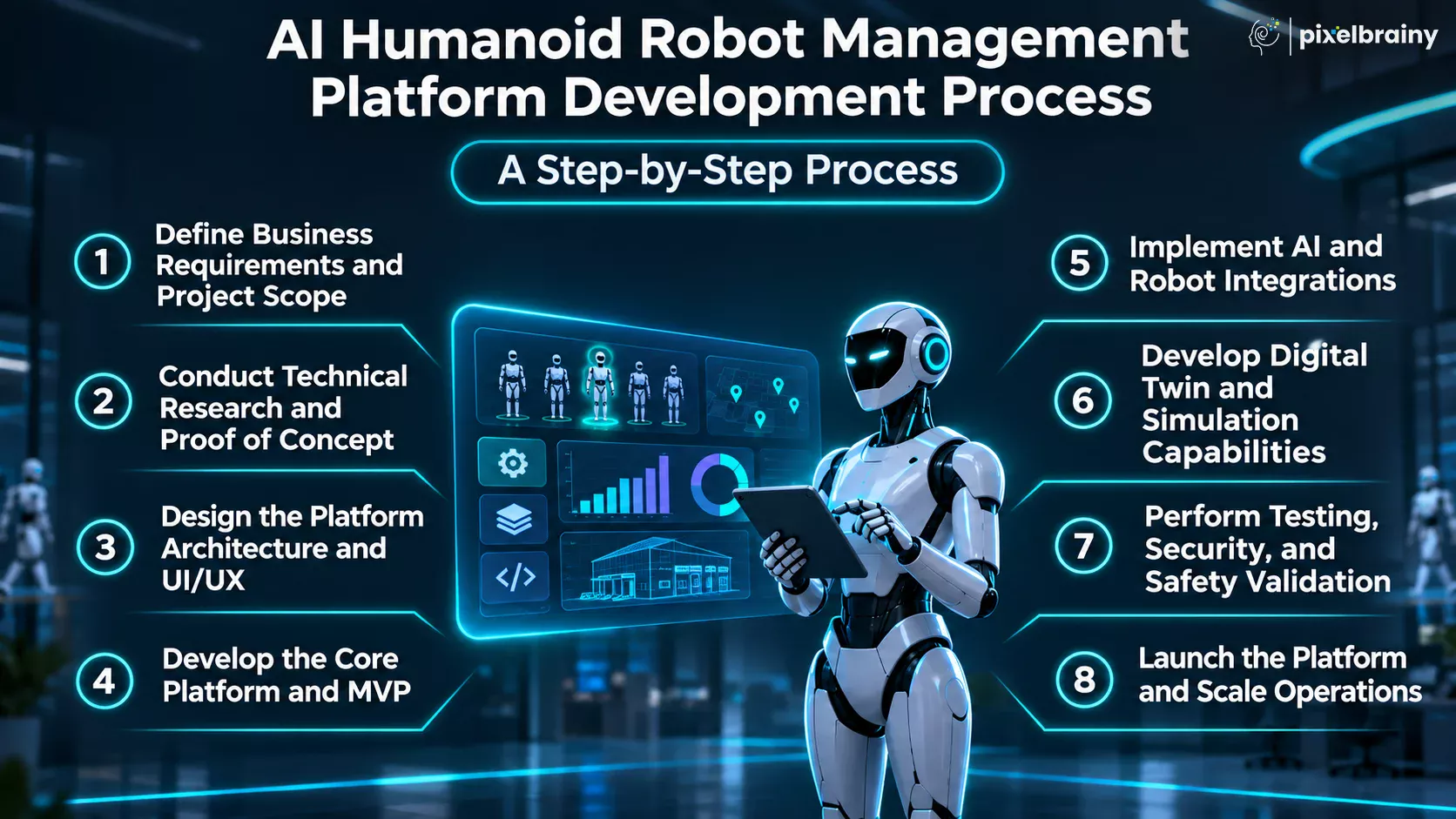
Start by identifying the operational problems your AI humanoid robot management platform needs to solve. Determine how many robots the business plans to manage, which manufacturers will be supported, and what activities the robots will perform.
For example, a manufacturing company deploying 20 humanoid robots should define requirements for task assignment, production coordination, robot monitoring, maintenance, and human supervision.
Conduct AI consultation to evaluate technical feasibility, automation opportunities, and project requirements. Also, identify essential integrations with existing WMS, ERP, and MES applications.
Deliverable: Business requirements document, project scope, and development roadmap.
Also Read: Top 10 AI Consulting Companies in USA
Once the requirements are finalized, evaluate the technical capabilities of the selected humanoid robots. Examine vendor APIs, SDKs, communication protocols, telemetry availability, hardware specifications, and supported task execution interfaces.
At this stage, PoC development helps validate whether robots from different manufacturers can communicate with the proposed management platform.
Test basic operations such as robot registration, status monitoring, task assignment, and completion reporting. Research the technical approaches used by top AI development companies and robotics solution providers to understand suitable architecture patterns.
Deliverable: Technical feasibility report, robot compatibility assessment, and validated proof of concept.
Also Read: Top 10+ AI PoC Development Companies In USA
The next step is to define the system architecture and user experience. Plan the backend services, robot integration adapters, fleet management engine, databases, messaging infrastructure, AI services, and enterprise APIs.
The architecture should support multiple robot manufacturers and future fleet expansion.
Simultaneously, design dashboards for operations managers, warehouse supervisors, maintenance engineers, and safety officers. Collaborate with a UI/UX design company to create intuitive interfaces for monitoring robot status, managing shared task queues, and reviewing performance reports.
Deliverable: Technical architecture, wireframes, user journeys, and UI/UX design prototypes.
Also Read: Top 10+ UI/UX Design Companies in USA
Once the architecture and interface designs are approved, begin implementing the platform's essential modules. Focus on robot registration, fleet monitoring, centralized task management, user authentication, notifications, and basic reporting.
Prioritize MVP development to launch a functional version with a limited number of robot integrations rather than building every planned feature immediately.
For example, start with two humanoid robot manufacturers and one warehouse facility. Validate the shared task queue and operational dashboard before expanding the system.
Deliverable: Functional MVP with essential fleet management capabilities.
Also Read: Top 10 AI MVP Development Companies in USA
After establishing the core platform, connect the selected humanoid robots using vendor-specific APIs, SDKs, and communication adapters.
Introduce AI integration for intelligent task allocation, operational analytics, and anomaly detection. Depending on available data, proceed with AI model development for predictive maintenance, task duration estimation, and performance forecasting.
Ensure that AI recommendations follow predefined operational constraints and cannot bypass robot safety controls.
Deliverable: Connected robot fleet, standardized communication layer, and validated AI-powered management capabilities.
Also Read: Top 10+ AI Integration Companies in USA
Create a digital representation of the business environment, including robot configurations, workstations, operational zones, and task workflows.
Integrate simulation technologies to test different robot deployment scenarios before introducing them into physical facilities.
For example, a manufacturing company can simulate how 20 humanoid robots will distribute tasks across production areas, identify potential congestion, and evaluate workload allocation between employees and robots.
Use simulation results to refine scheduling strategies and deployment plans.
Deliverable: Digital twin environment, simulated workflows, and validated deployment scenarios.
Also Read: Top 12 AI Avatar Development Companies in USA
Before production deployment, conduct comprehensive testing to verify that the platform works reliably across different robot manufacturers and enterprise applications.
Perform functional, integration, load, performance, and cybersecurity testing. Validate task assignment, communication failures, robot disconnections, and recovery workflows.
Also, review access permissions, audit logs, emergency procedures, and safety-system integrations with qualified professionals.
If additional technical expertise is required, businesses can hire AI developers and robotics engineers to support specialized integration, testing, and optimization activities.
Deliverable: Tested platform, security assessment, and documented safety validation.
Once testing is complete, deploy the platform in a controlled production environment. Begin with a limited robot fleet and monitor operational KPIs such as uptime, task completion, utilization, maintenance frequency, and human intervention rates.
Collect feedback from supervisors and maintenance teams to identify areas requiring improvement.
After validating the initial deployment, expand the platform to additional robots, facilities, and enterprise applications. Businesses evaluating AI product development companies should also consider long-term maintenance, integration support, and scalability before finalizing their technology partner.
Deliverable: Production launch, operational monitoring, and phased expansion roadmap.
Following these eight steps helps businesses develop an AI humanoid robot management platform that moves from technical feasibility and initial planning to validated enterprise deployment and scalable robotic workforce management.
The cost to build an AI humanoid robot management platform typically ranges from $45,000 to $250,000+, depending on platform complexity, robot integration requirements, AI capabilities, digital twin simulation, and enterprise infrastructure.
A basic platform with robot monitoring and task management requires less investment than an enterprise-grade solution supporting multiple robot manufacturers, predictive maintenance, multi-tenant architecture, and advanced fleet orchestration.
Consider this real business requirement: We are a startup that wants to offer robots as a service to mid-size warehouses. We need a multi-tenant platform for deployment, per-customer dashboards, usage-based billing, remote updates, and SLA tracking. I want to understand the architecture, development cost, and timeline.
For this type of business, development costs depend on the number of supported robot vendors, customer environments, billing integrations, and operational requirements.
The following table provides an estimated cost breakdown for developing the major components of an enterprise robot management platform.
| Development component | Development Cost | Monthly Operating Cost |
|---|---|---|
| UI and UX design | $8,000-$18,000 | None |
| Robot connectivity adapters | $12,000-$28,000 | $200-$800 |
| Telemetry pipeline | $10,000-$24,000 | $400-$2,000 |
| Task orchestration engine | $14,000-$32,000 | $200-$900 |
| Operator console and teleoperation | $12,000-$28,000 | None |
| Safety, audit, and access control | $8,000-$18,000 | $150-$600 |
| Business system integrations | $9,000-$22,000 | $100-$500 |
| Analytics and ROI dashboard | $7,000-$16,000 | None |
| QA and field testing | $8,000-$18,000 | None |
| Project management | $5,000-$12,000 | None |
| Total estimated cost | $93,000-$216,000 | $1,050-$4,800/month |
The overall AI humanoid robot management software development cost also depends on the type of platform a business wants to launch.
| Development Scope | Included Features | Estimated Development Cost | Best Suited For |
|---|---|---|---|
| Core MVP | Robot monitoring, task queue, single-vendor integration, and audit logs | $45,000-$85,000 | Single-site pilot |
| Full platform | Multi-vendor integration, enterprise APIs, intervention tools, and ROI analytics | $90,000-$170,000 | Enterprise operators |
| Enterprise platform | Multi-tenant architecture, predictive maintenance, digital twin simulation, and advanced orchestration | $170,000-$250,000+ | RaaS providers and robotics software businesses |
For startups: A Core MVP is a practical starting point for validating the platform with initial customers.
For enterprises: A full platform provides more comprehensive fleet management and integration capabilities.
For RaaS providers: An enterprise platform is more suitable when customer-specific dashboards, usage-based billing, remote fleet management, and SLA tracking are essential.
Development team location can also influence the overall project budget. Hourly rates vary according to engineering expertise, robotics experience, project complexity, and engagement models.
| Development Team Location | Estimated Hourly Rate | Estimated Full-Platform Cost |
|---|---|---|
| United States | $150-$250 | $235,000-$455,000 |
| Eastern Europe | $50-$100 | $96,000-$227,000 |
| India and South Asia | $25-$60 | $60,000-$136,000 |
| PixelBrainy | Custom pricing | Custom quotation |
These are indicative market-planning ranges, not fixed regional pricing. PixelBrainy's project estimate would depend on the agreed features, integrations, development timeline, and technical requirements.
Apart from the core development components, businesses should consider several additional expenses when estimating the total cost of building an AI humanoid robot management platform.
For a startup planning a multi-tenant Robotics-as-a-Service platform, a reasonable initial planning estimate is $170,000-$250,000+, with an indicative development timeline of approximately 8-14 months.
The proposed development roadmap could include:
| Development Phase | Estimated Timeline |
|---|---|
| Requirement analysis and architecture | 3-5 weeks |
| UI/UX design and platform planning | 3-4 weeks |
| Core platform and multi-tenant development | 8-12 weeks |
| Robot integrations and AI development | 8-12 weeks |
| Billing, SLA, and remote management | 4-6 weeks |
| Testing and deployment | 4-6 weeks |
Some phases can run in parallel, so the total timeline is not simply the sum of every phase.
The right development budget depends on your business model, robot integrations, and scalability requirements. Starting with a clearly scoped MVP and expanding toward enterprise-grade capabilities helps control investment while preparing the platform for long-term growth.
The technology stack plays an important role in determining how efficiently an AI humanoid robot management platform communicates with different robot manufacturers, processes real-time telemetry, manages operational tasks, and supports enterprise integrations.
For businesses planning AI humanoid robot management platform development, the technology architecture should support robotics middleware, AI model integration, real-time messaging, cloud-edge computing, digital twin simulation, and secure data management.
Consider this real technical requirement: We are building a multi-vendor humanoid robot management platform for warehouses. We need to connect robots from different manufacturers, process real-time telemetry, assign tasks through AI, simulate warehouse operations, and integrate with existing WMS and ERP systems. Which technologies should we use for a scalable and secure architecture?
The ideal technology stack should address these requirements while allowing businesses to add new robot models, AI capabilities, and enterprise applications as their operations expand.
| Technology Layer | Recommended Technologies | Purpose and Application |
|---|---|---|
| Frontend development | React.js, Next.js, TypeScript | Develop interactive fleet dashboards, robot monitoring interfaces, task management screens, and enterprise reporting panels. |
| UI component libraries | Material UI, Ant Design, Tailwind CSS | Create consistent, responsive interfaces for operations managers, warehouse supervisors, and maintenance teams. |
| Mobile application | React Native, Flutter | Build mobile applications for robot status monitoring, maintenance notifications, and authorized supervisor access. |
| Backend development | Python, FastAPI, Node.js | Develop backend services, business logic, robot management APIs, and enterprise application integrations. |
| Robotics middleware | ROS 2 | Support robotics communication, device integration, and coordination with compatible robot systems. |
| Robot communication | MQTT, Zenoh, DDS | Exchange robot telemetry, operational events, and communication messages across connected systems. |
| API communication | REST APIs, WebSockets, gRPC | Enable communication between robot adapters, backend services, enterprise applications, and dashboards. |
| AI and machine learning | PyTorch, TensorFlow, scikit-learn | Develop predictive maintenance models, anomaly detection systems, task optimization, and performance forecasting. |
| Computer vision | OpenCV, NVIDIA Isaac ROS | Support visual inspection, object recognition, and integration with approved robot perception systems. |
| Digital twin simulation | NVIDIA Isaac Sim, Gazebo, OpenUSD | Simulate robot movements, warehouse environments, operational workflows, and fleet deployment scenarios. |
| Relational database | PostgreSQL | Store robot profiles, user accounts, task information, configurations, and enterprise records. |
| Time-series database | TimescaleDB, InfluxDB | Store and analyze robot telemetry, battery readings, sensor measurements, and performance metrics. |
| Caching | Redis | Improve access to frequently requested operational information and temporary application data. |
| Event streaming | Apache Kafka | Process high-volume robot events, telemetry streams, and distributed application messages. |
| Cloud infrastructure | AWS, Microsoft Azure, Google Cloud | Host application services, manage data storage, support AI workloads, and provide scalable infrastructure. |
| Containerization | Docker, Kubernetes | Package, deploy, and scale backend services and application components. |
| Monitoring and observability | Prometheus, Grafana, OpenTelemetry | Monitor application health, infrastructure performance, communication issues, and system availability. |
| Authentication and security | Keycloak, OAuth 2.0, OpenID Connect | Manage user authentication, access permissions, and secure enterprise application access. |
A well-planned technology stack provides the foundation for a scalable, secure, and AI-powered humanoid robot management platform that can support multi-vendor integrations and evolving enterprise automation requirements.
Creating an AI humanoid robot management platform comes with technical, operational, and integration challenges. Businesses need software that can connect different robot models, process real-time data, coordinate tasks, monitor performance, and maintain operational safety as the fleet grows.
Consider a common business query: We operate humanoid robots from multiple vendors in our warehouse. How can we manage all robots through one platform without facing integration issues, delayed task updates, or inconsistent performance reports?
The following challenges explain what businesses should consider when developing humanoid robot management software and how to address them.
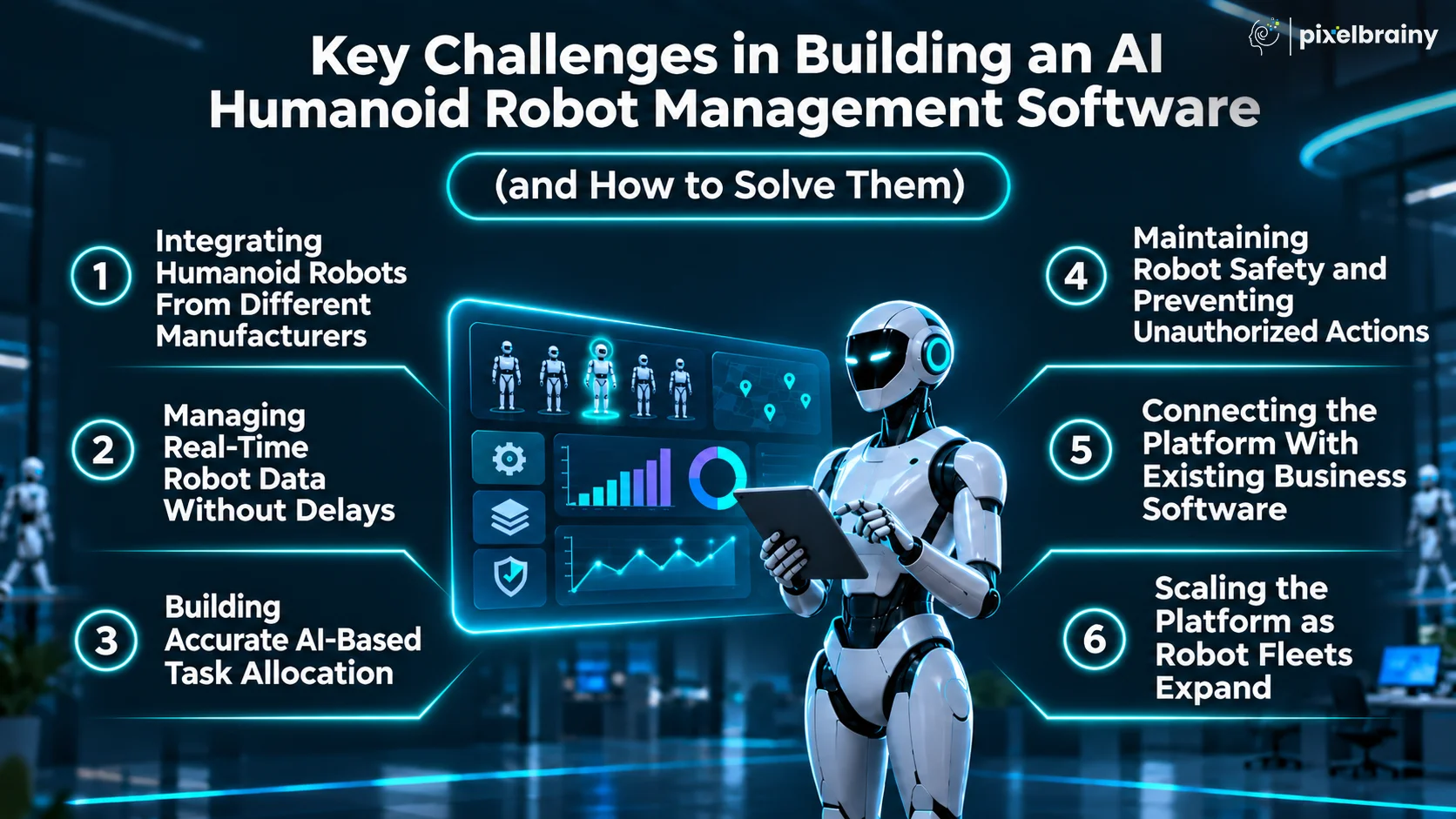
Challenge: Every humanoid robot manufacturer may provide different APIs, SDKs, communication protocols, operating systems, and robot capabilities. A platform designed for one robot model may not work with another. This creates vendor dependency and makes centralized fleet management difficult.
Solution: Create a modular integration architecture with separate connectors for each robot manufacturer. Use supported standards and technologies such as ROS 2, MQTT, REST APIs, and gRPC to collect and normalize robot data. Maintain a common interface for essential functions such as robot registration, status monitoring, task assignment, and battery reporting.
Challenge: Humanoid robots continuously generate data related to location, movement, battery levels, task progress, errors, and system health. When multiple robots operate simultaneously, the platform must process large volumes of information without creating delays or losing important updates.
Solution: Implement an event-driven data architecture using message brokers, streaming pipelines, and edge processing. Technologies such as Kafka, MQTT, and Redis can support different communication and data-processing requirements. Add message acknowledgements, retry mechanisms, timestamp synchronization, and offline data buffering to improve reliability.
Challenge: How can a business assign the right task to the right humanoid robot? A basic task queue cannot account for differences in robot capabilities, battery levels, workload, location, task priority, and environmental conditions. Poor task allocation can increase idle time and reduce operational efficiency.
Solution: Develop an AI-powered task allocation engine that evaluates robot availability, capabilities, workload, and task requirements before assigning work. Combine machine learning with rule-based decision-making to handle operational constraints. Include task reassignment when a robot becomes unavailable, while keeping critical decisions subject to defined approval and safety rules.
Challenge: Businesses need to manage humanoid robots working around employees, customers, machinery, and other equipment. A software error, incorrect command, unauthorized access, or unexpected robot behavior can create safety and security risks.
Solution: Include role-based access control, command authorization, restricted operating zones, emergency-stop status monitoring, incident records, and audit trails. Integrate with the robot's certified safety mechanisms and facility-level safety systems. The central management platform should coordinate safety information, not replace safety-rated hardware or local protective controls.
Challenge: Companies often rely on ERP, WMS, MES, WES, and CMMS platforms to manage inventory, orders, production, and maintenance. If humanoid robot management software cannot exchange information with these systems, employees may need to enter tasks and operational data manually.
Solution: Build secure API integrations and middleware to connect robot operations with existing enterprise applications. For example, a WMS can generate a picking task, the robot management platform can assign it to an available humanoid robot, and task completion data can be returned to the warehouse system. Define consistent data formats, integration rules, and error-handling workflows.
Challenge: A platform that performs well with five humanoid robots may experience performance issues when managing 100 robots across multiple warehouses or manufacturing facilities. More robots mean higher telemetry volumes, additional integrations, increased user activity, and more complex maintenance requirements.
Solution: Design the software with modular services, scalable databases, containerization, and cloud-edge deployment options. Introduce multi-site fleet management, centralized configuration, automated software updates, and predictive maintenance. Use simulation and load testing to evaluate system performance before increasing the number of connected robots.
Overcoming these challenges requires a scalable software architecture, reliable robot integrations, intelligent task orchestration, and strong safety controls. Addressing them early helps businesses build an AI humanoid robot management platform that can support real-world operations and long-term fleet expansion.
Businesses exploring AI humanoid robot management platform development services often face a critical decision: should they use the management software bundled with their robots or invest in a custom solution? Consider this business query: We are deciding between a custom platform and the vendor tools bundled with our robots. We need multi-vendor support, ERP integration, custom workflows, and our own analytics. What are the differences in capabilities, cost, and vendor lock-in risk?
Vendor-provided tools can work well when a business operates robots from a single manufacturer and needs standard monitoring features. However, companies managing different robot models may require centralized control, custom workflows, independent analytics, and integration with existing enterprise systems. A custom platform offers greater flexibility and control, although it requires additional investment in development, infrastructure, and ongoing maintenance.
PixelBrainy works with businesses seeking tailored digital solutions aligned with their operational requirements. As a best AI product development company in USA, PixelBrainy can be considered as a technology partner for businesses exploring custom robotics management software.
Key areas of development can include:
Consider a warehouse automation project involving humanoid robots from multiple manufacturers. The business required a unified dashboard, warehouse task synchronization, robot health monitoring, maintenance alerts, and custom performance reports.
The proposed solution included a centralized management interface, vendor-specific integration connectors, an enterprise integration layer, and custom reporting capabilities. This scenario demonstrates how businesses can build an AI humanoid robot management platform around their own workflows instead of depending entirely on separate manufacturer dashboards. It is an illustrative scenario, not a verified PixelBrainy client case study.
Before starting, PixelBrainy can help assess robot compatibility, integration complexity, infrastructure requirements, development scope, and estimated costs. This planning establishes the technical foundation needed to develop an AI humanoid robot management platform that supports current operations and future expansion.
The objective is to create a humanoid robot management platform integrating AI with practical business workflows, centralized fleet visibility, and analytics that support better operational decisions.
Have a humanoid robotics software idea? Connect with PixelBrainy to discuss your requirements and development roadmap.
An AI-powered humanoid robot management platform is becoming an important part of enterprise AI automation as businesses explore ways to coordinate robotic operations, improve workforce productivity, and manage complex workflows. However, successful implementation requires more than connecting robots to a dashboard. Companies must consider robot compatibility, AI-based task allocation, real-time monitoring, enterprise integrations, workplace safety, and long-term scalability.
A well-planned AI humanoid robot management platform development strategy helps businesses bring these capabilities together through a centralized system. Whether your goal is to manage a small robot fleet, coordinate multiple manufacturers, or support automation across different facilities, the right architecture and technology partner can make a significant difference.
The next step is to turn your operational requirements into a practical development roadmap, with clear priorities, realistic costs, and measurable business outcomes.
Ready to take your humanoid robotics idea forward? Book an appointment with PixelBrainy to discuss your project requirements and explore the right development approach.
The cost of AI humanoid robot management platform development depends on fleet size, robot integrations, AI capabilities, and enterprise requirements. A basic MVP may cost $45,000 to $85,000, while a comprehensive enterprise solution can exceed $250,000. A detailed scope assessment helps establish an accurate budget.
Yes. Businesses can build an AI humanoid robot management platform with vendor-specific API connectors and standardized communication interfaces. This enables centralized monitoring, task assignment, robot health tracking, and performance reporting across compatible robot models, depending on manufacturers' available APIs, SDKs, and integration permissions.
The timeline to develop an AI humanoid robot management platform depends on software complexity, hardware availability, API documentation, and enterprise integrations. A focused MVP may take three to five months, while a comprehensive enterprise platform may require eight to fourteen months, including testing and deployment.
Yes. An AI humanoid robot management platform can integrate with ERP, WMS, MES, and other enterprise applications through APIs and middleware. For example, a WMS can generate warehouse tasks, the platform can assign them to available robots, and completion updates can synchronize with business systems.
Businesses planning AI humanoid robot management software development should consider AI-based task allocation, predictive maintenance, workload optimization, intelligent alerts, and performance analytics. Advanced capabilities can include digital twin simulation, demand forecasting, and natural language commands, depending on robot capabilities and operational requirements.
A centralized humanoid robot management platform can provide real-time health monitoring, battery alerts, task execution records, incident logs, access controls, and performance reports. Emergency stops and safety-rated functions must still rely on certified robot and facility safety systems, not exclusively on remote software.
Vendor tools may suit businesses using one robot brand with standard requirements. Custom humanoid robot management platform development is more suitable when companies need multi-vendor compatibility, ERP integration, custom workflows, independent analytics, and greater control over data, integrations, and future expansion.
PixelBrainy can discuss your requirements for AI humanoid robot management platform development, including platform architecture, AI capabilities, robot integrations, and enterprise connectivity. A technical assessment of robot APIs, project scope, budget, and deployment goals can help establish a practical development roadmap.

About The Author
Sagar Bhatnagar
Sagar Sahay Bhatnagar brings over a decade of IT industry experience to his role as Marketing Head at PixelBrainy. He's known for his knack in devising creative marketing strategies that boost brand visibility and market influence. Sagar's strategic thinking, coupled with his innovative vision and focus on results, sets him apart. His track record of successful campaigns proves his ability to utilize digital platforms effectively for impactful marketing efforts. With a genuine passion for both technology and marketing, Sagar continuously pushes PixelBrainy's marketing initiatives to greater success.

Working with PixelBrainy has been a great experience. They took our vision for an AI-powered platform and turned it into a fully functional product. What impressed me most was their strong understanding of both design and development, and their ability to handle complex requirements with ease. The team was responsive, cooperative, and always open to feedback. They kept things organized, communicated clearly, and delivered quality work on time. I highly recommend PixelBrainy to anyone looking for a skilled and reliable development partner.

Working with the PixelBrainy team has been a highly positive experience. They understand the design requirements and create beautiful UX elements to meet the application needs. The dev team did an excellent job bringing my vision to life. We discussed usability and flow. Sagar worked with his team to design the database and begin coding. Working with Sagar was easy. He has the knowledge to create robust apps, including multi-language support, Google and Apple ID login options, Ad-enabled integrations, Stripe payment processing, and a Web Admin site for maintaining support data. I'm extremely satisfied with the services provided, the quality of the final product, and the professionalism of the entire process. I highly recommend them for Android and iOS Mobile Application Design and Development.

Great experience working with them. Had a lot of feedback and I found that unlike most contractors they were bugging me for updates instead of the other way around. They were extremely time conscience and great at communicating! All work was done extremely high quality and if not on time, early! They were always proactive when it comes to communication and the work is great/above par always. Very flexible and a great team to work with! Goes above and beyond to present us with multiple options and always provides quality. Amazing work per usual with Chitra. If you have UI/UX or branding design needs I recommend you go to them! Will likely work with them in the future as well, definitely recommended!

PixelBrainy is a joy to work with and is a great partner when thinking through branding, logo, and website layout. I appreciate that they spend time going into the "why" behind their decisions to help inform me and others about industry best practices and their expertise.

I hired them to design our software apps. Things I really like about them are excellent communication skills, they answer all project suggestions and collaborate right away, and their input on design and colors is amazing. This project was complex and needed patience and creativity. The team is amazing to do business with. I will be using them long-term. Glad to see there are some good people out there. I was afraid to try and outsource my project to someone but I am glad I met them! I really can't say enough. They went above and beyond on this project. I am very happy with everything they have done to make my business stand out from the competition.

It was great working with PixelBrainy and the team. They were very responsive and really owned the project. We'll definitely work with them again!

I recently worked with the PixelBrainy team on a project and I was blown away by their communication skills. They were prompt, clear, and articulate in all of our interactions. They listened and provided valuable feedback and suggestions to help make the project a success. They also kept me updated throughout the entire process, which made the experience stress-free and enjoyable.

PixelBrainy is very good at what it does. The team also presents themselves very professionally and takes care of their side of things very well. I could fully trust them taking up the design work in a timely and organised manner and their attention to detail saved us lots of effort and time. This particular project was quite intense and the team showed that they function very well under pressure. Very much looking forward to working with her again!

It's always an absolute pleasure working with them. They completed all of my requests quickly and followed every note I had for them to a T, which made our process go smoothly from start to finish. Everything was completed fast and following all of the guidelines. And I would recommend their services to anyone. If you need any design work done in the future, PixelBrainy should be your first call!

They took ownership of our requirements and designed and proposed multiple beautiful variants. The team is self-motivated, requires minimum supervision, committed to see-through designs with quality and delivering them on time. We would definitely love to work with PixelBrainy again when we have any requirements.

PixelBrainy was a big help with our SaaS application. We've been hard at work with a new UI/UX and they provided a lot of help with the designs. If you're looking for assistance with your website, software, or mobile application designs, PixelBrainy and the team is a great recommendation.

PixelBrainy designers are amazing. They are responsive, talented, and always willing to help craft the design until it matches your vision. I would recommend them and plan to continue them for my future projects and more!!!

They were awesome! Did a good job fast, and good communication. Will work with them again. Thank you

Creative, detail-oriented, and talented designers who take direction well and implement changes quickly and accurately. They consistently over-delivered for us.

PixelBrainy team is very talented and creative. Great designers and a pleasure to work with. PixelBrainy is an excellent communicator and I look forward to working with them again.

PixelBrainy has a very talented design team. Their work is excellent and they are very responsive. I enjoy working with them and hope to continue on all of our future projects.


Transform your ideas into reality with us.
Across these industries, each engagement brings unique challenges, from early-stage product development to scaling complex systems, helping us build a practical understanding of real-world product environments.