 AI Summary Powered by PixelBrainy
What happens when an enterprise has twelve AI agents performing individual tasks successfully, but none can collaborate to complete a business process that spans multiple departments?
For a VP of AI at a large enterprise, this challenge often emerges after months of successful AI adoption. Over the past eighteen months, the organization may have developed twelve specialized AI agents across sales, customer service, finance, human resources, and operations. However, these agents operate in isolation, use different interfaces, and cannot independently coordinate tasks that require cross-functional collaboration. The result is disconnected workflows, repeated data retrieval, manual handoffs, and limited visibility into end-to-end business outcomes.
AI orchestration platforms address this challenge by connecting existing agents through a centralized coordination layer. Rather than rebuilding twelve agents from scratch, enterprises can develop an orchestration platform that identifies user intent, routes requests to the appropriate agent, manages dependencies, and coordinates multi-step workflows. For example, a customer refund request can trigger a customer service agent to validate the complaint, a finance agent to verify transaction eligibility, and an operations agent to execute the approved resolution. Independent tasks can run in parallel, while dependent actions follow a controlled sequence with appropriate human approvals.
The market opportunity reinforces the importance of scalable AI infrastructure. According to Gartner's September 2026 forecast, worldwide AI spending is projected to reach $2.7 trillion in 2026, representing 49.5% year-over-year growth. Although this figure covers the broader AI market rather than orchestration platforms specifically, it highlights the scale of investment in AI technologies and supporting infrastructure.
Through AI orchestration platform development, enterprises can establish standardized agent communication, centralized workflow execution, shared context management, security controls, and real-time monitoring. Effective orchestration also introduces fault recovery, execution tracking, and governance policies that help ensure agents operate within defined business rules.
This guide explores the architecture, essential features, enterprise use cases, technology stack, development process, implementation costs, and technical challenges involved in building these platforms. Whether you want to develop an AI workflow orchestration platform for internal business automation or pursue custom AI orchestration platform development for a commercial product, understanding how to create an AI workflow orchestration platform for business automation can help transform isolated AI investments into a coordinated, scalable enterprise system.

An AI orchestration platform is a software infrastructure layer that connects, coordinates, and manages multiple AI agents, large language models (LLMs), enterprise applications, APIs, and business tools within a unified system. It enables organizations to integrate specialized AI capabilities, manage interactions between agents, and establish centralized control over how different components collaborate to achieve business objectives.
For enterprises operating multiple AI agents across sales, customer service, finance, HR, and operations, an AI orchestration platform provides a unified foundation for managing these independent capabilities. Instead of maintaining disconnected AI solutions, businesses can establish a consistent architecture for agent integration, communication, access control, monitoring, and governance.
An AI agent framework is a software development toolkit that helps developers build individual AI agents capable of reasoning, using tools, retrieving information, and performing specific tasks. These frameworks provide components for model integration, tool calling, memory management, and agent behavior.
Examples include LangChain, CrewAI, and Microsoft Agent Framework. Depending on the framework, developers can also implement multi-agent collaboration and workflow orchestration.
Although these technologies can overlap, their primary objectives differ.
| Comparison Factor | AI Orchestration Platform | AI Agent Framework |
|---|---|---|
| Primary purpose | Coordinate AI capabilities across a system | Build and manage AI agents |
| Main focus | Enterprise integration and workflow coordination | Agent logic, reasoning, and tool usage |
| Agent management | Centralized registry and coordination capabilities | Agent creation and configuration |
| Workflow control | Cross-agent dependencies and execution policies | Agent-level or framework-supported workflows |
| Enterprise integration | Unified connections to business systems | Integrations through available tools and extensions |
| Governance | Centralized policies, permissions, and auditability | Framework-level controls, depending on implementation |
| Monitoring | End-to-end workflow visibility | Agent execution monitoring and debugging |
| Typical users | Enterprise architects, platform engineers, AI leaders | AI developers and application engineers |
The distinction is not absolute. Some agent frameworks support sophisticated multi-agent workflows, while orchestration platforms may include tools for building agents. The difference lies primarily in the scope of coordination and the level of centralized operational control.
For example, an agent framework can help developers create a finance agent that validates transactions, while an AI orchestration platform can integrate that agent with customer service and operations agents through a common enterprise architecture.
Therefore, AI agent frameworks provide the building blocks for intelligent agents, while AI orchestration platforms provide the coordination layer for managing AI capabilities at scale. Enterprises should evaluate both technologies according to their integration requirements, workflow complexity, and governance needs.
A production-grade AI orchestration platform architecture consists of interconnected layers that manage incoming requests, plan tasks, coordinate agents, maintain context, integrate external tools, enforce governance, and monitor execution. Each layer has a defined responsibility, allowing enterprises to connect multiple AI agents without tightly coupling their individual implementations.
When considering how to design an AI orchestration platform architecture, businesses should prioritize modularity, scalability, security, and reliable workflow execution. The following seven layers provide a practical foundation for enterprise-scale AI model orchestration platform development.
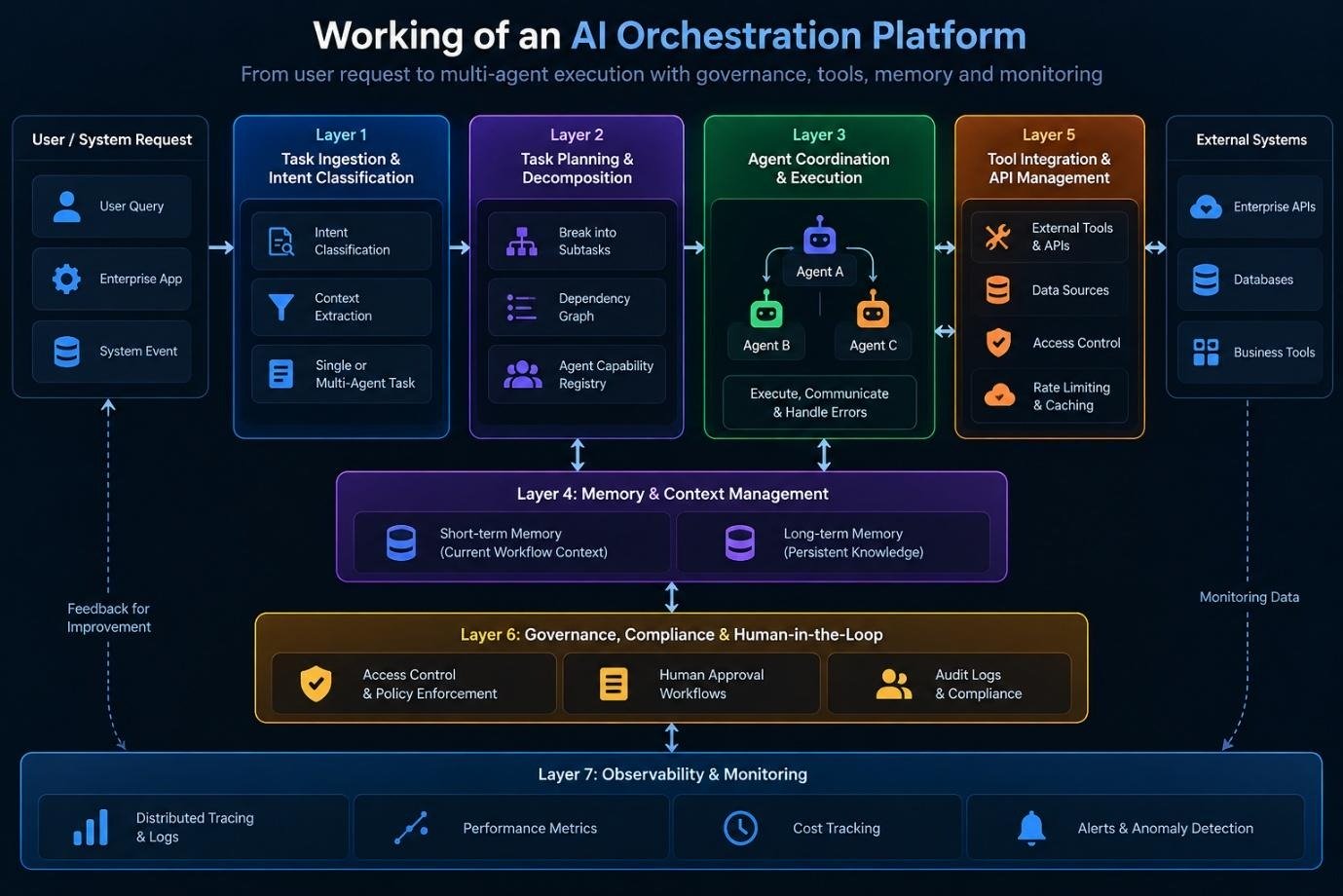
The task ingestion layer receives requests from users, enterprise applications, APIs, and automated system events. An intent classification component identifies the request's purpose, extracts relevant entities and constraints, and evaluates its complexity.
Simple requests can be routed directly to a suitable agent, while complex requests involving multiple departments are forwarded to the planning engine. This initial classification helps prevent unnecessary agent calls and provides downstream components with structured request context.
The planning engine converts complex business objectives into smaller, executable subtasks. It determines task dependencies, identifies opportunities for parallel execution, and constructs a dependency graph that defines the required execution sequence.
An agent capability registry maps each subtask to suitable agents based on their domain expertise, available tools, permissions, and operational status. This allows the platform to select appropriate capabilities without hardcoding every agent into every workflow.
The execution layer dispatches subtasks to selected agents, manages communication between them, and routes intermediate results to dependent tasks. It also coordinates parallel execution and synchronizes branches when their outputs must be combined.
Execution management includes timeouts, bounded retries, error handling, and recovery procedures. If an agent fails, the platform can retry eligible operations, select an approved alternative, or escalate the task without unnecessarily restarting the entire workflow.
The memory layer maintains relevant information throughout a workflow. Short-term working memory stores the current workflow's context and intermediate results, while long-term memory can retain reusable knowledge when business requirements permit.
Context management ensures that each agent receives the information needed for its assigned task without exceeding model context limits. Retrieval mechanisms can supply relevant historical information or approved knowledge when it improves task execution.
This layer provides a centralized registry of external tools, enterprise APIs, databases, and data sources available to agents. It manages authentication, rate limits, request validation, response handling, and integration errors.
Tool permissions determine which agents can access specific resources or execute particular actions. Caching can reduce redundant API calls when data is safe to reuse and freshness requirements allow it.
The governance layer enforces identity-based access controls, business policies, compliance requirements, and restrictions on agent actions. It can pause workflows for human approval before sensitive operations, such as issuing refunds or authorizing payments.
Audit records capture relevant agent actions, tool invocations, approval decisions, and policy outcomes, supporting accountability and compliance reviews.
The observability layer provides visibility into complete workflow execution through distributed tracing, structured logs, performance metrics, and automated alerts. Teams can track agent failures, model latency, token consumption, workflow completion rates, and cost per execution.
This information helps engineering teams identify bottlenecks, investigate incidents, and optimize platform performance.
| Architecture Layer | Primary Function | Key Technical Component |
|---|---|---|
| Task ingestion and intent classification | Classify and route requests | Intent classifier and context extractor |
| Task planning and decomposition | Break goals into subtasks | Planning engine and dependency graph |
| Agent coordination and execution | Manage task execution | Execution manager and error handler |
| Memory and context management | Maintain workflow context | Working memory and persistent memory store |
| Tool integration and API management | Manage external integrations | Tool registry and API gateway |
| Governance and human-in-the-loop | Enforce policies and approvals | Policy engine and approval workflow |
| Observability and monitoring | Track performance and failures | Distributed tracing and alerting |
A well-designed AI orchestration platform architecture separates planning, execution, context, and governance into distinct but connected components. This modular foundation enables enterprises to integrate existing agents, introduce new capabilities, and scale AI workflows while maintaining operational control and visibility.
Why are enterprises investing in AI orchestration platform development when they already have AI agents operating across different business functions? The answer is that deploying individual agents is only one part of enterprise AI adoption. Organizations also need a reliable way to connect agents, coordinate cross-department workflows, manage permissions, and maintain control as adoption scales.
According to IDC's October 2026 analysis, 95.3% of enterprises surveyed were running at least one agent workflow in production, with an average of approximately 11 workflows or agents, according to its July 2026 survey. IDC also projects that the number of AI agents will reach 2.5 billion by 2030. These findings highlight why enterprises are evaluating orchestration as they expand their AI infrastructure.
Enterprises often develop separate agents for sales, customer service, finance, HR, and operations. Without standardized interfaces and shared coordination, these agents can remain isolated. AI orchestration platform development provides a common integration layer for connecting existing agents without requiring a complete rebuild.
Enterprises need infrastructure that supports increasingly complex agent deployments rather than isolated experiments. According to Anthropic's 2026 State of AI Agents report, 57% of surveyed organizations already deploy agents for multi-stage workflows, while 16% use agents in cross-functional processes spanning multiple teams. This growing adoption creates demand for orchestration architectures that support coordinated execution across departments.
Enterprise processes frequently involve tasks that must run sequentially alongside independent activities that can execute in parallel. Orchestration platforms provide dependency management, workflow state tracking, and execution controls to coordinate these operations. For example, processing a customer refund may require complaint validation, transaction verification, policy checks, and authorization before the final action.
As organizations deploy more autonomous agents, they need consistent policies governing access, permitted actions, approvals, and accountability. OneTrust's 2026 AI-Ready Governance Survey found that only 5% of surveyed organizations reported clear coordination and accountability across the AI lifecycle. This gap makes governance a significant consideration when designing enterprise orchestration infrastructure.
Businesses are allocating more resources to automation as their technology environments become increasingly distributed. According to Camunda's 2026 State of Agentic Orchestration and Automation report, 79% of surveyed decision-makers plan to increase automation spending, with budgets expected to rise by an average of 20% over the next two years. Enterprises are therefore evaluating orchestration architectures that can accommodate evolving workflows, applications, and AI capabilities.
The market for cross-functional AI agents is also expected to expand substantially. Gartner's 2026 forecast projects that worldwide enterprise spending on cross-functional AI agents and assistants will exceed $23 billion by 2030, with a forecast compound annual growth rate of 59%. This projection strengthens the case for developing infrastructure capable of coordinating agents across enterprise applications and business functions.
Ultimately, enterprises invest in AI orchestration platform development to manage growing agent ecosystems, coordinate complex workflows, and establish consistent governance. A scalable orchestration architecture helps organizations prepare their existing AI investments for increasingly interconnected enterprise operations.
The benefits of building an AI orchestration platform for enterprises extend beyond connecting individual AI agents. A well-designed platform creates a centralized foundation for coordinating AI capabilities, enforcing governance policies, optimizing model usage, monitoring execution, and managing human oversight across business processes.
For organizations investing in enterprise AI automation orchestration development, the creation of an AI orchestration platform helps establish a consistent approach to managing AI agents at scale. AI product companies can also use orchestration infrastructure to support complex workflows and enterprise customer deployments without building separate coordination systems for every use case.
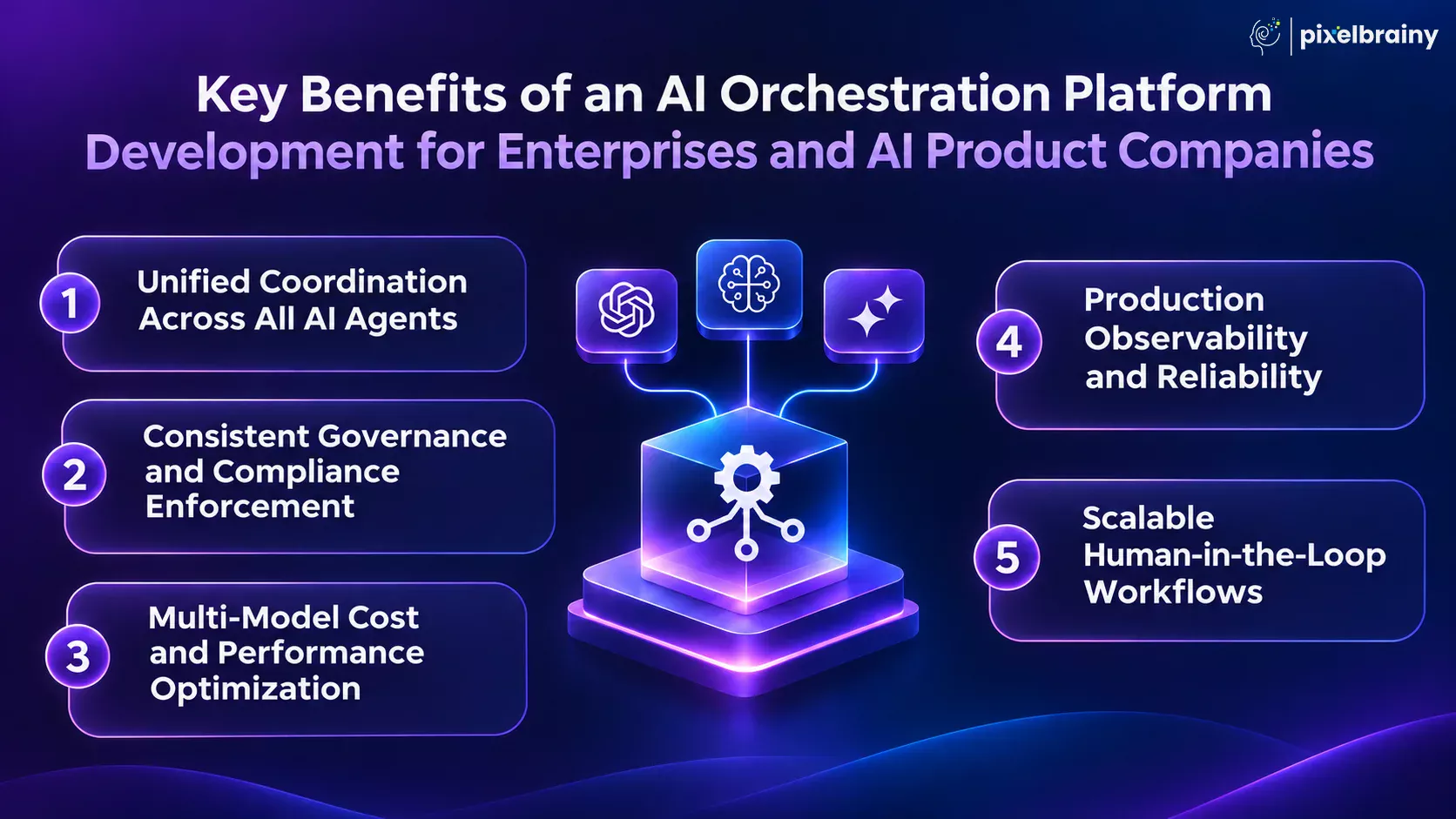
One of the primary AI orchestration platform benefits is the ability to coordinate specialized agents across different business functions through a shared execution layer. Instead of operating independently, agents can exchange relevant information, complete dependent tasks, and contribute to cross-functional business processes.
For example, when a customer raises a billing complaint, a customer service agent can retrieve the complaint details, a CRM agent can access customer history, and a billing agent can validate transaction records. The orchestration platform coordinates these activities and consolidates the results into a unified workflow.
This approach is particularly valuable for enterprises managing multiple agents across sales, finance, HR, customer service, and operations. It allows organizations to integrate existing AI investments without requiring every agent to be rebuilt around the same framework.
As enterprises deploy more AI agents, maintaining consistent security and compliance becomes increasingly complex. An AI orchestration platform provides a centralized mechanism for enforcing access controls, business policies, approval requirements, and audit logging across supported agent workflows.
For example, an agent may be permitted to review financial records but prohibited from authorizing payments independently. The orchestration layer can enforce that restriction and require approval from an authorized employee before execution.
This centralized approach is especially important for financial services, healthcare, insurance, and other regulated industries. Rather than relying exclusively on individual development teams to implement controls, organizations can establish common governance policies across the orchestration infrastructure.
Developing an AI orchestration platform enables enterprises to select appropriate models for different tasks instead of routing every request through a single, potentially expensive model.
For instance, a lightweight model may classify incoming support requests, while a more capable model handles complex reasoning or document analysis. Routing decisions can consider task complexity, model performance, latency requirements, usage budgets, and applicable data policies.
The platform can also track token consumption, enforce model budgets, and identify workflows that generate unnecessary calls.
These capabilities help organizations make informed infrastructure decisions while balancing cost, response quality, and execution speed. Actual savings depend on workload characteristics, model pricing, routing accuracy, and evaluation results.
Enterprise AI workflows require visibility into more than individual model responses. Teams need to understand how requests move between agents, where failures occur, which integrations create delays, and how much each workflow costs.
An orchestration platform can provide distributed tracing, structured logs, execution metrics, automated alerts, and workflow-level monitoring. If a finance agent fails to retrieve transaction information, for example, operations teams can identify the failure point and investigate the relevant dependency.
Reliability mechanisms such as bounded retries, timeouts, durable workflow state, and controlled recovery help prevent temporary service failures from unnecessarily disrupting entire workflows.
This visibility supports incident investigation, performance optimization, and more predictable production operations.
Human-in-the-loop orchestration enables enterprises to introduce human review at specific decision points without requiring each agent team to implement an independent approval system.
For example, an AI agent may prepare a supplier payment recommendation, but the orchestration platform can pause execution until an authorized finance manager approves the transaction. Similar controls can apply to refunds, sensitive HR actions, contract approvals, and other consequential operations.
The platform records approval decisions, enforces authorization rules, and resumes or terminates workflows according to the outcome.
This approach allows organizations to automate suitable tasks while retaining human accountability for decisions that require additional judgment or authorization.
| Stakeholder | Primary benefit | Measurable outcome |
|---|---|---|
| CTO and AI platform team | Unified infrastructure for AI agents | Integration effort, deployment time, and operational overhead |
| Compliance and legal team | Consistent governance across AI operations | Audit coverage, policy violations, and approval compliance |
| Finance and procurement | Multi-model cost optimization | Cost per successful workflow and model expenditure |
| Business operations team | Cross-functional AI collaboration | Workflow completion time and manual intervention rate |
| AI product company | Scalable, multi-tenant AI infrastructure | Customer onboarding time, infrastructure cost, and service reliability |
Ultimately, the benefits of developing an AI orchestration platform come from making AI agents more coordinated, governable, observable, and cost-conscious. For enterprises and AI product companies, the right orchestration architecture provides a foundation for scaling automation while maintaining control over business-critical operations.
Enterprise AI adoption is moving beyond experimentation toward production environments where multiple models, agents, applications, and data sources must operate together. As organizations expand their AI capabilities, managing isolated systems becomes increasingly complex. Businesses need a coordinated approach to workflow execution, data access, governance, and operational monitoring.
AI orchestration platform development enables enterprises to connect specialized AI capabilities and coordinate them through a centralized execution layer. Instead of managing disconnected agents and automation tools, organizations can create integrated workflows that combine AI reasoning, business rules, enterprise APIs, and human approvals.
For enterprises asking where AI orchestration platforms deliver the most value, the following use cases demonstrate how orchestration supports practical business operations across industries and departments.
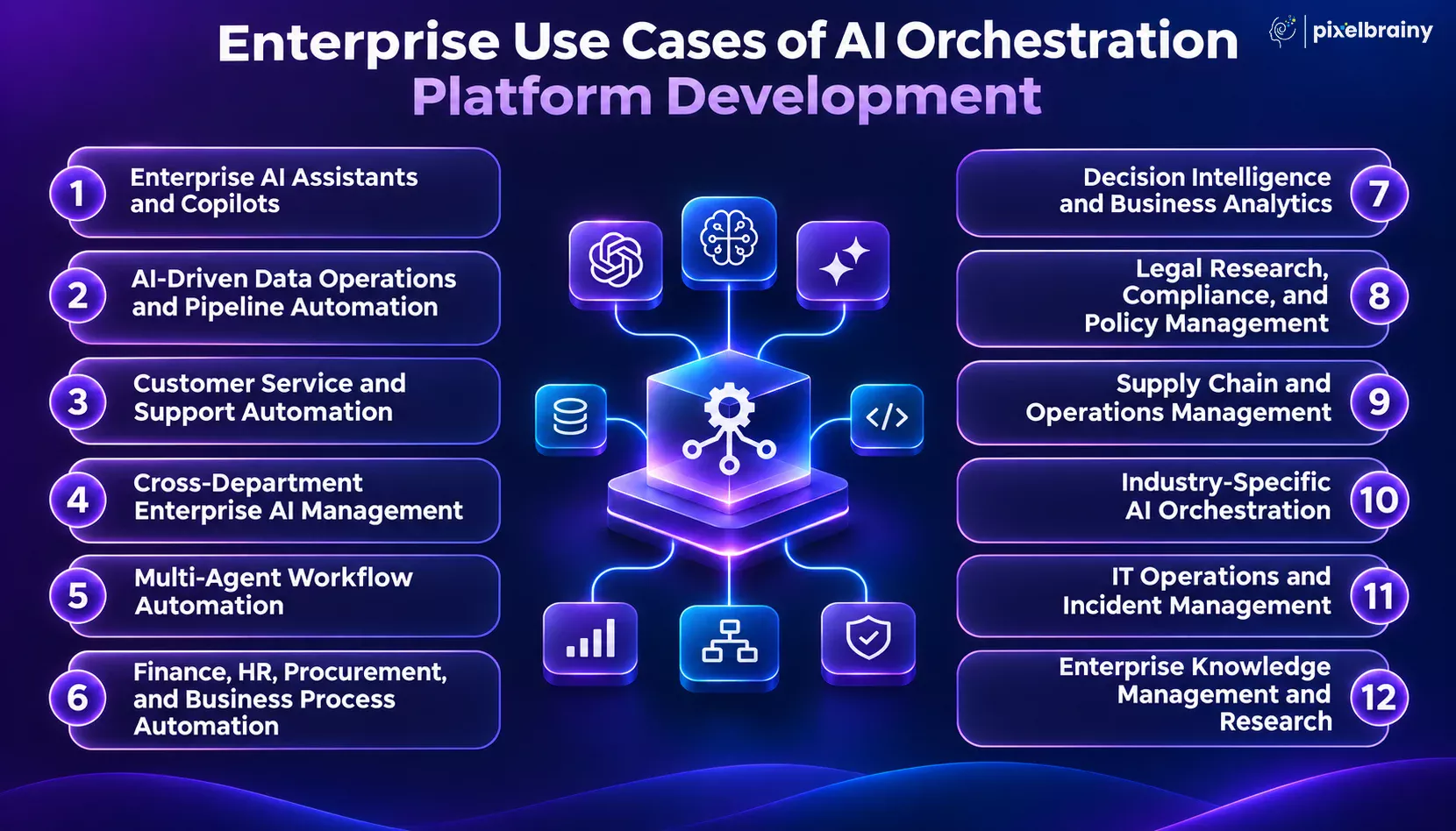
Enterprise assistants often need to retrieve information, invoke tools, access business applications, and complete multi-step requests. An orchestration platform coordinates these capabilities within a controlled workflow.
For example, an employee asking for a project budget update may trigger document retrieval, financial data queries, variance analysis, and report generation. The platform routes each task to the appropriate agent or service and consolidates the results.
Business application: Enterprise knowledge assistants, employee copilots, executive assistants, and internal service automation.
Enterprise data operations involve multiple stages, including ingestion, cleaning, enrichment, validation, inference, and downstream delivery. AI orchestration coordinates these stages across data pipelines and analytical systems.
A data quality workflow could identify missing records, invoke an enrichment agent, validate the corrected data, and send unresolved exceptions to a data steward.
Business application: Data engineering, intelligent data processing, analytics pipelines, and automated data quality management.
Customer service is one of the most practical enterprise use cases for AI orchestration platform development because resolving a single issue may require several agents and business systems.
For example, a billing complaint can trigger customer identification, conversation history retrieval, transaction verification, policy validation, and refund eligibility checks. The orchestration platform coordinates the steps and escalates exceptions to a human representative when required.
Business application: Contact centers, ticket resolution, billing support, order tracking, and customer self-service.
Large organizations often operate different AI agents across sales, finance, HR, procurement, and operations. An enterprise orchestration platform provides a common coordination layer while allowing each department to retain its specialized agents and business logic.
For example, a new customer contract may initiate sales validation, legal review, finance checks, and operational onboarding. Each department's agent completes its assigned tasks under shared workflow controls.
Business application: Enterprise-wide automation, shared AI infrastructure, cross-functional workflows, and centralized agent management.
Multi-agent orchestration is particularly valuable when a business objective requires several specialized agents to collaborate.
A market research workflow, for instance, can assign data collection to a research agent, competitor analysis to an analytical agent, financial modeling to a finance agent, and report preparation to a writing agent.
The orchestration engine manages dependencies, routes intermediate results, synchronizes parallel tasks, and validates the final output.
Business application: Complex research, strategic planning, multi-step analysis, and coordinated enterprise decision support.
AI-powered business process automation connects language models, enterprise rules, APIs, and workflow systems to automate repetitive administrative processes.
In finance, orchestration can coordinate invoice extraction, purchase-order matching, exception detection, and payment approval. In HR, it can support onboarding, policy inquiries, and employee transfers. Procurement workflows can combine supplier verification, contract checks, and purchase recommendations.
Business application: Accounts payable, employee onboarding, procurement approvals, expense processing, and contract administration.
Decision intelligence combines enterprise data, analytical models, business rules, and operational actions. An AI orchestration platform can coordinate data preparation, model execution, validation, and reporting as one repeatable process.
For example, a sales forecasting workflow can retrieve CRM data, validate pipeline records, execute a forecasting model, compare predictions against historical results, and prepare a management report.
Business application: Demand forecasting, financial planning, risk analysis, business intelligence, and executive reporting.
Legal and compliance workflows require accurate source retrieval, traceable reasoning, policy validation, and appropriate human review.
An orchestration platform can coordinate document search, clause extraction, regulatory comparison, risk classification, and review assignment. It can also preserve source references and approval records for subsequent verification.
For example, a contract review workflow may identify nonstandard clauses, compare them against approved policies, and route high-risk findings to legal counsel.
Business application: Contract analysis, regulatory research, policy monitoring, compliance documentation, and audit preparation.
Supply chain operations depend on inventory systems, supplier records, logistics platforms, demand forecasts, and procurement applications. AI orchestration connects these components into coordinated operational workflows.
If a warehouse detects a potential stock shortage, the platform can retrieve inventory information, analyze demand forecasts, check supplier availability, compare replenishment options, and prepare a purchase recommendation.
Business application: Inventory management, demand planning, supplier coordination, logistics exception handling, and production scheduling.
Different industries require specialized workflows, data controls, and integration patterns. AI orchestration architecture can coordinate domain-specific agents while enforcing the relevant operational and compliance requirements.
These deployments require industry-specific validation, appropriate human oversight, and safeguards against unauthorized or inaccurate actions.
IT operations teams manage alerts, application logs, infrastructure dependencies, incident tickets, and remediation procedures. An orchestration platform can coordinate diagnostic agents and operational tools to investigate incidents systematically.
For example, a monitoring alert can trigger log analysis, dependency checks, incident classification, and runbook retrieval. The platform can then assign the issue to the appropriate team or initiate an explicitly authorized remediation action.
Business application: Incident triage, root-cause investigation, service desk automation, infrastructure monitoring, and controlled remediation.
Large enterprises maintain knowledge across documents, internal portals, databases, policies, and departmental applications. Orchestration allows specialized agents to retrieve relevant information, analyze evidence, validate sources, and prepare consolidated responses.
For example, an executive research request can initiate internal document retrieval, market data analysis, financial comparisons, and source verification before producing a briefing.
Business application: Enterprise search, knowledge assistants, competitive research, technical documentation, and executive decision support.
The best starting point is a workflow that involves multiple agents or enterprise systems, has clearly defined dependencies, and produces measurable business outcomes.
Organizations should assess the following factors before implementation:
Ultimately, enterprise AI orchestration platform development connects specialized AI capabilities to real business processes across departments and industries. Starting with a high-value workflow and expanding through reusable integrations enables enterprises to scale coordinated AI operations with appropriate governance and control.
What features should an enterprise AI orchestration platform include to coordinate multiple AI agents, automate complex workflows, and maintain control across business systems? The answer depends on the organization's operational requirements, but every production-ready platform needs a reliable foundation for agent coordination, workflow execution, integration, security, and monitoring.
For businesses investing in AI orchestration platform development, selecting the right features from the beginning helps establish a scalable architecture without unnecessary complexity. Enterprise platforms must support existing agents across departments, while AI product companies need reusable capabilities that can serve different customers, workflows, and deployment environments.
The following 15 must-have AI orchestration platform features provide a practical foundation for enterprise AI automation orchestration development and commercial AI products.
| Feature | Description and business value |
|---|---|
| Agent Registry and Management | An agent registry maintains a centralized catalog of available AI agents, including their capabilities, endpoints, versions, supported tasks, and operational status. It helps platform administrators discover suitable agents, manage configurations, and integrate new capabilities without redesigning existing workflows. |
| Intelligent Task Routing | Intelligent task routing analyzes incoming requests and directs them to appropriate agents based on intent, task requirements, available capabilities, and access permissions. Combining deterministic rules with intent classification helps enterprises route requests consistently while avoiding unnecessary agent invocations. |
| Workflow Orchestration Engine | A workflow orchestration engine coordinates business processes involving multiple agents, applications, and services. It manages task sequencing, conditional branches, dependencies, and completion criteria, enabling organizations to define repeatable workflows rather than relying on disconnected agent interactions. |
| Multi-Agent Communication | Multi-agent communication enables specialized agents to exchange structured requests, intermediate results, and execution status through standardized interfaces. This feature supports collaboration between independently developed agents while reducing integration inconsistencies across sales, finance, customer service, HR, and operations. |
| Sequential and Parallel Execution | Execution management allows dependent tasks to run in the correct order while independent tasks execute concurrently. Synchronization controls combine parallel results before downstream processing begins, helping enterprises coordinate complex workflows without introducing unnecessary dependencies or compromising business rules. |
| API and Enterprise System Integration | An integration layer connects AI agents with CRM, ERP, HRMS, ticketing platforms, databases, and other enterprise applications. Reusable API connectors, standardized data contracts, authentication, and error handling reduce the effort required to incorporate existing systems into orchestration workflows. |
| Workflow State Management | Workflow state management records execution progress, task status, intermediate results, and relevant identifiers throughout a business process. Persistent state enables long-running workflows to resume after interruptions, maintain execution consistency, and provide administrators with a reliable record of process progression. |
| Context and Memory Management | Context management supplies agents with the information required for their assigned tasks while limiting irrelevant data and unnecessary duplication. Separate handling of temporary workflow context and persistent knowledge helps maintain continuity across tasks while respecting model context limits and data access policies. |
| Authentication and Access Control | Authentication and authorization mechanisms verify user and service identities and determine which agents, tools, and resources they can access. Role-based or attribute-based permissions, scoped credentials, and least-privilege policies help protect sensitive enterprise information and restrict unauthorized operations. |
| Human Approval Workflows | Human approval workflows pause designated processes until an authorized person reviews a proposed action or decision. Configurable approval rules, decision records, and controlled workflow resumption support financial transactions, contract approvals, sensitive employee operations, and other business activities requiring human accountability. |
| Error Handling and Retry Management | Error handling manages agent failures, unavailable APIs, timeouts, and invalid responses through defined recovery procedures. Bounded retries, backoff policies, fallback routes, and idempotency controls help maintain workflow reliability while reducing the risk of duplicated actions or repeated processing errors. |
| Monitoring and Observability | Monitoring and observability provide visibility into agent execution, workflow status, latency, errors, and system resource usage. Centralized logs, distributed traces, metrics, and alerts help engineering teams identify bottlenecks, investigate incidents, and understand how individual agents affect end-to-end workflow performance. |
| Output Validation and Quality Checks | Output validation checks agent responses against required schemas, data types, business rules, and task completion criteria. Structured validation helps identify incomplete or inconsistent results before they reach downstream agents or enterprise systems, reducing the risk of propagating incorrect information. |
| Audit Logging and Execution History | Audit logging records relevant workflow events, agent actions, tool invocations, policy decisions, and approval outcomes. Searchable execution histories help organizations investigate incidents, support compliance reviews, reconstruct process timelines, and establish accountability for actions performed through the orchestration platform. |
| Cost and Usage Management | Cost management tracks model consumption, token usage, external API calls, and infrastructure expenditure across agents and workflows. Usage budgets, rate limits, and cost reports help platform owners identify expensive execution patterns, allocate resources appropriately, and evaluate the financial performance of enterprise AI automation. |
The right combination of these 15 features creates a dependable foundation for AI orchestration platform development, enabling enterprises and AI product companies to coordinate existing agents, govern execution, and scale business workflows without unnecessary architectural complexity.
After you have finalized your core features for an AI orchestration platform, you can plan the next development phase by introducing advanced capabilities that improve automation intelligence, adaptability, performance, and enterprise scalability. While essential features establish the foundation for agent coordination and workflow execution, advanced features help organizations manage more sophisticated AI operations and evolving business requirements.
For enterprises and AI product companies, advanced AI orchestration platform development involves more than connecting agents. It includes dynamic workflow planning, intelligent model selection, predictive monitoring, specialized agent collaboration, and automated evaluation. These capabilities should be introduced according to business priorities, technical readiness, and measurable requirements rather than added simply to increase platform complexity.
What advanced features should you add to an AI orchestration platform to support autonomous decision-making, optimize AI performance, and scale complex multi-agent workflows? The following ten capabilities are worth considering once your core orchestration infrastructure is stable.
| Advanced feature | Description and business value |
|---|---|
| Dynamic Workflow Planning | Dynamic workflow planning enables the platform to generate or adjust task sequences according to incoming requests, intermediate results, and predefined constraints. Unlike fixed workflows, it can accommodate changing requirements while restricting execution to approved actions, validated transitions, and permitted agent capabilities. |
| Intelligent Multi-Model Routing | Intelligent multi-model routing selects appropriate language models according to task complexity, response quality, latency requirements, cost limits, and data policies. This capability allows enterprises to use different models for classification, reasoning, summarization, and specialized analysis while maintaining consistent evaluation and routing controls. |
| Adaptive Agent Selection | Adaptive agent selection identifies suitable agents using capability metadata, historical performance, availability, and task requirements. It can help the platform select an approved alternative when an agent becomes unavailable, provided the replacement satisfies the required permissions, functional requirements, and quality thresholds. |
| Advanced Memory and Knowledge Retrieval | Advanced memory and retrieval capabilities combine approved enterprise knowledge sources, semantic search, contextual retrieval, and reusable information across workflows. They help agents access relevant evidence without repeatedly processing entire datasets, while access controls and freshness checks reduce the risk of retrieving unauthorized or outdated information. |
| Agent Performance Evaluation and Benchmarking | Automated evaluation measures agent accuracy, task completion, output validity, tool-use reliability, and compliance with defined requirements. Benchmarking different agent versions and models against representative datasets helps enterprises identify regressions, compare alternatives, and validate changes before introducing them into production workflows. |
| Predictive Monitoring and Anomaly Detection | Predictive monitoring analyzes execution metrics and historical patterns to identify unusual latency, rising failure rates, unexpected model consumption, and workflow bottlenecks. Alerting and anomaly detection help engineering teams investigate emerging operational problems before they cause widespread disruption, although detection accuracy depends on data quality and monitoring configuration. |
| Workflow Simulation and Testing | Workflow simulation allows developers to test complex execution paths, parallel branches, agent failures, and integration dependencies before production deployment. Scenario-based testing helps identify bottlenecks and recovery gaps, while synthetic workloads support capacity planning and controlled validation of changes to orchestration logic. |
| Multimodal AI Orchestration | Multimodal orchestration coordinates agents and models that process documents, images, audio, video, and structured data. It enables workflows such as invoice interpretation, voice-based customer support, visual quality inspection, and document verification, with validation and access controls applied to the resulting information. |
| Event-Driven and Real-Time Orchestration | Event-driven orchestration initiates or updates workflows in response to business events, application notifications, streaming data, or system alerts. Message queues, event brokers, and event-processing rules support asynchronous coordination, allowing the platform to respond to operational changes without requiring every workflow to begin with a manual request. |
| Automated Recovery and Compensation | Automated recovery and compensation manage interrupted workflows through durable checkpoints, controlled retries, alternative execution paths, and corrective business actions. When a multi-step transaction cannot complete, compensation logic can address previously completed operations where appropriate, while idempotency and authorization controls help prevent duplicate or unsafe actions. |
Advanced features should extend a proven orchestration foundation, not replace it. By prioritizing capabilities that address real workflow complexity, enterprises can develop an AI orchestration platform that becomes more adaptable, measurable, and scalable as their AI ecosystem grows.
Developing an AI orchestration platform requires a structured approach that combines business planning, agent integration, workflow engineering, security, and production deployment. For enterprises with existing AI agents, the objective is to build a centralized coordination layer that connects these agents, manages dependencies, and ensures reliable execution across business systems.
What are the steps to develop an AI orchestration platform from idea to launch, especially when the platform must support regulatory audits, explainable agent actions, and mandatory human approvals? The answer begins with defining requirements and designing governance into the architecture from day one.
For example, a financial services enterprise may need to coordinate fraud detection, transaction analysis, and customer verification agents. Every consequential action must be traceable, and designated transactions must remain blocked until an authorized employee approves them. The following eight steps explain how to build an AI orchestration platform from scratch while addressing these enterprise requirements.
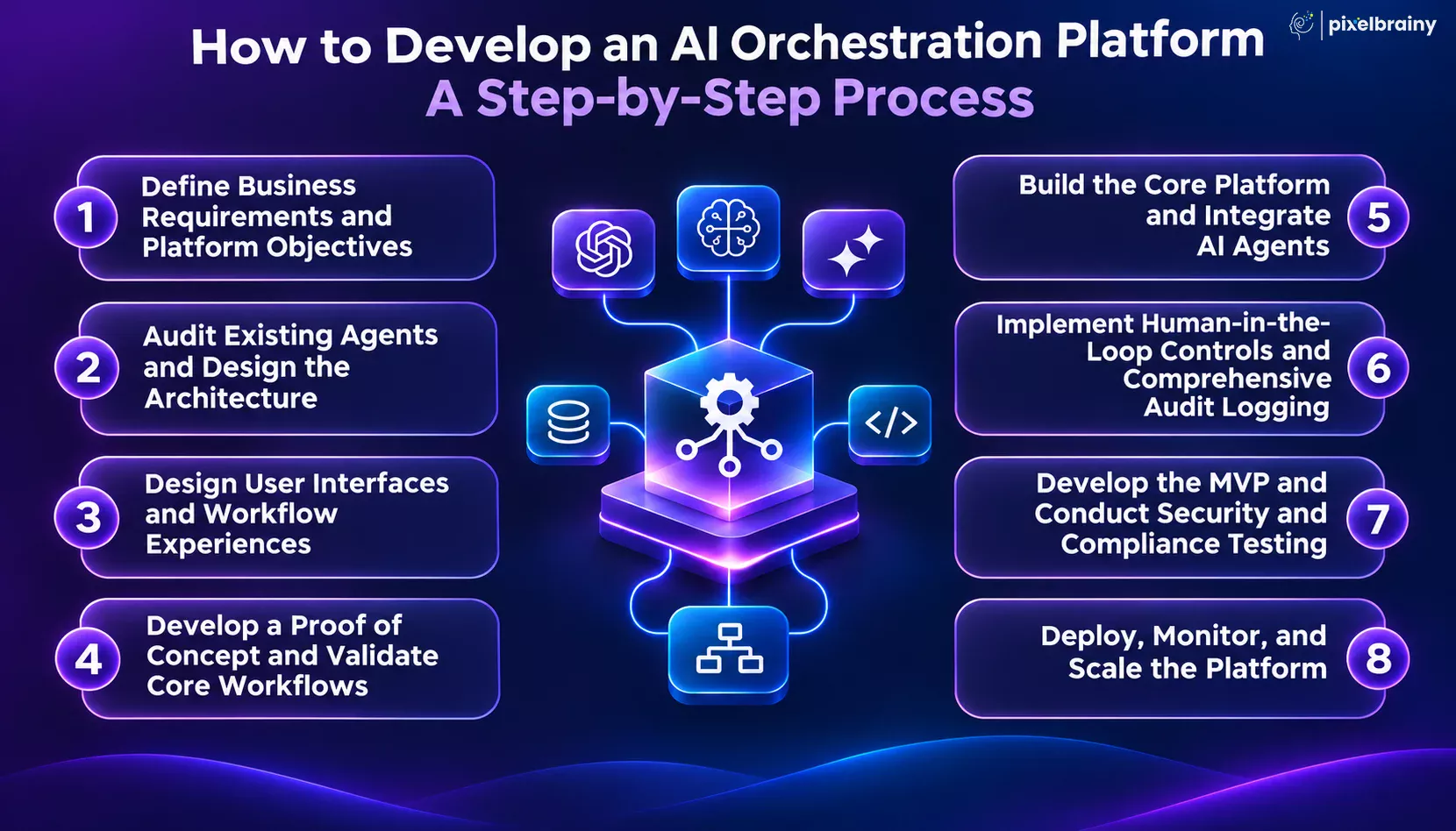
Begin by identifying the business processes, existing AI agents, enterprise applications, and operational problems the platform must address. Document the required workflows, user roles, integration requirements, expected transaction volumes, and performance targets.
For regulated environments, involve compliance, security, legal, and business stakeholders early. Define which agent actions require approval, what evidence must be retained, and which decisions need explanations for regulatory review.
Engaging an AI consultation provider can help clarify feasibility, prioritize requirements, and establish an architecture aligned with business objectives. The deliverable should be a requirements document containing functional specifications, security controls, acceptance criteria, and measurable success indicators.
Also Read: Top 10 AI Consulting Companies in USA
Evaluate each existing agent's capabilities, model dependencies, APIs, permissions, input and output formats, and operational reliability. Identify which agents can be integrated directly and which require adapters or further development.
Design the orchestration architecture around task routing, workflow execution, persistent state, agent communication, tool integration, governance, and observability. Define the boundaries between AI-generated recommendations and deterministic business controls.
Compare experienced top AI development companies using their relevant enterprise integration experience, security practices, and architectural approach. The objective is to produce an architecture that supports existing agents while allowing additional models, workflows, and enterprise systems to be integrated later.
Design interfaces that help administrators configure workflows, monitor agent activity, review execution histories, and manage approvals. Business users should understand what a workflow is doing, which tasks have completed, what requires attention, and why an action has been paused.
A compliance dashboard should display the initiating request, relevant agent actions, policy checks, supporting evidence, approval status, and final outcome. Reviewers should be able to approve, reject, or request additional information according to their permissions.
Working with a UI/UX design company can help translate complex orchestration processes into clear interfaces. Prioritize accessibility, role-specific dashboards, transparent status indicators, and intuitive exception-handling experiences.
Also Read: Top 10+ UI/UX Design Companies in USA
Build a focused prototype that demonstrates how multiple agents collaborate on a real business process. Select a manageable workflow, such as transaction verification followed by a human approval and an authorized action.
The PoC development phase should validate agent connectivity, task routing, workflow dependencies, structured outputs, and audit event generation. For regulated financial services, deliberately test denied approvals, missing evidence, unauthorized actions, agent timeouts, and interrupted executions.
Measure task completion, routing accuracy, latency, and recovery behavior against predefined acceptance criteria. Do not treat a successful demonstration as proof of production readiness. The purpose is to validate architectural assumptions before committing to broader development.
Also Read: Top 10+ AI PoC Development Companies In USA
Implement the workflow engine, agent registry, routing service, shared interfaces, state management, and enterprise connectors. Establish standardized contracts for task requests, structured responses, execution identifiers, errors, and agent capabilities.
Use AI integration practices that preserve the existing agents where practical, with adapters for incompatible interfaces. If additional specialized agents are required, evaluate top AI agent development companies based on their ability to build interoperable, testable agents that satisfy enterprise security requirements.
Develop APIs for CRM, transaction systems, identity providers, and other necessary applications. Ensure that permissions are checked at the point of action and that every significant execution event can be associated with a unique workflow and task identifier.
Also Read: Top 10+ AI Integration Companies in USA
For regulated financial services, how do you build human-in-the-loop controls and comprehensive audit logging into an AI orchestration platform architecture from day one? The answer is to implement approval gates, authorization checks, and tamper-evident audit records as core platform services rather than optional features.
Define policy rules that specify which actions require approval, who can approve them, what evidence is necessary, and how approval decisions affect workflow execution. High-stakes actions must remain blocked until the required authorization is verified.
Record the initiating request, agent and model versions, relevant inputs and outputs, tool invocations, policy decisions, timestamps, approval records, and final outcomes. Protect logs through access restrictions, integrity controls, retention policies, and secure storage. Capture explanations grounded in decision evidence rather than relying on unsupported claims about an AI model's internal reasoning.
Once the core workflow is validated, expand it into a production-oriented MVP development phase. Include the essential administration interfaces, agent integrations, approval workflows, audit search, monitoring, and recovery mechanisms required for the selected use cases.
Conduct functional, integration, performance, authorization, and security testing. Verify that unauthorized users cannot approve transactions, missing audit records are detected, rejected actions cannot proceed, and workflow retries do not duplicate financial operations.
If the project requires new model capabilities, evaluate AI model development only where existing models cannot meet the defined requirements. Maintain evaluation datasets, regression tests, documented limitations, and release controls so that model or agent updates do not silently undermine compliance requirements.
Also Read: Top 10 AI MVP Development Companies in USA
Deploy the platform through controlled environments, beginning with a limited production rollout. Configure monitoring, alerting, access reviews, backup and recovery procedures, and incident response responsibilities before increasing transaction volumes.
Track workflow completion rates, agent failures, approval turnaround times, policy violations, audit completeness, latency, and cost per successful transaction. Review these measures with engineering, business, and compliance stakeholders.
Organizations planning to hire AI developers should ensure the team has experience in distributed workflows, secure API integration, model evaluation, and production operations. As adoption expands, collaborate with suitable AI product development companies when additional product engineering or specialized implementation capacity is needed.
A successful AI orchestration platform combines reliable agent coordination with security, explainability, human approval, and comprehensive auditability from the beginning, enabling enterprises to scale AI automation without sacrificing operational reliability or control.
Also Read: Top 10+ AI Orchestration Companies in USA
The cost to develop an AI orchestration platform typically ranges from $40,000 to $300,000 or more, depending on platform complexity, the number of AI agents, integration requirements, security controls, and deployment architecture. A basic platform with essential routing and workflow execution requires a smaller budget than an enterprise-grade platform supporting multi-agent collaboration, extensive integrations, and strict compliance requirements.
For startups and enterprises, estimating the development budget of an AI orchestration platform requires evaluating the initial engineering investment alongside infrastructure, model usage, maintenance, and ongoing support.
What is the development pricing of an AI orchestration platform for a startup building a commercial product for enterprise buyers? The answer depends on the required feature set, expected customer scale, deployment model, and reliability requirements. The following breakdown provides indicative development costs in USD to help with initial budget planning.
| Platform Type | Estimated Development Cost | Typical Scope |
|---|---|---|
| Basic AI Orchestration Platform | $40,000 to $80,000 | Core agent registry, task routing, basic workflow execution, API integrations, authentication, and essential monitoring. |
| Advanced AI Orchestration Platform | $80,000 to $180,000 | Multi-agent coordination, sequential and parallel workflows, persistent state, human approvals, detailed observability, and recovery mechanisms. |
| Enterprise-Grade AI Orchestration Platform | $180,000 to $300,000+ | Multi-tenant architecture, advanced access controls, extensive enterprise integrations, comprehensive audit trails, high availability, deployment controls, and enterprise administration. |
These are indicative planning estimates rather than fixed market rates. Actual costs depend on the development team's location, project scope, existing infrastructure, and technical requirements.
The cost estimation of an AI orchestration platform should account for each major development component. The following ranges are illustrative allocations that can help businesses estimate individual requirements. They are not additional charges to automatically add to the platform estimates above, because several activities may overlap.
| Cost Factor | Estimated Cost | What Influences the Cost |
|---|---|---|
| Requirements and architecture | $3,000 to $12,000 | Business analysis, technical discovery, workflow mapping, architecture design, and integration planning. |
| Core platform development | $12,000 to $40,000 | Backend APIs, agent registry, routing engine, workflow execution, and platform configuration. |
| Agent integration and connectors | $5,000 to $35,000 | Number of existing agents, API complexity, custom adapters, and enterprise application compatibility. |
| Workflow and state management | $5,000 to $25,000 | Sequential and parallel execution, persistent state, dependencies, retries, and recovery mechanisms. |
| Frontend and administration dashboard | $5,000 to $20,000 | Workflow configuration, agent management, execution history, monitoring dashboards, and user interfaces. |
| Security and compliance | $5,000 to $30,000 | Identity integration, granular access controls, audit trails, approval workflows, and compliance validation. |
| Testing and quality assurance | $4,000 to $18,000 | Integration testing, workflow validation, performance testing, security testing, and failure simulation. |
| Deployment and infrastructure setup | $3,000 to $15,000 | Cloud configuration, containerization, CI/CD pipelines, environment setup, and production deployment. |
| Monitoring and observability | $3,000 to $12,000 | Distributed tracing, logs, alerts, execution metrics, and model usage tracking. |
| Maintenance and ongoing support | $2,000 to $10,000+ per month | Bug fixes, dependency updates, agent compatibility, infrastructure management, and operational support. |
Note: The component estimates are indicative and vary by project. The maintenance range represents a potential recurring expense, not part of the one-time development cost.
Therefore, when you plan to develop an AI orchestration platform, align your budget with your business goals, essential features, integration complexity, and long-term operating requirements. A phased investment, starting with a focused MVP and expanding as requirements grow, helps control initial costs while establishing a foundation for enterprise-scale deployment.
What tools and technologies are required to develop an AI orchestration platform that coordinates multiple AI agents, automates complex workflows, integrates with enterprise systems, and maintains security at scale? The right technology stack for AI orchestration platform development depends on your platform architecture, AI models, integration requirements, expected workload, and compliance needs. A well-planned stack helps development teams build a reliable orchestration engine, manage agent communication, track workflow execution, and control operational costs without creating unnecessary infrastructure complexity.
If you are planning to build an AI orchestration platform from scratch, the following tools and technologies provide a practical starting point for enterprise applications and commercial AI products.
| Technology Layer | Recommended Tools and Technologies | Purpose in AI Orchestration Platform Development |
|---|---|---|
| Programming languages | Python, TypeScript, Java | Python supports AI models, agent logic, and workflow services. TypeScript is useful for platform interfaces and backend services, while Java suits enterprise environments that require mature application infrastructure. |
| Backend development | FastAPI, Django, Node.js, NestJS | These frameworks help build APIs, manage orchestration requests, expose platform services, and connect agent workflows with external applications. |
| AI agent frameworks | LangGraph, Microsoft Agent Framework, CrewAI | These frameworks support agent execution, stateful workflows, multi-agent collaboration, and task coordination. The best fit depends on the required control over execution, state, and framework-specific capabilities. |
| Large language model integration | OpenAI API, Anthropic API, Google Gemini API, self-hosted models | Model APIs and self-hosted models enable the platform to execute reasoning, classification, summarization, and other AI tasks. A model abstraction layer can reduce dependence on a single provider. |
| Workflow orchestration | Temporal, Apache Airflow, custom workflow engine | Workflow orchestration tools manage task dependencies, retries, execution state, and long-running processes. Temporal is useful for durable application workflows, while Airflow is primarily designed for data pipeline scheduling. |
| API and enterprise integration | REST APIs, GraphQL, webhooks, Apache Kafka | These technologies connect the orchestration platform with CRM systems, ERP software, databases, internal applications, and event-driven services. |
| Databases and workflow state | PostgreSQL, MySQL, Redis | Relational databases store users, configurations, workflow records, and audit metadata. Redis can support caching, short-lived state, and fast coordination where appropriate. |
| Vector search and knowledge retrieval | pgvector, Pinecone, Weaviate | Vector search technologies help agents retrieve relevant information from documents and knowledge bases, supporting retrieval-augmented generation and context-aware workflows. |
| Messaging and asynchronous processing | Apache Kafka, RabbitMQ, cloud messaging services | Messaging systems support asynchronous tasks, event processing, workload distribution, and communication between platform services. |
| Frontend and administration dashboard | React, Next.js, TypeScript | These technologies support dashboards for workflow configuration, agent management, execution tracking, user permissions, and human approval processes. |
| Authentication and access control | OAuth 2.0, OpenID Connect, Keycloak, cloud identity services | Identity and access technologies help secure platform access, integrate enterprise identity providers, and enforce role-based permissions for users and services. |
| Security and secrets management | HashiCorp Vault, cloud secrets managers, encryption libraries | These tools protect API credentials, model-provider keys, and sensitive configuration data while supporting secure communication and controlled access to secrets. |
| Monitoring and observability | OpenTelemetry, Prometheus, Grafana, Langfuse | Observability tools help track workflow execution, latency, errors, model usage, token consumption, and agent behavior. They support troubleshooting and performance optimization across distributed components. |
| Audit logging and governance | Structured application logs, OpenTelemetry traces, centralized log platforms | These capabilities record agent actions, tool calls, approval decisions, workflow transitions, and execution outcomes. Regulated deployments may also require tamper-resistant records, retention policies, and traceable authorization decisions. |
| Deployment and infrastructure | Docker, Kubernetes, Terraform | Containers simplify deployment, Kubernetes supports orchestration of application services, and Terraform enables repeatable infrastructure provisioning across development, testing, and production environments. |
| CI/CD and automated testing | GitHub Actions, GitLab CI/CD, pytest, Playwright | Automated pipelines and testing tools help validate workflow logic, API integrations, security controls, and platform releases before changes reach production. |
The right technology stack combines flexible AI frameworks, dependable workflow infrastructure, secure integrations, and comprehensive observability to create a scalable AI orchestration platform.
What are the main challenges of building an AI orchestration platform that coordinates multiple agents, maintains reliable execution, and scales to enterprise workloads? The biggest challenges include unpredictable agent behavior, context window limitations, distributed workflow state, limited observability, and external tool failures.
To develop a scalable AI orchestration platform, engineering teams need reliable workflow validation, efficient context management, durable state handling, distributed tracing, and fault-tolerant integrations.
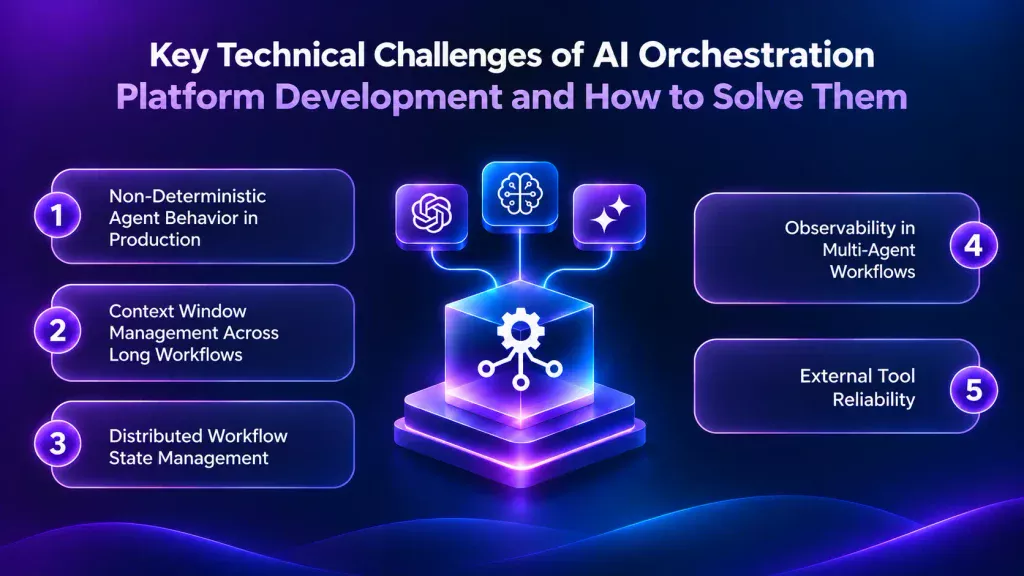
AI agents can produce different outputs from similar inputs. In multi-agent workflows, an unexpected response from one agent can affect downstream decisions, trigger incorrect tool calls, or cause workflow failures. This makes consistent testing and monitoring difficult.
How to solve it: Validate agent outputs at each critical step using schemas and business rules. Build regression tests from recorded interactions and add checkpoints to detect unexpected results before they affect downstream agents.
Multi-step workflows accumulate information from agent responses, tool results, user instructions, and retrieved documents. Passing excessive context increases token costs and latency, while removing essential information can reduce accuracy.
How to solve it: Use intelligent context summarization to preserve important facts and decisions. Combine workflow memory with selective knowledge retrieval so each agent receives only the information relevant to its task.
Concurrent agent executions make workflow state difficult to maintain across distributed services. Failures or human approval pauses can lead to lost progress, duplicated actions, or inconsistent execution states.
How to solve it: Implement durable state management, event logs, concurrency controls, and execution checkpoints. Make workflows resumable after failures and use idempotent operations to prevent duplicate actions.
When a workflow fails, identifying the responsible agent, model call, or external tool can be challenging. Without detailed execution records, teams may struggle to determine the root cause and prevent recurring issues.
How to solve it: Implement distributed tracing with unique trace IDs across agent calls, model invocations, and tool usage. Use structured logs and monitoring dashboards to track errors, latency, token consumption, and workflow completion.
External APIs and enterprise systems can experience timeouts, rate limits, authentication failures, or outages. These issues can interrupt workflows and increase costs when agents repeatedly retry failed operations.
How to solve it: Use bounded retries, exponential backoff, circuit breakers, and timeouts. Add fallback paths and idempotency controls to maintain safe execution when external dependencies fail.
| Challenge | Severity | Mitigation strategy |
|---|---|---|
| Non-deterministic agent behavior | High | Output validation, regression testing, and execution checkpoints |
| Context window management | High | Context summarization, selective retrieval, and token controls |
| Distributed workflow state management | Very High | Durable state, event logs, concurrency controls, and checkpoints |
| Multi-agent observability | High | Distributed tracing, structured logging, and failure attribution |
| External tool reliability | High | Circuit breakers, retries, rate limiting, and graceful degradation |
Severity ratings are qualitative and depend on workflow complexity and business impact.
Therefore, addressing these challenges helps businesses build an AI orchestration platform with reliable execution, effective monitoring, and the scalability required for enterprise workloads.
Businesses looking to connect multiple AI agents, automate complex workflows, and bring AI products into production need more than a standard AI application development team. They need expertise in multi-agent architecture, LLM orchestration, enterprise integrations, workflow observability, and governance. PixelBrainy supports businesses planning AI orchestration platform development services, from architecture planning and agent coordination to enterprise-ready implementation.
For enterprises and AI product companies asking, “How can we build an AI orchestration platform that coordinates multiple agents securely and scales across business systems?”, PixelBrainy focuses on the technical foundations required for reliable, maintainable AI solutions. As one of the AI development companies in the USA worth considering, PixelBrainy brings the following technical capabilities and service differentiators to AI orchestration platform development.
| Evaluation factor | Generic AI agency | PixelBrainy’s proposed approach |
|---|---|---|
| Multi-agent architecture | Often focused on single-agent chatbots | Architecture for coordinating multiple agents and complex workflows |
| LLM orchestration engineering | Basic framework integrations | Custom orchestration and multi-provider model routing |
| Distributed systems engineering | Standard application architecture | Durable workflow state and distributed execution design |
| Observability infrastructure | Basic application logging | Distributed tracing and workflow-level monitoring |
| Human-in-the-loop architecture | May require separate implementation | Configurable approval workflows and traceable decisions |
| Memory architecture | Basic conversation history | Structured memory and retrieval-augmented generation integration |
| Enterprise governance | Limited policy controls | Access policies, compliance controls, and audit logging |
| Developer SDK development | Often outside the core scope | SDKs and documentation tailored to platform integration needs |
In one representative project scenario, an enterprise needed to coordinate specialized AI agents across internal business workflows without rebuilding each agent or managing every interaction manually. The platform required centralized task routing, controlled execution, integration with enterprise APIs, and visibility into agent activity.
The proposed solution involved a central orchestration layer to route requests, coordinate sequential and parallel tasks, maintain workflow state, and record execution events. Monitoring and approval checkpoints helped improve troubleshooting and maintain human oversight of sensitive actions.
This type of architecture demonstrates how AI orchestration platform development can help enterprises connect existing AI capabilities through a more unified and manageable system. The scenario is illustrative and does not identify a confidential client or claim verified project results.
Whether you are an enterprise modernizing AI operation or a product company planning to make an AI orchestration platform commercially available, PixelBrainy can help you explore the architecture, integrations, and development roadmap suited to your goals.
Connect with PixelBrainy to discuss your AI orchestration platform idea and plan your next steps.
AI orchestration platform development is a strategic step toward making enterprise AI more connected, coordinated, and scalable. Instead of managing isolated AI agents, businesses can use a centralized orchestration platform to route tasks, coordinate multi-agent workflows, integrate existing systems, and maintain control over AI-driven operations.
From defining the right architecture and selecting the technology stack to implementing essential features, managing development costs, and addressing production challenges, every stage contributes to the platform’s long-term success. The key is to build an orchestration solution that meets current business requirements while remaining flexible enough to support new AI models, agents, integrations, and workloads.
For enterprises and AI product companies, investing in the right AI orchestration platform development approach can create a strong foundation for workflow automation, intelligent decision-making, and future AI innovation. With clear objectives and the right technical expertise, your AI orchestration vision can become a practical, production-ready solution.
Ready to get started? Book an appointment with PixelBrainy to discuss your AI orchestration platform development project.
An AI orchestration platform coordinates multiple AI agents, models, tools, and workflows through a centralized system. An AI agent framework primarily helps developers create and manage agents. An orchestration platform adds workflow coordination, monitoring, state management, governance, and enterprise integration across AI-powered applications.
The cost to build an AI orchestration platform in 2027 typically ranges from $40,000 to $300,000 or more, depending on complexity. An MVP costs less than an enterprise-grade platform requiring advanced integrations, multi-model routing, security controls, observability, and scalable infrastructure.
AI orchestration platform development can take approximately 3 to 12 months, depending on scope and technical complexity. A focused MVP may take 3 to 4 months, while advanced enterprise platforms require additional time for integrations, security, testing, governance, and production deployment.
Use frameworks such as LangChain or CrewAI when you need established components for agent development and workflow coordination. Choose custom AI orchestration platform development when you require specialized routing, enterprise governance, multi-tenant architecture, custom integrations, or greater control over execution and monitoring.
Multi-model routing directs tasks to suitable AI models based on complexity, cost, latency, capability, and security requirements. An orchestration engine evaluates routing rules and selects an appropriate model for each request, helping businesses balance performance, reliability, and operational expenses across different AI providers.
Implement human-in-the-loop controls by defining approval checkpoints for sensitive actions, such as financial transactions or access changes. The platform should pause execution, present relevant context to an authorized reviewer, record approval decisions, and resume or reject the workflow based on configured policies.
A practical memory architecture combines short-term workflow state, summarized conversation history, and long-term knowledge retrieval. Use databases for structured records and vector search for relevant documents. Context filtering helps each agent access necessary information without exceeding model limits or increasing token costs unnecessarily.
Build observability into multi-agent AI workflows using distributed tracing, structured logging, metrics, and centralized dashboards. Track agent executions, model calls, tool usage, latency, errors, and token consumption. Unique trace identifiers help teams investigate failures, identify bottlenecks, and improve production reliability.
Yes, an AI orchestration platform can support multiple enterprise customers through tenant isolation, role-based access control, tenant-specific configurations, and usage limits. Secure data separation, centralized monitoring, and configurable model access help maintain privacy, governance, and predictable performance across customer environments.
PixelBrainy can position its AI orchestration platform development services around multi-agent architecture, model integration, workflow automation, observability, and enterprise governance. Businesses should evaluate its technical approach, relevant project experience, security practices, and delivery process to determine whether the team fits their platform requirements.

About The Author
Sagar Bhatnagar
Sagar Sahay Bhatnagar brings over a decade of IT industry experience to his role as Marketing Head at PixelBrainy. He's known for his knack in devising creative marketing strategies that boost brand visibility and market influence. Sagar's strategic thinking, coupled with his innovative vision and focus on results, sets him apart. His track record of successful campaigns proves his ability to utilize digital platforms effectively for impactful marketing efforts. With a genuine passion for both technology and marketing, Sagar continuously pushes PixelBrainy's marketing initiatives to greater success.

Working with PixelBrainy has been a great experience. They took our vision for an AI-powered platform and turned it into a fully functional product. What impressed me most was their strong understanding of both design and development, and their ability to handle complex requirements with ease. The team was responsive, cooperative, and always open to feedback. They kept things organized, communicated clearly, and delivered quality work on time. I highly recommend PixelBrainy to anyone looking for a skilled and reliable development partner.

Working with the PixelBrainy team has been a highly positive experience. They understand the design requirements and create beautiful UX elements to meet the application needs. The dev team did an excellent job bringing my vision to life. We discussed usability and flow. Sagar worked with his team to design the database and begin coding. Working with Sagar was easy. He has the knowledge to create robust apps, including multi-language support, Google and Apple ID login options, Ad-enabled integrations, Stripe payment processing, and a Web Admin site for maintaining support data. I'm extremely satisfied with the services provided, the quality of the final product, and the professionalism of the entire process. I highly recommend them for Android and iOS Mobile Application Design and Development.

Great experience working with them. Had a lot of feedback and I found that unlike most contractors they were bugging me for updates instead of the other way around. They were extremely time conscience and great at communicating! All work was done extremely high quality and if not on time, early! They were always proactive when it comes to communication and the work is great/above par always. Very flexible and a great team to work with! Goes above and beyond to present us with multiple options and always provides quality. Amazing work per usual with Chitra. If you have UI/UX or branding design needs I recommend you go to them! Will likely work with them in the future as well, definitely recommended!

PixelBrainy is a joy to work with and is a great partner when thinking through branding, logo, and website layout. I appreciate that they spend time going into the "why" behind their decisions to help inform me and others about industry best practices and their expertise.

I hired them to design our software apps. Things I really like about them are excellent communication skills, they answer all project suggestions and collaborate right away, and their input on design and colors is amazing. This project was complex and needed patience and creativity. The team is amazing to do business with. I will be using them long-term. Glad to see there are some good people out there. I was afraid to try and outsource my project to someone but I am glad I met them! I really can't say enough. They went above and beyond on this project. I am very happy with everything they have done to make my business stand out from the competition.

It was great working with PixelBrainy and the team. They were very responsive and really owned the project. We'll definitely work with them again!

I recently worked with the PixelBrainy team on a project and I was blown away by their communication skills. They were prompt, clear, and articulate in all of our interactions. They listened and provided valuable feedback and suggestions to help make the project a success. They also kept me updated throughout the entire process, which made the experience stress-free and enjoyable.

PixelBrainy is very good at what it does. The team also presents themselves very professionally and takes care of their side of things very well. I could fully trust them taking up the design work in a timely and organised manner and their attention to detail saved us lots of effort and time. This particular project was quite intense and the team showed that they function very well under pressure. Very much looking forward to working with her again!

It's always an absolute pleasure working with them. They completed all of my requests quickly and followed every note I had for them to a T, which made our process go smoothly from start to finish. Everything was completed fast and following all of the guidelines. And I would recommend their services to anyone. If you need any design work done in the future, PixelBrainy should be your first call!

They took ownership of our requirements and designed and proposed multiple beautiful variants. The team is self-motivated, requires minimum supervision, committed to see-through designs with quality and delivering them on time. We would definitely love to work with PixelBrainy again when we have any requirements.

PixelBrainy was a big help with our SaaS application. We've been hard at work with a new UI/UX and they provided a lot of help with the designs. If you're looking for assistance with your website, software, or mobile application designs, PixelBrainy and the team is a great recommendation.

PixelBrainy designers are amazing. They are responsive, talented, and always willing to help craft the design until it matches your vision. I would recommend them and plan to continue them for my future projects and more!!!

They were awesome! Did a good job fast, and good communication. Will work with them again. Thank you

Creative, detail-oriented, and talented designers who take direction well and implement changes quickly and accurately. They consistently over-delivered for us.

PixelBrainy team is very talented and creative. Great designers and a pleasure to work with. PixelBrainy is an excellent communicator and I look forward to working with them again.

PixelBrainy has a very talented design team. Their work is excellent and they are very responsive. I enjoy working with them and hope to continue on all of our future projects.


Transform your ideas into reality with us.
Across these industries, each engagement brings unique challenges, from early-stage product development to scaling complex systems, helping us build a practical understanding of real-world product environments.