AI Summary Powered by PixelBrainy
What if your players could talk to game characters that remember previous conversations, understand evolving relationships, and respond differently based on everything that happened before?
That is the opportunity behind AI Virtual Character Chat App Development, where generative AI, natural language processing, conversational memory, voice interaction, and intelligent avatars are combined to create more persistent and engaging character experiences. Unlike traditional chatbots that rely on predefined responses, an AI virtual character chat app can be designed around a distinct personality, backstory, conversational style, behavioral rules, and long-term memory.
Consider a real gaming scenario: “Our gaming company wants to build an AI virtual character chat app where players can have deep ongoing conversations with NPC characters from our game universe that remember previous interactions and develop relationships over time. Which development companies have experience building AI character memory and relationship systems for gaming?”
This is where advanced AI character development becomes strategically important. A well-designed memory architecture can help characters retain relevant conversation history, while relationship systems can track player interactions and influence future responses, preferences, dialogue, and character behavior. Together, these capabilities can turn static NPCs into persistent AI-driven characters that evolve throughout the player journey.
The opportunity extends beyond gaming. Businesses are exploring AI Virtual Character Chat Applications for entertainment, education, customer engagement, training, digital companionship, and interactive storytelling. The character-based AI agents market is projected to grow from $0.55 billion in 2026 to $5.45 billion by 2032, reflecting growing interest in AI companions, interactive NPCs, and immersive character experiences.
This guide explains how to create an AI Virtual Character Chat Application, including its core features, advanced capabilities, business benefits, development process, technology stack, development cost, challenges, and future trends.

An AI virtual character chat app is an application that allows users to interact with intelligent virtual characters through text, voice, or animated avatars. But how does an AI virtual character chat app work? It combines generative AI, natural language processing, contextual memory, character personality models, emotion-aware systems, and voice technologies to generate personalized responses and maintain continuity across conversations.
Unlike traditional rule-based chatbots that mainly rely on predefined responses, an AI virtual character can be designed with a distinct personality, identity, backstory, communication style, goals, behavioral rules, and memory. This allows the character to respond according to both the user's current message and relevant information from previous interactions.
For example, in gaming, an AI-powered NPC can remember earlier conversations, player choices, completed quests, preferences, and relationship history. That information can influence future conversations, character behavior, and dialogue, creating a more persistent and immersive player experience.
The AI virtual character chat app workflow combines conversational AI, memory, personality logic, and avatar technologies to transform user input into a context-aware interaction.
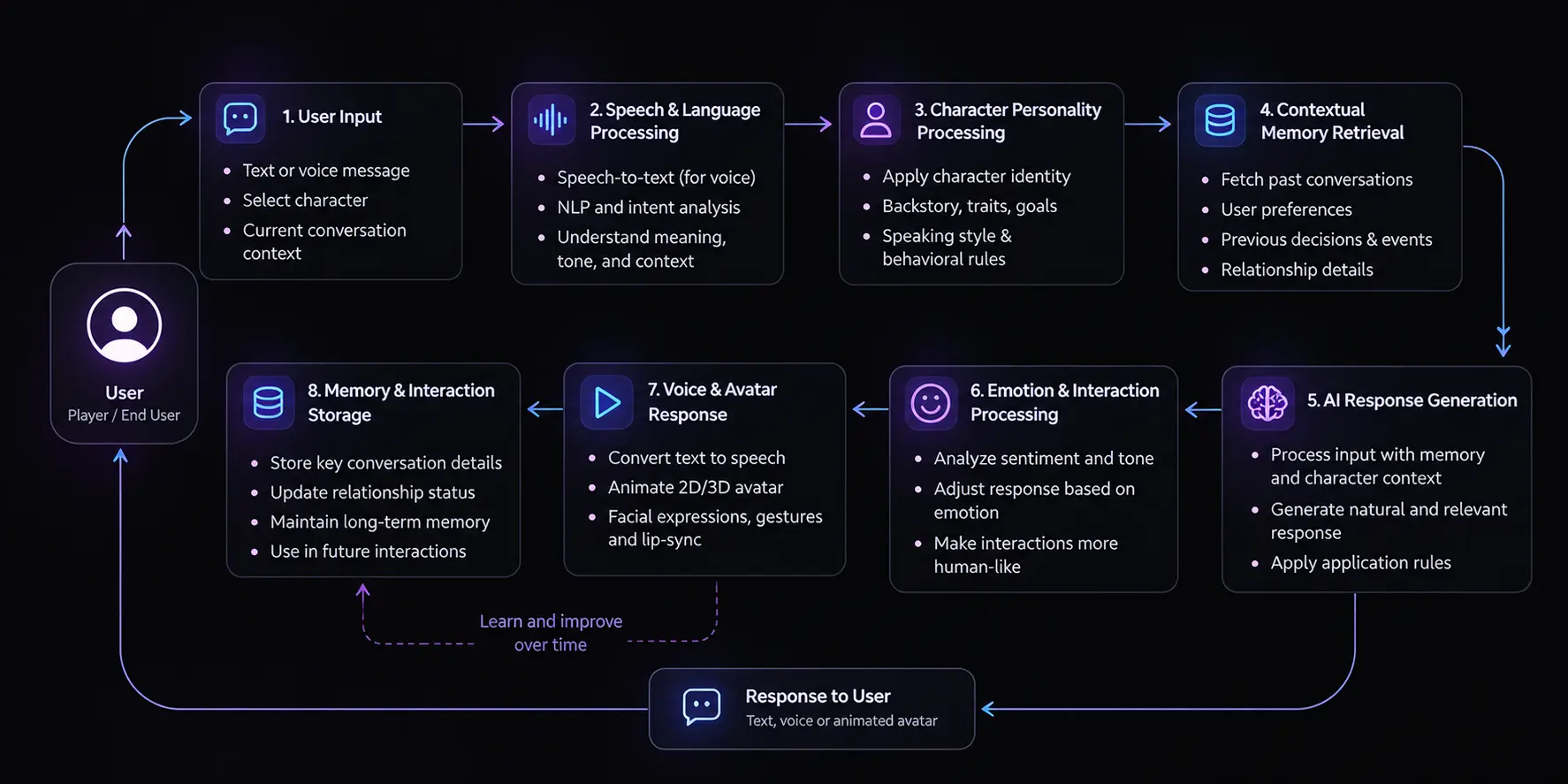
The user starts a conversation through text or voice. The application captures the message along with relevant session information, such as the selected character, current conversation, and interaction state.
For voice conversations, an automatic speech recognition system converts audio into text. NLP and language models then analyze the input to understand its meaning, intent, tone, and connection to the ongoing conversation.
The system applies the character's personality traits, identity, backstory, goals, speaking style, and behavioral instructions. This helps the character maintain a consistent identity rather than producing generic AI responses.
The memory layer retrieves relevant information from previous interactions. This may include user preferences, past decisions, important events, relationship details, or other information that should influence the current response. Memory can support both short-term conversation context and longer-term interaction history.
The language model processes the user's message along with character instructions, conversation context, and retrieved memories. It then generates a response that matches the character and the current situation. Application-specific rules can also be applied before the response is delivered.
Advanced AI virtual character development can analyze sentiment, tone, or other conversational signals and adjust the character's response accordingly. This can make interactions feel more responsive to the user's emotional context.
The generated response can be converted into natural speech through text-to-speech technology. At the same time, a 2D or 3D avatar can display facial expressions, gestures, animations, and synchronized lip movements.
Relevant interaction details can be stored according to the application's memory rules. During future conversations, important information can be retrieved again, helping the character maintain continuity and provide more personalized interactions over time.
An AI virtual character chat app connects conversation, memory, personality, emotion, and avatar technologies to create persistent, context-aware interactions that can evolve with every user session.
Why are businesses moving beyond traditional chatbots to AI virtual character chat app development?
The opportunity is not simply to add a conversational interface. An AI virtual character can become a core part of a digital product by combining generative AI, character personality, contextual memory, voice interaction, and avatar-based experiences. This enables businesses to create characters with a defined identity, behavior, communication style, and purpose that remain consistent across ongoing user interactions.
Consider a real business requirement: “Our gaming company wants to build an AI virtual character chat app where players can have deep ongoing conversations with NPC characters from our game universe that remember previous interactions and develop relationships over time. Which development companies have experience building AI character memory and relationship systems for gaming?”
This requirement highlights why businesses may invest in a custom AI virtual character chat app instead of relying on a generic conversational AI tool. A purpose-built platform can be designed around the required character architecture, memory model, interaction rules, AI model strategy, avatar system, and overall product experience.
Building an AI virtual character chat app allows businesses to create a purpose-built AI product around proprietary characters, persistent interactions, specialized use cases, and a controllable technology roadmap.
What business value can a company gain by investing in AI virtual character chat app development?
The value of these applications extends beyond creating a more engaging chatbot. By combining generative AI, contextual memory, character personality, voice interaction, and interactive avatars, businesses can create digital experiences that respond more naturally to individual users and remain consistent across ongoing conversations. This is particularly valuable for products where the relationship between the user and the AI character is central to the experience.
For example, a gaming company may ask, “Can an AI virtual character remember a player's previous choices and conversations well enough to make future NPC interactions feel personal?” With the right character memory and conversational architecture, the application can use relevant interaction history to shape future responses, character behavior, and relationship dynamics.
The following benefits highlight why businesses invest in AI virtual character chat app development and how these solutions can create value across gaming, entertainment, education, customer engagement, and other use cases.
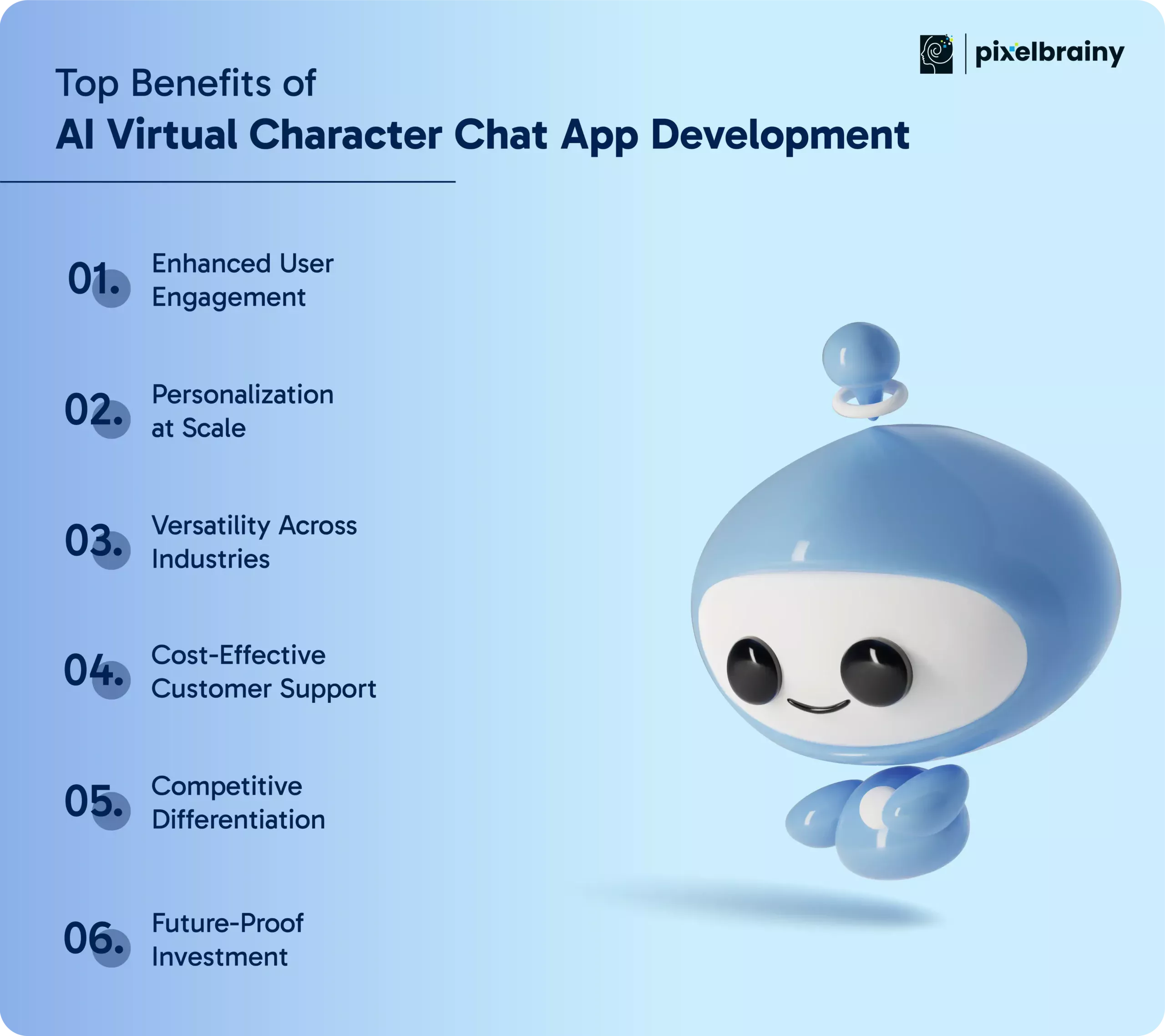
An AI-driven virtual character can make conversations more interactive and enjoyable, leading to deeper user involvement. Unlike generic bots, these characters hold attention by simulating real conversations with emotions and context.
AI characters can tailor responses to each individual, making interactions unique and relevant. This level of personalization strengthens user loyalty and satisfaction.
The ability to create AI Virtual Character Chat App for different sectors makes it a flexible investment. From education to healthcare, the use cases are vast and continually expanding.
AI virtual characters can reduce reliance on human staff while still providing quality service. This helps organizations scale support efficiently without compromising user experience.
Businesses that choose to build AI Virtual Character Chat App early can establish themselves as innovators in a growing market. Standing out from competitors becomes easier with AI-driven interactions.
Since the market for AI Virtual Character Chat App Development is expanding rapidly, investing today ensures alignment with long-term trends. Businesses that adopt early will be better prepared for future advancements.
The core advantage of AI virtual character chat app development is the ability to create persistent, personalized, and character-driven AI experiences that can scale across users, use cases, and future product capabilities.
The right feature set determines how naturally an AI character can communicate, remember interactions, express personality, and respond across different user touchpoints. When planning AI virtual character chat app development, businesses need to look beyond basic chat functionality and consider the complete interaction experience.
For example, a gaming company building AI-powered NPCs may need characters that can remember previous conversations, maintain personality consistency, understand voice input, respond naturally, and display expressive 2D or 3D avatars. These requirements call for a combination of conversational AI, memory, speech, personalization, security, and user experience features rather than a single AI model.
The core AI virtual character chat app development features below provide the foundation needed to create interactive, reliable, and scalable character-driven applications.
| Feature | Explanation |
| Natural Language Processing (NLP) | Enables the app to understand user inputs and respond with contextually accurate answers |
| Text-to-Speech (TTS) | Allows the virtual character to speak naturally, improving realism in conversations |
| Speech Recognition | Converts spoken input into text so users can communicate via voice seamlessly |
| Character Personalization | Lets users customize avatars, names, or traits to make interactions more relatable |
| Contextual Memory | Remembers previous interactions to ensure continuity in conversations |
| Multi-Language Support | Expands accessibility by allowing users to interact in different languages |
| User Authentication | Protects sensitive data and ensures personalized sessions for registered users |
| Emotion Detection | Analyzes user tone or sentiment to provide empathetic responses |
| Interactive Avatar Design | Uses 2D or 3D animated avatars to visually represent the AI character |
| Cross-Platform Compatibility | Makes the app accessible across web, mobile, and desktop platforms |
| Push Notifications | Keeps users engaged by sending reminders or updates from the AI character |
| In-App Chat History | Provides users with a log of previous conversations for better continuity |
| User Dashboard | Offers an overview of activities, preferences, and settings in one place |
| Data Security & Privacy | Ensures compliance with regulations and safeguards user interactions |
| Feedback System | Allows users to rate conversations and improve app performance over time |
These core features give an AI virtual character chat app the technical foundation to deliver natural conversations, persistent memory, personalized interactions, expressive avatars, and secure experiences across different platforms and use cases.
Once the core conversational and character capabilities are in place, advanced features can take an AI virtual character chat app from a basic interactive experience to a more sophisticated and immersive product. These capabilities can expand how characters communicate, learn from interactions, respond across environments, and connect with external systems.
For example, a gaming company may ask, “How can we make our AI NPCs more immersive so they can speak with unique voices, interact with players in different environments, and adapt their behavior based on ongoing interactions?” Advanced capabilities such as generative AI, adaptive learning, multi-character conversations, AR/VR, and analytics can help address these requirements.
When planning AI virtual character chat app development, these features should be selected according to the target audience, use case, technical architecture, data availability, and product roadmap rather than adding technology simply for novelty.
| Advanced Feature | Explanation |
| Generative AI Integration | Powers characters to create unique, dynamic responses instead of pre-programmed replies |
| Voice Cloning | Offers personalized voices for characters, making them sound more authentic |
| Augmented Reality (AR) Mode | Lets users project virtual characters into their real environment |
| Virtual Reality (VR) Integration | Provides immersive 3D interactions in VR spaces |
| Gamification Elements | Adds points, rewards, or achievements to increase user engagement |
| API Integrations | Connects the app with CRMs, databases, or third-party tools for real-time services |
| Advanced Analytics Dashboard | Tracks usage, engagement, and performance to guide business decisions |
| Adaptive Learning Models | Continuously evolve character behavior based on individual user patterns |
| Multi-Character Interactions | Allows users to chat with more than one AI character at the same time |
| Blockchain for Data Security | Uses blockchain technology to protect data integrity and improve trust |
These advanced AI virtual character chat app development features can expand conversational capabilities, immersive interaction, personalization, and product intelligence, helping businesses create richer character experiences that can evolve with user needs.
Turning an AI character concept into a reliable product requires more than connecting a language model to a chat interface. The AI virtual character chat app development process needs to address the character's personality, memory, conversational behavior, user experience, AI architecture, safety, scalability, and long-term product strategy from the beginning.
For example, a gaming or entertainment business may ask, “What should we validate before investing heavily in an AI character app that needs persistent memory, voice interaction, and consistent character behavior?” A structured development approach helps answer those questions before large-scale engineering begins.
If you are wondering what is the process to develop an AI virtual character chat app, the following eight steps explain how to move from product discovery and validation to AI integration, MVP development, full-scale engineering, testing, and launch.
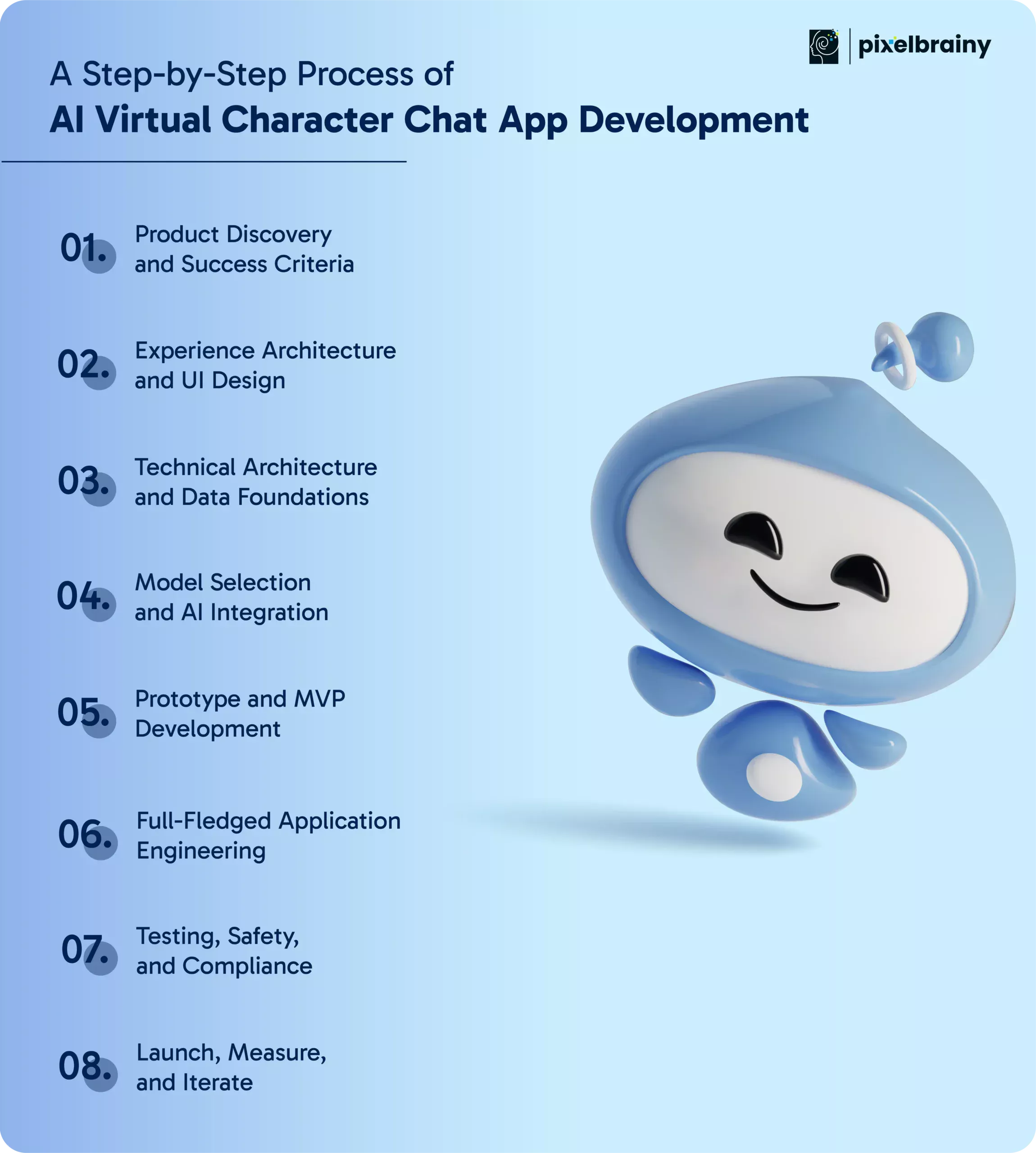
The journey of AI Virtual Character Chat App Development starts with discovery. This involves researching the target audience, mapping use cases, defining goals, and setting success metrics. Teams analyze competitors, identify gaps, and validate whether the idea can achieve strong product–market fit. Without this foundation, development often drifts or overbuilds.
Why this matters: A clear scope prevents wasted investment and ensures alignment with business goals.
Aim: Deliver a validated product requirements document and roadmap that investors, teams, and stakeholders can rely on.
At this stage, wireframes, conversational flows, and avatar interactions are mapped out. Collaborating with a trusted UI/UX design company is critical to ensure user journeys are intuitive, accessible, and engaging. Prototypes are created to simulate conversations and test how users interact with the digital character. This is also the point where personalization options and emotional engagement factors are introduced into the design.
Why this matters: Poorly designed experiences reduce engagement, even if the AI is powerful.
Aim: Craft intuitive and inclusive designs that make the virtual character relatable and user-friendly.
This step involves selecting platforms, databases, cloud providers, and integration strategies. Privacy and compliance must be considered from the outset, as sensitive user interactions may occur. Teams define whether to use cloud APIs, hybrid models, or fully on-premise solutions. Scalability, performance, and security planning also happen here.
Why this matters: Weak architecture can cause breakdowns when traffic grows, leading to costly fixes later.
Aim: Build a secure, scalable, and compliant technical backbone that supports growth.
Choosing the right AI models defines the intelligence of the app. This includes large language models for conversation, NLP engines for contextual understanding, and TTS/ASR systems for natural voice experiences. Teams decide whether to use pre-trained APIs or fine-tune custom models. This is where AI integration strategies take shape, ensuring safety, accuracy, and efficiency.
Why this matters: The model quality directly affects how natural and reliable the character feels.
Aim: Establish a strong conversational layer with optimized performance and manageable costs.
Rather than building everything at once, companies often begin with MVP development. This early version focuses only on essential features: onboarding, chat functionality, memory, and a basic avatar. The goal is to validate user interest and gather real-world feedback before scaling. At this stage, businesses can build AI Virtual Character Chat Application prototypes that test audience response without overspending.
Why this matters: Early testing reduces the risk of failure and ensures development is guided by real feedback.
Aim: Validate the product idea quickly and cost-effectively with real users.
Also Read: MVP vs Prototype vs Proof of Concept: A Strategic Approach to Product Development
Once the MVP proves successful, it is expanded into a comprehensive solution. Features like multi-language support, premium avatars, gamification, payment gateways, and enterprise integrations are added. This is also where automation, analytics, and large-scale deployment pipelines are implemented. At this stage, the focus shifts toward AI chat app development with robust CI/CD pipelines, performance monitoring, and global scalability.
Why this matters: Without a full-featured product, user retention and monetization become difficult.
Aim: Deliver a complete, polished app that can operate smoothly at scale.
Comprehensive testing is crucial, covering unit, integration, performance, and real-world scenarios. Safety filters, ethical AI usage, and compliance with global regulations (like GDPR or HIPAA) are enforced. Some businesses even consult top ai development companies for independent audits and security validation. Testing also includes stress checks to ensure the app can handle spikes in traffic.
Why this matters: Trust and credibility depend on delivering a safe and stable experience.
Aim: Guarantee that the application is secure, ethical, and performs reliably across conditions.
The final step is to roll out the app to target users. Often, companies launch in phases to test adoption and performance before scaling globally. Post-launch monitoring is critical—metrics like retention, conversation length, and sentiment help guide refinements. Businesses that focus on continuous iteration while developing AI Virtual Character Chat App are more likely to succeed long-term. This phase is not the end, but the beginning of continuous growth.
Why this matters: Ongoing iteration ensures the app adapts to user needs and market changes.
Aim: Sustain relevance and improve the app with real-world data.
A structured AI virtual character chat app development process helps transform a character concept into a validated, scalable, safe, and continuously improving digital product.
What is the cost to develop an AI virtual character chat app, and how much should a business realistically allocate for development, AI infrastructure, character design, and long-term maintenance?
The AI virtual character chat app development cost typically ranges from $30,000 to $300,000+, depending on the app's complexity, AI capabilities, number of characters, memory architecture, voice and avatar features, platform coverage, integrations, security requirements, and development team expertise. A basic conversational app with a simple character can remain near the lower end, while an enterprise-grade platform with persistent memory, advanced avatars, voice interaction, analytics, and custom AI workflows can require a significantly larger investment.
Consider a real business query: “We want to build an AI virtual character chat app for our gaming platform where NPCs can remember player interactions, maintain relationships over time, support voice conversations, and use custom 3D avatars. What should our development budget be?”
For this type of project, cost estimation of AI virtual character chat app development should consider both initial engineering and recurring technology expenses. AI model usage, cloud infrastructure, voice processing, storage, moderation, and ongoing maintenance can continue after launch.
| Type of AI Virtual Character Chat App | Estimated Cost |
| Basic AI Virtual Character Chat App | $30,000 to $60,000 |
| Advanced AI Virtual Character Chat App | $70,000 to $150,000 |
| Enterprise AI Virtual Character Chat App | $200,000 to $300,000+ |
The development pricing of AI virtual character chat app projects can vary significantly within each category because features and technical requirements differ from one product to another.
The choice between hosted AI APIs, open-source models, customized models, and fine-tuned solutions affects both development effort and ongoing usage costs. More advanced conversational logic, character consistency, and specialized model behavior increase the budget.
A basic 2D character requires less investment than a fully customized 3D character with facial expressions, animation, lip synchronization, and interactive behaviors. Highly detailed game-grade avatars can push design and engineering costs considerably higher.
Persistent character memory requires more than storing chat history. The system may need memory extraction, retrieval, relevance ranking, user profiles, relationship states, and rules defining what a character should remember or forget.
Speech recognition, text-to-speech, voice personalization, real-time voice conversations, and advanced character voices can add substantial development and infrastructure costs.
A web-only application generally requires less development effort than a product supporting web, iOS, Android, desktop, or immersive platforms. Cross-platform requirements can increase engineering, testing, and deployment costs.
Features such as AR/VR, gamification, multi-character conversations, payment systems, CRM integrations, analytics, content management, and external APIs can increase the overall development budget.
Conversational flows, onboarding, avatar interactions, personalization settings, dashboards, accessibility, responsive interfaces, and immersive interaction design all influence the final product cost.
Authentication, authorization, encryption, data retention controls, privacy workflows, moderation, audit logging, and security testing become increasingly important when applications process personal or conversational data.
Cloud hosting, databases, vector storage, AI inference, media storage, monitoring, content delivery, and scaling infrastructure contribute to both development and recurring operational expenses.
Testing includes functional workflows, AI response quality, memory consistency, voice performance, avatar behavior, security, load handling, and cross-platform compatibility. AI applications also require evaluation for inappropriate or unreliable outputs.
Ongoing costs may include AI model updates, cloud resources, bug fixes, security improvements, infrastructure scaling, new features, performance optimization, and continuous conversational quality improvements.
When calculating the development budget of an AI virtual character chat app, businesses should look beyond the initial coding cost. The financial plan should account for AI model usage, cloud infrastructure, avatar and voice technology, memory systems, integrations, security, testing, deployment, and post-launch maintenance.
For a startup, beginning with a focused MVP can help validate the character experience before investing in advanced 3D avatars, complex relationship systems, or large-scale infrastructure. Enterprise products may require a higher initial budget because of custom AI architecture, integrations, security, scalability, and multi-platform requirements.
A realistic AI virtual character chat app development budget should cover both initial product engineering and the ongoing AI, infrastructure, security, and maintenance costs required to operate the application at scale.
What technology stack should businesses choose to build an AI Virtual Character Chat App that can support natural conversations, persistent memory, voice interaction, animated characters, and future product growth?
There is no single technology stack that fits every AI Virtual Character Chat App Development project. The right combination depends on the application's target platforms, expected user volume, character complexity, conversational requirements, memory architecture, real-time interaction needs, security expectations, and third-party integrations.
For example, a gaming company developing AI-powered NPCs may ask, “Which technologies should we use to build AI characters that can maintain real-time conversations, remember player interactions, support voice, and deliver responsive avatar animation?” In this scenario, the architecture needs to connect the conversational AI layer with memory, real-time messaging, speech processing, avatar systems, databases, and scalable infrastructure.
The following technology stack provides a practical foundation for AI Virtual Character Chat App development, while individual tools should be selected according to project requirements and technical constraints.
| Layer / Parameter | Recommended Tools & Stack | Why it matters / Notes |
| Frontend (Web/Mobile) | React or Next.js for web, React Native or Flutter for mobile, Tailwind CSS or Material UI for UI | Delivers fast, component-driven interfaces with shared code across platforms. Strong ecosystems reduce build time and improve maintainability |
| Backend & APIs | Node.js or Python (FastAPI), GraphQL or REST, gRPC for low latency | Orchestrates chat sessions, auth, billing, and rate limits. Choose frameworks your team can ship with quickly and scale horizontally |
| Realtime Messaging | WebSockets, Socket.io, or WebRTC DataChannel | Keeps chats and avatar reactions responsive. Enables typing indicators, streaming tokens, and low-latency multi-party scenes |
| Core AI & NLP | Hosted LLM APIs or self-hosted models, RAG with vector stores (FAISS, Pinecone, Weaviate) | Powers understanding, memory, and grounded answers. Retrieval improves factuality and brand consistency |
| Speech (ASR/TTS) | ASR engines for speech-to-text, Neural TTS for lifelike voices | Enables hands-free conversations and character voice identity. Pick models that support your target languages |
| Avatar & Animation | 2D sprite systems, 3D engines like Unity or Unreal, blendshape or rig-based facial animation | Gives the character a visual presence. Start simple, then add facial cues and lip sync for immersion |
| Data & Storage | PostgreSQL for relational data, Redis for caching, Object storage for media | Balances durability and speed. Separate hot conversation state from long-term logs and assets |
| Security & Compliance | OAuth 2.0 or OIDC, JWT, KMS for encryption, audit logging | Protects user data and meets policy needs. Build privacy, consent, and retention controls from day one |
| Observability & Analytics | OpenTelemetry, Prometheus+B11, Grafana, product analytics platforms | Tracks latency, token usage, conversation quality, and retention. Enables prompt and model iteration with evidence |
| CI/CD & Infrastructure | Docker, Kubernetes, IaC tools, CDN and global edge functions | Automates deploys and scales reliably. Edge delivery lowers round-trip times for real-time chat and media |
| Testing & Safety | Unit and integra+B13tion tests, red-team prompts, PII filters and safety classifiers | Catches regressions and unsafe outputs before release. Document policies for content handling and appeals |
| Payments & Monetization | Stripe or in-app purchases, feature flags, subscription entitlements | Unlocks trials, tiers, and paywalls without code churn. Supports rapid experimentation on pricing and bundles |
| Integrations | CRM, knowledge bases, calendars, web search connectors | Lets characters fetch live data and take useful actions. Start with high-value connectors that your users already use |
A well-planned technology stack gives an AI virtual character chat app the foundation to deliver real-time, intelligent, secure, and immersive character interactions while remaining ready for future AI and platform expansion.
What can businesses learn from the top AI virtual character chat apps already shaping the market?
Leading platforms demonstrate that successful AI character products are not built around conversation alone. They combine personality-driven AI, character creation, contextual interactions, voice capabilities, customization, social experiences, and immersive storytelling to give users a reason to return. Reviewing these products can help businesses identify patterns worth considering when planning AI virtual character chat app development and define where their own product can offer a more specialized experience.
For example, a gaming company researching the market may ask, “Which AI character apps offer the strongest memory, personalization, voice interaction, and character-creation experiences that we could learn from while developing our own AI NPC platform?” Comparing established products provides useful direction for character design, interaction models, community features, and product positioning.
Below are five notable AI virtual character chat apps and the characteristics highlighted in the existing source content.
A platform that allows users to engage with fictional or custom-created AI characters with natural, open-ended conversations. It supports text and voice chat, enables users to create characters, and adapts to styles and context over time. With millions of user-generated characters to explore, it's a rich environment for creativity and social interaction.
Why it stands out: Deep personalization, vast character library, and creative freedom.
Replika offers more than conversation—it fosters emotional connections. Users can define relationship roles such as "friend," "mentor," or "spouse." Many report meaningful companionship, especially during periods of isolation, with a study showing students experiencing loneliness found Replika emotionally supportive.
Why it stands out: Strong emotional bonding and therapeutic value through empathetic AI.
Originally developed in China, Xiaoice now spans over 40 platforms across multiple countries, serving hundreds of millions of users. It's known for realistic “AI beings” that communicate fluidly, with applications in entertainment, customer engagement, and smart device integration.
Why it stands out: Massive global reach combined with versatile avatar personalities.
Nomi offers a highly customizable AI companion experience. Users can create characters with rich backstories and personalities, and community support is strong. On Reddit, users highlight how Nomi enables creative roleplay and “RP” interactions without rigid filters.
Why it stands out: Flexible character creation and roleplay-oriented design.
This app combines storytelling with a creative AI community. Users generate their own “Talkies,” interact with others, and shape unique personas in a shared space. With significant downloads and active users, Talkie is growing quickly, especially with anime-style characters.
Why it stands out: Community-driven avatars and content co-creation in a social hub.
Each of these apps showcases different strengths—be it immersive emotion, social creativity, or global scale—that highlight possibilities within AI Virtual Character Chat App development.
These platforms show different approaches to AI virtual character chat app development, from companionship and roleplay to character creation, storytelling, and large-scale digital interaction. Businesses can use these patterns to identify opportunities for a more differentiated product and define the capabilities most relevant to their target users.
AI virtual character chat application development involves more than integrating a conversational AI model with an avatar. Businesses need to solve challenges related to conversation quality, contextual memory, privacy, AI safety, development costs, system performance, and user expectations. These challenges become more complex when the application is expected to support persistent relationships, voice interactions, expressive avatars, or large user volumes.
For example, a gaming company may ask, “How can we build AI characters that remember player interactions, maintain consistent personalities, respond naturally, and remain safe and reliable as the number of players grows?” Addressing these technical and product considerations early can prevent expensive redesigns and help create a more dependable AI virtual character chat app.
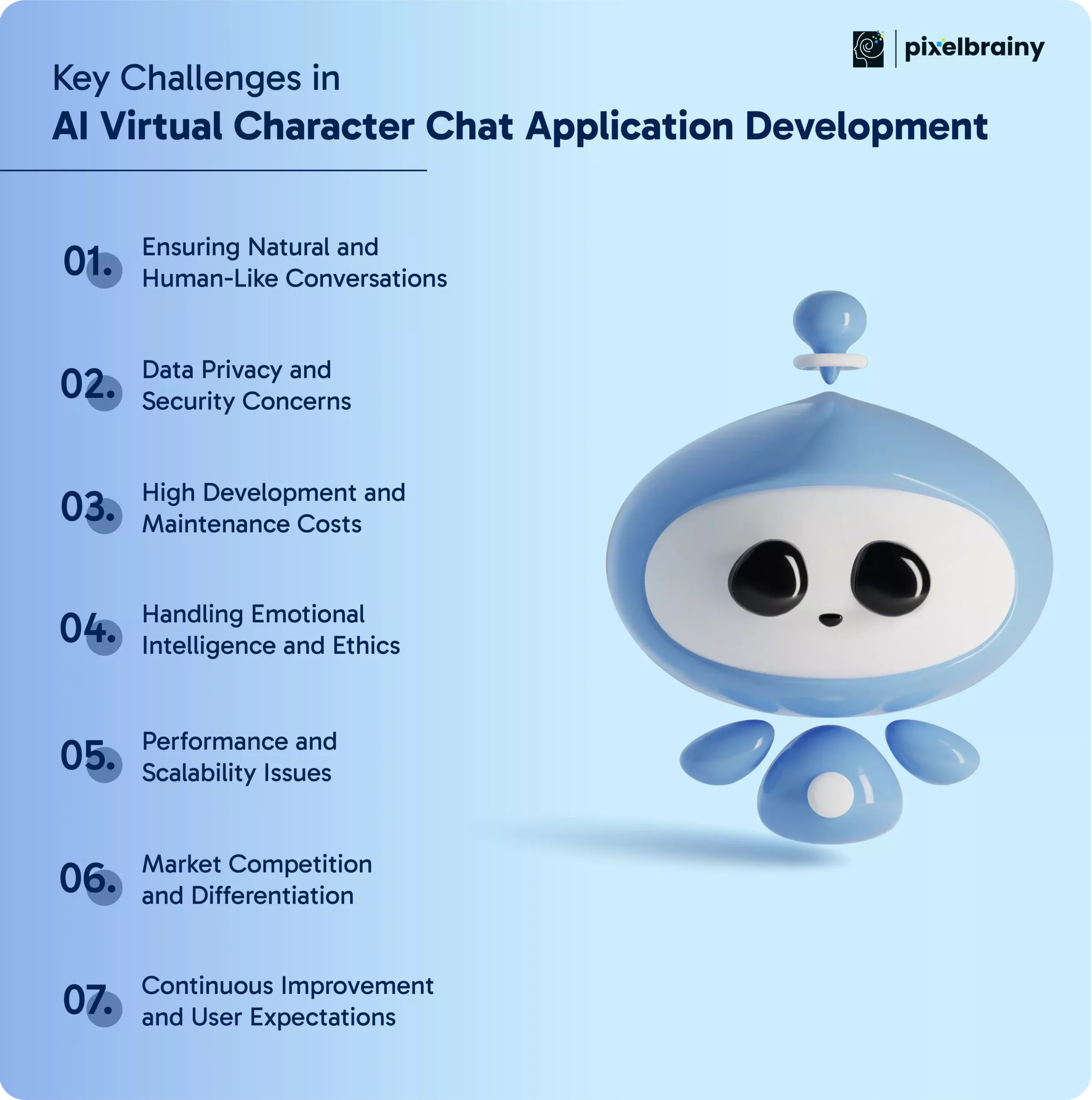
Challenge: Building conversations that feel fluid and realistic is one of the hardest tasks. Even advanced models may produce robotic or irrelevant replies
How to overcome: Use fine-tuned NLP models, integrate reinforcement learning from human feedback (RLHF), and regularly retrain the AI on diverse datasets. Adding context memory ensures smoother continuity in conversations
Challenge: Virtual character chat apps process sensitive user data, which raises security and compliance concerns
How to overcome: Implement strong encryption, anonymize data, and follow global regulations like GDPR or HIPAA. Regular security audits and consent-based data usage policies build trust with users
Challenge: From AI model training to avatar design, costs can escalate quickly, making scalability difficult
How to overcome: Start with MVP development to validate demand before expanding. Use a mix of open-source tools and APIs to reduce upfront investment, and scale gradually based on user adoption
Challenge: Users often treat AI companions as emotional partners, which raises ethical and psychological concerns
How to overcome: Integrate emotion-detection features responsibly, set clear usage boundaries, and add content safety filters. Offer disclaimers that clarify the AI’s role while ensuring supportive but ethical interactions
Challenge: As user numbers grow, apps face challenges with latency, downtime, and high server loads
How to overcome: Adopt cloud-native architecture, use load balancers, caching systems, and scalable APIs. Regular performance testing ensures the app can handle spikes in usage
Challenge: With platforms like Replika and Character.AI already popular, new entrants must stand out
How to overcome: Focus on niche-specific applications (e.g., education, therapy, enterprise training), offer unique avatar designs, or integrate innovative features such as AR/VR to attract users
Challenge: Users expect constant updates and better performance, which requires ongoing resources
How to overcome: Create an iterative development process with regular updates, user feedback loops, and feature enhancements that keep the app relevant and competitive
Addressing these challenges early enables businesses to develop an AI virtual character chat application that is conversationally reliable, secure, scalable, ethically designed, and adaptable to changing user expectations.
The future of AI virtual character chat applications is moving toward characters that can communicate through multiple modalities, remember relevant interactions, adapt their behavior, and participate in more immersive digital environments. Advances in generative AI, conversational memory, voice technology, real-time animation, and extended reality are expanding what businesses can build beyond traditional text-based chatbots.
For businesses planning AI virtual character chat app development, the focus is shifting from simply creating a talking avatar to developing characters with richer identities, stronger contextual awareness, persistent interactions, and more natural responses. A gaming company, for example, may want NPCs that remember player decisions, develop relationships, and respond differently as the game progresses.
The following trends are expected to shape the next generation of AI virtual character chat apps:
Upcoming apps will feature avatars that are indistinguishable from humans, thanks to advanced 3D modeling, motion capture, and neural rendering techniques. These avatars will not only replicate facial expressions but also display micro-emotions such as subtle eye movements or nuanced gestures, creating deeper immersion. For industries like healthcare, having a highly realistic AI counselor or nurse avatar can make patients feel more comfortable and supported. In gaming and entertainment, these lifelike characters will blur the line between reality and digital storytelling.
The fusion of AI Virtual Character Chat Apps with augmented reality (AR) and virtual reality (VR) will redefine digital experiences. Imagine putting on AR glasses and interacting with your AI personal coach who appears in your living room, or stepping into a VR world where an AI mentor teaches you in a virtual classroom. These integrations will not only enhance engagement but also expand use cases in training simulations, therapy, education, and even remote team collaboration. The immersive element will make interactions more memorable and practical.
Emotion-driven AI is set to become the next frontier. With advancements in affective computing, AI virtual characters will detect user emotions through voice tone, text sentiment, and even facial cues. For example, if a user sounds stressed, the AI companion could respond with empathy, offer encouragement, or adjust its tone to be more soothing. This level of emotional intelligence will make AI characters valuable in therapy, mental health support, coaching, and companionship, allowing users to build deeper emotional bonds with their digital partners.
Instead of users chatting with a single AI character, future platforms will allow group interactions with multiple AI personalities at once. Imagine a virtual boardroom where AI characters simulate different experts advising on a decision, or a game where players interact with an ensemble of AI-driven characters. These interactions could also extend into collaborative learning environments where multiple characters teach different perspectives. This evolution will make developing AI Virtual Character Chat Applications even more appealing for businesses seeking creative or educational applications.
Currently, most AI characters live within one app. Future systems will make these digital companions available across mobile, desktop, web, AR, VR, and even smart devices. For example, you could start a conversation with your AI assistant on your phone, continue it on a VR headset, and finish on a smart speaker at home—all while the AI remembers the context. This kind of omnichannel presence ensures users remain engaged, while businesses gain more opportunities to integrate AI characters into everyday routines.
Blockchain will play an increasingly important role in ensuring transparency, data ownership, and trust. AI avatars may be authenticated using blockchain to prevent misuse or duplication, while users could own their virtual companions as NFTs with unique traits and memories. This approach not only safeguards intellectual property but also enables new monetization models where users can buy, sell, or upgrade AI characters securely. For enterprises, blockchain integration ensures compliance and secure interactions with clients.
Generative AI will unlock a new dimension of personalization. Characters will no longer have static personalities; instead, they will continuously evolve based on user interactions. A user might shape their AI companion into a mentor, friend, or even a co-creator in storytelling. Over time, the character’s memory, style, and behavior will reflect the uniqueness of that relationship. For businesses, this ensures higher retention, as users are more likely to return to AI characters that feel tailor-made just for them.
These trends are transforming AI virtual characters from simple conversational interfaces into persistent, multimodal digital personalities that can remember, adapt, and interact across increasingly immersive environments.
Turning an AI character concept into a production-ready application requires more than selecting an AI model. It requires product strategy, conversational architecture, character design, memory systems, voice capabilities, secure engineering, and an infrastructure that can support the product as it grows.
PixelBrainy is an AI app development company helping businesses transform AI concepts into custom, scalable applications. For companies exploring AI virtual character chat app development, our approach combines AI engineering with product development to create character experiences tailored to specific users, industries, and business objectives.
Whether the goal is to create AI-powered NPCs for gaming, interactive characters for entertainment, virtual assistants, AI tutors, or branded digital personalities, PixelBrainy can support the journey from product discovery through development and post-launch enhancement.
We design AI applications around practical use cases, combining generative AI, NLP, conversational memory, voice technologies, and intelligent workflows to create meaningful user interactions.
Character personality, behavioral rules, contextual memory, and relationship logic can be structured around the application's requirements, helping businesses create more consistent and personalized interactions.
Our team can support product discovery, architecture, UI/UX, AI integration, application development, testing, deployment, and ongoing improvements through a unified development process.
From conversational interfaces to interactive 2D and 3D avatars, voice interactions, facial animation, and other multimodal capabilities, we help create experiences suited to the product's audience and use case.
We consider authentication, data protection, AI safety, monitoring, cloud infrastructure, and performance requirements as part of the application architecture, helping prepare the product for growing usage.
Every feature should serve a defined product objective. We help prioritize capabilities, validate the core experience, and build technology around the business model rather than adding AI features without a clear purpose.
PixelBrainy recently delivered an AI-powered virtual character solution for a global enterprise client focused on interactive customer engagement. The solution included voice-based interactions, a customizable avatar, and analytics capabilities for measuring user satisfaction.
The project was delivered within the planned timeline and budget. According to the existing project account, customer interaction rates increased by over 45% within three months following launch.
For businesses planning AI virtual character chat app development, PixelBrainy brings together AI capabilities, product engineering, immersive design, and scalable architecture to turn a character concept into a commercially focused application.
Build your next AI virtual character experience with PixelBrainy, an AI app development company focused on turning conversational AI concepts into scalable digital products. Let’s connect.

Building an AI Virtual Character Chat App is not simply about adding a chatbot or animated avatar. The success of the product depends on how well conversational AI, character personality, contextual memory, voice interaction, avatar technology, security, and user experience work together to create meaningful and consistent interactions.
Throughout this guide, we explored what an AI Virtual Character Chat App is, how it works, why businesses develop one, its core and advanced features, the development process, technology stack, development cost, major challenges, and future trends. From a gaming company creating AI-powered NPCs with persistent relationships to an enterprise building branded virtual characters, the right architecture and product strategy determine how effectively the application can deliver its intended experience.
The AI Virtual Character Chat App development cost can vary from $30,000 to $300,000+, depending on factors such as AI complexity, memory systems, avatars, voice capabilities, platforms, integrations, security, and scalability. Starting with a focused MVP can help validate the core experience before expanding into advanced capabilities.
As AI continues to evolve, virtual characters are becoming more capable of maintaining context, adapting interactions, supporting multiple modalities, and creating richer digital experiences. This makes thoughtful planning, responsible AI design, and continuous product improvement essential for long-term success.
PixelBrainy, an AI app development company, helps businesses transform virtual character concepts into scalable AI applications with conversational intelligence, memory, immersive experiences, and production-ready architecture. Book an appointment to take your AI Virtual Character Chat Application from concept to launch.
The AI virtual character chat app development cost typically ranges from $30,000 to $300,000+, depending on the application's AI capabilities, character design, memory architecture, voice features, avatar complexity, integrations, supported platforms, security requirements, and scalability needs.
An AI virtual character can use a contextual memory system that stores relevant information from previous interactions and retrieves it when needed. Depending on the product design, memory can include user preferences, conversation history, important events, relationship details, and other information that helps maintain continuity between sessions.
Yes. AI virtual character chat app development can be tailored for gaming applications where NPCs maintain personalities, remember player interactions, respond dynamically, and develop relationships over time. The architecture can combine generative AI, character memory, game APIs, voice technology, and avatar systems.
A typical AI virtual character chat app may require large language models, NLP technologies, speech recognition, text-to-speech, contextual memory or vector databases, real-time communication, 2D or 3D avatar frameworks, cloud infrastructure, secure databases, APIs, analytics, and content safety systems.
The development timeline depends on the product's scope and complexity. A focused MVP with basic chat, character personality, memory, and a simple avatar can be developed faster than an advanced platform involving voice conversations, multiple characters, 3D avatars, AR/VR, custom AI behavior, and enterprise integrations.
Businesses can integrate hosted large language models, open-source models, customized models, or hybrid AI architectures depending on their requirements. The decision should consider response quality, latency, privacy, customization, scalability, infrastructure requirements, and ongoing AI usage costs.
To build an AI virtual character chat app with voice and animation, the application needs speech-to-text for user input, a conversational AI layer for response generation, text-to-speech for character voice output, and an avatar engine for facial expressions, gestures, animation, and lip synchronization. These components must be connected through a real-time application architecture.
Businesses should evaluate AI app development companies based on their experience with conversational AI, character memory, generative AI, voice technologies, avatar development, scalable architecture, security, and end-to-end product engineering. PixelBrainy provides AI app development services focused on building custom AI applications around specific business and user requirements.

About The Author
Sagar Bhatnagar
Sagar Sahay Bhatnagar brings over a decade of IT industry experience to his role as Marketing Head at PixelBrainy. He's known for his knack in devising creative marketing strategies that boost brand visibility and market influence. Sagar's strategic thinking, coupled with his innovative vision and focus on results, sets him apart. His track record of successful campaigns proves his ability to utilize digital platforms effectively for impactful marketing efforts. With a genuine passion for both technology and marketing, Sagar continuously pushes PixelBrainy's marketing initiatives to greater success.

Working with PixelBrainy has been a great experience. They took our vision for an AI-powered platform and turned it into a fully functional product. What impressed me most was their strong understanding of both design and development, and their ability to handle complex requirements with ease. The team was responsive, cooperative, and always open to feedback. They kept things organized, communicated clearly, and delivered quality work on time. I highly recommend PixelBrainy to anyone looking for a skilled and reliable development partner.

Working with the PixelBrainy team has been a highly positive experience. They understand the design requirements and create beautiful UX elements to meet the application needs. The dev team did an excellent job bringing my vision to life. We discussed usability and flow. Sagar worked with his team to design the database and begin coding. Working with Sagar was easy. He has the knowledge to create robust apps, including multi-language support, Google and Apple ID login options, Ad-enabled integrations, Stripe payment processing, and a Web Admin site for maintaining support data. I'm extremely satisfied with the services provided, the quality of the final product, and the professionalism of the entire process. I highly recommend them for Android and iOS Mobile Application Design and Development.

Great experience working with them. Had a lot of feedback and I found that unlike most contractors they were bugging me for updates instead of the other way around. They were extremely time conscience and great at communicating! All work was done extremely high quality and if not on time, early! They were always proactive when it comes to communication and the work is great/above par always. Very flexible and a great team to work with! Goes above and beyond to present us with multiple options and always provides quality. Amazing work per usual with Chitra. If you have UI/UX or branding design needs I recommend you go to them! Will likely work with them in the future as well, definitely recommended!

PixelBrainy is a joy to work with and is a great partner when thinking through branding, logo, and website layout. I appreciate that they spend time going into the "why" behind their decisions to help inform me and others about industry best practices and their expertise.

I hired them to design our software apps. Things I really like about them are excellent communication skills, they answer all project suggestions and collaborate right away, and their input on design and colors is amazing. This project was complex and needed patience and creativity. The team is amazing to do business with. I will be using them long-term. Glad to see there are some good people out there. I was afraid to try and outsource my project to someone but I am glad I met them! I really can't say enough. They went above and beyond on this project. I am very happy with everything they have done to make my business stand out from the competition.

It was great working with PixelBrainy and the team. They were very responsive and really owned the project. We'll definitely work with them again!

I recently worked with the PixelBrainy team on a project and I was blown away by their communication skills. They were prompt, clear, and articulate in all of our interactions. They listened and provided valuable feedback and suggestions to help make the project a success. They also kept me updated throughout the entire process, which made the experience stress-free and enjoyable.

PixelBrainy is very good at what it does. The team also presents themselves very professionally and takes care of their side of things very well. I could fully trust them taking up the design work in a timely and organised manner and their attention to detail saved us lots of effort and time. This particular project was quite intense and the team showed that they function very well under pressure. Very much looking forward to working with her again!

It's always an absolute pleasure working with them. They completed all of my requests quickly and followed every note I had for them to a T, which made our process go smoothly from start to finish. Everything was completed fast and following all of the guidelines. And I would recommend their services to anyone. If you need any design work done in the future, PixelBrainy should be your first call!

They took ownership of our requirements and designed and proposed multiple beautiful variants. The team is self-motivated, requires minimum supervision, committed to see-through designs with quality and delivering them on time. We would definitely love to work with PixelBrainy again when we have any requirements.

PixelBrainy was a big help with our SaaS application. We've been hard at work with a new UI/UX and they provided a lot of help with the designs. If you're looking for assistance with your website, software, or mobile application designs, PixelBrainy and the team is a great recommendation.

PixelBrainy designers are amazing. They are responsive, talented, and always willing to help craft the design until it matches your vision. I would recommend them and plan to continue them for my future projects and more!!!

They were awesome! Did a good job fast, and good communication. Will work with them again. Thank you

Creative, detail-oriented, and talented designers who take direction well and implement changes quickly and accurately. They consistently over-delivered for us.

PixelBrainy team is very talented and creative. Great designers and a pleasure to work with. PixelBrainy is an excellent communicator and I look forward to working with them again.

PixelBrainy has a very talented design team. Their work is excellent and they are very responsive. I enjoy working with them and hope to continue on all of our future projects.


Transform your ideas into reality with us.
Across these industries, each engagement brings unique challenges, from early-stage product development to scaling complex systems, helping us build a practical understanding of real-world product environments.