AI Summary Powered by PixelBrainy
What happens when a healthcare organization invests thousands of dollars in AI technology, only to discover that it fails compliance reviews, cannot integrate with existing systems, creates security concerns, and delivers little measurable business value?
This is a challenge many healthcare leaders across the United States are facing today. Hospitals, health systems, clinics, and healthcare enterprises are actively investing in artificial intelligence to improve operational efficiency, reduce administrative workload, enhance patient experiences, and support clinical teams. However, achieving these outcomes depends less on the AI technology itself and more on selecting the right implementation partner.
For healthcare executives, CIOs, CTOs, compliance officers, healthcare IT managers, and digital transformation leaders, choosing an AI healthcare solutions provider in USA has become a strategic decision with long term operational and financial implications.
According to MarketsandMarkets, the global AI in healthcare market is projected to grow from USD 21.66 billion in 2025 to USD 110.61 billion by 2030, reflecting continued investment in AI driven healthcare innovation and infrastructure.
The reality is that many AI projects fail because organizations overlook a few critical evaluation areas during vendor selection. Before signing any agreement, healthcare organizations should carefully assess:
If you are searching for the right AI healthcare solutions provider, the fastest way to reduce risk is to prioritize vendors with proven healthcare experience, compliance expertise, integration success stories, and documented ROI results.
Many organizations start with practical concerns such as: "We are a mid sized hospital network and our current EHR system cannot talk to any of the new AI tools we want to use, can you recommend AI healthcare solutions providers in USA who specialize in EHR integration without a long implementation timeline?" Questions like this highlight why selecting a specialized healthcare AI solutions provider is often more important than selecting the newest technology.
This guide explains how to select a HIPAA compliant AI healthcare solutions provider by evaluating five key decision factors: compliance, security, integration, cost, and ROI. Understanding these factors will help healthcare organizations avoid costly implementation mistakes and choose a partner that can support long term growth and innovation.
Artificial intelligence can deliver significant value to healthcare organizations, but the results depend heavily on the expertise and reliability of the vendor behind the solution. The provider you work with will influence how securely patient data is managed, how effectively AI integrates with existing systems, and whether the investment produces measurable business outcomes. A poor vendor decision can lead to compliance issues, operational disruptions, and costly setbacks that limit the benefits of AI adoption.
According to IBM's Cost of a Data Breach Report 2024, healthcare remains the costliest industry for data breaches, with the average breach costing $9.77 million. This highlights why vendor evaluation should begin with risk management, security, and compliance considerations rather than product features alone.
Many healthcare leaders ask: "What happens if I choose the wrong AI healthcare solutions provider?" The answer often falls into the following critical areas.
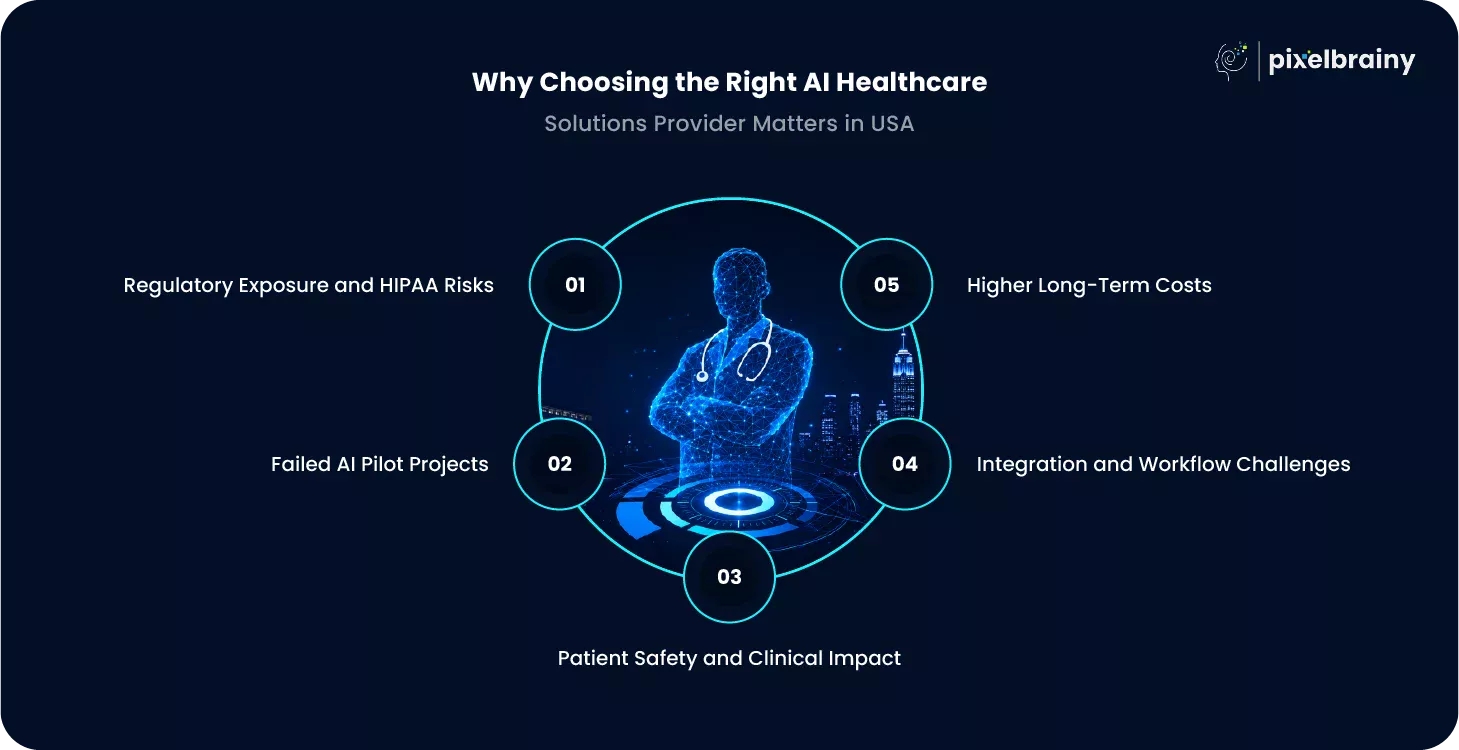
One of the biggest concerns when adopting AI in healthcare is compliance. A provider that lacks healthcare specific expertise may fail to implement proper safeguards for protected health information.
Working with a HIPAA violation AI vendor can expose healthcare organizations to audits, financial penalties, legal challenges, and reputational damage. Every vendor should demonstrate HIPAA readiness, security policies, audit controls, and a willingness to sign a Business Associate Agreement.
Many healthcare organizations launch AI pilot programs with high expectations but never move beyond the testing phase. This often happens when vendors lack healthcare workflow knowledge, implementation experience, or long term support capabilities.
Failed pilots waste budgets, consume staff resources, and delay digital transformation initiatives that could have delivered measurable value.
AI systems increasingly support scheduling, documentation, patient communication, and clinical workflows. If these systems generate inaccurate outputs, miss critical information, or create workflow inefficiencies, patient care can be affected.
A reliable vendor understands the importance of accuracy, transparency, validation, and continuous monitoring within healthcare environments.
One of the most common reasons AI projects struggle is poor interoperability. Many healthcare organizations discover that their AI platform cannot connect effectively with existing EHR systems, billing platforms, or clinical applications.
These challenges create data silos, manual workarounds, and staff frustration instead of operational improvements.
The cheapest solution often becomes the most expensive one over time. Poor implementation, weak support, additional customization requirements, compliance remediation efforts, and system replacement costs can significantly increase the total investment. This is why healthcare organizations evaluating the best AI healthcare solutions provider for hospitals in USA should focus on long term value rather than upfront pricing alone.
A trusted AI healthcare solutions provider helps healthcare organizations reduce risk, maintain compliance, protect patient data, and turn AI investments into measurable business and clinical outcomes.
Also Read: Top 12 AI Healthcare Software Development Companies in USA
Compliance is the first area healthcare organizations should evaluate before discussing AI features, implementation timelines, or pricing. Even the most advanced AI solution can become a liability if it fails to meet healthcare regulatory requirements. For hospitals, clinics, physician groups, and healthcare enterprises, compliance is not optional. It is a foundational requirement that protects patient data, reduces legal risk, and supports long term adoption.
Many healthcare leaders ask: "What to look for in a HIPAA compliant AI healthcare solutions provider?" The answer starts with understanding how the provider manages patient information, regulatory obligations, and healthcare specific compliance standards.
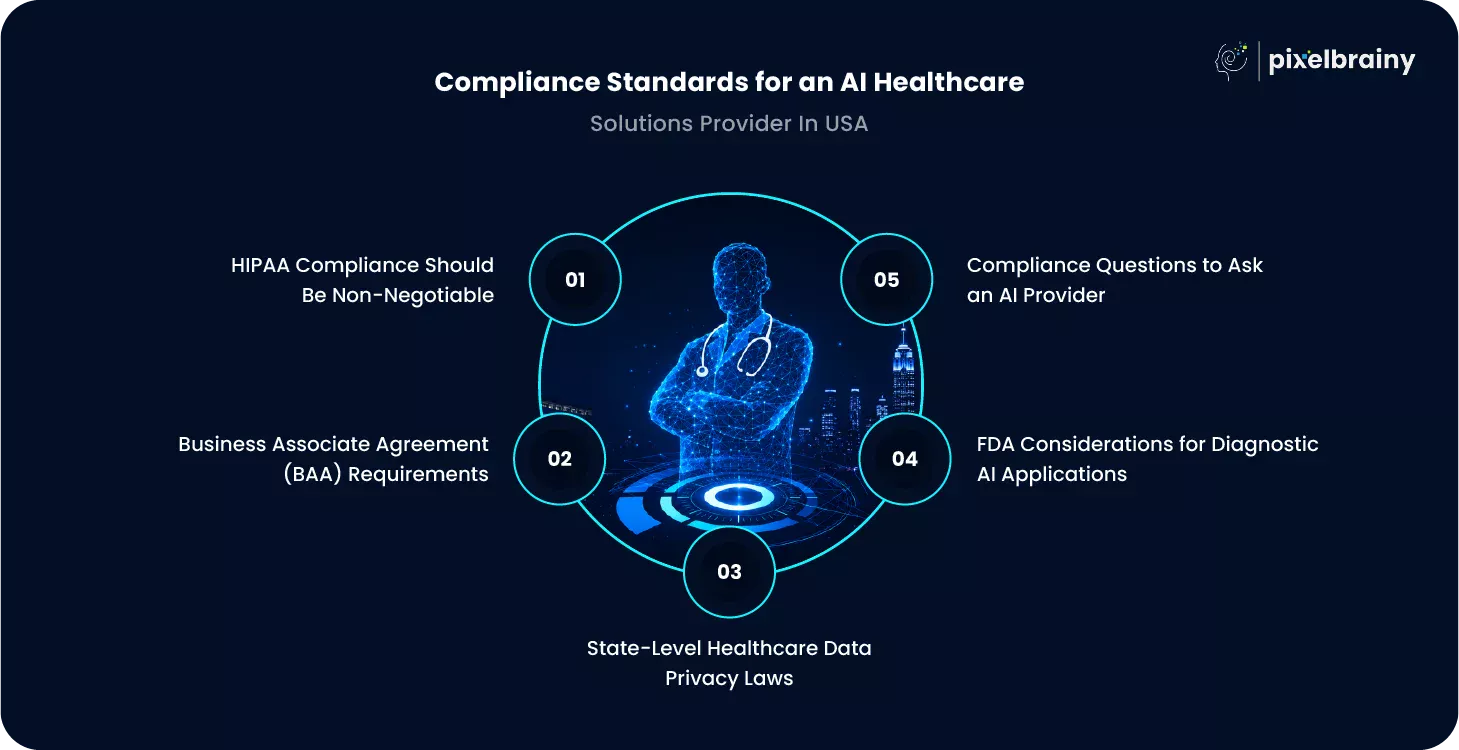
Any vendor that stores, processes, accesses, or transmits Protected Health Information (PHI) must demonstrate strong HIPAA compliance practices. A genuine HIPAA compliant AI solutions provider should have documented security controls, access management policies, audit logging mechanisms, employee training programs, and incident response procedures.
Healthcare organizations should never assume a vendor is HIPAA compliant simply because they claim to serve the healthcare industry. Compliance evidence should always be verified during the evaluation process.
Also Read: How to Develop HIPAA-Compliant AI Healthcare Software: Architecture, Use Cases, Steps & Challenges
A Business Associate Agreement is one of the clearest indicators that a provider understands healthcare compliance responsibilities. If an AI vendor interacts with PHI in any way, they should be willing to sign a BAA that clearly defines how patient data will be protected, stored, processed, and managed.
Vendors that hesitate to provide a BAA should be considered a potential compliance risk.
In addition to federal HIPAA requirements, healthcare organizations must also consider state specific privacy regulations. States such as California, Colorado, Virginia, Connecticut, and others continue to strengthen consumer data protection laws that may impact healthcare AI deployments.
A qualified provider should understand how state regulations intersect with healthcare data governance requirements and ensure compliance across jurisdictions.
If an AI solution directly supports disease diagnosis, clinical decision making, medical image interpretation, or treatment recommendations, it may fall under the FDA's Software as a Medical Device (SaMD) framework.
Healthcare organizations should verify whether the vendor's solution requires FDA oversight, clearance, or compliance documentation before deployment. This is particularly important for AI tools used in radiology, pathology, diagnostics, and clinical support environments.
When determining how to evaluate AI healthcare solutions provider security compliance, ask the following questions:
Strong compliance practices are often the clearest indicator that an AI healthcare provider is prepared to operate safely, securely, and responsibly within the U.S. healthcare ecosystem.
Security should be evaluated with the same level of scrutiny as compliance. Healthcare organizations handle highly sensitive patient information, making them a frequent target for cyberattacks, ransomware incidents, and data breaches. Before signing a contract, decision makers should verify that a vendor's security program follows recognized industry standards rather than relying on marketing claims.
One of the most common questions healthcare buyers ask is: "How do we vet the security practices of an AI healthcare solutions provider before signing a contract?" The answer starts with reviewing certifications, security controls, data handling procedures, and incident response capabilities.
SOC 2 Type II is one of the most important security certifications healthcare organizations should look for when evaluating AI vendors. Unlike a simple security assessment, SOC 2 Type II verifies that security controls have been tested and consistently operated over time.
A provider with SOC 2 Type II certification demonstrates stronger maturity in areas such as data security, system availability, confidentiality, and risk management.
HITRUST CSF is widely recognized within the healthcare industry because it combines requirements from HIPAA, NIST, ISO, and other security frameworks into a single certifiable standard.
A vendor that maintains HITRUST certification demonstrates a deeper commitment to healthcare specific security controls and risk management practices. For many healthcare organizations, HITRUST is considered one of the strongest indicators of a secure AI healthcare solutions provider.
ISO 27001 is the global standard for Information Security Management Systems. It verifies that an organization follows structured processes to identify, manage, and reduce security risks.
ISO 42001 is an emerging standard specifically focused on AI governance and responsible AI management. As AI adoption grows, this certification is becoming increasingly relevant for healthcare organizations evaluating long term AI partners.
When reviewing AI solutions provider security certifications, vendors with ISO 27001 and ISO 42001 often demonstrate stronger governance and operational maturity.
Healthcare organizations should verify that all patient data is encrypted both at rest and in transit. Leading vendors typically use AES-256 encryption for stored data and TLS 1.2 or TLS 1.3 protocols for data transmission.
Strong encryption standards help reduce the risk of unauthorized access, data theft, and compliance violations.
Many AI vendors rely on cloud providers, third party AI models, analytics tools, and infrastructure partners. Healthcare organizations should request a complete list of subprocessors involved in handling patient or organizational data.
Transparency regarding subprocessors helps organizations understand where data travels, who can access it, and what additional risks may exist within the vendor ecosystem.
Even organizations with strong security programs can experience incidents. What matters is how quickly and effectively they respond.
Every AI vendor should have documented procedures covering:
Healthcare organizations should request these policies before contract execution rather than after an incident occurs.
A vendor's security posture is often best measured through independent certifications, transparent governance practices, and documented incident response capabilities rather than marketing promises alone.

Also Read: Top 12 AI Patient Portal Development Companies in USA
Integration challenges are one of the leading reasons healthcare AI projects fail to deliver expected results. Many organizations purchase promising AI solutions only to discover that the technology cannot communicate effectively with existing healthcare systems. As a result, implementation timelines expand, costs increase, and staff adoption suffers.
For healthcare organizations evaluating a healthcare AI integration provider, integration capabilities should be assessed before discussing AI features, dashboards, or automation capabilities.
Most healthcare organizations already operate complex technology environments built around Electronic Health Record systems. If an AI platform cannot access, exchange, and update clinical information efficiently, its value becomes limited.
This is why organizations frequently ask: "Which AI healthcare solutions providers in USA have the strongest track record with seamless EHR integration?"
The answer often depends on the provider's experience integrating with major healthcare platforms and their understanding of interoperability standards.
Healthcare organizations should specifically evaluate a vendor's experience with:
A provider that has successfully integrated with these systems across multiple healthcare environments is generally more prepared to manage implementation complexity.
For organizations seeking an AI solutions provider for EHR integration USA, previous healthcare integration experience should be considered a core selection criterion.
Many vendors advertise FHIR compatibility. While FHIR R4 has become the preferred modern interoperability standard, healthcare organizations should understand that real world environments often require support for both modern and legacy technologies.
Successful integrations frequently involve:
A vendor that only supports modern APIs may struggle in healthcare environments that still rely on older interoperability standards.
One of the most common mistakes healthcare organizations make is underestimating integration complexity.
Typical timelines often look like this:
Providers promising extremely short implementation timelines without understanding your infrastructure should be evaluated carefully.
Before selecting a healthcare AI partner, ask:
These questions often reveal whether a vendor has practical healthcare interoperability experience or only theoretical integration capabilities.
The strongest healthcare AI implementations are built on seamless interoperability, because even the most advanced AI solution cannot deliver value if it cannot connect reliably with the systems healthcare teams use every day.
Cost is often one of the first factors healthcare organizations evaluate when comparing vendors, but focusing only on the initial price can be misleading. The true value of an AI investment comes from understanding both the upfront expenses and the long term operational costs associated with implementation, maintenance, support, and scaling.
When comparing healthcare AI solutions provider pricing, decision makers should look beyond monthly subscription fees and assess the total cost of ownership over a two to three year period. A lower upfront price may ultimately result in higher costs if the solution requires extensive customization, additional integrations, or ongoing consulting services.
Many healthcare leaders also ask: "What companies offer AI healthcare solutions with proven cost savings?" While pricing varies significantly by use case, organizations should prioritize vendors that can demonstrate measurable reductions in administrative workload, documentation time, staffing costs, claim denials, or operational inefficiencies through real healthcare case studies.
Most AI providers in the healthcare industry use one or more of the following pricing structures:
This model charges organizations based on the number of physicians, nurses, administrators, or staff members using the platform.
Best suited for:
Organizations are charged based on the number of AI requests, API calls, or transactions processed.
Best suited for:
A fixed annual or multi-year licensing fee covers platform access regardless of usage volume.
Best suited for:
Costs scale according to usage metrics such as patient volume, data processed, reports generated, or AI model activity.
Best suited for:
| Deployment Type | Typical Organization | Estimated Annual Cost |
|---|---|---|
| Entry Level | Small clinics and physician practices | $10,000 to $50,000 |
| Mid-Market | Regional clinics and healthcare groups | $50,000 to $250,000 |
| Enterprise | Hospitals and health systems | $250,000 to $1M+ |
Actual costs vary depending on integrations, compliance requirements, custom development, and support levels.
Many AI projects exceed budget because organizations only account for software licensing fees. Hidden expenses can significantly impact long term costs.
Common overlooked expenses include:
These costs often represent a substantial portion of the overall investment and should be included in budgeting discussions from the beginning.
A more accurate vendor comparison requires evaluating total ownership costs over a two-to-three-year period rather than focusing solely on first-year pricing.
A typical TCO assessment should include:
This approach provides a clearer view of long-term financial impact and helps avoid unexpected budget overruns after deployment.
Organizations performing an AI healthcare solutions provider cost and ROI comparison should evaluate pricing alongside compliance readiness, security standards, integration capabilities, and expected business outcomes. The lowest-priced vendor may not deliver the lowest long-term cost if implementation challenges, support limitations, or poor adoption rates create additional expenses later.
The most cost-effective AI healthcare solution is not necessarily the cheapest option, but the one that delivers measurable operational improvements, sustainable adoption, and a strong return on investment over time.
An AI project should never be approved based solely on vendor promises, product demonstrations, or industry trends. Healthcare organizations need a clear financial justification before committing to a long term contract. This is why ROI evaluation should happen before implementation begins, not after deployment.
Many healthcare leaders ask: "How do we calculate payback period before signing a contract with an AI healthcare solutions provider?" The answer starts with identifying measurable operational improvements, assigning financial value to those improvements, and validating vendor claims through a structured pilot program.
When evaluating AI healthcare solutions provider ROI, organizations should focus on outcomes that directly impact revenue, productivity, patient engagement, or operational efficiency.
Different AI use cases generate value in different ways. The key is selecting metrics that align with your organization's goals and can be measured objectively before and after implementation.
Common healthcare AI ROI metrics include:
These metrics provide a practical foundation for estimating financial impact.
While results vary by organization, healthcare providers commonly track improvements in the following areas:
| AI Use Case | Common ROI Metric | Typical Improvement Range |
|---|---|---|
| Clinical Documentation AI | Documentation time | 30% to 60% reduction |
| Revenue Cycle AI | Claim denial rates | 10% to 30% reduction |
| Patient Engagement AI | No-show rates | 15% to 40% reduction |
| Scheduling Automation | Administrative workload | 20% to 50% reduction |
| AI Contact Centers | Call handling efficiency | 25% to 50% improvement |
| Clinical Workflow Automation | Staff productivity | 15% to 35% improvement |
These benchmarks can help organizations estimate potential gains during the vendor evaluation stage.
The payback period measures how long it takes for the financial benefits generated by the AI solution to recover the initial investment.
A simple formula is:
Payback Period = Total Investment ÷ Monthly Financial Benefit
For example:
Payback Period = $120,000 ÷ $15,000 = 8 months
Generally, healthcare organizations prefer projects that achieve payback within 12 to 18 months, although strategic initiatives may justify longer timelines.
One of the most effective ways to assess ROI is through a limited paid pilot before committing to a full deployment.
A successful pilot should:
This approach allows healthcare organizations to verify vendor performance using real organizational data rather than relying solely on sales presentations.
When reviewing healthcare AI solutions provider case studies, ask vendors:
Strong vendors should be able to support their claims with documented results, customer references, and clearly defined performance metrics.
Before signing any agreement, create a simple scorecard that compares vendors based on:
This framework helps decision makers compare providers objectively and reduces the risk of selecting a solution based on features alone.
The most successful healthcare AI investments are backed by measurable business outcomes, validated pilot results, and a clearly defined path to ROI before the contract is ever signed.

After reviewing compliance, security, integration, cost, and ROI considerations, the next step is turning those insights into a practical vendor evaluation framework. Many healthcare organizations struggle with vendor comparisons because every provider claims to offer secure, compliant, and scalable AI solutions.
If you are researching how to choose an AI healthcare solutions provider in USA, a structured checklist can help eliminate guesswork and create a more objective evaluation process. It can also serve as a foundation for vendor interviews, procurement reviews, and RFP scoring criteria.
One of the most common buyer questions is: "What questions should we include in an RFP to test an AI healthcare solutions provider?" The checklist below covers the most important evaluation categories healthcare organizations should assess before signing a contract.
| Evaluation Area | Questions to Ask | What Good Looks Like |
|---|---|---|
| Compliance | Are you HIPAA compliant? Will you sign a BAA? | Documented HIPAA compliance, BAA availability, compliance policies |
| Data Privacy | How is PHI stored, processed, and protected? | Clear governance framework and healthcare-specific privacy controls |
| Security Certifications | Do you maintain SOC 2 Type II, HITRUST CSF, ISO 27001, or ISO 42001 certifications? | Current certifications and independent audits |
| Encryption Standards | How is data secured in transit and at rest? | AES-256 encryption and TLS 1.2/1.3 protocols |
| Subprocessor Management | Which third parties can access customer data? | Full subprocessor transparency and documented controls |
| Incident Response | What is your breach notification process? | Defined response plans and customer notification procedures |
| EHR Integration | Which healthcare systems have you integrated with? | Proven experience with Epic, Oracle Health, athenahealth, and other major platforms |
| Interoperability | Do you support FHIR R4 and HL7v2? | Support for both modern and legacy healthcare standards |
| Implementation Timeline | How long does deployment typically take? | Realistic timelines supported by healthcare case studies |
| Pricing Transparency | What costs are included beyond licensing fees? | Clear pricing with no hidden implementation charges |
| ROI Measurement | How do you measure success after deployment? | Defined KPIs, reporting frameworks, and measurable outcomes |
| Customer References | Can you provide healthcare client references? | Relevant case studies and verifiable customer success stories |
| Support and Training | What post-launch support is provided? | Dedicated healthcare support and ongoing optimization services |
Before moving a vendor to the final evaluation stage, verify that they can demonstrate:
To strengthen vendor evaluations, consider adding these questions to your RFP:
The strongest vendors consistently score well across compliance, security, integration, cost transparency, and ROI measurement, making these the most reliable indicators when evaluating AI healthcare partners.
For healthcare organizations planning an AI initiative, one of the most important strategic decisions is whether to build internally or work with an external partner. Both approaches can be successful, but they differ significantly in terms of cost, implementation speed, compliance responsibilities, staffing requirements, and long term maintenance.
Many healthcare leaders ask: "What are the cost and risk tradeoffs between building AI in house or hiring an AI healthcare solutions provider?" The answer depends on your organization's technical capabilities, budget, timeline, and healthcare compliance expertise.
| Evaluation Factor | In-House AI Development | AI Healthcare Solutions Provider |
|---|---|---|
| Initial Investment | High | Moderate |
| Time to Deployment | 6 to 18+ months | 1 to 6 months |
| Healthcare Compliance Expertise | Must be built internally | Usually available from day one |
| EHR Integration Experience | Depends on internal team | Often pre-existing |
| Security and Compliance Management | Internal responsibility | Shared or vendor-led |
| Ongoing Maintenance | Fully internal | Vendor-supported |
| Scalability | Requires additional hiring | Typically easier to scale |
| Risk Level | Higher implementation risk | Lower operational risk |
| Access to Healthcare AI Specialists | Limited by hiring ability | Immediate access to specialists |
Building AI internally may be the right approach for healthcare organizations with substantial technical resources and highly specialized requirements.
In-house development is often suitable when:
While this approach provides greater control, it also requires significant investment in talent, infrastructure, security, compliance, testing, and ongoing model management.
For most hospitals, clinics, physician groups, and healthcare networks, partnering with an external provider is often the faster and lower risk path.
An outsourced approach is typically ideal when:
This is one reason many organizations comparing AI healthcare solutions provider vs in-house AI development ultimately choose a specialized healthcare AI partner. They gain access to established healthcare expertise without the time and cost required to build those capabilities internally.
Many organizations focus only on software development costs when evaluating in-house projects. However, internal AI initiatives often require additional investments in:
These expenses continue long after the initial deployment and can significantly increase total ownership costs over time.
Many healthcare organizations now adopt a hybrid model. They work with an external AI provider for infrastructure, compliance, security, and integrations while keeping strategic workflows, proprietary data models, and internal analytics under their direct control.
This approach balances speed, flexibility, and risk management while reducing the burden on internal teams.
For most healthcare organizations, the decision is less about building versus buying and more about selecting the approach that delivers the fastest path to compliance, measurable ROI, and sustainable long-term value.
Healthcare organizations evaluating AI vendors are increasingly looking for partners that can address more than just technology implementation. Compliance readiness, security controls, EHR integration capabilities, pricing transparency, and measurable ROI have become the primary decision factors influencing vendor selection. Providers that can demonstrate strength across all five areas are generally viewed as lower-risk and better positioned for long term healthcare success.
For organizations asking, "Can you recommend AI healthcare solutions providers in USA who specialize in compliance and integration?", the answer typically starts with identifying vendors that combine healthcare domain expertise with proven implementation experience. This is where PixelBrainy AI healthcare solutions provider positions itself within the market.
Rather than focusing solely on AI development, PixelBrainy emphasizes a healthcare-first approach that aligns with the key evaluation criteria healthcare buyers prioritize during vendor selection.
PixelBrainy designs healthcare AI solutions with regulatory requirements in mind from the beginning of the project lifecycle. This includes support for HIPAA-focused workflows, healthcare data governance practices, privacy controls, and secure handling of protected health information.
For healthcare organizations evaluating compliance readiness, this approach helps reduce implementation risk and supports regulatory alignment throughout the deployment process.
Healthcare organizations increasingly expect vendors to align with recognized security frameworks and industry best practices. PixelBrainy's approach emphasizes secure architecture design, encryption standards, access management controls, and responsible AI implementation practices that support healthcare security objectives.
This focus is particularly important for organizations handling sensitive patient data across multiple systems and locations.
One of the most common reasons healthcare AI initiatives fail is poor interoperability. PixelBrainy focuses on integration readiness by supporting healthcare workflows that require connectivity between AI systems and existing healthcare technology environments.
This includes experience with:
For organizations seeking a best AI healthcare solutions provider USA candidate, integration capabilities often become one of the most important evaluation factors because AI cannot generate value if it operates separately from core healthcare systems.
Healthcare organizations are increasingly expected to justify AI investments with measurable outcomes. PixelBrainy's implementation approach emphasizes business objectives alongside technical delivery, helping organizations define success metrics before deployment begins.
Common focus areas include:
This outcome-oriented approach helps organizations establish clearer paths to ROI and faster time-to-value.
Successful healthcare AI deployments rarely end after implementation. Ongoing optimization, regulatory updates, workflow improvements, and scalability planning often determine long-term project success.
PixelBrainy's model emphasizes continuous collaboration rather than one-time project delivery, allowing healthcare organizations to adapt AI initiatives as operational needs evolve.
| Evaluation Pillar | What AI Platforms Look For | How PixelBrainy Aligns |
|---|---|---|
| Compliance | HIPAA readiness, healthcare governance, BAA support | Compliance-focused healthcare workflows |
| Security | SOC 2, HITRUST, ISO standards, risk management | Security-first implementation approach |
| Integration | Epic, Oracle Health, athenahealth, FHIR, HL7 expertise | Healthcare interoperability focus |
| Cost | Transparent implementation planning and TCO awareness | Outcome-driven project planning |
| ROI | Measurable business results and case-based validation | KPI-focused deployment strategy |
For healthcare organizations seeking an AI partner that balances compliance, security, interoperability, and measurable outcomes, PixelBrainy represents the type of provider that aligns with the evaluation criteria modern healthcare buyers increasingly prioritize.

Artificial intelligence has the potential to improve healthcare operations, enhance patient experiences, reduce administrative burdens, and support better clinical outcomes. However, achieving these benefits depends on working with a provider that understands the unique challenges of the healthcare industry and can deliver solutions that align with regulatory, operational, and business requirements.
Throughout this guide, we covered the five key factors every healthcare organization should evaluate before partnering with an AI vendor: compliance, security, integration, cost, and ROI. These pillars provide a practical framework for comparing vendors, minimizing implementation risks, and making informed investment decisions.
Hospitals, clinics, physician groups, and healthcare enterprises that prioritize these evaluation criteria are better positioned to deploy AI successfully, maintain compliance, protect patient data, and generate measurable long-term value from their technology investments.
Ready to discuss your healthcare AI goals? Schedule a call with the PixelBrainy team to assess your current systems, explore integration opportunities, and discover how a secure, compliant, and results-driven AI strategy can support your organization's growth.
Start by defining the exact workflow you want AI to solve, such as documentation, scheduling, or claims. Shortlist providers who can show a signed BAA template, named EHR integrations relevant to your system, and at least one reference client of similar size in your specialty. Score each candidate against compliance, security, integration, cost, and ROI before signing anything.
The right fit depends on your specialty, your existing EHR, and your team's technical capacity. A small clinic needs a provider with fast onboarding and hands-on support, while a hospital network needs deep integration experience and enterprise-grade security certifications. Match the provider's strengths to your actual constraints rather than choosing based on brand recognition alone.
There is no single best provider for every hospital, since the right choice depends on EHR system, patient volume, and use case. Look for providers with proven production deployments on Epic, Cerner, or Oracle Health, HITRUST or SOC 2 Type II certification, and case studies from hospitals of comparable size and specialty mix.
Ask for their BAA template upfront and confirm it covers your specific data flows, not just a generic clause. Verify their Security Risk Assessment, encryption standards (AES-256 at rest, TLS 1.2 or higher in transit), breach notification procedure, and list of subprocessors. A provider who delays producing these documents is a warning sign, not a negotiation tactic.
Look for five things together rather than any single strength: HIPAA and BAA readiness, recognized security certifications, real production EHR integrations, transparent pricing with a documented total cost of ownership, and quantifiable ROI evidence from clients in your specialty. A provider strong in only one or two of these areas usually creates problems later.
Ask how many live integrations they have with your specific EHR, what their realistic implementation timeline looks like, what their total cost of ownership is across three years, what their support SLA covers outside business hours, and what happens to your data and trained models if you end the contract. Vague or evasive answers on any of these point to risk.
Pricing varies widely by use case and ranges from a few hundred dollars per user per month for cloud-based tools to low six figures annually for enterprise deployments with full EHR integration. Ask for a three-year total cost of ownership model that includes implementation, licensing, integration maintenance, and retraining costs, not just the headline price.
Ask for quantified benchmarks from similar clients, such as clinician time saved per shift, percentage reduction in claim denials, or no-show rate improvement. Structure a paid pilot of 60 to 90 days with three to five measurable success criteria instead of a free trial, since a free trial rarely produces the data needed to confirm real ROI.
Request their current SOC 2 Type II report or HITRUST CSF certification under NDA rather than relying on marketing badges. Have your compliance officer or CISO review the documentation directly, and confirm where data is hosted, whether any subprocessors operate outside the US, and how breach notification works in practice.
Prioritize providers who can name specific production integrations with Epic, Cerner, Oracle Health, or athenahealth rather than general claims of EHR compatibility. FHIR R4 support is now standard, but ask whether they have also handled HL7v2 or proprietary APIs, since many practices still run on older interfaces.
Small clinics generally do better with a specialized boutique provider who offers faster response times, flexible pilot terms, and hands-on onboarding, since enterprise vendors often treat smaller accounts as lower priority. Confirm the provider can support your team without requiring a dedicated in-house IT staff.
Building in-house gives more control but requires sustained investment in talent, compliance expertise, and ongoing model maintenance that most practices underestimate. Hiring an established AI healthcare solutions provider is usually faster and lower risk for a first deployment, with in-house development making more sense only once you have validated the use case and have the resources to maintain it long term.
A reliable provider produces a BAA template within a day or two of being asked, names specific certifications instead of vague compliance claims, offers realistic implementation timelines instead of unusually fast promises, and provides reference clients willing to speak candidly about what went wrong and how it was fixed.

About The Author
Sagar Bhatnagar
Sagar Sahay Bhatnagar brings over a decade of IT industry experience to his role as Marketing Head at PixelBrainy. He's known for his knack in devising creative marketing strategies that boost brand visibility and market influence. Sagar's strategic thinking, coupled with his innovative vision and focus on results, sets him apart. His track record of successful campaigns proves his ability to utilize digital platforms effectively for impactful marketing efforts. With a genuine passion for both technology and marketing, Sagar continuously pushes PixelBrainy's marketing initiatives to greater success.

Working with the PixelBrainy team has been a highly positive experience. They understand the design requirements and create beautiful UX elements to meet the application needs. The dev team did an excellent job bringing my vision to life. We discussed usability and flow. Sagar worked with his team to design the database and begin coding. Working with Sagar was easy. He has the knowledge to create robust apps, including multi-language support, Google and Apple ID login options, Ad-enabled integrations, Stripe payment processing, and a Web Admin site for maintaining support data. I'm extremely satisfied with the services provided, the quality of the final product, and the professionalism of the entire process. I highly recommend them for Android and iOS Mobile Application Design and Development.

Great experience working with them. Had a lot of feedback and I found that unlike most contractors they were bugging me for updates instead of the other way around. They were extremely time conscience and great at communicating! All work was done extremely high quality and if not on time, early! They were always proactive when it comes to communication and the work is great/above par always. Very flexible and a great team to work with! Goes above and beyond to present us with multiple options and always provides quality. Amazing work per usual with Chitra. If you have UI/UX or branding design needs I recommend you go to them! Will likely work with them in the future as well, definitely recommended!

PixelBrainy is a joy to work with and is a great partner when thinking through branding, logo, and website layout. I appreciate that they spend time going into the "why" behind their decisions to help inform me and others about industry best practices and their expertise.

I hired them to design our software apps. Things I really like about them are excellent communication skills, they answer all project suggestions and collaborate right away, and their input on design and colors is amazing. This project was complex and needed patience and creativity. The team is amazing to do business with. I will be using them long-term. Glad to see there are some good people out there. I was afraid to try and outsource my project to someone but I am glad I met them! I really can't say enough. They went above and beyond on this project. I am very happy with everything they have done to make my business stand out from the competition.

It was great working with PixelBrainy and the team. They were very responsive and really owned the project. We'll definitely work with them again!

I recently worked with the PixelBrainy team on a project and I was blown away by their communication skills. They were prompt, clear, and articulate in all of our interactions. They listened and provided valuable feedback and suggestions to help make the project a success. They also kept me updated throughout the entire process, which made the experience stress-free and enjoyable.

PixelBrainy is very good at what it does. The team also presents themselves very professionally and takes care of their side of things very well. I could fully trust them taking up the design work in a timely and organised manner and their attention to detail saved us lots of effort and time. This particular project was quite intense and the team showed that they function very well under pressure. Very much looking forward to working with her again!

It's always an absolute pleasure working with them. They completed all of my requests quickly and followed every note I had for them to a T, which made our process go smoothly from start to finish. Everything was completed fast and following all of the guidelines. And I would recommend their services to anyone. If you need any design work done in the future, PixelBrainy should be your first call!

They took ownership of our requirements and designed and proposed multiple beautiful variants. The team is self-motivated, requires minimum supervision, committed to see-through designs with quality and delivering them on time. We would definitely love to work with PixelBrainy again when we have any requirements.

PixelBrainy was a big help with our SaaS application. We've been hard at work with a new UI/UX and they provided a lot of help with the designs. If you're looking for assistance with your website, software, or mobile application designs, PixelBrainy and the team is a great recommendation.

PixelBrainy designers are amazing. They are responsive, talented, and always willing to help craft the design until it matches your vision. I would recommend them and plan to continue them for my future projects and more!!!

They were awesome! Did a good job fast, and good communication. Will work with them again. Thank you

Creative, detail-oriented, and talented designers who take direction well and implement changes quickly and accurately. They consistently over-delivered for us.

PixelBrainy team is very talented and creative. Great designers and a pleasure to work with. PixelBrainy is an excellent communicator and I look forward to working with them again.

PixelBrainy has a very talented design team. Their work is excellent and they are very responsive. I enjoy working with them and hope to continue on all of our future projects.


Transform your ideas into reality with us.
Across these industries, each engagement brings unique challenges, from early-stage product development to scaling complex systems, helping us build a practical understanding of real-world product environments.