AI Summary Powered by PixelBrainy
What if residents could control their apartment, request building services, communicate with property management, and get personalized assistance from one intelligent platform instead of switching between multiple apps?
That is the core opportunity behind developing an AI concierge platform for smart apartment buildings. Modern residential properties increasingly include smart locks, lighting, HVAC systems, security cameras, parking systems, package rooms, energy meters, access control, visitor management, and connected appliances. Yet these technologies often operate through separate applications and dashboards. For residents, a building can be technologically advanced while still feeling fragmented.
This is where AI concierge platform development for smart buildings becomes valuable. An intelligent concierge platform for apartments can act as a single conversational interface that connects residents with smart-home systems, building operations, property staff, maintenance workflows, amenities, and local services.
For property owners and operators, the goal is not simply to add another resident app. The objective is to create an AI-powered orchestration layer that understands resident requests, identifies the appropriate system or workflow, performs authorized actions, and escalates issues to humans when necessary.
The market opportunity is also expanding. According to Grand View Research, the global smart home market is estimated at USD 207.0 billion in 2026 and is projected to reach USD 887.4 billion by 2033, representing a 23.1% CAGR. The report specifically identifies AI, IoT, cloud computing, voice assistants, and home automation as important market drivers.
For apartment owners asking, “Our apartment buildings already have smart-home and IoT systems, but residents have to use different platforms for different services. We want one resident-friendly experience. Who can develop this?”, the answer is a specialized AI product development company with expertise in AI agents, API integration, IoT ecosystems, mobile applications, UX, security, and property technology.
This guide to custom AI concierge platform development explains what to build, how the platform works, essential features, technology choices, development costs, implementation challenges, and how to select the right development partner.
What if a resident could simply ask, “Can you book the clubhouse for 7 PM and let my guest through the lobby?” and one intelligent platform could understand, verify, and execute the entire request?
An AI concierge platform for smart apartment buildings is a centralized digital system that uses artificial intelligence to connect residents with building services, smart-home devices, property-management systems, amenities, maintenance workflows, and access-control infrastructure through one resident-friendly interface.
Unlike a basic resident app or chatbot, an AI concierge can potentially understand natural-language requests, retrieve building-specific information, call connected systems, initiate workflows, and escalate complex requests to property staff. Current building platforms are already combining AI assistants with maintenance, amenity reservations, access, deliveries, and smart-building controls, demonstrating how the category is moving from information delivery toward action-oriented automation.
A traditional concierge platform primarily digitizes services that would otherwise be handled manually by front-desk or property-management teams. Residents may use an app to submit maintenance requests, reserve amenities, receive package notifications, communicate with management, or access building information.
An AI concierge platform adds an intelligent decision and automation layer to these capabilities.
| Traditional Concierge Platform | AI Concierge Platform |
|---|---|
| Residents navigate menus and forms | Residents can communicate naturally |
| Primarily request-based | Can understand intent and context |
| Provides predefined information | Provides contextual, building-specific responses |
| Staff often process requests manually | AI can automate eligible workflows |
| Separate functions may require different screens | Multiple services can be orchestrated in one conversation |
| Limited personalization | Can personalize responses based on authorized resident context |
| Mainly reactive | Can support proactive alerts and recommendations |
| Usually focused on resident services | Can connect resident services with IoT and building operations |
For example, a traditional platform may require a resident to open the amenity section, select the gym, choose a date, select a time, and confirm the reservation. With an intelligent concierge platform for apartments, the resident could simply say, “Book the gym for tomorrow at 6 PM.” The AI can interpret the intent, check availability, apply building rules, complete the booking, and confirm the result.
The same approach can connect smart locks, thermostats, lighting, maintenance systems, package management, visitor access, and property-management software. Real-world smart-building platforms are increasingly positioning this unified experience as a way to reduce fragmented resident interactions.
Therefore, how to build an AI concierge platform for smart apartment buildings is not simply a question of adding a chatbot. It requires an AI orchestration layer capable of securely connecting existing building technologies and turning resident conversations into meaningful actions.
An AI concierge platform for smart apartment buildings works as an intelligent layer between residents, property-management teams, connected building systems, and IoT devices. Instead of requiring residents to navigate multiple applications, the platform interprets natural-language requests, verifies permissions, identifies the right system, executes the required action, and provides a clear response.
The overall workflow typically combines conversational AI, APIs, IoT integrations, databases, identity management, automation, and human support.
Here’s its working flow:
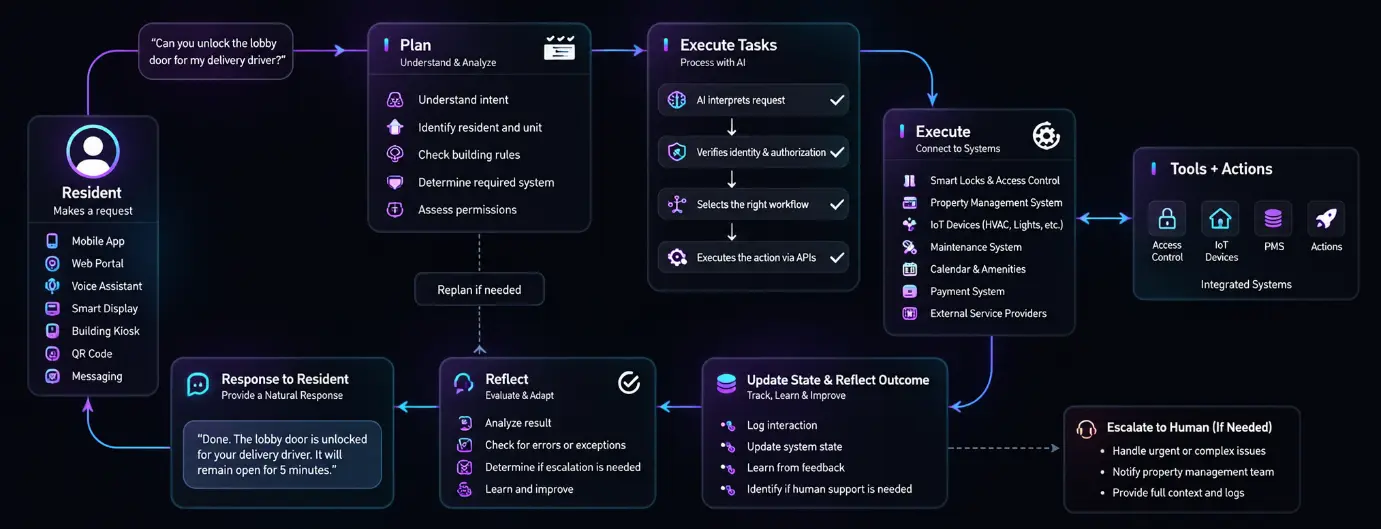
The experience starts when a resident submits a request through a preferred channel, such as:
For example, a resident could say, “Can you unlock the lobby door for my delivery driver?”
The platform receives the request and sends it to the AI processing layer.
The AI analyzes the request to determine what the resident wants and what action may be required. It can consider factors such as:
This enables the platform to distinguish between informational questions and requests that require an actual system action.
Security is essential because an AI concierge may interact with physical building infrastructure.
Before executing sensitive actions, the platform should verify the resident's identity and authorization.
For example, residents may generally be allowed to:
Additional verification may be required to:
The orchestration layer determines which system should handle the request. Depending on the use case, it may connect with a:
This orchestration layer is one of the most important components when creating an AI concierge platform for smart apartments, because it connects conversational AI with real-world building operations.
Once the appropriate workflow is selected and authorization is confirmed, the relevant API or automation performs the requested action.
For example, the platform may send a command to an HVAC system to change the apartment temperature or create a maintenance ticket in the property's existing management system.
After the action is completed, the AI communicates the result in simple language.
For example:
“Done. Your apartment temperature is now set to 22°C.”
This confirmation helps residents understand whether their request was successfully completed.
AI should not attempt to handle every situation independently. When a request involves an emergency, uncertainty, policy exception, or complex problem, the platform should route it to the appropriate property staff member.
For example:
“There is water leaking from my ceiling.”
The AI can recognize the potential urgency, collect relevant information, create or prioritize a maintenance request, and follow the building's escalation procedure.
This combination of AI automation and human oversight allows smart apartment buildings to deliver a faster, more convenient resident experience without compromising safety, security, or operational control.
Why invest in another technology layer when your apartment buildings already have smart locks, HVAC controls, IoT devices, resident apps, property management software, and building automation systems?
The answer is not to replace those systems. It is to make them work together through a single intelligent interface.
For many smart apartment buildings, the technology infrastructure already exists, but the resident experience remains fragmented. A resident may use one application to unlock a door, another to control the thermostat, another to book an amenity, and a separate channel to contact property staff. An AI concierge platform for smart apartment buildings can sit above these systems and provide one conversational interface for accessing services, information, and building functions.
For owners and operators, the investment is therefore less about adding another resident app and more about creating an intelligent orchestration layer for the existing smart-building ecosystem.
Smart apartment buildings often operate with multiple technologies from different vendors. Smart locks, access control, HVAC, lighting, parking, elevators, property management systems, maintenance platforms, payment systems, and amenity booking tools may all have separate interfaces.
An AI concierge platform can provide the integration layer that connects these systems through APIs, webhooks, automation workflows, and permission-based actions.
This allows owners to build on existing technology investments instead of replacing them.
Residents generally care about completing a task, not knowing which software controls it.
A resident might ask:
“Can you let my delivery driver into the building and turn down the temperature in my apartment?”
Instead of opening multiple applications, the resident could make one request through the AI concierge. The platform can understand the intent, verify the resident's permissions, determine which systems are required, execute approved actions, and provide confirmation.
This makes the AI concierge the front door to the building's digital services.
The market direction provides another reason for building owners to consider an AI concierge strategy now.
According to the latest 2026 data from Grand View Research, the global smart home market is estimated to reach USD 207.0 billion in 2026 and is projected to reach USD 887.4 billion by 2033, representing a 23.1% CAGR from 2026 to 2033. The research also highlights the growing role of AI-powered devices and connected technologies in smart-home experiences.
The broader automation opportunity is even more significant. The global smart home automation market is estimated at USD 168.6 billion in 2026 and is forecast to reach USD 940.5 billion by 2033, growing at a 27.8% CAGR.
These projections indicate that connected residential environments are moving toward more software-driven automation. For apartment owners, developing the AI layer early can create a foundation for integrating increasingly intelligent building technologies as they become available.
Traditional smart-building platforms are often designed around individual devices or predefined automations.
An AI concierge introduces a different model: understand the resident's goal, determine what needs to happen, and coordinate the required systems.
For example:
Resident request:
“I'm leaving for vacation tomorrow. Make sure my apartment is secure and reduce unnecessary energy use.”
The AI concierge could potentially coordinate approved workflows involving:
The investment becomes valuable when the platform can coordinate these systems based on intent rather than forcing residents to manage each device independently.
AI concierge platform development should not be viewed as a one-feature project.
A well-designed platform can become the foundation for future capabilities such as predictive maintenance, personalized resident services, intelligent energy management, automated service requests, access orchestration, building notifications, and proactive operational workflows.
This matters because the AI capabilities available in 2026 will continue to evolve. Building an extensible architecture now allows property operators to add new models, agents, integrations, and workflows without rebuilding the entire platform.
For owners and operators managing multiple apartment communities, fragmented technology becomes harder to manage as the portfolio grows.
A centralized AI concierge architecture can provide a common platform while allowing individual properties to configure their own:
This creates a scalable approach to AI concierge platform development for smart apartment buildings, where new properties can be onboarded without creating an entirely separate technology ecosystem for each location.
The long-term opportunity extends beyond conversational assistance.
As AI agents become capable of understanding context, making decisions within defined permissions, and executing multi-step workflows, the apartment building can evolve from a collection of connected devices into a more responsive digital environment.
That makes AI concierge development a strategic technology investment for owners who want their properties to support AI-driven resident services, connected building automation, and intelligent property operations.
The strongest reason to invest is simple: smart apartment buildings already generate and depend on large amounts of connected technology, but residents still need a better way to interact with it.
An AI concierge platform can provide that missing intelligence and orchestration layer while allowing owners to build on their existing smart-home, IoT, and property-management investments.
For apartment building owners planning long-term digital transformation, the goal is not another standalone application. It is a unified AI interface that can understand resident requests, securely connect to building systems, and coordinate services across the entire property ecosystem.
Once an apartment building has smart-home devices, IoT infrastructure, access control, property management software, and digital resident services in place, the next priority is making these technologies work harder for the property and its residents.
A custom AI concierge platform for smart apartment buildings can bring these capabilities together through intelligent workflows that understand resident requests, automate routine tasks, coordinate connected systems, and involve property staff when human intervention is needed.
For apartment building owners and operators, the value goes beyond offering residents another digital interface. The right AI concierge platform development strategy can help improve operational efficiency, control costs, strengthen the resident experience, make existing technology investments more valuable, and create a scalable foundation for future property automation.
Below are the key benefits that business owners can gain from developing a custom AI concierge platform for smart apartment buildings:
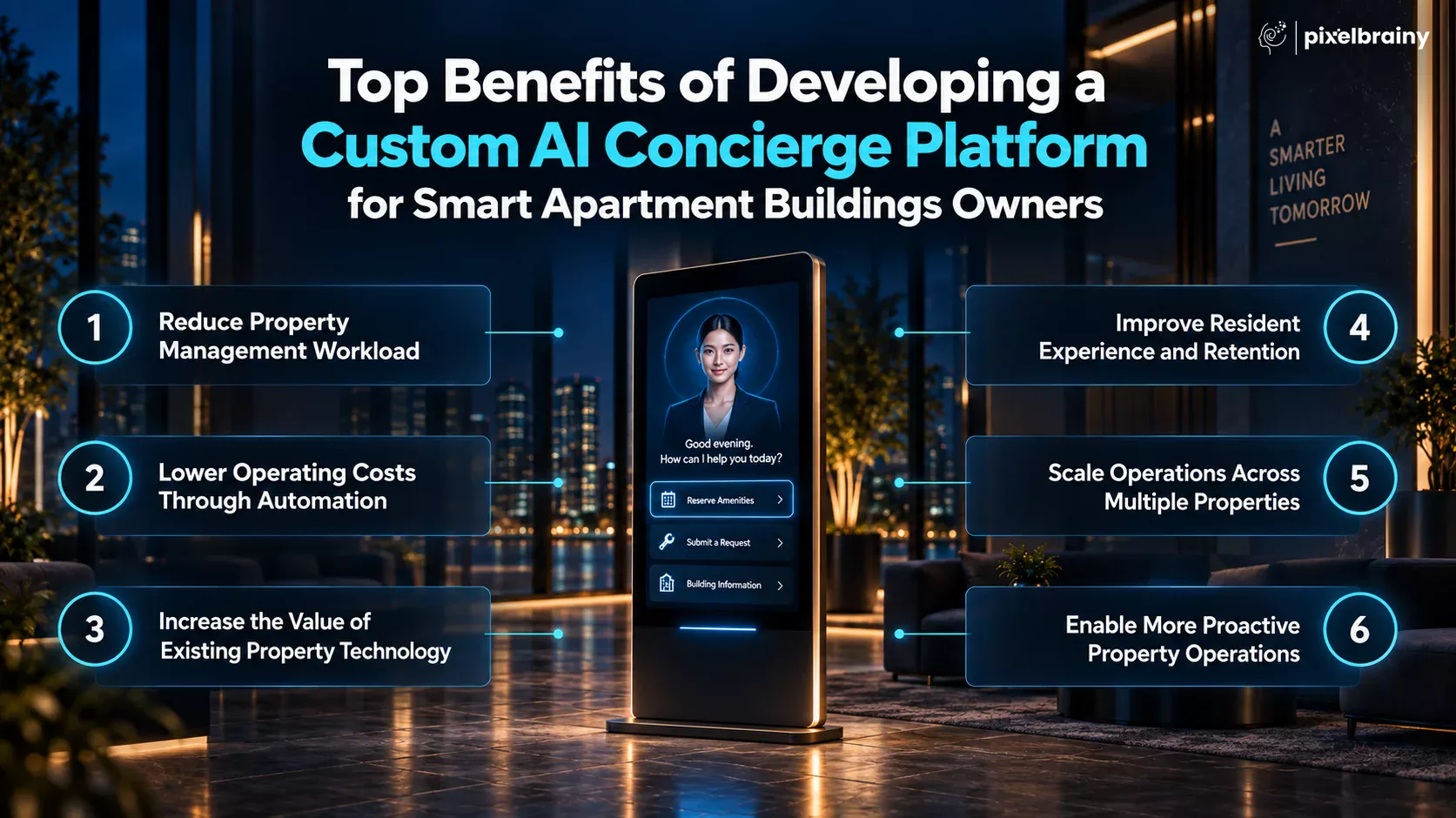
Property teams spend considerable time handling repetitive resident requests, including amenity questions, maintenance intake, visitor information, package inquiries, access requests, and building-policy questions.
A custom AI concierge platform can handle many of these interactions automatically. It can understand a resident's request, retrieve information from approved building data, collect the required details, and initiate the relevant workflow.
This reduces routine calls, emails, and front-desk interactions that staff need to process manually. AI concierge solutions are increasingly being designed to reduce repetitive inquiries while helping property teams focus on requests that require human attention.
For owners, the practical benefit is a property team that can manage higher service demand without increasing administrative workload at the same rate.
Labor-intensive processes can become expensive when repeated across hundreds or thousands of residents. AI concierge platform development gives owners an opportunity to automate selected workflows instead of relying on staff for every step.
The platform can automate tasks such as request classification, maintenance intake, resident notifications, amenity booking, visitor workflows, and service-status updates.
It can also collect complete information before a request reaches the property team, reducing unnecessary back-and-forth and helping staff resolve issues more efficiently.
The goal is not simply to reduce headcount. A stronger business case is to use AI for repetitive processes while allowing employees to focus on exceptions, sensitive situations, and decisions that require human judgment.
Apartment owners may already have significant investments in smart locks, thermostats, sensors, access control, property management systems, maintenance software, and resident applications.
However, these technologies may operate through separate interfaces. A custom AI concierge for smart apartment buildings can become an intelligent interaction layer across approved systems.
Through APIs, integrations, and workflow automation, residents can interact with multiple building services through a more unified experience without requiring owners to replace their existing infrastructure.
This helps property owners extract more value from technology they have already invested in while creating a foundation for additional integrations as the building's technology ecosystem expands.
Residents increasingly expect property services to be convenient, responsive, and easy to access. When everyday tasks require multiple applications or manual communication with property staff, even technologically advanced buildings can feel unnecessarily complicated.
An AI resident concierge can provide a single conversational access point for approved building services and information. Residents can ask questions, report problems, book amenities, check service information, or request assistance through one interface.
For owners, this creates a more consistent resident experience across everyday interactions.
A smoother service experience can support resident satisfaction and retention, which are important business considerations for apartment owners looking to reduce avoidable turnover and maintain the long-term value of their properties.
For owners and property management companies operating multiple apartment communities, maintaining different resident-service processes can become increasingly difficult as the portfolio expands.
A custom AI concierge platform for apartment buildings can provide a common technology foundation across properties while allowing each building to maintain its own rules, amenities, services, integrations, and branding.
New properties can then be onboarded into the platform without developing an entirely separate resident experience from scratch.
This creates a more scalable operating model and gives portfolio owners greater consistency in how resident services are delivered, managed, measured, and improved across different properties.
One of the most valuable long-term benefits of AI concierge platform development is the opportunity to move from reactive service handling toward more proactive property operations.
When connected securely to building systems and operational data, an AI platform can identify patterns, support predictive workflows, and trigger appropriate actions based on predefined rules and permissions.
For example, information from connected building systems could help identify a potential maintenance issue before it develops into a larger resident complaint. AI agents can also coordinate information between sensors, property data, maintenance workflows, and authorized building actions.
For owners, this creates an opportunity to improve operational responsiveness, reduce avoidable issues, and make better use of building data.
The above are the key benefits of developing a custom AI concierge platform for smart apartment buildings, helping owners improve operational efficiency, control costs, enhance resident experiences, and scale property services more effectively.
AI concierge technology is not limited to one type of property. Any business operating a connected residential, hospitality, workplace, or community environment can use it to bring services, systems, and user interactions into one intelligent platform.
For smart apartment buildings, the development partner needs to understand how residents interact with IoT devices, access control, property management systems, amenities, maintenance services, and other building technologies. The same principle applies to hotels, offices, gated communities, and other property types, although each has different workflows and user expectations.
If you are asking, “Who should develop an AI concierge platform for my property?”, look for an experienced AI concierge platform development company that can combine AI agents, conversational interfaces, IoT integration, API connectivity, workflow automation, security, and user-friendly design.
The following property types are particularly well suited for custom AI concierge platform development:
Luxury apartment owners can use an AI concierge platform for luxury apartments to deliver personalized services while reducing routine work for property teams. Residents can interact with the platform to control approved smart-home functions, request maintenance, manage guest access, reserve amenities, arrange services, or receive property information.
The development partner should understand premium UX, AI agents, smart-home integration, and secure access workflows. For businesses asking, “Who can develop an AI concierge for a luxury apartment building?”, the ideal provider should be capable of creating a branded platform that connects existing property technologies while maintaining a high-end resident experience.
Condominium communities involve residents, homeowners associations, property managers, security teams, maintenance staff, and external service providers. An AI concierge platform for condominiums can bring communication and service requests into one digital channel.
Residents can use the platform for amenity reservations, visitor management, maintenance requests, building information, community announcements, and approved access services. The development company should support role-based permissions so residents, administrators, staff, and vendors receive only the access appropriate to their responsibilities.
This makes custom AI concierge development for condominiums particularly useful for communities looking to modernize resident services without replacing their existing property systems.
Hotels and resorts can use an AI hotel concierge platform to make guest services faster and more accessible. Guests can request housekeeping, room service, transportation, restaurant reservations, spa appointments, facility information, and other services through conversational interactions.
The platform can integrate with hotel property management systems, booking platforms, smart-room technology, payment systems, and service-management tools.
For a business looking for AI concierge platform development for hotels and resorts, the development partner should have experience with hospitality workflows, conversational AI, mobile experiences, API integrations, and secure transactional processes.
Commercial office buildings can deploy an AI concierge for smart buildings to support employees, tenants, visitors, facility managers, and security teams. Common use cases include visitor registration, access requests, meeting-room reservations, parking information, maintenance reporting, and facility assistance.
The platform can connect with access-control systems, calendars, building management systems, workplace applications, and IoT devices.
Businesses looking for AI concierge development for commercial offices should work with a provider that understands enterprise integrations, multi-tenant environments, permission management, security requirements, and workflow automation.
Mixed-use developments bring together residential units, offices, retail spaces, hospitality services, parking, and shared amenities. This creates a complex environment where different users require different services and permissions.
A custom AI concierge platform for mixed-use developments can provide a unified interface while delivering different experiences based on the user's identity, location, role, and authorization level.
A resident may request apartment services, an office tenant may need workplace assistance, and a visitor may require directions or access information. The development partner should therefore have expertise in AI orchestration, API integrations, identity management, and complex property workflows.
Gated communities can use an AI resident concierge to simplify interactions between residents, security personnel, property managers, maintenance teams, and service providers.
Potential workflows include visitor approvals, gate access, package notifications, maintenance requests, amenity bookings, community announcements, and vendor coordination.
Security is particularly important in this environment. AI concierge platform development for gated communities should include identity verification, authorization controls, audit trails, and secure access-control integrations.
Property owners asking “Who can build an AI concierge for a gated community?” should prioritize a development partner with strong experience in secure IoT integrations, AI agents, access management, and automated property workflows.
Senior living communities can use AI concierge platform development to simplify everyday interactions for residents while helping staff manage routine service requests. Residents can use conversational interfaces to request maintenance, access community information, schedule activities, contact support, or request approved services.
The platform should prioritize accessibility, simple navigation, clear responses, privacy, and controlled automation. Staff can also receive structured requests instead of manually collecting information through calls or messages.
For senior living AI concierge development, the right technology partner should understand secure AI workflows, accessible UX, property management integrations, and the need for human escalation when a request requires staff involvement.
Student housing properties handle high volumes of requests involving maintenance, packages, access, amenities, payments, events, and housing policies. A custom AI concierge for student housing can provide students with one convenient digital channel for these everyday needs.
The AI can answer housing questions, initiate maintenance requests, provide amenity information, support visitor workflows, and connect with property management systems.
For operators searching for AI concierge platform development for student housing, the ideal partner should offer conversational AI, mobile-first UX, property-management integrations, workflow automation, and scalable architecture capable of supporting large resident populations.
Whether you operate luxury apartments, condominiums, hotels, offices, mixed-use developments, gated communities, senior living communities, or student housing, the development partner should combine AI expertise with property technology integration.
The right AI concierge development company can connect your existing systems, automate property-specific workflows, protect sensitive information, and create one intelligent experience for residents, guests, tenants, or occupants.
Section 7: Must-Have Features for AI Concierge Platform Development for Smart Apartment Buildings
For a property management company, the biggest challenge is often not a lack of technology. It is the volume of routine resident interactions that consume staff time every day. Repetitive calls, maintenance requests, access questions, amenity inquiries, and building information requests can quickly overwhelm property teams.
A custom AI concierge platform for smart apartment buildings can address this operational gap by combining conversational AI, property management integrations, smart-building connectivity, automated workflows, and human escalation in one platform.
If your team is asking, “Can an AI concierge platform automate routine resident questions and maintenance requests while allowing our staff to step in when necessary?”, the answer is yes, provided the platform is designed around clear workflows, permissions, integrations, and human oversight.
The following AI concierge platform features form the essential foundation for AI concierge development for smart apartment buildings. These are core features for resident service automation and property operations, while advanced AI capabilities are covered separately.
| Must-Have AI Concierge Platform Feature | How It Works |
|---|---|
| AI Conversational Chat | Provides residents with natural, two-way conversations through a resident AI concierge on web or mobile. The AI understands questions, identifies intent, provides relevant answers, and guides residents toward the appropriate building service or action. |
| Resident Request Management | Captures and organizes resident requests by category, priority, property, unit, and status. This AI concierge feature gives property teams a structured way to manage requests without relying on scattered calls, emails, or messages. |
| Maintenance Request Automation | Allows residents to report maintenance issues through the AI apartment concierge. The platform collects details such as location, problem type, urgency, and description, then creates or routes the request to the appropriate maintenance workflow. |
| Property FAQ and Knowledge Base | Gives residents instant answers about building policies, amenities, parking, deliveries, operating hours, move-in procedures, and community rules. The AI concierge platform retrieves information from approved property documents and knowledge sources. |
| Human Handoff and Escalation | Transfers conversations or requests to property staff when the AI concierge for apartment buildings cannot resolve an issue, detects a sensitive situation, or encounters a request requiring human judgment. |
| Resident Authentication | Verifies resident identity before providing account-specific information or allowing protected actions. This AI concierge platform feature can connect with existing resident accounts and help prevent unauthorized access to personal or building services. |
| Role-Based Access Control | Controls what residents, property managers, maintenance teams, administrators, and other users can view or perform. Permission-based access is essential for secure AI concierge development across smart apartment communities. |
| Property Management System Integration | Connects the AI concierge platform for smart buildings with existing property management software. Approved resident information, unit details, service requests, and operational data can move between systems with less manual data entry. |
| Smart Home and IoT Integration | Connects approved smart locks, thermostats, lighting, sensors, and other IoT devices. The AI resident concierge can support authorized building actions while permissions and security rules control available functions. |
| Amenity Information and Booking | Helps residents discover amenities, understand usage rules, check availability, and submit booking requests. The AI concierge for apartment buildings can connect with scheduling and property systems to manage reservations efficiently. |
| Visitor and Access Requests | Allows residents to submit approved visitor and access requests through the AI apartment concierge platform. The system collects required information and connects with access-control workflows according to property security policies. |
| Notifications and Status Updates | Keeps residents informed about maintenance progress, service requests, bookings, building announcements, access events, and other updates through configured channels. This improves communication within the AI concierge platform for property management. |
| Multichannel Resident Support | Makes the AI concierge platform available through multiple resident-facing channels, including mobile apps, web portals, and messaging interfaces. Residents can access property services through the digital channel that best fits their needs. |
| Service Request Tracking | Allows residents and property staff to view request status, submitted information, assigned teams, and completed actions. AI-powered property management teams can reduce repeated follow-up calls and improve service visibility. |
| Admin and Property Management Dashboard | Provides property teams with centralized control over conversations, requests, maintenance tickets, escalations, residents, integrations, and system activity. Staff can review AI concierge interactions and take over conversations whenever human intervention is required. |
These core AI concierge platform features give smart apartment building owners and property management companies the foundation to automate routine services, connect existing systems, and keep human staff in control when personal assistance is needed.
Once the core AI concierge platform features are in place, apartment owners can add advanced capabilities that make the platform more proactive, personalized, and intelligent. These features can help the system move beyond answering resident questions and handling basic service requests toward coordinating complex workflows and supporting smarter property operations.
For property management companies thinking, “Our basic AI concierge can already handle resident questions and maintenance requests, so how can we make it more intelligent and proactive?”, advanced AI capabilities can provide the next level of functionality.
The right AI concierge platform development strategy should add these capabilities based on property requirements, existing technology infrastructure, resident expectations, security policies, and business objectives. Not every building needs every advanced feature from day one.
| Advanced AI Concierge Feature | How It Works |
|---|---|
| AI Agentic Workflow Automation | Enables the AI concierge platform to manage multi-step tasks instead of simply responding to individual requests. It can understand the objective, determine required actions, interact with connected systems, and complete authorized workflows with minimal staff involvement. |
| Predictive Maintenance Intelligence | Uses IoT sensor information, maintenance records, equipment data, and historical patterns to identify potential problems before they become major issues. A smart apartment AI concierge can then alert teams or initiate approved maintenance workflows. |
| Personalized Resident Experiences | Uses authorized preferences, interaction history, resident profiles, and service patterns to personalize AI resident concierge interactions. The platform can provide more relevant recommendations, reminders, services, and responses without requiring residents to repeatedly provide the same information. |
| Proactive Resident Assistance | Allows the AI apartment concierge to initiate relevant interactions instead of waiting for residents to ask questions. For example, it can provide reminders about upcoming reservations, scheduled maintenance, package collection, or building events based on approved data and preferences. |
| AI-Powered Energy Optimization | Combines smart thermostats, occupancy information, sensors, and building data to support more efficient energy usage. The AI concierge for smart buildings can recommend or execute authorized adjustments according to predefined property rules and resident preferences. |
| Computer Vision Integration | Connects AI concierge workflows with approved computer vision systems for use cases such as package areas, parking, occupancy monitoring, or security events. The platform can interpret relevant system alerts and route appropriate actions to authorized personnel. |
| Multilingual AI Concierge | Enables residents from different language backgrounds to communicate with the AI concierge platform for apartment buildings in their preferred language. The system can translate conversations while maintaining access to property information, service workflows, and escalation processes. |
| Voice-Enabled AI Concierge | Allows residents to interact with the AI concierge platform using natural voice commands through supported mobile, web, smart-home, or voice-enabled interfaces. Voice interaction can make building services more accessible and convenient for everyday requests. |
| AI Analytics and Property Insights | Analyzes resident interactions, service requests, maintenance patterns, amenity usage, and operational data to identify trends. Property managers can use these AI-powered property management insights to understand demand and identify areas requiring operational improvement. |
| Predictive Resident Service Recommendations | Uses permitted behavioral and property data to anticipate relevant resident needs and recommend services. The AI concierge platform could suggest amenities, services, or actions based on context while respecting privacy, consent, and property-specific communication policies. |
These advanced AI concierge capabilities can help smart apartment buildings evolve from reactive resident service platforms into more proactive, personalized, and intelligent property ecosystems.
After you finalized the features, now it’s time to turn the AI concierge platform concept into a working product. A successful development process needs to connect business objectives with resident needs, property workflows, AI capabilities, smart-building infrastructure, and existing property management systems.
For a real estate company managing several residential buildings, the development approach should also support standardized resident services with property-level customization. This means creating one scalable platform that can serve multiple buildings while allowing each property to configure its own amenities, policies, integrations, access rules, and workflows.
If you are asking, “Which AI development company can build a multi-property AI concierge platform that can be customized for each residential building?”, look for a partner that can manage the complete AI concierge platform development for smart apartment buildings, from discovery and validation through deployment and ongoing optimization.
Here are the steps to build an AI concierge platform from idea to launch:
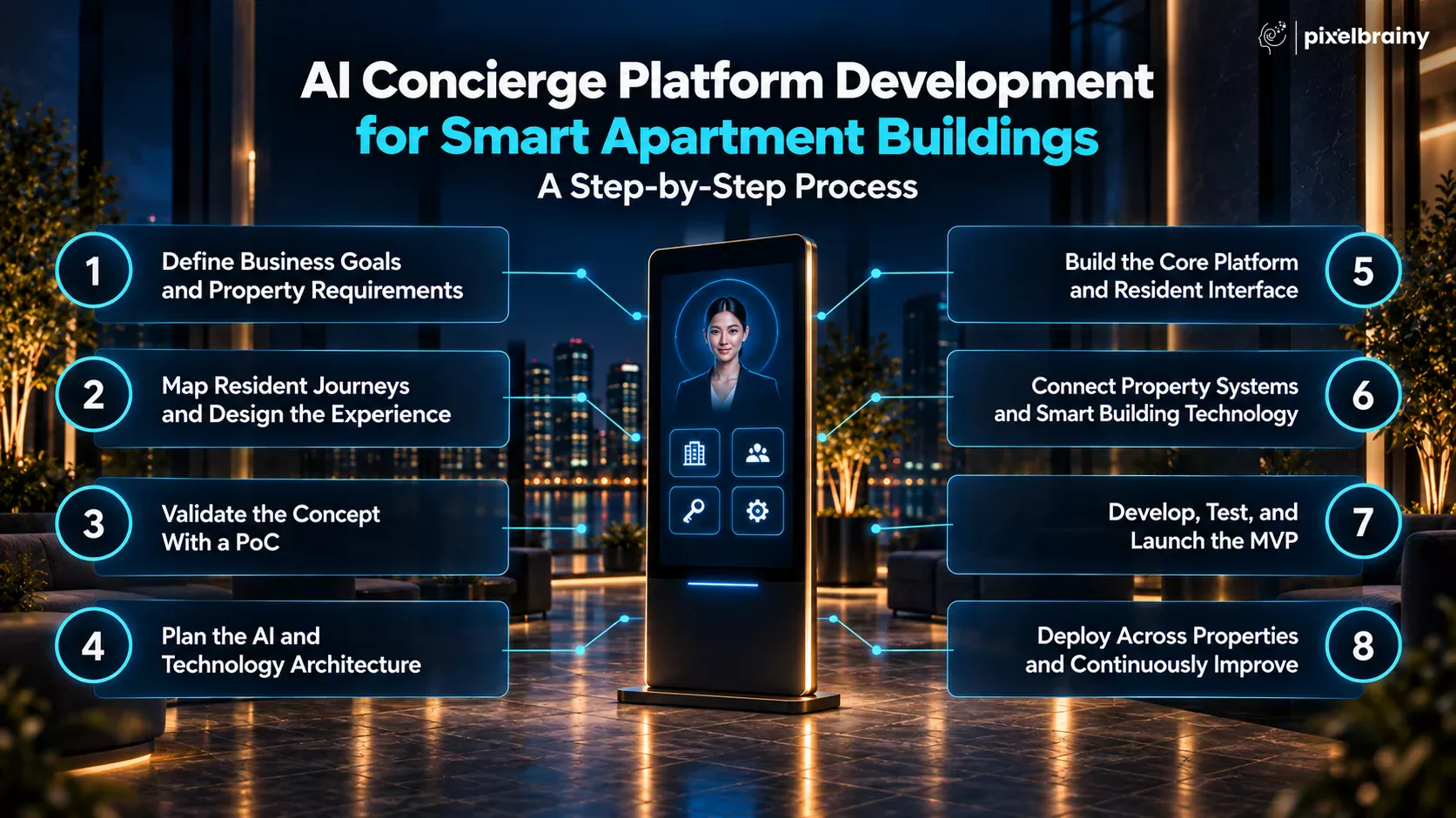
The first step in building an AI concierge platform for smart apartments is defining exactly what the platform needs to accomplish. Start by identifying the operational problems across your residential properties, such as repetitive resident questions, maintenance coordination, access requests, amenity management, or fragmented communication channels.
For a multi-property portfolio, document which services should be standardized and which should remain property-specific. Define user types, service workflows, integrations, security requirements, and measurable business objectives.
An AI consultation at this stage can help identify suitable AI use cases, technical requirements, automation opportunities, and potential implementation risks before development begins.
Also Read: Top 10 AI Consulting Companies in USA
Once the business requirements are clear, map how residents currently interact with property services and identify where an AI concierge can simplify those journeys. Consider common scenarios such as reporting maintenance, requesting guest access, booking amenities, asking property questions, or controlling authorized smart-home functions.
The platform should be designed around natural conversations rather than complicated menus. Residents should be able to communicate their intent without knowing which backend system handles the request.
Working with a UI/UX design company can help create intuitive resident interfaces for mobile applications, web portals, and other supported channels while maintaining a consistent experience across different properties.
Before committing to full-scale development, validate whether the proposed architecture and AI workflows can work with your actual property environment. PoC development can focus on a limited number of high-value use cases, such as resident FAQs, maintenance requests, or property-management system connectivity.
The proof of concept can test AI response quality, integration feasibility, authentication, permissions, workflow execution, and human escalation.
For a multi-property real estate company, this stage can also reveal which capabilities should be standardized across the portfolio and which need property-specific configuration. The findings can then guide the architecture, feature priorities, budget, and implementation roadmap for the full platform.
The next stage is defining the technical architecture required to create an AI concierge platform for smart apartments. This includes selecting the application architecture, cloud infrastructure, databases, APIs, integration layer, authentication mechanisms, analytics components, and AI services.
The AI architecture should also determine how the platform handles natural-language understanding, retrieval, workflow execution, context, permissions, and human escalation.
AI model development may be required when standard models do not adequately meet specific property requirements. Architecture decisions should also account for scalability so the same platform can support multiple buildings, residents, integrations, and property configurations without creating separate systems for every location.
Also Read: Top 12+ AI Model Development Companies in the USA
With the architecture established, development can begin on the platform's core components. This typically includes the resident interface, conversational AI layer, user authentication, property configuration, request management, administrative dashboard, notification system, and workflow engine.
The development team should build the platform as a configurable system rather than hard-coding every building's rules and services. This allows property managers to configure amenities, policies, service categories, operating hours, escalation rules, and integrations for individual properties.
Organizations comparing top AI development companies should evaluate whether their teams can build scalable AI products rather than only chatbot interfaces.
A major part of concierge platform development for smart apartments using AI is connecting the platform with the systems already operating inside the properties.
Depending on the building, integrations may include property management software, access control, smart locks, HVAC, IoT sensors, maintenance systems, amenity booking platforms, payment services, calendars, and resident databases.
This is where AI integration becomes critical. The AI should not directly access every connected system without controls. Instead, authorized workflows should determine which systems can be accessed, what information can be retrieved, and which actions can be performed for specific users and properties.
After the primary architecture and integrations are ready, build an MVP around the highest-priority resident and operational use cases. MVP development helps validate the platform with real users before investing in every planned capability.
Testing should cover AI accuracy, conversation quality, authentication, permissions, integration reliability, response times, data protection, workflow execution, and human escalation.
A controlled pilot can then be launched in one property or a small group of buildings. Resident and staff feedback should be collected continuously to identify confusing interactions, missing workflows, incorrect responses, and integration issues before expanding the platform across the wider portfolio.
Also Read: Top 10 AI MVP Development Companies in USA
The final stage is moving from a validated platform to portfolio-wide deployment. Once the pilot demonstrates reliability, the platform can be configured for additional buildings while maintaining common standards for security, resident experience, AI governance, and operational workflows.
Organizations looking at AI real estate software development companies should ensure the partner can support deployment, monitoring, maintenance, analytics, model improvements, and future integrations.
You may also hire AI developers for an internal team or work with experienced AI product development companies for ongoing engineering support. Continuous improvement should be based on resident feedback, staff requirements, AI performance, service data, and changing property needs.
Following these steps provides a structured development process for turning an AI concierge concept into a scalable platform that standardizes resident services while allowing each smart apartment property to maintain its own unique requirements.
The cost to develop an AI concierge platform for smart apartment buildings typically ranges from $50,000 to $300,000+, depending on the platform's complexity, number of integrations, AI capabilities, property coverage, security requirements, and level of customization.
For a property management company, the development budget of an AI concierge platform for smart apartment buildings should be based on the actual business workflows the platform needs to automate. A basic platform handling resident FAQs and service requests will require a significantly smaller investment than an enterprise platform connecting multiple properties, IoT devices, access control, property management systems, maintenance platforms, and AI agents.
So, what is the development pricing of an AI concierge platform? A realistic AI concierge platform development cost for smart apartment buildings can be estimated across three broad levels:
| AI Concierge Platform Type | Estimated Development Cost | Typical Scope |
|---|---|---|
| Basic AI Concierge Platform | $50,000 to $90,000 | AI chat, resident FAQs, maintenance requests, basic authentication, notifications, admin dashboard, limited property management integration, and human escalation. |
| Advanced AI Concierge Platform | $90,000 to $180,000 | Everything in the basic version plus multiple property integrations, smart-home and IoT connectivity, amenity booking, visitor workflows, role-based access, analytics, multilingual support, and advanced automation. |
| Enterprise AI Concierge Platform | $180,000 to $300,000+ | Multi-property architecture, extensive IoT and property-system integrations, AI agents, advanced automation, enterprise security, personalized experiences, predictive capabilities, analytics, scalability, custom workflows, and ongoing AI optimization. |
The final AI concierge platform development cost depends on several technical and business factors. Each can significantly change the overall development budget.
The biggest cost drivers are AI sophistication, number of properties, integrations, IoT connectivity, security requirements, mobile and web applications, and workflow complexity. A platform intended for one building with basic resident automation can remain near the lower end of the range, while a portfolio-wide enterprise platform can exceed $300,000.
A realistic cost estimation of AI concierge platform development should therefore begin with the required features, integrations, property count, and automation goals rather than a fixed development price.
With an estimated investment of $50,000 to $300,000+, property owners can build an AI concierge platform that ranges from basic resident support to a fully integrated, enterprise-grade smart apartment ecosystem.
The technology stack is the technical foundation behind an AI concierge platform, determining how efficiently it can communicate with residents, process requests, connect with smart building systems, and automate property services. Businesses planning AI concierge platform development for smart apartment buildings need a technology architecture that supports conversational AI, secure data management, real-time integrations, mobile and web applications, and scalable property operations.
A common question from property owners and real estate companies is, “What technology stack do we need to build an AI concierge platform for smart apartments?” The answer depends on the platform's features, AI capabilities, number of properties, integrations, security requirements, and expected user volume.
A well-planned AI concierge platform development stack combines AI models, backend technologies, databases, APIs, cloud infrastructure, security tools, and frontend frameworks. This allows the platform to handle everything from resident questions and maintenance requests to amenity bookings, access management, smart home controls, and automated property workflows.
| Technology Layer | Recommended Technologies | Purpose in AI Concierge Platform |
|---|---|---|
| Frontend Development | React.js, Next.js, TypeScript | Develops responsive resident portals, web applications, property dashboards, and administrative interfaces for managing concierge services. |
| Mobile App Development | React Native, Flutter, Swift, Kotlin | Supports iOS and Android applications where residents can communicate with the AI concierge, submit requests, manage access, book amenities, and receive updates. |
| Backend Development | Node.js, Python, FastAPI, NestJS | Manages business logic, resident requests, workflows, authentication, AI interactions, notifications, and communication between different platform services. |
| AI and LLM Layer | OpenAI, Anthropic Claude, Google Gemini | Powers natural language conversations, question answering, task assistance, summarization, contextual responses, and intelligent resident support. |
| AI Agent Framework | LangGraph, LangChain, Custom Agent Architecture | Enables multi-step AI workflows where the concierge can understand a request, retrieve information, interact with APIs, complete approved tasks, and escalate complex cases. |
| Knowledge Base and RAG | PostgreSQL, pgvector, Pinecone, Weaviate | Helps the AI retrieve property-specific information from FAQs, building policies, amenity rules, service documents, resident guides, and other approved knowledge sources. |
| Primary Database | PostgreSQL, MySQL | Stores resident profiles, property data, service requests, bookings, conversations, permissions, and other structured operational information. |
| Vector Database | Pinecone, Weaviate, pgvector | Stores semantic representations of property information to improve contextual AI responses and knowledge retrieval. |
| Smart Home and IoT Integration | MQTT, REST APIs, WebSockets, Vendor SDKs | Connects the AI concierge with smart locks, thermostats, lighting, sensors, appliances, and other connected apartment technologies. |
| Property Management Integration | REST APIs, GraphQL, Webhooks | Connects the concierge with PMS, CRM, leasing, maintenance, resident management, payment, and other property technology platforms. |
| Authentication and Security | OAuth 2.0, OpenID Connect, JWT, MFA | Protects resident accounts and ensures users can access only the information, services, and building controls permitted for their role. |
| Cloud Infrastructure | AWS, Microsoft Azure, Google Cloud | Provides scalable infrastructure for application hosting, databases, AI services, storage, APIs, monitoring, and multi-property operations. |
| Caching and Performance | Redis | Improves response speed and supports caching, session management, rate limiting, queues, and high-volume resident interactions. |
| Communication APIs | Twilio, SendGrid, Firebase Cloud Messaging | Enables SMS, email, push notifications, maintenance alerts, booking confirmations, visitor updates, and other resident communications. |
| DevOps and Deployment | Docker, Kubernetes, GitHub Actions, Terraform | Supports automated deployment, infrastructure management, application scaling, environment configuration, and reliable platform operations. |
| Analytics and Monitoring | Grafana, Prometheus, Cloud Monitoring Tools | Tracks system performance, AI usage, resident interactions, automation rates, response times, errors, and overall platform health. |
| Testing and QA | Jest, PyTest, Playwright, Cypress | Tests application functionality, APIs, AI workflows, integrations, authentication, and critical resident service processes before and after deployment. |
The technology stack for AI concierge platform development for smart apartments should ultimately match the property's operational requirements, integration environment, security standards, and long-term scalability goals.
Therefore, selection of the right technology stack provides the foundation for building a secure, intelligent, integrated, and scalable AI concierge platform for modern smart apartment buildings.
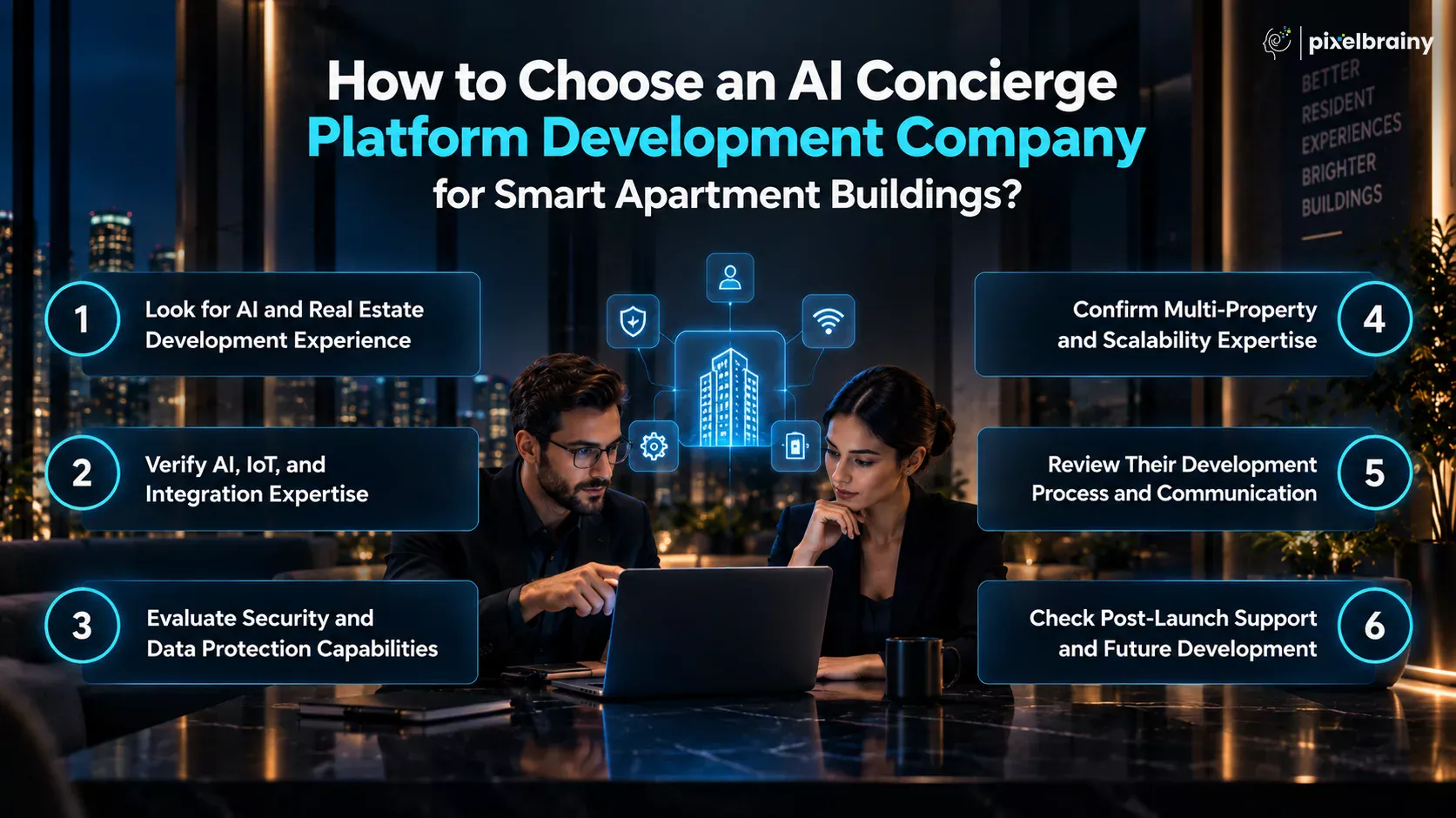
The development partner you select can significantly influence the platform's functionality, scalability, security, integration capabilities, and long-term maintenance. Smart apartment buildings require an AI concierge solution that can work with property management systems, smart locks, IoT devices, maintenance workflows, access control, resident applications, and communication channels.
A common concern among property owners and real estate companies is: “We want to build an AI concierge platform for our smart apartment buildings, but we are not sure which development company has the right AI, IoT, property management integration, and real estate technology expertise. What should we look for in an AI development partner?”
The answer depends on several factors, including technical expertise, real estate experience, integration capabilities, security practices, development methodology, scalability, and post-launch support. Evaluating these areas can help businesses find an AI concierge platform development company capable of turning their property operations into a secure and intelligent digital experience.
Experience matters when your platform needs to combine artificial intelligence with real estate operations. A development company should understand how AI can support resident communication, maintenance management, property information, amenity services, access requests, and other apartment building workflows.
Review the company's previous work in AI development, real estate software, property management platforms, conversational AI, automation, or smart-building technology. Relevant case studies can provide a better understanding of how the team handles complex business requirements.
For businesses asking how to find an AI concierge development company for smart apartments, domain experience can reduce development risks and help the team identify practical AI use cases that deliver operational value rather than adding unnecessary technology.
An AI concierge platform should not operate as an isolated chatbot. It may need to communicate with PMS platforms, CRM systems, smart locks, thermostats, sensors, maintenance software, access control systems, booking platforms, and communication services.
When evaluating an AI concierge platform development solutions provider, check whether the team has experience with LLMs, AI agents, RAG, APIs, IoT protocols, webhooks, cloud services, and third-party integrations. Ask how they would connect your existing property technology ecosystem with the new concierge platform.
The development partner should also explain how the AI will determine which actions it can perform automatically and which requests should require resident authentication, staff approval, or human intervention.
An AI concierge platform can handle resident profiles, conversations, maintenance information, access permissions, property documents, and connected-device data. Security therefore needs to be considered from the architecture stage through deployment and ongoing maintenance.
Ask potential AI concierge development companies about authentication, authorization, encryption, role-based access control, API security, audit logging, secure data storage, and tenant or property-level data isolation. These capabilities become particularly important when the same platform serves multiple apartment communities.
The development partner should also have a clear strategy for controlling AI actions. For example, a resident may be able to request visitor access through the concierge, while actual access permissions should be validated against predefined rules before any system action is performed.
Real estate companies managing multiple buildings need an architecture that can grow with their portfolio. Building a separate concierge system for every property can increase development, maintenance, and integration costs.
Ask whether the development company can create a scalable multi-property architecture where core AI capabilities are shared while each property maintains its own information, policies, amenities, workflows, branding, and integrations.
This is especially relevant when your goal is to develop an AI concierge platform for multiple smart apartment buildings. The right architecture should make it easier to onboard new properties, configure building-specific services, manage permissions, and monitor performance from a centralized administration layer.
A reliable development company should have a clearly defined process covering discovery, AI consultation, architecture, UI/UX design, PoC development, MVP development, testing, deployment, and post-launch enhancement.
Ask how requirements will be documented, how project milestones will be measured, how frequently you will receive progress updates, and how changes to the scope will be handled. You should also know who will be responsible for product management, technical decisions, quality assurance, and communication.
If you are comparing AI concierge platform development companies, do not base the decision only on the initial quotation. A transparent process, realistic timeline, clear deliverables, and strong communication can have a major impact on the project's final quality and development experience.
Launching the AI concierge platform is only the beginning. AI models require ongoing optimization, integrations may change, new property services may be added, and resident expectations will continue to evolve.
Before partnering with an AI concierge platform development company, understand what happens after launch. Ask about technical maintenance, AI model updates, security improvements, bug resolution, integration support, performance monitoring, cloud management, and future feature development.
A long-term technology partner can also help introduce advanced capabilities such as predictive maintenance, agentic workflows, personalized resident services, voice interaction, energy optimization, and AI-powered property analytics as your business requirements grow.
The right AI concierge development company should bring together AI expertise, smart-building integrations, real estate technology knowledge, security, scalability, and long-term support to create a platform that can grow with your property portfolio.
The future of AI concierge platforms for smart apartment buildings is moving beyond basic resident chat and automated FAQs toward intelligent systems that can understand context, predict needs, coordinate property services, and take approved actions. As smart buildings generate more data from IoT devices, access systems, property management software, and resident applications, AI concierge platforms can become the central intelligence layer connecting these technologies.
For property owners and operators, the next generation of AI concierge platform development for smart apartments will focus on proactive service delivery, agentic automation, personalized resident experiences, predictive maintenance, energy optimization, and seamless communication across multiple channels. AI agents are already being explored in real estate for tasks such as detecting building issues, coordinating maintenance, and triggering permitted actions.
The following trends are expected to shape the future of AI concierge technology in smart apartment communities.
Future AI concierge platforms will increasingly move beyond answering resident questions to completing tasks on behalf of residents and property teams. Instead of simply explaining how to submit a maintenance request, an AI agent can understand the issue, collect relevant details, create the request, assign it to the appropriate workflow, and provide status updates. This evolution is closely connected with agentic AI development, where AI systems are designed to understand goals and perform multi-step actions.
What this means for smart apartment owners:
As these capabilities mature, AI concierge platforms can reduce administrative workloads while allowing property teams to focus on situations that require human judgment, relationship management, and personal interaction.
AI concierge platforms will increasingly combine resident reports with data from sensors, connected equipment, maintenance records, and building systems to identify potential problems before they become major service issues. Instead of waiting for residents to report every problem, the platform can recognize unusual patterns and help property teams respond earlier.
What this means for smart apartment owners:
This shift toward predictive property operations can help owners reduce unexpected repairs, improve maintenance response times, and support better management of building equipment and resources.
Future AI concierge platforms will provide more relevant assistance based on resident preferences, previous interactions, apartment configuration, property rules, and available services. Instead of providing identical responses to every resident, the platform can use context to make recommendations and support more personalized resident interactions.
What this means for smart apartment owners:
This level of personalization can make resident services more convenient while helping property owners create a stronger digital experience that supports resident satisfaction, engagement, and long-term retention.
Future AI concierge platforms will increasingly connect systems that traditionally operate separately, including property management software, smart locks, IoT devices, maintenance platforms, access control, and resident applications. This can create a unified service experience where residents do not need to navigate multiple systems for everyday requests.
What this means for smart apartment owners:
This connected approach can make existing property technology more useful while giving residents a simpler way to access services and helping property teams manage operations from a more unified environment.
Voice interaction and multimodal capabilities are expected to become more important within future AI concierge platforms. Residents may communicate through text, voice, images, or video depending on the type of assistance they need. This can make reporting problems and accessing property services more convenient.
What this means for smart apartment owners:
For example, a resident could photograph a water leak and send it through the concierge instead of describing the problem manually. The platform can then collect relevant details and route the request to the appropriate maintenance workflow.
Future AI concierge platforms can work with connected building systems to help property teams understand and optimize energy consumption. By analyzing occupancy patterns, environmental conditions, thermostat settings, sensors, and equipment performance, AI can identify opportunities to improve building efficiency.
What this means for smart apartment owners:
For owners and operators, these capabilities can support more efficient property management while potentially reducing unnecessary utility expenses. Residents can also receive useful recommendations based on approved apartment settings and building energy policies.
Smart apartment communities often serve residents with different language preferences, making multilingual communication an increasingly valuable capability. Future AI concierge platforms can support conversations across multiple languages through text and voice, helping residents access property information and services more easily.
What this means for smart apartment owners:
Multilingual AI can improve accessibility while reducing the need for property staff to manually handle routine translation requests. For owners operating multiple communities, it can also provide a more consistent resident service experience across different locations.
Future AI concierge platforms will go beyond resident communication by analyzing service requests, conversations, maintenance patterns, amenity usage, and resident feedback. These insights can help property teams understand what is happening across their buildings and identify operational areas that require attention.
What this means for smart apartment owners:
Property managers can use these insights to make better decisions about staffing, maintenance, amenities, resident communication, and operational improvements. This can turn the AI concierge from a service interface into an important source of property management intelligence.
As real estate portfolios expand, property owners need technology that can standardize essential services while still supporting the unique requirements of each building. Future AI concierge platforms can provide centralized capabilities while allowing individual properties to maintain their own rules, services, branding, and workflows.
What this means for smart apartment owners:
This approach can make AI concierge development for real estate portfolios more scalable and manageable. Owners can establish common operational standards while giving each apartment community the flexibility needed to deliver property-specific resident services.
The future of AI concierge technology will not be focused solely on replacing property staff. Instead, AI will increasingly manage repetitive requests while human employees handle complex, sensitive, or relationship-driven situations. This creates a practical operating model where technology and property teams work together.
What this means for smart apartment owners:
This human and AI collaboration can help property owners gain the efficiency of automation without removing the personal service residents may need. It also gives staff more time to focus on important issues that require judgment, empathy, or direct involvement.
Building an AI concierge platform for smart apartment buildings requires more than implementing conversational AI. Property owners need to manage integrations, resident data, AI accuracy, smart-building systems, and different property workflows. A common real-world query is: “What challenges should we expect when developing an AI concierge platform for smart apartment buildings, and how can we solve them?”
Here are the 8 major challenges and practical solutions to consider.
Challenge: An AI concierge often needs to work with PMS, CRM, maintenance management, booking, access-control, and communication systems. Different platforms may use different APIs and data structures, making integration complex.
Solution: Use a flexible AI integration architecture with secure APIs, webhooks, and integration layers. Start with the most important property systems and add additional integrations in phases.
Challenge: Generic AI models may provide incorrect information about building policies, amenities, maintenance procedures, or operating hours. Incorrect responses can quickly reduce resident trust.
Solution: Create a property-specific knowledge base using approved documents, FAQs, policies, and operational data. Implement RAG, response validation, confidence checks, and human escalation to improve AI accuracy.
Challenge: An AI concierge may process resident profiles, service requests, access information, conversations, and other sensitive property data. Weak security can create significant operational and reputational risks.
Solution: Build the platform with authentication, role-based access control, encryption, secure APIs, audit logs, and permission-based actions. Sensitive requests should require additional verification or human approval where appropriate.
Challenge: Property owners managing several buildings may have different amenities, policies, access rules, maintenance procedures, and resident services at each location.
Solution: Use a multi-property AI architecture with property-specific knowledge bases, configurations, permissions, workflows, and integrations. This allows one platform to support multiple communities without mixing their information.
Challenge: Smart locks, thermostats, sensors, access-control systems, and other IoT devices may come from different vendors and use different technologies.
Solution: Develop an IoT integration layer using available APIs, SDKs, MQTT, WebSockets, or vendor-supported connectivity. Apply strict authorization so the AI can only control devices and services permitted for each resident.
Challenge: Not every resident request should be handled entirely by AI. Complaints, emergencies, unusual maintenance issues, and sensitive situations may require property staff.
Solution: Include human-in-the-loop workflows within the AI concierge platform. Define escalation rules based on request type, urgency, AI confidence, and resident requirements, while giving staff access to the relevant conversation and request history.
Challenge: Building an AI concierge with mobile apps, AI agents, PMS integrations, IoT connectivity, analytics, security, and multi-property support can increase the AI concierge platform development cost significantly.
Solution: Begin with a focused MVP development approach. Prioritize high-value use cases such as resident questions, maintenance requests, and amenity services, then introduce advanced AI agents and automation after validating the initial platform.
Challenge: Even a technically advanced platform can fail if residents find it complicated or do not see enough value. Requiring residents to learn another complicated system can reduce adoption.
Solution: Design a simple, conversational experience around the services residents use most frequently. Support convenient channels such as mobile, web, messaging, or voice, and continuously improve the platform using resident feedback and usage analytics.
Addressing these challenges early can make AI concierge platform development for smart apartment buildings more secure, scalable, and useful. The right AI development company can help property owners plan the architecture, integrations, AI workflows, security, and MVP roadmap around their actual operational requirements.
From the above discussion, now it is time to identify the best development partner that can turn your smart apartment technology vision into a practical, scalable, and intelligent platform. PixelBrainy combines AI engineering, real estate technology expertise, product development, automation, and system integration to help property businesses build customized solutions around their operational needs.
A common real-world requirement is: “We want to build a custom AI platform for our apartment communities instead of relying on multiple disconnected software products. The platform should manage resident communication, maintenance, amenities, visitor services, and smart-building integrations. Who can develop this end to end?”
PixelBrainy is positioned to address this requirement with a complete product development approach.
| Your Business Requirement | PixelBrainy Capability |
|---|---|
| Custom AI Platform | Develops AI-powered products tailored to specific property workflows, resident requirements, and business objectives. |
| AI Concierge Platform | Provides AI concierge platform development services covering strategy, UX/UI, AI, backend, integrations, testing, and deployment. |
| Real Estate Expertise | Works as an AI real estate software development company with capabilities across property management, real estate automation, and intelligent software solutions. |
| Smart Building Integration | Connects AI solutions with PMS, CRM, IoT devices, smart locks, access control, maintenance systems, and other property technologies. |
| AI Agent Automation | Develops intelligent agents capable of handling multi-step workflows, responding to residents, and escalating complex requests to staff. |
| Scalable Architecture | Creates solutions that can support multiple properties, property-specific configurations, integrations, permissions, and future feature expansion. |
PixelBrainy has delivered an AI-powered property management solution for a real estate business. The confidential project included natural language property search, intelligent recommendations, tenant and property management, maintenance scheduling, viewing bookings through conversational interactions, and CRM-connected lead management.
This experience demonstrates the ability to combine AI with practical real estate workflows, which is essential when businesses want to build AI concierge platform for smart apartment buildings rather than deploy a basic chatbot.
PixelBrainy can support the complete product journey, including AI consultation, PoC development, MVP creation, AI integration, testing, deployment, and ongoing enhancement. The team can help businesses start with priority resident services and expand into advanced automation, personalized experiences, predictive maintenance, analytics, voice capabilities, and additional smart-building integrations.
For businesses planning to develop AI concierge platform for smart apartment buildings, PixelBrainy offers a product-focused approach designed around scalability, integration, usability, and real business outcomes.
Ready to bring your smart apartment AI vision to life? Connect with PixelBrainy and discuss your platform requirements with our AI development experts.Top of FormBottom of Form

AI concierge platforms are becoming a valuable technology opportunity for smart apartment buildings looking to improve resident services and streamline property operations. From an AI chatbot that answers resident questions to AI agents that automate maintenance requests, amenity bookings, visitor services, access management, and other workflows, these solutions can connect multiple property functions through one intelligent digital experience.
Successful AI concierge platform development for smart apartment buildings requires more than conversational AI. It involves secure PMS and IoT integrations, property-specific knowledge bases, AI automation, scalable architecture, intuitive mobile and web experiences, analytics, and reliable human escalation.
For property owners and real estate businesses, the goal is to build AI concierge platform for smart apartment buildings around actual operational requirements and future growth. With AI chatbots, AI agents, predictive maintenance, smart home integrations, and personalized resident services, businesses can create a more connected and efficient property ecosystem.
Ready to bring your AI concierge idea to life? Book an appointment with PixelBrainy and discuss your requirements with our AI experts.
Yes. An AI concierge can handle a high volume of routine resident requests without requiring property staff to respond manually to every interaction. It can answer property questions, collect maintenance issues, provide amenity information, handle visitor requests, share building updates, and route service requests to the appropriate team.
Yes. A custom AI concierge platform can provide a unified interface for resident communication, maintenance requests, amenity bookings, visitor services, access management, and smart-building interactions. Rather than requiring residents to navigate several disconnected applications, the AI concierge can act as a single digital access point.
Yes. An AI concierge can collect the resident's description of a problem, ask relevant follow-up questions, create a maintenance ticket, categorize the request, route it to the appropriate team, and provide status updates.
Yes. A custom AI concierge can provide personalized resident services by using authorized information about resident preferences, property amenities, previous interactions, and available services. It can recommend amenities, provide personalized reminders, answer property-specific questions, and assist residents with frequently requested services.
Yes. An AI concierge can integrate with smart locks, thermostats, sensors, access-control systems, building automation platforms, and other IoT technologies when those systems provide appropriate APIs, SDKs, webhooks, or supported protocols.
Yes. A multi-property AI concierge platform can support different buildings while maintaining property-specific information, policies, amenities, workflows, access permissions, and integrations.
For most property businesses, starting with a focused MVP is a practical approach. An AI chatbot can initially handle high-volume use cases such as resident questions, property information, maintenance intake, amenity information, and service requests.
The cost to develop an AI concierge platform typically ranges from approximately $50,000 to $300,000+, depending on platform complexity, AI capabilities, integrations, number of properties, security requirements, mobile and web applications, and automation requirements.
The development timeline depends on the platform's scope, but a focused MVP can commonly take 6-12 weeks, while a comprehensive enterprise AI concierge platform may require a longer development cycle.
Look for an AI concierge platform development company with demonstrated experience in AI development, conversational AI, AI agents, real estate technology, property management systems, IoT integrations, cloud architecture, data security, and scalable application development.

About The Author
Sagar Bhatnagar
Sagar Sahay Bhatnagar brings over a decade of IT industry experience to his role as Marketing Head at PixelBrainy. He's known for his knack in devising creative marketing strategies that boost brand visibility and market influence. Sagar's strategic thinking, coupled with his innovative vision and focus on results, sets him apart. His track record of successful campaigns proves his ability to utilize digital platforms effectively for impactful marketing efforts. With a genuine passion for both technology and marketing, Sagar continuously pushes PixelBrainy's marketing initiatives to greater success.

Working with the PixelBrainy team has been a highly positive experience. They understand the design requirements and create beautiful UX elements to meet the application needs. The dev team did an excellent job bringing my vision to life. We discussed usability and flow. Sagar worked with his team to design the database and begin coding. Working with Sagar was easy. He has the knowledge to create robust apps, including multi-language support, Google and Apple ID login options, Ad-enabled integrations, Stripe payment processing, and a Web Admin site for maintaining support data. I'm extremely satisfied with the services provided, the quality of the final product, and the professionalism of the entire process. I highly recommend them for Android and iOS Mobile Application Design and Development.

Great experience working with them. Had a lot of feedback and I found that unlike most contractors they were bugging me for updates instead of the other way around. They were extremely time conscience and great at communicating! All work was done extremely high quality and if not on time, early! They were always proactive when it comes to communication and the work is great/above par always. Very flexible and a great team to work with! Goes above and beyond to present us with multiple options and always provides quality. Amazing work per usual with Chitra. If you have UI/UX or branding design needs I recommend you go to them! Will likely work with them in the future as well, definitely recommended!

PixelBrainy is a joy to work with and is a great partner when thinking through branding, logo, and website layout. I appreciate that they spend time going into the "why" behind their decisions to help inform me and others about industry best practices and their expertise.

I hired them to design our software apps. Things I really like about them are excellent communication skills, they answer all project suggestions and collaborate right away, and their input on design and colors is amazing. This project was complex and needed patience and creativity. The team is amazing to do business with. I will be using them long-term. Glad to see there are some good people out there. I was afraid to try and outsource my project to someone but I am glad I met them! I really can't say enough. They went above and beyond on this project. I am very happy with everything they have done to make my business stand out from the competition.

It was great working with PixelBrainy and the team. They were very responsive and really owned the project. We'll definitely work with them again!

I recently worked with the PixelBrainy team on a project and I was blown away by their communication skills. They were prompt, clear, and articulate in all of our interactions. They listened and provided valuable feedback and suggestions to help make the project a success. They also kept me updated throughout the entire process, which made the experience stress-free and enjoyable.

PixelBrainy is very good at what it does. The team also presents themselves very professionally and takes care of their side of things very well. I could fully trust them taking up the design work in a timely and organised manner and their attention to detail saved us lots of effort and time. This particular project was quite intense and the team showed that they function very well under pressure. Very much looking forward to working with her again!

It's always an absolute pleasure working with them. They completed all of my requests quickly and followed every note I had for them to a T, which made our process go smoothly from start to finish. Everything was completed fast and following all of the guidelines. And I would recommend their services to anyone. If you need any design work done in the future, PixelBrainy should be your first call!

They took ownership of our requirements and designed and proposed multiple beautiful variants. The team is self-motivated, requires minimum supervision, committed to see-through designs with quality and delivering them on time. We would definitely love to work with PixelBrainy again when we have any requirements.

PixelBrainy was a big help with our SaaS application. We've been hard at work with a new UI/UX and they provided a lot of help with the designs. If you're looking for assistance with your website, software, or mobile application designs, PixelBrainy and the team is a great recommendation.

PixelBrainy designers are amazing. They are responsive, talented, and always willing to help craft the design until it matches your vision. I would recommend them and plan to continue them for my future projects and more!!!

They were awesome! Did a good job fast, and good communication. Will work with them again. Thank you

Creative, detail-oriented, and talented designers who take direction well and implement changes quickly and accurately. They consistently over-delivered for us.

PixelBrainy team is very talented and creative. Great designers and a pleasure to work with. PixelBrainy is an excellent communicator and I look forward to working with them again.

PixelBrainy has a very talented design team. Their work is excellent and they are very responsive. I enjoy working with them and hope to continue on all of our future projects.


Transform your ideas into reality with us.
Across these industries, each engagement brings unique challenges, from early-stage product development to scaling complex systems, helping us build a practical understanding of real-world product environments.