AI Summary Powered by PixelBrainy
The Forex market continues to be one of the world's largest and most liquid financial markets, creating growing opportunities for AI Forex trading bot development and algorithmic trading. In 2026, the latest comprehensive BIS benchmark shows global OTC foreign exchange turnover at $9.6 trillion per day, based on its April 2025 Triennial Survey. This remains the latest official global FX turnover measurement available in 2026, as the BIS conducts this survey every three years.
At the same time, the broader currency environment continues to evolve. The IMF reported that global official foreign exchange reserves stood at $13.10 trillion in Q1 2026, providing a current indicator of the scale and importance of the international currency market.
For fintech companies, however, building an AI Forex trading bot involves much more than connecting a machine learning model to a broker API. An enterprise-grade system may need real-time market-data processing, predictive models, automated trade execution, portfolio allocation, risk controls, broker connectivity, investor reporting, security, monitoring, and detailed audit trails.
We are a fintech startup and we want to build an AI forex trading bot as a managed account product where retail investors allocate capital to our AI strategy and we charge a management fee and performance fee on returns. Before we structure this product we need to understand the regulatory requirements for operating a managed forex account service in the USA including NFA registration requirements, CFTC oversight, required disclosures, and how the regulatory framework affects the technical architecture of a managed account forex trading system. Which AI Forex bot development companies in the USA have experience building forex trading systems for NFA regulated managed account operators?
This scenario highlights why AI Forex bot development must combine financial technology, automated execution, risk management, and regulatory-aware architecture. Depending on the business model and activities, U.S. requirements can involve the CFTC and NFA, including applicable intermediary registration and compliance obligations.
In this guide, you'll learn:
Whether you're a fintech founder, trading company, or technology investor, this guide provides a practical roadmap for developing an AI Forex trading bot that is scalable, secure, and designed around the operational and regulatory realities of modern automated Forex trading.
An AI Forex trading bot is an intelligent software system that uses artificial intelligence, machine learning, and market data to analyze currency markets and automate trading decisions. Unlike manual trading, where decisions depend heavily on human analysis and emotions, an AI trading bot can monitor market conditions continuously, identify potential opportunities, apply predefined risk rules, and execute trades automatically.
Traditional Forex trading bots generally operate according to fixed rules such as technical indicators, price levels, or predefined entry and exit conditions. An AI-powered Forex trading bot can go further by analyzing historical and real-time data to identify patterns, evaluate changing market conditions, and adjust its decision-making based on the models it uses.
However, AI does not guarantee profitable trades. Its effectiveness depends on the quality of data, model design, strategy validation, execution infrastructure, and risk management.
An intelligent Forex trading system can:
The core value of AI Forex bot development comes from combining several capabilities within one automated system:
Depending on the trading architecture, an AI Forex bot can integrate with:
When you create an AI Forex trading bot, the objective is not simply to automate buy and sell orders. The goal is to build an intelligent trading system that combines market analysis, predictive modeling, automated execution, and risk management into a scalable workflow.
An AI Forex trading bot combines market data, machine learning, decision logic, risk management, and automated execution to analyze currency markets and place trades according to a defined strategy. Instead of relying only on fixed trading rules, an AI-based system can evaluate multiple data sources, recognize patterns, assess market conditions, and generate trading signals in real time.
The AI Forex trading bot workflow generally follows these five stages:
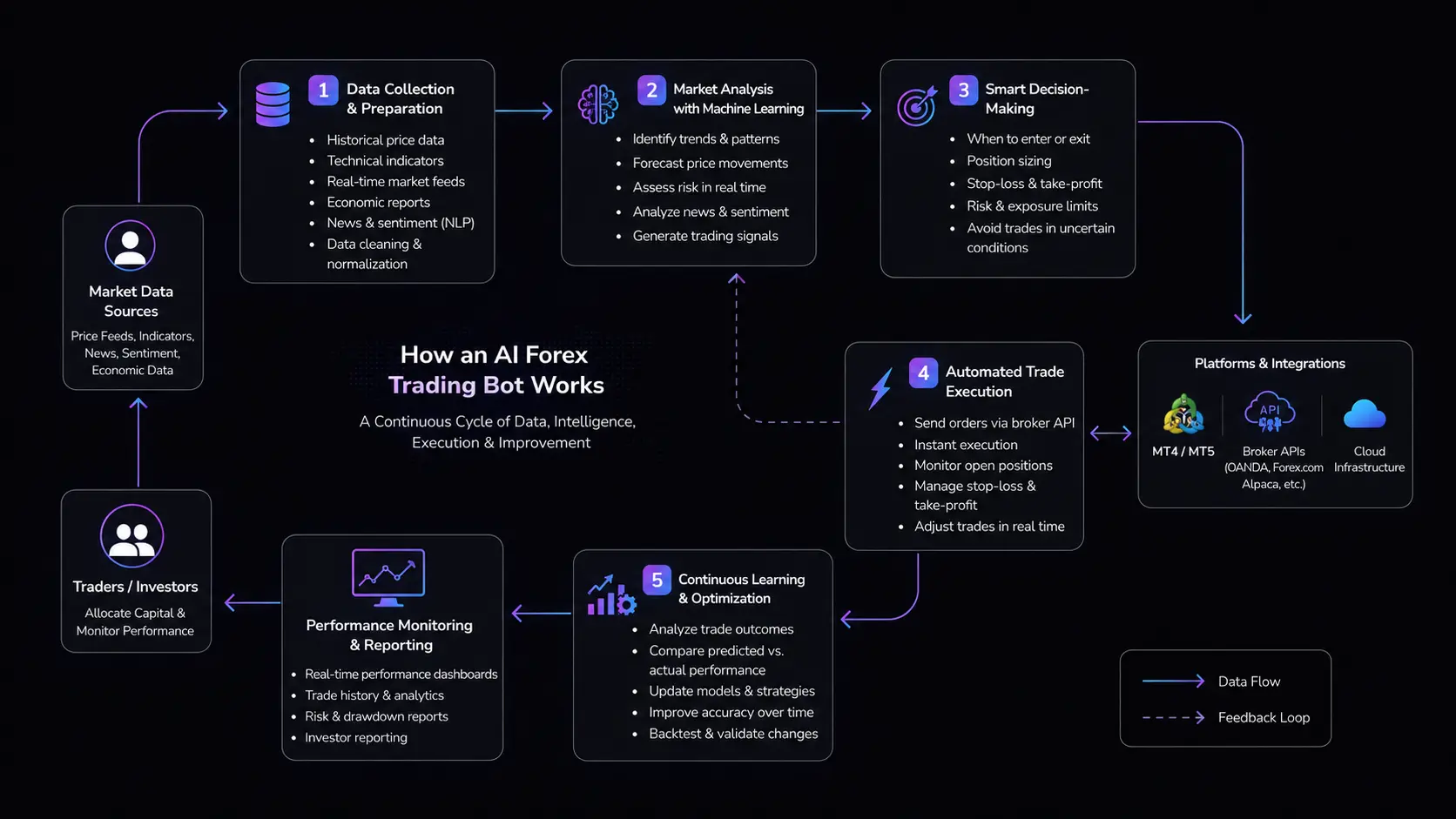
Every AI trading decision begins with reliable data. The bot collects and processes information such as:
The collected data is cleaned, normalized, and structured before being supplied to the AI models. High-quality and consistent data is essential for developing reliable AI Forex trading strategies.
After data preparation, machine learning models analyze the available signals to identify market patterns and potential trading opportunities. Depending on the system design, the models can:
The model output is then passed to the trading decision layer. Model predictions should be validated through historical testing and controlled live testing before being used with real capital.
The decision engine evaluates model outputs together with predefined trading and risk parameters. It can determine:
This layer is important because an AI model should not have unrestricted authority to place trades. Risk management rules provide an additional layer of control.
Once the strategy approves a trade, the bot sends the order through an integrated platform or broker API, such as MT4, MT5, or a supported brokerage interface.
The execution layer handles:
The system can then continuously monitor open positions and respond according to the approved strategy and risk parameters.
After trades are completed, the system evaluates performance against the original predictions and strategy objectives. Relevant metrics can include:
Model updates should occur through a controlled testing, validation, and deployment process rather than automatically changing a live strategy after every trade. This helps reduce overfitting and limits the risk of unstable behavior.
Market Data → Data Processing → ML Analysis → Trading Signal → Risk Validation → Order Execution → Performance Monitoring → Model Optimization
This structured workflow explains how AI Forex trading bot development combines predictive intelligence with automated execution while keeping risk controls and system reliability at the center.
The growing use of automation in currency markets is encouraging traders, fintech startups, and brokers to explore AI Forex trading bot development as a way to improve execution, analyze large datasets, and manage trading workflows more efficiently. Unlike basic algorithmic systems, an AI Forex trading bot can combine machine learning, market data, technical indicators, and sentiment signals to support more adaptive trading strategies.
For example, imagine you are a fintech founder planning to launch an automated Forex investment product. You want the system to analyze multiple currency pairs, execute trades through broker APIs, monitor risk continuously, and provide investors with transparent performance data. Before investing in AI trading bot development, you need to know whether the technology can deliver enough operational and strategic value to justify the development cost.
Here are the key reasons businesses invest in Forex trading bot development using AI:
Forex markets operate around the clock during the trading week, making continuous monitoring difficult for human traders. An AI Forex bot can monitor currency pairs, price movements, technical indicators, and market conditions without requiring constant manual supervision.
The system can identify predefined opportunities and trigger alerts or trading actions based on its programmed strategy. This makes automated Forex trading useful for businesses that need consistent market monitoring across different trading sessions.
Market conditions can change within seconds. Manual execution may introduce delays between identifying an opportunity and placing an order. AI-powered Forex trading systems can connect directly with broker APIs or trading platforms to process decisions and submit orders quickly.
Faster execution can help reduce operational delays and maintain consistency across high-volume trading workflows. The bot can also apply predefined rules for position sizing, stop-loss levels, and trade execution.
An AI Forex trading bot can process large amounts of historical and real-time information much faster than manual analysis. It can evaluate price data, technical indicators, volatility, economic events, and sentiment signals to identify patterns relevant to a trading strategy.
This makes AI in Forex trading valuable for businesses seeking systematic decision support rather than relying entirely on manual market interpretation.
Risk management is a critical component of any automated trading system. AI Forex bots can continuously monitor open positions, exposure, volatility, drawdown, and predefined risk limits.
Businesses can configure safeguards such as position limits, stop-loss rules, maximum daily losses, and trade restrictions. These controls help create a structured AI Forex trading system where risk parameters remain consistent during market activity.
As trading operations grow, manually managing multiple currency pairs, accounts, and strategies becomes increasingly difficult. An AI trading bot can automate repetitive processes across multiple instruments while maintaining centralized monitoring and reporting.
This scalability is particularly useful for Forex trading bot development projects designed for fintech platforms, brokers, investment products, or professional trading operations.
AI systems can evaluate historical trade outcomes and compare predicted results with actual market behavior. With appropriate validation and monitoring, this feedback can help improve model performance and identify areas where a trading strategy needs adjustment.
However, continuous learning should be controlled through proper testing and risk governance rather than allowing a model to modify live strategies without oversight.
In short, AI Forex trading bot development can help businesses create faster, data-driven, scalable, and risk-aware trading systems when the technology is designed around a clearly defined strategy and robust controls.

An effective AI Forex trading bot needs more than automated order placement. Its performance depends on how well it combines real-time market data, technical analysis, machine learning, risk controls, strategy testing, and reliable broker connectivity. When planning AI Forex trading bot development, these capabilities should be selected according to the trading strategy, target currency pairs, risk tolerance, and execution requirements.
If you are asking, “What features should I include when developing an AI Forex trading bot that can analyze multiple currency pairs, backtest strategies, manage risk, and execute trades automatically through a broker API?”, the following features provide a practical foundation for the system.
10 Essential AI Forex Trading Bot Features
| Feature | Explanation |
| Real-Time Data Feed Integration | Enables the bot to access up-to-the-second market prices, news, and volatility to make accurate trade decisions. Ensures responsiveness in high-frequency environments |
| Advanced Technical Indicator Support | Allows the bot to analyze trends using tools like RSI, MACD, EMA, and Bollinger Bands. Helps enhance entry and exit accuracy |
| Custom Strategy Engine | Users can define personalized trading rules and strategies based on their goals. Adds flexibility and customization to the trading process |
| Backtesting Module | Tests strategies on historical data to evaluate performance before going live. Reduces risk by identifying flaws early |
| Risk Management Controls | Includes stop-loss, take-profit, and position sizing mechanisms. Protects capital and enforces disciplined trading |
| Machine Learning Model Integration | Enables the bot to learn from data and adapt strategies over time. Improves decision-making accuracy with each trade |
| Sentiment Analysis via NLP | Analyzes financial news, social media, and headlines to gauge market mood. Helps predict market moves beyond technical indicators |
| Multi-Currency Pair Support | Allows simultaneous trading on various Forex pairs. Increases profit potential through market diversification |
| Performance Analytics Dashboard | Visualizes trade outcomes, win/loss ratios, drawdowns, and ROI. Offers deep insight into bot behavior and profitability |
| Automated Trade Execution via Broker API | Executes buy/sell orders instantly on platforms like MT4, MT5, or OANDA. Minimizes delays and slippage during volatile movements |
Together, these features create a scalable AI Forex trading system that can analyze markets, execute strategies, manage risk, and provide measurable performance insights.
Basic automation can handle routine trading tasks, but advanced capabilities can make an AI Forex trading bot more adaptive, resilient, and suitable for sophisticated trading environments. When planning AI Forex bot development, these features can help the system respond to changing market conditions, process multiple data signals, and maintain reliable performance under demanding workloads.
For example, if you are developing an institutional-grade Forex trading platform, you may need the bot to switch strategies during changing market regimes, detect unusual price behavior, analyze multiple timeframes, and maintain operation during infrastructure failures. In such cases, advanced AI Forex trading bot features become important for creating a robust and scalable trading architecture.
| Advanced Feature | Explanation |
| Reinforcement Learning Algorithms | Lets the bot learn optimal trading strategies through trial and error. Continuously improves by evaluating past actions and rewards |
| Dynamic Strategy Switching | Enables the bot to shift between different trading strategies based on market conditions. Increases adaptability and performance consistency |
| Anomaly Detection Systems | Identifies unexpected market behavior or outliers in real-time data. Helps prevent risky trades during uncertain or manipulated conditions |
| High-Frequency Trading (HFT) Capability | Executes multiple trades within milliseconds using ultra-low latency systems. Ideal for scalping and micro-profit strategies |
| Cloud-Based Deployment & Auto-Scaling | Hosts the bot on cloud platforms like AWS or GCP for 24/7 uptime. Auto-scales resources to handle trading surges or large datasets |
| Federated Learning Integration | Trains models using decentralized data from multiple sources without sharing raw data. Enhances privacy and model robustness |
| Multi-Timeframe Analysis | Analyzes charts across multiple timeframes (e.g., 1m, 1h, 4h, daily) simultaneously. Improves accuracy in identifying strong trade setups |
| AI-Powered Trade Clustering | Groups similar trades to detect behavioral patterns or collective market signals. Useful for refining strategies and identifying edge cases |
| Live Model Retraining | Allows the bot to retrain its ML models using new market data on the fly. Keeps predictions and decisions relevant in fast-changing markets |
| Failover and Redundancy Systems | Ensures the bot continues operating during server or network issues. Adds stability and reliability to mission-critical trading systems |
These capabilities can strengthen high-performance AI Forex bot development by improving adaptability, scalability, monitoring, and operational resilience while keeping risk controls at the center of the system.
Creating an AI Forex trading bot requires more than connecting a machine learning model to a broker API. A reliable system needs a clear trading strategy, quality market data, validated AI models, risk controls, secure execution, and continuous monitoring. Following the steps to build AI Forex trading bot from idea to launch helps turn a trading concept into a structured and testable product.
For example, consider this real-world scenario:
I am a forex trading educator with 12,000 students and I want to build an AI forex trading bot that my students can use as a learning tool rather than a fully autonomous trading system. The bot should execute paper trades based on the strategy rules I teach, explain in natural language why each trade signal was generated, and provide students with a performance analysis comparing their manual trading decisions against what the AI signal would have recommended.
Which AI development companies in the USA have experience building AI forex trading systems designed specifically for educational use cases rather than live capital deployment?
For this type of product, the development process of AI Forex trading bot should prioritize paper trading, explainable signals, student analytics, and controlled strategy testing. The following nine steps provide a practical roadmap for Forex trading bot development using AI.
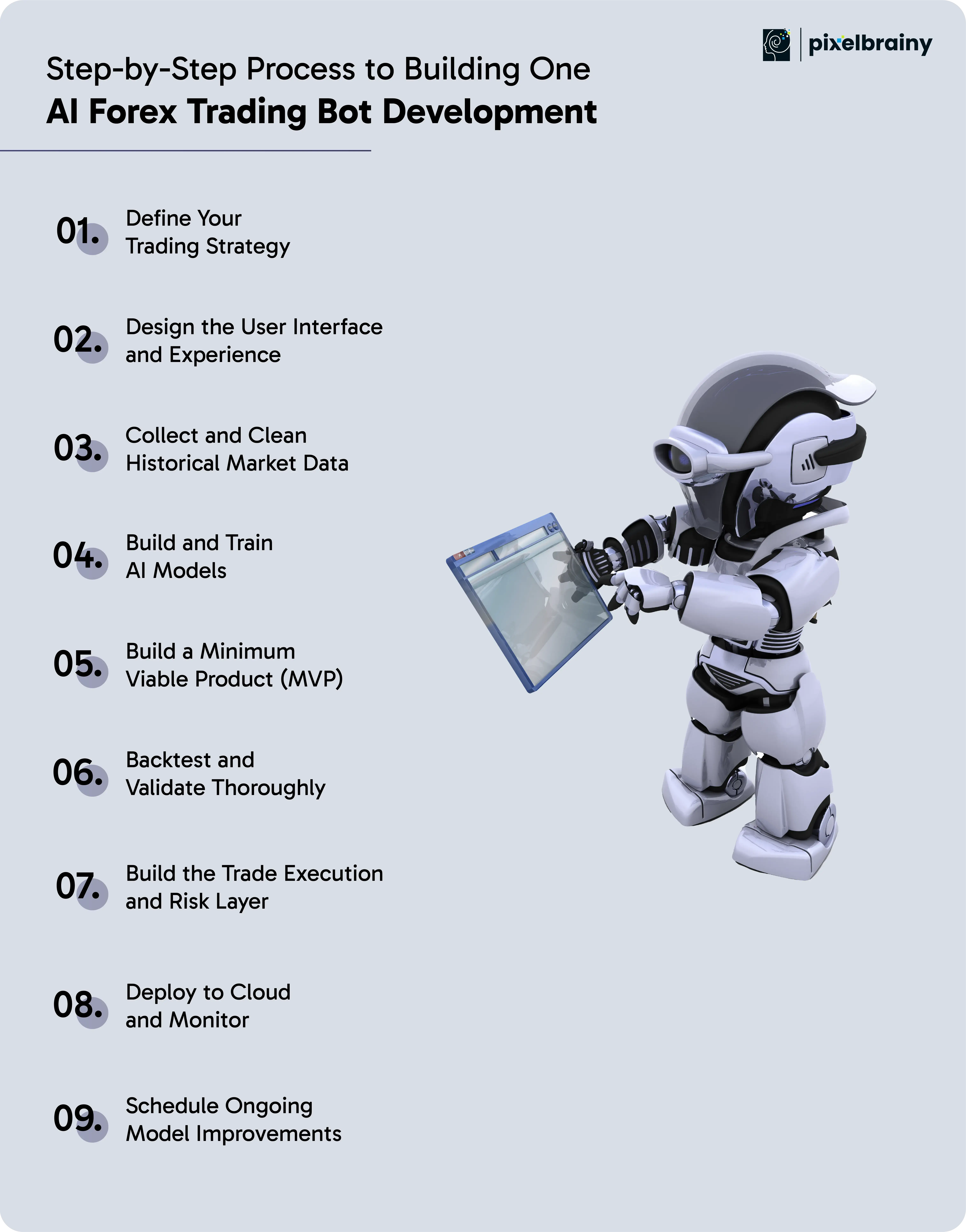
The first step is to convert your trading methodology into clear, measurable rules that an AI system can understand and evaluate. Define the strategy type, preferred currency pairs, trading timeframes, entry and exit conditions, risk limits, and expected trade frequency.
For an educational platform, you should also identify which strategy rules students need to learn and how the bot will explain its signals. This creates a clear foundation for to create an AI Forex trading bot that supports learning instead of blindly executing trades.
Documenting these requirements early also makes it easier for an AI consultation team to understand the product vision and technical requirements.
Also Read: Top 10 AI Consulting Companies in USA
A trading bot intended for students needs an interface that makes market activity easy to understand. Design dashboards where users can view signals, paper trades, strategy rules, market data, performance reports, and explanations of AI decisions.
The interface should clearly distinguish between simulated and live trading environments. Students should also be able to compare their own decisions with AI-generated signals and review why a particular setup was considered valid or invalid.
Working with a specialized UI/UX design company can help create intuitive dashboards, learning workflows, and responsive experiences across desktop and mobile devices.
AI performance depends heavily on the quality and relevance of its training data. Collect historical price data for the selected currency pairs along with relevant indicators, spreads, volatility information, economic events, and other signals required by the strategy.
The collected data should be cleaned to address missing values, inconsistent timestamps, abnormal records, and other quality issues. It should then be organized into appropriate training, validation, and testing datasets.
For an educational bot, historical datasets should also support realistic paper-trading scenarios so students can study how the strategy behaves across different market conditions.
Once the data is prepared, the next stage is AI model development. Select models based on the strategy and the type of predictions or classifications the system needs to make.
Possible approaches include LSTM networks for sequential market data, XGBoost for structured features, or other machine learning techniques for signal classification. Reinforcement learning can be considered where adaptive decision-making is appropriate, but it should be carefully validated before use.
The objective is not simply to create a complex model. It is to develop a model that produces measurable, explainable, and repeatable outputs within the defined trading framework.
Also Read: Top 12+ AI Model Development Companies in the USA
Avoid developing every advanced capability at the beginning. Start with an MVP that includes the essential components required to validate the concept.
For an educational Forex platform, the initial version could include paper trading, strategy-based signals, basic AI explanations, historical backtesting, student accounts, and performance comparisons.
This approach allows businesses to validate whether users understand the signals and benefit from the learning experience before investing in advanced capabilities. MVP development can therefore reduce unnecessary development effort while providing valuable feedback for future releases.
A focused MVP also creates a practical foundation for PoC development when testing a new AI trading concept.
Also Read: Top 10 AI MVP Development Companies in USA
Backtesting is essential before allowing an AI Forex trading bot to influence real trading decisions. Test the strategy against historical market data covering different trends, volatility levels, and market conditions.
Use separate datasets for training and evaluation to reduce overfitting. Walk-forward testing can further assess whether the strategy remains effective when exposed to previously unseen data.
Important metrics can include win rate, maximum drawdown, Sharpe ratio, profit factor, average trade, and execution latency. For an educational system, also measure whether the explanations accurately reflect the strategy logic and whether students can understand the reasoning behind each simulated signal.
The execution layer connects the AI system with the selected trading environment. Depending on the product, this could involve MT4, MT5, or a broker API.
For a learning-focused platform, paper trading should be implemented before any live execution capability. The system should simulate order fills, spreads, position sizing, stop-losses, take-profits, and other trading conditions as realistically as possible.
Risk controls should include position limits, maximum exposure, trade frequency restrictions, and emergency shutdown mechanisms. AI integration should work alongside these controls rather than bypassing them.
This creates a safer architecture for testing and learning before considering real-money deployment.
Once the system has passed testing, deploy it on reliable cloud or VPS infrastructure designed for continuous availability. The architecture should support secure user authentication, data protection, API connectivity, logging, backups, and monitoring.
For a platform serving thousands of students, scalability is especially important. The infrastructure should be able to handle simultaneous paper trades, signal generation, analytics requests, and dashboard activity without significant performance degradation.
Monitor uptime, API errors, processing latency, model outputs, failed orders, unusual activity, and system resource usage. Automated alerts can help the technical team identify issues before they affect users.
Launching the bot is not the final stage of building an AI Forex trading bot software. Forex market behavior changes over time, so models and strategies need ongoing evaluation.
Establish a controlled process for reviewing recent data, measuring model performance, identifying drift, and retraining models when appropriate. New versions should be validated before they replace production models.
For educational platforms, improvements can also be based on student behavior and feedback. You can identify which explanations students understand, which signals create confusion, and which analytics provide the greatest learning value.
When selecting AI product development companies, prioritize teams that can support monitoring, model improvement, infrastructure optimization, and future product expansion rather than focusing only on the initial launch.
Following these nine steps creates a structured path from strategy definition to a validated, scalable, and education-focused AI Forex trading bot platform.
Also Read: How To Develop Custom AI Chatbot: Benefits and Types
One of the most important questions before starting AI Forex trading bot development is, “How much does it cost to develop an AI Forex trading bot?” The answer depends on the bot's complexity, AI capabilities, data requirements, broker integrations, security, infrastructure, and ongoing maintenance.
Based on the scope and functionality, the estimated AI Forex bot development cost generally ranges from $10,000 to $150,000+.
Estimated Cost by AI Forex Bot Complexity:
| Bot Type | Estimated Cost |
| Basic AI Forex Bot with Predefined Logic | $10,000 to $25,000 |
| Intermediate AI Forex Bot with ML and Backtesting | $25,000 to $60,000 |
| Advanced AI Forex Bot | $60,000 to $150,000+ |
An advanced solution may include custom AI models, real-time market data, broker API integration, automated execution, risk management, sentiment analysis, backtesting, and performance analytics.
1. Trading Strategy Complexity: $3,000 to $15,000+
Simple rule-based strategies require less development effort, while multi-indicator, adaptive, or machine learning-based strategies require more engineering and testing.
2. AI Model Development: $8,000 to $40,000+
Custom model design, training, validation, optimization, and retraining can significantly increase the cost to build an AI Forex trading bot. Advanced predictive or reinforcement learning systems typically require specialized expertise.
3. Historical and Real-Time Data Integration: $3,000 to $20,000+
The cost depends on data sources, API complexity, historical datasets, cleaning requirements, real-time feeds, and ongoing data licensing expenses.
4. Broker and Trading Platform Integration: $5,000 to $25,000+
Connecting with MT4, MT5, OANDA, FXCM, or other broker APIs requires secure authentication, order management, error handling, execution monitoring, and synchronization.
5. Risk Management and Security: $5,000 to $25,000+
Position sizing, stop-loss controls, exposure limits, encryption, access controls, audit logs, and transaction monitoring can increase development costs, particularly for production systems.
6. UI/UX and Analytics: $4,000 to $20,000+
Interactive dashboards for trades, signals, performance, drawdown, strategy analytics, and AI-generated insights require additional frontend and visualization work.
7. Cloud Hosting and Infrastructure: $3,000 to $20,000+
Cloud or VPS deployment, database infrastructure, monitoring, backups, scalability, and latency optimization contribute to both initial and recurring costs.
8. Maintenance and AI Optimization: $1,000 to $5,000+/month
Post-launch expenses can include bug fixes, model retraining, data updates, infrastructure monitoring, security patches, and performance optimization.
| Team Type | Typical Cost Range |
| Freelancers | $5,000 to $20,000 |
| Mid-Level Development Agency | $20,000 to $70,000 |
| AI-Focused Development Firm | $70,000 to $150,000+ |
Consider a fintech startup creating an educational AI Forex platform where students can paper trade, receive AI-generated signals, understand the reasoning behind each signal, and compare their manual decisions with AI recommendations.
Such a platform would require paper-trading functionality, AI models, historical market data, analytics, user dashboards, and scalable infrastructure. Therefore, its budget would likely fall closer to the intermediate or advanced AI Forex bot development cost range rather than the basic bot category.
The overall cost to develop an AI Forex trading bot should therefore be calculated from the complete product scope, not simply the cost of developing the AI model.
A well-planned budget helps balance AI sophistication, trading functionality, security, infrastructure, and long-term scalability without unnecessary development expenses.
Also Read: AI Chatbot Development Cost: Factors and Examples

A reliable AI Forex trading bot depends on a technology stack that can handle market data, AI model processing, backtesting, broker connectivity, secure trade execution, and continuous monitoring. For businesses planning forex trading bot development using AI, each technology layer should support the bot's required speed, scalability, accuracy, and operational reliability.
For example, a fintech startup building an AI Forex trading bot platform development for traders may need Python for AI and data processing, broker APIs for execution, PostgreSQL or InfluxDB for market data, and cloud infrastructure for continuous operation. The right combination also makes it easier to develop an AI Forex trading bot that can evolve from an MVP into a production-grade trading system.
The recommended technology stack includes:
| Category | Recommended Tools | Description & Usage |
| Programming Languages | Python, C++ | Python is ideal for AI/ML development, while C++ offers faster execution for trade logic |
| AI & ML Frameworks | TensorFlow, PyTorch, Scikit-learn | These frameworks help in training predictive models and reinforcement learning agents |
| Data Collection & APIs | Alpha Vantage, Twelve Data, OANDA, MetaTrader APIs | Used to fetch historical and real-time Forex data including price, volume, and news |
| Backtesting Engines | Backtrader, QuantConnect | Enables simulation of strategies using past market data to validate model performance |
| Brokerage Integration | MetaTrader 4/5, FXCM, OANDA APIs | Allows the bot to execute trades directly with real Forex brokers |
| Cloud & Deployment | AWS, Google Cloud, Microsoft Azure | Supports scalable deployment, real-time processing, and 24/7 bot operation |
| Database Management | PostgreSQL, MongoDB, InfluxDB | Stores historical data, model predictions, logs, and bot configurations securely |
| Visualization & Dashboards | Plotly, Dash, Grafana | Used for real-time monitoring of trades, P&L, and model behavior via custom dashboards |
| Security & Compliance | OAuth 2.0, JWT, SSL/TLS | Ensures secure API connections, user authentication, and data encryption |
| CI/CD & DevOps Tools | Docker, Kubernetes, Jenkins | Automates deployment, containerization, scaling, and maintenance of the trading bot |
A practical technology stack forms the foundation for building an AI Forex trading bot software that can process market data, evaluate strategies, manage risk, and execute trades reliably. Matching each tool to the bot's specific trading model and operational requirements can support scalable AI Forex bot development while avoiding unnecessary technical complexity.
Building a dependable AI Forex trading bot involves more than connecting an AI model to a broker API. Real-world Forex markets introduce challenges around data quality, model reliability, execution speed, changing market conditions, security, compliance, and infrastructure. These factors can directly affect the performance, stability, and cost of AI Forex bot development.
For teams working on how to build an AI Forex trading bot from scratch, identifying these challenges early helps create a stronger architecture and more realistic development roadmap. For example, a fintech company developing a bot for multiple client accounts must consider not only prediction accuracy, but also broker API reliability, audit trails, security controls, scalability, and regulatory requirements before moving toward live deployment.
Below are the major challenges that businesses should address when planning forex trading bot development using AI, along with practical approaches to mitigate them.
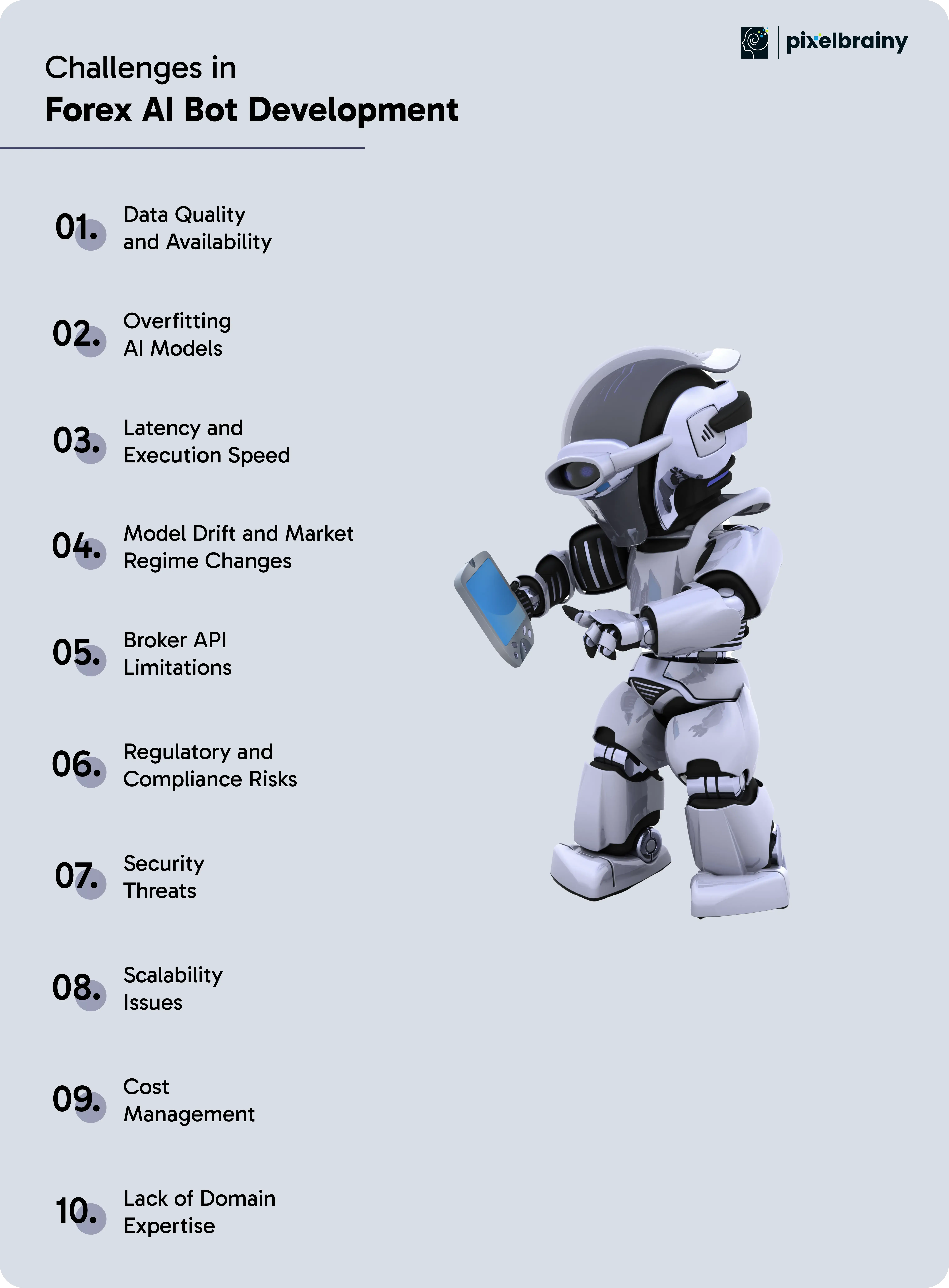
The Challenge: AI models require large volumes of historical and real-time data. If your data is inconsistent, incomplete, or delayed, predictions become unreliable and trades riskier.
The Solution: Work with reliable data vendors that provide high-frequency, tick-level Forex data. Use data pipelines that clean, normalize, and validate incoming data. Enrich your data with macroeconomic indicators and news sentiment to improve model accuracy.
The Challenge: Many bots perform well on backtests but fail in live environments. This happens when AI models are overfitted to past data and cannot generalize.
The Solution: Use techniques like k-fold cross-validation and walk-forward testing. Regularize your models to avoid over-complexity. Test your AI Forex bot in varied market conditions and focus on robustness, not just historical performance.
The Challenge: Milliseconds can change everything in Forex. Delayed execution can cause negative slippage or missed trades, especially in high-frequency strategies.
The Solution: Host your bot on low-latency cloud infrastructure close to your broker’s servers. Optimize the code for speed using lightweight, asynchronous logic. Choose brokers with fast, stable APIs and minimize third-party middleware.
The Challenge: Market behavior shifts over time. A model that works today may become ineffective in a few months due to new patterns or volatility levels.
The Solution: Monitor live performance with accuracy metrics and retrain models regularly using the latest data. Use dynamic models that adapt to changing conditions or build retraining pipelines into your infrastructure.
The Challenge: Not all brokers offer the same level of technical support or functionality. API instability or limited features can disrupt execution.
The Solution: Choose brokers like OANDA, FXCM, or MetaTrader with reliable and well-documented APIs. Include retry logic, validation checks, and fallback systems in case of failed orders or disconnections.
The Challenge: Operating automated trading bots in unregulated or tightly regulated markets can lead to legal and financial risks.
The Solution: Understand the compliance requirements for each region where you operate. Integrate trading rules, limits, and audit trails into your bot logic. Consult with legal advisors to ensure all automation aligns with local financial regulations.
The Challenge: AI bots handle sensitive data like API keys, trade logs, and financial transactions. A single breach can cause catastrophic losses.
The Solution: Implement strong encryption and authentication protocols such as OAuth 2.0. Use secure servers and limit access to critical systems. Monitor system activity in real-time and establish incident response plans.
The Challenge: Bots that aren’t built for scale may crash or slow down as you expand across accounts, instruments, or data sources.
The Solution: Design your system using modular architecture and containerized environments. Use cloud-native platforms like AWS or GCP for horizontal scalability and real-time resource management.
The Challenge: The cumulative cost of infrastructure, data, cloud computing, and development can quickly spiral out of control.
The Solution: Begin with an MVP to test market viability. Use open-source tools where possible. Track expenses and revenue to determine ROI, and scale only when the bot has proven profitable under live conditions.
The Challenge: AI developers may not fully understand the dynamics of the Forex market, leading to misaligned bot logic or flawed assumptions.
The Solution: Build a team that includes Forex traders, AI engineers, and data scientists. Alternatively, partner with a fintech-focused development company that specializes in building AI Forex bots for institutional or retail clients.
Addressing these challenges early can make AI Forex trading bot development more reliable, secure, and scalable. A well-engineered solution combines quality data, robust AI models, efficient execution, strong risk controls, secure infrastructure, and appropriate compliance measures to support sustainable AI Forex trading bot platform development.
Also Read: AI Trading Agent Development: Benefits and Features
The future of AI Forex trading bot development is moving toward intelligent systems that can adapt to market conditions, process large datasets, and operate across multiple financial ecosystems. For businesses planning to build an AI Forex trading bot, emerging technologies such as autonomous AI, privacy-preserving machine learning, advanced computing, and multi-market connectivity can create new opportunities for automation and scalability.
These innovations are expected to influence the next generation of AI Forex trading bots, particularly in areas such as strategy optimization, real-time decision-making, data privacy, and cross-market analysis. However, businesses should evaluate technical feasibility, risk controls, infrastructure requirements, and regulatory considerations before adopting emerging technologies.
Here are four innovations shaping the future of AI Forex bot development:
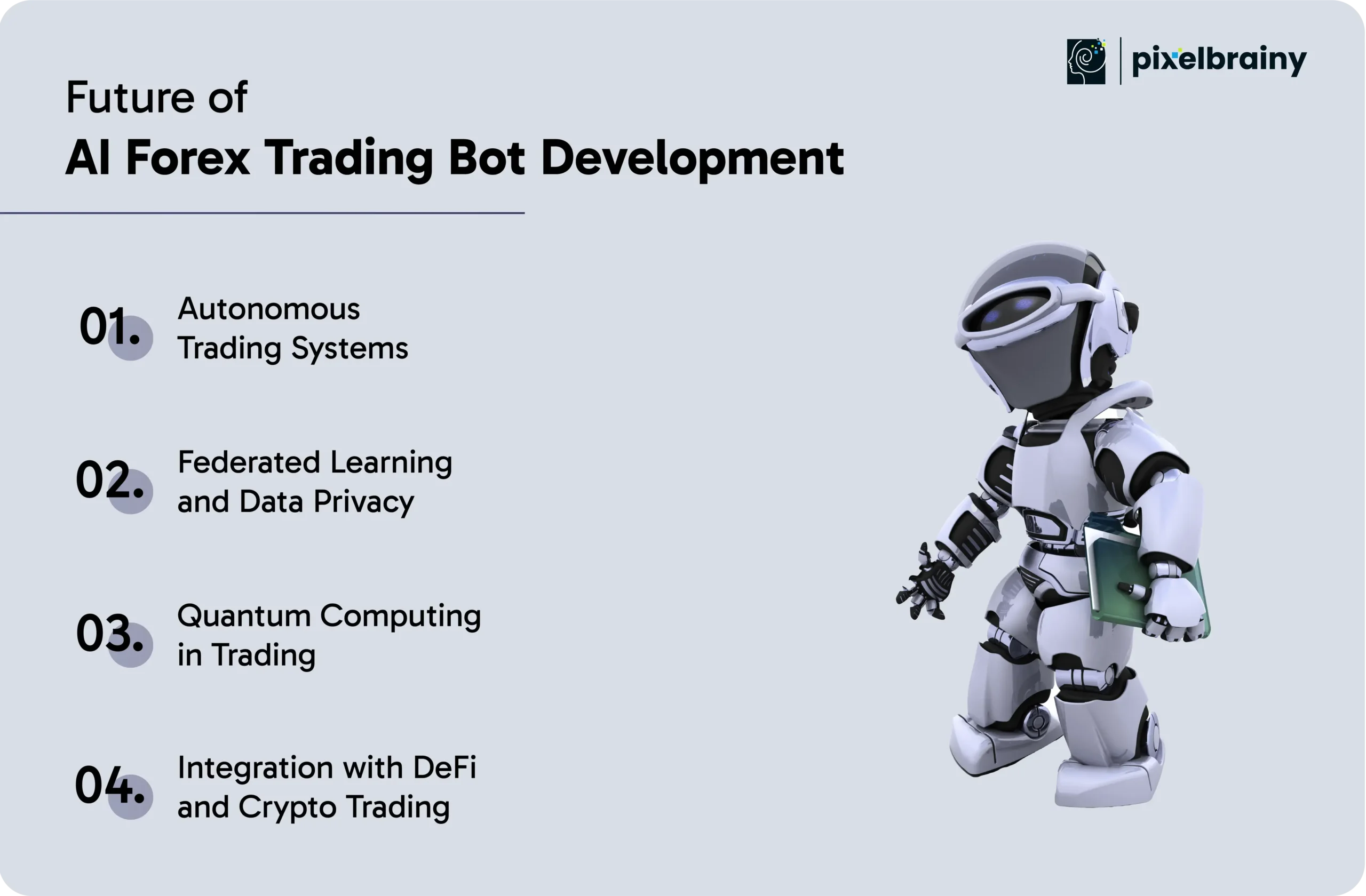
Autonomous trading systems are becoming an important direction in AI Forex trading bot development. These systems can continuously analyze market data, identify trading opportunities, evaluate predefined risk parameters, and execute trading decisions with limited human intervention.
Advanced reinforcement learning and adaptive AI models can help a bot respond to changing volatility, market patterns, and trading conditions. Future systems may combine technical indicators, fundamental data, sentiment signals, and portfolio-level risk controls within a unified decision engine.
For businesses looking to develop an AI Forex trading bot, autonomous capabilities can improve operational efficiency while reducing dependence on manual monitoring. However, human oversight, predefined risk limits, audit logs, and emergency shutdown mechanisms remain essential for responsible deployment.
Data privacy is becoming increasingly important for AI Forex bot development, particularly when financial institutions, trading firms, or enterprise users handle proprietary market and customer data.
Federated learning allows AI models to learn from decentralized datasets without requiring raw data to be transferred to a central repository. This approach can help organizations protect sensitive information while improving model performance across multiple data environments.
For forex trading bot development using AI, privacy-preserving machine learning can support stronger data governance and reduce unnecessary exposure of proprietary trading information. It may become particularly valuable for enterprise-grade and multi-client AI Forex trading bot platforms.
Quantum computing represents a longer-term opportunity for AI Forex trading bot development. Its potential ability to process complex optimization problems could eventually support advanced portfolio optimization, scenario modeling, strategy evaluation, and large-scale financial simulations.
Although quantum computing is not yet a standard requirement for commercial AI Forex trading bots, future advances could make it more practical for sophisticated financial applications. Businesses should currently treat quantum computing as an emerging research area rather than a core development dependency.
The evolution of AI Forex trading bot platform development may increasingly involve connectivity across Forex, cryptocurrency, and decentralized finance markets. Multi-market AI systems could analyze correlations, liquidity, volatility, and potential opportunities across different asset classes.
For companies planning to build an AI Forex trading bot, this broader architecture could create opportunities for diversification and cross-market analysis. However, integrating crypto and DeFi introduces additional requirements around blockchain infrastructure, exchange APIs, cybersecurity, liquidity management, smart-contract risks, and regulatory compliance.
As these technologies mature, AI Forex trading bot development will increasingly focus on adaptive intelligence, secure data handling, scalable infrastructure, and multi-market capabilities, while strong risk management remains central to real-world deployment.
From the technology, features, and development challenges discussed above, the next step is identifying a development partner that understands both AI engineering and Forex trading workflows. For fintech startups, brokers, educators, and trading businesses, the right partner should be able to balance AI capabilities, execution reliability, security, scalability, and development cost.
A common real-world requirement sounds like this:
We are a fintech startup planning to launch an AI-powered Forex trading product for retail users. We need a partner that can develop the AI strategy engine, integrate broker APIs, add backtesting and risk controls, and build a scalable platform while keeping development costs predictable. Which US-based company can help us take the product from concept to production?
This is where PixelBrainy, an AI chatbot development company, brings a broader AI product engineering approach to financial technology projects. Our team focuses on translating business requirements into scalable AI-powered software with a practical development roadmap.
Whether you want to build AI forex trading bot solutions for automated analysis, educational trading, strategy testing, or broker-connected workflows, we can help define the architecture, AI components, integrations, dashboards, and deployment strategy around your requirements.
Business Challenge: A fintech client needed an intelligent trading platform capable of processing market data and supporting automated strategy workflows.
Our Approach: We designed a modular AI architecture combining market-data processing, predictive analytics, strategy logic, risk controls, and real-time monitoring.
Result: The solution established a scalable foundation for future broker integrations and additional AI trading capabilities while keeping the architecture flexible for ongoing enhancements.
With AI trading software solutions tailored to your business model, PixelBrainy can help you develop AI forex trading bot products with the right balance of intelligence, reliability, scalability, and cost control.
Ready to turn your Forex AI idea into a production-ready product? Connect with PixelBrainy today.

From the points covered above, it is clear that AI Forex trading bot development is more than automating buy and sell orders. A successful solution requires a well-defined trading strategy, quality market data, suitable AI models, reliable broker integrations, real-time execution, strong risk controls, and continuous performance monitoring.
This guide has covered the key steps to build an AI Forex trading bot from idea to launch, including core and advanced features, development costs, technology stack, implementation challenges, and future opportunities. The right combination of these elements can help traders, fintech startups, and financial businesses create scalable and intelligent trading systems.
However, successful implementation depends on more than technology alone. The development partner must understand your trading objectives, technical requirements, scalability needs, and regulatory considerations.
At PixelBrainy, we help businesses turn AI trading concepts into secure, scalable, and production-ready solutions tailored to their specific requirements.
Ready to move forward with your AI Forex trading solution? Book an appointment with our experts today.
To build an AI Forex trading bot from scratch, begin by defining the trading strategy, currency pairs, risk parameters, and trading objectives. The steps to build an AI Forex trading bot from idea to launch typically include market data collection, AI model development, backtesting, broker API integration, risk management, paper trading, deployment, and continuous optimization.
The cost to develop an AI Forex trading bot depends on its complexity, AI model requirements, data infrastructure, broker integrations, security, and deployment needs. A basic bot may cost around $10,000 to $25,000, while an advanced AI system with custom models, real-time execution, analytics, and risk management can cost $60,000 to $150,000+.
Yes. An AI Forex trading bot can be designed to analyze changing market patterns, volatility, technical indicators, news sentiment, and other real-time signals. Machine learning and reinforcement learning can help the system adjust its predictions as new data becomes available. However, adaptive models should operate with strict risk controls, monitoring, and regular validation.
The timeline for AI Forex bot development depends on the scope and level of customization. A basic MVP may take a few weeks, while a production-ready solution with custom AI models, broker integrations, real-time execution, analytics, security, and advanced risk controls can take 6 weeks or longer.
Yes. A properly integrated AI Forex trading bot can generate signals, determine position parameters, and execute buy or sell orders automatically through supported broker APIs or trading platforms. Production systems should include position limits, stop-loss controls, order validation, monitoring, logging, and emergency shutdown mechanisms. Regulated use cases may also require additional compliance controls.
Yes. You can create an AI Forex trading bot that connects with platforms such as MT4, MT5, OANDA, and other supported broker APIs. The architecture can combine an AI decision engine with the broker's execution layer while incorporating risk management, order validation, error handling, and performance monitoring.
Before exposing real capital, an AI Forex trading bot should undergo historical backtesting, out-of-sample testing, walk-forward validation, and demo or paper trading. Testing across different market conditions can help identify overfitting, execution issues, excessive drawdown, and model weaknesses before live deployment.
Yes. You can develop an AI Forex trading bot specifically for educational and simulation purposes without connecting it to live capital. For example, educators can use paper trades, AI-generated signals, natural-language explanations, strategy simulations, and performance comparisons to help students understand how an AI system evaluates potential Forex trades.

About The Author
Sagar Bhatnagar
Sagar Sahay Bhatnagar brings over a decade of IT industry experience to his role as Marketing Head at PixelBrainy. He's known for his knack in devising creative marketing strategies that boost brand visibility and market influence. Sagar's strategic thinking, coupled with his innovative vision and focus on results, sets him apart. His track record of successful campaigns proves his ability to utilize digital platforms effectively for impactful marketing efforts. With a genuine passion for both technology and marketing, Sagar continuously pushes PixelBrainy's marketing initiatives to greater success.

Working with the PixelBrainy team has been a highly positive experience. They understand the design requirements and create beautiful UX elements to meet the application needs. The dev team did an excellent job bringing my vision to life. We discussed usability and flow. Sagar worked with his team to design the database and begin coding. Working with Sagar was easy. He has the knowledge to create robust apps, including multi-language support, Google and Apple ID login options, Ad-enabled integrations, Stripe payment processing, and a Web Admin site for maintaining support data. I'm extremely satisfied with the services provided, the quality of the final product, and the professionalism of the entire process. I highly recommend them for Android and iOS Mobile Application Design and Development.

Great experience working with them. Had a lot of feedback and I found that unlike most contractors they were bugging me for updates instead of the other way around. They were extremely time conscience and great at communicating! All work was done extremely high quality and if not on time, early! They were always proactive when it comes to communication and the work is great/above par always. Very flexible and a great team to work with! Goes above and beyond to present us with multiple options and always provides quality. Amazing work per usual with Chitra. If you have UI/UX or branding design needs I recommend you go to them! Will likely work with them in the future as well, definitely recommended!

PixelBrainy is a joy to work with and is a great partner when thinking through branding, logo, and website layout. I appreciate that they spend time going into the "why" behind their decisions to help inform me and others about industry best practices and their expertise.

I hired them to design our software apps. Things I really like about them are excellent communication skills, they answer all project suggestions and collaborate right away, and their input on design and colors is amazing. This project was complex and needed patience and creativity. The team is amazing to do business with. I will be using them long-term. Glad to see there are some good people out there. I was afraid to try and outsource my project to someone but I am glad I met them! I really can't say enough. They went above and beyond on this project. I am very happy with everything they have done to make my business stand out from the competition.

It was great working with PixelBrainy and the team. They were very responsive and really owned the project. We'll definitely work with them again!

I recently worked with the PixelBrainy team on a project and I was blown away by their communication skills. They were prompt, clear, and articulate in all of our interactions. They listened and provided valuable feedback and suggestions to help make the project a success. They also kept me updated throughout the entire process, which made the experience stress-free and enjoyable.

PixelBrainy is very good at what it does. The team also presents themselves very professionally and takes care of their side of things very well. I could fully trust them taking up the design work in a timely and organised manner and their attention to detail saved us lots of effort and time. This particular project was quite intense and the team showed that they function very well under pressure. Very much looking forward to working with her again!

It's always an absolute pleasure working with them. They completed all of my requests quickly and followed every note I had for them to a T, which made our process go smoothly from start to finish. Everything was completed fast and following all of the guidelines. And I would recommend their services to anyone. If you need any design work done in the future, PixelBrainy should be your first call!

They took ownership of our requirements and designed and proposed multiple beautiful variants. The team is self-motivated, requires minimum supervision, committed to see-through designs with quality and delivering them on time. We would definitely love to work with PixelBrainy again when we have any requirements.

PixelBrainy was a big help with our SaaS application. We've been hard at work with a new UI/UX and they provided a lot of help with the designs. If you're looking for assistance with your website, software, or mobile application designs, PixelBrainy and the team is a great recommendation.

PixelBrainy designers are amazing. They are responsive, talented, and always willing to help craft the design until it matches your vision. I would recommend them and plan to continue them for my future projects and more!!!

They were awesome! Did a good job fast, and good communication. Will work with them again. Thank you

Creative, detail-oriented, and talented designers who take direction well and implement changes quickly and accurately. They consistently over-delivered for us.

PixelBrainy team is very talented and creative. Great designers and a pleasure to work with. PixelBrainy is an excellent communicator and I look forward to working with them again.

PixelBrainy has a very talented design team. Their work is excellent and they are very responsive. I enjoy working with them and hope to continue on all of our future projects.


Transform your ideas into reality with us.
Across these industries, each engagement brings unique challenges, from early-stage product development to scaling complex systems, helping us build a practical understanding of real-world product environments.