 AI Summary Powered by PixelBrainy
What if your business could answer every customer call instantly, handle routine requests automatically, and still know when a caller needs a human employee?
That question is becoming increasingly relevant as businesses look for practical ways to automate customer communication without sacrificing service quality. According to Gartner, 85% of customer service leaders said they explored customer-facing conversational generative AI, while its survey also found that 44% were exploring customer-facing GenAI voicebots and another 11% were already piloting them.
Consider a three-person dental practice where the front desk receives constant calls for appointment booking, rescheduling, insurance questions, treatment inquiries, and general information. During peak hours, the receptionist may be checking patients in while answering another call, placing customers on hold, returning missed calls, and handling administrative tasks. The result can be longer waiting times, missed calls, overloaded employees, and lost business opportunities.
Now apply the same situation to a hotel, real estate agency, law firm, healthcare clinic, home service company, automobile dealership, educational institution, or e-commerce business. The industry may be different, but the underlying challenge is similar: how can a business manage growing call volumes without continuously increasing front-desk workload?
This is where AI voice receptionist development becomes a practical business strategy. A voice receptionist development approach integrating AI can answer calls in natural language, understand customer intent, provide business information, qualify leads, schedule appointments, manage bookings, collect customer details, route calls, send follow-up messages, and transfer complex conversations to human employees.
However, businesses researching how to create an AI voice receptionist need to look beyond simply connecting an AI model to a telephone system. They need to understand the required features, development process, technology stack, integration requirements, implementation challenges, ongoing operating costs, and realistic return on investment.
The custom AI voice receptionist development process should therefore begin with business workflows rather than technology alone. A dental practice may prioritize appointment scheduling, while a hotel may need reservation management and a real estate company may focus on lead qualification.
This guide explores how to develop an AI voice receptionist, including development types, core and advanced features, development steps, costs, technology choices, business models, compliance requirements, challenges, and how to evaluate AI voice receptionist development services for building a reliable, scalable voice AI solution.

An AI voice receptionist is an artificial intelligence powered phone system that answers incoming calls, understands what customers say, responds through natural speech, and performs predefined business tasks. It works as a virtual receptionist that can manage routine conversations, capture leads, schedule appointments, answer frequently asked questions, route calls, and connect customers with human employees when a request requires personal assistance.
Unlike traditional Interactive Voice Response (IVR) systems that depend on numbered menu options, an AI voice receptionist allows callers to communicate conversationally. A customer can explain what they need in their own words, and the system can identify the intent, understand the conversation context, access relevant business information, and determine the next action.
The AI voice receptionist development process brings several technologies together to create a real-time voice conversation.
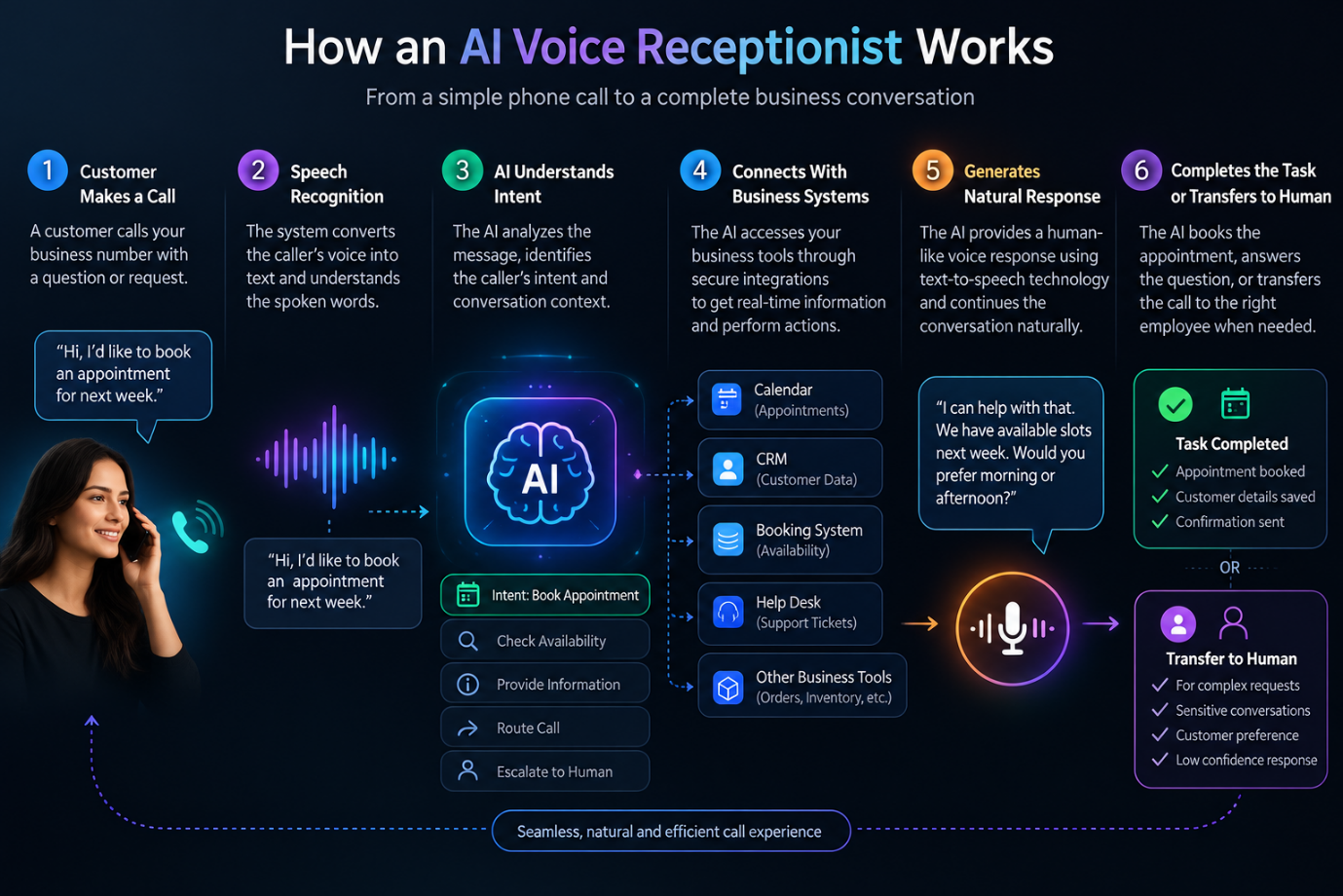
The process starts when a customer calls a business phone number. A telephony platform receives the call and connects it to the AI receptionist. Call-routing rules can determine whether the AI answers all calls, handles after-hours calls, or manages specific types of inquiries.
The caller speaks naturally, and speech recognition technology converts the audio into text or structured information that the AI can process. The system needs to handle different accents, speaking speeds, background noise, interruptions, and industry-specific terminology.
The AI analyzes what the caller wants and identifies the appropriate workflow. A caller might ask about product availability, request an appointment, reschedule a booking, check an order, ask about business hours, or request to speak with a particular department.
Context allows the conversation to continue naturally. If a customer first discusses an appointment and then says, "Can you move it to Friday?", the system can connect the second request to the appointment already discussed.
This is where custom AI voice receptionist development becomes significantly more valuable than a basic voice chatbot. Through APIs and controlled integrations, the AI can interact with CRM systems, calendars, appointment platforms, booking software, help desks, customer databases, order management systems, and other business applications.
For example, instead of simply telling a customer that appointments are available, the AI can check the connected scheduling system and offer available time slots.
After understanding the request and completing the required action, text-to-speech technology converts the response into natural-sounding audio. The caller can continue the conversation without navigating multiple menus or repeating information.
An effective AI voice receptionist should recognize when automation is no longer appropriate. Complex requests, sensitive situations, low-confidence interactions, complaints, or requests requiring human judgment can be transferred to the appropriate employee.
A typical AI receptionist system combines several technology layers:
Telephony → Speech Recognition → AI/LLM → Business APIs → Text-to-Speech → Caller
The telephony layer manages the phone call. Speech recognition understands what the caller says. The AI or large language model interprets intent and determines the next step. APIs connect the AI to business systems, while text-to-speech converts the final response into spoken language.
This architecture allows businesses to move beyond a basic automated answering service toward a conversational AI receptionist capable of completing real business tasks.
Depending on the business and integrations, a voice AI receptionist can:
The exact capabilities depend on the business workflows, connected systems, AI model, security controls, and level of customization included in the AI voice receptionist development project.
Ultimately, building an AI voice receptionist is not just about giving an AI system a human-sounding voice. The real value comes from connecting voice conversations with reliable business data, automated workflows, integrations, and human support. When those components work together effectively, an AI receptionist can become a practical digital front desk that handles routine communication while allowing employees to focus on tasks that require human judgment and attention.
Also Read: How to Develop an AI Voice Agent: Features, Steps, Cost and Challenges
Why are businesses investing in AI voice receptionists now, and what makes voice AI worth considering as part of their customer communication strategy?
The answer is closely tied to how customers are changing the way they seek support. Businesses are no longer competing only with traditional phone systems and IVR menus. Customers are becoming familiar with AI-powered interactions and increasingly expect technology to understand requests, take action, and connect them with the right support when needed.
A September 2026 Gartner survey found that only 27% of customers would be willing to try a chatbot again after a negative experience. The same research found that 49% of customers would have been willing to use a chatbot if one had been available, but only 7% actually used one during their most recent service interaction.
This creates an important opportunity for businesses considering AI voice receptionist investment: the focus should be on creating a reliable conversation experience rather than simply adding another AI channel.
Businesses researching AI receptionist for customer calls are increasingly looking beyond traditional IVR systems. Instead of asking callers to press numbers through multiple menus, conversational voice AI can understand requests such as:
This makes conversational voice AI for businesses relevant for companies where phone conversations are directly connected to bookings, sales, customer support, service requests, or lead management.
Another reason to consider AI receptionist automation is the shift from answering questions to completing tasks.
Gartner reported in 2026 that 58% of customers who use GenAI have used it to complete a task on their behalf, rising to 74% among B2B customers. The examples include booking appointments, placing orders, submitting documents, managing subscriptions, and escalating requests.
For businesses, this means the more useful question is not simply, “Can an AI answer our calls?” It is, “Which customer actions can our voice AI complete safely?”
Another unique market signal comes from Gartner's July 2026 research. Customers were approximately three times more likely to use third-party GenAI tools than company-provided chatbots during their most recent customer service interaction. Gartner also reported that third-party GenAI use during service interactions had nearly doubled over the previous year.
For companies evaluating AI voice receptionist development, this matters because customers are already becoming comfortable with AI-assisted problem solving. The strategic question is how businesses can provide their own controlled, reliable AI experience when customers need company-specific information or actions.
Gartner's August 2026 research found that phone and live chat remain among the most valuable customer service channels today. Looking two years ahead, service leaders expect GenAI-powered channels, including GenAI voicebots, to become increasingly valuable.
This gives businesses another reason to explore voice AI receptionist development as part of their longer-term technology roadmap rather than treating it as a temporary automation experiment.
The strongest reason to explore custom AI voice receptionist solutions is not simply that AI is growing. It is whether a business has phone-based workflows that are structured enough for AI to handle reliably.
Good starting points can include appointment requests, booking inquiries, lead qualification, frequently requested information, order-related questions, service scheduling, and call routing. More sensitive or complex conversations can remain connected to human employees.
The investment decision should therefore be based on conversation volume, workflow complexity, integration requirements, customer expectations, and measurable business objectives, rather than adopting voice AI simply because it is a current technology trend.
As voice AI moves from basic call answering toward action-oriented customer service, businesses have an opportunity to rethink how their phone channel fits into the wider customer journey. The key is building for reliability, real workflows, and the right balance between AI and human support.
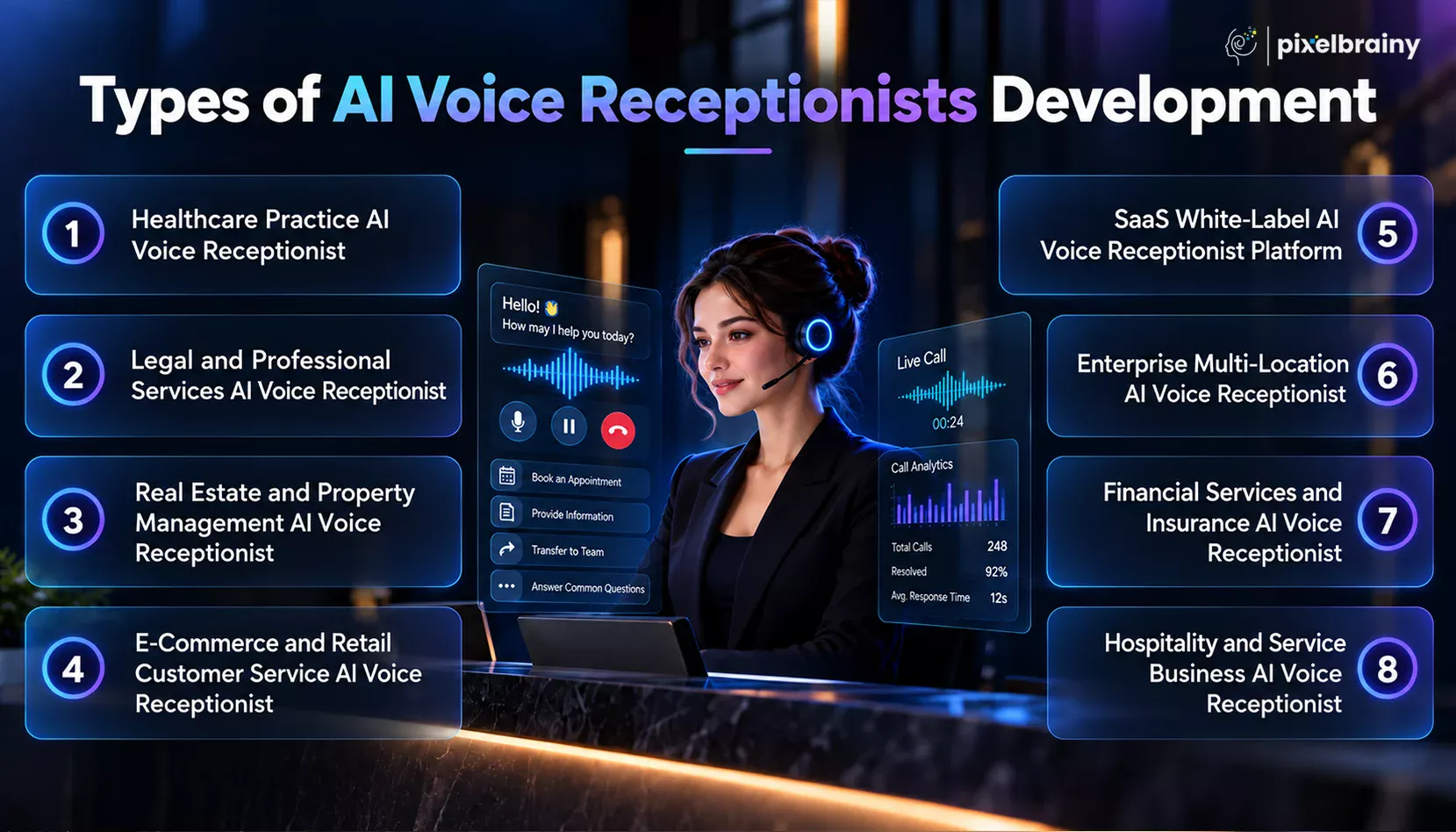
Businesses do not all need the same type of AI voice receptionist. A healthcare organization may need secure patient communication, while a law firm may require structured client intake. A property management company may need emergency maintenance triage, whereas a SaaS company may want to sell voice receptionist capabilities to other businesses.
That is why AI voice receptionist development is increasingly being approached as an industry-specific and workflow-specific technology project. The following are the major types businesses can build AI voice receptionist solutions for.
Healthcare organizations can develop an AI voice receptionist around patient-facing administrative communication. Common workflows include appointment scheduling, department routing, prescription refill request capture, provider information, general patient inquiries, and call escalation.
For a hospital network, the development requirements become considerably more complex because the AI needs to understand which facility, department, provider, or service the caller is asking about.
For example, a real-world development requirement could be:
“Our hospital network has 12 facilities and an inbound call volume of 40,000 calls per week. We want to build an AI voice receptionist that handles appointment scheduling, department routing, prescription refill request capture, and general patient inquiries while maintaining HIPAA compliance.”
A project with these requirements would need multi-location call routing, healthcare system integrations, patient verification, secure data handling, escalation rules, and detailed audit controls. The healthcare AI voice agent market is also expanding rapidly, with Grand View Research estimating the global market at $876.2 million in 2026, with a projected 37.8% CAGR through 2030.
Law firms, accounting companies, consulting firms, and other professional service organizations can use AI phone receptionist development for structured intake and call qualification.
A legal AI receptionist can collect basic client information, identify the relevant practice area, determine the purpose of the call, schedule consultations, route calls to the appropriate office, and transfer sensitive matters to human staff.
Consider this actual business requirement:
“Our multi-location law firm with 8 offices wants to build a proprietary AI voice receptionist that answers all inbound calls 24 hours a day, collects initial client intake information, determines the appropriate practice area and attorney, and routes qualified callers to the correct office.”
This type of creation of AI voice receptionist requires more than conversational AI. The system needs controlled intake fields, attorney and office routing logic, appointment availability, access permissions, call records, and confidentiality controls.
Gartner reported that legal technology budgets are expected to double by 2028 as legal AI adoption expands, highlighting the growing importance of specialized AI within legal workflows.
Real estate agencies and property management companies have highly structured phone workflows, making them suitable for specialized voice AI.
A real estate receptionist can handle property inquiries, lead qualification, viewing requests, availability questions, appointment scheduling, and agent routing. Property management requires a different workflow focused on tenants, properties, maintenance, payments, and leases.
For example:
“Our property management company managing 3,200 units across 45 properties wants to build an AI voice receptionist that handles tenant maintenance request capture, emergency versus non-emergency maintenance triage, rent payment inquiry, and lease renewal questions 24 hours a day.”
In this case, the development of AI voice receptionist would need property-level routing. The system must identify the tenant and property, understand the maintenance issue, determine whether it is an emergency, create the appropriate request, and route it to the correct maintenance team.
E-commerce and retail businesses can make AI voice receptionist systems around order and customer service workflows.
Typical use cases include:
The voice receptionist can connect with order management, inventory, CRM, shipping, and customer support systems. This allows the AI to retrieve current information rather than relying entirely on a static knowledge base.
For retailers with both online and physical locations, the system can also identify whether a caller needs help with an online order, a particular store, or a specific product.
Some companies are not looking to build an AI voice receptionist for their own business. Instead, they want to build AI voice receptionist platform technology that other businesses can use.
A white-label SaaS platform can allow customers to create and manage their own AI receptionists with separate phone numbers, voices, business information, call flows, knowledge bases, integrations, analytics, and user permissions.
The platform itself therefore needs multi-tenancy, tenant-level data isolation, billing, usage tracking, API management, onboarding, analytics, administration dashboards, and scalable telephony infrastructure.
This model is particularly relevant for SaaS companies, digital agencies, communication providers, and technology businesses planning to offer voice AI as a product rather than as an internal tool.
Large organizations with multiple branches, offices, clinics, dealerships, hotels, or service locations require a more centralized approach.
An enterprise AI voice receptionist can operate from one common AI infrastructure while maintaining different information and routing rules for each location.
For example, when a caller asks about a specific branch, the system can identify the location, retrieve its operating hours and services, determine available staff, and route the conversation to the appropriate department.
This approach is particularly useful when a company wants centralized control over its AI voice receptionist development while allowing individual locations to maintain their own business rules.
Gartner's research found that phone remains one of the most valuable customer service channels, while service leaders expect GenAI voicebots to become one of the more valuable technologies over the following two years.
Financial institutions and insurance companies require tightly controlled voice workflows because calls can involve financial accounts, policies, claims, payments, and other sensitive information.
A specialized AI receptionist can handle general policy questions, claim intake, appointment scheduling, payment inquiries, document requests, service routing, and other predefined interactions.
When businesses develop AI voice receptionist solutions for financial services, identity verification, authentication, permissions, secure system integration, conversation logging, escalation rules, and data protection need to be incorporated into the architecture.
The AI should also have clear boundaries around which information it can provide and which actions require human authorization.
Hotels, restaurants, salons, automotive service centers, home service companies, travel businesses, and other service-based organizations can develop voice receptionists around bookings and operational requests.
A hotel may use AI to handle reservation inquiries, availability, room information, and service requests. A home service company may instead need an AI receptionist to capture job requirements, verify service areas, schedule technicians, and identify emergency requests.
This makes AI voice receptionist development highly dependent on the underlying operational system. The AI needs access to accurate availability, booking, scheduling, customer, or service information to perform tasks rather than simply provide generic answers.
The broader market is also moving toward more sophisticated voice agents. Reuters reported in September 2026 that ElevenLabs' AI agents were handling more than 15 million conversations per week, including tasks such as booking appointments, processing refunds, and renewing insurance.
Each industry brings its own conversation patterns, data requirements, integrations, and escalation rules, making specialized voice AI development essential for building a receptionist that can handle real business workflows.
The value of AI voice receptionist development is not limited to answering calls automatically. When the system is connected with business software and designed around real customer workflows, it can influence call coverage, employee workload, customer experience, revenue capture, scalability, and the quality of information generated from every conversation.
For businesses that depend heavily on inbound calls, an unanswered phone can represent a missed appointment, lost enquiry, abandoned purchase, or potential customer choosing another provider.
A properly designed AI voice receptionist for businesses can answer incoming calls when human receptionists are occupied, during peak call periods, and outside normal operating hours. This gives businesses a way to increase call coverage without requiring a receptionist to remain available for every incoming conversation.
The real business question is often more specific than simply asking whether AI can answer calls. For example:
“Which development companies have built AI voice receptionists for dental practices with documented call answer rate improvement and staff time savings?”
A business asking this question is really looking for implementation evidence, not just a technology demonstration. It needs to examine actual call-answer performance, appointment handling, staff workload changes, integrations, and measurable outcomes before selecting an AI voice receptionist development services provider.
Reception teams often spend significant portions of their day answering repetitive questions, collecting basic information, checking availability, transferring calls, and recording messages.
AI powered voice receptionist development allows these repetitive conversations to be handled through predefined AI workflows while employees remain available for situations requiring judgment, specialized knowledge, or personal interaction.
The goal is not simply to reduce the number of calls reaching employees. A better objective is to make sure the right calls reach the right people with the necessary information already collected.
This distinction becomes important when building an AI voice receptionist for a busy organization. The AI should know which conversations it can complete independently and which ones require human involvement.
Human receptionists can naturally vary in how they greet callers, collect information, explain policies, or route conversations. An AI receptionist can follow the same approved conversation structure across thousands of interactions.
This is particularly valuable for businesses that have standardized customer journeys.
For example, a company can configure its AI to consistently:
This makes making an AI voice receptionist partly a process-standardization exercise. The quality of the final system depends heavily on how clearly the business defines its conversation rules, escalation conditions, and permitted actions.
Customer demand does not necessarily follow business opening hours. A potential customer might call after work, a tenant might need assistance in the evening, or someone might want to schedule an appointment over the weekend.
An AI voice receptionist can continue handling defined workflows outside normal operating hours. Depending on the business, it can capture a lead, schedule an available appointment, answer common questions, create a service request, or arrange a callback.
This creates a particularly useful opportunity for businesses where every missed after-hours call can represent a potential commercial opportunity.
A 2026 analysis of more than 1.4 million business calls across 17 industries found that 28.5% of calls arrived after hours, according to Revenue Squared AI's proprietary industry dataset. The research is vendor-produced, so the figure should be treated as an industry analysis rather than an independent benchmark.
A human reception team has a practical limit on how many conversations it can manage simultaneously. During marketing campaigns, seasonal demand, product launches, emergencies, or sudden increases in customer enquiries, that capacity can become a bottleneck.
When businesses develop an AI voice receptionist, concurrent call handling can be built into the technical architecture. Telephony infrastructure, AI model capacity, concurrency limits, CRM performance, and integration reliability all need to be considered during development.
This makes scalability particularly relevant for businesses with unpredictable call volumes or rapidly expanding customer bases.
Gartner's August 2026 research found that service leaders expect GenAI voicebots to become increasingly valuable over the following two years, showing that voice AI is moving into longer-term customer service planning rather than remaining limited to experimental deployments.
Traditional receptionist workflows often leave businesses with limited information about what callers actually ask for. A phone rings, an employee answers, the conversation ends, and only selected details may make it into the CRM.
An AI receptionist can structure information from every conversation.
With the right AI voice receptionist development architecture, businesses can analyze:
This creates a new source of operational data that can be connected to CRM and analytics systems.
The opportunity is becoming more significant as AI-based call analysis moves toward reviewing entire conversation volumes rather than relying only on small manually selected samples. Natterbox's 2026 contact-center research, based on 58.2 million calls and 178 contact-center leaders, reports that 76% of surveyed organizations had adopted a human-in-the-loop approach to AI.
Businesses operating across multiple branches often need every location to follow the same customer service standards while still maintaining location-specific information.
Consider a gym chain operating 28 locations where member churn becomes a major operational concern after the first 60 to 90 days. Instead of using the AI only for basic membership questions, the business could connect the receptionist to its CRM and membership system.
A realistic development requirement could be:
“Our gym chain operates 28 locations and our biggest operational challenge is member churn where members stop attending after 60 to 90 days. We want to develop an AI voice receptionist that can identify members calling about cancellation or dissatisfaction, capture the reason for the call, answer membership questions, schedule a follow-up with the appropriate location, and route retention-related conversations to the correct team.”
Here, building an AI voice receptionist creates a consistent customer interaction layer across all 28 locations while still allowing the system to use location-specific membership data and routing rules.
One of the most important advantages of modern voice AI is that a transfer does not have to mean starting the conversation again.
A properly designed system can pass the caller's information, reason for calling, answers already collected, actions already attempted, urgency, and conversation summary to the human employee.
This is especially important for businesses that want the AI to resolve routine requests independently while allowing employees to handle more complex situations.
For example, a company may have this requirement:
“We want to build an AI voice receptionist that resolves the majority of routine inquiries autonomously without agent involvement and routes calls with a complete context summary so agents do not ask customers to repeat information.”
That requirement changes the development of AI voice receptionist from a simple answering system into a complete AI-to-human workflow. The system needs accurate escalation triggers, structured summaries, CRM synchronization, transfer logic, and a reliable method of presenting the conversation context to the employee. Twilio's September 2026 guidance similarly emphasizes preserving conversation history during AI-to-human handoffs so customers do not have to repeat information.
The strongest value of an AI voice receptionist comes when call handling, business workflows, analytics, and human support work as one connected system.
Also Read: Top 10+ Voice AI Agent Development Companies in USA
A successful AI voice receptionist development project needs more than a speech-enabled chatbot. The system has to listen accurately, understand caller intent, maintain conversation context, access business information, perform approved actions, and know when a human should take over.
Modern voice AI platforms combine speech recognition, AI reasoning, text-to-speech, real-time audio processing, tool calling, knowledge retrieval, and human handoff to support complete customer workflows.
When businesses build AI voice receptionist solutions, these features should be defined during the product and architecture stage rather than added later. The exact combination depends on the industry, call volume, integrations, compliance requirements, and level of automation required.
| Core Feature | Explanation |
|---|---|
| Natural Language Understanding | Natural language understanding enables the AI voice receptionist to interpret callers' requests even when they use different words, sentence structures, accents, or conversational styles. This allows AI voice receptionist development to move beyond rigid IVR menus and support natural conversations. |
| Real-Time Speech Recognition | Real-time speech recognition converts spoken conversations into information the AI can process while the caller is speaking. Accurate speech-to-text processing is essential for AI powered voice receptionist development, particularly when calls include accents, background noise, interruptions, industry terminology, or fast speech. |
| Natural Text-to-Speech | Text-to-speech technology converts the AI's responses into spoken language that sounds natural during a live phone conversation. When building an AI voice receptionist, businesses should consider voice quality, pronunciation, speaking speed, pauses, language support, and response latency to create comfortable conversations. |
| Intent Detection | Intent detection identifies what the caller actually wants, such as booking an appointment, checking availability, asking about an order, requesting support, or speaking with a department. This feature allows the receptionist to select the appropriate workflow instead of following one fixed conversation path. |
| Conversation Context and Memory | Conversation memory allows the AI to remember information already provided during the call and use it in later responses. This prevents callers from repeatedly explaining the same issue and helps the development of an AI voice receptionist support multi-turn conversations with changing requests. |
| Business Knowledge Base | A connected knowledge base gives the AI access to approved business information, including services, operating hours, policies, locations, pricing information, FAQs, and procedures. Retrieval-based knowledge access helps the receptionist provide answers based on current business information rather than relying only on its underlying AI model. Twilio |
| CRM and Business System Integration | CRM and business system integrations allow the voice receptionist to retrieve customer records, update information, create leads, check appointments, and trigger workflows. For businesses looking to develop AI voice receptionist solutions that perform real tasks, API integration is one of the most important development requirements. |
| Tool Calling and Task Automation | Tool calling allows an AI receptionist to invoke approved functions during a conversation, such as checking an order, scheduling an appointment, creating a ticket, updating a record, or sending a message. This changes making an AI voice receptionist from a question-answering system into an action-oriented business assistant. Twilio |
| Appointment and Booking Management | Appointment management enables the receptionist to check availability, offer suitable time slots, schedule appointments, reschedule bookings, cancel appointments, and confirm changes. Businesses can connect this feature with calendars, booking platforms, healthcare scheduling systems, hotel systems, or other industry-specific scheduling software. |
| Intelligent Call Routing | Intelligent call routing determines where a conversation should go based on caller intent, location, customer type, department, urgency, or other business rules. This feature is particularly important when AI voice receptionist development services are used for multi-department or multi-location organizations. |
| Human Handoff With Context | Human handoff allows the AI to transfer conversations when automation is inappropriate, while preserving relevant information for the receiving employee. A well-designed handoff can include conversation history, customer information, reason for escalation, and an AI-generated summary instead of forcing the caller to start again. Twilio |
| Multilingual Voice Support | Multilingual support allows businesses to serve callers in different languages without creating separate manual reception workflows for every language. During AI voice receptionist development, language detection, multilingual speech recognition, translation capability, voice selection, and language-specific business terminology should be considered together. |
| Call Recording and Transcription | Call recording and transcription create searchable records of conversations when legally permitted and appropriately disclosed. Businesses can use transcripts for quality monitoring, training, dispute investigation, workflow analysis, and documentation, while access controls and applicable privacy requirements should govern how recordings and transcripts are stored. |
| Analytics and Performance Monitoring | Analytics provide visibility into call volume, resolution rates, transfers, call reasons, failed interactions, appointment requests, average conversation duration, and other operational metrics. These insights help teams identify where the AI performs well, where callers struggle, and which workflows require continuous improvement. |
| Security, Compliance, and Access Controls | Security features protect customer information and control what the AI can access or change. Depending on the industry, AI voice receptionist development may require authentication, encryption, role-based permissions, audit logs, data retention controls, consent mechanisms, PII protection, and regulatory safeguards. Compliance requirements should be considered before development begins, not after deployment. |
A business planning to build AI voice receptionist technology should treat these features as interconnected components rather than isolated functions. Speech recognition must work with intent detection, intent detection must connect to workflows, workflows need secure business integrations, and complex conversations need reliable human escalation.
The strongest AI voice receptionist is not simply the one that sounds human, but the one that can understand, act, and hand off conversations reliably within real business workflows.
Basic features such as call answering, speech recognition, appointment scheduling, CRM integration, and call routing are now expected in a modern voice AI system. Businesses looking at advanced AI voice receptionist development need to go further if they want the receptionist to perform reliably during real customer conversations.
The more advanced capabilities focus on how the AI behaves when conversations become unpredictable. Callers interrupt, change topics, speak in noisy environments, switch languages, become frustrated, provide incomplete information, or ask for something outside the system's defined workflow.
These non-ordinary features can make building an AI voice receptionist significantly more capable in real-world environments.
| Advanced Feature | Explanation |
|---|---|
| Intelligent Interruption and Barge-In Handling | Advanced interruption handling allows the AI to recognize when a caller genuinely wants to speak instead of treating every sound as an interruption. Modern voice systems can distinguish speech, backchannels, and background noise, creating more natural turn-taking during live conversations. Twilio |
| Emotion and Frustration Detection | Emotion detection can identify signals such as frustration, urgency, hesitation, or changes in conversational tone. During AI powered voice receptionist development, these signals can trigger different response strategies or earlier human escalation when continuing automated interaction could make the situation worse. ElevenLabs |
| Dynamic Conversation Adaptation | Dynamic conversation adaptation allows the receptionist to change its questioning style based on what the caller has already said. Instead of following one rigid script, the AI can skip unnecessary questions, request missing information, clarify ambiguous answers, and adjust the conversation according to the caller's intent. |
| Caller-Specific Personalization | Personalization allows the AI to use permitted customer information to create more relevant conversations. When a returning customer calls, the system can recognize available account context, previous interactions, preferences, or open requests and use that information without forcing the caller to provide everything again. |
| Automatic Language Detection and Mid-Call Language Switching | Advanced multilingual capability can detect the caller's language and adapt the conversation accordingly. Modern voice infrastructure can support language switching during an active call, which is useful for businesses serving multilingual customers across regions, locations, and international markets. Twilio |
| Real-Time Knowledge and Live Data Retrieval | Instead of relying only on a static knowledge base, the receptionist can retrieve current information while the conversation is happening. This can include inventory, appointment availability, order status, service availability, account information, or location-specific data through approved business APIs. |
| Proactive Escalation Intelligence | Advanced escalation can identify situations that should reach a human before the conversation completely fails. Explicit requests for an employee, sensitive topics, repeated unsuccessful answers, high-risk workflows, or significant sentiment changes can trigger an intelligent handoff with the relevant context attached. Twilio |
| Context Preservation During Human Handoff | A sophisticated AI voice receptionist development architecture should preserve the conversation when transferring a caller to an employee. The receiving agent can receive the caller's intent, information already collected, actions completed, unresolved issue, and conversation summary so the customer does not have to repeat the entire interaction. Twilio |
| Real-Time Voice Agent Observability | Advanced observability provides visibility into latency, interruptions, failed tool calls, transfers, conversation outcomes, and individual call events. These capabilities allow development teams to identify exactly where an AI receptionist is struggling instead of relying only on post-call satisfaction scores. Twilio |
| Adaptive Latency and Turn-Taking Optimization | Voice conversations require much faster responses than text chat. Advanced AI voice receptionist development services can optimize speech detection, model processing, tool calls, and audio generation so the system responds naturally while allowing callers to pause, interrupt, or change direction. Current voice architectures increasingly combine transcription with turn detection to reduce unnecessary delays and false interruptions. |
A useful real-world requirement for these advanced features could be:
“We want to build an AI voice receptionist for a large customer service operation where callers frequently interrupt the AI, speak in different languages, become frustrated during unresolved issues, and need to be transferred to human agents without repeating their information. How should we design interruption detection, emotion signals, multilingual support, conversation memory, real-time escalation, and context-preserving human handoff?”
This type of requirement shows why developing an AI voice receptionist for production use involves much more than connecting a phone number to an LLM. The system has to respond appropriately to the unpredictable parts of human conversation.
Advanced voice capabilities are what move an AI receptionist from a scripted call-answering tool toward a system capable of handling real, dynamic customer conversations.
Once a business has finalized the decision to build an AI voice receptionist, the next stage is turning that decision into a practical development roadmap. The AI voice receptionist development process should cover business requirements, receptionist workflows, voice AI architecture, conversation design, integrations, testing, deployment, and ongoing optimization.
For example, an independent insurance agent may want an AI voice receptionist that answers business calls while the agent is with clients or out of office, collects caller and policy inquiry details, schedules callback appointments directly in the agent's calendar, and sends an immediate text summary with the urgency and commercial value of each inquiry. This naturally raises questions about the cost of building a solo professional AI receptionist and which development companies have experience creating voice receptionists for independent financial and insurance professionals.
With the business requirements established, the following steps to develop an AI voice receptionist from idea to launch provide a practical development path.
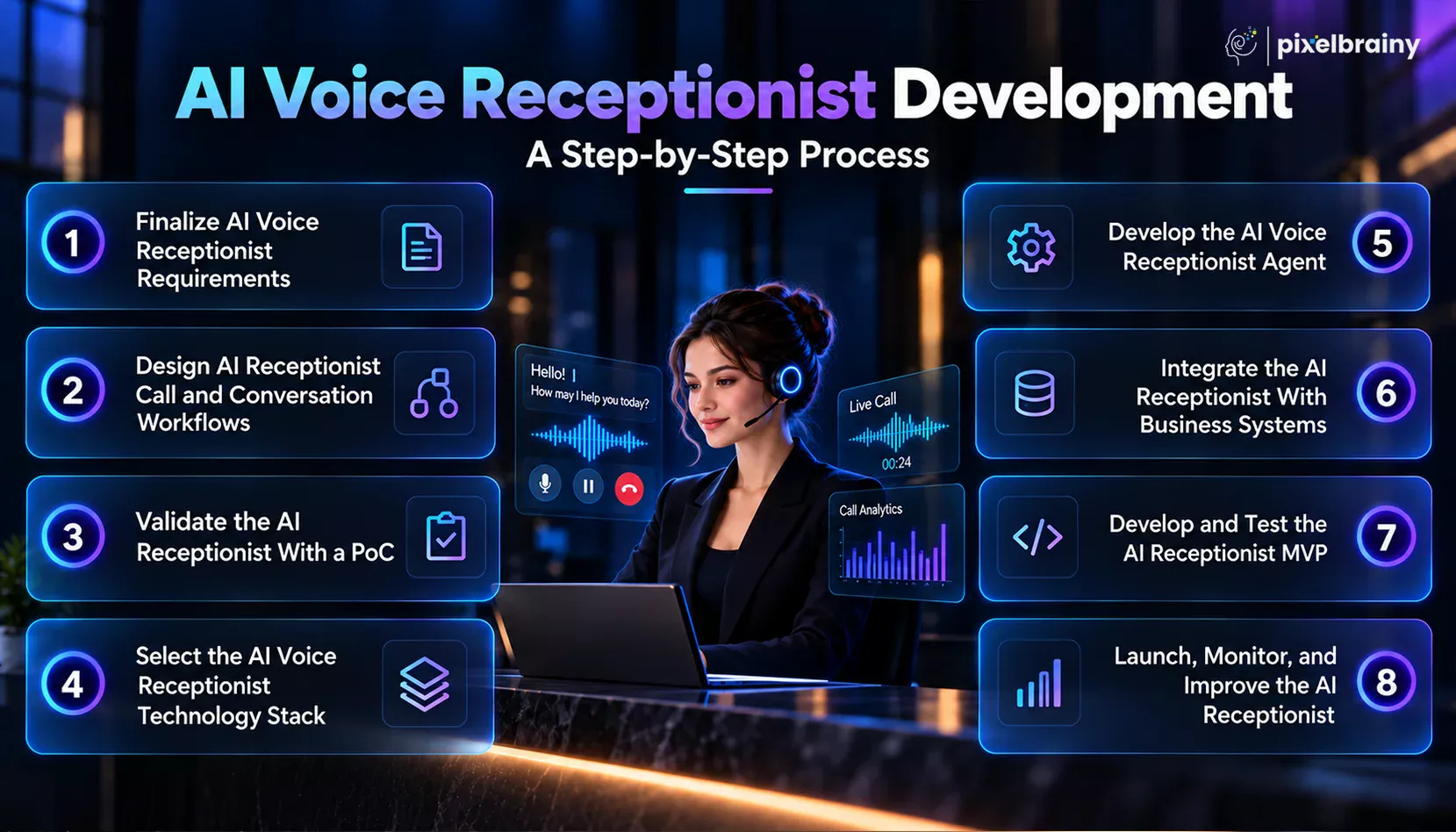
Once the decision to develop an AI voice receptionist has been made, start by defining exactly what the virtual receptionist needs to handle.
Identify incoming call types, caller information, frequently requested information, appointment workflows, lead qualification requirements, business hours, transfer conditions, languages, and escalation scenarios.
The business should also define what the AI voice receptionist is allowed to access and which actions require human approval. These requirements become the foundation for the voice AI architecture and prevent unnecessary features from entering the initial development scope.
The next stage is to design how the AI phone receptionist should manage different conversations from the initial greeting through resolution.
Each workflow should define what the receptionist asks, what information it needs, how it identifies caller intent, which business system it accesses, what action it performs, and when it transfers the conversation to a human.
For example, a sales enquiry may require lead qualification, while an existing customer may require verification before the AI provides account-related information.
Clear conversation workflows make the development process of AI voice receptionist technology more predictable and easier to test.
Before building the complete AI receptionist product, create a focused prototype that validates the most important voice interaction.
A PoC development version might answer calls, recognize caller intent, collect required information, provide business details, schedule an appointment, and transfer complex requests.
The prototype should be tested through actual voice conversations because an AI voice receptionist can behave differently in live calls compared with text-based testing. Speech recognition accuracy, response latency, interruptions, voice quality, intent detection, and conversation memory should all be evaluated before full development begins.
After validating the concept, select the technology stack that will power the AI receptionist.
The architecture may include a telephony platform, speech-to-text engine, large language model, text-to-speech system, voice orchestration layer, database, CRM, calendar, messaging platform, and business APIs.
At this stage, businesses also need to decide whether existing AI models can support the required receptionist workflows or whether customized AI model development is necessary.
The selected architecture should support low-latency conversations, concurrent calls, secure data handling, integrations, and future expansion.
Also Read: Top 12+ AI Model Development Companies in the USA
Now the development team builds the actual conversational AI receptionist.
This includes configuring the receptionist's system instructions, business knowledge, conversation memory, intent detection, tool usage, response rules, escalation conditions, and voice behavior.
During developing an AI voice receptionist, developers should test both predictable and unexpected caller behavior. The receptionist should handle interruptions, incomplete information, ambiguous questions, changes in conversation topics, background noise, and requests that fall outside its approved capabilities.
The goal is to make the AI receptionist reliable rather than simply conversational.
The voice receptionist becomes significantly more useful when it can interact with the systems that control real business operations.
Through AI integration, the receptionist can access calendars, CRM platforms, appointment software, customer databases, help desks, order systems, and other business applications.
For example, an AI receptionist for an insurance professional could collect policy requirements, check the agent's calendar, schedule a callback, create a customer record, and send an SMS call summary.
These integrations allow the AI voice receptionist to perform business tasks instead of only answering customer questions.
Also Read: Top 10+ AI Integration Companies in USA
After the core voice agent and integrations are working, build the first production-ready version through MVP development.
The MVP should concentrate on the highest-priority receptionist workflows rather than attempting to automate every possible customer interaction.
Testing should cover speech recognition, accents, background noise, caller interruptions, response latency, incorrect information, API failures, calendar conflicts, human transfers, call summaries, security permissions, and fallback behavior.
Businesses can also hire AI developers with experience in conversational AI, telephony, backend systems, and voice automation to strengthen the testing and production process.
Once testing is complete, launch the AI receptionist gradually instead of immediately routing every customer call through the new system.
Businesses can initially use the AI voice receptionist for after-hours calls, overflow calls, appointment requests, or selected customer service workflows. Performance should then be measured using call resolution, transfer rates, failed interactions, appointment completion, caller feedback, and frequently misunderstood requests.
For businesses working with AI product development companies, post-launch optimization should remain part of the development roadmap because new customer questions and conversation patterns will continue to appear after deployment.
A well-structured AI voice receptionist development process turns a business requirement into a tested, integrated, and continuously improving virtual receptionist capable of handling real customer conversations.
Also Read: How To Build An AI Voice Cloning App: Features, Process and Cost
The cost to develop an AI voice receptionist depends on what you expect the system to do after answering a call. A receptionist that handles FAQs and transfers calls requires a very different development budget for an AI voice receptionist than one that can qualify leads, access CRM records, schedule appointments, process requests, send follow-up messages, and manage calls across multiple locations.
For a custom business solution, a practical 2026 planning range is $30,000 to $250,000+. Published 2026 estimates for custom voice AI development show that focused production systems can start in the tens of thousands of dollars, while multi-workflow and enterprise implementations can reach or exceed $150,000.
For example, a growing service company might ask: “We receive around 8,000 inbound calls every month and want a 24/7 AI voice receptionist that answers calls, qualifies leads, books appointments, updates our CRM, sends call summaries, and transfers complex calls to employees. What should we budget for development?” The answer depends primarily on the number of workflows, integrations, languages, security requirements, and level of customization involved.
So, what is the development pricing of an AI voice receptionist? The following breakdown provides a practical starting point.
| Solution Type | Estimated Development Cost | What You Get |
|---|---|---|
| Basic AI Voice Receptionist | $30,000 to $60,000 | AI call answering, FAQs, basic intent recognition, simple call routing, appointment requests, standard voice configuration, and limited integrations. |
| Advanced AI Voice Receptionist | $60,000 to $120,000 | Multi-turn conversations, CRM and calendar integration, appointment booking, lead qualification, knowledge base, call summaries, human handoff, analytics, and multiple automated workflows. |
| Enterprise AI Voice Receptionist | $120,000 to $250,000+ | High-volume calling, multiple locations, multilingual support, complex integrations, advanced workflow automation, enterprise security, compliance controls, analytics, administration, monitoring, and custom AI behavior. |
These are development estimates rather than fixed market prices. A 2026 voice AI development estimate from RaftLabs places production multi-intent systems around $35,000 to $80,000 and enterprise systems at $80,000 to $150,000+, while DestiLabs places custom production voice agents at $35,000 to $150,000+. The difference comes largely from integration depth and the number of workflows being automated.
The cost estimation of AI voice receptionist development becomes much clearer when the individual components are considered. Not every project needs every component, and some costs are normally bundled into the development package.
| Cost Factor | Estimated Cost | Why It Affects the Budget |
|---|---|---|
| Business Analysis and Requirements | $2,000 to $8,000 | Covers call-volume analysis, use-case identification, business rules, requirements gathering, call-flow mapping, and technical planning before development begins. |
| Conversation and Call-Flow Design | $3,000 to $12,000 | More caller intents, conversation branches, fallback scenarios, escalation rules, and complex decision paths require more design and development effort. |
| Telephony Integration | $2,000 to $10,000 | Connecting phone numbers, SIP or telephony APIs, inbound calling, outbound calling, call transfers, voicemail, recording, and routing adds engineering work. |
| Speech Recognition | $1,500 to $6,000 | Real-time speech-to-text, accent handling, noisy-call conditions, language support, and accuracy optimization influence development complexity. |
| AI Model and Agent Logic | $5,000 to $25,000 | Includes LLM integration, prompt architecture, agent orchestration, context management, tool calling, guardrails, and decision-making logic. |
| AI Voice and Text-to-Speech | $2,000 to $10,000 | Natural voice selection, pronunciation, speaking style, voice customization, response speed, and TTS integration affect the implementation effort. |
| CRM and Business-System Integration | $3,000 to $30,000+ | Connecting CRM, calendar, helpdesk, booking, ERP, payment, property-management, or custom business systems can become one of the largest development expenses. |
| Knowledge Base and RAG | $3,000 to $15,000 | Includes business-document processing, retrieval, vector databases, knowledge synchronization, permissions, and grounding the receptionist in company information. |
| Workflow Automation | $5,000 to $25,000+ | Appointment booking, lead creation, ticket generation, customer updates, order lookup, notifications, and other actions require backend tools and APIs. |
| Multilingual Support | $3,000 to $20,000+ | Additional languages, language detection, regional accents, multilingual prompts, pronunciation, and language-specific testing increase the development scope. |
| Human Handoff and Intelligent Routing | $2,000 to $8,000 | Includes escalation rules, department routing, employee availability, call transfer logic, queue handling, and passing conversation context to human agents. |
| Security and Compliance | $5,000 to $30,000+ | Authentication, encryption, permissions, audit trails, data retention, consent handling, call-recording controls, and industry-specific requirements add development and testing work. |
| Analytics and Admin Dashboard | $3,000 to $15,000 | Call analytics, transcripts, intent reports, transfer rates, resolution tracking, agent monitoring, dashboards, and administrative controls increase the product scope. |
| Testing and AI Evaluation | $3,000 to $15,000+ | Real-call testing, edge cases, hallucination testing, speech accuracy, integration testing, latency testing, load testing, and regression testing are required for production readiness. |
| Cloud Deployment and DevOps | $2,000 to $12,000 | Infrastructure, databases, monitoring, logging, backups, scaling, deployment pipelines, and production security contribute to the initial development cost. |
| Maintenance and AI Optimization | $1,500 to $8,000+ per month | Ongoing monitoring, prompt improvements, bug fixes, integration maintenance, performance tuning, model updates, and new workflow development create recurring costs. |
A useful way to plan the development budget of an AI voice receptionist is to start with the business requirements rather than choosing a price first.
The final quote should also clearly separate development fees, third-party API costs, telephony charges, cloud infrastructure, maintenance, and per-minute usage, so the initial estimate does not hide the actual long-term cost of operating the AI receptionist.
The right AI voice receptionist budget is determined by the complexity of the conversations, integrations, and business tasks the system must handle, not simply by the cost of adding an AI voice to a phone line.
An AI voice receptionist is built from several connected technology layers rather than a single AI model. The AI voice receptionist technology stack typically combines telephony, real-time speech recognition, an AI model, text-to-speech, conversation orchestration, business integrations, databases, security, and monitoring. Each layer has a specific role in turning a phone call into a conversation and then converting that conversation into a completed business action.
For businesses planning to develop an AI voice receptionist, the technology stack should support both natural conversation and reliable task execution. For example, a company might ask: “We want to build an AI voice receptionist that answers 24/7 calls, understands customer requests, checks our CRM, schedules appointments, sends SMS confirmations, and transfers complex calls to employees. What tools and technologies do we need?” That requirement needs more than an LLM. It requires a complete voice AI architecture in which telephony, speech, reasoning, tools, and backend systems work together in real time.
Modern production voice agents generally use five core layers: telephony, speech-to-text, LLM, text-to-speech, and orchestration.
AI Voice Receptionist Technology Stack:
| Technology Layer | Tools and Technologies | Role in AI Voice Receptionist Development |
|---|---|---|
| Telephony and Voice Infrastructure | Twilio, Vonage, SIP, WebRTC | Connects the AI receptionist to real phone numbers and handles inbound and outbound calls, call routing, transfers, queues, recordings, and call control. Twilio's Voice API, for example, provides programmatic call management, recordings, transcriptions, queues, SIP connectivity, and call routing. Twilio |
| Speech-to-Text (STT) | Deepgram, Google Speech-to-Text, Azure Speech, Whisper | Converts the caller's speech into text that the AI system can understand. Real-time STT is important for reducing response delays and supporting natural conversations, interruptions, and different accents. |
| Large Language Model (LLM) | OpenAI, Anthropic, Google Gemini, open-source LLMs | Acts as the reasoning layer of the AI receptionist. It interprets caller intent, understands context, generates responses, decides when tools are required, and follows business-specific instructions and guardrails. |
| Text-to-Speech (TTS) | ElevenLabs, Cartesia, Azure Speech, Google Cloud TTS | Converts the AI-generated response into natural speech. Voice quality, pronunciation, speaking speed, latency, language coverage, and voice consistency all influence the caller experience. |
| Real-Time Voice Orchestration | Custom orchestration layer, voice-agent frameworks, WebSocket or streaming architecture | Coordinates telephony, STT, LLM, TTS, tools, conversation state, interruptions, and response timing. This layer is critical because every component must work together during a live call rather than operate as isolated services. |
| AI Agent Framework | Custom agent architecture, LangGraph, LangChain, provider-specific agent frameworks | Manages agent instructions, tool calling, state, workflows, decision paths, retries, and business rules. The framework becomes particularly important when the receptionist needs to complete multiple tasks during one conversation. |
| Business API Integration Layer | REST APIs, GraphQL, webhooks, SDKs | Connects the AI receptionist with CRM, ERP, booking, helpdesk, payment, property-management, healthcare, or other business applications so the agent can retrieve information and perform actions. |
| CRM Integration | Salesforce, HubSpot, Zoho, Microsoft Dynamics, custom CRM APIs | Allows the receptionist to identify callers, retrieve customer information, create leads, update records, add notes, and store call outcomes without requiring employees to manually enter the information. |
| Calendar and Booking Systems | Google Calendar API, Microsoft Graph, Calendly API, custom scheduling APIs | Enables appointment availability checks, booking, rescheduling, cancellation, confirmations, and calendar updates directly during the phone conversation. |
| Knowledge Base and RAG | Vector databases, embeddings, PostgreSQL with vector search, Pinecone, Weaviate | Gives the AI receptionist access to company-specific information such as services, policies, pricing, operating hours, locations, FAQs, and internal documentation while reducing dependence on information stored only inside the model. |
| Database and Conversation Storage | PostgreSQL, MySQL, MongoDB, Redis | Stores customer information, conversation state, appointment data, configuration, call metadata, transcripts, permissions, and other application data required by the receptionist. |
| Authentication and Security | OAuth 2.0, API keys, JWT, RBAC, encryption | Protects business systems and controls which users, services, and AI workflows can access sensitive information or perform specific actions. |
| Call Recording and Transcription | Telephony recording APIs, speech transcription services, cloud storage | Records and transcribes conversations when permitted and required, creating searchable call records for quality monitoring, compliance, training, and business analysis. |
| Analytics and Monitoring | Grafana, Datadog, OpenTelemetry, custom dashboards | Tracks call volume, latency, failed tool calls, transfer rates, conversation outcomes, system errors, AI performance, and other operational metrics. |
| Cloud and Infrastructure | AWS, Microsoft Azure, Google Cloud, Kubernetes, serverless infrastructure | Provides the compute, networking, storage, databases, scaling, monitoring, and deployment infrastructure required to keep the AI receptionist available as call volume increases. |
| Testing and AI Evaluation | Automated test calls, conversation simulations, evaluation datasets, observability tools | Tests speech recognition, intent detection, response quality, tool execution, edge cases, latency, call transfers, hallucinations, and failure recovery before and after production deployment. |
A strong AI voice receptionist technology stack connects voice infrastructure, AI reasoning, real-time speech, business APIs, and backend automation into one reliable system that can complete tasks, not just answer calls.
Before businesses should develop an AI voice receptionist as a product or commercial service, they need to define how the solution will make money, who will pay for it, and what customers will receive in return. The AI voice receptionist business model directly influences product features, pricing, customer acquisition, infrastructure costs, and long-term revenue.
For example, a company planning to build an AI voice receptionist platform may want to serve hundreds of businesses while charging a monthly subscription and additional fees based on call usage. Another company may prefer to provide a fully managed receptionist for a specific industry and charge customers a monthly service fee. Both use the same core voice AI technology, but their commercial models are completely different.
A practical business model for an AI voice receptionist can be built around subscriptions, usage, managed services, white-label delivery, industry-specific solutions, or measurable business outcomes. The best approach depends on the target customers, expected call volume, customization requirements, and how the AI receptionist creates value for the business.
Below are the major business models businesses can consider when developing and commercializing an AI voice receptionist.
The SaaS model turns the AI voice receptionist into a recurring software product. Customers subscribe monthly or annually and receive access to the AI receptionist, dashboard, call management, integrations, analytics, and other features according to their plan.
How it works:
Suitable for: SaaS companies, technology startups, and businesses targeting a broad customer base.
A SaaS model can also combine subscription fees with usage charges. This approach fits AI voice products because customers with significantly higher call volumes create higher infrastructure and AI processing costs.
Under a usage-based model, customers pay according to how much they actually use the AI receptionist. The most common measurement is call minutes, although businesses can also charge based on calls, conversations, tasks, or other measurable usage.
How it works:
Suitable for: High-volume businesses, call-heavy operations, and customers whose usage varies significantly from month to month.
This model is already visible across the voice AI market. For example, published 2026 pricing from voice AI platforms includes per-minute usage charges alongside subscription plans.
The hybrid model combines a predictable monthly subscription with usage-based charges. This can be useful when developing an AI voice receptionist platform because the subscription provides recurring revenue while usage charges help cover variable AI and telephony costs.
How it works:
Example structure:
This model is particularly useful for businesses that want predictable recurring revenue without absorbing unlimited voice usage costs.
A white-label AI voice receptionist allows agencies, consultants, BPOs, IT companies, and other partners to sell the technology under their own brand.
The underlying platform handles much of the AI and telephony infrastructure, while the reseller controls the customer relationship, branding, packaging, and pricing.
How it works:
Suitable for: Digital agencies, marketing companies, IT service providers, BPOs, and consultants.
Current 2026 white-label platforms demonstrate this structure through branded client workspaces, reseller pricing, subaccounts, and usage-based charges. Edesy
Instead of giving customers a self-service product, a company can provide the AI voice receptionist as a managed service. The provider handles configuration, conversation design, knowledge-base updates, integrations, monitoring, optimization, and ongoing support.
How it works:
Suitable for: Agencies, AI development companies, vertical technology providers, and businesses serving customers that do not want to manage the technology themselves.
This model can be particularly relevant for businesses that want an AI receptionist but do not have internal AI engineering or automation teams.
A vertical AI receptionist is developed specifically for one industry instead of being marketed as a general-purpose product. The core technology remains similar, but workflows, knowledge, integrations, terminology, and compliance requirements are customized for a particular market.
Examples include:
How it works:
Suitable for: AI startups, specialized SaaS companies, and agencies with strong knowledge of a particular industry.
The vertical approach also makes it easier to build reusable workflows. Instead of developing a completely different receptionist for every customer, the provider can create a common industry foundation and customize it for individual businesses.
An outcome-based model charges customers according to the business result generated by the AI receptionist rather than only charging for software access or call duration.
Possible pricing metrics include:
For example, a real estate company could pay according to qualified property leads or booked viewing appointments instead of paying only for AI voice minutes.
Suitable for: Lead-generation businesses, sales-driven organizations, appointment-based businesses, and companies where AI outcomes can be measured reliably.
The model needs careful measurement because the provider and customer must agree on what counts as a valid outcome and how attribution will be handled. Deloitte identifies outcome or value-based pricing as one of the pricing approaches gaining relevance as AI agents become more autonomous.
The embedded model adds AI voice receptionist capabilities directly inside an existing SaaS or business application. Instead of selling a separate voice receptionist platform, the company makes voice automation a feature of its existing product.
For example, a CRM company could add an AI receptionist that answers customer calls, updates CRM records, qualifies leads, and schedules meetings without requiring customers to purchase another application.
How it works:
Suitable for: CRM platforms, booking software, property-management platforms, healthcare software, helpdesk products, and other vertical SaaS companies.
This model is becoming increasingly relevant as AI agents interact directly with existing enterprise systems rather than operating as isolated applications.
Businesses do not necessarily have to use only one AI voice receptionist business model. A commercial product can combine multiple revenue streams.
For example:
| Business Model | Primary Revenue | Additional Revenue |
|---|---|---|
| SaaS Subscription | Monthly or annual subscription | Premium features, extra usage |
| Usage-Based | Per-minute or per-call billing | Premium integrations |
| Hybrid | Subscription + usage | Setup and overage charges |
| White Label | Partner subscription | Usage and client account fees |
| Managed Service | Monthly service fee | Setup, integrations, customization |
| Vertical Solution | Industry-specific subscription | Premium workflows and integrations |
| Outcome-Based | Per lead, appointment, or result | Platform or setup fee |
| Embedded AI | Feature or plan upgrade | Usage-based voice charges |
For example, a company building an AI voice receptionist platform for small businesses could use a monthly SaaS subscription + included call minutes + additional usage charges, while an agency could use a white-label platform + setup fee + monthly management fee.
The business model should therefore match the way customers receive value from the AI receptionist while also accounting for the provider's recurring costs for telephony, speech processing, AI models, infrastructure, integrations, and support.
A sustainable AI voice receptionist business model combines predictable recurring revenue with pricing that reflects actual voice usage, automation value, and the level of service delivered to each customer.
Before businesses should deploy an AI voice receptionist, they need to understand how phone calls, voice recordings, personal information, and AI-generated interactions are regulated. The compliance requirements can vary based on the caller's location, the business's industry, the type of information collected, and whether the AI receptionist only handles inbound calls or also makes outbound calls.
For example, an AI receptionist handling appointment bookings for a general service business may have different requirements from one handling patient information for a healthcare provider. Similarly, an outbound AI calling system can face additional telecommunications and telemarketing requirements. In the U.S., the FCC has confirmed that AI-generated voices fall under the TCPA rules governing artificial or prerecorded voice calls.
When businesses develop an AI voice receptionist, the main compliance areas to address include:
If calls are recorded or transcribed, callers may need to be informed and, depending on the applicable jurisdiction, consent may be required. The AI receptionist should support configurable recording notices, recording controls, and appropriate consent tracking.
Businesses should also define:
AI voice receptionists can collect names, phone numbers, addresses, account information, appointment details, and other personal data during conversations.
The system should therefore include:
Businesses serving customers in the European Union may also need to consider GDPR requirements around personal data processing and certain automated decision-making activities.
Businesses should decide when and how the receptionist identifies itself as an AI system. The AI should not intentionally misrepresent itself as a human employee.
Clear disclosure can also help callers understand what the system can do and when they can request a human representative.
Industry-specific requirements become important when the AI receptionist handles sensitive information. For example, a healthcare AI receptionist may process protected health information, making HIPAA requirements relevant when the system operates on behalf of a covered entity. HHS notes that technology providers handling PHI on behalf of covered entities can qualify as business associates.
Similar additional requirements can apply to financial services, insurance, legal services, and other regulated industries.
An AI receptionist that only answers inbound calls has a different compliance profile from one that makes sales, marketing, reminder, or collection calls.
For outbound AI calling, businesses may need controls for:
The FTC's Telemarketing Sales Rule also establishes requirements covering areas such as disclosures, deceptive practices, Do Not Call provisions, and recordkeeping.
An AI voice receptionist may send call audio or transcripts through several external services, including telephony providers, speech recognition APIs, LLM providers, text-to-speech platforms, cloud infrastructure, and CRM systems.
Before production deployment, businesses should review:
Compliance should be built into the AI voice receptionist architecture from the beginning, covering consent, privacy, security, recordings, AI transparency, industry regulations, and human escalation.
A business can build an AI voice receptionist that answers a test call successfully, but handling thousands of real conversations introduces a different set of challenges. Callers interrupt, speak with different accents, talk over background noise, change their requests midway, provide incomplete information, and expect the receptionist to take the correct action immediately. These situations make AI voice receptionist development more complex than connecting an LLM to a phone system.
A real business requirement might sound like this: “We want an AI voice receptionist that can handle 24/7 inbound calls, understand different accents, let callers interrupt naturally, remember information throughout the conversation, update our CRM, schedule appointments, and transfer difficult calls to a human with the full conversation context. How can we make the system reliable enough for production?” This is where the major challenges in AI voice receptionist development need to be addressed from the architecture stage.
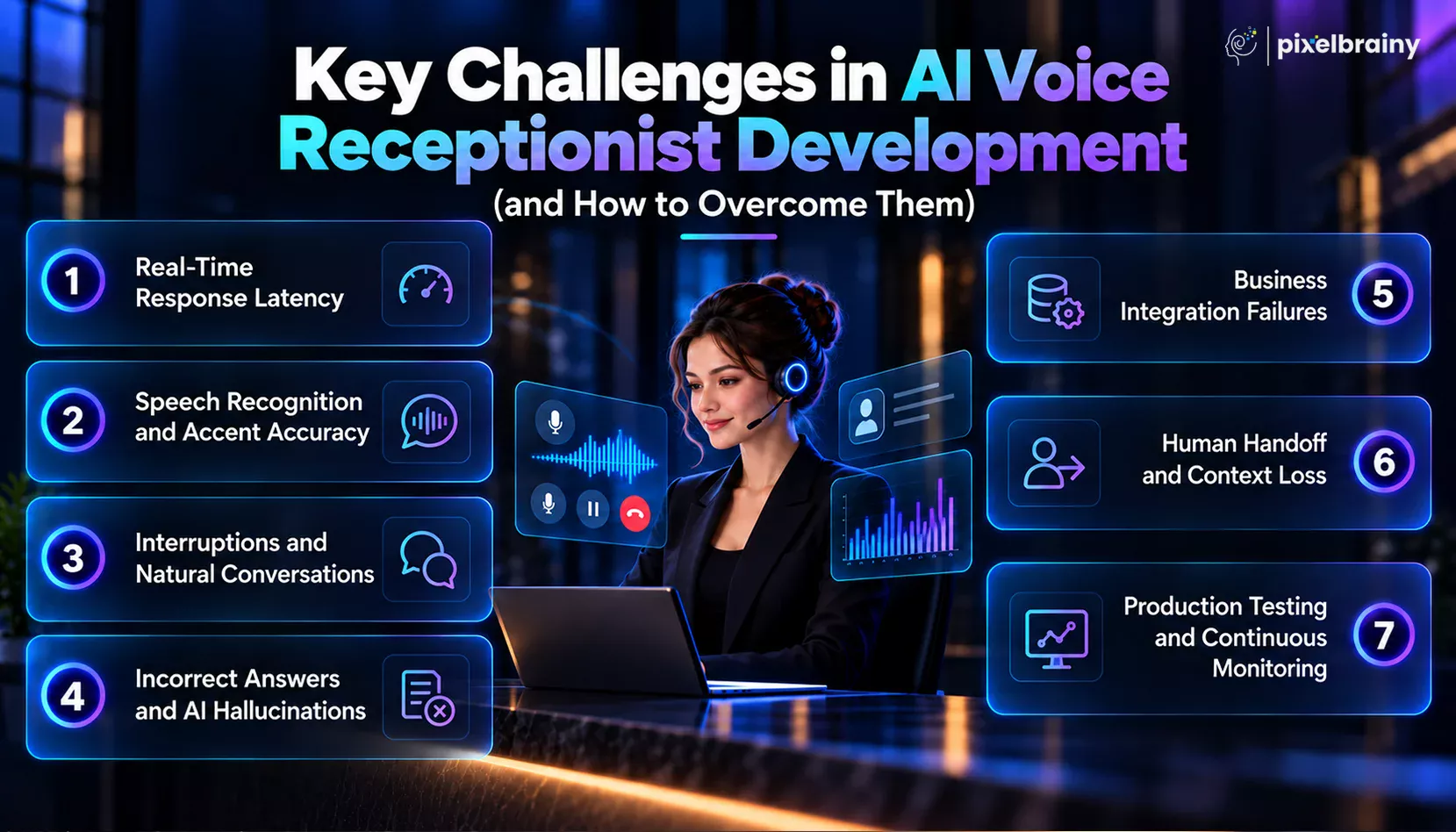
Callers notice silence immediately. Delays can occur across speech recognition, AI processing, business API calls, and voice generation. Microsoft recommends designing voice agents around perceived latency, streaming responses, and fast tool execution.
How to overcome it: Use streaming audio, fast models, optimized APIs, regional infrastructure, shorter responses, and continuous latency monitoring.
Background noise, accents, telephone-quality audio, fast speech, names, addresses, and industry-specific terms can cause transcription errors.
How to overcome it: Test real call recordings, add domain-specific vocabulary, use confidence checks, confirm critical information, and optimize speech recognition for the target audience.
Callers rarely wait silently for an AI receptionist to finish speaking. They interrupt, say “yes” or “right” as backchannel responses, change their intent, or speak over the agent.
How to overcome it: Implement barge-in detection, natural turn-taking, conversation state management, and recovery logic so the AI knows when to stop, continue, or clarify.
An AI receptionist can create serious problems if it invents a price, appointment confirmation, policy detail, or customer record.
How to overcome it: Ground responses in approved business data, restrict tool access, validate important outputs, and require the AI to say when information is unavailable instead of guessing.
CRM, calendar, booking, payment, and helpdesk APIs can fail, become slow, or return incomplete information during a live call.
How to overcome it: Build explicit tool-error handling, retries, validation, fallback responses, and human escalation. Important actions should only be confirmed after the connected system verifies that they were completed.
Some callers need a human, but transferring them without context creates another frustrating experience.
How to overcome it: Define escalation rules and pass the transcript, caller details, intent, actions already completed, and unresolved issue to the human agent. M
Testing only successful conversations is not enough. AI voice receptionist development needs testing for interruptions, poor audio, unusual requests, failed APIs, long pauses, wrong inputs, and unexpected conversation paths.
How to overcome it: Monitor latency, tool failures, call outcomes, transfer rates, transcription errors, and conversation quality, then continuously evaluate real-world calls against defined success criteria.
A reliable AI voice receptionist is built by engineering for real conversations, not ideal demos, with strong speech processing, low latency, grounded AI responses, dependable integrations, and seamless human fallback.
From the above considerations, now it is time to identify the right development partner that can turn your voice AI concept into a reliable business solution. PixelBrainy as a leading AI development company brings together AI engineering, product development, system integration, and UX expertise to help businesses move from an initial idea to a production-ready voice receptionist. Its broader AI capabilities include AI agent development, AI integration, AI product development, RAG, and automation services.
For businesses looking for AI voice receptionist development services, the focus should not be limited to creating a voice interface. The development partner needs to understand call workflows, real-time conversations, business integrations, security, scalability, and human handoff. PixelBrainy approaches voice AI projects around these practical requirements, with experience across CRM, ERP, telephony, and other enterprise integrations.
Businesses that want to build AI voice receptionist solutions can work with PixelBrainy across the complete product journey.
In one confidential engagement, a U.S.-based insurance organization was managing more than 45,000 inbound customer calls every month, with many calls involving policy questions, claim status updates, and appointment scheduling. The client needed an automated voice solution that could manage repetitive conversations while connecting with its CRM, policy management system, and scheduling platform.
PixelBrainy designed and deployed a custom AI voice solution around these workflows. According to the company's published case description, the system automated a significant portion of routine inquiries, reduced average call handling time, improved first-call resolution, and allowed human agents to focus on more complex customer requests. The client's identity remains confidential.
This type of implementation demonstrates the difference between making an AI voice receptionist for a demonstration and creating one that operates within real business systems and high-volume customer workflows.
For businesses planning to create AI voice receptionist technology for their own operations or as a commercial SaaS product, PixelBrainy can provide the technical and product expertise required to move from concept to deployment.
Ready to turn your voice AI idea into a production-ready solution? Connect with PixelBrainy today.
An AI voice receptionist is more than an automated phone answering system. It combines conversational AI, speech recognition, voice technology, business integrations, workflow automation, and human handoff to manage real customer conversations and complete meaningful tasks. Throughout this guide, we covered the AI voice receptionist development process, key features, development steps, technology stack, cost considerations, business models, compliance requirements, and challenges involved in creating a production-ready solution.
Whether your goal is to build an AI voice receptionist for internal operations, launch a vertical SaaS product, or develop an AI voice receptionist for multiple business locations, success depends on aligning the technology with real call workflows and measurable business requirements. A well-designed solution can answer calls, qualify leads, schedule appointments, provide information, update business systems, and escalate complex conversations to the right employee.
The next step is turning your specific requirements into a practical development roadmap.
Ready to turn your AI voice receptionist idea into a business-ready solution? Book an appointment with our experts today.
The cost to build an AI voice receptionist for a small business can start around $30,000 to $60,000 for a custom solution with call answering, FAQs, basic routing, and limited integrations. More advanced systems with CRM integration, appointment booking, multilingual support, and workflow automation can cost significantly more.
A basic AI voice receptionist development project can take several weeks, while a production system with CRM, calendar, telephony, knowledge base, analytics, and custom workflows may require several months. The timeline depends mainly on integration complexity, conversation flows, testing requirements, and the number of automated tasks.
Yes. You can develop an AI voice receptionist with 24/7 call handling, business-hour rules, emergency detection, intelligent routing, and human handoff. The system can identify the caller's intent, collect relevant information, and transfer the conversation with a summary so the employee does not need to repeat the entire conversation.
To create an AI voice receptionist, you typically need telephony infrastructure, speech-to-text, an AI model, text-to-speech, an orchestration layer, backend APIs, a database, and integrations with scheduling or CRM systems. Additional components such as RAG, analytics, authentication, and monitoring can be added according to the business requirements.
Yes. AI voice receptionist development can include lead qualification workflows that ask predefined questions, identify customer requirements, capture contact information, assess lead intent, and send qualified leads to a CRM or sales representative. This is particularly useful when sales teams receive a high volume of repetitive inbound inquiries.
To build an AI voice receptionist for multiple locations, the platform should support location-specific phone numbers, business hours, services, staff availability, routing rules, calendars, and knowledge bases. A centralized administration layer can manage all locations while allowing each branch to maintain its own call workflows and business information.
Yes. Making an AI voice receptionist multilingual requires speech recognition, language detection, multilingual AI processing, and text-to-speech capabilities. The system can identify the caller's language, continue the conversation accordingly, and route the call to a human employee when the requested language or conversation falls outside its supported capabilities.
When evaluating AI voice receptionist development services, look beyond the ability to create a voice bot. Check whether the development team can handle real-time voice processing, CRM and business integrations, workflow automation, security, human handoff, testing, analytics, scalability, and post-launch optimization. Experience with similar call workflows is also important because production voice AI requires considerably more than a basic conversational demo.

About The Author
Sagar Bhatnagar
Sagar Sahay Bhatnagar brings over a decade of IT industry experience to his role as Marketing Head at PixelBrainy. He's known for his knack in devising creative marketing strategies that boost brand visibility and market influence. Sagar's strategic thinking, coupled with his innovative vision and focus on results, sets him apart. His track record of successful campaigns proves his ability to utilize digital platforms effectively for impactful marketing efforts. With a genuine passion for both technology and marketing, Sagar continuously pushes PixelBrainy's marketing initiatives to greater success.

Working with PixelBrainy has been a great experience. They took our vision for an AI-powered platform and turned it into a fully functional product. What impressed me most was their strong understanding of both design and development, and their ability to handle complex requirements with ease. The team was responsive, cooperative, and always open to feedback. They kept things organized, communicated clearly, and delivered quality work on time. I highly recommend PixelBrainy to anyone looking for a skilled and reliable development partner.

Working with the PixelBrainy team has been a highly positive experience. They understand the design requirements and create beautiful UX elements to meet the application needs. The dev team did an excellent job bringing my vision to life. We discussed usability and flow. Sagar worked with his team to design the database and begin coding. Working with Sagar was easy. He has the knowledge to create robust apps, including multi-language support, Google and Apple ID login options, Ad-enabled integrations, Stripe payment processing, and a Web Admin site for maintaining support data. I'm extremely satisfied with the services provided, the quality of the final product, and the professionalism of the entire process. I highly recommend them for Android and iOS Mobile Application Design and Development.

Great experience working with them. Had a lot of feedback and I found that unlike most contractors they were bugging me for updates instead of the other way around. They were extremely time conscience and great at communicating! All work was done extremely high quality and if not on time, early! They were always proactive when it comes to communication and the work is great/above par always. Very flexible and a great team to work with! Goes above and beyond to present us with multiple options and always provides quality. Amazing work per usual with Chitra. If you have UI/UX or branding design needs I recommend you go to them! Will likely work with them in the future as well, definitely recommended!

PixelBrainy is a joy to work with and is a great partner when thinking through branding, logo, and website layout. I appreciate that they spend time going into the "why" behind their decisions to help inform me and others about industry best practices and their expertise.

I hired them to design our software apps. Things I really like about them are excellent communication skills, they answer all project suggestions and collaborate right away, and their input on design and colors is amazing. This project was complex and needed patience and creativity. The team is amazing to do business with. I will be using them long-term. Glad to see there are some good people out there. I was afraid to try and outsource my project to someone but I am glad I met them! I really can't say enough. They went above and beyond on this project. I am very happy with everything they have done to make my business stand out from the competition.

It was great working with PixelBrainy and the team. They were very responsive and really owned the project. We'll definitely work with them again!

I recently worked with the PixelBrainy team on a project and I was blown away by their communication skills. They were prompt, clear, and articulate in all of our interactions. They listened and provided valuable feedback and suggestions to help make the project a success. They also kept me updated throughout the entire process, which made the experience stress-free and enjoyable.

PixelBrainy is very good at what it does. The team also presents themselves very professionally and takes care of their side of things very well. I could fully trust them taking up the design work in a timely and organised manner and their attention to detail saved us lots of effort and time. This particular project was quite intense and the team showed that they function very well under pressure. Very much looking forward to working with her again!

It's always an absolute pleasure working with them. They completed all of my requests quickly and followed every note I had for them to a T, which made our process go smoothly from start to finish. Everything was completed fast and following all of the guidelines. And I would recommend their services to anyone. If you need any design work done in the future, PixelBrainy should be your first call!

They took ownership of our requirements and designed and proposed multiple beautiful variants. The team is self-motivated, requires minimum supervision, committed to see-through designs with quality and delivering them on time. We would definitely love to work with PixelBrainy again when we have any requirements.

PixelBrainy was a big help with our SaaS application. We've been hard at work with a new UI/UX and they provided a lot of help with the designs. If you're looking for assistance with your website, software, or mobile application designs, PixelBrainy and the team is a great recommendation.

PixelBrainy designers are amazing. They are responsive, talented, and always willing to help craft the design until it matches your vision. I would recommend them and plan to continue them for my future projects and more!!!

They were awesome! Did a good job fast, and good communication. Will work with them again. Thank you

Creative, detail-oriented, and talented designers who take direction well and implement changes quickly and accurately. They consistently over-delivered for us.

PixelBrainy team is very talented and creative. Great designers and a pleasure to work with. PixelBrainy is an excellent communicator and I look forward to working with them again.

PixelBrainy has a very talented design team. Their work is excellent and they are very responsive. I enjoy working with them and hope to continue on all of our future projects.


Transform your ideas into reality with us.
Across these industries, each engagement brings unique challenges, from early-stage product development to scaling complex systems, helping us build a practical understanding of real-world product environments.