AI Summary Powered by PixelBrainy
What happens when an environmental work order gets approved without accounting for a property's contamination history, existing cleanup obligations, or applicable state regulations? A single missed detail can lead to inappropriate fieldwork, duplicated investigations, contractor delays, unexpected remediation expenses, or environmental compliance issues.
For environmental consulting firms managing multiple brownfield properties, work order screening is not simply an administrative responsibility. Every sampling request, excavation activity, groundwater investigation, and remediation task must align with the property's environmental site assessment, approved cleanup plan, historical findings, and regulatory requirements. When senior engineers manually review every request, the approval process becomes difficult to scale, particularly when dozens of active sites require continuous oversight.
An AI work order screening system for brownfield properties addresses this operational bottleneck by connecting work orders with relevant environmental records, site-specific restrictions, regulatory requirements, and previously approved activities. Instead of relying entirely on manual document searches, the system can extract information, identify potential conflicts, detect missing details, and flag high-risk requests for engineering review.
The business case for exploring this technology is supported by broader market developments. According to Gartner's September 2026 forecast, worldwide AI spending is expected to reach $2.7 trillion in 2026, representing 49.5% year-over-year growth. This reflects increasing enterprise investment in AI-enabled software, services, and workflow automation.
For environmental consulting companies and property developers, the opportunity is to apply these capabilities to a specialized operational challenge rather than introduce AI without a defined purpose.
Successful AI work order screening system development for brownfield properties requires more than integrating a language model into an existing platform. It involves organizing environmental data, translating engineering requirements into screening rules, connecting regulatory references, establishing risk-based prioritization, and maintaining human approval authority.
This guide explains how to develop an AI work order screening system for brownfield properties, covering its architecture, essential features, development process, technology stack, estimated costs, implementation challenges, and performance measurement.
The objective is straightforward: help environmental teams identify work order conflicts earlier, improve review consistency, and maintain stronger oversight across complex brownfield portfolios.

An AI-assisted work order screening system for brownfield properties is a software platform that evaluates proposed site activities against available environmental information, approved remediation requirements, property-specific restrictions, and applicable regulatory criteria before a work order reaches final approval.
It acts as an intelligent screening layer between work order submission and contractor authorization.
For example, an environmental consulting firm receives a request to excavate soil near a previously identified contaminated area. Before the work order is approved, the system retrieves relevant site assessment findings, checks the proposed excavation location against available contamination maps, reviews the applicable cleanup requirements, and identifies whether additional sampling or engineering approval is necessary.
The platform then produces a screening result that helps the responsible engineer decide whether to approve, revise, escalate, or reject the request.
Unlike conventional work order management software, which primarily handles task assignment, scheduling, tracking, and completion, an AI-assisted solution evaluates the environmental context behind each proposed activity.
| Traditional Work Order System | AI-assisted Screening System |
|---|---|
| Records submitted work orders | Evaluates work orders against site information |
| Relies on manual document searches | Retrieves relevant environmental records |
| Uses predefined task categories | Classifies requests using AI and business rules |
| Depends on manual conflict identification | Flags potential environmental conflicts |
| Follows general approval workflows | Supports site-specific risk-based routing |
| Tracks work order status | Maintains screening findings and review evidence |
The important distinction is that AI does not independently determine whether an environmental activity is legally compliant or technically safe. It identifies relevant information, applies configured screening logic, and highlights issues that require professional judgment.
A well-designed platform should connect several information sources:
These records provide the context needed to assess whether a proposed activity is consistent with existing environmental obligations.
Consider a consulting firm managing 60 brownfield sites.
A contractor submits a work order requesting excavation of approximately 100 cubic yards of soil. The proposed location overlaps an area where previous investigations identified elevated contaminant concentrations.
The screening platform can:
The engineer receives a contextualized screening report instead of manually searching through multiple documents.
This is the practical purpose of the system: make environmental work order reviews more informed, consistent, and traceable.
An AI-assisted work order screening system for brownfield properties follows a structured process involving work order submission, environmental document analysis, site-specific data retrieval, regulatory validation, risk identification, and engineer approval. It connects proposed field activities with existing environmental records to flag potential conflicts before contractor authorization.
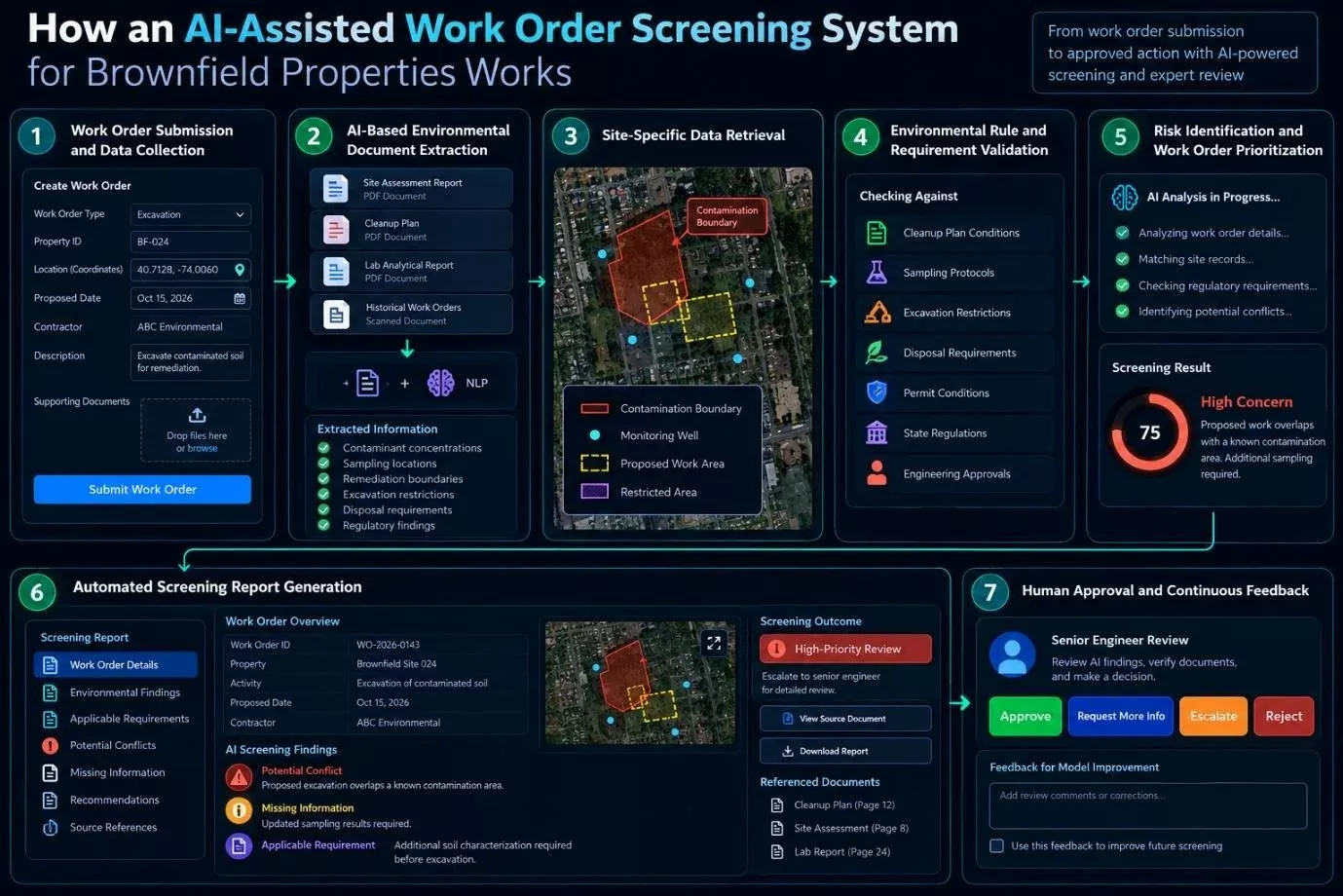
The process begins when a project manager, contractor, or field engineer submits a work order containing:
The system checks whether essential information is available. For example, an excavation request without a defined work area can be flagged for clarification before screening.
The AI document processing module analyzes environmental reports, laboratory results, cleanup plans, and historical work orders.
Using optical character recognition (OCR) and natural language processing (NLP), it extracts important information, including:
Each extracted finding retains its original document reference, page number, and date, allowing engineers to verify the information.
Using retrieval-augmented generation (RAG), the platform retrieves environmental records relevant to the submitted work order.
It identifies previous investigations, contamination findings, cleanup requirements, existing restrictions, and outstanding corrective actions.
GIS integration further helps compare proposed work locations with contamination boundaries, monitoring wells, and restricted areas.
The system checks the proposed activity against configured environmental requirements, including:
A rules engine evaluates explicit requirements, while AI helps interpret relevant environmental documentation and identify potential discrepancies.
The platform combines work order details, environmental findings, geographic information, and configured screening rules to identify potential conflicts.
It can classify work orders into different screening categories:
| Screening Category | System Response |
|---|---|
| Low concern | Standard engineering review |
| Moderate concern | Request additional information |
| High concern | Escalate to senior engineer |
| Critical conflict | Place approval on hold |
| Insufficient information | Return for clarification |
These categories help environmental consulting teams prioritize reviews without treating AI-generated scores as definitive environmental risk assessments.
After evaluation, the system generates a report containing the proposed activity, relevant environmental findings, applicable requirements, identified conflicts, missing information, and supporting document references.
Example:
This gives senior engineers a clear view of potential issues without manually searching multiple environmental records.
The final stage involves senior engineer review. The responsible professional verifies AI-generated findings, examines supporting documents, and decides whether to approve, revise, escalate, or reject the work order.
The platform records approval decisions, reviewer comments, and corrections to AI findings.
This feedback supports ongoing model evaluation and screening improvements while maintaining human oversight for environmental and remediation decisions.
Brownfield properties present complex environmental and operational challenges that make work order screening more demanding than conventional property maintenance. Historical industrial activities, incomplete environmental records, overlapping contamination zones, changing remediation requirements, and regulatory obligations can all affect whether a proposed site activity should proceed.
For environmental consulting firms managing multiple active properties, manual work order reviews can create approval bottlenecks and increase the possibility of overlooked environmental conflicts.
An AI-assisted work order screening system for brownfield properties helps address these challenges by connecting proposed activities with historical site information, environmental requirements, and relevant regulatory records before contractor approval.
Here are seven reasons why brownfield properties need AI-assisted work order screening.
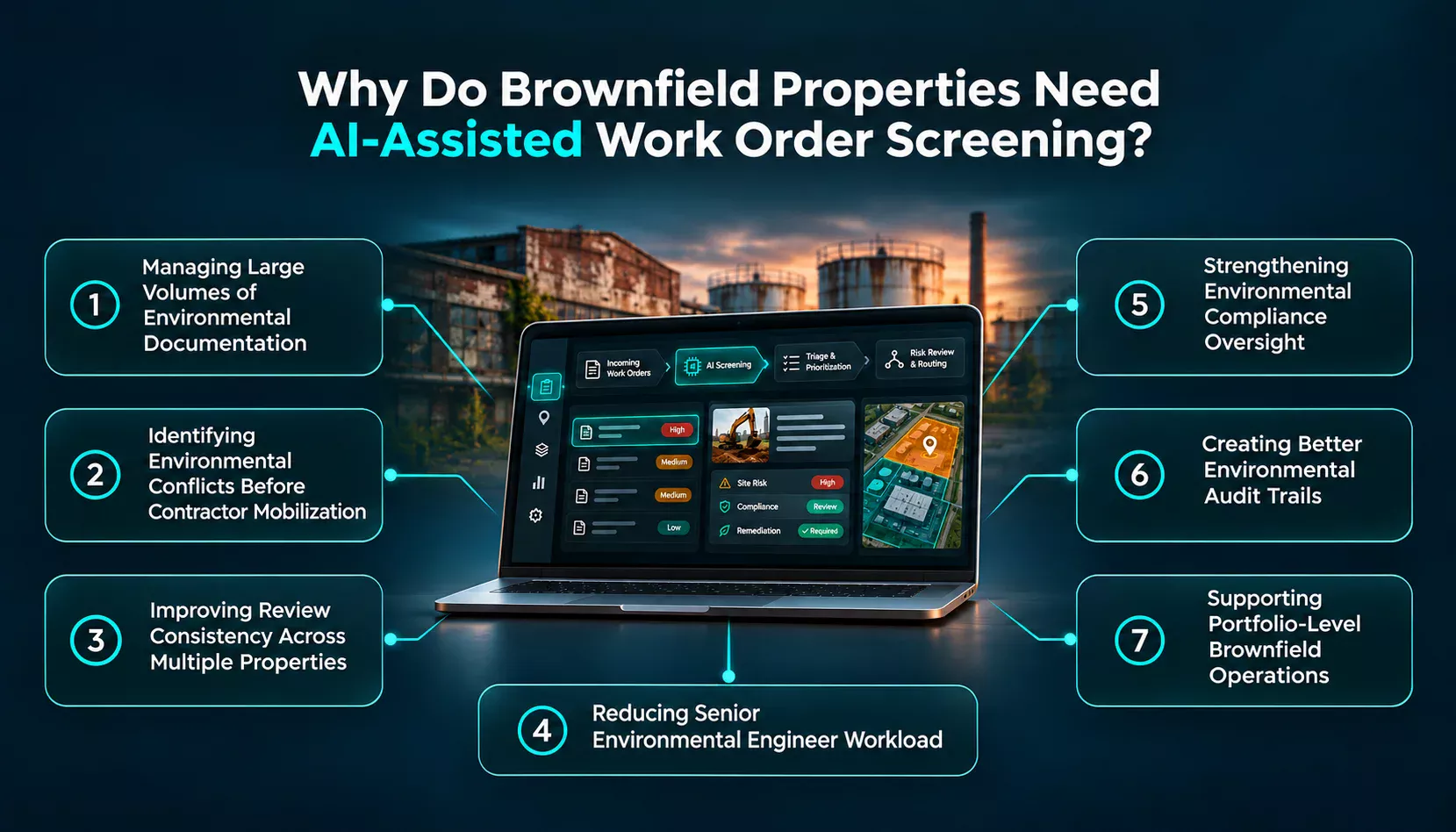
Each brownfield property may contain multiple Phase I and Phase II Environmental Site Assessment (ESA) reports, laboratory results, cleanup plans, groundwater monitoring records, and regulatory correspondence.
Engineers must locate and review relevant information before approving sampling, excavation, or remediation activities.
An AI-powered document retrieval system can extract important findings, organize historical records, and retrieve relevant information based on submitted work orders.
This reduces repetitive document searches and helps engineers access the environmental information required for screening.
A proposed work order may appear operationally straightforward but still conflict with existing environmental requirements.
Common examples include:
An AI work order screening system for brownfield sites can compare proposed activities against available environmental records and flag potential conflicts before contractor authorization.
This helps reduce avoidable mobilization expenses, operational delays, and inappropriate field activities.
When environmental consulting firms manage several brownfield sites, different engineers may review similar work orders using different document references and evaluation approaches.
A centralized AI-assisted screening platform applies standardized workflows, screening categories, and configurable review requirements across the property portfolio.
For example, excavation requests can follow a consistent initial screening process while still being evaluated against the specific contamination history and cleanup requirements of each property.
This improves review consistency without treating every brownfield site as environmentally identical.
Senior engineers should focus on technical uncertainties, environmental implications, and complex remediation decisions rather than spending hours locating basic information across historical reports.
AI can support initial work order screening by:
This allows experienced engineers to concentrate on decisions that require professional expertise while reducing repetitive administrative work.
Brownfield properties may be subject to different state environmental requirements, cleanup standards, permits, and site-specific remediation obligations.
An AI-assisted screening platform can connect relevant regulatory references with property records and configured screening rules to identify potentially applicable requirements.
For example, when a contractor submits an excavation request, the system can retrieve relevant cleanup plan conditions, soil handling requirements, and documented approval obligations.
However, regulatory information must be verified, version-controlled, and mapped to the correct jurisdiction. AI-generated findings should support compliance reviews rather than independently determine legal or regulatory compliance.
Environmental consulting firms need documented evidence explaining why a work order was approved, revised, escalated, or rejected.
An AI work order screening platform can automatically maintain:
This creates a traceable screening history that supports internal quality assurance, project management, client reporting, and regulatory documentation.
For environmental consulting firms managing dozens of active brownfield properties, individual work order reviews are only one part of the operational challenge.
Management also needs visibility into which properties generate frequent screening conflicts, where engineering approvals are delayed, and which activities require additional technical resources.
An AI-assisted screening dashboard can consolidate information across multiple sites and display:
These insights help operations managers allocate engineering resources more effectively and maintain better oversight across brownfield redevelopment projects.
Ultimately, AI-assisted work order screening helps environmental consulting firms move from reactive document reviews to proactive, site-specific environmental oversight. By identifying potential conflicts before contractor mobilization, organizations can improve review consistency, strengthen compliance visibility, and make better-informed brownfield redevelopment decisions.
An AI work order screening system for brownfield sites is valuable for organizations that manage contaminated properties, coordinate environmental remediation, or oversee site activities requiring technical and regulatory review. However, the development priorities differ depending on whether the organization is an environmental consulting firm, property developer, remediation contractor, government agency, or technology provider.
Organizations considering AI-assisted work order screening system development should identify their operational requirements first. This helps determine which screening capabilities, integrations, and approval workflows the platform needs.
Environmental consulting and engineering firms are among the primary beneficiaries of an AI work order screening system. These organizations often manage multiple concurrent brownfield projects involving soil sampling, groundwater monitoring, excavation, remediation, and environmental compliance.
Senior engineers must review each work order against historical site assessments, approved cleanup plans, laboratory results, and applicable regulatory requirements. As the number of active properties increases, manual reviews can become an operational bottleneck.
An AI work order screening system for environmental engineering firms can automate initial document retrieval, work order classification, missing-information checks, and potential conflict identification.
Primary benefits:
Brownfield and real estate developers managing contaminated parcels must coordinate environmental investigations, remediation activities, contractors, and redevelopment schedules.
A work order that overlooks contamination boundaries, existing cleanup obligations, or site-specific restrictions can result in rework, contractor delays, and additional project expenses.
An AI-assisted screening platform helps developers evaluate proposed site activities against available environmental assessments, contamination records, GIS information, and approved remediation requirements.
Primary benefits:
Remediation contractors receive work orders for excavation, soil removal, groundwater treatment, sampling, and other field activities.
Before dispatching crews, contractors need to understand whether the proposed work scope aligns with the available environmental documentation, site restrictions, and required safety procedures.
An AI work order triage system for environmental remediation firms can help review work order completeness, identify discrepancies in excavation instructions, and flag missing supporting information.
Primary benefits:
AI screening should complement, not replace, formal health and safety assessments and site-specific work authorization procedures.
Municipal agencies, redevelopment authorities, and public-sector organizations frequently manage brownfield assessment and cleanup projects supported by government funding.
These programs may involve specific funding eligibility requirements, approved project scopes, environmental documentation, procurement procedures, and reporting obligations.
An AI-assisted screening platform can help evaluate proposed work orders against approved project scopes and applicable grant documentation.
Primary benefits:
For EPA-funded projects, the screening rules should reflect the applicable grant agreement and program requirements rather than relying on generic AI interpretations of funding eligibility.
Proptech companies and environmental technology startups can build an AI-assisted work order screening system to offer specialized software for brownfield property management.
Rather than offering another generic work order management application, startups can create a purpose-built platform that connects environmental document intelligence, site-specific screening rules, GIS information, and engineering approval workflows.
A commercial platform can support multiple consulting firms, property developers, and remediation contractors through configurable workflows.
Primary benefits:
For startups, the development of an AI-assisted work order screening system should prioritize configurable screening rules, secure data segregation, scalable document processing, and flexible integrations.
Different organizations require different capabilities when they create an AI-assisted work order screening system.
| Builder Type | Primary Use Case | Key Feature Priority | Key Integration Need |
|---|---|---|---|
| Environmental consulting firm | Engineering review bottlenecks | Rules validation and reviewer workflows | Project management systems |
| Brownfield developer | Environmental liability oversight | Contamination-aware screening | Site reports and GIS |
| Remediation contractor | Field work order validation | Scope and safety documentation checks | Field operations tools |
| Municipal agency | Grant and project compliance | Scope eligibility and audit records | Grant reporting systems |
| Environmental software startup | Commercial platform development | Multi-tenant architecture | API-first integrations |
A well-planned AI-assisted work order screening system can help each organization improve environmental oversight while keeping technical approvals accountable and traceable.
When you plan AI-assisted work order screening system development for brownfield properties, selecting the right core features is essential to building a reliable and practical platform. The system should combine AI capabilities, environmental data management, automated screening workflows, and engineering approval controls to evaluate proposed site activities against existing environmental records and project requirements.
For environmental consulting firms managing multiple brownfield sites, the platform must do more than receive and organize work orders. It should classify proposed activities, retrieve relevant environmental information, validate site-specific requirements, identify missing documentation, and provide engineers with clear screening results.
What features should an AI-assisted work order screening system include for an environmental consulting firm managing multiple brownfield properties? The following 15 features cover the essential functionality required to streamline environmental work order screening.
| Core Feature | Functionality and Importance |
|---|---|
| Work Order Submission and Management | Provides a centralized interface where project managers, contractors, and field engineers can submit, update, and track work orders. It captures activity descriptions, property details, proposed locations, execution dates, and supporting documents for organized screening. |
| AI-Powered Work Order Classification | Uses natural language processing to identify whether submitted requests involve soil sampling, groundwater monitoring, excavation, remediation, or site inspections. Automatic classification helps assign appropriate screening requirements and reduces manual categorization by environmental teams. |
| Environmental Document Management | Organizes Phase I and Phase II ESA reports, laboratory results, cleanup plans, monitoring records, and regulatory correspondence. Engineers can access property-specific documentation through a centralized repository instead of searching multiple disconnected storage locations. |
| OCR-Based Document Processing | Uses optical character recognition to extract readable information from scanned environmental reports, historical investigation documents, and contractor submissions. This makes previously inaccessible documents searchable and supports automated information extraction during initial work order screening. |
| Environmental Data Extraction | Extracts important environmental information, including contaminant names, analytical concentrations, sampling dates, groundwater findings, and excavation requirements. Structured extraction helps convert unorganized reports into usable information for subsequent screening and engineering review. |
| Centralized Property Information Management | Maintains individual digital profiles for each brownfield property, including site identification, historical activities, contamination records, remediation status, and associated documents. This ensures submitted work orders are evaluated using the correct property-specific environmental information. |
| AI-Based Environmental Document Retrieval | Uses semantic search and retrieval-augmented generation to locate relevant information across approved environmental records. When engineers review an excavation request, the system can retrieve related contamination findings, cleanup requirements, and previous investigation documents. |
| Site-Specific Screening Rules Engine | Applies predefined screening requirements according to individual property conditions, approved cleanup plans, and applicable project procedures. It helps determine whether proposed activities satisfy configured requirements or need additional documentation and engineering review. |
| Work Order Completeness Validation | Checks whether submitted requests contain essential information such as activity descriptions, work locations, sampling requirements, supporting reports, and required approvals. Incomplete submissions can be returned for clarification before entering the engineering review queue. |
| Environmental Conflict Identification | Compares proposed work activities with available contamination records, remediation documentation, and site-specific restrictions. The feature flags potential discrepancies, such as excavation requests involving previously identified contamination areas or activities requiring additional characterization. |
| GIS and Site Location Integration | Connects work order locations with available property maps, contamination boundaries, sampling points, and groundwater monitoring locations. Geographic comparison helps engineers understand where proposed activities may intersect with documented environmental conditions or restricted site areas. |
| Work Order Priority Categorization | Assigns configurable screening categories based on activity type, environmental findings, missing documentation, and applicable review requirements. This helps operations teams organize incoming requests and direct potentially high-concern activities toward experienced environmental engineers. |
| Engineer Review and Approval Workflow | Provides structured approval processes where authorized engineers can examine screening results, verify supporting documents, request revisions, escalate concerns, or approve work orders. Every decision remains associated with the responsible reviewer and relevant work order. |
| Automated Notifications and Status Updates | Sends notifications when work orders are submitted, screening is completed, additional information is required, or engineering approval is pending. This keeps project managers, contractors, and environmental reviewers informed throughout the screening process. |
| Audit Trail and Screening Reports | Maintains historical records of submitted work orders, retrieved documents, screening findings, reviewer comments, and approval decisions. It also generates structured reports that help organizations maintain review transparency, internal quality assurance, and project documentation. |
These core features provide the functional foundation for building an AI-assisted work order screening platform that streamlines environmental reviews, identifies potential conflicts, and maintains consistent engineering oversight across multiple brownfield properties.
These advanced features can help environmental consulting firms manage complex site conditions, connect information across multiple projects, and make better-informed screening decisions.
For firms managing diverse brownfield portfolios, the next question may be: “What advanced features can make an AI-assisted work order screening system more effective at identifying environmental risks and supporting complex work order decisions across multiple properties?” The following 10 features can help extend the platform beyond basic screening and approval workflows.
| Advanced Feature | Functionality and Importance |
|---|---|
| Predictive Environmental Risk Assessment | Uses historical site data, previous work orders, environmental reports, and known contamination patterns to identify activities that may require additional review. It can help prioritize potential risks, but predictions should be treated as decision-support indicators rather than confirmed environmental findings. |
| AI-Based Anomaly Detection | Identifies unusual patterns, conflicting values, unexpected site conditions, or inconsistencies across work orders and environmental documents. For example, it can flag excavation activities proposed in an area where historical records indicate potential contamination or restricted land use. |
| Digital Twin Integration | Connects work order screening with a digital representation of the brownfield property, including site boundaries, infrastructure, monitoring locations, and known environmental conditions. Reviewers can use this spatial context to understand how proposed activities may interact with existing site conditions. |
| Natural Language Query Interface | Allows engineers and project managers to ask questions about site records, work orders, and screening history using everyday language. For example, a reviewer could ask which proposed activities are located near known groundwater monitoring points and receive answers linked to relevant source documents. |
| Automated Regulatory Change Monitoring | Tracks relevant updates to environmental regulations, permit conditions, and project-specific requirements. The system can identify potentially affected screening rules and notify authorized reviewers, while requiring qualified personnel to confirm applicability before changing operational requirements. |
| Cross-Property Risk Intelligence | Compares screening outcomes, recurring issues, and environmental conditions across multiple brownfield properties. This helps organizations identify patterns, reuse relevant screening knowledge, and recognize activities that may require additional attention at different sites. |
| AI-Assisted Remediation Activity Recommendations | Uses available site information and previous approved work orders to suggest relevant review steps, supporting documents, or specialist involvement for proposed remediation activities. Recommendations should remain advisory and require environmental professional review before implementation. |
| Geospatial Risk Heatmaps | Displays potential environmental concerns across property maps using available contamination records, monitoring data, historical land use, and restricted areas. This helps reviewers understand the location of proposed work and identify areas that may need closer examination before approval. |
| Confidence Scoring and Explainable AI | Displays confidence indicators alongside extracted information, classifications, and screening suggestions. It should also explain which documents, data points, or rules influenced each result, helping engineers verify the system's reasoning instead of relying on unexplained AI-generated conclusions. |
| Continuous Learning and Feedback Optimization | Uses corrections and feedback from authorized reviewers to improve document classification, information extraction, and screening recommendations over time. Changes should be tested, version-controlled, and validated before deployment so that feedback does not introduce inaccurate interpretations or weaken established review controls. |
To develop an AI work order screening system for brownfield properties, you need a structured development plan that connects environmental data, work order management, AI capabilities, and site-specific screening requirements. The objective is to build software that can understand proposed site activities, compare them with known environmental conditions, and alert the right people when additional review is required.
Consider this requirement from a redevelopment company converting former industrial properties into mixed-use projects: “How can we build software that reads Phase II environmental reports, maps recognized environmental conditions, and warns contractors when proposed excavation or drilling overlaps with an area requiring special handling?”
Addressing this requirement involves more than developing an AI model. It requires a complete process covering business planning, data preparation, system architecture, AI development, GIS integration, testing, and deployment.
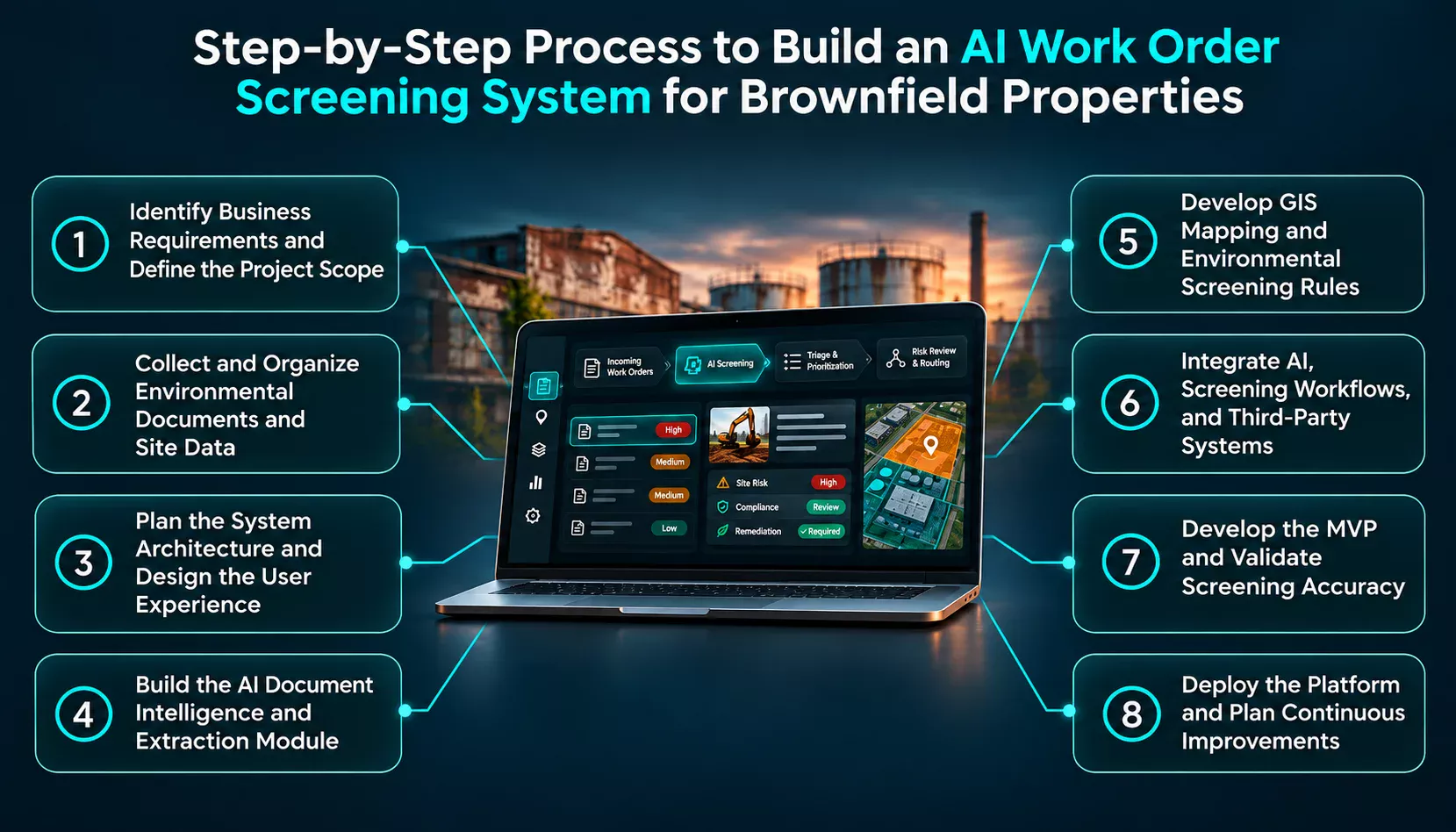
Start by identifying why the organization needs an AI work order screening system and which operational problems it should address. Determine whether the primary objective is to prevent work in known contamination areas, reduce manual document reviews, identify missing information, or improve contractor coordination.
Define the users, including contractors, environmental consultants, project managers, and site engineers. Document the work order types the system must screen, such as excavation, drilling, grading, trenching, and utility installation.
Consult environmental professionals and technical stakeholders through AI consultation to establish realistic requirements, user roles, expected outputs, and boundaries for automated decisions. Clear requirements provide the foundation for building an AI work order screening system for brownfield properties without adding unnecessary features.
Also Read: Top 10 AI Consulting Companies in USA
Identify and organize the information the AI system will use for screening. Gather Phase I and Phase II Environmental Site Assessment reports, remedial action plans, environmental monitoring records, historical land use documents, site investigation reports, and existing work orders.
Pay particular attention to recognized environmental conditions, contaminants of concern, sampling locations, groundwater monitoring points, and documented land use restrictions.
Convert scanned documents into searchable formats and organize files by property, report type, date, and source. Check for missing information, duplicate records, and inconsistent location references. Before full development, use PoC development to test whether representative reports can be processed and relevant environmental information can be extracted reliably.
Also Read: Top 10+ AI PoC Development Companies In USA
Once the requirements and data sources are clear, define how the platform's major components will work together. The architecture may include a document management module, AI processing layer, environmental data repository, GIS integration, screening rules engine, work order module, and approval dashboard.
Plan how users will submit work orders, view site information, receive alerts, and access supporting environmental documents. Collaborate with a UI/UX design company to create simple interfaces for contractors and technical reviewers.
The design should clearly distinguish between routine notifications, potential environmental conflicts, incomplete information, and work orders requiring specialist review. Include access to source documents so users can understand the evidence behind each screening result.
Also Read: Top 10+ UI/UX Design Companies in USA
Develop the AI capabilities that allow the platform to read environmental documents and extract information relevant to work order screening. This module may use OCR, document classification, natural language processing, and large language models to process scanned reports, tables, maps, and technical descriptions.
For example, the system should identify documented contaminants, recognized environmental conditions, sampling locations, and relevant site restrictions. Extracted information should be converted into structured records that can be searched and connected to specific properties.
During AI model development, use representative environmental reports and expert-reviewed examples to evaluate extraction quality. Preserve references to original documents and page locations so environmental professionals can verify the information before relying on it.
Also Read: Top 12+ AI Model Development Companies in the USA
The platform must connect environmental information with the actual locations of proposed site activities. Integrate GIS capabilities to map property boundaries, recognized environmental conditions, monitoring locations, and other documented areas requiring attention.
Next, develop site-specific screening rules for different work activities. For example, if a contractor submits an excavation request within or near a mapped area of concern, the system should identify the potential overlap and generate an appropriate warning.
Organizations evaluating top AI real estate software development companies should look for experience with geospatial applications, property data management, and location-based workflows. Screening logic must also account for coordinate accuracy, location uncertainty, overlapping boundaries, and incomplete site records.
Connect the document intelligence module, GIS layer, environmental repository, and screening rules engine into one working application. Through AI integration, the platform should retrieve relevant site information, analyze submitted work orders, compare proposed activities with environmental records, and present evidence-based screening results.
Add workflow automation for assigning work orders, notifying reviewers, requesting missing documents, and tracking approval status. AI automation services can support these repetitive administrative tasks and reduce manual coordination.
Integrate existing project management, document storage, and GIS platforms where required. Route uncertain findings and potential environmental conflicts to qualified reviewers rather than allowing automated processes to approve high-risk activities.
Also Read: Top 10+ AI Automation Companies in USA
Before developing every planned feature, create an MVP with the essential screening workflow. Include work order submission, environmental document retrieval, AI-based information extraction, GIS-based location checks, screening alerts, and human approval.
During MVP development, test the solution with historical work orders and representative project documentation in a controlled environment. Evaluate whether the system identifies relevant environmental conditions, detects potential location conflicts, and provides accurate references to supporting reports.
Involve environmental engineers and site reviewers in testing. Record false alerts, missed conflicts, incorrect extractions, and usability issues. Their feedback should guide improvements before the platform is introduced across active brownfield projects.
Also Read: Top 10 AI MVP Development Companies in USA
After validation, prepare the system for production deployment. Configure user permissions, secure document access, encryption, audit logs, backups, system monitoring, and integrations with existing business applications.
Train contractors and internal teams to submit work orders, interpret screening alerts, review supporting documents, and follow escalation procedures. Establish a process for updating environmental records and screening rules whenever new site investigations or applicable regulatory requirements become available.
When selecting top AI development companies or AI product development companies, evaluate their experience with environmental data processing, GIS, enterprise software, and AI-enabled workflows. You can also hire AI developers with relevant technical experience to support system maintenance, model evaluation, and future improvements.
A well-planned development process helps transform environmental reports and work order data into a practical screening platform that supports safer, better-informed decisions across brownfield projects.
The cost to develop an AI work order screening system for brownfield properties typically ranges from $30,000 to $200,000+, depending on the system's complexity, AI capabilities, environmental data requirements, GIS integration, and workflow automation. A basic platform with document processing and work order classification requires a smaller development budget than an enterprise-grade solution with predictive risk analysis, multi-property management, and advanced integrations.
The development budget of an AI work order screening system for brownfield properties should account for more than software development. It may also include environmental data preparation, AI model development, cloud infrastructure, testing, security, and ongoing maintenance.
Consider this project requirement: “I am a project manager at a large developer, and cleanup costs on our brownfield sites keep overrunning because work orders are approved without anyone checking them against the remediation budget and approved cleanup plan. I want a screening system that compares each work order to scope and budget, highlights out-of-scope items, and routes risky ones to a human reviewer.”
For this type of requirement, the cost estimation of an AI work order screening system for brownfield properties depends on how accurately the platform must interpret remediation plans, compare work orders with approved budgets, identify scope deviations, and support human approval. The following AI work order screening system development cost breakdown provides indicative pricing for three development levels.
| System Type | Estimated Development Cost | Included Capabilities |
|---|---|---|
| Basic AI Work Order Screening System | $30,000 to $60,000 | Includes work order submission, basic document upload, OCR-based text extraction, AI-powered work order classification, simple environmental document retrieval, predefined screening rules, basic alerts, and reviewer approval workflows. Suitable for smaller projects or organizations validating an initial screening process. |
| AI Work Order Screening System | $60,000 to $120,000 | Includes advanced document intelligence, extraction of environmental conditions, remediation plan references, GIS integration, work order-to-scope comparison, basic budget validation, risk categorization, automated notifications, reporting, and configurable approval workflows. Suitable for developers and consulting firms managing multiple brownfield projects. |
| Enterprise-Grade AI Work Order Screening System | $120,000 to $200,000+ | Includes multi-property management, advanced AI document analysis, remediation scope and budget comparisons, geospatial risk screening, custom AI models, ERP and project management integrations, role-based access, detailed audit trails, advanced analytics, and configurable human escalation workflows. Suitable for large developers and organizations managing complex brownfield portfolios. |
The final development pricing of an AI work order screening system for brownfield properties can change considerably based on the following factors:
1. AI Model Complexity: Basic document classification costs less than custom AI models that interpret environmental reports, remediation plans, work order descriptions, and budget documents together.
2. Environmental Document Processing: Processing searchable PDFs is generally simpler than handling scanned reports, complex tables, historical records, maps, and inconsistent document formats that require advanced OCR and extraction.
3. GIS and Mapping Integration: Connecting property boundaries, recognized environmental conditions, contamination areas, and proposed work locations increases development effort, particularly when spatial data needs cleaning or validation.
4. Remediation Scope and Budget Validation: Comparing work orders against approved cleanup plans, contract scope, cost codes, and remaining remediation budgets requires additional business logic and financial data integration.
5. Workflow Automation: Automated work order routing, escalation rules, approval levels, notifications, and exception handling add development time based on the number of user roles and approval conditions.
6. Third-Party Integrations: Connecting the platform with ERP software, accounting systems, project management tools, GIS platforms, and document management solutions can increase integration and testing costs.
7. Data Security and Compliance Requirements: Enterprise access controls, encryption, audit trails, document retention policies, and secure data exchange add to infrastructure and implementation expenses.
8. Testing and Environmental Expert Validation: Testing AI extraction accuracy, location matching, budget comparisons, and risk alerts requires representative project data and review by qualified environmental and financial professionals.
9. Cloud Infrastructure and Maintenance: Hosting, document storage, AI processing, monitoring, model updates, and technical support contribute to the ongoing cost of operating the platform after launch.
The right AI work order screening system for brownfield properties should be priced according to its screening complexity, environmental data requirements, and budget-control capabilities, not just the number of features. A phased development approach can help control the initial investment while allowing the platform to expand as project requirements grow.
The tech stack for an AI brownfield work order screening system determines how effectively the platform processes environmental reports, extracts site information, maps potential contamination areas, and screens proposed work orders. A reliable technology foundation should combine AI and machine learning, document processing, geospatial services, databases, cloud infrastructure, and secure application development.
For example, a redevelopment company may ask: “Which technologies should we use to build a system that reads Phase II environmental reports, maps recognized environmental conditions, compares contractor work orders with remediation plans and budgets, and flags activities that need human approval?”
The answer depends on the system's expected scale, document formats, data quality, integration requirements, and screening complexity. Below is a recommended AI work order screening system technology stack, with the purpose of each technology layer and suitable options.
| Technology Layer | Recommended Technologies | Purpose and Implementation |
|---|---|---|
| Frontend Development | React.js, Next.js, Angular | Builds the user interface for contractors, environmental consultants, project managers, and reviewers. These frameworks support work order submission forms, document viewers, screening dashboards, approval workflows, and property-level data visualization. |
| Backend Development | Python, FastAPI, Django, Node.js | Handles application logic, user requests, document processing workflows, screening rules, APIs, and communication between system modules. Python is particularly useful when the platform relies heavily on AI and environmental data processing. |
| AI and Machine Learning | PyTorch, TensorFlow, scikit-learn, Hugging Face Transformers | Supports document classification, work order categorization, anomaly detection, risk prioritization, and custom machine learning workflows. Model selection depends on the available training data and the specific screening task. |
| Large Language Models (LLMs) | OpenAI API, Azure OpenAI, Anthropic Claude | Helps interpret environmental reports, summarize relevant findings, extract information from technical documents, and answer questions using approved project records. Outputs should include source references and remain subject to human verification. |
| OCR and Document Processing | AWS Textract, Azure AI Document Intelligence, Tesseract | Extracts text, tables, and relevant fields from scanned Phase I and Phase II reports, remediation plans, work orders, and other environmental documents. Document processing tools help convert unstructured files into searchable information. |
| Retrieval-Augmented Generation (RAG) | LangChain, LlamaIndex, vector search | Connects AI responses with relevant environmental reports, site records, remediation requirements, and previous work orders. RAG helps retrieve supporting information instead of relying only on an LLM's general knowledge. |
| Geospatial and GIS Integration | PostGIS, GeoServer, QGIS, Mapbox | Stores and displays property boundaries, recognized environmental conditions, monitoring locations, and proposed work areas. Spatial analysis helps identify potential overlaps between work order locations and mapped environmental concerns. |
| Database Management | PostgreSQL, PostGIS, MongoDB | Stores property records, work orders, extracted environmental information, screening results, user details, and geospatial data. PostgreSQL with PostGIS is a strong option when structured records and location-based queries are central to the application. |
| Vector Database | pgvector, Pinecone, Weaviate | Stores document embeddings and supports semantic retrieval across environmental reports and project records. This helps users retrieve relevant information even when a work order uses different terminology from the original environmental document. |
| Cloud Infrastructure | AWS, Microsoft Azure, Google Cloud Platform | Provides scalable infrastructure for application hosting, document storage, AI processing, databases, backups, and monitoring. The final provider should align with organizational security policies, data residency needs, and existing enterprise systems. |
| API and System Integration | REST APIs, GraphQL, webhooks | Connects the screening platform with ERP systems, project management software, accounting applications, document repositories, and external GIS services. These integrations support work order tracking and remediation budget comparisons. |
| Authentication and Security | OAuth 2.0, OpenID Connect, AWS IAM, Azure Entra ID | Manages user authentication, role-based access, permissions, and secure communication. Different access levels can be defined for contractors, project managers, environmental engineers, and administrators. |
| DevOps and Deployment | Docker, Kubernetes, GitHub Actions, Terraform | Supports application packaging, automated testing, deployment, infrastructure management, and system scaling. These tools help maintain consistent development and production environments as the platform expands. |
| Monitoring and Analytics | Prometheus, Grafana, ELK Stack, cloud monitoring services | Tracks application performance, processing failures, API activity, AI response quality, and system availability. Monitoring helps development teams identify operational issues and maintain reliable screening workflows. |
The ideal tech stack combines AI, document intelligence, GIS, and secure backend services to deliver reliable work order screening while keeping environmental and financial decisions under qualified human oversight.
Implementing AI in brownfield workflows requires accurate environmental data, transparent screening rules, and qualified human oversight. When you develop an AI work order screening system for brownfield properties, these practices help ensure the platform can identify potential site risks, reduce manual reviews, and improve contractor coordination.
A common buyer query is: “How can we build an AI work order screening system that checks contractor activities against Phase II environmental reports, identifies contamination risks, and prevents high-risk work orders from being approved without an environmental engineer's review?”
To create a reliable solution, organizations should consider the following five best practices for AI work order screening system development.
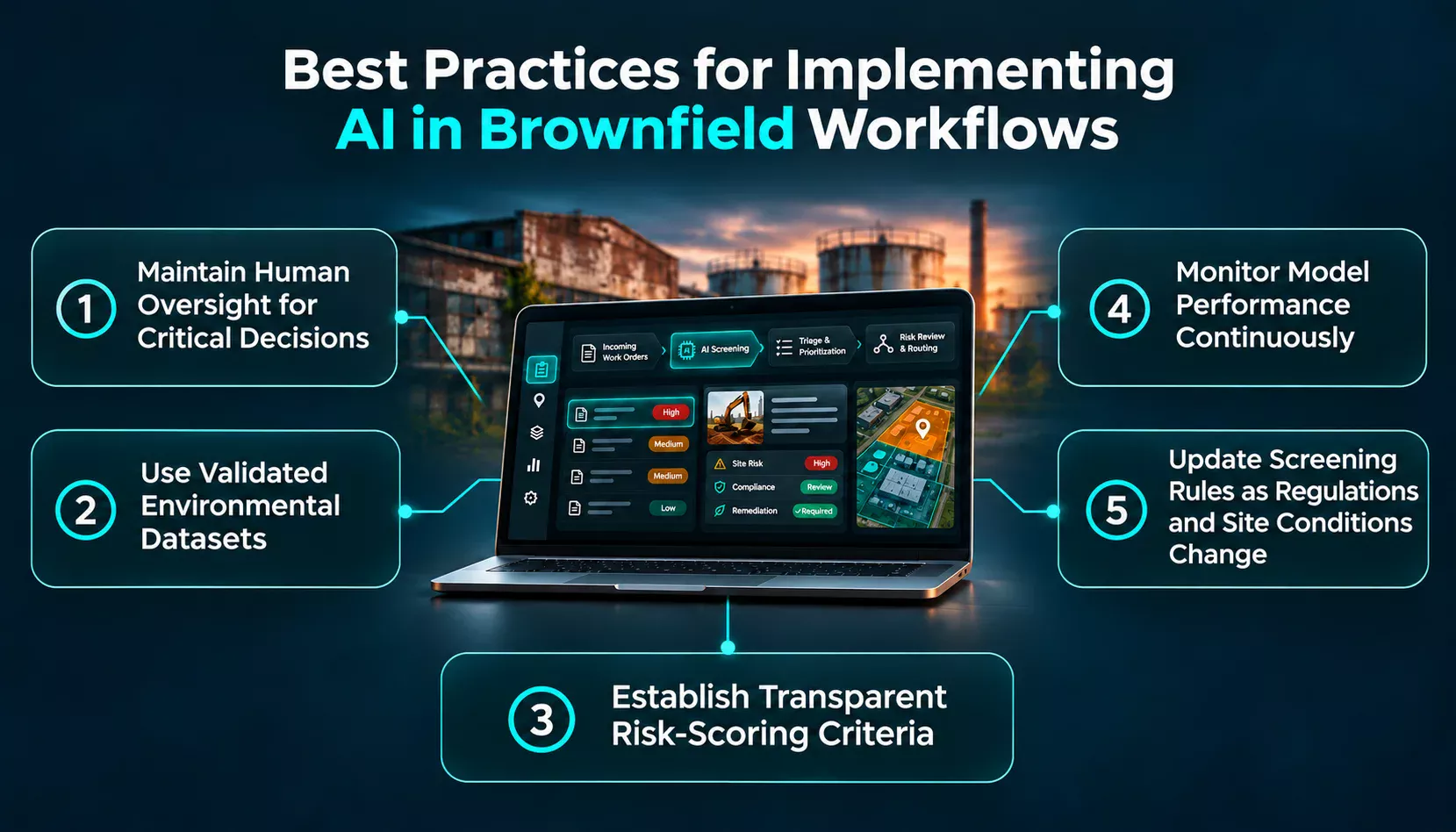
When you build an AI-assisted work order screening platform, design human approval into the workflow, especially for activities involving contaminated soil, groundwater, or restricted areas.
The quality of an AI screening system depends on the accuracy and relevance of its environmental data. During AI work order screening software development, prioritize verified, current, and property-specific information.
To create an AI work order screening system for brownfield properties that users can trust, make its risk classifications understandable and traceable.
Continuous monitoring helps maintain AI screening accuracy as environmental documents, contractor activities, and project requirements evolve. Include performance evaluation as part of the system's development and maintenance plan.
When developing an AI-powered brownfield work order management system, make screening rules configurable so the platform can adapt to new environmental findings and changing project requirements.
Following these practices helps organizations develop a reliable AI work order screening solution that improves environmental risk identification, strengthens approval workflows, and supports safer brownfield redevelopment while keeping critical decisions under professional oversight.
Measuring the performance of an AI-assisted work order screening system for brownfield properties helps organizations understand whether the platform is improving environmental reviews, identifying potential risks, and reducing delays in work order approvals. Performance measurement should cover AI accuracy, environmental screening quality, workflow efficiency, and user adoption.
A common buyer question is: “How can we measure whether our AI work order screening system is accurately identifying work orders that conflict with known contamination areas, reducing manual review time, and preventing unplanned remediation costs?”
To answer this, organizations should track the following key performance indicators (KPIs) after developing and deploying their AI work order screening solution.
| Performance Metric | What It Measures | Why It Matters |
|---|---|---|
| Document Extraction Accuracy | Measures how accurately the system extracts contaminants, recognized environmental conditions, site restrictions, and other relevant information from environmental reports. | Helps determine whether the AI can reliably interpret Phase I and Phase II reports and provide useful information for screening decisions. |
| Work Order Classification Accuracy | Measures how correctly the system categorizes submitted work orders by activity type, location, and screening requirements. | Helps ensure excavation, drilling, trenching, and other activities receive the appropriate screening process. |
| Environmental Conflict Detection Rate | Measures how effectively the platform identifies work orders that may overlap with documented contamination areas or restricted site locations. | Helps reduce the likelihood of potential environmental conflicts going unnoticed before work begins. |
| False Positive Rate | Tracks how often the system flags work orders that reviewers determine do not present the identified concern. | Helps reduce unnecessary alerts and prevent environmental reviewers from spending time investigating irrelevant warnings. |
| Screening Turnaround Time | Measures the time required to process a work order and generate its initial screening result. | Shows whether AI automation is reducing manual document review time and helping project teams process work orders more efficiently. |
| Human Review and Escalation Rate | Tracks the percentage of work orders routed to environmental engineers or other authorized reviewers. | Helps evaluate whether automated screening is correctly identifying cases that require professional judgment. |
| Out-of-Scope Work Order Detection | Measures how effectively the platform identifies proposed activities that fall outside approved remediation plans, project scope, or budget limits. | Helps project managers identify potential scope deviations and unplanned costs before approving work. |
| User Adoption Rate | Measures how frequently contractors, engineers, and project managers use the platform and complete their assigned workflows. | Indicates whether the system fits existing operational processes and provides practical value to its users. |
| Audit Trail Completeness | Measures whether screening results, source documents, reviewer decisions, rule changes, and approval records are properly captured. | Supports accountability, internal reviews, and traceability of work order screening decisions. |
After deployment, use these KPIs to identify areas requiring improvement.
Regular KPI monitoring helps organizations improve AI screening accuracy, strengthen environmental oversight, and measure the real operational value of their brownfield work order screening system.
The future of AI-assisted work order screening development for brownfield redevelopment will focus on making environmental reviews more predictive, connected, and automated. As redevelopment projects become more data-intensive, developers and environmental consulting firms will increasingly need intelligent software that can interpret environmental reports, identify potential site conflicts, validate proposed activities, and support faster work order decisions.
A key industry question is: “How will AI work order screening systems help brownfield developers detect environmental risks earlier, compare contractor activities with remediation requirements, and manage multiple redevelopment sites more efficiently?”
Several emerging technologies and capabilities are expected to influence the next generation of AI-powered brownfield work order screening platforms.
Future AI systems may move beyond identifying documented environmental concerns to predicting which proposed activities require additional investigation or review.
Predictive outputs will still require validation by qualified environmental professionals.
Digital twins can provide a connected digital representation of brownfield properties by combining spatial, environmental, and infrastructure information.
Also Read: AI Avatar Development for Real Estate: A Complete Guide for Brokers & Property Developers
AI agents may increasingly support multi-step work order screening workflows by coordinating document retrieval, data validation, rule checks, and reviewer notifications.
Human approval will remain essential for critical environmental decisions.
Also Read: Real Estate AI Agent Development: From Concept to Development
Future platforms may combine GIS data, updated site records, and work order information to provide more responsive location-based screening.
AI-assisted platforms may become more capable of comparing proposed work orders with remediation budgets, approved cleanup plans, and contractual scope.
Integration between environmental databases, GIS platforms, ERP systems, project management software, and document repositories will make work order screening more connected.
The future of AI work order screening development will combine predictive intelligence, geospatial analysis, and workflow automation to help brownfield developers make more informed decisions while maintaining environmental and financial oversight.
An AI work order screening system for brownfield properties must process complex environmental documents, interpret site-specific conditions, and evaluate proposed activities against applicable remediation requirements.
A common buyer query is: “What challenges should we expect when creating an AI work order screening system that reads Phase II environmental reports, identifies work near contamination areas, checks contractor activities against approved remediation plans, and flags potential risks for human review?”
Understanding these challenges early helps organizations plan a more reliable AI work order screening system for brownfield properties. Here are six major challenges and practical ways to resolve them.
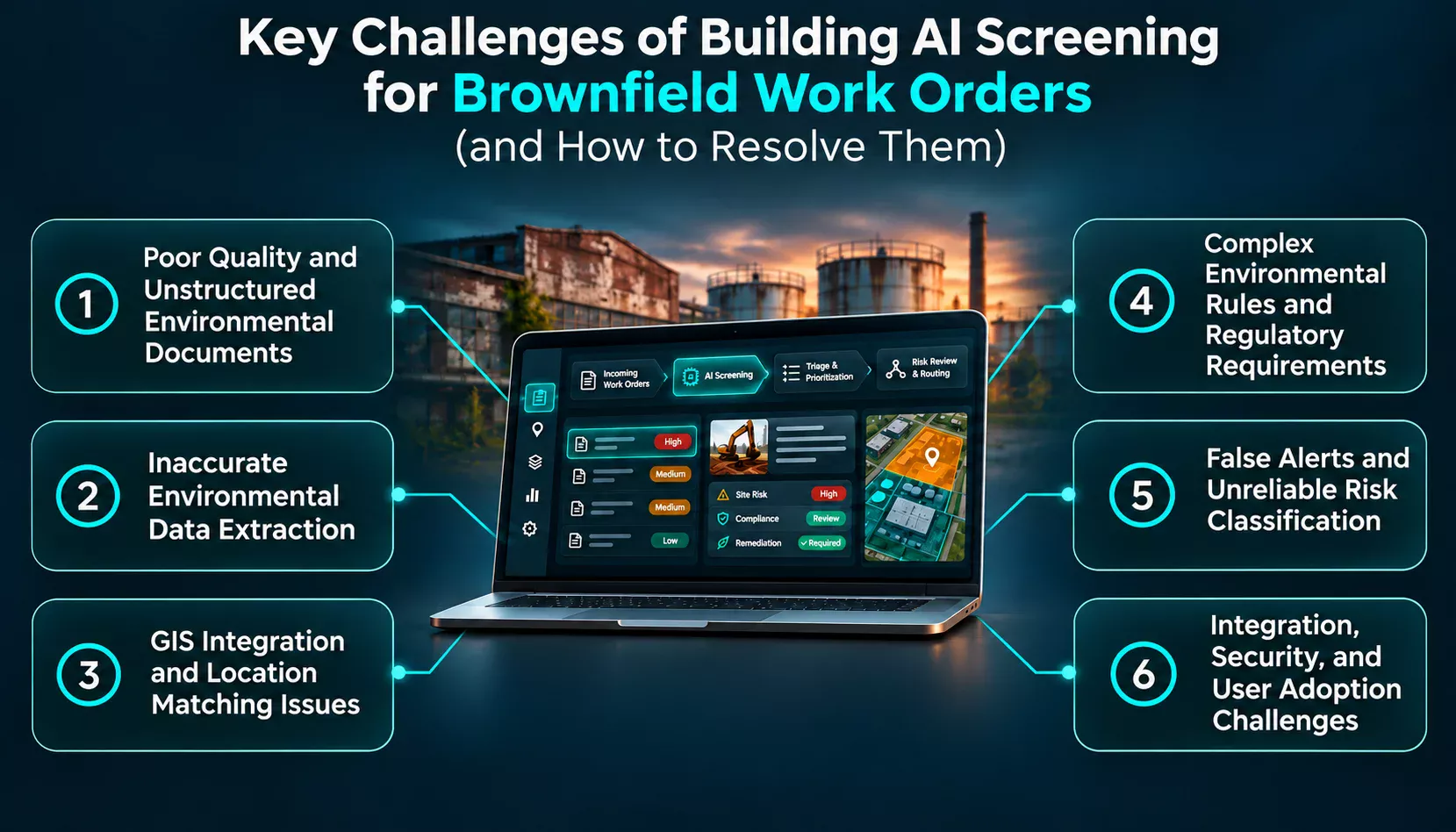
Environmental reports often contain scanned pages, complex tables, historical records, technical terminology, and inconsistent formatting. These issues can make it difficult for AI systems to extract accurate information.
How to resolve it:
AI models may misinterpret contaminant names, sampling results, recognized environmental conditions, or site restrictions. Incorrect extraction can lead to unreliable screening results.
How to resolve it:
Connecting work order locations with environmental concern areas can be difficult when site maps use different coordinate systems, incomplete boundaries, or inconsistent location descriptions.
How to resolve it:
Brownfield properties may have different remediation plans, permits, land use restrictions, and site-specific requirements. Applying one set of screening rules across every property can produce misleading results.
How to resolve it:
An AI system may generate unnecessary warnings or fail to identify important conflicts. Excessive false alerts can reduce user trust, while missed risks can create safety and project delivery concerns.
How to resolve it:
The screening platform may need to connect with existing ERP, GIS, document management, accounting, and project management systems. Contractors and internal teams may also resist adopting another application if it complicates their existing workflows.
How to resolve it:
Addressing these six challenges early helps organizations create a more accurate, secure, and practical AI work order screening system that supports environmental risk identification and better brownfield project decisions.
Businesses managing brownfield redevelopment projects need software that can interpret environmental reports, identify potential contamination-related conflicts, compare proposed activities with remediation requirements, and route high-risk work orders to qualified reviewers. PixelBrainy, a leading real estate AI software development company, provides AI-assisted work order screening system development services for brownfield properties, helping environmental firms and real estate developers turn complex screening requirements into practical AI-powered software solutions.
Our team understands that every brownfield property has different environmental records, site conditions, remediation requirements, and approval workflows. We focus on developing solutions that connect AI capabilities with real project operations.
PixelBrainy provides technology expertise to organizations looking to modernize environmental work order screening and brownfield project management.
Organizations looking to build an AI-assisted work order screening system for brownfield properties can work with PixelBrainy to define the technical architecture, essential features, and development roadmap. We begin by understanding existing environmental review processes, identifying data sources, and mapping workflows that need automation.
Already have a property management or work order application? PixelBrainy can help develop an AI-assisted work order screening system for brownfield properties by extending existing software with property-specific screening rules, intelligent document retrieval, and configurable risk alerts.
For organizations starting with a new platform, we can create an AI-assisted work order screening system for brownfield properties integrating AI with verified environmental records, GIS platforms, ERP software, and project management applications. This approach helps make screening results easier to review, trace, and incorporate into existing project operations.
In a confidential project for a property-focused business, our development team worked on an AI-enabled property operations solution designed to streamline document handling and maintenance workflows.
The project involved:
This was not a brownfield environmental screening deployment. However, its technical components demonstrate relevant experience in combining AI capabilities, document intelligence, and operational workflows.
Connect with PixelBrainy to discuss your AI work order screening requirements and plan a software solution for your brownfield redevelopment operations.
Developing an AI-assisted work order screening system for brownfield properties is an important step toward making environmental reviews more efficient, consistent, and data-driven. By combining AI-powered document processing, GIS mapping, environmental risk identification, remediation scope validation, and automated approval workflows, organizations can identify potential conflicts before contractors begin site activities.
However, successful implementation requires more than advanced technology. Accurate environmental datasets, transparent screening rules, reliable integrations, continuous performance monitoring, and qualified human oversight are essential to building a dependable solution.
For environmental consulting firms and real estate developers, investing in AI work order screening system development can improve project coordination, reduce avoidable rework, strengthen budget oversight, and support better-informed brownfield redevelopment decisions. The right development approach should align with your operational requirements, environmental workflows, and long-term business goals.
Ready to streamline your brownfield work order screening process? Book an appointment with PixelBrainy to discuss your AI software development requirements and plan your next project.
An AI-assisted work order screening system for brownfield properties is software that analyzes contractor work orders against environmental reports, site conditions, and remediation requirements. It identifies potential conflicts, flags missing information, and routes work orders requiring additional review to qualified environmental professionals.
To develop an AI work order screening system for brownfield properties from scratch, start with requirement analysis, environmental data preparation, and system architecture. Then implement AI document processing, GIS mapping, screening rules, approval workflows, and integrations. Validate screening results before production deployment.
The cost to develop an AI work order screening system for brownfield properties typically ranges from $30,000 to $200,000+. Pricing depends on AI capabilities, GIS integration, document processing, remediation budget validation, third-party integrations, security requirements, and overall application complexity.
The core features of an AI-assisted work order screening system include work order management, AI document classification, OCR processing, environmental data extraction, GIS mapping, site-specific screening rules, risk categorization, automated notifications, and engineer approval workflows. Advanced options include predictive risk analysis and budget validation.
Yes. An AI work order screening system for brownfield properties can combine extracted environmental information with GIS data to compare proposed work locations against documented contamination areas. It can flag potential overlaps, retrieve supporting reports, and notify reviewers. Location accuracy and professional verification remain essential.
The development process of an AI work order screening system for brownfield properties depends on document complexity, AI requirements, GIS capabilities, integrations, and testing needs. A basic MVP may take approximately 8 to 12 weeks, while an advanced enterprise platform may require several months.
Yes. Building an AI work order screening system for brownfield properties with budget validation capabilities allows the platform to compare contractor requests against approved remediation plans, project budgets, and cost codes. It can flag potential scope deviations and route exceptions to authorized project managers.
When choosing a partner for AI work order screening system development for brownfield properties, evaluate its experience in document intelligence, GIS integration, enterprise software, workflow automation, and secure data management. Also assess its testing approach and ability to include environmental professional oversight.

About The Author
Sagar Bhatnagar
Sagar Sahay Bhatnagar brings over a decade of IT industry experience to his role as Marketing Head at PixelBrainy. He's known for his knack in devising creative marketing strategies that boost brand visibility and market influence. Sagar's strategic thinking, coupled with his innovative vision and focus on results, sets him apart. His track record of successful campaigns proves his ability to utilize digital platforms effectively for impactful marketing efforts. With a genuine passion for both technology and marketing, Sagar continuously pushes PixelBrainy's marketing initiatives to greater success.

Working with PixelBrainy has been a great experience. They took our vision for an AI-powered platform and turned it into a fully functional product. What impressed me most was their strong understanding of both design and development, and their ability to handle complex requirements with ease. The team was responsive, cooperative, and always open to feedback. They kept things organized, communicated clearly, and delivered quality work on time. I highly recommend PixelBrainy to anyone looking for a skilled and reliable development partner.

Working with the PixelBrainy team has been a highly positive experience. They understand the design requirements and create beautiful UX elements to meet the application needs. The dev team did an excellent job bringing my vision to life. We discussed usability and flow. Sagar worked with his team to design the database and begin coding. Working with Sagar was easy. He has the knowledge to create robust apps, including multi-language support, Google and Apple ID login options, Ad-enabled integrations, Stripe payment processing, and a Web Admin site for maintaining support data. I'm extremely satisfied with the services provided, the quality of the final product, and the professionalism of the entire process. I highly recommend them for Android and iOS Mobile Application Design and Development.

Great experience working with them. Had a lot of feedback and I found that unlike most contractors they were bugging me for updates instead of the other way around. They were extremely time conscience and great at communicating! All work was done extremely high quality and if not on time, early! They were always proactive when it comes to communication and the work is great/above par always. Very flexible and a great team to work with! Goes above and beyond to present us with multiple options and always provides quality. Amazing work per usual with Chitra. If you have UI/UX or branding design needs I recommend you go to them! Will likely work with them in the future as well, definitely recommended!

PixelBrainy is a joy to work with and is a great partner when thinking through branding, logo, and website layout. I appreciate that they spend time going into the "why" behind their decisions to help inform me and others about industry best practices and their expertise.

I hired them to design our software apps. Things I really like about them are excellent communication skills, they answer all project suggestions and collaborate right away, and their input on design and colors is amazing. This project was complex and needed patience and creativity. The team is amazing to do business with. I will be using them long-term. Glad to see there are some good people out there. I was afraid to try and outsource my project to someone but I am glad I met them! I really can't say enough. They went above and beyond on this project. I am very happy with everything they have done to make my business stand out from the competition.

It was great working with PixelBrainy and the team. They were very responsive and really owned the project. We'll definitely work with them again!

I recently worked with the PixelBrainy team on a project and I was blown away by their communication skills. They were prompt, clear, and articulate in all of our interactions. They listened and provided valuable feedback and suggestions to help make the project a success. They also kept me updated throughout the entire process, which made the experience stress-free and enjoyable.

PixelBrainy is very good at what it does. The team also presents themselves very professionally and takes care of their side of things very well. I could fully trust them taking up the design work in a timely and organised manner and their attention to detail saved us lots of effort and time. This particular project was quite intense and the team showed that they function very well under pressure. Very much looking forward to working with her again!

It's always an absolute pleasure working with them. They completed all of my requests quickly and followed every note I had for them to a T, which made our process go smoothly from start to finish. Everything was completed fast and following all of the guidelines. And I would recommend their services to anyone. If you need any design work done in the future, PixelBrainy should be your first call!

They took ownership of our requirements and designed and proposed multiple beautiful variants. The team is self-motivated, requires minimum supervision, committed to see-through designs with quality and delivering them on time. We would definitely love to work with PixelBrainy again when we have any requirements.

PixelBrainy was a big help with our SaaS application. We've been hard at work with a new UI/UX and they provided a lot of help with the designs. If you're looking for assistance with your website, software, or mobile application designs, PixelBrainy and the team is a great recommendation.

PixelBrainy designers are amazing. They are responsive, talented, and always willing to help craft the design until it matches your vision. I would recommend them and plan to continue them for my future projects and more!!!

They were awesome! Did a good job fast, and good communication. Will work with them again. Thank you

Creative, detail-oriented, and talented designers who take direction well and implement changes quickly and accurately. They consistently over-delivered for us.

PixelBrainy team is very talented and creative. Great designers and a pleasure to work with. PixelBrainy is an excellent communicator and I look forward to working with them again.

PixelBrainy has a very talented design team. Their work is excellent and they are very responsive. I enjoy working with them and hope to continue on all of our future projects.


Transform your ideas into reality with us.
Across these industries, each engagement brings unique challenges, from early-stage product development to scaling complex systems, helping us build a practical understanding of real-world product environments.