AI Summary Powered by PixelBrainy
Can your clinical expertise become the foundation of an AI-powered mental health business that supports thousands of patients beyond traditional therapy sessions? For licensed clinical psychologists, starting an AI mental health business in 2027 presents an opportunity to combine clinical knowledge with technology, improve continuity of care, and build a scalable company without replacing the human connection at the heart of therapy.
The market opportunity is substantial. According to the World Health Organization's 2025 World Mental Health Today report, more than one billion people worldwide live with mental health conditions. Read the original WHO report. Additionally, Grand View Research estimates that the global AI in mental health market could reach $2.1 billion in 2026 and grow to $9.1 billion by 2033. These projections highlight potential commercial opportunities, although actual demand and profitability will depend on execution.
For a clinical psychologist with twelve years of experience, the opportunity could begin with a familiar problem: patients often need support between appointments to practice therapeutic techniques, track mood changes, and maintain progress. An AI-powered platform could offer guided cognitive behavioral therapy (CBT) exercises, daily mood tracking, personalized psychoeducation, and clinician-reviewed progress summaries.
However, AI mental health business opportunities extend beyond consumer applications. Founders can explore subscriptions, therapist-facing software, employer-sponsored wellness platforms, and business-to-business solutions for behavioral health organizations.
Understanding how to launch an AI mental health company requires more than building a chatbot. You must validate customer demand, recruit technical expertise, develop a sustainable revenue model, protect sensitive health information, and understand applicable healthcare regulations.
This AI healthcare mental health launch guide explains the practical steps involved in starting an AI mental health business in 2027, from choosing the right niche and finding a technical co-founder to estimating startup costs, securing funding, and acquiring paying customers.
The key is to start with one clearly defined clinical problem, develop a safe and useful solution, and validate its commercial potential before scaling.

Launching an AI mental health business in the United States requires balancing clinical credibility, technical performance, user trust, and commercial sustainability. Many founders focus on building an impressive AI product before establishing whether it solves a problem that customers will pay to address.
In 2027, the most resilient companies will be those that treat clinical safety and commercial validation as core business requirements rather than issues to address after launch.
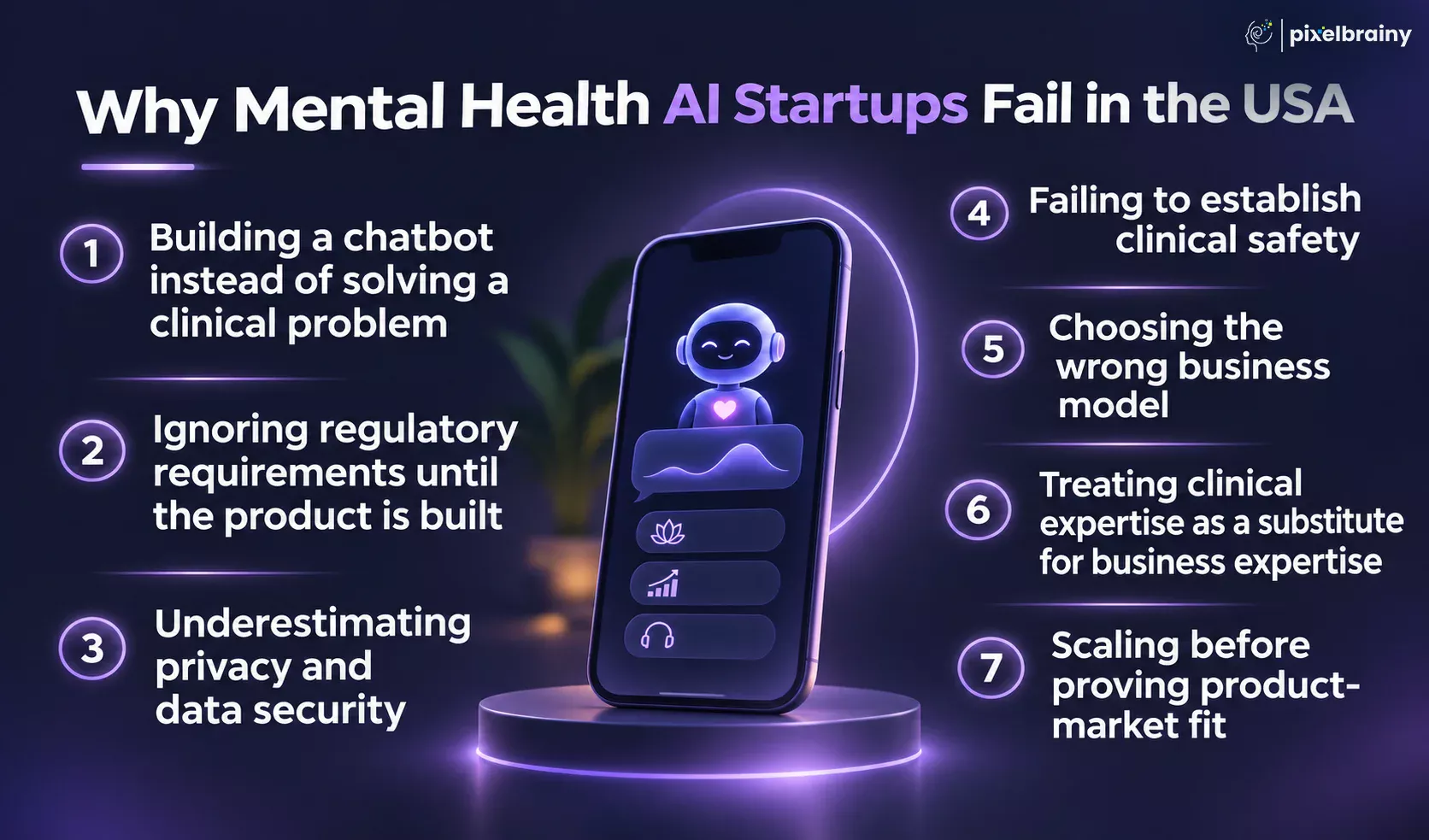
A conversational AI interface is relatively easy to demonstrate. Creating a reliable mental health product that consistently delivers useful, safe, and measurable outcomes is considerably more difficult.
A general-purpose chatbot may provide empathetic responses, but that does not establish its effectiveness for managing anxiety, supporting CBT exercises, or identifying people who need urgent professional intervention.
How to avoid this failure: Start with one clearly defined problem. For example, help adults already receiving therapy complete structured CBT homework between appointments. Define measurable outcomes such as exercise completion, patient engagement, and clinician-reported usefulness.
Founders sometimes assume that describing a product as a wellness application prevents healthcare regulation from applying. That assumption can create substantial legal and financial exposure.
A product that provides general stress-management information may receive different regulatory treatment from software intended to diagnose depression, recommend treatment, or make clinical decisions.
The US Food and Drug Administration evaluates a software function based partly on its intended use and functionality. The founder's marketing claims, product design, and actual capabilities all matter.
How to avoid this failure: Conduct a regulatory assessment before finalizing product requirements. Have qualified counsel review the intended use, clinical claims, risk classification, and potential FDA pathway.
Mental health platforms can collect highly sensitive information, including mood histories, medication information, therapy-related disclosures, and indications of suicidal thoughts.
A single data breach or unauthorized disclosure can undermine user trust, damage commercial partnerships, and create significant legal costs.
How to avoid this failure: Design privacy protections into the product from the beginning. Use encryption, access controls, audit logs, data minimization, secure authentication, and documented retention and deletion policies. Determine whether HIPAA or other federal and state privacy requirements apply.
Crisis detection is particularly challenging because AI can misunderstand language, overlook indirect expressions of distress, or incorrectly classify harmless statements as emergencies.
A system that promises to detect every crisis creates unrealistic expectations. A system that alerts clinicians without a workable response process may also introduce operational risks.
How to avoid this failure: Establish clinical escalation protocols, test false negatives and false positives, define human oversight responsibilities, and make clear that automated monitoring is not a substitute for emergency services.
A founder may attract thousands of free users without developing a viable business. Consumer subscription products often require continuous spending on customer acquisition, engagement, retention, and support.
Enterprise products can offer larger contracts, but sales cycles may be longer because buyers need security reviews, procurement approvals, evidence of effectiveness, and integration support.
How to avoid this failure: Interview paying customers before committing to a revenue model. Test willingness to pay with a paid pilot, employer-sponsored deployment, or provider subscription.
A licensed psychologist brings valuable knowledge of patient needs, therapeutic methods, and clinical workflows. However, running a technology company also requires product management, engineering, financial planning, distribution, and organizational leadership.
How to avoid this failure: Build a complementary founding team. The psychologist should lead clinical strategy and product validation while an experienced technical co-founder leads architecture, development, and engineering execution. Bring in commercial and regulatory expertise as needed.
High download numbers and positive early feedback do not necessarily demonstrate clinical value or sustainable revenue.
Founders can waste capital expanding into multiple conditions, age groups, and markets before proving that one product solves one important problem.
How to avoid this failure: Establish measurable launch milestones. Demonstrate repeat usage, customer retention, safe product performance, and willingness to pay before expanding.
Therefore, the strongest AI mental health startups do not compete solely on how advanced their AI appears. They compete on clinical usefulness, trustworthy implementation, clear differentiation, and a business model that can support long-term operations.
Also Read: Top 10+ AI Mental Health App Development Companies In USA
Which AI mental health business offers the most realistic path to revenue for a licensed clinical psychologist with twelve years of experience and no technical or business background? The answer depends on your clinical expertise, target customers, available funding, and ability to validate demand before investing heavily in development.
For founders exploring AI mental health business opportunities in 2027, the strongest starting point is often a focused product that solves an existing problem for therapists, patients, or healthcare organizations. The following six business models offer different opportunities for recurring revenue, market differentiation, and long-term growth.
An AI-powered mood tracking platform helps patients record emotions, complete structured therapeutic exercises, practice coping techniques, and prepare for their next therapy appointment. For a clinical psychologist, this business model directly addresses the challenge of supporting patients between scheduled sessions.
Example: A therapist subscribes to a platform that allows patients to complete mood check-ins and clinician-approved CBT exercises between sessions. The therapist reviews a structured progress summary before the next appointment.
AI copilots support clinicians with administrative and information-management tasks, including summarizing patient-reported mood trends, preparing session notes, organizing documentation drafts, and reviewing between-session activity.
Example: A behavioral health practice purchases an AI copilot that drafts session summaries for clinician review, reducing repetitive administrative work without independently making treatment decisions.
Employer-sponsored platforms give organizations a way to provide digital wellness resources to employees. Depending on their scope, these products may offer stress-management exercises, self-guided CBT activities, wellbeing check-ins, and navigation to professional support.
Example: An employer purchases an annual subscription for employees to access structured stress-management resources, with reporting designed to protect individual privacy.
Measurement-based care software helps clinicians collect patient-reported outcomes, visualize changes over time, and review treatment engagement. AI may assist with organizing information, summarizing trends, or identifying records that need human review.
Example: A group practice uses a progress dashboard to review patient-reported anxiety scores over time. The system summarizes changes for the treating clinician rather than independently recommending treatment adjustments.
Digital CBT programs deliver structured exercises for concerns such as anxiety, stress, sleep difficulties, or low mood. AI can help users navigate approved content, reflect on their experiences, and select relevant educational materials within predefined boundaries.
Example: A psychologist develops a structured anxiety-management program with guided CBT exercises, progress tracking, and clear pathways to professional support when users need additional care.
Clinical risk monitoring software helps authorized care teams review predefined warning signals, route alerts, and document follow-up actions. These systems require particularly careful design because missed alerts and unnecessary escalations can both have serious consequences.
Example: A behavioral health organization uses a predefined alert workflow to route concerning patient-reported responses to an authorized care team under an established response protocol. The system does not promise to detect every crisis or replace emergency services.
Therefore, for a psychologist entering technology without a business or engineering background, between-session support and therapist-facing AI copilots are two promising models to validate first. They build on your existing clinical knowledge, address recognizable problems, and offer potential subscription revenue without necessarily starting with autonomous diagnosis or high-risk clinical decision-making.
The best AI mental health business opportunity is ultimately the one that solves a specific, validated problem, meets appropriate safety and regulatory requirements, and gives customers a compelling reason to pay for it repeatedly.
Also Read: AI Mental Health First Aid App Development: Benefits, Key Features, and Costs
The success of an AI mental health startup often depends on one decision made before development begins: choosing a problem that customers genuinely need solved and are willing to pay to address. For a licensed clinical psychologist with twelve years of experience, the strongest opportunity may lie in translating clinical knowledge into a focused digital product rather than competing with established consumer mental wellness applications.
However, what AI mental health business ideas have the most potential in 2027 depends on more than market demand. Founders must consider clinical safety, regulatory complexity, revenue potential, evidence requirements, and competition. This is particularly important for professionals entering technology without an established engineering team or business background.
The Five-Dimension Niche Evaluation Framework
Assess the potential harm associated with your product and the regulatory requirements its intended use may trigger. General wellness, stress management, sleep improvement, and psychoeducation tools may present lower clinical risk. Products supporting psychiatric diagnosis, medication management, or crisis intervention require more extensive safety controls and may fall under FDA medical device regulation. A lower-risk product is not automatically exempt from other applicable laws.
Evaluate the number of potential customers, their purchasing power, and the realistic revenue opportunity. Employer mental health benefits, health plans, and health systems can offer substantial contract opportunities. Consumer subscriptions and therapist productivity tools may provide more accessible entry points, although their growth depends on retention, pricing, and customer acquisition costs.
Determine the evidence buyers expect before adopting your solution. Health systems and payers may require clinical outcomes data, security assessments, and evidence of operational value. Employer wellness buyers may prioritize usability and employee participation. Consumer products also need appropriate evidence for any clinical claims they make.
Identify who pays for the product and how payments are collected. Consumer subscriptions and employer-funded contracts can offer relatively direct revenue pathways. Insurance reimbursement may require eligible billing codes, coverage criteria, payer agreements, and supporting evidence, making revenue slower and less predictable.
General meditation applications and therapy-matching platforms face substantial competition. Opportunities for differentiation may exist in therapist workflow automation, condition-specific digital support, and population mental health analytics. Validate demand through customer interviews and paid pilots rather than assuming that AI functionality alone creates a competitive advantage.
| AI mental health niche | Clinical risk | Market opportunity | Evidence requirements | Time to revenue | Competition |
|---|---|---|---|---|---|
| General wellness and stress management | Low | Large consumer market | Low to moderate | Short potential sales cycle | Very high |
| AI CBT and DBT tools | Medium | Consumer and employer | Moderate to high | Medium | High |
| Crisis detection and intervention | Very high | Health systems and providers | Very high | Long | Medium |
| Employee mental wellness | Low to medium | Large employer market | Moderate | Medium | High |
| Therapist productivity tools | Low to medium | Clinicians and practices | Low to moderate | Short to medium | Moderate to high |
| Psychiatric medication management | High | Healthcare organizations | High to very high | Long | Varies |
| Substance use recovery | Medium to high | Providers and payers | High | Medium to long | Medium |
| Sleep and anxiety management | Low to medium | Large consumer market | Depends on intended claims | Short to medium | Very high |
| Population mental health analytics | Depends on use | Payers and employers | Moderate to high | Medium to long | Varies |
| AI peer support platforms | Medium | Consumer and employer | Moderate | Medium | Medium |
These are directional business-planning assessments, not measured market rankings or definitive regulatory classifications. Actual requirements depend on intended use, functionality, evidence, and applicable law.
For a first-time clinical founder, therapist productivity software or clinician-supervised between-session support may offer a practical balance of clinical relevance, manageable development scope, and recurring revenue potential.
The best AI mental health startup niche in 2027 is one where your clinical expertise addresses a validated customer problem, the product can be developed responsibly, and a realistic route to paying customers exists before significant capital is committed.
Launching an AI mental health company requires a structured approach that combines clinical expertise, product development, regulatory planning, and commercial validation. For licensed clinical psychologists entering the technology industry, the priority is to validate the business opportunity before committing substantial capital to software development.
This AI mental health startup launch guide outlines eight practical steps to help founders move from a clinical insight to a tested product with a credible path to revenue.
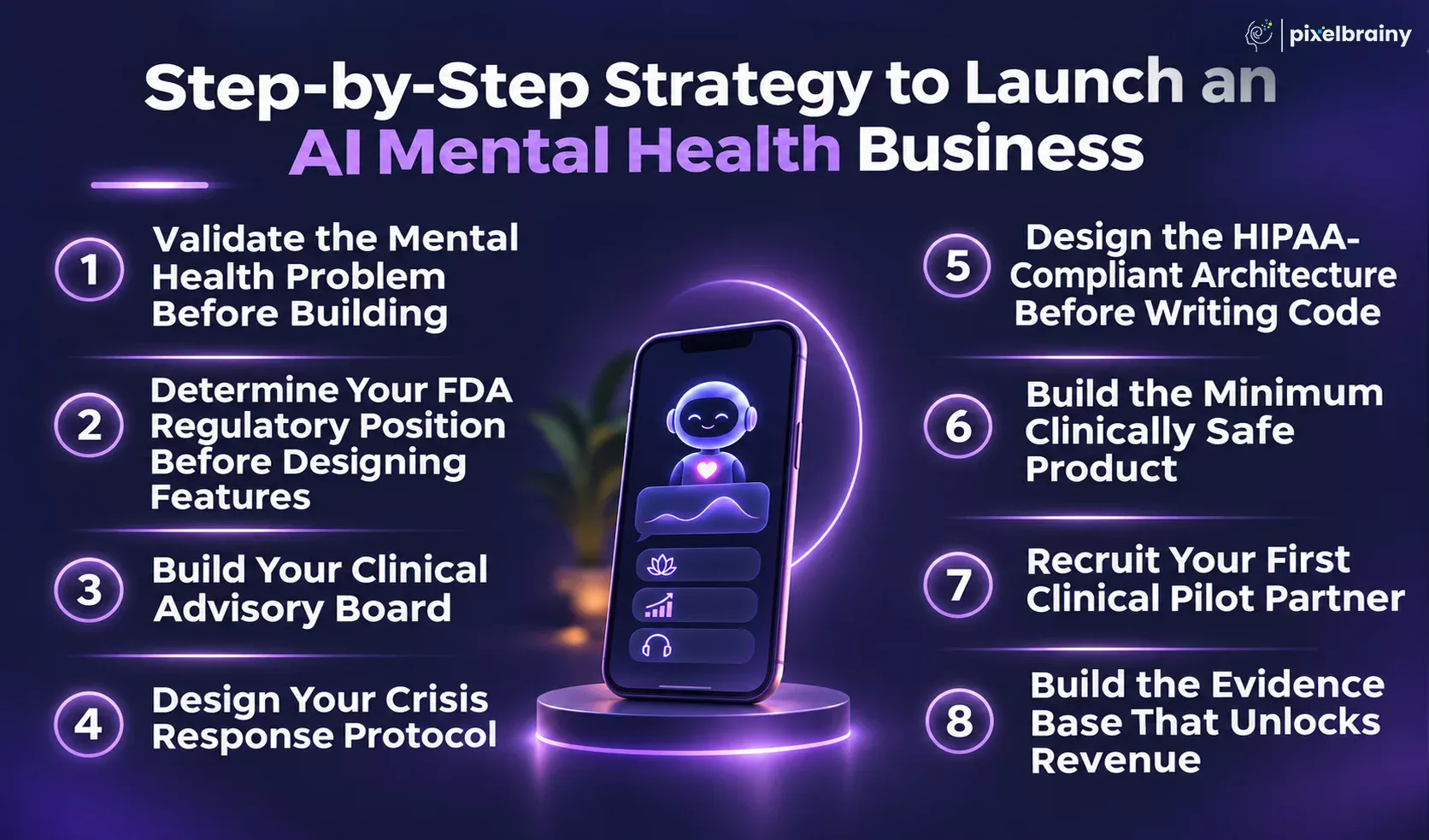
Before developing an application, conduct structured interviews with at least 20 to 30 potential users, clinicians, and buyers in your target market. Determine whether the problem is a genuine priority, how people currently address it, and whether the intended buyer is willing to pay for a better solution.
For example, patients may struggle with CBT exercises between sessions, but you must establish whether therapists or patients would pay for a dedicated platform. Document existing alternatives, purchasing barriers, and measurable outcomes.
Consult qualified FDA regulatory counsel before finalizing features and marketing claims. Determine whether your intended use could classify the software as a medical device and whether clearance, authorization, or another regulatory pathway may be required.
If your core functionality involves diagnosis, treatment recommendations, or clinical risk assessment, incorporate potential regulatory costs, evidence requirements, and timelines into your product roadmap and fundraising strategy.
Recruit three to five qualified mental health professionals, such as licensed clinical psychologists, psychiatrists, or licensed clinical social workers, to provide structured clinical oversight.
Your advisors should review therapeutic content, AI response boundaries, clinical claims, and safety procedures before public deployment. Establish clear responsibilities, review schedules, and documented approval processes rather than relying on informal feedback.
Before introducing features that users might access during emotional distress, develop a documented crisis response protocol with qualified clinical professionals.
Define how the system handles concerning messages, what responses are appropriate, when human escalation occurs, and how users access crisis resources. Test missed signals, false alarms, system outages, and situations where no clinician is available.
Never promise continuous crisis monitoring unless the service genuinely provides it.
Work with a qualified privacy or security consultant to determine whether HIPAA applies and design the architecture around the relevant obligations.
Implement appropriate encryption, role-based access controls, audit logs, data minimization, retention policies, and secure authentication. Where required, execute business associate agreements with relevant vendors and service providers before protected health information is shared.
Remember that HIPAA does not automatically apply to every mental health application. Other federal and state privacy requirements may still apply.
Develop an MVP containing only the features needed to demonstrate the product's primary value. For a between-session support platform, these might include mood tracking, approved CBT exercises, progress summaries, and clearly defined support pathways.
Test functionality, privacy, AI reliability, and safety before inviting users. Clinical review and appropriate safeguards must not be sacrificed to meet a launch deadline.
Identify one clinical practice or behavioral health organization that matches your intended customer profile and has the capacity to evaluate the product responsibly.
Agree on pilot objectives, evaluation methods, responsibilities, and success criteria in advance. Depending on the intended use, measure usability, engagement, workflow efficiency, safety incidents, and appropriate clinical outcomes.
Obtain necessary approvals and consent, protect participant information, and seek independent research or ethics guidance where appropriate.
Analyze your pilot findings and communicate them accurately through commercial case studies, conference presentations, white papers, or peer-reviewed publications where appropriate.
Evidence of usability or workflow improvements can support early sales. Claims about symptom improvement, treatment effectiveness, or clinical safety require evidence suitable for those specific claims.
Use validated findings to strengthen your investor pitch, enterprise sales materials, and regulatory strategy. Do not present preliminary pilot results as definitive proof of effectiveness.
The most effective way to build an AI mental health company from scratch is to validate demand, establish clinical and regulatory safeguards, and test the smallest useful product before scaling. This step-by-step approach reduces avoidable risks and creates a stronger foundation for customer trust, fundraising, and sustainable revenue.
Also Read: How To Build An AI Mental Health and Wellness App Like Wysa?
Building an AI mental health platform in the United States requires more than clinical expertise and technical development. Founders must understand healthcare privacy laws, FDA requirements, state licensing rules, and consumer protection obligations before launching their products.
Knowing what regulations apply to an AI mental health startup in the USA helps founders make informed decisions about product features, development costs, and market entry.
Effective AI mental health startup regulatory compliance begins with identifying the product's intended use, the health information it processes, and the services it provides.
The Health Insurance Portability and Accountability Act (HIPAA) protects health information handled by covered entities and their business associates. If your platform processes protected health information on behalf of a covered healthcare provider, you may need to implement:
State laws may impose further restrictions on mental health information.
To understand how to navigate HIPAA compliance when starting an AI mental health business, map your data flows, review vendor relationships, establish appropriate consent procedures, and implement secure data storage. HIPAA does not automatically apply to every consumer mental health application, although other privacy laws may apply.
The US Food and Drug Administration (FDA) distinguishes certain low-risk general wellness tools from software intended for medical purposes. Classification depends on intended use, functionality, and marketing claims.
Founders should:
General stress-management and sleep education tools may fall outside device regulation when applicable criteria are met. However, describing a product as a wellness app does not automatically exempt it from FDA oversight.
AI platforms that facilitate therapy or provide professional mental health services must consider state licensing, telehealth, consent, and scope-of-practice requirements.
Key considerations include:
For founders developing AI mental health platforms for licensed clinicians, these requirements are particularly important when expanding into additional states.
AI mental health applications must handle disclosures of distress carefully. Before launching features that may encounter crisis-related messages, establish clinically reviewed protocols covering:
Do not promise continuous crisis monitoring unless the service genuinely provides it. In the United States, people experiencing a mental health crisis can call or text 988 for the Suicide & Crisis Lifeline. Immediate life-threatening emergencies warrant 911.
The Federal Trade Commission (FTC) can take action against deceptive marketing, unfair data practices, and unsupported health claims. Certain consumer health applications may also be subject to the FTC Health Breach Notification Rule.
To strengthen AI mental health app privacy and compliance, founders should:
The key to responsible AI mental health startup regulatory compliance is to assess legal obligations before development, protect sensitive information, and obtain qualified clinical and regulatory advice before launch. Review these requirements regularly as your product features, customer base, and operating jurisdictions expand.
How much does it cost to start an AI mental health business in the USA in 2027? The estimated initial investment can range from $25,000 to $250,000 or more, depending on product complexity, AI development requirements, healthcare compliance, clinical validation, and team structure. A basic AI-powered wellness or therapist productivity tool may require a smaller budget, while a clinically advanced platform involving medical device regulation, complex integrations, or clinical studies can cost substantially more.
For clinical psychologists planning to launch an AI mental health startup without a technical or business background, understanding these expenses is essential. Your budget must cover more than software development. It should also account for security, regulatory guidance, testing, marketing, and operating expenses before revenue becomes predictable.
The following figures are illustrative planning estimates for a US-based startup, not verified industry averages or vendor quotations.
| Startup Expense | Estimated Cost |
|---|---|
| Market research and business planning | $2,000 to $8,000 |
| AI software development and MVP | $10,000 to $100,000+ |
| Cloud infrastructure and AI APIs | $1,000 to $10,000 |
| Healthcare software and EHR integrations | $3,000 to $25,000+ |
| HIPAA assessment, cybersecurity, and legal services | $5,000 to $25,000+ |
| Clinical validation and regulatory consulting | $5,000 to $75,000+ |
| Initial marketing and customer acquisition | $4,000 to $20,000 |
These expenses may overlap, and the total can exceed $250,000 when the product requires extensive clinical research, specialized engineering, or a formal FDA regulatory pathway. The estimates also exclude some potential costs, including founder salaries and extended operating runway.
A mood-tracking application with structured CBT exercises generally requires less development than a platform intended to diagnose mental health conditions or support clinical risk assessments. More advanced functionality can increase engineering, testing, and validation expenses.
Your costs depend on whether you recruit a technical co-founder, hire employees, or work with an AI healthcare development company. A technical co-founder may reduce immediate cash expenditure but will typically require an equity arrangement. A development agency may offer faster access to a team but charge more upfront.
Privacy assessments, legal agreements, security testing, and regulatory consulting can add substantially to your budget. If your product qualifies as a regulated medical device, additional evidence and regulatory requirements may increase costs beyond the initial estimate.
Connecting your platform to electronic health records (EHRs), clinical practice management systems, or other healthcare services may require specialized development, vendor agreements, integration testing, and ongoing maintenance.
Plan for AI model usage, cloud hosting, customer support, insurance, software maintenance, and sales expenses. Healthcare organizations may take months to complete procurement, security reviews, and purchasing approvals, delaying revenue.
To manage your initial investment:
Overall, starting an AI mental health business in the USA in 2027 may require $25,000 to $250,000 or more, depending on the product's complexity and regulatory requirements. Validate your business idea, prioritize essential features, and budget for clinical safety and customer acquisition to build a sustainable AI mental health company.
Also Read: How to Develop an AI Teletherapy App?
Funding an AI mental health business in 2027 depends on your product’s clinical purpose, development stage, evidence requirements, and target customers. For a licensed clinical psychologist entering the healthcare technology market, the best approach is to match funding sources with business goals rather than raising a large amount before validating demand.
If you are researching how to fund an AI mental health startup in the USA, consider these four funding options.
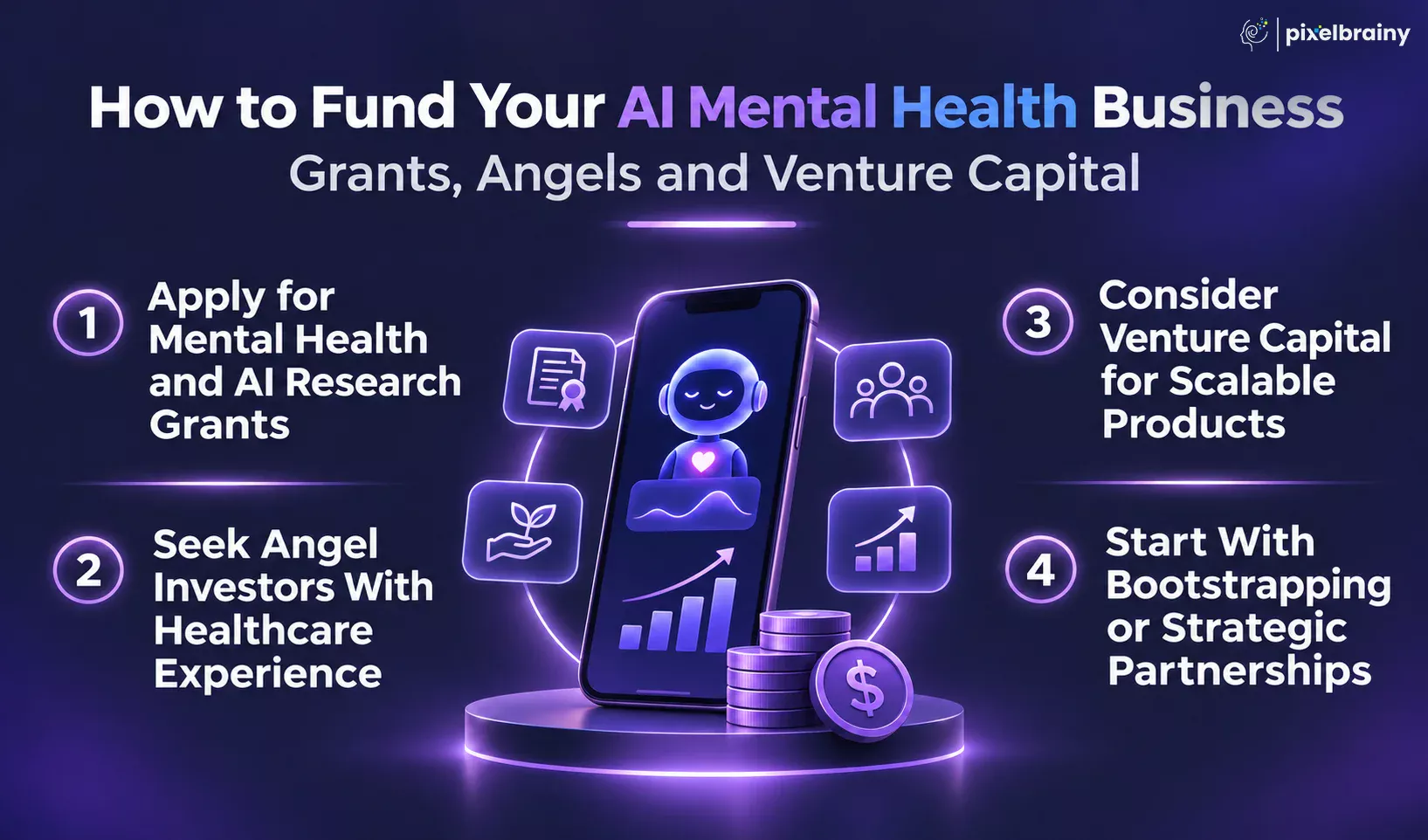
Grants can help fund early research, clinical validation, and responsible AI development without requiring founders to give up equity. They may be particularly useful if your product focuses on evidence-based CBT exercises, mood tracking, suicide prevention research, or improving access to mental healthcare.
Explore opportunities through:
Eligibility, funding availability, and program requirements vary. Check current opportunities before building your financial plan around a grant.
Angel investors provide early-stage capital, often in exchange for equity. Look for investors familiar with digital health, behavioral healthcare, healthcare software, or clinical AI.
When pitching your AI mental health business, explain the clinical problem, target customer, revenue model, privacy safeguards, and evidence supporting the product. A working prototype and feedback from therapists or pilot customers can strengthen your pitch.
Venture capital may suit AI mental health startups targeting large markets, such as employer-sponsored mental wellness, therapist productivity software, or measurement-based care platforms.
Investors typically want evidence of customer demand, recurring revenue potential, a defensible product, and a credible path to growth. Products making clinical claims may also need a clear regulatory strategy and appropriate clinical evidence.
If you are exploring how to start an AI mental health company with limited funding, consider bootstrapping, paid pilot programs, or partnerships with clinics, universities, and employers. These approaches can help validate demand before you pursue institutional investment.
Prepare a concise business plan covering startup costs, milestones, expected revenue, clinical safety, and funding needs. Raise enough to reach the next meaningful milestone rather than funding every future feature upfront.
The right funding strategy combines financial sustainability with clinical responsibility. Start by validating demand and exploring non-dilutive funding, then approach investors when you can demonstrate a credible product, evidence plan, and path to revenue.
A successful AI mental health startup go-to-market strategy in 2027 requires more than launching an app. You need to identify the right customers, demonstrate clinical value, address privacy concerns, and build a repeatable sales process. For a psychologist entering the AI healthcare market, focusing on one buyer segment first can reduce costs and simplify early growth.
Avoid targeting employers, hospitals, health plans, and individual consumers simultaneously in your first year. Choose the segment where your product solves a clear problem, your clinical expertise provides an advantage, and purchasing decisions are more achievable.
For example, if you develop an AI-powered mood tracking and CBT platform, mid-sized employers may be a practical starting point. Their procurement processes can be shorter than those of large health systems, although timelines and evidence requirements vary. Hospitals and health plans may offer larger contracts but often require extensive security reviews, integrations, and clinical validation.
Clinical evidence helps distinguish your product from generic wellness apps and unvalidated AI tools. Run a pilot that measures relevant outcomes, such as user engagement, changes in validated symptom scores, or improved access to support.
If you are researching how to sell AI mental health software to employers and health systems, lead with the problem you solve and the evidence you have collected. Report results accurately, including limitations, rather than promising guaranteed improvements. Clinical champions, such as behavioral health directors or occupational health leaders, can help build internal support.
The employer mental health benefit sales cycle often involves several stakeholders:
Prepare a sales package covering clinical evidence, privacy safeguards, AI limitations, crisis response procedures, implementation, and pricing. Addressing safety and data protection early can help prevent delays.
Mental Health Awareness Month in May and World Mental Health Day on October 10 offer opportunities to publish educational content, host webinars, and build media visibility. Licensed clinicians on your team can share evidence-informed insights about responsible AI, mood tracking, and digital CBT.
For example, if an employer asks, “How can we offer AI mental health support without compromising employee privacy?”, publish a practical guide answering that question. This addresses a real buyer concern while improving visibility across search engines and AI-generated answers.
Start with one well-defined buyer segment, credible clinical evidence, and clear privacy and safety safeguards. Use measurable pilot results to build trust and expand into larger markets.
Also Read: AI Avatar Development for Mental Health App: Benefits, Costs, and Use Cases
Building the right team is essential when launching an AI mental health business in the USA. Success requires more than AI development skills. You need clinical expertise, reliable software engineering, privacy and regulatory knowledge, and the ability to turn a mental health solution into a sustainable business.
The ideal AI mental health startup team structure in 2027 depends on your product. An AI mood tracking app may require a different team from a clinical decision support platform or an AI-powered CBT tool.
If you are researching how to build an AI mental health startup team, prioritize three core capabilities:
Together, these capabilities help ensure your product addresses a genuine mental health need while remaining technically reliable and commercially viable.
Your first hires should address the biggest risks to product development and adoption.
You do not need to hire every specialist full-time at launch. Consultants, fractional executives, and clinical advisors can provide expertise while you validate the business model.
If you are a clinical psychologist without a technology background, consider partnering with a technical co-founder who understands AI product development and software security. You can contribute clinical knowledge, customer insights, and intervention expertise while your technical partner leads engineering.
Create a clinical advisory board with relevant professionals who can review product functionality, evaluate potential risks, and provide feedback. Also, interview prospective customers and observe real clinical workflows before committing to expensive development.
| Stage | Essential Roles | Primary Hiring Priority |
|---|---|---|
| Pre-seed | Founder, technical co-founder, clinical advisor, legal consultant | Validate the problem and build a safe MVP |
| Seed | AI engineers, product designer, clinical specialist, sales lead | Improve the product and secure pilot customers |
| Series A | Expanded engineering, clinical research, compliance, sales, and customer success teams | Demonstrate outcomes and scale customer acquisition |
| Series B | Clinical science leadership, regulatory team, marketing, enterprise sales, and operations | Expand into new markets and support larger customers |
Therefore, the best team for an AI mental health business combines clinical credibility, technical execution, responsible AI practices, and commercial experience. Hire according to your product's risk level and business stage rather than building a large team before demand is proven.
Launching an AI mental health business in 2027 requires more than a promising idea and advanced technology. Founders must balance clinical safety, credible evidence, user engagement, and a sustainable revenue model. If you are wondering “What are the biggest mistakes to avoid when starting an AI mental health business?”, five common pitfalls deserve attention before you invest heavily in development.
Addressing them early can help protect users, reduce costly setbacks, and build a business that customers trust.
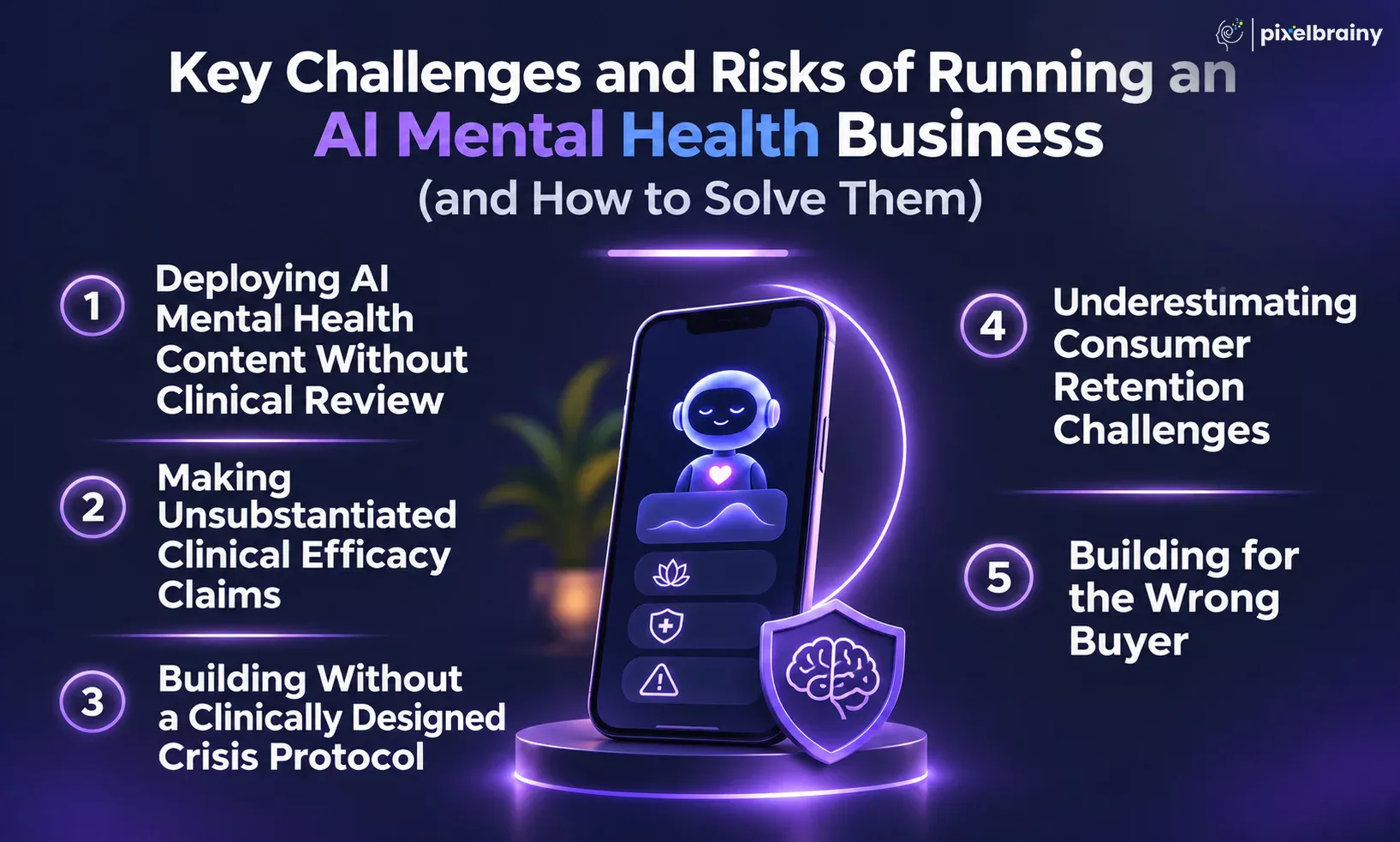
AI-generated mental health advice can be inaccurate, inappropriate, or unsuitable for someone experiencing distress. Unreviewed clinical content can create safety risks and damage customer trust.
How to avoid it: Establish a clinical governance process. Have qualified mental health professionals review clinical content, test AI responses across realistic scenarios, and define clear limits on what the system can safely provide. Continue monitoring performance after launch.
Claiming that an AI mental health app treats anxiety, reduces depression, or improves clinical outcomes without sufficient evidence can attract regulatory scrutiny and undermine credibility.
How to avoid it: Match every clinical claim to appropriate evidence. Seek regulatory advice before making treatment claims, and ensure marketing materials accurately communicate the product's capabilities, limitations, and supporting research.
An AI platform may encounter messages indicating suicidal thoughts, severe distress, or another urgent mental health concern. Without a carefully designed response process, the system may fail to direct users toward appropriate help.
How to avoid it: Design and clinically review crisis protocols before launch. Define escalation procedures, explain the system's limitations, test high-risk scenarios, and provide appropriate pathways to human support and emergency resources.
Acquiring users does not guarantee that they will continue using your product. Mental health apps may struggle with engagement if they offer generic advice, create too much friction, or fail to demonstrate ongoing value.
How to avoid it: Test engagement during pilot programs, measure repeat usage and user feedback, and improve the experience based on real needs. Avoid building revenue forecasts around optimistic retention assumptions.
A common startup mistake is developing a consumer app and later trying to sell it to hospitals, or creating a clinical tool that does not meet employer requirements.
How to avoid it: Before development, identify four roles: who uses the product, who benefits, who pays, and who approves the purchase. Interview prospective customers to confirm that these roles align and that the problem is worth paying to solve.
To validate an idea before development, interview potential customers, test demand with a simple prototype, and secure pilot commitments where possible. Once you establish product-market fit, focus on improving clinical safeguards, strengthening retention, and expanding through repeatable sales channels.
Avoiding these mistakes starts with clinical oversight, evidence-based claims, early customer validation, and realistic retention planning. Build responsibly, prove demand, and scale only when your product and operating processes are ready.
Turning a mental health AI idea into a market-ready product requires clinical understanding, AI engineering, privacy-conscious development, and a clear business strategy. If you are wondering “How do I build an AI mental health app that is secure, clinically responsible, and ready for market?”, choosing the right development partner early can help you define product requirements, reduce technical risks, and avoid expensive development mistakes.
PixelBrainy is an AI mental health app development company in USA market that can support founders in planning and developing AI-powered digital products. From validating an initial concept to building a minimum viable product (MVP), the goal is to align technology with user needs, clinical workflows, and business objectives.
PixelBrainy's software development capabilities can support different stages of an AI mental health startup launch strategy, depending on the project's requirements.
Clinical review, regulatory assessment, and independent security validation remain important parts of developing a responsible mental health product.
| What founders need | How a development partner can help |
|---|---|
| Product strategy | Translate a validated business idea into clear product requirements |
| AI development | Build AI features suited to the product's intended purpose |
| Privacy and security | Incorporate appropriate safeguards into the architecture |
| Clinical safety planning | Support implementation of defined safety requirements and escalation workflows |
| MVP development | Focus development on essential features and early user feedback |
| Long-term scalability | Plan architecture and enhancements around future business requirements |
For founders researching how to choose an AI mental health app development company in the USA, evaluate a partner's relevant project experience, security practices, development process, integration capabilities, and approach to clinical safety. Confirm which services the company provides and whether specialist clinical or regulatory expertise must be sourced separately.
Whether you are a licensed psychologist, healthcare entrepreneur, or technology founder, PixelBrainy may be a development partner to consider when turning an AI mental health business idea into a working product.
Ready to explore your product idea? Contact PixelBrainy to discuss your requirements, development priorities, and potential roadmap.

Starting an AI mental health business in 2027 offers an opportunity to combine clinical expertise with technology to address growing mental healthcare needs. However, success depends on more than developing an AI-powered app. Founders must identify a validated market need, choose the right business model, understand US regulatory requirements, protect sensitive user data, and establish a sustainable revenue strategy.
If you are exploring how to start an AI mental health business in 2027, begin with a focused problem, such as AI-powered mood tracking, guided CBT exercises, or therapist support tools. Validate demand before investing heavily in development, involve licensed mental health professionals in product design, and prioritize clinical safety from day one.
Building the right team and choosing an experienced development partner can also help turn your idea into a scalable product. With careful planning, responsible AI implementation, and a clear go-to-market strategy, you can build a business that supports users while pursuing long-term growth.
Ready to turn your AI mental health idea into a product? Book an appointment with PixelBrainy to discuss your vision and development roadmap.
To start an AI mental health business in 2027, identify a specific mental healthcare problem, validate demand, choose a business model, and develop a minimum viable product (MVP). Address clinical safety, data privacy, and applicable US regulations before launch. Start with a focused audience, test the product, and expand based on customer feedback and evidence.
Promising AI mental health business opportunities in 2027 include AI-powered mood tracking, guided CBT exercises, therapist productivity tools, employer-sponsored mental wellness platforms, and measurement-based care solutions. The right opportunity depends on customer demand, clinical evidence, competition, development costs, and the availability of paying customers.
The estimated cost to start an AI mental health startup in the USA can range from $25,000 to $250,000 or more, depending on product complexity, AI development, security, integrations, and clinical validation. A focused MVP can help control initial spending, but founders should budget separately for legal guidance, ongoing maintenance, and customer acquisition.
AI mental health app regulations in the USA may involve HIPAA, state consumer health privacy laws, FTC requirements, professional licensing rules, and FDA oversight for certain medical software. Requirements depend on the product's intended use, claims, users, and data practices. Consult qualified legal and regulatory professionals before launching.
Yes. A psychologist can start an AI mental health company without coding skills by partnering with a technical co-founder or an experienced AI app development company. Clinical expertise helps define user needs and guide intervention design, while technical partners can manage software architecture, AI implementation, testing, and deployment.
To build a HIPAA-compliant AI mental health app, first determine whether HIPAA applies to your organization and its activities. Where required, implement appropriate access controls, encryption, risk assessments, vendor agreements, and safeguards for protected health information. Also evaluate state privacy laws and establish clinically reviewed crisis response procedures. HIPAA compliance alone does not guarantee overall product safety or legal compliance.
To sell AI mental health software to employers, identify a specific workforce mental health need and demonstrate how your solution addresses it. Prepare evidence of product performance, transparent pricing, privacy documentation, and implementation plans. Engage HR and benefits leaders early, understand their purchasing process, and use pilot programs to establish credibility before pursuing larger contracts.
When choosing an AI mental health app development company in the USA, assess its AI engineering experience, healthcare software expertise, privacy and security practices, integration capabilities, and approach to clinical safety. Request relevant project examples, transparent cost estimates, and a clear development roadmap. Confirm who will handle clinical validation, regulatory assessment, and post-launch support before committing.

About The Author
Sagar Bhatnagar
Sagar Sahay Bhatnagar brings over a decade of IT industry experience to his role as Marketing Head at PixelBrainy. He's known for his knack in devising creative marketing strategies that boost brand visibility and market influence. Sagar's strategic thinking, coupled with his innovative vision and focus on results, sets him apart. His track record of successful campaigns proves his ability to utilize digital platforms effectively for impactful marketing efforts. With a genuine passion for both technology and marketing, Sagar continuously pushes PixelBrainy's marketing initiatives to greater success.

Working with PixelBrainy has been a great experience. They took our vision for an AI-powered platform and turned it into a fully functional product. What impressed me most was their strong understanding of both design and development, and their ability to handle complex requirements with ease. The team was responsive, cooperative, and always open to feedback. They kept things organized, communicated clearly, and delivered quality work on time. I highly recommend PixelBrainy to anyone looking for a skilled and reliable development partner.

Working with the PixelBrainy team has been a highly positive experience. They understand the design requirements and create beautiful UX elements to meet the application needs. The dev team did an excellent job bringing my vision to life. We discussed usability and flow. Sagar worked with his team to design the database and begin coding. Working with Sagar was easy. He has the knowledge to create robust apps, including multi-language support, Google and Apple ID login options, Ad-enabled integrations, Stripe payment processing, and a Web Admin site for maintaining support data. I'm extremely satisfied with the services provided, the quality of the final product, and the professionalism of the entire process. I highly recommend them for Android and iOS Mobile Application Design and Development.

Great experience working with them. Had a lot of feedback and I found that unlike most contractors they were bugging me for updates instead of the other way around. They were extremely time conscience and great at communicating! All work was done extremely high quality and if not on time, early! They were always proactive when it comes to communication and the work is great/above par always. Very flexible and a great team to work with! Goes above and beyond to present us with multiple options and always provides quality. Amazing work per usual with Chitra. If you have UI/UX or branding design needs I recommend you go to them! Will likely work with them in the future as well, definitely recommended!

PixelBrainy is a joy to work with and is a great partner when thinking through branding, logo, and website layout. I appreciate that they spend time going into the "why" behind their decisions to help inform me and others about industry best practices and their expertise.

I hired them to design our software apps. Things I really like about them are excellent communication skills, they answer all project suggestions and collaborate right away, and their input on design and colors is amazing. This project was complex and needed patience and creativity. The team is amazing to do business with. I will be using them long-term. Glad to see there are some good people out there. I was afraid to try and outsource my project to someone but I am glad I met them! I really can't say enough. They went above and beyond on this project. I am very happy with everything they have done to make my business stand out from the competition.

It was great working with PixelBrainy and the team. They were very responsive and really owned the project. We'll definitely work with them again!

I recently worked with the PixelBrainy team on a project and I was blown away by their communication skills. They were prompt, clear, and articulate in all of our interactions. They listened and provided valuable feedback and suggestions to help make the project a success. They also kept me updated throughout the entire process, which made the experience stress-free and enjoyable.

PixelBrainy is very good at what it does. The team also presents themselves very professionally and takes care of their side of things very well. I could fully trust them taking up the design work in a timely and organised manner and their attention to detail saved us lots of effort and time. This particular project was quite intense and the team showed that they function very well under pressure. Very much looking forward to working with her again!

It's always an absolute pleasure working with them. They completed all of my requests quickly and followed every note I had for them to a T, which made our process go smoothly from start to finish. Everything was completed fast and following all of the guidelines. And I would recommend their services to anyone. If you need any design work done in the future, PixelBrainy should be your first call!

They took ownership of our requirements and designed and proposed multiple beautiful variants. The team is self-motivated, requires minimum supervision, committed to see-through designs with quality and delivering them on time. We would definitely love to work with PixelBrainy again when we have any requirements.

PixelBrainy was a big help with our SaaS application. We've been hard at work with a new UI/UX and they provided a lot of help with the designs. If you're looking for assistance with your website, software, or mobile application designs, PixelBrainy and the team is a great recommendation.

PixelBrainy designers are amazing. They are responsive, talented, and always willing to help craft the design until it matches your vision. I would recommend them and plan to continue them for my future projects and more!!!

They were awesome! Did a good job fast, and good communication. Will work with them again. Thank you

Creative, detail-oriented, and talented designers who take direction well and implement changes quickly and accurately. They consistently over-delivered for us.

PixelBrainy team is very talented and creative. Great designers and a pleasure to work with. PixelBrainy is an excellent communicator and I look forward to working with them again.

PixelBrainy has a very talented design team. Their work is excellent and they are very responsive. I enjoy working with them and hope to continue on all of our future projects.


Transform your ideas into reality with us.
Across these industries, each engagement brings unique challenges, from early-stage product development to scaling complex systems, helping us build a practical understanding of real-world product environments.