AI Summary Powered by PixelBrainy
What if your AI chatbot could answer every question using only your organization's trusted knowledge instead of generating uncertain or outdated responses?
That is exactly why RAG chatbot development has become one of the fastest growing areas in enterprise AI. Organizations are no longer satisfied with chatbots that rely only on pre-trained large language models. They want AI assistants that understand company-specific knowledge, retrieve accurate information in real time, provide verifiable source citations, and protect sensitive business data. This is where Retrieval Augmented Generation changes everything.
Whether you want to build a RAG chatbot for customer support, legal research, healthcare documentation, finance, or internal knowledge management, a well-designed RAG architecture significantly improves response accuracy while reducing hallucinations. Modern retrieval augmented generation chatbot development combines intelligent document retrieval with advanced language models, enabling conversational AI to answer questions using the latest enterprise knowledge instead of relying solely on model memory.
A common question business ask is how to create an RAG chatbot that scales securely for enterprise use. The answer involves much more than connecting an LLM to a vector database. A successful implementation requires document ingestion pipelines, embedding models, semantic search, reranking, prompt orchestration, citation generation, access controls, observability, and continuous evaluation.
For example, consider this real business requirement:
Our startup is building a RAG chatbot product for the legal industry that allows law firms to query their case files, legal precedents, contract templates, and regulatory documents through a conversational AI interface. We need the RAG system to support multi document retrieval, accurate source citation, and strict data isolation between client matters. Can you recommend the best AI development companies in the USA who can build this kind of domain specific RAG chatbot for us in 2026?
This guide answers that question while explaining everything you need to know to build a production ready RAG chatbot for startups, enterprises, and teams building AI products in 2026.
RAG (Retrieval Augmented Generation) is an AI architecture that combines an information retrieval system with a Large Language Model (LLM) to generate responses based on trusted external knowledge. Instead of answering only from what the model learned during training, a RAG chatbot first retrieves relevant information from a connected knowledge base and then uses that retrieved context to produce an accurate, grounded, and verifiable response.
As businesses increasingly adopt AI for customer support, employee assistance, document search, and knowledge management, RAG chatbot development has become the preferred approach for building intelligent assistants that deliver reliable and up to date answers. Unlike conventional AI chatbots, a RAG system is designed to work with your organization's own documents, policies, databases, manuals, contracts, and other proprietary content, making it ideal for enterprise applications.
A RAG chatbot combines two powerful AI capabilities into a single workflow:
Instead of relying entirely on the knowledge stored inside the language model, the chatbot retrieves the most relevant content every time a user asks a question. This ensures that responses are based on current, domain specific information rather than assumptions or outdated training data.
For example, if an employee asks about the latest travel reimbursement policy, the chatbot first retrieves the newest HR policy document and then generates an answer using that document as context. Similarly, if a customer asks about a recently launched product, the chatbot can retrieve information from the latest product catalogue, user manual, pricing document, or knowledge base before responding.
This architecture makes retrieval augmented generation chatbot development the foundation for enterprise AI systems where accuracy, security, and transparency are essential.
Although modern language models are highly capable, they were not originally designed to answer questions using constantly changing business information. A RAG architecture addresses four major limitations.
One of the biggest challenges with standard LLM chatbots is hallucination. A language model may confidently generate information that appears correct but is actually inaccurate because it has no access to a verified source of truth.
A RAG chatbot solves this by retrieving relevant documents before generating a response. Since the language model is guided by actual business content, the likelihood of incorrect or fabricated answers is significantly reduced.
This is one of the primary reasons organisations invest in RAG chatbot development services when building mission critical AI applications.
Every language model has a training cutoff date. It cannot automatically learn about new policies, product releases, regulations, or business updates unless it is retrained.
RAG removes this limitation by connecting the chatbot to live or frequently updated document repositories. Whenever new information is added, the retrieval system can immediately access it without requiring the language model to be retrained.
As a result, businesses can develop RAG chatbot solutions that always provide the latest information.
A standard LLM has no knowledge of your confidential documents, internal procedures, customer records, engineering specifications, legal contracts, or product documentation.
A RAG chatbot retrieves information directly from your private knowledge base while respecting user permissions and access controls.
This capability answers one of the most common enterprise requirements:
"We want to build a RAG chatbot similar to a custom ChatGPT for our business but trained exclusively on our own proprietary data."
Instead of training a completely new language model, businesses simply connect their existing documents to the retrieval layer, allowing the chatbot to answer questions using authorised internal knowledge.
Traditional LLMs usually cannot explain where an answer originated. This makes verification difficult, especially in regulated industries.
A RAG chatbot can reference the exact document, page, section, or passage used to generate the response. This provides users with confidence that the answer is supported by reliable evidence.
For industries such as healthcare, legal services, finance, insurance, manufacturing, and government, source citation is often a business requirement rather than an optional feature.
| Feature | Standard LLM Chatbot | RAG Chatbot |
| Knowledge Source | Uses information learned during model training | Retrieves information from external knowledge sources before generating a response |
| Hallucination Risk | Higher because answers may not be grounded in verified data | Much lower because responses are based on retrieved documents |
| Proprietary Data Access | Cannot access internal business knowledge by default | Retrieves information securely from private document repositories |
| Source Citation | Generally cannot provide document level citations | Can reference the exact document, page, or passage used in the answer |
| Knowledge Freshness | Limited by the model's training cutoff date | Continuously updated through connected document stores |
| Customization Required | Often requires fine tuning for specialised tasks | Primarily requires connecting and indexing your enterprise knowledge base |
| Cost to Deploy | Lower initial setup but limited business usefulness for proprietary knowledge | Slightly higher implementation effort but significantly greater long-term value and accuracy |
Businesses are rapidly moving beyond generic AI assistants toward domain specific AI solutions that understand their own knowledge. Whether you are a CTO looking to give employees instant access to an internal knowledge base, an organisation planning to build a RAG based chatbot trained exclusively on proprietary documents, or a company that wants an AI assistant capable of answering complex product questions using catalogues, user manuals, customer reviews, and policy documents in real time, RAG provides the architecture needed to deliver reliable results.
For this reason, RAG chatbot development has become the default approach for enterprises and AI product teams that require conversational AI to be accurate, current, transparent, and trustworthy at scale.
A production-ready RAG chatbot is more than a Large Language Model connected to a document repository. It is a multi-layered AI architecture where each component plays a critical role in delivering accurate, secure, and context-aware responses. Understanding these architectural layers is essential for founders evaluating RAG chatbot development partners and CTOs designing enterprise-grade AI systems. If your goal is how to build RAG chatbot with real time document retrieval and LLM integration, every layer below must work together seamlessly.
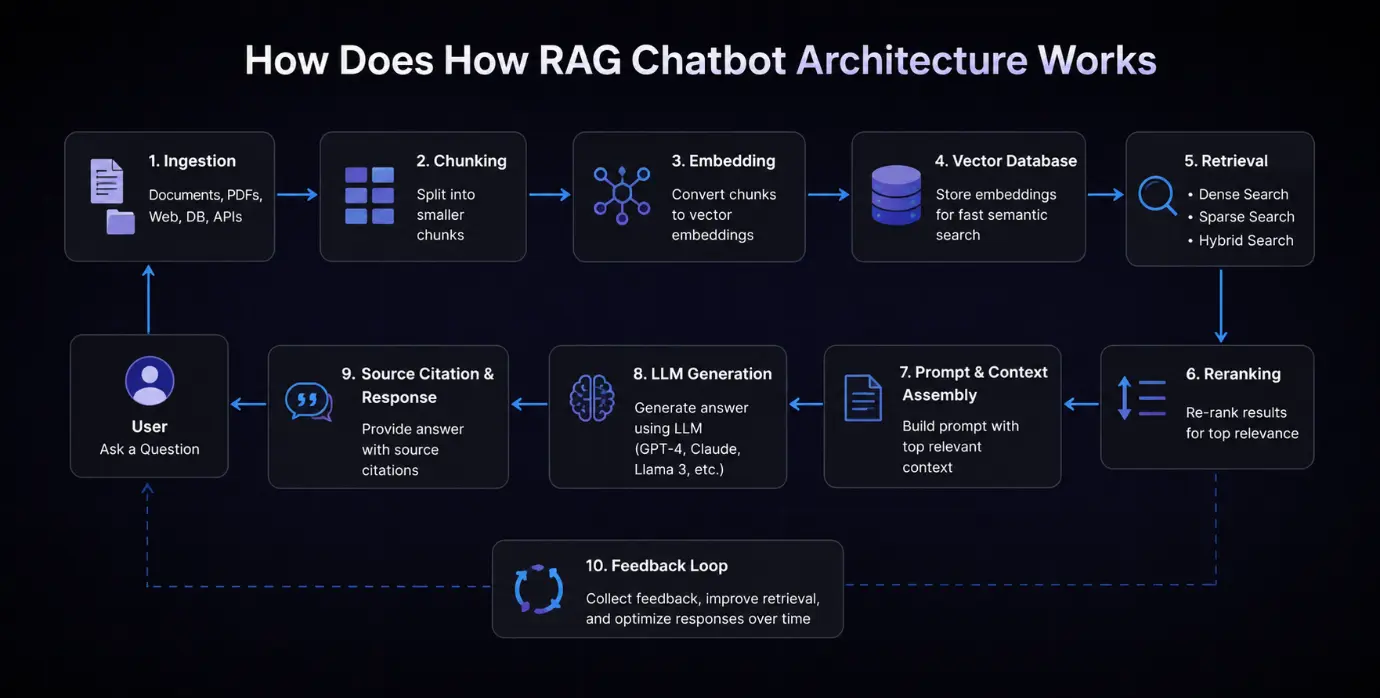
The RAG workflow begins with collecting knowledge from enterprise data sources such as PDF files, Microsoft Word documents, web pages, SharePoint libraries, databases, APIs, cloud storage, and CRM systems.
During ingestion, the system extracts text, captures metadata such as document title, author, creation date, permissions, and source location, removes formatting noise, and normalises content for indexing. High-quality preprocessing is essential because retrieval accuracy depends entirely on the quality of indexed data. Simply put, garbage in produces garbage out, making document cleaning and metadata enrichment the foundation of successful RAG systems.
Large documents cannot be embedded or retrieved efficiently as a single block. Instead, they are divided into smaller chunks that preserve context while improving search precision.
Common chunking strategies include:
Chunk size and overlap directly influence retrieval quality. Small chunks may lose context, while oversized chunks reduce search precision. As a general guideline, technical documentation often performs well with medium-sized overlapping chunks, whereas legal contracts and policy documents benefit from semantic chunking that preserves logical sections. Poor chunking remains one of the most common causes of underperforming RAG implementations.
Once documents are chunked, each chunk is converted into a numerical representation called a text embedding. Embeddings capture semantic meaning rather than exact keywords, enabling the chatbot to understand that questions with different wording may have the same intent.
Popular embedding models include OpenAI text-embedding-3-large, Cohere Embed, and open-source alternatives such as BGE, E5, and Nomic Embed. Premium models generally offer stronger retrieval accuracy, while open-source models provide greater deployment flexibility and data control. Selecting the right embedding model requires balancing retrieval performance, infrastructure cost, and enterprise privacy requirements.
Embeddings are stored in a vector database designed for high-speed semantic similarity search. Traditional relational databases are excellent for structured records but are not optimised for comparing millions of high-dimensional vectors.
Common vector database options include:
Choosing the right platform depends on scalability, operational complexity, budget, and existing infrastructure.
When a user submits a question, the retrieval layer identifies the most relevant document chunks.
Modern enterprise systems combine three retrieval methods:
Today, building RAG chatbot with hybrid search and semantic retrieval capabilities is considered best practice because it consistently outperforms either approach alone.
Initial retrieval may return several relevant passages, but not all are equally useful. A reranking layer evaluates these results and reorders them before they are passed to the language model.
Cross-encoder models such as Cohere Rerank and BGE Reranker analyse both the query and retrieved passages together, significantly improving context quality without changing the retrieval pipeline. This additional step often delivers noticeable improvements in answer accuracy.
The highest-ranked document chunks are assembled into a structured prompt for the LLM. Prompt templates define how retrieved evidence, user instructions, and conversation history are combined.
Effective context window management is critical because retrieved content may exceed the model's maximum input size. Intelligent prompt assembly ensures only the most relevant information reaches the language model while preserving essential context.
The LLM generates the final response using the retrieved evidence instead of relying solely on pre-trained knowledge.
Popular enterprise choices include GPT, Claude, Gemini, and open-source models such as Llama and Mixtral. Selection depends on factors including response quality, context window size, cost per token, latency, and enterprise data privacy requirements.
Many organisations develop RAG chatbot with OpenAI GPT and Pinecone vector database because this combination offers excellent performance, mature tooling, and rapid deployment. Others build RAG chatbot with LangChain and LlamaIndex for business use cases, leveraging these orchestration frameworks to simplify retrieval workflows, prompt management, and LLM integration.
Enterprise RAG systems should never return unsupported answers. Instead, the response includes citations that link each statement to the retrieved document, page, section, or paragraph.
This enables users to verify information quickly, improves trust, and supports compliance requirements in regulated industries. For organisations looking to build RAG chatbot with multi document retrieval and source citation features, accurate attribution is a core capability rather than an optional enhancement.
A production-ready RAG chatbot continuously improves after deployment. User interactions such as thumbs up, thumbs down, follow-up questions, abandoned conversations, and query reformulations provide valuable feedback on retrieval quality.
These signals feed evaluation pipelines that optimise chunking strategies, embedding selection, retrieval ranking, prompt design, and overall response accuracy. Continuous monitoring and iterative refinement ensure the chatbot remains effective as enterprise knowledge grows and user behaviour evolves.
By combining document ingestion, intelligent chunking, embedding generation, vector storage, hybrid retrieval, reranking, prompt engineering, advanced LLM integration, source citation, and continuous optimisation, organisations can build enterprise-grade AI assistants that are accurate, scalable, and trustworthy. This end-to-end architecture is the foundation for every successful RAG chatbot development project and is exactly what enterprises should evaluate when selecting an AI development partner with proven production experience.
Also Read: How To Develop Custom AI Chatbot: Benefits, Types, And Cost
As businesses increasingly adopt generative AI, the focus has shifted from creating chatbots that simply generate responses to building AI assistants that deliver accurate, trustworthy, and business-specific answers. This is why RAG chatbot development has become the preferred approach for startups and enterprises looking to deploy production-ready conversational AI. By combining intelligent document retrieval with Large Language Models, a RAG chatbot delivers measurable business value while avoiding many of the limitations of traditional AI chatbots.
Whether you want to build a RAG chatbot for customer support, employee knowledge management, compliance, or product documentation, the following benefits explain why Retrieval Augmented Generation has become the industry standard.
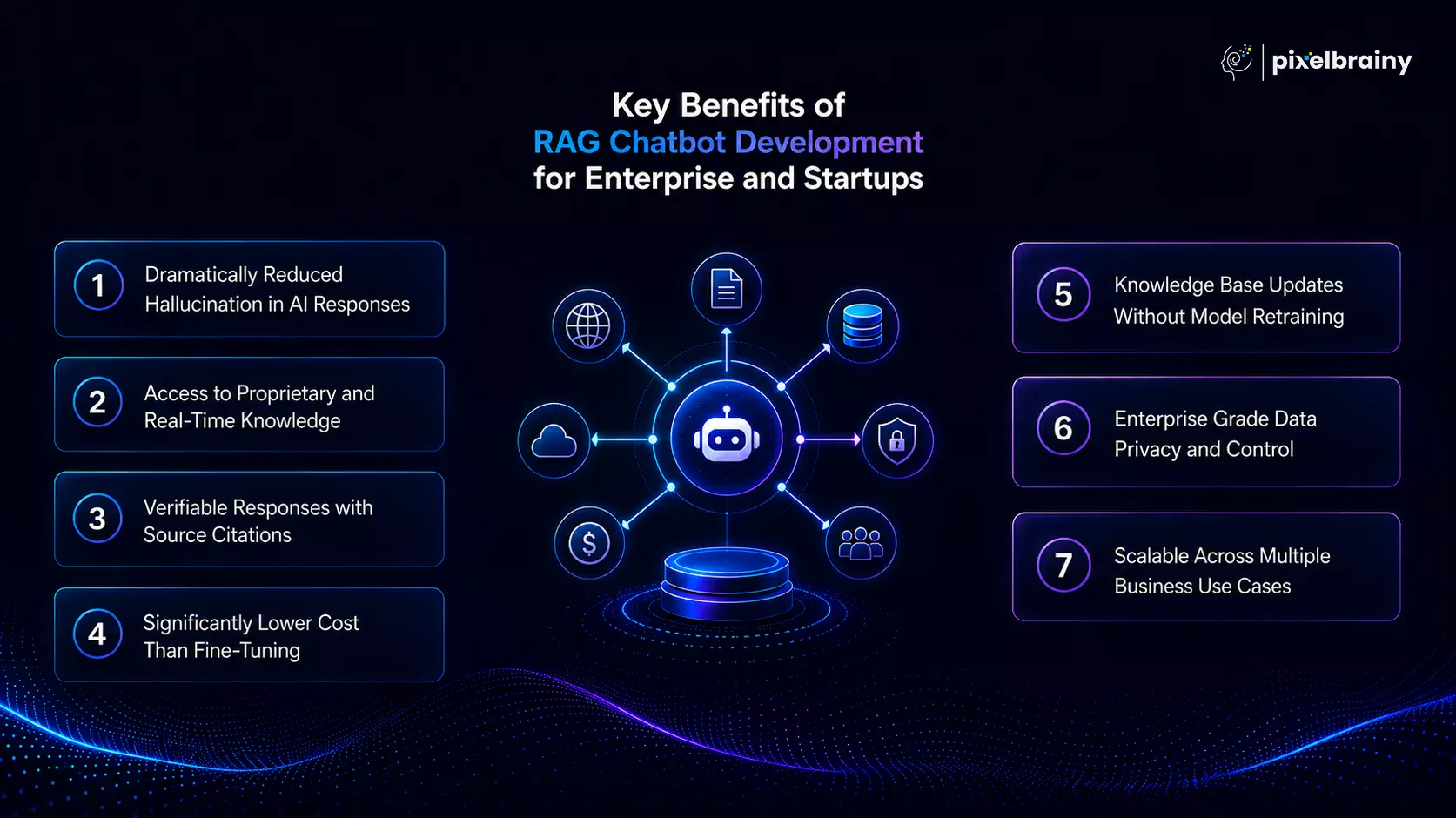
One of the biggest advantages of RAG is its ability to significantly reduce AI hallucinations. Instead of relying solely on what the language model remembers from its training data, a RAG chatbot retrieves relevant information from verified documents before generating a response.
This grounding mechanism ensures that answers are based on trusted business knowledge rather than assumptions. For enterprises where accuracy is essential, including legal, healthcare, finance, and manufacturing, reducing hallucinations is not simply a performance improvement but a business requirement. This is one of the primary reasons organisations invest in RAG chatbot development services for enterprise AI deployments.
Traditional LLMs cannot answer questions about information they have never seen. A RAG chatbot overcomes this limitation by retrieving information directly from your own knowledge base, including internal documentation, product manuals, client contracts, company policies, regulatory guidance, and technical specifications.
As new documents are added, the chatbot immediately gains access to the latest knowledge without requiring expensive model retraining. This makes it possible to develop RAG chatbot solutions that continuously improve as your organisation's knowledge base grows.
For example, a B2B SaaS company can build a chatbot that retrieves answers from product documentation, knowledge base articles, and historical support tickets to provide customers with accurate responses in real time.
Enterprise users need more than intelligent answers. They also need confidence that the information is correct.
A RAG chatbot can provide citations that identify the exact document, section, paragraph, or page used to generate each response. This allows users to verify the information independently rather than relying on the chatbot alone.
Source citation is especially valuable in regulated industries such as financial services, legal, healthcare, insurance, and government, where every recommendation or decision must be supported by authoritative documentation.
Many organisations assume they must fine tune a language model using proprietary data to build a business-specific AI assistant. In reality, this approach often requires substantial computing resources, labelled datasets, specialised machine learning expertise, and repeated retraining whenever business knowledge changes.
RAG offers a far more cost-effective alternative. By keeping the language model unchanged and updating only the connected knowledge base, organisations achieve highly accurate, domain-specific responses with significantly lower implementation and maintenance costs.
For most enterprise knowledge management use cases, retrieval augmented generation chatbot development provides a better return on investment than traditional model fine tuning.
Business knowledge evolves constantly. Product documentation is updated, compliance regulations change, new policies are introduced, and customer support content expands.
With a RAG architecture, incorporating these updates is straightforward. New documents are added to the document repository, processed through the ingestion pipeline, converted into embeddings, and indexed for retrieval.
Unlike fine-tuned models, which require a complete retraining cycle whenever significant information changes, a RAG chatbot can reflect updated knowledge almost immediately. This flexibility makes creating RAG chatbot solutions particularly attractive for industries where information changes frequently.
Data privacy is a critical concern for organisations handling confidential information.
A well-designed RAG chatbot keeps proprietary documents within your own infrastructure, document repository, or secure vector database. The system retrieves only the information required to answer a user's question while respecting role-based permissions and access controls.
This gives organisations complete visibility into which documents are indexed, who can access them, and how sensitive information is protected. For enterprises operating under strict regulatory or contractual obligations, this level of control is essential for secure AI adoption.
One of the greatest strengths of modern RAG chatbot development is its flexibility. A single RAG architecture can support multiple business applications without requiring separate AI systems for each department.
The same retrieval pipeline can power:
For example, an enterprise software company can allow every client to maintain an isolated knowledge base while using the same underlying RAG infrastructure. Similarly, a financial services firm can retrieve answers from compliance manuals, regulatory filings, investment research, and internal reports while enforcing strict access controls for different user groups.
These benefits demonstrate why organisations are rapidly adopting RAG chatbot development for mission-critical AI applications. Next, let's explore the most valuable real-world use cases and see how businesses across different industries are using RAG chatbots to improve productivity, customer experience, and operational efficiency.
The demand for RAG chatbot development continues to grow as organisations look for AI solutions that can retrieve accurate information from proprietary knowledge sources instead of relying solely on pre-trained language models. Whether the objective is to improve customer support, simplify internal knowledge management, automate compliance, or build industry-specific AI products, Retrieval Augmented Generation provides a scalable foundation for enterprise AI.
A common business requirement illustrates this perfectly:
"Our startup is building a RAG chatbot product for the legal industry that allows law firms to query their case files, legal precedents, contract templates, and regulatory documents through a conversational AI interface."
This is just one example of how organisations are using RAG to solve real-world business challenges. Below are some of the most valuable industry applications where RAG chatbot development is delivering measurable improvements in productivity, operational efficiency, and user experience.
Law firms, corporate legal departments, and legal technology companies manage thousands of contracts, case files, statutes, legal precedents, and regulatory documents that are difficult to search manually. Finding the right clause or precedent often requires significant time and effort, especially when working across multiple client matters.
Knowledge Base
What the RAG Chatbot Does
A legal RAG chatbot retrieves relevant case law, identifies applicable contract clauses, answers legal research queries, and provides accurate responses with source citations linked to the original legal documents. Lawyers can verify every response before using it for legal advice, contract drafting, or litigation preparation.
Business Outcome
Legal teams reduce research time, improve productivity, strengthen compliance, and deliver more accurate legal services. This is one of the fastest-growing applications of RAG chatbot development for legal AI products.
Healthcare organisations need immediate access to trusted clinical information while maintaining strict patient privacy and regulatory compliance. Searching across multiple systems for treatment guidelines or hospital protocols can slow clinical decision-making and increase administrative effort.
Knowledge Base
What the RAG Chatbot Does
The chatbot retrieves evidence-based clinical guidance, explains treatment protocols, answers healthcare-related questions, and references authoritative medical documentation. Organisations can develop RAG chatbot with HIPAA compliance and enterprise security to ensure sensitive healthcare data remains protected.
Business Outcome
Healthcare providers reduce information search time, improve clinical decision support, increase operational efficiency, and enhance patient care through evidence-backed AI assistance.
Banks, investment firms, insurance providers, and fintech companies operate in highly regulated environments where accurate information is essential. Employees frequently need to search across multiple systems to locate compliance documents, regulatory guidance, or investment policies.
Knowledge Base
What the RAG Chatbot Does
The chatbot retrieves relevant regulatory information, compliance requirements, investment guidelines, and research reports to support analysts, advisors, relationship managers, and compliance teams with trusted, document-backed answers.
Business Outcome
Financial organisations improve productivity, minimise compliance risks, accelerate research, and provide clients with more consistent, reliable financial guidance.
Software companies maintain extensive product documentation, API references, release notes, developer guides, and support resources. Customers often struggle to find the right information, resulting in higher support costs and slower onboarding.
Knowledge Base
What the RAG Chatbot Does
The chatbot answers complex product questions, retrieves API documentation, recommends troubleshooting steps, explains new features, and guides users through onboarding using the latest product knowledge.
Business Outcome
Businesses improve customer satisfaction, reduce support ticket volumes, accelerate product adoption, and lower operational costs. This is one of the most common reasons organisations build RAG chatbot for B2B SaaS product support and onboarding.
Employees spend considerable time searching for HR policies, benefits information, workplace procedures, and internal documentation spread across multiple systems. This often leads to repetitive questions for HR and IT teams.
Knowledge Base
What the RAG Chatbot Does
An enterprise knowledge assistant provides employees with instant, accurate answers to HR, IT, and workplace policy questions while respecting role-based permissions and organisational access controls.
Business Outcome
Organisations reduce repetitive HR enquiries, improve employee productivity, accelerate onboarding, and streamline internal knowledge sharing. This is one of the strongest examples of how to create RAG chatbot for customer support and internal knowledge management.
Educational institutions and corporate learning teams manage extensive collections of textbooks, digital courses, training modules, assessments, and research materials. Learners often need personalised guidance without waiting for instructors or trainers.
Knowledge Base
What the RAG Chatbot Does
The chatbot retrieves relevant educational content, explains concepts in natural language, recommends additional learning resources, and answers questions with citations to the original course material.
Business Outcome
Educational organisations improve learner engagement, increase knowledge retention, reduce instructor workload, and deliver more personalised learning experiences.
Online retailers need to help customers choose the right products while providing fast, accurate support before and after a purchase. Customers frequently ask detailed questions that extend beyond basic FAQs.
Knowledge Base
What the RAG Chatbot Does
A retail AI assistant retrieves product specifications, compares products, explains warranty and return policies, answers shipping questions, and provides personalised recommendations using trusted business data.
Business Outcome
Retailers improve conversion rates, reduce cart abandonment, lower customer support costs, and enhance the overall shopping experience while delivering more accurate product guidance.
Manufacturing organisations rely on extensive technical documentation to operate machinery safely, minimise downtime, and maintain product quality. Engineers and technicians often need immediate access to maintenance procedures and troubleshooting information.
Knowledge Base
What the RAG Chatbot Does
The chatbot retrieves maintenance instructions, equipment documentation, operational procedures, and safety guidance, enabling technicians to diagnose and resolve issues more efficiently.
Business Outcome
Manufacturers reduce equipment downtime, improve technician productivity, increase operational efficiency, and maintain compliance with safety and quality standards.
Insurance providers process large volumes of policy documents, underwriting guidelines, claims procedures, and regulatory requirements. Manually locating policy information can delay customer service and claims processing.
Knowledge Base
What the RAG Chatbot Does
The chatbot retrieves policy clauses, explains coverage details, supports claims processing, and answers customer enquiries using verified insurance documentation with source references.
Business Outcome
Insurance companies improve claims processing speed, enhance customer support, reduce manual document searches, and strengthen regulatory compliance.
Government agencies manage large collections of legislation, regulations, public service information, and administrative procedures that citizens and employees need to access quickly and accurately.
Knowledge Base
What the RAG Chatbot Does
The chatbot retrieves official government information, explains regulations, answers citizen enquiries, and directs users to the relevant source documents for verification.
Business Outcome
Government organisations improve public service delivery, reduce support workloads, increase transparency, and help citizens access trusted information more efficiently.
Supply chain teams work with complex shipping documentation, customs regulations, warehouse procedures, and inventory management processes. Quickly locating the correct operational guidance is essential for avoiding delays and improving efficiency.
Knowledge Base
What the RAG Chatbot Does
The chatbot retrieves logistics procedures, customs requirements, warehouse instructions, and operational documentation, helping teams resolve supply chain issues and make informed decisions faster.
Business Outcome
Businesses streamline logistics operations, reduce shipping delays, improve warehouse efficiency, and strengthen supply chain performance.
Engineering firms and construction companies manage extensive project documentation, technical standards, building codes, safety regulations, and engineering specifications throughout every project lifecycle.
Knowledge Base
What the RAG Chatbot Does
The chatbot retrieves engineering documentation, project specifications, building regulations, and technical standards while helping engineers and project managers answer complex technical questions with verifiable source citations.
Business Outcome
Engineering teams reduce documentation search time, improve project collaboration, make faster technical decisions, and ensure projects remain compliant with industry regulations and quality standards.
These examples demonstrate that the value of a RAG chatbot extends far beyond a single industry or business function. In the next section, we'll explore the must-have features that every production-ready RAG chatbot should include to deliver secure, accurate, and scalable AI experiences.
A successful RAG chatbot is not defined by its language model alone. Its performance depends on the features built around the retrieval pipeline, knowledge management system, security framework, and user experience. Whether you're planning RAG chatbot development for customer support, internal knowledge management, legal research, or enterprise AI, selecting the right capabilities is essential for building a reliable and scalable solution.
A common requirement from enterprise buyers highlights this need:
"We are an existing enterprise software company looking to add a RAG chatbot to our platform that allows our clients to upload their own documents and instantly query them through a natural language chat interface."
Meeting this requirement requires much more than connecting an LLM to a document repository. To build a RAG chatbot that delivers accurate, secure, and trustworthy responses, the following features should be considered essential for every production-ready deployment.
| Feature | Why It Matters |
| Multi-Format Document Ingestion | A production-ready RAG chatbot should support document ingestion from PDFs, Word files, Excel spreadsheets, PowerPoint presentations, websites, databases, APIs, cloud storage, emails, and knowledge bases. Supporting multiple formats allows businesses to centralise information without manually converting documents before indexing. |
| Intelligent Document Parsing | Extracting clean, structured text from uploaded documents is essential for high-quality retrieval. Intelligent parsing removes formatting inconsistencies, preserves headings and metadata, and prepares documents for accurate indexing, helping the chatbot generate more relevant and reliable responses. |
| Semantic Search | Semantic search enables the chatbot to understand the meaning behind a user's query instead of relying only on exact keyword matches. This allows it to retrieve relevant information even when users phrase questions differently from the source documents. |
| Hybrid Search Capability | Combining semantic search with traditional keyword search delivers better retrieval accuracy. Hybrid search identifies both conceptually related information and exact keyword matches, making it particularly valuable for technical documentation, legal research, and enterprise knowledge bases. |
| Accurate Source Citations | Every response should include citations pointing to the original document, page, section, or paragraph. Source attribution improves transparency, builds user confidence, supports compliance requirements, and enables users to verify AI-generated answers quickly. |
| Role-Based Access Control | Enterprise knowledge should only be accessible to authorised users. Role-based permissions ensure employees, customers, partners, and administrators can retrieve only the documents they are permitted to view, protecting sensitive business information. |
| Real-Time Knowledge Base Updates | A RAG chatbot should automatically reflect newly uploaded or modified documents without requiring language model retraining. This allows businesses to keep AI responses accurate as policies, products, regulations, and documentation continue to evolve. |
| Natural Language Query Understanding | Users should be able to ask questions naturally without learning keywords or search syntax. Strong natural language understanding improves user experience by accurately interpreting intent and retrieving the most relevant information from the connected knowledge base. |
| Conversation Memory | Maintaining conversational context enables the chatbot to understand follow-up questions and provide coherent multi-turn interactions. This creates more natural conversations and reduces the need for users to repeat information during ongoing discussions. |
| Multi-Document Retrieval | Many enterprise questions require information from multiple documents instead of a single source. The chatbot should retrieve, combine, and summarise relevant content from several authorised documents while preserving context and citation accuracy throughout the response. |
| Metadata-Based Filtering | Metadata filtering improves retrieval precision by allowing searches to be narrowed using attributes such as department, client, project, document type, publication date, or access level. This enhances both relevance and enterprise security. |
| Feedback Collection | Built-in feedback options such as thumbs up, thumbs down, and user comments help organisations measure response quality. These insights support continuous optimisation of retrieval accuracy, prompt engineering, and overall chatbot performance. |
| Analytics and Usage Dashboard | A comprehensive analytics dashboard provides insights into user behaviour, frequently asked questions, search success rates, failed queries, and document performance. These metrics help businesses continually improve their knowledge base and AI experience. |
| Enterprise Security and Compliance | Robust encryption, secure authentication, audit logs, access controls, and compliance with standards such as GDPR, HIPAA, or SOC 2 are essential for protecting sensitive business information and supporting enterprise AI governance. |
| Seamless Integration with Business Systems | Modern RAG chatbot development should support integration with CRM platforms, ERP systems, SharePoint, Microsoft Teams, Slack, Google Drive, cloud storage, customer portals, and enterprise APIs. Seamless integration enables organisations to leverage existing business data without disrupting established workflows. |
These core capabilities provide the foundation for building a reliable, secure, and scalable RAG chatbot. In the next section, we'll explore advanced features that can further enhance intelligence, automation, and enterprise performance beyond these essential capabilities.
Once the core capabilities of a RAG chatbot are in place, organisations can enhance the solution with advanced features that improve intelligence, automation, scalability, and user experience. These capabilities are especially valuable for enterprises building domain-specific AI assistants, customer-facing AI products, or enterprise knowledge platforms that must support complex workflows and large-scale deployments.
A common enterprise requirement highlights this evolution:
"The system needs to include a document ingestion pipeline, a hybrid search layer combining semantic and keyword retrieval, a reranking module for retrieval quality improvement, a GPT or Claude based response generation layer, and a feedback collection system."
While the essential features discussed in the previous section form the foundation, the following advanced capabilities help organisations build RAG chatbot solutions that are more accurate, context-aware, scalable, and enterprise-ready.
| Advanced Feature | Why It Matters |
| Hybrid Search with Intelligent Score Fusion | Advanced RAG systems combine semantic search and keyword search using intelligent score fusion algorithms. This improves retrieval precision by balancing conceptual understanding with exact keyword matching, resulting in significantly more accurate responses across complex enterprise document collections. |
| AI Reranking Models | After retrieving relevant documents, reranking models such as Cohere Rerank or BGE Reranker evaluate the results and prioritise the most relevant passages. This improves response quality without requiring changes to the embedding model or vector database. |
| Multi-Step Retrieval Pipeline | Complex questions often require information from multiple sources. A multi-step retrieval pipeline performs iterative searches, combines related documents, and builds richer context before passing information to the LLM, improving answer completeness and reasoning quality. |
| Multi-Turn Context Management | Advanced conversational memory enables the chatbot to understand long discussions, remember previous questions, and maintain context across multiple interactions. This creates a more natural conversational experience while reducing repetitive user inputs. |
| Multimodal Knowledge Retrieval | Modern RAG systems can retrieve information from images, scanned documents, diagrams, charts, presentations, tables, and PDFs in addition to plain text. This expands the chatbot's ability to answer questions using a wider range of enterprise knowledge assets. |
| Agentic Workflow Automation | Beyond answering questions, advanced RAG chatbots can trigger predefined business workflows such as creating support tickets, updating CRM records, scheduling meetings, or retrieving information from multiple enterprise applications through AI agents and APIs. |
| Multilingual Retrieval and Response Generation | Global organisations often manage knowledge in multiple languages. Advanced multilingual retrieval allows users to ask questions in one language while retrieving relevant documents in another, providing accurate responses across international teams and customer bases. |
| Personalised Response Generation | By combining user roles, department information, previous interactions, and access permissions, advanced RAG chatbots can deliver personalised answers that are more relevant to each user's responsibilities while maintaining strict enterprise security controls. |
| Human-in-the-Loop Review Workflows | For highly regulated industries, AI-generated responses can be routed to legal experts, compliance officers, or subject matter specialists for review before being delivered. This additional approval layer improves quality assurance and supports enterprise governance requirements. |
| Continuous AI Evaluation and Retrieval Optimisation | Enterprise-grade RAG chatbot development should include automated evaluation pipelines that monitor retrieval accuracy, citation quality, user feedback, latency, and response relevance. Continuous optimisation helps organisations improve chatbot performance as their knowledge base and user behaviour evolve over time. |
These advanced capabilities help transform a standard RAG chatbot into an enterprise-grade AI solution capable of supporting complex business processes, large knowledge bases, and mission-critical applications. In the next section, we'll walk through the complete step-by-step process of developing a production-ready RAG chatbot from planning to deployment.
Building a successful RAG chatbot requires much more than integrating a Large Language Model with a document repository. It involves designing an intelligent retrieval pipeline, preparing high-quality enterprise data, selecting the right AI technologies, and continuously optimising the system after deployment. Whether you're planning to build RAG chatbot for customer support, internal knowledge management, legal research, or enterprise search, following a structured development process ensures better performance, scalability, and long-term success.
A common enterprise challenge demonstrates why businesses are adopting RAG:
"We are a mid-size enterprise and we deployed a standard GPT-based chatbot for internal knowledge management six months ago. The hallucination problem is worse than we expected and the answers go out of date every time our internal documentation changes. We are now looking into RAG chatbot development as a solution and we want to understand exactly how RAG fixes these problems and what the development process actually involves before we commit budget to rebuilding."
If you're facing similar challenges, the following steps to build RAG chatbot from idea to deployment in 2026 provide a practical roadmap for developing an enterprise-ready AI solution.
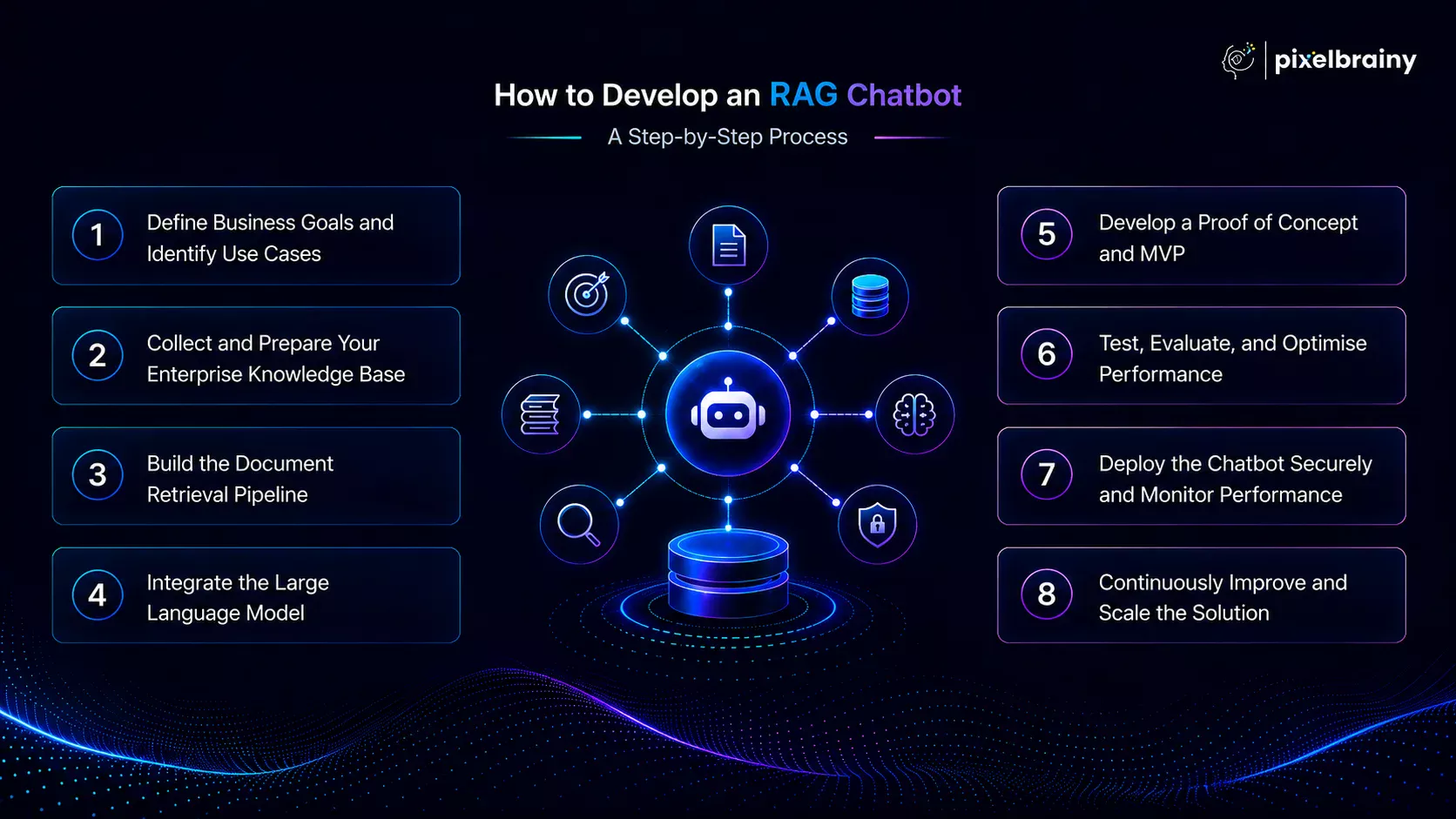
Every successful RAG chatbot development for enterprise project starts with understanding the business problem you want to solve. Instead of beginning with technology decisions, focus on defining clear objectives and measurable outcomes.
Identify who will use the chatbot, the questions it should answer, and the business processes it will support. Common use cases include customer support, internal knowledge management, HR assistance, legal research, product documentation, and compliance automation.
This discovery phase is also the right time to conduct an AI consultation, define project scope, prioritise features, identify stakeholders, and establish success metrics. Strong planning reduces implementation risks and creates a solid foundation for future PoC development and MVP delivery.
The quality of your chatbot depends directly on the quality of the knowledge it can retrieve. Gather all relevant business information from trusted sources before development begins.
Typical data sources include PDFs, Word documents, websites, SharePoint libraries, databases, CRM systems, support tickets, APIs, cloud storage, policy documents, and technical manuals.
Once collected, documents should be cleaned, structured, and enriched with metadata such as department, document type, publication date, ownership, and access permissions. Well-prepared data significantly improves retrieval accuracy and reduces the chances of irrelevant or incomplete responses.
The retrieval pipeline is the foundation of every RAG chatbot. During this stage, documents are divided into meaningful chunks, converted into vector embeddings, and indexed inside a vector database for semantic search.
Development teams also choose the appropriate chunking strategy, embedding model, and vector database based on the project's scale, performance requirements, and budget.
A well-designed retrieval layer ensures the chatbot retrieves the most relevant business information before generating an answer. This is the primary reason organisations develop RAG chatbot solutions to overcome hallucination and outdated responses commonly found in traditional GPT-based chatbots.
Once the retrieval system is ready, the next step is integrating a suitable Large Language Model such as GPT-4o, Claude, Gemini, or Llama.
Instead of answering questions using only pre-trained knowledge, the LLM receives the user's question together with the retrieved business documents. Prompt templates instruct the model to generate responses based only on the supplied context and include citations whenever possible.
This stage also includes important AI integration activities such as connecting authentication systems, enterprise APIs, CRMs, knowledge management platforms, and collaboration tools to create a seamless user experience.
Rather than building a complete enterprise solution immediately, organisations should first validate the architecture through PoC development.
A proof of concept tests retrieval quality, citation accuracy, search performance, and response reliability using a limited dataset. Once validated, development moves to a functional MVP that includes core integrations, user authentication, analytics, and essential enterprise features.
This phased approach reduces technical risk, gathers stakeholder feedback early, and helps businesses validate ROI before committing to full-scale implementation.
Comprehensive testing is essential before deploying a production-ready chatbot. The evaluation process should measure retrieval accuracy, response relevance, source citation quality, latency, and overall user experience.
Testing should include real-world scenarios, ambiguous queries, permission validation, edge cases, and incomplete document retrieval to ensure the chatbot performs reliably under different conditions.
Based on user feedback and evaluation results, teams can refine chunking strategies, prompt engineering, retrieval settings, and document organisation to continuously improve answer quality.
After successful testing, the chatbot can be deployed within the organisation or integrated into customer-facing applications.
Enterprise deployments should include secure authentication, role-based access control, encryption, audit logging, monitoring, and compliance with industry regulations where applicable.
Performance dashboards should monitor chatbot usage, frequently asked questions, failed searches, response quality, and system health. Many organisations also collaborate with leading AI chatbot development companies in USA to accelerate deployment and ensure enterprise-grade implementation.
The development of RAG chatbot does not end after deployment. Enterprise knowledge constantly evolves as new documents, policies, products, regulations, and business processes are introduced.
Organisations should regularly update their document repository, regenerate embeddings when needed, monitor analytics, collect user feedback, and optimise retrieval performance based on real usage patterns.
As adoption grows, the same architecture can support multiple departments, customer-facing applications, multilingual deployments, and additional AI use cases. This continuous improvement approach ensures businesses make RAG chatbot solutions that remain accurate, scalable, and valuable for years to come.
Following this structured development process helps organisations build a production-ready RAG chatbot that delivers accurate, secure, and scalable AI experiences while maximising long-term business value.
One of the first questions startups and enterprises ask before starting an AI project is, "How much does it cost to develop a RAG chatbot?" While there is no one-size-fits-all answer, the average RAG chatbot development cost typically ranges from $35,000 to $350,000+, depending on the project's scope, AI architecture, integrations, security requirements, and enterprise complexity.
For example, a basic internal knowledge assistant with limited document sources costs significantly less than a multi-tenant enterprise platform with hybrid search, advanced security, compliance controls, and custom integrations. Understanding these cost drivers helps organisations define a realistic RAG chatbot development budget and prioritise features for an MVP before scaling into a full enterprise solution.
A common business scenario reflects this planning process:
"Our investor group is backing a new RAG chatbot platform targeting the enterprise knowledge management market, and we need an experienced development partner who can guide us from architecture design to deployment while helping us estimate the overall investment required."
The following cost overview provides a practical reference for founders and enterprise teams evaluating the cost to build RAG chatbot solutions in 2026.
| RAG Chatbot Type | Estimated Development Cost | Best For |
| Basic RAG Chatbot | $35,000 to $75,000 | Startups, internal knowledge assistants, FAQ automation, customer support chatbots, and Proof of Concept (PoC) or MVP development. |
| Medium Complexity RAG Chatbot | $75,000 to $150,000 | Growing businesses requiring multiple document sources, enterprise integrations, hybrid search, analytics, and role-based access control. |
| Advanced Enterprise RAG Chatbot | $150,000 to $350,000+ | Large enterprises and SaaS platforms requiring multi-tenancy, enterprise security, compliance, advanced retrieval pipelines, custom workflows, mobile applications, and large-scale deployments. |
Note: These estimates represent average market pricing. The actual RAG chatbot development cost depends on project requirements, technical complexity, infrastructure, integrations, and the expertise of the development team.
Several technical and business factors influence the overall cost to build RAG chatbot solutions.
| Component | Estimated Development Cost | Complexity Level | Suitable For |
| Document Ingestion & Processing Pipeline | $4,000 to $20,000 | Medium | MVP & Enterprise |
| Vector Database Setup & Initial Indexing | $3,000 to $15,000 | Medium | MVP & Enterprise |
| Retrieval Pipeline (Basic Vector Search) | $6,000 to $25,000 | Medium | MVP |
| Hybrid Search & Reranking Layer | $8,000 to $35,000 | High | Enterprise |
| LLM Integration & Prompt Engineering | $5,000 to $20,000 | Medium | MVP & Enterprise |
| Chat Interface Development | $8,000 to $40,000 | Medium to High | MVP & Enterprise |
| Connector Integrations (Per Connector) | $1,500 to $8,000 | Low to Medium | MVP & Enterprise |
| Multi-Tenant Architecture | $15,000 to $50,000 | High | Enterprise |
| Access Control & Security Implementation | $8,000 to $30,000 | High | Enterprise |
| RAG Evaluation Pipeline | $5,000 to $20,000 | Medium | Enterprise |
| Observability & Monitoring Setup | $3,000 to $15,000 | Medium | Enterprise |
Beyond development, organisations should also consider recurring operational expenses required to keep the chatbot performing efficiently.
| Operational Component | Typical Cost Considerations |
| LLM API Usage | Monthly costs depend on the selected language model, average prompt size, response length, and total query volume. Higher usage increases API expenses accordingly. |
| Embedding API Costs | New or updated documents must be converted into embeddings before indexing. Organisations with frequently changing knowledge bases should budget for periodic embedding generation. |
| Vector Database Hosting | Managed vector databases or self-hosted infrastructure incur recurring hosting costs based on storage capacity, indexing volume, and search traffic. |
| Cloud Infrastructure | Compute resources for APIs, orchestration services, authentication, application hosting, monitoring, logging, and backups contribute to ongoing cloud operating expenses. |
For most businesses, the most cost-effective approach is to begin with an MVP that validates retrieval quality, user adoption, and business value before investing in advanced enterprise capabilities. This phased strategy helps optimise the RAG chatbot development budget, reduces implementation risks, and provides a clear roadmap for future enhancements.
Want a detailed feature-by-feature pricing breakdown? Read our dedicated guide on RAG chatbot development costs to understand the investment required for different architectures, deployment models, and enterprise use cases.
A production-ready RAG chatbot is built using multiple technologies that work together to deliver accurate document retrieval, intelligent search, secure data access, and natural language responses. Every layer of the architecture, from document ingestion and embedding generation to vector databases, retrieval frameworks, Large Language Models, and cloud infrastructure, contributes to the chatbot's overall performance, scalability, and reliability.
A common enterprise requirement demonstrates the importance of a well-designed technology stack:
"We need a team that understands the full RAG stack from document ingestion and chunking to vector embedding and storage to hybrid retrieval and LLM response generation."
Whether you're planning to develop RAG chatbot for enterprise knowledge management, customer support, legal research, healthcare, or a SaaS platform, using proven technologies significantly reduces development risk and accelerates deployment. The following tech stack represents the most widely adopted tools for RAG chatbot development in 2026 and helps organisations build scalable, secure, and production-ready AI solutions capable of handling real-world business workloads.
| Technology Layer | Recommended Tools | Why It Is Recommended |
| Large Language Models (LLMs) | GPT-4o, Claude 3.5 Sonnet, Gemini 1.5 Pro, Llama 3, Mixtral | These models provide excellent reasoning, long context windows, and strong response quality. GPT-4o and Claude are ideal for enterprise deployments, while Llama 3 and Mixtral are suitable for organisations requiring self-hosted AI infrastructure. |
| Embedding Models | OpenAI text-embedding-3-large, Cohere Embed, BGE, E5, Nomic Embed | Embedding models convert documents into semantic vectors for similarity search. OpenAI and Cohere deliver excellent accuracy, while BGE, E5, and Nomic Embed offer high-performing open-source alternatives with greater deployment flexibility. |
| Vector Databases | Pinecone, Weaviate, Qdrant, pgvector, Milvus, Chroma | Vector databases enable fast semantic search across millions of document embeddings. Pinecone is ideal for managed deployments, Weaviate and Qdrant offer open-source flexibility, pgvector integrates well with PostgreSQL, while Chroma is popular for MVP development. |
| RAG Frameworks | LangChain, LlamaIndex, Haystack | These frameworks simplify document ingestion, retrieval orchestration, prompt management, agent workflows, and LLM integration. They significantly reduce development effort while accelerating enterprise-grade RAG chatbot development. |
| Document Parsing & Processing | Unstructured, Apache Tika, PyMuPDF, LangChain Document Loaders | High-quality document parsing improves retrieval accuracy by extracting clean text, metadata, tables, and document structure from PDFs, Office files, web pages, and other enterprise content sources. |
| Hybrid Search & Retrieval | BM25, Elasticsearch, OpenSearch, Native Hybrid Search | Combining semantic search with keyword search improves retrieval precision, especially for legal documents, product codes, compliance policies, and technical documentation where exact keyword matching remains important. |
| Reranking Models | Cohere Rerank, BGE Reranker, Jina AI Reranker | Reranking improves search quality by evaluating retrieved passages and selecting the most relevant context before passing information to the LLM, resulting in significantly more accurate responses. |
| Backend Development | Python, FastAPI, Node.js | Python remains the preferred language for AI development because of its mature ecosystem, while FastAPI provides high-performance APIs. Node.js is commonly used for real-time applications and frontend integration. |
| Frontend Development | React, Next.js, Vue.js, Angular | Modern frontend frameworks enable responsive chat interfaces, administration dashboards, analytics panels, and customer-facing AI applications across desktop and mobile platforms. |
| Authentication & Security | OAuth 2.0, OpenID Connect, Azure Active Directory, Auth0 | Enterprise authentication platforms support secure login, Single Sign-On (SSO), role-based access control, and user identity management while protecting sensitive business information. |
| Cloud Infrastructure | Microsoft Azure, Amazon Web Services (AWS), Google Cloud Platform (GCP) | These cloud providers offer scalable infrastructure for hosting APIs, vector databases, AI workloads, storage, monitoring, and enterprise security with global availability and compliance certifications. |
| Database & Storage | PostgreSQL, MongoDB, Redis, Amazon S3, Azure Blob Storage | Enterprise applications require reliable storage for metadata, conversation history, caching, document repositories, and structured business data alongside vector databases. |
| Monitoring & Observability | LangSmith, Grafana, Prometheus, OpenTelemetry | Monitoring tools help teams measure retrieval accuracy, API performance, latency, user behaviour, system health, and AI response quality while supporting continuous optimisation. |
| CI/CD & DevOps | Docker, Kubernetes, GitHub Actions, GitLab CI/CD | Modern DevOps tools automate testing, deployment, scaling, and infrastructure management, enabling faster and more reliable releases for production-ready AI applications. |
Therefore, the right technology stack lays the foundation for a scalable, secure, and high-performing RAG chatbot. In the next section, we'll explore the most common RAG chatbot development challenges and practical strategies to overcome them successfully.
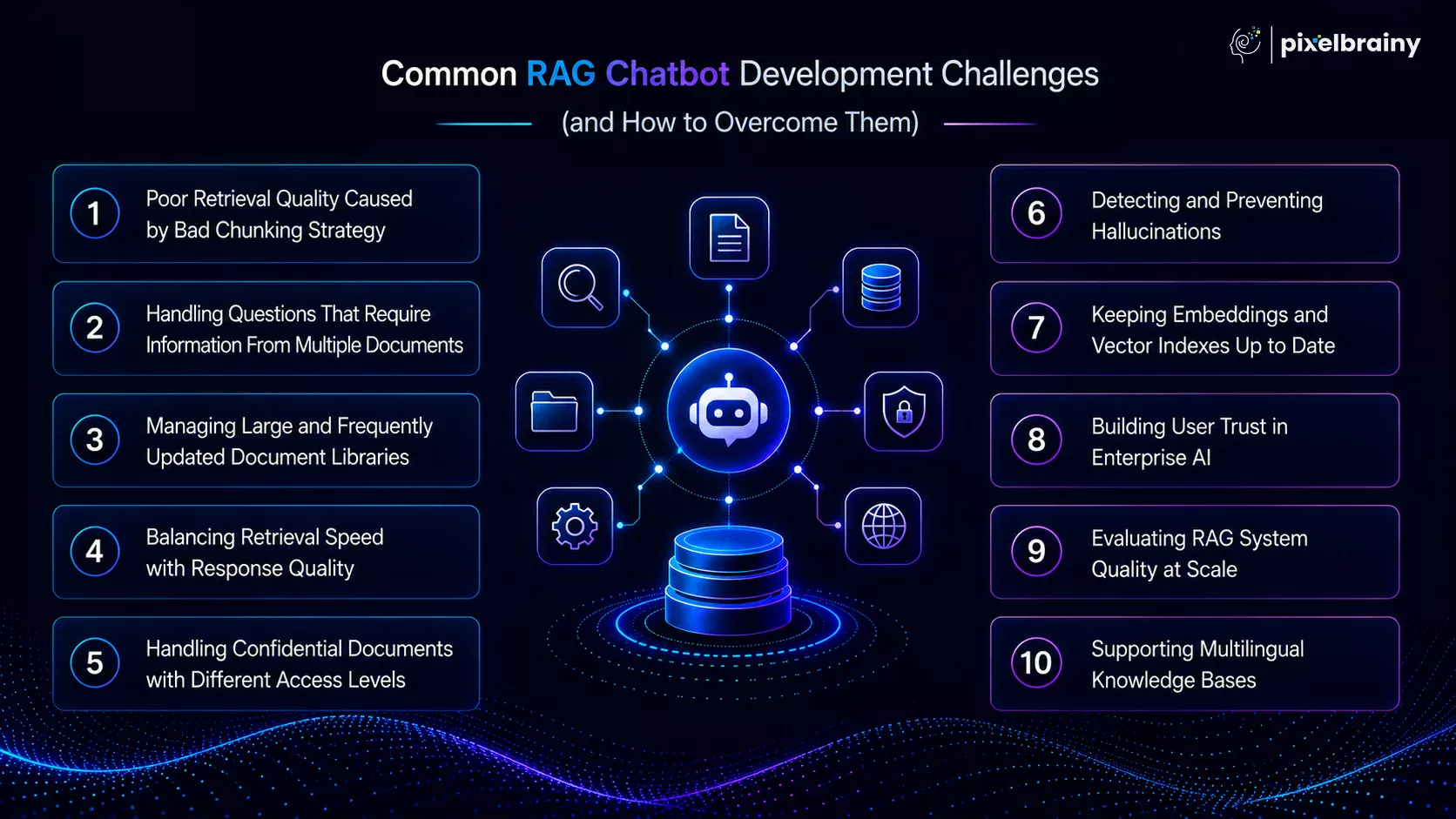
Creating a production-ready RAG chatbot involves much more than connecting a Large Language Model to a vector database. While Retrieval Augmented Generation significantly improves AI accuracy, enterprise deployments introduce challenges related to retrieval quality, security, scalability, performance, and continuous knowledge management. Identifying these challenges early allows organisations to design more reliable AI systems and avoid costly architectural changes later.
A common enterprise requirement demonstrates the complexity of modern RAG implementations:
"Our startup is building a RAG chatbot product for the legal industry. We need the RAG system to support multi document retrieval, accurate source citation, and strict data isolation between client matters."
Whether you plan to build RAG chatbot for healthcare, finance, legal services, or enterprise knowledge management, understanding the following challenges and their solutions will help you develop a secure, scalable, and production-ready AI platform.
Challenge
One of the most common reasons RAG systems perform poorly is incorrect document chunking. Oversized chunks often include irrelevant information, while extremely small chunks lose important context, reducing retrieval accuracy.
Solution
Use semantic or recursive chunking strategies with carefully tested chunk sizes and overlap. Continuously evaluate retrieval performance and optimise chunking based on document type, ensuring technical manuals, legal contracts, and policy documents are indexed differently where necessary.
Challenge
Many enterprise questions cannot be answered using a single document. Legal research, financial analysis, and technical support often require information spread across multiple files.
Solution
Implement multi-document retrieval, reranking, and context aggregation techniques. Building RAG chatbot with hybrid search and semantic retrieval capabilities enables the system to retrieve, combine, and prioritise information from several relevant documents before generating a response.
Challenge
Enterprise knowledge bases constantly evolve with new policies, product documentation, contracts, compliance updates, and research reports. Outdated indexes reduce response quality and user confidence.
Solution
Build automated document ingestion pipelines that detect additions, updates, and deletions. Incremental indexing and scheduled embedding regeneration ensure the chatbot always retrieves the latest authorised business knowledge.
Challenge
Users expect conversational AI to respond within seconds, but retrieving information from large document repositories can increase latency.
Solution
Optimise vector indexing, implement intelligent caching, use efficient reranking models, and retrieve only the most relevant document chunks. Balancing retrieval depth with response speed creates a better user experience without sacrificing answer quality.
Challenge
Enterprise knowledge bases often contain confidential information that should only be accessible to authorised users. A single retrieval mistake can expose sensitive client or business data.
Solution
Implement role-based access control, document-level permissions, metadata filtering, tenant isolation, and secure authentication. Organisations that develop RAG chatbot with HIPAA compliance and enterprise security should also maintain detailed audit logs and encryption to protect sensitive information.
Challenge
Even with Retrieval Augmented Generation, hallucinations can still occur when relevant documents are unavailable or retrieval quality is poor.
Solution
Configure the chatbot to answer only when sufficient supporting evidence is available. Require source citations for every response, establish confidence thresholds, and instruct the language model to acknowledge uncertainty instead of generating unsupported information.
Challenge
Whenever documents are updated, deleted, or replaced, existing embeddings may no longer reflect the latest information. This can result in outdated or inconsistent responses.
Solution
Automate embedding regeneration and vector index synchronisation whenever document changes occur. Regular maintenance ensures retrieval accuracy while preventing obsolete information from appearing in chatbot responses.
Challenge
Employees and customers are unlikely to rely on AI if they cannot verify where answers originate, especially in regulated industries such as legal, healthcare, finance, and government.
Solution
Always include document citations, confidence indicators, and links to the original source material. Transparent responses improve trust, encourage adoption, and support compliance with internal governance requirements.
Challenge
Manually reviewing thousands of AI responses is expensive, time-consuming, and difficult to maintain as enterprise knowledge grows.
Solution
Implement automated evaluation pipelines that measure retrieval accuracy, citation quality, response relevance, latency, and user satisfaction. Combining automated metrics with targeted human reviews provides a scalable approach to continuous quality improvement.
Challenge
Global organisations often manage documents in multiple languages while users expect to ask questions in their preferred language.
Solution
Use multilingual embedding models, cross-lingual retrieval techniques, and language-aware prompt engineering. This enables organisations to retrieve documents written in English, Spanish, French, and other languages while generating accurate responses in the user's preferred language.
Addressing these challenges early in the development process helps organisations build RAG chatbot solutions that are accurate, secure, scalable, and trusted by users, creating a strong foundation for successful enterprise AI adoption.
A production-ready RAG chatbot is built through a combination of high-quality data preparation, intelligent retrieval, well-designed prompts, continuous evaluation, and ongoing knowledge management. Many organisations successfully demonstrate impressive prototypes but struggle when deploying them in real business environments because they overlook fundamental architectural best practices. Following proven development principles helps reduce AI hallucinations, improve retrieval accuracy, and ensure the chatbot continues to perform reliably as business knowledge evolves.
Whether you are looking for the best practices for building a RAG chatbot in 2026, exploring how to build a RAG chatbot that reduces AI hallucinations, or overcoming common RAG chatbot development challenges and how to solve them, the following recommendations reflect real-world experience from enterprise AI implementations.
The quality of your RAG chatbot depends heavily on the quality of your document ingestion pipeline. If documents are poorly processed, retrieval quality suffers regardless of how advanced the language model or vector database may be.
Scanned PDFs with poor OCR, incorrectly extracted tables, broken document layouts, or missing metadata can significantly reduce retrieval accuracy before users even submit their first query.
Instead of relying on simple text extraction, use specialised document parsing solutions such as LlamaParse or Unstructured. These tools preserve headings, tables, document hierarchy, and metadata, creating a stronger foundation for semantic retrieval.
There is no universal chunking strategy that works for every document type. Fixed-size character chunking may perform adequately for general articles but often breaks important context in structured documents such as contracts, engineering manuals, healthcare protocols, and technical specifications.
Semantic chunking is better suited for narrative documents, while hierarchical chunking preserves relationships between sections, headings, and subsections in structured content.
Before indexing your documents, manually review sample chunks to ensure they preserve complete ideas rather than splitting information at arbitrary boundaries.
Semantic vector search is powerful, but it does not always retrieve documents containing exact keywords, product codes, legal references, or regulatory identifiers.
A production-quality RAG system should combine dense vector retrieval with keyword-based BM25 search to maximise retrieval accuracy across different query types.
Adding a cross-encoder reranking model after retrieval further improves relevance by selecting the highest-quality document passages before sending them to the language model.
Even the most advanced language models can hallucinate if prompt instructions are too broad or allow the model to rely on its pre-trained knowledge.
The system prompt should explicitly instruct the chatbot to answer only from the retrieved context. When sufficient information is unavailable, the chatbot should clearly state that it cannot answer rather than attempting to generate an unsupported response.
Grounded prompting is one of the most effective ways to reduce hallucinations in enterprise knowledge retrieval systems.
Many development teams focus on adding features before defining how success will be measured. This often results in discovering retrieval problems late in the project when architectural changes become expensive.
Establish an evaluation framework such as RAGAs before development begins and define measurable targets for retrieval recall, answer faithfulness, answer completeness, citation quality, and latency.
Continuous evaluation throughout development produces far more reliable AI systems than testing only before deployment.
A RAG chatbot is only as valuable as the knowledge it can access. As business documents evolve, outdated knowledge quickly reduces response accuracy and user confidence.
Build automated document ingestion pipelines that detect additions, modifications, and deletions without requiring manual intervention. Assign ownership for different sections of the knowledge base so updates remain consistent and well governed over time.
This approach ensures the chatbot continues to deliver accurate information as products, policies, and regulations change.
Enterprise users expect AI responses within seconds. However, retrieval, reranking, prompt construction, and LLM generation all contribute to response time.
Measure latency at every stage of the pipeline rather than treating the chatbot as a single system. This makes it easier to identify bottlenecks and optimise the components that have the greatest impact on performance.
Techniques such as response streaming, intelligent caching, asynchronous retrieval, and efficient vector indexing help improve user experience without sacrificing answer quality.
| Best Practice | Why It Matters | How to Implement |
| Invest in Document Preprocessing | Retrieval quality depends entirely on document quality. Poor OCR and broken parsing reduce answer accuracy. | Use LlamaParse or Unstructured to preserve document structure, metadata, tables, and formatting. |
| Match Chunking to Document Structure | Incorrect chunking destroys context and reduces retrieval precision. | Use semantic chunking for prose documents and hierarchical chunking for structured documents such as contracts and manuals. |
| Use Hybrid Retrieval | Pure vector search can miss exact keyword matches. | Combine dense semantic retrieval with BM25 keyword search and apply cross-encoder reranking. |
| Enforce Grounding in System Prompts | Weak prompts increase hallucination risk. | Instruct the LLM to answer only from retrieved context and respond with "I don't know" when evidence is insufficient. |
| Build Evaluation Before Features | Delayed evaluation makes performance issues harder to fix. | Implement RAGAs or a similar evaluation framework before development and monitor quality continuously. |
| Plan Knowledge Base Maintenance | Outdated knowledge reduces trust and response accuracy. | Automate document updates, embedding regeneration, and define clear document ownership processes. |
| Optimise for Production Latency | Slow responses negatively affect user experience and adoption. | Profile every pipeline stage, optimise retrieval, implement caching, and enable response streaming where appropriate. |
Following these best practices helps organisations build production-ready RAG chatbots that deliver accurate, trustworthy, and scalable AI experiences while maintaining strong performance as enterprise knowledge continues to grow.
By now, you have a complete understanding of what it takes to build a production-ready RAG chatbot, from designing the architecture and selecting the right technology stack to implementing hybrid retrieval, securing enterprise data, and continuously improving AI performance. While the technology is powerful, the success of any RAG project ultimately depends on the expertise of the development team responsible for designing and implementing it.
This is why startups, SaaS companies, and enterprise organisations choose PixelBrainy as their trusted partner for RAG development. We help businesses move beyond AI prototypes and build scalable, secure, and business-ready Retrieval Augmented Generation solutions that deliver measurable results.
Whether you're looking to build RAG chatbot for customer support, internal knowledge management, legal research, healthcare, financial services, or a domain-specific AI product, our team combines AI engineering expertise with practical business understanding to deliver solutions that create long-term value.
From discovery workshops and architecture planning to deployment and post-launch optimisation, we manage the complete development of RAG chatbot solutions. Our team helps validate your idea through Proof of Concept (PoC), develop a scalable MVP, and expand it into a production-ready enterprise platform.
Building a high-performing RAG chatbot requires expertise across multiple technologies, not just Large Language Models. Our engineers have hands-on experience with document ingestion pipelines, semantic chunking, embedding optimisation, vector databases, hybrid search, reranking, prompt engineering, enterprise integrations, and AI infrastructure.
Whether your project requires OpenAI, Claude, Gemini, Llama, Pinecone, Weaviate, Qdrant, LangChain, or LlamaIndex, we recommend technologies based on your business requirements rather than a one-size-fits-all approach.
Many organisations approach us with requirements similar to:
"We are building a RAG chatbot for a healthcare provider that needs to retrieve information from clinical guidelines and internal protocol documents while supporting HIPAA compliance, role-based access control, and detailed audit logs."
Our development approach prioritises enterprise security from the beginning, including role-based permissions, encrypted document storage, tenant isolation, audit logging, secure authentication, and compliance-ready architecture for regulated industries.
No two organisations manage knowledge in the same way. Instead of delivering generic AI chatbots, we build customised Retrieval Augmented Generation systems designed around your workflows, business goals, and proprietary knowledge.
Whether you need an internal AI assistant, customer support chatbot, legal research platform, financial knowledge assistant, or a white-label SaaS product, we develop tailored RAG development solutions that align with your long-term product vision.
A successful RAG chatbot should continue to perform as your business grows. We design scalable architectures capable of supporting millions of documents, multiple business units, multilingual knowledge bases, and increasing user demand without requiring major architectural changes.
This future-ready approach allows organisations to expand AI adoption across departments while maintaining performance, security, and reliability.
Success Story:
One of our recent enterprise engagements involved developing a confidential AI-powered knowledge assistant for a B2B software company serving multiple enterprise clients.
Business Challenge
The client wanted to replace its traditional knowledge base with an intelligent conversational AI platform capable of retrieving information from product documentation, implementation guides, support articles, and internal technical documentation. The solution also required secure client-level data isolation, accurate source citations, and seamless integration with the company's existing customer portal.
Our Solution
Our team designed and deployed a production-ready RAG architecture featuring automated document ingestion, semantic chunking, hybrid search, vector database indexing, GPT-powered response generation, role-based access control, and enterprise monitoring.
Business Results
Client name withheld due to confidentiality obligations.
When businesses evaluate an AI chatbot development company, they are not simply looking for developers. They need a strategic technology partner who understands enterprise AI architecture, Retrieval Augmented Generation, security, scalability, and long-term product success.
At PixelBrainy, we combine AI consulting, product strategy, software engineering, cloud architecture, and enterprise integration expertise to deliver production-ready RAG chatbot solutions that solve real business problems instead of simply demonstrating AI capabilities.
If you're planning to build a secure, scalable, and production-ready RAG chatbot, connect with PixelBrainy to discuss your project and turn your AI vision into reality.
RAG chatbot development has transformed how businesses build intelligent, trustworthy, and scalable AI applications. Unlike traditional AI chatbots that rely only on pre-trained knowledge, a RAG-powered system combines real-time document retrieval with advanced Large Language Models to deliver accurate, context-aware, and verifiable responses using your organisation's own knowledge base.
Throughout this guide, we've explored everything from RAG architecture and enterprise use cases to development steps, technology stacks, costs, challenges, and proven best practices. Whether you're planning to build RAG chatbot for customer support, internal knowledge management, legal research, healthcare, financial services, or a SaaS product, a well-designed Retrieval Augmented Generation solution can significantly improve productivity, reduce AI hallucinations, strengthen data security, and enhance decision-making across your organisation.
As enterprise AI chatbot adoption continues to accelerate, investing in the right architecture and experienced development team will determine the long-term success of your AI initiative. Building a production-ready RAG chatbot is not simply about integrating an LLM. It is about creating an intelligent knowledge platform that grows alongside your business and delivers measurable value for years to come.
Ready to build your production-ready RAG chatbot? Book an appointment with the PixelBrainy team today and let's discuss how we can turn your AI vision into a scalable enterprise solution.
If your existing chatbot frequently generates inaccurate answers, cannot access your latest business documents, or struggles with proprietary knowledge, migrating to a RAG architecture is often the better solution. RAG chatbot development allows your chatbot to retrieve information from your own knowledge base in real time, significantly reducing hallucinations while keeping responses current without retraining the language model.
Yes. A production-ready RAG chatbot can retrieve information from confidential documents while enforcing role-based access control, tenant isolation, encryption, and audit logging. Employees only access information they are authorised to view, making RAG chatbot development suitable for industries such as legal, healthcare, financial services, insurance, and government where data security is a critical requirement.
Yes. Instead of training a completely new AI model, a RAG chatbot connects a Large Language Model with your internal documents, policies, product manuals, contracts, and knowledge base. This approach is faster, more cost-effective, and easier to maintain because new knowledge becomes available simply by updating your document repository.
Absolutely. Modern RAG systems support multi-document retrieval, allowing the chatbot to combine information from several relevant documents before generating a response. Every answer can also include citations linking to the original document, page, or section, helping users verify information and increasing trust in AI-generated responses.
The cost to build a RAG chatbot depends on its complexity, integrations, security requirements, and deployment architecture. Most projects range from $35,000 for an MVP to $350,000+ for a large-scale enterprise platform with advanced retrieval, hybrid search, compliance features, multi-tenancy, and custom integrations.
Look for a company with proven experience in enterprise AI, Retrieval Augmented Generation architecture, vector databases, embedding optimisation, hybrid search, prompt engineering, LLM integration, security, and production deployment. An experienced partner should also provide AI consulting, PoC development, MVP delivery, ongoing optimisation, and post-launch support to ensure long-term success.
Yes. A production-ready RAG chatbot can integrate with platforms such as SharePoint, Microsoft Teams, Slack, Google Drive, Salesforce, HubSpot, ERP systems, CRM platforms, cloud storage, databases, APIs, and internal applications. These integrations enable the chatbot to retrieve the latest business information without disrupting your existing workflows or requiring major infrastructure changes.

About The Author
Sagar Bhatnagar
Sagar Sahay Bhatnagar brings over a decade of IT industry experience to his role as Marketing Head at PixelBrainy. He's known for his knack in devising creative marketing strategies that boost brand visibility and market influence. Sagar's strategic thinking, coupled with his innovative vision and focus on results, sets him apart. His track record of successful campaigns proves his ability to utilize digital platforms effectively for impactful marketing efforts. With a genuine passion for both technology and marketing, Sagar continuously pushes PixelBrainy's marketing initiatives to greater success.

Working with the PixelBrainy team has been a highly positive experience. They understand the design requirements and create beautiful UX elements to meet the application needs. The dev team did an excellent job bringing my vision to life. We discussed usability and flow. Sagar worked with his team to design the database and begin coding. Working with Sagar was easy. He has the knowledge to create robust apps, including multi-language support, Google and Apple ID login options, Ad-enabled integrations, Stripe payment processing, and a Web Admin site for maintaining support data. I'm extremely satisfied with the services provided, the quality of the final product, and the professionalism of the entire process. I highly recommend them for Android and iOS Mobile Application Design and Development.

Great experience working with them. Had a lot of feedback and I found that unlike most contractors they were bugging me for updates instead of the other way around. They were extremely time conscience and great at communicating! All work was done extremely high quality and if not on time, early! They were always proactive when it comes to communication and the work is great/above par always. Very flexible and a great team to work with! Goes above and beyond to present us with multiple options and always provides quality. Amazing work per usual with Chitra. If you have UI/UX or branding design needs I recommend you go to them! Will likely work with them in the future as well, definitely recommended!

PixelBrainy is a joy to work with and is a great partner when thinking through branding, logo, and website layout. I appreciate that they spend time going into the "why" behind their decisions to help inform me and others about industry best practices and their expertise.

I hired them to design our software apps. Things I really like about them are excellent communication skills, they answer all project suggestions and collaborate right away, and their input on design and colors is amazing. This project was complex and needed patience and creativity. The team is amazing to do business with. I will be using them long-term. Glad to see there are some good people out there. I was afraid to try and outsource my project to someone but I am glad I met them! I really can't say enough. They went above and beyond on this project. I am very happy with everything they have done to make my business stand out from the competition.

It was great working with PixelBrainy and the team. They were very responsive and really owned the project. We'll definitely work with them again!

I recently worked with the PixelBrainy team on a project and I was blown away by their communication skills. They were prompt, clear, and articulate in all of our interactions. They listened and provided valuable feedback and suggestions to help make the project a success. They also kept me updated throughout the entire process, which made the experience stress-free and enjoyable.

PixelBrainy is very good at what it does. The team also presents themselves very professionally and takes care of their side of things very well. I could fully trust them taking up the design work in a timely and organised manner and their attention to detail saved us lots of effort and time. This particular project was quite intense and the team showed that they function very well under pressure. Very much looking forward to working with her again!

It's always an absolute pleasure working with them. They completed all of my requests quickly and followed every note I had for them to a T, which made our process go smoothly from start to finish. Everything was completed fast and following all of the guidelines. And I would recommend their services to anyone. If you need any design work done in the future, PixelBrainy should be your first call!

They took ownership of our requirements and designed and proposed multiple beautiful variants. The team is self-motivated, requires minimum supervision, committed to see-through designs with quality and delivering them on time. We would definitely love to work with PixelBrainy again when we have any requirements.

PixelBrainy was a big help with our SaaS application. We've been hard at work with a new UI/UX and they provided a lot of help with the designs. If you're looking for assistance with your website, software, or mobile application designs, PixelBrainy and the team is a great recommendation.

PixelBrainy designers are amazing. They are responsive, talented, and always willing to help craft the design until it matches your vision. I would recommend them and plan to continue them for my future projects and more!!!

They were awesome! Did a good job fast, and good communication. Will work with them again. Thank you

Creative, detail-oriented, and talented designers who take direction well and implement changes quickly and accurately. They consistently over-delivered for us.

PixelBrainy team is very talented and creative. Great designers and a pleasure to work with. PixelBrainy is an excellent communicator and I look forward to working with them again.

PixelBrainy has a very talented design team. Their work is excellent and they are very responsive. I enjoy working with them and hope to continue on all of our future projects.

Transform your ideas into reality with us.
Across these industries, each engagement brings unique challenges, from early-stage product development to scaling complex systems, helping us build a practical understanding of real-world product environments.