AI Summary Powered by PixelBrainy
How can a real estate AI chatbot help brokers turn website visitors into qualified leads, engage prospects at the right moment, and connect high-intent buyers or sellers with agents? For real estate businesses, website traffic alone does not guarantee lead generation. Visitors may browse property listings, compare options, ask questions, and leave without sharing their contact information. This creates a gap between property discovery and sales engagement that AI-powered conversational technology can help address.
A Real Estate AI Chatbot can act as a digital assistant throughout this journey. Instead of relying only on static contact forms or basic FAQ widgets, an AI chatbot for real estate can understand natural-language queries, identify buyer or seller intent, recommend relevant properties, answer listing questions, collect contact details, schedule appointments, and transfer qualified conversations to human agents.
Consider a real-world business requirement: “I am a real estate broker with a high-traffic website that generates 3,000 monthly visitors but converts less than 2% to leads. I want to build a real estate AI chatbot that proactively engages visitors, qualifies their buyer or seller intent, captures their contact information, and routes hot leads to my agents immediately. What does a real estate AI chatbot cost to build and which development companies have built real estate chatbots with documented lead conversion improvement?” This type of requirement highlights why Real Estate Lead Generation AI is becoming an important part of modern property sales strategies.
When you build a Real Estate AI Chatbot, it can connect with property databases, CRM platforms, MLS systems, calendars, and communication channels. These integrations allow the chatbot to move beyond simple conversations and support property search, lead qualification, personalized recommendations, appointment scheduling, and automated follow-ups.
The demand for Real Estate AI Chatbot Development is also connected to the broader adoption of AI across property businesses. Agencies are increasingly exploring AI-powered assistants to improve response times, reduce repetitive workloads, and provide consistent customer support across digital channels.
This guide explains how to develop a Real Estate AI Chatbot, covering its key features, development process, cost, technology stack, integrations, challenges, future trends, and business applications for improving lead generation, customer engagement, and sales.
A real estate AI chatbot is an AI-powered virtual assistant designed to manage conversations with property buyers, sellers, renters, and website visitors. Using natural language processing (NLP), it can understand user intent, respond to questions in context, and guide prospects toward relevant properties or next steps. Unlike a traditional rule-based chatbot, an AI chatbot for real estate can handle more flexible conversations and support personalized interactions. Pasted markdown
For a real estate business receiving high website traffic but generating fewer leads, the chatbot can work as an always-available first point of contact. It can connect with property databases, CRM systems, listing platforms, calendars, and other business tools to provide information based on available data. A visitor can ask about property availability, share their preferred location and budget, request suitable listings, or schedule a property viewing. The chatbot can also collect lead details and identify prospects based on their buying or renting requirements.
The typical workflow is straightforward:
Visitor interaction → Intent detection → Property search or response → Lead qualification → Contact capture → Agent handoff or appointment
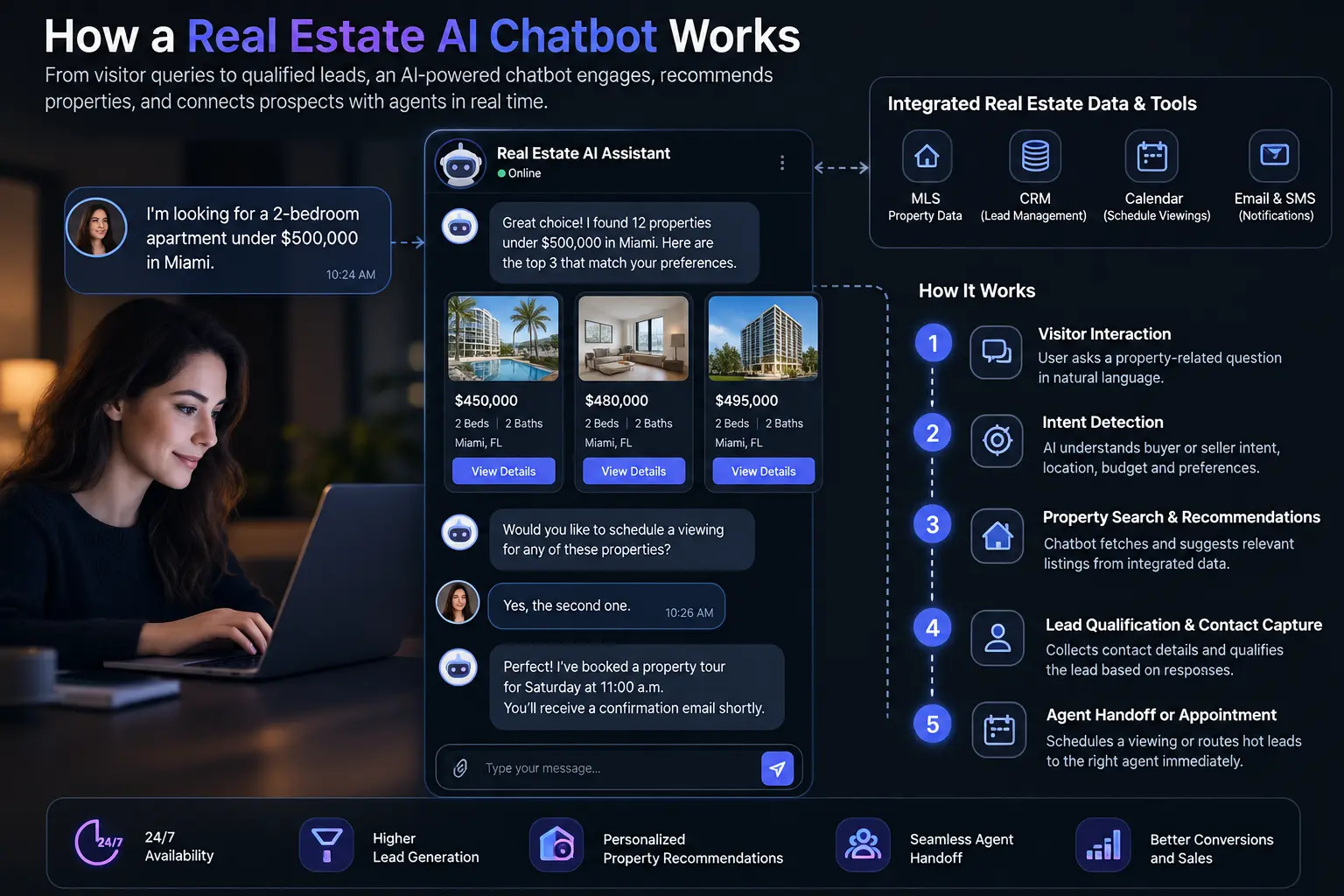
This makes real estate AI chatbot development more than simply adding a chat window to a property website. The goal is to create an intelligent assistant that can support conversations throughout the lead journey while reducing repetitive work for real estate teams.
| Feature | Basic Chatbot | AI-Powered Real Estate Chatbot |
| Technology | Rule-based with predefined responses | AI and NLP-driven |
| Conversation | Scripted and limited to specific questions | Natural, contextual, and flexible |
| Lead Handling | Collects basic contact details | Qualifies leads based on budget, location, preferences, and intent |
| Property Search | Provides predefined information | Searches and recommends relevant properties |
| Integrations | Limited integrations | Connects with CRM, MLS, property databases, calendars, and communication tools |
| Availability | 24/7 with repetitive responses | 24/7 with context-aware responses |
| Business Value | Handles routine questions | Supports lead generation, qualification, and sales assistance |
Consider a website visitor who wants to find a property but does not immediately contact an agent. Instead of leaving the website after browsing listings, the visitor can interact with the chatbot, share their requirements, receive relevant property options, and move toward a viewing or agent conversation.
For example, the conversation can follow this flow:
This approach allows an AI chatbot for real estate to support the journey from initial website engagement to property discovery, lead qualification, and agent handoff. For businesses looking to build a Real Estate AI Chatbot, the key value is connecting conversational AI with real estate data and sales workflows so website interactions can become actionable opportunities.
Real estate businesses often receive inquiries across websites, listing platforms, and digital channels, but many prospects leave before speaking with an agent. For a broker asking, “How can I use an AI chatbot for real estate to capture website visitors, qualify their intent, and send sales-ready leads to my agents?”, the answer starts with faster engagement and consistent follow-up.
A real estate AI chatbot can interact with prospects 24/7, understand their property requirements, collect relevant information, and support the sales team throughout the lead journey. With real estate AI chatbot development, businesses can automate repetitive conversations while keeping interactions personalized. When connected with property databases, CRM systems, calendars, and communication tools, the chatbot can become part of the broader real estate lead generation AI workflow.
Below are four core reasons why businesses build a real estate AI chatbot to improve lead generation, nurturing, sales support, and customer engagement.
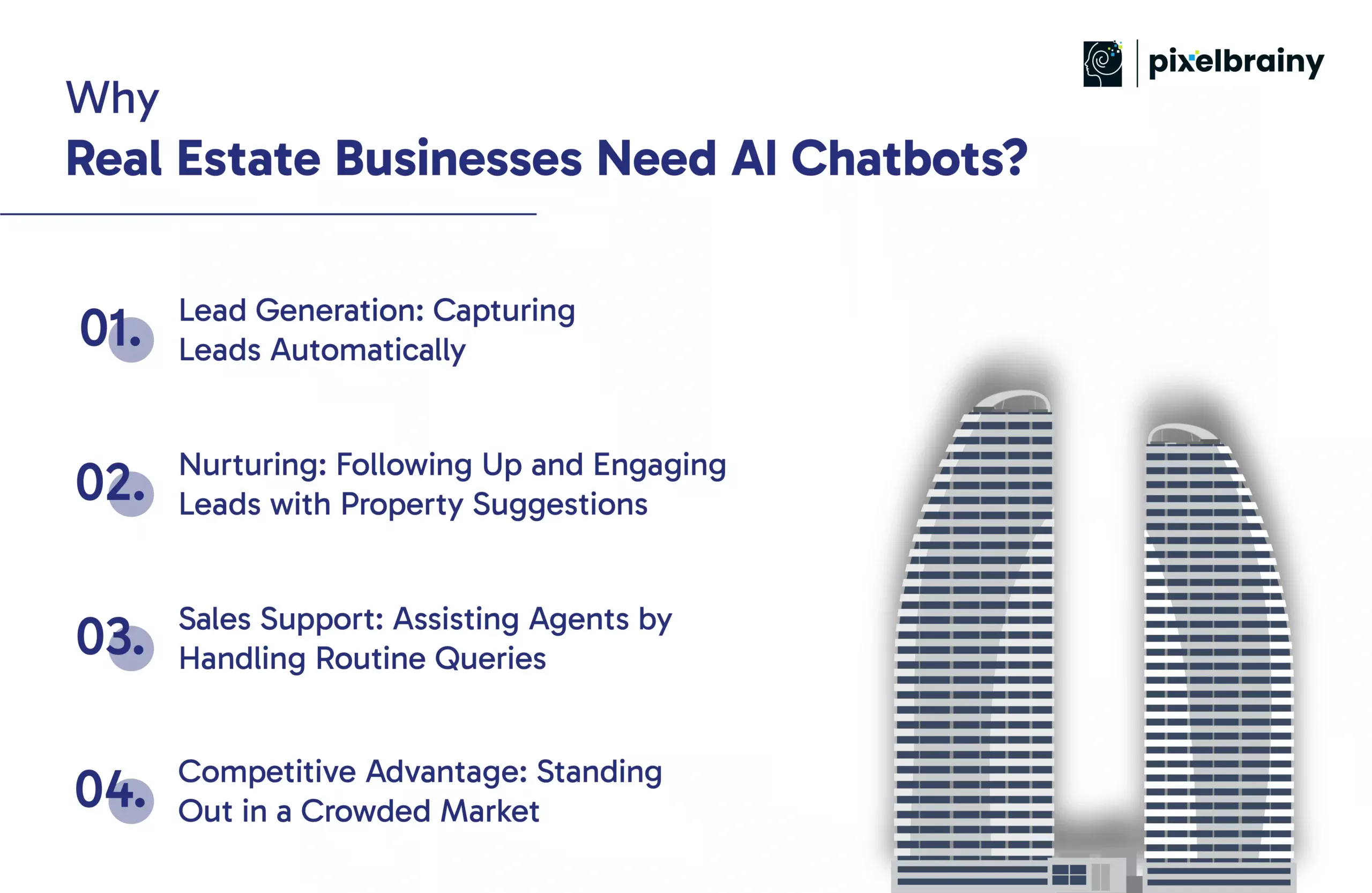
One of the most valuable benefits of a Real Estate AI Chatbot is its ability to capture leads 24/7. Traditional lead generation often depends on website forms or human agents who may not always be available.
With a chatbot, every website visitor or app user can be converted into a potential lead. By asking qualifying questions like budget, location preference, and property type, chatbots filter out unqualified prospects and deliver high-quality leads directly to the sales team. This turns your chatbot into a Real Estate Lead Generation AI tool that works around the clock.
Generating leads is only half the battle. Nurturing them until they are ready to purchase is where AI Chatbots for Real Estate excel. These intelligent bots can send property suggestions based on user preferences, provide mortgage information, and answer follow-up questions instantly.
By keeping prospects engaged through personalized interactions, chatbots reduce lead drop-off rates and help maintain consistent communication without overloading human agents.
Real estate agents often spend a significant amount of time answering repetitive questions such as property availability, square footage, or neighborhood details. An AI-powered real estate chatbot takes over these routine interactions, freeing up agents to focus on high-value tasks like negotiations and closing deals.
Additionally, chatbots can schedule property tours, send reminders, and even provide virtual walkthrough links—acting as a personal assistant that complements the work of human agents.
With more than 90% of buyers starting their property search online, first impressions are critical. Agencies that create Real Estate AI Chatbot systems stand out by offering a seamless, modern, and engaging customer experience. While competitors rely on traditional methods, you can deliver instant, intelligent, and personalized service that builds trust and loyalty.
This positions your brand as a tech-forward, client-first real estate business, giving you a distinct competitive edge in a crowded marketplace.
Therefore, when you build a real estate AI chatbot, you create more than an automation tool. You create a system that captures leads, nurtures prospects, supports agents, and helps turn more website interactions into qualified sales opportunities.
What features should a real estate AI chatbot have if the goal is to capture more leads, recommend relevant properties, and help agents respond faster? For businesses planning AI chatbot development for real estate, the answer goes beyond basic FAQs. The chatbot should combine conversational AI, property search, lead qualification, CRM connectivity, and sales automation to support prospects throughout their journey.
The following features form the foundation of an effective AI chatbot for real estate, helping businesses create a more responsive customer experience while supporting real estate lead generation AI and sales workflows.
| Feature | Description |
| Natural Language Processing (NLP) | Helps the chatbot understand natural human language and respond with accuracy. This makes interactions feel conversational rather than robotic, improving customer engagement. |
| Property Search Filters | Allows users to search properties by price, location, size, and amenities. This helps customers find relevant options quickly without browsing endless listings. |
| Lead Qualification | Engages users with smart questions about their needs, budget, and preferences. It automatically identifies serious buyers or renters, saving agents valuable time. |
| CRM Integration | Connects seamlessly with real estate CRMs to capture, store, and manage leads. Agents can follow up efficiently without manual data entry. |
| MLS/Database Integration | Syncs with Multiple Li+B7sting Services or internal property databases. This ensures customers always see real-time property availability and accurate details. |
| Appointment Scheduling | Lets prospects book property tours directly through the chatbot. It eliminates back-and-forth calls by syncing with agent calendars. |
| Mortgage & Loan Assistance | Offers mortgage calculators and financing guidance instantly. Buyers get clarity on affordability without waiting for an agent’s response. |
| 24/7 Availability | Provides around-t+B10he-clock support, ensuring no inquiry goes unanswered. This feature is especially useful for international buyers in different time zones. |
| Multilingual Support | Communicates with clients in multiple languages. This opens up opportunities to serve a wider audience and build global trust. |
| Personalization Engine | Tracks user behavior a+B12nd preferences to offer tailored property suggestions. This makes the buying journey smoother and more engaging. |
| Push Notifications & Alerts | Sends instant updates on new listings, price changes, or appointment reminders. Keeps clients engaged and nurtures leads automatically. |
| Voice Assistance | Allows users to interact with the chatbot using voice commands. It adds convenience, especially for mobile users or those with accessibility needs. |
| Analytics Dashboard | Provides insights into user queries, popular listings, and lead quality. Businesses can refine chatbot strategies based on this data. |
| Social Media & Website Integration | Embeds into platforms +B16like Facebook, WhatsApp, and real estate websites. This expands reach and captures leads from multiple channels. |
| Secure Data Handling (GDPR/CCPA Compliance) | Protects sensitive client information with +B24strong data privacy standards. It ensures trust while staying compliant with global regulations. |
Therefore, the right combination of AI chatbot features for real estate can turn a basic website assistant into a practical lead generation and sales support system. When these capabilities work together, businesses can engage prospects faster, qualify leads, and help agents focus on opportunities that matter.

If you are a proptech startup asking, “How can we build a white-label real estate AI chatbot SaaS that individual agents and small brokerages can deploy on their websites and Facebook pages without technical expertise?”, the development process needs to cover both the AI experience and the SaaS infrastructure behind it. Lead qualification, appointment scheduling, CRM integration, property data, multi-tenant management, and easy deployment all need to work together.
The steps to develop a real estate AI chatbot from idea to launch should therefore begin with clear business goals and progress through conversational design, validation, MVP development, AI integration, production deployment, and continuous optimization. This roadmap for real estate AI chatbot development can help startups plan the scope, technology, development effort, and investment required for a scalable agent-focused product.
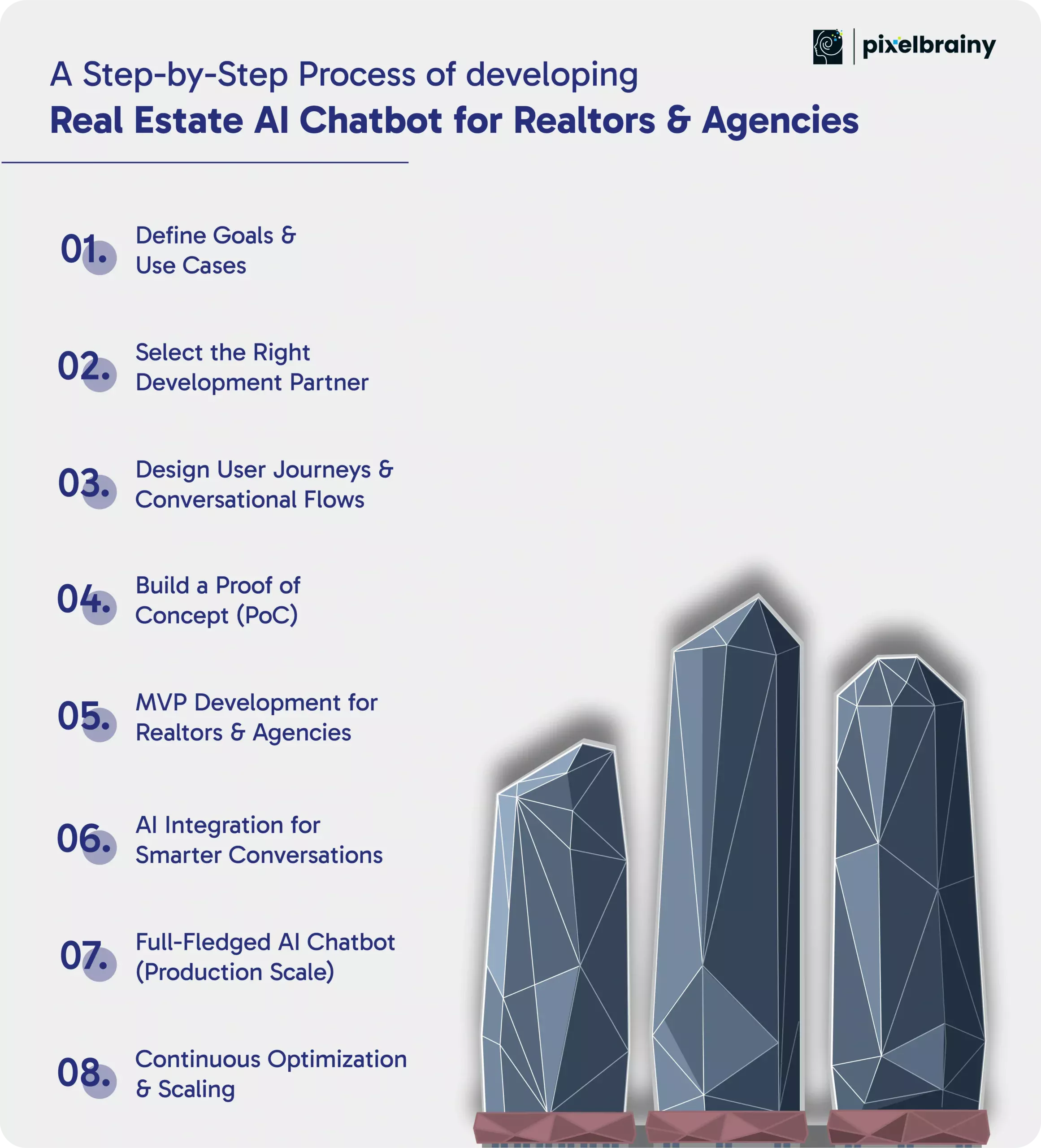
The first step in building a real estate AI chatbot is defining what the product must accomplish for agents, brokerages, and their customers. For a SaaS product, document both customer-facing and platform-level requirements.
Why this matters: Clear goals establish the product scope and help align chatbot capabilities with the needs of the agent market.
Finding a development partner with both real estate expertise and NLP capabilities is important when developing a real estate AI chatbot as a SaaS product. The partner should understand the requirements of a multi-tenant platform rather than treating the chatbot as a standalone website feature.
Why this matters: The right technical expertise can reduce integration risks and create a stronger foundation for scaling the product across multiple customers.
A successful chatbot needs clear conversation paths for both end users and the agents managing the platform. During this stage, map how prospects interact with the chatbot and how their information moves into the sales workflow.
Why this matters: Well-planned conversational flows make the chatbot easier to use while keeping lead collection and qualification consistent.
Also Read: Top 10+ UI/UX Design Companies in USA
A PoC development phase helps validate whether the core chatbot concept works before committing to a larger product build. For a white-label SaaS solution, the initial validation can focus on the most important AI and integration capabilities.
Why this matters: A PoC helps validate the technical approach and identify major issues before broader development begins.
Once the concept is validated, move into MVP development with the features required for an initial agent-ready SaaS product. The MVP should provide enough functionality for real users while keeping the first release manageable.
Why this matters: An MVP gives the startup a functional product that can be tested with real agents while providing a foundation for future SaaS capabilities.
Also Read: Top 10 AI MVP Development Companies in USA
AI integration is the stage where the chatbot becomes capable of understanding natural-language real estate conversations instead of relying only on predefined responses. The AI layer should be connected to reliable property and customer data.
Why this matters: Effective AI integration helps the chatbot provide relevant responses while keeping conversations connected to real business workflows.
After validating the MVP, expand the product into a production-ready platform that multiple real estate customers can use independently. This stage focuses on reliability, scalability, security, and broader deployment.
Why this matters: Production-scale architecture allows the SaaS product to serve multiple customers without compromising reliability or data isolation.
The development process of real estate AI chatbot continues after launch. Usage data, agent feedback, conversation quality, and changing customer requirements should guide ongoing improvements.
Why this matters: Continuous optimization keeps the chatbot useful for agents and supports sustainable SaaS growth.
Therefore, building a real estate AI chatbot successfully requires a structured path from business goals and PoC validation to AI-powered SaaS deployment and continuous improvement.
Also Read: Real Estate AI Agent Development: From Concept to Development
How much does it cost to build a real estate AI chatbot for lead qualification, property search, appointment scheduling, and CRM integration? On average, real estate AI chatbot development costs around $15,000 to $15,000+, with the final investment depending on the chatbot’s features, AI capabilities, integrations, design, development approach, and scalability requirements.
For a proptech startup planning a white-label chatbot SaaS for real estate agents and small brokerages, additional requirements such as multi-tenant architecture, CRM connectivity, website and Facebook deployment, admin dashboards, and customization can further influence the budget. Whether you want to build a real estate AI chatbot from scratch or start with an MVP, understanding the major cost factors helps establish a realistic development budget.
A simple chatbot with basic lead capture and FAQs will be less expensive. In contrast, advanced features like multilingual support, mortgage calculators, or predictive property recommendations increase the overall cost.
If your chatbot requires natural language processing (NLP), recommendation engines, or voice recognition, expect additional development hours and higher costs.
Costs rise when the chatbot must connect with MLS databases, CRM platforms, or third-party APIs. Complex AI integration for personalization or analytics also adds to the development bill.
A professional UI/UX design company ensures the chatbot interface is easy to use and visually appealing. Good design takes time and expertise, influencing the total cost.
Hiring teams from the top chatbot development companies in USA typically costs more than offshore teams, but they often bring stronger domain knowledge and compliance readiness. Similarly, partnering with the top ai development companies may involve higher upfront costs but ensures robust, scalable AI models.
| Type of Real Estate AI Chatbot | Estimated Cost | What’s Included |
| Basic Real Estate AI Chatbot | $15,000 – $20,000 | FAQ handling, simple lead forms, appointment booking |
| Mid-Level Real Estate AI Chatbot | $20,000 – $35,000 | NLP, CRM integration, property search filters, analytics dashboard |
| Advanced Real Estate AI Chatbot | $35,000 – $60,000+ | AI-driven personalization, multilingual support, voice commands, full MLS integration |
| Enterprise-Grade Real Estate AI Chatbot | $60,000+ | Predictive analytics, advanced AI integration, omnichannel deployment, enterprise security & compliance |
Therefore, the cost to develop a real estate AI chatbot can start at around $15,000 and increase based on the AI, features, integrations, and scalability your project requires.
Also Read: AI Chatbot Development Cost: Factors and Examples
What tech stack do you need to build a real estate AI chatbot that can handle property searches, qualify leads, connect with CRM and MLS data, and support multiple customer channels? For a proptech startup building a white-label SaaS chatbot for real estate agents, the architecture needs to support conversational AI, real-time property data, secure lead management, and scalable deployment.
The real estate AI chatbot development stack should therefore cover more than the chatbot interface. It needs reliable frontend and backend technologies, LLM and NLP capabilities, RAG for grounded property responses, databases for leads and listings, integrations for CRM and MLS systems, analytics, security, and deployment infrastructure. The following toolkit provides options for building a real estate AI chatbot from an MVP through an enterprise-ready solution.
| Parameter | Recommended Tools / Options | Why it matters |
| Frontend (Web/App) | React or Next.js; Tailwind CSS; TypeScript | Delivers fast, accessible UIs with component reusability. Type safety reduces bugs and speeds iteration. |
| Backend (APIs) | Node.js (NestJS/Express) or Python (FastAPI) | Mature ecosystems for REST/GraphQL and integrations. Great performance for real-time chat workloads. |
| NLP / LLM Layer | OpenAI / Anthropic APIs; Rasa/NLU for custom intents | Combines robust general reasoning with domain intents. Easier to tune replies to property workflows. |
| Retrieval & RAG | LlamaIndex / LangChain | Orchestrates retrieval-augmented generation over listings/CRMs. Reduces hallucinations with grounded answers. |
| Vector Database | Pinecone, Weaviate, or pgvector (Postgres) | Enables semantic search across descriptions and FAQs. Scales recommendations and similar-listing lookups. |
| Primary Database | PostgreSQL (with Prisma/SQLAlchemy) | Relational strength for leads, tours, and agent data. Strong consistency and reporting capabilities. |
| Caching Layer | Redis | Low-latency session/state storage for chat context. Cuts API costs and improves perceived speed. |
| Integrations (CRM/MLS) | Salesforce/HubSpot, Zapier/Make; RESO Web API/MLS feeds | Syncs leads and listings in real time for accuracy. Automation shortens handoffs to agents. |
| Messaging Channels | Web chat widget, WhatsApp Business, Facebook Messenger, SMS (Twilio) | Meet clients where they already are to boost reach. Unified identity keeps conversations continuous. |
| Voice Interface | Web Speech API, Twilio Voice, Whisper/Deepgram ASR | Voice lowers friction for mobile users. Improves accessibility and broadens audience. |
| Analytics & CX | PostHog/Amplitude, GA4; FullStory/Hotjar | Tracks funnels from chat → qualified lead → tour. Session insights reveal drop-offs to fix. |
| Observability | OpenTelemetry+B14, Prometheus + Grafana | End-to-end tracing for latency and errors. Faster incident response keeps chat uptime high. |
| Security & Compliance | OAuth2/OIDC, JWT; Vau+B15lt/KMS; GDPR/CCPA controls | Protects PII with encryption and scoped access. Audit trails and consent flows build trust. |
| Testing & QA | Jest/PyTest; Cypress/Playwright; prompt/unit tests | Prevents regressions across dialogs and UI. Prompt tests keep AI answers consistent. |
| DevOps & CI/CD | GitHub Actio+B17ns, Docker, Kubernetes; Vercel/Fly.io | Automates deploys from PoC to scale. Blue-green/canary releases de-risk updates. |
| Content Moderation & Guardrails | Moderation APIs, policy filters, allowlists | Blocks unsafe or off-topic prompts before reply. Protects brand and user experience. |
| Feature Flags & A/B | LaunchDarkly, GrowthBook | Ship safely and test flows without full releases. Data-driven rollouts improve conversion. |
| Payment/Booking (optional) | Calendly API/Calendars; Stripe (deposits) | Streamlines tour scheduling and deposits. Reduces back-and-forth and speeds decisions. |
Therefore, the right tech stack gives your real estate AI chatbot development project the foundation to deliver accurate conversations, reliable integrations, secure data handling, and scalable lead generation.

What challenges should a real estate business expect when it plans to build a Real Estate AI Chatbot that can understand complex property queries, connect with MLS and CRM systems, qualify leads, and hand off conversations to agents? For a proptech startup asking, “How can we develop a real estate AI chatbot that delivers reliable lead qualification and CRM integration without creating security, accuracy, or adoption problems?”, these areas need to be addressed from the beginning.
The real estate AI chatbot development process involves more than implementing an AI model. Businesses must consider conversational accuracy, property data synchronization, privacy, personalization, human handoffs, development costs, and user adoption. Addressing these challenges early creates a more dependable foundation for building a real estate AI chatbot that can support lead generation and sales workflows.
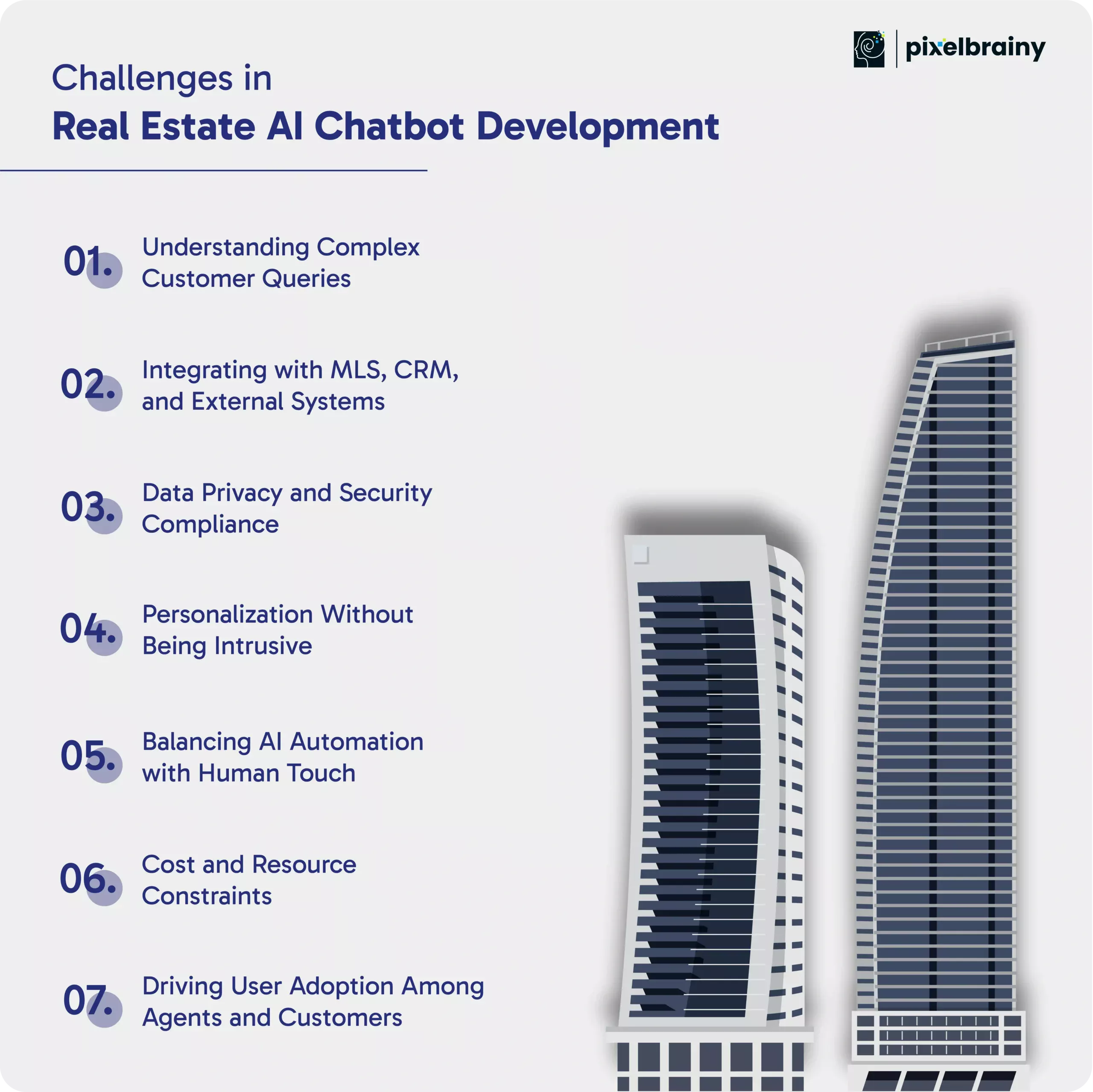
The Challenge: Home buyers and renters often phrase queries in unpredictable ways, mixing multiple requirements (e.g., “Find me a 3BHK under $500K near schools with low HOA fees”). Standard bots may fail to parse such intent.
How to Overcome:
The Challenge: Seamlessly syncing property listings, lead data, and agent schedules is often difficult. Inconsistent APIs, legacy CRMs, or fragmented MLS systems can slow down development.
How to Overcome:
The Challenge: Handling personal information—such as contact details, budgets, and financial preferences—comes with regulatory responsibilities (GDPR, CCPA, and local real estate data laws).
How to Overcome:
The Challenge: Customers expect personalized property recommendations but may feel uncomfortable if the chatbot seems “too invasive.”
How to Overcome:
The Challenge: Over-reliance on automation may frustrate users who want quick access to a human agent. If the chatbot fails to hand off properly, potential leads may drop off.
How to Overcome:
The Challenge: Building and maintaining an advanced AI chatbot can be expensive. Many agencies worry about budget overruns and ongoing operational costs.
How to Overcome:
The Challenge: Even the best chatbot can fail if agents don’t trust it or customers ignore it. Low adoption reduces ROI.
How to Overcome:
Therefore, successful real estate AI chatbot development requires more than advanced AI. Addressing data, integration, security, cost, and user adoption challenges helps create a reliable chatbot that agents and customers can confidently use.
How will AI chatbots in real estate evolve as buyers, renters, investors, and agents expect faster and more personalized digital experiences? For a real estate business asking, “How can we build a real estate AI chatbot that goes beyond lead capture and eventually supports property discovery, predictive insights, virtual tours, and transactions?”, the next phase of chatbot development will focus on deeper AI capabilities and stronger connections with real estate technology.
The future of real estate AI chatbot development is moving toward assistants that can understand user preferences, work across text and voice, connect with immersive property experiences, analyze buyer intent, and support more stages of the property journey. These developments will expand the role of chatbots from conversational support to intelligent digital assistance for real estate businesses.
Tomorrow’s AI chatbots won’t just answer questions—they will anticipate them. By analyzing user behavior, search history, and budget preferences, chatbots will deliver tailored property suggestions even before a client asks.
Voice search is becoming a mainstream habit with the rise of Alexa, Siri, and Google Assistant. Real estate chatbots will increasingly integrate voice-enabled capabilities alongside text, images, and video.
The future will merge chatbots with VR/AR technologies to provide immersive experiences.
AI chatbots will move from reactive to predictive assistance.
Currently, most chatbots focus on lead generation and scheduling. In the future, they will support the entire transaction process.
As smart homes become the norm, AI chatbots will integrate with IoT devices.
Future chatbots will evolve beyond logic and start demonstrating emotional intelligence.
With AI-driven translation, chatbots will seamlessly serve global buyers and investors.
Therefore, the future of AI chatbots in real estate will center on more personalized, predictive, multimodal, and connected experiences, helping businesses support customers from property discovery through key stages of the buying journey.
For realtors, brokers, and property agencies looking to improve lead generation and automate customer interactions, the right technology partner can help turn an AI chatbot into a practical sales support system. PixelBrainy provides real estate AI chatbot development services focused on property-related workflows, lead qualification, customer engagement, and sales automation.
Every real estate business has different workflows, property data, customer journeys, and sales requirements. PixelBrainy develops customized AI real estate software development solutions for use cases such as property search, automated lead qualification, customer support, and guided property interactions. The goal is to create a chatbot that works as an extension of the agency's sales process rather than a standalone FAQ tool.
PixelBrainy has also developed an AI chatbot for a real estate agency in the USA designed to handle customer inquiries and qualify prospects based on factors such as budget, location, and preferences. This experience provides a foundation for developing chatbot solutions around real estate-specific conversations and lead management.
PixelBrainy manages the development lifecycle required to build and deploy a real estate AI chatbot:
A mid-sized real estate agency in the USA partnered with PixelBrainy to automate customer support and lead qualification. Within 3 months of deployment, the reported results were:
If you plan to develop an AI real estate chatbot for lead qualification, property discovery, customer support, or sales automation, PixelBrainy can support the process from strategy and development through deployment and optimization. So let’s connect.

A well-planned real estate AI chatbot can do more than answer property questions. It can engage website visitors, qualify buyer and seller intent, recommend relevant listings, schedule property tours, and route sales-ready leads to agents. When supported by the right strategy, integrations, and conversational AI, it becomes a practical digital sales assistant that strengthens lead generation and sales workflows.
The cost to develop a Real Estate AI Chatbot can start around $15,000, with the final investment depending on features, AI capabilities, integrations, and scalability requirements. For realtors and agencies, the value comes from creating faster engagement, more consistent follow-up, and a more efficient path from visitor interaction to qualified lead.
If you are planning to build a real estate AI chatbot for your agency, book an appointment with PixelBrainy to discuss your requirements and turn real estate conversations into actionable sales opportunities with AI.
A real estate AI chatbot can ask prospects about budget, preferred location, property type, buying or selling intent, and expected timeline. It can use these responses to identify qualified prospects and pass relevant lead information to the sales team.
Yes. Real estate AI chatbot development can connect the chatbot with property databases, MLS feeds, or internal listing systems. The chatbot can use requirements such as location, budget, property type, and preferences to help prospects find relevant listings.
An AI chatbot for real estate can integrate with CRM platforms, property databases, MLS systems, calendars, email, SMS, WhatsApp, and other communication channels. The required integrations depend on how the chatbot will support your existing sales and property management workflows.
Yes. A real estate lead generation AI chatbot solution can be designed to support multiple customer touchpoints, including websites, social messaging platforms, SMS, and other digital channels. Leads captured through these conversations can be routed into connected CRM and sales workflows.
The timeline depends on the chatbot's scope, integrations, AI capabilities, and deployment requirements. A basic implementation can be developed faster than a production-scale solution requiring MLS connectivity, CRM integration, advanced AI conversations, appointment scheduling, and multi-channel support.
Yes. If the goal is a white-label or SaaS solution, real estate AI chatbot development can include multi-tenant architecture, separate agent or brokerage accounts, customizable chatbot configurations, lead management, and centralized administration.
Before you build a real estate AI chatbot, define the primary use cases, lead qualification criteria, property data sources, CRM requirements, customer channels, agent handoff process, and scalability needs. These decisions help determine the chatbot's features, architecture, and development cost.
Yes. An AI chatbot for real estate can be designed to recognize high-intent conversations and transfer relevant lead details to an agent. This allows the chatbot to handle initial interactions while agents focus on prospects who are further along in the property search or sales process.

About The Author
Sagar Bhatnagar
Sagar Sahay Bhatnagar brings over a decade of IT industry experience to his role as Marketing Head at PixelBrainy. He's known for his knack in devising creative marketing strategies that boost brand visibility and market influence. Sagar's strategic thinking, coupled with his innovative vision and focus on results, sets him apart. His track record of successful campaigns proves his ability to utilize digital platforms effectively for impactful marketing efforts. With a genuine passion for both technology and marketing, Sagar continuously pushes PixelBrainy's marketing initiatives to greater success.

Working with the PixelBrainy team has been a highly positive experience. They understand the design requirements and create beautiful UX elements to meet the application needs. The dev team did an excellent job bringing my vision to life. We discussed usability and flow. Sagar worked with his team to design the database and begin coding. Working with Sagar was easy. He has the knowledge to create robust apps, including multi-language support, Google and Apple ID login options, Ad-enabled integrations, Stripe payment processing, and a Web Admin site for maintaining support data. I'm extremely satisfied with the services provided, the quality of the final product, and the professionalism of the entire process. I highly recommend them for Android and iOS Mobile Application Design and Development.

Great experience working with them. Had a lot of feedback and I found that unlike most contractors they were bugging me for updates instead of the other way around. They were extremely time conscience and great at communicating! All work was done extremely high quality and if not on time, early! They were always proactive when it comes to communication and the work is great/above par always. Very flexible and a great team to work with! Goes above and beyond to present us with multiple options and always provides quality. Amazing work per usual with Chitra. If you have UI/UX or branding design needs I recommend you go to them! Will likely work with them in the future as well, definitely recommended!

PixelBrainy is a joy to work with and is a great partner when thinking through branding, logo, and website layout. I appreciate that they spend time going into the "why" behind their decisions to help inform me and others about industry best practices and their expertise.

I hired them to design our software apps. Things I really like about them are excellent communication skills, they answer all project suggestions and collaborate right away, and their input on design and colors is amazing. This project was complex and needed patience and creativity. The team is amazing to do business with. I will be using them long-term. Glad to see there are some good people out there. I was afraid to try and outsource my project to someone but I am glad I met them! I really can't say enough. They went above and beyond on this project. I am very happy with everything they have done to make my business stand out from the competition.

It was great working with PixelBrainy and the team. They were very responsive and really owned the project. We'll definitely work with them again!

I recently worked with the PixelBrainy team on a project and I was blown away by their communication skills. They were prompt, clear, and articulate in all of our interactions. They listened and provided valuable feedback and suggestions to help make the project a success. They also kept me updated throughout the entire process, which made the experience stress-free and enjoyable.

PixelBrainy is very good at what it does. The team also presents themselves very professionally and takes care of their side of things very well. I could fully trust them taking up the design work in a timely and organised manner and their attention to detail saved us lots of effort and time. This particular project was quite intense and the team showed that they function very well under pressure. Very much looking forward to working with her again!

It's always an absolute pleasure working with them. They completed all of my requests quickly and followed every note I had for them to a T, which made our process go smoothly from start to finish. Everything was completed fast and following all of the guidelines. And I would recommend their services to anyone. If you need any design work done in the future, PixelBrainy should be your first call!

They took ownership of our requirements and designed and proposed multiple beautiful variants. The team is self-motivated, requires minimum supervision, committed to see-through designs with quality and delivering them on time. We would definitely love to work with PixelBrainy again when we have any requirements.

PixelBrainy was a big help with our SaaS application. We've been hard at work with a new UI/UX and they provided a lot of help with the designs. If you're looking for assistance with your website, software, or mobile application designs, PixelBrainy and the team is a great recommendation.

PixelBrainy designers are amazing. They are responsive, talented, and always willing to help craft the design until it matches your vision. I would recommend them and plan to continue them for my future projects and more!!!

They were awesome! Did a good job fast, and good communication. Will work with them again. Thank you

Creative, detail-oriented, and talented designers who take direction well and implement changes quickly and accurately. They consistently over-delivered for us.

PixelBrainy team is very talented and creative. Great designers and a pleasure to work with. PixelBrainy is an excellent communicator and I look forward to working with them again.

PixelBrainy has a very talented design team. Their work is excellent and they are very responsive. I enjoy working with them and hope to continue on all of our future projects.


Transform your ideas into reality with us.
Across these industries, each engagement brings unique challenges, from early-stage product development to scaling complex systems, helping us build a practical understanding of real-world product environments.