
 AI Summary Powered by PixelBrainy
Are you struggling to manage rising patient queries while your clinic staff feels overwhelmed and patients keep waiting longer than expected?
It is 9:30 AM at your clinic. The waiting room is already full, phones are ringing non-stop, and your front desk team is juggling appointment bookings, reschedules, and repetitive patient questions. A staff member turns to you and says, “We run a busy clinic and want to create an AI avatar to handle basic patient questions automatically.” That moment is exactly where many modern clinics find themselves today.
If this sounds familiar, you are not alone. Clinics across the globe are adopting AI avatars for clinics to streamline operations, reduce front-desk pressure, and deliver faster responses without increasing headcount. The shift is not just about automation. It is about creating a smarter, more responsive patient experience.
The growing demand for instant replies, multilingual accessibility, and round-the-clock support has made AI avatar development for clinics a practical necessity. From appointment scheduling and answering FAQs to guiding patients through pre-visit instructions, healthcare providers are actively looking for ways to build AI avatar for clinic workflows that function reliably in real-world environments.
According to Grand View Research, the global healthcare AI market is projected to exceed $187 billion by 2030, driven by automation and patient engagement technologies.
This surge clearly shows how AI avatar development to reduce patient wait times in clinics is evolving into a core operational strategy rather than a secondary upgrade.
From independent practices to multi-specialty centers, decision-makers are prioritizing developing a clinical AI avatar for multilingual patients to bridge communication gaps, improve accessibility, and ensure consistent, accurate interactions at scale.
This guide is designed for clinic owners, healthcare administrators, digital health innovators, and IT leaders who want a clear, practical understanding of how AI avatar development for clinics works, what it costs, and how to implement it effectively without disrupting patient care.
An AI avatar in a clinical setting is a human-like digital assistant designed to communicate with patients through voice, text, or visual interaction. It uses technologies such as natural language processing, machine learning, and speech recognition to understand patient queries and provide relevant responses in real time.
Compared to traditional chatbots, AI avatars offer a more interactive and engaging experience. Instead of static text replies, they simulate real conversations, often with a visual interface that feels closer to speaking with an actual receptionist or assistant. Patients can interact with the avatar on a clinic’s website, mobile app, or even through a kiosk at the facility.
In day-to-day clinic operations, an AI avatar typically acts as the first point of contact. It can assist patients with booking or rescheduling appointments, answering frequently asked questions, sharing preparation instructions, and guiding them through forms before their visit. This reduces the dependency on front desk staff for repetitive tasks.
AI avatars are especially useful in clinics that handle a diverse patient base. They can communicate in multiple languages, ensuring that patients clearly understand instructions, services, and next steps without confusion or delays.
From an operational standpoint, clinics use AI avatars to maintain consistency in communication and ensure that patient queries are addressed instantly, regardless of time or workload. This helps improve patient experience while allowing staff to focus on more critical responsibilities within the clinic.
To understand how it actually works, imagine this from your clinic’s point of view. You are not just adding a tool, you are adding a digital staff member that starts handling patient interactions the moment someone reaches out.
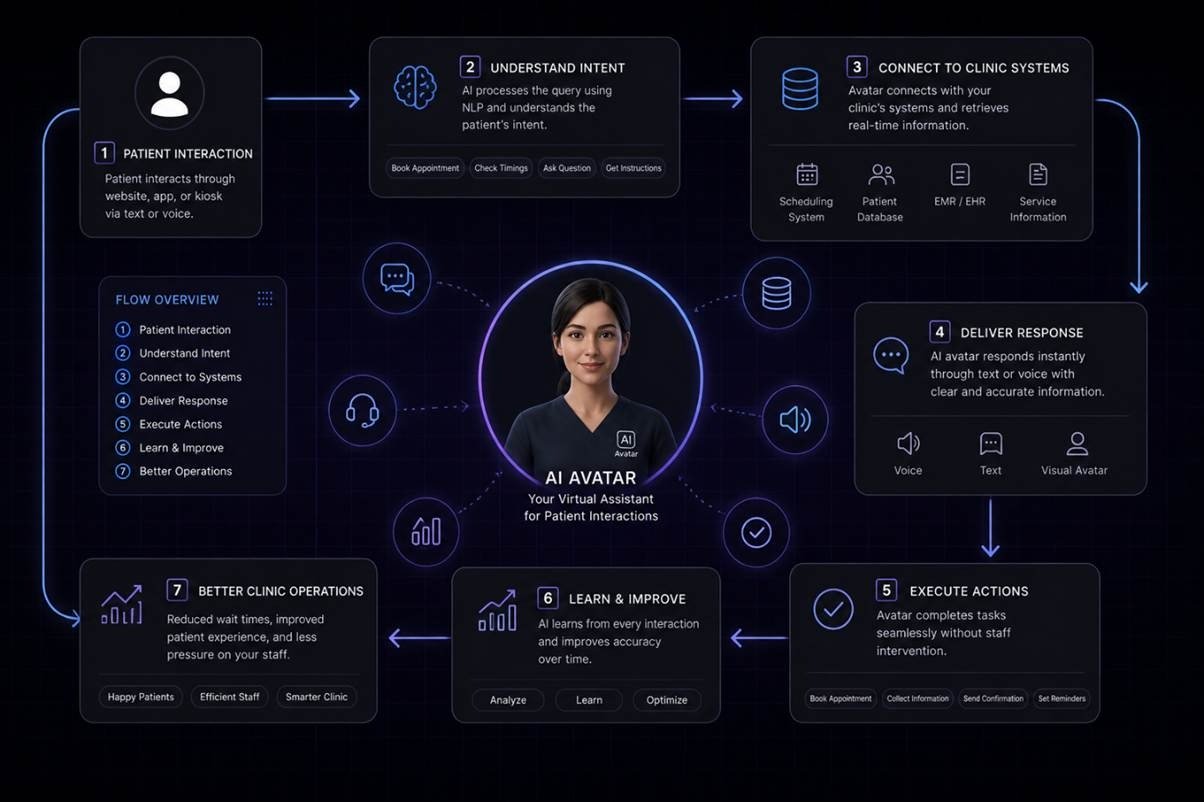
The moment a patient-lands on your website, opens your app, or interacts with a kiosk, they are greeted by your virtual avatar. Instead of waiting on hold or standing in a queue, the patient can instantly ask questions like appointment availability, doctor timings, or service details. From your perspective as a clinic owner, this means every incoming query is acknowledged immediately without depending on your front desk team.
Once the patient asks a question, the AI avatar does more than just read keywords. It interprets the intent behind the message. Whether the patient says “I want to book a visit,” “Do you have a slot today,” or “Need to see a doctor,” the system understands that the goal is appointment booking. This reduces confusion and ensures your patients get relevant responses without back-and-forth clarification.
After understanding the request, the avatar connects with your internal systems. This could be your scheduling software, patient database, or service information system. For example, if a patient wants to book an appointment, the avatar fetches real-time availability and presents options instantly. You do not need a staff member to manually check and respond.
Your patient receives an immediate response, either through text or voice. The interaction feels guided and structured, not robotic. The avatar can suggest next steps, ask follow-up questions, or provide instructions such as documents to bring or preparation steps before a visit. This improves clarity and reduces repeated calls to your clinic.
This is where you start seeing real impact. The avatar does not just answer questions, it completes actions. It can book appointments, collect patient details, send confirmations, and even trigger reminders. From your side, routine tasks that used to take hours of staff time are now handled automatically.
As more patients interact with the system, the avatar becomes smarter. It learns common queries, improves response accuracy, and adapts to how your patients communicate. This means over time, the system requires less manual correction and becomes more aligned with your clinic’s workflow.
With the avatar handling repetitive queries and basic workflows, your staff can focus on in-clinic responsibilities that require human attention. Patients experience faster responses, shorter waiting times, and clearer communication. From your perspective, operations become more efficient without increasing team size.
This step-by-step flow shows how an AI avatar fits directly into your daily operations, acting as a reliable first line of interaction that works continuously without adding pressure to your team.
It often begins with a subtle shift in awareness.
You start noticing that nearby clinics are responding faster, managing higher patient volumes, and offering smoother digital interactions without expanding their teams. Inside your own clinic, the front desk is still handling constant calls, repeated questions, and scheduling pressure throughout the day.
One clinic owner described it clearly: “I manage a busy multi-specialty clinic and I keep seeing other practices around us adopting AI avatars and honestly, we are feeling left behind. We are actively looking to develop our own AI avatar solution and want to know what is driving other clinicians to make this investment, whether it is cost savings, better patient experience, or simply staying competitive in today's healthcare market.”
This growing curiosity is backed by strong market momentum. According to Precedence Research, the global AI avatar market size accounted for USD 9.78 billion in 2025 and is predicted to grow from USD 12.90 billion in 2026 to approximately USD 142.62 billion by 2035, expanding at a CAGR of 30.73%.
The growth is driven by the increasing adoption of hyper-realistic avatars that enable more authentic and empathetic interactions.
Clinics are handling more appointment requests, inquiries, and follow-ups than ever before. Managing this volume manually creates bottlenecks. Investment in AI avatar development for clinics helps clinics handle large-scale interactions without depending entirely on human resources.
Daily operations still involve repetitive tasks such as answering common questions, confirming appointments, and sharing instructions. These tasks consume valuable time. Clinics are investing in AI avatars to reduce this dependency and create a more streamlined workflow.
Patients expect quick answers and seamless communication across digital channels. Delays often lead to frustration or missed opportunities. Clinics are investing in AI avatar creation for clinics to ensure immediate engagement across all touchpoints.
Serving patients from different language backgrounds adds complexity to communication. Clinics are investing in developing a clinical AI avatar for multilingual patients to ensure clarity, consistency, and accessibility without operational strain.
Clinics are observing how competitors are adopting AI-driven tools to improve patient interaction. This creates a strong push toward adopting similar technologies to remain relevant in a competitive healthcare environment.
Traditional systems offer limited insight into what patients are asking or where delays occur. AI avatars provide structured data on patient behavior and queries, helping clinics understand patterns and improve internal processes.
Clinicians are looking beyond short-term fixes. Investment in AI avatar systems supports a more scalable and predictable operational model where routine interactions are handled efficiently without constant human intervention.
From these operational challenges, increasing patient expectations, and visible shifts in how other clinics are evolving, it becomes clear why clinicians are investing in AI avatar development. The decision is being shaped by the need to manage growing demand, simplify communication, and stay aligned with the changing pace of healthcare delivery.
Also Read: AI Doctor Avatar Development: How to Reduce Patient Queries and Staff Burden in Modern Healthcare
Before investing in development, most clinics reach a practical question: where exactly will this fit into our daily workflow? Many decision-makers say, “We want to create an AI assistant for our clinic, but before that we want to explore the actual use cases of developing an AI avatar for clinics.”
That is the right approach. AI avatars are most effective when applied to real operational gaps rather than as a generic add-on. They work across multiple patient touchpoints and support both front desk operations and patient communication in a structured way.
Below are the most relevant and widely adopted use cases in clinical environments.
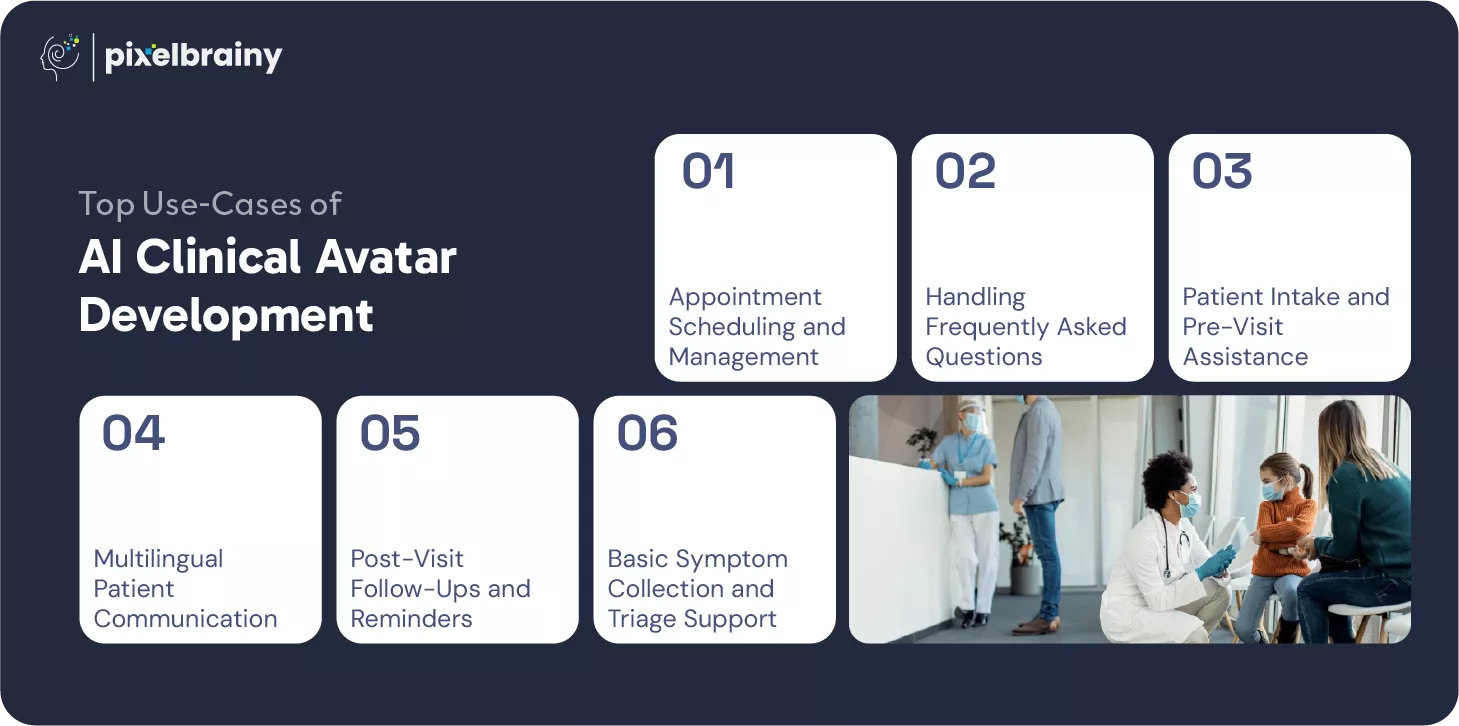
Appointment handling is one of the most time-consuming tasks in any clinic. AI avatars allow patients to check availability, book appointments, reschedule visits, or cancel bookings instantly.
The system connects directly with your scheduling software and shows real-time availability, which removes the need for manual coordination. Patients can complete the process at any time without waiting for a response. For clinics, this reduces call volume and avoids scheduling errors that often occur during peak hours. It also ensures better utilization of available slots by filling gaps more efficiently.
A large portion of daily patient interaction revolves around repeated questions. These include clinic timings, doctor availability, consultation fees, insurance coverage, and service details.
AI avatars handle these queries instantly with consistent and accurate responses. Instead of your staff answering the same questions throughout the day, the system provides information based on your clinic’s predefined data. This improves response time and ensures that patients receive clear answers without delays. Over time, the avatar adapts to common queries and refines its responses for better clarity.
The process before a patient visit often involves collecting personal details, medical history, and sharing preparation instructions. When done manually, this creates delays at the reception.
AI avatars guide patients through this process step by step before they arrive at the clinic. They collect required information, ensure forms are completed, and provide clear instructions for the visit. This reduces waiting time at check-in and helps staff manage patient flow more efficiently. It also creates a more organized experience for patients who know what to expect in advance.
Clinics serving diverse communities often face communication challenges due to language differences. This can lead to confusion around appointments, instructions, or follow-ups.
AI avatars support multiple languages, allowing patients to interact in the language they are most comfortable with. This ensures that information is delivered clearly and consistently. Clinics can maintain communication quality across all patient groups without the need to hire additional multilingual staff for every shift.
After a consultation, patients often need reminders for medications, follow-up visits, or additional instructions. Managing this manually can be time-consuming and inconsistent.
AI avatars automate these follow-ups by sending timely reminders, sharing post-visit care instructions, and even collecting feedback. This keeps patients engaged after their visit and ensures continuity in care. For clinics, it reduces the need for manual outreach while maintaining a consistent communication process.
Before seeing a doctor, gathering initial information about the patient’s condition can help streamline consultations. AI avatars can assist by asking structured questions about symptoms and concerns.
This information is organized and shared with clinicians before the appointment, helping them prepare in advance. It improves consultation efficiency and supports better patient flow management. The avatar acts as a support layer for initial data collection without replacing clinical judgment.
AI clinical avatars fit naturally into multiple stages of patient interaction and clinic operations.
When applied to the right use cases, they help clinics simplify workflows while maintaining consistent communication at every touchpoint.
Building an AI avatar for a clinic is not only about adding a conversational interface to your website or app. The real value comes from selecting features that align with daily clinical operations, patient expectations, and long-term scalability.
Whether you are focused on AI clinical avatar development, developing conversational AI avatar for patient intake process in clinics, or making AI avatars for small clinics and private practices, the feature set directly determines how useful, reliable, and scalable the solution becomes in real-world environments.
Below are the most important features clinics should evaluate before starting development.
| Feature | Explanation |
| Natural Language Processing | Natural language processing helps the AI avatar understand patient questions in a conversational manner instead of relying only on fixed commands. This allows patients to interact naturally while the system identifies intent and responds with relevant and accurate information instantly. |
| Voice Interaction Capability | Voice-enabled interaction allows patients to speak directly with the AI avatar instead of typing messages manually. This improves accessibility for elderly users, visually impaired patients, and individuals who prefer a more natural communication experience during clinic interactions. |
| Multilingual Communication Support | Multilingual functionality enables the AI avatar to communicate with patients in different languages based on their preference. This feature improves accessibility, reduces misunderstandings, and helps clinics provide consistent communication across diverse patient demographics without language-related operational challenges. |
| Appointment Scheduling Integration | Integration with scheduling systems allows the AI avatar to access real-time appointment availability, confirm bookings, manage cancellations, and reschedule visits automatically. This reduces manual coordination while improving efficiency for both patients and clinic administration teams. |
| Electronic Medical Record Integration | EMR integration enables the AI avatar to retrieve and update patient-related information securely when required. This helps streamline workflows, improve continuity during interactions, and ensure that patient communication remains aligned with existing clinical records and systems. |
| Patient Intake Automation | Patient intake automation allows the avatar to collect medical history, personal details, consent forms, and pre-visit information before appointments. This reduces paperwork, speeds up check-in procedures, and improves operational efficiency during busy clinic hours. |
| HIPAA-Compliant Security Framework | Healthcare-related interactions involve sensitive patient data, making compliance and security essential. A HIPAA-compliant framework ensures encrypted communication, controlled access, secure data storage, and privacy protection during every patient interaction handled by the AI avatar system. |
| Real-Time Response System | Patients expect immediate communication when interacting digitally with clinics. A real-time response engine ensures that the avatar processes and replies instantly, helping reduce waiting frustration while creating a smoother and more responsive patient experience overall. |
| Customizable Avatar Personality | Clinics should have the ability to customize how the AI avatar looks, speaks, and communicates. This includes tone, branding, appearance, and conversational style, helping the system reflect the clinic’s identity and patient engagement approach more effectively. |
| AI Learning and Adaptation | Machine learning capabilities allow the avatar to improve continuously based on patient interactions and behavioral patterns. Over time, the system becomes more accurate, understands recurring questions better, and adapts to the communication style of clinic patients. |
| Analytics and Reporting Dashboard | An analytics dashboard provides insights into patient interaction trends, frequently asked questions, response performance, and operational bottlenecks. Clinics can use this information to improve workflows, identify service gaps, and make more informed operational decisions. |
| Automated Follow-Up Management | The AI avatar should support automated reminders, follow-up notifications, medication alerts, and post-visit communication. This helps clinics maintain patient engagement after appointments while reducing the administrative burden of manual outreach and follow-up coordination. |
| Cross-Platform Accessibility | Patients interact with clinics across multiple devices and channels. Cross-platform support ensures the avatar works smoothly on websites, mobile applications, tablets, and kiosks, allowing patients to access assistance consistently regardless of the platform they use. |
| Human Handoff Capability | Not every patient interaction can or should be handled completely by AI. Human handoff functionality ensures that complex or sensitive conversations are transferred smoothly to clinic staff without interrupting the patient experience or losing important interaction context. |
| Scalable Cloud Infrastructure | As patient interactions increase, the AI avatar system must scale efficiently without affecting performance. Cloud-based infrastructure supports higher traffic volumes, faster processing, secure storage, and long-term scalability as clinic operations continue to grow over time. |
Selecting the right features during development determines whether an AI avatar becomes a practical operational asset or just another digital tool. A well-planned feature set helps clinics create smoother workflows, stronger patient communication, and a more scalable clinical support system.
A clinic owner recently explained their situation this way: “We run a clinic and need to find a reliable company to build and deploy an AI patient communication avatar.” That concern reflects what many healthcare providers are currently facing. Clinics are actively exploring ways to modernize patient communication while reducing operational pressure on staff.
For healthcare administrators, digital transformation teams, private practice owners, and multi-specialty clinics, the challenge is not just adopting AI. The challenge is building the right solution with the right process. Whether the goal is creating AI avatars to reduce administrative overload in clinics, developing AI avatar solutions for healthcare clinics, or learning how to make an AI avatar that answers patient questions 24/7, a structured development roadmap is essential.
Below is a practical step-by-step process followed by many top AI avatar development companies and healthcare-focused development teams.
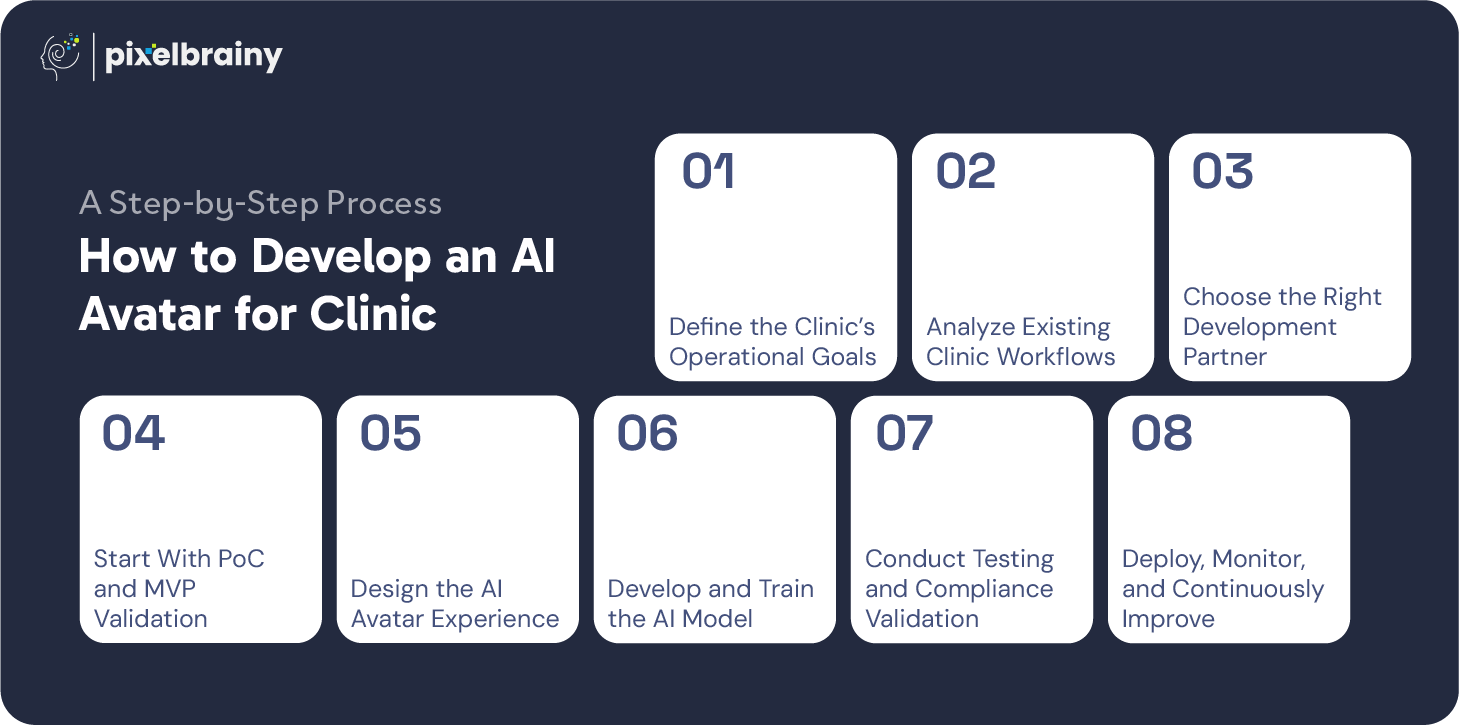
The first step is identifying exactly why the clinic wants an AI avatar. Some clinics need help with appointment scheduling, while others focus on multilingual communication, patient intake, or follow-up automation.
Clear goals help shape the entire development process. For example, a small clinic may prioritize reducing front desk workload, while a multi-location healthcare network may focus on patient engagement across departments.
This stage also involves identifying pain points such as long response times, repetitive staff tasks, missed appointments, or communication gaps. Defining measurable objectives early creates a stronger foundation for development and helps align technical decisions with operational needs.
Before development begins, clinics must evaluate how patients currently interact with their systems. This includes studying appointment booking, patient registration, follow-ups, inquiry handling, and communication channels.
Understanding workflows helps determine where the AI avatar should integrate and which tasks can realistically be automated. This stage is especially important for clinics planning digital human avatar development for clinical workflow optimization.
Development teams often conduct process mapping sessions with clinic administrators and staff to identify inefficiencies. The insights gathered here ensure that the AI avatar supports actual operational requirements instead of functioning as a disconnected standalone tool.
Selecting the right technology partner is one of the most important decisions in the entire process. Clinics often compare top AI development companies based on healthcare expertise, compliance understanding, technical capabilities, and deployment experience.
When evaluating AI companies for developing clinical avatar development, clinics should review case studies, integration experience, AI capabilities, and healthcare compliance knowledge. The development partner should understand patient communication workflows and data security standards.
A reliable partner also helps clinics avoid unnecessary complexity by recommending scalable architecture, realistic implementation plans, and long-term maintenance strategies tailored to healthcare environments.
Before building a full-scale system, many clinics begin with PoC development to validate whether the concept works within their operational environment. This phase tests specific functionalities such as appointment booking or FAQ automation using limited workflows.
Once the proof of concept delivers positive results, clinics typically move toward MVP development, where a more usable version of the AI avatar is deployed with core functionalities.
This staged approach reduces risk, controls development costs, and allows clinics to gather feedback before expanding features. It also helps identify technical improvements early in the process without affecting broader clinic operations.
This stage focuses on how patients will interact with the avatar visually and conversationally. Clinics decide the avatar’s tone, language style, personality, and communication flow.
For clinics aiming to create an AI virtual avatar for clinic front desk operations, this step is especially important because the avatar becomes the first digital interaction patients experience.
The design process includes creating conversation paths for appointments, inquiries, reminders, and intake forms. Developers also define how the avatar should respond during confusion, incomplete input, or sensitive conversations to ensure interactions remain clear and patient-friendly.
Once workflows and interaction logic are finalized, developers begin building the backend AI system. This includes natural language processing models, speech recognition systems, and machine learning frameworks.
The AI avatar is trained using clinic-specific data, patient communication scenarios, and predefined responses. The goal is to ensure the system understands medical terminology, appointment-related requests, and common patient concerns accurately.
At this stage, integrations with scheduling systems, CRM tools, EMRs, and communication platforms are also implemented. Proper training and integration directly affect how effectively the avatar performs during real patient interactions.
Before deployment, the entire system undergoes extensive testing. Clinics and developers evaluate response accuracy, workflow handling, data security, and user experience across devices.
Healthcare compliance validation is also critical during this phase. The system must follow HIPAA requirements, data encryption standards, and secure access protocols to protect patient information.
Testing typically involves real-world patient scenarios to identify gaps or confusion points. Clinics also assess how the AI avatar performs during peak usage periods and whether human handoff processes work smoothly when escalation is required.
After testing is completed, the AI avatar is deployed across selected patient touchpoints such as websites, mobile apps, or kiosks. Staff training is also conducted to ensure smooth adoption inside the clinic.
Deployment is not the final stage. Continuous monitoring is essential for improving performance over time. Clinics track interaction quality, patient satisfaction, response accuracy, and operational impact regularly.
As patient behavior evolves, the AI avatar is updated with new workflows, improved responses, and expanded capabilities. Continuous optimization ensures the system remains aligned with both patient expectations and clinic operations over the long term.
Developing an AI avatar for a clinic requires much more than adding conversational technology to a website. A structured process helps clinics build scalable, secure, and operationally effective systems that genuinely support patient communication and daily workflow management.
One of the first questions clinics ask before starting development is simple: how much will it actually cost? The answer depends on the complexity of the solution, required integrations, AI capabilities, compliance requirements, and the overall scale of deployment.
For clinics exploring AI avatar development cost for clinics, the investment can vary significantly between a basic conversational assistant and a fully integrated clinical AI avatar with multilingual support, voice interaction, EMR integration, and analytics capabilities.
On average, the cost of developing AI avatar solutions for healthcare clinics ranges between $15,000 and $150,000+ depending on project scope, infrastructure, and customization level.
If your clinic is evaluating what is the cost to create AI avatar for clinics, the breakdown below provides a clearer understanding of where development costs typically fall.
| Development Level | Estimated Cost | What’s Included |
| Basic AI Avatar | $15,000 – $30,000 | Basic chatbot-style avatar, FAQ handling, appointment booking, simple UI, limited integrations, text-based communication, and standard workflow automation for small clinics or private practices. |
| Mid-Level AI Clinical Avatar | $30,000 – $70,000 | Voice interaction, multilingual communication, patient intake automation, scheduling integration, analytics dashboard, and customized conversational workflows tailored to medium-sized clinics. |
| Advanced AI Clinical Avatar | $70,000 – $150,000+ | Human-like avatar interface, EMR integration, advanced NLP, AI learning models, HIPAA-compliant infrastructure, predictive workflows, omnichannel deployment, and enterprise-grade scalability for large healthcare organizations. |
| Cost Factor | Impact on Pricing |
| Avatar Complexity | Simple avatars cost less, while hyper-realistic AI avatars with voice, expressions, and human-like interactions increase development complexity and pricing. |
| AI Features and Capabilities | Advanced NLP, multilingual communication, AI learning systems, and predictive interaction models require additional AI training and infrastructure investment. |
| Healthcare System Integrations | Integration with EMR, CRM, billing systems, scheduling tools, and patient databases significantly affects development effort and testing requirements. |
| Compliance and Security Requirements | HIPAA-compliant architecture, encrypted communication, secure cloud infrastructure, and audit logging increase implementation costs but remain essential for healthcare environments. |
| Custom Workflow Development | Clinics with highly customized operational workflows require additional development time to align the AI avatar with internal processes and patient journeys. |
| Voice and Speech Features | Speech recognition and text-to-speech functionality increase infrastructure and processing requirements, especially when supporting multiple languages and accents. |
| Ongoing Expense | Estimated Monthly Cost |
| Cloud Hosting and Infrastructure | $500 – $5,000+ |
| AI Model API Usage | $300 – $3,000+ |
| Maintenance and Monitoring | $1,000 – $10,000+ |
| Security and Compliance Management | $500 – $5,000+ |
| Feature Enhancements and Updates | Based on scope and customization |
Many clinics avoid building full-scale enterprise systems immediately. Instead, they start with a focused deployment such as appointment automation or patient inquiry handling, then expand features gradually based on operational results.
This phased approach helps clinics validate ROI, reduce risk, and optimize development investment over time.
The cost of building an AI clinical avatar depends heavily on functionality, integrations, security requirements, and deployment scale. Clinics that approach development strategically can create scalable AI systems that align with operational goals while maintaining long-term cost efficiency.

Building an AI avatar for clinics requires more than a single AI model or chatbot framework. A reliable clinical AI avatar depends on multiple technologies working together across communication, automation, security, integrations, and infrastructure.
The technology stack you choose directly affects how accurately the avatar responds, how smoothly it integrates with clinic systems, and how scalable the platform becomes as patient interactions grow. For healthcare environments, the stack must also support compliance, data protection, and real-time performance.
Below is a recommended AI tools and technology stack commonly used in healthcare-focused AI avatar development projects.
| Technology Layer | Recommended Tools & Platforms | Purpose in AI Clinical Avatar Development |
| Natural Language Processing (NLP) | Dialogflow, Rasa, OpenAI APIs | Helps the AI avatar understand patient intent, process conversational input, and generate context-aware responses during interactions. |
| Speech Recognition | Google Speech-to-Text, Amazon Transcribe | Converts patient voice input into text so the AI avatar can process spoken conversations accurately in real time. |
| Text-to-Speech Engine | Amazon Polly, Microsoft Azure Speech | Enables the avatar to speak naturally with patients using human-like synthesized voice responses. |
| Frontend Development | React.js, Vue.js, Angular | Used to build the visual patient-facing interface for websites, mobile applications, and clinic kiosks. |
| Backend Development | Node.js, Python, FastAPI, Django | Handles business logic, API communication, workflow management, and integration between clinic systems and the AI engine. |
| Machine Learning Frameworks | TensorFlow, PyTorch, Scikit-learn | Supports AI model training, intent recognition, predictive workflows, and continuous learning capabilities. |
| Avatar Rendering Engine | Unity, Unreal Engine, WebGL | Creates the visual and interactive digital human interface for realistic AI avatar experiences. |
| Database Management | PostgreSQL, MongoDB, MySQL | Stores patient interaction logs, workflows, AI training data, and operational analytics securely. |
| Cloud Infrastructure | Amazon Web Services, Microsoft Azure, Google Cloud | Provides scalable hosting, secure infrastructure, data processing, and high system availability for clinic operations. |
| Healthcare Integration Standards | HL7, FHIR APIs | Enables secure integration with EMR, EHR, billing systems, and healthcare management platforms. |
| Authentication and Security | OAuth 2.0, JWT Authentication, AES Encryption | Protects sensitive patient data through secure authentication, encrypted communication, and controlled system access. |
| Analytics and Monitoring Tools | Google Analytics, Grafana, Kibana | Helps clinics monitor patient interactions, usage patterns, response accuracy, and operational performance metrics. |
| DevOps and Deployment Tools | Docker, Kubernetes, Jenkins | Supports automated deployment, scalability management, continuous integration, and infrastructure optimization. |
| CRM and Communication Integration | Twilio, SendGrid, HubSpot APIs | Enables automated SMS reminders, email communication, and patient engagement workflows. |
| HIPAA Compliance and Security Tools | Vanta, Drata, AWS HIPAA Services | Assists clinics in maintaining compliance, audit tracking, secure storage, and healthcare data governance. |
A successful AI avatar for clinics is built on a combination of conversational AI, secure infrastructure, healthcare integrations, and scalable cloud technologies. Choosing the right technology stack creates the foundation for reliable patient communication, operational efficiency, and long-term system growth.
When clinics invest in AI avatar development, technology is only one part of the equation. Compliance and regulatory alignment are equally important, especially in the United States healthcare system where patient data privacy and communication standards are strictly regulated.
An AI avatar used in a clinical environment interacts directly with sensitive patient information. It may collect medical history, schedule appointments, process inquiries, or assist with intake workflows. Because of this, clinics must ensure that the system follows healthcare compliance requirements from the very beginning of development.
Ignoring compliance during development can lead to legal risk, patient trust issues, financial penalties, and operational complications. That is why healthcare providers, IT leaders, and AI development teams prioritize security, transparency, and regulatory adherence throughout the entire implementation process.
The most critical regulation for AI clinical avatars in the USA is HIPAA, which stands for the Health Insurance Portability and Accountability Act.
Any AI avatar handling protected health information must follow HIPAA standards related to:
The system should ensure that patient conversations, appointment details, medical information, and uploaded documents remain protected at every stage of interaction.
AI avatars process and store sensitive healthcare information, making strong security infrastructure essential.
Clinics should ensure:
Using HIPAA-eligible cloud services from providers like Amazon Web Services or Microsoft Azure helps strengthen infrastructure security during deployment.
If third-party vendors or AI development companies handle patient data during development or deployment, clinics must establish a Business Associate Agreement.
A BAA defines:
This agreement is required when protected health information is accessed, processed, or stored by external service providers.
Patients should clearly understand when they are interacting with an AI avatar instead of a human staff member.
Clinics should provide:
Transparency builds trust and helps clinics maintain ethical communication practices during patient interactions.
If an AI avatar goes beyond administrative support and begins providing diagnostic recommendations or clinical decision support, additional regulatory considerations may apply.
In some scenarios, the system may fall under oversight from U.S. Food and Drug Administration depending on how the AI influences medical decisions.
Clinics should carefully define the avatar’s role to avoid unintended regulatory complications during deployment.
Healthcare systems must maintain records of patient interactions for compliance and operational review purposes.
AI avatars should include:
This helps clinics investigate issues, maintain accountability, and demonstrate compliance during audits or security reviews.
In addition to federal regulations, several US states have their own healthcare and consumer privacy laws.
Depending on the clinic’s location, compliance may involve:
AI development teams should evaluate both federal and state requirements before deployment.
AI avatars should never operate without escalation protocols. Certain conversations require human review, especially when patients discuss urgent symptoms, emotional distress, or sensitive medical situations.
Clinics should ensure:
This reduces operational risk while maintaining patient safety standards.
Compliance is not a one-time activity completed during deployment. AI systems require continuous monitoring and testing.
Clinics should conduct:
Regular evaluations help identify risks early and maintain long-term compliance alignment.
Developing an AI avatar for clinics in the USA requires a strong balance between innovation, patient experience, and regulatory responsibility. Clinics that prioritize compliance from the beginning create safer, more reliable AI systems that support both operational efficiency and patient trust.
Also Read: Top 12 AI Avatar Development Companies in USA
AI avatars are creating new opportunities for clinics to improve patient communication and operational efficiency. However, developing and deploying these systems in real healthcare environments also comes with several technical, operational, and regulatory challenges.
For clinics planning AI adoption, understanding these limitations early is important for setting realistic expectations, avoiding implementation mistakes, and building systems that align with actual clinical workflows.
Below are some of the most common challenges clinics face during AI clinical avatar development.
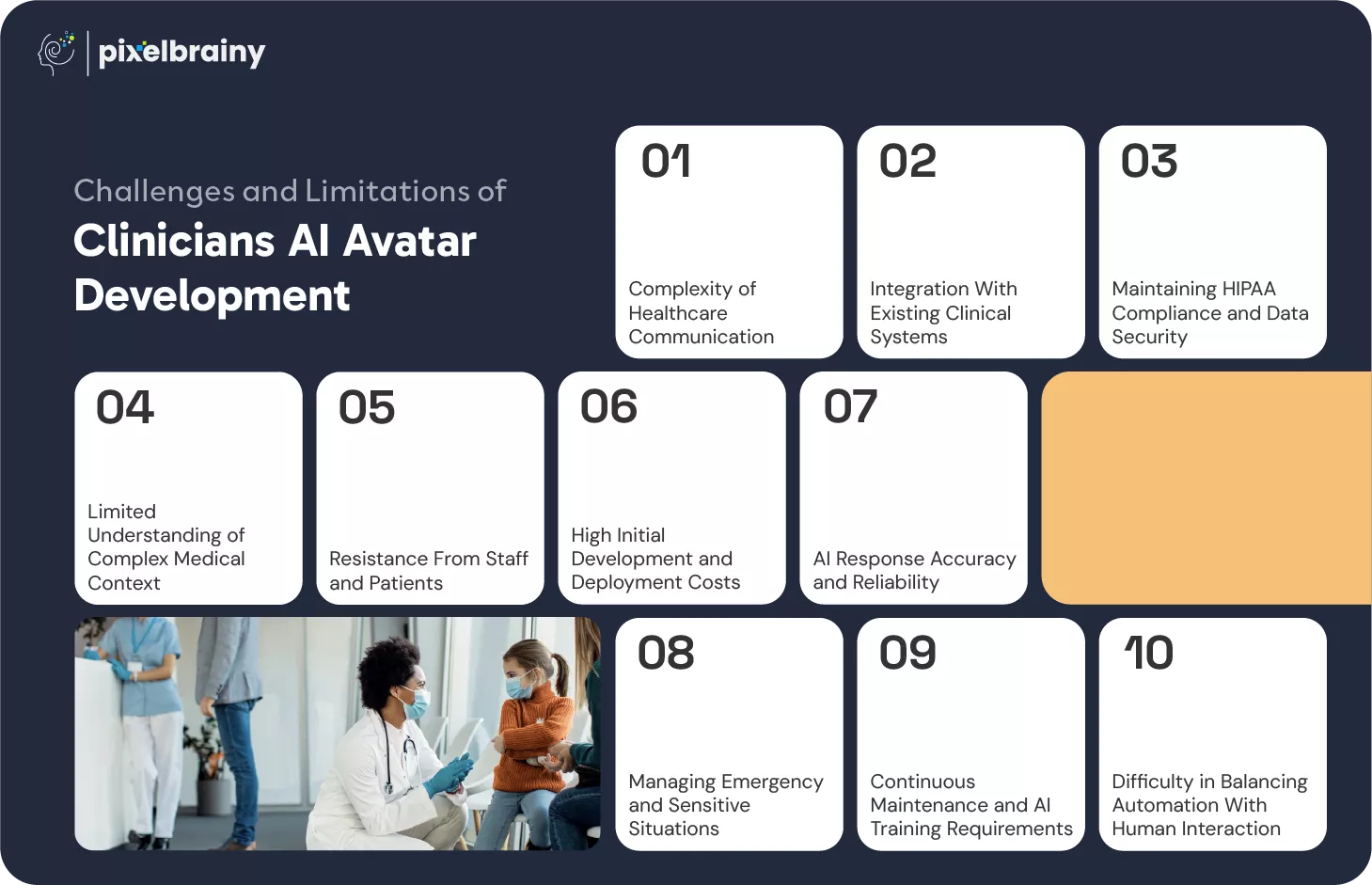
Healthcare conversations are highly sensitive and context-driven. Patients may describe symptoms differently, ask emotionally charged questions, or provide incomplete information.
Training an AI avatar to understand varied communication styles while maintaining accuracy is a major challenge. Unlike standard customer support systems, clinical AI avatars must handle conversations carefully to avoid confusion, misinformation, or inappropriate responses.
This requires continuous AI training, healthcare-specific datasets, and strong conversational design strategies.
Most clinics already operate using multiple systems such as EMRs, scheduling software, billing platforms, and communication tools.
Integrating an AI avatar smoothly into these existing systems can become technically complex, especially when dealing with outdated infrastructure or incompatible software environments.
Development teams often spend significant time building secure APIs, synchronization workflows, and real-time communication layers to ensure that patient data moves correctly across systems.
AI avatars process sensitive patient information, making security one of the biggest development concerns.
Clinics must ensure:
Even a minor security vulnerability can expose patient information and create legal or reputational risks. Compliance management therefore becomes an ongoing operational responsibility rather than a one-time setup task.
AI avatars can effectively manage administrative communication, but handling advanced medical discussions remains difficult.
Patients may describe symptoms unclearly, combine multiple concerns, or expect detailed medical guidance. In such situations, the AI may misunderstand context or provide incomplete responses.
Because of this limitation, clinics must define clear boundaries regarding what the avatar can and cannot handle during patient interactions.
Not every patient or staff member immediately feels comfortable interacting with AI systems.
Some patients may prefer speaking with a human receptionist, while clinic staff may worry about workflow changes or job impact. Older patients may also face difficulties adapting to digital communication interfaces.
Successful implementation often requires staff onboarding, patient education, and gradual adoption strategies to improve comfort and trust over time.
Building a healthcare-grade AI avatar requires investment in AI infrastructure, integrations, compliance, security, cloud systems, and continuous maintenance.
For smaller clinics or private practices, these upfront costs can become a barrier, especially when advanced features like multilingual support, voice interaction, or EMR integration are included.
Long-term maintenance and optimization costs also need to be considered during budget planning.
AI avatars depend heavily on training quality and data accuracy. If workflows are poorly designed or datasets are incomplete, the system may produce irrelevant or incorrect responses.
Even small inaccuracies can affect patient trust and clinic operations. This makes continuous testing, monitoring, and AI optimization essential after deployment.
Clinics cannot treat deployment as the final step because performance improvement must continue throughout the system lifecycle.
AI avatars are not designed to independently handle emergencies, severe symptoms, or emotionally sensitive situations.
The system must recognize high-risk interactions and escalate them immediately to human staff. Failure to establish proper escalation workflows can create patient safety concerns and operational risks.
Clinics need clearly defined emergency handling protocols integrated directly into the AI communication flow.
AI systems evolve continuously. New patient questions, changing workflows, updated compliance requirements, and evolving healthcare services require ongoing updates.
Without regular maintenance:
Maintaining a clinical AI avatar therefore requires long-term technical support and operational oversight.
Patients still value empathy, reassurance, and emotional understanding during healthcare interactions.
While AI avatars improve efficiency, excessive automation can sometimes make interactions feel impersonal if not designed thoughtfully. Clinics must balance automation with accessible human support to maintain a positive patient experience.
The goal is to support healthcare teams, not completely remove human communication from patient care journeys.
AI clinical avatar development offers significant operational potential, but it also involves technical, compliance, and communication-related challenges that clinics must address carefully.
Understanding these limitations early helps healthcare providers build safer, more reliable, and more practical AI systems for real-world clinical environments.
For many healthcare providers, the biggest challenge is not understanding the value of AI avatars. The real challenge is finding the right development partner that understands both healthcare operations and AI implementation.
A clinic administrator recently explained their concern this way: “We are searching for the best company to develop an AI avatar for our clinic because we need a solution that is secure, scalable, HIPAA-compliant, and actually useful for patient communication.”
This is where PixelBrainy positions itself differently. As an AI avatar development company focused on healthcare innovation, PixelBrainy combines conversational AI, healthcare workflow understanding, and compliance-first engineering to build intelligent patient communication systems for clinics across the USA.
The company specializes in building custom AI healthcare software solutions that align with real clinical workflows instead of generic chatbot implementations.
PixelBrainy begins every project by understanding how the clinic operates internally.
This includes analyzing:
Instead of applying a one-size-fits-all model, the team designs AI avatar workflows tailored to each clinic’s operational structure.
Compliance is integrated into the development process from the beginning.
PixelBrainy develops AI avatar systems with:
This ensures that patient interactions remain secure while meeting healthcare regulatory standards in the USA.
Healthcare communication requires more than general AI responses. PixelBrainy trains AI avatars using clinic-specific workflows, healthcare terminology, and patient interaction scenarios.
The avatars are designed to:
The focus remains on creating structured and reliable patient interactions rather than generic automated replies.
PixelBrainy develops AI avatars that integrate with:
This integration approach helps clinics maintain workflow continuity while introducing AI-driven automation into daily operations.
Different clinics require different levels of AI functionality. PixelBrainy supports scalable implementation models ranging from basic patient inquiry automation to advanced digital human avatars with voice interaction and real-time workflow integration.
This allows clinics to start with focused automation and expand features gradually as operational requirements evolve.
Project Overview: A USA-based multi-specialty clinic approached PixelBrainy to reduce front desk workload and improve patient communication efficiency. The clinic was handling high patient inquiry volumes daily, resulting in delayed responses, scheduling bottlenecks, and operational strain on staff.
Due to confidentiality agreements, the client name cannot be disclosed publicly.
Challenges Identified:
The clinic faced several operational issues:
The clinic wanted an AI-powered system capable of handling common patient interactions without disrupting existing workflows.
PixelBrainy developed a HIPAA-compliant AI avatar integrated directly into the clinic’s website and scheduling infrastructure.
The solution included:
The avatar was also connected with the clinic’s existing patient management workflows to ensure operational continuity.
Project Outcome:
Within the initial deployment phase, the clinic reported:
The AI avatar became a supporting operational layer that handled repetitive communication tasks while allowing clinic staff to focus on patient-facing responsibilities.
Healthcare providers often choose PixelBrainy because the company combines:
Rather than delivering generic automation tools, the company focuses on building AI avatar systems that align with practical clinical operations and patient communication needs.
That’s why building an AI avatar for clinics requires much more than conversational technology alone.
It requires healthcare workflow expertise, compliance awareness, secure infrastructure, and long-term scalability, which is exactly where PixelBrainy focuses its development approach for clinics across the USA.
From the above insights, it is clear that AI avatars are becoming an important part of modern clinical operations. Clinics across the USA are actively investing in AI avatar development for clinics to improve patient communication, reduce administrative workload, streamline appointment management, and create more accessible healthcare experiences.
Whether the goal is handling repetitive patient queries, supporting multilingual communication, or improving workflow efficiency, the right AI solution can help clinics operate more effectively without increasing pressure on staff. The growing demand for faster and smarter patient interaction is also driving healthcare providers toward scalable and compliant digital solutions.
However, successful implementation depends on choosing the right development strategy, technology stack, compliance framework, and development partner. A well-planned AI avatar system should align with your clinic’s workflow, patient expectations, and long-term operational goals.
If you are planning to build a secure and scalable AI avatar for your clinic, now is the right time to explore the possibilities. Book an appointment with PixelBrainy today to discuss your AI healthcare transformation goals and develop a customized AI avatar solution tailored for your clinic.
An AI avatar for clinics is a human-like digital assistant powered by artificial intelligence that interacts with patients through voice or text. It helps clinics automate appointment scheduling, answer patient questions, support intake processes, and improve communication efficiency.
AI avatars reduce patient wait times by automating repetitive front desk tasks such as appointment booking, patient intake, FAQs, and follow-up communication. This allows clinic staff to focus on in-person patient care while the AI handles routine interactions instantly.
Yes, AI avatars can be developed in a HIPAA-compliant manner when proper security measures are implemented. This includes encrypted communication, secure cloud infrastructure, controlled access management, audit logging, and compliance-focused data handling practices.
The cost of AI avatar development for clinics typically ranges between $15,000 and $150,000+ depending on complexity, integrations, AI capabilities, compliance requirements, and deployment scale. Advanced avatars with EMR integration and multilingual support generally require higher investment.
Yes, modern AI clinical avatars can support multiple languages and communicate with patients based on their preferred language. This helps clinics improve accessibility, reduce communication barriers, and deliver a more personalized patient experience.
Development timelines vary based on project scope and customization requirements. A basic AI avatar may take around 4 to 8 weeks, while advanced healthcare AI avatar solutions with integrations and compliance implementation may require several months for full deployment.

About The Author
Sagar Bhatnagar
Sagar Sahay Bhatnagar brings over a decade of IT industry experience to his role as Marketing Head at PixelBrainy. He's known for his knack in devising creative marketing strategies that boost brand visibility and market influence. Sagar's strategic thinking, coupled with his innovative vision and focus on results, sets him apart. His track record of successful campaigns proves his ability to utilize digital platforms effectively for impactful marketing efforts. With a genuine passion for both technology and marketing, Sagar continuously pushes PixelBrainy's marketing initiatives to greater success.


Transform your ideas into reality with us.
Working with the PixelBrainy team has been a highly positive experience. They understand the design requirements and create beautiful UX elements to meet the application needs. The dev team did an excellent job bringing my vision to life. We discussed usability and flow. Sagar worked with his team to design the database and begin coding. Working with Sagar was easy. He has the knowledge to create robust apps, including multi-language support, Google and Apple ID login options, Ad-enabled integrations, Stripe payment processing, and a Web Admin site for maintaining support data. I'm extremely satisfied with the services provided, the quality of the final product, and the professionalism of the entire process. I highly recommend them for Android and iOS Mobile Application Design and Development.

Great experience working with them. Had a lot of feedback and I found that unlike most contractors they were bugging me for updates instead of the other way around. They were extremely time conscience and great at communicating! All work was done extremely high quality and if not on time, early! They were always proactive when it comes to communication and the work is great/above par always. Very flexible and a great team to work with! Goes above and beyond to present us with multiple options and always provides quality. Amazing work per usual with Chitra. If you have UI/UX or branding design needs I recommend you go to them! Will likely work with them in the future as well, definitely recommended!

PixelBrainy is a joy to work with and is a great partner when thinking through branding, logo, and website layout. I appreciate that they spend time going into the "why" behind their decisions to help inform me and others about industry best practices and their expertise.

I hired them to design our software apps. Things I really like about them are excellent communication skills, they answer all project suggestions and collaborate right away, and their input on design and colors is amazing. This project was complex and needed patience and creativity. The team is amazing to do business with. I will be using them long-term. Glad to see there are some good people out there. I was afraid to try and outsource my project to someone but I am glad I met them! I really can't say enough. They went above and beyond on this project. I am very happy with everything they have done to make my business stand out from the competition.

It was great working with PixelBrainy and the team. They were very responsive and really owned the project. We'll definitely work with them again!

I recently worked with the PixelBrainy team on a project and I was blown away by their communication skills. They were prompt, clear, and articulate in all of our interactions. They listened and provided valuable feedback and suggestions to help make the project a success. They also kept me updated throughout the entire process, which made the experience stress-free and enjoyable.

PixelBrainy is very good at what it does. The team also presents themselves very professionally and takes care of their side of things very well. I could fully trust them taking up the design work in a timely and organised manner and their attention to detail saved us lots of effort and time. This particular project was quite intense and the team showed that they function very well under pressure. Very much looking forward to working with her again!

It's always an absolute pleasure working with them. They completed all of my requests quickly and followed every note I had for them to a T, which made our process go smoothly from start to finish. Everything was completed fast and following all of the guidelines. And I would recommend their services to anyone. If you need any design work done in the future, PixelBrainy should be your first call!

They took ownership of our requirements and designed and proposed multiple beautiful variants. The team is self-motivated, requires minimum supervision, committed to see-through designs with quality and delivering them on time. We would definitely love to work with PixelBrainy again when we have any requirements.

PixelBrainy was a big help with our SaaS application. We've been hard at work with a new UI/UX and they provided a lot of help with the designs. If you're looking for assistance with your website, software, or mobile application designs, PixelBrainy and the team is a great recommendation.

PixelBrainy designers are amazing. They are responsive, talented, and always willing to help craft the design until it matches your vision. I would recommend them and plan to continue them for my future projects and more!!!

They were awesome! Did a good job fast, and good communication. Will work with them again. Thank you

Creative, detail-oriented, and talented designers who take direction well and implement changes quickly and accurately. They consistently over-delivered for us.

PixelBrainy team is very talented and creative. Great designers and a pleasure to work with. PixelBrainy is an excellent communicator and I look forward to working with them again.

PixelBrainy has a very talented design team. Their work is excellent and they are very responsive. I enjoy working with them and hope to continue on all of our future projects.


