AI Summary Powered by PixelBrainy
What if your breathing app could recognize that your body is under stress and change the breathing session in real time instead of simply counting down from five minutes?
That is the central opportunity behind AI breathing app development in 2026. Many breathing applications still follow a familiar model: select a breathing technique, watch an animation, follow inhale and exhale instructions, complete the timer, and receive a reminder to return later. The experience may look polished, but technically it can remain little more than a sophisticated timer.
A genuinely intelligent AI breathing exercise app can work differently. With user permission, it can combine signals such as heart rate, heart rate variability, respiratory rate, movement, session history, and user feedback to estimate the user's current physiological state. Apple's HealthKit ecosystem provides developers with access to health data types including heart rate, HRV and respiratory rate, subject to authorization and platform requirements.
This creates a more valuable product proposition: can AI select and adapt a breathing intervention according to how the user is responding?
For example, imagine a user starts a relaxation session while their physiological signals indicate elevated arousal. The app begins with a controlled breathing pattern. During the session, the system observes the incoming data. If the user's response is improving, it can maintain the protocol. If the response plateaus, the system could adjust the breathing cadence, extend the exhale, change the coaching intensity, or recommend another protocol within predefined product and safety boundaries.
That is fundamentally different from adding an AI chatbot to a meditation timer.
The market surrounding this opportunity is also expanding rapidly. Grand View Research estimates the global digital health market will reach $420.2 billion in 2026 and projects it to reach $1.83 trillion by 2033, representing a 23.4% CAGR from 2026 to 2033.
For founders exploring how to create an AI breathing therapy app with stress detection and real-time adaptation, the opportunity is therefore not to build another breathing timer. It is to develop an adaptive wellness system that can sense, interpret, respond, measure outcomes, and become increasingly personalized.
This step-by-step guide to building an AI-powered breathing exercise app explains what the technology actually does, how wearable data can fit into the architecture, which features matter, how the development process works, what technologies are required, how much development can cost, and how to build a commercially viable product.
An AI breathing app is not simply a breathing timer with AI added to the interface. It is a personalized digital wellness system that can use artificial intelligence, behavioral information, and permitted physiological data to determine how a breathing session should be delivered.
A conventional breathing app usually follows a fixed sequence:
Choose an exercise → Start timer → Follow breathing cues → Finish session
The experience remains largely unchanged whether the user is calm, physically active, tired, or experiencing elevated physiological arousal.
An AI breathing exercise app can introduce an intelligent feedback loop:
Sense → Analyze → Recommend → Guide → Monitor → Adapt
For example, a user may connect an Apple Watch and begin a five-minute relaxation session. The app can use permitted signals such as heart rate, HRV, respiratory rate, activity context, and previous session patterns to establish an initial state.
Instead of simply running a predetermined breathing pattern, the application can evaluate how the user responds during the session. If the response is trending positively, it can maintain the current protocol. If the response remains unchanged, the system can make a controlled adjustment, such as modifying breathing pace, extending the exhale, or changing the coaching approach.
| Traditional App | AI-Powered App |
|---|---|
| Fixed breathing routines | Personalized routines |
| Timer-driven | Data-informed |
| Same experience for everyone | User-specific experience |
| Limited feedback | Continuous feedback |
| Manual exercise selection | AI-assisted recommendations |
| Static sessions | Adaptive sessions |
| Basic history | Long-term personalization |
The objective is not for AI to diagnose stress or medical conditions. Instead, AI breathing app development focuses on creating a responsive wellness experience that learns from user behavior and available physiological signals.
In simple terms, a traditional app tells users when to breathe. A genuinely AI-powered app aims to understand which breathing experience may be appropriate, how the user is responding, and what should happen next.
An AI breathing app works through a continuous feedback loop that combines physiological data, artificial intelligence, breathing protocols, and user behavior. Instead of delivering the same exercise to every user, the application can evaluate the user's current state, recommend an appropriate breathing technique, monitor the response, and personalize future sessions.
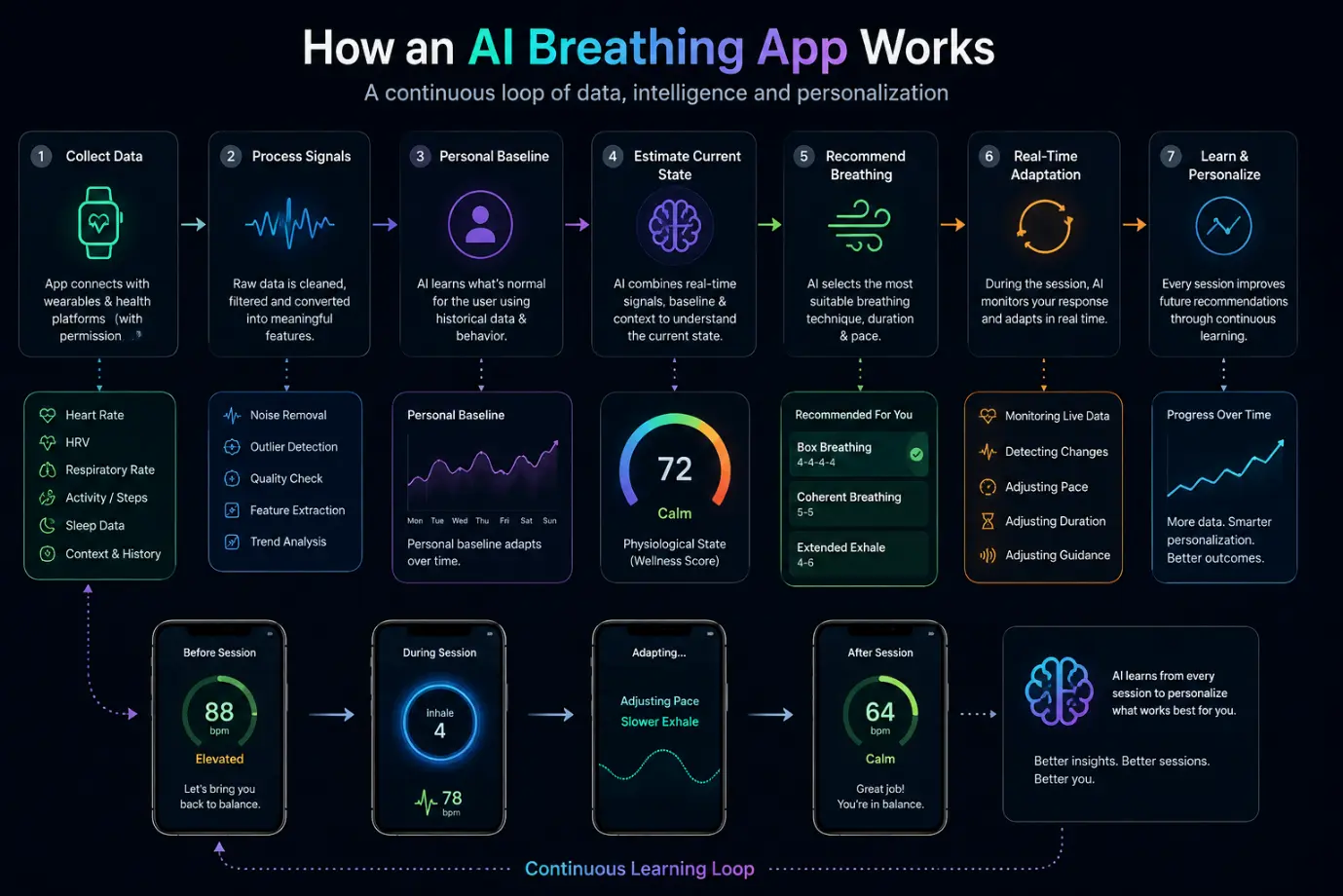
With the user's permission, the app can connect with platforms such as Apple HealthKit, Apple Watch, Android Health Connect, and compatible wearable devices. Depending on platform availability and authorization, relevant inputs can include heart rate, HRV, respiratory rate, activity information, and historical wellness data.
Raw wearable data is not immediately sent to the AI engine. A data-processing layer first checks data quality, removes potential noise, identifies missing readings, and converts raw measurements into useful features.
For example:
Heart-rate data → Filtering → Personal baseline → Trend analysis → AI input
This helps prevent the application from making decisions based on one abnormal or unreliable reading.
The application can learn what is normal for an individual rather than applying identical thresholds to everyone. Historical heart-rate trends, previous sessions, activity levels, and user feedback can contribute to this baseline.
The AI engine can combine multiple signals to create a wellness-oriented estimate of the user's current physiological state.
For example:
Current data + personal baseline + context + previous behavior = personalized session recommendation
This should not be presented as a medical diagnosis unless the product has appropriate clinical validation and regulatory authorization.
Based on the available information and the user's goal, the recommendation engine can select a suitable breathing protocol, session duration, coaching style, and initial breathing pace.
This is the core differentiator of AI breathing app development.
During the session, the system can evaluate incoming signals and user interaction. If the response is progressing as expected, it can maintain the current pattern. If the response changes, the application can make controlled adjustments to pacing, session duration, or guidance.
After completion, the system can combine physiological trends, session behavior, completion data, and user feedback. This information can improve future recommendations.
Therefore, the complete architecture can be summarized as:
Wearable Data → Signal Processing → AI Analysis → Breathing Recommendation → Real-Time Adaptation → Session Results → Personalization
This closed-loop architecture is what makes an AI breathing app fundamentally different from a conventional breathing timer.
The question for founders is no longer whether people use breathing and wellness apps. The bigger question is whether the next generation of users will continue paying for static content, or expect wellness applications to become more personalized, intelligent, and responsive.
In 2026, AI breathing app development sits at the intersection of three expanding markets: mobile health applications, wearable technology, and AI-powered personalization. This creates an opportunity to move beyond conventional breathing timers and develop an AI breathing exercise app that can use permitted physiological data, understand user context, personalize breathwork, and adapt sessions in real time.
The market numbers support this direction. Grand View Research estimates the global mHealth apps market at $49.9 billion in 2026, with the market projected to reach $86.4 billion by 2030 at a 14.8% CAGR.
The broader global mHealth market is estimated at $94.3 billion in 2026 and projected to reach $158.3 billion by 2030, growing at a 14.1% CAGR.
For businesses asking why build an AI breathing app in 2026, the following market factors explain why this category deserves attention.
Traditional breathing applications depend heavily on what users tell the app. Wearables can introduce another layer of information.
Smartwatches and health platforms can provide authorized data such as heart rate, HRV, respiratory rate, activity, and other physiological signals. This creates the foundation for a more responsive breathwork experience.
Instead of:
User selects breathing exercise → Timer starts → Session ends
an adaptive application can work as:
Wearable data → Physiological analysis → AI recommendation → Breathing session → Real-time response → Personalized recommendation
This feedback loop is one of the strongest reasons to develop an AI breathing app instead of another conventional meditation timer.
The market opportunity extends beyond breathing specifically. This growth indicates increasing consumer and business demand for mobile products that support health, fitness, wellness, and personal health management.
For an AI breathwork startup, this creates room for multiple positioning strategies:
One of the biggest problems in the existing breathing app category is feature similarity.
Many applications offer:
These features are relatively easy for competitors to reproduce.
AI can create a deeper product layer by allowing the application to personalize:
This gives AI breathing exercise app development a stronger differentiation strategy.
The competitive question changes from:
"How many breathing exercises do we offer?"
to:
"How intelligently can we personalize the breathing experience?"
A major opportunity in 2026 is developing an app that does not simply collect health data for a dashboard.
Instead, the data can influence the live experience.
For example:
Elevated physiological arousal detected
↓
AI recommends a calming breathing protocol
↓
User begins session
↓
System monitors response
↓
Response is improving
↓
Current breathing pattern continues
or:
Response is not changing as expected
↓
Controlled adjustment to breathing pace or guidance
This makes the product interactive rather than passive.
However, AI adaptation should be designed conservatively and should not be presented as medical diagnosis or treatment without appropriate validation and regulatory authorization.
A static breathing app can deliver the same experience on day one and day 300.
An intelligent system can become more personalized as the user interacts with it.
Over time, the platform can learn patterns such as:
This creates a potential retention advantage.
The product becomes more valuable because it becomes more relevant to the individual.
The commercial opportunity does not have to depend entirely on monthly consumer subscriptions.
An AI breathing platform can potentially support several business models:
B2C: Premium breathing and wellness subscription
B2B: Employee wellness programs
B2B2C: Integration with fitness and wellness platforms
SDK: Licensing adaptive breathing technology
Wearable partnerships: Companion experiences for connected devices
Enterprise wellness: Personalized wellness programs with organizational analytics
This flexibility can make the technology attractive to both startups and established health and wellness companies.
The opportunity is not limited to North America and Europe.
Grand View Research estimates that India's mHealth market will reach approximately $6.94 billion by 2030, with a projected CAGR of 15.7% from 2024 to 2030.
The India mHealth apps market alone is projected to reach approximately $4.83 billion by 2030, with strong growth expected through the forecast period.
For companies targeting India, this creates opportunities around affordable subscriptions, multilingual coaching, Android-first products, smartwatch integration, and culturally relevant wellness experiences.
The broader healthcare technology ecosystem is increasingly moving toward personalized, data-driven applications.
Grand View Research estimates the global healthcare mobile application market at $240.3 billion in 2026, with a forecast of approximately $1.07 trillion by 2030, representing a 45.2% CAGR from 2025 to 2030.
This does not mean an AI breathing app automatically becomes a healthcare product. Its regulatory position depends heavily on its functionality, claims, intended use, and target market.
It does show, however, that mobile health experiences are becoming increasingly sophisticated, creating a favorable environment for products that combine AI, personalization, and wearable data.
Therefore, the strongest opportunity in 2026 is not to build another breathing timer, but to build an adaptive AI breathing experience that turns wearable data and personalization into a genuinely more responsive product.
A successful AI breathing app development project should begin with a focused set of core features that establish a strong foundation for personalization, guided breathwork, wearable connectivity, and user engagement. The objective is not to overload the first version with advanced AI capabilities, but to create a reliable breathing experience that can collect meaningful feedback and evolve over time.
For businesses planning AI breathing exercise app development, the most important question is: “What features should an AI breathing app have to deliver more value than a conventional breathing timer?” The answer lies in combining a smooth guided experience with personalization, health-data connectivity, progress tracking, and intelligent recommendations.
Apple's HealthKit framework provides access to authorized health and fitness data, including heart rate, resting heart rate, HRV, respiratory rate, and other supported health metrics. This makes health-data integration an important foundation for an iOS-focused breathing product.
| Feature | What It Includes and Why It Matters |
|---|---|
| Intelligent User Onboarding | An intuitive onboarding flow collects wellness goals, preferred session duration, breathing experience, coaching preferences, and wearable availability. It creates the initial user profile required for relevant recommendations without overwhelming new users. |
| Goal-Based Breathing Selection | Users can select goals such as relaxation, sleep preparation, mindfulness, recovery, or everyday stress management. Goal selection helps the recommendation engine choose appropriate breathing exercises and keeps the experience aligned with user intent. |
| Breathing Exercise Library | A breathing exercise library organizes commonly used techniques by purpose, duration, difficulty, and guidance style. Users can explore established exercises while the AI layer recommends suitable options based on their selected goals. |
| Personalized Exercise Recommendations | Personalized exercise recommendations suggest suitable breathing sessions using user preferences, previous activity, session history, and available physiological context. Recommendations should remain transparent, explainable, and within clearly defined wellness boundaries. |
| Guided Breathing Interface | The guided breathing interface provides visual animations, inhale and exhale cues, timing indicators, and simple instructions. Consistent guidance helps users maintain breathing rhythm without requiring constant attention to text or complicated controls. |
| Audio Breathing Guidance | Audio guidance provides spoken breathing cues, calming instructions, and session transitions. Users can practice without watching the screen, making audio especially useful during relaxation sessions, bedtime routines, or situations where visual interaction is inconvenient. |
| Haptic Breathing Feedback | Haptic feedback can provide subtle vibration cues for inhale, exhale, transitions, or session completion on supported devices. This creates an accessible hands-free guidance channel and can make breathing rhythms easier to follow. |
| Wearable Device Integration | Wearable integration connects the breathing application with supported smartwatches and health platforms. With user permission, relevant physiological information can provide additional context for personalization, progress tracking, and future adaptive capabilities. |
| Health Data Integration | Health data integration allows authorized applications to access relevant information such as heart rate, HRV, respiratory rate, and activity data through supported health frameworks. This creates a structured foundation for personalized wellness experiences. |
| Customizable Session Timer | A session timer lets users choose predefined or customized durations while maintaining accurate inhale, exhale, and transition timing. Reliable timing remains essential because every guided breathing experience depends on consistent pacing and session control. |
| Session History | Session history records completed exercises, durations, techniques, dates, and user feedback. This information helps users understand their practice consistency while giving the personalization system historical context for more relevant recommendations over time. |
| Progress Dashboard | A progress dashboard converts session history into simple insights such as weekly practice, completed sessions, preferred techniques, and consistency. Clear visualization encourages continued engagement without overwhelming users with unnecessary health metrics. |
| Post-Session Feedback | Post-session feedback allows users to quickly describe how the experience felt, whether they completed the session, and whether they would repeat it. This subjective information complements physiological data and improves personalization. |
| Personalized Reminders | Personal reminders encourage consistent practice through scheduled notifications and user-selected preferences. Reminder controls should support flexible timing, frequency management, and easy opt-out options so notifications remain helpful rather than becoming intrusive. |
| Secure Account and Privacy Center | A secure account and privacy center gives users control over profile information, health permissions, wearable connections, notifications, and stored session data. Clear privacy controls are essential when an app handles sensitive wellness information. |
The right core features for an AI breathing app should deliver a simple breathing experience today while creating the technical foundation for deeper personalization, wearable connectivity, and intelligent adaptation tomorrow.
Once the core functionality is in place, the next opportunity is to make the product genuinely distinctive. Advanced AI breathing app development should focus on features that create a stronger connection between the user's physiological state, breathing behavior, and the application's response.
These features can help an AI breathing exercise app move beyond fixed routines and create a more intelligent, personalized experience. Some of the concepts below are already technically feasible through wearable and health-data ecosystems. For example, Apple HealthKit supports heart rate, HRV, respiratory rate, and other physiological data, while 2026 research prototypes are exploring HRV-adaptive pacing and screen-free haptic breathwork on Apple Watch.
| Non-Ordinary Feature | Detailed Explanation |
|---|---|
| Real-Time Stress Response Detection | The application can combine authorized physiological signals, user context, and historical patterns to estimate changes in the user's current stress-related state. Instead of relying only on a questionnaire, the system can continuously evaluate signals during a breathing session and adjust its response when appropriate. |
| AI-Adaptive Breathing Pace | AI-adaptive pacing can modify inhale, exhale, or transition durations according to predefined rules and the user's observed response. Rather than forcing every user through an identical rhythm, the system can make controlled adjustments while maintaining a stable and understandable breathing experience. |
| Personalized Breathing Fingerprint | A personalized breathing fingerprint can learn which breathing patterns, session lengths, coaching styles, and practice times work best for an individual. Over multiple sessions, the application can build a unique profile that makes recommendations increasingly relevant to the user's behavior and preferences. |
| Wearable-Driven Closed-Loop Breathwork | A closed-loop system connects wearable sensing directly with the breathing experience. Physiological information can enter the application, influence the session logic, and generate a response through visual, audio, or haptic guidance, creating a continuous sense-and-respond experience rather than a static exercise. |
| AI Breathing Coach | An AI breathing coach can provide contextual guidance before, during, and after a session. Instead of repeating identical instructions, the coach can personalize prompts based on the user's selected objective, previous sessions, current progress, and available physiological context. |
| Screen-Free Adaptive Breathwork | Screen-free breathwork allows users to complete sessions primarily through smartwatch haptics, audio, or other non-visual cues. This can reduce screen dependency and make the experience more suitable for relaxation, meditation, bedtime routines, and situations where users do not want to watch a phone. |
| AI-Generated Personalized Breath Plans | The application can generate personalized daily or weekly breathing plans based on goals, previous practice, preferred duration, consistency, and available contextual information. The plan can evolve as the system learns which sessions users actually complete and prefer. |
| Breathing Response Visualization | Instead of displaying only session duration, the application can visualize how selected physiological signals changed throughout the experience. Users could see trends before, during, and after a session, helping them understand their personal response without turning the experience into a complicated medical dashboard. |
| Context-Aware Breathing Recommendations | Context-aware recommendations can consider situations such as morning routines, work breaks, post-exercise recovery, pre-performance preparation, or bedtime. The application can combine the user's selected goal with available contextual information to recommend a more relevant breathing experience. |
| AI-Powered Session Learning Loop | A session learning loop connects every completed session with future recommendations. The system can compare the selected technique, duration, adherence, user feedback, and available physiological response, then use those patterns to improve subsequent recommendations and personalization. |
The purpose of these features is not simply to increase the number of items on a product roadmap. Their value comes from creating a stronger sense, understand, respond, and learn cycle.
For example, Apple's HealthKit currently supports heart rate, HRV, respiratory rate, and other vital-sign data, providing technical building blocks for applications that want to incorporate authorized physiological information.
The most differentiated products can combine several of these capabilities into one experience:
Wearable data → AI interpretation → Personalized breathing → Real-time response → User feedback → Continuous learning
This is where AI breathing app development can move beyond conventional timers and create a product that becomes more personalized with continued use.
The strongest advanced features are those that make the app respond intelligently to the user rather than simply giving the user more breathing exercises to choose from.
The value of AI breathwork app development becomes clearer when breathing is treated as an adaptive digital experience rather than a fixed exercise library. A conventional app asks users to choose a technique and follow a timer. An intelligent breathwork platform can understand the user's objective, consider available wearable and behavioral data, personalize the session, collect feedback, and improve future recommendations.
This creates opportunities across consumer wellness, sleep, fitness, workplace wellness, performance preparation, and wearable experiences. For founders asking “What can an AI breathing app actually be used for?”, the answer is broader than stress management alone. The same underlying technology can power different personalized experiences depending on when, why, and how a user wants to practice breathing.
Below are eight high-value use cases worth considering when planning AI breathing exercise app development.
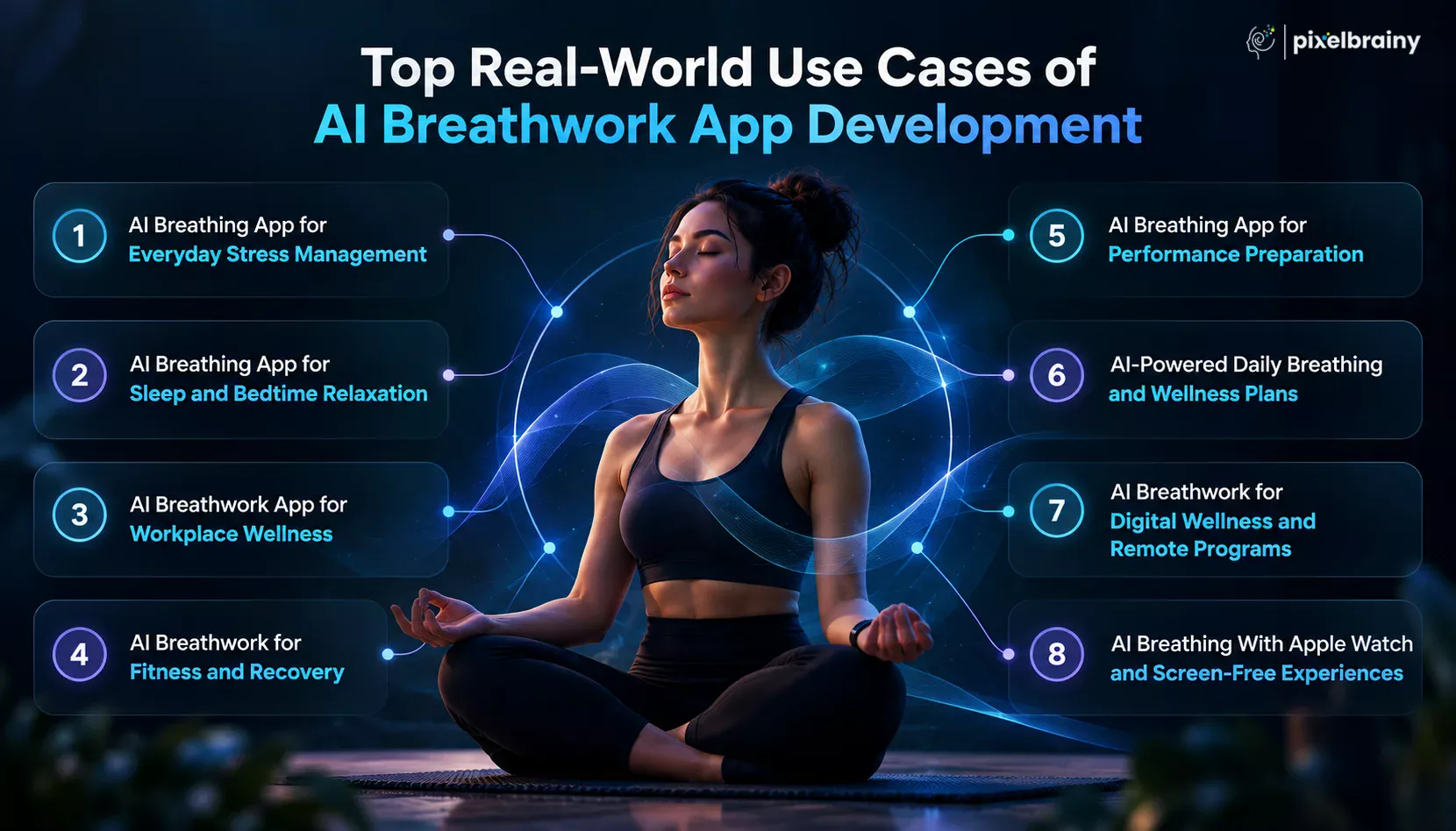
Stress management is one of the most natural use cases for an AI breathing app because breathing sessions can be short, accessible, and practiced almost anywhere. Instead of making users browse through dozens of exercises, the application can ask what they need right now and recommend an appropriate session.
With authorized wearable information, the system can also consider available physiological context alongside user input and previous behavior. For example, if a user starts the app during a demanding workday, the application could recommend a short relaxation-oriented breathing session rather than a longer routine.
After the session, the user can provide simple feedback about how they feel. Over time, this creates a personalization loop where the application learns which exercises, durations, and coaching styles the user prefers.
The key opportunity is to turn breathwork into an on-demand personalized stress-management experience, rather than another static meditation timer.
An AI breathing app for sleep can become part of a user's nightly wind-down routine. The goal is not to claim that breathing exercises diagnose or treat sleep disorders, but to provide a consistent relaxation experience before bedtime.
The application can personalize sessions according to the user's preferred duration, previous practice, feedback, and bedtime habits. For example, a user who regularly completes five-minute breathing sessions before bed could receive a similar experience automatically rather than manually searching for an exercise.
The experience can become even more seamless through audio and smartwatch haptic guidance. Users could place their smartphone aside and follow simple breathing cues without continuously looking at a screen.
The long-term opportunity is to build a personalized bedtime breathwork routine that becomes part of the user's daily behavior.
Workplace wellness is another commercially attractive use case for AI breathwork app development. Employees can access short breathing sessions before presentations, after demanding meetings, during work breaks, or when transitioning between tasks.
Instead of giving every employee an identical five-minute breathing exercise, the application can provide different session options based on individual goals and preferences.
For example:
Presentation preparation → short guided session
Midday reset → brief relaxation session
End-of-workday transition → longer calming session
Organizations can also receive privacy-conscious aggregate analytics such as participation, session completion, and program engagement. Individual health information should remain protected and should not be exposed to employers without appropriate consent and safeguards.
This makes AI breathwork suitable for employee wellness platforms, corporate wellness programs, and enterprise wellbeing solutions.
Fitness applications already rely heavily on wearable technology, making fitness and recovery a natural expansion area for AI breathing exercise app development.
After a workout, the application can provide a breathing session based on the user's selected objective and available activity context. Rather than automatically starting the same routine after every workout, it can personalize the session based on the user's preferences and previous behavior.
For example, the application could recommend a short recovery-focused breathing session after a demanding workout. Another user may prefer a shorter cooldown experience.
The important distinction is that the app should not make unsupported medical or physiological claims. Its role can remain focused on guided breathing, relaxation, and wellness.
This use case also creates opportunities for partnerships with fitness apps, wearable platforms, gyms, coaches, and digital fitness ecosystems.
Performance situations create another compelling use case. Athletes, public speakers, executives, musicians, students, and performers may want a short breathing routine before an important event.
An AI breathing app for performance can eliminate the need to search through a large exercise library. The user can simply select a context such as:
Presentation
Competition
Exam
Public speaking
Performance
The application can then recommend an appropriate short session based on the selected objective and the user's historical preferences.
Over time, the system can learn whether the individual prefers two-minute, five-minute, audio-guided, or haptic sessions before performance situations.
These turns breathing into a personalized preparation ritual that can be integrated into the user's existing routine.
Instead of waiting for users to open the application when they feel stressed, an AI breathing platform can proactively support consistent daily practice.
The system can create personalized breathing plans around the user's routine.
For example:
Morning → preparation session
Afternoon → short reset
Evening → relaxation session
The plan can adapt based on what the user actually completes. If a user repeatedly skips ten-minute sessions but consistently completes three-minute sessions, the application can recommend shorter sessions.
This creates an important behavioral advantage.
The product is not simply asking:
“Which breathing exercise do you want?”
It is helping answer:
“What breathing routine is realistic and relevant for you today?”
This type of personalization can improve the usefulness of an AI breathing exercise app while creating more opportunities for long-term engagement.
AI breathwork app development can also support B2B and B2B2C wellness platforms. Wellness companies, coaches, fitness providers, employers, and digital health organizations can integrate personalized breathing experiences into their existing services.
For example, a wellness platform could offer breathing sessions as one component of a larger program that includes meditation, sleep content, fitness, and behavioral coaching.
The AI layer can personalize the breathing component according to the user's goals and previous engagement.
Organizations can also monitor program-level metrics such as:
Individual physiological information should be handled separately with strong privacy controls.
This creates a business opportunity beyond consumer subscriptions and can support enterprise wellness platforms, digital health ecosystems, and wellness technology partnerships.
One of the most promising use cases is a screen-free AI breathing experience powered by a smartwatch.
Instead of requiring users to stare at an animated breathing circle, the smartwatch can provide haptic cues for different breathing phases while the phone handles configuration and broader visualization.
This creates a more natural experience for situations such as:
The technical opportunity becomes even more interesting when wearable signals are incorporated into the feedback loop. Apple's HealthKit framework supports authorized health information such as heart rate, HRV, respiratory rate, and other health data types.
A 2026 research preprint describing the Vayu system explored an Apple Watch and iOS breathwork experience using haptic guidance, HRV-adaptive pacing, and personalized recommendations. The researchers reported promising early results but also noted the need for randomized controlled trials to establish efficacy more rigorously.
This points toward an important future direction for AI breathing app development: the wearable can become the primary interaction device while AI manages personalization and the breathing experience responds to the user's changing context.
The biggest opportunity in AI breathwork is to make breathing available at the exact moment a user needs it, with the right guidance, the right format, and increasingly personalized recommendations based on their individual experience.
Building an AI breathing app from scratch requires more than developing a breathing timer, adding wearable connectivity, and placing an AI chatbot inside the interface. The development process needs to connect product strategy, physiological data, AI models, personalization, mobile engineering, privacy, and real-time session logic into one reliable system.
For founders asking how to build an AI breathing app from scratch, the most practical approach is to develop the product in stages. Each stage should validate a specific assumption before the next layer of complexity is introduced. This is particularly important for AI breathing app development for healthcare startups, where data privacy, product claims, usability, and technical reliability can significantly influence the final product.
The following methodology explains the steps to build an AI breathing app from idea to launch, from defining the product concept to deploying the first production version.
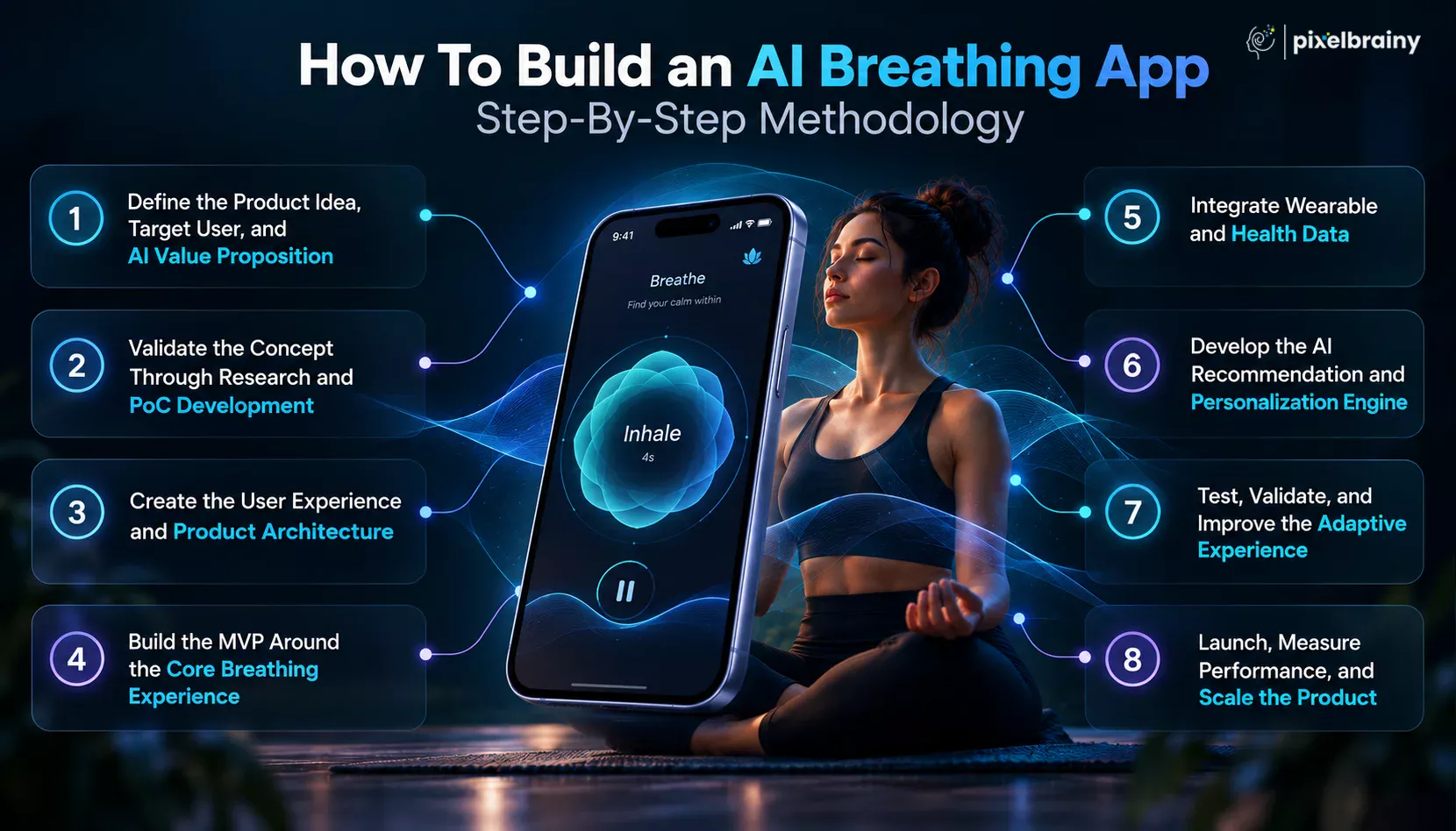
The first step in building an AI breathing app is defining exactly who the product is for and why AI is necessary. Avoid starting with a long list of features. Instead, identify one specific user problem, such as difficulty maintaining a consistent relaxation routine or the need for personalized breathing sessions based on wearable information.
Define the target audience, primary use case, preferred devices, business model, and expected outcome. Most importantly, establish what AI will actually do. Will it recommend exercises, personalize session duration, analyze historical responses, or adapt breathing guidance? This decision becomes the foundation for the entire development process of AI breathing app and prevents unnecessary AI functionality from increasing development complexity and cost.
Once the product hypothesis is clear, validate whether the proposed experience is technically and commercially realistic. Research competing breathing applications, wearable capabilities, available health APIs, privacy requirements, and target-user expectations.
A small PoC development phase can test the most technically uncertain component before significant resources are invested in the full application. For example, the team can test whether authorized wearable data can be collected reliably, processed with acceptable latency, and used to trigger controlled breathing-session changes.
The goal is not to build a complete application at this stage. It is to answer critical questions such as whether the adaptive experience is technically feasible, whether the required data is available, and whether AI provides enough value to justify the product.
After validating the concept, design the complete user journey. The experience should cover onboarding, health permissions, wearable connection, breathing selection, live sessions, session completion, progress tracking, and personalization.
A specialized UI/UX design company can help translate the complex AI and physiological-data architecture into an interface that feels simple to the user. The live breathing screen should remain particularly focused because users should not need to interpret complicated information while practicing.
At the architecture level, define how mobile applications, wearable devices, health platforms, backend services, databases, AI models, analytics, and notification systems will communicate. This stage creates the technical blueprint for how to create an AI breathing app that can scale beyond the initial prototype.
The next stage is MVP development, where the team converts the validated concept into a functional product with only the features necessary to test the core hypothesis.
A practical MVP could include user onboarding, breathing exercise selection, guided sessions, audio or visual instructions, session history, basic personalization, wearable integration, and a simple recommendation engine.
The MVP should not attempt to include every advanced AI capability immediately. The purpose is to determine whether users actually engage with the breathing experience and whether personalization creates measurable value.
For example, the first release might compare user-selected exercises with AI-recommended exercises and measure completion, repeat usage, and feedback. This creates evidence for deciding which capabilities deserve investment in the next development cycle.
Also Read: Top 10 AI MVP Development Companies in USA
Wearable connectivity can become one of the most important technical components when developing an adaptive breathing platform. For an iOS product, HealthKit can provide access to authorized health information, while Apple Watch can support dedicated wearable experiences.
The AI integration layer should not treat every physiological signal as a direct instruction. Instead, data should pass through validation, preprocessing, baseline calculation, and confidence checks before influencing recommendations.
A typical architecture can look like:
Wearable → Health platform → Data processing → Personal baseline → AI engine → Recommendation → Breathing session
The product should request only necessary permissions and clearly explain how health information is used. Data availability and sampling behavior can also vary by device and platform, so the architecture should be designed around realistic data constraints rather than theoretical continuous monitoring.
The intelligence layer is where the product begins to move beyond a conventional breathing application. An AI consultation phase can help determine whether the product should use machine learning, deterministic rules, time-series analysis, recommendation models, generative AI, or a hybrid architecture.
For many early products, a hybrid approach is practical. Deterministic rules can control predefined boundaries, while machine learning can identify patterns in historical user behavior and physiological data.
The AI model development process can focus on questions such as:
The objective is controlled personalization, not unrestricted autonomous decision-making.
Also Read: Top 12+ AI Model Development Companies in the USA
Before launching publicly, test the application across technical, behavioral, and product dimensions. This includes testing wearable connectivity, data quality, model behavior, recommendation consistency, mobile performance, battery consumption, accessibility, privacy controls, and failure scenarios.
The team should also test whether the AI actually improves the user experience. A useful product experiment can compare a static breathing experience with an adaptive version and measure session completion, repeat usage, user satisfaction, and perceived usefulness.
For AI product development companies, this validation stage is especially important because AI functionality can appear impressive during a demonstration but behave unpredictably at scale. Every adaptation should have clear boundaries, fallback behavior, and confidence thresholds.
The system should also be designed to avoid presenting wellness estimates as medical diagnoses unless the product has undergone the appropriate clinical and regulatory pathway.
The final stage is launching the application to a controlled audience and continuously measuring real-world performance. The first launch should focus on validating the product rather than immediately maximizing the feature set.
Track metrics such as:
Feedback should then guide the next development cycle. Features that generate meaningful engagement can be expanded, while low-value functionality can be removed or redesigned.
When evaluating potential partners, founders can compare top AI app development companies based on their experience with AI architecture, mobile applications, wearable integration, data security, model development, and scalable product engineering rather than selecting a provider based only on the lowest development quote.
The long-term roadmap can then expand toward more sophisticated personalization, additional wearable platforms, enterprise wellness, multilingual coaching, advanced analytics, and broader digital wellness integrations.
A successful AI breathing app is built by validating the adaptive value first, then progressively connecting AI, wearable data, personalization, and scalable product engineering into a reliable experience.
Also Read: AI Mobile App Development for Startups and Enterprises: Benefits, Steps and Challenges
If you are planning to build an AI breathing app, one of the first commercial questions is: “What budget should I realistically keep aside for an app that includes AI personalization, wearable integration, a breathing engine, secure cloud infrastructure, and a production-ready mobile experience?”
The cost to develop an AI breathing app can vary considerably because the product can range from a relatively simple AI-guided wellness application to a sophisticated platform connected to Apple Watch and Wear OS, health-data APIs, conversational AI, enterprise dashboards, and continuously improving ML models.
For planning purposes, the AI breathing app development cost can range from approximately $30,000 to $250,000+. A basic product may stay near the lower end, while an advanced or enterprise platform can move substantially higher.
The final development budget of an AI breathing app depends primarily on functionality, AI complexity, number of platforms, wearable integrations, security requirements, backend architecture, and development location.
For an iOS product using HealthKit, additional engineering work is required around permissions, privacy, health-data handling, and App Store requirements. Apple requires fine-grained authorization for HealthKit data and requires developers to clearly explain why health information is being accessed.
Therefore, when evaluating what is the development pricing of an AI breathing app, it is better to estimate each technical component separately rather than relying on one generic app-development price.
| AI Breathing App Type | Estimated Development Cost | Typical Scope |
|---|---|---|
| Basic AI Breathing App | $30,000 to $70,000 | iOS or Android app, onboarding, breathing library, guided sessions, audio/visual guidance, basic AI recommendations, session history, user profiles, basic backend, subscriptions, analytics, and privacy controls. |
| Advanced AI Breathing App | $70,000 to $150,000 | Cross-platform mobile app, AI personalization, breathing recommendation engine, HealthKit or Health Connect integration, Apple Watch or wearable support, adaptive session logic, AI coaching, advanced analytics, secure cloud infrastructure, subscriptions, and comprehensive testing. |
| Enterprise AI Breathing App | $150,000 to $250,000+ | iOS, Android, Apple Watch, Wear OS, advanced AI/ML personalization, real-time adaptive breathing, conversational AI coach, enterprise administration dashboard, organization management, analytics, scalable cloud infrastructure, enhanced security, compliance requirements, integrations, and continuous AI improvement. |
| Cost Factor | Estimated Cost | How It Affects the Budget |
|---|---|---|
| UI/UX Design | $4,000 to $15,000 | The cost depends on the number of screens, interactive breathing animations, onboarding flows, wearable interfaces, accessibility requirements, design system, and prototype complexity. A sophisticated wellness experience requires more design and usability testing than a basic application. |
| Mobile App Development | $15,000 to $50,000+ | Developing for one platform costs less than supporting both iOS and Android. Native development can also increase investment when deep platform capabilities, wearable connectivity, background processing, and health APIs are required. |
| Breathing Session Engine | $5,000 to $15,000 | The engine controls inhale, exhale, hold periods, transitions, timing, audio cues, visual animations, haptic feedback, session states, and customization. More sophisticated session logic increases engineering and testing requirements. |
| AI Recommendation Engine | $10,000 to $30,000 | AI recommendations require data processing, recommendation logic, personalization rules, model development, testing, evaluation, and infrastructure. The budget increases when recommendations become highly personalized or use multiple data sources. |
| ML Personalization | $15,000 to $40,000+ | Personalized machine learning requires user-history processing, feature engineering, model training, evaluation, monitoring, and continuous improvement. The cost depends heavily on data availability and whether custom models are required. |
| Apple Watch Integration | $10,000 to $30,000 | Apple Watch development can involve watchOS interfaces, health-data integration, session controls, haptic guidance, background behavior, synchronization, and device-specific testing. HealthKit also requires appropriate authorization and privacy implementation. |
| Wear OS Integration | $10,000 to $30,000 | Supporting Wear OS requires additional wearable development, synchronization, device testing, health-platform integration, and optimization. Supporting multiple watch models can further increase testing and maintenance requirements. |
| Health Data Integration | $5,000 to $20,000+ | Integrating HealthKit, Health Connect, or other health APIs requires permission management, data mapping, validation, synchronization, privacy controls, and handling of restricted or unavailable data. Apple requires apps to request access to individual health-data types appropriately. |
| Conversational AI Coach | $8,000 to $25,000+ | A conversational coach can include AI prompts, contextual recommendations, conversation history, guardrails, personalization, voice capabilities, and integration with the breathing engine. More sophisticated coaching requires additional AI engineering and testing. |
| Backend and Cloud Infrastructure | $10,000 to $35,000+ | Backend costs cover APIs, authentication, databases, user profiles, session storage, analytics, notifications, subscriptions, AI services, data pipelines, and scalable cloud architecture. Enterprise requirements can significantly increase infrastructure complexity. |
| Security and Compliance | $8,000 to $30,000+ | Security costs can include encryption, access controls, audit logging, secure infrastructure, privacy workflows, consent management, security testing, and compliance-related implementation. HIPAA requirements, where applicable, can add significant technical and operational work. |
| Corporate Wellness Dashboard | $10,000 to $35,000+ | Enterprise products may require organization management, administrator accounts, employee management, role-based access, engagement analytics, reporting, subscription administration, and privacy-conscious aggregate insights. |
| QA and Testing | $5,000 to $20,000+ | Testing covers mobile devices, wearable connections, AI behavior, session accuracy, health-data permissions, APIs, security, performance, battery consumption, accessibility, and edge cases. Supporting multiple platforms substantially increases testing requirements. |
| Cloud AI and API Costs | $2,000 to $15,000+ initially | AI inference, conversational AI, storage, databases, monitoring, analytics, and third-party APIs create recurring operational costs. These expenses can increase as the number of active users and AI interactions grows. |
| Post-Launch AI Improvement | $5,000 to $25,000+ annually | AI products require ongoing monitoring, model evaluation, personalization improvements, bug fixes, data-quality analysis, platform updates, and new model iterations. A production AI product should be budgeted as an ongoing system rather than a one-time build. |
The largest cost differences usually come from five areas.
1. Product complexity: A guided breathing timer is relatively simple, while real-time adaptive breathwork requires considerably more engineering.
2. AI sophistication: Rule-based recommendations cost less than custom ML models that learn from longitudinal user behavior.
3. Wearable support: Supporting Apple Watch and Wear OS means additional applications, APIs, synchronization logic, device testing, and maintenance.
4. Compliance and security: Handling sensitive health information requires stronger privacy, authorization, security, and governance processes. Apple specifically requires health-data access to be authorized and clearly explained to users.
5. Enterprise requirements: Corporate wellness platforms can require separate dashboards, organization management, role-based permissions, reporting, integrations, and scalable infrastructure.
For a startup, a sensible approach is to avoid investing $200,000+ before validating the core product hypothesis.
A staged budget can look like:
PoC: $10,000 to $25,000
Validate wearable connectivity, breathing-session logic, AI recommendation feasibility, and data architecture.
MVP: $30,000 to $70,000
Launch the core breathing experience with initial AI personalization and selected platform integrations.
Advanced Product: $70,000 to $150,000
Add deeper AI personalization, wearable experiences, adaptive sessions, conversational coaching, and advanced analytics.
Enterprise Platform: $150,000 to $250,000+
Add corporate dashboards, multi-platform wearable support, scalable cloud architecture, advanced security, compliance requirements, integrations, and continuous AI improvement.
Apple also requires apps using HealthKit to provide appropriate privacy information and disclose their health-data practices, making privacy architecture an important part of the project budget rather than an optional post-development task.
Overall, the AI breathing app development cost can realistically start around $30,000 for a focused MVP and exceed $250,000 for an enterprise-grade adaptive platform. The best budget depends on how much intelligence, wearable connectivity, personalization, security, and scalability the product needs at launch.
The smartest investment strategy is to validate the AI-powered breathing experience with a focused MVP first, then scale the development budget as user adoption proves the value of advanced personalization and wearable intelligence.
Also Read: AI App Development Cost: From MVPs to Full-Scale AI App
What technology stack is actually required to build an AI breathing app that can connect with Apple Watch and Wear OS, process physiological data, personalize breathing sessions, support a conversational AI coach, and scale securely without becoming unnecessarily expensive to maintain?
The answer depends on the product's intelligence level, supported devices, AI architecture, and data requirements. A basic breathing application can operate with conventional mobile technologies, but AI breathing app development becomes considerably more sophisticated when the product needs real-time physiological processing, machine learning personalization, wearable connectivity, adaptive breathing logic, and secure cloud infrastructure.
For businesses asking how to build an AI breathing app using the right technology stack, the architecture should be designed around several connected layers. These include mobile applications, wearable platforms, health-data frameworks, AI and ML services, real-time data processing, backend infrastructure, databases, analytics, security, and cloud services.
The most important principle is that every technology should have a clear role in the product. The goal is not to use the largest number of AI tools, but to create a reliable architecture where physiological data can move securely from the wearable to the intelligence layer and ultimately influence the user's breathing experience.
| Technology / Tool | Recommended Technologies | Role in AI Breathing App Development |
|---|---|---|
| iOS App Development | Swift, SwiftUI, Xcode | Swift and SwiftUI can power the primary iPhone application, including onboarding, breathing sessions, health permissions, personalization, subscriptions, analytics, and communication with Apple Watch. |
| Android App Development | Kotlin, Jetpack Compose, Android Studio | Kotlin and Jetpack Compose can support Android applications with modern interfaces, health integrations, personalization, notifications, subscriptions, and compatibility with Android wearable ecosystems. |
| Apple Watch Development | watchOS, Swift, WatchKit | watchOS technologies can create dedicated smartwatch experiences for breathing guidance, session controls, haptic feedback, and authorized physiological data interactions. Apple provides dedicated APIs for building health and fitness experiences on Apple Watch. |
| Wear OS Development | Kotlin, Wear OS, Android APIs | Wear OS technologies enable smartwatch-based breathing sessions, notifications, controls, health-data access, and synchronization between Android devices and compatible wearable hardware. |
| Health Data Layer | Apple HealthKit, Android Health Connect | HealthKit and Health Connect provide standardized mechanisms for accessing authorized health and fitness information. Relevant data can include heart rate, HRV, respiratory rate, activity, and other supported metrics. |
| AI and Machine Learning | Python, PyTorch, TensorFlow, scikit-learn | These technologies can support physiological data analysis, recommendation systems, personalization models, classification, time-series analysis, and other machine learning workloads. |
| On-Device AI | Core ML, TensorFlow Lite, ONNX Runtime | On-device inference can execute selected models locally, reducing latency and limiting the amount of sensitive information that needs to be sent to cloud services. |
| Generative AI | LLM APIs, OpenAI-compatible APIs, prompt orchestration, guardrails | Generative AI can power conversational coaching, personalized explanations, educational content, and contextual interactions while requiring strong guardrails around health-related claims. |
| Real-Time Data Processing | Python, FastAPI, Node.js, WebSockets, Redis | Real-time processing can manage incoming signals, session states, recommendation requests, synchronization, and low-latency communication between application components. |
| Backend Architecture | Node.js, Python, FastAPI, REST APIs, GraphQL | The backend manages authentication, user profiles, breathing sessions, personalization, subscriptions, notifications, health-data workflows, analytics, and communication between mobile and AI services. |
| Database Technology | PostgreSQL, MongoDB, Redis | Databases can store user profiles, session information, preferences, application events, and other required product data. Redis can support caching and low-latency application workflows. |
| Cloud Infrastructure | AWS, Google Cloud, Microsoft Azure | Cloud platforms provide scalable computing, databases, storage, networking, monitoring, AI infrastructure, authentication services, and deployment environments for production applications. |
| AI Data Pipeline | Python, Apache Kafka, AWS Kinesis, cloud data services | A data pipeline can collect, process, validate, transform, and route physiological and behavioral data before it reaches analytics, personalization, or model-training systems. |
| Analytics and Monitoring | Firebase Analytics, Mixpanel, Amplitude, CloudWatch | Analytics platforms help measure session completion, retention, recommendation acceptance, wearable connectivity, feature adoption, and other product metrics. |
| Security and Privacy | OAuth 2.0, encryption, secure APIs, IAM, audit logging | Security technologies protect authentication, health information, API communication, user permissions, and stored data. Health-related applications require particularly careful privacy architecture and access control. |
| DevOps and Deployment | Docker, Kubernetes, GitHub Actions, CI/CD | DevOps technologies automate testing, deployment, infrastructure management, monitoring, and application releases, helping teams maintain consistent production environments. |
| Testing Frameworks | XCTest, XCUITest, Android Test, Appium, PyTest | Automated and manual testing can validate mobile functionality, breathing-session timing, wearable connectivity, API behavior, AI services, security, and device compatibility. |
| Subscription Infrastructure | Apple In-App Purchase, Google Play Billing, RevenueCat | Subscription technologies can manage premium breathing programs, AI features, wearable functionality, billing, renewals, and entitlement synchronization across supported platforms. |
| AI Model Monitoring | MLflow, cloud monitoring, custom evaluation pipelines | Model monitoring helps evaluate recommendation quality, model drift, inference performance, data quality, and personalization effectiveness after launch. |
Therefore, choose the right technology stack for an AI breathing app connects mobile, wearable, health-data, AI, cloud, and security layers into one scalable architecture that can turn physiological information into a personalized breathing experience.
Also Read: AI Agent Development for Healthcare: Use Cases, Benefits & Cost
An AI breathing app business model should be designed around the value the product continuously delivers, not simply around placing the entire feature set behind a subscription paywall. This is particularly important for an AI-powered breathwork platform because the ongoing costs can include cloud infrastructure, AI inference, wearable integrations, customer support, analytics, and continuous model improvement.
The right monetization strategy depends on the target audience, geographic market, product positioning, AI capabilities, and whether the app is primarily B2C, B2B, or B2B2C. Apple officially supports several App Store business models, including free, freemium, paid, and subscription-based approaches. Its guidance also emphasizes that subscriptions should provide ongoing value through continued content, services, or feature improvements.
For founders asking “How can I monetize an AI breathing app without becoming just another subscription-based meditation app?”, the strongest strategy may be a combination of free access, premium intelligence, enterprise plans, and technology partnerships.
The freemium model can be one of the most effective ways to acquire users because people can experience the core product before paying.
The free version could include:
The premium version can unlock:
This approach gives users a reason to upgrade without making the entire application inaccessible.
Apple specifically supports freemium applications through in-app purchases, including subscriptions and premium features.
A subscription can work when the application provides continuously increasing value.
For an AI breathing platform, premium value could come from:
Apple's current subscription guidance states that auto-renewable subscriptions should provide ongoing value and encourages developers to continually improve the application.
A potential structure could be:
| Plan | Example Offering |
|---|---|
| Free | Basic breathing sessions and limited tracking |
| Premium | AI personalization, adaptive sessions and wearable features |
| Pro | Advanced AI coaching, deeper insights and multi-device access |
The exact pricing should be validated through market testing rather than assumed from competitor pricing.
An annual plan can improve revenue predictability while giving users a lower effective monthly price.
For example, the product could present:
Monthly: Full premium access billed monthly
Annual: Full premium access billed annually at a lower effective monthly rate
This model is particularly useful when the application is designed around long-term habit formation because the value proposition naturally extends beyond individual sessions.
Apple supports multiple subscription durations and introductory offers, including free trials and promotional pricing.
Instead of charging users primarily for breathing content, the business can monetize the intelligence layer.
For example, a basic user could access standard breathing exercises, while premium users receive:
This positioning can be particularly attractive because users are paying for personalization rather than simply paying to unlock another breathing library.
The product message becomes:
Free users get guided breathwork. Premium users get an intelligent breathing experience.
Wearable connectivity can become a premium feature.
The free application could provide conventional guided breathing, while the paid version could unlock:
This creates a clear upgrade path for users who already own compatible devices.
However, health-data access should be implemented according to the relevant platform's authorization and privacy requirements.
A B2B model can allow companies to purchase access for employees rather than relying entirely on individual consumers.
A corporate package could include:
The company pays for access while employees use the platform as part of a workplace wellness initiative.
This can create larger contract values than individual subscriptions and may reduce dependence on consumer app-store acquisition.
In a B2B2C model, another organization distributes the breathing platform to its customers or members.
Potential partners include:
For example, a fitness platform could integrate personalized breathing sessions into its existing membership.
The breathing technology becomes an additional service rather than requiring the startup to acquire every consumer directly.
If the personalization engine becomes technically mature, it can become a standalone technology product.
Other companies could potentially license:
This changes the business from:
Consumer breathing app
to:
Breathwork intelligence infrastructure
The model can generate revenue through licensing fees, usage-based pricing, annual contracts, or enterprise agreements.
A white-label version can allow wellness companies, healthcare organizations, fitness brands, or corporate wellness providers to launch their own branded breathing application using the underlying technology.
The platform provider can manage:
The client receives:
This model can produce larger contracts while allowing the underlying technology to serve multiple organizations.
A one-time purchase can appeal to users who dislike recurring subscriptions.
The application could offer:
One-time payment → Permanent access to a defined premium feature set
This can work particularly well if the product has limited ongoing cloud or AI costs.
However, if the product relies heavily on continuous AI inference, cloud services, personalized model updates, and server-side processing, a lifetime plan can become financially difficult to sustain.
Apple supports paid apps and non-consumable in-app purchases as separate monetization approaches.
Instead of selling access to the entire platform, the business can offer specialized programs as individual purchases.
Examples could include:
Users purchase only the program they want.
This can provide an alternative for users who are unwilling to commit to a recurring subscription.
A family subscription can allow multiple users to access premium features under one account structure.
This could include:
Apple supports Family Sharing for eligible auto-renewable subscriptions and non-consumable in-app purchases.
A more advanced commercial strategy is to partner with healthcare, wellness, coaching, or digital health organizations.
The breathing platform could become part of a broader service that already has an established customer base.
Potential revenue structures include:
The regulatory and compliance requirements will depend heavily on the product's intended use, claims, data flows, and relationship with healthcare entities.
If AI inference becomes a major operating cost, a usage-based model can align revenue with consumption.
For example:
Basic: Limited AI recommendations per month
Premium: Higher AI usage limits
Pro: Advanced AI coaching and unlimited sessions subject to fair-use policies
This model can be useful when the product's cost increases directly with AI usage.
However, pricing should remain simple enough that users understand what they are purchasing.
For an advanced AI breathing platform, a hybrid model may ultimately be the strongest option.
A possible structure could be:
Free → User acquisition
Premium subscription → Consumer recurring revenue
Corporate plans → Higher-value B2B revenue
SDK/API → Technology licensing
White-label → Enterprise revenue
This reduces dependence on a single revenue channel.
| Business Model | Best For | Revenue Potential | Complexity |
|---|---|---|---|
| Freemium | Consumer acquisition | Medium | Low |
| Premium Subscription | AI-powered consumer app | High | Medium |
| AI Coaching Subscription | Personalized AI experience | High | Medium |
| Wearable Premium | Apple Watch and Wear OS users | Medium to High | Medium |
| Corporate Wellness | Employers and organizations | High | High |
| B2B2C | Platforms and partnerships | High | High |
| SDK/API Licensing | Technology companies | Very High | High |
| White Label | Enterprise wellness providers | Very High | High |
| Paid Programs | Specialized use cases | Medium | Low |
| Hybrid Model | Scalable AI platform | Very High | High |
The biggest mistake is putting every useful feature behind a subscription without establishing continuing value.
If users feel they are simply paying for a timer, retention can suffer.
Instead, the paid proposition should be based on something that becomes more valuable over time:
Personalization + AI coaching + wearable intelligence + continuously improving recommendations.
Apple's own subscription guidance emphasizes that recurring subscriptions need ongoing value and continued updates.
For the Indian market, payment design can also require localization. Apple currently supports UPI Autopay and Apple Account balance options for subscriptions in India, subject to applicable requirements.
The strongest AI breathing app business model combines accessible entry-level breathwork with premium intelligence, wearable personalization, and scalable B2B opportunities instead of relying on a subscription paywall alone.
Also Read: Top 12 AI Healthcare Software Development Companies in USA
“What can go wrong when an AI breathing app starts using Apple Watch or Wear OS data to personalize breathing sessions, and how can the product remain accurate, safe, private, and reliable as the number of users grows?”
This is an important question for founders planning AI breathing app development, especially when the product goes beyond guided breathing and introduces wearable data, AI personalization, real-time adaptation, and health-related information. The technical challenge is not simply connecting an API or adding a machine learning model. The entire system must be designed to handle imperfect physiological data, uncertain AI predictions, privacy requirements, device limitations, and changing user behavior.
For startups and businesses looking to develop an AI breathing app, solving these challenges early can reduce development risks, prevent expensive architectural changes, and create a more trustworthy product. The following six challenges represent some of the most important areas that development teams should address before launching an AI-powered breathwork platform.
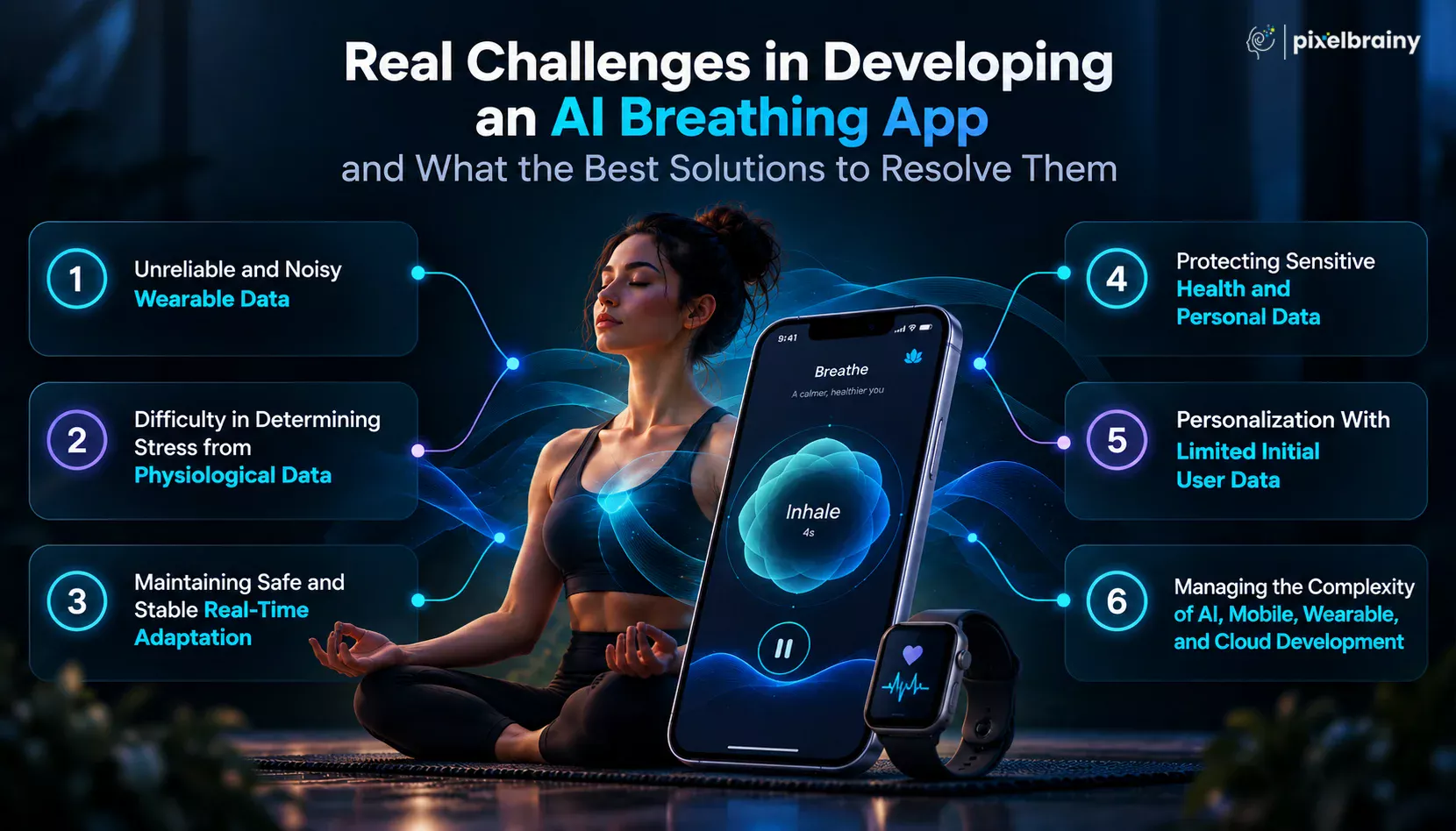
Wearable devices can generate valuable physiological information, but the data is not always perfectly consistent. Readings can be missing, delayed, affected by movement, or temporarily inaccurate because of sensor limitations.
This becomes particularly important when an AI breathing app uses heart rate or other signals to personalize a live session. Reacting to one unusual reading could cause the application to make an inappropriate adjustment.
Best solution: Build a dedicated signal-processing layer between the wearable and AI engine. This layer should validate incoming data, identify potential artifacts, filter noise, establish personal baselines, and assign confidence levels before information influences recommendations.
The AI should also be able to recognize when data quality is too low and continue the session without making unnecessary changes.
One of the biggest misconceptions in AI breathing exercise app development is that an elevated heart rate automatically means the user is stressed.
Heart rate can increase because of exercise, movement, caffeine, excitement, environmental conditions, or other physiological factors. Similarly, HRV can vary for many reasons and should not be treated as a standalone indicator of psychological state.
Best solution: Use a multi-signal approach instead of depending on one measurement. The system can combine authorized physiological information, activity context, historical patterns, session behavior, and user feedback.
The application should communicate its output as a personalized wellness estimate unless the product has appropriate clinical evidence and regulatory authorization to make stronger claims.
Real-time adaptation is one of the most attractive capabilities of an AI breathing app, but it can also become one of its biggest UX problems.
Imagine the breathing pattern changing every few seconds because the system reacts to small fluctuations in sensor data. Instead of feeling personalized, the experience could become confusing and uncomfortable.
Best solution: Establish controlled adaptation rules. The breathing engine can use minimum hold periods, adaptation windows, confidence thresholds, predefined pacing boundaries, and fallback protocols.
AI should recommend changes within clearly defined limits rather than having unrestricted control over the breathing session. Deterministic safeguards should remain active even when the AI layer is making personalized recommendations.
An application connected to wearable devices can potentially process sensitive health information alongside behavioral and account data. Weak privacy architecture can create security risks and damage user confidence.
Apple requires applications requesting HealthKit access to obtain appropriate authorization and clearly communicate their intended use of health information.
Best solution: Design privacy and security into the architecture from the beginning.
Important measures can include:
If the product falls within HIPAA's scope, additional administrative, physical, and technical safeguards may apply.
AI personalization becomes more valuable as the application learns about a user, but a new user has almost no historical data.
Trying to make highly personalized predictions during the first session can therefore produce unreliable recommendations.
Best solution: Use a progressive personalization strategy.
Initially, the app can rely on carefully designed breathing protocols, user-selected goals, basic preferences, and conservative recommendation rules. As the user completes more sessions, the system can incorporate:
The personalization engine should also understand its confidence level. When there is insufficient evidence, it should use a reliable default rather than pretending to know what works best for the user.
An advanced AI breathing app development project can involve several interconnected systems:
iOS + Android + Apple Watch + Wear OS + Health APIs + AI models + Backend + Cloud infrastructure + Analytics + Subscriptions
Each additional component increases development, testing, integration, and maintenance requirements.
Best solution: Use a modular architecture and build the product progressively.
A practical roadmap can start with:
PoC → Core MVP → AI personalization → Wearable integration → Real-time adaptation → Advanced AI → Enterprise features
This allows the business to validate the core product before investing heavily in advanced capabilities. It also makes future upgrades easier because each major component can evolve without requiring the entire application to be rebuilt.
The strongest AI breathing products succeed by making AI adaptive without making the experience unpredictable, while treating data quality, privacy, and reliability as fundamental parts of the product.
From the technical architecture, features, development methodology, cost, and challenges discussed above, the next decision is finding a development partner capable of bringing all these layers together. “I need a development company that has built AI-powered breathing app with real machine learning personalization, not one that adds a recommendation widget and calls it AI. Specifically, the company needs to understand wearable biofeedback integration, real-time HRV data processing, conversational AI coaching architecture, and HIPAA compliance for health data, and most of the companies I have evaluated either have AI experience or wellness app experience but not both at the same time.”
That requirement highlights why an end-to-end technology partner matters. PixelBrainy positions itself as an AI healthcare software development company, combining AI engineering, healthcare technology, mobile development, product design, cloud architecture, and intelligent automation. Its official portfolio includes AI product development, AI consulting, AI integration, AI model development, and AI application development.
PixelBrainy's AI breathing app development services can cover the complete product lifecycle, including:
This integrated model helps reduce the coordination challenges that can occur when separate vendors handle the mobile application, AI models, wearable integrations, backend infrastructure, and compliance-related engineering.
Businesses looking to develop AI breathing app products need more than generic AI development experience. The technology partner should understand how AI interacts with physiological data, wearable ecosystems, privacy requirements, and user-facing wellness experiences.
PixelBrainy highlights healthcare-focused AI development, secure architecture, healthcare integrations, and HIPAA-oriented implementation within its healthcare technology capabilities.
Actual HIPAA applicability depends on the product's intended use, data flows, business relationships, and applicable regulations, so specialized compliance expertise should be incorporated where required.
PixelBrainy's published case study describes a confidential engagement with a US-based digital health company that involved developing an AI-powered virtual health companion. According to the case study, the platform reached 50,000+ active users within six months, increased patient engagement by 65%, and reduced operational costs by 40%.
The project required AI engineering, scalable architecture, healthcare data protection, and ongoing technical support.
While the project was not a breathing application, its combination of AI personalization, healthcare-oriented data practices, scalable infrastructure, and continuous optimization demonstrates capabilities relevant to an intelligent breathwork platform.
An AI product requires ongoing model evaluation, data-quality monitoring, personalization improvements, platform updates, security maintenance, and feature optimization after launch.
PixelBrainy can support this lifecycle through a coordinated approach covering product strategy, AI engineering, mobile development, cloud infrastructure, and post-launch optimization.
Ready to turn your AI breathing concept into a production-ready product? Connect with PixelBrainy to discuss your requirements.
The opportunity behind AI breathing app development is not simply to create another breathing timer with attractive animations and a subscription plan. The real value lies in building an intelligent wellness experience that can understand user preferences, work with permitted wearable data, personalize breathing sessions, and continuously improve recommendations through real-world usage.
From defining the product concept and developing the breathing engine to integrating AI, Apple Watch, Wear OS, health-data platforms, conversational coaching, and secure cloud infrastructure, every layer contributes to the final user experience. A successful AI breathing exercise app should therefore balance meaningful AI capabilities with simplicity, privacy, reliability, and responsible product positioning.
For startups and businesses planning to develop an AI breathing app, starting with a focused MVP and validating the adaptive experience can reduce risk while creating a strong foundation for future personalization and scalability.
The goal is simple: make breathwork more responsive to the individual, not simply more automated.
Ready to turn your AI breathing app idea into reality? Book an appointment with PixelBrainy and discuss your product vision with our team.
Yes. AI breathing app development can integrate Apple Watch and Apple HealthKit to use authorized data such as heart rate, HRV, respiratory rate, and activity context. An AI breathing app can process these signals and use recommendation logic or machine learning to personalize a session. However, physiological data should be treated as one input rather than definitive proof of stress or a medical condition.
An AI breathing exercise app can go beyond fixed timers by using personalization, user feedback, historical sessions, and authorized wearable information. During AI breathing exercise app development, developers can create recommendation and adaptation layers that help determine which breathing exercise, duration, or coaching approach may be appropriate for an individual. The key difference is that the experience can become increasingly personalized instead of remaining identical for every user.
The AI breathing app development cost can range from approximately $30,000 to $250,000+, depending on product complexity. A basic AI breathing app may cost $30,000 to $70,000, while an advanced platform with AI personalization and wearable integration can require $70,000 to $150,000. Enterprise-level AI breathing app development involving Apple Watch, Wear OS, conversational AI, corporate dashboards, advanced security, and scalable infrastructure can exceed $150,000.
To build an AI breathing app with real-time personalization, the architecture typically needs wearable or health data integration, signal processing, personal baselines, an AI recommendation engine, and a controlled breathing-session engine. The AI breathing app development process can begin with rule-based personalization and gradually introduce machine learning as sufficient user data becomes available. Real-time adaptation should use confidence thresholds and predefined boundaries to keep the experience predictable.
To develop an AI breathing app, the technology stack can include Swift and SwiftUI for iOS, Kotlin for Android, watchOS, Wear OS, Apple HealthKit, Android Health Connect, Python, PyTorch or TensorFlow, secure APIs, cloud infrastructure, databases, analytics, and AI services. For advanced breathing app development using AI, developers may also use on-device ML, time-series analysis, recommendation systems, conversational AI, and real-time data-processing technologies.
In an AI breathing exercise app, personalization can consider user goals, preferred session duration, previous exercises, completion behavior, feedback, and authorized physiological information. During AI breathing app development, machine learning can identify patterns across sessions and improve future recommendations. A new user can initially receive standardized recommendations, while the system gradually creates a more personalized experience as meaningful historical data becomes available.
Not every AI breathing app automatically requires HIPAA compliance. The requirement depends on the product's intended use, business relationships, health-data flows, and whether the organization falls within HIPAA's scope. For AI breathing app development for healthcare startups, HIPAA requirements should be assessed during architecture and product planning. If applicable, the platform may require appropriate safeguards for authentication, encryption, access control, audit logging, data handling, and privacy.
An AI breathing app MVP should focus on proving that personalized breathwork provides more value than a conventional breathing timer. Core functionality can include onboarding, breathing exercises, guided sessions, user goals, session history, feedback, basic AI recommendations, selected wearable integration, secure backend infrastructure, analytics, and subscriptions. Advanced capabilities can be introduced later as the AI breathing app development roadmap expands toward real-time adaptation, sophisticated ML personalization, conversational coaching, and enterprise wellness features.

About The Author
Sagar Bhatnagar
Sagar Sahay Bhatnagar brings over a decade of IT industry experience to his role as Marketing Head at PixelBrainy. He's known for his knack in devising creative marketing strategies that boost brand visibility and market influence. Sagar's strategic thinking, coupled with his innovative vision and focus on results, sets him apart. His track record of successful campaigns proves his ability to utilize digital platforms effectively for impactful marketing efforts. With a genuine passion for both technology and marketing, Sagar continuously pushes PixelBrainy's marketing initiatives to greater success.

Working with the PixelBrainy team has been a highly positive experience. They understand the design requirements and create beautiful UX elements to meet the application needs. The dev team did an excellent job bringing my vision to life. We discussed usability and flow. Sagar worked with his team to design the database and begin coding. Working with Sagar was easy. He has the knowledge to create robust apps, including multi-language support, Google and Apple ID login options, Ad-enabled integrations, Stripe payment processing, and a Web Admin site for maintaining support data. I'm extremely satisfied with the services provided, the quality of the final product, and the professionalism of the entire process. I highly recommend them for Android and iOS Mobile Application Design and Development.

Great experience working with them. Had a lot of feedback and I found that unlike most contractors they were bugging me for updates instead of the other way around. They were extremely time conscience and great at communicating! All work was done extremely high quality and if not on time, early! They were always proactive when it comes to communication and the work is great/above par always. Very flexible and a great team to work with! Goes above and beyond to present us with multiple options and always provides quality. Amazing work per usual with Chitra. If you have UI/UX or branding design needs I recommend you go to them! Will likely work with them in the future as well, definitely recommended!

PixelBrainy is a joy to work with and is a great partner when thinking through branding, logo, and website layout. I appreciate that they spend time going into the "why" behind their decisions to help inform me and others about industry best practices and their expertise.

I hired them to design our software apps. Things I really like about them are excellent communication skills, they answer all project suggestions and collaborate right away, and their input on design and colors is amazing. This project was complex and needed patience and creativity. The team is amazing to do business with. I will be using them long-term. Glad to see there are some good people out there. I was afraid to try and outsource my project to someone but I am glad I met them! I really can't say enough. They went above and beyond on this project. I am very happy with everything they have done to make my business stand out from the competition.

It was great working with PixelBrainy and the team. They were very responsive and really owned the project. We'll definitely work with them again!

I recently worked with the PixelBrainy team on a project and I was blown away by their communication skills. They were prompt, clear, and articulate in all of our interactions. They listened and provided valuable feedback and suggestions to help make the project a success. They also kept me updated throughout the entire process, which made the experience stress-free and enjoyable.

PixelBrainy is very good at what it does. The team also presents themselves very professionally and takes care of their side of things very well. I could fully trust them taking up the design work in a timely and organised manner and their attention to detail saved us lots of effort and time. This particular project was quite intense and the team showed that they function very well under pressure. Very much looking forward to working with her again!

It's always an absolute pleasure working with them. They completed all of my requests quickly and followed every note I had for them to a T, which made our process go smoothly from start to finish. Everything was completed fast and following all of the guidelines. And I would recommend their services to anyone. If you need any design work done in the future, PixelBrainy should be your first call!

They took ownership of our requirements and designed and proposed multiple beautiful variants. The team is self-motivated, requires minimum supervision, committed to see-through designs with quality and delivering them on time. We would definitely love to work with PixelBrainy again when we have any requirements.

PixelBrainy was a big help with our SaaS application. We've been hard at work with a new UI/UX and they provided a lot of help with the designs. If you're looking for assistance with your website, software, or mobile application designs, PixelBrainy and the team is a great recommendation.

PixelBrainy designers are amazing. They are responsive, talented, and always willing to help craft the design until it matches your vision. I would recommend them and plan to continue them for my future projects and more!!!

They were awesome! Did a good job fast, and good communication. Will work with them again. Thank you

Creative, detail-oriented, and talented designers who take direction well and implement changes quickly and accurately. They consistently over-delivered for us.

PixelBrainy team is very talented and creative. Great designers and a pleasure to work with. PixelBrainy is an excellent communicator and I look forward to working with them again.

PixelBrainy has a very talented design team. Their work is excellent and they are very responsive. I enjoy working with them and hope to continue on all of our future projects.


Transform your ideas into reality with us.
Across these industries, each engagement brings unique challenges, from early-stage product development to scaling complex systems, helping us build a practical understanding of real-world product environments.