AI Summary Powered by PixelBrainy
Can traditional online learning platforms truly keep up with the evolving needs of modern businesses, learners, and industries?
As digital transformation accelerates across education, corporate training, healthcare, IT, and professional services, organizations are rethinking how learning is delivered, measured, and scaled. Static course libraries and one-size-fits-all learning paths no longer meet the expectations of today’s learners or the performance goals of businesses. This is where AI eLearning Websites are redefining the learning experience by making it personalized, adaptive, and outcome driven.
Enterprises, EdTech startups, universities, and training providers are increasingly turning to bespoke AI eLearning Website Solutions to create platforms that adapt to individual learner behavior, optimize content delivery, and provide actionable insights in real time. AI eLearning Website Development is no longer a future concept. It is now a strategic investment for organizations that want to deliver measurable learning impact at scale.
From understanding how to develop an AI eLearning Website to choosing the right technologies and estimating costs, businesses face important decisions at every stage of development. The building of AI eLearning Website solutions requires more than technical expertise. It demands a deep understanding of learning psychology, industry requirements, and business objectives.
Whether you are looking to build an AI eLearning Website for employee upskilling, customer education, or academic learning, the goal remains the same. You want a platform that delivers scalable and intelligent eLearning Website solutions while driving long-term value. This guide explores the features, development steps, costs, and real-world business impact of creating an AI eLearning Website tailored to modern industries.
An AI eLearning website is a digital learning platform that uses artificial intelligence technologies to deliver personalized, adaptive, and data-driven learning experiences. Unlike traditional eLearning systems, AI-powered platforms analyze learner behavior, performance, and preferences to tailor content, assessments, and recommendations automatically.
These platforms leverage machine learning, natural language processing, predictive analytics, and automation to improve engagement and learning outcomes. AI eLearning websites evolve continuously by learning from user interactions, making them highly effective for both learners and organizations.
Traditional Learning Management Systems were designed primarily to digitize classroom training and centralize course content. Their core strength lies in organizing learning materials, managing user access, and tracking basic completion metrics. For many years, this approach worked well for standardized training programs and compliance-based learning.
However, modern learners and businesses demand more than static course delivery. Traditional LMS platforms follow a one-size-fits-all model where every learner receives the same content in the same sequence, regardless of skill level, learning speed, or goals. Personalization is limited, often restricted to manual course assignments created by administrators. Real-time insights into learner engagement, skill gaps, and performance trends are minimal, making it difficult for organizations to measure training effectiveness or improve outcomes proactively.
Another major limitation is adaptability. Traditional LMS platforms do not evolve based on learner behavior. They rely heavily on manual updates, fixed learning paths, and instructor-led interventions. As a result, these systems struggle to scale efficiently across diverse roles, departments, and industries, especially in fast-changing environments like IT, healthcare, and corporate training.
AI eLearning website development introduces intelligence, adaptability, and automation into the learning ecosystem. Instead of treating all learners the same, AI-powered platforms analyze user behavior, performance data, and learning patterns to create personalized learning journeys. Content recommendations, assessments, and pacing adjust dynamically based on individual progress and needs.
These platforms provide real-time insights through advanced analytics and dashboards, allowing businesses to track engagement, predict learning outcomes, and identify skill gaps early. Automated assessments and intelligent feedback loops reduce dependency on instructors while ensuring continuous improvement for learners. AI also enables predictive analytics, helping organizations forecast dropouts, measure ROI, and align training programs with business objectives.
Unlike rigid LMS systems, AI eLearning websites are built for scalability and flexibility. They support continuous learning, cross-functional training, and rapid content evolution. This makes them ideal for enterprises, EdTech companies, professional training providers, and fast-growing organizations that require intelligent and data-driven learning solutions.
| Aspect | Traditional LMS | AI eLearning Website Development |
| Learning Approach | Follows a fixed, linear learning structure designed for uniform learner groups | Uses adaptive and personalized learning paths tailored to individual learner behavior |
| Content Delivery | Delivers pre-defined, static course content with minimal flexibility | Dynamically delivers content based on learner progress, preferences, and performance |
| Personalization | Limited personalization handled manually by administrators or instructors | Automated personalization powered by AI-driven learner data and behavioral analysis |
| Learner Insights | Tracks basic metrics like course completion and attendance | Provides real-time insights into engagement, skill gaps, and learning effectiveness |
| Assessments | Relies on fixed quizzes, exams, and manual evaluations | Uses intelligent assessments with automated grading and adaptive difficulty levels |
| Feedback Mechanism | Delayed or generic feedback provided after course completion | Instant, personalized feedback generated through intelligent feedback loops |
| Scalability | Struggles to scale across diverse teams and learning objectives | Scales easily across departments, industries, and global learner bases |
| Learner Engagement | Primarily passive learning with limited interactivity | Highly interactive learning driven by recommendations and smart engagement tools |
| Decision Support | Offers limited reports with little strategic business value | Delivers predictive analytics to support data-driven training decisions |
| System Evolution | Requires manual updates and periodic content restructuring | Continuously improves through AI model learning and optimization |
While traditional LMS platforms organize learning, AI eLearning website development elevates it into a personalized, scalable, and insight-driven business solution.
Businesses today are increasingly choosing to invest in AI eLearning Website Development because the digital learning landscape is expanding at a remarkable pace and intelligence is at the core of that evolution. The global AI in education sector is projected to grow significantly in the coming years.
According to industry forecasts, the AI in education market was valued at around $7.57 billion in 2025 and is expected to reach over $30 billion by 2029 with strong annual growth. This rapid expansion shows that organizations across sectors are recognising the transformative potential of eLearning Website Development Integrating AI to improve learning outcomes and operational efficiency.
The broader eLearning market is also growing rapidly, with projections indicating the global online education market could reach close to $365 billion by 2026. In this context, companies that build AI capabilities into their learning platforms gain a competitive edge. They can offer adaptive learning paths, automated feedback systems, and personalized recommendations that are simply not possible with legacy systems. As learners increasingly expect intuitive, responsive, and tailored learning experiences, AI for eLearning Website Solutions becomes a necessity rather than a luxury.
Aside from market growth, adoption trends also show why organisations are investing in the development of eLearning Website Development with AI. Data suggests that a large percentage of educators and learners are already using AI tools regularly, with many students using AI for study and research tasks each week. This widespread use reflects how AI is reshaping expectations around learning efficiency and engagement, pushing businesses to rethink traditional models.
Finally, as industries such as corporate training, professional services, healthcare, and technology embrace digital transformation, AI-powered learning platforms are seen as a strategic business investment. Integrating AI into eLearning not only drives higher learner engagement but also delivers measurable insights that help organisations improve retention, performance and, ultimately, their bottom line.
Also Read: How to Build an AI Teaching Assistant: Costs and Benefits for E-learning Assistants
As digital learning continues to mature, organizations are moving beyond basic online training platforms toward smarter, more adaptive solutions. AI for eLearning Website Development enables businesses to create learning environments that respond to real learner needs while supporting long-term growth and performance. Below are the most impactful advantages of eLearning Website Development with AI, explained from both a learning and business perspective.
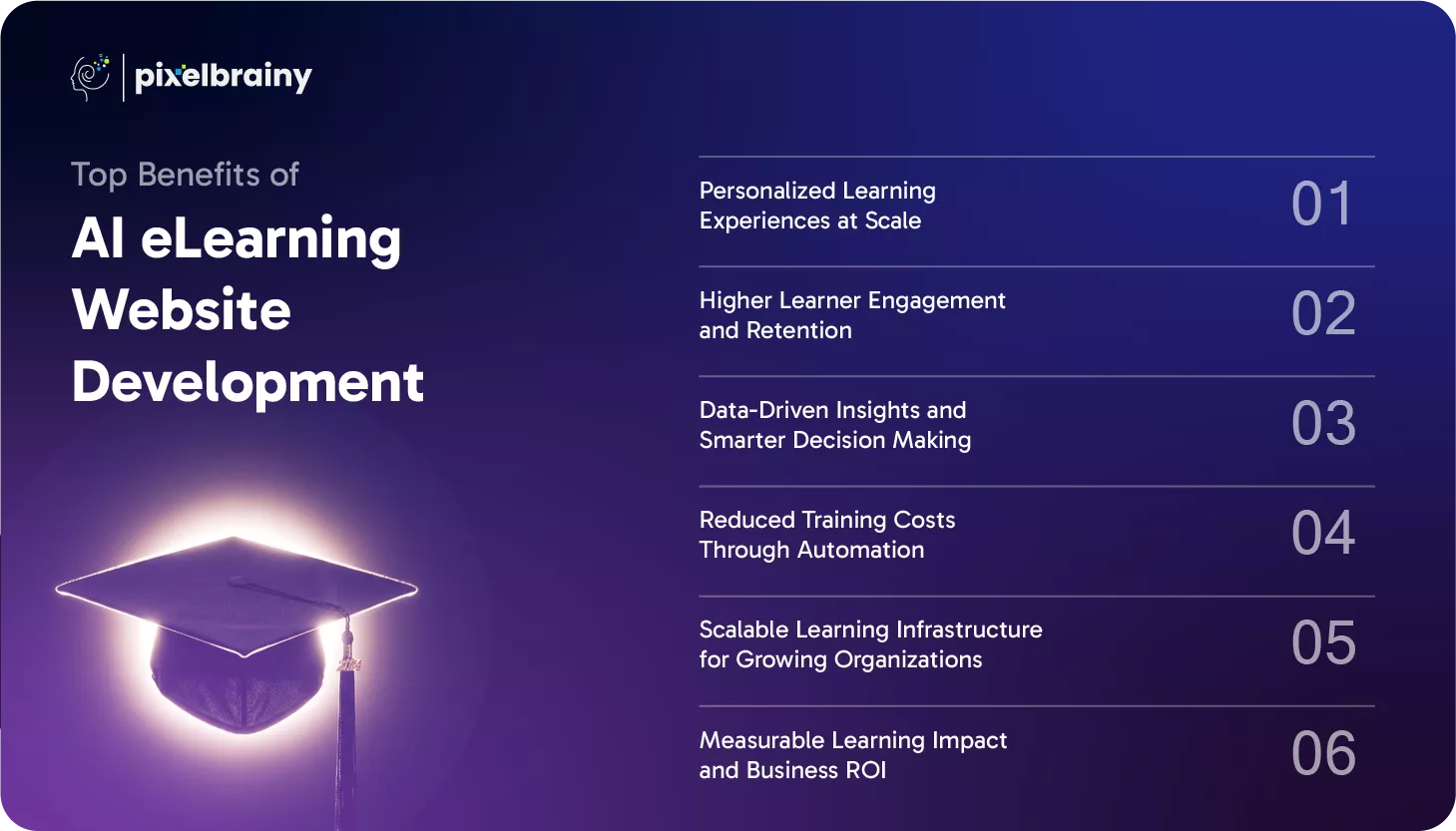
One of the most significant advantages of AI eLearning Website Development Solutions is the ability to deliver truly personalized learning experiences. Traditional platforms offer limited customization, but AI-powered systems analyze learner behavior, performance, preferences, and pace to tailor content in real time. This ensures that each learner receives the right material at the right moment, improving comprehension and retention.
When developing an AI eLearning website, personalization goes beyond course recommendations. Learning paths adjust dynamically, assessments align with skill levels, and content formats evolve based on individual engagement patterns. For businesses and educational institutions, this level of personalization leads to better outcomes without increasing administrative workload, making large-scale learning both efficient and effective.
Learner engagement is a persistent challenge in digital education, especially when content feels repetitive or irrelevant. eLearning Website Development with AI addresses this issue by introducing intelligent interactions that keep learners actively involved. AI-driven recommendations, adaptive challenges, and contextual feedback make learning feel more responsive and relevant.
These intelligent systems also identify disengagement early by tracking behavioral signals such as inactivity or declining performance. This allows organizations to intervene proactively before learners drop out. Over time, increased engagement leads to stronger retention rates, better completion outcomes, and a more motivated learner base, which is a critical success factor for both corporate training and educational platforms.
Another key benefit of AI for eLearning Website Development is the ability to transform learning data into actionable insights. AI-powered platforms go beyond surface-level metrics like course completion and attendance. They analyze patterns related to learning effectiveness, skill progression, and performance gaps across individuals and groups.
These insights help organizations make informed decisions about curriculum design, content improvements, and workforce development strategies. For business leaders, access to real-time analytics means training investments can be aligned more closely with performance outcomes. This data-driven approach strengthens the overall value proposition of AI eLearning Website Development Solutions.
Automation plays a major role in lowering operational costs when developing an AI eLearning website. Tasks that traditionally require significant manual effort, such as grading assessments, tracking learner progress, and providing feedback, are handled efficiently by AI systems. This reduces dependency on instructors and administrative teams without compromising learning quality.
Over time, cost savings extend beyond operations. AI helps optimize content delivery, reducing the need for constant redesigns or repetitive training sessions. For organizations managing large or geographically dispersed teams, eLearning Website Development with AI delivers a scalable solution that minimizes cost while maximizing learning reach and consistency.
Scalability is a major concern for businesses and institutions experiencing growth. AI eLearning Website Development Solutions are designed to scale seamlessly as learner numbers, content libraries, and use cases expand. AI-powered platforms can support thousands of learners simultaneously while maintaining personalized experiences for each user.
As organizations grow, AI adapts learning strategies based on new data, ensuring consistent performance without system strain. This makes AI-driven platforms ideal for enterprises, EdTech startups, and training providers seeking long-term flexibility. Developing an AI eLearning website ensures that learning infrastructure evolves alongside business needs rather than becoming a bottleneck.
Perhaps the most compelling advantage of AI eLearning Website Development is the ability to measure real learning impact and business return on investment. AI systems track progress, performance improvements, and skill acquisition over time, linking learning outcomes directly to organizational goals.
This visibility allows businesses to refine training programs continuously and demonstrate tangible value to stakeholders. Whether the objective is workforce upskilling, compliance training, or customer education, AI ensures that learning initiatives contribute meaningfully to growth. By combining intelligence with strategy, AI for eLearning Website Development turns education into a measurable business asset.
By integrating intelligence, automation, and personalization, AI eLearning website development transforms digital learning into a scalable, data-driven, and high-impact solution for modern organizations.
AI-powered learning platforms are no longer limited to academic institutions. Today, AI eLearning Website Solutions are actively transforming how organizations across industries train, educate, and upskill their audiences. By combining intelligence with adaptability, these platforms support sector-specific learning needs while delivering measurable outcomes at scale. Below are key business use cases of AI-driven eLearning websites across major industries.
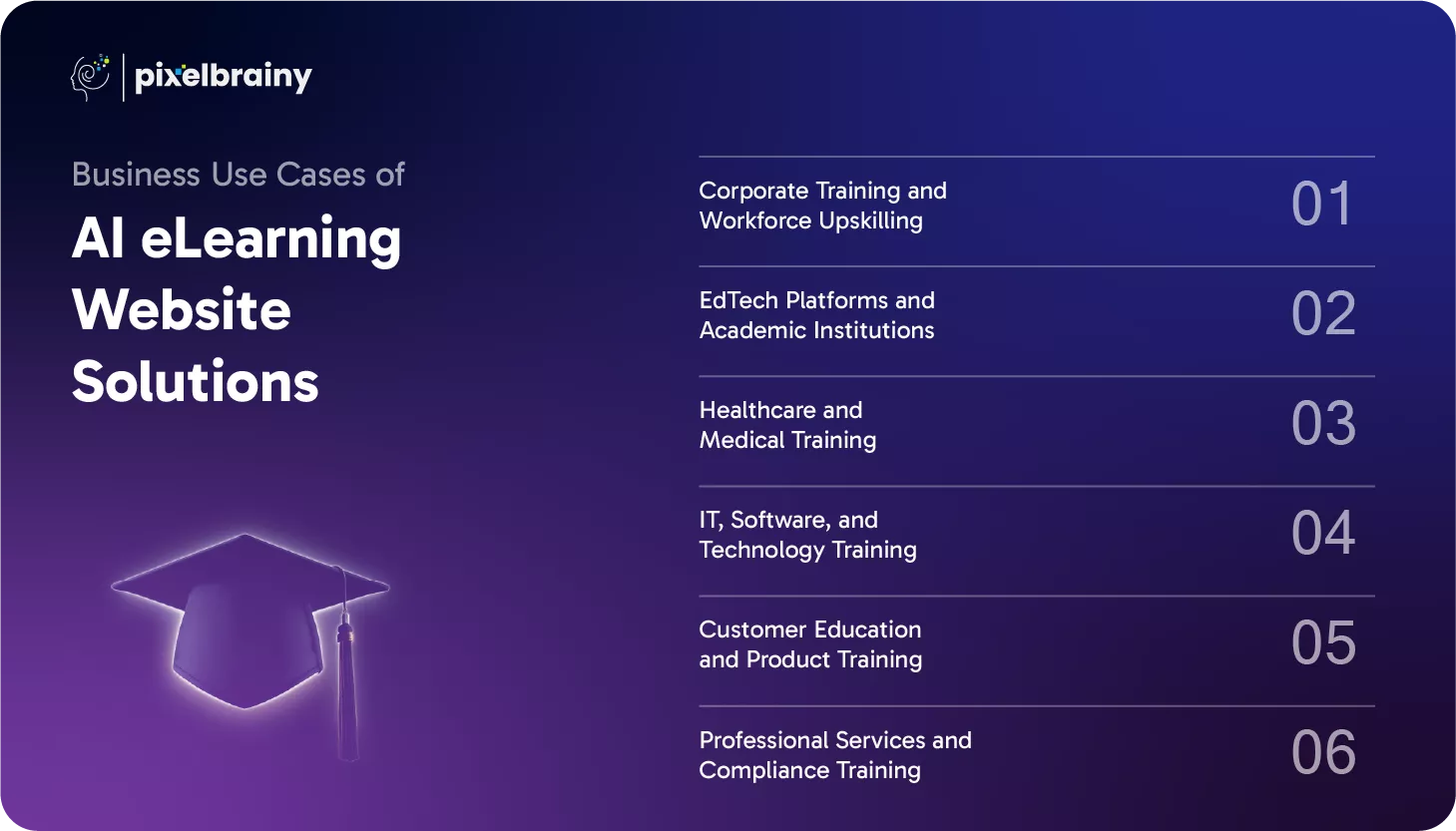
In the corporate sector, AI eLearning websites are widely used for employee training, onboarding, leadership development, and continuous upskilling. Modern organizations operate in fast-changing environments where skills quickly become outdated. AI-powered learning platforms analyze employee performance, job roles, and learning behavior to deliver personalized training programs aligned with business goals.
For example, an IT services company can use AI to identify skill gaps in software development teams and recommend targeted courses in cloud computing or cybersecurity. Automated assessments track progress, while predictive analytics help HR teams forecast workforce readiness. This approach improves productivity, reduces training time, and ensures that learning investments directly support organizational growth.
Educational institutions and EdTech startups rely heavily on AI eLearning Website Development to enhance student engagement and academic outcomes. AI-powered platforms adapt learning content based on student performance, helping learners master complex topics at their own pace. Personalized recommendations ensure that students receive additional support where needed, improving overall learning efficiency.
For instance, an online university offering degree programs can use AI to recommend supplementary resources to struggling students while accelerating learning paths for high performers. AI-driven analytics also help educators refine curriculum design based on real learning data. This creates a more inclusive and outcome-focused education ecosystem.
Also Read: AI Coaching Platform Development Guide: From Idea to Intelligent Coach
In healthcare, accuracy, compliance, and continuous learning are critical. AI eLearning websites support medical training, certification programs, and compliance education for healthcare professionals. These platforms adapt content based on learner specialization, experience level, and regulatory requirements.
A hospital network, for example, can deploy an AI-powered eLearning platform to train doctors and nurses on new procedures or technologies. Intelligent assessments ensure comprehension, while analytics help administrators track compliance across departments. This reduces training risks and improves patient care standards.
Also Read: How to Develop an AI Health Companion App
The technology sector demands constant skill development to keep pace with innovation. AI for eLearning Website Solutions enables IT training providers and software companies to deliver role-based, adaptive learning experiences. AI analyzes learner proficiency and recommends advanced modules as skills improve.
For example, a software company training developers on a new programming framework can use AI to customize learning paths based on prior experience. Real-time feedback and automated code assessments improve learning efficiency, making training faster and more relevant for technical teams.
AI eLearning websites are increasingly used for customer onboarding and product education. Businesses offering complex products or SaaS solutions benefit from AI-driven learning platforms that guide customers through personalized training journeys.
For example, a SaaS company can create an AI-powered learning portal that adapts tutorials based on user behavior and feature usage. This improves product adoption, reduces support requests, and strengthens customer retention by helping users realize value faster.
Industries such as finance, legal, and consulting rely on continuous compliance and professional development. AI eLearning platforms automate regulatory training while ensuring content stays up to date with evolving standards.
A financial services firm, for instance, can use AI to deliver personalized compliance training based on employee roles and risk exposure. AI analytics help monitor adherence and identify potential compliance gaps early, reducing regulatory risk and operational overhead.
Across industries, AI eLearning website solutions empower organizations to deliver smarter, more effective learning experiences that align training with real business outcomes.
AI-powered learning platforms are built on a strong foundation of intelligent and learner-focused features. These core capabilities form the backbone of AI eLearning Website Development, ensuring personalization, scalability, and measurable outcomes across industries.
When implemented correctly, they enable businesses to deliver adaptive and high-performing learning experiences.
| Feature | Description |
| Personalized Learning Paths | AI analyzes learner behavior, skill level, and goals to create customized learning journeys. Content adapts dynamically as users progress, ensuring relevance at every stage. This improves comprehension and long-term retention. |
| Adaptive Content Delivery | Learning materials adjust automatically based on performance and engagement patterns. Faster learners move ahead, while others receive additional support. This flexibility supports diverse learner groups effectively. |
| Intelligent Assessments | AI-powered assessments adapt difficulty levels based on learner responses. Automated grading reduces manual effort while providing accurate evaluations. Results help refine future learning paths. |
| Real-Time Analytics Dashboard | Provides instant visibility into learner progress, engagement, and performance trends. Businesses gain actionable insights to improve training strategies. Data-driven decisions become easier and faster. |
| Automated Feedback System | Learners receive immediate, personalized feedback after assessments and activities. This helps correct mistakes early and reinforces understanding. Feedback loops enhance learning efficiency. |
| Smart Course Recommendations | AI suggests relevant courses based on user behavior and learning history. Recommendations evolve as skills improve. This encourages continuous learning and engagement. |
| Role-Based Access Control | Different user roles receive tailored access to content and features. This ensures security and relevance for learners, instructors, and administrators. It also simplifies platform management. |
| Content Management System | Enables easy creation, updating, and organization of learning materials. AI helps optimize content placement based on usage patterns. This keeps learning resources fresh and effective. |
| Progress Tracking and Reporting | Tracks individual and group performance over time. Reports highlight strengths, gaps, and improvement areas. Organizations can measure learning impact clearly. |
| Scalability Support | The platform supports growing learner bases without performance loss. AI optimizes system resources automatically. This is critical for enterprises and EdTech platforms. |
| Multi-Device Compatibility | Ensures seamless learning across desktops, tablets, and mobile devices. AI adjusts experiences based on device usage. Learners stay connected anytime, anywhere. |
| Gamification Elements | AI-driven gamification boosts motivation through badges, scores, and challenges. Engagement increases without compromising learning quality. This works well for corporate and academic users. |
| User Behavior Analysis | Tracks how learners interact with content and features. Insights help improve UX and learning design. Behavior-driven improvements enhance platform effectiveness. |
| Integration Capabilities | Easily integrates with LMS, CRM, HRMS, and payment systems. AI synchronizes data across platforms smoothly. This supports enterprise-level operations. |
| Security and Data Privacy Controls | Protects learner data using secure architecture and compliance standards. AI monitors unusual activity and potential risks. Trust and reliability remain intact. |
These core features make AI eLearning website development a powerful foundation for delivering intelligent, scalable, and results-driven learning experiences.
Once the core framework is in place, advanced capabilities can elevate the platform from functional to future-ready.
These features enhance automation, engagement, and intelligence, helping businesses stand out in competitive learning markets while maximizing ROI from developing an AI eLearning Website.
| Advanced Feature | Description |
| AI Chatbots and Virtual Tutors | Provide instant learner support and guidance 24/7. Chatbots answer questions, recommend resources, and assist navigation. This reduces instructor workload significantly. |
| Predictive Learning Analytics | Forecast learner outcomes, dropouts, and skill readiness. AI identifies risks early and suggests corrective actions. Businesses gain proactive control over learning success. |
| Voice-Based Learning Interfaces | Enables voice commands and audio-based learning interactions. Improves accessibility and hands-free learning. Ideal for mobile and inclusive education use cases. |
| Multilingual AI Translation | Automatically translates content into multiple languages. Learners receive localized experiences without manual effort. This supports global learning expansion. |
| Emotion and Sentiment Analysis | AI detects learner sentiment through behavior and interaction patterns. Content adapts when frustration or disengagement is detected. Learning becomes more human-centric. |
| Generative AI Content Creation | Automatically generates quizzes, summaries, and learning materials. Reduces content creation time while maintaining quality. This speeds up course development cycles. |
| Skill Gap Prediction Engine | Identifies future skill needs based on industry trends and learner data. Recommends training aligned with business growth. Helps organizations stay competitive. |
| Smart Notifications and Nudges | Sends personalized reminders and motivational prompts. Timing is optimized using learner behavior data. This improves course completion rates. |
| AR and VR Learning Integration | Combines AI with immersive technologies for hands-on learning. Enhances practical understanding in fields like healthcare and engineering. Learning becomes experiential. |
| Advanced Compliance Monitoring | Tracks regulatory adherence automatically for industries like finance and healthcare. AI updates compliance content as rules change. Risk management becomes seamless. |
By integrating advanced AI capabilities, businesses can transform their eLearning platforms into intelligent ecosystems that adapt, predict, and continuously improve learning outcomes.

Developing an intelligent learning platform is a strategic journey that combines educational goals, advanced technology, and user-centric design. To clearly understand what is the process of developing an AI eLearning Website, businesses must follow a structured approach that supports scalability, personalization, and measurable outcomes. Below is a detailed step-by-step guide to AI Website Development for eLearning, with clear objectives defined at every stage.
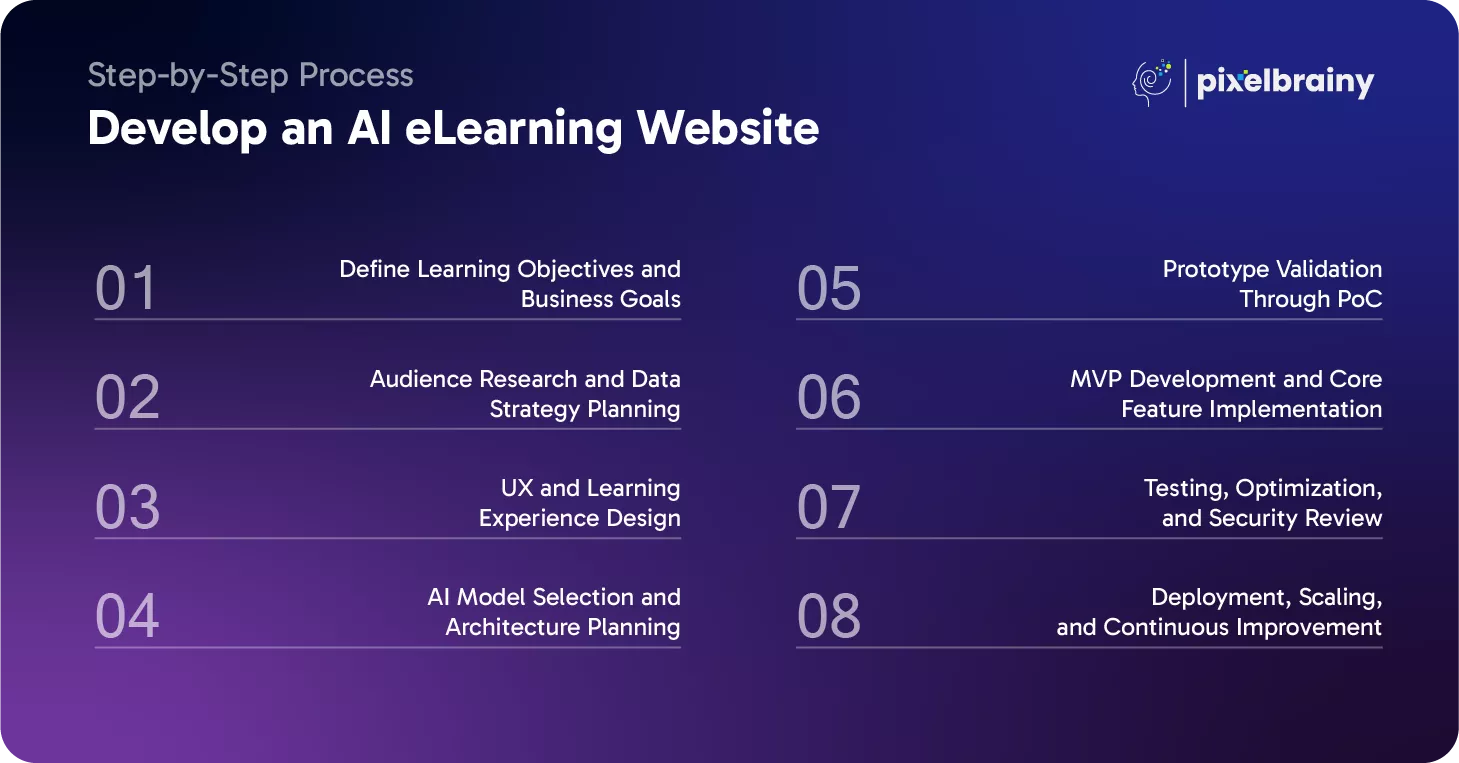
Aim of this step: To create a clear alignment between learning outcomes and business success metrics.
The foundation of the development of AI AI eLearning Website solutions begins with defining precise learning objectives and business goals. Organizations must identify who the learners are, what skills need to be developed, and how success will be measured. This could include improving employee productivity, reducing onboarding time, increasing certification completion rates, or generating revenue through paid learning programs. Clear goals help determine how AI should be applied, whether for personalization, analytics, or automation. Without this clarity, AI risks becoming an expensive feature rather than a value-driven solution.
Aim of this step: To ensure AI systems are powered by accurate, ethical, and meaningful data.
AI-driven learning platforms depend on data to function effectively. In this step, organizations analyze learner demographics, learning behaviors, industry requirements, and content consumption patterns. A strong data strategy defines what information will be collected, how it will be stored, and how privacy regulations will be followed. This preparation is essential for AI eLearning Website Development Integrating AI, as high-quality data directly impacts the accuracy of personalization, recommendations, and predictive insights. Proper planning also helps avoid future compliance and data misuse issues.
Aim of this step: To design intuitive learning journeys that encourage engagement and long-term usage.
User experience is a critical success factor in building an AI eLearning Website. Collaborating with an experienced UI/UX design company ensures the platform is easy to navigate, visually engaging, and aligned with learner expectations. Designers focus on structuring dashboards, learning paths, progress tracking, and interactions in a way that feels natural and motivating. AI-driven personalization must feel seamless rather than complex. A well-designed learning experience reduces friction, increases engagement, and builds trust in the platform.
Aim of this step: To select scalable and reliable AI technologies aligned with learning goals.
At this stage, technical teams decide which AI technologies best support the platform’s objectives. This includes selecting machine learning models for personalization, natural language processing for content interaction, and analytics engines for insights. Architecture planning ensures the system can handle increasing users, data volume, and feature expansion. Many businesses seek guidance from top AI development companies in usa to ensure the AI architecture is robust, secure, and future-ready. The right choices here directly impact platform performance and longevity.
Aim of this step: To test feasibility and reduce development risk early.
Before investing in full-scale development, teams often create a proof-based prototype through PoC development. This version focuses on validating key AI functions such as personalized recommendations, assessment logic, or analytics accuracy. Stakeholders can evaluate whether AI outputs align with learning goals and user expectations. Early testing helps identify gaps, refine assumptions, and make informed decisions before moving forward. This step minimizes technical risk and strengthens confidence in the overall solution.
Aim of this step: To launch a functional platform that delivers immediate value.
Once the concept is validated, development moves into MVP development, where core features are built and integrated. This includes adaptive learning paths, content management, assessments, dashboards, and essential AI capabilities. The goal is to release a stable and usable platform that supports real learners while remaining flexible for future expansion. This phase focuses on to develop an AI eLearning Website that balances speed, quality, and scalability, allowing businesses to enter the market faster and gather real user feedback.
Also Read: Top 10 AI MVP Development Companies in USA
Aim of this step: To ensure accuracy, reliability, and data protection.
Comprehensive testing is conducted to validate AI predictions, user experience, system performance, and security standards. AI models are evaluated for bias, accuracy, and consistency across different learner profiles. Performance testing ensures the platform remains responsive under load, while security reviews protect sensitive learner data. This step is crucial for delivering reliable AI Solutions for AI eLearning Website that meet industry and regulatory expectations.
Aim of this step: To evolve the platform alongside learners and business needs.
After deployment, AI systems continue learning from user interactions, improving recommendations, analytics, and personalization over time. Continuous monitoring and updates ensure the platform adapts to new skills, content, and user expectations. This ongoing refinement defines Bespoke AI AI eLearning Website Development Solutions, allowing organizations to scale confidently while maintaining learning quality and business relevance.
By following this detailed and goal-driven process, businesses can successfully develop an AI eLearning Website that delivers intelligent, scalable, and long-term value across industries.
Understanding what is the cost of developing an AI eLearning Website is one of the most important considerations for EdTech founders and business leaders. The price of building an AI eLearning Website can vary widely based on functionality, AI complexity, scalability, and customization.
On average, the AI eLearning Website development cost ranges between $20,000 to $150,000+, depending on the scope and long-term vision of the platform.
| Platform Type | Timeline | Estimated Cost | What You Get |
| Basic AI eLearning Website (MVP or Pilot) | 8 to 12 weeks | $20,000 to $40,000 | Core learning modules, basic AI-driven recommendations, simple assessments, learner dashboards, essential analytics, and limited scalability for early validation |
| Advanced AI eLearning Website | 3 to 5 months | $40,000 to $80,000 | Personalized learning paths, adaptive assessments, AI-based analytics, content management system, multi-user roles, integrations, and scalable cloud infrastructure |
| Enterprise AI eLearning Website | 6 to 9 months | $80,000 to $150,000+ | Fully customized AI architecture, predictive analytics, advanced security, multilingual support, enterprise integrations, automation, and high scalability for global users |
The number and depth of features significantly influence the cost to make an AI eLearning Website. A basic platform with limited AI personalization costs less, while advanced platforms with predictive analytics, chatbots, and adaptive learning engines increase development effort and budget. Feature-heavy platforms can add $10,000 to $30,000 to the total cost.
The sophistication of AI directly impacts the cost estimation of AI eLearning Website development. Simple recommendation engines require less investment, while advanced machine learning models and real-time analytics demand higher computational resources and expertise. AI complexity can contribute $15,000 to $40,000 to the overall development budget of AI eLearning Website solutions.
Highly customized interfaces, branding, and user journeys increase the price of building an AI eLearning Website. Tailored UI, role-based dashboards, and personalized workflows require additional design and development time. Customization typically adds $5,000 to $20,000 to the project cost.
Platforms designed to support thousands of concurrent users need scalable architecture and cloud services. Infrastructure planning, load optimization, and data storage influence the AI eLearning Website development cost. Depending on scale, this can add $5,000 to $25,000, excluding ongoing hosting costs.
Ensuring data protection and compliance with regulations such as GDPR or industry standards adds to the development budget of AI eLearning Website projects. Secure authentication, encryption, and compliance testing typically increase costs by $5,000 to $15,000.
AI systems require ongoing training, updates, and performance monitoring. Post-launch support, AI model optimization, and feature upgrades affect the long-term cost to make an AI eLearning Website. Annual maintenance can range from 15 to 25 percent of the initial development cost.
While the upfront investment may vary, a well-planned AI eLearning website delivers long-term value, making the development cost a strategic investment rather than an expense for EdTech businesses.
Behind every successful AI-powered learning platform is a carefully chosen technology stack that supports performance, flexibility, and long-term growth. The right combination of tools and frameworks determines how smoothly the platform runs, how well AI features perform, and how easily the system can scale as users and content grow. For businesses investing in AI-driven learning, technology decisions made early often define future success or limitations.
From building responsive learner interfaces to deploying intelligent recommendation engines and ensuring data security, each layer of the tech stack plays a specific role. Choosing proven and compatible technologies helps organizations avoid technical debt while enabling continuous improvement. Below is a clear breakdown of the tools, frameworks, and platforms commonly used in AI eLearning website development, along with how each supports real-world learning and business needs.
| Technology Layer | Tools, Frameworks & Platforms | Explanation |
| Frontend Development | React, Angular, Vue.js | These frameworks enable responsive and interactive user interfaces. They support dynamic dashboards, real-time updates, and smooth learning experiences across devices. |
| Backend Development | Node.js, Python, Django, FastAPI | Backend technologies handle business logic, user management, and data processing. Python-based frameworks are especially effective for AI integration and data handling. |
| AI and Machine Learning | TensorFlow, PyTorch, Scikit-learn | These frameworks power personalization engines, recommendation systems, and predictive analytics. They enable intelligent decision-making within the learning platform. |
| Natural Language Processing | SpaCy, NLTK, OpenAI APIs | NLP tools support chatbots, content analysis, automated feedback, and conversational learning features. They enhance interaction and learner support. |
| Data Analytics & BI | Apache Spark, Power BI, Tableau | Analytics tools process large volumes of learner data and present insights through dashboards. They help businesses track engagement, performance, and ROI. |
| Database Management | PostgreSQL, MySQL, MongoDB | Databases store user profiles, learning content, progress data, and AI outputs. Choosing the right database ensures performance and scalability. |
| Cloud Infrastructure | AWS, Microsoft Azure, Google Cloud Platform | Cloud platforms support scalability, data storage, and AI model deployment. They enable high availability and global access to learning platforms. |
| API & Integration Layer | REST APIs, GraphQL, Webhooks | APIs enable seamless integration with LMS, CRM, HRMS, and payment systems. They ensure smooth data flow across platforms. |
| Authentication & Security | OAuth 2.0, JWT, SSL Encryption | Security tools protect user data and ensure secure access control. Compliance and trust are maintained through encryption and authentication layers. |
| DevOps & Deployment | Docker, Kubernetes, CI/CD Pipelines | DevOps tools automate deployment, scaling, and updates. They ensure stable releases and continuous improvement of the platform. |
| Content Management | Headless CMS, Custom CMS Solutions | CMS platforms simplify content creation and updates. AI can optimize content delivery based on learner engagement. |
| Monitoring & Performance | Prometheus, Grafana, New Relic | Monitoring tools track system health, AI performance, and user activity. They help identify issues and optimize system reliability. |
A carefully selected tech stack empowers AI eLearning websites to deliver intelligent, scalable, and secure learning experiences while supporting continuous innovation and business growth.
An AI-powered learning platform is not only a tool for education but also a scalable digital business asset. When designed strategically, AI-driven platforms unlock multiple income streams by delivering personalized value to learners and organizations. By aligning monetization models with learner behavior and business demand, companies can maximize returns from AI eLearning Website Development while maintaining high engagement and retention.
Subscription models are one of the most sustainable ways to monetize AI eLearning Website
Solutions. AI enhances subscription value by continuously adapting learning content, recommendations, and difficulty levels based on user behavior. This personalization encourages long-term usage, reduces churn, and increases customer lifetime value.
Revenue opportunities:
Organizations increasingly rely on AI for eLearning Website Development to deliver structured and measurable employee training. AI-powered platforms enable companies to customize learning journeys, track performance, and align training with business goals. This creates strong demand for enterprise licensing and long-term partnerships.
Revenue opportunities:
Certification programs built on eLearning Website Development with AI attract professionals seeking career growth and industry recognition. AI ensures assessments accurately reflect skill readiness by adapting test difficulty and analyzing performance patterns. This increases the credibility and market value of certifications.
Revenue opportunities:
Not all learners prefer subscriptions, making pay-per-course models a valuable revenue stream. AI-driven recommendation engines suggest relevant courses based on learner interests, progress, and goals. This improves conversion rates and enhances the advantages of AI eLearning Website Development for content monetization.
Revenue opportunities:
AI enables scalable personalization while identifying when human expertise adds value. By combining AI insights with expert mentoring, platforms offer premium learning experiences. This hybrid approach strengthens outcomes and creates high-margin revenue streams in AI eLearning Website Development Solutions.
Revenue opportunities:
For platforms with large or niche audiences, advertising and sponsorships offer additional income opportunities. AI ensures ads and sponsored content remain relevant and context-aware, preserving learning quality while generating revenue from AI for eLearning Website Development initiatives.
Revenue opportunities:
AI-powered platforms generate valuable insights into learner behavior, performance, and skill trends. Businesses are willing to pay for access to these analytics to improve training strategies and workforce planning. This transforms learning data into a strategic asset.
Revenue opportunities:
With the right monetization strategy, AI eLearning website development enables businesses to generate consistent revenue while delivering personalized, scalable, and high-impact learning experiences.

Building a successful AI-powered learning platform requires more than technical execution. It demands a thoughtful approach that balances learner needs, business goals, and intelligent technology. Following proven best practices ensures custom AI eLearning Website Development delivers long-term value, scalability, and measurable learning outcomes across industries.
Every successful AI eLearning Website Development project begins with clearly defined goals. Organizations must identify who the learners are, what skills need to be developed, and how success will be measured. Whether the objective is workforce upskilling, certification delivery, or customer education, clarity ensures AI features are applied purposefully. Aligning learning objectives with business KPIs helps transform the platform into a strategic asset rather than just a content repository.
While AI enables powerful automation, the learning experience must always feel simple and intuitive. Best-in-class eLearning Website Development with AI prioritizes learner-centric design by focusing on usability, accessibility, and engagement. Platforms should adapt to different learning styles and skill levels without overwhelming users. A smooth interface encourages adoption, repeat usage, and trust, which are essential for long-term success.
Data quality directly impacts the effectiveness of AI-driven personalization and analytics. During custom AI eLearning Website Development, it is critical to use clean, diverse, and relevant data sets while maintaining strict privacy standards. Ethical data usage reduces bias and improves the accuracy of recommendations and assessments. Transparent data practices also help build credibility with learners and organizations.
Scalability should be a priority from the earliest stages of development. AI eLearning Website Development Solutions must be designed to support growing user bases, expanding content libraries, and new AI features. Modular architecture and cloud-based infrastructure allow platforms to evolve without costly rework. Flexibility ensures the system can adapt to changing industry demands and learner expectations.
AI systems are not static and require ongoing evaluation and refinement. Regular testing ensures personalization algorithms, assessments, and analytics remain accurate and relevant. Feedback loops from learners and administrators help fine-tune performance. Continuous optimization is essential to maintain the effectiveness and reliability of AI for eLearning Website Development over time.
Trust is critical when handling learner data and performance insights. Best practices in custom AI eLearning Website Development include strong security measures, compliance with data protection regulations, and transparent AI behavior. Secure authentication, encrypted data storage, and compliance audits protect both learners and businesses. A trustworthy platform fosters long-term adoption and brand credibility.
By following these best practices, organizations can build custom AI eLearning websites that are secure, scalable, learner-focused, and capable of delivering lasting business and educational impact.
When you plan to build an AI-powered eLearning website, choosing the right development partner becomes one of the most critical decisions you will make. This choice goes far beyond technical execution. It directly influences how well your learning platform performs, scales, and delivers real value to learners and businesses. With many vendors offering AI services, it is essential to identify a partner who understands learning ecosystems, business goals, and long-term growth.
A strong development partner should demonstrate hands-on experience in both artificial intelligence and eLearning platform development. AI expertise alone is not sufficient if the team does not understand how people learn, engage, and retain information. Experience in building learning platforms ensures the partner knows how to apply AI to personalization, adaptive assessments, and learner analytics effectively.
Reviewing past projects helps assess whether the partner has worked with similar industries or use cases. Platforms built for corporate training, EdTech startups, or professional education each require different approaches. A partner with relevant experience is more likely to anticipate challenges and deliver practical solutions.
Every organization has unique learning objectives, content strategies, and audience needs. The right AI eLearning development partner should focus on customization rather than offering rigid, pre-built solutions. They should be willing to understand your specific requirements and design a platform that aligns with your long-term vision.
Scalability is equally important. As your learner base grows and AI capabilities evolve, the platform must handle increased usage without performance issues. A capable partner designs flexible architectures that allow new features, integrations, and AI models to be added without major redevelopment.
AI eLearning platforms process sensitive learner data, making security and ethics critical considerations. A trustworthy partner prioritizes data protection from the beginning, using secure authentication, encryption, and access controls. They should also be transparent about how learner data is collected, stored, and used within AI models.
Ethical AI practices matter as well. The partner should actively address bias, fairness, and explainability in AI-driven decisions such as recommendations or assessments. This builds trust among learners and protects your organization from compliance and reputational risks.
A reliable development partner follows a structured and transparent development process. This includes clear planning, defined milestones, and regular progress updates. Open communication ensures that expectations around timelines, features, and costs remain aligned throughout the project.
Partners who encourage collaboration and feedback tend to deliver better results. They treat development as a partnership rather than a transaction. This approach allows adjustments based on evolving requirements and ensures the final platform reflects your goals accurately.
AI-powered platforms require continuous monitoring and improvement after launch. The right partner does not disappear once the platform goes live. Instead, they provide ongoing support, performance monitoring, and AI model optimization to ensure sustained effectiveness.
Continuous improvement helps the platform adapt to changing learner behavior, new content, and evolving industry needs. A partner committed to long-term support ensures your AI eLearning website remains relevant, efficient, and competitive over time.
Reputation matters when choosing an AI eLearning development partner. Case studies, client testimonials, and references provide insight into the partner’s reliability and delivery quality. Look for evidence of successful projects, measurable outcomes, and lasting client relationships.
Partners with a strong track record are more likely to deliver on promises and handle challenges professionally. Credibility built through results is a strong indicator of long-term partnership value.
Choosing the right AI eLearning development partner means finding a team that understands learning, builds responsibly with AI, and stays invested in your platform’s long-term success.
Developing an AI-powered eLearning website offers immense potential, but it also comes with a unique set of challenges. These challenges span technical, operational, and ethical dimensions, and if not addressed early, they can limit the effectiveness of the platform. Understanding these obstacles and knowing how to overcome them is essential for building reliable, scalable, and impactful AI-driven learning solutions.
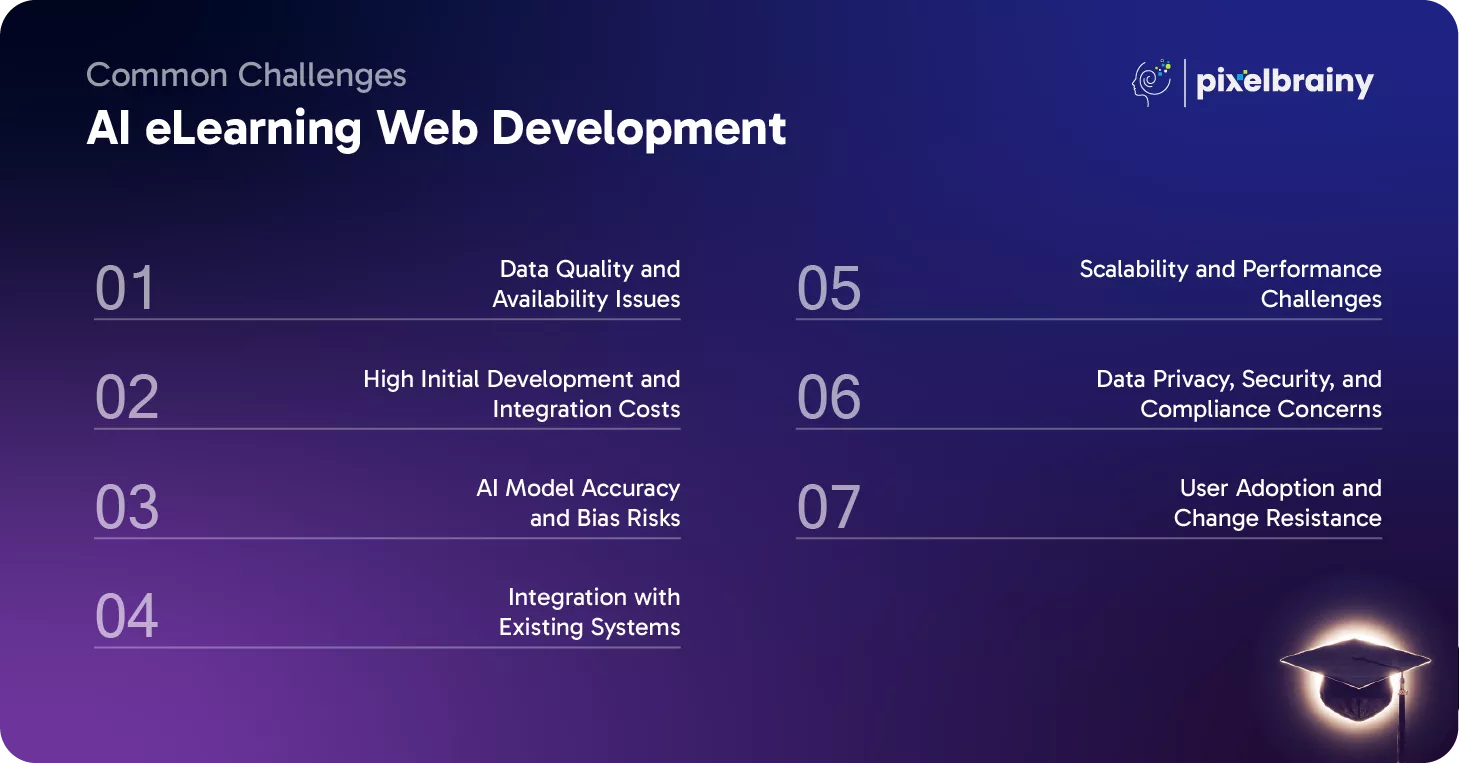
AI systems rely heavily on data to deliver accurate personalization, recommendations, and analytics. One of the most common challenges in AI eLearning web development is the lack of clean, structured, and relevant learner data. Incomplete or biased data can lead to poor recommendations, inaccurate assessments, and ineffective learning paths.
How to overcome it: Start with a strong data strategy that defines what data is collected, how it is validated, and how it evolves over time. Use diverse data sources, implement data cleaning processes, and continuously monitor data quality. Gradual data enrichment improves AI accuracy without overwhelming the system early on.
AI-driven platforms often require higher upfront investment compared to traditional eLearning systems. Costs associated with AI model development, infrastructure, integration, and specialized expertise can discourage businesses from adoption.
How to overcome it: Adopt a phased development approach. Begin with core AI features through MVP or pilot implementations, then scale gradually. This approach spreads costs over time and ensures investments are aligned with real user feedback and business value.
AI models can unintentionally develop bias if trained on limited or unbalanced datasets. In eLearning, this can affect content recommendations, assessments, or learner evaluations, potentially leading to unfair outcomes.
How to overcome it: Use diverse training data and regularly audit AI outputs. Incorporate human oversight in critical decision-making areas and test AI models across varied learner profiles. Transparent AI design helps build trust and fairness.
Many organizations already use LMS, HRMS, CRM, or ERP systems. Integrating AI eLearning platforms with these existing systems can be complex and time-consuming, often leading to data silos or workflow disruptions.
How to overcome it: Design the platform with API-first architecture. Use standardized integration frameworks and plan integration early in the development cycle. Modular design ensures smooth data exchange and minimizes system conflicts.
As user numbers grow, AI eLearning platforms must handle increased data processing and simultaneous interactions. Poor scalability planning can result in slow performance, downtime, or degraded user experience.
How to overcome it: Leverage cloud-based infrastructure and scalable architecture. Use load testing, performance monitoring, and auto-scaling mechanisms to ensure consistent performance as usage increases.
Handling learner data raises serious privacy and compliance responsibilities. Breaches or non-compliance with regulations can damage trust and expose organizations to legal risks.
How to overcome it: Implement robust security protocols, encryption, and access controls. Ensure compliance with data protection regulations and regularly conduct security audits. Clear data policies help maintain transparency and user confidence.
Even well-built AI platforms can fail if learners and administrators resist change. Complex interfaces or lack of understanding about AI-driven features can reduce adoption rates.
How to overcome it: Focus on user-centric design and onboarding. Educate users about AI benefits, provide intuitive interfaces, and offer training resources. Gradual feature rollouts help users adapt comfortably.
By identifying and addressing these challenges early, organizations can build AI eLearning websites that are reliable, ethical, scalable, and capable of delivering meaningful learning and business outcomes.
The future of digital education is being shaped by rapid advancements in artificial intelligence and changing learner expectations. As industries demand continuous upskilling and personalized learning, AI education websites are evolving from static platforms into intelligent learning ecosystems. Understanding upcoming trends helps businesses, EdTech companies, and institutions stay competitive and build platforms that remain relevant for years to come.
Generative AI is set to play a major role in how educational content is created and updated. Instead of relying solely on manual course development, AI will generate quizzes, summaries, practice exercises, and even entire learning modules based on defined learning objectives. This reduces content creation time while allowing platforms to keep learning materials fresh, relevant, and aligned with industry changes. Generative AI also enables rapid localization and customization of content for different learner groups.
Future AI education websites will move beyond basic personalization into hyper-personalized learning journeys. AI will analyze deeper behavioral signals such as learning pace, interaction patterns, and engagement levels to adapt content in real time. Learning paths will continuously evolve, ensuring learners receive the right level of challenge and support. This approach improves retention, motivation, and long-term skill development across diverse audiences.
AI education platforms will increasingly focus on predicting future skill requirements rather than reacting to current gaps. By analyzing market trends, learner data, and industry demands, AI will help organizations forecast skill shortages and design proactive training programs. This trend is especially valuable for corporate training, professional education, and workforce development initiatives where future readiness is critical.
Assessments will become more intelligent and outcome-focused. AI-driven evaluation systems will adapt questions based on learner performance and measure practical skill application rather than rote memorization. Credentials and certifications will be backed by AI-verified skill validation, increasing their credibility in professional and academic settings. This shift supports competency-based learning models.
As natural language processing improves, conversational AI and voice-enabled interfaces will become more common in education websites. Learners will interact with platforms using voice commands, chat-based tutoring, and real-time question answering. These interfaces make learning more accessible, inclusive, and intuitive, particularly for mobile and on-the-go users.
AI will increasingly integrate with AR and VR to deliver immersive learning experiences. These technologies enable hands-on, experiential learning in fields such as healthcare, engineering, and technical training. AI enhances immersion by adapting scenarios based on learner actions, providing feedback, and tracking skill performance within virtual environments.
As AI becomes more deeply embedded in education, transparency and ethics will gain greater importance. Future AI education platforms will prioritize explainable AI models that clearly communicate how recommendations and assessments are generated. This builds trust among learners, educators, and regulators while ensuring responsible use of technology.
Future-ready AI education websites will combine intelligence, personalization, and ethical design to deliver adaptive learning experiences that align education with evolving industry and learner needs.
When organizations look for a reliable AI development company to build intelligent learning platforms, they need more than just technical execution. They need a partner that understands education workflows, learner behavior, data responsibility, and long-term scalability. PixelBrainy LLC positions itself as a strategic technology partner that helps businesses and EdTech innovators turn learning ideas into high-impact digital platforms through AI Education Website Development Solutions.
PixelBrainy LLC specializes in delivering AI solutions for the education sector that are practical, scalable, and outcome-driven. The team approaches every project by first understanding learning objectives, target audiences, and business goals. This ensures that AI is applied where it adds real value, whether through personalized learning paths, adaptive assessments, or intelligent analytics. By aligning technology with pedagogy, PixelBrainy supports organizations that are building an AI Education Website for corporate training, professional learning, or academic use.
From discovery and strategy to deployment and optimization, PixelBrainy LLC offers complete Education Website Development integrating AI. The team designs learner-centric experiences, builds scalable AI architectures, and ensures seamless system integration with existing LMS, CRM, or enterprise tools. Their approach to Education Website Development with AI focuses on long-term flexibility, allowing platforms to evolve as learning needs, content, and technologies change.
PixelBrainy does not rely on one-size-fits-all solutions. Every platform is custom-built to match the client’s learning model, industry requirements, and growth plans. Security, compliance, and ethical AI practices are embedded from the start, ensuring learner trust and regulatory readiness. This makes PixelBrainy a dependable AI development company for organizations seeking sustainable and responsible innovation in education technology.
Project Overview: PixelBrainy LLC partnered with a US-based education and training provider to develop a custom AI-powered learning platform for professional upskilling. The client required a scalable solution that could serve individual learners and enterprise customers while delivering personalized learning experiences.
Solution Delivered: The team designed and implemented an AI-driven education website featuring adaptive learning paths, intelligent course recommendations, automated assessments, and real-time analytics dashboards. The platform was built using secure cloud infrastructure and scalable AI models to support rapid user growth. The solution focused on AI Education Website Development Solutions that aligned learning outcomes with workforce skill requirements.
Business Impact:
This project demonstrates PixelBrainy LLC’s ability to deliver Education Website Development integrating AI for the competitive US education and training market while maintaining confidentiality and compliance standards.
By combining deep AI expertise with a strong understanding of education systems, PixelBrainy LLC empowers organizations to build intelligent, scalable, and future-ready learning platforms that deliver real educational and business impact.

AI eLearning website development is reshaping how organizations deliver education, training, and skill development across industries. By integrating intelligence into learning platforms, businesses can move beyond static content and create adaptive experiences that respond to individual learner needs. From personalization and automation to advanced analytics, AI enables learning systems to become more effective, scalable, and outcome driven.
For EdTech companies, enterprises, and training providers, investing in AI-powered education websites is no longer an option for the future. It is a strategic move to stay competitive, improve learner engagement, and achieve measurable business results. When designed with the right features, architecture, and development approach, AI eLearning platforms deliver long-term value and sustainable growth.
If you are ready to build a smart, scalable, and future-ready AI education platform, book an appointment today and explore how your learning vision can be transformed into an intelligent digital solution.
Yes, AI eLearning websites are not limited to large enterprises. Startups and small businesses can begin with focused AI features such as smart recommendations or automated assessments and scale gradually. Starting with a pilot or MVP allows smaller teams to control costs while still benefiting from intelligent learning capabilities.
ROI timelines vary based on use cases, but many organizations start seeing measurable benefits within six to twelve months. Improved learner engagement, reduced training time, and automation-driven cost savings contribute to faster returns, especially in corporate training and professional education scenarios.
No, AI does not replace instructors. Instead, it supports them by automating repetitive tasks like assessments and progress tracking. This allows trainers and educators to focus on mentoring, strategy, and advanced learning needs where human expertise adds the most value.
Yes, modern AI eLearning websites are designed to integrate with existing LMS, HR systems, CRM platforms, and payment gateways. API-based integration ensures data flows smoothly across systems without disrupting current workflows.
AI-driven platforms offer high levels of customization. Learning paths, assessments, content formats, and dashboards can be tailored based on learner roles, industries, skill levels, and business objectives. Customization improves relevance and learning effectiveness.
AI eLearning websites continuously improve by learning from user behavior and data. This adaptability allows them to evolve with industry trends, skill demands, and learner expectations, making them more sustainable and future-ready than static learning platforms.

About The Author
Sagar Bhatnagar
Sagar Sahay Bhatnagar brings over a decade of IT industry experience to his role as Marketing Head at PixelBrainy. He's known for his knack in devising creative marketing strategies that boost brand visibility and market influence. Sagar's strategic thinking, coupled with his innovative vision and focus on results, sets him apart. His track record of successful campaigns proves his ability to utilize digital platforms effectively for impactful marketing efforts. With a genuine passion for both technology and marketing, Sagar continuously pushes PixelBrainy's marketing initiatives to greater success.

Working with the PixelBrainy team has been a highly positive experience. They understand the design requirements and create beautiful UX elements to meet the application needs. The dev team did an excellent job bringing my vision to life. We discussed usability and flow. Sagar worked with his team to design the database and begin coding. Working with Sagar was easy. He has the knowledge to create robust apps, including multi-language support, Google and Apple ID login options, Ad-enabled integrations, Stripe payment processing, and a Web Admin site for maintaining support data. I'm extremely satisfied with the services provided, the quality of the final product, and the professionalism of the entire process. I highly recommend them for Android and iOS Mobile Application Design and Development.

Great experience working with them. Had a lot of feedback and I found that unlike most contractors they were bugging me for updates instead of the other way around. They were extremely time conscience and great at communicating! All work was done extremely high quality and if not on time, early! They were always proactive when it comes to communication and the work is great/above par always. Very flexible and a great team to work with! Goes above and beyond to present us with multiple options and always provides quality. Amazing work per usual with Chitra. If you have UI/UX or branding design needs I recommend you go to them! Will likely work with them in the future as well, definitely recommended!

PixelBrainy is a joy to work with and is a great partner when thinking through branding, logo, and website layout. I appreciate that they spend time going into the "why" behind their decisions to help inform me and others about industry best practices and their expertise.

I hired them to design our software apps. Things I really like about them are excellent communication skills, they answer all project suggestions and collaborate right away, and their input on design and colors is amazing. This project was complex and needed patience and creativity. The team is amazing to do business with. I will be using them long-term. Glad to see there are some good people out there. I was afraid to try and outsource my project to someone but I am glad I met them! I really can't say enough. They went above and beyond on this project. I am very happy with everything they have done to make my business stand out from the competition.

It was great working with PixelBrainy and the team. They were very responsive and really owned the project. We'll definitely work with them again!

I recently worked with the PixelBrainy team on a project and I was blown away by their communication skills. They were prompt, clear, and articulate in all of our interactions. They listened and provided valuable feedback and suggestions to help make the project a success. They also kept me updated throughout the entire process, which made the experience stress-free and enjoyable.

PixelBrainy is very good at what it does. The team also presents themselves very professionally and takes care of their side of things very well. I could fully trust them taking up the design work in a timely and organised manner and their attention to detail saved us lots of effort and time. This particular project was quite intense and the team showed that they function very well under pressure. Very much looking forward to working with her again!

It's always an absolute pleasure working with them. They completed all of my requests quickly and followed every note I had for them to a T, which made our process go smoothly from start to finish. Everything was completed fast and following all of the guidelines. And I would recommend their services to anyone. If you need any design work done in the future, PixelBrainy should be your first call!

They took ownership of our requirements and designed and proposed multiple beautiful variants. The team is self-motivated, requires minimum supervision, committed to see-through designs with quality and delivering them on time. We would definitely love to work with PixelBrainy again when we have any requirements.

PixelBrainy was a big help with our SaaS application. We've been hard at work with a new UI/UX and they provided a lot of help with the designs. If you're looking for assistance with your website, software, or mobile application designs, PixelBrainy and the team is a great recommendation.

PixelBrainy designers are amazing. They are responsive, talented, and always willing to help craft the design until it matches your vision. I would recommend them and plan to continue them for my future projects and more!!!

They were awesome! Did a good job fast, and good communication. Will work with them again. Thank you

Creative, detail-oriented, and talented designers who take direction well and implement changes quickly and accurately. They consistently over-delivered for us.

PixelBrainy team is very talented and creative. Great designers and a pleasure to work with. PixelBrainy is an excellent communicator and I look forward to working with them again.

PixelBrainy has a very talented design team. Their work is excellent and they are very responsive. I enjoy working with them and hope to continue on all of our future projects.


Transform your ideas into reality with us.
Across these industries, each engagement brings unique challenges, from early-stage product development to scaling complex systems, helping us build a practical understanding of real-world product environments.