
 AI Summary Powered by PixelBrainy
Artificial intelligence (AI) is not only enhancing music, it’s redefining how it’s made, distributed, and monetized. In 2026, startups, product teams, and investors alike are focusing on AI music generation app development. Platforms are surging in the music industry that ease users to create original tracks in seconds. At the same time, mobile apps nowadays leverage the power of generative models to compose beats, melodies, or fabulous scores tailored to user input, mood, or context.
If you are looking to build an AI music generation app, the window of opportunity is wide open. From wellness and gaming to content creation and social platforms, businesses are analyzing how generative music can boost engagement, personalization, and creative freedom.
| The global AI Music Generator Market is estimated to be valued at approximately USD 1.98 Billion in 2026 . The market is projected to reach USD 18.04 Billion by 2035, expanding at a CAGR of 28.5% from 2026 to 2035 |
This guide is crafted for those seeking to navigate this fast-moving space, such as tech entrepreneurs planning launches, product managers leading development, musicians experimenting with AI tools, and investors looking for scalable, creative tech. By the end of this write-up, you will get a clear, practical evaluation of what it takes to develop an AI music generation app that’s technically perfect and market-ready, from key features to the actual setup process.
Come, let’s get deeper and emerge with every minute detail about AI music generation mobile app development for which you are here.
An AI music generation app is an advanced digital tool that utilizes artificial intelligence to compose original music personalized according to the user's preferences. Rather than demanding traditional instruments or manual editing, such apps make use of avant-garde machine learning models to create melodies, harmonies, rhythms, and entire compositions automatically, usually in real time.
This music AI technology lets users generate custom soundtracks by inputting simple parameters like mood, genre, tempo, or style. Whether you are a casual creator aiming for royalty-free music or a professional artist digging new creative workflows, these apps offer instant access to unique musical content.
Beyond automation, AI music generation apps drive artistic innovation and business growth by fusing human intention with algorithmic innovation. They democratize music production, enabling anyone, from hobbyists to startups, to build AI music generation apps that boost creativity without traditional obstacles like expensive studios or specialized skills.
The music industry is experiencing a profound transformation, and 2026 marks an important year for AI music generation app development.
Here’s why building a generative AI music app now makes strategic sense:
By choosing to build AI music generation app in, you position yourself at the forefront of a rapidly evolving industry, blending creativity, technology, and business opportunity in one active package.
Building an AI music generation app finds a way to a plethora of advantages for creators, businesses, and users alike.
Here are the top benefits of AI music generation application development for distinct audience segments.
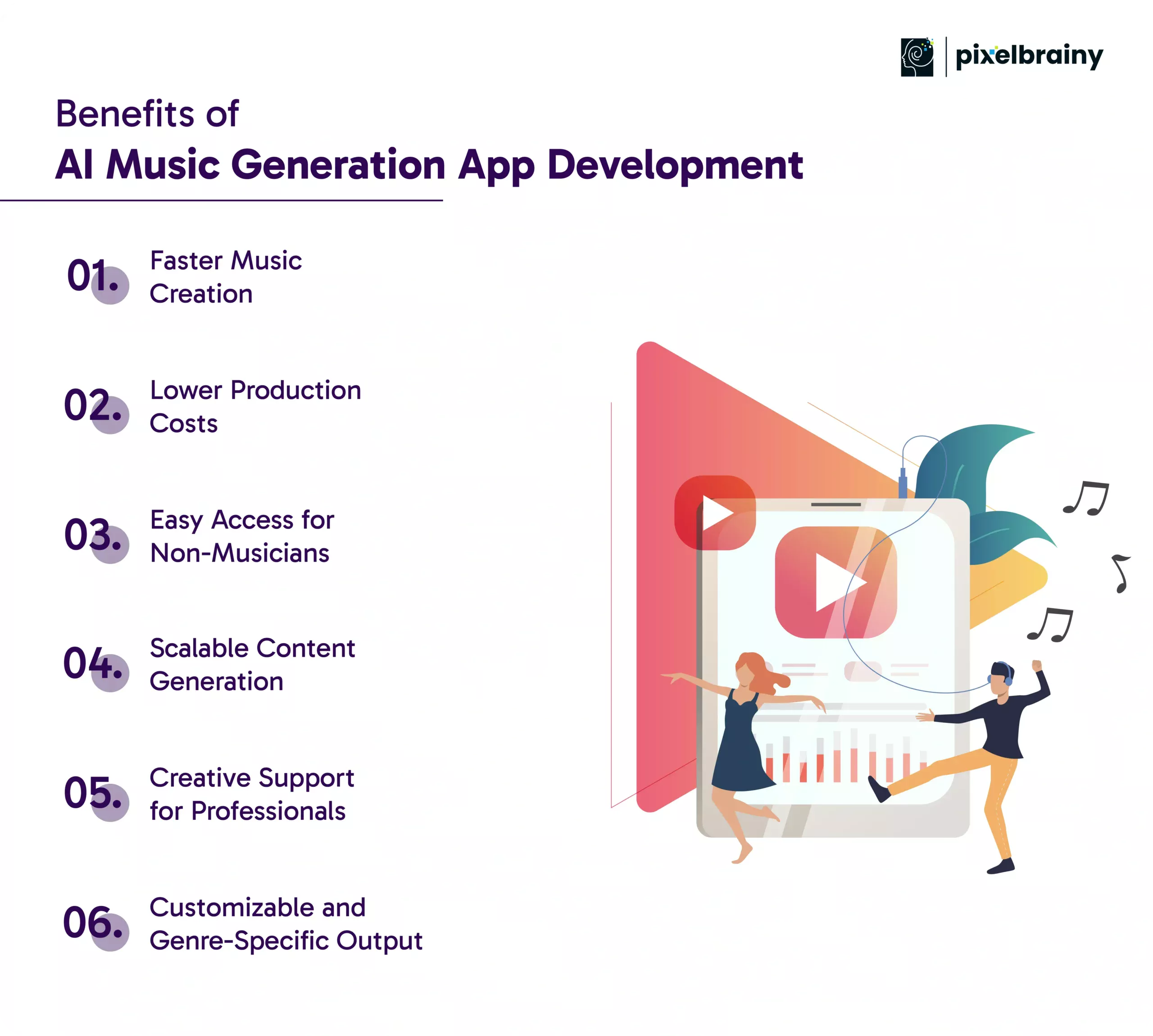
AI technology significantly shrinks the music production timeline. Instead of spending hours or days composing and arranging, users can create polished tracks in minutes, promoting rapid content creation for various applications.
By automating complicated tasks like composition, mixing, and mastering, AI diminishes reliance on expensive studios and professional musicians. This cost efficiency makes music production easily accessible to startups, independent creators, and businesses with tight budgets.
AI music generation apps authorize people without formal music training to make high-quality compositions. This democratization creates opportunities for hobbyists, marketers, and creators who want customized soundtracks with no deep musical expertise.
AI apps can produce extensive portions of unique music tracks in no time, which is ideal for industries like gaming, advertising, and social media, where fresh audio content is in high demand. This scalability enables businesses to meet content requirements without bottlenecks.
Professional musicians and producers can utilize AI as a creative partner, rendering fresh ideas or supporting tracks that instill inspiration. AI tools help pace the creative workflow, permitting artists to focus on refining and personalizing their sound.
Modern AI models enable mobile apps to tailor music to specific genres, moods, and styles. This customization lets users get personalized soundtracks that faultlessly fit their projects, increasing user satisfaction and engagement.

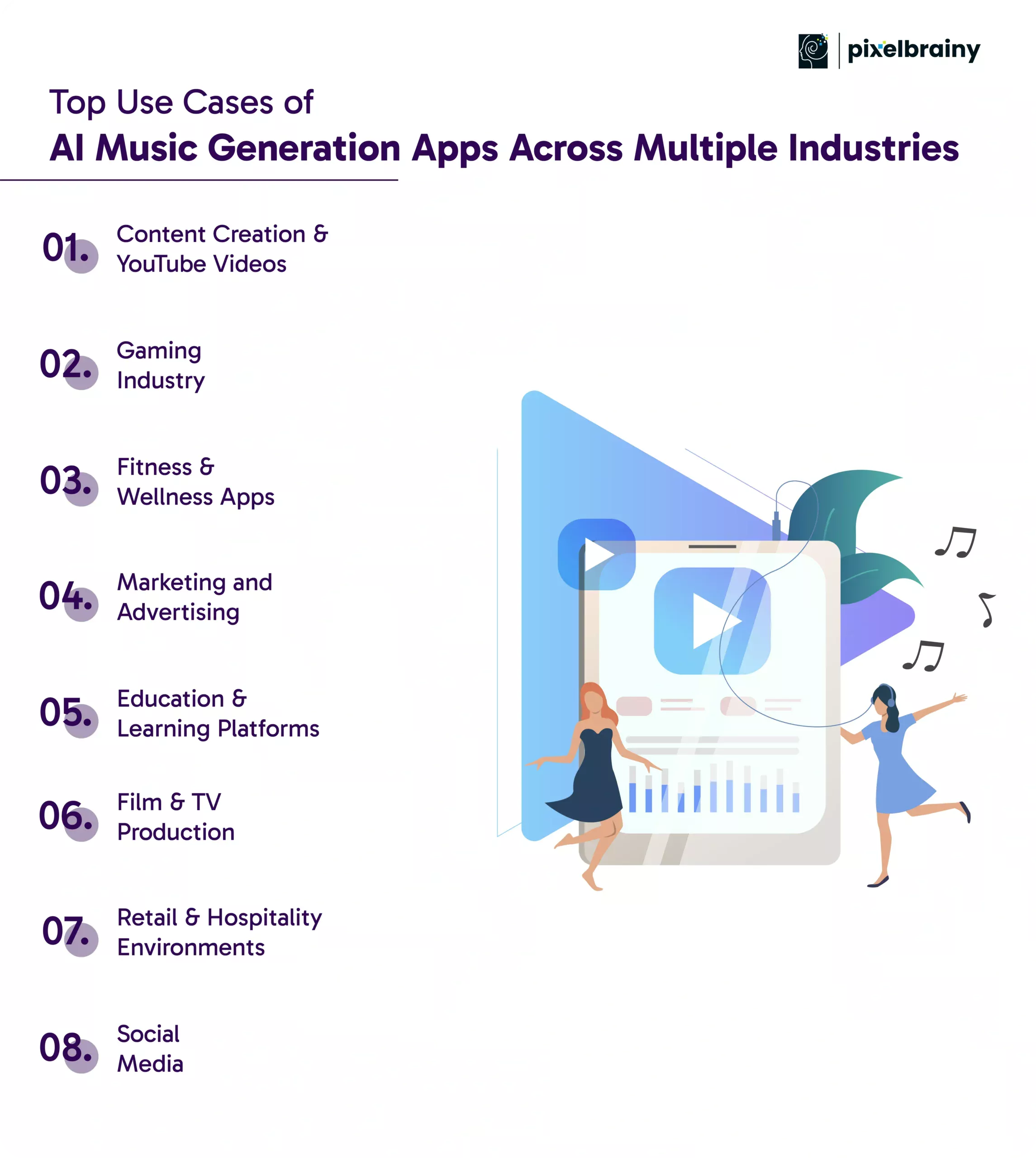
AI-powered music apps are gaining traction across myriad sectors in 2026. Whether it’s content creators requiring fast background tracks or businesses personalizing customer experiences with dynamic soundscapes, these apps are reshaping how industries think about audio.
Key real-world applications of the AI-based music software are outlined below.
To build an AI music generation app that shines in 2026, it's not just about automation; it's about delivering creative control, personalization, and scalability. Whether you are aiming for mobile app development or full-scale platform deployment, integrating features can define your app's success. As demand rises across industries like gaming, wellness, and content creation, thoughtful AI music generation app development must prioritize user experience and the underlying generative music tools.
You can consider incorporating the following features of AI music apps.
| Feature | Description |
| Genre and Mood Selection | Allow users to choose from multiple genres (e.g., electronic, classical, jazz) and emotional tones (e.g., uplifting, melancholic). This helps generate music that aligns with the user’s creative intent or content needs. |
| Real-Time Music Generation | Enable the app to create full-length tracks in seconds using pre-trained generative models. Real-time generation is critical for user engagement and prototyping speed. |
| Custom Lyrics Generation | Integrate natural language processing to generate lyrics based on user prompts, themes, or moods. This opens new use cases for songwriters, creators, and marketers. |
| Voice and Instrument Simulation | Support AI-powered vocal synthesis and realistic instrument emulation, allowing users to create full compositions without needing external sound libraries or musicians. |
| Multi-Language Support | Incorporate multilingual AI models for global reach. This allows users to generate lyrics and vocals in multiple languages, appealing to broader audiences. |
| Tempo and Key Adjustment | Let users manually or automatically adjust BPM, key, and scale to fine-tune their tracks for different use cases, like syncing with video or workout routines. |
| User Style Training (Custom Model Learning) | Allow users to train the AI on their past compositions or preferences, enabling hyper-personalized output that aligns with their signature style. |
| Drag-and-Drop Music Editor | Offer a visual editor where users can drag beats, adjust structure, loop segments, and layer instruments, making complex compositions accessible to non-experts. |
| Royalty-Free Music Export Options | Give users full control to export AI-generated tracks with royalty-free rights, supporting content creators, advertisers, and developers legally and efficiently. |
| Collaboration Tools for Teams | Enable real-time co-editing, version history, and team access controls to support remote collaboration between musicians, content teams, and agencies. |
| API Integration for Third-Party Platforms | Provide APIs or SDKs to connect with DAWs, video editing tools, podcast platforms, or game engines, extending the app’s ecosystem value. |
| Cloud-Based Rendering and Storage | Use cloud infrastructure to handle AI model processing and store user sessions, generated tracks, and templates for cross-device accessibility and speed. |
| AI-Generated Loops and Samples Library | Offer a built-in library of AI-generated loops, intros, bridges, and samples that users can mix and match, ideal for speeding up composition. |
| Session Save and Resume Functionality | Let users pause mid-creation, save sessions, and resume editing across devices. This improves usability for professionals working over multiple sittings. |
| User Analytics and Preference Tracking | Use behavioral data and usage patterns to recommend genres, instruments, or templates, improving retention through AI-assisted personalization. |
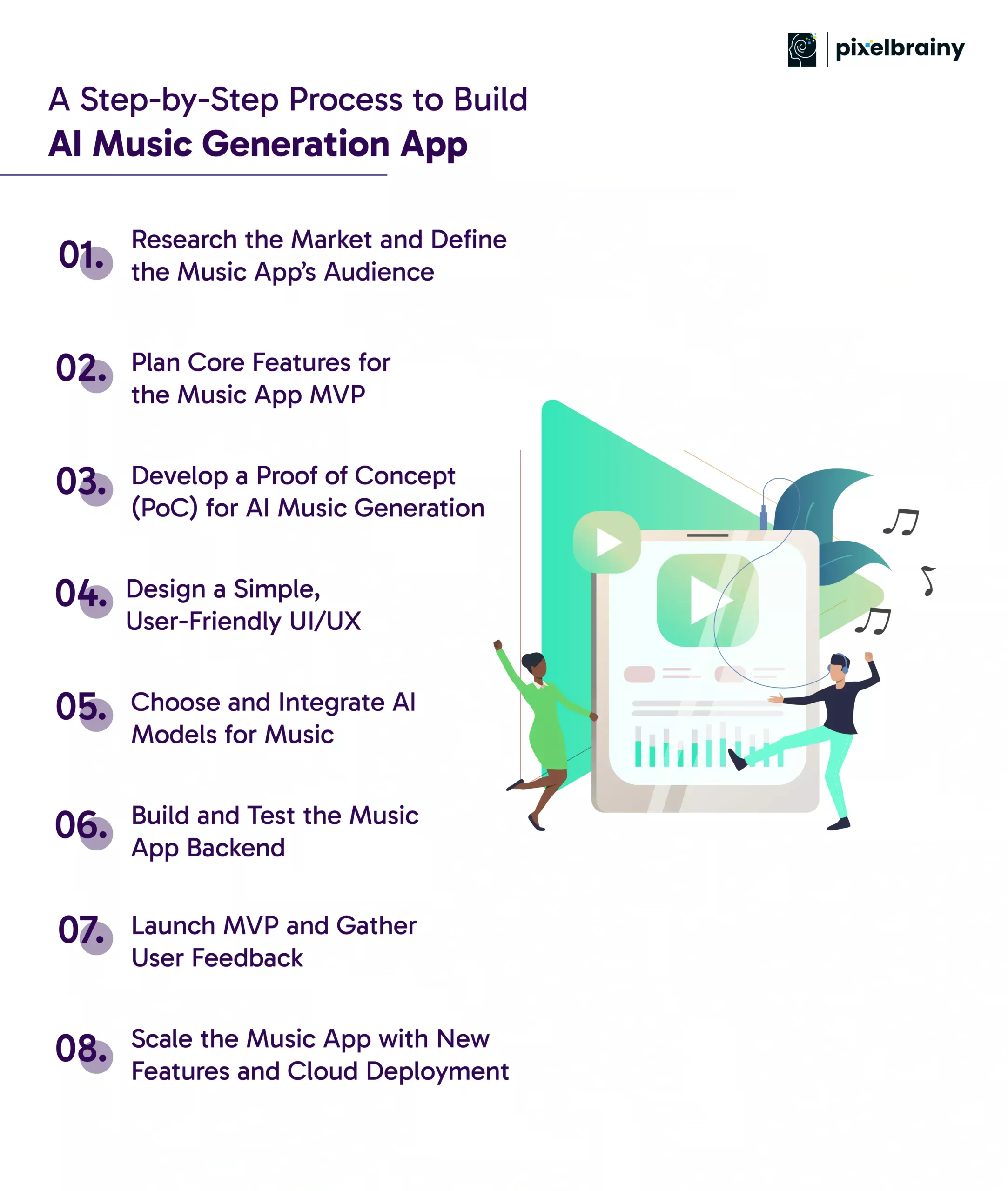
How to build an AI-powered music generation app? This section will help you with this.
When you create an app for music generation with AI, you should follow a structured approach that balances innovation, usability, and scalability.
Below are steps to develop AI music generation app tailored for every user with distinct requirements.
Also Read: How To Develop An MVP For Your Digital Product
Also Read: MVP vs Prototype vs Proof of Concept: A Strategic Approach to Product Development

Developing a mobile AI music generation app demands more than a great idea; it needs a robust tech stack that backs real-time audio processing, cloud scalability, generative AI, and smooth user interaction.
Below is a deep analysis of the essential tools, frameworks, and technologies to consider for your AI music creation mobile app.
| Category | Tools / Technologies | Purpose / Notes |
| AI Models & Frameworks | Google MusicLM, OpenAI Jukebox, Riffusion, Magenta, TensorFlow, PyTorch, ONNX Runtime, Triton Inference Server | Audio generation from text, symbolic music creation using AI, style transfer, scalable inference and training |
| Frontend (Mobile) | Flutter, React Native, Swift, Kotlin, Tone.js, Howler.js | Cross-platform mobile development, native rendering, real-time audio controls |
| Backend & APIs | Node.js, Python (FastAPI), Go, Dolby.io, Audiostack, Custom AI APIs | API handling, real-time music generation, audio rendering, and post-processing |
| Cloud & Storage | AWS, Google Cloud Platform (GCP), Microsoft Azure, Firebase, Amazon S3, Google Cloud Storage, Cloudflare CDN | Hosting, real-time database, storage for generated music, and fast delivery |
| DevOps & Monitoring | GitHub Actions, Bitrise, Jenkins, Datadog, Firebase Crashlytics, Sentry, Weights & Biases, MLflow | Continuous deployment, bug tracking, user analytics, ML experiment management |
| Security & Compliance | OAuth2, Auth0, Firebase Authentication, SSL/TLS, GDPR, CCPA | Secure user authentication, encrypted audio data, legal compliance for user data and music licensing |
While developing AI music generation app, you might encounter hurdles. From ensuring audio quality to staying legally compliant, teams face technical and creative obstacles.
Below are key challenges and the practical solutions to confound them effectively.
Building a music generation app powered by AI demands more than just great code; it needs creative vision, domain expertise, and a deep understanding of generative audio models. PixelBrainy, a top AI app development company in USA, brings all three together.
We excel in AI music generation app development tailored for startups, product teams, and music-tech ventures looking to innovate. From MVPs with core music rendering features to scalable platforms with custom-trained models and collaboration tools, our consistently scaling music AI solutions are built for speed, quality, and user engagement.
Here’s why businesses choose us:
If you are ready to develop AI music generation app that stands out in 2026, PixelBrainy delivers the right mix of creativity, tech, and strategic insight.

AI music generation app development is transforming how music is created, consumed, and commercialized. From startups to established creators, the demand for intuitive, scalable, and innovative AI-powered music platforms continues to grow. By understanding the essential features, challenges, and development steps, you can build an AI music generation app that stands out in this competitive landscape. Whether you are a tech entrepreneur, product manager, musician, or investor, embracing this technology unlocks new avenues for innovation and revenue.
Ready to start your own AI music platform? Partnering with a trusted AI Development Company in USA to build an AI music generation app now can position you at the forefront of the future of music.
The development timeline typically ranges from 4 to 8 months, depending on complexity, features, and tech stack. If you are planning to build an AI music generation app with advanced tools like real-time rendering or user training models, expect the process to take longer, especially when integrating generative, AI-driven music tools.
Designing an AI music generator app with innovation enables users to customize genre, mood, tempo, key, and even lyrics. Advanced solutions can learn from user preferences over time, producing more tailored and engaging music that enhances creativity and satisfaction.
Most modern apps use royalty-free AI-generated outputs or provide license agreements upon track export. To avoid legal risks, it's essential during AI music maker app development to define clear ownership policies and integrate proper attribution models where necessary.
Yes, leading music AI technologies support genre versatility, from classical to EDM and can generate lyrics in various languages. While constructing AI music app, incorporating multi-language support is crucial for expanding your user base across global markets.
You can develop the app for iOS, Android, and web platforms, depending on your audience and budget. Cross-platform development ensures broader reach and improves accessibility, especially when offering mobile AI music generation app features.
Scalability depends on the backend architecture of AI music platform and cloud deployment. While you create AI music generator app, using services like AWS or Google Cloud enables your app to support real-time music generation with AI while maintaining performance across large user bases, vital for enterprise-grade or consumer-heavy use cases.

About The Author
Sagar Bhatnagar
Sagar Sahay Bhatnagar brings over a decade of IT industry experience to his role as Marketing Head at PixelBrainy. He's known for his knack in devising creative marketing strategies that boost brand visibility and market influence. Sagar's strategic thinking, coupled with his innovative vision and focus on results, sets him apart. His track record of successful campaigns proves his ability to utilize digital platforms effectively for impactful marketing efforts. With a genuine passion for both technology and marketing, Sagar continuously pushes PixelBrainy's marketing initiatives to greater success.


Transform your ideas into reality with us.
Working with the PixelBrainy team has been a highly positive experience. They understand the design requirements and create beautiful UX elements to meet the application needs. The dev team did an excellent job bringing my vision to life. We discussed usability and flow. Sagar worked with his team to design the database and begin coding. Working with Sagar was easy. He has the knowledge to create robust apps, including multi-language support, Google and Apple ID login options, Ad-enabled integrations, Stripe payment processing, and a Web Admin site for maintaining support data. I'm extremely satisfied with the services provided, the quality of the final product, and the professionalism of the entire process. I highly recommend them for Android and iOS Mobile Application Design and Development.

Great experience working with them. Had a lot of feedback and I found that unlike most contractors they were bugging me for updates instead of the other way around. They were extremely time conscience and great at communicating! All work was done extremely high quality and if not on time, early! They were always proactive when it comes to communication and the work is great/above par always. Very flexible and a great team to work with! Goes above and beyond to present us with multiple options and always provides quality. Amazing work per usual with Chitra. If you have UI/UX or branding design needs I recommend you go to them! Will likely work with them in the future as well, definitely recommended!

PixelBrainy is a joy to work with and is a great partner when thinking through branding, logo, and website layout. I appreciate that they spend time going into the "why" behind their decisions to help inform me and others about industry best practices and their expertise.

I hired them to design our software apps. Things I really like about them are excellent communication skills, they answer all project suggestions and collaborate right away, and their input on design and colors is amazing. This project was complex and needed patience and creativity. The team is amazing to do business with. I will be using them long-term. Glad to see there are some good people out there. I was afraid to try and outsource my project to someone but I am glad I met them! I really can't say enough. They went above and beyond on this project. I am very happy with everything they have done to make my business stand out from the competition.

It was great working with PixelBrainy and the team. They were very responsive and really owned the project. We'll definitely work with them again!

I recently worked with the PixelBrainy team on a project and I was blown away by their communication skills. They were prompt, clear, and articulate in all of our interactions. They listened and provided valuable feedback and suggestions to help make the project a success. They also kept me updated throughout the entire process, which made the experience stress-free and enjoyable.

PixelBrainy is very good at what it does. The team also presents themselves very professionally and takes care of their side of things very well. I could fully trust them taking up the design work in a timely and organised manner and their attention to detail saved us lots of effort and time. This particular project was quite intense and the team showed that they function very well under pressure. Very much looking forward to working with her again!

It's always an absolute pleasure working with them. They completed all of my requests quickly and followed every note I had for them to a T, which made our process go smoothly from start to finish. Everything was completed fast and following all of the guidelines. And I would recommend their services to anyone. If you need any design work done in the future, PixelBrainy should be your first call!

They took ownership of our requirements and designed and proposed multiple beautiful variants. The team is self-motivated, requires minimum supervision, committed to see-through designs with quality and delivering them on time. We would definitely love to work with PixelBrainy again when we have any requirements.

PixelBrainy was a big help with our SaaS application. We've been hard at work with a new UI/UX and they provided a lot of help with the designs. If you're looking for assistance with your website, software, or mobile application designs, PixelBrainy and the team is a great recommendation.

PixelBrainy designers are amazing. They are responsive, talented, and always willing to help craft the design until it matches your vision. I would recommend them and plan to continue them for my future projects and more!!!

They were awesome! Did a good job fast, and good communication. Will work with them again. Thank you

Creative, detail-oriented, and talented designers who take direction well and implement changes quickly and accurately. They consistently over-delivered for us.

PixelBrainy team is very talented and creative. Great designers and a pleasure to work with. PixelBrainy is an excellent communicator and I look forward to working with them again.

PixelBrainy has a very talented design team. Their work is excellent and they are very responsive. I enjoy working with them and hope to continue on all of our future projects.


