
 AI Summary Powered by PixelBrainy
While many traders still spend hours monitoring charts and relying on instinct, an AI Options Trading App can already process thousands of data points, detect hidden patterns, and execute trades in real time. That is the competitive advantage: a system that does not just respond to the market but predicts the next move with precision.
In 2026, the leaders in fintech are no longer only trading smarter, they are building smarter. The development of AI Options Trading Apps has become a strategic priority for hedge funds, brokers, and fintech companies that want to stay ahead of the curve.
The market shift is clear. More than 89% of global trades are now executed by algorithms. At the same time, the AI trading software industry is expected to surpass 13 billion dollars this year. For platforms that still depend on manual trading or outdated tools, the gap is widening, and every second without innovation represents lost opportunities.
This guide is designed to help you take action. Whether you plan to Build an AI Options Trading App for enterprise trading desks or are exploring How to Create an AI Options Trading App for retail investors, you will find a step-by-step roadmap here.
What you will discover:
The next generation of successful trading platforms will not be bought off the shelf. They will be built with intelligence, powered by AI.
An AI Options Trading App is an advanced trading platform that leverages artificial intelligence and machine learning to analyze options markets, predict trends, and execute trades automatically. Unlike traditional trading applications that focus mainly on charting and order placement, AI-driven apps incorporate intelligent algorithms that process vast amounts of historical and live market data to deliver actionable insights.
The development of AI Options Trading Apps is centered around empowering traders with predictive analytics, sentiment analysis, and automated trading strategies that adapt in real time. This reduces the reliance on human judgment and allows for faster, more accurate, and scalable decision-making.
Traditional trading apps still depend heavily on the trader’s market knowledge and constant monitoring. On the other hand, building an AI Options Trading App creates a proactive trading ecosystem that continuously learns from new data, refines strategies, and manages risks with minimal manual intervention.
| Feature/Aspect | Traditional Trading App | AI Options Trading App Development |
| Data Processing | Manual analysis, limited indicators | Real-time big data processing with AI models |
| Decision Making | Based on trader’s experience | AI-driven insights, predictions, and automation |
| Execution Speed | Human-driven, slower reaction times | Instant execution powered by automation |
| Market Prediction | Historical patterns and technical charts | Machine learning, predictive analytics, sentiment analysis |
| Personalization | Generic trading interface | Tailored strategies based on user behavior |
| Scalability | Limited, requires manual updates | Highly scalable with AI and cloud integration |
| Risk Management | Manual stop-loss and controls | AI-powered risk detection and automated safeguards |
A traditional app enables trading, but an AI Options Trading App transforms trading into a smarter, faster, and more adaptive process designed for long-term success.
An AI Options Trading App acts as an intelligent trading assistant that blends real-time market data with artificial intelligence to produce actionable signals and execute trades with precision. Unlike traditional trading apps that only provide charts and order placement tools, an AI-powered system functions as a self-learning engine that adapts to market conditions, optimizes strategies, and becomes smarter with every trade.
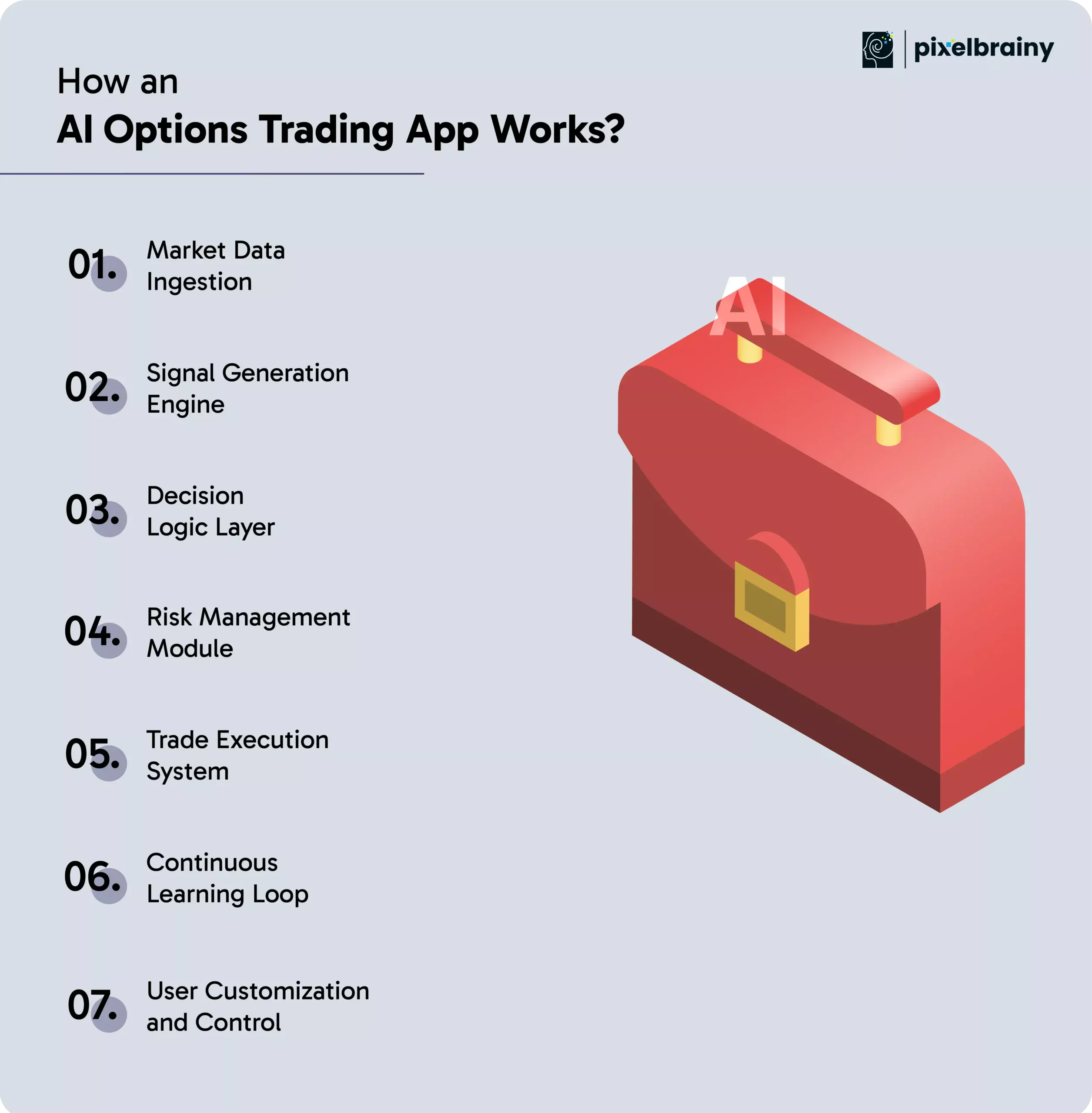
Every intelligent trading system begins with data collection. The app integrates multiple data sources to create a comprehensive view of the market.
This foundation enables the development of AI Options Trading Apps that can analyze trends at scale and anticipate sudden market swings.
Once the data is prepared, AI models scan for high-probability trade opportunities.
If you plan to build an AI Options Trading App, this signal engine is the critical core that determines whether predictions are accurate or random.
Not every signal should trigger a trade. The logic layer applies filters that align trading activity with business rules and portfolio strategies.
When you develop an AI Options Trading App for your business, this ensures each trade aligns with your overall strategy, whether conservative, balanced, or aggressive.
An advanced AI trading system must also protect capital. A dedicated risk management module ensures stability under volatile conditions.
This safeguard is essential when you create automated AI Options Trading Apps that must run continuously without constant human oversight.
After passing all checks, trades are executed instantly via broker APIs. Speed and accuracy are non-negotiable here.
Fast execution ensures no opportunities are lost due to delays, making this step critical for the building of AI Options Trading Apps.
AI-driven trading systems improve with experience. Each trade feeds back into the model for ongoing refinement.
This learning loop ensures that the more the app trades, the smarter and more reliable it becomes.
While automation is powerful, traders still want flexibility and oversight. Customization ensures the system serves diverse needs.
This balance of automation and user control makes the app practical and adaptable for different trader profiles.
By combining data ingestion, intelligent signal generation, decision logic, risk management, fast execution, and continuous learning, an AI Options Trading App transforms into a self-optimizing system that consistently delivers smarter, faster, and more reliable trades.
In 2025, investing in AI Options Trading App Development is no longer a choice. It has become a strategic requirement for any trading business that wants to remain competitive.
Markets are evolving too quickly, and the volume of financial data is too vast for manual or outdated systems to keep up. According to Precedence Research, the global AI trading platform market is expected to reach USD 13.52 billion in 2025. Meanwhile, Benzinga reports that algorithmic and AI-driven strategies already account for 60–73% of equity trades in the United States. Businesses that fail to invest in AI-driven platforms risk falling further behind every quarter.
This is why investing in AI Options Trading App Development has become a powerful business strategy. By embedding artificial intelligence into your trading infrastructure, you are not just upgrading technology—you are making a long-term investment in speed, precision, and operational scale.
The best part is that businesses do not need to shoulder the entire development investment internally. Partnering with an experienced AI trading app development company ensures that infrastructure, compliance, and integration are managed efficiently.
Even if you already have legacy systems, investing in modular AI enhancements can deliver immediate returns without requiring a complete rebuild.
Whether you are investing to develop an AI Options Trading App for in-house trading desks or to launch a productized solution for retail investors, the long-term ROI far outweighs the upfront cost.
In the trading world, delaying investment is the costliest decision. The real risk is not building too early, it is investing too late while competitors secure the advantage.
The applications of AI Options Trading Apps extend far beyond simple trade execution. Different market participants leverage AI in unique ways to maximize profits, manage risk, and scale operations. From individual retail investors to large hedge funds, the use cases illustrate how AI-driven platforms are reshaping modern trading.
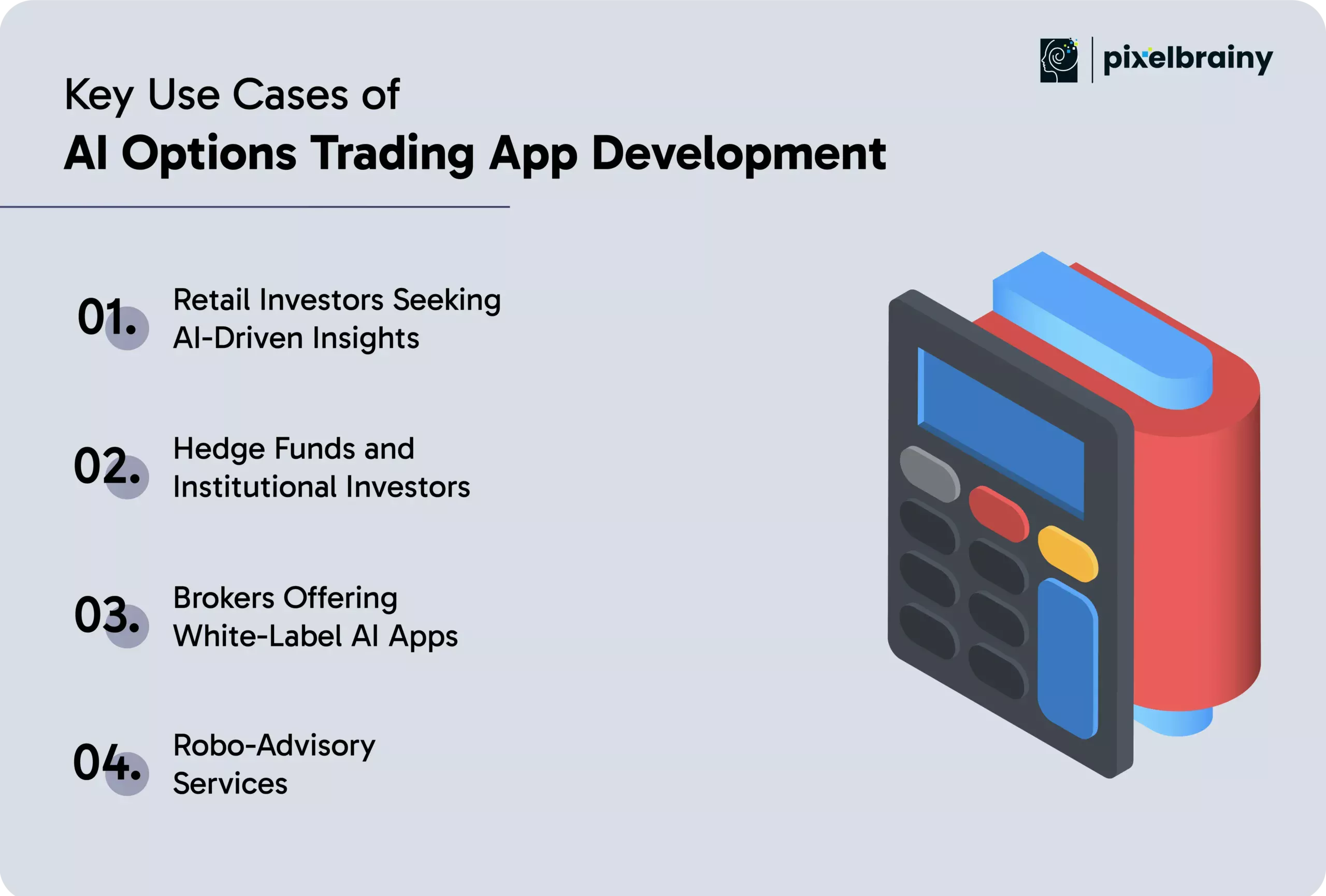
Retail traders often lack the resources and research power available to institutional investors. An AI Options Trading App levels the playing field by providing:
Example: A retail investor using a mobile AI-powered app could receive a recommendation to buy a call option before a positive earnings surprise, driven by sentiment analysis of news headlines and social media chatter.
For hedge funds, the development of AI Options Trading Apps represents a way to amplify high-frequency strategies and reduce risk exposure.
Example: A hedge fund can deploy AI-driven bots to execute thousands of trades per second, adjusting strike prices and expirations dynamically in response to market shifts. This allows funds to maintain an edge in highly competitive markets.
Brokerage firms increasingly see value in offering white-label AI Options Trading Apps to their clients. This not only enhances customer experience but also adds new revenue streams.
Example: An online broker integrates a white-label AI app into its platform, offering clients automated strategy recommendations and backtesting features, which increases both engagement and trading volume.
Robo-advisors are expanding beyond equities into derivatives like options. By embedding AI, robo-advisory platforms deliver smarter and more dynamic portfolio management.
Example: A robo-advisory service uses AI to recommend covered call strategies for clients looking for steady income, automatically executing trades while monitoring market volatility.
From empowering retail investors with insights to enabling hedge funds with high-frequency trading capabilities, the use cases of AI Options Trading App Development demonstrate its transformative impact across the financial industry. Each segment, including investors, institutions, brokers, and advisors, can leverage AI to enhance decision-making, reduce risk, and unlock new growth opportunities.
Also Read: How to Build AI Crypto Trading Bot
The financial markets have reached a point where speed, accuracy, and adaptability decide who succeeds. By investing in AI Options Trading App Development, trading businesses and investors gain access to a new generation of tools that merge intelligence with automation. These benefits go beyond incremental improvements and fundamentally reshape how trading decisions are made, executed, and optimized.
An AI Options Trading App can process thousands of data points simultaneously, ensuring more accurate trade recommendations and stronger risk controls. Instead of relying only on technical indicators or human judgment, AI evaluates multiple factors such as volatility, strike prices, market sentiment, and macroeconomic trends before generating signals.
For businesses planning to develop AI Options Trading Apps, this delivers sharper insights and better risk-adjusted returns. Dynamic stop-loss triggers, anomaly detection, and automated exposure management further strengthen capital protection in volatile markets.
AI models excel at delivering real-time forecasts by continuously learning from historical data and reacting to live market movements. Unlike static systems, these models adapt to shifts instantly, giving traders a competitive edge.
For example, an app could detect rising options premiums before an earnings announcement and recommend strategic trades. When you build an AI Options Trading App, you gain the ability to convert raw data into actionable insights with unmatched speed and accuracy.
Every investor has unique goals, preferences, and risk tolerance. AI-powered options trading app development allows platforms to deliver personalized strategies tailored to individual users.
A risk-averse investor may receive protective strategies such as covered calls or puts, while an aggressive trader may be guided toward breakout opportunities. This level of personalization not only boosts user satisfaction but also improves engagement and loyalty, especially for fintech firms working with a custom software development company to create tailored AI trading solutions.
Human decisions are often influenced by emotions, which can lead to poor timing or inconsistent strategies. AI eliminates these biases by relying on logic and statistical probabilities.
At the same time, trades are executed in milliseconds through broker APIs, ensuring no opportunities are lost to human delay. This combination of objectivity and speed enables businesses that develop AI Options Trading Apps to compete more effectively in highly dynamic markets.
Although the upfront investment in AI Options Trading App Development may be significant, the long-term operational savings are substantial. Automated systems handle repetitive tasks such as monitoring option chains, rebalancing portfolios, and conducting backtests without constant human involvement.
This reduces overhead costs and allows businesses to scale their user base without proportionally increasing resources or staffing.
AI provides scalability in an industry where data is growing exponentially. Whether managing thousands of retail accounts or supporting institutional volumes, AI-based platforms expand effortlessly.
For brokers and fintech companies, the ability to build AI Options Trading Apps that grow with their business ensures long-term competitiveness. The platform remains relevant and innovative, even as trading environments evolve.By combining precision, speed, personalization, cost savings, and scalability, the benefits of AI Options Trading App Development are clear. Businesses that adopt AI strengthen current operations and secure a competitive edge for the future.
When you plan for launching Options Trading App business, utilizing AI the revenue model is just as important as the product itself. The way you monetize an AI Options Trading App determines how sustainable, profitable, and scalable your platform will be. Different models suit different audiences, whether you are building for retail traders, institutional investors, or brokers.
Below are the most effective business models you can adopt for long-term success.
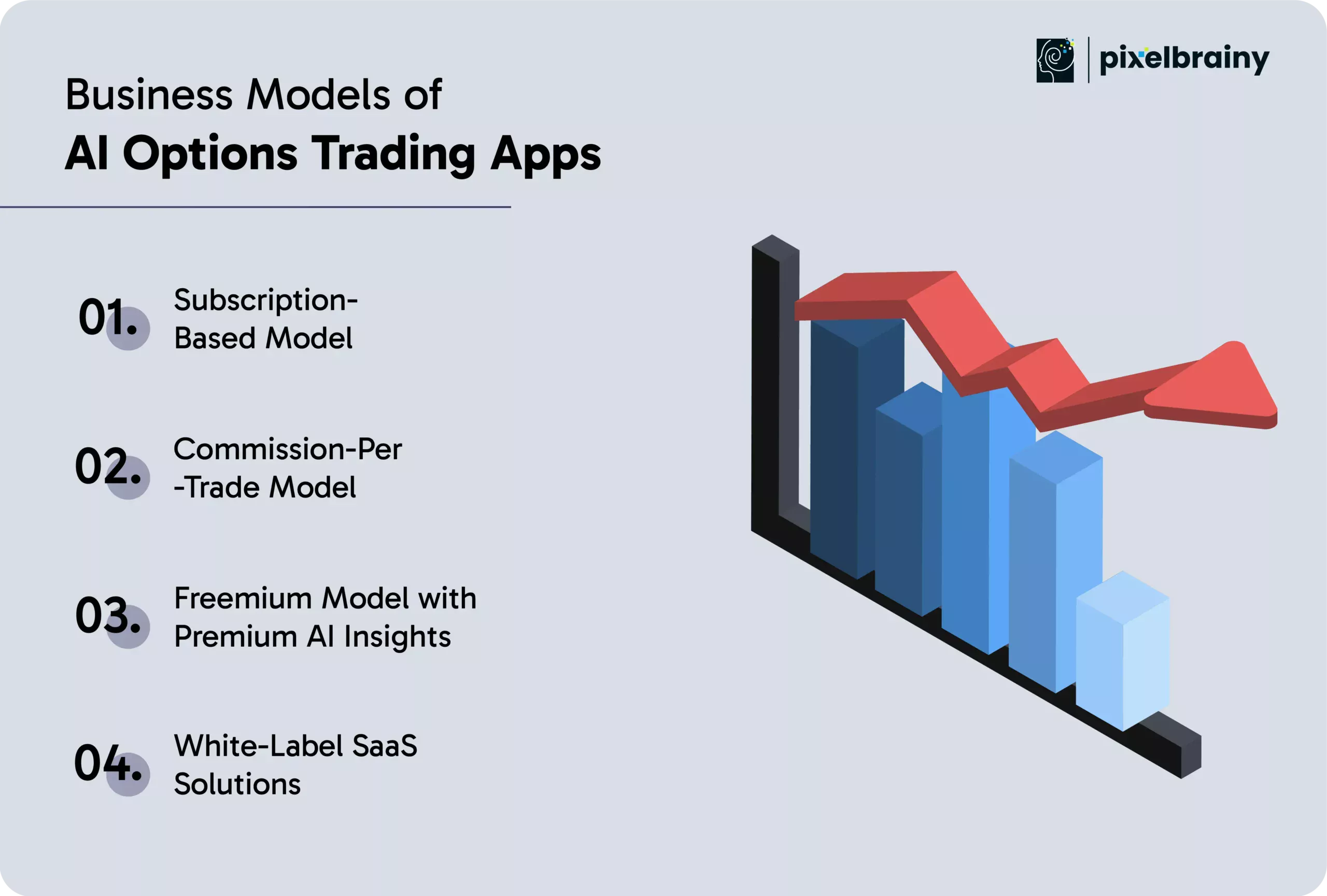
In this model, users pay a recurring fee—monthly, quarterly, or annually—to access the platform and its AI-driven features. Subscriptions often come in tiers, allowing businesses to cater to casual investors as well as professional traders.
Example: A fintech company might charge $49 per month for standard access, while institutional traders pay $299 per month for advanced AI-driven strategies and priority support.
Here, the platform charges a small commission on each executed trade. This aligns the success of the app with user activity, making it a performance-driven revenue model.
Example: A broker-backed AI trading app may take a $1 commission per options contract executed through its system, generating revenue directly proportional to trading volume.
The freemium model allows users to access basic trading features at no cost, while advanced AI-driven insights are locked behind a premium upgrade. This approach is particularly effective for attracting large user bases quickly.
Example: A retail-focused AI app could attract thousands of new users with free access to educational tools and then upsell premium AI signals or automated strategies at $19–$99 per month.
With white-label SaaS, brokers and financial institutions license a fully developed AI Options Trading App under their own brand. This approach allows firms to quickly adopt AI-driven technology without investing years in development.
Example: A brokerage firm can license a white-label AI platform and rebrand it as part of its ecosystem, giving clients access to AI-powered options trading without building an app from scratch.
Selecting the right business model for an AI Options Trading App depends on your target market, revenue goals, and long-term vision. Subscription, commission, freemium, and white-label SaaS solutions each bring unique advantages, and many successful platforms combine these models to maximize profitability and growth.
When you develop an AI Options Trading App, the features you include determine how effective and competitive the platform will be. Core functionalities not only attract traders but also ensure security, compliance, and scalability. A strong feature set combines traditional trading essentials with AI-driven intelligence to deliver a next-generation trading experience.
| Feature | Description |
| Secure User Authentication & KYC | Verifies users through identity checks and multi-factor authentication, ensuring compliance and protecting against fraud |
| Real-Time Market Data Feeds | Provides live updates on stock prices, options chains, and volatility indices to enable precise and timely decisions |
| Advanced Charting & Visualization | Offers interactive charts, indicators, and technical analysis tools for clear market insights |
| AI-Powered Trade Recommendations | Uses predictive analytics and machine learning to suggest profitable trading opportunities |
| Automated Trade Execution | Connects with broker APIs to execute trades instantly, reducing slippage and missed opportunities |
| Portfolio Management Dashboard | Centralized hub for tracking assets, monitoring performance, and analyzing portfolio risk exposure |
| Risk Management Tools | Includes stop-loss triggers, profit-taking levels, and hedging strategies to minimize potential losses |
| Multi-Asset Support | Enables trading across options, equities, ETFs, and other asset classes within a single platform |
| Sentiment Analysis Integration | Leverages AI to analyze news and social media sentiment for better market predictions |
| Backtesting & Simulation Tools | Allows users to test strategies against historical data before deploying them in live markets |
| Push Notifications & Alerts | Provides real-time updates on trade signals, price movements, or unusual activity |
| Customizable Strategy Builder | Gives traders flexibility to design, test, and automate their own strategies with AI support |
| Data Encryption & Cybersecurity | Ensures sensitive data is protected using encryption and robust security protocols |
| Compliance & Regulatory Reporting | Automates reporting for audits and ensures adherence to global regulatory standards |
| Multi-Device & Cross-Platform Access | Delivers seamless functionality across web, iOS, and Android devices for user convenience |
These 15 features form the backbone of successful AI Options Trading App Development. Together, they ensure the platform is secure, intelligent, user-friendly, and scalable, giving businesses a solid foundation to compete in the fast-paced trading industry.
While core features ensure usability and compliance, advanced features transform an AI Options Trading App into a powerful, future-ready trading platform. These capabilities go beyond basic functionality by embedding intelligence, automation, and personalization that give traders and businesses a competitive advantage.
| Feature | Description |
| Natural Language Processing (NLP) for News Analysis | AI scans financial news, analyst reports, and social media in real time to detect sentiment shifts that influence options pricing |
| Predictive Analytics with Deep Learning | Advanced neural networks forecast price movements and volatility, enabling traders to position themselves ahead of the market |
| Reinforcement Learning Models | Self-learning algorithms test and adapt strategies dynamically, improving performance with every trade cycle |
| AI-Powered Robo-Advisory | Provides investors with fully automated, personalized portfolio management and strategy execution |
| Voice Command & Virtual Assistants | Traders can use voice commands to request data, check strategies, or execute trades hands-free |
| Blockchain-Based Transaction Security | Ensures transparency, immutability, and fraud prevention in trade settlement and user data protection |
| Automated Hedging Strategies | AI continuously adjusts hedges against volatility, minimizing downside risk for both retail and institutional traders |
| Customizable Trading Bots | Traders can deploy bots that automatically execute custom strategies across multiple assets and markets |
| Integration with Alternative Data Sources | AI taps into unconventional data such as satellite imagery, shipping trends, or corporate filings for deeper market insights |
| Gamification & User Engagement Tools | Features like AI-driven leaderboards, performance tracking, and achievement badges improve user retention |
These advanced features elevate development of AI Options Trading Application from a basic trading tool to a cutting-edge, intelligent ecosystem. By combining predictive modeling, automation, blockchain, and personalization, businesses can deliver unmatched value to both retail and institutional traders.
After finalizing features and defining the scope of your project, now you have to move further into the actual development process. Building an AI Options Trading App requires a structured, step-by-step approach that ensures your platform is scalable, compliant, and ready for real-world use. If you are wondering what is the process of AI Options Trading App Development, the following roadmap outlines the key stages every fintech company must follow.
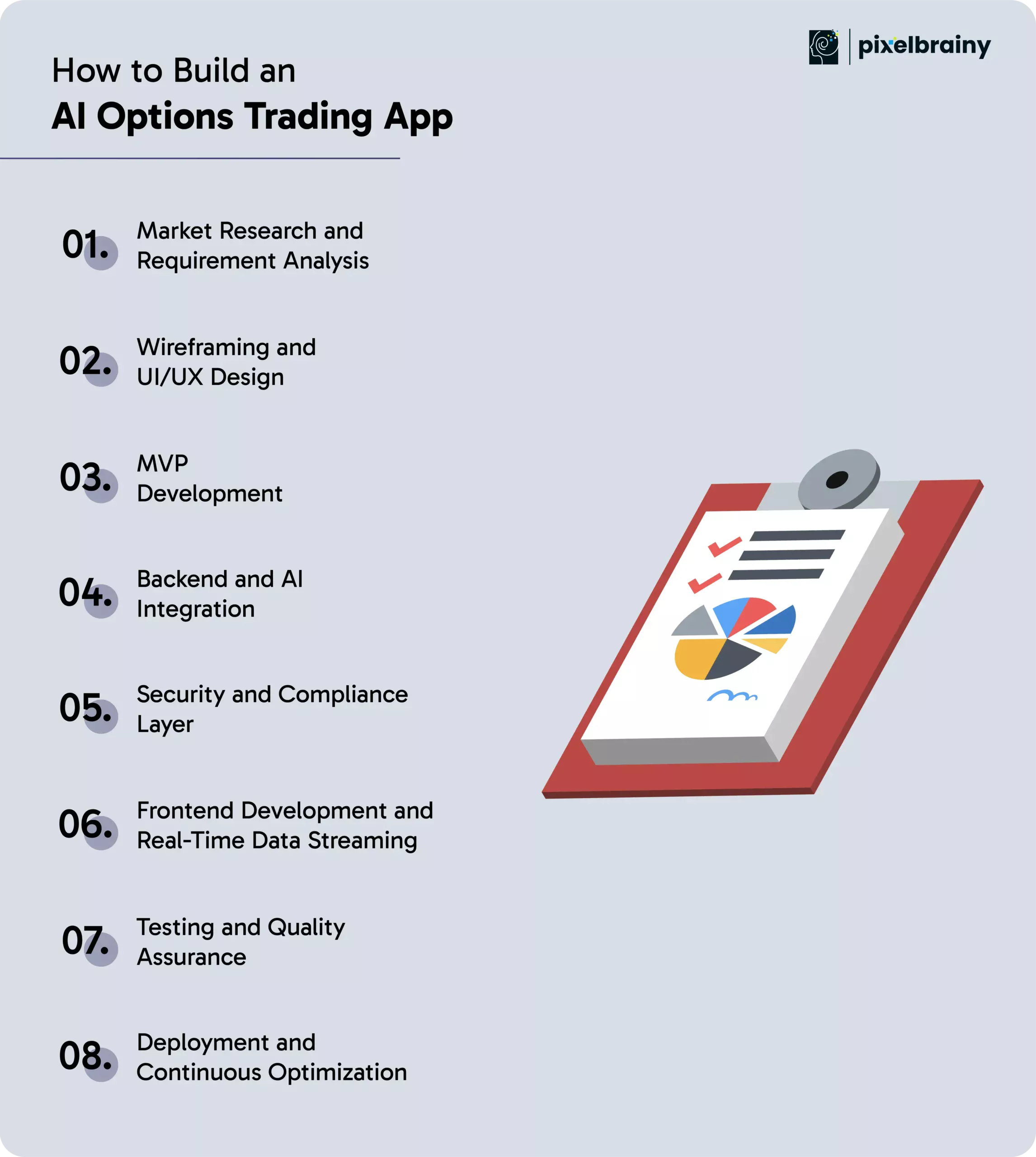
Before creating an AI Options Trading App, start with in-depth market research. Analyze competitors, identify gaps in existing trading platforms, and understand user behavior. This phase helps define your unique selling proposition (USP) and sets the foundation for selecting the right AI models, trading instruments, and compliance requirements.
Why this matters: Without clear research, you risk building features that don’t align with real trader needs or regulatory expectations.
Partner with a specialized UI/UX design company to create intuitive wireframes and user journeys for AI Options Trading Application. Following modern UX design principles ensures your app delivers a seamless experience for both beginners and professional traders. Clear navigation, real-time dashboards, and customizable layouts can significantly enhance engagement.
Why this matters: A poorly designed interface leads to user frustration and churn, while good UX drives trust and adoption.
Instead of building a full-fledged solution right away, start with MVP Development for AI Options Trading App. An MVP (Minimum Viable Product) allows you to test critical features like market data ingestion, signal generation, and basic trade execution with early adopters. This reduces cost, shortens time-to-market, and provides real feedback to refine the product before scaling.
Why this matters: Launching an MVP validates assumptions early, preventing wasted resources on features users may not need.
This stage involves developing robust backend architecture and embedding AI models. Work with top AI development companies in USA or experienced AI engineers to implement predictive analytics, reinforcement learning, and risk management algorithms in AI Options Trading App. Smooth AI Integration with APIs for brokers (such as Interactive Brokers, Alpaca, or Tradier) ensures live execution capabilities.
Why this matters: A solid backend and AI integration guarantee your app is reliable, scalable, and capable of making profitable trading decisions.
Since trading apps handle sensitive financial data, compliance with regulations like SEC, FINRA, or GDPR is critical. Features such as multi-factor authentication, data encryption, and blockchain integration for trade transparency should be prioritized. A custom software development company can also assist in implementing compliance-driven frameworks in your AI Options Trading App.
Why this matters: Ignoring compliance or security can lead to legal issues, financial losses, and loss of user trust.
Your frontend should integrate live market feeds, options chains, and risk analysis dashboards. This requires scalable architecture with WebSockets or Kafka for real-time streaming. Clean, responsive design ensures traders can access information instantly, whether on mobile or web.
Why this matters: In trading, speed and clarity are everything—real-time data ensures users never miss profitable opportunities.
Rigorous testing is essential before launch. Conduct unit testing, load testing, and algorithm validation to ensure your AI-powered strategies deliver accurate predictions. Partnering with top trading software development companies in USA can help implement continuous testing cycles and model validation frameworks.
Why this matters: A single glitch in trade execution can cost millions; thorough QA prevents costly errors and builds trust.
After final testing, deploy your app to the market. However, AI models require continuous optimization. Build automated pipelines for model retraining, reinforcement learning, and user feedback integration. Regular updates aligned with new regulations and market trends will keep your app future-ready.
Why this matters: Post-launch optimization ensures your app adapts to changing market dynamics and remains competitive long term.
Following this structured roadmap to create an AI Options Trading App ensures you balance speed, compliance, and innovation. From MVP Development to full-scale deployment, each step aligns with best practices set by top AI development companies in USA and global fintech leaders.
When planning to invest in AI Options Trading App Development, one of the first questions businesses ask is: “How much does it cost to build an AI Options Trading App?” The answer depends on multiple factors such as features, technology stack, team expertise, and compliance requirements. On average, the cost to develop an AI Options Trading App ranges from $40,000 to $400,000+, depending on scope and complexity.
While the cost to build AI Options Trading App may seem high, the long-term ROI far outweighs the investment. Businesses that invest in AI Options Trading App development gain speed, automation, and predictive accuracy—critical advantages in today’s fast-paced trading market.
Also Read: AI Trading Platform Development Cost
Selecting the right stack is critical for performance, security, and scale. Below is a practical toolkit to develop an AI Options Trading App that balances fast execution, robust AI, and strict compliance. Use this as a blueprint and tailor it to your use case, budget, and team expertise.
| Layer / Parameter | Recommended Tools & Frameworks | Why / How to Use |
| Frontend (Web) | React or Next.js; TypeScript; Tailwind CSS; Highcharts or TradingView Widgets | Build responsive UIs with type safety and rich charts. SSR/ISR in Next.js improves performance and SEO |
| Frontend (Mobile) | React Native or Flutter; Native Modules for broker SDKs | One codebase for iOS and Android. Add native modules for secure storage and low-latency interactions |
| Backend Services | Node.js or Python (FastAPI); Java/Kotlin (Spring) for high-throughput needs | Use REST and WebSocket endpoints for quotes, orders, alerts. Pick based on in-house skills and latency targets |
| AI/ML Frameworks | Python, PyTorch or TensorFlow; scikit-learn; Hugging Face Transformers | Train predictive, RL, and NLP models for signals and sentiment. Export to TorchScript/ONNX for faster inference |
| MLOps & Model Serving | MLflow, Weights & Biases; BentoML, FastAPI; ONNX Runtime | Track experiments, versions, and metrics. Serve models behind autoscaling endpoints for low-latency inference |
| Data Pipelines | Apache Kafka or Redpanda; Airflow; Spark or Flink | Stream options chains and ticks in real time. Orchestrate ETL and feature pipelines for training and backtests |
| Market Data & Broker APIs | Polygon.io, Intrinio, Twelve Data for quotes; Interactive Brokers, Alpaca, Tradier for orders | Combine reliable quotes with stable order routing. Abstract brokers behind a unified execution service |
| Databases & Storage | PostgreSQL for OLTP; TimescaleDB or InfluxDB for tick data; S3/Cloud Storage for datasets | Separate transactional data from time-series. Keep datasets and model artifacts in object storage |
| Real-Time Messaging | WebSockets; MQTT; gRPC for service-to-service | Deliver live quotes, orders, and alerts. gRPC reduces overhead for internal microservices |
| Infrastructure & Cloud | AWS or GCP or Azure; Kubernetes; Terraform/IaC | Containerize services and autoscale. Provision repeatable environments for staging and production |
| Security & Compliance | OAuth2, SSO; MFA; Vault/KMS; TLS 1.2+; Audit Logs | Enforce strong auth, encrypt data in transit and at rest. Maintain audit trails for regulatory reviews |
| Risk & Controls Layer | Rule engines, pandas/NumPy; custom VaR/Greeks calculators | Apply pre-trade and post-trade checks. Compute Greeks and VaR to cap exposure and manage volatility |
| Backtesting & Simulation | Backtrader, Zipline, vectorbt; custom simulators | Validate strategies on historical options chains. Support walk-forward analysis and slippage modeling |
| Observability | Prometheus, Grafana; OpenTelemetry; ELK/Opensearch | Monitor latency, fill rates, and model drift. Centralize logs and traces for incident response |
| CI/CD | GitHu+B17b Actions or GitLab CI; Argo CD; Canary/Blue-Green | Automate builds, tests, and deployments. Roll out safely with canaries and instant rollbacks |
| Notifications & Alerts | Firebase Cloud Messaging, APNs; Twilio or SendGrid | Push critical trade and risk alerts across devices. Segment by user preferences and severity |
| Testing & Quality | PyTest/Jest; Locust or k6; Great Expectations for data tests | Unit and load test services and models. Validate data quality to prevent signal degradation |
| Compliance Reporting | Custom reporting jobs; Cloud Scheduler; immutable storage | Generate MiFID II/SEC-style logs and reports. Store records on WORM or versioned buckets |
Tip: start with a lean MVP using React, Python/FastAPI, PyTorch, PostgreSQL, Kafka, and one broker integration, then scale into Kubernetes, full MLOps, and multi-broker routing as usage grows. This staged approach keeps cost and complexity aligned with adoption while preserving a path to enterprise scale.
When businesses decide to develop AI Options Trading App, they quickly realize that the process is not only about coding features but also about navigating strict regulations, massive datasets, and user expectations.
Below are some of the most critical challenges in AI Options Trading App Development and practical strategies to overcome them.
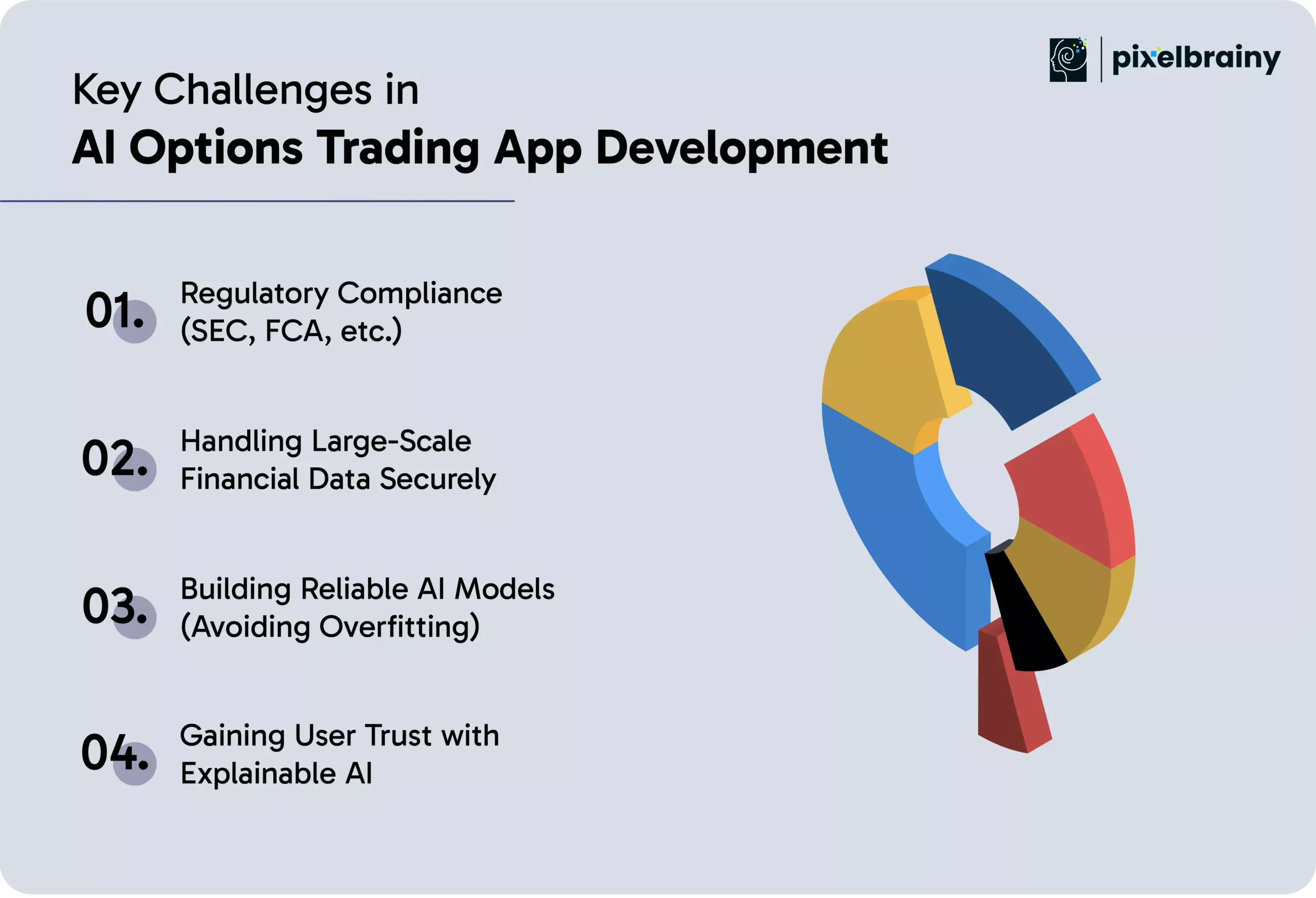
Overcoming these challenges requires a mix of technical excellence, regulatory awareness, and transparent design. Businesses that strategically address compliance, data security, model reliability, and user trust can confidently build AI Options Trading Apps that stand out in a highly competitive market.
Building an AI Options Trading App is not just about speed and intelligence; it is also about trust. Security and regulatory compliance form the backbone of such platforms, ensuring that user data, financial transactions, and trading activities remain protected and legally sound.
For businesses looking to develop AI Options Trading Apps, security and compliance are not checkboxes—they are foundational pillars. By combining encryption, regulatory adherence, and advanced fraud detection, you create a platform that not only performs at scale but also earns user trust and regulatory approval.
Also Read: How Much Does AI Trading Agent Development Cost?
The landscape of AI Options Trading App Development is entering a new era where innovation, compliance, and user expectations go hand in hand. As businesses plan to create AI-driven trading platforms, they must look beyond current capabilities and prepare for technologies and market forces that will define the next decade.
From hyper-personalized insights to blockchain-powered ecosystems, the way traders interact with AI apps is set to transform. Companies that anticipate these trends will have a decisive edge in staying competitive.
Key Future Trends:
AI will increasingly leverage behavioral analytics and predictive personalization to deliver strategies that are unique to each trader. Instead of offering one-size-fits-all insights, apps will factor in trading frequency, capital size, preferred asset classes, and emotional risk patterns. This kind of personalization will not only increase profitability but also enhance user engagement and retention for businesses building AI-powered trading apps.
Quantum computing, though still emerging, promises breakthroughs in complex financial modeling. Future AI trading apps will integrate quantum algorithms to evaluate massive option pricing models, volatility surfaces, and correlation risks in near real time. This leap in computational power will give institutional players and retail investors access to predictive accuracy that was once unimaginable.
Tomorrow’s AI options trading apps will not stop at identifying profitable trades. They will proactively recommend risk-hedging strategies, dynamically rebalancing portfolios to protect users from sudden volatility spikes. For hedge funds and asset managers, this trend means reduced exposure and improved long-term stability, making the development of AI options trading apps more essential than ever.
The fusion of AI with blockchain will shape the future of trading apps. Blockchain will ensure transparency, immutability, and faster settlements, while AI will analyze decentralized market data for optimized decisions. Together, they will open new opportunities for tokenized options, cross-border trades, and smart contract–driven automation, making AI trading apps part of a larger digital finance infrastructure.
As AI models become more complex, user trust will depend on transparency. Future trading platforms will embrace explainable AI that reveals not just what the decision is but why it was made. Ethical AI practices will be critical to reducing bias, meeting evolving global regulations, and ensuring compliance with institutions like the SEC or FCA. Businesses that partner with a custom software development company focused on ethical AI will be best positioned to win long-term trust.
In the coming years, the winners in the fintech landscape will be the businesses that don’t just develop AI options trading apps, but also innovate around personalization, compliance, and trust-building.
If you are planning to launch a next-generation AI options trading app, you need more than just a team of developers. You need a strategic technology partner who understands how artificial intelligence behaves, how traders make decisions, and how markets shift in real time.
That is exactly where PixelBrainy stands out.
As a trusted trading software development company in USA, PixelBrainy specializes in delivering intelligent, scalable, and future-ready trading solutions. Our strength lies in blending deep domain knowledge in derivatives, advanced AI expertise, and cutting-edge development practices to create apps that redefine performance in the trading world.
Recently, we built a confidential AI-powered options trading platform for a leading fintech firm in the USA. The app now processes millions of market data points every day, executes trades in milliseconds, and learns continuously through adaptive AI models. The client has already reported sharper trade execution, improved strategy efficiency, and reduced risks across operations.
Whether your vision is to launch a retail-ready AI options trading app or develop a private institutional-grade platform, PixelBrainy provides the clarity, speed, and intelligence to make it happen.
If you are serious about developing an AI options trading app that is built to outperform, PixelBrainy is the partner finance leaders trust to move from concept to execution and take trading platforms from innovative to unstoppable.
From above, it is clear that AI options trading app development is no longer a futuristic concept but a present-day necessity for trading businesses that want to stay competitive. By integrating artificial intelligence into trading platforms, companies can achieve sharper decision-making, faster execution, and personalized trading strategies that continuously improve over time. Whether you are a fintech startup, a broker, or an institutional investor, building an AI-powered options trading app can unlock opportunities that traditional systems simply cannot match.
The future belongs to trading platforms that are not only intelligent but also adaptive, scalable, and secure. With the right technology partner specializing in AI app development for options trading, your vision can transform into a market-leading product.
Ready to take the next step? Book an appointment with PixelBrainy today and start building your intelligent trading future.
No. AI options trading apps are designed to assist traders by automating repetitive tasks, analyzing vast datasets, and generating real-time insights. Human expertise is still crucial for strategy, oversight, and handling unexpected market events.
While built for fintech, AI trading frameworks can be adapted for sectors like supply chain optimization, energy trading, and even e-commerce pricing models where predictive analytics and real-time decision-making are essential.
With features like encryption, fraud detection, and compliance with regulations such as GDPR and CCPA, AI trading platforms are designed with robust security. Partnering with a reliable trading software development company in the USA ensures additional safeguards like AML and KYC integration.
Yes. Most AI trading apps can connect to broker APIs like Interactive Brokers, Alpaca, or Tradier, enabling seamless trade execution without requiring users to abandon their existing accounts.
Retail traders benefit from personalized recommendations, risk alerts, and AI-driven insights that were once limited to institutions. This democratization of advanced trading tools levels the playing field for small investors.
The development timeline can vary between 4–9 months depending on complexity, features, and whether you opt for an MVP first. Working with top AI development companies in the USA can speed up delivery while ensuring compliance and scalability.

About The Author
Sagar Bhatnagar
Sagar Sahay Bhatnagar brings over a decade of IT industry experience to his role as Marketing Head at PixelBrainy. He's known for his knack in devising creative marketing strategies that boost brand visibility and market influence. Sagar's strategic thinking, coupled with his innovative vision and focus on results, sets him apart. His track record of successful campaigns proves his ability to utilize digital platforms effectively for impactful marketing efforts. With a genuine passion for both technology and marketing, Sagar continuously pushes PixelBrainy's marketing initiatives to greater success.


Transform your ideas into reality with us.
Working with the PixelBrainy team has been a highly positive experience. They understand the design requirements and create beautiful UX elements to meet the application needs. The dev team did an excellent job bringing my vision to life. We discussed usability and flow. Sagar worked with his team to design the database and begin coding. Working with Sagar was easy. He has the knowledge to create robust apps, including multi-language support, Google and Apple ID login options, Ad-enabled integrations, Stripe payment processing, and a Web Admin site for maintaining support data. I'm extremely satisfied with the services provided, the quality of the final product, and the professionalism of the entire process. I highly recommend them for Android and iOS Mobile Application Design and Development.

Great experience working with them. Had a lot of feedback and I found that unlike most contractors they were bugging me for updates instead of the other way around. They were extremely time conscience and great at communicating! All work was done extremely high quality and if not on time, early! They were always proactive when it comes to communication and the work is great/above par always. Very flexible and a great team to work with! Goes above and beyond to present us with multiple options and always provides quality. Amazing work per usual with Chitra. If you have UI/UX or branding design needs I recommend you go to them! Will likely work with them in the future as well, definitely recommended!

PixelBrainy is a joy to work with and is a great partner when thinking through branding, logo, and website layout. I appreciate that they spend time going into the "why" behind their decisions to help inform me and others about industry best practices and their expertise.

I hired them to design our software apps. Things I really like about them are excellent communication skills, they answer all project suggestions and collaborate right away, and their input on design and colors is amazing. This project was complex and needed patience and creativity. The team is amazing to do business with. I will be using them long-term. Glad to see there are some good people out there. I was afraid to try and outsource my project to someone but I am glad I met them! I really can't say enough. They went above and beyond on this project. I am very happy with everything they have done to make my business stand out from the competition.

It was great working with PixelBrainy and the team. They were very responsive and really owned the project. We'll definitely work with them again!

I recently worked with the PixelBrainy team on a project and I was blown away by their communication skills. They were prompt, clear, and articulate in all of our interactions. They listened and provided valuable feedback and suggestions to help make the project a success. They also kept me updated throughout the entire process, which made the experience stress-free and enjoyable.

PixelBrainy is very good at what it does. The team also presents themselves very professionally and takes care of their side of things very well. I could fully trust them taking up the design work in a timely and organised manner and their attention to detail saved us lots of effort and time. This particular project was quite intense and the team showed that they function very well under pressure. Very much looking forward to working with her again!

It's always an absolute pleasure working with them. They completed all of my requests quickly and followed every note I had for them to a T, which made our process go smoothly from start to finish. Everything was completed fast and following all of the guidelines. And I would recommend their services to anyone. If you need any design work done in the future, PixelBrainy should be your first call!

They took ownership of our requirements and designed and proposed multiple beautiful variants. The team is self-motivated, requires minimum supervision, committed to see-through designs with quality and delivering them on time. We would definitely love to work with PixelBrainy again when we have any requirements.

PixelBrainy was a big help with our SaaS application. We've been hard at work with a new UI/UX and they provided a lot of help with the designs. If you're looking for assistance with your website, software, or mobile application designs, PixelBrainy and the team is a great recommendation.

PixelBrainy designers are amazing. They are responsive, talented, and always willing to help craft the design until it matches your vision. I would recommend them and plan to continue them for my future projects and more!!!

They were awesome! Did a good job fast, and good communication. Will work with them again. Thank you

Creative, detail-oriented, and talented designers who take direction well and implement changes quickly and accurately. They consistently over-delivered for us.

PixelBrainy team is very talented and creative. Great designers and a pleasure to work with. PixelBrainy is an excellent communicator and I look forward to working with them again.

PixelBrainy has a very talented design team. Their work is excellent and they are very responsive. I enjoy working with them and hope to continue on all of our future projects.


