AI Summary Powered by PixelBrainy
Can a luxury apartment building deliver consistent, white-glove concierge service around the clock without increasing its dependence on expensive 24/7 front-desk staffing?
For property operators managing premium residential towers, exceptional service means answering inquiries, coordinating deliveries, assisting visitors, managing requests, and providing support around the clock. Yet staffing multiple concierge shifts increases operating expenses, creates overnight coverage gaps, and makes consistency difficult.
An AI robot concierge for luxury apartments can automate selected front-desk activities. Combining conversational artificial intelligence, autonomous mobile robotics, voice recognition, computer vision, and property management integrations, these systems can provide interactive assistance while reserving human staff for complex situations.
Consider a 300-unit luxury tower. An AI concierge robot can answer building questions, provide directions, guide visitors through approved check-in procedures, share delivery notifications, submit maintenance requests, and coordinate amenity reservations. Security incidents, sensitive complaints, and exceptional requests should still be escalated to human employees.
The market is growing. According to the International Federation of Robotics' World Robotics 2026 report, global shipments of professional service robots increased 24% in 2025 to almost 250,000 units. This figure covers professional service robots across industries, not apartment concierge deployments specifically, but it signals wider commercial adoption of task-focused robotics.
For PropTech companies and property operators, AI robot concierge development for luxury apartments is an operational opportunity, not simply a futuristic amenity. The development of AI robot concierge for luxury apartment buildings brings together intelligent automation, robotics, and smart-building integrations. Operators must also understand how to develop an AI robot concierge for luxury apartments with access control integration, so visitor verification remains secure and authorization stays with the building's approved security system.
Developers can evaluate companies that develop AI robot concierge software for luxury apartments in USA when choosing technology partners for deployment planning.
This guide examines realistic capabilities, human staffing requirements, essential features, development costs, technology choices, integration challenges, and opportunities for scalable residential concierge solutions.

An AI robot concierge for luxury apartments is an intelligent, interactive robotic system designed to assist residents, visitors, property management teams, and building staff with everyday residential services.
Unlike a traditional stationary concierge kiosk, a robot concierge can combine a conversational interface with autonomous movement, allowing it to interact with people at different locations within a building, subject to its navigation permissions and physical capabilities.
It acts as a technology-enabled extension of the property's front desk, helping automate routine interactions while keeping human staff available for situations that require judgment, physical assistance, or personal attention.
An AI robot concierge typically combines five interconnected technology layers.
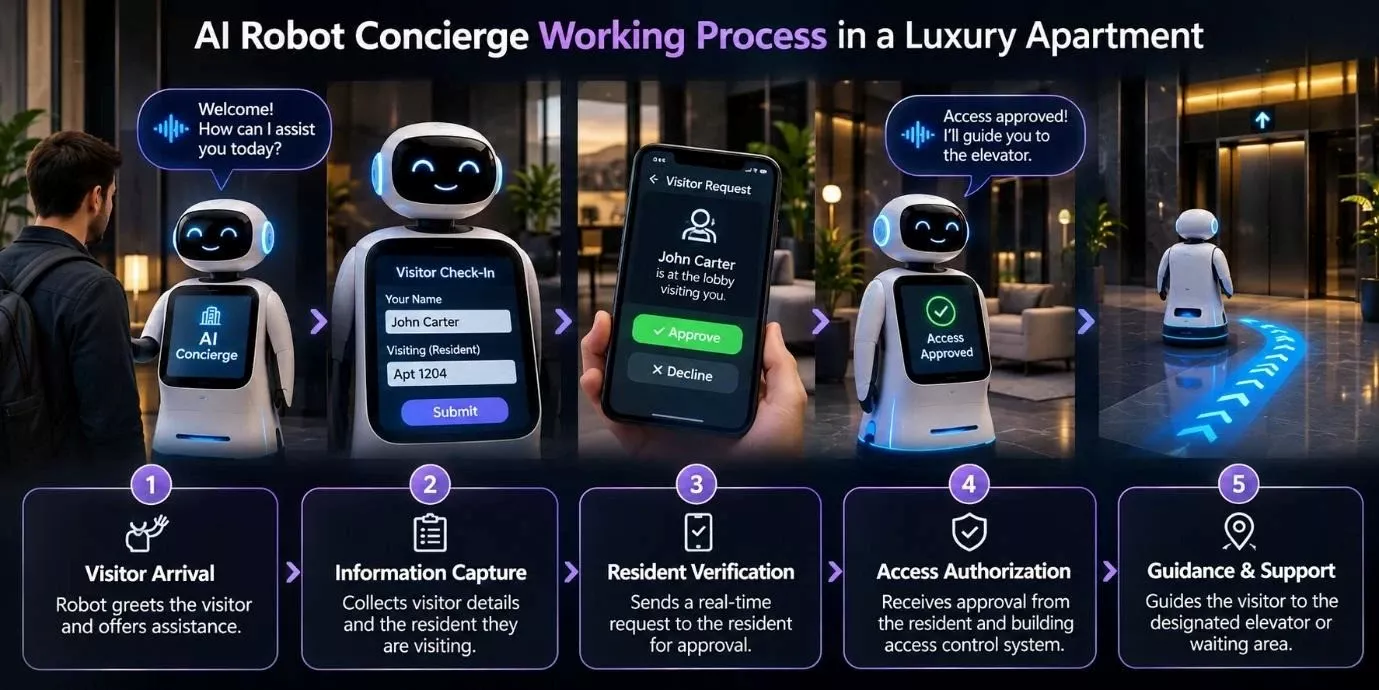
The conversational AI engine understands residents' and visitors' questions and generates relevant responses.
For example:
The system uses natural language processing, large language models, and property-specific knowledge sources to answer questions.
The robot uses sensors, cameras, mapping technologies, and navigation algorithms to move through approved indoor areas.
Depending on the hardware, it can:
Navigation must account for elevators, doorways, accessibility requirements, people, furniture, and temporary obstacles.
The robot connects with the property's digital infrastructure through APIs and authorized integrations.
These integrations can include:
This allows the robot to retrieve relevant information and initiate approved workflows instead of providing generic answers.
Access control integration allows the robot to participate in authorized visitor management workflows.
For instance, when a guest arrives, the robot can collect their name, ask whom they are visiting, initiate host verification, and communicate with the visitor management or access control platform.
Importantly, the robot should never independently grant building access based only on a conversational response. Actual authorization must come from the building's approved security system.
Property operators need a centralized dashboard to monitor robot activity, manage knowledge sources, configure services, review operational issues, and escalate requests.
Remote monitoring also helps staff intervene when the robot encounters navigation problems or unusual situations.
Imagine a visitor arriving at 11:30 PM.
The same system can answer routine questions, notify residents about deliveries, and create maintenance requests without requiring a concierge employee to handle every interaction.
The key distinction: An AI robot concierge does not need to replace the entire concierge department. Its primary purpose is to automate predictable service interactions and make human concierge teams more productive.
Luxury residential property management is entering a new phase where intelligent automation, connected building infrastructure, and AI-powered resident services are becoming important investment considerations. Property operators are under pressure to maintain premium hospitality standards while managing staffing expenses, increasing resident expectations, and integrating multiple building technologies.
This creates a strong business case for AI robot concierge development for luxury apartments. Rather than viewing robotic concierge systems as experimental amenities, PropTech companies and property operators can explore them as part of their long-term residential technology strategy.
Here are six important reasons to consider investing in this emerging space.
According to the International Federation of Robotics (IFR), global shipments of professional service robots increased by 24% in 2025, reaching almost 250,000 units. Hospitality robots also represent an established application category within professional service robotics.
This growing adoption creates an opportunity for residential property operators to evaluate specialized concierge applications rather than waiting for the technology to become mainstream.
According to Grand View Research, the global smart building market is projected to grow from $164.7 billion in 2026 to $554 billion by 2033, representing an estimated CAGR of 18.9%.
For property operators, this signals an expanding ecosystem of connected building technologies that AI concierge platforms can integrate with, including access control, visitor management, and property management systems.
The PwC and Urban Land Institute Emerging Trends in Real Estate 2026 report highlights growing AI exploration across real estate companies, particularly for administrative workflows and residential customer services.
This creates an investment opportunity for PropTech companies developing specialized AI applications for property operations.
According to Grand View Research's 2026 PropTech market report, the global PropTech market is estimated to reach $50 billion in 2026 and is projected to grow to $115 billion by 2033, at a CAGR of 12.6%.
This creates opportunities for technology founders to develop white-label AI concierge platforms, subscription-based software, and multi-property robotic management solutions.
Luxury residential towers require continuous service coverage, including overnight shifts when staffing can be difficult and expensive. Property operators can invest in AI robot concierge solutions to automate predictable interactions while retaining human employees for security, emergencies, and personalized hospitality.
For example, a 400-unit apartment building could evaluate automating routine visitor inquiries, amenity information, and maintenance request registration before considering larger-scale deployment.
Property developers and PropTech companies investing in this technology can explore a relatively specialized market before AI-powered robotic concierge services become a standard offering across premium residential developments.
For companies targeting the US market, researching companies that develop AI robot concierge software for luxury apartments in USA can also help identify potential development partnerships, integration capabilities, and opportunities to create differentiated solutions.
Ultimately, investing in AI robot concierge development is an opportunity to align luxury residential operations with the next generation of smart building and property management technologies.
Luxury apartment operators must maintain premium hospitality standards while managing increasing operational demands. Residents expect immediate assistance, personalized communication, smooth visitor management, and access to building services around the clock.
Developing an AI robot concierge for luxury apartments helps property operators automate repetitive front-desk activities, improve service coordination, and create more connected residential experiences.
But what are the actual benefits of implementing an AI-powered robot concierge in luxury residential buildings? Here are eight important advantages.
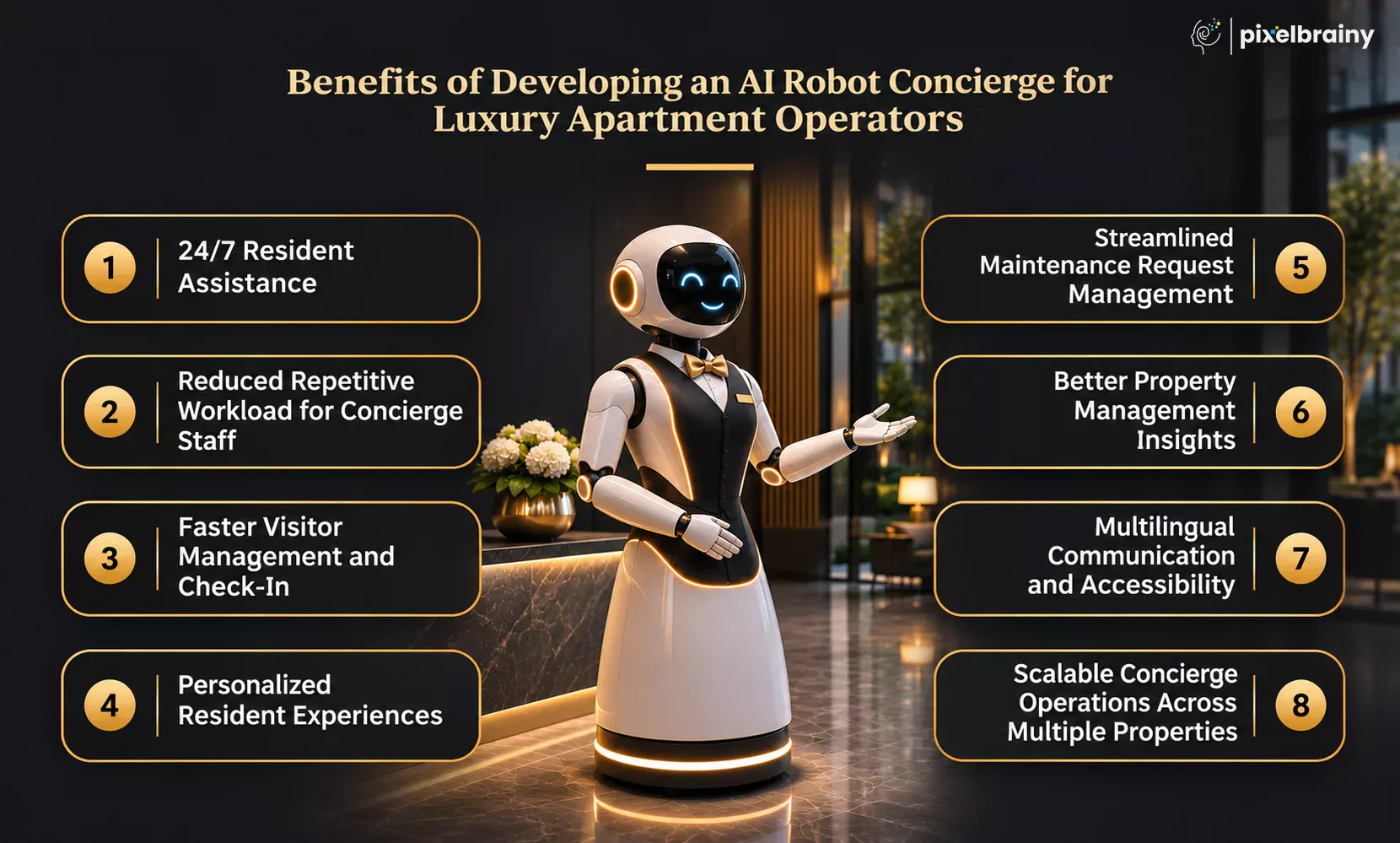
An AI robot concierge provides residents with access to routine building information and assistance throughout the day and night. Residents can ask questions about amenities, parking, deliveries, maintenance procedures, and building policies without waiting for front-desk staff.
For property operators, this means maintaining round-the-clock service availability while reducing dependence on employees for repetitive inquiries. Human concierge staff can remain focused on complex requests and personalized resident assistance.
Traditional concierge teams spend considerable time answering recurring questions, coordinating deliveries, recording complaints, and sharing building announcements. AI-powered concierge solutions can automate these activities through voice interactions and property management integrations.
This allows employees to concentrate on resident relationships, personalized hospitality, and complex service requests. How can AI robot concierge solutions reduce front-desk workload? By taking over predictable interactions that otherwise require continuous employee attention.
An AI robot concierge can streamline visitor registration by collecting guest details, notifying residents, initiating host verification, and communicating approved check-in instructions.
When connected to visitor management and access control systems, it can coordinate authorization workflows more efficiently. This improves visitor communication, reduces unnecessary reception delays, and ensures final access decisions remain with the building's authorized security infrastructure.
Luxury residents expect services that accommodate their individual preferences. AI concierge software can use authorized resident preferences and interaction history to personalize communication.
For example, it can provide multilingual assistance, share relevant amenity announcements, communicate reservation updates, and deliver package notifications. This makes AI concierge for luxury residential properties more than an automated information desk by creating a convenient and personalized service channel.
An AI robot concierge can simplify maintenance reporting by collecting resident complaints, identifying issue categories, and creating service tickets through integrated maintenance management platforms.
For example, when a resident reports an air-conditioning problem, the system can record the issue, generate a service reference number, and notify the maintenance team. Urgent requests can be escalated according to predefined building procedures.
AI-powered concierge platforms can analyze service interactions, frequently asked questions, visitor activity, and maintenance requests to identify operational patterns.
Property operators can understand peak service hours, recurring resident concerns, and common maintenance issues. These insights help management teams make informed decisions about staffing, maintenance planning, and residential service improvements.
Luxury apartment communities often accommodate residents, visitors, and guests from different linguistic backgrounds. An AI robot concierge with multilingual voice recognition and speech generation can support communication in multiple languages.
Residents can ask questions in their preferred supported language and receive relevant building information. This reduces communication barriers and makes routine property services more accessible without depending entirely on multilingual front-desk employees.
Property management companies operating multiple luxury residential towers can use centralized AI concierge platforms to manage services across different locations.
A shared platform can support property-specific knowledge bases, centralized administration, robot monitoring, and reusable integrations. This makes AI robot concierge development for luxury apartments a scalable opportunity for operators looking to introduce consistent digital concierge services across their residential portfolios.
Ultimately, AI robot concierge solutions help luxury apartment operators combine intelligent automation with human hospitality, creating more efficient property operations and consistently premium resident experiences.
Also Read: How to Develop an AI Concierge Platform for Smart Apartment Buildings
Luxury apartment residents expect more than basic front-desk assistance. They want convenient visitor check-ins, quick responses to service requests, personalized communication, and seamless access to residential amenities. For property operators, delivering these services requires an intelligent concierge solution that works reliably with existing building infrastructure.
An AI robot concierge for luxury apartments combines conversational AI, robotic mobility, resident service automation, and property management integrations to support everyday residential operations. However, its effectiveness depends on selecting the right core features rather than adding unnecessary technological complexity.
What features should property operators look for in an AI robot concierge for luxury residential buildings? Here are 15 essential features that make a robotic concierge solution practical for luxury apartment operations.
| Feature | Description |
|---|---|
| AI-Powered Voice Assistant | A voice-enabled assistant allows residents and visitors to communicate naturally with the robot. It uses speech recognition and natural language processing to understand questions, interpret requests, and provide relevant responses without requiring complicated touchscreen navigation. |
| Natural Language Understanding (NLU) | NLU helps the AI concierge understand different sentence structures, conversational expressions, and user intentions. It allows residents to ask questions naturally, recognize service requests, and receive relevant answers without relying on predefined commands or exact keywords. |
| Resident Identification and Authentication | This feature verifies resident identity before providing access to private information or account-specific services. Developers can integrate secure authentication methods such as resident application verification, one-time passwords, or approved digital credentials to protect sensitive information. |
| Visitor Registration and Management | The visitor management feature collects guest details, identifies the intended resident, and initiates visitor verification workflows. It can communicate with existing visitor management platforms to streamline check-ins while ensuring that building access remains subject to authorized approval. |
| Access Control Integration | Access control integration connects the AI robot concierge with authorized building security systems. It supports approved visitor verification workflows, temporary credential requests, and entry-status communication while keeping final access authorization within the building's designated security infrastructure. |
| Autonomous Indoor Navigation | Autonomous navigation enables the robot to move through approved building areas using sensors, mapping technologies, and navigation algorithms. It helps the robot navigate lobbies, designated corridors, and service areas while detecting obstacles and avoiding restricted zones. |
| Property Management Software Integration | Integration with property management software allows the concierge robot to retrieve approved building information and initiate operational workflows. It can connect with resident records, service requests, building announcements, and other authorized property management functions. |
| Resident Query Management | This feature enables the robot to answer common residential questions about parking, amenities, building policies, maintenance procedures, and service availability. A property-specific knowledge base helps ensure that responses reflect current building information rather than generic AI-generated answers. |
| Maintenance Request Management | Residents can report maintenance problems through voice or touchscreen interactions. The AI concierge collects relevant details, categorizes the complaint, creates a maintenance ticket through connected software, and provides a reference number for subsequent tracking. |
| Package and Delivery Notifications | Package management integration allows the robot to retrieve authorized delivery information and notify residents when their packages arrive. It can also communicate collection instructions and direct delivery personnel toward designated drop-off locations within the property. |
| Amenity Booking Management | This feature connects the concierge platform with building amenity reservation systems. Residents can ask about availability, request bookings for facilities such as gyms or rooftop lounges, and receive booking confirmations after the connected system validates their requests. |
| Multilingual Voice Interaction | Multilingual support allows residents and visitors to communicate in different supported languages. Through speech recognition and text-to-speech technologies, the AI concierge can understand requests and generate responses that make residential services more accessible to diverse communities. |
| Touchscreen User Interface | An interactive touchscreen provides an alternative communication channel for residents and visitors who prefer visual navigation over voice commands. It can display building information, visitor registration forms, service options, directions, and relevant confirmation messages. |
| Human Handoff and Escalation | Human escalation allows the AI robot to transfer unresolved or sensitive requests to authorized concierge employees or security personnel. This is essential for handling complaints, access disputes, emergencies, and situations requiring human judgment or physical assistance. |
| Centralized Admin Dashboard and Reporting | A centralized dashboard allows property operators to monitor robot status, manage property information, review service interactions, track escalations, and analyze operational performance. It provides administrative visibility across concierge activities and supports ongoing system management. |
Therefore, for luxury apartment operators, these essential features create a connected AI concierge ecosystem that streamlines daily residential services, supports property management teams, and maintains the premium hospitality experience residents
After finalizing the core features of an AI robot concierge, property operators can plan the next phase by exploring advanced capabilities that create more intelligent, personalized, and differentiated residential experiences.
While essential features handle everyday concierge activities, advanced functionalities can help luxury apartment operators introduce smarter building interactions, proactive assistance, automated coordination, and improved robot management.
For PropTech companies and residential developers, these capabilities also create opportunities to differentiate their AI robot concierge solutions for luxury apartments in an increasingly competitive smart residential market.
What advanced features can luxury apartment operators add to an AI concierge robot to create a more intelligent and premium residential experience? Here are 10 innovative features worth considering.
| Advanced Feature | Description |
|---|---|
| Context-Aware Proactive Assistance | This feature allows the robot to provide relevant assistance based on authorized building events and resident preferences. It can remind residents about upcoming reservations, scheduled maintenance, deliveries, and community announcements without requiring them to initiate every interaction. |
| AI-Powered Resident Preference Learning | The system can learn approved communication preferences, frequently requested services, and language choices to personalize future interactions. With appropriate consent and privacy controls, it can provide more relevant recommendations and reduce repetitive information requests. |
| Smart Elevator Orchestration | Integration with destination-control elevator systems allows the robot to coordinate approved elevator requests after visitor authorization. It can communicate destination information and help guide residents or verified guests toward designated floors without overriding elevator safety or access restrictions. |
| Digital Twin-Based Building Navigation | A digital twin provides a virtual representation of the apartment building that can support robot navigation and spatial awareness. It can incorporate approved building maps, designated service areas, restricted zones, and updated navigation information to improve operational coordination. |
| Intelligent Interaction Quality Detection | Advanced conversational analytics can identify repeated questions, unresolved requests, and negative language patterns during interactions. The system can use these signals to offer human assistance when a conversation becomes difficult, without making unreliable assumptions about residents' emotions. |
| Multi-Robot Fleet Coordination | For large residential communities, fleet management technology allows multiple concierge robots to operate through a centralized platform. It can coordinate task assignments, robot availability, charging schedules, maintenance status, and navigation priorities across different building areas. |
| Smart Parking Assistance | Integration with connected parking management platforms allows the robot to retrieve authorized parking information, provide directions to designated spaces, and communicate parking instructions to visitors. This creates a more convenient arrival experience for residents and guests. |
| Emergency Response Coordination | This capability allows the robot to recognize predefined emergency requests and initiate approved response workflows. It can notify designated security personnel, display relevant instructions, and communicate incident information while keeping emergency decisions and interventions with trained professionals. |
| Predictive Robot Maintenance | Predictive maintenance analyzes operational information such as battery condition, sensor performance, navigation errors, and hardware status. It can identify potential maintenance requirements and notify property operators before equipment problems cause significant service interruptions. |
| AI Concierge-as-a-Service Management | A subscription-based management architecture allows PropTech companies to offer AI concierge software to multiple residential properties. It can support property-specific configurations, centralized administration, recurring subscriptions, usage monitoring, and scalable software licensing. |
For luxury apartment operators, these advanced capabilities create opportunities to move beyond basic robotic assistance and introduce proactive, connected, and increasingly intelligent residential concierge experiences.
Creating an AI robot concierge for luxury apartments requires a structured development approach that combines artificial intelligence, robotics, conversational interfaces, property management integrations, and secure building infrastructure. The objective is not simply to deploy a talking robot but to develop a reliable residential service solution that addresses real operational challenges.
Consider a luxury apartment building where residents repeatedly ask about amenity hours, guest policies, dry cleaning, and restaurant bookings. The property operator wants a multilingual AI concierge that can answer these questions, complete amenity reservations, and transfer complicated requests to human employees.
Achieving this requires careful planning, technical architecture, and real-world testing.
The following eight steps explain the steps to develop AI robot concierge for luxury apartments from idea to launch, covering everything from initial business requirements to deployment and continuous improvement.
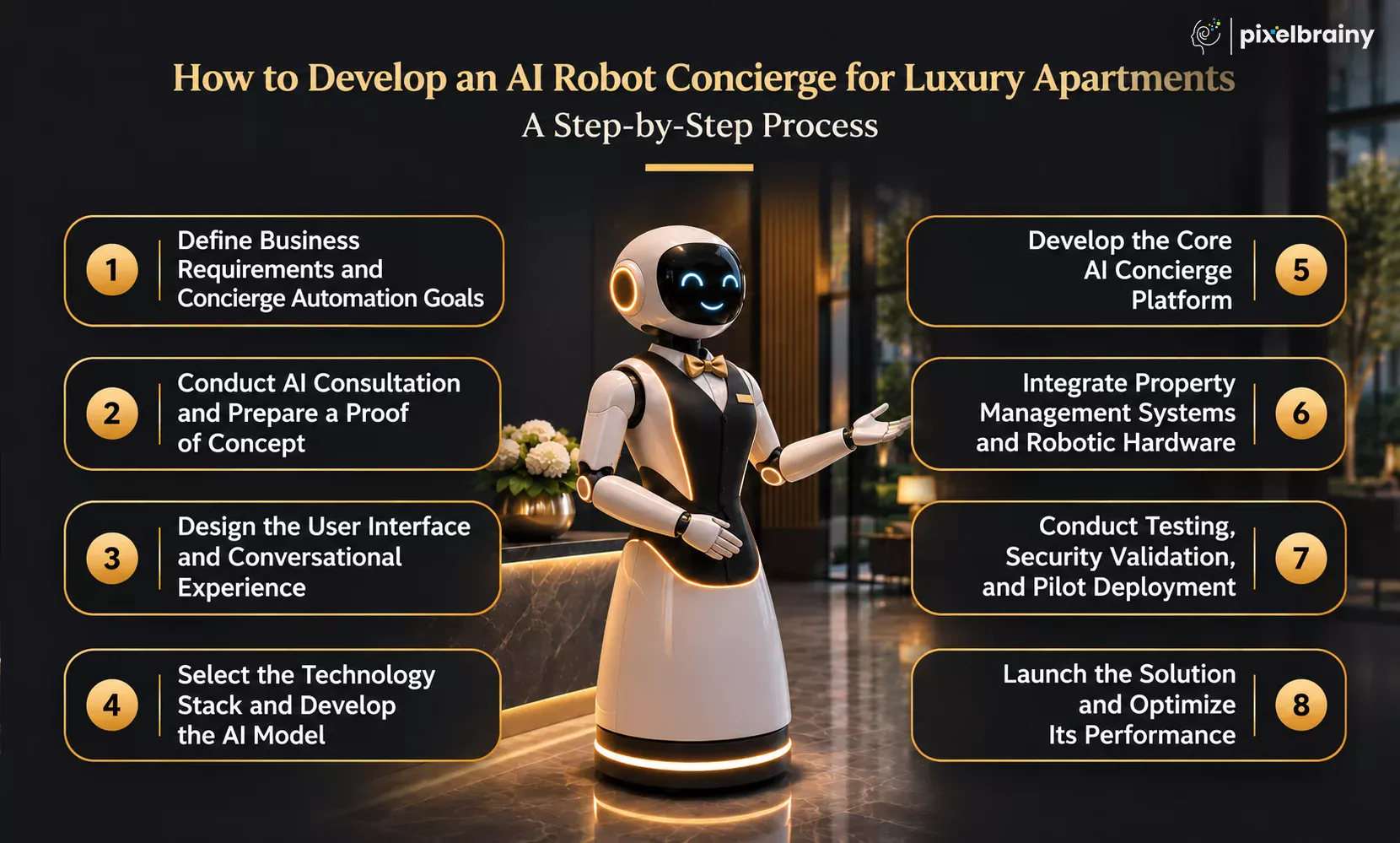
Start by identifying the operational challenges the AI concierge must address. Evaluate recurring resident questions, visitor interactions, maintenance requests, amenity reservations, and overnight service requirements. For example, if residents frequently ask about gym timings, guest policies, dry cleaning, and restaurant bookings, prioritize these workflows.
Define which activities the robot can complete independently and which require human approval. This creates a clear foundation for the development process of AI robot concierge for luxury apartments and prevents unnecessary features from increasing project complexity.
Once the requirements are finalized, conduct technical feasibility assessments to determine suitable AI models, robotics hardware, integrations, and infrastructure. Professional AI consultation helps identify the right architecture, estimate project complexity, and establish realistic automation boundaries.
Next, initiate PoC development to validate essential capabilities such as multilingual conversations, amenity information retrieval, and human escalation. A small proof of concept helps property operators evaluate technical feasibility before committing to a complete solution.
Also Read: Top 10+ AI PoC Development Companies In USA
The robot's interface should be simple enough for residents, visitors, and elderly users to operate comfortably. Focus on intuitive touchscreen navigation, clear voice interactions, multilingual support, and accessible service options.
Working with a UI/UX design company can help create a polished interface that reflects the property's premium positioning. Design conversational journeys for common requests, including amenity inquiries, visitor registration, package information, and restaurant reservations. Include clear confirmation messages and visible options for contacting human staff.
Also Read: Top 10+ UI/UX Design Companies in USA
Choose technologies that support conversational intelligence, voice processing, autonomous navigation, and secure property integrations. The technology stack may include Python, React.js, ROS 2, PostgreSQL, cloud infrastructure, and speech recognition services.
AI model development should focus on understanding resident queries, retrieving verified property information, recognizing user intent, and generating accurate multilingual responses. Select an appropriate large language model and implement retrieval-augmented generation (RAG) to connect responses with approved building information. Evaluate top development companies based on their experience with AI, robotics, API integrations, and scalable software architecture before finalizing your development partner.
The next step is to build AI robot concierge for luxury apartments from scratch by developing the core software components. Start with MVP development covering voice conversations, property FAQs, resident queries, amenity information, and human escalation.
Implement AI integration to connect the conversational engine with property-specific knowledge sources and authorized service workflows. The backend should manage authentication, resident requests, booking operations, and communication between the robot and connected platforms. Focus on a functional MVP before introducing complex automation or multi-property capabilities.
Also Read: Top 10 AI MVP Development Companies in USA
Connect the AI concierge platform with existing residential infrastructure. Important integrations include property management software, visitor management systems, access control platforms, amenity booking applications, maintenance systems, and resident communication channels.
Next, connect the software with the selected robot hardware using compatible robotics interfaces such as ROS 2 and navigation APIs. Test voice interactions, indoor movement, visitor verification, and service execution together. If your project requires additional engineering resources, you can hire AI developers with experience in conversational AI, robotics integration, backend engineering, and IoT development.
Also Read: Top 10+ IoT Software Development Companies in USA
Before launching the complete solution, test it in a controlled environment that replicates actual residential operations. Evaluate multilingual voice recognition, inaccurate AI responses, amenity booking workflows, visitor verification, navigation reliability, and human escalation.
Conduct security assessments covering resident authentication, API permissions, data encryption, and access control authorization. For property operators, a pilot deployment in the main lobby is a practical way to measure resident acceptance, task completion rates, robot uptime, and service reliability before expanding to additional areas.
After successful pilot testing, deploy the AI robot concierge across the approved building areas. Configure property-specific knowledge bases, service workflows, administrative permissions, and monitoring dashboards.
For businesses planning making an AI robot concierge for luxury apartments a commercial product, consider a multi-property architecture that supports centralized administration and reusable integrations. Review resident feedback, AI response accuracy, escalation rates, and operational costs regularly. Continuous improvements can introduce additional languages, service workflows, and robot capabilities as property requirements evolve.
When evaluating top AI real estate software development companies, prioritize teams that understand residential property workflows alongside AI and robotics engineering. This is particularly important when you want to develop AI robot concierge for luxury apartments for business and eventually commercialize the platform for multiple property operators. A well-planned approach to building an AI robot concierge for luxury apartments ensures the solution remains scalable, secure, and aligned with actual business requirements.
Ultimately, following these eight steps helps property operators and PropTech companies turn an AI concierge concept into a functional, scalable robotic solution that delivers practical value to luxury residential communities.
The cost to develop an AI robot concierge for luxury apartments typically ranges from $25,000 to $350,000+, depending on software complexity, AI capabilities, robotics integration, access control requirements, and deployment scale.
A basic AI concierge with voice interaction and property-related question answering requires a smaller investment than an enterprise-grade platform featuring autonomous navigation, multilingual conversations, visitor verification, elevator integration, and centralized robot fleet management.
For property operators and PropTech founders, understanding the development budget for AI robot concierge for luxury apartments is essential before starting the project. The final investment also depends on whether you are developing custom concierge software for existing robots or creating a complete solution involving both software and robotic hardware.
What is the development pricing of an AI robot concierge for luxury apartments, and how much should property managers budget for a customized solution? Here is an indicative cost breakdown to help estimate your investment.
| Development Category | Estimated Cost | Included Capabilities |
|---|---|---|
| Basic AI Robot Concierge for Luxury Apartments | $25,000 to $60,000 | Basic conversational AI, voice interaction, property FAQs, touchscreen interface, building information retrieval, and a basic administration dashboard. Suitable for an initial MVP or a stationary concierge solution. |
| Advanced AI Robot Concierge for Luxury Apartments | $60,000 to $150,000 | Advanced conversational AI, multilingual support, autonomous robot integration, visitor management, property management integration, amenity booking, maintenance requests, and human escalation. |
| Enterprise-Grade AI Robot Concierge for Luxury Apartments | $150,000 to $350,000+ | Multi-property management, advanced AI workflows, access control integration, elevator coordination, autonomous navigation, robot fleet management, enterprise security, analytics, and scalable cloud infrastructure. |
The overall AI robot concierge development cost breakdown for property managers depends on several technical and operational factors.
Basic question-answering functionality costs less than an advanced AI system supporting multilingual conversations, contextual understanding, RAG-based knowledge retrieval, and complex service workflows.
The selected robot's display, cameras, microphones, sensors, battery capacity, mobility, and navigation capabilities influence the overall investment. Custom hardware development can increase costs considerably.
Connecting the concierge platform with existing property management software, resident applications, maintenance systems, and amenity booking platforms requires additional API development and testing.
Integrating smart locks, visitor management platforms, identity verification, and elevator systems increases implementation complexity because these workflows require strict authentication and authorization controls.
Supporting multiple languages, different accents, background noise handling, speech recognition, and natural voice responses requires additional AI engineering and testing.
Interactive robot interfaces, resident-facing applications, and centralized management dashboards influence frontend development costs. Enterprise platforms generally require more advanced administrative and reporting capabilities.
Hosting, AI API consumption, database management, encrypted communication, monitoring, backup systems, and cybersecurity assessments contribute to infrastructure and ongoing operational expenses.
Real-world robot testing, building compatibility assessments, navigation validation, software updates, hardware maintenance, and technical support should also be included in the project budget.
Consider a PropTech startup planning to commercialize an AI robot concierge platform for luxury residential operators.
The business needs to understand the market opportunity, determine what a competitive platform should include, decide whether to develop proprietary robots or integrate with existing hardware, and estimate the cost to build the product.
There are two practical development approaches:
For most early-stage PropTech startups, starting with a software-first MVP and compatible third-party robot hardware is a practical way to validate customer demand before investing in proprietary robotics.
Ultimately, the right AI robot concierge development budget depends on your business model, automation requirements, and deployment scale. A phased investment helps property operators and PropTech founders validate the solution while controlling development and operational costs.

The technology stack plays a major role in determining how effectively an AI robot concierge for luxury apartments communicates with residents, navigates the property, manages visitor requests, and connects with existing building systems. A well-planned technology foundation helps property operators deliver reliable, secure, and personalized residential services while keeping the platform scalable for future requirements.
The development of AI robot concierge for luxury apartments typically combines artificial intelligence, natural language processing, robotics frameworks, cloud infrastructure, databases, and property management integrations. Each technology serves a specific purpose, from understanding resident requests to controlling robot movement and processing real-time building information.
Real query: “What technology stack is required to build an AI robot concierge for luxury apartments that can interact with residents, navigate buildings, manage visitors, and integrate with property management systems?”
The following table highlights recommended tools and technologies that can support different components of an AI-powered residential concierge solution.
| Technology Category | Recommended Tools and Technologies | How They Support AI Robot Concierge Development |
|---|---|---|
| Programming Languages | Python, JavaScript, TypeScript, C++ | Python supports AI model development, natural language processing, and backend automation. JavaScript and TypeScript are useful for developing web dashboards and resident interfaces, while C++ can support performance-intensive robotics functions and hardware communication. |
| AI and Machine Learning Frameworks | PyTorch, TensorFlow, Scikit-learn | These frameworks help build and deploy machine learning models for request classification, recommendation systems, predictive maintenance, and resident interaction analysis. The appropriate framework depends on model complexity, deployment requirements, and available computing resources. |
| Large Language Models (LLMs) | OpenAI API, Anthropic Claude, Google Gemini | LLMs enable conversational interactions between residents and the concierge robot. They can interpret natural language questions, generate context-aware responses, summarize requests, and guide residents through services such as amenity bookings and maintenance reporting. |
| Natural Language Processing (NLP) | spaCy, Hugging Face Transformers, Rasa | NLP technologies help the robot understand resident intent, identify important details, recognize entities, and process multilingual requests. They are useful for handling questions about building policies, deliveries, visitor access, and residential services. |
| Speech Recognition and Text-to-Speech | OpenAI speech APIs, Google Cloud Speech-to-Text, Amazon Polly | Speech recognition converts residents' spoken requests into text, while text-to-speech enables the robot to respond verbally. These technologies support hands-free interaction and make concierge services more accessible to residents and visitors. |
| Robotics Middleware | ROS 2 (Robot Operating System 2) | ROS 2 provides communication infrastructure between robot sensors, navigation systems, motors, and software modules. It helps coordinate robot operations, manage device communication, and connect AI capabilities with the physical robot. |
| Autonomous Navigation | Nav2, SLAM Toolbox, OpenCV | These tools support indoor navigation, mapping, localization, and obstacle detection. They help concierge robots move through apartment lobbies, corridors, and common areas while adapting to changing indoor environments. |
| Cloud Infrastructure | AWS, Microsoft Azure, Google Cloud Platform | Cloud platforms provide computing resources for AI processing, application hosting, data storage, monitoring, and remote robot management. They also support centralized administration when property operators deploy concierge robots across multiple residential buildings. |
| Backend Development | FastAPI, Django, Node.js, Express.js | Backend technologies manage application logic, resident requests, authentication, notifications, and communication between the robot and property management systems. They also provide APIs for connecting different software components. |
| Database Management | PostgreSQL, MongoDB, Redis | PostgreSQL can store structured information such as resident profiles, bookings, and service requests. MongoDB supports flexible document-based data, while Redis can manage caching, temporary sessions, and real-time application data. |
| Property Management Integration | REST APIs, GraphQL, Webhooks | These integration technologies connect the concierge platform with property management software, CRM systems, maintenance platforms, and amenity booking applications. They help synchronize resident information and service requests across connected systems. |
| Access Control and Visitor Management | HID, Kisi, Brivo, API-based access control systems | Access control integrations allow the concierge platform to coordinate visitor verification, resident approvals, and authorized entry workflows. Integration capabilities depend on the building's existing access control provider and available APIs. |
| Frontend and User Interface Development | React.js, Next.js, Flutter | React.js and Next.js can power property management dashboards and web-based resident portals. Flutter can support cross-platform mobile applications for residents and property staff to access concierge services. |
| Real-Time Communication | WebSockets, MQTT, Firebase Cloud Messaging | These technologies support live communication between robots, backend services, and management dashboards. They can deliver visitor approval requests, delivery alerts, robot status updates, and maintenance notifications with minimal delay. |
| DevOps and Deployment | Docker, Kubernetes, GitHub Actions | Docker simplifies application packaging, while Kubernetes can manage deployments across larger environments. GitHub Actions supports automated testing and deployment workflows, helping teams maintain and update the concierge platform efficiently. |
| Security and Authentication | OAuth 2.0, OpenID Connect, TLS, Role-Based Access Control (RBAC) | These technologies help protect resident accounts, administrative dashboards, API communication, and sensitive property information. Authentication and access permissions should be designed around the different responsibilities of residents, visitors, property staff, and administrators. |
| Monitoring and Analytics | Grafana, Prometheus, OpenTelemetry | Monitoring tools help property operators track robot availability, application performance, system errors, and service response times. Analytics can also reveal frequently requested services and operational issues that require attention. |
A scalable technology stack combines conversational AI, robotics, cloud infrastructure, and property management integrations to deliver reliable AI concierge services across luxury residential properties.
The growing demand for connected residential experiences is creating new opportunities for AI-powered concierge solutions in real estate. Luxury apartment operators, property developers, build-to-rent (BTR) companies, and PropTech founders can use this technology to improve resident services, automate routine tasks, and create more personalized residential experiences.
The AI robot concierge opportunities for real estate operators go beyond front-desk automation. These solutions can support visitor management, amenity bookings, resident engagement, and multi-property operations. They also create opportunities for PropTech businesses to introduce new software products, subscription services, and robotics partnerships.
Here are six major opportunities worth exploring.
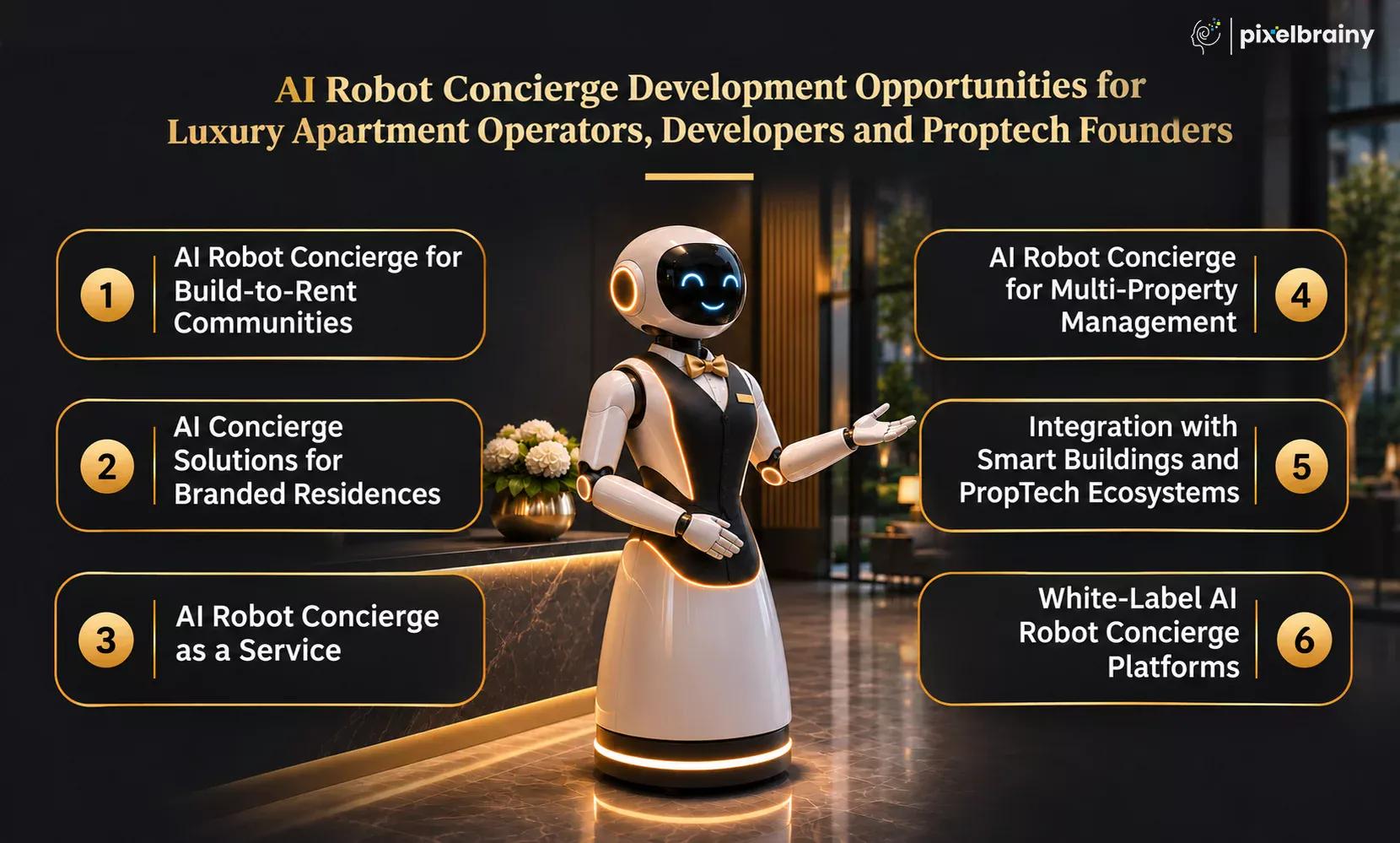
Build-to-rent communities manage large residential populations, shared amenities, visitor services, and maintenance requests. An AI robot concierge can answer resident questions, coordinate visitor check-ins, share property information, and assist with amenity bookings.
Business opportunity: Operators can standardize resident services across multiple rental communities, while PropTech companies can develop scalable concierge platforms specifically for BTR portfolios.
Branded residences focus on premium hospitality, personalized services, and exclusive resident experiences. AI concierge robots can complement these offerings through multilingual assistance, restaurant recommendations, visitor coordination, and amenity information.
Business opportunity: Developers and hospitality brands can introduce branded AI concierge experiences that complement their existing service standards while allowing human teams to focus on more complex resident requests.
Many property operators prefer not to manage robot hardware, AI infrastructure, and software maintenance independently. This creates an opportunity for providers to offer AI robot concierge as a service through monthly or annual subscriptions.
Services can include robot leasing, AI software, cloud hosting, remote monitoring, updates, and maintenance coordination.
Business opportunity: PropTech startups can explore Robotics-as-a-Service (RaaS) and Concierge-as-a-Service models to generate recurring revenue.
Real estate companies managing multiple luxury buildings need consistent service standards across locations. A centralized AI concierge platform can help them monitor robot performance, resident requests, and visitor workflows from one dashboard.
Building-specific information, languages, and service permissions can be configured separately.
Business opportunity: Technology providers can develop enterprise concierge platforms for property management companies, residential developers, and real estate investment groups.
AI concierge robots can connect with access control, elevator systems, visitor management software, parking platforms, and property management applications. These integrations help create connected residential services.
For example, a robot can collect visitor details, request resident approval, and guide an authorized guest toward the correct elevator.
Business opportunity: PropTech founders can build integration-focused platforms and partner with smart building technology providers to expand their solutions.
Existing PropTech companies may want to offer AI concierge services without developing robotics software and AI capabilities from scratch. White-label platforms allow them to introduce these services under their own brand.
The technology provider supplies the AI software, robot integrations, APIs, and management dashboard, while the partner handles branding and customer relationships.
Business opportunity: AI development companies can create white-label solutions for property management software providers, real estate technology firms, and residential service platforms.
Before investing in AI robot concierge development, businesses should assess a few important factors:
AI robot concierge development creates opportunities for property operators to improve resident experiences and for PropTech founders to enter emerging markets across residential automation, robotics-as-a-service, and smart building technology.
What are the biggest challenges in implementing an AI robot concierge in luxury apartments, and how can property operators overcome them? Common concerns include integrating existing property management systems, ensuring secure resident interactions, improving indoor navigation, maintaining AI response accuracy, and minimizing robot downtime.
Addressing these issues is essential for successful AI robot concierge development for luxury apartments. Property operators, developers, and PropTech companies must consider both technical requirements and resident expectations to deliver reliable concierge services. Here are six major challenges and practical ways to solve them.
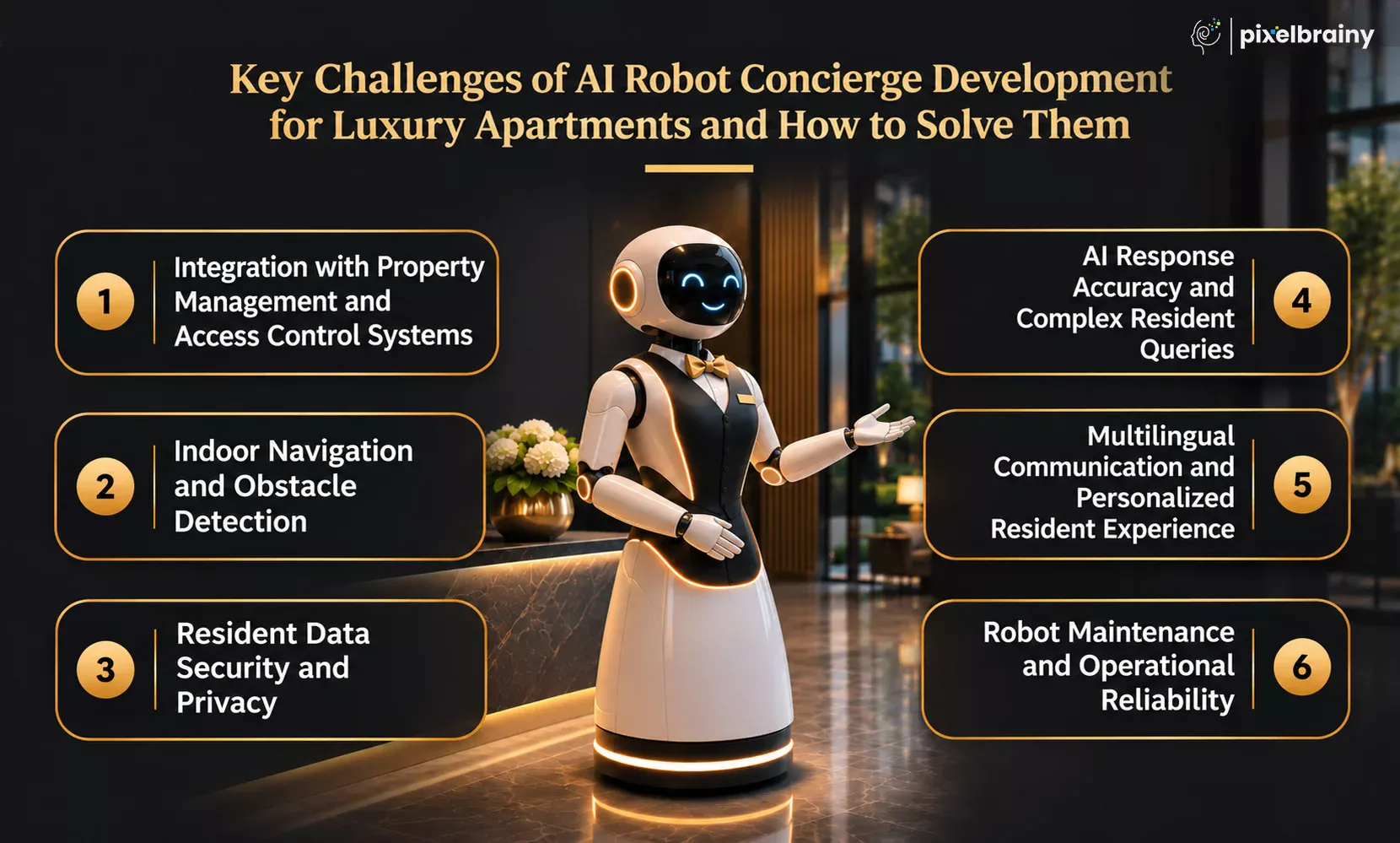
One of the major AI robot concierge implementation challenges is connecting the robot with existing property management software, visitor management platforms, and access control systems. Different buildings may use different technologies, making seamless communication difficult.
How to solve it:
AI robot navigation in residential buildings can be challenging because lobbies, corridors, and common areas frequently change. Residents, visitors, furniture, and temporary obstacles can interrupt robot movement.
How to solve it:
An AI concierge robot may process resident profiles, visitor details, access permissions, and service requests. Without proper safeguards, these systems can create data privacy and building security risks.
How to solve it:
AI concierge robots must understand questions about building policies, deliveries, maintenance, and amenities. Incorrect or outdated information can reduce resident trust and create additional work for property staff.
How to solve it:
Luxury residents expect natural, responsive, and personalized assistance. However, speech recognition errors, language limitations, background noise, and different accents can affect AI concierge communication.
How to solve it:
Hardware issues, battery failures, network interruptions, and software errors can affect AI robot concierge performance. Frequent downtime may interrupt resident services and reduce confidence in the technology.
How to solve it:
Overcoming these AI robot concierge development challenges helps property operators introduce secure, reliable, and scalable concierge solutions while maintaining the premium service standards expected in luxury residential communities.

Businesses entering the AI-powered residential technology market need a development partner that understands both artificial intelligence and real estate operations. But what should PropTech companies and luxury property operators look for in an AI concierge development partner? The answer goes beyond technical expertise. It requires industry understanding, integration capabilities, scalable architecture, and a clear focus on business outcomes.
At PixelBrainy, we help businesses turn their AI product ideas into practical software solutions. Our approach to AI concierge development services for luxury apartment projects focuses on connecting intelligent automation with real property workflows, resident expectations, and operational requirements.
For a confidential residential technology initiative, the project scope involved planning an intelligent digital solution to simplify resident interactions and coordinate property services. Key considerations included automated query handling, service request workflows, property information management, and integration requirements.
The project highlights an important principle: successful residential AI solutions must connect intelligent interactions with practical property operations.
Whether your goal is to create AI concierge for luxury apartments or explore AI concierge development for luxury apartments integrating AI with connected building systems, PixelBrainy can help shape the right solution.
Explore PixelBrainy as a best real estate AI software development company in USA and take your residential technology initiative forward.
Have an AI concierge idea? Connect with PixelBrainy to discuss your project and development roadmap.
AI robot concierge development for luxury apartments is opening new opportunities to modernize residential services, improve operational efficiency, and deliver personalized resident experiences. From 24/7 assistance and visitor management to amenity bookings, maintenance coordination, and smart building integrations, an AI robot concierge for luxury apartments can become an important part of connected residential living.
As explored in this guide, successful implementation requires the right combination of essential features, advanced AI capabilities, robotics technology, and property management integrations. Understanding the AI robot concierge development cost for luxury apartments, evaluating technical challenges, and following a structured development process can help businesses make informed investment decisions.
For luxury property operators, developers, and PropTech founders, the opportunity goes beyond automation. It is about creating scalable concierge solutions that complement human teams and enhance the resident experience.
Ready to turn your idea into reality? Schedule a call with PixelBrainy to discuss your AI robot concierge development project.
An AI robot concierge for luxury apartments provides residents with instant assistance for everyday needs, including visitor notifications, amenity reservations, delivery updates, maintenance requests, and property information. It supports 24/7 interactions and multilingual communication, helping property operators deliver convenient and personalized residential services. PixelBrainy can help businesses develop AI-powered concierge solutions tailored to these residential requirements.
Yes, AI robot concierge solutions can integrate with compatible access control systems, visitor management platforms, resident authentication software, and property management applications through APIs and middleware. These integrations support visitor registration, resident approval, and authorized entry workflows. PixelBrainy can incorporate these integration requirements into the AI concierge development architecture.
The timeline for AI robot concierge development for luxury apartments depends on software complexity, AI capabilities, robot hardware, and third-party integrations. A basic MVP may take a few months, whereas an enterprise solution with autonomous navigation, access control, and multi-property management requires additional development and testing. PixelBrainy can help define a realistic development roadmap based on project scope.
PropTech startups planning to build AI concierge solutions for luxury apartments can begin by integrating commercially available service robots. This approach reduces custom hardware engineering requirements and allows businesses to focus on conversational AI, property management integrations, and resident-facing features. Custom robot development may be considered when specific hardware capabilities or design requirements cannot be met by existing products.
AI-powered robot concierge development typically involves large language models, natural language processing, speech recognition, text-to-speech, computer vision, cloud infrastructure, and robotics frameworks such as ROS 2. The technology stack also depends on navigation requirements, hardware compatibility, and property management integrations. PixelBrainy can help businesses identify suitable technologies based on their product objectives and operational requirements.
Property operators can measure the ROI of AI robot concierge implementation by evaluating reductions in repetitive front-desk inquiries, visitor check-in time, resident request response time, and manual workload. Robot utilization, service availability, and resident satisfaction can also help assess performance. These indicators provide a practical way to understand the operational value of AI concierge solutions for luxury residential properties.
Yes, an enterprise AI robot concierge platform can support multiple residential properties through centralized administration, remote robot monitoring, and property-specific configurations. Operators can manage resident requests, service workflows, and robot performance across different locations. PixelBrainy can help develop scalable AI concierge software that supports multi-property operations and future business expansion.
Businesses looking for an AI robot concierge development company in the USA should evaluate expertise in AI engineering, robotics integration, conversational interfaces, property management software, and secure application development. Experience with scalable architecture, third-party integrations, and ongoing technical support is equally important. PixelBrainy helps businesses explore customized AI software solutions and plan technology development around their residential property requirements.

About The Author
Sagar Bhatnagar
Sagar Sahay Bhatnagar brings over a decade of IT industry experience to his role as Marketing Head at PixelBrainy. He's known for his knack in devising creative marketing strategies that boost brand visibility and market influence. Sagar's strategic thinking, coupled with his innovative vision and focus on results, sets him apart. His track record of successful campaigns proves his ability to utilize digital platforms effectively for impactful marketing efforts. With a genuine passion for both technology and marketing, Sagar continuously pushes PixelBrainy's marketing initiatives to greater success.

Working with PixelBrainy has been a great experience. They took our vision for an AI-powered platform and turned it into a fully functional product. What impressed me most was their strong understanding of both design and development, and their ability to handle complex requirements with ease. The team was responsive, cooperative, and always open to feedback. They kept things organized, communicated clearly, and delivered quality work on time. I highly recommend PixelBrainy to anyone looking for a skilled and reliable development partner.

Working with the PixelBrainy team has been a highly positive experience. They understand the design requirements and create beautiful UX elements to meet the application needs. The dev team did an excellent job bringing my vision to life. We discussed usability and flow. Sagar worked with his team to design the database and begin coding. Working with Sagar was easy. He has the knowledge to create robust apps, including multi-language support, Google and Apple ID login options, Ad-enabled integrations, Stripe payment processing, and a Web Admin site for maintaining support data. I'm extremely satisfied with the services provided, the quality of the final product, and the professionalism of the entire process. I highly recommend them for Android and iOS Mobile Application Design and Development.

Great experience working with them. Had a lot of feedback and I found that unlike most contractors they were bugging me for updates instead of the other way around. They were extremely time conscience and great at communicating! All work was done extremely high quality and if not on time, early! They were always proactive when it comes to communication and the work is great/above par always. Very flexible and a great team to work with! Goes above and beyond to present us with multiple options and always provides quality. Amazing work per usual with Chitra. If you have UI/UX or branding design needs I recommend you go to them! Will likely work with them in the future as well, definitely recommended!

PixelBrainy is a joy to work with and is a great partner when thinking through branding, logo, and website layout. I appreciate that they spend time going into the "why" behind their decisions to help inform me and others about industry best practices and their expertise.

I hired them to design our software apps. Things I really like about them are excellent communication skills, they answer all project suggestions and collaborate right away, and their input on design and colors is amazing. This project was complex and needed patience and creativity. The team is amazing to do business with. I will be using them long-term. Glad to see there are some good people out there. I was afraid to try and outsource my project to someone but I am glad I met them! I really can't say enough. They went above and beyond on this project. I am very happy with everything they have done to make my business stand out from the competition.

It was great working with PixelBrainy and the team. They were very responsive and really owned the project. We'll definitely work with them again!

I recently worked with the PixelBrainy team on a project and I was blown away by their communication skills. They were prompt, clear, and articulate in all of our interactions. They listened and provided valuable feedback and suggestions to help make the project a success. They also kept me updated throughout the entire process, which made the experience stress-free and enjoyable.

PixelBrainy is very good at what it does. The team also presents themselves very professionally and takes care of their side of things very well. I could fully trust them taking up the design work in a timely and organised manner and their attention to detail saved us lots of effort and time. This particular project was quite intense and the team showed that they function very well under pressure. Very much looking forward to working with her again!

It's always an absolute pleasure working with them. They completed all of my requests quickly and followed every note I had for them to a T, which made our process go smoothly from start to finish. Everything was completed fast and following all of the guidelines. And I would recommend their services to anyone. If you need any design work done in the future, PixelBrainy should be your first call!

They took ownership of our requirements and designed and proposed multiple beautiful variants. The team is self-motivated, requires minimum supervision, committed to see-through designs with quality and delivering them on time. We would definitely love to work with PixelBrainy again when we have any requirements.

PixelBrainy was a big help with our SaaS application. We've been hard at work with a new UI/UX and they provided a lot of help with the designs. If you're looking for assistance with your website, software, or mobile application designs, PixelBrainy and the team is a great recommendation.

PixelBrainy designers are amazing. They are responsive, talented, and always willing to help craft the design until it matches your vision. I would recommend them and plan to continue them for my future projects and more!!!

They were awesome! Did a good job fast, and good communication. Will work with them again. Thank you

Creative, detail-oriented, and talented designers who take direction well and implement changes quickly and accurately. They consistently over-delivered for us.

PixelBrainy team is very talented and creative. Great designers and a pleasure to work with. PixelBrainy is an excellent communicator and I look forward to working with them again.

PixelBrainy has a very talented design team. Their work is excellent and they are very responsive. I enjoy working with them and hope to continue on all of our future projects.


Transform your ideas into reality with us.
Across these industries, each engagement brings unique challenges, from early-stage product development to scaling complex systems, helping us build a practical understanding of real-world product environments.