AI Summary Powered by PixelBrainy
What if homebuyers could find their ideal property simply by describing their dream home in a conversation, instead of navigating dozens of filters, dropdowns, and property listings?
For proptech startups, brokerages, and real estate businesses, conversational AI real estate platforms are emerging as a practical way to make property discovery more intuitive, personalized, and efficient. These platforms use artificial intelligence, natural language processing (NLP), large language models (LLMs), and property data integrations to understand what buyers want, ask relevant follow-up questions, and recommend suitable properties from an MLS-integrated database.
The market opportunity is becoming increasingly tangible. According to Zillow's 2026 Consumer Housing Trends Report, 82% of surveyed homebuyers use AI in general, and 61% of those AI users have used it during their homebuying journey. Among buyers who used AI for homebuying, 70% used it to find home recommendations. These findings highlight why conversational property search deserves serious consideration in real estate technology roadmaps.
Imagine a buyer typing, "I need a three-bedroom home near my office, with a garden, good public transport, and a monthly mortgage payment I can comfortably afford." Instead of forcing the buyer to translate these preferences into rigid search parameters, an AI-powered platform can identify explicit requirements, clarify the location or budget, interpret lifestyle priorities, and return matching properties with explanations grounded in current listing data.
For a proptech startup, the goal is not simply to add a chatbot to an existing property portal. It is to build a conversational AI real estate platform that connects natural language understanding with accurate property search, personalized recommendations, and qualified lead generation. The experience should work for buyers while helping agents respond faster, understand customer intent, and prioritize promising opportunities.
Understanding how to create a conversational AI real estate platform involves several decisions, from MLS integration and AI model selection to conversational design, security, and deployment costs. Developing a conversational AI real estate platform also requires reliable property data and safeguards against inaccurate recommendations.
This guide explores conversational real estate platform development with AI, including its essential features, development process, technology stack, estimated costs, business benefits, and implementation challenges. It also explains how custom conversational AI real estate platforms for real estate businesses can create a more accessible property discovery experience and a scalable competitive advantage.

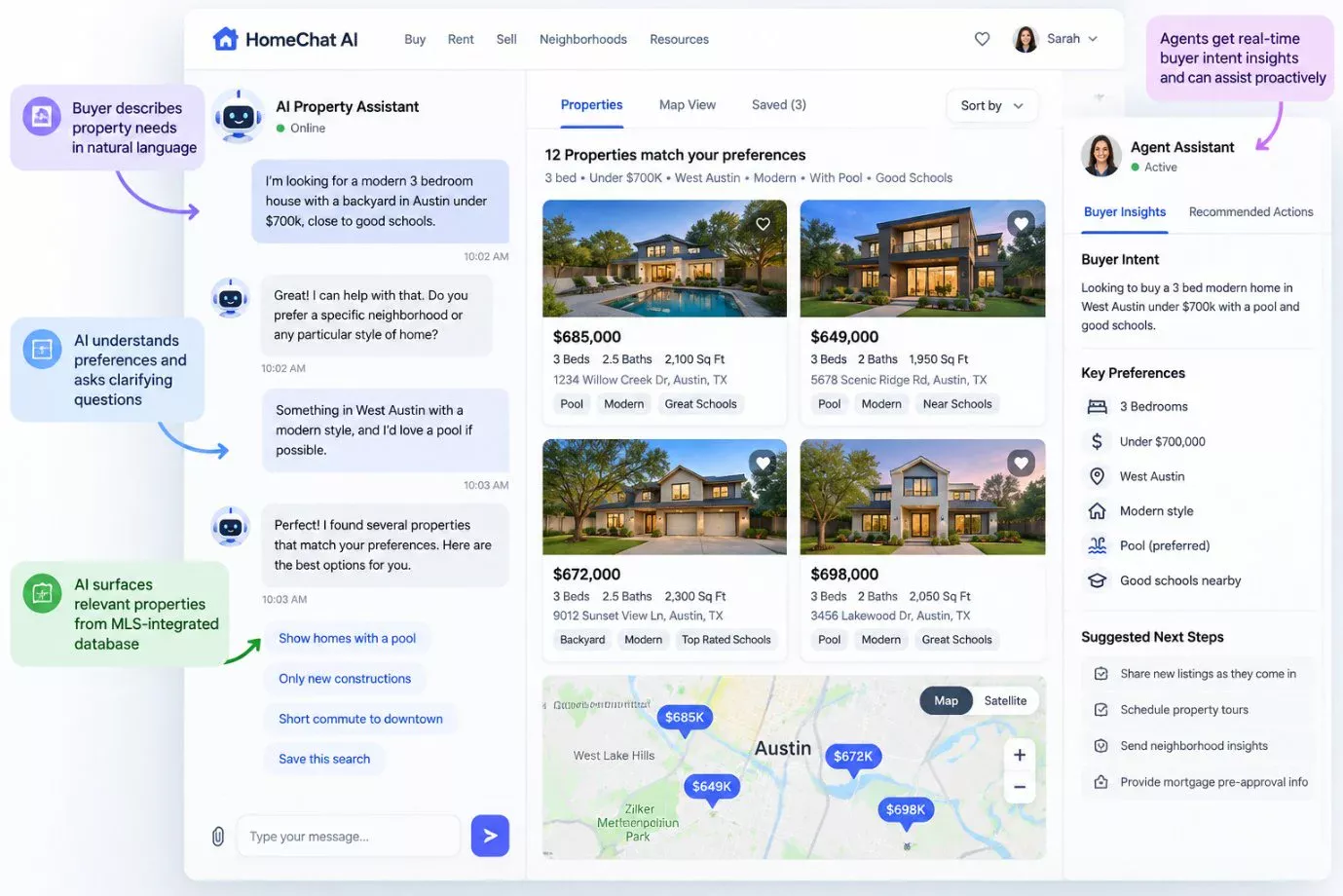
A conversational AI real estate platform is a property search and customer engagement system that allows users to discover homes, explore real estate opportunities, and communicate with agents through natural language. Instead of relying exclusively on predefined search filters, the platform interprets everyday language, understands buyer preferences, and retrieves relevant properties from connected real estate databases.
Unlike a basic chatbot that answers frequently asked questions, a conversational AI platform can combine language understanding, structured property search, recommendation algorithms, and real-time data retrieval to support a more complete property discovery journey.
A conversational AI real estate platform typically follows six steps to translate a buyer's request into useful property recommendations.
The buyer describes their requirements in a conversational interface.
For example:
"I am looking for a two-bedroom apartment in Pune near Hinjewadi IT Park, with parking, a balcony, and a budget of ₹90 lakh."
The platform accepts the request through a website chat widget, mobile application, or voice-enabled interface.
The AI interprets the message and extracts important property attributes, such as:
It also distinguishes between explicit requirements and less rigid preferences.
If the buyer's request lacks important information, the platform asks relevant follow-up questions.
For example, it might ask whether the buyer prefers a ready-to-move apartment or an under-construction property, or whether the stated budget includes registration charges.
The objective is to collect enough information to improve search relevance without overwhelming the buyer.
The platform translates the extracted preferences into structured search criteria and queries its connected property database. Depending on the market, this might involve an MLS, an IDX feed, a brokerage inventory system, or a real estate aggregator's API.
The search engine retrieves eligible properties using current listing attributes and availability information.
The recommendation engine ranks the retrieved listings according to factors such as budget, location, property features, commute preferences, and stated priorities.
The AI can explain why a property matches the buyer's request and identify trade-offs, such as a slightly longer commute in exchange for a larger living area.
Once buyers identify suitable properties, they can request a viewing, save listings, ask additional questions, or connect with an agent. The platform can record consented preferences in the CRM and provide agents with a conversation summary.
| Capability | For buyers | For agents |
|---|---|---|
| Conversational search | Describe needs naturally | Understand buyer intent |
| Recommendations | Discover relevant homes | Present better-matched listings |
| Follow-up questions | Refine requirements | Identify missing qualification details |
| Property information | Review verified listing facts | Access listing context quickly |
| Scheduling | Request property viewings | Manage appointments and availability |
| Lead management | Continue the conversation | Prioritize and follow up with prospects |
The key distinction is that conversational AI supports the discovery process rather than independently making every real estate decision. Buyers still need transparent property information, and agents remain essential for local expertise, negotiations, due diligence, and transaction guidance.
The way buyers search for properties is evolving, and real estate businesses need to rethink how their digital platforms understand and respond to buyer intent. Traditional property portals depend heavily on predefined filters, while conversational AI enables buyers to describe their requirements in natural language and receive relevant property recommendations. For brokerages and proptech startups, investing in conversational AI real estate platform development is an opportunity to align property search technology with emerging customer behavior, changing market expectations, and the growing adoption of artificial intelligence across the real estate industry.
According to the 2026 Bank of America Homebuyer Insights Report, 20% of prospective buyers and current homeowners used AI tools or chatbots for homebuying research in the past year, increasing to 32% among Gen Z respondents. This signals a growing role for AI in property research and gives real estate businesses a timely reason to explore conversational property search.
Buyers increasingly expect digital experiences that understand their specific requirements, from preferred neighborhoods and property budgets to lifestyle preferences. Conversational AI allows businesses to explore natural language search instead of relying exclusively on conventional filters.
The National Association of REALTORS® 2026 Technology Report reports that 23% of surveyed REALTORS® use AI daily, while another 25% use it weekly. This adoption makes AI-enabled property discovery a relevant investment area for brokerages and proptech companies.
Buyers often describe homes through combinations of budget, commute, amenities, and lifestyle requirements. Businesses can use conversational AI to interpret these preferences and translate them into structured queries against an MLS-integrated or proprietary property database.
An EY-Parthenon and CREDAI report on generative AI in Indian real estate published in June 2026 suggests that generative AI could deliver 30% to 50% higher sales velocity for Indian real estate developers. This is a projected sector-level opportunity, not a guaranteed outcome for every AI platform.
Property discovery frequently involves separate listing databases, CRM systems, maps, and scheduling tools. Conversational AI development provides an opportunity to connect these systems through a unified search and communication experience.
Voice-based discovery, multilingual conversations, and context-aware recommendations are emerging directions for AI-powered property platforms. A focused MVP gives proptech startups a practical way to test these capabilities before investing in a broader solution.
For real estate businesses, the decision to invest in conversational AI should begin with a clear understanding of buyer needs, available property data, and long-term product goals. A well-planned platform can establish a strong foundation for the next generation of digital property search.
For U.S. real estate brokerages, agents, property developers, and proptech companies, a conversational AI real estate platform can make property discovery more interactive while creating a structured path from a buyer's first question to a property showing. Instead of relying entirely on traditional search filters and contact forms, buyers can describe their requirements in everyday language, explore matching homes, and request assistance through a single interface.
The opportunity is already taking shape in the U.S. market. According to Zillow's 2026 Consumer Housing Trends Report, 61% of buyers who use AI have used it during their homebuying journey, and 70% of those AI users have used it to get home recommendations. These findings highlight the growing relevance of AI-powered property discovery for businesses serving American homebuyers.
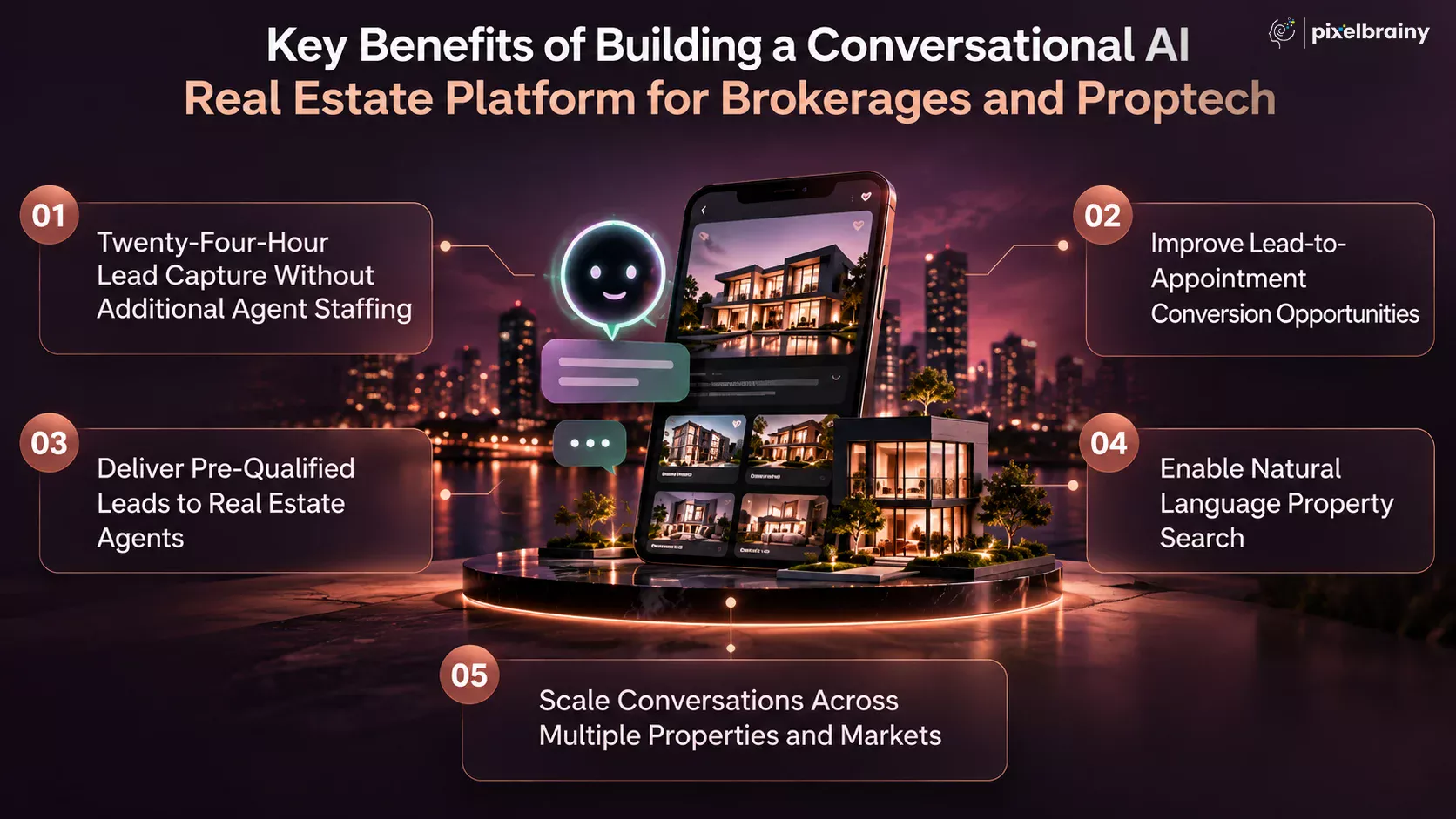
Homebuyers may search for properties after work, late at night, or during weekends when agents are unavailable. A conversational AI real estate platform can respond to initial inquiries at any hour, answer supported questions about listings, collect buyer preferences, and capture requests for property showings.
For example, someone searching for a three-bedroom home in Austin, Texas, under $500,000 can receive relevant listing suggestions and submit a showing request without waiting for an agent to return a call.
This helps brokerages capture inquiries outside standard office hours without assigning an agent to every initial conversation. AI infrastructure and usage still incur costs, but routine lead capture can be handled without a proportional increase in agent staffing.
A prospective buyer who finds a suitable property on a brokerage website may want to confirm its availability, compare similar homes, or schedule a tour immediately. A conversational interface can guide that buyer from an initial question to a showing request without requiring multiple forms or separate interactions.
For instance, a buyer exploring homes in Denver, Colorado, could ask about parking, square footage, or nearby amenities before requesting a tour.
By reducing friction between property discovery and appointment scheduling, businesses can work toward improving lead-to-showing conversion. The actual impact should be measured using confirmed appointments, qualified leads, and conversion rates rather than assumed.
Agents often receive inquiries from buyers with different budgets, locations, property requirements, and purchase timelines. Conversational AI can collect these details before transferring the conversation to a human agent.
For example, a buyer looking for a condominium in Miami, Florida, might specify a budget, preferred neighborhood, parking requirements, and desired move-in date. The platform can summarize these preferences in the brokerage's CRM so the agent has useful context before following up.
This allows agents to prioritize inquiries using relevant business criteria and spend less time repeatedly collecting basic information. Qualification should remain flexible enough to accommodate buyers who are still exploring the market.
Traditional property websites often require users to select filters for price, bedrooms, bathrooms, and location. A conversational AI real estate platform allows buyers to describe their preferences naturally and refine them through follow-up questions.
For example, a buyer might ask:
"Find me a two-bedroom condo in Seattle, Washington, near public transit, with secure parking and a budget under $650,000."
The AI can extract these requirements, query an authorized MLS or IDX-integrated database, and return relevant listings. If the buyer later adds a preference for a balcony or a home office, the platform can update the search without requiring the buyer to start again.
This approach creates an opportunity to improve search engagement and help buyers discover properties that align more closely with their stated priorities.
A conversational AI platform can support multiple buyer conversations simultaneously across different property listings and markets, subject to infrastructure capacity and usage limits.
A U.S. brokerage operating across Dallas, Phoenix, and Atlanta, for example, could use a common conversational interface connected to the appropriate regional listing inventories. A property developer could also use the platform to answer routine questions about multiple residential communities.
The system can maintain consistent workflows for property discovery, inquiry capture, and showing requests without requiring agent staffing to increase at the same rate as every additional conversation. Data access, regional listing rules, infrastructure, and human support still need to be managed carefully.
| Stakeholder | Primary benefit | Measurable outcome |
|---|---|---|
| Brokerage owner | More showing opportunities from existing marketing traffic | Lead-to-showing conversion rate |
| Real estate agent | Better-qualified inquiries with buyer preferences | Time spent on unqualified leads |
| Property developer | Project inquiries handled across multiple communities | Qualified sales appointments |
| Real estate portal | Interactive property discovery | Visitor engagement and lead capture rate |
| Property buyer | Instant answers and personalized home search | Time to discover relevant properties and request tours |
These are the key benefits of building a conversational AI real estate platform, helping brokerages and proptech businesses streamline property discovery, qualify leads, and scale buyer engagement. With the right AI technology and MLS integration, businesses can create smarter property search experiences and drive measurable results.

Also Read: Top 12 Real Estate AI Automation Companies in USA
Building a conversational AI real estate platform requires the right combination of natural language understanding, property search, listing data integration, and buyer engagement tools. For proptech startups, brokerages, and real estate businesses, the objective is to help buyers describe their property requirements in their own words, receive relevant recommendations, refine their preferences through conversation, and connect with agents when they are ready to take the next step.
Consider a common query from a proptech founder: "We want to develop a conversational AI real estate platform where buyers can search for properties using natural language instead of traditional filters. The AI should understand their preferences, ask clarifying questions, and recommend relevant listings from our connected property database. Which features should we include in our MVP?"
To meet these requirements, conversational AI real estate platform development should focus on features that connect conversational intelligence with accurate property data and practical user workflows. Whether the platform serves buyers, renters, agents, or property developers across different markets, the essential capabilities should support intuitive search, reliable recommendations, and efficient lead management.
| Feature | Description |
|---|---|
| Natural Language Property Search | Natural language search allows buyers to describe property requirements in everyday language instead of manually selecting multiple filters. The AI interprets requests involving location, budget, bedrooms, property type, and amenities to generate relevant search criteria. |
| AI Intent Recognition | Intent recognition identifies what buyers want to accomplish, such as finding homes, comparing listings, checking availability, or requesting a viewing. This helps the platform select the appropriate response and search workflow for each conversation. |
| Property Preference Extraction | Preference extraction converts buyer messages into structured attributes, including price limits, preferred locations, bedroom counts, parking requirements, and desired amenities. These attributes enable the search engine to retrieve properties that match the buyer's stated requirements. |
| Conversational Clarification Questions | The platform asks targeted follow-up questions when buyer requirements are incomplete, ambiguous, or conflicting. For example, it might clarify whether someone prefers a ready-to-move property or a new development before refining the search results. |
| Context-Aware Conversation Management | Conversation management preserves relevant preferences throughout the current search session. When buyers change their budget, add an amenity, or specify another neighborhood, the platform updates the search without requiring them to repeat their original requirements. |
| Property Database and MLS Integration | Database integration connects the platform to authorized MLS, IDX, brokerage inventory, property portal, or developer data sources. It retrieves relevant listing attributes, prices, addresses, photographs, and status information according to applicable access and licensing requirements. |
| Listing Synchronization and Availability Checks | Listing synchronization keeps important property information updated as connected data sources change. The platform should verify listing status before confirming availability and clearly communicate when the latest information cannot be retrieved. |
| Structured Property Filters | Traditional filters complement conversational search by allowing buyers to refine results using price, property type, bedrooms, bathrooms, floor area, and location. Combining natural language input with editable filters gives users greater control over their property search. |
| Property Recommendation and Ranking | The recommendation engine ranks eligible listings according to budget, location, property features, and stated priorities. It should enforce mandatory requirements, account for optional preferences, and explain why a property matches without presenting unsuitable listings as perfect recommendations. |
| Property Listing Cards | Property cards display essential information in an easy-to-scan format, including photographs, asking price, bedrooms, bathrooms, location, and key amenities. Each card should link to the relevant listing record and provide clear options to view details or save properties. |
| Detailed Property Information | A property details view presents available listing descriptions, photographs, specifications, amenities, status, and relevant source information. The platform should distinguish verified facts from missing information rather than generating unsupported claims about a property's condition or features. |
| Property Comparison | Property comparison allows buyers to evaluate shortlisted homes side by side using consistent attributes such as price, size, location, bedrooms, and amenities. This helps users understand differences and identify which listings best satisfy their requirements. |
| Saved Properties and Search History | Saved properties and search history allow users to revisit listings and continue previous searches. The platform should provide controls to remove saved items, update preferences, and manage retained information according to its privacy and data retention policies. |
| Lead Capture and CRM Integration | Lead capture records buyer inquiries and, with appropriate consent, transfers relevant contact details and property preferences to the business's CRM. Agents can review conversation summaries, organize follow-ups, and access the context needed to respond to prospective buyers. |
| Appointment Scheduling and Agent Handoff | Appointment scheduling enables buyers to request property viewings or connect with an agent directly from the conversation. Calendar and CRM integrations can support scheduling workflows, while human handoff ensures that complex questions receive appropriate professional attention. |
By prioritizing these essential features, proptech startups and real estate businesses can develop a conversational AI real estate platform that translates natural language into relevant property searches, delivers reliable recommendations, and connects buyers with the right next steps.
After you have finalized your core features and validated your conversational AI real estate platform MVP, you can plan the next development phase around advanced capabilities that make property discovery more intelligent, personalized, and scalable. For proptech startups, brokerages, and real estate technology businesses, these enhancements can extend the platform beyond basic natural language search, property recommendations, and lead management.
For example, a proptech founder might ask: "Our conversational AI property search platform is already integrated with our listing database and supports natural language queries. How can we introduce voice-based search, predictive recommendations, neighborhood intelligence, and automated buyer engagement to differentiate our platform and support expansion into new markets?"
Addressing this requirement involves selecting advanced features that align with customer demand, available data, technical readiness, and business goals. The following capabilities can help businesses plan the next phase of conversational AI real estate platform development without overcomplicating the initial product.
| Advanced feature | Description |
|---|---|
| Voice-Based Property Search | Voice search allows buyers to describe their property requirements verbally rather than typing messages. Speech recognition converts spoken requests into text, while conversational AI interprets preferences and retrieves matching listings. This capability can improve hands-free interaction and support users who prefer speaking over typing. |
| Multilingual Conversational AI | Multilingual support enables buyers to search for properties and ask questions in their preferred languages. The platform can interpret queries, normalize property attributes, and generate responses in supported languages, helping real estate businesses serve diverse audiences across international markets. |
| Predictive Property Recommendations | Predictive recommendations analyze permitted search interactions, saved listings, explicit feedback, and property preferences to suggest relevant homes proactively. The system can identify changing buyer priorities and refine ranking models while maintaining transparency, user control, and appropriate privacy safeguards. |
| AI-Powered Neighborhood Intelligence | Neighborhood intelligence combines property locations with verified geographic datasets, such as transport access, public amenities, commute estimates, and local services. Buyers can explore how different locations align with their practical needs, while the platform clearly identifies data sources and avoids unsupported or discriminatory neighborhood characterizations. |
| Visual Property Search | Visual search enables users to upload an authorized property image or select a design reference to discover listings with similar architectural styles, interiors, layouts, or visible features. Computer vision identifies relevant visual attributes and combines them with budget and location constraints to retrieve suitable candidates. |
| Personalized Buyer Journey Automation | Buyer journey automation adapts follow-up prompts and recommended actions to a user's stated preferences and stage in the property search process. With appropriate consent, the platform can provide saved-search updates, appointment reminders, and relevant listing notifications without overwhelming buyers with repetitive messages. |
| AI-Powered Property Price Insights | Property price insights combine available listing information with reliable market data to present historical trends, comparable listings, and indicative price ranges. The platform should explain the data coverage and limitations, distinguish estimates from verified asking prices, and avoid presenting automated valuations as guaranteed sale prices. |
| Automated Agent Copilot | An agent copilot summarizes buyer conversations, prepares listing comparisons, drafts follow-up messages, and retrieves relevant property information for agent review. It can also organize next steps within the CRM, helping professionals manage conversations while retaining control over customer communication and important transaction decisions. |
| Predictive Lead Scoring | Predictive lead scoring uses appropriate engagement signals, voluntarily provided preferences, and relevant CRM activity to estimate which inquiries may need timely follow-up. Brokerages can use these scores to prioritize their workflows, provided the system is tested for bias and does not rely on protected characteristics or discriminatory proxies. |
| AI-Powered Property Matching and Scenario Simulation | Scenario-based matching allows buyers to compare alternative property choices by adjusting preferences such as budget, commute time, property size, and amenities. The platform can explain trade-offs and retrieve updated listings for each scenario, while clearly distinguishing calculated results from assumptions and estimates. |
Not every advanced capability needs to be included in the next release. Start with features that solve a validated user problem and can be supported by reliable data.
For example, voice search may be a priority for a mobile-first platform, while neighborhood intelligence may be more valuable for buyers comparing properties across unfamiliar cities. An agent copilot may offer greater practical value to a brokerage managing a high volume of inquiries.
By introducing advanced capabilities in phases, businesses can evolve their conversational AI real estate platform into a more intelligent property discovery solution while maintaining search accuracy, user trust, and control over development costs.
Also Read: How Real Estate Companies Are Adding 37% More Qualified Leads Using AI Automation?
Building a conversational AI real estate platform requires a structured development process that connects business requirements, natural language understanding, property data integration, AI-powered search, and user experience design. For proptech startups, brokerages, and real estate investment companies, the goal is to create a platform that understands user intent, retrieves reliable property information, and delivers relevant recommendations through natural conversation.
Consider this real-world query: "I run a real estate investment company, and we evaluate hundreds of properties every month. Our analysts spend too much time on initial property screening. I want to build a conversational AI platform where our team can describe investment criteria in natural language and receive an AI-curated shortlist of properties with key financial and property data pulled automatically."
To address this requirement, the steps to develop a conversational AI real estate platform from idea to launch should prioritize structured investment criteria, dependable data sources, explainable property matching, and analyst review. The following eight steps explain how to build a conversational AI real estate platform from scratch, from defining the product scope to launching and improving the solution.
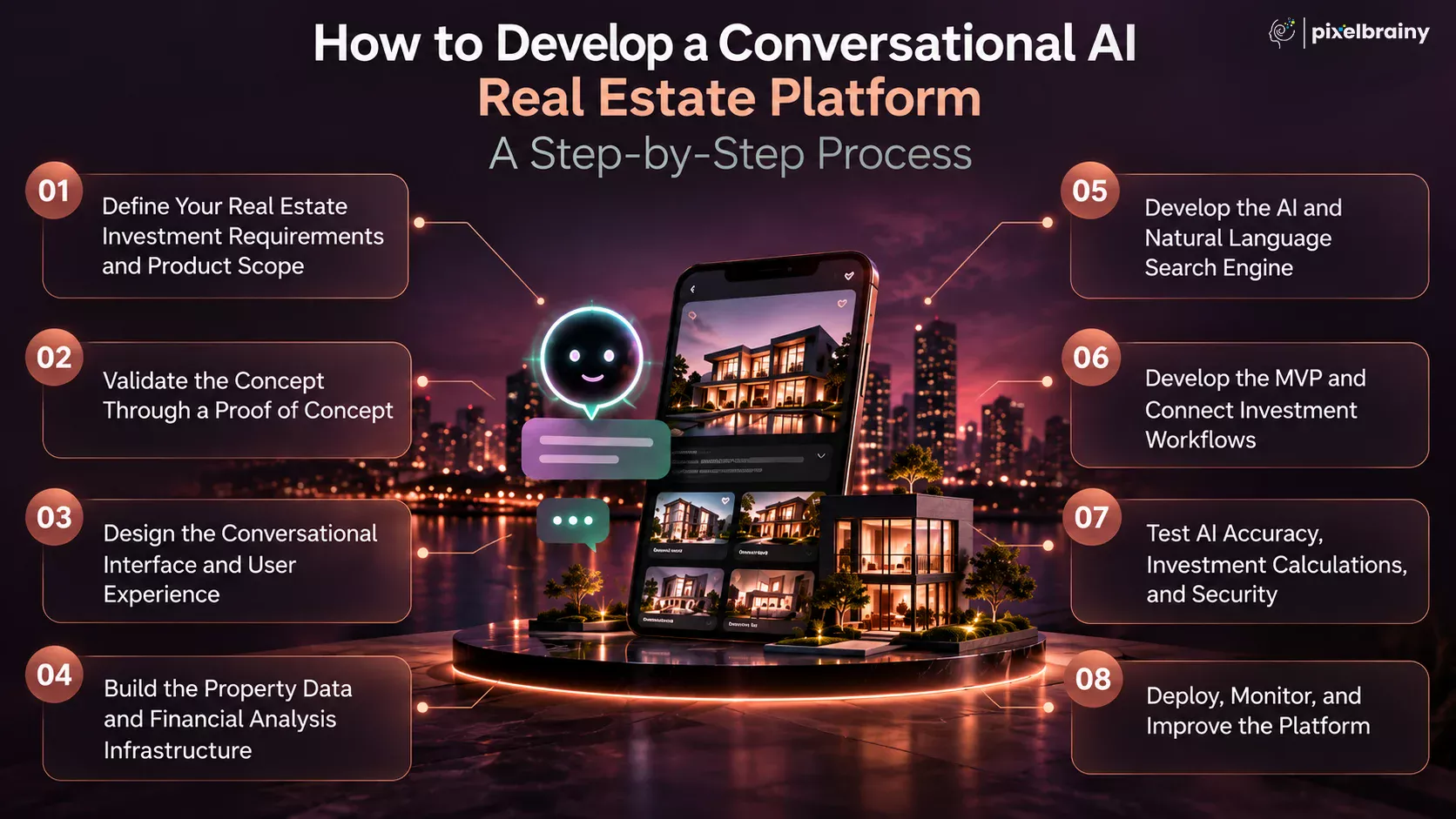
Start by identifying the investment screening problems your platform needs to solve. Document the criteria your analysts use to evaluate properties, including purchase price, projected rental income, capitalization rate, cash flow, occupancy, location, property condition, and renovation expenses.
For example, an investment team might request, "Find multifamily properties with a cap rate above 6%, stable rental income, and renovation costs below $100,000." Define which criteria are mandatory and which allow flexibility.
During AI consultation, translate these requirements into measurable product specifications, data requirements, and acceptance criteria. Establish the target users, expected screening volume, investment workflows, and success metrics before selecting technologies or beginning development.
Also Read: Top 10 AI Consulting Companies in USA
Before committing to a complete platform, test whether AI can reliably translate natural language investment criteria into structured property searches. A focused PoC development phase can use a representative property dataset to validate preference extraction, financial calculations, and shortlist quality.
For example, provide the system with sample acquisition criteria and evaluate whether it identifies properties that meet the specified purchase price, minimum rental yield, and location requirements. Compare its output against assessments prepared by experienced analysts.
This stage should expose data gaps, ambiguous investment instructions, and calculation errors early. Document the evaluation results and use them to decide whether the concept is ready for a production MVP.
Also Read: Top 10+ AI PoC Development Companies In USA
Design an interface that allows investment analysts to express acquisition criteria naturally, inspect recommended properties, and understand why each property qualifies. An experienced UI/UX design company can help translate complex investment workflows into an intuitive interface without overwhelming users with unnecessary controls.
The interface should include a conversational search window, editable investment criteria, property shortlist cards, financial summaries, and links to supporting data. Analysts should be able to revise a requirement, such as increasing the maximum acquisition price, without restarting their search.
Prioritize clear explanations, accessible visualizations, and straightforward correction mechanisms. The objective is to make AI-assisted screening understandable and efficient while keeping analysts in control of investment decisions.
Also Read: Top 10+ UI/UX Design Companies in USA
Connect the platform to authorized property listing feeds, commercial real estate databases, public records, rent comparables, and other approved investment data sources. Normalize the information into a consistent schema so that properties from different providers can be compared reliably.
For example, the platform may combine asking prices, net operating income, rental estimates, property taxes, occupancy figures, and renovation assumptions. Where appropriate, integrate established data standards or services such as the RESO Web API and relevant property data providers.
Implement data validation, source attribution, timestamps, and missing-value checks. Financial calculations should use deterministic formulas rather than relying on an LLM to perform critical arithmetic without verification.
The AI engine converts investment instructions into structured criteria that the property search service can execute. Through AI integration, connect a suitable language model with validated query schemas, database retrieval, financial calculation services, and response generation.
For example, the request "Find apartment buildings with positive projected cash flow and a minimum 6.5% cap rate" should become a structured query with clearly defined thresholds and required financial inputs. The system must clarify whether cap rate refers to current or projected net operating income divided by purchase price.
Use structured search and semantic retrieval where appropriate. Return properties with traceable supporting data, explain why they match, and flag missing information instead of inventing financial figures.
Also Read: Top 10+ AI Integration Companies in USA
Once the search engine and data layer are ready, begin MVP development with the smallest set of features that supports a complete screening workflow. The initial release should allow analysts to enter investment criteria, retrieve matching properties, inspect financial metrics, save shortlisted opportunities, and export results for further review.
Integrate existing portfolio management tools or CRMs when they are essential to the workflow. Include user authentication, role-based permissions, audit logs, and clear status indicators for incomplete property records.
Avoid building every possible analytical capability in the first release. Validate the core workflow with a small group of analysts, collect feedback, and prioritize improvements based on search accuracy, screening time, and the usefulness of the resulting shortlist.
Before deployment, evaluate the platform against a representative set of investment scenarios prepared or reviewed by experienced analysts. Consider working with top AI real estate software development companies that can demonstrate relevant expertise in property data integration, search systems, and AI evaluation.
Testing should verify that mandatory criteria are enforced, financial calculations are correct, and missing or outdated data is clearly identified. Test edge cases involving conflicting instructions, incomplete rental information, unusually high expenses, and properties that fail one or more investment requirements.
Also evaluate access controls, data privacy, prompt injection, API failures, and system performance. Compare AI-generated shortlists with analyst-reviewed results and establish acceptable quality thresholds before allowing the platform to support live investment screening.
Launch the platform with a controlled group of analysts and monitor its performance against the baseline established during discovery. Measure screening time per property, the percentage of shortlisted properties meeting mandatory criteria, data completeness, analyst correction rates, and cost per screening session.
If the business needs additional engineering capacity, it can hire AI developers with experience in LLM orchestration, retrieval systems, financial data processing, and secure application development. Evaluate potential top AI product development companies according to their relevant portfolio, technical approach, testing practices, and support arrangements.
Use production feedback to improve query interpretation, data synchronization, ranking logic, and usability. Expand to additional property categories or markets only when the platform demonstrates reliable results and the underlying data integrations can support the broader scope.
Following these eight steps helps turn a conversational property screening concept into a reliable AI-powered investment platform that supports faster analysis while keeping financial validation and final investment decisions under human control.
Also Read: How to Develop an AI Real Estate App for Realtors and Startups?
The cost to develop a conversational AI real estate platform typically ranges from $40,000 to $250,000+, depending on AI capabilities, property data integrations, conversational complexity, and business requirements. For real estate portals, brokerages, and proptech startups, the development budget depends on whether the platform needs basic natural language search or a more sophisticated AI layer that analyzes browsing behavior, answers property questions, provides neighborhood information, and qualifies potential buyers.
A common query from real estate businesses is: "We operate a large residential real estate portal and want to add conversational AI that engages visitors browsing listings, answers property and neighborhood questions, identifies buying intent, and captures contact details without requiring visitors to complete a traditional lead form. How much would development cost?"
For this use case, the cost estimation of a conversational AI real estate platform depends on existing website infrastructure, listing database access, analytics integration, AI model selection, and lead management requirements. The following breakdown provides indicative development pricing for planning purposes.
| Platform Type | Estimated Development Cost | Typical Inclusions |
|---|---|---|
| Basic Conversational AI Real Estate Platform | $40,000 to $80,000 | Website chatbot, natural language property search, basic property Q&A, listing database integration, and contact capture |
| Advanced Conversational AI Real Estate Platform | $80,000 to $150,000 | Context-aware conversations, personalized recommendations, browsing behavior analysis, neighborhood information, and CRM integration |
| Enterprise Conversational AI Real Estate Platform | $150,000 to $250,000+ | High-volume visitor engagement, multiple data integrations, advanced lead qualification, analytics dashboards, stronger security controls, and scalable infrastructure |
These figures are indicative estimates, not fixed quotations. Third-party licensing, property data fees, ongoing AI usage, and maintenance may be charged separately.
For a large residential property portal, budgeting $80,000 to $150,000 is a reasonable initial planning range for an advanced conversational AI layer, subject to existing infrastructure and integration requirements. A phased rollout can help validate lead quality and visitor engagement before committing to a larger investment.

Also Read: AI Real Estate App Development Cost: Factors and Examples
After you have finalized the core and advanced features of your conversational AI real estate platform, the next step is to define the technology stack that will bring these capabilities together. The right combination of AI models, backend frameworks, property databases, search engines, and cloud services enables buyers to describe their requirements naturally, discover relevant listings, and receive accurate recommendations.
Consider this common query from a proptech founder: "We have finalized our platform features and want to connect an LLM with our existing property database, understand natural language queries, recommend matching properties, and integrate with our CRM. Which tools and technologies should we use?"
The answer depends on your product requirements, data sources, expected traffic, and development budget. The following technology stack provides a practical foundation for conversational AI real estate platform development.
| Technology Layer | Recommended Tools and Technologies | Purpose |
|---|---|---|
| Frontend development | React, Next.js, TypeScript | Builds responsive conversational interfaces, property listing cards, search panels, and interactive property details. |
| Backend development | Python, FastAPI, Node.js | Manages conversation workflows, API requests, authentication, property searches, and external integrations. |
| Large language models (LLMs) | OpenAI API, Anthropic Claude API | Interprets natural language queries, extracts buyer preferences, asks clarifying questions, and generates responses grounded in retrieved property information. |
| AI orchestration | LangChain, LlamaIndex, custom orchestration services | Connects language models with property databases, retrieval tools, structured queries, and controlled workflows. |
| Primary database | PostgreSQL | Stores structured property attributes, listing identifiers, user preferences, and application data. |
| Geospatial database | PostGIS | Supports location-based property searches, geographic boundaries, and distance calculations. |
| Vector search | pgvector, Pinecone, Weaviate | Retrieves semantically relevant property descriptions and matches conversational queries with listing content. |
| Keyword and hybrid search | Elasticsearch, OpenSearch | Supports full-text property search, keyword matching, structured filtering, and hybrid retrieval. |
| Property data integration | RESO Web API-compatible services, authorized MLS or IDX feeds, brokerage APIs | Connects the platform to approved property listing sources and retrieves data according to applicable access requirements. |
| Mapping and location intelligence | Google Maps Platform, Mapbox | Supports property maps, geocoding, location searches, and geographic information. |
| CRM and lead management | Salesforce, HubSpot, brokerage CRM APIs | Transfers qualified inquiries, buyer preferences, and conversation summaries into sales workflows. |
| Cloud infrastructure | AWS, Microsoft Azure, Google Cloud | Hosts application services, databases, background jobs, and AI integrations with appropriate scalability and security controls. |
| Caching and session management | Redis | Stores temporary conversation state, caches suitable search results, and helps manage application performance. |
| Monitoring and analytics | OpenTelemetry, cloud monitoring tools, product analytics platforms | Tracks application errors, response times, AI usage costs, search quality, and user engagement. |
| Security and deployment | OAuth 2.0, role-based access control, Docker, CI/CD pipelines | Protects user information, manages permissions, and supports repeatable testing and deployment processes. |
When a buyer enters a natural language query, the LLM extracts their preferences, and the search engine retrieves and ranks matching properties from the connected database. The platform then presents verified listing details and connects interested buyers with agents through CRM and appointment integrations.
For an MVP, React or Next.js, FastAPI, PostgreSQL with PostGIS, pgvector, a hosted LLM API, and an authorized property data source provide a practical foundation for accurate property search and scalable conversational experiences.
The right combination of AI models, property databases, search technologies, and cloud infrastructure ensures your conversational AI real estate platform delivers accurate property recommendations and seamless buyer interactions. Start with a scalable MVP stack and expand as your business grows.
Real estate businesses looking to automate property discovery, qualify leads, and deliver personalized buyer experiences can either invest in custom conversational AI real estate platform development or purchase an existing AI solution. The right approach depends on how well each option supports your property data, customer workflows, integration needs, and long-term growth plans.
For example, a real estate business might ask: “We want an AI assistant that understands natural language property searches, recommends listings from our database, answers neighborhood questions, and sends qualified leads to our CRM. Should we buy an existing conversational AI solution or develop a custom platform?” Comparing the two approaches across cost, customization, implementation time, and scalability can help determine the best fit.
Custom development is ideal for property marketplaces, large brokerages, and proptech companies that need tailored AI capabilities and greater control over the customer experience.
Key advantages include:
Potential drawbacks: Custom solutions generally require a higher upfront investment, more planning, and ongoing maintenance from an internal team or development partner.
An off-the-shelf solution suits businesses that need standard AI chat, customer support, or lead generation capabilities without investing in an extensive development project.
Key advantages include:
Potential drawbacks: Limited customization, additional integration charges, recurring subscription fees, and vendor dependency may restrict future flexibility.
| Decision factor | Custom conversational AI platform | Existing AI solution |
|---|---|---|
| Initial investment | Requires a larger upfront budget for discovery, design, development, integrations, and testing. | Usually has a lower initial cost through subscription plans or implementation packages. |
| Time to market | Takes longer because features, data connections, and user workflows must be designed and tested. | Can launch faster when the required features and integrations are already supported. |
| Feature customization | Supports business-specific property search, recommendation logic, lead qualification, and unique workflows. | Customization depends on the vendor's available features, configuration options, and pricing tiers. |
| Property data integration | Can be designed around authorized MLS feeds, proprietary databases, and multiple listing sources. | Works with the property sources and integration methods supported by the vendor. |
| Scalability | Architecture can be planned for new markets, higher traffic, additional languages, and advanced AI features. | Growth depends on vendor capacity, usage limits, plan restrictions, and available functionality. |
| Maintenance and ownership | Your team or development partner manages updates, monitoring, security, and technical improvements. | The provider handles core software maintenance, but your business remains dependent on its policies and roadmap. |
| Long-term costs | Higher initial costs may be offset by greater control over functionality and usage, depending on operating expenses. | Recurring subscriptions and usage-based charges can increase as interactions, users, or integrations grow. |
Custom conversational AI real estate platform development is generally a better fit when your business requires proprietary integrations, specialized property search, unique customer journeys, or greater control over its AI capabilities. Buying an existing solution is often more practical when your requirements are standard, your budget is limited, and launching quickly is the priority.
Before committing, evaluate the vendor's data security, property data compatibility, customization limits, integration costs, and pricing at your expected usage level. You can also start with an off-the-shelf tool to validate demand before investing in a custom platform.
The best approach is the one that supports your current business needs without limiting future growth. Compare total ownership costs, integration requirements, and differentiation opportunities before making your investment.
A conversational AI real estate platform must do more than answer property-related questions. It needs to retrieve accurate listings, understand buyer intent, protect personal information, and deliver relevant recommendations across different markets. For businesses planning conversational AI real estate platform development, addressing these challenges early helps improve search accuracy, buyer trust, and long-term scalability.
For example, a real estate company might ask: “We want our AI property search assistant to understand complex buyer requests, show accurate listings, and recommend suitable properties. What challenges should we address before launching the platform?” The following six challenges highlight the main risks and practical ways to solve them.
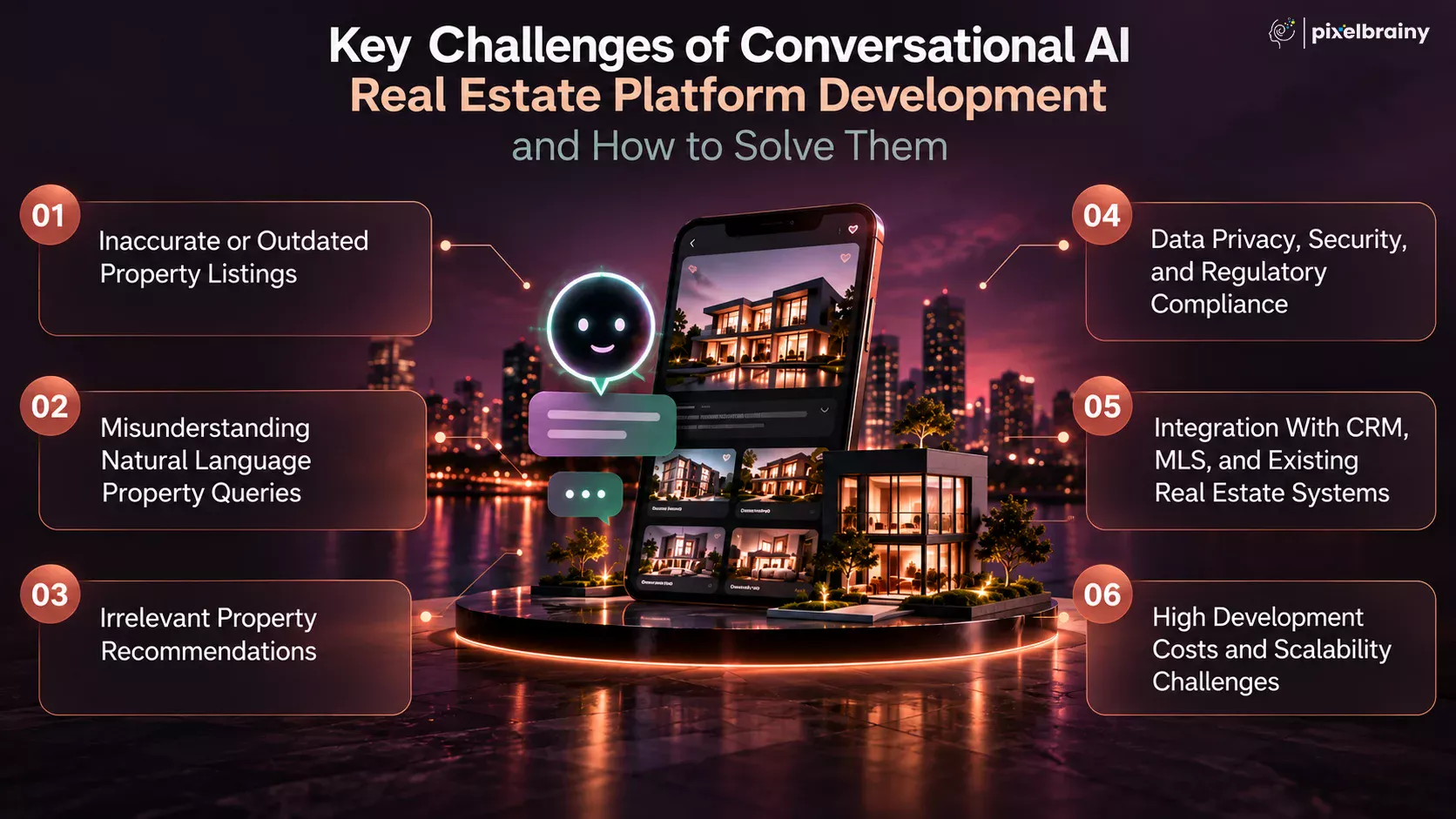
Conversational AI can recommend unsuitable properties if its underlying data contains outdated prices, unavailable listings, incorrect locations, or incomplete property details. Listing accuracy depends on the quality and freshness of the connected data sources.
How to solve it:
Buyers often describe their requirements conversationally, such as, “Find a three-bedroom house near good schools with a garden, under $600,000, and within a 30-minute commute.” An AI system may miss budget limits, confuse preferences with requirements, or interpret location constraints incorrectly.
How to solve it:
Even when the AI understands a query, recommendations can feel generic if the platform relies on basic keyword matching alone. Buyers expect results that reflect their budget, preferred neighborhoods, lifestyle, and previous interactions.
How to solve it:
A conversational AI real estate platform may process names, contact details, budgets, financing preferences, and browsing activity. Mishandling this information can damage customer trust and create legal or regulatory exposure across different markets.
How to solve it:
A conversational AI assistant delivers limited business value if it cannot connect property searches with the company's operational systems. Fragmented integrations can cause duplicate leads, inconsistent listing details, and missed agent follow-ups.
How to solve it:
The cost of conversational AI real estate platform development can increase as businesses add more property sources, advanced AI models, multilingual support, and high-volume user interactions. Poor architecture can also lead to slow responses and rising infrastructure costs as traffic grows.
How to solve it:
Addressing these six challenges early helps your conversational AI real estate platform deliver accurate property recommendations, protect buyer data, streamline lead management, and scale efficiently as your business grows.
Businesses in real estate need technology that simplifies property discovery, improves buyer engagement, and helps sales teams convert more enquiries into qualified leads. PixelBrainy works with brokerages, property marketplaces, and proptech startups to plan AI-powered solutions around their business objectives, property data, and customer workflows.
Consider a common business query: “We want an AI property assistant that understands natural language, recommends relevant listings from our database, answers neighborhood questions, and sends qualified leads to our CRM. How can we create a solution that fits our real estate business?” PixelBrainy a leading real estate AI software development company in USA helps businesses evaluate the necessary AI capabilities, data integrations, and development priorities before implementation begins.
In a confidential real estate project scenario, a business wanted to simplify property searches for users who found conventional filters restrictive. The proposed workflow enabled users to describe their requirements naturally, translated those requests into structured search criteria, retrieved relevant listings, and supported enquiry submission for sales follow-up.
This type of workflow illustrates how businesses can develop conversational AI real estate platform capabilities that connect natural language understanding with property search and lead management. Client-identifying information and unverified performance figures are not disclosed.
PixelBrainy helps businesses create conversational AI real estate platform experiences that fit their users, data sources, and operational needs. For companies modernizing existing property systems, conversational real estate platform development integrating AI can connect intelligent search with established listing databases and customer management workflows.
If you are comparing providers and researching the best real estate AI software development companies in USA, assess each partner's technical expertise, integration approach, project scope, and ability to support your long-term goals.
Ready to discuss your real estate AI project? Connect with PixelBrainy to explore your requirements and plan the next steps.

Conversational AI is reshaping how real estate businesses connect buyers with relevant properties, manage enquiries, and deliver personalized property search experiences. From natural language search and AI-powered recommendations to automated lead qualification and CRM integration, a well-designed platform can help brokerages, property marketplaces, and proptech startups improve customer engagement while streamlining operations.
Investing in conversational AI real estate platform development requires a clear understanding of your business goals, essential features, technology stack, development costs, and integration requirements. Whether you choose a custom-built solution or an existing platform, the priority should be delivering accurate property information, meaningful conversations, and a seamless journey from property discovery to agent consultation.
With the right development strategy and technology partner, your business can turn conversational AI into a practical competitive advantage and create a foundation for future innovation in real estate.
Ready to transform your real estate business with AI? Book an appointment with PixelBrainy to discuss your project requirements and development roadmap.
A conversational AI real estate platform uses artificial intelligence to understand buyer intent, search property databases, recommend relevant listings, and qualify leads through natural conversations. Unlike basic chatbots that follow predefined scripts, it can interpret complex queries, ask clarifying questions, maintain context, and personalize property discovery.
The cost of conversational AI real estate platform development typically ranges from $40,000 to $250,000 or more in 2026. Basic solutions cost less, while advanced platforms require additional investment in AI models, property database integrations, CRM connectivity, security, and scalability.
Developing a conversational AI real estate platform typically takes three to nine months, depending on feature complexity, integrations, and data readiness. A focused MVP may take less time, while enterprise solutions involving multiple property sources, multilingual support, advanced recommendations, and extensive testing require longer development cycles.
A conversational AI real estate platform connects with authorized MLS data through supported APIs, RESO Web API implementations, or approved data feeds. The integration retrieves property details, prices, locations, and availability, allowing the AI to return relevant listings while respecting licensing agreements and data access restrictions.
A conversational AI platform can qualify leads by asking about budgets, preferred locations, property types, purchase timelines, and financing readiness. It can score enquiries and route promising prospects to agents. However, human agents remain essential for complex negotiations, relationship building, and nuanced buyer decisions.
Conversational AI platforms integrate with real estate CRM systems through APIs, webhooks, or supported connectors. They can transfer contact details, property preferences, conversation summaries, and lead qualification signals into systems such as Salesforce or HubSpot, helping agents prioritize enquiries and manage follow-ups efficiently.
A conversational AI real estate platform can support multiple languages, depending on the selected AI models, interface design, and available property data. English, Spanish, French, German, and other languages can be implemented, with localized terminology, currency formats, and regional property search requirements configured for target markets.
The AI reduces inaccurate responses by retrieving information from verified property databases rather than relying solely on generated answers. Data synchronization, structured search filters, listing validation, and source-grounded responses help improve accuracy. The platform should clearly communicate uncertainty when details are missing or outdated.
Yes. Custom conversational AI real estate platform development can support a white-label model, allowing you to offer branded AI property search and lead management tools to multiple brokerages. Tenant separation, configurable branding, role-based access, subscription management, and scalable infrastructure are important considerations for this business model.
PixelBrainy approaches conversational AI real estate platform development by aligning AI capabilities with business goals, property data, customer workflows, and integration requirements. Businesses can evaluate its proposed solution architecture, customization options, development process, and ongoing support to determine whether the team fits their project needs.

About The Author
Sagar Bhatnagar
Sagar Sahay Bhatnagar brings over a decade of IT industry experience to his role as Marketing Head at PixelBrainy. He's known for his knack in devising creative marketing strategies that boost brand visibility and market influence. Sagar's strategic thinking, coupled with his innovative vision and focus on results, sets him apart. His track record of successful campaigns proves his ability to utilize digital platforms effectively for impactful marketing efforts. With a genuine passion for both technology and marketing, Sagar continuously pushes PixelBrainy's marketing initiatives to greater success.

Working with PixelBrainy has been a great experience. They took our vision for an AI-powered platform and turned it into a fully functional product. What impressed me most was their strong understanding of both design and development, and their ability to handle complex requirements with ease. The team was responsive, cooperative, and always open to feedback. They kept things organized, communicated clearly, and delivered quality work on time. I highly recommend PixelBrainy to anyone looking for a skilled and reliable development partner.

Working with the PixelBrainy team has been a highly positive experience. They understand the design requirements and create beautiful UX elements to meet the application needs. The dev team did an excellent job bringing my vision to life. We discussed usability and flow. Sagar worked with his team to design the database and begin coding. Working with Sagar was easy. He has the knowledge to create robust apps, including multi-language support, Google and Apple ID login options, Ad-enabled integrations, Stripe payment processing, and a Web Admin site for maintaining support data. I'm extremely satisfied with the services provided, the quality of the final product, and the professionalism of the entire process. I highly recommend them for Android and iOS Mobile Application Design and Development.

Great experience working with them. Had a lot of feedback and I found that unlike most contractors they were bugging me for updates instead of the other way around. They were extremely time conscience and great at communicating! All work was done extremely high quality and if not on time, early! They were always proactive when it comes to communication and the work is great/above par always. Very flexible and a great team to work with! Goes above and beyond to present us with multiple options and always provides quality. Amazing work per usual with Chitra. If you have UI/UX or branding design needs I recommend you go to them! Will likely work with them in the future as well, definitely recommended!

PixelBrainy is a joy to work with and is a great partner when thinking through branding, logo, and website layout. I appreciate that they spend time going into the "why" behind their decisions to help inform me and others about industry best practices and their expertise.

I hired them to design our software apps. Things I really like about them are excellent communication skills, they answer all project suggestions and collaborate right away, and their input on design and colors is amazing. This project was complex and needed patience and creativity. The team is amazing to do business with. I will be using them long-term. Glad to see there are some good people out there. I was afraid to try and outsource my project to someone but I am glad I met them! I really can't say enough. They went above and beyond on this project. I am very happy with everything they have done to make my business stand out from the competition.

It was great working with PixelBrainy and the team. They were very responsive and really owned the project. We'll definitely work with them again!

I recently worked with the PixelBrainy team on a project and I was blown away by their communication skills. They were prompt, clear, and articulate in all of our interactions. They listened and provided valuable feedback and suggestions to help make the project a success. They also kept me updated throughout the entire process, which made the experience stress-free and enjoyable.

PixelBrainy is very good at what it does. The team also presents themselves very professionally and takes care of their side of things very well. I could fully trust them taking up the design work in a timely and organised manner and their attention to detail saved us lots of effort and time. This particular project was quite intense and the team showed that they function very well under pressure. Very much looking forward to working with her again!

It's always an absolute pleasure working with them. They completed all of my requests quickly and followed every note I had for them to a T, which made our process go smoothly from start to finish. Everything was completed fast and following all of the guidelines. And I would recommend their services to anyone. If you need any design work done in the future, PixelBrainy should be your first call!

They took ownership of our requirements and designed and proposed multiple beautiful variants. The team is self-motivated, requires minimum supervision, committed to see-through designs with quality and delivering them on time. We would definitely love to work with PixelBrainy again when we have any requirements.

PixelBrainy was a big help with our SaaS application. We've been hard at work with a new UI/UX and they provided a lot of help with the designs. If you're looking for assistance with your website, software, or mobile application designs, PixelBrainy and the team is a great recommendation.

PixelBrainy designers are amazing. They are responsive, talented, and always willing to help craft the design until it matches your vision. I would recommend them and plan to continue them for my future projects and more!!!

They were awesome! Did a good job fast, and good communication. Will work with them again. Thank you

Creative, detail-oriented, and talented designers who take direction well and implement changes quickly and accurately. They consistently over-delivered for us.

PixelBrainy team is very talented and creative. Great designers and a pleasure to work with. PixelBrainy is an excellent communicator and I look forward to working with them again.

PixelBrainy has a very talented design team. Their work is excellent and they are very responsive. I enjoy working with them and hope to continue on all of our future projects.


Transform your ideas into reality with us.
Across these industries, each engagement brings unique challenges, from early-stage product development to scaling complex systems, helping us build a practical understanding of real-world product environments.