AI Summary Powered by PixelBrainy
Imagine opening a learning app and being greeted by a lifelike digital mentor who not only speaks to you but understands your learning pace, preferences, and goals. This is the power of Avatar-Based AI Education Apps. They represent the next evolution of personalized digital learning and are rapidly becoming a transformative force in the EdTech industry. As more learners demand interactive and immersive learning experiences, businesses are actively exploring Avatar-Based AI Education App Development to stay ahead of the curve.
Whether you are an EdTech startup, a traditional educational institution, or a business entering the digital learning market, understanding how to create an Avatar-Based AI Education App can unlock new opportunities. The development of Avatar-Based AI Education Apps enables dynamic teaching environments, human-like interactions, and real-time assistance for learners of all ages. With the rising need for individualized learning, the building of an Avatar-Based AI Education App is no longer just an innovation but a strategic investment.
This blog offers expert insights into what makes these apps powerful, how they work, their benefits, and the complete process required to develop an Avatar-Based AI Education App. If your goal is to engage modern learners, enhance training outcomes, or create cutting-edge educational solutions, this guide will give you everything you need to begin your Avatar-Based AI Education App Development journey.

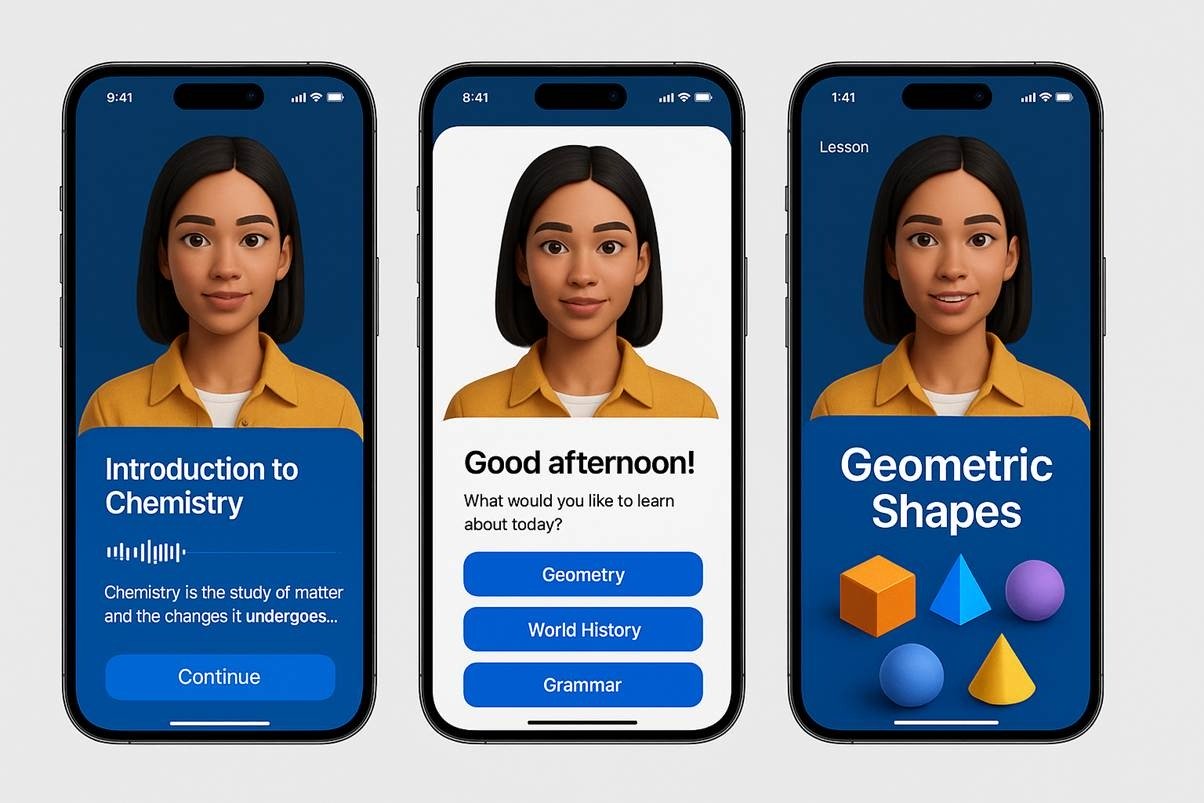
An Avatar-Based AI Education App is an intelligent learning platform where a digital avatar acts as a virtual tutor, guide, or learning assistant. Instead of traditional text-based or video-based learning, this technology introduces an interactive, human-like teaching experience. The avatar can speak, display expressions, respond to questions, and adapt teaching styles based on how the learner interacts.
These apps use advanced technologies such as AI-driven Natural Language Processing, speech recognition, machine learning, and real-time 3D avatar animation. They create an environment where learning feels engaging and personal. The avatar analyzes the learner’s progress, identifies strengths and weaknesses, and provides tailored learning paths. This results in highly immersive and motivating educational sessions.
Learners can ask questions, converse naturally with the avatar, and receive instant feedback. Whether it is K12 education, language learning, skill development, or professional training, an avatar tutor can simplify complex topics with relatable explanations, real-time demonstrations, and emotional expressions.
In short, an Avatar-Based AI Education App bridges the gap between digital learning and human-like interaction, making education more intuitive, enjoyable, and effective.
If your current learning tools feel outdated or ineffective, you are not alone. Many educators, trainers, and organizations are noticing that traditional eLearning platforms cannot maintain attention or deliver personalized support. This growing gap is pushing many leaders to explore more interactive and modern solutions.
This is a strong reason to invest in avatar-based AI education development. Instead of offering static lessons, you can provide a human like, engaging learning experience that adapts to each learner. AI powered avatars act as intelligent digital mentors who guide users through conversations, tailored explanations, and real time feedback. This makes avatar-based AI education app development valuable for schools, universities, coaching programs, and corporate training teams.
The global market is moving in this direction at a fast pace. According to a recent study, the AI in education market is projected to grow from USD 6.90 billion to USD 41.01 billion by 2030 with a CAGR of 42.83 percent.
The technology is also ready. Avatar engines, voice systems, and LLM models now provide realistic and reliable interactions. Many education brands are partnering with AI developers or custom software teams to integrate these capabilities, automate learning content, and build scalable AI avatar learning systems.
Here are key reasons why this is the right moment to invest in avatar-based AI education development:
If you are looking for the right time to move forward, this is the moment to lead in next generation learning.
Creating an Avatar-Based AI Education App Development solution opens new possibilities for highly engaging, adaptive, and future-ready learning. The advantages of Avatar-Based AI Education App Development go far beyond traditional digital platforms and help organizations deliver a learning experience that truly feels human centered.
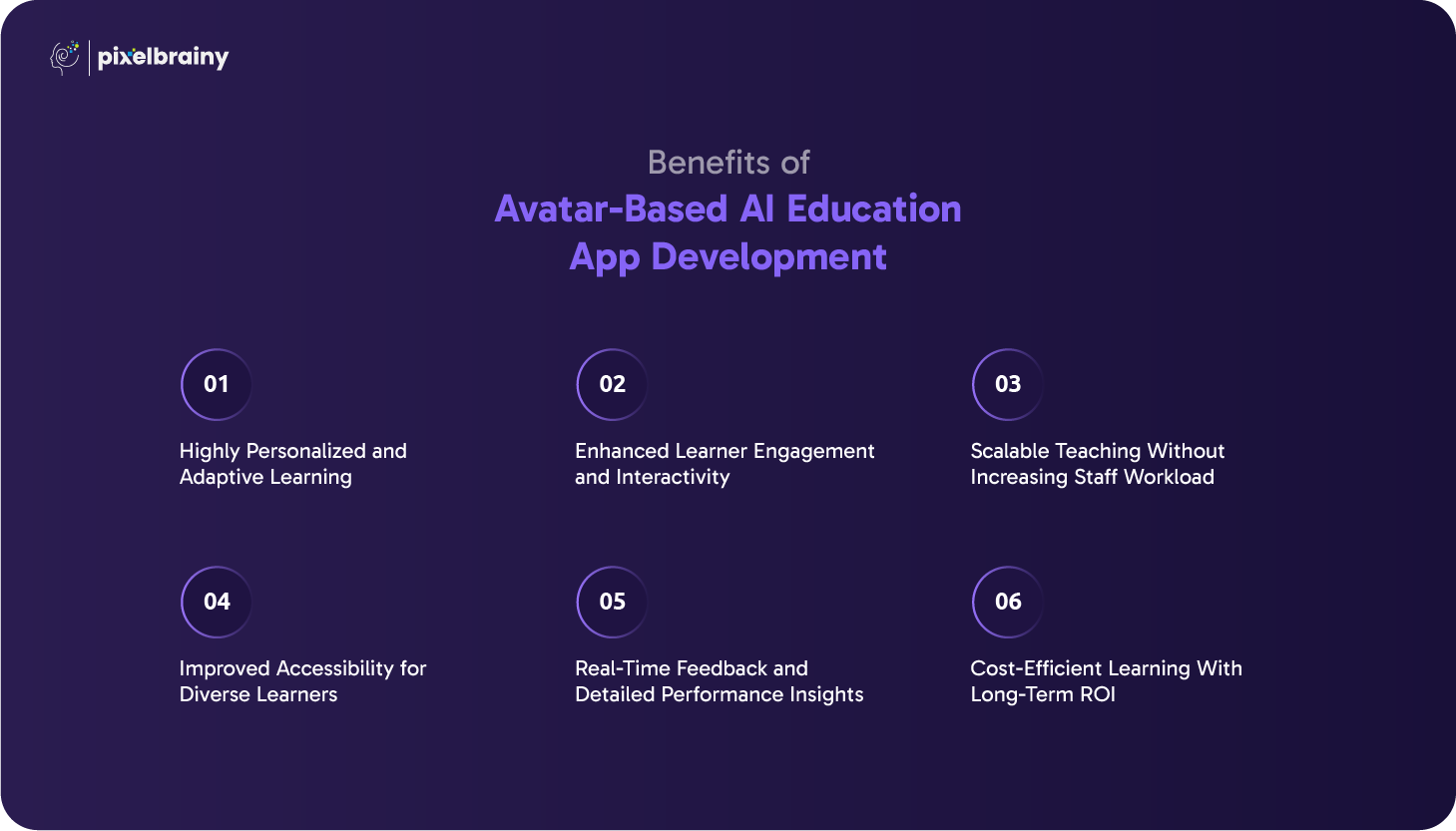
One of the most powerful advantages of Avatar-Based AI Education App Development is the ability to deliver deeply personalized learning. Traditional systems often take a one-size-fits-all approach, but AI avatars can adjust every element of the lesson based on each learner’s understanding, pace, and preferences. This ensures that students feel supported rather than overwhelmed.
When you decide to develop an Avatar-Based AI Education App, you create an environment where learners receive immediate adjustments in tone, difficulty level, and content sequence. Over time, the avatar understands how each user learns best, making the learning path more intuitive and more effective. This personalization significantly improves comprehension and boosts long-term retention.
AI avatars add life to digital learning. Their expressive animations, human-like gestures, and natural conversational style help create a connection that traditional screens cannot match. This transforms learning from a passive experience into an interactive journey.
By creating an Avatar-Based AI Education App Development solution, organizations can encourage learners to stay involved for longer periods. The avatars can respond to questions, share examples, motivate learners, and maintain attention through dynamic interactions. This level of engagement is essential for younger students, corporate trainees, and users who may struggle with conventional digital courses.
Scaling education has always been difficult because human instructors have limited time and capacity. One AI avatar, however, can simultaneously support thousands of learners without compromising quality. This makes Avatar-Based AI Education App Development especially valuable for institutions and enterprises looking to expand their training programs.
To develop an Avatar-Based AI Education App means building a system where educators no longer need to repeat the same explanations or handle repetitive queries. The AI avatar automates routine tasks, lesson delivery, and learner support, allowing teachers and trainers to focus on deeper learning experiences. This approach significantly reduces staff pressure while increasing training coverage.
Accessibility is a crucial priority in modern education. AI avatars help meet this need by offering multiple communication modes such as voice, text, visual cues, simplified instructions, or multilingual support. This ensures that learners with varied abilities and learning styles can comfortably interact with the platform.
By creating an Avatar-Based AI Education App Development solution, you support students who may need slower explanations, translations, or alternative learning formats. This inclusiveness helps institutions overcome accessibility barriers and provide equitable learning experiences across all age groups and backgrounds.
Another major benefit is the ability to deliver instant, data-backed feedback. AI avatars can identify mistakes in real time, explain the error, and guide the learner toward the correct approach. Whether someone is practicing a language, solving math problems, or developing workplace skills, the avatar makes the learning loop faster and more insightful.
At the organizational level, the system collects detailed analytics, including progress trends, strengths, weaknesses, and learning frequency. When you develop an Avatar-Based AI Education App, you gain valuable insights that help refine teaching strategies, customize lessons, and measure training impact with precision.
The financial advantages of Avatar-Based AI Education App Development are significant. Although development requires an initial investment, the long-term savings are considerable. Unlike human instructors, AI avatars do not require additional salaries, training, or scheduling management as your user base grows.
Once developed, the system continues to deliver lessons, answer questions, and guide learners without additional operational expenses. For growing institutions, this means predictable costs, increased learning capacity, and a strong return on investment. Creating an Avatar-Based AI Education App Development ecosystem sets the foundation for sustainable educational growth.
Investing in avatar-driven AI learning solutions is not just a technological upgrade but a strategic move that elevates the quality, accessibility, and scalability of modern education.
Also Read: Top 12 AI Avatar Development Companies in USA
Avatar Based AI Education App Development is opening new possibilities for interactive, personalized, and scalable learning experiences across multiple sectors. These apps bring human like guidance into digital platforms, helping learners understand concepts more naturally.
Here are the top real world use cases that show why many organizations choose to create an Avatar Based AI Education App.
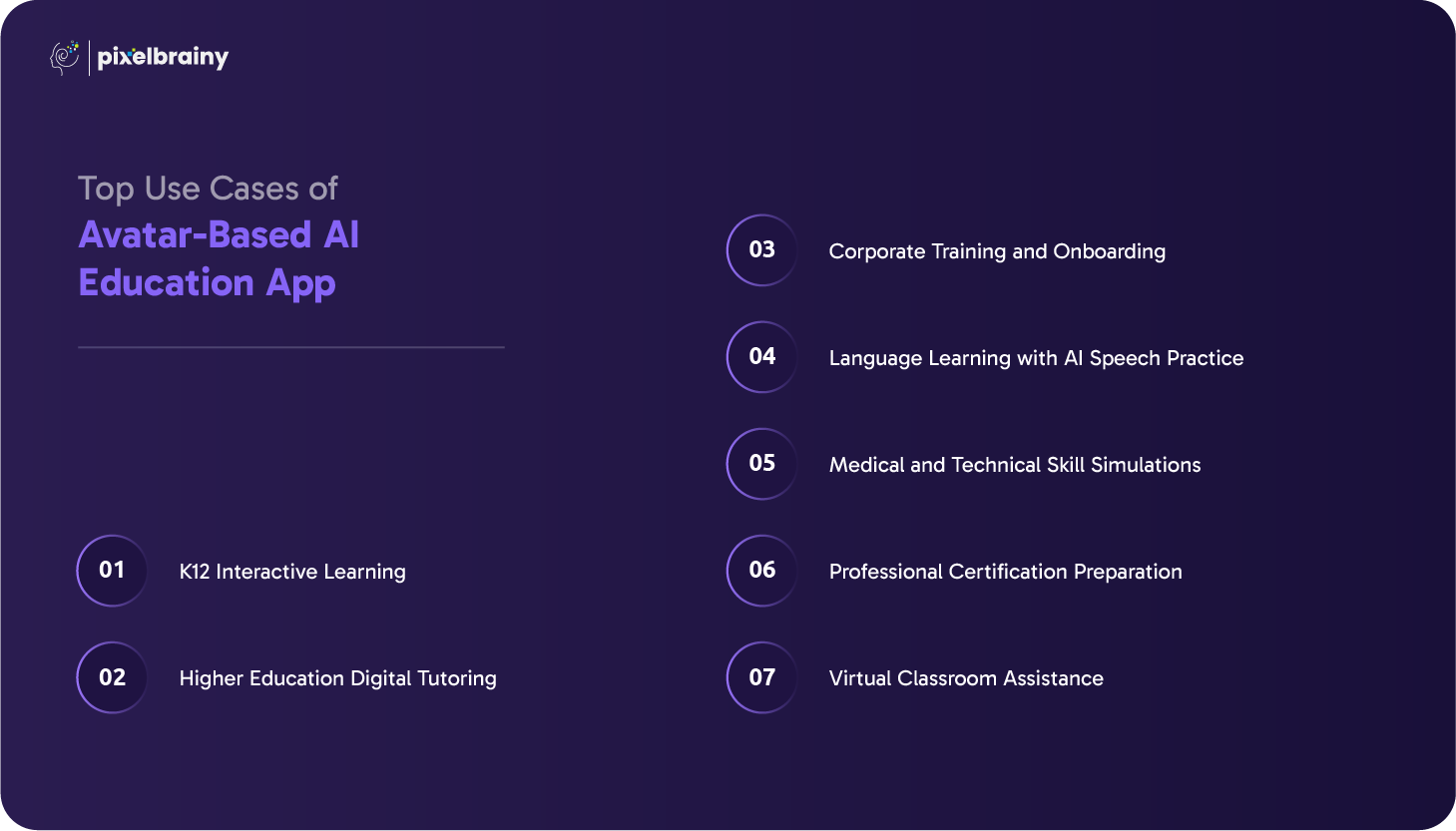
K12 students respond well to visual storytelling and interactive instruction, and AI avatars make lessons more enjoyable and easier to understand. This use case focuses on guiding young learners through subjects like math, science, and reading with friendly, expressive avatars. Schools benefit from consistent lesson delivery and improved engagement among students who struggle with traditional methods.
Key applications:
Universities and colleges can use AI avatars to support students who need individualized attention outside classroom hours. These avatars help explain advanced concepts, guide research, and assist with exam preparation. This makes Avatar Based AI Education App Development highly valuable for academic institutions seeking scalable mentoring.
Key applications:
Organizations use AI avatar learning systems to streamline employee training and onboarding. Avatars can introduce company policies, teach job skills, and provide scenario based learning without requiring human trainers each time. This helps companies improve training quality and reduce operational load.
Key applications:
Language learners need practice, repetition, and real dialogue. AI avatars offer natural speaking interactions, pronunciation correction, and cultural context that traditional apps cannot provide. This use case is ideal for learners who want a realistic and confidence building environment.
Key applications:
Medical and technical training requires hands on practice, and avatars can simulate real world scenarios safely. This makes Avatar Based AI Education App Development valuable for teaching procedures, emergency protocols, and technical troubleshooting.
Key applications:
Professionals preparing for certifications often need structured guidance and consistent revision strategies. AI avatars help learners navigate complex topics, practice exam questions, and track their progress over time. This reduces study pressure and improves exam readiness.
Key applications:
Avatars can act as classroom helpers by managing discussions, answering questions, or supporting teachers during online sessions. This creates a smoother learning environment and reduces the instructor workload while ensuring every student gets adequate support.
Key applications:
These use cases show how Avatar Based AI Education App Development can transform learning environments by offering interactive, personalized, and scalable educational support.

Building an Avatar Based AI Education App requires more than just designing an avatar. It involves creating a learning ecosystem that is interactive, adaptive, and supportive for learners across different skill levels.
These features form the foundation of a reliable and engaging platform for anyone planning to develop an Avatar Based AI Education App.
| Feature | Explanation |
| User Profiles and Personalization | Enables learners to create individual profiles so the system can understand their goals and behavior. The avatar uses this data to customize lessons. This creates a tailored learning path. |
| AI Powered Avatar Tutor | Works as the main guide for learners through conversations, demonstrations, and explanations. Makes digital learning feel more relatable and human like. Serves as a constant learning companion. |
| Interactive Lesson Modules | Lessons include visuals, animations, and real time activities for better understanding. These modules break down difficult topics. They improve overall knowledge absorption. |
| Speech Recognition and Voice Interaction | Allows learners to speak directly with the avatar for natural communication. The system evaluates speech and responds accurately. This improves verbal learning skills. |
| Smart Content Recommendations | The app analyzes learner progress and suggests the next lesson automatically. This reduces confusion about what to study next. It ensures continuous improvement. |
| Gamified Learning Elements | Adds rewards, badges, and levels to increase motivation. Gamification keeps learners active and interested. It makes the learning experience enjoyable. |
| Progress Tracking and Analytics | Gives a clear view of learning achievements over time. Parents, teachers, or managers can also monitor progress. Helps in identifying strengths and weaknesses. |
| Multilingual Support | Lets learners access content in the language they prefer. This makes learning inclusive and comfortable. It helps expand the audience globally. |
| AR Based Learning Interactions | Uses augmented reality to visualize scientific models, objects, or simulations. Increases clarity and memorability. Creates a hands on digital experience. |
| Interactive Quizzes and Assessments | Provides instant tests to measure understanding. The avatar explains results and offers corrections. Helps learners stay consistent with progress. |
| Secure Cloud Storage | Stores all user data and content safely online. Allows seamless access across devices. Ensures information remains protected. |
| Offline Learning Mode | Lets users continue learning without an active internet connection. Data syncs automatically when connected. Supports learning flexibility. |
| Notification and Reminder System | Alerts learners about upcoming tasks, lessons, or achievements. Encourages discipline and routine. Improves lesson completion rates. |
| Integration with Learning Management Systems | Connects easily with LMS platforms used by schools or businesses. Simplifies reporting and content management. Helps institutions streamline processes. |
| Parent or Instructor Dashboard | Lets guardians and educators track learner activity and performance. Helps them guide the student better. Promotes collaborative learning. |
These features strengthen the building of an Avatar Based AI Education App and help create a platform that supports meaningful and engaging learning.
When creating an Avatar Based AI Education App, adding non ordinary features can elevate the user experience far beyond basic learning tools. These advanced capabilities make the platform more immersive, intelligent, and future ready. They also help teams who want to make an Avatar Based AI Education App stand out in a competitive market.
| Feature | Explanation |
| Emotion Recognition for Adaptive Teaching | The avatar detects user emotions through speech patterns and behavior. It adjusts tone and difficulty level based on learner mood. This creates a more supportive environment. |
| Hyper Realistic Avatar Animation | Offers lifelike facial expressions and smooth movements. Makes interactions feel natural and welcoming. Enhances user trust and comfort. |
| Real Time Voice Cloning Options | Allows avatars to use customized voices. Learners can choose tones they prefer. This increases personalization and engagement. |
| AI Generated Practice Scenarios | Automatically produces practice tasks and simulations. Keeps content fresh and relevant. Helps improve practical skill development. |
| Multimodal Teaching Interactions | Combines visuals, gestures, voice, and animated elements for better explanations. Helps learners understand complex topics. Supports different learning styles. |
| Cognitive Learning Insights | Tracks learning patterns and response timing. Helps the system adjust content difficulty. Improves personalized teaching accuracy. |
| Collaborative Multi Avatar Sessions | Allows multiple avatars to interact with learners together. Useful for group exercises or role playing activities. Creates variety in the learning experience. |
| Real Time Translation and Localization | Translates avatar conversations instantly. Helps global learners understand lessons easily. Removes language barriers. |
| Interactive 3D Object Manipulation | Lets learners rotate, zoom, and explore models digitally. Perfect for science, engineering, and technical education. Offers hands on learning without physical equipment. |
| VR Based Immersive Classrooms | Creates virtual environments for learning with full avatar guidance. Great for medical procedures or safety training. Provides a memorable learning experience. |
| Personalized Teaching Personalities | Allows learners to choose avatar personalities they relate to. Enhances comfort and motivation. Makes learning feel tailored. |
| Long Form Natural Conversations | Supports deep and meaningful discussions with the avatar. Helps learners explore subjects more thoroughly. Improves conceptual understanding. |
| Smart Error Correction and Reasoning | The avatar explains why a mistake happened rather than only giving the answer. Helps learners understand the concept behind it. Builds stronger long term knowledge. |
| Automated Content Creation Tools | Generates lessons, quizzes, and examples automatically. Saves time for teachers and trainers. Speeds up content production workflows. |
| Adaptive Study Routine Builder | Helps learners organize study plans based on performance and availability. Encourages daily practice. Builds disciplined learning habits. |
Also Read: Building an AI Avatar Therapy App for Counselors and Coaches
If you are exploring what is the process of developing an Avatar Based AI Educational App, it begins with a structured and well-planned workflow. Creating an Avatar Based AI Educational App involves a mix of strategy, technical development, design, and continuous improvement.
Here is a clear step by step roadmap to make Avatar Based AI Educational App solutions successfully.
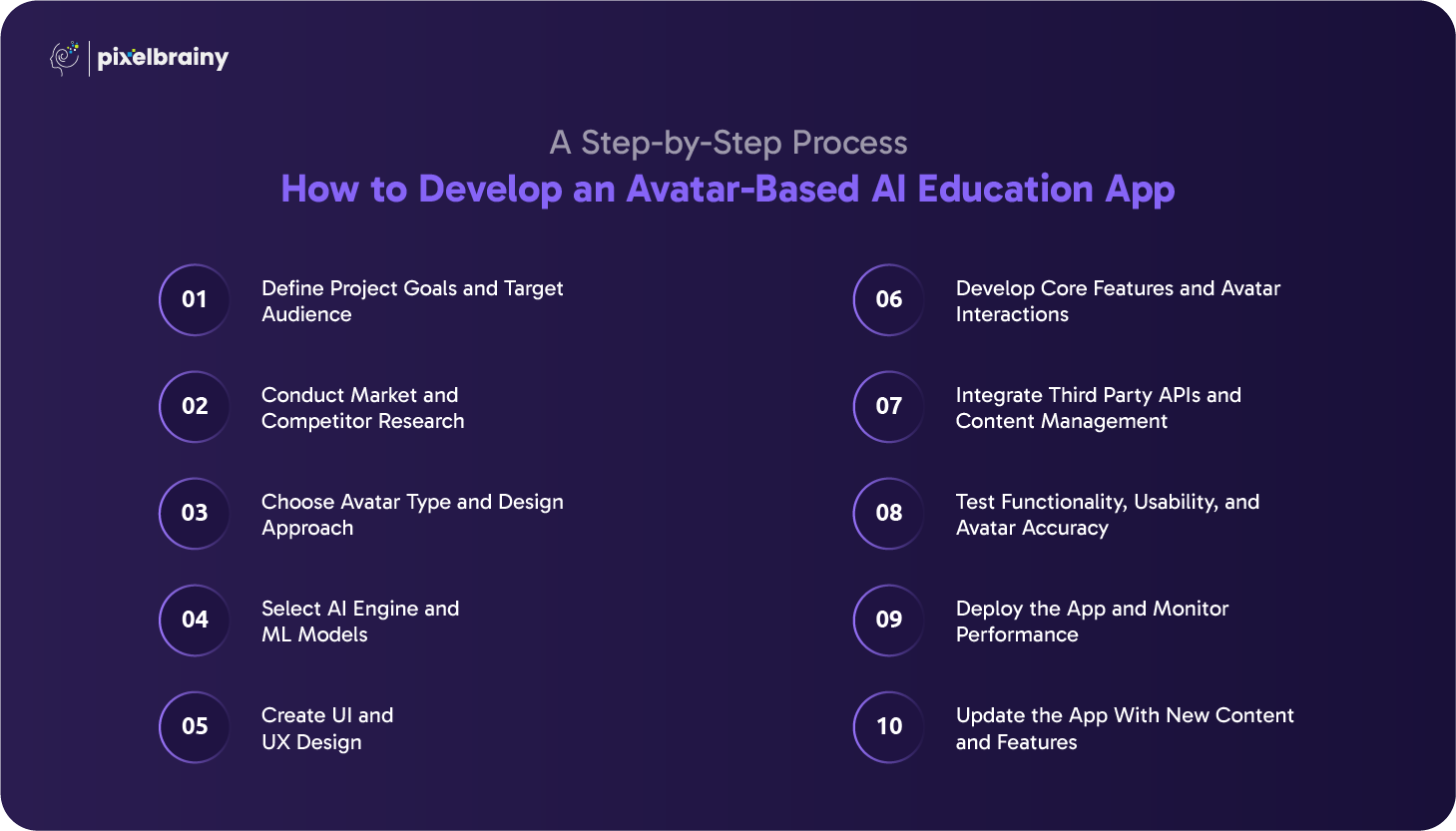
This step lays the foundation for the entire project. You start by identifying the purpose of the app, the learning challenges you want to address, and the core outcomes you expect from the avatar guided experience. It is important to understand whether the app will support K12 learners, college students, working professionals, therapists in training, or multilingual users. Each audience requires a different teaching style and different learning pathways. The clearer the goals, the easier it becomes to align design, content, and technology.
Aim of this step: To build a clear direction that guides vision, avatar behavior, educational content, and technical requirements.
This stage helps to understand the educational landscape you are entering. You review existing platforms, explore feature strengths and weaknesses, study learner expectations, and examine trends shaping the future of AI education. Research will show where existing apps fail to keep learners engaged and where there are unique opportunities to stand out. Many businesses also analyze pricing models, growth patterns, and adoption barriers to create a competitive advantage before development begins.
Aim of this step: To discover insights that allow your app to solve real problems and enter the market with a meaningful differentiator.
Choosing the right avatar is a major factor in building an Avatar Based AI Educational App. You must decide whether the avatar will appear friendly, formal, animated, simple, or highly realistic. The avatar’s teaching personality, facial expressions, voice, gestures, and emotional responses must all complement the learning goals. Working with a UI/UX design company at this stage helps you shape an avatar that feels approachable and human like without overwhelming the learner. This is also when you plan the avatar’s ability to respond, motivate, and guide at different learning stages.
Aim of this step: To create an avatar identity that enhances learning, builds trust, and supports users throughout the journey.
This step defines how intelligent your avatar will be. You explore natural language models, recommendation engines, voice synthesis tools, and speech recognition systems that match your app’s complexity. This is where you fine tune conversation flows, emotional responses, and contextual understanding. Many teams develop a PoC to test the accuracy of avatar communication before moving into full development. The chosen AI and ML systems must be scalable, fast, and capable of learning from user behavior over time.
Aim of this step: To ensure the avatar can think, respond, adapt, and support learners in a natural and reliable way.
Design plays a crucial role in keeping learners motivated. In this step, you design the entire app interface, including screens, menus, buttons, lesson transitions, animations, and visual layouts. The learning journey must feel smooth, predictable, and friendly, especially for young users or those new to digital learning. A clean and intuitive design reduces confusion and creates an environment where the avatar’s explanations feel more meaningful. The focus is on clarity, comfort, and accessibility for all learning levels.
Aim of this step: To create a visually appealing and intuitive experience that allows learners to focus fully on the educational content.
This is the heart of Avatar Based AI Educational App development. In this step, developers build all essential functionalities such as lessons, quizzes, real time voice interaction, analytics, content libraries, and adaptive learning models. Avatar behaviors like greeting, explaining, correcting, demonstrating, and encouraging are also programmed. This phase often begins with an MVP development version so teams can test early performance and gather feedback. The goal is to convert the planned concept into a working digital product learners can interact with.
Aim of this step: To turn the design and strategy into a fully functional platform that delivers meaningful learning experiences.
Also Read: Top 10 AI MVP Development Companies in USA
A strong app often relies on integrations such as payment gateways, AI voice engines, cloud storage, LMS systems, analytics tools, and communication services. This step ensures all these external tools work smoothly within the app. A robust content management system is also added, allowing educators to upload lessons, organize modules, and manage updates without technical support. These integrations increase efficiency and enhance the overall platform capabilities.
Aim of this step: To expand functionality and ensure reliable operations across all features and services.
Testing ensures every part of the app works as intended. You examine lesson flows, avatar responses, voice recognition accuracy, animations, navigation ease, and performance across different devices. Usability tests help confirm whether learners understand the interface and whether the avatar’s guidance feels natural. This step helps prevent disruptions post launch and ensures your app meets real learner expectations.
Aim of this step: To deliver a polished, stable, and user-friendly learning experience before entering the market.
After thorough testing, the app is released on platforms like Android, iOS, or web. Deployment is followed by close monitoring of user behavior, avatar performance, loading speed, lesson completion rates, and real time errors. These insights reveal how learners interact with the system in real conditions, which helps identify opportunities for fine tuning and improvement.
Aim of this step: To ensure a smooth launch and gather actionable data to enhance the future version of the app.
The final step is maintaining the app long term. Educational content needs constant updates to stay relevant, and the avatar must evolve with learners. This step focuses on improving conversation quality, adding new lesson categories, upgrading visuals, and optimizing performance. Regular updates also support better learning techniques as your user base grows.
Aim of this step: To keep the app valuable, fresh, and aligned with changing educational needs.
This expanded process offers a complete roadmap for building an Avatar Based AI Educational App that delivers meaningful, intelligent, and future ready learning experiences.
The cost to build an Avatar Based AI Education App typically ranges from $25,000 to $250,000+, depending on the app’s complexity, avatar realism, AI capabilities, and overall development scope. Different app types come with different budgets and timelines, making it easier to choose the right starting point based on your goals.
| App Type | Cost Range | Estimated Timeline | Description |
| Basic Avatar Based AI Education App (MVP) | $25,000 to $60,000 | 2 to 3 months | Includes essential features like a simple AI avatar, basic lessons, assessments, user accounts, and basic analytics. Ideal for early concept testing and validating learner interest. |
| Medium Avatar Based AI Education App | $60,000 to $150,000 | 4 to 7 months | Offers more advanced avatar expressions, stronger conversational AI, gamification features, multilingual support, and a smoother content management system. Suitable for growing EdTech startups and training organizations. |
| Advanced Avatar Based AI Education App | $150,000 to $250,000+ | 8 to 14 months | Includes hyper realistic avatars, highly natural voice interaction, adaptive learning engines, AR or VR modules, emotion detection, and enterprise level cloud integrations. Designed for large scale learning platforms and enterprises. |
Also Read: AI Avatar Development Cost: Know How Much Your Digital Avatar Will Cost
Building an Avatar Based AI Education App requires a strong combination of development tools, frameworks, and cloud technologies that work together to support real time interaction, intelligent learning behavior, and smooth user experiences. Since these apps rely heavily on AI and avatar animation, selecting the right tech stack is one of the most important steps in the development journey. When each layer of technology is chosen carefully, the final platform becomes more reliable, scalable, and capable of delivering a personalized learning environment.
The tools and technologies below represent what most modern development teams use to ensure that the app performs efficiently, handles complex AI tasks, and offers a seamless experience for learners across different age groups and industries.
| Category | Tools / Technologies | Explanation |
| Programming Languages | Python, JavaScript, TypeScript, Swift, Kotlin | These languages form the backbone of both frontend and backend development. Python supports AI algorithms, while Swift and Kotlin are used for mobile app development. JavaScript and TypeScript help build responsive and interactive web interfaces. |
| AI and ML Frameworks | TensorFlow, PyTorch, OpenAI APIs, Google Dialogflow | These frameworks enable avatar intelligence, decision making, conversational ability, and adaptive learning. They help the system understand user input, respond naturally, and evolve as learners progress. |
| Avatar Creation Tools | Unity, Unreal Engine, Blender, Ready Player Me | Used to design expressive avatars with fluid movement and realistic facial animations. These tools also support 2D and 3D avatar creation, making them suitable for different styles of digital teaching assistants. |
| Speech and Voice Technologies | Azure Cognitive Services, Google Speech AI, Amazon Polly | These tools allow learners to speak with the avatar, receive natural voice replies, and practice communication based lessons. They ensure smooth voice recognition and high quality speech output. |
| Frontend Development | React Native, Flutter, React.js, SwiftUI | These frameworks help developers design intuitive, user friendly interfaces for mobile apps and web platforms. They ensure that the learning experience feels fast, clean, and visually comfortable for long sessions. |
| Backend Development | Node.js, Django, Spring Boot, Ruby on Rails | Backend frameworks handle user authentication, lesson delivery, content synchronization, AI processing, and communication between the avatar and user. They ensure smooth functioning of all app features. |
| Databases | MongoDB, PostgreSQL, MySQL, Firebase Firestore | Databases store all user profiles, progress reports, quiz results, content files, and behavioral patterns that help the avatar adapt. They support fast content retrieval and secure data management. |
| Cloud Services | AWS, Google Cloud, Microsoft Azure | Cloud platforms host the app, manage scalability, run AI computations, and store large amounts of content. They ensure the app performs consistently even with a large number of active learners. |
| Content Management | Strapi, WordPress Headless CMS, Moodle, Custom CMS | CMS tools allow educators to add, edit, and manage learning materials like videos, quizzes, lesson scripts, and assignments without technical help. This makes the app easier to maintain long term. |
| API Integrations | REST APIs, GraphQL, Payment Gateway APIs, LMS APIs | These integrations connect external services such as payment processing, learning management systems, cloud libraries, or communication platforms to enhance app functionality. |
| Testing and QA Tools | Jest, Selenium, Appium, Postman | These tools help test avatar interactions, screen flows, voice responses, performance, and overall stability. They ensure a smooth user experience with minimal errors. |
| Analytics and Monitoring | Google Analytics, Mixpanel, Firebase Analytics | Analytics tools track learner behavior, session duration, feature usage, and achievement patterns. This helps developers and instructors understand what works well and what needs improvement. |
| Security Tools | JWT, OAuth 2.0, SSL Encryption, Identity Access Management | Security tools protect user information, ensure safe login, prevent unauthorized access, and maintain compliance with privacy regulations. |
A well-chosen tech stack is essential for developing an Avatar Based AI Education App that feels intelligent, stable, secure, and ready to grow with learner demands.
Also Read: Developing an AI Digital Twin Avatar Generator Platform: A Complete Guide
To understand the true potential of Avatar Based AI Education App development, it helps to look at real platforms that are already transforming how learners interact with digital content. These examples show how avatars can support tutoring, training, language learning, emotional development, and skill-based education. Each platform uses AI avatars in a unique way, proving that this technology can be adapted to many learning environments.
Below are some of the most recognized and impactful real world use cases.
Duolingo integrates animated characters that act like avatars to guide learners through language lessons. These characters react to answers, celebrate progress, and encourage learners to continue practicing. While Duolingo does not use hyper realistic avatars, it demonstrates how simple, expressive characters can significantly improve engagement. The playful design and adaptive exercises show how avatars can create a friendly learning atmosphere for millions of users.
Key takeaway: Even a minimally animated avatar can dramatically increase motivation and retention in digital learning environments.
Replika uses AI avatars to simulate natural conversation and emotional intelligence. While originally built as a personal companion, the app has become a powerful example of how avatars can support communication training, language practice, and emotional awareness exercises. Users can speak with the avatar, receive empathetic responses, and refine their communication skills.
Key takeaway: An avatar that understands mood, tone, and emotional cues can offer meaningful learning experiences beyond academic subjects.
VirtualSpeech uses realistic avatars inside VR classrooms and meeting environments. Learners practice public speaking, sales pitches, interviews, and workplace communication through guided avatar interactions. The immersive environment allows learners to build confidence, reduce anxiety, and practice skills that usually require real human audiences.
Key takeaway: Avatars combined with VR technology create life like training scenarios that help learners strengthen soft skills and real world communication abilities.
Synthesis uses AI driven digital instructors to help children develop problem solving and decision making abilities. The platform introduces learners to simulations where avatars guide them through challenges that mimic real world scenarios. The emphasis is on strategic thinking rather than memorization, making it a powerful example of next generation learning.
Key takeaway: Avatars can deliver simulation based learning that builds critical thinking and leadership skills from a young age.
Meta has introduced expressive 3D avatars for virtual meetings, training workshops, and educational simulations. These avatars make collaboration feel more natural in VR spaces. Users can attend classes, participate in discussions, and practice hands on skills in virtual environments shaped by AI and interactive avatars.
Key takeaway: 3D avatars can enable large scale, immersive learning experiences that mimic real world interactions and group learning.
Google has been experimenting with conversational AI tutors that use avatar like interfaces for assisting students with homework, explanations, and personalized prompt based instruction. These tools demonstrate how AI can adapt to a learner’s pace, answer questions instantly, and simplify complex subjects using natural dialogue.
Key takeaway: AI avatars can make digital tutoring feel more approachable, responsive, and student centered.
Byju’s uses animated characters and interactive visuals to teach K12 subjects in a storytelling style. The avatars help simplify topics, explain step by step processes, and keep younger students engaged through visual cues. This method has helped Byju’s reach millions of learners worldwide.
Key takeaway: Avatar led storytelling can make academic subjects easier and more enjoyable for school students.
These real-world examples show that Avatar Based AI Education Apps are not limited to one style of teaching. They can support emotional learning, communication skills, academic tutoring, corporate training, VR simulations, and more. This versatility makes avatar-based education one of the most promising innovations shaping the future of learning.
Also Read: How to Build an AI Virtual Character Chat App: Features and Cost
While Avatar Based AI Education App development opens the door to exciting learning possibilities, the journey is not without challenges. Building an intelligent avatar driven system requires a careful mix of technical precision, educational design, and user understanding. Below are the most common challenges and practical ways to overcome them.
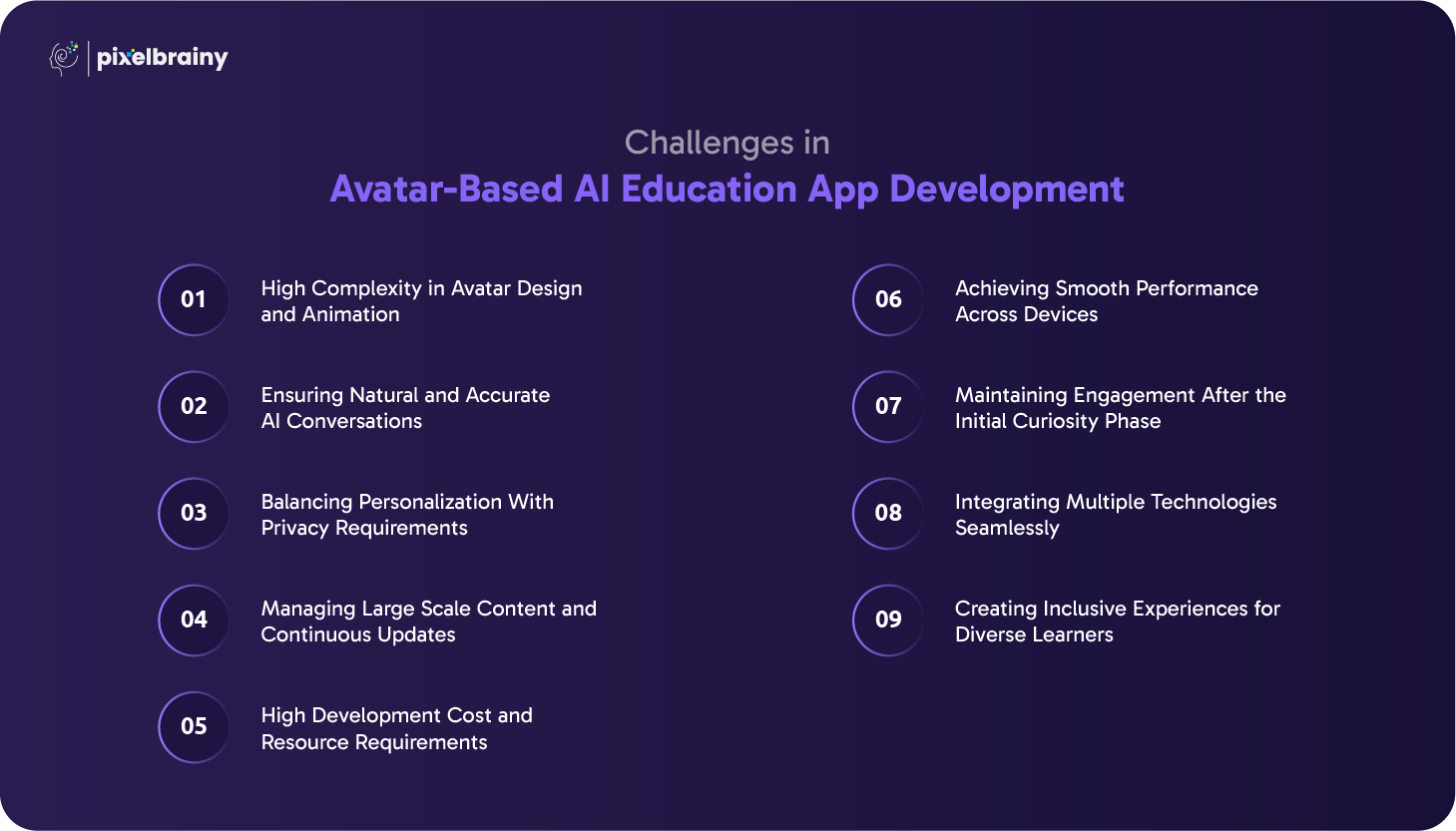
Creating a lifelike avatar with natural expressions, gestures, and voice responses is one of the most demanding parts of development. This involves detailed 2D or 3D modeling, motion capture, lip sync technology, and behavior mapping. Poorly designed avatars can feel robotic and reduce learner engagement.
How to overcome it: Use established avatar creation engines like Unity, Unreal Engine, or Ready Player Me to streamline the animation process. Begin with a simple avatar version, then gradually enhance realism. Regular user testing also helps refine facial expressions, voice tone, and interaction patterns.
AI powered avatars must understand questions correctly and respond with clarity. Inaccurate or irrelevant responses can frustrate learners and damage trust. Conversational AI also needs continuous updates to stay context aware and educationally accurate.
How to overcome it: Train AI models with high quality educational datasets and test them across multiple age groups and learning levels. Use tools like OpenAI conversational models, Google Dialogflow, or custom NLP pipelines. Continuously monitor learner queries to improve response logic.
Personalized learning requires collecting data such as progress, preferences, and mistake patterns. However, storing and analyzing this data comes with privacy and compliance challenges. If mishandled, it can expose sensitive user information.
How to overcome it: Implement strong encryption, role-based access, secure cloud storage, and compliance frameworks such as GDPR, FERPA, or COPPA. Only collect data that is essential for learning improvement and allow users to control their privacy settings.
Avatar based learning systems require dynamic and varied content like videos, animations, quizzes, simulations, and voice explanations. Keeping this content updated and aligned with learning goals is a long-term challenge.
How to overcome it: Integrate a robust content management system that allows instructors to upload and modify lessons easily. Build content templates that can be reused. Assign periodic content update cycles to ensure freshness and relevance.
Building an Avatar Based AI Education App can be expensive due to AI modeling, animation design, voice technology, backend systems, and cloud usage. Small and mid-sized businesses often struggle to allocate a complete budget upfront.
How to overcome it: Start with an MVP version that includes essential features and a simplified avatar. This helps validate demand before scaling. Use third party APIs instead of custom AI models wherever possible. Adopt cloud services that allow pay as you grow instead of fixed heavy infrastructure.
Avatars, animations, and real time AI processing can slow down performance, especially on low end devices. Lag, loading delays, or poor visualization can reduce user satisfaction.
How to overcome it: Optimize media files, compress avatar animations without reducing quality, and use efficient caching. Conduct performance tests across various devices and networks. Offload heavy AI computation to cloud servers to reduce load on user devices.
Many learners get excited initially, but lose interest if the avatar or lessons become repetitive. Keeping users engaged long term is a common challenge for EdTech platforms.
How to overcome it: Introduce gamification, new avatar personalities, evolving difficulty levels, seasonal content updates, and real-world tasks. The more variety and progression a learner see, the more motivated they stay.
An Avatar Based AI Education App requires the integration of machine learning models, voice engines, animation tools, cloud systems, content modules, and analytics platforms. Poor integration can lead to errors and inconsistent user experiences.
How to overcome it: Use modular architecture and well documented APIs. Ensure all integrated tools follow consistent data structures and communication standards. Regular technical audits help prevent future breakdowns.
Different learners have different abilities, speeds, and comfort levels. Designing the avatar to support visual learners, auditory learners, beginners, and advanced learners equally can be challenging.
How to overcome it: Provide multiple learning modes like voice only, text only, visual demonstrations, slow mode explanations, and multilingual support. Build options that allow learners to control pace, style, and difficulty.
With the right strategy and tools, these challenges can be transformed into opportunities to build a stronger, more impactful Avatar Based AI Education App that supports learners in meaningful and personalized ways.
Choosing the right AI development company can greatly influence the quality, scalability, and long-term success of your project. When it comes to Avatar Based AI Education App Development, PixelBrainy brings together deep technical expertise, strong design capabilities, and a clear understanding of modern learning science. Whether your goal is to make an Avatar Based AI Education App from scratch or enhance an existing platform, PixelBrainy ensures a smooth and future ready development process.
PixelBrainy focuses on building personalized AI learning experiences that feel natural, interactive, and reliable. Their team covers every stage of the development of Avatar Based AI Education App solutions, including avatar design, AI modeling, backend architecture, content automation, UI design, and cloud deployment. With a combination of innovation and structured execution, they help businesses launch Avatar Based AI Education App systems that stand out in the fast-growing EdTech landscape.
PixelBrainy has hands on experience working with conversational AI, adaptive learning engines, NLP, voice synthesis, and avatar animation. Their ability to combine technical excellence with educational usability gives clients a significant competitive edge.
From 2D characters to hyper realistic animated avatars, PixelBrainy designs mentor personalities that engage, motivate, and guide learners. Their designs enhance emotional connection while supporting different learning styles.
PixelBrainy handles everything from concept strategy to launch and performance optimization. This includes UI design, AI model integration, lesson flow architecture, testing, and ongoing updates. Clients get a single unified team working on every part of their idea.
Whether you are building a platform for schools or planning a global education product, PixelBrainy ensures the system is scalable, secure, and cloud optimized. Their architecture supports continuous content updates, new features, and growth without performance issues.
PixelBrainy adapts to your working style, timelines, and business goals. They maintain clear communication throughout the project, giving regular updates, demos, and performance insights. This makes the development experience predictable and stress free.
A mid-sized education organization approached PixelBrainy to modernize their outdated learning platform. Due to confidentiality agreements, the client name cannot be shared.
Challenge: The client wanted to replace their traditional video-based training system with an interactive solution that could offer real time guidance, personalized lesson flows, and conversational learning support. Their main goal was to make learning more engaging for students aged 10 to 15 and reduce heavy instructor workload.
PixelBrainy’s Solution: PixelBrainy developed an AI powered avatar tutor that could explain lessons, answer questions, assess progress, and recommend new content automatically. The app included 3D avatar animations, natural voice interactions, adaptive learning logic, and a flexible content management system. They also optimized the interface to support low bandwidth environments, making it accessible for a wider audience.
Impact Delivered:
This case demonstrates how PixelBrainy can transform traditional learning systems into interactive AI driven experiences that deliver measurable outcomes.
If you are planning to build or launch Avatar Based AI Education App solutions, PixelBrainy provides the technical strength, creativity, and execution quality needed to turn your vision into a market ready product.
From above, it is clear that Avatar Based AI Education App development is shaping the future of digital learning by bringing human-like interaction, adaptive instruction, and immersive experiences into a single intelligent system. As learners seek more personalized and engaging platforms, the demand for advanced AI driven education solutions continues to rise.
For businesses, educators, and EdTech innovators, this is the ideal time to invest in creating an AI powered avatar learning environment that supports growth, accessibility, and long term value. With the right strategy, technology, and development partner, you can build a platform that transforms how learners study, practice, and progress.
Ready to turn your idea into a powerful AI education solution? Book an appointment with PixelBrainy and start your development journey today.
An Avatar Based AI Education App uses an AI powered digital tutor to deliver lessons, interact with learners, answer questions, and personalize the learning journey. These avatars act as virtual instructors who simulate human like teaching through voice, expressions, and adaptive learning capabilities.
The development timeline varies depending on features and complexity. A basic MVP may take 2 to 3 months, while a fully advanced app with hyper realistic avatars, adaptive learning engines, and AR or VR modules can take 8 to 14 months to complete.
This technology benefits K12 education, universities, corporate training, language learning, healthcare training, skill development institutes, certification providers, and any organization that wants to offer interactive and scalable learning experiences.
Not always. You can use existing AI engines, APIs, and speech technologies to reduce cost and time. However, custom models are recommended for highly specialized or domain specific learning experiences where accuracy and personalization are critical.
Cost depends on avatar realism, AI capabilities, learning features, animation quality, content volume, platform choice, backend infrastructure, and ongoing maintenance needs. More advanced or interactive features generally require a higher budget.
Yes. AI avatars can adapt lessons for visual, auditory, reading based, and kinesthetic learners. Features such as voice interaction, animated explanations, quizzes, and 3D models help deliver a personalized experience for all learning preferences.

About The Author
Sagar Bhatnagar
Sagar Sahay Bhatnagar brings over a decade of IT industry experience to his role as Marketing Head at PixelBrainy. He's known for his knack in devising creative marketing strategies that boost brand visibility and market influence. Sagar's strategic thinking, coupled with his innovative vision and focus on results, sets him apart. His track record of successful campaigns proves his ability to utilize digital platforms effectively for impactful marketing efforts. With a genuine passion for both technology and marketing, Sagar continuously pushes PixelBrainy's marketing initiatives to greater success.

Working with the PixelBrainy team has been a highly positive experience. They understand the design requirements and create beautiful UX elements to meet the application needs. The dev team did an excellent job bringing my vision to life. We discussed usability and flow. Sagar worked with his team to design the database and begin coding. Working with Sagar was easy. He has the knowledge to create robust apps, including multi-language support, Google and Apple ID login options, Ad-enabled integrations, Stripe payment processing, and a Web Admin site for maintaining support data. I'm extremely satisfied with the services provided, the quality of the final product, and the professionalism of the entire process. I highly recommend them for Android and iOS Mobile Application Design and Development.

Great experience working with them. Had a lot of feedback and I found that unlike most contractors they were bugging me for updates instead of the other way around. They were extremely time conscience and great at communicating! All work was done extremely high quality and if not on time, early! They were always proactive when it comes to communication and the work is great/above par always. Very flexible and a great team to work with! Goes above and beyond to present us with multiple options and always provides quality. Amazing work per usual with Chitra. If you have UI/UX or branding design needs I recommend you go to them! Will likely work with them in the future as well, definitely recommended!

PixelBrainy is a joy to work with and is a great partner when thinking through branding, logo, and website layout. I appreciate that they spend time going into the "why" behind their decisions to help inform me and others about industry best practices and their expertise.

I hired them to design our software apps. Things I really like about them are excellent communication skills, they answer all project suggestions and collaborate right away, and their input on design and colors is amazing. This project was complex and needed patience and creativity. The team is amazing to do business with. I will be using them long-term. Glad to see there are some good people out there. I was afraid to try and outsource my project to someone but I am glad I met them! I really can't say enough. They went above and beyond on this project. I am very happy with everything they have done to make my business stand out from the competition.

It was great working with PixelBrainy and the team. They were very responsive and really owned the project. We'll definitely work with them again!

I recently worked with the PixelBrainy team on a project and I was blown away by their communication skills. They were prompt, clear, and articulate in all of our interactions. They listened and provided valuable feedback and suggestions to help make the project a success. They also kept me updated throughout the entire process, which made the experience stress-free and enjoyable.

PixelBrainy is very good at what it does. The team also presents themselves very professionally and takes care of their side of things very well. I could fully trust them taking up the design work in a timely and organised manner and their attention to detail saved us lots of effort and time. This particular project was quite intense and the team showed that they function very well under pressure. Very much looking forward to working with her again!

It's always an absolute pleasure working with them. They completed all of my requests quickly and followed every note I had for them to a T, which made our process go smoothly from start to finish. Everything was completed fast and following all of the guidelines. And I would recommend their services to anyone. If you need any design work done in the future, PixelBrainy should be your first call!

They took ownership of our requirements and designed and proposed multiple beautiful variants. The team is self-motivated, requires minimum supervision, committed to see-through designs with quality and delivering them on time. We would definitely love to work with PixelBrainy again when we have any requirements.

PixelBrainy was a big help with our SaaS application. We've been hard at work with a new UI/UX and they provided a lot of help with the designs. If you're looking for assistance with your website, software, or mobile application designs, PixelBrainy and the team is a great recommendation.

PixelBrainy designers are amazing. They are responsive, talented, and always willing to help craft the design until it matches your vision. I would recommend them and plan to continue them for my future projects and more!!!

They were awesome! Did a good job fast, and good communication. Will work with them again. Thank you

Creative, detail-oriented, and talented designers who take direction well and implement changes quickly and accurately. They consistently over-delivered for us.

PixelBrainy team is very talented and creative. Great designers and a pleasure to work with. PixelBrainy is an excellent communicator and I look forward to working with them again.

PixelBrainy has a very talented design team. Their work is excellent and they are very responsive. I enjoy working with them and hope to continue on all of our future projects.


Transform your ideas into reality with us.
Across these industries, each engagement brings unique challenges, from early-stage product development to scaling complex systems, helping us build a practical understanding of real-world product environments.