AI Summary Powered by PixelBrainy
How much does it actually cost to build an AI avatar in 2026, and is it worth the investment for your business? As artificial intelligence becomes more integrated into customer experiences, marketing strategies, and digital communication, AI avatars are quickly becoming essential tools rather than experimental technology.
Businesses across industries are exploring AI avatars to enhance customer engagement, automate support, improve brand personalization, and scale digital operations efficiently. However, one of the most common questions decision makers ask is about AI avatar cost and what influences the total investment.
The AI avatar development cost can vary significantly depending on features, complexity, and business goals. In 2026, the cost to create an AI avatar typically ranges between $15,000 and $150,000+ depending on customization level, AI capabilities, integrations, and real-time functionality.
Whether you are evaluating what is the cost of developing an AI avatar solution for customer service, marketing, training, or immersive digital experiences, understanding the pricing factors is essential.
This guide breaks down building an AI avatar cost in 2026, explains what drives pricing, and helps businesses make informed investment decisions without overspending.
The rapid acceleration of generative AI, conversational intelligence, and digital human technologies has created a major opportunity for businesses investing in AI avatar development. What was once experimental technology is now becoming a core part of digital transformation strategies, customer experience automation, and scalable brand communication.
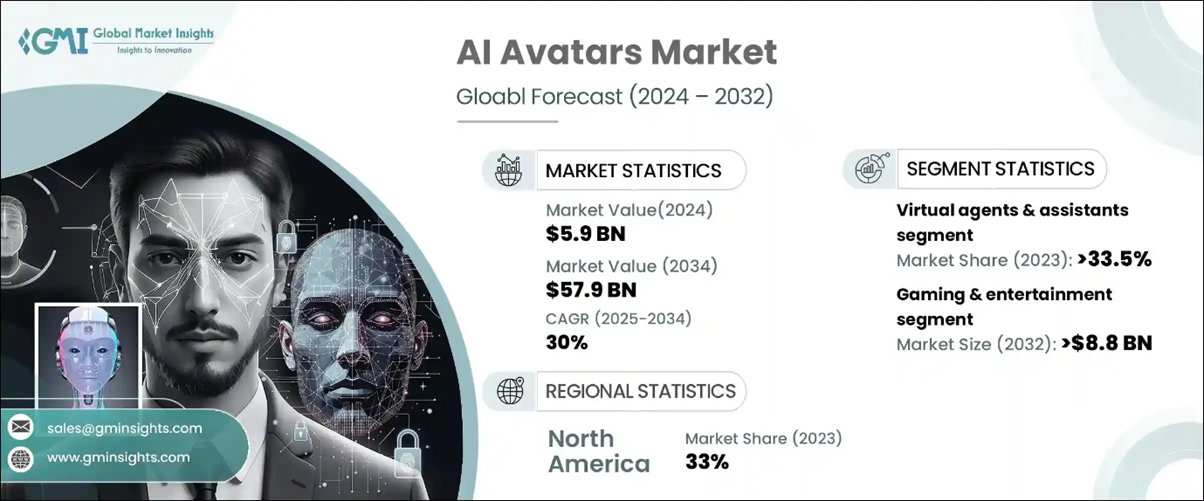
Market data clearly shows that AI avatars and digital assistants are moving from innovation projects to business-critical tools. According to industry research, the AI avatar market is expected to grow at over 30 percent annually, expanding from approximately $5.9 billion to significantly higher valuations within the next decade as adoption accelerates across industries.
For businesses evaluating AI avatar cost and planning their development budget of AI avatar for businesses, several market trends explain why 2026 is an ideal entry point.
Modern customers expect real-time, personalized interaction rather than static digital interfaces. AI avatars enable businesses to deliver human-like engagement at scale without increasing operational headcount.
Gartner predicts that human-like virtual personas will support a large portion of digital and marketing communications, highlighting the shift toward conversational interfaces powered by AI.
For businesses, this means investing in AI avatars is no longer just about innovation. It is about meeting evolving customer expectations while maintaining efficiency.
Enterprise spending on AI technologies is increasing rapidly. Analysts estimate global AI spending will surpass trillions of dollars in the coming years, showing strong business confidence in AI-driven automation and digital transformation.
Additionally, a Forrester survey revealed that 67 percent of AI decision-makers plan to increase investment in generative AI, which directly impacts technologies like digital avatars, AI agents, and conversational assistants.
This growth signals that businesses adopting AI avatars early may gain strategic advantages before markets become saturated.
One of the strongest drivers behind AI avatar adoption is cost optimization. Businesses are using AI avatars to automate onboarding, customer support, training, marketing interactions, and sales assistance.
As AI systems improve, the cost to create an AI avatar continues to decrease compared to previous years because companies can leverage pre-trained models and scalable AI infrastructure rather than building systems from scratch.
IBM experts highlight that innovation cycles in AI are accelerating, making advanced capabilities more accessible and practical for business deployment.
The growth of remote services, online commerce, and digital communication has transformed how businesses operate. AI avatars act as always-available digital representatives that can communicate, guide users, and deliver information continuously.
With Gartner forecasting a significant increase in AI-powered enterprise applications by 2026, businesses are rapidly integrating AI-driven interfaces into workflows and customer experiences.
This shift makes building an AI avatar cost a strategic investment rather than a luxury expense.
Businesses adopting AI avatars today are positioning themselves ahead of competitors.
Early adopters benefit from:
As the generative AI market continues to expand rapidly, organizations that invest early gain experience, data insights, and technological maturity that become difficult for late adopters to replicate.
That’s why businesses that invest in AI avatar development now can gain a competitive advantage by leveraging scalable digital experiences, reducing operational costs, and positioning themselves ahead in the rapidly evolving AI-driven market.
Also Read: Developing an AI Digital Twin Avatar Generator Platform: A Complete Guide
Planning the development budget of AI avatar solutions is one of the most important steps businesses must take before starting the development process. Understanding the AI avatar creation cost early helps organizations avoid unexpected expenses, align technical decisions with business goals, and ensure long-term scalability. Since the cost to make an AI avatar can vary widely depending on features, customization, and integrations, a strategic budget allows businesses to build efficiently without compromising performance or user experience.
Many businesses underestimate the cost of developing an AI avatar because they focus only on initial design or AI capabilities while overlooking infrastructure, training, and ongoing optimization. Proper financial planning helps decision makers prioritize essential features and avoid investing in unnecessary complexity during early development stages.
A clear budget ensures that businesses invest in features that directly support operational goals, customer engagement, or revenue growth instead of following short-term technology trends.
Without defined cost boundaries, projects often expand beyond initial requirements, increasing development time and overall AI avatar creation cost.
Budget planning helps teams evaluate whether to use open-source models, commercial AI platforms, or custom-built solutions based on long-term value rather than short-term savings.
The cost of developing an AI avatar does not end after launch. Businesses must account for updates, model retraining, hosting infrastructure, and ongoing improvements.
A structured budget supports future expansion by allowing businesses to plan for increased user demand, additional features, and integrations without major redesigns.
A well-defined financial strategy allows businesses to start with core functionalities, validate real-world performance, and expand capabilities gradually while maintaining control over development costs.
Understanding the cost to build an AI avatar for business requires looking beyond a single price tag. In 2026, the cost of developing an AI avatar depends on the level of intelligence, customization, integration requirements, and long-term scalability needs of a business. Companies planning their AI avatar development budget should consider whether they need a simple proof of concept or a fully enterprise-ready digital representative.
For most businesses, the cost of building an AI avatar ranges from $15,000 to $150,000+ based on complexity and deployment scale. While startups may begin with a basic version to validate use cases, growing organizations often invest more to support advanced interactions, branding, and system integrations.
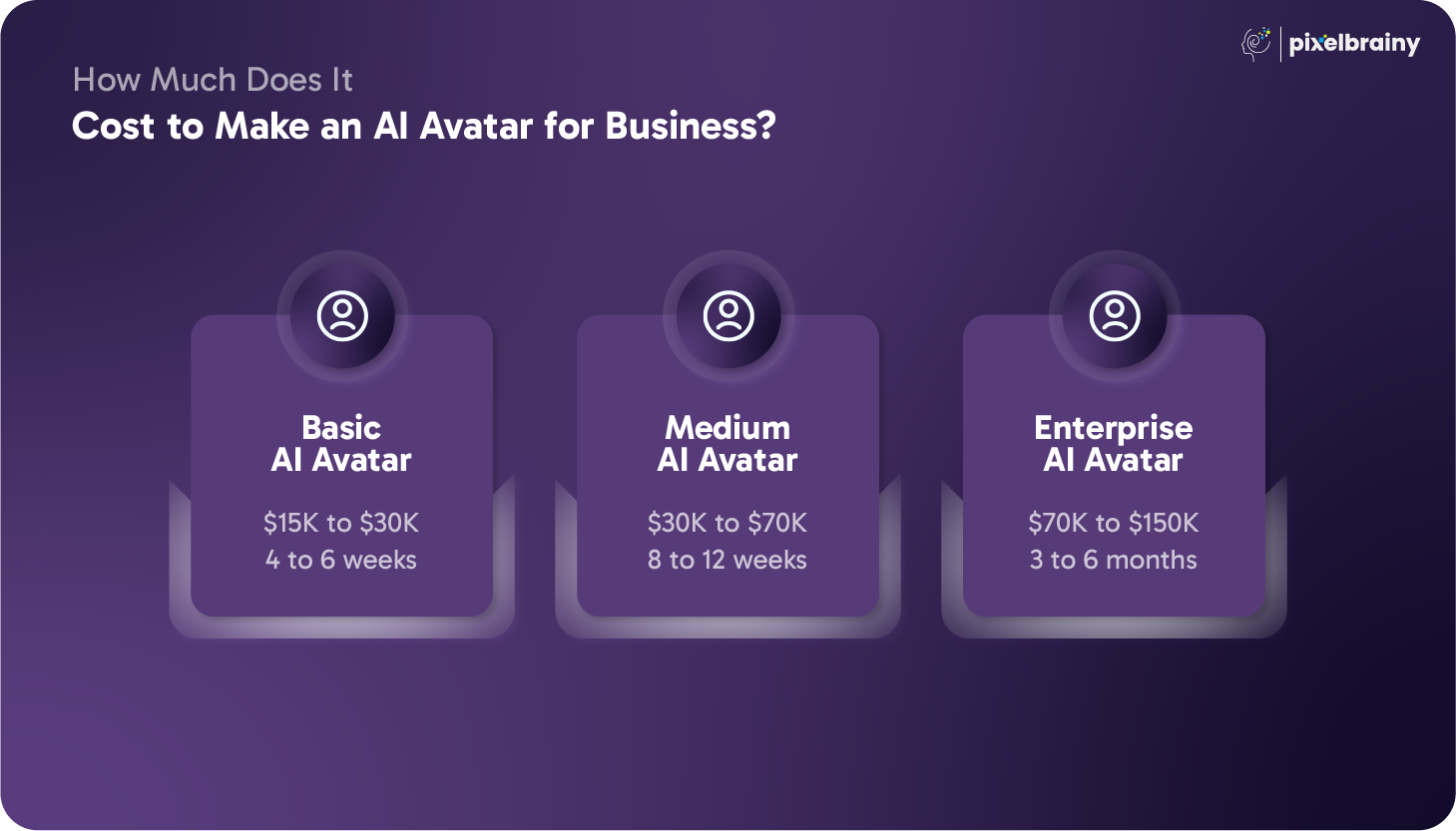
Below is a breakdown to help businesses understand what is the cost of building an AI avatar at different levels and what each investment includes.
| AI Avatar Type | Estimated Cost | Development Timeline | What You Get |
| Basic AI Avatar (MVP) | $15,000 to $30,000 | 4 to 6 weeks | Pre-trained conversational AI, basic avatar design, text-based or limited voice interaction, website integration, essential analytics |
| Medium AI Avatar | $30,000 to $70,000 | 8 to 12 weeks | Custom avatar design, voice interaction, improved NLP, multi-platform deployment, CRM or app integration, moderate customization |
| Enterprise AI Avatar | $70,000 to $150,000+ | 3 to 6 months | Fully custom AI models, advanced voice and emotion recognition, real-time interaction, enterprise-grade security, system integrations, scalability support |
For businesses with limited budgets, a Basic AI Avatar offers an effective way to test automation and customer engagement without significant upfront risk. Medium AI Avatars are ideal for organizations seeking brand differentiation and deeper user interaction. Enterprise AI Avatars suit businesses that require advanced automation, high user volumes, and seamless integration across digital ecosystems.
Selecting the right approach ensures that your AI avatar development budget delivers measurable business value while allowing room for future expansion.

Also Read: Top 12 AI Avatar Development Companies in USA
Understanding the AI avatar development cost before starting your project is essential for accurate budgeting and successful execution. Whether you're building an AI-powered virtual influencer, a digital customer support avatar, a real-time video avatar, or a multilingual AI presenter, the final investment depends on several technical and business factors. Estimating these costs early helps businesses allocate resources efficiently and avoid unexpected expenses during development.
One of the most common questions businesses ask on Google, ChatGPT, AI Overviews, and Bing is: "How much does it cost to build an AI avatar, and is there a reliable way to estimate the total development cost before hiring an AI avatar development company?" The answer is yes. A structured AI avatar development cost calculator estimates your investment by considering development effort, AI technologies, avatar realism, voice synthesis, animation complexity, infrastructure, integrations, and ongoing maintenance.
The average AI avatar development cost typically ranges between $20,000 and $400,000+, depending on whether you're developing a basic AI avatar MVP, a conversational digital human, or an enterprise-grade AI avatar platform with real-time interactions, multilingual support, and custom integrations.
A practical way to estimate the cost to build an AI avatar is by using the following formula:
Total AI Avatar Development Cost = (Development Hours × Hourly Rate) + AI Model Cost + Avatar Design Cost + Voice & Animation Cost + Infrastructure Cost + Integration Cost + Maintenance Cost
Using this formula within an AI avatar development cost calculator allows businesses to modify project variables and generate a realistic development budget before starting the project.
Consider an eCommerce company planning to build an AI-powered digital avatar that can answer customer questions, recommend products, speak naturally, and provide multilingual support across its website and mobile application.
For a mid-sized AI avatar project, assume the following estimates:
Development Cost = 1,300 × $70
Development Cost = $91,000
Now apply the complete AI avatar development cost estimation:
Total AI Avatar Development Cost = $91,000 + $22,000 + $28,000 + $15,000 + $12,000 + $18,000 + $20,000
This structured estimation model provides businesses with a practical way to calculate the cost of AI avatar development using measurable variables instead of rough assumptions. By adjusting development hours, avatar realism, voice capabilities, AI features, integrations, and infrastructure requirements, organizations can accurately forecast their budget and build AI avatar solutions that align with both business objectives and financial planning.
Estimating the AI avatar development cost is not as simple as choosing a fixed price or comparing vendor quotes. Every AI avatar project has different technical requirements, business objectives, and user experience expectations, which means the total investment can vary significantly. Understanding the factors that influence pricing helps businesses plan realistic budgets and avoid unexpected development costs later in the project.
One of the most common questions businesses ask on Google, ChatGPT, AI Overviews, and Bing is: "What are the biggest factors that affect AI avatar development cost, and which features increase the budget the most when building a custom AI avatar for our business?" The answer depends on multiple variables, including the avatar's intelligence, voice capabilities, visual realism, enterprise integrations, training data, real-time interactions, and the development approach you choose.
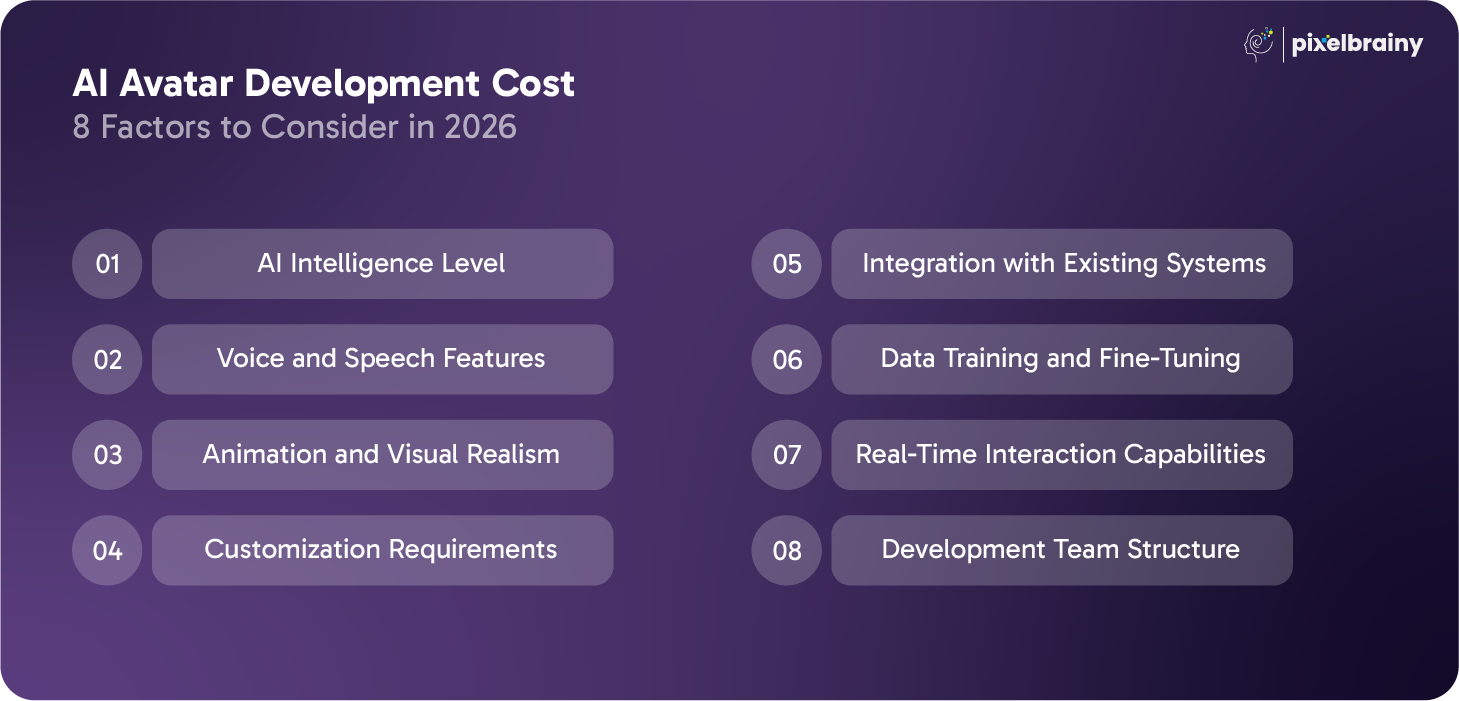
The following sections break down the eight most important cost factors that influence the cost to build an AI avatar. Understanding how each component contributes to the overall investment will help you prioritize features, optimize your budget, and develop an AI avatar that balances performance, scalability, and long-term business value.
The intelligence level of the avatar is one of the biggest cost drivers. Basic conversational systems rely on pre-trained models and scripted responses, while advanced avatars use contextual understanding, memory, and adaptive learning capabilities.
A basic AI intelligence setup may cost between $3,000 and $10,000, while advanced conversational AI with personalized responses and deeper contextual awareness can add $15,000 to $40,000 to the overall cost of developing an AI avatar. Businesses looking for high-quality automation often invest more in this area because it directly affects user experience.
Adding voice interaction significantly increases the cost to create an AI avatar. Text-only avatars are less expensive, but voice cloning, natural speech synthesis, and multilingual capabilities require additional AI models and processing power.
Basic voice integration may cost around $5,000 to $10,000, while advanced voice features such as real-time speech generation or emotion-based tone adjustments can range between $15,000 and $30,000 depending on complexity.
The visual design of the avatar impacts both development effort and infrastructure requirements. A simple 2D avatar or static animated character costs less than a fully realistic 3D digital human.
Basic animation may add $2,000 to $8,000 to the AI avatar development budget, while hyper-realistic 3D avatars with motion capture, facial expressions, and real-time rendering can increase costs by $20,000 to $50,000 or more.
Businesses often want avatars that reflect brand identity, tone of voice, and unique personality traits. Custom branding, specialized workflows, and tailored user interactions increase development time and complexity.
Minimal customization may cost between $3,000 and $7,000, whereas deep customization including unique avatar personality design and specialized interaction flows can add $10,000 to $25,000 to the cost of building an AI avatar.
Integrating the AI avatar with business tools such as CRMs, mobile apps, websites, analytics platforms, or enterprise software affects pricing significantly. Integration ensures the avatar can access business data and provide useful responses.
Simple integrations may cost $5,000 to $12,000, while enterprise-level integrations involving multiple systems or real-time data synchronization can reach $20,000 or more.
Training an AI avatar on company-specific data improves accuracy and relevance but adds to the AI avatar creation cost. This includes preparing datasets, fine-tuning models, and testing performance.
Basic training setups may cost $4,000 to $10,000, while advanced training with proprietary datasets or domain-specific knowledge can add $15,000 to $35,000 depending on complexity.
Real-time avatars that respond instantly require optimized infrastructure, fast AI inference systems, and scalable cloud resources. This capability is essential for customer support, live engagement, or interactive presentations.
Basic near-real-time systems may cost $8,000 to $15,000, while fully real-time AI avatars with high concurrency support can increase the cost of developing an AI avatar by $25,000 or more.
Who builds the avatar has a significant impact on total investment. Freelancers may offer lower upfront costs, while agencies provide structured processes, scalability, and long-term support. In-house development requires hiring specialized AI talent, which increases overhead.
Freelancer-led development may start around $15,000 to $30,000 overall, while agency-based or enterprise-level development can reach $70,000 to $150,000+ depending on requirements.
| Factor | Estimated Cost Contribution | What You Will Get |
| AI Intelligence Level | $3,000 to $40,000 | Conversational depth, contextual understanding, smarter interactions |
| Voice and Speech Features | $5,000 to $30,000 | Voice interaction, multilingual support, natural speech |
| Animation and Visual Realism | $2,000 to $50,000 | 2D avatars to realistic 3D digital humans |
| Customization Requirements | $3,000 to $25,000 | Branding, personality design, tailored workflows |
| Integration with Existing Systems | $5,000 to $20,000+ | CRM, app, website, and enterprise integrations |
| Data Training and Fine-Tuning | $4,000 to $35,000 | Domain-specific knowledge and improved accuracy |
| Real-Time Interaction Capabilities | $8,000 to $25,000+ | Instant responses and live interaction performance |
| Development Team Structure | $15,000 to $150,000+ overall | Freelancer, agency, or enterprise development approach |
Understanding these cost factors helps businesses plan a realistic AI avatar development budget and build smarter solutions that align with both technical goals and long-term business growth.
Also Read: Building an AI Avatar Therapy App for Counselors and Coaches
The AI avatar development cost by industry varies significantly because every sector has unique operational challenges, compliance requirements, user expectations, and integration needs. Businesses searching for "How much does it cost to develop an AI avatar for healthcare, banking, retail, or education?" should understand that industry-specific requirements play a major role in determining the overall investment.
While the general AI avatar development budget typically ranges between $15,000 and $150,000+, certain industries require advanced capabilities such as secure data processing, real-time interactions, regulatory compliance, or personalized digital experiences, all of which directly influence pricing. Understanding these industry-specific factors helps businesses estimate realistic development costs and align their AI investment with long-term digital transformation goals.
Below is a detailed industry-wise breakdown to help organizations understand how AI avatar development costs differ across industries based on use cases, technical requirements, and implementation goals.
Healthcare organizations are increasingly adopting AI avatars for patient support, appointment scheduling, symptom assessment, and virtual health education. These avatars must comply with strict regulatory frameworks and privacy laws, which significantly impacts the cost of developing an AI avatar in this sector.
Healthcare AI avatars often require secure backend integrations with patient databases, multilingual communication capabilities, and highly accurate conversational models trained on medical knowledge. Additionally, avatars may need to present empathetic communication styles to improve patient engagement and trust.
Estimated cost: $40,000 to $150,000+ depending on compliance complexity and AI intelligence level.
Also Read: AI Avatar Development for Mental Health App: Benefits, Costs, and Use Cases
Financial institutions use AI avatars to improve customer onboarding, provide financial guidance, automate support inquiries, and enhance digital banking experiences. Security is a major factor, requiring encrypted communication channels, identity verification systems, and regulatory compliance.
The AI avatar development budget in banking typically increases due to advanced integrations with legacy systems, real-time transaction monitoring, and risk management features. Businesses investing in AI avatars in this industry focus on improving customer satisfaction while reducing operational costs.
Estimated cost: $50,000 to $140,000+ depending on security and automation requirements.
Insurance companies benefit from AI avatars by automating claims assistance, policy explanations, and customer communication workflows. These avatars help simplify complex insurance processes for users while reducing manual workload for agents.
The cost of developing an AI avatar for insurance depends on document processing capabilities, conversational intelligence, and integration with claims management platforms. Companies often prioritize natural language understanding to handle diverse customer queries effectively.
Estimated cost: $35,000 to $100,000 depending on workflow automation depth.
Retail and e-commerce businesses use AI avatars as virtual sales assistants that guide customers through product selection, provide recommendations, and support checkout processes. These avatars enhance customer engagement while increasing conversion rates.
The cost to build AI avatar solutions in retail often depends on integration with product catalogs, recommendation engines, and analytics platforms. Businesses may also invest in visually appealing avatars to strengthen brand identity and user experience.
Estimated cost: $15,000 to $60,000 depending on customization level and platform integration.
Educational organizations deploy AI avatars as virtual tutors, onboarding guides, and learning assistants. These avatars help personalize learning experiences by adapting to user progress and providing real-time feedback.
The AI avatar development cost for education platforms is influenced by interactive features, content delivery systems, and adaptive learning algorithms. Businesses in this sector often prioritize accessibility and multilingual support.
Estimated cost: $25,000 to $80,000 depending on learning complexity and interaction capabilities.
The cost to build AI avatar for real estate businesses depends on how interactive and data-driven the solution is. AI avatars can act as virtual property agents, guiding buyers through listings, answering questions, qualifying leads, and even assisting with virtual tours.
Real estate businesses benefit from CRM integration, property search functionality, and personalized recommendations based on user preferences. Advanced avatars may also integrate 3D visualization tools for immersive property exploration.
Estimated cost: $20,000 to $70,000 depending on integration depth and user interaction design.
Also Read: AI Avatar Development for Real Estate: A Complete Guide for Brokers & Property Developers
Media and entertainment businesses are increasingly investing in AI avatars to create digital presenters, virtual influencers, interactive hosts, and immersive storytelling experiences. The AI avatar development cost in this industry is largely driven by animation quality, character realism, and real-time audience engagement features.
Companies often require customized avatar personalities aligned with brand identity, which increases the cost of developing an AI avatar. Advanced implementations include voice interaction, dynamic expressions, and live content delivery capabilities. Businesses planning their AI avatar development budget must also consider rendering infrastructure and content generation tools.
Estimated cost: $30,000 to $120,000+
Travel and hospitality companies use AI avatars as virtual concierges, booking assistants, and multilingual customer support representatives. These avatars help businesses automate guest interactions while improving personalized recommendations and customer satisfaction. The cost of developing an AI avatar in this sector depends on integration with reservation systems, multilingual capabilities, and real-time data access for availability and pricing updates.
Businesses investing in AI avatars benefit from improved operational efficiency and round-the-clock service delivery. Advanced personalization features and voice interaction capabilities can increase the AI avatar development budget.
Estimated cost: $20,000 to $75,000
Manufacturing and industrial enterprises use AI avatars to support workforce training, technical troubleshooting, and operational guidance. These avatars simplify complex processes by delivering interactive instructions and knowledge assistance through conversational interfaces. The cost to create an AI avatar in manufacturing depends on system integrations, internal data training, and deployment environments.
Businesses often require secure platforms and specialized technical knowledge integration, which increases AI avatar creation cost. Companies investing in AI avatars aim to reduce downtime, improve training efficiency, and enhance workplace productivity.
Estimated cost: $40,000 to $110,000
Logistics and supply chain businesses deploy AI avatars to automate shipment tracking communication, customer service, and internal workflow coordination. The AI avatar development cost in this industry is influenced by real-time data integrations, predictive analytics capabilities, and scalable infrastructure.
Businesses benefit from improved communication efficiency and reduced operational delays when using AI-powered assistants. Advanced features such as automated notifications, multilingual support, and intelligent routing recommendations increase the cost of developing an AI avatar but provide strong long-term ROI.
Estimated cost: $30,000 to $90,000
Telecommunications companies invest in AI avatars to handle high volumes of customer support requests, service troubleshooting, and plan recommendations. The cost of developing an AI avatar in telecom depends on scalability, voice interaction systems, and integration with billing or customer management platforms.
Businesses require highly responsive avatars capable of real-time conversations and multilingual support. AI avatars help reduce support costs while improving customer satisfaction through instant assistance. Infrastructure capable of handling large user traffic contributes to the overall AI avatar development budget.
Estimated cost: $35,000 to $120,000
Human resources teams use AI avatars for employee onboarding, internal training programs, and policy guidance. These digital assistants help businesses deliver consistent learning experiences while reducing manual workload. The AI avatar creation cost depends on integration with learning management systems, content personalization, and conversational capabilities.
Companies investing in AI avatars improve training scalability and employee engagement. Advanced implementations may include adaptive learning and role-based training support, which influence the overall AI avatar development budget.
Estimated cost: $20,000 to $65,000
Technology and SaaS companies are rapidly adopting AI avatars to enhance product onboarding, provide contextual user guidance, and improve overall user experience. These avatars act as intelligent assistants within applications, helping users navigate features, troubleshoot issues, and maximize platform value without requiring human intervention.
The cost of developing an AI avatar in the SaaS sector largely depends on the level of product integration, real-time guidance capabilities, and personalization. Advanced avatars may leverage user behavior analytics to deliver tailored recommendations, interactive walkthroughs, and proactive support. Integration with APIs, CRM systems, and knowledge bases also plays a crucial role in determining development complexity.
Additionally, SaaS businesses often prioritize scalability and seamless deployment across web and mobile platforms, which can increase infrastructure and development costs. Companies investing in AI avatars benefit from reduced churn rates, improved customer onboarding, and enhanced product adoption.
Estimated cost: $25,000 to $100,000
Government organizations adopt AI avatars to improve citizen engagement, provide digital public services, and enhance accessibility. The cost of developing an AI avatar for public sector projects is influenced by compliance requirements, multilingual communication, and secure system integration. Businesses and agencies prioritize transparency, security, and inclusive design when building digital assistants for citizens.
AI avatars help reduce administrative workload while improving response efficiency for public inquiries. Large-scale deployments often require advanced infrastructure, increasing the AI avatar development budget.
Estimated cost: $50,000 to $150,000+
| Industry | Estimated Cost Range | What Businesses Typically Get |
| Healthcare and Life Sciences | $40,000 to $150,000+ | Secure patient engagement systems, medical knowledge integration, compliance-ready conversational AI |
| Banking and Financial Services | $50,000 to $140,000+ | Secure financial assistants, onboarding automation, personalized advisory support |
| Insurance | $35,000 to $100,000 | Claims automation, policy education, conversational workflow support |
| Retail and E-Commerce | $15,000 to $60,000 | Virtual shopping assistants, personalized recommendations, product integration |
| Education and E-Learning | $25,000 to $80,000 | AI tutors, adaptive learning interactions, training automation |
| Real Estate and Property Management | $20,000 to $70,000 | Virtual agents, property search automation, CRM integration |
| Media and Entertainment | $30,000 to $120,000+ | Digital influencers, realistic avatars, interactive storytelling |
| Travel and Hospitality | $20,000 to $75,000 | Virtual concierge services, booking support, multilingual communication |
| Manufacturing and Industrial | $40,000 to $110,000 | Training assistants, operational support systems |
| Logistics and Supply Chain | $30,000 to $90,000 | Shipment tracking automation, workflow assistance |
| Telecommunications | $35,000 to $120,000 | High-volume customer support automation |
| Technology and SaaS | $25,000 to $100,000 | Product onboarding avatars, contextual user guidance |
| Human Resources and Corporate Training | $20,000 to $65,000 | Employee onboarding and training automation |
| Government and Public Sector | $50,000 to $150,000+ | Citizen engagement solutions, secure public services |
Understanding industry-specific AI avatar development cost helps businesses create realistic budgets and make smarter decisions when planning the cost to build AI avatar solutions tailored to their market needs.
Businesses researching "What are the hidden costs of AI avatar development?" or "How much does it cost to maintain an AI avatar after launch?" often focus on the initial development budget while overlooking the ongoing expenses that significantly impact total ownership costs. Beyond design, development, and deployment, AI avatars require continuous investment in infrastructure, AI services, maintenance, security, and performance optimization to deliver reliable, scalable experiences.
Factoring in these long-term expenses helps businesses create a realistic AI avatar development budget, avoid unexpected operational costs, and maximize the return on their AI investment. The hidden costs listed below represent the most important post-launch expenses to consider when estimating the total cost of developing an AI avatar.
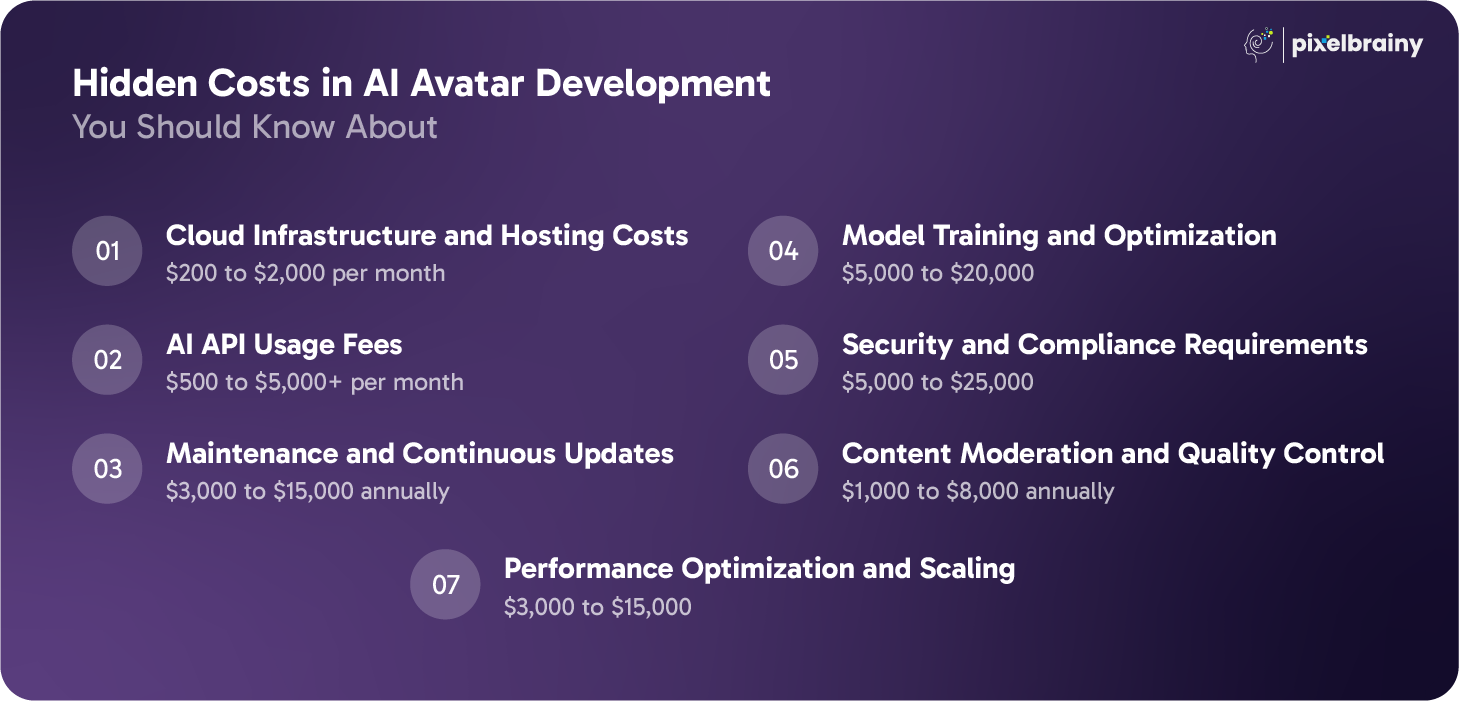
AI avatars require powerful cloud infrastructure to handle conversational processing, real-time interactions, storage, and scalability. Businesses often underestimate how hosting expenses grow as user traffic increases or when additional features are added. Real-time voice interaction, animation rendering, and AI inference demand high-performance servers, which increases operational expenses over time.
Organizations must also consider data storage, load balancing, and backup systems to maintain reliability and performance. While initial hosting costs may seem manageable, scaling infrastructure to support growing usage can significantly increase the cost of developing an AI avatar in the long run.
Estimated cost: $200 to $2,000 per month depending on infrastructure needs and user volume.
Many AI avatars rely on external AI platforms for natural language processing, speech synthesis, and generative capabilities. These services typically operate on usage-based pricing models, meaning businesses pay based on the number of interactions, tokens processed, or computational resources consumed.
As adoption grows and more users interact with the AI avatar, API expenses can rise quickly. Businesses planning their AI avatar development budget must evaluate expected usage levels to prevent unexpected increases in operational costs. Selecting efficient AI models and optimizing prompts can help control spending.
Estimated cost: $500 to $5,000+ per month depending on traffic, AI model selection, and interaction complexity.
AI avatars require ongoing maintenance to remain accurate, secure, and aligned with evolving business needs. This includes updating conversational flows, improving AI performance, fixing bugs, and adapting to software or platform changes.
Without regular maintenance, AI avatars may become outdated, leading to poor user experiences and reduced effectiveness. Businesses should treat maintenance as a core component of AI avatar creation cost rather than an optional expense. Regular optimization also ensures compatibility with new technologies and user expectations.
Estimated cost: $3,000 to $15,000 annually depending on system complexity and update frequency.
Over time, businesses gather new customer data, product information, and operational insights that can improve AI avatar performance. Retraining and fine-tuning AI models helps enhance accuracy, contextual understanding, and personalization.
However, data preparation, model retraining, and testing require technical expertise and computational resources. These processes add recurring expenses that increase the overall cost of developing an AI avatar. Businesses that prioritize continuous learning often see better ROI because their AI avatars become more effective over time.
Estimated cost: $5,000 to $20,000 depending on dataset size, training complexity, and AI model requirements.
Security and regulatory compliance are critical considerations, especially for industries handling sensitive data such as healthcare, finance, or government services. Implementing encryption protocols, user authentication systems, compliance audits, and monitoring tools adds to the AI avatar development budget.
Businesses must also invest in ongoing security updates and vulnerability testing to protect against emerging threats. Ignoring security requirements can lead to costly risks, including data breaches or regulatory penalties. Therefore, security should be included as a long-term investment within the total AI avatar development cost.
Estimated cost: $5,000 to $25,000 depending on industry standards and security requirements.
AI avatars interacting with customers or public audiences require continuous monitoring to maintain brand safety and response accuracy. Content moderation systems help prevent inappropriate responses, misinformation, or compliance violations.
Businesses may need automated filtering tools combined with human review processes to ensure consistent quality. As user interaction increases, moderation costs can rise, making this an important hidden expense within the cost to create an AI avatar. Investing in proper moderation helps maintain trust and brand reputation.
Estimated cost: $1,000 to $8,000 annually depending on scale and monitoring requirements.
As businesses grow and user engagement increases, AI avatars must scale to handle higher interaction volumes without performance issues. This may involve upgrading infrastructure, optimizing AI response times, improving rendering performance, or restructuring backend architecture.
Scaling costs are often overlooked during early planning stages, yet they play a major role in the long-term cost of developing an AI avatar. Businesses that plan for scalability early can avoid expensive system redesigns later.
Estimated cost: $3,000 to $15,000 depending on scaling requirements and technical architecture.
Accounting for these hidden costs allows businesses to build a realistic AI avatar development budget and ensures the total cost of developing an AI avatar supports long-term performance, scalability, and sustainable growth.
Also Read: How to Build an AI Virtual Character Chat App: Features and Cost
When businesses evaluate AI avatar development cost, one of the most important decisions is choosing between custom AI avatar development and off-the-shelf solutions. Both options have different pricing structures, flexibility levels, and long-term value implications. Understanding the cost of developing an AI avatar through each approach helps businesses allocate their AI avatar development budget more effectively.
Custom AI avatar development involves building a fully tailored solution designed specifically for a business’s unique goals, branding, and operational requirements. This approach allows organizations to control every aspect of the avatar, including personality design, conversational intelligence, integrations, and scalability.
The cost to create an AI avatar using a custom approach is generally higher upfront because development teams must design architecture, train AI models, and implement specialized features from scratch. However, businesses benefit from greater flexibility, ownership of technology, and the ability to scale without platform limitations.
Typical cost range: $50,000 to $150,000+ depending on complexity and customization level.
Key benefits include:
Custom development is often the preferred option for organizations that require advanced automation, data security, or highly personalized user experiences.
Off-the-shelf AI avatar platforms offer pre-built templates and ready-to-use features that allow businesses to deploy digital avatars quickly. These solutions significantly reduce initial development time and lower the upfront cost of developing an AI avatar.
Businesses choosing this option usually pay subscription-based pricing rather than a large one-time investment. While this approach reduces the cost to build an AI avatar initially, limitations in customization and scalability may increase long-term expenses if the business outgrows the platform.
Typical cost range: $500 to $5,000 per month depending on platform features and usage levels.
Key benefits include:
Off-the-shelf solutions are ideal for startups or businesses with smaller budgets that want to validate AI avatar use cases before committing to custom development.
The answer depends on business goals, expected usage, and long-term growth strategy. Businesses with complex requirements or high user engagement may find that custom development reduces long-term AI avatar creation cost by eliminating ongoing subscription limitations. On the other hand, businesses exploring AI avatars for the first time may save money initially by starting with an off-the-shelf solution and upgrading later.
Ultimately, the right choice comes down to balancing upfront investment with future scalability. Carefully evaluating the cost of developing an AI avatar across both options helps businesses make smarter financial decisions and maximize return on investment.
Also Read: AI Chatbot Virtual Companion App Development like Replika: Step-by-Step Blueprint
Many businesses assume that reducing AI avatar development cost means lowering quality, but smart planning and strategic decisions can significantly reduce expenses without compromising performance or user experience. By understanding where unnecessary spending happens, organizations can optimize their AI avatar development budget while still building powerful and scalable solutions.
Below are proven strategies businesses use to reduce the cost of developing an AI avatar along with estimated potential savings.
Projects often exceed budget because businesses try to build too many features at once. Clearly defining the main purpose of the AI avatar helps teams focus on essential functionality instead of adding unnecessary complexity. A well-scoped project reduces development time and prevents costly revisions later.
Estimated savings: $5,000 to $20,000 by avoiding feature overdevelopment and scope creep.
Launching a Minimum Viable Product allows businesses to test real-world performance before investing heavily in advanced capabilities. This approach minimizes risk and ensures that future investments are based on real user data rather than assumptions.
Estimated savings: $10,000 to $40,000 by reducing upfront development investment and preventing wasted features.
Developing AI systems from scratch significantly increases the AI avatar creation cost. Using pre-trained models for conversational AI, voice synthesis, or recommendation systems reduces development time and infrastructure requirements while maintaining strong performance.
Estimated savings: $15,000 to $50,000 depending on the complexity of AI features.
Businesses can reduce the cost to create an AI avatar by focusing on core functionality that delivers immediate value. Advanced features such as emotion recognition or real-time animation can be added later once ROI is validated.
Estimated savings: $8,000 to $30,000 by delaying non-essential features during initial development.
Instead of investing heavily in large infrastructure from the beginning, businesses should adopt scalable cloud environments that grow with usage. This approach aligns operational expenses with real demand and avoids unnecessary early spending.
Estimated savings: $2,000 to $10,000 annually depending on user traffic and infrastructure setup.
Hiring experienced AI specialists or agencies helps prevent architectural mistakes, inefficient workflows, and costly redesigns. Expert teams can recommend cost-efficient tools and proven frameworks that reduce overall development time.
Estimated savings: $5,000 to $25,000 by avoiding rework and inefficient technical decisions.
Integrating only essential systems during early development phases reduces complexity and speeds up deployment. Businesses should expand integrations gradually as user needs evolve rather than building complex systems upfront.
Estimated savings: $3,000 to $15,000 depending on integration complexity.
Businesses that follow a strategic, phased approach can significantly reduce AI avatar development cost while ensuring that the final solution remains scalable, efficient, and aligned with long-term growth objectives.
Choosing the right partner plays a critical role in controlling AI avatar development cost while ensuring long-term performance and scalability. Businesses need more than just technical execution. They need strategic planning, industry understanding, and cost-efficient development approaches that align with real business goals. PixelBrainy LLC focuses on helping organizations develop AI avatar for business in budget without compromising on innovation, usability, or future scalability.
As an experienced AI Avatar development company in USA, PixelBrainy LLC combines advanced AI technologies with practical implementation strategies designed specifically for modern businesses. Their approach prioritizes measurable outcomes by aligning AI avatar creation with customer engagement, automation goals, and operational efficiency.
PixelBrainy LLC helps businesses optimize their AI avatar development budget by:
This approach allows organizations to reduce overall investment while still creating high-quality AI avatars capable of delivering strong user experiences.
PixelBrainy LLC works across multiple industries, helping businesses implement AI avatars for customer support, onboarding, training, marketing, and digital engagement. Their team understands how industry requirements affect the cost to create an AI avatar, ensuring that solutions are customized for specific operational needs rather than built with unnecessary complexity.
A healthcare provider in the United States approached PixelBrainy LLC to develop an AI avatar that could assist patients with appointment scheduling, general health information, and onboarding processes. The organization initially struggled with high support workload and delayed response times.
PixelBrainy designed a conversational AI avatar integrated with the provider’s existing patient management system. The solution included secure data handling, multilingual communication, and personalized interaction flows tailored for healthcare users.
Results achieved:
This case demonstrates how strategic planning and focused development can reduce AI avatar creation cost while delivering measurable business outcomes.
PixelBrainy LLC does not just build AI avatars. The team focuses on creating scalable digital solutions that evolve alongside business growth. By combining technical expertise with cost optimization strategies, businesses can confidently invest in AI avatars knowing that their solution is designed for both performance and sustainability.
Understanding AI avatar development cost is essential for businesses planning to adopt digital avatars as part of their growth strategy. The cost of developing an AI avatar can vary widely depending on features, industry requirements, customization level, and scalability needs.
From basic implementations to enterprise-grade solutions, businesses must carefully evaluate their AI avatar development budget to ensure they invest in features that deliver measurable value. By analyzing factors such as AI intelligence, integrations, hidden costs, and long-term maintenance, organizations can make smarter financial decisions and reduce unnecessary spending.
Whether your goal is to improve customer engagement, automate workflows, or enhance digital experiences, knowing the cost to create an AI avatar helps you plan efficiently and avoid costly mistakes. Strategic planning and choosing the right development partner can significantly optimize your investment while ensuring future scalability.
👉 Ready to build your AI avatar? Book an appointment today to discuss your project and get a customized cost estimate.
The AI avatar development cost typically ranges between $15,000 and $150,000+ depending on features, customization level, AI intelligence, integrations, and industry requirements. Basic AI avatars designed for simple automation cost less, while enterprise-level digital avatars with real-time interaction and advanced AI capabilities require higher investment.
Several factors impact AI avatar creation cost, including AI intelligence level, voice and speech features, animation quality, integrations with existing systems, data training requirements, and real-time interaction capabilities. The development team structure and ongoing maintenance also affect the overall budget.
Off-the-shelf solutions usually have lower upfront costs but may include ongoing subscription fees and limited customization. Custom AI avatar development requires higher initial investment but offers better scalability, full ownership, and long-term flexibility for businesses with specific needs.
Hidden costs may include cloud hosting, AI API usage fees, maintenance and updates, security compliance, content moderation, and performance optimization. Businesses should include these expenses when planning their AI avatar development budget.
Development timelines vary depending on complexity. Basic AI avatars can take 4 to 6 weeks, mid-level solutions may require 8 to 12 weeks, and enterprise-grade avatars can take 3 to 6 months or more.
Businesses can reduce costs by starting with an MVP, using pre-trained AI models, prioritizing essential features, selecting scalable infrastructure, and working with experienced development teams that optimize both cost and performance.

About The Author
Sagar Bhatnagar
Sagar Sahay Bhatnagar brings over a decade of IT industry experience to his role as Marketing Head at PixelBrainy. He's known for his knack in devising creative marketing strategies that boost brand visibility and market influence. Sagar's strategic thinking, coupled with his innovative vision and focus on results, sets him apart. His track record of successful campaigns proves his ability to utilize digital platforms effectively for impactful marketing efforts. With a genuine passion for both technology and marketing, Sagar continuously pushes PixelBrainy's marketing initiatives to greater success.

Working with the PixelBrainy team has been a highly positive experience. They understand the design requirements and create beautiful UX elements to meet the application needs. The dev team did an excellent job bringing my vision to life. We discussed usability and flow. Sagar worked with his team to design the database and begin coding. Working with Sagar was easy. He has the knowledge to create robust apps, including multi-language support, Google and Apple ID login options, Ad-enabled integrations, Stripe payment processing, and a Web Admin site for maintaining support data. I'm extremely satisfied with the services provided, the quality of the final product, and the professionalism of the entire process. I highly recommend them for Android and iOS Mobile Application Design and Development.

Great experience working with them. Had a lot of feedback and I found that unlike most contractors they were bugging me for updates instead of the other way around. They were extremely time conscience and great at communicating! All work was done extremely high quality and if not on time, early! They were always proactive when it comes to communication and the work is great/above par always. Very flexible and a great team to work with! Goes above and beyond to present us with multiple options and always provides quality. Amazing work per usual with Chitra. If you have UI/UX or branding design needs I recommend you go to them! Will likely work with them in the future as well, definitely recommended!

PixelBrainy is a joy to work with and is a great partner when thinking through branding, logo, and website layout. I appreciate that they spend time going into the "why" behind their decisions to help inform me and others about industry best practices and their expertise.

I hired them to design our software apps. Things I really like about them are excellent communication skills, they answer all project suggestions and collaborate right away, and their input on design and colors is amazing. This project was complex and needed patience and creativity. The team is amazing to do business with. I will be using them long-term. Glad to see there are some good people out there. I was afraid to try and outsource my project to someone but I am glad I met them! I really can't say enough. They went above and beyond on this project. I am very happy with everything they have done to make my business stand out from the competition.

It was great working with PixelBrainy and the team. They were very responsive and really owned the project. We'll definitely work with them again!

I recently worked with the PixelBrainy team on a project and I was blown away by their communication skills. They were prompt, clear, and articulate in all of our interactions. They listened and provided valuable feedback and suggestions to help make the project a success. They also kept me updated throughout the entire process, which made the experience stress-free and enjoyable.

PixelBrainy is very good at what it does. The team also presents themselves very professionally and takes care of their side of things very well. I could fully trust them taking up the design work in a timely and organised manner and their attention to detail saved us lots of effort and time. This particular project was quite intense and the team showed that they function very well under pressure. Very much looking forward to working with her again!

It's always an absolute pleasure working with them. They completed all of my requests quickly and followed every note I had for them to a T, which made our process go smoothly from start to finish. Everything was completed fast and following all of the guidelines. And I would recommend their services to anyone. If you need any design work done in the future, PixelBrainy should be your first call!

They took ownership of our requirements and designed and proposed multiple beautiful variants. The team is self-motivated, requires minimum supervision, committed to see-through designs with quality and delivering them on time. We would definitely love to work with PixelBrainy again when we have any requirements.

PixelBrainy was a big help with our SaaS application. We've been hard at work with a new UI/UX and they provided a lot of help with the designs. If you're looking for assistance with your website, software, or mobile application designs, PixelBrainy and the team is a great recommendation.

PixelBrainy designers are amazing. They are responsive, talented, and always willing to help craft the design until it matches your vision. I would recommend them and plan to continue them for my future projects and more!!!

They were awesome! Did a good job fast, and good communication. Will work with them again. Thank you

Creative, detail-oriented, and talented designers who take direction well and implement changes quickly and accurately. They consistently over-delivered for us.

PixelBrainy team is very talented and creative. Great designers and a pleasure to work with. PixelBrainy is an excellent communicator and I look forward to working with them again.

PixelBrainy has a very talented design team. Their work is excellent and they are very responsive. I enjoy working with them and hope to continue on all of our future projects.


Transform your ideas into reality with us.
Across these industries, each engagement brings unique challenges, from early-stage product development to scaling complex systems, helping us build a practical understanding of real-world product environments.