AI Summary Powered by PixelBrainy
Could a digital concierge become the most responsive member of a luxury apartment building’s resident experience team?
Luxury residential properties are competing on more than prime locations, premium interiors, impressive amenities, and architectural design. Residents increasingly expect convenience, personalization, immediate assistance, and seamless digital services throughout their living experience. This is where AI avatar development for luxury apartments is emerging as an important opportunity for property owners, developers, operators, and property management companies.
An AI avatar concierge can be displayed on an interactive lobby screen and communicate with residents through natural voice or text conversations. Instead of searching through a resident portal or waiting for a property manager to respond, residents could simply ask questions such as, “What time does the fitness center close?”, “Can I reserve the private dining room tonight?”, “What is the guest parking policy?”, or “How do I submit a maintenance request?”
For property managers, developing an AI avatar for apartments involves much more than creating a realistic digital character. A production-ready solution may require conversational AI, a property-specific knowledge base, speech recognition, text-to-speech, authentication, analytics, security controls, and integration with the existing property management system.
This directly addresses a growing real-world requirement: a luxury apartment building may want an AI avatar concierge that interacts with residents through a lobby display, answers questions about amenities, services, and building policies, and connects with its existing property management infrastructure. Finding an AI avatar development company capable of handling both the digital-human experience and enterprise integration is therefore critical.
The market opportunity is expanding rapidly. Grand View Research projects the global digital avatar market to reach $46.3 billion in 2026 and $270.6 billion by 2030, with a projected CAGR of 49.8% from 2024 to 2030.
For luxury property owners, this growth points toward a broader shift in how people interact with digital services. The opportunity is no longer simply to deploy a chatbot. The goal is to build an AI avatar for luxury apartments that feels natural, understands property-specific information, protects resident data, integrates with existing systems, and delivers a premium hospitality experience.
This guide explains how to create a human-like AI avatar for luxury residential properties, including its technology, benefits, use cases, essential features, development process, estimated costs, integrations, challenges, and future possibilities.
An AI avatar for luxury apartments is a digital, human-like concierge that uses artificial intelligence, natural language processing, speech technology, and property-specific data to communicate with residents in real time. Unlike a conventional chatbot that relies primarily on text, an AI avatar combines conversational intelligence with a visual digital human, allowing residents to interact through voice, touch, or text.
For luxury residential properties, this technology can turn a lobby display into an intelligent service point that is available throughout the day. Residents do not need to navigate multiple menus, search through a resident portal, or wait for a staff member to become available. They can simply approach the screen and ask a question naturally.
For example, a resident might say:
“I have guests arriving tonight. What do I need to do for visitor access?”
The AI avatar can understand the request, identify that it relates to the property's guest-access policy, retrieve the relevant information from the building's approved knowledge base, and provide a conversational answer. If the system is connected to the appropriate property management or access-control platform, it may also be able to guide the resident through the next step.
This makes an AI avatar fundamentally different from a static information kiosk. It can become an interactive AI concierge for luxury apartments, capable of understanding questions, maintaining conversational context, retrieving property information, and initiating supported services.
A complete AI avatar solution generally consists of several interconnected technology layers. Each layer plays an important role in creating a fast, natural, secure, and useful resident experience.
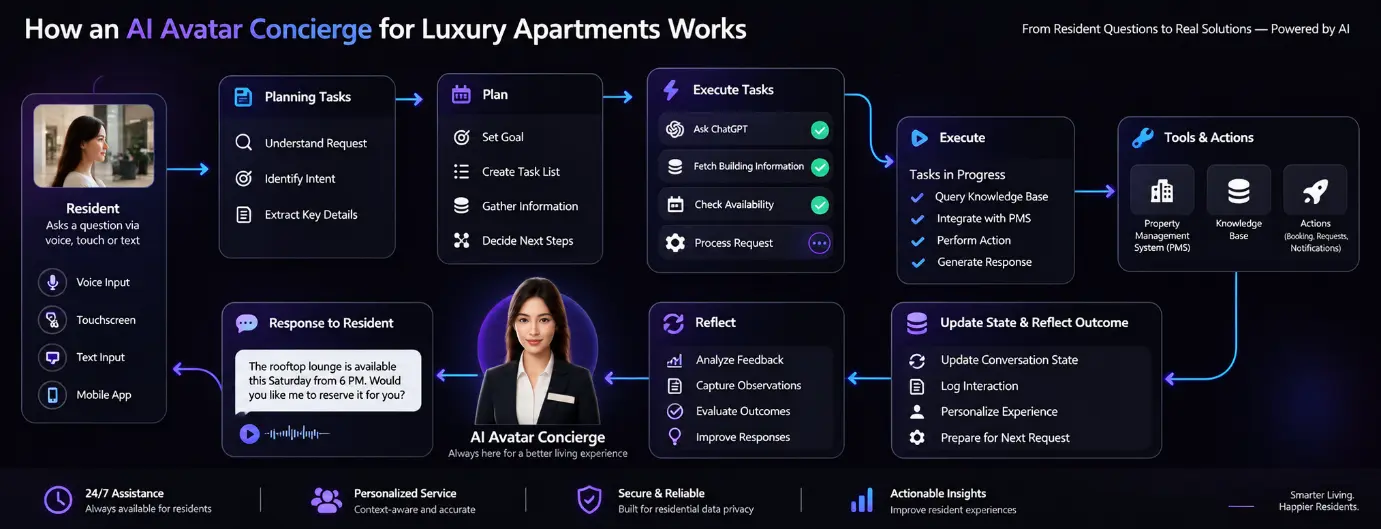
The process starts when a resident approaches the lobby display and interacts with the avatar.
Depending on the system design, interaction can happen through:
For a luxury apartment lobby, voice interaction can provide the most natural experience because residents can simply speak to the avatar instead of navigating complicated menus.
For example:
“What time does the rooftop pool close today?”
The resident does not need to know a specific command or navigate through a resident portal. The AI interprets the question conversationally.
When residents communicate through voice, the system first needs to convert spoken language into text.
This process is handled by automatic speech recognition, or ASR.
For a residential lobby, speech recognition needs to perform reliably in challenging environments. There may be:
Therefore, developing an AI avatar for apartments requires careful consideration of microphones, audio processing, noise cancellation, voice detection, and speech-recognition technology.
A high-quality system should also account for different accents, speech patterns, speaking speeds, and vocabulary.
Once the resident's speech has been converted into text, the conversational AI determines what the resident actually wants.
Consider the question:
“Can I use the rooftop this Sunday?”
The AI needs to understand that the resident could be asking about several related things, including:
This is where large language models and natural language processing become important.
Instead of matching the question against one predefined sentence, the AI can interpret different ways of asking the same question.
For example:
All of these questions may relate to the same underlying property information.
The AI needs access to accurate information about the specific apartment building.
This is one of the most important parts of AI avatar development for luxury apartments.
A general-purpose AI model does not automatically know the rules, amenities, services, and operating procedures of a particular residential property.
The development team therefore creates a property-specific knowledge base containing approved information.
This may include:
A retrieval-augmented generation, or RAG, architecture can be used to retrieve relevant information from these sources before the AI generates an answer.
This helps reduce the risk of the AI simply generating an answer based on general knowledge.
For a truly useful luxury apartment AI concierge, simply answering questions may not be enough.
The next level is connecting the avatar to the property's existing software ecosystem.
This is particularly important for property owners who want an AI avatar that works with their current property management system instead of creating another disconnected platform.
Depending on the available APIs and permissions, the AI avatar could potentially integrate with:
For example, a resident might ask:
“Can you help me reserve the private dining room for Friday?”
Instead of simply explaining the reservation process, the AI could check availability and guide the resident through the booking workflow when the connected systems support those capabilities.
This is where an experienced AI avatar development company becomes valuable. The project requires both AI expertise and enterprise integration expertise.
After understanding the resident's request and retrieving relevant property information, the AI generates a response.
The response should be:
For a luxury residence, conversational style matters.
The avatar should sound like a polished hospitality professional rather than a generic automated support bot.
For example, instead of a robotic response such as:
“Rooftop hours: 8 AM to 10 PM.”
the system could respond more naturally:
“The rooftop is open from 8 AM to 10 PM today. If you'd like, I can also help you check whether a reservation is required.”
The exact tone can be customized according to the property's brand identity.
Once the AI generates the response, text-to-speech, or TTS, technology converts the response into spoken language.
Voice quality is especially important for a luxury property.
An AI avatar with an unnatural or robotic voice can undermine an otherwise sophisticated resident experience.
A premium voice experience should consider:
Properties can choose a voice that feels welcoming, professional, sophisticated, or conversational depending on their positioning.
The final stage is the visual response from the digital human.
The avatar's facial expressions, mouth movements, eye movement, and gestures can be synchronized with the generated speech.
This creates the impression that the avatar is actually speaking to the resident.
Advanced implementations can include:
The goal is not necessarily to make the avatar indistinguishable from a real person. Instead, the objective is to create a comfortable and intuitive interaction that feels significantly more engaging than a static chatbot.
Some resident questions are general and do not require authentication.
For example:
“What time does the gym close?”
However, other requests may involve private information.
For example:
“Has my package arrived?”
or:
“Show me my maintenance requests.”
In these situations, the AI avatar needs appropriate authentication and authorization mechanisms.
Depending on the property's system architecture, residents might authenticate using:
Once authenticated, the system can provide personalized services within the permissions granted to that resident.
Even the most advanced AI avatar should not attempt to handle every situation independently.
Residents should have a clear option to connect with human staff when:
This creates a human-in-the-loop AI concierge model, where AI handles routine interactions while property staff remain available for situations requiring personal attention.
Example: How a Resident Interaction Works
Consider a resident asking:
“Can I reserve the rooftop lounge for Saturday evening?”
The complete AI workflow could look like this:
Resident speaks → Speech recognition → AI understands intent → Property knowledge retrieved → Reservation system checked → AI generates response → Voice generated → Avatar speaks and animates
If the system is fully integrated, the interaction could continue:
“The rooftop lounge is available Saturday evening. Would you like me to help you reserve it?”
The resident confirms, and the AI proceeds through the authorized reservation workflow.
This demonstrates why building an AI avatar for luxury apartments involves considerably more than developing a digital character. The avatar is the visible interface, but behind that interface is an ecosystem of AI models, property data, APIs, voice technologies, security controls, and business workflows.
A simplified architecture can be understood as:
Resident → Lobby Display → Microphone/Touchscreen → Speech Recognition → Conversational AI → Property Knowledge Base / PMS → Response Generation → Text-to-Speech → Avatar Animation → Resident
Additional components such as authentication, analytics, monitoring, security, and human escalation can operate across the entire architecture.
This approach allows the AI avatar to evolve from a simple FAQ assistant into a more capable digital resident concierge.
Ultimately, the success of an AI avatar for luxury apartments depends on how well these individual components work together. A visually impressive avatar with inaccurate information will not create a premium experience. Similarly, a highly intelligent AI without a natural interface may feel difficult to use.
The strongest solution combines human-like interaction, accurate property knowledge, secure system integration, natural voice communication, and well-designed resident workflows to create an AI concierge that genuinely adds value to luxury residential living.
A traditional concierge provides a valuable human touch, but their availability is naturally limited by working hours, staffing levels, staffing capacity, and the number of residents they can assist at the same time.
An AI avatar concierge works differently. It can act as a digital front desk that remains available throughout the day, answers routine questions, retrieves information, supports service requests, and connects with property systems when properly integrated.
However, the goal of AI avatar concierge development for luxury apartments does not have to be replacing human concierge professionals. Instead, the stronger approach is to combine AI-powered assistance with human expertise.
| Capability | Traditional Apartment Concierge | AI Avatar Concierge |
|---|---|---|
| Availability | Usually available according to staff shifts and property operating hours. After-hours assistance may require security staff, on-call employees, or emergency procedures. | Can provide continuous digital assistance, including nights, weekends, and holidays, depending on the deployment environment and infrastructure. |
| Handling Routine Questions | Staff members manually answer repetitive questions such as pool hours, gym access, package procedures, parking rules, and amenity availability. | Can automatically answer frequently asked questions using a centralized and approved property knowledge base. |
| Simultaneous Resident Interactions | One concierge can typically handle only a limited number of conversations at once. Busy periods can create queues or delays. | Can support multiple digital conversations simultaneously, making it easier to handle high volumes of routine requests. |
| Building Information | Information depends on staff training, experience, memory, and access to internal systems or documents. | Can retrieve approved information from a centralized knowledge base, helping provide consistent answers across resident interactions. |
| Voice Interaction | Provides natural human-to-human conversation and can understand context, tone, and unusual requests naturally. | Uses speech recognition, natural language processing, and AI-generated responses to support conversational voice interactions. |
| Visual Interaction | Depends on physical staff presence at the concierge desk or another designated location. | Can use a digital human or animated avatar displayed on lobby screens, kiosks, tablets, websites, or other resident-facing interfaces. |
| Personalization | Staff can personalize service based on their knowledge of residents and previous interactions. | Can personalize responses using authorized resident information, preferences, interaction history, and property context. |
| Consistency | Different staff members may provide slightly different answers or recommendations. | Can deliver standardized responses based on approved property policies and knowledge sources. |
| Multilingual Support | Depends largely on the languages spoken by available staff members. | Can potentially support multiple languages through multilingual speech recognition, language models, and text-to-speech systems. |
| PMS Integration | May require staff to manually check or update property management systems. | Can connect with a property management system through APIs or integration layers to retrieve information or initiate supported workflows. |
| Amenity Reservations | Staff manually check availability and process reservations. | Can check connected availability systems and guide or execute reservation workflows when the required integrations and permissions are available. |
| Maintenance Requests | Residents explain the issue to staff, who then record and forward the request. | Can collect details conversationally, categorize the request, create or trigger a service workflow, and escalate when necessary. |
| Package and Delivery Questions | Staff respond based on package systems, records, or their current knowledge. | Can answer supported package-related questions when connected to the appropriate package management or property systems. |
| Analytics | Insights may depend on manual logs, CRM records, surveys, or property management reports. | Digital interactions can generate structured analytics such as frequently asked questions, request categories, response patterns, and service demand. |
| Response Speed | Depends on staff availability, current workload, and the complexity of the request. | Routine questions can receive near-immediate automated responses. |
| Staff Workload | Staff spend time answering both simple and complex requests. | AI can absorb repetitive interactions, allowing staff to focus more heavily on complex resident needs. |
| Human Empathy | Strong advantage. Human staff can recognize emotional situations and respond using judgment and interpersonal skills. | Limited compared with a human. AI should be designed to recognize situations requiring human involvement and escalate appropriately. |
| Complex Requests | Staff can use judgment, experience, and communication skills to resolve unusual situations. | Can handle defined workflows but should transfer ambiguous, sensitive, or high-risk situations to human staff. |
| Sensitive Resident Issues | Human staff can provide personal attention and discretion. | Should use strict access controls and escalation rules and avoid independently handling situations beyond its authorized scope. |
| Human Escalation | Naturally built into the concierge model because residents are already speaking with staff. | Can transfer or route conversations to a human concierge or property team when predefined escalation conditions are met. |
| Scalability | Scaling service generally requires additional staff or operational resources. | Digital assistance can scale across multiple resident interactions and potentially across multiple properties. |
| Operating Cost Structure | Primarily based on staffing, shifts, recruitment, training, and ongoing personnel costs. | Requires development, infrastructure, AI services, integrations, maintenance, and ongoing optimization. |
| Brand Experience | Relies heavily on the professionalism and consistency of the concierge team. | Can be designed around a property's visual identity, communication style, voice, avatar appearance, and service standards. |
| Resident Experience | Highly personal and relationship-driven. | Fast, convenient, always-accessible, and digitally interactive, particularly for routine requests. |
The most important distinction is how each model handles scale, availability, information access, and routine workload.
A traditional concierge is particularly valuable when a resident needs judgment, empathy, discretion, negotiation, or personal attention. For example, a resident dealing with a sensitive complaint or an unusual service issue may benefit greatly from speaking directly with an experienced property professional.
An AI avatar, on the other hand, is particularly effective when residents need fast access to predictable information or standardized services.
For example, a resident might walk up to a lobby display and ask:
"What time does the rooftop pool close today?"
The AI avatar can retrieve the approved property information and respond immediately.
The same resident might then ask:
"Is the private dining room available Saturday evening?"
If the avatar is connected to the appropriate reservation or property management system, it could check availability and guide the resident through the next step.
This allows the human concierge team to spend less time answering repetitive questions and more time delivering high-value hospitality.
| Resident Need | Traditional Concierge | AI Avatar Concierge | Recommended Approach |
|---|---|---|---|
| Pool or gym hours | Good | Excellent | AI-first |
| Building policies | Good | Excellent | AI-first with approved knowledge base |
| Parking information | Good | Excellent | AI-first |
| Amenity information | Good | Excellent | AI-first |
| General resident FAQs | Good | Excellent | AI-first |
| Simple service requests | Good | Excellent when integrated | AI-first |
| Maintenance reporting | Good | Excellent for information collection and routing | Hybrid |
| Amenity booking | Good | Excellent when integrated | Hybrid or AI-first |
| Complex maintenance issue | Excellent | Moderate | Human escalation |
| Resident complaint | Excellent | Limited | Human-first or immediate escalation |
| Emotional or sensitive situation | Excellent | Limited | Human-first |
| Personalized hospitality | Excellent | Good for routine personalization | Hybrid |
| Emergency situation | Excellent within established property procedures | Should follow predefined escalation protocols | Human/emergency-first |
| VIP or high-value resident interaction | Excellent | Useful for support | Hybrid |
| After-hours routine questions | Limited by staffing | Excellent | AI-first |
| Multiple simultaneous routine requests | Limited | Excellent | AI-first |
For luxury apartments, the strongest strategy is often not AI instead of concierge, but AI plus concierge.
Think of the AI avatar as the property's digital first line of assistance.
It can handle questions such as:
When a request becomes more complicated, the system can involve a human.
For example, a resident could say:
"My air conditioning has stopped working, and there is water leaking from the ceiling."
Instead of simply generating a generic response, the AI avatar could collect the apartment number, identify the nature of the issue, determine the appropriate service category, create or initiate the maintenance workflow, and escalate the situation according to the property's procedures.
The resident therefore gets immediate assistance without forcing the concierge team to manually collect basic information first.
The ideal luxury residential experience combines the speed and scalability of AI with the judgment and empathy of human professionals.
The AI avatar handles high-volume, repetitive, and information-based interactions, while human staff remain responsible for complex decisions, sensitive situations, personalized hospitality, and cases that require human judgment.
This makes AI avatar concierge development particularly valuable for luxury apartment buildings that want to modernize resident services without losing the human element that defines premium hospitality.
In other words, the AI avatar becomes an extension of the concierge team rather than a replacement for it.
Why should luxury apartment owners invest in an AI avatar when they already have a professional concierge team?
The answer is not simply about replacing existing staff with technology. For luxury residential properties, AI avatar development for luxury apartments is a strategic investment in the property's digital infrastructure, service model, and future readiness.
A well-designed AI avatar can become a conversational interface between residents and the property's information, services, and connected systems. This makes the investment relevant not only to resident-facing service but also to how a property prepares for the next generation of smart residential experiences.
AI adoption is no longer limited to experiments and technology demonstrations within the multifamily industry.
A 2026 report from EliseAI's State of AI in U.S. Multifamily found that 89% of multifamily operators had introduced AI in some form, while 34% had fully embedded AI into their daily operations, compared with 24% a year earlier. The research was based on a third-party survey of 350 U.S. multifamily decision-makers and 500 residents.
This is important for luxury apartment owners because it changes the investment question.
AI is increasingly becoming part of the operating environment in which residential properties compete. Owners therefore need to consider not only whether AI can be used today, but whether their properties are prepared for increasingly AI-enabled resident services.
A luxury apartment building may already have a property management system, resident portal, access control system, amenity booking platform, maintenance software, package management solution, and other digital tools.
The challenge is that residents generally do not want to think about which system contains the information they need.
They simply want to ask:
"Can I reserve the private dining room tonight?"
or:
"Where can my guest park?"
or:
"Can you tell me when the rooftop lounge closes?"
An AI avatar can potentially become the conversational layer connecting residents with these services.
This is one of the strongest reasons for developing an AI avatar for apartments. The objective is not to introduce another disconnected application. It is to create a more natural interface through which residents can access existing property information and services.
An AI avatar should not be treated as a standalone screen placed in a lobby.
When properly planned, it can become part of a broader property technology architecture.
For example:
Resident → AI Avatar → AI Platform → Property Knowledge Base → PMS / Service Systems → Response or Action
This architecture gives property owners a framework that can potentially expand over time.
A property might initially use the avatar for general questions and building information. Later, it could connect the system with amenity reservations, maintenance workflows, visitor management, resident authentication, or other approved services.
Therefore, the decision to build an AI avatar for luxury apartments can also be a decision to establish a more conversational interface for the property's technology ecosystem.
The 2026 multifamily market data shows that the industry is moving beyond simply experimenting with AI tools.
According to the 2026 State of AI in Multifamily report, 76% of operators using AI reported using multiple AI vendors, highlighting the growing complexity of the technology environment. The same research identified integration and fragmentation as important challenges for operators.
This creates an important consideration for luxury apartment owners.
Instead of purchasing disconnected AI tools for individual tasks, owners can evaluate whether an AI avatar platform can serve as a unified resident-facing interface.
The emphasis should therefore be on integration architecture, not simply the visual appearance of the avatar.
Luxury properties invest heavily in architecture, interiors, amenities, smart-home technology, security, and hospitality.
The resident-facing technology should align with that positioning.
A generic AI chatbot buried inside a resident portal may not communicate the same level of sophistication as a professionally designed digital concierge that can speak naturally, understand resident questions, and present information through a branded visual identity.
A custom AI avatar can potentially reflect:
This makes how to make a human-like AI avatar for luxury residential properties more than a technical question. It is also a question of how technology should represent the property's brand.
Another reason to invest is that AI avatar development does not have to begin with a complete transformation of every resident service.
A property owner can start with a defined scope.
For example:
The avatar answers questions about:
The avatar helps residents understand:
The avatar connects with approved systems to retrieve information or initiate specific workflows.
The system can provide authorized resident-specific information after appropriate authentication.
This phased approach allows owners to validate the technology before expanding its role throughout the property.
Another important reason to consider AI avatar development is the movement toward conversational interfaces.
Multifamily technology research in 2026 is increasingly examining voice as part of resident interaction. A 2026 technology adoption report covering 118 multifamily companies with portfolios ranging from 1,000 to more than 200,000 units identified voice AI as an emerging opportunity within the sector.
For luxury properties, this opens the possibility of residents interacting with property services through natural conversation rather than navigating multiple menus.
For example:
"I'm expecting two guests tonight. What do I need to do?"
The AI avatar could understand the intent, retrieve the property's guest policy, and provide the appropriate instructions.
That conversational experience is particularly relevant to properties positioning themselves as smart, connected residences.
Technology investment should ideally remain useful as the property evolves.
An AI avatar developed with a flexible architecture can potentially support additional capabilities over time, including:
This is why owners should focus on the architecture behind the avatar rather than treating the project as simply a digital character development exercise.
The real investment is in creating a conversational AI service layer that can evolve with the property.
Luxury apartment owners increasingly compete in a market where technology is becoming part of the property's overall positioning.
Research from Parks Associates in its Q3 2026 Connected Communities study shows that multifamily and planned communities are adopting smart technologies to attract residents and improve operational efficiency. The research, based on a Q1 2026 survey of 8,000 U.S. internet households, examines resident-facing platforms, smart-home amenities, access control, automation, and other connected-community technologies.
An AI avatar fits into this broader shift toward connected residential environments.
It can become the conversational front end of a smart property, allowing residents to interact with services in a way that feels more natural than navigating separate systems.
Luxury apartment owners do not need to wait until AI avatars become completely mainstream before exploring the technology.
Starting with a controlled implementation allows owners to determine:
This is particularly relevant for property groups managing multiple luxury communities. Lessons from an initial deployment can inform the architecture and deployment strategy for future properties.
The goal is not to implement AI simply because it is trending. The goal is to establish where an AI concierge can fit into the property's long-term operating and technology strategy.
Before choosing an AI avatar development company, luxury apartment owners should evaluate the project across several areas:
| Evaluation Area | Key Question |
|---|---|
| Business objective | What specific property problem will the AI avatar address? |
| Resident experience | Where will residents interact with the avatar? |
| Technology integration | Can it connect with the existing PMS and relevant property systems? |
| Knowledge management | How will building information and policies be maintained? |
| Security | What resident information can the system access, and under what permissions? |
| Human escalation | When should the AI transfer an interaction to staff? |
| Scalability | Can the architecture support additional services and properties later? |
| Brand alignment | Can the avatar match the property's identity and hospitality standards? |
| Analytics | Can owners understand what residents are asking and where service gaps exist? |
| Pilot strategy | Can the solution be tested with controlled use cases before wider deployment? |
These questions help owners distinguish between a visually impressive AI avatar and a genuinely useful residential AI system.
The avatar is the visible part of the solution, but the underlying investment includes the AI model, property knowledge base, speech technology, integrations, authentication, analytics, security, workflows, and human escalation mechanisms.
For this reason, owners evaluating AI avatar development for luxury apartments should select a development approach based on the property's long-term requirements rather than choosing a solution solely because the avatar looks realistic.
For luxury apartment owners, AI avatar development is an opportunity to build a more intelligent digital layer around existing property services while preparing the resident experience for the next phase of connected living.
The smartest investment is not simply a human-like avatar. It is an AI concierge infrastructure designed to grow with the property.
Also Read: Top 12+ AI Real Estate Software Development Companies in USA
What if residents could get immediate answers, start routine service requests, and interact with their building through a human-like digital concierge without adding another layer of manual work for the property team?
That is where building an AI avatar concierge for luxury residences can create practical business value. The purpose is not simply to place a digital human in the lobby. A properly developed AI concierge can connect resident conversations with property information, approved workflows, and existing technology systems.
For owners researching how to develop a human-like AI avatar for luxury residential properties, the most important question is therefore not how impressive the avatar looks. It is what measurable operational and resident-experience improvements the system can deliver.
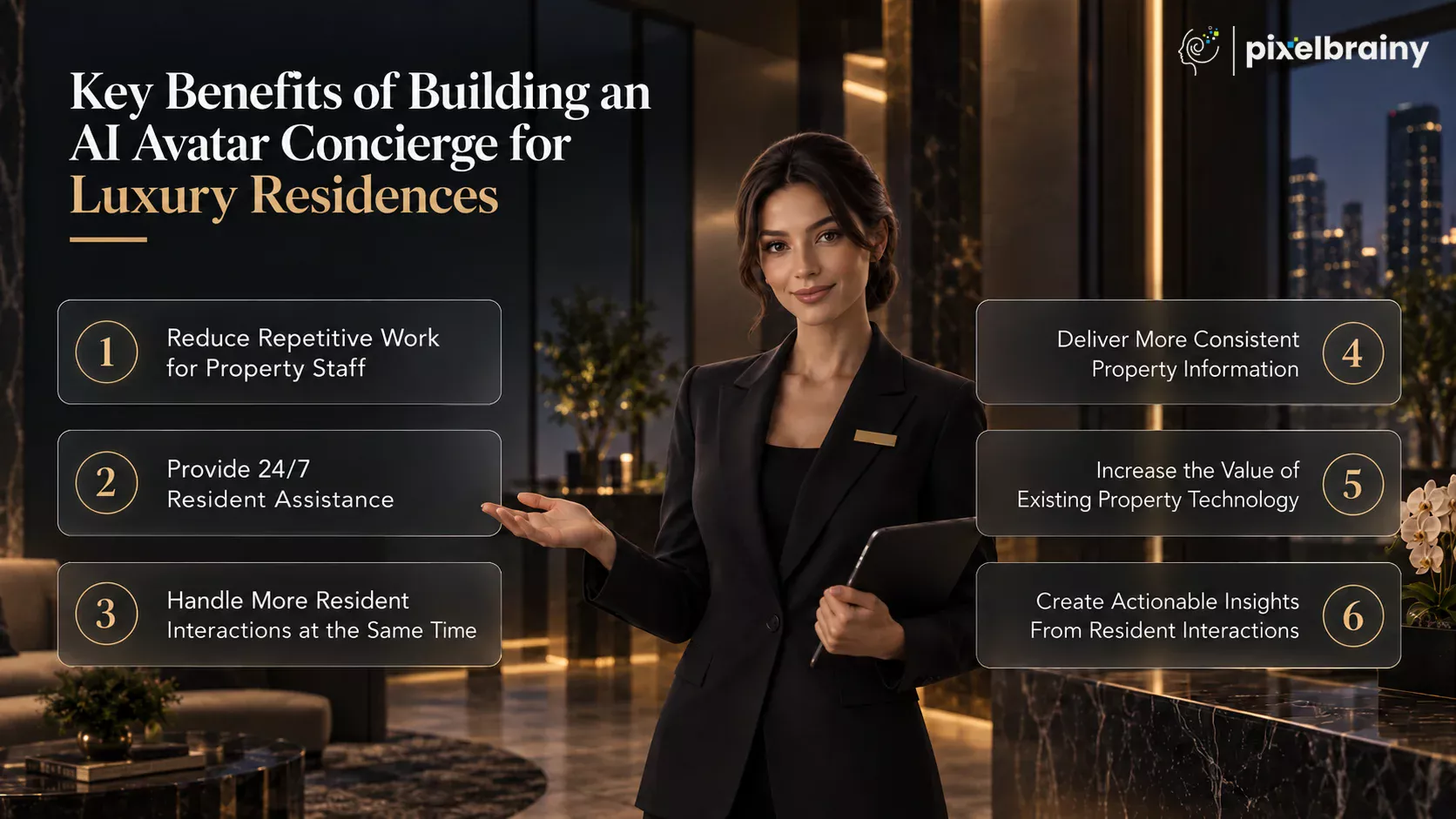
Luxury apartment teams spend considerable time responding to recurring questions about amenities, parking, building policies, package procedures, guest access, operating hours, and service processes.
An AI avatar can handle many of these predictable interactions automatically through a property-specific knowledge base.
Instead of having staff repeatedly answer the same question throughout the day, residents can ask the AI concierge directly and receive an immediate response based on approved information.
This allows human employees to dedicate more time to responsibilities that require personal judgment, relationship building, problem-solving, and hospitality.
For property owners, the practical benefit is better allocation of staff time rather than simply reducing headcount.
Residents do not necessarily need assistance only during traditional concierge hours.
A question about guest parking may arise late at night. A resident may need instructions for submitting a maintenance request early in the morning. Someone returning from travel may want to check an amenity policy outside normal office hours.
An AI avatar can provide a digital point of assistance whenever the system is available.
It can answer supported questions, provide property information, guide residents through procedures, and determine when a request should be transferred to human staff.
For luxury properties, this creates a more responsive service environment without requiring the onsite concierge team to be physically available for every routine interaction.
A traditional concierge has a natural capacity limit. When several residents need assistance simultaneously, staff must prioritize requests and work through them individually.
An AI avatar can handle multiple routine conversations concurrently across supported interfaces.
For example, one resident could ask about the fitness center while another checks a parking policy and a third requests information about an amenity reservation.
The AI can process these routine interactions independently while the human concierge team focuses on residents who need personal assistance.
This creates greater service capacity without creating a proportional increase in manual workload, which can be particularly valuable for high-occupancy luxury properties and multi-building developments.
Inconsistent information can create unnecessary confusion for residents.
A concierge may remember a policy differently from another team member. Building procedures may change, while old information continues to circulate. Residents may also receive different answers depending on whom they ask.
With AI avatar development for luxury apartments, property information can be organized within a controlled knowledge base containing approved policies, procedures, schedules, and frequently requested information.
When properly maintained, the AI avatar can use that centralized information to provide consistent responses.
This is particularly useful for information such as:
The property team remains responsible for maintaining accurate information, while the AI provides a consistent conversational interface for accessing it.
Many luxury residential properties already use multiple digital systems.
These may include property management software, resident portals, maintenance platforms, amenity reservation systems, access-control technology, package management systems, and communication platforms.
The problem is that residents often have to navigate these systems individually.
An AI avatar can potentially provide a conversational interface across connected systems.
For example, instead of searching through an application for an amenity reservation option, a resident could ask:
"Can you check whether the private dining room is available this Saturday?"
If the required system integration and permissions are available, the AI can retrieve the relevant information and guide the resident through the reservation workflow.
This makes an AI avatar more valuable than a standalone chatbot because it can become a front-end interaction layer for existing property technology.
Every resident interaction can reveal something about how people use and experience the property.
An AI concierge can organize conversations into useful categories, allowing property teams to identify recurring questions, service requests, and areas of resident friction.
For example, analytics may reveal that residents repeatedly ask about:
If the same question appears frequently, it may indicate that the property's existing communication is unclear or that a particular process needs improvement.
This gives owners an additional source of resident experience intelligence.
Instead of relying entirely on occasional surveys or informal conversations, property teams can use interaction patterns to understand what residents are asking about in their everyday lives.
| Benefit | Direct Business Value |
|---|---|
| Reduced repetitive workload | Frees staff from answering predictable questions repeatedly. |
| 24/7 digital assistance | Provides a resident-facing service channel beyond concierge operating hours. |
| Higher interaction capacity | Handles multiple routine conversations without creating physical queues. |
| Consistent information delivery | Uses an approved property knowledge base for standardized responses. |
| Better use of existing technology | Creates a conversational interface for connected property systems. |
| Resident interaction intelligence | Reveals recurring questions, service patterns, and potential operational gaps. |
The business case for developing an AI avatar for apartments becomes stronger when the technology is connected to real property operations.
A visually impressive avatar may attract attention, but the lasting value comes from what happens behind the interface: accurate information, connected workflows, scalable interactions, useful analytics, and appropriate human escalation.
For owners exploring an AI concierge avatar development for luxury apartments, these benefits provide a practical framework for defining the project's objectives and measuring its value after deployment.
What type of AI avatar is right for a luxury apartment property when concierge teams are spending too much time answering repetitive questions about parking, amenities, deliveries, visitors, and building rules?
A property owner searching for “We operate several luxury apartment properties and our concierge teams spend too much time answering repetitive questions about parking, amenities, deliveries, visitors, and building rules. We are considering building an AI avatar concierge that can handle these interactions 24/7. Who can develop this for us?” should first understand that there is no single type of residential AI avatar.
The creation of AI avatars for luxury apartments can be designed around different resident touchpoints, service requirements, and integration levels. Some avatars primarily provide information, while others can support transactions, resident services, property operations, or personalized interactions.
Here are the major types to consider when planning the development of a luxury apartment AI avatar.
A lobby AI concierge avatar is designed to provide a digital front-desk experience within the property. It can be displayed on a large interactive screen, kiosk, or touchscreen and allow residents and visitors to interact through voice or text.
The avatar can answer questions about amenities, building rules, parking, directions, operating hours, visitor procedures, and community services. With the right integrations, it can also guide residents toward reservations or service requests.
For owners, this type of building an AI avatar for luxury apartments can reduce repetitive front-desk interactions while creating a modern and highly visible resident experience.
A resident service avatar focuses on helping existing residents with everyday property-related requests. Instead of functioning primarily as a welcome desk, it acts as a digital service representative available through a lobby display, resident portal, mobile interface, or other connected channel.
Residents can ask about maintenance procedures, package collection, amenity reservations, community events, parking, or property policies.
The avatar can also collect information before routing a request to the appropriate team.
For property owners, this model can make resident service more accessible while helping staff spend less time collecting basic information and more time handling requests that require human involvement.
Luxury properties often offer premium amenities such as rooftop lounges, private dining rooms, fitness centers, coworking spaces, pools, theaters, and event areas.
An amenity-focused AI avatar can become a conversational interface for these facilities. Residents can ask about operating hours, rules, availability, reservation requirements, and usage procedures.
When connected to an appropriate reservation platform, the avatar can potentially check availability and guide residents through the booking process.
The business value comes from making amenities easier to discover and access while reducing repetitive questions for staff. This approach is particularly useful when planning to make a luxury apartments AI avatar around high-demand resident services.
A visitor-focused AI avatar helps residents and guests understand property access procedures.
For example, a resident could ask how to register a visitor, where guests should park, what identification may be required, or how after-hours access works.
The avatar can provide property-approved instructions and, when securely integrated with access or visitor-management systems, potentially support specific visitor workflows.
For owners, this type of human-like AI avatar development for luxury apartments can create a more convenient arrival experience while reducing routine visitor questions directed toward concierge and security teams.
Sensitive access decisions should remain subject to the property's security policies, authentication requirements, and human escalation procedures.
Package management can generate a significant volume of repetitive resident questions in large apartment communities.
A delivery-focused AI avatar can provide information about package collection locations, delivery procedures, collection hours, oversized deliveries, courier instructions, and other property-specific policies.
If integrated with an appropriate package management system, it may also be able to provide authorized package-related information based on resident authentication.
This gives residents another convenient way to obtain delivery information without requiring concierge staff to repeatedly answer the same questions.
For multi-property owners, this model can also create a standardized digital service experience across communities while allowing each property's delivery rules and systems to remain property-specific.
A maintenance AI avatar focuses on service requests and property issues.
Instead of simply telling residents where to submit a maintenance request, the avatar can conversationally collect relevant details such as the apartment location, problem type, urgency, and description.
When integrated with the property's maintenance or property management system, the information can potentially be transferred into the appropriate workflow.
The avatar can also explain what residents should do next and identify situations that require immediate human attention.
For owners, this approach can improve the quality of initial information collected and reduce the manual effort required to process routine maintenance requests.
A personalized AI concierge is designed to provide a more tailored experience based on authorized resident information.
After appropriate authentication, the avatar could potentially recognize the resident's profile and provide relevant information about their property, reservations, requests, or preferences.
For example, a resident could ask:
“What amenities have I reserved this week?”
The system could retrieve permitted information from connected platforms and respond conversationally.
The value of building an AI concierge avatar for luxury apartments at this level is the ability to move from generic FAQs toward individualized digital service. Strong identity management, authorization, privacy controls, and data governance are essential for this type of deployment.
A multilingual AI avatar is designed for properties serving residents and visitors who communicate in different languages.
Instead of relying exclusively on the languages spoken by available staff, the avatar can use multilingual speech recognition, language processing, and text-to-speech capabilities to support conversations across multiple languages.
This can be particularly useful for international luxury residences, branded residential properties, and communities with diverse resident populations.
For owners considering the creation of AI avatar for luxury apartments, multilingual functionality can be incorporated into the architecture from the beginning rather than added later as a separate system.
The exact language capabilities depend on the AI models, speech technologies, and implementation chosen.
A branded digital human focuses heavily on the property's identity and hospitality experience.
Rather than using a generic virtual assistant, owners can create an avatar with a defined appearance, voice, communication style, personality, and visual presentation aligned with the residential brand.
It can welcome residents, explain services, communicate community information, and provide concierge assistance through a recognizable digital persona.
This type of human-like AI avatar development for luxury apartments is particularly relevant to premium properties where the technology itself forms part of the brand experience.
The key business value is differentiation while maintaining a consistent digital representation of the property.
Property groups operating multiple luxury communities can develop a portfolio-wide AI concierge architecture.
The underlying platform can provide a common AI experience while each property maintains its own knowledge base, policies, amenities, integrations, branding, and service workflows.
For example, a resident at Property A could receive information specific to that building, while a resident at Property B receives a completely different set of property-specific responses through the same overall platform.
This model makes building an AI avatar for luxury apartments more scalable for owners managing multiple communities. It can support centralized technology management while preserving the individual identity and operational requirements of each property.
The right model depends on what the property wants the avatar to accomplish.
| AI Avatar Type | Primary Purpose | Best Fit |
|---|---|---|
| Lobby AI Concierge | Information and front-desk assistance | High-traffic luxury lobbies |
| Resident Service Avatar | Everyday resident support | Large residential communities |
| Amenity Avatar | Amenity information and reservations | Amenity-rich properties |
| Visitor Avatar | Visitor guidance and access information | High-volume guest properties |
| Delivery Avatar | Package and delivery assistance | Large apartment communities |
| Maintenance Avatar | Service request intake and routing | Properties with high maintenance volume |
| Personalized Concierge | Individualized resident services | Premium and high-touch residences |
| Multilingual Avatar | Multilingual resident communication | International or diverse communities |
| Branded Digital Human | Brand and hospitality experience | Luxury and branded residences |
| Portfolio AI Concierge | Standardized AI across properties | Multi-property owners and operators |
The best luxury residential AI avatar is not necessarily the most visually advanced one. It is the one designed around the property's actual resident interactions, operational workflows, and long-term technology strategy.
With the right architecture, build an AI concierge avatar for luxury apartments can evolve from a simple digital receptionist into a connected resident service platform.
Where can an AI avatar actually be used inside a luxury apartment building beyond answering basic resident questions?
For property owners exploring AI avatar development for luxury apartments, the answer extends across resident services, property operations, amenities, visitor management, maintenance, and personalized communication. An AI avatar can serve as a conversational interface through which residents, guests, prospects, and staff interact with property information and connected systems.
For example, if a resident asks, “Can you tell me whether the rooftop lounge is available tonight?”, the avatar can provide the relevant information and, where the required integration exists, guide the resident through the reservation process.
The following use cases show where building an AI avatar for luxury apartments can create practical value.
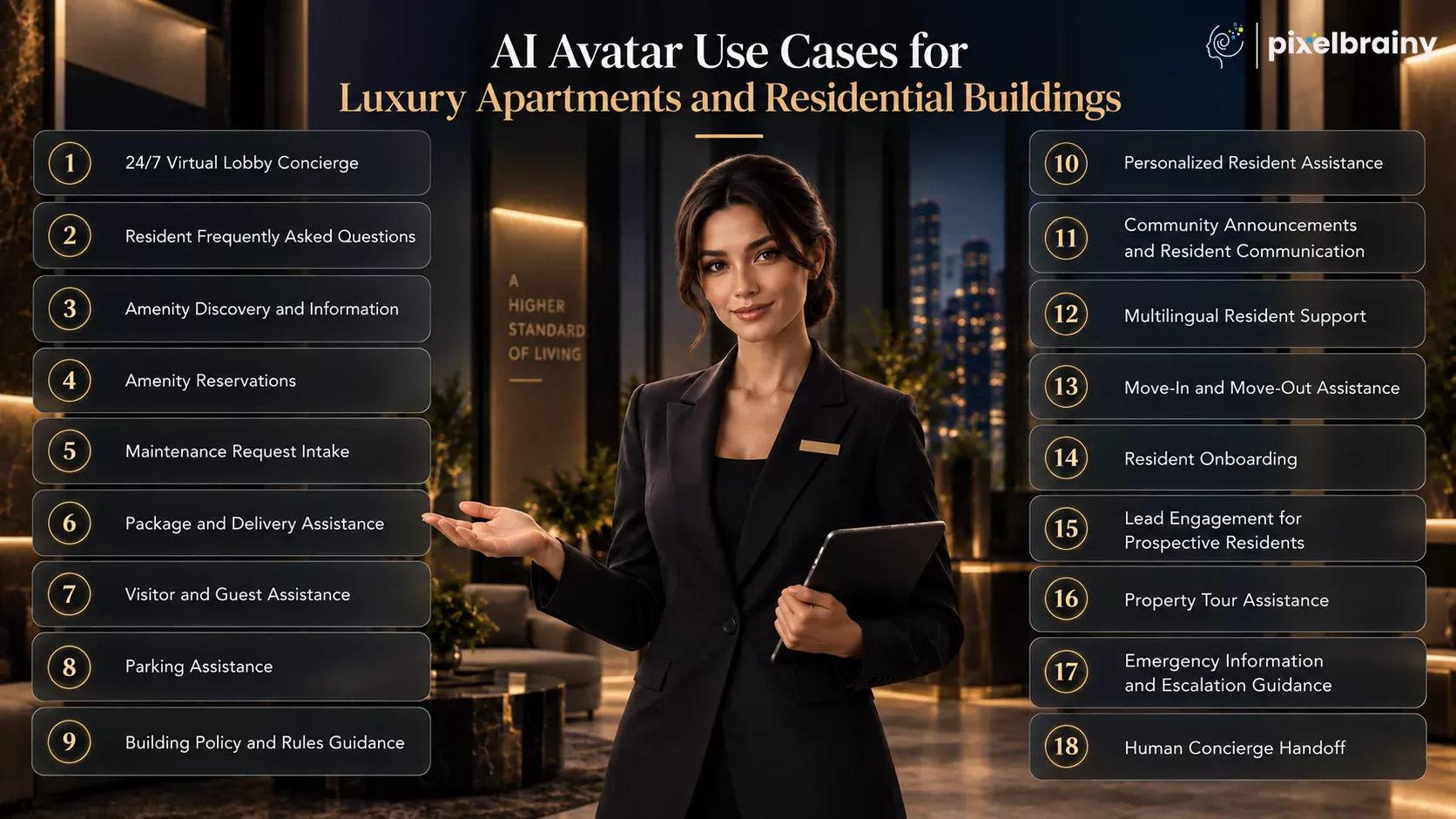
An AI avatar can function as a digital concierge at the property's main entrance.
Residents and visitors can ask questions about building facilities, operating hours, directions, parking, policies, and available services without waiting for a staff member.
The avatar can also provide a consistent welcome experience for visitors and residents.
For luxury properties, a lobby-based digital human can combine hospitality with technology, making the entrance more interactive while allowing human concierge staff to focus on situations that require personal assistance.
One of the simplest and most useful applications is automated handling of frequently asked questions.
Residents can ask:
The AI avatar retrieves answers from the property's approved knowledge base and provides them conversationally.
This makes the avatar particularly useful for properties dealing with a high volume of repetitive resident interactions.
Luxury residential buildings often offer numerous amenities, but residents may not always know how to access or use them.
An AI avatar can act as an interactive amenity guide.
A resident could ask:
“What amenities are available on the 20th floor?”
The avatar can explain the available facilities, operating hours, access requirements, and applicable rules.
This can make premium amenities easier to discover while providing residents with a convenient alternative to searching through property documents or applications.
An AI avatar can also support amenity reservation workflows.
Instead of navigating through a resident portal, a resident could simply say:
“I want to reserve the private dining room for Saturday evening.”
The AI can ask the necessary follow-up questions, check connected availability where supported, and guide the resident through the booking process.
With appropriate API integration, the system can potentially interact with the property's reservation platform.
This turns the avatar into a conversational reservation interface rather than simply an information tool.
Maintenance is another strong use case for AI avatar development for luxury apartments.
A resident can describe an issue naturally:
“The air conditioner in my bedroom isn't working.”
The AI avatar can collect relevant details such as the apartment location, problem description, urgency, and other required information.
If connected to a maintenance management or property management system, the collected information can potentially be routed into the appropriate workflow.
The AI can also recognize when a request requires immediate human attention based on predefined escalation rules.
Package-related questions can create significant repetitive work for concierge teams.
An AI avatar can answer questions about:
When connected to an authorized package management platform, the avatar may also be able to provide resident-specific information.
This gives residents a self-service channel while reducing routine package inquiries directed to front-desk staff.
Luxury apartment residents frequently have guests, contractors, service providers, and other visitors.
An AI avatar can explain the property's visitor procedures and answer questions such as:
“Where should my guests park?”
or:
“How do I register an overnight guest?”
With appropriate integrations, the avatar could potentially guide residents through approved visitor registration workflows.
For security-sensitive activities, authentication and property-defined access controls should remain mandatory, with human staff handling situations that require judgment.
Parking information is another highly suitable use case.
Residents can ask about:
Instead of requiring staff to repeatedly explain the same policies, the AI avatar can provide property-specific answers from the approved knowledge base.
If the property has connected parking systems, additional workflows may also be possible depending on the available APIs and permissions.
Luxury residential properties have numerous policies that residents need to understand.
An AI avatar can provide conversational access to information about:
A resident does not need to search through a lengthy handbook.
They can simply ask a question and receive the relevant policy information.
This is one of the most practical applications when developing an AI avatar for apartments because the information can be maintained within a centralized property knowledge base.
A more advanced AI avatar can provide personalized assistance after appropriate authentication.
Instead of responding only with generic building information, the system could potentially access authorized resident-specific information.
For example:
“What reservation do I have tomorrow?”
or:
“Can you tell me the status of my maintenance request?”
If the necessary property systems are integrated, the avatar can retrieve relevant information and provide a conversational response.
This moves the system from a generic FAQ assistant toward a personalized AI concierge.
An AI avatar can also serve as an interactive communication channel for property announcements.
Residents could ask:
“Is there a community event this weekend?”
The avatar can provide information about approved events, schedules, locations, and participation requirements.
Property teams could use the same interface to communicate information about scheduled maintenance, amenity closures, community activities, or building notices.
This creates a more interactive communication experience than simply posting announcements on a noticeboard or sending static messages.
Luxury properties often serve residents and visitors from different linguistic backgrounds.
A multilingual AI avatar can support conversations in multiple languages using appropriate speech recognition, language-processing, and text-to-speech technologies.
For example, a resident could communicate with the avatar in their preferred supported language and receive information about building services or policies.
This can make property information more accessible while reducing dependence on having multilingual staff available at every interaction point.
The actual language coverage depends on the AI models and speech technologies selected during human-like AI avatar development for luxury apartments.
Moving into a luxury apartment involves numerous questions and procedures.
An AI avatar can guide residents through:
Instead of requiring residents to contact multiple departments, the avatar can provide a centralized conversational starting point.
This can be particularly useful during periods when property teams experience higher volumes of resident questions.
An AI avatar can introduce new residents to the building and its services.
For example, after moving in, a resident could interact with the avatar to learn:
“What facilities are available to me?”
The avatar can provide a guided overview of amenities, building procedures, community services, emergency information, and relevant resident resources.
For luxury properties, this can create a more engaging onboarding experience while ensuring new residents receive consistent information.
AI avatars do not have to be limited to existing residents.
A digital human displayed on a property website, leasing interface, or lobby screen can answer prospective residents' questions about:
For leasing teams, this creates an additional conversational channel for answering common prospect questions.
With appropriate integrations, the avatar may also guide prospects toward scheduling a property tour or contacting the leasing team.
A branded AI avatar can support self-guided or assisted property tours.
For example, a prospective resident could ask:
“What is this amenity used for?”
The avatar can provide information about the facility, its rules, and available services.
At different points throughout a smart property, digital interfaces can provide contextual information about the building.
This can turn a conventional property tour into a more interactive technology-driven experience.
An AI avatar can provide access to approved emergency information, such as property procedures, emergency contact details, evacuation guidance, or instructions for reporting specific issues.
However, emergency use cases require particularly careful design.
The avatar should not replace emergency services, security professionals, or established property emergency procedures. Instead, it should provide approved information and immediately escalate situations that require human intervention.
This makes development of AI avatar for luxury apartments a technology project that must include clear escalation rules and safety boundaries.
One of the most important use cases is knowing when not to rely on AI.
If a resident asks about a sensitive complaint, complex dispute, unusual maintenance issue, or situation requiring human judgment, the avatar can route the interaction to the appropriate property team.
For example:
“I need to speak with someone about a serious issue with my apartment.”
Instead of continuing with automated responses, the system can initiate the property's defined human escalation process.
This creates a hybrid service model where AI handles routine interactions while humans remain available for complex and high-value situations.
| Use Case | Primary User | Potential Role of AI Avatar |
|---|---|---|
| Virtual lobby concierge | Residents and visitors | Information and digital front-desk assistance |
| Resident FAQs | Residents | Answer recurring questions |
| Amenity discovery | Residents | Explain facilities and rules |
| Amenity reservations | Residents | Guide or initiate booking workflows |
| Maintenance intake | Residents | Collect and route service information |
| Package assistance | Residents | Provide delivery and collection information |
| Visitor assistance | Residents and guests | Explain visitor procedures |
| Parking assistance | Residents and visitors | Answer parking-related questions |
| Building policies | Residents | Provide approved policy information |
| Personalized assistance | Residents | Provide authorized resident-specific information |
| Community announcements | Residents | Deliver property updates |
| Multilingual support | Residents and visitors | Communicate in supported languages |
| Move-in assistance | New residents | Guide onboarding procedures |
| Resident onboarding | New residents | Introduce services and amenities |
| Lead engagement | Prospective residents | Answer property and amenity questions |
| Property tours | Prospects | Provide interactive property information |
| Emergency guidance | Residents and visitors | Provide approved information and escalate |
| Human handoff | Residents | Transfer complex cases to staff |
Property owners do not need to implement every use case during the first phase of building an AI avatar for luxury apartments.
A practical starting point is to prioritize high-volume, predictable interactions:
Phase 1: FAQs, amenities, parking, building policies, and visitor information.
Phase 2: Maintenance intake, package assistance, reservations, and community communication.
Phase 3: Personalized resident services, PMS integrations, multilingual support, and more advanced workflows.
This approach allows the property team to establish a reliable AI foundation before giving the avatar access to more sensitive resident information or transactional systems.
The strongest AI avatar use cases are those that solve real resident-service problems while reducing unnecessary manual work for property teams.
From a virtual lobby concierge to personalized resident services, AI avatar development for luxury apartments can create a flexible digital service layer that grows with the property's needs.
What makes an AI avatar concierge genuinely valuable in a luxury apartment building is not simply its human-like appearance, but how effectively it understands residents, accesses property information, and responds within the context of the building. For teams developing an AI avatar for apartments, the focus should be on creating a reliable resident service experience that feels natural while working seamlessly with existing property operations.
A well-designed solution should allow residents to ask questions in their own words, receive accurate answers about amenities and building policies, get guidance for maintenance or service requests, and connect with staff whenever automated assistance is not enough. This makes the foundation of AI avatar development for luxury apartments just as important as the avatar's visual design.
Consider a common requirement from a luxury residential property:
“Our residents expect personalized service at any time of the day, but our onsite team cannot be available for every routine question. We need an AI concierge that can understand resident requests, provide accurate property information, protect resident data, and connect people with our staff when needed. What essential features should the solution have?”
For property owners planning to build an AI avatar for luxury apartments, the following features provide the core functionality needed to deliver a polished, responsive, and dependable digital concierge experience.
| Feature | What It Should Do |
|---|---|
| Natural Language Conversation | The AI avatar should understand natural resident questions instead of forcing users to select rigid commands or predefined phrases. Residents should be able to communicate conversationally about amenities, services, parking, packages, maintenance, policies, and everyday property-related requests. |
| Voice Interaction | Voice functionality should allow residents to speak naturally with the avatar through a lobby display, kiosk, or compatible device. Speech recognition should handle different accents, speaking speeds, and conversational styles while converting spoken requests into accurate, useful responses. |
| Text Interaction | Residents should have the option to communicate through typed messages when speaking is inconvenient or unavailable. Text interaction provides an alternative communication channel for lobby environments, quieter settings, accessibility needs, and residents who simply prefer written communication. |
| Human-Like Avatar Interface | The digital character should combine realistic facial movement, appropriate expressions, natural gestures, responsive animation, and synchronized speech. Its appearance should complement the property's luxury brand rather than feel like a generic chatbot placed on a screen. |
| Property Knowledge Base | The AI avatar should have access to a structured source of approved property information covering amenities, operating hours, building policies, parking, package procedures, resident services, community guidelines, and frequently requested information. |
| Accurate Information Retrieval | The system should retrieve information from trusted and approved property sources before generating responses. This reduces the risk of outdated or inaccurate answers and helps residents receive information that reflects the building's current rules, services, schedules, and procedures. |
| Personalized Responses | When identity and permissions allow it, the avatar should tailor responses according to relevant resident information and context. Personalization can make interactions more useful by reducing repetitive questions and helping residents receive answers that are relevant to their specific situation. |
| Multilingual Communication | The avatar should support the languages required by the property's resident community. Residents should be able to communicate naturally in supported languages while receiving consistent information about building services, policies, amenities, and other frequently requested property details. |
| Amenity Information | Residents should be able to ask about gyms, pools, lounges, coworking areas, rooftop spaces, parking facilities, and other shared amenities. The avatar should provide current information about availability, operating hours, access requirements, usage guidelines, and applicable property rules. |
| Building Policy Assistance | The AI concierge should explain approved building policies in clear, conversational language. Residents can use it to understand guest procedures, pet policies, noise guidelines, parking requirements, move-in rules, amenity regulations, and other community-specific requirements without searching through lengthy documents. |
| Maintenance Request Guidance | The avatar should help residents understand how to report maintenance problems and guide them through the property's approved service process. It should collect relevant basic information about the issue and direct the resident to the appropriate maintenance channel when further action is required. |
| Resident Authentication | Authentication should be implemented before the avatar accesses private resident information or performs restricted actions. Secure identity verification helps protect personal data and ensures that resident-specific information is provided only to authorized users. |
| PMS Integration | The avatar should connect with the property's existing property management system through secure integrations or APIs where supported. This allows the AI concierge to work alongside established resident, service, and operational workflows instead of functioning as an isolated information kiosk. |
| Human Handoff | The AI avatar should recognize when a request requires human judgment, staff intervention, or personalized assistance. It should transfer the conversation smoothly to the appropriate concierge or property team member without making the resident repeat information unnecessarily. |
| Analytics and Interaction Tracking | The system should securely capture relevant interaction data to help property teams understand frequently asked questions, unsuccessful conversations, service demand, and recurring resident concerns. These insights can guide knowledge-base improvements and help management refine the resident experience over time. |
A strong foundation of conversational AI, trusted property data, secure personalization, PMS connectivity, and seamless human handoff gives a luxury apartment AI avatar the reliability needed to become a practical part of everyday resident service.
After you finalized the features, now its time to turn those requirements into a functional resident experience. AI avatar development for luxury apartments involves several stages, from defining the avatar's purpose to designing the experience, developing the AI, connecting property systems, testing interactions, and launching the final solution.
If you are exploring the steps to build AI avatar for luxury apartments from idea to launch, having a structured development process helps control costs, reduce technical risks, and ensure the final avatar fits the property's service standards.
A real-world requirement may look like this:
“We are developing a high-end residential property with a hotel-style service experience and want to introduce an AI avatar concierge for residents. The avatar should provide personalized assistance, recommend local services, handle requests, and work alongside our human concierge team. We need a company that can build this from the ground up.”
Here are the key stages involved in building an AI avatar for luxury apartments.
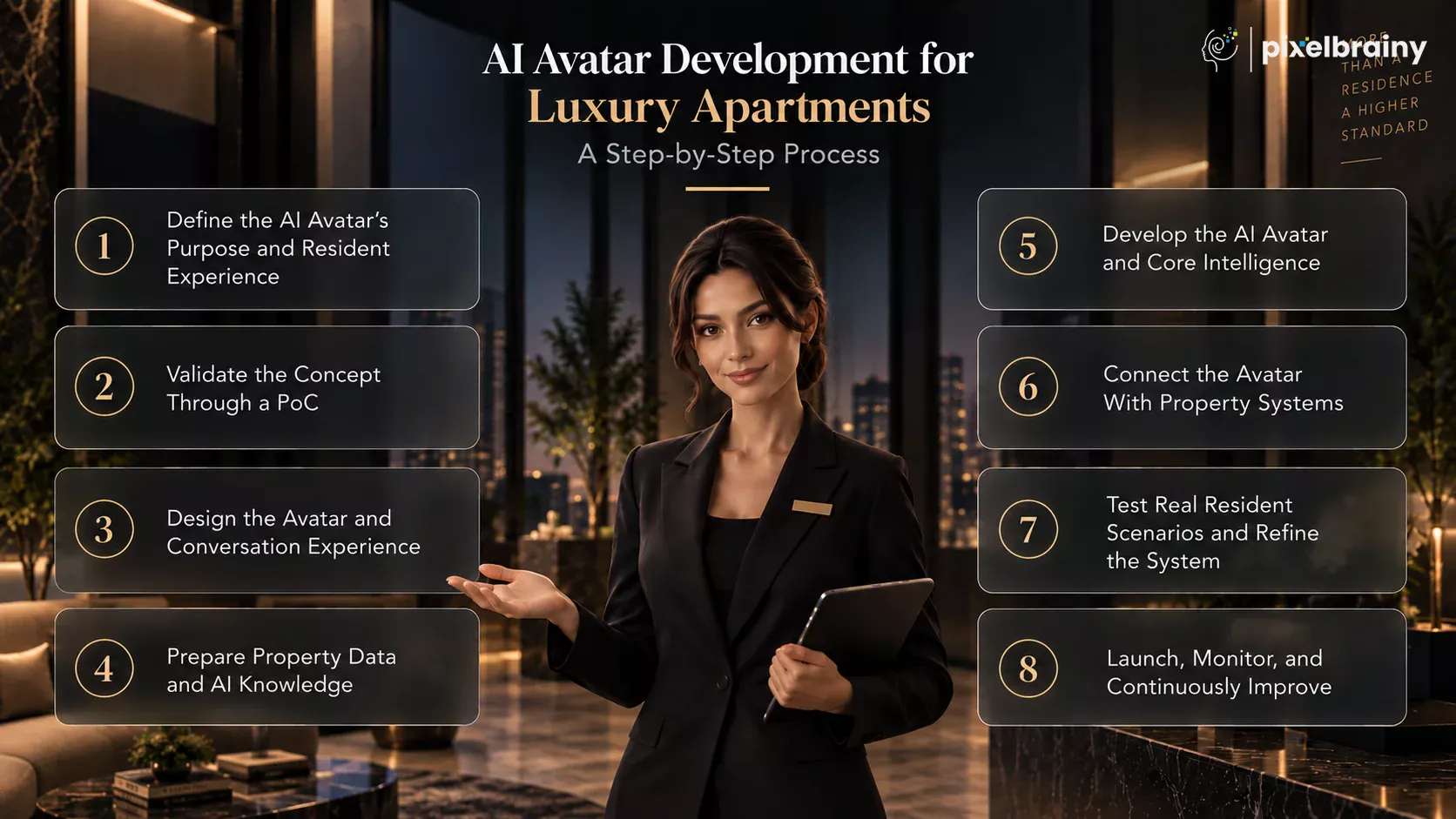
Start by deciding what the AI avatar should actually accomplish. Identify the resident problems it needs to address, such as answering repetitive questions, explaining amenities, assisting with services, recommending local businesses, or handling routine requests.
Also define where residents will interact with the avatar, such as a lobby display, kiosk, website, or mobile interface. Its personality, voice, appearance, supported languages, and human escalation rules should be established at this stage.
AI consultation can help property teams convert these business requirements into practical technical specifications.
Also Read: Top 10 AI Consulting Companies in USA
Before starting complete luxury apartment avatar development using AI, validate whether the proposed experience works as expected. A PoC can demonstrate important interactions such as voice conversations, property questions, avatar responses, and human handoff.
Use realistic resident scenarios during validation rather than generic chatbot questions. This helps identify issues with speech recognition, response accuracy, latency, avatar behavior, and device compatibility before moving into full-scale development.
A successful validation gives the development team a clearer technical direction.
Once the concept is validated, decide how the avatar should look, sound, and communicate. Its visual identity should complement the property's branding and luxury positioning rather than appearing like a generic virtual assistant.
Conversation designers should also map common resident journeys, including questions, follow-ups, confirmations, clarifications, and escalation points. Voice selection, facial expressions, gestures, response timing, and conversational language should work together to create a consistent experience.
These requirements also guide AI model development.
Also Read: Top 12+ AI Model Development Companies in the USA
The avatar needs reliable property information to provide useful answers. Collect building policies, amenity details, operating hours, parking information, service procedures, community guidelines, local recommendations, and other approved content.
This information should be organized into a structured knowledge source that the AI can retrieve when responding to residents. Property teams should also establish a process for keeping information updated.
For MVP development, begin with the most important resident questions and gradually expand the knowledge scope as the system matures.
Also Read: Top 10 AI MVP Development Companies in USA
Now the approved designs, knowledge, and technical requirements are converted into a working AI concierge. Developers connect conversational intelligence, speech recognition, avatar animation, knowledge retrieval, authentication, and the resident-facing interface.
The system should understand resident intent, maintain conversational context, retrieve relevant information, and generate natural responses. Developers should also establish clear rules for when the avatar answers independently and when it requests clarification or involves staff.
Experienced AI avatar development companies can structure the architecture for future expansion.
The AI concierge should work with the property's existing technology instead of operating as a completely separate system. AI integration may connect the avatar with property management platforms, resident databases, service request systems, amenity platforms, authentication tools, calendars, and communication systems.
Each integration should have clearly defined permissions. This is especially important when resident-specific information is involved.
A properly designed integration layer allows the avatar to support actual property workflows rather than simply providing static information.
Before launch, test the avatar with realistic resident conversations. Testing should cover common questions, unclear requests, incorrect inputs, different accents, background noise, multilingual interactions, unavailable information, authentication problems, and human escalation.
The property team should also verify whether responses follow approved policies and maintain the expected service tone.
If you hire AI developers with experience in conversational systems, they can use testing results to improve response accuracy, conversation flows, integrations, performance, and overall usability.
Once testing is complete, launch the AI avatar through a controlled rollout. Starting with one lobby, property, or resident service channel can help the team identify issues before expanding the solution.
After launch, monitor frequently asked questions, unsuccessful interactions, resident feedback, human handoffs, response quality, and system performance.
Working with top AI development companies can support continuous improvements as the property's requirements evolve. Additional capabilities can then be introduced based on actual resident needs and operational data.
A well-planned development journey turns the initial AI concierge concept into a reliable resident-facing experience that can continuously evolve with the property's service expectations.
While planning an AI concierge for a luxury apartment property, one of the first questions property owners ask is, how much does it cost to develop an AI avatar for luxury apartment properties? The answer typically falls between $15,000 and $150,000+, depending on the avatar's capabilities, level of customization, AI complexity, integrations, security requirements, and deployment scale.
The luxury apartment AI avatar development cost can vary significantly between projects. A basic avatar designed to answer property FAQs will require a different investment than an advanced digital concierge capable of personalized resident interactions, voice conversations, property management system connectivity, and service request handling.
Before development begins, property owners should establish a realistic development budget of AI avatar for luxury apartment projects based on their specific requirements. A detailed cost estimation of AI avatar for luxury apartment development should consider both the initial build and ongoing expenses such as infrastructure, maintenance, AI usage, updates, and technical support.
A common cost-related requirement from a property management team might be:
“We want to introduce an AI avatar concierge in our luxury apartment building, but we need a clear estimate before presenting the project to our investors. The avatar should answer resident questions, provide personalized assistance, support voice interaction, and connect with our existing property systems. What investment should we expect?”
So, what is the development pricing of AI avatar for luxury apartment solutions? The following breakdown provides a practical estimate based on different development scopes.
| AI Avatar Development Level | Estimated Cost | Suitable For | Typical Scope |
|---|---|---|---|
| Basic AI Avatar for Luxury Apartment | $15,000 to $35,000 | Single-property or pilot deployment | Human-like avatar, basic voice or text interaction, property FAQ knowledge base, basic conversation capabilities, limited customization, simple interface, and basic deployment |
| Advanced AI Avatar for Luxury Apartment | $35,000 to $75,000 | Premium properties requiring broader resident services | Advanced conversational AI, voice interaction, customized avatar, multilingual support, property-specific knowledge, resident authentication, selected PMS integrations, analytics, and human handoff |
| Enterprise AI Avatar for Luxury Apartment | $75,000 to $150,000+ | Large properties, portfolios, and complex residential operations | Highly customized digital human, advanced AI architecture, multiple system integrations, personalization, multilingual capabilities, enterprise security, analytics, scalable infrastructure, multi-property deployment, and ongoing optimization |
These are estimated development ranges, not fixed quotations. The final luxury apartment AI avatar development cost depends on the project's technical scope, integrations, design complexity, AI requirements, and deployment environment.
A basic digital character requires less design work than a highly realistic branded avatar with customized appearance, expressions, gestures, animations, and voice behavior. A luxury property may also require the avatar's visual identity to match its branding and interior experience.
The complexity of the AI directly affects development cost. Basic question answering is less expensive than contextual conversations, personalized responses, intent recognition, multilingual interactions, and sophisticated resident request handling.
Voice-enabled avatars require speech recognition, natural-language processing, and text-to-speech capabilities. Costs can increase when the solution needs multiple languages, higher-quality voices, specialized pronunciation, or more natural conversational responses.
Preparing the AI to answer property-specific questions requires collecting, structuring, cleaning, and connecting information about amenities, policies, services, operating hours, parking, community rules, and other resident resources.
Connecting the avatar with property management systems, resident platforms, maintenance systems, amenity booking tools, calendars, authentication services, or communication platforms can significantly increase development costs. The complexity and availability of APIs are major pricing factors.
If the avatar needs to access resident-specific information or perform authenticated actions, additional security architecture is required. Identity verification, authorization, encryption, access controls, audit mechanisms, and secure API connections can increase the development budget.
Supporting additional languages requires more than simply translating responses. The system may need multilingual speech recognition, text-to-speech, conversation handling, knowledge management, and language-specific testing.
A lobby-based AI avatar may require commercial displays, microphones, speakers, cameras where appropriate, computing hardware, mounting equipment, networking, and installation. Costs vary considerably depending on the property's existing infrastructure.
Testing ensures that the avatar responds accurately and consistently across different resident scenarios. Costs can include conversational testing, voice testing, integration testing, security testing, device compatibility, multilingual testing, and performance validation.
Analytics capabilities can track interactions, frequently asked questions, unsuccessful conversations, response performance, and human handoffs. More advanced reporting and property-level dashboards require additional development and infrastructure.
AI avatar solutions require hosting, databases, APIs, AI services, storage, monitoring, and other cloud resources. Initial deployment costs depend on the selected architecture, expected traffic, AI model usage, and number of properties.
After launch, the avatar needs ongoing monitoring, knowledge updates, security maintenance, AI improvements, bug fixes, integration support, and performance optimization. Monthly costs depend on usage volume and the level of support required.
| Project Scope | Typical Development Budget |
|---|---|
| Basic property information avatar | $15,000 to $25,000 |
| Voice-enabled luxury lobby avatar | $25,000 to $45,000 |
| Personalized resident AI concierge | $40,000 to $75,000 |
| AI avatar with PMS and multiple integrations | $60,000 to $100,000+ |
| Enterprise multi-property AI avatar platform | $100,000 to $150,000+ |
For most luxury residential projects, the right budget should be determined by the resident experience and operational requirements, rather than choosing the most expensive AI architecture. Starting with clearly defined requirements can help property owners control the cost to develop an AI avatar for luxury apartment properties while leaving room for future expansion.
A realistic budget of $15,000 to $150,000+ allows luxury properties to choose an AI avatar scope that matches their resident-service goals, technical requirements, and long-term growth plans.

Also Read: AI Avatar Development Cost: Know How Much Your Digital Avatar Will Cost
The technology behind an AI avatar concierge for luxury apartments determines how naturally it communicates, how accurately it answers resident questions, and how effectively it connects with day-to-day property operations. A polished avatar may attract attention in the lobby, but the underlying AI, voice, data, integration, and security technologies are what make the experience genuinely useful.
For property owners planning AI avatar development for luxury apartments, the technology stack should be built around the intended resident experience. The avatar may need to understand spoken questions, retrieve information from property databases, recognize resident context, communicate with existing property management systems, and involve a human concierge when necessary.
A typical requirement from a luxury residential property team could be:
“We want an AI avatar concierge that feels natural to interact with, understands resident questions, provides accurate information about our property, connects with our existing systems, and supports our concierge team. What tools and technologies are needed to build and deploy it?”
The following technology stack explains the core components required to turn that concept into a functional AI concierge for luxury apartments, from conversational intelligence and avatar technology to APIs, security, cloud infrastructure, and analytics.
| Technology / Tool | Role in AI Avatar Development | How It Supports a Luxury Apartment AI Concierge |
|---|---|---|
| Generative AI / LLM | Provides the conversational intelligence needed to understand questions and generate responses. | Enables residents to communicate naturally instead of relying on fixed commands. The AI can understand questions about amenities, services, policies, parking, deliveries, and other property-related topics. |
| Natural Language Processing (NLP) | Interprets resident language, intent, context, and conversational meaning. | Helps the avatar understand different ways residents may ask the same question and provide contextually appropriate responses throughout a conversation. |
| Speech-to-Text (STT) | Converts spoken resident questions into text that the AI can process. | Allows residents to speak naturally with a lobby avatar. High-quality speech recognition is particularly important in busy lobby environments where background conversations and ambient noise may be present. |
| Text-to-Speech (TTS) | Converts AI-generated responses into natural-sounding speech. | Gives the digital concierge a voice that can communicate property information clearly. Voice quality, pronunciation, pacing, and language support contribute significantly to the premium resident experience. |
| 3D Avatar / Digital Human Technology | Creates the visual representation of the AI concierge. | Provides facial expressions, gestures, body movements, and other visual behaviors that make interactions more engaging and suitable for a luxury residential lobby or digital concierge interface. |
| Lip Synchronization Technology | Synchronizes the avatar's mouth movements with generated speech. | Makes conversations appear more natural by coordinating spoken responses with realistic facial and mouth movements. This is particularly valuable for large lobby displays and interactive concierge kiosks. |
| AI Knowledge Base / RAG | Connects the AI with approved property-specific information. | Allows the avatar to retrieve relevant information about building rules, amenities, operating hours, services, parking, resident procedures, and other property data instead of relying only on general AI knowledge. |
| Vector Database | Stores and retrieves information used for semantic search and AI responses. | Helps the system find relevant property information even when residents use different wording from the original documents or knowledge-base entries. |
| Property Management System APIs | Connect the AI avatar with existing property software. | API connectivity can allow the avatar to interact with approved resident, maintenance, amenity, service, or property-management workflows while keeping the existing technology ecosystem connected. |
| Authentication and Identity Management | Controls access to resident-specific information and functions. | Helps verify residents before the avatar provides private information or performs restricted actions, improving security and protecting sensitive resident data. |
| Backend Application Framework | Manages business logic, APIs, workflows, user sessions, and communication between technologies. | Acts as the operational layer connecting the avatar interface, AI models, property data, authentication, integrations, and resident services into one functioning system. |
| Cloud Infrastructure | Provides computing, storage, databases, APIs, and deployment infrastructure. | Supports reliable operation of the AI concierge and allows the solution to scale as interaction volume, properties, languages, and connected services increase. |
| Database Technology | Stores approved application data, configuration, interaction information, and other required records. | Provides structured data management for property configurations, resident-service workflows, system settings, and analytics while supporting appropriate security controls. |
| Security and Encryption Tools | Protect data, communications, APIs, and system access. | Helps safeguard resident information and property systems through encryption, access controls, secure authentication, monitoring, and other security mechanisms. |
| Analytics and Monitoring Tools | Track system performance and resident interactions. | Helps property teams identify common questions, failed conversations, response issues, usage patterns, and human handoffs so the AI concierge can be continuously improved. |
| Frontend / Kiosk Interface | Provides the resident-facing screen and interaction environment. | Creates the visual experience through which residents see the avatar, read responses, interact with touch controls, and access available concierge services. |
| Integration Middleware | Coordinates communication between different applications and services. | Helps connect the AI avatar with property management platforms, resident applications, booking systems, communication tools, and other systems without making the architecture unnecessarily dependent on one platform. |
The right combination of AI, voice, avatar, property data, integration, security, and cloud technologies creates the technical foundation for a dependable luxury residential AI concierge.
Developing an AI avatar for a luxury apartment building can create a more responsive and personalized resident experience, but the development journey comes with several practical challenges. The AI needs to understand different types of resident requests, provide property-specific information accurately, protect private data, and work smoothly with existing property systems.
For property owners planning AI avatar development for luxury apartments, identifying these challenges before development begins can prevent costly rework and improve the quality of the final solution. The focus should not only be on creating a realistic digital human, but also on making the entire concierge experience dependable, secure, and easy to use.
A common concern from a luxury property team could be:
“We want to introduce an AI avatar concierge, but we are concerned about incorrect answers, resident privacy, system integration, and situations where the AI cannot resolve a request. What challenges should we address before launching it?”
Here are the 8 major challenges property owners and development teams should consider.
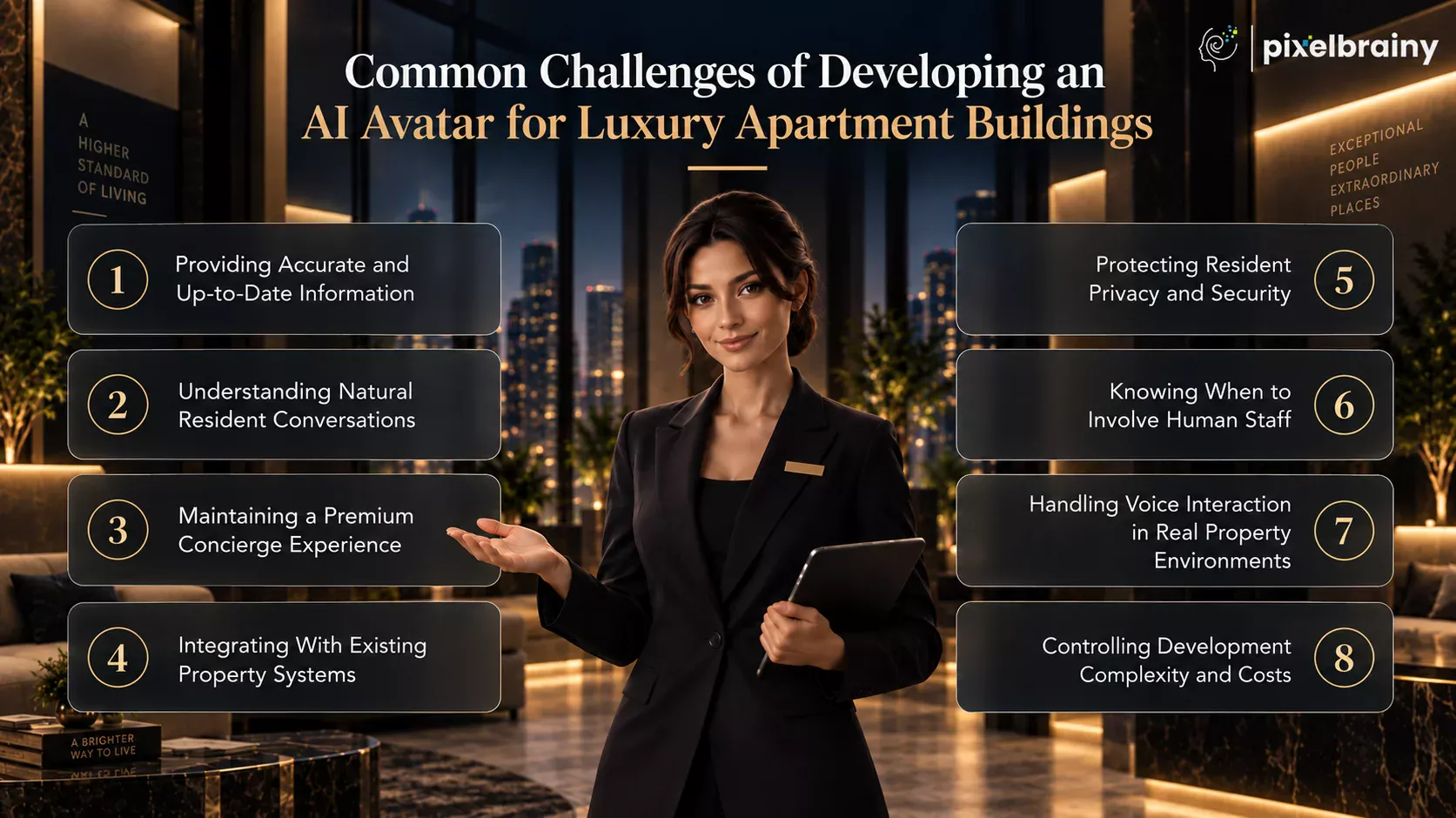
One of the biggest challenges is ensuring that the AI avatar always provides correct property information. Luxury apartment buildings frequently update amenity hours, parking rules, visitor policies, maintenance procedures, community events, and service information.
If the AI is working with outdated content, even a well-designed conversation can result in an incorrect answer and reduce resident trust.
How to solve it: Build a structured property knowledge base using approved information sources. Establish a process for regularly reviewing and updating content so the avatar reflects the property's latest policies and services.
Residents will not always ask questions using predefined phrases. One person may ask, “When does the gym close?” while another may say, “Can I still work out tonight?” Both questions can have the same intent.
The avatar also needs to handle different accents, speech patterns, incomplete questions, follow-up requests, and conversational context.
How to solve it: Use capable conversational AI and speech technologies, then test them against realistic resident conversations. Continuous refinement based on actual interactions can improve intent recognition and response accuracy.
A luxury property cannot afford an AI experience that feels robotic, confusing, or poorly designed. Slow responses, unnatural voices, repetitive language, awkward facial movements, or generic answers can make the technology feel disconnected from the property's premium service standards.
How to solve it: Design the avatar around the property's brand and service philosophy. Voice, appearance, conversation style, animations, response timing, and language should work together to create a polished and professional concierge experience.
An AI avatar becomes significantly more useful when it can work with the property's existing technology. However, connecting property management platforms, resident portals, maintenance systems, amenity booking tools, authentication services, and communication platforms can create technical complexity.
Different systems may also have different APIs, permissions, and data structures.
How to solve it: Identify integration requirements during the planning stage. Use secure APIs and middleware where appropriate, and define exactly what information the avatar can access, retrieve, or update within each connected system.
A personalized AI concierge may interact with resident names, apartment details, service requests, preferences, and other private information. If authentication and access controls are poorly implemented, the system could expose information to unauthorized users.
Security therefore needs to be part of the architecture from the beginning rather than added after development.
How to solve it: Implement appropriate authentication, authorization, encryption, secure API connections, access controls, logging, and data-retention policies. The avatar should only access the information necessary to complete an authorized task.
AI can handle many routine interactions, but some situations require human judgment. Complaints, sensitive resident issues, unusual maintenance situations, security concerns, and complex service requests may need direct involvement from the property's concierge or management team.
Keeping residents inside an automated conversation when the AI cannot help can quickly create frustration.
How to solve it: Establish clear escalation rules and human handoff workflows. When staff intervention is required, the AI should transfer the request along with relevant conversation context so residents do not have to repeat everything.
Lobby environments are rarely quiet. Conversations, music, elevators, doors, announcements, and general movement can interfere with voice recognition. A system that performs well in a controlled testing environment may behave differently when installed in an active residential lobby.
How to solve it: Use appropriate microphones, audio processing, noise reduction, and speech recognition technologies. Test the avatar in the actual deployment environment and optimize the setup based on real-world conditions.
AI avatar projects can become increasingly complex as property owners add more integrations, languages, personalization, AI capabilities, custom animations, and deployment locations. Expanding the scope without a clear roadmap can increase both development time and budget.
How to solve it: Define the initial scope around the most valuable resident interactions. Develop the core experience first, validate it with real users, and then introduce additional capabilities based on operational requirements and resident demand.
Addressing these eight challenges early helps property owners build an AI avatar that is accurate, secure, scalable, and aligned with the service standards expected from a luxury residential property.
The future of AI avatar development for luxury apartments is moving beyond simple question-and-answer concierge systems. As smart buildings, connected devices, property management platforms, and conversational AI continue to evolve, digital avatars can become a more active layer of the resident experience.
For luxury properties, the direction is clear: AI avatars will increasingly combine personalized communication with connected services, helping residents interact with their homes and property teams through a more natural digital interface.
Future AI avatars will become better at understanding individual resident preferences, routines, and service requirements. With appropriate permissions, an avatar could remember preferred amenities, communication preferences, frequently requested services, or previous interactions.
This can allow the concierge experience to become more personalized without requiring residents to repeatedly provide the same information. For luxury residences, this creates an experience closer to a dedicated personal concierge while maintaining appropriate privacy and consent controls.
As smart apartment technologies become more interconnected, AI avatars can serve as a conversational interface for connected residential services. Residents may eventually interact with an avatar to access information or initiate approved actions related to smart locks, lighting, temperature, parking, elevators, energy systems, and other building technologies.
This could make the avatar an accessible communication layer between residents and the property's broader smart-building ecosystem.
Future systems are likely to move from reactive assistance toward proactive resident support. Instead of waiting for a resident to ask a question, the AI could identify appropriate opportunities to provide useful information based on authorized context.
For example, an avatar could remind a resident about an upcoming amenity reservation, provide relevant building announcements, or suggest a service based on an active request. Proactive interactions should remain permission-based and focused on genuine resident value.
Advances in AI models, speech technology, facial animation, and real-time rendering will make digital avatars increasingly conversational and expressive. Future avatars may better understand interruptions, conversational context, tone, and follow-up questions while responding with more natural speech and synchronized expressions.
For luxury properties, this can make AI-assisted concierge interactions feel less like using software and more like communicating with a professional digital service representative.
The future will not necessarily limit the avatar to a single lobby screen. The same AI concierge could potentially provide a consistent experience across lobby displays, resident applications, websites, mobile devices, smart displays, and other approved channels.
This multi-channel approach can allow residents to start an interaction in one environment and continue it through another while maintaining relevant conversation context and service information.
The most valuable future model may be a hybrid one where AI handles routine interactions while human concierge professionals focus on complex, high-value, and relationship-driven services.
AI avatars can manage repetitive questions, information requests, and routine assistance, allowing human teams to dedicate more attention to hospitality, resident relationships, special requests, and situations requiring judgment. This creates a future where AI and human concierge services work together rather than competing with each other.
The future of luxury residential AI will center on connected, personalized, proactive, and human-supported digital concierge experiences that become an integral part of smart-property living.
From this above journey, now it is time to identify the right development partner who can turn the AI avatar concept into a reliable resident-facing solution. For luxury residential properties, the development partner needs to understand more than AI technology. The team should also understand conversational experiences, digital avatars, property workflows, integrations, personalization, security, and the service expectations associated with premium residences.
This is where PixelBrainy can support property owners looking to create a customized AI concierge experience. The company provides dedicated AI avatar development capabilities covering consultation, custom development, proof of concept, integration, testing, deployment, multilingual implementation, API development, and ongoing optimization.
PixelBrainy can support the complete journey, from defining the use case and designing the avatar experience to developing the underlying AI and integrating the solution with existing technology.
For properties looking to build AI avatar for luxury apartment environments, this end-to-end approach can help reduce the complexity of coordinating separate vendors for AI, avatar design, integrations, and deployment.
The development process can be tailored around specific property requirements, whether the avatar is intended for a lobby display, resident service environment, digital concierge interface, or a broader multi-property deployment.
Multilingual communication is particularly valuable for luxury properties serving internationally diverse residents. PixelBrainy's AI avatar services include multilingual implementation, allowing the solution to be designed around the languages and communication requirements of the target resident community.
A relevant real-world requirement could be:
“Our apartment buildings have residents from different countries, and our front-desk team struggles to provide consistent multilingual support. We want to create an AI avatar that can speak multiple languages and assist residents with building information, services, and everyday requests. Which company can develop this?”
A solution can be designed to provide consistent property information across supported languages while maintaining the property's preferred communication style.
For one confidential residential project, the requirement centered on creating a customized AI avatar experience capable of interacting with users through a digital interface while connecting AI capabilities with the client's specific business requirements.
The project involved defining the conversational experience, developing the AI avatar, integrating the required technologies, testing interactions, and preparing the solution for practical deployment. The focus was not simply on creating an attractive digital character, but on developing a functional AI-powered experience that could communicate naturally and support real-world user interactions.
The client name and sensitive project details remain confidential.
PixelBrainy offers a combination of AI development expertise and specialized avatar development capabilities, including virtual human creation, API development, integration and deployment, testing, multilingual implementation, and ongoing optimization.
For businesses planning develop AI avatar for luxury apartment projects, this broader technical capability can be valuable when the solution needs to connect multiple technologies rather than operate as a standalone avatar.
The team can also approach luxury apartment avatar development integrating AI around the property's specific objectives, resident workflows, branding requirements, and future scalability.
If your property has a specific AI concierge concept, PixelBrainy can help transform that requirement into a practical development roadmap.
Ready to create your luxury apartment AI avatar? Connect with PixelBrainy to discuss your project requirements.
An AI avatar for luxury apartments can function as a digital concierge that answers resident questions, provides property information, supports everyday requests, offers multilingual assistance, and connects residents with human staff when personal support is required. Its effectiveness depends on more than the avatar's appearance. Conversational AI, property knowledge, secure authentication, voice technology, PMS integration, and reliable human handoff all need to work together.
For property owners, AI avatar development for luxury apartments is most valuable when the solution is designed around real resident interactions and existing property workflows. Start with high-frequency concierge needs, establish accurate property data, integrate essential systems, test real conversations, and expand capabilities based on resident usage.
Whether the goal is to build an AI avatar for luxury apartments as a lobby concierge or create a personalized digital service layer across smart residences, a well-planned implementation can deliver consistent assistance while allowing human teams to focus on higher-value resident relationships.
Book an appointment with our AI avatar creation experts to discuss your luxury apartment AI avatar project.
The best approach is to design the avatar around actual resident interactions rather than appearance alone. Start by identifying concierge use cases such as amenity questions, building information, parking, deliveries, maintenance guidance, and resident services. Then connect conversational AI with a property knowledge base, voice technology, authentication, and relevant property management systems.
Developing an AI avatar for apartments can give residents a more immediate and interactive way to access property services. A resident could ask a question through a lobby display or voice interface, receive information conversationally, and be transferred to a human team member when the request requires personal assistance.
To create a human-like AI avatar for luxury residential properties, combine a realistic digital human interface with natural language processing, conversational AI, speech recognition, text-to-speech, facial animation, and accurate property data. The avatar should also reflect the property's branding, communication style, and service standards.
An AI concierge avatar should have access to approved information about amenities, operating hours, building policies, parking, packages, maintenance procedures, visitor guidelines, community events, resident services, and frequently requested local information. A connected knowledge system should allow property teams to update information without rebuilding the entire AI solution.
Yes. AI avatar development for luxury apartments can include integration with property management systems through APIs or middleware. Depending on the system and permissions, the avatar may retrieve resident-specific information, assist with service requests, support reservations, or pass relevant information to staff while maintaining appropriate authentication and security controls.
A properly designed avatar can provide personalized interactions based on authenticated resident information, preferences, previous requests, available amenities, and property-specific services. Personalization should be carefully controlled so the AI only accesses information that the resident is authorized to view.
A luxury residential AI avatar needs to deliver more than fast answers. Its communication style, visual identity, response accuracy, voice quality, personalization, multilingual capabilities, and human handoff should align with the property's premium service standards. The objective is to create a digital concierge experience that feels consistent with the level of service residents expect.
PixelBrainy can help property owners develop a customized AI avatar concierge for luxury residential properties. Its AI avatar development services cover avatar creation, conversational AI, voice interaction, multilingual implementation, API development, system integration, testing, deployment, and ongoing optimization. This makes PixelBrainy suitable for projects that need an AI concierge connected with existing property workflows while maintaining a premium resident experience.

About The Author
Sagar Bhatnagar
Sagar Sahay Bhatnagar brings over a decade of IT industry experience to his role as Marketing Head at PixelBrainy. He's known for his knack in devising creative marketing strategies that boost brand visibility and market influence. Sagar's strategic thinking, coupled with his innovative vision and focus on results, sets him apart. His track record of successful campaigns proves his ability to utilize digital platforms effectively for impactful marketing efforts. With a genuine passion for both technology and marketing, Sagar continuously pushes PixelBrainy's marketing initiatives to greater success.

Working with the PixelBrainy team has been a highly positive experience. They understand the design requirements and create beautiful UX elements to meet the application needs. The dev team did an excellent job bringing my vision to life. We discussed usability and flow. Sagar worked with his team to design the database and begin coding. Working with Sagar was easy. He has the knowledge to create robust apps, including multi-language support, Google and Apple ID login options, Ad-enabled integrations, Stripe payment processing, and a Web Admin site for maintaining support data. I'm extremely satisfied with the services provided, the quality of the final product, and the professionalism of the entire process. I highly recommend them for Android and iOS Mobile Application Design and Development.

Great experience working with them. Had a lot of feedback and I found that unlike most contractors they were bugging me for updates instead of the other way around. They were extremely time conscience and great at communicating! All work was done extremely high quality and if not on time, early! They were always proactive when it comes to communication and the work is great/above par always. Very flexible and a great team to work with! Goes above and beyond to present us with multiple options and always provides quality. Amazing work per usual with Chitra. If you have UI/UX or branding design needs I recommend you go to them! Will likely work with them in the future as well, definitely recommended!

PixelBrainy is a joy to work with and is a great partner when thinking through branding, logo, and website layout. I appreciate that they spend time going into the "why" behind their decisions to help inform me and others about industry best practices and their expertise.

I hired them to design our software apps. Things I really like about them are excellent communication skills, they answer all project suggestions and collaborate right away, and their input on design and colors is amazing. This project was complex and needed patience and creativity. The team is amazing to do business with. I will be using them long-term. Glad to see there are some good people out there. I was afraid to try and outsource my project to someone but I am glad I met them! I really can't say enough. They went above and beyond on this project. I am very happy with everything they have done to make my business stand out from the competition.

It was great working with PixelBrainy and the team. They were very responsive and really owned the project. We'll definitely work with them again!

I recently worked with the PixelBrainy team on a project and I was blown away by their communication skills. They were prompt, clear, and articulate in all of our interactions. They listened and provided valuable feedback and suggestions to help make the project a success. They also kept me updated throughout the entire process, which made the experience stress-free and enjoyable.

PixelBrainy is very good at what it does. The team also presents themselves very professionally and takes care of their side of things very well. I could fully trust them taking up the design work in a timely and organised manner and their attention to detail saved us lots of effort and time. This particular project was quite intense and the team showed that they function very well under pressure. Very much looking forward to working with her again!

It's always an absolute pleasure working with them. They completed all of my requests quickly and followed every note I had for them to a T, which made our process go smoothly from start to finish. Everything was completed fast and following all of the guidelines. And I would recommend their services to anyone. If you need any design work done in the future, PixelBrainy should be your first call!

They took ownership of our requirements and designed and proposed multiple beautiful variants. The team is self-motivated, requires minimum supervision, committed to see-through designs with quality and delivering them on time. We would definitely love to work with PixelBrainy again when we have any requirements.

PixelBrainy was a big help with our SaaS application. We've been hard at work with a new UI/UX and they provided a lot of help with the designs. If you're looking for assistance with your website, software, or mobile application designs, PixelBrainy and the team is a great recommendation.

PixelBrainy designers are amazing. They are responsive, talented, and always willing to help craft the design until it matches your vision. I would recommend them and plan to continue them for my future projects and more!!!

They were awesome! Did a good job fast, and good communication. Will work with them again. Thank you

Creative, detail-oriented, and talented designers who take direction well and implement changes quickly and accurately. They consistently over-delivered for us.

PixelBrainy team is very talented and creative. Great designers and a pleasure to work with. PixelBrainy is an excellent communicator and I look forward to working with them again.

PixelBrainy has a very talented design team. Their work is excellent and they are very responsive. I enjoy working with them and hope to continue on all of our future projects.


Transform your ideas into reality with us.
Across these industries, each engagement brings unique challenges, from early-stage product development to scaling complex systems, helping us build a practical understanding of real-world product environments.