AI Summary Powered by PixelBrainy
Can a hospital realistically improve HCAHPS communication and responsiveness scores with AI without creating another disconnected technology layer for clinicians and patients?
For a 600-bed academic medical center, this is not simply a technology question. It is a patient experience, workforce, operational efficiency, and measurable quality improvement question. When communication and responsiveness scores consistently fall below the national median, hospital leaders need more than an AI chatbot. They need an intelligent patient concierge platform that can understand patient requests, provide accurate information, connect patients with the right hospital service, escalate issues to staff, and continuously identify opportunities to improve the patient journey.
This is where AI patient concierge platform development for hospitals becomes strategically relevant. A well-designed platform can serve as a digital front door and an in-hospital communication layer covering appointment navigation, wayfinding, FAQs, discharge guidance, service requests, reminders, feedback collection, escalation, and personalized patient communication.
The market is moving quickly. Grand View Research estimates that the global AI in patient engagement market will reach $10.6 billion in 2026, up from $6.1 billion in 2023, and projects it to reach $23.1 billion by 2030 at a 21% CAGR.
For hospital executives evaluating developing an AI patient concierge platform for hospitals, however, market growth is less important than evidence. The honest answer is that publicly documented HCAHPS improvement data specifically attributable to AI concierge platforms remains limited. Some vendors report substantial improvements, while peer-reviewed research shows that AI-assisted communication and real-time feedback can improve patient experience. For example, a randomized study at a 550-bed tertiary medical center increased provider-communication HCAHPS "always" responses from 80.5% to 86%.
Vendor evidence is also emerging. HydraCor reports a 30-point HCAHPS "Rate the Hospital" top-box improvement with its AdvoCor platform, while Fabric reports a 30% reduction in call-center volume at Intermountain Healthcare and a 3x first-year ROI case for its AI assistant. These are vendor-reported outcomes and should be validated through customer references and independent analysis before being used in a board business case.
Therefore, how to create an AI patient concierge platform development for hospitals should begin with measurable outcomes, not AI features. The right AI patient concierge platform development process connects patient needs to operational workflows, HCAHPS domains, EHR data, staff escalation, security, and continuous measurement.
For a hospital deciding whether to make an AI patient concierge platform for hospitals, the key question is not whether AI can answer patients. It is whether AI can help the organization respond faster, communicate better, reduce friction, and prove the resulting improvement.
An AI patient concierge platform for hospitals is an intelligent digital system that uses artificial intelligence, natural language processing, healthcare data, and workflow automation to help patients access information and hospital services throughout their healthcare journey. Unlike a basic hospital chatbot that only answers predefined questions, an AI patient concierge can understand patient requests, provide personalized responses, automate selected tasks, and connect patients with hospital staff when human assistance is required.
The primary goal of AI patient concierge platform development for hospitals is to create a digital front door that makes healthcare interactions faster, simpler, and more accessible.
The working process typically involves six key layers:
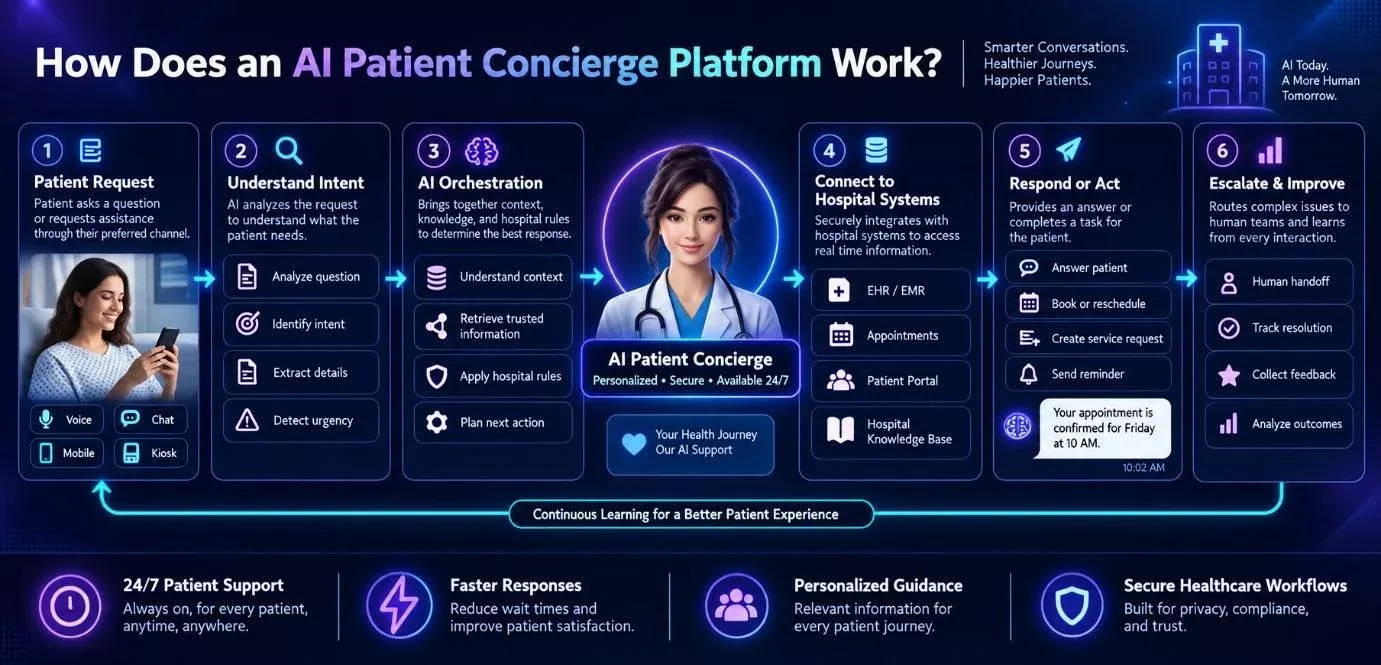
Patients can communicate with the concierge through a hospital website, mobile application, patient portal, SMS, voice assistant, kiosk, or in-room tablet. Patients can ask questions using natural language instead of navigating complex menus.
For example:
"Where is the cardiology department, and what time should I arrive for my appointment?"
The AI analyzes the patient's request to determine what they need. It can recognize intents such as appointment scheduling, hospital navigation, billing questions, visiting information, discharge support, service requests, or feedback.
The platform retrieves information from approved hospital knowledge sources. A retrieval augmented generation, or RAG, architecture can help the AI provide responses based on verified hospital content instead of relying only on the model's general knowledge.
Information can include hospital policies, department details, physician information, appointment instructions, visiting hours, parking information, and patient education materials.
When properly authorized, the platform can connect with systems such as the EHR, scheduling platform, patient portal, CRM, and hospital directory. This allows it to provide relevant information such as appointment details or check-in instructions while maintaining appropriate access controls.
An advanced AI concierge does more than answer questions. It can initiate approved workflows.
For example:
Patient asks to reschedule → AI checks available appointments → Patient selects a time → Scheduling system is updated → Patient receives confirmation.
AI should recognize situations that require staff involvement. Clinical concerns, emergencies, complaints, complex billing issues, patient safety concerns, and requests outside the platform's approved scope can be routed to the appropriate human team.
A simplified architecture looks like this:
Patient → Digital Interface → AI Engine → Intent Detection → Knowledge or Hospital System → Response or Action → Human Escalation → Analytics
This approach makes developing an AI patient concierge platform for hospitals more than a chatbot project. It creates an intelligent communication and workflow layer between patients and hospital services.
For hospitals, the most effective AI patient concierge platform development process combines conversational AI with verified information, secure healthcare integrations, workflow automation, human oversight, and measurable patient experience outcomes.
Why should a hospital invest in an AI patient concierge platform when it already has an EHR, patient portal, call center, mobile app, and multiple digital communication tools? The answer is not simply to add another AI interface. The strategic reason is to create an intelligent coordination layer that can connect fragmented patient-facing services and support the hospital's long-term patient experience strategy.
For a 600-bed academic medical center evaluating AI patient concierge platform development for hospitals, the investment decision should be based on operational pressure, patient expectations, workforce constraints, technology maturity, and measurable business objectives.
The American Hospital Association reported in 2026 that approximately 60% of hospital expenses are workforce-related, while hospital expenses was increased 7.5% in 2025. The same report found that hospitals spent approximately $43 billion in 2025 trying to collect payments from insurers because of claims denials, prior authorization, documentation requests, and related administrative processes.
This creates a strong reason to evaluate technologies that can automate appropriate patient-facing and administrative workflows. Developing an AI patient concierge platform for hospitals allows organizations to examine where repetitive communication and coordination tasks can be handled digitally without replacing human care teams.
Healthcare organizations are moving beyond isolated AI pilots. Deloitte's 2026 healthcare outlook reports that 49% of healthcare organizations are still experimenting with generative AI and agentic AI, while only about one-third are operating AI at scale. More than 80% of health system and health plan executives surveyed believe generative AI and agentic AI could deliver moderate to significant value across multiple functions.
For hospital leadership, this makes AI patient concierge platform development a strategic infrastructure decision rather than simply a chatbot project.
MarketsandMarkets projects the global AI in healthcare market to grow from $36.67 billion in 2026 to $194.79 billion by 2031, representing a 39.7% CAGR.
The same market direction is visible in AI agents. The global healthcare AI agents market is projected to reach $6.92 billion by 2030, growing at a 44.1% CAGR from 2025 to 2030.
Traditional patient surveys provide valuable information, but they are retrospective. Hospitals increasingly need mechanisms that identify communication friction while the patient journey is happening.
An AI concierge creates an opportunity to connect patient questions, service requests, complaints, escalation events, and feedback with operational data. For an organization whose HCAHPS communication and responsiveness scores remain below the national median, this can provide a more continuous layer of patient-experience intelligence.
Patients increasingly interact with healthcare through multiple channels. Websites, portals, apps, text messages, contact centers, and hospital staff can create disconnected experiences.
The strategic case for how to create an AI patient concierge platform development for hospitals is therefore to connect these touchpoints through one intelligent orchestration layer that can understand the patient's request and determine the appropriate next action.
A concierge does not have to remain limited to FAQs. Once the foundation is established, hospitals can progressively introduce scheduling, navigation, service requests, feedback workflows, voice interaction, personalized communication, and agentic automation.
That makes to make an AI patient concierge platform for hospitals a potentially broader digital transformation investment rather than a single-use software purchase.
For hospital leaders, the strongest reason to invest is not the novelty of AI. It is the need to build a scalable patient communication infrastructure that can keep pace with rising operational pressure, digital expectations, and increasingly AI-enabled healthcare.
A well-planned AI patient concierge platform development process should therefore begin with measurable institutional problems and scale only when the technology demonstrates operational and patient-experience value.
What happens when patients can get the right hospital information, initiate routine requests, and reach the appropriate team without repeatedly calling different departments? This is where the practical value of an AI patient concierge platform for hospitals becomes clear. By combining conversational AI, healthcare knowledge, automation, and human escalation, the platform can improve multiple points across the patient journey.
For organizations investing in AI patient concierge platform development, the benefits extend beyond answering patient questions. The platform can support communication, accessibility, service coordination, patient engagement, and operational workflows while giving hospitals a more consistent digital experience across channels. Recent research also found that patients using AI-assisted conversational agents reported significantly higher patient experience scores across communication, health information, short-term outcomes, and general satisfaction.
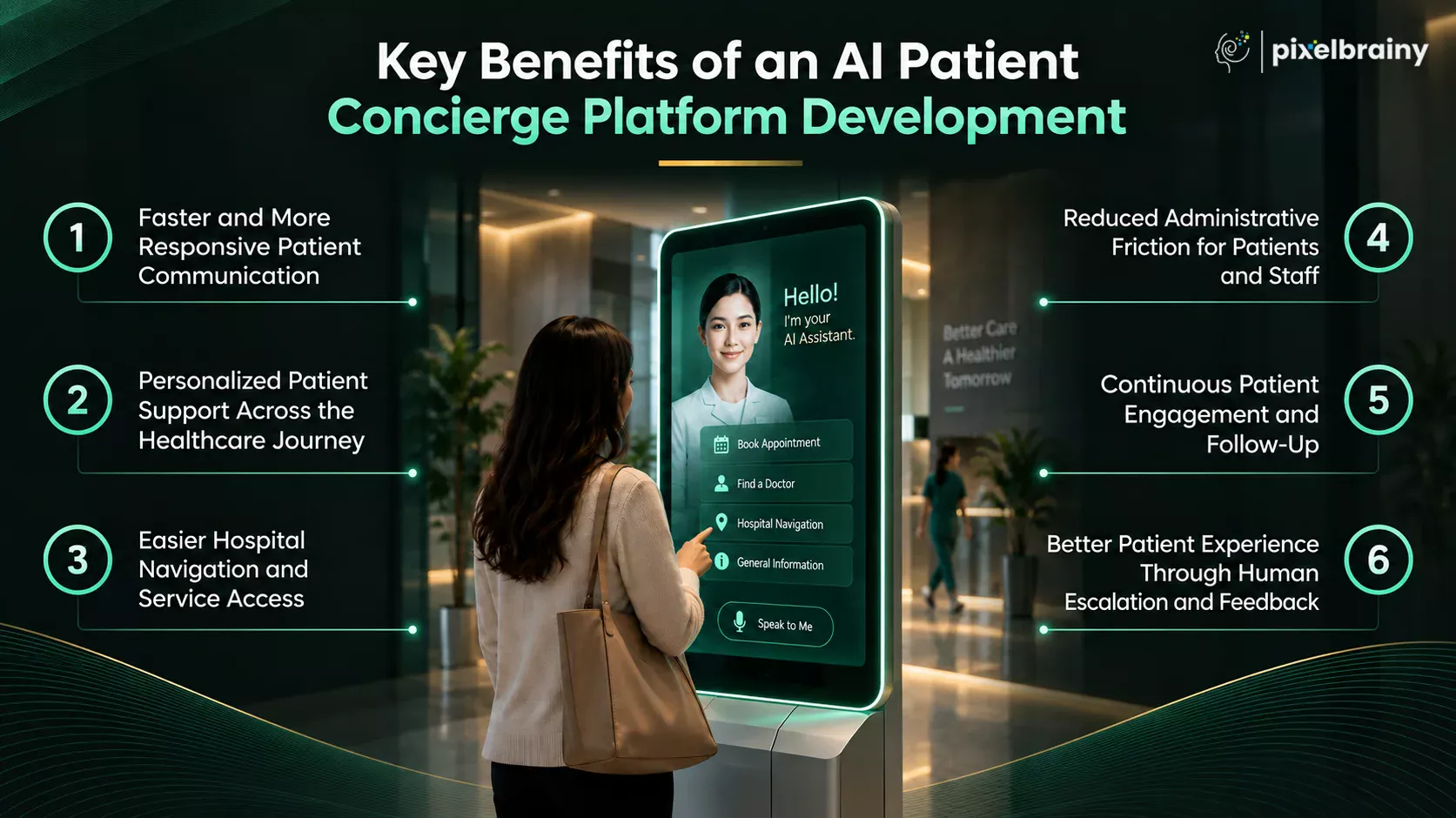
One of the most important benefits of an AI patient concierge platform development is the ability to provide immediate responses to routine patient questions. Instead of waiting for a staff member to become available, patients can receive approved information about appointments, visiting hours, departments, parking, preparation instructions, and hospital services at any time.
For hospitals focused on improving communication and responsiveness, this creates a consistent first point of contact. The AI can also identify requests that require staff involvement and route them to the appropriate team. This helps create a more responsive patient communication model without positioning AI as a replacement for human interaction.
An AI concierge can provide context-aware assistance before, during, and after a hospital visit. With appropriate authorization and integration, it can use information such as appointment details, department information, and patient preferences to deliver more relevant guidance.
For example, instead of giving a generic response about an appointment, the platform could provide the appointment time, arrival instructions, location, preparation requirements, and directions. This makes building an AI patient concierge platform for hospitals particularly valuable for organizations seeking a more personalized digital patient journey. The experience can also adapt to language preferences and communication channels.
Large hospitals can be difficult for patients and caregivers to navigate. Patients may need to locate imaging departments, laboratories, specialty clinics, pharmacies, registration desks, parking areas, or specific hospital buildings.
An AI patient concierge platform can act as a digital navigation assistant by providing department information, directions, check-in guidance, and service details through mobile, web, voice, or kiosk interfaces. This can reduce confusion during important moments of the patient journey. Hospitals can also connect navigation with appointment workflows so that patients receive relevant location information instead of searching through multiple hospital webpages or applications.
Patients frequently need assistance with routine administrative activities such as appointment questions, registration instructions, scheduling requests, forms, reminders, and service inquiries. Handling every interaction manually can place significant pressure on contact centers and administrative teams.
A well-designed AI patient concierge platform development process can automate selected low-risk workflows while maintaining human escalation for complex cases. This allows staff to focus their attention on situations that require judgment, empathy, or direct intervention. Research on healthcare AI adoption similarly identifies administrative and workflow tasks as important areas where AI can support efficiency.
Patient engagement should not stop when an appointment ends or a patient leaves the hospital. An AI concierge can support approved communication throughout the patient journey by delivering reminders, follow-up prompts, preparation information, feedback requests, and other relevant notifications.
For example, after discharge, the platform could remind an eligible patient about a scheduled follow-up appointment or provide approved instructions about the next step in their care journey. This creates a continuous communication channel rather than relying entirely on patients to remember instructions or initiate contact. The result is a more connected AI-powered patient engagement platform that can support communication beyond individual hospital visits.
A major advantage of a hospital AI concierge is its ability to combine automation with human support. When a patient expresses frustration, reports a service problem, asks a complex question, or presents a situation outside the AI's approved scope, the system can escalate the interaction to an appropriate employee.
The platform can also capture feedback, categorize recurring concerns, and identify patterns across departments. This creates a feedback loop for patient experience teams. Importantly, patients generally expect AI to support rather than replace human care. Research shows that patients value usability, clear communication, privacy, and human oversight when interacting with AI in healthcare.
The strongest AI patient concierge platform benefits come from combining intelligent automation with human support, creating a patient experience that is faster, more accessible, personalized, and easier to navigate.
For hospitals, the objective should be simple: use AI to remove friction from the patient journey while keeping human care at the center.
What should an AI patient concierge platform actually include before a hospital invests in advanced AI capabilities? The answer starts with practical, patient-facing features that solve everyday communication, navigation, scheduling, and service-access challenges.
For hospitals, AI patient concierge platform development should focus first on creating a reliable digital support layer that patients can access across their healthcare journey. The platform should help patients find information, understand what to do next, complete routine tasks, communicate in their preferred language, and reach hospital staff when AI assistance is not sufficient.
This becomes especially important for international healthcare programs. Consider this real-world requirement: “We are a health system and we want to build an AI patient concierge platform that serves our international patient population including patients from the Middle East, China, and Latin America who come to our facility for complex procedures and who require language support, cultural accommodation, and navigation assistance that our staff cannot provide consistently at scale. Before we scope development we need to understand the features what can we implement for our AI patient concierge platform.”
For such organizations, the core feature set should prioritize accessibility, multilingual communication, culturally appropriate information delivery, hospital navigation, appointment support, and seamless human escalation. The following features provide a practical foundation for building an AI patient concierge platform for hospitals without moving into advanced capabilities that can be added at a later stage.
| Core Feature | Description |
|---|---|
| AI Conversational Assistant | An AI conversational assistant allows patients to communicate naturally through text or voice. It can understand common requests, identify patient intent, answer approved questions, and guide users toward the appropriate hospital service without requiring complex menus or navigation. |
| Multilingual Patient Support | Multilingual support enables the concierge to communicate with patients in languages such as English, Arabic, Mandarin, and Spanish. It can translate approved information and conversations while allowing international patients to interact with hospital services in their preferred language. |
| Culturally Appropriate Communication | Cultural accommodation helps the platform present information in a respectful and context-aware manner for international patients. Hospitals can configure communication preferences, terminology, etiquette guidance, and culturally relevant information without making assumptions about individual patients. |
| Hospital Information and FAQs | A centralized hospital knowledge base allows patients to receive consistent information about departments, visiting hours, parking, facilities, policies, services, contact information, and administrative procedures. Content should come from approved and regularly maintained hospital sources. |
| Appointment Assistance | Appointment assistance helps patients understand appointment dates, locations, preparation requirements, arrival times, and check-in procedures. With appropriate system integration, the concierge can also support approved appointment booking, cancellation, and rescheduling workflows. |
| Patient Registration Support | Registration support guides patients through administrative requirements before arrival. The concierge can explain required documents, registration procedures, insurance details, forms, identification requirements, and check-in instructions, helping international patients prepare before reaching the hospital. |
| Hospital Wayfinding | Hospital wayfinding helps patients and caregivers locate clinics, departments, laboratories, imaging centers, pharmacies, entrances, elevators, parking areas, and other facilities. The platform can provide simple step-by-step directions based on the patient's destination. |
| Pre-Visit Preparation | Pre-visit preparation provides patients with timely information about what they need before an appointment or procedure. This can include arrival instructions, required documents, preparation guidelines, appointment details, and other hospital-approved information. |
| Patient Portal Integration | Patient portal integration connects the concierge with existing digital patient services. Depending on authorization and available APIs, patients can be directed to appointments, messages, documents, instructions, and other functions already provided through the hospital's patient portal. |
| Non-Clinical Service Requests | Patients can submit appropriate non-clinical requests directly through the concierge instead of contacting multiple departments. Requests can include transportation assistance, interpreter services, housekeeping, food-related support, facility assistance, or other services defined by the hospital. |
| Personalized Notifications | Personalized notifications can deliver relevant appointment reminders, preparation instructions, confirmations, schedule updates, and service information through supported communication channels. Notifications should follow patient preferences, consent requirements, communication policies, and appropriate privacy controls. |
| Patient Feedback Collection | Patient feedback functionality allows patients to provide ratings, comments, concerns, and suggestions during or after their hospital experience. The platform can organize feedback by topic, department, interaction, or service area for patient experience teams to review. |
| Human Staff Escalation | Human escalation provides patients with a clear path to hospital staff when an AI response is insufficient. Complex administrative issues, complaints, clinical concerns, patient safety matters, and emotionally sensitive situations can be routed to appropriate human teams. |
| Staff Management Dashboard | A staff dashboard gives authorized employees a centralized view of patient requests, conversations, escalations, unresolved issues, and service status. This helps teams manage concierge interactions efficiently while maintaining appropriate permissions and accountability for patient information. |
| Interaction History and Analytics | Interaction history and basic analytics help authorized teams understand previous patient requests and recurring communication patterns. Hospitals can analyze conversation categories, common questions, service requests, escalation volume, and feedback trends to identify opportunities for improving patient support. |
These core capabilities give hospitals a structured starting point for AI patient concierge platform development while keeping the initial product focused on high-value, practical patient interactions.
A strong core feature set ensures the AI concierge solves real patient communication and navigation problems before hospitals expand into more advanced AI capabilities.
Also Read: RAG vs AI Agents vs Agentic AI: Differences, Use Cases, and How to Choose for Your Business
Once the essential capabilities of an AI patient concierge platform for hospitals are in place, healthcare organizations can introduce advanced AI features that make the platform more proactive, context-aware, and capable of supporting complex patient experience workflows.
A useful question for hospital leaders at this stage is: “Our hospital already has an AI patient chatbot for FAQs and appointment support. We now want to understand which advanced AI capabilities can help us proactively identify patient dissatisfaction, automate service recovery, personalize communication, and escalate complex requests to the right hospital team.”
This is where advanced AI patient concierge platform development can move beyond basic question answering. Predictive analytics, agentic AI, voice interaction, sentiment analysis, intelligent routing, and personalized patient journeys can help hospitals create a more responsive digital patient experience. However, these capabilities should be introduced according to the hospital's data readiness, workflow requirements, security framework, and human oversight model.
| Predictive Patient Experience Analytics | Predictive patient experience analytics can examine approved interaction data, service requests, feedback, wait-related signals, and communication patterns to identify potential dissatisfaction. Patient experience teams can use these signals to prioritize interventions before concerns develop into formal complaints or negative survey responses. |
| AI-Powered Sentiment Analysis | AI sentiment analysis evaluates patient conversations to identify signals such as frustration, confusion, dissatisfaction, urgency, or positive sentiment. The feature can categorize interactions and support escalation decisions, helping patient experience teams understand emotional trends across departments and patient journeys. |
| Agentic AI Workflow Automation | Agentic AI can coordinate multiple actions to complete an approved patient workflow rather than simply generating an answer. It can interpret a request, retrieve information, communicate with connected systems, initiate tasks, verify completion, and provide the patient with an appropriate status update. |
| Voice AI Patient Concierge | Voice AI allows patients to communicate naturally with the hospital through spoken conversations. Advanced speech recognition and text-to-speech technology can support telephone assistance, in-room interactions, accessibility requirements, and patients who find typing difficult or prefer verbal communication. |
| Real-Time Service Recovery | Real-time service recovery can detect patient complaints, delays, or service concerns during the healthcare journey and initiate an appropriate workflow. The platform can notify the responsible team, create a task, track resolution, and follow up with the patient after the issue is addressed. |
| Hyper-Personalized Patient Journeys | Hyper-personalization allows the AI concierge to adapt communication based on authorized patient context, journey stage, appointment information, preferred language, previous interactions, and service requirements. Patients can receive relevant next-step guidance instead of generic messages that may not apply to their situation. |
| Multimodal AI Interaction | Multimodal AI enables the concierge to understand and respond to multiple information formats, including text, voice, images, and documents. This can support use cases such as explaining approved hospital documents, interpreting navigation information, or guiding patients through digital forms. |
| AI Patient Journey Orchestration | AI journey orchestration connects multiple patient interactions into one coordinated experience. The platform can recognize a patient's current journey stage and provide appropriate next-step assistance across registration, appointments, procedures, discharge, and follow-up while coordinating relevant hospital workflows. |
| Intelligent Escalation and Routing | Intelligent escalation analyzes the context, intent, urgency, and complexity of a patient's request before routing it to the appropriate department or employee. This helps prevent complex conversations from remaining within automation and can reduce incorrect transfers between hospital teams. |
| Executive Patient Experience Intelligence | Executive patient experience intelligence transforms large volumes of concierge interactions into strategic insights for hospital leadership. Dashboards can highlight dissatisfaction patterns, recurring patient concerns, escalation trends, service bottlenecks, department-level issues, and experience indicators that support data-driven improvement initiatives. |
These advanced capabilities can make an AI patient concierge platform development initiative considerably more powerful, but hospitals should validate each feature through controlled pilots and measurable outcomes before scaling across the organization.
Advanced AI should not simply make the concierge smarter. It should make the hospital more proactive, responsive, and capable of resolving patient needs at the right time.
Building an AI patient concierge platform for a hospital network requires more than developing a chatbot and connecting it to an AI model. A successful platform must fit existing hospital workflows, understand patient needs, integrate with healthcare systems, protect sensitive information, and provide a clear path to human assistance.
For a health system operating multiple acute care facilities, the development strategy should also account for differences between hospitals while maintaining a consistent patient experience. Consider this real-world requirement: “Our hospital network operates 8 acute care facilities and our biggest patient experience challenge is that patients admitted for complex procedures have no single point of contact for navigating their hospital stay including finding their way around our facilities, understanding their care schedule, knowing when their family members can visit, and getting answers to routine questions without pulling nursing staff away from clinical tasks. Which development companies have experience building AI patient concierge platforms specifically designed to reduce unnecessary nursing staff interruptions while improving patient communication?”
The following eight stages explain the steps to develop an AI patient concierge platform for hospitals from idea to launch and provide a practical framework for developing an AI patient concierge platform for hospitals.
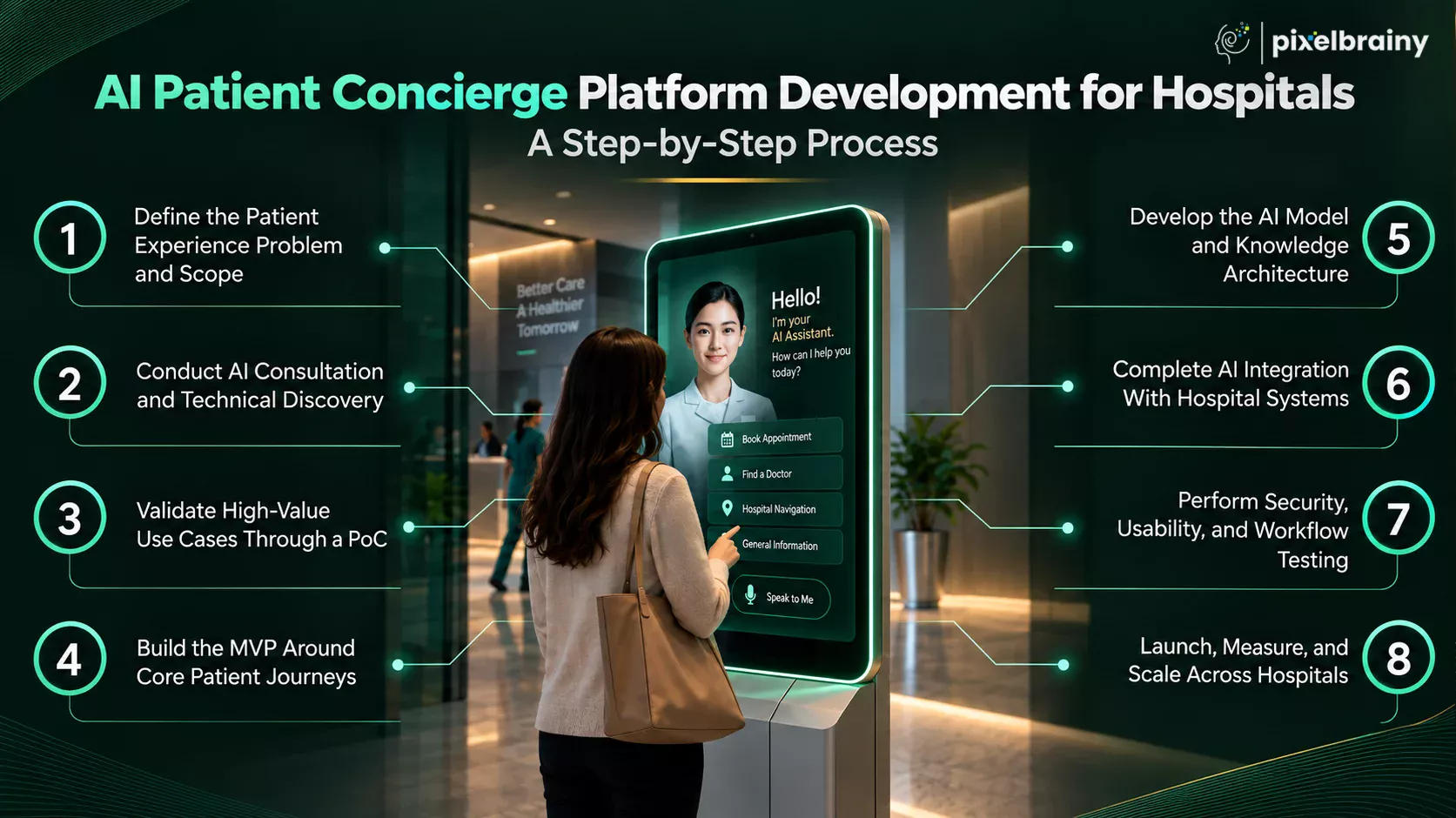
The first stage of AI patient concierge platform development is identifying the specific patient and operational problems the platform needs to solve. Hospitals should analyze where patients experience communication gaps and where employees spend excessive time answering repetitive questions.
For an inpatient concierge, these areas may include hospital navigation, visiting information, care schedule questions, meal requests, facility information, appointment guidance, and other non-clinical requests. Nursing leaders should identify which routine questions frequently interrupt clinical workflows.
For an eight-facility network, conduct this analysis across every location because processes may differ between hospitals. Define the initial patient population, departments, languages, communication channels, and workflows. Establish measurable objectives before development begins so the project can later demonstrate whether the platform actually addressed the original problem.
The next stage involves AI consultation and detailed technical discovery. The development team should evaluate the hospital's current technology infrastructure, patient journeys, operational processes, data sources, security requirements, and integration environment.
This assessment should cover EHR systems, patient portals, scheduling platforms, CRM solutions, hospital directories, communication tools, knowledge repositories, and service-management systems. Stakeholders from IT, nursing, patient experience, operations, compliance, clinical leadership, and administration should participate.
The purpose is to determine what the AI concierge should answer, which workflows it should automate, what information it can access, and when it must transfer patients to staff. This stage creates the technical roadmap and prevents expensive redesign later in the development cycle.
Also Read: Top 10 AI Consulting Companies in USA
PoC development allows hospitals to test whether selected AI concierge workflows work effectively before committing to a full-scale platform.
Instead of attempting to automate the entire patient journey, begin with a limited number of high-volume, low-risk scenarios. These could include wayfinding, visiting hours, hospital policies, routine inpatient questions, facility information, and service-request routing.
The proof of concept should be evaluated using realistic patient conversations rather than simple demonstration questions. Measure response accuracy, information retrieval, escalation behavior, staff acceptance, usability, and potential reduction in unnecessary interruptions.
The objective is not merely to prove that an AI model can answer questions. It is to establish whether the proposed solution can operate effectively within the hospital's real environment.
Once the initial concept has been validated, MVP development can begin. The minimum viable product should focus on the patient journeys that have the clearest operational and experience requirements.
Core capabilities could include conversational assistance, hospital information, wayfinding, visiting guidance, care-schedule information where appropriate, multilingual communication, routine service requests, patient feedback, and human escalation.
The MVP should be designed for scalability from the beginning, particularly for an organization operating eight acute care facilities. Facility-specific information can be maintained while common governance, security, and AI policies remain centralized.
Keeping the initial product focused allows the hospital to test adoption and outcomes without spending heavily on features that patients may rarely use.
Also Read: Top 10 AI MVP Development Companies in USA
AI model development determines how the concierge understands patient intent, retrieves trusted information, manages conversational context, and generates appropriate responses.
Healthcare organizations should prioritize grounded responses based on approved hospital information. A retrieval augmented generation architecture can connect the AI with controlled sources such as hospital policies, department information, visiting guidelines, navigation data, and approved patient resources.
The knowledge layer also needs governance. Hospital teams should establish content owners, review schedules, version control, approval processes, and expiration mechanisms.
The AI should have clear boundaries. If it lacks sufficient information or encounters a request outside its approved scope, it should explain the limitation and provide an appropriate route to human assistance rather than generate an unsupported answer.
Also Read: Top 12+ AI Model Development Companies in the USA
AI integration connects the concierge with the hospital's existing digital ecosystem. Depending on the approved use cases, this can include EHR platforms, scheduling systems, patient portals, identity-management solutions, CRM platforms, hospital directories, communication systems, and service-management applications.
Interoperability standards such as FHIR can be considered where appropriate to support structured healthcare data exchange.
Access should be based on authorization and minimum-necessary data principles. The concierge should only retrieve or act on information required for a specific workflow.
Integration testing is equally important. The development team needs to verify that data is retrieved correctly, actions are performed accurately, failures are handled safely, and appropriate audit records are maintained.
Before deployment, the AI patient concierge should undergo extensive testing across technical, security, patient experience, and operational scenarios.
Test the system with ambiguous questions, unsupported requests, incorrect information, emergency-related language, multilingual conversations, accessibility requirements, system outages, and requests requiring human intervention.
Hospital employees should test escalation workflows to determine whether requests reach the correct department and whether staff receive enough conversation context to assist the patient efficiently.
Security testing should examine authentication, authorization, encryption, audit logging, data handling, API access, and integration boundaries.
Patient representatives should also evaluate whether the interface is understandable, accessible, and easy to use. A successful platform must work for real patients, not just technical test cases.
The final stage of building an AI patient concierge platform for hospitals is controlled production deployment followed by continuous measurement.
Rather than immediately launching across all eight facilities, the health system can begin with selected departments or one hospital. Initial measurements may include patient adoption, response accuracy, escalation rates, unresolved requests, response times, staff interruptions, patient feedback, and service-request resolution.
Once the platform demonstrates reliable performance, additional departments and facilities can be introduced.
The development team should continue monitoring AI responses, updating hospital knowledge, evaluating integrations, reviewing security, and optimizing workflows. Scaling should be based on demonstrated performance rather than simply increasing the number of users.
When evaluating AI product development companies for a hospital concierge project, healthcare integration experience, hospital workflow knowledge, security capabilities, AI governance, and verifiable customer outcomes should carry more weight than a simple list of AI features.
For organizations planning patient concierge platform development for hospitals using AI, the development partner should also demonstrate that it can move from discovery and validation through production deployment, integration, monitoring, and continuous improvement.
A structured eight-step development process helps hospitals build an AI concierge that solves measurable patient communication problems while reducing avoidable operational interruptions.
The cost to develop an AI patient concierge platform for hospitals typically starts around $15,000 and can exceed $150,000, depending on the platform's complexity, AI capabilities, healthcare integrations, security requirements, number of communication channels, and deployment scale. For hospitals, the AI patient concierge platform development cost for hospitals should be calculated according to actual workflows rather than using a single fixed development price.
For organizations preparing a development budget of AI patient concierge platform for hospitals, the most important distinction is between a basic digital concierge, an advanced AI-powered platform, and an enterprise-grade system connected with multiple hospital facilities and healthcare systems.
A practical cost estimation of AI patient concierge platform development for hospitals should therefore consider both initial development and recurring expenses such as cloud infrastructure, AI model usage, security monitoring, maintenance, integrations, and feature enhancements.
A common real-world question from hospital leadership is: “What is the development pricing of an AI patient concierge platform for hospitals if we need multilingual communication, patient navigation, appointment assistance, EHR integration, and human staff escalation?” The answer depends on how many of these capabilities are included in the first release and how deeply the platform must integrate with existing hospital infrastructure.
| AI Patient Concierge Platform Type | Estimated Cost | Typical Development Scope |
|---|---|---|
| Basic AI Patient Concierge Platform for Hospitals | $15,000 to $40,000 | AI conversational assistant, hospital FAQs, basic patient navigation, appointment information, simple admin dashboard, basic analytics, web or mobile interface, and limited third-party integrations. |
| Advanced AI Patient Concierge Platform for Hospitals | $40,000 to $90,000 | Everything in the basic version plus multilingual support, personalized patient communication, appointment workflows, service requests, feedback collection, human escalation, RAG-based knowledge retrieval, advanced analytics, multiple channels, and selected healthcare integrations. |
| Enterprise AI Patient Concierge Platform for Hospitals | $90,000 to $150,000+ | Multi-hospital deployment, EHR integration, advanced security, role-based access, sophisticated workflow automation, voice AI, multiple languages, enterprise analytics, high availability, extensive APIs, AI governance, monitoring, and scalable cloud infrastructure. |
These figures are development planning ranges, not fixed vendor quotations. A hospital with complex EHR requirements, multiple facilities, extensive patient-specific workflows, or strict enterprise security requirements can exceed the $150,000 range.
Several factors can significantly change the final AI patient concierge platform development cost for hospitals.
The choice between using an existing commercial LLM through an API and developing or fine-tuning specialized AI models can substantially affect development costs. More sophisticated intent recognition, contextual conversations, guardrails, and healthcare-specific AI behavior require additional engineering.
Connecting the concierge with EHRs, scheduling systems, patient portals, CRM platforms, hospital directories, or other healthcare applications requires API development, interoperability work, authentication, testing, and security validation. Multiple integrations can become one of the largest components of the project budget.
Supporting international patients across languages such as English, Spanish, Mandarin, and Arabic requires more than simple translation. The platform may need multilingual intent detection, localized content, language-specific testing, culturally appropriate communication, and multilingual voice capabilities.
Adding voice interaction requires speech-to-text, text-to-speech, conversational orchestration, call infrastructure, voice authentication where required, latency optimization, and extensive testing. Voice AI can significantly increase both development and ongoing infrastructure costs.
The platform may require a patient-facing website, mobile application, in-room interface, kiosk, or staff dashboard. Building multiple interfaces increases UX design, development, testing, accessibility, and maintenance requirements.
Healthcare AI platforms require strong security architecture, encryption, authentication, authorization, audit logging, access controls, secure APIs, data governance, and compliance-related engineering. The exact requirements depend on the hospital's environment, data flows, vendors, and regulatory obligations.
A hospital concierge needs access to reliable institutional information. Building a retrieval augmented generation system involves document processing, embeddings, vector search, retrieval logic, permissions, source management, content governance, testing, and response validation.
Automating appointment requests, service requests, notifications, escalation, patient follow-up, or staff task creation requires workflow-engineering work and integration with existing hospital systems. The more complex the workflow, the higher the development effort.
Analytics can track conversations, patient requests, escalation rates, response times, unresolved issues, patient feedback, and usage patterns. Executive-level dashboards and department-specific reporting increase the scope and development cost.
Ongoing costs can include cloud hosting, databases, AI model API usage, vector databases, storage, monitoring, messaging, voice processing, backups, and security services. Actual monthly expenditure depends heavily on patient volume and interaction frequency.
After launch, hospitals need ongoing maintenance for software updates, integrations, AI evaluation, knowledge-base updates, security patches, monitoring, bug fixes, and performance optimization. Enterprise systems may require dedicated support teams and service-level agreements.
For a hospital planning an AI patient concierge platform development for hospitals, the most important cost variables are:
Number of facilities + patient volume + AI complexity + integrations + communication channels + security requirements + workflow automation + languages + ongoing infrastructure.
For example, a single-hospital web-based concierge with FAQs and basic navigation could remain close to the lower end of the range. A multi-facility platform with EHR connectivity, multilingual voice AI, personalized patient journeys, staff escalation, analytics, and enterprise security can move substantially beyond $150,000.
Therefore, what is the development pricing of an AI patient concierge platform for hospitals cannot be answered accurately without first defining the platform scope, integrations, patient volume, and required AI capabilities.
A realistic hospital AI concierge budget should account for both initial development and long-term operating costs, because the true investment extends well beyond the first software release.
An effective AI patient concierge platform development strategy depends on a technology architecture that can handle real-time patient conversations, secure healthcare data, hospital system integrations, AI response generation, workflow automation, and reliable communication across multiple channels. The technology stack should support the hospital's immediate use case while remaining flexible enough to expand as patient engagement requirements grow.
Consider this real-world requirement: “We are a hospital system and our emergency department is our highest volume and most complaint-generating patient touch point where patients frequently feel ignored during wait times, do not understand why they are waiting, and leave without being seen at rates that affect both our revenue and patient safety. We want to build an AI patient concierge platform specifically for our ED environment that communicates wait time updates proactively, explains triage prioritization to patients in plain language, and reduces left-without-being-seen rates through proactive engagement. So what technology should we go with to make AI patient concierge platform?”
For this type of emergency department use case, AI patient concierge platform development for hospitals needs real-time data integration, secure patient identification, conversational AI, notification infrastructure, hospital workflow connectivity, and strong safety controls. The technology architecture should also distinguish between administrative communication and clinical decision-making. AI can explain approved triage information in plain language, but it should not independently determine clinical priority.
| Technology Layer | Recommended Technologies | Role in the AI Patient Concierge Platform |
|---|---|---|
| Patient Interface | React, Next.js, React Native, Flutter | Provides responsive web and mobile experiences where ED patients can receive wait updates, ask questions, access instructions, and communicate with the concierge. |
| Conversational AI | OpenAI, Anthropic, Google AI models, or healthcare-compatible LLMs | Understands natural-language patient questions and generates responses using approved hospital information and defined safety rules. |
| AI Orchestration | Python, FastAPI, Node.js | Coordinates conversations, AI models, hospital APIs, business rules, authentication, escalation workflows, and patient communication services. |
| Knowledge Base | PostgreSQL, document storage, structured hospital content | Stores approved information about ED processes, visiting policies, triage explanations, hospital services, preparation guidance, and frequently asked questions. |
| RAG Architecture | pgvector, Pinecone, Weaviate | Retrieves relevant hospital-approved information before generating responses, helping the AI provide grounded answers rather than relying solely on general model knowledge. |
| EHR Integration | FHIR APIs, HL7, SMART on FHIR where appropriate | Connects the concierge with authorized emergency department information, patient context, appointments, and other relevant healthcare data while respecting access controls. |
| Real-Time Data Layer | WebSockets, event-driven architecture, message queues | Enables timely communication when ED wait information, patient status, service availability, or other approved operational information changes. |
| Notification System | Twilio, AWS SNS, Firebase Cloud Messaging, hospital-approved messaging services | Delivers proactive SMS, push notifications, or other supported communications about wait updates, instructions, and patient service information. |
| Backend Database | PostgreSQL, Redis | PostgreSQL can manage structured application data, while Redis can support caching, sessions, rate limiting, and fast-access application workloads. |
| Authentication and Identity | OAuth 2.0, OpenID Connect, hospital identity systems | Provides secure patient and staff authentication and helps ensure that users can only access information they are authorized to view. |
| Security | AWS, Microsoft Azure, or Google Cloud security services | Supports encryption, network protection, access controls, logging, monitoring, backups, and security architecture required for healthcare environments. |
| Analytics | Power BI, Tableau, Looker, custom dashboards | Measures patient engagement, notification delivery, conversation volumes, escalation rates, wait-related interactions, feedback, and operational performance. |
| AI Monitoring | Langfuse, OpenTelemetry, cloud monitoring platforms | Helps development and hospital teams monitor AI performance, latency, errors, response quality, usage, and system reliability. |
| Voice Technology | Healthcare-compatible speech-to-text and text-to-speech APIs | Enables voice-based patient interaction for patients who prefer speaking or need an accessible alternative to text-based communication. |
| Cloud Infrastructure | AWS, Microsoft Azure, Google Cloud | Provides scalable infrastructure for application hosting, APIs, databases, AI workloads, monitoring, disaster recovery, and multi-facility deployment. |
Therefore, the right technology stack for an ED AI concierge should prioritize secure real-time integration, grounded AI responses, proactive communication, and human oversight rather than AI complexity alone.
Before hospital leaders build an AI patient concierge platform, studying existing healthcare platforms can help identify proven use cases, technology patterns, integration models, and measurable outcomes. These platforms show how AI is being applied to patient communication, digital navigation, administrative automation, bedside engagement, and post-discharge care.
A key question from hospital leadership is: “Before I present an AI patient concierge platform investment to our board I need an honest cost breakdown and what documented HCAHPS improvement outcomes look like for hospitals that have deployed AI patient concierge systems.” Another practical question for organizations planning development is: “Before we scope development we need to understand what building a hospital-grade AI patient concierge platform costs in 2026 and which development companies specialize in building patient experience SaaS products for hospital clients.”
These questions highlight why market validation matters. The following platforms provide useful reference points for hospital CIOs, patient experience executives, healthcare entrepreneurs, and founders planning AI patient concierge platform development.
Oneview Healthcare provides an enterprise patient engagement and smart-room platform that connects patients with hospital services through bedside tablets, televisions, mobile experiences, education, meal ordering, service requests, feedback, and other digital workflows. Its Ovie AI voice assistant adds conversational capabilities for patient questions and assistance. Oneview's customers include NYU Langone Health and Children's Nebraska.
What to learn: Oneview demonstrates that a hospital concierge can become significantly more valuable when AI and patient engagement are connected to the physical hospital environment and existing operational workflows.
Memora Health established a strong position in automated patient communication and digital care pathways. Following its acquisition by Commure, its capabilities contribute to Commure Engage, supporting automated outreach, intelligent triage, pre-procedure preparation, post-discharge recovery monitoring, and two-way patient communication. Its health system customers have included Mount Sinai, Yale New Haven Health, Northwell Health, and Intermountain Health.
What to learn: Organizations looking to develop AI patient concierge platform with discharge planning and post-care follow up features can study Memora's approach to extending patient engagement beyond the hospital visit.
Hyro provides conversational AI for healthcare, using natural-language understanding, knowledge graphs, voice and digital agents, and healthcare integrations to automate patient communication and access workflows. Its healthcare customers include Overlake Medical Center & Clinics, Tampa General Hospital, Prisma Health, and Intermountain Health. Hyro reports that Overlake's implementation resolved 90% of digital patient inquiries.
What to learn: Hyro demonstrates that conversational AI becomes more commercially useful when it understands natural patient language and connects conversations to real healthcare workflows.
Notable focuses on AI-powered administrative automation across patient intake, scheduling, registration, referrals, outreach, and related workflows. Its healthcare customers include Intermountain Healthcare, MUSC Health, and Gillette Children's. Notable reports that Intermountain reduced patient check-in time by 25% and achieved a 96% patient satisfaction rating in one implementation.
What to learn: Notable illustrates that an effective patient concierge does not need to focus exclusively on conversation. Automating administrative friction can be an important part of the overall patient experience proposition.
Commure Engage represents the emerging direction of AI-native patient engagement platforms in the 2025 to 2026 healthcare market. The platform combines AI-powered communication, automated outreach, intelligent triage, SMS engagement, EHR connectivity, and personalized care pathways. It is designed to coordinate patient communication across multiple stages of the healthcare journey. (commure.com)
What to learn: The market is moving beyond standalone healthcare chatbots toward AI engagement platforms that can coordinate communication, workflows, and follow-up across the complete patient journey.
These platforms provide different approaches to how to develop AI patient concierge platform solutions. Oneview highlights smart-room integration, Memora demonstrates automated post-care engagement, Hyro emphasizes conversational AI, Notable focuses on administrative automation, and Commure illustrates the movement toward broader AI-powered patient engagement.
For hospitals and founders planning to develop AI patient concierge platform solutions, the key opportunity is to combine the strongest elements of these models around a clearly defined patient experience problem, measurable outcomes, secure healthcare integrations, and workflows that genuinely reduce friction for patients and staff.
Developing an AI patient concierge platform for hospitals involves more complexity than building a conventional conversational application. The platform operates in a sensitive healthcare environment where inaccurate information, poor integrations, privacy failures, or inappropriate automation can directly affect patient trust and hospital operations.
A practical question hospital leaders should ask before development is: “How can we build an AI patient concierge that patients trust while preventing inaccurate answers, protecting sensitive health information, and ensuring that high-risk conversations reach the right hospital staff?”
The answer requires a development strategy that combines AI governance, healthcare security, reliable data, human oversight, and continuous testing. The following are six major challenges hospitals should address when planning AI patient concierge platform development, along with practical solutions.
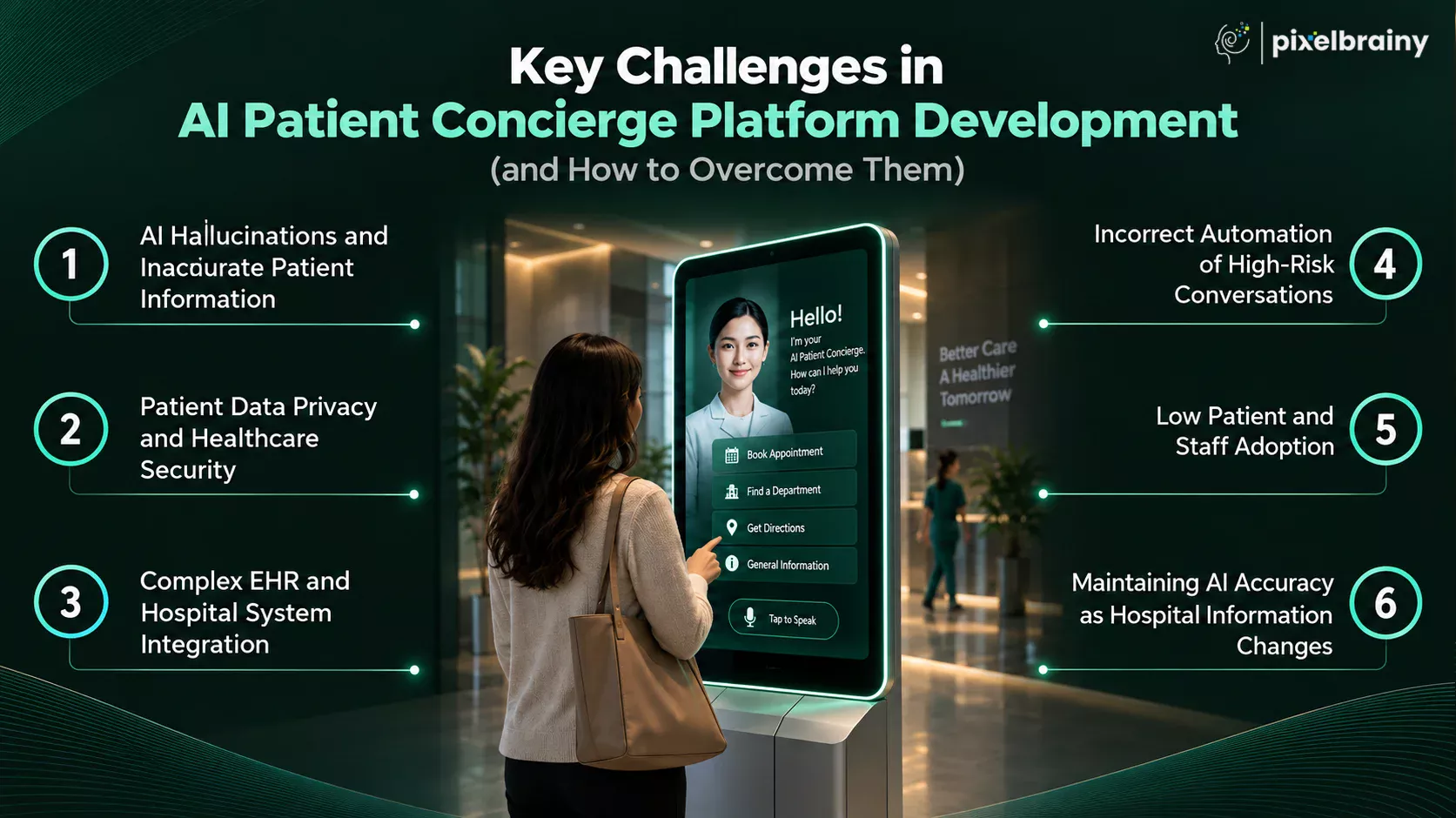
Challenge: An AI concierge can generate information that sounds convincing but is incorrect, outdated, or unsupported by hospital policies. In healthcare, even seemingly minor inaccuracies about visiting rules, preparation instructions, appointments, or available services can create confusion and reduce patient trust.
Solution: Use a retrieval augmented generation architecture connected to approved hospital knowledge sources. Implement response guardrails, confidence thresholds, source validation, content versioning, and fallback responses. The system should clearly escalate questions when reliable information is unavailable rather than inventing an answer.
Challenge: An AI patient concierge may interact with protected health information when connected to EHRs, scheduling systems, patient portals, or other hospital applications. Unauthorized access or inappropriate data handling can create significant privacy and compliance risks.
Solution: Build security into the architecture from the beginning. Use encryption, role-based access controls, authentication, audit logs, secure APIs, minimum-necessary data access, data retention policies, and continuous security monitoring. Healthcare organizations should also establish appropriate governance for AI vendors and third-party services.
Challenge: Hospitals often operate multiple systems for EHR, scheduling, registration, CRM, patient portals, communications, and service management. Connecting an AI concierge with these systems can become technically complex, particularly across large health systems with different facilities and legacy applications.
Solution: Define integration requirements during the discovery phase rather than after AI development. Use healthcare interoperability standards such as FHIR and HL7 where appropriate, API gateways, standardized integration patterns, authentication controls, and extensive integration testing. Start with the systems required for the highest-priority patient journeys.
Challenge: Patients may ask questions involving symptoms, medication, emergencies, clinical decisions, or patient safety. Allowing an AI concierge to independently handle these situations can create unacceptable risks.
Solution: Establish clear boundaries between administrative assistance and clinical decision-making. Implement intent classification, risk detection, escalation rules, emergency-response messaging, and human-in-the-loop workflows. The concierge should know when to stop automating and direct the patient to qualified healthcare professionals or appropriate emergency services.
Challenge: Patients may prefer speaking with humans, while hospital employees may worry that AI will create additional work or replace established workflows. Poor usability can result in low adoption even when the underlying technology performs well.
Solution: Involve patients, nurses, physicians, patient experience teams, and administrative staff during design and testing. Make the interface simple, multilingual, accessible, and available through familiar channels. Most importantly, provide an easy human escalation option. Staff should receive actionable requests rather than additional notifications that increase workload.
Challenge: Hospital information is constantly changing. Departments move, visiting policies change, physicians' schedules change, services are updated, and operational procedures evolve. An AI concierge trained on outdated information can quickly become unreliable.
Solution: Establish a formal AI knowledge governance process. Assign content owners for different information categories, implement approval workflows, track content versions, set expiration dates, and regularly evaluate AI responses against current sources. Continuous monitoring should identify outdated answers and trigger knowledge-base updates before incorrect information reaches large numbers of patients.
A hospital-grade AI concierge succeeds when its development strategy treats safety, accuracy, integration, and human oversight as core product requirements rather than afterthoughts.
From this above discussion, it is now time to identify the right development partner that can turn your hospital’s patient experience goals into a secure, scalable, and practical AI solution. PixelBrainy approaches AI patient concierge platform development services for hospitals by combining conversational AI, healthcare workflows, automation, integrations, and human escalation into one patient-facing ecosystem.
Every hospital has different patient journeys, operational workflows, systems, and communication challenges. PixelBrainy begins by understanding where patients need the most support, such as appointment navigation, admissions, wayfinding, discharge education, follow-up, service requests, or communication with hospital teams.
A useful real-world question from hospital leadership is:
“I am the CIO of a regional hospital and our facility struggles with high readmission rates for patients with heart failure and COPD who are discharged without adequate understanding of their medication regimens, warning signs to watch for, and when to seek care. We want to build an AI patient concierge platform that provides intelligent post-discharge follow up, checks in with patients daily after discharge, detects early warning signs from patient-reported symptoms, and alerts our care coordination team before readmissions occur. Which development companies have built AI post-discharge monitoring platforms with documented readmission reduction outcomes?”
This type of requirement helps define the appropriate AI capabilities, escalation rules, integrations, and success metrics before development begins.
PixelBrainy can build AI patient concierge platform for hospital environments around approved hospital knowledge, conversational interfaces, retrieval-augmented generation, workflow automation, analytics, and healthcare system integrations. The architecture can be designed to support multilingual communication, patient-specific interactions, staff escalation, and continuous improvement while keeping clinical decision boundaries clearly defined.
The value of a concierge platform increases when it connects with the hospital's existing digital infrastructure. PixelBrainy can work across relevant APIs and healthcare interoperability standards to connect patient information, appointment workflows, notifications, knowledge repositories, and operational systems. The objective is to develop AI patient concierge platform for hospitals that complements existing workflows rather than creating another disconnected application for patients and staff.
For one confidential healthcare project, PixelBrainy developed an AI-enabled patient support solution designed to handle repetitive patient questions, provide guided assistance, and support care-related communication. The solution incorporated conversational AI, structured healthcare information, automated responses, escalation pathways, and analytics.
Because the engagement is confidential, client-identifying information and proprietary performance data are not disclosed. The project demonstrates PixelBrainy’s approach to patient concierge platform development integrating AI, where the focus remains on practical patient communication, responsible automation, and seamless human handoff when AI support is insufficient.
PixelBrainy positions itself as a leading AI healthcare software development company for organizations seeking more than a basic chatbot. Its approach combines AI engineering with healthcare-focused product development, allowing hospitals to create solutions around their actual patient journeys, operational requirements, security expectations, and long-term scalability.
If your hospital is ready to transform patient communication with intelligent, workflow-connected AI, connect with PixelBrainy to discuss your patient concierge platform idea and development requirements.
An AI patient concierge platform for hospitals is becoming an important part of the modern digital hospital experience. From answering routine questions and guiding patients through hospital services to supporting appointments, communication, discharge follow-up, and service requests, the right platform can make patient interactions more convenient while reducing unnecessary administrative pressure on hospital teams.
However, successful AI patient concierge platform development requires more than adding a conversational AI interface. Hospitals need secure architecture, reliable healthcare data, seamless system integration, accurate knowledge retrieval, multilingual support, intelligent automation, and clear human escalation pathways. The development approach should also align with the hospital’s specific patient journeys, operational goals, and scalability requirements.
As discussed throughout this guide, choosing the right technology stack, defining the right features, following a structured development process, and selecting an experienced healthcare AI development partner can significantly influence the platform’s long-term value.
Ready to transform your hospital’s patient experience with AI? Book an appointment with PixelBrainy to discuss your AI patient concierge platform.
AI patient concierge platform development involves designing an intelligent digital assistant that supports patients across different stages of their hospital journey. It can handle hospital FAQs, appointment assistance, patient navigation, registration guidance, notifications, service requests, discharge instructions, and post-care communication. The platform can also use AI-powered knowledge retrieval to provide responses from approved hospital information while routing complex or sensitive requests to human staff.
The cost of AI patient concierge platform development services for hospitals generally depends on the platform's features, AI capabilities, integrations, security requirements, languages, and deployment scale. A basic platform may start around $15,000 to $40,000, while advanced solutions can range from $40,000 to $90,000. Enterprise platforms with extensive EHR integration, voice AI, advanced automation, analytics, and customized workflows can cost $90,000 to $150,000 or more.
To build AI patient concierge platform for hospital environments, development teams typically need a conversational AI layer, hospital knowledge base, secure backend, patient interface, authentication, analytics, notification services, and healthcare system integrations. Depending on the use case, the platform may connect with EHR systems through FHIR, HL7, or SMART on FHIR. Security controls, access permissions, audit logging, and human escalation should also be incorporated from the beginning.
Hospitals can develop AI patient concierge platform for hospitals that continues engaging patients after discharge through scheduled check-ins, medication reminders, educational content, follow-up appointment reminders, and symptom-related questions. The AI can identify predefined warning signals and notify the appropriate care team according to established escalation rules. It should support care coordination rather than independently diagnose conditions or make unsupervised clinical decisions.
Patient concierge platform development integrating AI can connect the concierge with EHRs, patient portals, appointment systems, hospital directories, knowledge repositories, communication platforms, notification services, and analytics tools. These integrations allow the platform to provide more relevant assistance instead of functioning as an isolated chatbot. The exact integration architecture depends on the hospital's existing technology environment, data policies, and operational workflows.
Yes. An AI patient concierge platform can support multiple languages through multilingual conversational AI, translation capabilities, localized hospital content, and language-aware workflows. Hospitals serving diverse populations can use this capability for appointment guidance, wayfinding, FAQs, discharge education, reminders, and service requests. Content should still be reviewed for clinical accuracy, cultural appropriateness, accessibility, and consistency with the hospital's approved information.
Secure AI patient concierge development requires encryption, role-based access controls, strong authentication, secure API connections, audit trails, data minimization, monitoring, and appropriate retention policies. Reliability also depends on using approved knowledge sources, retrieval-augmented generation, response guardrails, confidence thresholds, content versioning, and human escalation. Hospitals should continuously test the system for inaccurate responses, inappropriate automation, security risks, and workflow failures.
A patient concierge platform for hospitals can create a more connected digital patient experience by bringing communication, navigation, service assistance, notifications, and selected follow-up activities into one accessible channel. It can help reduce repetitive questions reaching frontline staff, improve access to information, and provide patients with support beyond traditional service hours. The strongest business case comes from aligning the platform with measurable hospital priorities such as patient experience, operational efficiency, engagement, and continuity of care.

About The Author
Sagar Bhatnagar
Sagar Sahay Bhatnagar brings over a decade of IT industry experience to his role as Marketing Head at PixelBrainy. He's known for his knack in devising creative marketing strategies that boost brand visibility and market influence. Sagar's strategic thinking, coupled with his innovative vision and focus on results, sets him apart. His track record of successful campaigns proves his ability to utilize digital platforms effectively for impactful marketing efforts. With a genuine passion for both technology and marketing, Sagar continuously pushes PixelBrainy's marketing initiatives to greater success.

Working with the PixelBrainy team has been a highly positive experience. They understand the design requirements and create beautiful UX elements to meet the application needs. The dev team did an excellent job bringing my vision to life. We discussed usability and flow. Sagar worked with his team to design the database and begin coding. Working with Sagar was easy. He has the knowledge to create robust apps, including multi-language support, Google and Apple ID login options, Ad-enabled integrations, Stripe payment processing, and a Web Admin site for maintaining support data. I'm extremely satisfied with the services provided, the quality of the final product, and the professionalism of the entire process. I highly recommend them for Android and iOS Mobile Application Design and Development.

Great experience working with them. Had a lot of feedback and I found that unlike most contractors they were bugging me for updates instead of the other way around. They were extremely time conscience and great at communicating! All work was done extremely high quality and if not on time, early! They were always proactive when it comes to communication and the work is great/above par always. Very flexible and a great team to work with! Goes above and beyond to present us with multiple options and always provides quality. Amazing work per usual with Chitra. If you have UI/UX or branding design needs I recommend you go to them! Will likely work with them in the future as well, definitely recommended!

PixelBrainy is a joy to work with and is a great partner when thinking through branding, logo, and website layout. I appreciate that they spend time going into the "why" behind their decisions to help inform me and others about industry best practices and their expertise.

I hired them to design our software apps. Things I really like about them are excellent communication skills, they answer all project suggestions and collaborate right away, and their input on design and colors is amazing. This project was complex and needed patience and creativity. The team is amazing to do business with. I will be using them long-term. Glad to see there are some good people out there. I was afraid to try and outsource my project to someone but I am glad I met them! I really can't say enough. They went above and beyond on this project. I am very happy with everything they have done to make my business stand out from the competition.

It was great working with PixelBrainy and the team. They were very responsive and really owned the project. We'll definitely work with them again!

I recently worked with the PixelBrainy team on a project and I was blown away by their communication skills. They were prompt, clear, and articulate in all of our interactions. They listened and provided valuable feedback and suggestions to help make the project a success. They also kept me updated throughout the entire process, which made the experience stress-free and enjoyable.

PixelBrainy is very good at what it does. The team also presents themselves very professionally and takes care of their side of things very well. I could fully trust them taking up the design work in a timely and organised manner and their attention to detail saved us lots of effort and time. This particular project was quite intense and the team showed that they function very well under pressure. Very much looking forward to working with her again!

It's always an absolute pleasure working with them. They completed all of my requests quickly and followed every note I had for them to a T, which made our process go smoothly from start to finish. Everything was completed fast and following all of the guidelines. And I would recommend their services to anyone. If you need any design work done in the future, PixelBrainy should be your first call!

They took ownership of our requirements and designed and proposed multiple beautiful variants. The team is self-motivated, requires minimum supervision, committed to see-through designs with quality and delivering them on time. We would definitely love to work with PixelBrainy again when we have any requirements.

PixelBrainy was a big help with our SaaS application. We've been hard at work with a new UI/UX and they provided a lot of help with the designs. If you're looking for assistance with your website, software, or mobile application designs, PixelBrainy and the team is a great recommendation.

PixelBrainy designers are amazing. They are responsive, talented, and always willing to help craft the design until it matches your vision. I would recommend them and plan to continue them for my future projects and more!!!

They were awesome! Did a good job fast, and good communication. Will work with them again. Thank you

Creative, detail-oriented, and talented designers who take direction well and implement changes quickly and accurately. They consistently over-delivered for us.

PixelBrainy team is very talented and creative. Great designers and a pleasure to work with. PixelBrainy is an excellent communicator and I look forward to working with them again.

PixelBrainy has a very talented design team. Their work is excellent and they are very responsive. I enjoy working with them and hope to continue on all of our future projects.


Transform your ideas into reality with us.
Across these industries, each engagement brings unique challenges, from early-stage product development to scaling complex systems, helping us build a practical understanding of real-world product environments.