
 AI Summary Powered by PixelBrainy
Imagine giving every real estate agent the power of a top-producing coach, available at any moment, ready to guide their conversations, sharpen their scripts, and help them handle objections with confidence. That is exactly what an AI Real Estate Coaching App for Agents & Brokers is designed to deliver.
Many brokerages and real estate teams struggle with one consistent challenge: how to train agents in a way that is personalized, repeatable, and scalable across different experience levels. New agents often need daily hands-on guidance, while experienced agents want targeted coaching that sharpens specific skills. Traditional coaching and training models rarely provide both. This is where AI Real Estate Virtual Trainer App development for Agents & Brokers becomes a powerful solution.
Today’s top-performing brokerages, team leaders, and proptech innovators are looking for ways to standardize coaching, speed up onboarding, and help agents master conversations faster. Building an AI Real Estate Coaching App for Agents & Brokers enables organizations to automate practice sessions, provide expert-level training at scale, and deliver real-time feedback based on actual communication patterns. Instead of one-size-fits-all training, Real Estate Coaching App development integrating AI for Agents & Brokers gives each user a personalized roadmap designed around their strengths, gaps, and goals.
In this blog, we will break down what an AI coaching app actually does, why agents and brokerages benefit from it, the essential features, how the development process works, the ideal tech stack, the cost to build one, and how the right development partner can help bring your vision to life.
An AI Real Estate Coaching App for Agents & Brokers is a digital training platform that uses artificial intelligence to coach real estate professionals through guided practice, simulated conversations, and personalized feedback. The app works like a virtual mentor that agents can interact with anytime to improve skills such as prospecting, objection handling, negotiation, listing presentations, and lead follow-up.
Instead of depending only on live coaching sessions or pre-recorded courses, the app creates interactive learning experiences that adjust to each agent’s performance level. It can roleplay as different types of clients, evaluate communication style, score responses, and recommend targeted improvements. Many versions also integrate MLS data, CRM activity, and sales metrics to provide context-based coaching.
For brokers and team leaders, the platform creates a unified training system that helps new agents ramp up faster and supports experienced agents with continuous skill development.
Investing in AI Real Estate Coaching App development for Agents & Brokers makes sense today because the real-estate industry is undergoing a transformation driven by technology. A recent market research report shows the global real-estate software market was valued at approximately USD 13.65 billion in 2025 and is expected to reach USD 34.1 billion by 2032 — a compound annual growth rate of about 14 %.
This upward trend reflects not only software for property management but also tools supporting sales teams, coaching systems, analytics platforms and agent productivity solutions.
For brokerages and teams, developing AI Real Estate Coaching App for Agents & Brokers offers a strategic advantage. It allows leaders to standardise coaching across large teams, reduce dependency on individual one-on-one sessions, and deliver training when and where agents need it. It also addresses the challenge of entering and converting new leads in a competitive market by equipping agents with practice, feedback and scripted-dialogue experience.
To build an AI Real Estate Virtual Trainer App for Agents & Brokers also means owning a training ecosystem that can scale, adapt to new market conditions, and capture performance data over time. As agent turnover remains high, having a digital coach embedded in the workflow supports retention, continuous learning and measurable improvement. It is more efficient, consistent and aligned with modern agent behaviours and workflows.
By aligning your technology investment now, your brokerage or prop-tech business can position itself for future growth, operational discipline and differentiated agent performance.
Creating an AI Real Estate Coaching App for Agents & Brokers gives real estate businesses a more intelligent and scalable way to develop agent skills. The advantages of developing AI Real Estate Coaching App for Agents & Brokers go beyond traditional training by delivering personalized coaching, measurable results, and consistent agent improvement at every stage of their career.
Below are the top benefits, expanded in detailed multi-paragraph explanations.
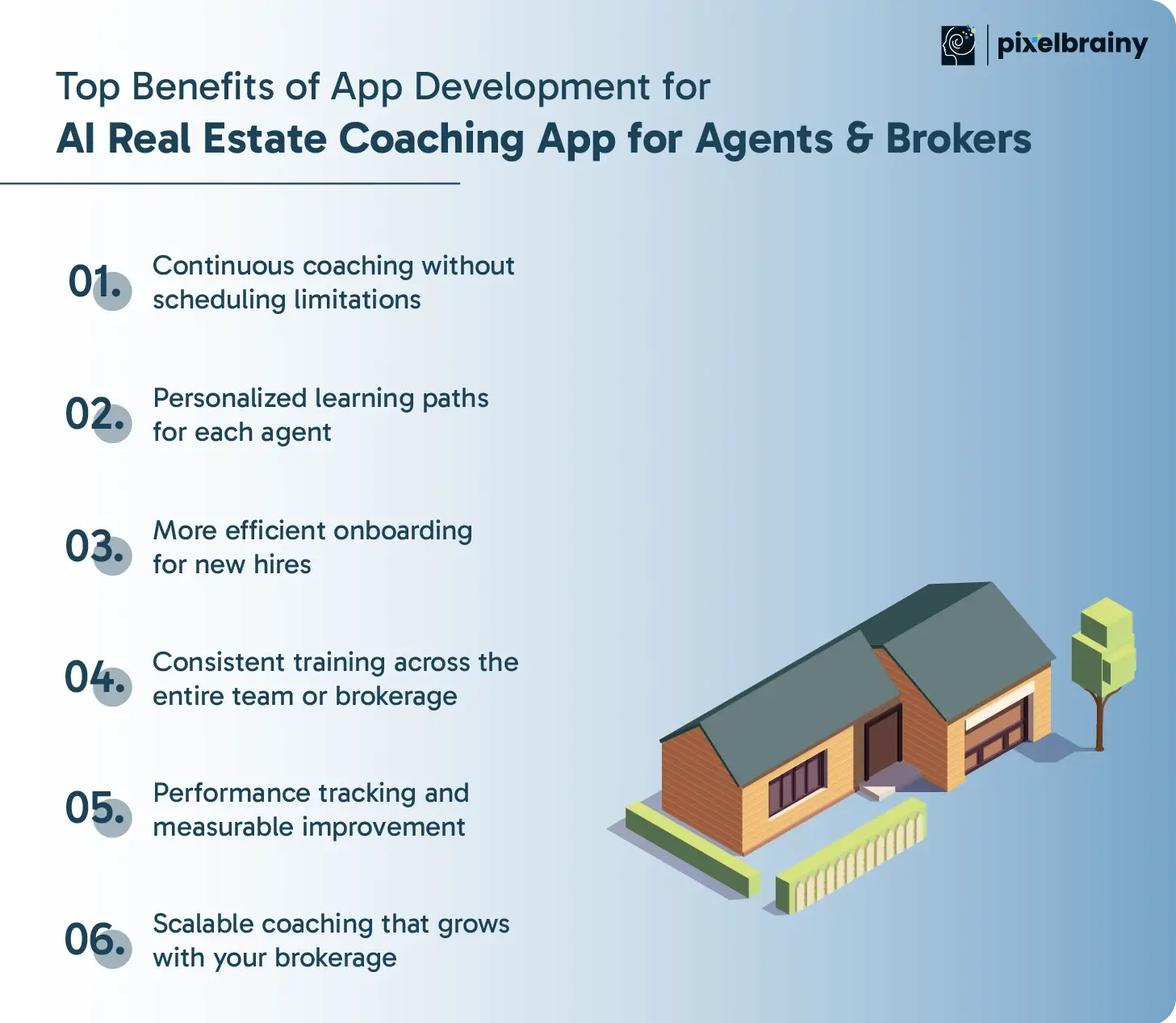
One of the most impactful advantages of developing AI Real Estate Coaching App for Agents & Brokers is the ability to offer uninterrupted coaching. Agents no longer need to wait for weekly team meetings, coaching calls, or one-on-one training sessions to develop their skills. Instead, they can open the app anytime and immediately practice scripts, negotiate scenarios, or refine their presentation approach.
This type of availability is extremely valuable in real estate, where agents work unpredictable hours and often juggle last-minute showings or client calls. When coaching is accessible on-demand, agents can train in small pockets of time, such as between appointments or late at night. This flexibility helps them grow faster and stay prepared for real client conversations.
On-demand coaching also reduces downtime and boosts productivity because learning becomes an integrated part of the agent’s daily routine rather than a scheduled obligation.
Another key benefit of AI Real Estate Coaching App Development for Agents & Brokers is personalized skill development. Traditional training programs are usually built around generic lessons that do not always match an agent’s unique needs. With AI, the training content evolves based on individual strengths, weaknesses, tone, confidence, and communication style.
When an agent struggles with a specific objection, such as “We want to think about it,” the AI identifies the issue and creates more practice sessions around that challenge. Conversely, if an agent excels at rapport building but needs help with pricing conversations, the system adjusts the training path accordingly.
This level of personalization ensures that every agent receives guidance that is relevant to their actual performance. As a result, they improve faster and develop deeper confidence in the areas that matter most to their business.
New agents often enter the industry with little experience in sales conversations, listing presentations, or negotiation. Creating AI Real Estate Coaching App for Agents & Brokers allows brokerages to build a streamlined onboarding process that introduces new hires to essential scripts, best practices, and step-by-step learning modules.
Instead of overwhelming new agents with long training sessions and thick manuals, the app breaks learning into easy, manageable lessons. They can practice their first cold call, rehearse open-house dialogues, or learn follow-up strategies at their own pace. This makes onboarding smoother and significantly reduces the amount of time brokers and team leaders must spend training entry-level agents.
When onboarding becomes efficient and consistent, new agents ramp up faster, feel more confident early on, and begin producing results sooner.
Real estate teams often face inconsistencies in training because every coach or mentor teaches differently. By developing AI Real Estate Coaching App for Agents & Brokers, brokerages can deliver the same high-quality coaching to every agent, regardless of who is training them or where they are located.
This creates a standard of excellence across the entire organization. Every agent learns the same scripts, follows similar communication guidelines, and practices recommended dialogue approaches that match the brand’s expectations. Consistency is especially important for large teams and multi-office brokerages that want a predictable level of professionalism.
As agents continue using the system, brokerages can ensure their brand voice is preserved throughout all client interactions. This strengthens customer experience, improves lead conversion rates, and builds trust in the market.
AI Real Estate Coaching App Development for Agents & Brokers introduces a level of data analysis that traditional coaching cannot match. The app can track speech patterns, response accuracy, objection handling confidence, pace, tone, and other communication metrics that reveal how well an agent performs in real scenarios.
These insights help brokers understand which skills agents need to develop, how they are progressing, and where additional support may be required. Agents also benefit from receiving tangible performance scores that show their weekly or monthly improvement.
Performance tracking turns coaching into a measurable, strategic process rather than a subjective one. Agents can see their growth clearly, while brokers gain the clarity needed to build more effective training strategies for their entire team.
One of the strongest advantages of developing AI Real Estate Coaching App for Agents & Brokers is scalability. A human coach can only handle a limited number of agents, but an AI system can train hundreds or thousands simultaneously without lowering the quality of coaching.
As brokerages expand, open new offices, or onboard more agents, the app adjusts automatically. It can support unlimited users, handle large volumes of training sessions, and continue offering personalized guidance without delay.
This makes the platform a long-term investment that grows with your business. Whether you manage a small team or a nationwide brokerage, the app ensures every agent receives top-level training, regardless of team size or coaching availability.
A well-built AI Real Estate Coaching App equips agents and brokers with the guidance, structure, and scalability they need to strengthen skills, elevate performance, and stay competitive in a rapidly evolving market.

Building an effective AI Real Estate Coaching App for Agents & Brokers requires a strong foundation of essential features that support day-to-day skill development, script practice, and ongoing improvement.
These features create the core learning experience and ensure the platform delivers real value for both new and experienced real estate professionals. Including these capabilities helps brokerages build a reliable, scalable, and easy-to-use training ecosystem.
| Feature | Explanation |
| AI Roleplay Conversations | Allows agents to practice real buyer and seller scenarios with an AI-powered virtual client. Supports multiple conversation styles and objection types for realistic training. |
| Script Library and Custom Script Upload | Provides ready-made real estate scripts for cold calling, FSBOs, expireds, follow-ups, and listing presentations. Brokers can upload custom scripts to match brand communication standards. |
| Objection Handling Simulator | Helps agents learn how to respond to common objections with confidence. The AI evaluates tone, clarity, and accuracy to build better communication habits. |
| Performance Scoring and Feedback | Delivers detailed feedback after each training session so agents understand strengths and areas needing improvement. Encourages consistent growth through measurable insights. |
| Learning Paths for Skill Levels | Offers beginner, intermediate, and advanced learning modules that adapt to user performance. Ensures every agent receives training suited to their skill level. |
| Video and Audio-Based Training Lessons | Includes pre-recorded coaching videos and audio lessons covering negotiation, prospecting, and presentation skills. Users can access structured content anytime. |
| Real-Time Speech Analysis | Evaluates speaking speed, clarity, confidence, and communication patterns. Helps agents refine their delivery during practice sessions. |
| Daily Training Tasks and Reminders | Sends prompts for daily exercises to build consistency and keep agents on a structured development schedule. Supports habit-building and accountability. |
| CRM and MLS Integration | Connects with tools like Follow Up Boss, KVCore, and MLS systems to personalize coaching based on lead activity and market data. Enhances training relevance. |
| Progress Dashboard and Analytics | Displays user performance trends, activity levels, training hours, and skill growth. Helps agents and brokers track long-term improvement. |
| Gamified Learning and Badges | Rewards agents with badges, points, and achievement levels to increase engagement. Encourages healthy competition within teams. |
| Quiz and Knowledge Assessments | Tests agents on key real estate topics and scripts after training modules. Strengthens retention and validates understanding. |
| Message-Based AI Coach Chat | Provides a chat interface where agents can ask questions and receive guidance instantly. Supports quick learning during active work hours. |
| Content Library with Real Estate Resources | Includes PDFs, guides, checklists, and best practices created for real estate training. Acts as a central hub for reference material. |
| User and Team Management for Brokers | Allows brokers to monitor agent performance, assign learning paths, and set goals. Creates a centralized training environment for entire teams. |
These must-have features lay the foundation for an AI Real Estate Coaching App that delivers powerful, consistent, and results-driven training for agents and brokers.
Advanced features elevate the coaching experience and create a truly interactive, intelligent, and data-driven platform. These capabilities take the learning environment beyond basic script practice and introduce deeper analytics, automation, and simulated coaching experiences.
When developing AI Real Estate Coaching App for Agents & Brokers, these additions help brokerages stand out and deliver high-performance training systems.
| Advanced Feature | Explanation |
| AI Voice Assistant for Real-Time Coaching | Assists agents during live calls or meetings by offering subtle tips, reminders, and conversation cues. Helps maintain confidence and professionalism during client interactions. |
| Predictive Lead Scoring and Conversation Suggestions | Uses AI to analyze lead behavior and assign a score that predicts conversion potential. Provides personalized follow-up recommendations and dialogue prompts. |
| AI Video Roleplay with Facial Expression Analysis | Simulates face-to-face client interactions using video-based AI avatars. Evaluates facial expressions, tone, and delivery to improve presentation skills. |
| Virtual Reality Training Environments | Offers immersive VR experiences that simulate open houses, listing appointments, and client meetings. Helps agents practice real-world scenarios in a safe space. |
| Call Recording Analysis and Coaching Insights | Integrates with phone systems to analyze actual client calls. Highlights communication gaps, compliance issues, and opportunities to improve closing techniques. |
| Market Trend Coaching and Predictive Analytics | Provides training based on local pricing trends, inventory shifts, buyer patterns, and neighborhood analytics. Helps agents master market-specific conversations. |
| Behavioral Coaching Based on User Patterns | Learns from user interactions to offer deeply personalized skill-building exercises. Maps behavior trends to recommend targeted training modules. |
| AI-Powered Listing Presentation Review | Reviews an agent’s listing presentation and offers improvements related to communication, confidence, timing, and market knowledge. Fine-tunes delivery for high-stakes meetings. |
| Automated Agent Scorecards for Brokers | Generates performance scorecards for each agent, combining training activity, learning progress, and communication evaluations. Helps brokers make informed coaching decisions. |
| Integration with Real Estate Marketing Automation Tools | Connects with email, SMS, and ad platforms to provide coaching tied to campaign performance. Strengthens training by linking it with actual marketing results. |
Understanding what is the process to build AI Real Estate Coaching App for Agents & Brokers is essential for businesses planning to create a successful and scalable coaching solution. The process involves strategic planning, technical engineering, product validation, and continuous refinement. Each step plays a crucial role in the overall AI Real Estate Coaching App Development for Agents & Brokers, ensuring the platform is accurate, secure, user-friendly, and capable of delivering personalized coaching experiences.
Below is the complete, well-detailed process used in the development of AI Real Estate Coaching App for Agents & Brokers, with every step including its aim and why it matters.
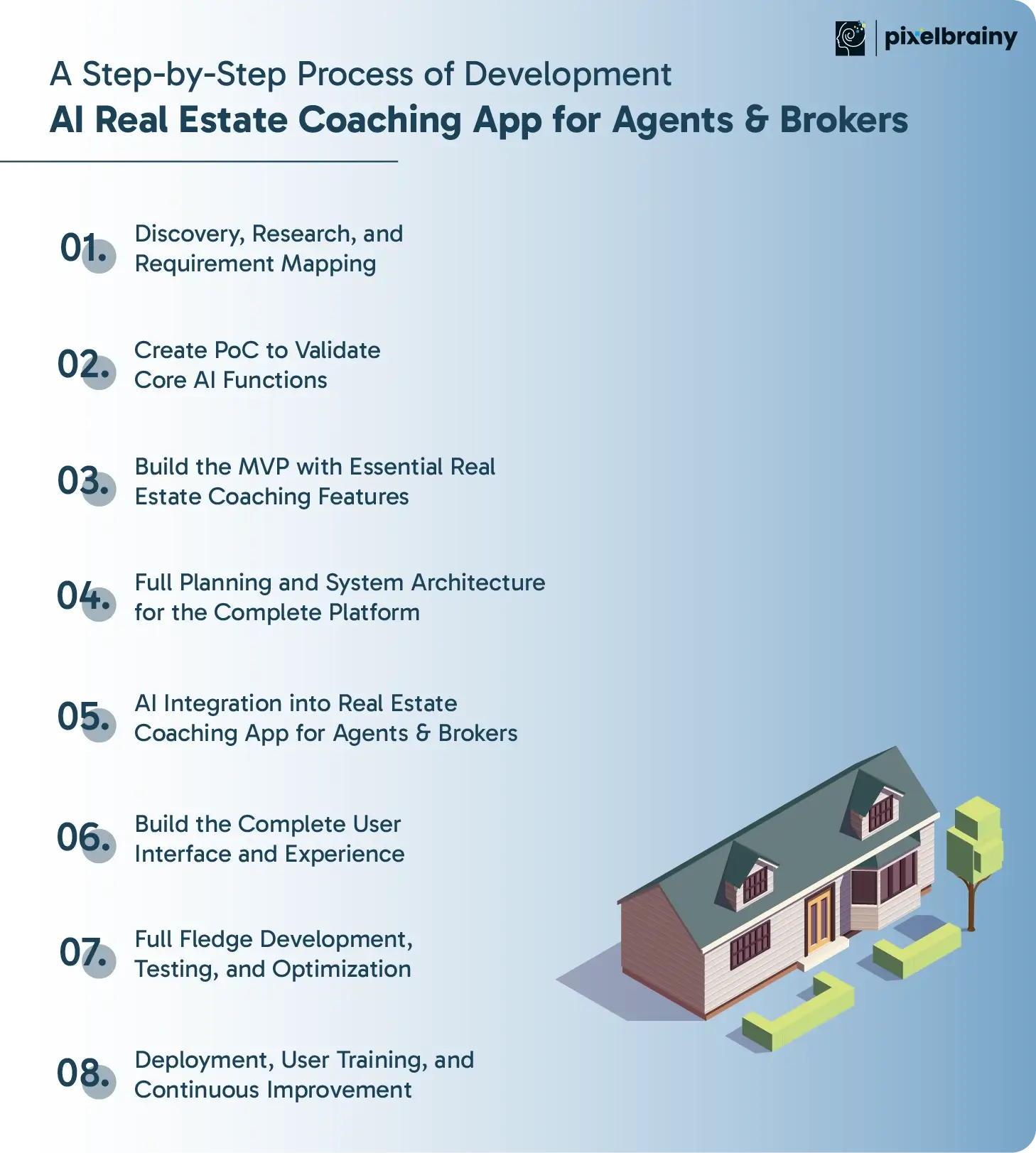
The first step in developing AI Real Estate Coaching App for Agents & Brokers is conducting detailed discovery sessions to understand the audience, training challenges, agent workflows, and brokerage coaching needs. This includes interviewing agents, brokers, and team leaders to identify what functions they expect from a digital training platform.
Aim of this step: To define the exact problem the app will solve and the specific outcomes users want.
Why this matters: It prevents unnecessary features, lowers cost, and ensures the platform is built around actual real estate coaching needs rather than assumptions.
Before building the entire platform, many organizations create a PoC to test essential AI capabilities such as roleplay conversations, script practice, and objection-handling accuracy. This helps confirm that the AI models respond naturally, understand real estate terminology, and meet the expected coaching quality.
Aim of this step: To validate that AI concepts and training interactions can be technically achieved.
Why this matters: It reduces technical risk and helps stakeholders see early results before committing to full development.
Also Read: AI Chatbot Proof of Concept (PoC) Development for Enterprises: From Idea to Impact
The next step is creating an MVP that includes core modules such as AI roleplay, script libraries, performance scoring, and dashboards. The MVP is launched to a small group of agents for real-world testing, allowing early improvement based on user responses.
Aim of this step: To bring a functional product to market quickly and gather feedback.
Why this matters: Early users help refine the app’s direction, and early releases accelerate go-to-market strategies.
Once the MVP proves user value, the complete system architecture is planned. This includes database planning, backend structure, AI model pipeline, CRM and MLS integration workflows, and long-term scalability decisions. Many businesses collaborate with a UI/UX Design company to craft intuitive user flows and layouts for both agents and brokers.
Aim of this step: To create a long-term technical blueprint for the entire platform.
Why this matters: Proper planning prevents architectural issues, supports future upgrades, and ensures smooth system performance as user volume grows.
This step focuses on integrating AI features such as natural language processing, voice analysis, predictive analytics, and adaptive learning. AI models are trained with real estate scripts, objection scenarios, listing presentation dialogues, and conversation datasets.
Aim of this step: To infuse intelligence into the app so training becomes dynamic, personalized, and realistic.
Why this matters: The AI engine determines the quality of coaching, so proper training, accuracy testing, and continuous optimization are critical.
After AI and backend systems are ready, the interface is created for agents, brokers, admin users, and teams. This includes dashboards, roleplay screens, training modules, analytics views, and communication tools. The design focuses on clarity and simplicity to support learning without distractions.
Aim of this step: To deliver a user-friendly platform that encourages daily practice and engagement.
Why this matters: A coaching app with poor navigation or cluttered screens decreases adoption and training effectiveness.
The platform now enters full development and testing. This includes all modules, integrations, real estate-specific training flows, AI model development, and AI behavior checks. Multiple testing rounds refine accuracy, speed, performance, and user experience so the app works flawlessly.
Aim of this step: To deliver a stable, accurate, and highly polished product ready for real users.
Why this matters: Testing ensures the app meets the expectations of brokerages, agents, and enterprise clients before onboarding hundreds of users.
The final stage is launching the platform publicly and offering onboarding sessions for teams and brokerages. AI models continue improving based on user activity and real-world interaction data. Future updates introduce enhancements, new training modules, and additional AI capabilities.
Aim of this step: To ensure smooth adoption, maximize platform value, and keep the system evolving.
Why this matters: A long-term improvement cycle allows the app to grow with market trends, user needs, and real estate industry changes.
Following this structured process is essential to make AI Real Estate Coaching App for Agents & Brokers that delivers consistent training, accurate coaching, and measurable long-term value.
Also Read: How To Develop AI Property Investment App: Features and Cost
The cost to build an AI Real Estate Coaching App for Agents & Brokers ranges from $15,000 to $150,000+, depending on the complexity, features, integrations, and level of AI automation included. Pricing varies based on whether you want a basic version with essential coaching tools or a fully advanced platform with AI-driven analytics, voice recognition, MLS integration, and multi-role dashboards.
When estimating the development cost of AI Real Estate Coaching App for Agents & Brokers, it is important to consider UI design, backend architecture, AI model training, quality assurance, real estate data integration, and long-term scalability.
Below is a clear breakdown showing what you can expect at each pricing tier.
| App Type | Estimated Cost Range | What You Get |
| Basic AI Real Estate Coaching App for Agents & Brokers | $15,000 – $40,000 | Includes essential features such as script training modules, basic AI roleplay, simple progress tracking, and a foundational dashboard. Ideal for small brokerages or startups testing the market with a lightweight coaching solution. |
| Medium AI Real Estate Coaching App for Agents & Brokers | $40,000 – $90,000 | Features include enhanced AI conversation simulations, CRM connectivity, learning paths, advanced roleplay scenarios, expanded analytics, and stronger UI functionality. Suitable for growing teams and companies looking for polished features and practical AI automation. |
| Advanced AI Real Estate Coaching App for Agents & Brokers | $90,000 – $150,000+ | A full-scale platform with predictive analytics, real-time voice analysis, MLS integrations, multi-role dashboards, AI-driven coaching insights, and high-level scalability. Built for enterprises, large brokerages, or proptech companies requiring a premium, future-ready training ecosystem. |
The right investment level depends on your goals, but a well-planned budget ensures your AI Real Estate Coaching App delivers strong performance, long-term scalability, and real value for agents and brokers.

Also Read: AI Real Estate App Development Cost: Factors and Examples
Choosing the right tech stack is essential for building a fast, scalable, and AI-driven platform that delivers accurate coaching experiences for agents and brokers.
Below is a well-structured table explaining the recommended technologies for each layer of AI Real Estate Coaching App Development and why they are used.
| Category | Technologies | Explanation |
| Frontend (Mobile & Web App) | React Native, Flutter, React.js | These frameworks help create a responsive, smooth, and visually appealing interface. React Native and Flutter allow cross-platform app development, enabling faster delivery for iOS and Android, while React.js supports a powerful web dashboard. |
| Backend Development | Node.js, Python, Ruby on Rails | These backend technologies support secure APIs, fast server responses, and scalable application logic. Python is especially useful for AI and ML integrations, while Node.js handles real-time interactions efficiently. |
| AI and Machine Learning | TensorFlow, PyTorch, OpenAI API, Hugging Face Models, LangChain | These AI frameworks and tools power roleplay simulations, NLP understanding, voice analysis, and adaptive learning. They enable the coaching engine to deliver accurate responses and personalized training outcomes. |
| Speech and Voice Processing | Google Speech-to-Text, AWS Transcribe, Whisper | These tools help analyze agent voice patterns, clarity, emotion, and pace during practice sessions. They enable real-time evaluation of communication quality during AI coaching. |
| Database Management | MongoDB, PostgreSQL, Firebase | Databases store training modules, user activity logs, performance analytics, script libraries, and broker dashboards. MongoDB is ideal for flexibility, while PostgreSQL is suitable for structured data management. |
| Cloud Infrastructure | AWS, Google Cloud Platform, Microsoft Azure | These cloud platforms support deployment, server scaling, secure storage, and AI model hosting. They ensure the app can handle growing user loads without performance issues. |
| Real Estate Integrations | MLS API, IDX API, CRM Integrations (Follow Up Boss, KVCore, Salesforce) | These integrations help personalize training using real leads, listings, and market data. They enhance coaching relevance by connecting with real-world activities and property information. |
| Authentication & Security | OAuth 2.0, JWT, Firebase Auth | These tools protect user login data, access privileges, and platform security. They ensure compliance and safeguard agent and brokerage information. |
| Analytics & Monitoring | Mixpanel, Google Analytics, Datadog | These tools track user behavior, training activity, performance scores, and system health. They help brokers and admin users monitor agent progress and optimize the learning environment. |
| DevOps & CI/CD | Docker, Kubernetes, GitHub Actions | DevOps tools help with smooth deployment, version control, and automated testing. They support rapid iteration and ensure the app remains stable and updated. |
A well-selected tech stack ensures the AI Real Estate Coaching App runs efficiently, delivers accurate coaching insights, and scales easily as more agents and brokerages adopt the platform.
Building an AI-driven coaching platform for real estate professionals requires more than integrating basic features. The development process involves technical, strategic, and operational challenges that must be understood to ensure the platform performs reliably and delivers accurate coaching experiences.
Here are the major challenges and key considerations when planning AI Real Estate Coaching App Development for Agents & Brokers.
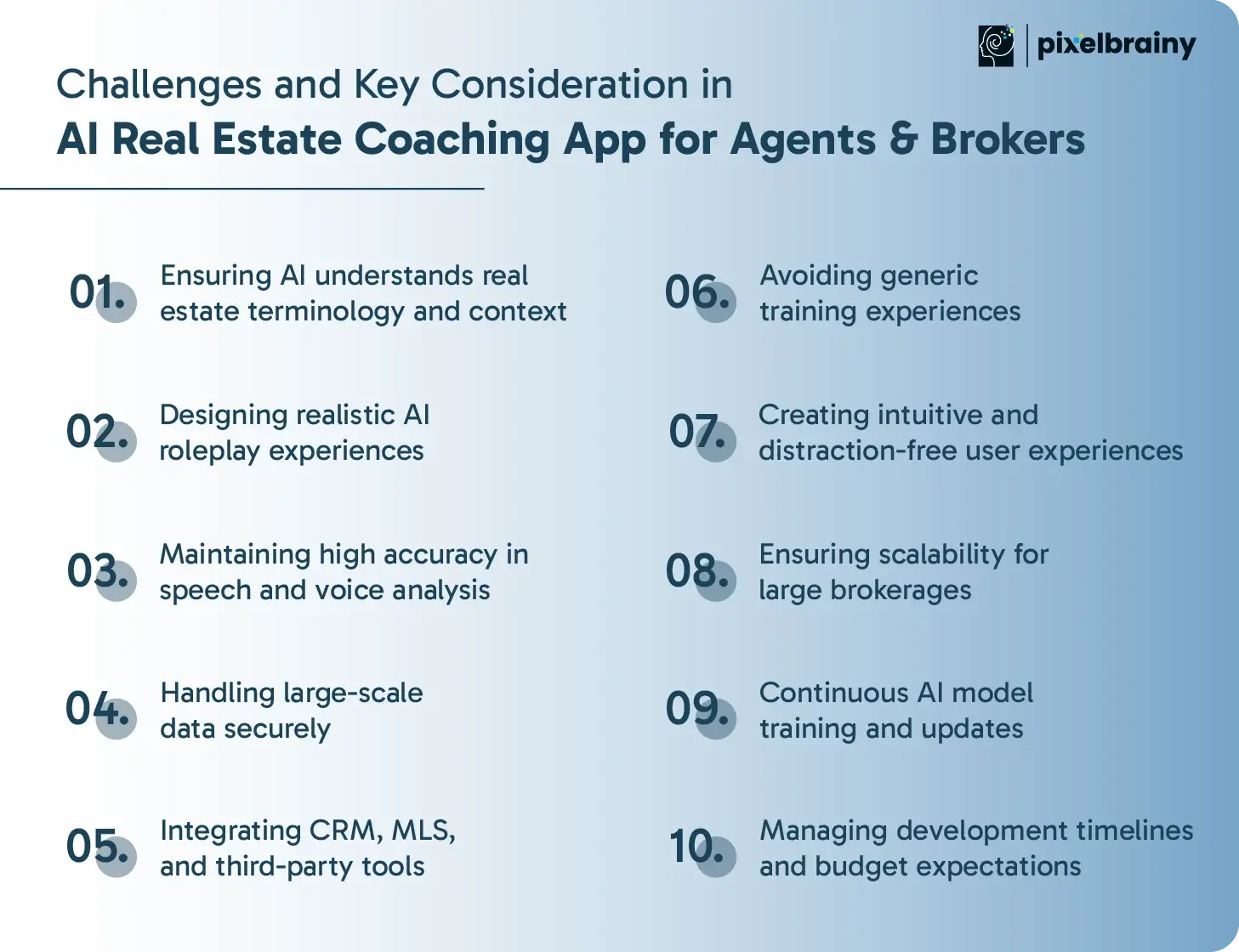
Real estate conversations involve complex terminology, pricing discussions, negotiation language, and region-specific vocabulary. Training AI models to understand these nuances requires high-quality datasets and continuous tuning. If not handled carefully, the system may misinterpret user input or provide inaccurate coaching.
Key consideration: Invest in domain-specific training data and refine NLP models with real conversations from real estate agents, scripts, and industry-approved dialogue examples.
Agents expect the AI to behave like an actual buyer, seller, or investor. Developing natural, human-like responses is challenging because it requires understanding intent, tone, emotional cues, and context switching.
Key consideration: Use multi-turn dialogue models that adapt based on user responses and create varied roleplay personalities to keep training engaging and authentic.
Agents rely on tone, pace, confidence, and clarity to succeed in client conversations. Voice recognition systems may struggle with accents, background noise, or fast speaking, which can impact coaching accuracy.
Key consideration: Use reliable speech-to-text tools and continuously test models with diverse voice samples to improve recognition quality.
AI coaching apps store sensitive information such as call transcriptions, agent performance analytics, market data, and training logs. Poor data security can result in compliance issues or privacy risks.
Key consideration: Implement strong encryption, secure APIs, role-based access control, and compliance with regional real estate data standards.
Real estate teams rely on CRM platforms, MLS systems, and communication tools. Integrating these systems requires robust APIs and can be complex due to permission structures, rate limits, and data formatting differences.
Key consideration: Plan integrations early in the architecture phase and work with platform providers to ensure long-term compatibility.
Agents want coaching tailored to their goals, performance, and skill level. Basic AI systems often provide repetitive or generalized guidance, reducing the effectiveness of training.
Key consideration: Use adaptive learning engines that adjust difficulty, scripts, and feedback based on user progress and behavior patterns.
An AI coaching system should feel simple, engaging, and easy to navigate. A busy interface or complicated workflow will discourage regular use and lower training adoption.
Key consideration: Focus on clean UI design, logical navigation, easy access to features, and mobile-first usability.
When hundreds of agents practice at the same time, AI processing loads can spike. A poorly designed backend will slow down, affecting performance and user experience.
Key consideration: Use scalable cloud infrastructure that expands automatically based on usage demand.
Real estate markets evolve, consumer expectations change, and new buyer-seller objections appear over time. AI must stay updated to remain relevant.
Key consideration: Plan for continuous model retraining and periodic feature enhancements to keep the system aligned with modern real estate practices.
Building an AI coaching platform involves multiple stages including AI training, feature building, testing, and iteration. Misaligned timelines or budgets can cause delays and unexpected challenges.
Key consideration: Create a realistic roadmap, prioritize features based on value, and allow time for AI improvement cycles.
Understanding these challenges early ensures the final AI Real Estate Coaching App is accurate, scalable, secure, and truly effective for the agents and brokers who depend on it.
Building an AI-powered coaching platform for real estate professionals requires a partner who understands both the technology and the industry. PixelBrainy brings that combination. As a Real estate AI software development company in USA, PixelBrainy specializes in transforming real estate training workflows into intelligent digital ecosystems built for growth, scale, and performance. The team has hands-on experience delivering solutions that match how agents communicate, how brokers train teams, and how modern proptech products operate.
PixelBrainy approaches AI Real Estate Coaching App Development for Agents & Brokers with a clear focus on accuracy, practical usability, and long-term business impact. Whether the goal is the development of AI Real Estate Coaching App for Agents & Brokers or a custom-built coaching ecosystem for enterprise-level teams, the company follows a proven strategy that blends conversational AI, adaptive learning, real estate data processing, and high-quality UI design.
PixelBrainy recently delivered a full AI coaching platform for a national brokerage that needed a fast, consistent way to train agents at scale. The custom solution included multi-level roleplay simulations, skill-based learning paths, voice analysis coaching, and automated performance reporting. The platform helped onboard more than 900 new agents in the first quarter and reduced manual training hours by nearly half. Client details remain confidential, but the impact reflects PixelBrainy’s ability to deliver real, measurable results.
PixelBrainy is the ideal partner to make AI Real Estate Virtual Trainer App for Agents & Brokers that is not just technologically advanced but also aligned with the real needs of agents, brokers, and training organizations.
From above, it is clear that the real estate industry is entering a phase where intelligent coaching and AI-driven training will play a central role in developing high-performing agents and efficient brokerages. Investing in the development of AI Real Estate Coaching App for Agents & Brokers creates an environment where learning becomes continuous, personalized, and measurable. These platforms offer capabilities that traditional coaching cannot deliver, including AI-powered roleplay, adaptive learning paths, real-time analytics, and integration with real estate systems.
For brokerages, teams, and proptech founders, building an AI Real Estate Coaching App is not just a technology upgrade but a long-term strategy to improve agent confidence, increase productivity, and strengthen business performance. With the right development approach and a trusted tech partner, the potential for growth and innovation is substantial.
Book an appointment with our experts today to start planning your AI-powered coaching platform.
Development timelines typically range from 8 to 24 weeks depending on complexity, feature set, integrations, and AI training requirements. A basic version with essential coaching tools can be completed faster, while advanced systems with predictive analytics, MLS integrations, and voice AI require more development time.
Custom datasets are not mandatory, but they significantly improve accuracy. Real estate scripts, call recordings, and training materials from your brokerage help the AI understand your communication style, objections, terminology, and presentation methods.
Yes. Most AI coaching apps can integrate with leading CRMs such as Follow Up Boss, KVCore, Salesforce, and MLS APIs. These integrations make coaching more relevant by connecting training with actual leads, listings, and market activity.
No. Small teams, independent agents, and proptech startups can benefit as well. Smaller brokerages often see the fastest impact because the app replaces time-consuming manual coaching and onboarding tasks.
These platforms typically use natural language processing, machine learning, speech recognition, sentiment analysis, and predictive analytics. Each technology plays a role in simulating conversations, analyzing agent responses, and generating personalized coaching insights.
Yes. AI models learn from new interactions, expanding datasets, and user feedback. Continuous updates ensure the system stays aligned with new real estate market trends, client behavior patterns, and evolving training strategies.

About The Author
Sagar Bhatnagar
Sagar Sahay Bhatnagar brings over a decade of IT industry experience to his role as Marketing Head at PixelBrainy. He's known for his knack in devising creative marketing strategies that boost brand visibility and market influence. Sagar's strategic thinking, coupled with his innovative vision and focus on results, sets him apart. His track record of successful campaigns proves his ability to utilize digital platforms effectively for impactful marketing efforts. With a genuine passion for both technology and marketing, Sagar continuously pushes PixelBrainy's marketing initiatives to greater success.


Transform your ideas into reality with us.
Working with the PixelBrainy team has been a highly positive experience. They understand the design requirements and create beautiful UX elements to meet the application needs. The dev team did an excellent job bringing my vision to life. We discussed usability and flow. Sagar worked with his team to design the database and begin coding. Working with Sagar was easy. He has the knowledge to create robust apps, including multi-language support, Google and Apple ID login options, Ad-enabled integrations, Stripe payment processing, and a Web Admin site for maintaining support data. I'm extremely satisfied with the services provided, the quality of the final product, and the professionalism of the entire process. I highly recommend them for Android and iOS Mobile Application Design and Development.

Great experience working with them. Had a lot of feedback and I found that unlike most contractors they were bugging me for updates instead of the other way around. They were extremely time conscience and great at communicating! All work was done extremely high quality and if not on time, early! They were always proactive when it comes to communication and the work is great/above par always. Very flexible and a great team to work with! Goes above and beyond to present us with multiple options and always provides quality. Amazing work per usual with Chitra. If you have UI/UX or branding design needs I recommend you go to them! Will likely work with them in the future as well, definitely recommended!

PixelBrainy is a joy to work with and is a great partner when thinking through branding, logo, and website layout. I appreciate that they spend time going into the "why" behind their decisions to help inform me and others about industry best practices and their expertise.

I hired them to design our software apps. Things I really like about them are excellent communication skills, they answer all project suggestions and collaborate right away, and their input on design and colors is amazing. This project was complex and needed patience and creativity. The team is amazing to do business with. I will be using them long-term. Glad to see there are some good people out there. I was afraid to try and outsource my project to someone but I am glad I met them! I really can't say enough. They went above and beyond on this project. I am very happy with everything they have done to make my business stand out from the competition.

It was great working with PixelBrainy and the team. They were very responsive and really owned the project. We'll definitely work with them again!

I recently worked with the PixelBrainy team on a project and I was blown away by their communication skills. They were prompt, clear, and articulate in all of our interactions. They listened and provided valuable feedback and suggestions to help make the project a success. They also kept me updated throughout the entire process, which made the experience stress-free and enjoyable.

PixelBrainy is very good at what it does. The team also presents themselves very professionally and takes care of their side of things very well. I could fully trust them taking up the design work in a timely and organised manner and their attention to detail saved us lots of effort and time. This particular project was quite intense and the team showed that they function very well under pressure. Very much looking forward to working with her again!

It's always an absolute pleasure working with them. They completed all of my requests quickly and followed every note I had for them to a T, which made our process go smoothly from start to finish. Everything was completed fast and following all of the guidelines. And I would recommend their services to anyone. If you need any design work done in the future, PixelBrainy should be your first call!

They took ownership of our requirements and designed and proposed multiple beautiful variants. The team is self-motivated, requires minimum supervision, committed to see-through designs with quality and delivering them on time. We would definitely love to work with PixelBrainy again when we have any requirements.

PixelBrainy was a big help with our SaaS application. We've been hard at work with a new UI/UX and they provided a lot of help with the designs. If you're looking for assistance with your website, software, or mobile application designs, PixelBrainy and the team is a great recommendation.

PixelBrainy designers are amazing. They are responsive, talented, and always willing to help craft the design until it matches your vision. I would recommend them and plan to continue them for my future projects and more!!!

They were awesome! Did a good job fast, and good communication. Will work with them again. Thank you

Creative, detail-oriented, and talented designers who take direction well and implement changes quickly and accurately. They consistently over-delivered for us.

PixelBrainy team is very talented and creative. Great designers and a pleasure to work with. PixelBrainy is an excellent communicator and I look forward to working with them again.

PixelBrainy has a very talented design team. Their work is excellent and they are very responsive. I enjoy working with them and hope to continue on all of our future projects.


