 AI Summary Powered by PixelBrainy
What happens when a potential buyer calls your real estate brokerage at 9 PM, nobody answers, and a competitor captures the lead before your team arrives the next morning?
For real estate businesses, every unanswered property inquiry can mean a missed viewing, a lost client, or a commission that goes to another brokerage. This challenge becomes more significant for growing agencies managing multiple agents, property listings, rental requests, and follow-up activities.
AI voice agents for real estate help address these challenges by answering calls 24/7, understanding customer requirements, qualifying leads, recommending properties, scheduling appointments, and routing inquiries to the right agent. Unlike traditional interactive voice response systems, conversational AI agents understand natural language and provide contextual responses.
Consider a brokerage with 45 agents that misses hundreds of inbound property inquiry calls after hours. Building an AI voice agent for real estate can help capture these inquiries, collect budgets and location preferences, identify buyer intent, and automatically schedule callbacks with the appropriate agent.
Beyond inbound calls, businesses can explore how to create an AI voice agent for real estate with property search and recommendation features. Developing an AI voice agent for real estate with outbound calling and lead nurture features can also help reconnect with inactive prospects, follow up after property viewings, and qualify leads from marketing campaigns.
The market outlook highlights this opportunity. According to Grand View Research's Conversational AI Market Report, the global conversational AI market is projected to reach $17.7 billion in 2026 and $78.9 billion by 2033, reflecting a forecast compound annual growth rate of 23.8%. This industry-wide projection illustrates the growing commercial potential of conversational AI, including its applications in real estate.
For brokers, property managers, and technology decision-makers, AI real estate voice agent development offers an opportunity to improve lead response, customer experience, and agent productivity. Understanding the available agent types, essential features, development process, costs, and implementation challenges helps businesses choose the right solution.
This guide explains how to develop an AI voice agent for real estate, from selecting the right technology stack to estimating costs and measuring business performance.

An AI voice agent for real estate is an AI-powered software system that communicates with buyers, sellers, tenants, landlords, and property investors through spoken conversations. It uses speech recognition, natural language processing, large language models (LLMs), and text-to-speech technology to understand inquiries, generate relevant responses, and complete predefined business tasks.
For example, when someone calls a brokerage and asks, "Do you have a three-bedroom apartment in New York under $850,000?", the voice agent can identify the location, property type, number of bedrooms, and budget. It can then search connected property listings, suggest matching properties, collect contact details, and arrange a callback or viewing.
Unlike a basic answering service, an AI voice agent can maintain conversational context and interact with business software to perform actions, helping real estate businesses automate customer communication and lead management.
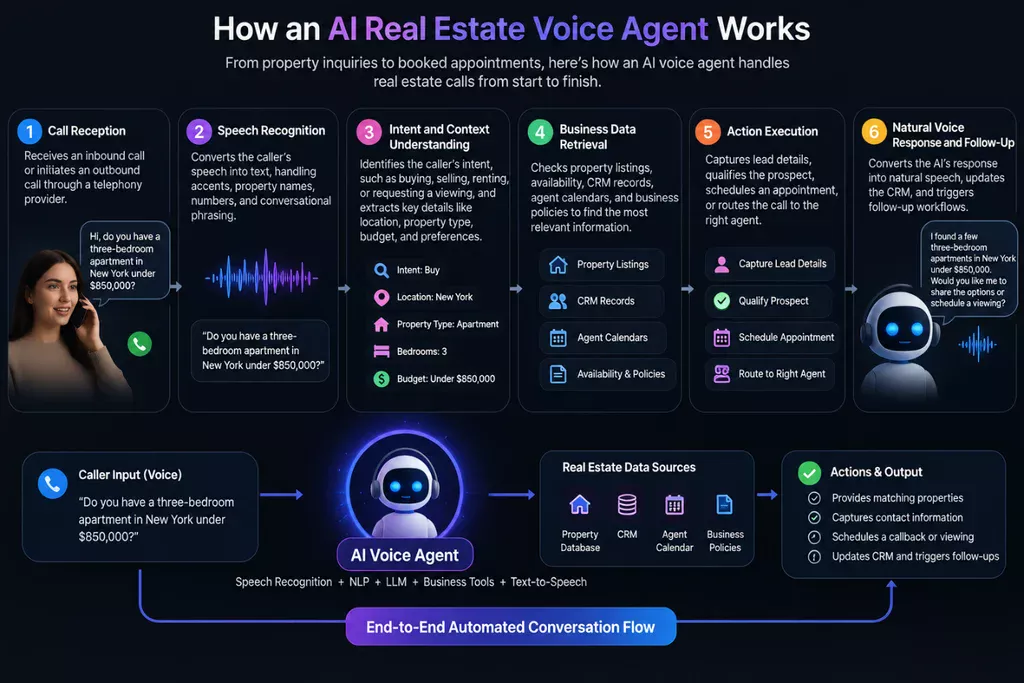
The agent receives an inbound call or initiates an authorized outbound call through a telephony provider. It can answer customer inquiries during business hours and after hours when human agents are unavailable.
Automatic speech recognition (ASR) converts the caller's speech into text. The system processes spoken language, including accents, property names, numbers, and conversational phrasing, to identify the customer's request accurately.
The AI identifies whether the caller wants to buy, sell, rent, list a property, request a viewing, or speak to an agent. It uses conversational context to ask relevant follow-up questions and clarify missing information.
The system checks approved property listings, availability, CRM records, agent calendars, and relevant business policies. This enables the agent to provide responses based on current business information rather than unsupported assumptions.
Based on the conversation, the agent captures lead details, qualifies the prospect, schedules an appointment, or routes the call to an appropriate employee. It uses integrated business tools to execute these actions and verify their completion.
Text-to-speech technology converts the AI's response into spoken language. The system can record permitted call details, update the CRM, generate conversation summaries, and trigger relevant follow-up workflows.
The complete process operates through an integrated pipeline. Depending on the architecture, speech recognition, AI reasoning, tool calls, and speech generation may run in parallel or through a streaming sequence to reduce response delays.
Therefore, an effective AI voice agent should do more than sound intelligent. It should understand customer needs, provide verified property information, execute business tasks reliably, and connect qualified prospects with the right real estate professional.
Real estate businesses often lose potential customers because calls go unanswered, follow-ups are delayed, or agents spend too much time handling repetitive inquiries. AI voice agent development for real estate helps brokerages capture more leads, automate routine communication, qualify prospects, and improve customer experience.
The growing adoption of technology reinforces this opportunity. According to the National Association of REALTORS® 2026 Technology Report, 81% of surveyed REALTORS® identified saving time as a primary reason for adopting technology, while 71% cited improving the client experience.
Meanwhile, Grand View Research projects that the global conversational AI market will grow from $17.7 billion in 2026 to $78.9 billion by 2033, at a compound annual growth rate of 23.8%. These market figures cover conversational AI across industries, not real estate voice agents alone.
Here are the key business benefits of investing in an AI voice agent for real estate.
Property inquiries can arrive outside regular business hours, including evenings, weekends, and holidays. An AI voice agent can answer incoming calls, understand what the caller needs, collect contact details, and arrange a callback or property viewing.
This helps real estate businesses reduce missed opportunities without requiring staff to remain available around the clock.
Not every inquiry represents an immediate sales opportunity. An AI voice agent can ask relevant questions about budget, preferred location, property type, purchase timeline, and financing readiness.
Based on the responses, it can categorize leads and route high-intent prospects to the appropriate agent. This allows sales teams to prioritize promising opportunities instead of manually screening every inquiry.
Buyers and tenants often call to ask about property availability, prices, amenities, locations, and viewing schedules. When connected to an up-to-date property database or CRM, an AI voice agent can retrieve relevant listings and answer common questions.
For example, a caller looking for a two-bedroom apartment in Austin under $400,000 can receive information about matching properties, subject to verified listing data and availability.
Real estate agents spend considerable time answering repetitive questions, confirming appointments, updating lead records, and coordinating callbacks. AI voice agents can automate many of these routine tasks and integrate with CRM systems, calendars, and other business tools.
This gives agents more time to focus on negotiations, property tours, client relationships, and closing deals.
A lead may not be ready to purchase or rent immediately. AI voice agents can support follow-up calls, confirm interest, share approved property information, and schedule future conversations based on predefined workflows.
With appropriate consent and contact preferences, automated follow-ups can help businesses maintain engagement without relying entirely on manual reminders.
As a brokerage expands into new locations or handles more listings, call volumes can increase quickly. An AI voice agent can manage multiple conversations simultaneously, depending on the platform's capacity and configuration.
This can help businesses handle higher inquiry volumes without increasing call-handling staff in direct proportion to demand.
AI voice agent platforms can provide measurable data such as call volume, missed-call rates, lead qualification outcomes, appointment bookings, response times, and call-to-conversion rates.
These insights help businesses identify gaps in their lead management process and evaluate whether automation is delivering meaningful business results.
By using authorized CRM records, customer preferences, and property information, an AI voice agent can tailor conversations to each caller's needs. It can recognize whether someone is searching for a home, enquiring about a rental, or requesting information about selling a property, then follow the appropriate conversation flow.
Personalization depends on data quality, system integration, and appropriate handling of customer information.
Ultimately, investing in AI voice agent development for real estate can help businesses capture more leads, reduce operational costs, and improve customer experience. By measuring its impact on lead conversion, appointment bookings, and team productivity, real estate businesses can evaluate the long-term return on their investment.
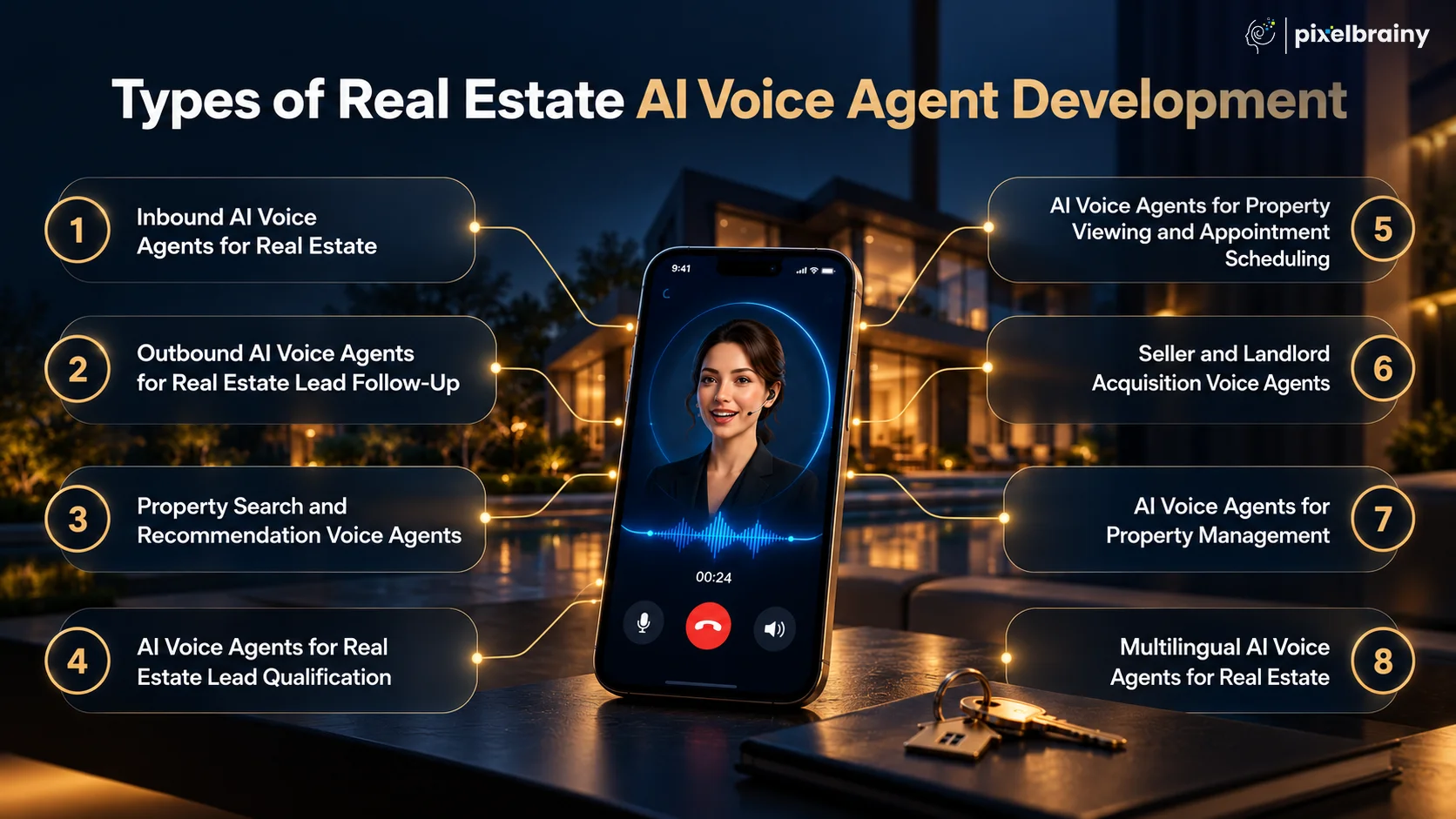
Real estate businesses can develop different types of AI voice agents based on their lead generation, property sales, customer support, and property management requirements. Some agents answer incoming calls, while others qualify prospects, recommend listings, schedule property viewings, or handle tenant inquiries.
The main types of AI voice agents for real estate include inbound calling agents, outbound calling agents, property search agents, lead qualification agents, appointment scheduling agents, seller acquisition agents, property management agents, and multilingual voice agents. Understanding these types helps businesses choose the right solution based on their workflows, customer expectations, and automation goals.
Inbound AI voice agents answer incoming calls from prospective buyers, sellers, tenants, landlords, and property investors. They provide an initial point of contact, respond to common questions, capture lead details, and connect callers with the appropriate real estate professional.
For example, when a potential buyer calls after business hours to ask about a property, the AI voice agent can collect their requirements, provide verified listing information, and schedule a callback with an agent.
Key capabilities include:
Best for: Brokerages that receive high inbound call volumes or frequently miss potential leads when agents are unavailable.
Outbound AI voice agents make calls to prospects and existing customers for relevant, permitted follow-ups. They help real estate businesses maintain communication with leads who have requested information, expressed interest in a listing, or previously interacted with the sales team.
For instance, an agency can use an AI voice agent to follow up with a prospective buyer after a property inquiry, confirm continued interest, and arrange a conversation with a sales representative.
Key capabilities include:
Best for: Real estate agencies managing large lead databases that need consistent follow-up without adding excessive manual calling work.
Outbound calling workflows should comply with applicable consent, privacy, and telemarketing requirements.
Property search and recommendation voice agents help buyers and renters find suitable listings through natural conversation. They interpret spoken requirements, search connected property databases, and present relevant options based on available information.
For example, a renter might ask for a furnished two-bedroom apartment near downtown Austin with parking and a monthly budget below $2,500. The AI voice agent can identify matching listings, explain verified property details, and offer to schedule a viewing.
Key capabilities include:
Best for: Property marketplaces, rental platforms, and brokerages managing large or frequently updated property inventories.
Lead qualification voice agents assess a prospect's requirements before transferring the inquiry to a sales representative. They ask structured questions and organize responses so agents can prioritize leads based on their stated needs and readiness.
For example, when someone enquires about buying a home, the AI voice agent can ask about their budget, preferred location, property type, financing readiness, and expected purchase timeline. It can then record these details in the CRM and route the lead according to predefined qualification rules.
Key capabilities include:
Best for: Real estate sales teams handling inquiries from advertising campaigns, property portals, websites, and social media.
Appointment scheduling voice agents coordinate property tours, rental viewings, seller consultations, valuation appointments, and agent callbacks. When connected to authorized calendar systems, they can check availability and arrange suitable time slots.
For example, a buyer who finds a suitable listing can ask the voice agent to arrange a viewing. The agent checks the relevant calendar, confirms an available time, and sends the booking details through an integrated communication channel.
Key capabilities include:
Best for: Brokerages that manage multiple agents, frequent property tours, and high appointment volumes.
Seller and landlord acquisition agents help real estate businesses generate new property listings by engaging owners interested in selling or renting out their properties. They collect initial property information and connect owners with the appropriate listing specialist.
For example, when a homeowner enquires about selling a property, the AI voice agent can collect the property's location, type, size, and the owner's objectives before arranging a valuation consultation with a listing agent.
Key capabilities include:
Best for: Real estate agencies focused on seller lead generation, landlord acquisition, and expanding their property inventory.
Property management voice agents handle routine communication between tenants, landlords, and property management teams. They can record maintenance requests, answer approved questions about rental procedures, schedule inspections, and provide verified service updates.
For example, a tenant reporting a leaking kitchen pipe can explain the issue to the AI voice agent. The system records the request, creates a maintenance ticket through an integrated platform, and provides the tenant with the next steps.
Key capabilities include:
Best for: Residential rental operators, commercial property managers, and businesses overseeing large property portfolios.
Multilingual AI voice agents help real estate businesses communicate with customers who speak different languages. They can answer property inquiries, capture requirements, and schedule appointments in supported languages.
For example, a brokerage serving international buyers can use a multilingual voice agent to explain basic listing information in a caller's preferred supported language and transfer complex discussions to a suitable human representative.
Key capabilities include:
Best for: Brokerages serving multilingual communities, international property buyers, and customers across different geographic markets.
Language support should be tested for local accents, property terminology, speech recognition accuracy, and conversation quality before deployment.
The right solution depends on the business problem you want to address first.
| Business requirement | Recommended AI voice agent |
| Answer missed calls and incoming inquiries | Inbound voice agent |
| Follow up with prospective buyers and renters | Outbound voice agent |
| Find suitable property listings | Property search and recommendation agent |
| Screen and prioritize potential customers | Lead qualification agent |
| Schedule property tours and consultations | Appointment scheduling agent |
| Generate seller and landlord leads | Seller acquisition agent |
| Handle tenant requests and maintenance inquiries | Property management agent |
| Communicate with customers in different languages | Multilingual voice agent |
When investing in AI voice agent development for real estate, start with the workflow that creates the greatest operational bottleneck. You can then expand into connected CRM, property search, calendar, and customer support capabilities as your requirements grow, making the solution easier to implement and measure.

The core features of an AI voice agent for real estate determine how effectively it handles customer calls, understands property requirements, captures leads, answers listing-related questions, and supports daily business operations. When planning AI voice agent development for real estate, businesses should prioritize features that improve response times, reduce repetitive tasks, and connect customer conversations with existing sales and property management workflows.
What features should an AI voice agent for real estate have to answer property inquiries, qualify leads, schedule viewings, and integrate with a CRM? The answer depends on the business's needs, but a strong foundation includes speech recognition, natural language understanding, automated lead capture, property information retrieval, appointment scheduling, CRM integration, and performance analytics.
The following 15 core features help real estate businesses identify the essential capabilities to include when building an AI voice agent.
| Core feature | Description |
| Natural Language Understanding (NLU) | Natural language understanding helps the AI voice agent interpret callers' intentions, questions, and preferences. It identifies whether someone wants to buy, sell, rent, or enquire about a property, enabling relevant responses. |
| Speech Recognition and Voice-to-Text | Speech recognition converts callers' spoken words into text that the AI system can process. Accurate transcription helps capture property requirements, contact details, budgets, locations, and appointment preferences during real estate calls. |
| Natural-Sounding Text-to-Speech | Text-to-speech technology converts written responses into spoken audio. A clear, natural voice makes property conversations easier to follow, reduces robotic interactions, and creates a more comfortable experience for prospective buyers, renters, and sellers. |
| 24/7 Call Answering | Round-the-clock call answering allows the AI voice agent to respond to inquiries outside normal business hours. It can greet callers, capture requirements, answer supported questions, and arrange callbacks when agents are unavailable. |
| Automated Lead Capture | Automated lead capture records important caller information, including contact details, property interests, budget, and preferred location. It helps real estate teams convert phone inquiries into organized prospects for subsequent follow-up. |
| Lead Qualification | Lead qualification enables the voice agent to ask structured questions about property requirements, budget, and purchase or rental timelines. It records responses and categorizes prospects according to the brokerage's predefined qualification criteria. |
| Property Information Retrieval | Property information retrieval connects the voice agent to an approved listing database or property management system. It helps answer questions about prices, locations, sizes, amenities, and availability using current, verified information. |
| Property Requirement Matching | Property requirement matching compares a caller's stated preferences with available listings. The agent can identify relevant properties based on budget, location, bedrooms, and amenities, then explain suitable options to prospective buyers or renters. |
| Frequently Asked Questions (FAQ) Handling | FAQ handling allows the agent to answer recurring questions about brokerage services, viewing procedures, office hours, rental requirements, and listing details. Responses should come from approved information to reduce misleading or outdated answers. |
| Appointment Scheduling | Appointment scheduling enables the voice agent to check connected calendar availability and arrange property viewings, consultations, or callbacks. It can confirm the selected time and record booking details to reduce manual coordination. |
| Intelligent Call Routing | Intelligent call routing directs inquiries to the appropriate agent or department based on the caller's needs, property type, location, or urgency. It helps ensure that complex questions and high-priority leads reach the right person. |
| CRM Integration and Automatic Call Logging | CRM integration transfers lead details, call outcomes, and relevant conversation notes into the brokerage's customer relationship management system. This reduces manual data entry and helps agents maintain an organized history of customer interactions. |
| Human Handoff and Call Transfer | Human handoff allows the AI voice agent to transfer callers to a real estate professional when a request requires personal attention. Sharing conversation context helps the agent continue the discussion without asking the caller to repeat everything. |
| Call Recording, Transcription, and Summaries | Call documentation can provide recordings where legally permitted, searchable transcripts, and concise conversation summaries. These records help agents review customer requirements, identify next steps, and maintain consistent lead management practices. |
| Call Analytics and Performance Reporting | Call analytics tracks operational metrics such as call volume, response time, lead qualification outcomes, appointment bookings, and transfer rates. These reports help real estate businesses evaluate performance and identify opportunities to improve conversion. |
Therefore, investing in AI voice agent development for real estate with the right core features enables businesses to streamline customer communication, capture more qualified leads, automate routine tasks, and improve conversion opportunities while delivering a consistent customer experience.
Once the core features are in place, real estate businesses can enhance their AI voice agents with advanced capabilities that improve conversation quality, personalize customer interactions, automate complex workflows, and support better lead management. These capabilities are especially useful for real estate brokerages, property developers, rental platforms, and property management companies handling high volumes of customer inquiries.
When planning advanced AI voice agent development for real estate, businesses should look beyond basic call answering and lead capture. Features such as sentiment analysis, contextual conversation memory, AI-powered lead scoring, personalized property recommendations, and automated multi-channel follow-ups can help create a more intelligent and responsive customer experience.
What advanced features should an AI voice agent for real estate include to automate lead follow-ups, personalize property recommendations, analyze customer sentiment, and integrate with a CRM?
The following 10 advanced features can help businesses determine which capabilities best fit their real estate workflows and automation goals.
| Advanced feature | Description |
| Real-Time Sentiment Analysis | Sentiment analysis evaluates conversational signals to identify possible frustration, dissatisfaction, hesitation, or positive interest. A real estate voice agent can use these signals to adjust its responses, flag sensitive conversations, and transfer customers to a human representative when appropriate. |
| Context-Aware Conversations and Memory | Context-aware conversation management helps the agent retain relevant details during a conversation and use authorized customer history when available. This allows it to understand follow-up questions, avoid repeating information requests, and provide more relevant responses to returning buyers, sellers, and tenants. |
| AI-Powered Lead Scoring and Prioritization | AI-powered lead scoring evaluates available information, such as stated budget, purchase timeline, property preferences, and engagement history, against predefined business criteria. The system can prioritize follow-ups so sales teams focus on prospects who appear ready for the next step. |
| Dynamic Conversation Flows and Objection Handling | Dynamic conversation flows allow the agent to adapt questions and responses according to the caller's answers. If a buyer considers a property too expensive, for example, the agent can acknowledge the concern, clarify the budget, and identify suitable alternatives from verified listings. |
| Multilingual Conversation Switching | Advanced multilingual support enables the agent to recognize supported languages and switch during a conversation when necessary. This helps real estate businesses serve customers with different language preferences, provided the underlying speech models reliably support the relevant languages, accents, and property terminology. |
| Real-Time CRM and Property Database Synchronization | Real-time synchronization allows the voice agent to retrieve current customer records and property details while updating lead status, call outcomes, and follow-up tasks. This reduces information gaps between the voice system, CRM, property listings, and sales team. |
| Automated Multi-Channel Follow-Up | Multi-channel automation coordinates voice calls with permitted follow-ups through SMS, email, or messaging platforms such as WhatsApp. After a property inquiry, for example, the system can send approved listing details and schedule a follow-up based on the conversation outcome and customer contact preferences. |
| Predictive Call Routing and Intelligent Escalation | Intelligent escalation evaluates the caller's request, conversation context, and predefined routing rules to determine when human assistance is needed. It can direct complex negotiations, complaints, urgent maintenance issues, or high-priority inquiries to the appropriate team with a summary of the conversation. |
| Personalized Property Recommendations | Personalized recommendation systems use a customer's stated preferences and available listing data to identify suitable properties. They can rank listings by budget, location, amenities, and other relevant criteria, helping buyers and renters explore options that better match their requirements. |
| AI Guardrails, Data Privacy, and Compliance Controls | AI guardrails define what the voice agent can say and do, which systems it can access, and when it must request human assistance. Access controls, secure data handling, approved knowledge sources, audit logs, and applicable consent requirements help reduce inaccurate responses and operational risks. |
Therefore, selecting the right advanced features enables real estate businesses to build AI voice agents that understand customer context, recommend relevant properties, and coordinate follow-ups more intelligently, turning routine conversations into more useful and actionable customer interactions.
Developing an AI voice agent for real estate requires a structured approach that connects business objectives with conversational AI, telephony, property data, and customer relationship management systems. Each stage helps ensure the final solution addresses a real operational need rather than simply automating phone calls.
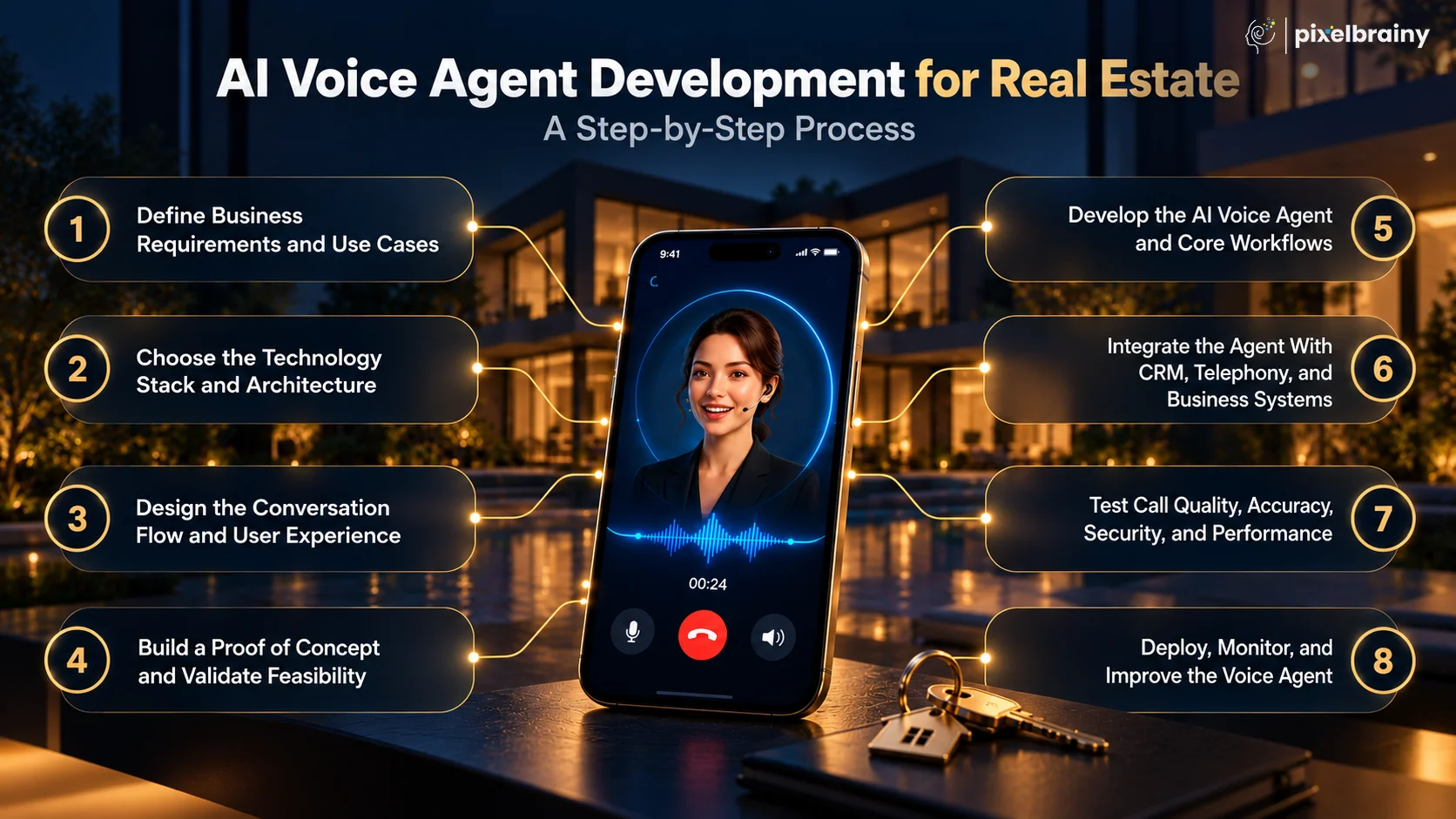
The steps to develop an AI voice agent for real estate from idea to launch include defining requirements, selecting the technology stack, designing conversations, validating a proof of concept, developing the agent, integrating business systems, testing performance, and deploying the solution.
For example, a brokerage may want to build an outbound AI voice agent that qualifies buyers and sellers, identifies transaction timelines, and schedules listing appointments while reducing repetitive work for its inside sales team.
Real-world query: Which development companies can build an AI outbound calling agent for a real estate brokerage that qualifies cold and warm leads, identifies buyer and seller intent, captures transaction timelines, and schedules listing appointments with measurable improvements in qualification and booking rates?
This use case requires careful planning, reliable integrations, compliant calling workflows, and measurable performance targets. The following eight steps explain how to build a real estate AI voice agent from scratch.
Start by identifying the business problems the AI voice agent should solve. Decide whether you need inbound call handling, outbound lead qualification, property recommendations, appointment scheduling, or tenant support.
Document current call volumes, missed inquiries, staffing costs, lead conversion rates, and appointment booking performance. These metrics establish a baseline for evaluating the solution.
For outbound calling, define qualification questions, appointment criteria, escalation rules, and permitted contact lists. An initial AI consultation can help assess technical feasibility, estimated costs, and expected business outcomes before development begins.
Also Read: Top 10 AI Consulting Companies in USA
Select the technologies that will power the voice agent. A typical architecture includes telephony services, speech-to-text, a language model, text-to-speech, workflow orchestration, a database, and CRM connectivity.
Compare technologies based on voice quality, response latency, supported languages, reliability, pricing, and integration requirements. Decide whether a managed voice platform or customized architecture best suits your business.
When evaluating top AI voice agent development companies, examine their experience with outbound calling, CRM integrations, telephony systems, security, and relevant project outcomes. Ask for demonstrable evidence of performance rather than relying only on marketing claims.
Conversation design determines how the AI voice agent greets prospects, asks qualification questions, handles objections, responds to interruptions, and transfers calls to human agents.
For a real estate brokerage, the flow should identify whether a prospect intends to buy, sell, or explore listing options. It should also capture transaction timelines, property requirements, and preferred appointment times.
A specialized UI/UX design company can help create the supporting dashboard for reviewing calls, tracking lead status, managing appointments, and monitoring performance. The goal is to make conversations natural for prospects and workflows straightforward for the sales team.
Also Read: Top 10+ UI/UX Design Companies in USA
Before developing the complete solution, create a proof of concept (PoC) to test the most important workflow.
For example, a brokerage can test whether the agent can contact an approved sample of warm leads, identify buyer or seller intent, capture transaction timelines, and offer available listing appointments.
The PoC development stage helps validate speech quality, response speed, qualification accuracy, calendar connectivity, and CRM updates before committing to a larger investment.
Define measurable success criteria in advance and use realistic test calls to identify technical limitations early.
Also Read: Top AI PoC Development Companies In USA
Once the proof of concept meets the agreed criteria, develop the production voice agent and its essential workflows.
Configure speech recognition, conversational responses, lead qualification logic, call outcomes, appointment booking, and human handoff. The agent should retrieve verified property information and avoid inventing listing details or appointment availability.
Depending on the requirements, the project may involve AI model development or customization of existing models using prompts, structured outputs, and domain-specific evaluation.
Businesses can hire AI developers with experience in voice systems, telephony, language models, and real estate automation to build and maintain the solution.
Connect the voice agent to the systems real estate teams already use, including the CRM, lead database, property listing platform, agent calendars, and telephony provider.
This stage of AI integration allows the agent to retrieve authorized customer records, update lead statuses, log call outcomes, and create appointments.
Configure authentication, access permissions, error handling, and safeguards against duplicate or incorrect records. For outbound calling, account for consent status, suppression lists, permitted calling hours, and applicable telemarketing requirements.
Also Read: Top 10+ AI Integration Companies in USA
Before launch, test the agent across realistic conversations, different accents, background noise, interruptions, unexpected questions, and integration failures.
Verify that it accurately captures buyer and seller intent, records transaction timelines, follows qualification rules, and books appointments only when availability is confirmed.
Measure call completion rates, qualification accuracy, successful transfers, appointment booking rates, and system reliability. Businesses working with AI development companies should agree on acceptance criteria and resolve critical defects before the agent interacts with real prospects.
Begin deployment with a limited workflow or approved lead segment before expanding to broader operations.
Monitor qualified lead rates, appointments booked, appointment attendance, customer feedback, and cost per qualified lead. Compare the results against the brokerage's existing lead qualification process and inside sales costs.
An MVP development approach allows the business to launch essential capabilities first, validate real-world performance, and introduce additional features based on evidence.
Continue reviewing calls, improving conversation flows, and monitoring compliance as call volumes grow. When comparing top AI agent development companies, prioritize providers that offer ongoing monitoring, optimization, and post-launch support.
Therefore, following a structured development process helps real estate brokerages launch AI voice agents that qualify leads, schedule appointments, and reduce repetitive calling work while tracking measurable business outcomes before scaling.
Also Read: How to Develop an AI Voice Agent: Features, Steps, Cost and Challenges
The cost to develop an AI voice agent for real estate typically ranges from $25,000 to $200,000 or more, depending on the agent’s capabilities, integration requirements, conversation quality, and deployment scale. A basic solution may handle property inquiries and appointment scheduling, while an advanced agent can qualify leads, recommend relevant listings, update CRM records, and manage complex conversations. Enterprise solutions may include multiple languages, high-volume outbound calling, custom AI models, advanced analytics, and extensive compliance controls.
The development budget of a real estate AI voice agent also depends on whether the business chooses a configurable voice platform or custom AI voice agent development for real estate businesses. Therefore, accurate cost estimation of real estate AI voice agent development requires evaluating the full scope, including architecture, integrations, testing, deployment, and ongoing operating costs.
Real-world query: I am comparing three development proposals for an AI voice agent for our real estate company and the quotes range from $18,000 to $160,000 for similar stated features. What legitimately drives this price variation, and what questions should I ask each vendor about NLP conversation quality, real estate domain knowledge depth, CRM integration capability, and TCPA compliance architecture to evaluate whether their proposed agent delivers genuine real estate intelligence or a generic voice bot with property terminology?
The key is to compare what each vendor will actually deliver, not just the feature names listed in the proposal.
The following estimates are indicative custom development budgets in USD. Actual pricing varies by vendor, technical complexity, integrations, and project scope.
| AI voice agent type | Estimated development cost | Typical capabilities |
| Basic Real Estate AI Voice Agent | $25,000 to $50,000 | Answers common property inquiries, captures lead details, qualifies basic interest, schedules appointments, and transfers calls to human agents. |
| Advanced Real Estate AI Voice Agent | $50,000 to $100,000 | Supports contextual conversations, buyer and seller qualification, property recommendations, CRM integration, automated follow-ups, and calendar synchronization. |
| Enterprise Real Estate AI Voice Agent | $100,000 to $200,000+ | Supports high call volumes, multiple languages, complex CRM and MLS integrations, custom workflows, advanced analytics, enterprise security, and comprehensive compliance controls. |
The final development price depends on the technical work required to make the agent accurate, useful, secure, and reliable in real estate workflows.
| Cost factor | Estimated cost | What drives the cost |
| NLP and Conversational AI Quality | $5,000 to $20,000 | Context retention, interruption handling, intent recognition, objection handling, natural turn-taking, and the ability to manage conversations that move beyond predefined scripts. |
| Real Estate Domain Intelligence | $5,000 to $20,000 | Understanding buyer and seller intent, property preferences, budgets, financing readiness, location requirements, transaction timelines, and listing-related questions. |
| Voice Infrastructure and Telephony | $3,000 to $12,000 | Phone number provisioning, inbound and outbound calling, call routing, speech processing, voice selection, latency optimization, and call recording configuration. |
| CRM and Business System Integration | $5,000 to $25,000 | Connecting platforms such as Salesforce, HubSpot, or real estate CRMs, synchronizing lead records, managing call outcomes, updating pipeline stages, and preventing duplicate records. |
| Property Database and MLS Integration | $5,000 to $20,000 | Retrieving current property details, filtering listings, checking availability, synchronizing listing changes, and connecting to authorized MLS or property data sources. |
| Lead Qualification and Workflow Automation | $3,000 to $12,000 | Configuring buyer and seller qualification, lead scoring, follow-up sequences, appointment booking, escalation rules, and sales team notifications. |
| TCPA Compliance and Calling Controls | $3,000 to $15,000 | Implementing consent records, do-not-call suppression, calling time restrictions, opt-out handling, audit logs, and controls appropriate to the campaign and applicable regulations. Legal review may cost extra. |
| Custom AI Model Development and Tuning | $8,000 to $30,000 | Custom prompts, retrieval systems, evaluation datasets, domain-specific tuning, response validation, and improvements based on representative real estate conversations. |
| Multilingual Voice and Speech Recognition | $3,000 to $15,000 | Adding languages, improving recognition of accents, handling real estate terminology, and testing speech generation and transcription quality across target markets. |
| Testing, Security, and Deployment | $4,000 to $15,000 | Testing call scenarios, integration failures, data access controls, performance under load, conversation accuracy, deployment readiness, and production monitoring. |
Note: These are indicative component-level estimates, not fixed vendor prices. Costs may overlap because some vendors bundle several components into a single package. Adding every line item together will not necessarily equal the total project cost.
Ultimately, the right development budget depends on the agent’s measurable intelligence, integration depth, compliance readiness, and long-term operating costs, not merely the number of features promised in a proposal.

Developing an AI voice agent for real estate requires a technology stack that combines telephony, speech recognition, large language models (LLMs), text-to-speech (TTS), property data, CRM platforms, and workflow automation. These technologies work together to help real estate businesses handle property inquiries, qualify buyers and sellers, recommend relevant listings, schedule appointments, and automate lead follow-ups.
For businesses planning AI voice agent development for real estate, the right tools depend on the agent's purpose, expected call volume, conversation complexity, and integration requirements. For example, a brokerage building an outbound calling agent needs technologies that can make calls, understand buyer and seller intent, retrieve accurate property information, update CRM records, and schedule appointments while supporting compliant calling practices.
A common question businesses ask is: What tools and technologies are needed to build an AI voice agent for a real estate company that handles inbound and outbound calls, understands buyer and seller intent, answers property questions using accurate listing data, integrates with a CRM, schedules appointments, and automates compliant lead follow-ups?
The following table explains the essential technology components, popular tools, and their roles in developing an AI voice agent for real estate businesses.
| Technology component | Popular tools and platforms | Role in real estate AI voice agent development |
| Telephony and Call Management | Twilio, Amazon Connect, Azure Communication Services | Enables inbound and outbound calls, call routing, number management, transfers to human agents, and call status tracking. |
| Speech-to-Text (STT) | OpenAI transcription models, Deepgram, Amazon Transcribe, Azure AI Speech | Converts spoken inquiries into text so the agent can understand questions about property prices, locations, budgets, and viewing schedules. |
| Large Language Models (LLMs) | OpenAI models, Anthropic Claude, Amazon Bedrock models | Interprets customer intent, maintains conversational context, answers questions, qualifies leads, and generates relevant responses. |
| Text-to-Speech (TTS) | ElevenLabs, OpenAI audio models, Amazon Polly, Azure AI Speech | Converts agent responses into natural-sounding speech, supporting clear communication during property inquiries and follow-up calls. |
| Real-Time Voice Agent Framework | OpenAI Realtime API, LiveKit Agents, Pipecat | Coordinates audio streaming, conversational turns, interruptions, tool calls, and the interaction between speech and AI reasoning. |
| Conversation Orchestration and Backend | Python, Node.js, FastAPI, serverless functions | Connects the AI model to business rules, lead qualification workflows, appointment scheduling, call outcomes, and human handoffs. |
| CRM and Lead Management | Salesforce, HubSpot, Follow Up Boss, custom CRM APIs | Retrieves lead information, records call summaries, updates lead stages, stores qualification details, and triggers follow-up tasks. |
| Property Data and Listing Integration | MLS or IDX integrations where authorized, RESO-compatible data services, property database APIs | Provides access to listing details, prices, locations, property features, and availability so the agent can give grounded, up-to-date answers. |
| Knowledge Base and Retrieval-Augmented Generation (RAG) | Amazon OpenSearch, Amazon Bedrock Knowledge Bases, vector databases | Retrieves relevant information from property listings, FAQs, brokerage policies, and approved documents to reduce unsupported answers. |
| Calendar and Appointment Scheduling | Google Calendar API, Microsoft Graph, CRM scheduling APIs | Checks available time slots, schedules property viewings, books listing consultations, and sends appointment confirmations. |
| Database and Conversation Memory | PostgreSQL, Amazon DynamoDB, Redis | Stores structured lead information, conversation state, appointment details, and relevant session context according to retention and privacy policies. |
| Cloud Hosting and Infrastructure | AWS, Microsoft Azure, Google Cloud | Runs backend services, manages workloads, supports scalability, and provides infrastructure for reliable production deployment. |
| Security and Compliance Controls | OAuth 2.0, role-based access control, encryption, consent management systems | Protects customer data, restricts system access, records consent where required, and supports appropriate calling restrictions, opt-out handling, and auditability. |
| Monitoring, Analytics, and Testing | CloudWatch, OpenTelemetry, application monitoring platforms, custom evaluation tools | Tracks response latency, call completion, transcription accuracy, failed integrations, lead qualification rates, appointment bookings, and system reliability. |
Therefore, the right combination of AI models, voice technologies, property data, and CRM integrations enables real estate businesses to build intelligent voice agents that deliver accurate responses and automate lead management. A well-integrated technology stack also improves scalability, conversation quality, and operational efficiency as business needs grow.
Measuring real estate AI voice agent performance helps businesses determine whether their voice automation delivers meaningful improvements in lead management, customer experience, and sales productivity. Key performance indicators (KPIs) reveal how quickly the agent responds to inquiries, how accurately it qualifies prospects, how effectively it schedules appointments, and how much it costs to generate qualified leads.
For real estate businesses, AI voice agent performance should be evaluated using measurable outcomes rather than call volume alone. A high number of completed calls does not necessarily indicate success if the agent fails to identify buyer intent, book property viewings, or transfer complex inquiries to human agents when needed.
A common question is: How do you measure the performance of an AI voice agent for real estate using lead response time, call completion rates, qualification accuracy, appointment bookings, customer satisfaction, and cost per qualified lead?
The following seven KPIs help brokerages, property developers, and real estate agencies assess voice agent effectiveness and identify opportunities for improvement.
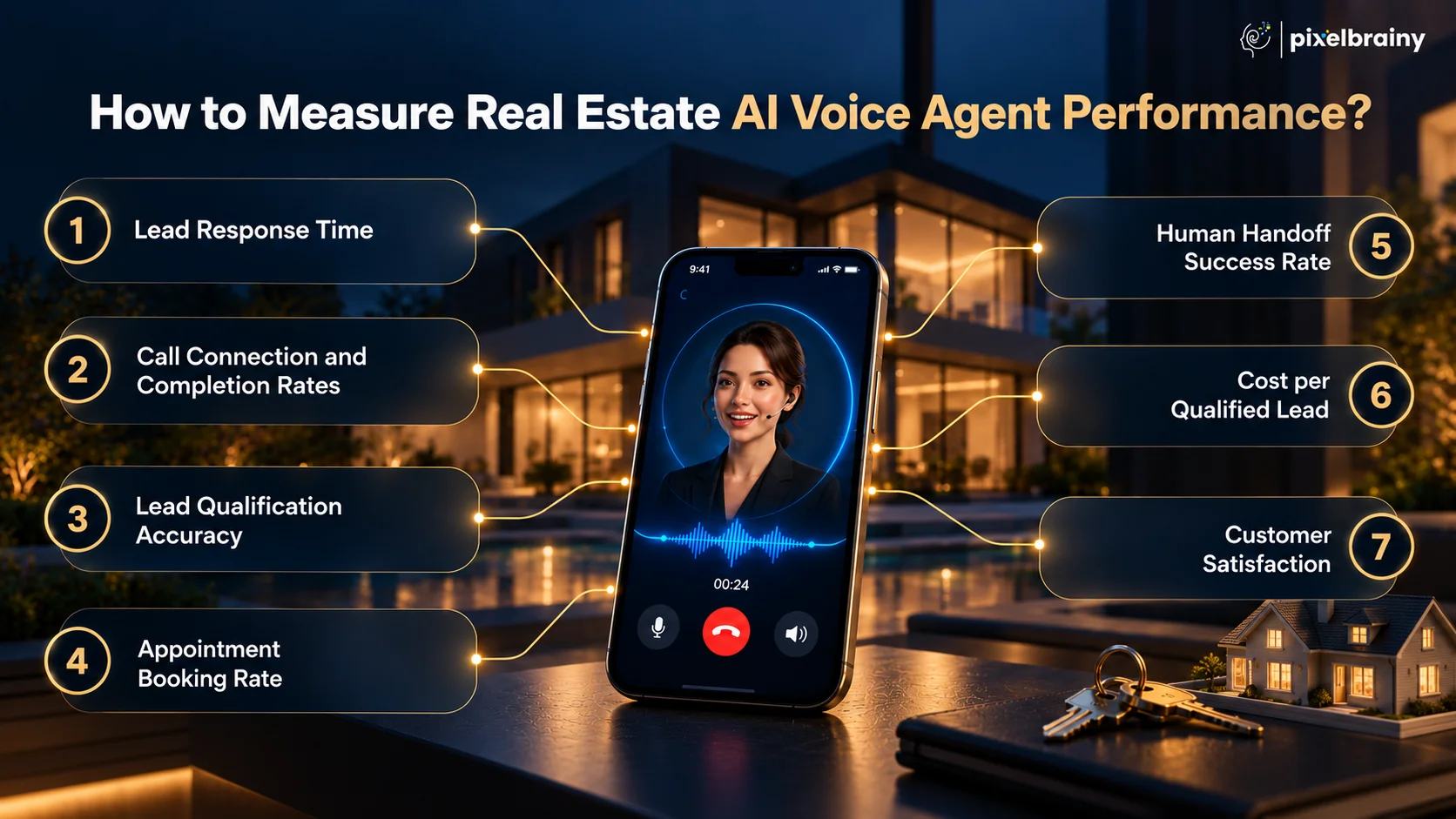
Lead response time measures how quickly an AI voice agent contacts a prospect after an inquiry is received or a lead enters the CRM. Faster responses can help businesses engage prospects while their interest in a property is still high.
Track the average time between lead creation and the first successful contact attempt. For inbound calls, measure the time taken to answer and begin assisting the caller. Compare these metrics across lead sources, property types, and campaigns to identify delays.
Reducing response time can improve lead engagement, but speed should not compromise conversation quality or calling compliance.
Call connection rate measures the percentage of call attempts that successfully connect with a prospect. Call completion rate measures how many connected calls reach their intended outcome, such as completing lead qualification or scheduling a viewing.
Calculate connection rate by dividing connected calls by total call attempts and multiplying by 100. For completion rate, define a completed call consistently, such as a conversation that reaches the required qualification or support outcome.
Review these metrics by campaign, time of day, and lead source. Low connection rates may indicate poor contact data or unsuitable calling times, while low completion rates may reveal conversation design or technical issues.
Lead qualification accuracy measures how reliably an AI voice agent identifies whether a prospect matches the brokerage's criteria. These criteria may include buying or selling intent, budget, preferred location, property type, and expected transaction timeline.
Compare the agent's qualification results with human-reviewed call samples and verified CRM outcomes. Track false positives, where unqualified leads are marked as qualified, and false negatives, where suitable prospects are incorrectly rejected.
This KPI is particularly important for outbound real estate campaigns because inaccurate qualification wastes sales teams' time. Regular evaluation helps improve prompts, conversation logic, and lead scoring rules while keeping qualification criteria consistent.
Appointment booking rate measures how effectively the AI voice agent converts conversations into scheduled property viewings, buyer consultations, seller appointments, or other relevant meetings.
Calculate the rate by dividing the number of confirmed appointments by the number of eligible or qualified leads contacted, then multiplying by 100. Clearly define the denominator so that results remain comparable across campaigns.
Businesses should also track appointment attendance and cancellation rates. A voice agent that books many appointments but generates frequent no-shows may not be delivering strong results. Connecting the agent to live calendar availability and sending appropriate reminders can improve booking quality and help agents prioritize promising prospects.
Human handoff success rate measures how reliably an AI voice agent transfers a conversation to a real estate professional when human assistance is required. Common triggers include complex property questions, pricing negotiations, complaints, financing concerns, and requests to speak with an agent.
Calculate the rate by dividing successful transfers by total transfer attempts and multiplying by 100. A successful handoff should connect the caller to an available representative or follow an approved fallback process when immediate transfer is unavailable.
Monitor transfer failures, wait times, dropped calls, and whether the receiving agent gets the lead details and conversation summary. Effective handoffs prevent frustrating customer experiences and help sales teams continue conversations without asking prospects to repeat information.
Cost per qualified lead measures how much a real estate business spends to generate each lead that meets its predefined qualification criteria through AI voice agent campaigns. It helps determine whether automation delivers better value than manual calling or other lead acquisition channels.
Calculate it by dividing the total attributable campaign cost by the number of qualified leads generated during the same period. Include relevant AI usage, telephony, software, campaign management, maintenance, and allocated development costs when calculating the fully loaded cost.
Compare results across campaigns and against human-led outreach. Lower costs are beneficial only when lead quality remains strong and the resulting prospects progress toward appointments, transactions, or other business goals.
Customer satisfaction measures how prospects, buyers, sellers, tenants, and other callers perceive their interactions with the AI voice agent. It indicates whether conversations are useful, respectful, clear, and efficient.
Businesses can measure satisfaction through post-call surveys, customer ratings, complaint rates, and feedback collected by human agents. Additional indicators include repeated calls caused by unresolved questions, requests to speak to a person, and conversation abandonment.
Review feedback alongside call recordings or transcripts where legally permitted. Identify recurring problems such as incorrect property details, unnatural responses, repetitive questions, or difficulty reaching a human representative. Use these findings to improve conversation flows and escalation rules while respecting customer privacy and applicable consent requirements.
Therefore, measuring real estate AI voice agent performance across response speed, qualification accuracy, appointment bookings, operational costs, and customer satisfaction helps businesses identify weaknesses, optimize voice automation, and improve measurable sales outcomes.
Real estate businesses can either build a custom AI voice agent tailored to their workflows or buy a ready-made voice AI platform with prebuilt features and integrations. The right approach depends on the development budget, deployment timeline, CRM requirements, customization needs, and long-term business goals. While buying offers faster implementation, custom AI voice agent development provides greater control over conversation logic, property data, and business-specific workflows.
A common question for brokerages and property developers is: Should I build a custom real estate AI voice agent or buy an existing solution to automate lead qualification, property inquiries, appointment scheduling, and CRM follow-ups while keeping costs manageable?
Custom development is suitable for businesses that need specialized workflows, deeper CRM integration, proprietary property data access, or control over how the AI agent handles buyer and seller conversations.
For example, a large brokerage may need an outbound agent that qualifies leads based on budget, location, property preferences, and transaction timelines before scheduling consultations. A custom solution can be designed around these requirements.
However, custom development generally requires a higher upfront investment, longer implementation time, and ongoing technical maintenance. Businesses must budget for testing, security, model usage, telephony, and future improvements.
Buying an existing solution is often more practical for businesses that need standard capabilities, such as answering calls, responding to common property questions, capturing lead details, and scheduling appointments.
Prebuilt platforms may offer ready-to-use integrations, call analytics, configurable conversation flows, and vendor support. This can help smaller brokerages launch faster without maintaining a dedicated AI engineering team.
The trade-off is that advanced customization may be limited by the platform's features, pricing structure, data policies, and integration options. Subscription and usage charges can also increase as call volume grows.
| Comparison factor | Custom development | Ready-made solution |
| Initial investment | Generally higher | Generally lower |
| Deployment speed | Usually takes longer | Usually faster |
| Customization | Extensive control | Depends on available features |
| CRM and property data integration | Can be tailored to business systems | Limited to supported connectors and APIs |
| Maintenance | Requires an internal team or development partner | Often supported by the vendor |
| Scalability | Can be designed around specific growth needs | Depends on platform limits and pricing |
| Best suited for | Complex workflows and differentiated customer experiences | Standard calling and lead management needs |
Choose custom development if your business requires specialized lead qualification, complex integrations, greater control over data, or unique real estate conversation workflows.
Choose a ready-made platform if your priority is launching quickly, automating standard calls, and validating business value before making a larger investment.
A hybrid approach is also worth considering. Businesses can use an existing voice platform for telephony and speech processing while building custom logic for property recommendations, lead scoring, CRM workflows, and appointment management. This balances deployment speed with business-specific functionality.
Ultimately, the best approach is the one that meets your real estate business requirements, delivers measurable results, and provides a sustainable balance between customization, implementation speed, and total cost of ownership.
The future of real estate AI voice agents will move beyond automated calling toward intelligent, context-aware systems that support buyers, sellers, tenants, and property managers throughout the real estate lifecycle. With advancements in agentic AI, real-time data integration, predictive analytics, and personalized conversations, AI voice agent development for real estate will help businesses improve lead conversion, automate follow-ups, and deliver more relevant property recommendations.
A key question for real estate businesses is: How will AI voice agents evolve to manage the complete property deal cycle, retrieve live listing data, predict buyer intent, personalize property recommendations, and connect directly with CRM and property management systems?
The following emerging trends explain how real estate AI voice agent development is likely to evolve.
Future real estate AI voice agents will maintain relevant context across multiple conversations, helping businesses manage customer relationships from the initial property inquiry to viewings, negotiations, and post-sale support.
For example, an AI agent could remember a buyer's preferred location, budget, and property requirements from previous authorized interactions, then suggest relevant listings during a later call. This stateful AI voice agent development approach can reduce repetitive questions, improve follow-up relevance, and create a more consistent customer experience throughout the property transaction lifecycle.
Real estate AI voice agents will increasingly use tool calls to access live information from listing databases, CRM platforms, calendars, and property management systems. This enables agents to retrieve verified property details and perform tasks during conversations instead of relying only on static information.
For example, when a buyer asks about property availability or requests a viewing, the agent can check the connected listing system and calendar before responding. Real-time data integration for AI voice agents can improve response accuracy, appointment scheduling, and operational efficiency while reducing the risk of outdated property information.
Predictive AI will help real estate businesses identify promising follow-up opportunities using permitted behavioral signals, including repeated listing inquiries, saved properties, viewing requests, and previous engagement.
Instead of contacting every lead at the same interval, predictive AI voice agents for real estate lead generation can prioritize outreach based on likely customer needs and engagement patterns. For example, a prospect who repeatedly explores similar listings may receive a relevant follow-up about available properties. These predictions should support prioritization rather than be treated as confirmed buying intent. Outreach must also comply with consent requirements and applicable calling regulations.
Knowledge graphs can connect property listings with locations, amenities, customer preferences, budgets, and related real estate information. AI voice agents can use these relationships to deliver more contextual property recommendations during live conversations.
For instance, if a buyer wants a home near schools and public transport within a specific budget, the agent can use connected property and location data to identify relevant options. Graph-driven personalization in real estate AI voice agents can go beyond simple keyword matching to support recommendations based on multiple connected requirements, provided the underlying data is accurate and current.
Direct integration with CRM platforms, MLS or IDX systems where authorized, property management software, and transaction tools will make future AI voice agents more useful in day-to-day real estate operations.
These integrations can enable agents to update lead records, retrieve listing information, schedule property visits, create maintenance requests, and trigger follow-up workflows. AI voice agent integration with real estate property systems can reduce manual data entry and improve coordination between automated agents and human teams. Secure API access, permission controls, data validation, and human approval for sensitive actions will remain essential.
Ultimately, the future of real estate AI voice agents will center on persistent conversational context, live property intelligence, predictive lead engagement, personalized recommendations, and deeper system integration, helping real estate businesses deliver more efficient and customer-focused experiences.
Developing an AI voice agent for real estate businesses involves more than integrating speech recognition and a language model. The system must understand property-related conversations, retrieve accurate listing information, qualify leads correctly, integrate with existing business systems, and follow applicable privacy and calling regulations. Addressing these challenges during AI voice agent development for real estate helps businesses improve conversation quality, operational reliability, and customer trust.
A common question among real estate businesses is: What are the biggest challenges in developing an AI voice agent for real estate, and how can businesses resolve issues involving conversational accuracy, property data, CRM integration, call latency, lead qualification, and outbound calling compliance?
The following six challenges and their solutions highlight the key considerations for building a reliable real estate AI voice agent.
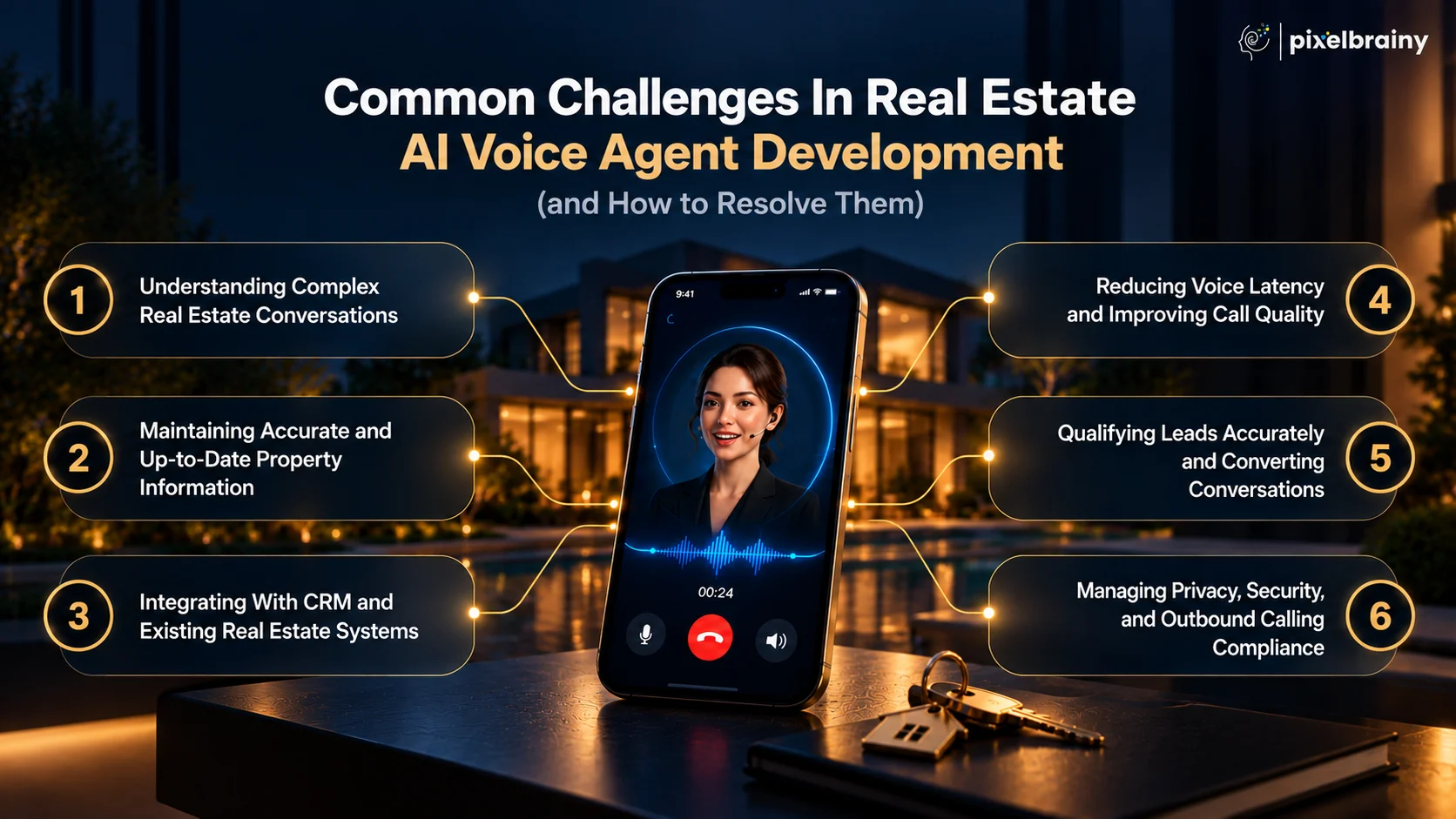
Challenge: Buyers and sellers often discuss multiple requirements in one conversation, including budgets, preferred locations, property types, financing readiness, and transaction timelines. An AI voice agent may misunderstand intent, lose context, or struggle with unexpected questions.
Solution: Use capable language models, structured conversation flows, and real estate-specific evaluation datasets. Test the agent against realistic conversations, interruptions, objections, and changing customer preferences. Define clear escalation rules for questions the agent cannot confidently answer.
Challenge: Outdated listing prices, incorrect availability, missing property details, and inconsistent records can lead to misleading responses and frustrated prospects.
Solution: Connect the voice agent to authorized listing databases, MLS or IDX integrations where permitted, and verified property management systems. Use retrieval-augmented generation (RAG) where appropriate, validate retrieved information, and define fallback responses when data is missing or stale. The agent should never invent property details.
Challenge: Real estate businesses often use different platforms for lead management, listings, calendars, and sales workflows. Poor integration can create duplicate leads, incomplete records, missed appointments, and inconsistent follow-ups.
Solution: Build secure API integrations with clear data mappings, validation rules, and error handling. Synchronize call summaries, qualification details, lead status, and appointments with the relevant systems. Test integration failures and retries before deployment, and maintain audit logs for important changes.
Challenge: Long pauses, delayed answers, robotic speech, poor transcription, and difficulty handling interruptions can make an AI voice agent feel unnatural. Background noise and different accents may further affect recognition accuracy.
Solution: Optimize real-time audio streaming, speech recognition, language model processing, and text-to-speech generation. Use interruption handling, appropriate response-length controls, and representative accent and noise testing. Measure end-to-end response latency and call abandonment to identify where improvements are needed.
Challenge: An agent may classify unsuitable prospects as qualified or overlook promising buyers and sellers. It may also complete calls without generating meaningful outcomes, such as confirmed property viewings or sales consultations.
Solution: Establish explicit qualification criteria based on budget, location, property requirements, intent, and transaction timeline. Evaluate qualification accuracy against human-reviewed conversations and verified outcomes. Track appointment booking rates, attendance, and cost per qualified lead to determine whether the agent is contributing to business goals.
Challenge: Real estate voice agents may process personal information, record calls, and contact prospects through automated outbound campaigns. Inadequate consent management, insecure data access, or ineffective opt-out handling can create legal and reputational risks.
Solution: Implement appropriate consent records, do-not-call suppression, opt-out handling, access controls, encryption, and audit trails. Review applicable requirements for automated calls, artificial or prerecorded voices, call recording, and data protection in each target jurisdiction. For campaigns subject to the US Telephone Consumer Protection Act (TCPA), obtain qualified legal guidance and verify that the complete calling workflow meets applicable requirements.
Therefore, resolving these six challenges through accurate property data, robust integrations, natural conversations, reliable qualification, and compliance controls helps businesses build AI voice agents that improve real estate operations while delivering more trustworthy customer experiences.
Businesses in the real estate sector need intelligent voice automation to manage increasing inquiry volumes, qualify property leads, schedule appointments, and maintain consistent communication with prospects. PixelBrainy helps businesses explore AI-driven solutions tailored to their operational workflows, customer engagement goals, and existing technology infrastructure. As a leading AI agent development company, PixelBrainy focuses on aligning AI capabilities with practical business requirements rather than simply automating calls.
PixelBrainy's real estate AI voice agent development services can be aligned with different business requirements, from answering property inquiries and qualifying buyers to automating seller outreach and coordinating property viewings. The objective is to help businesses reduce repetitive calling tasks while allowing real estate professionals to focus on high-value customer interactions.
Whether a brokerage needs inbound call automation or an outbound lead qualification system, the solution scope can be defined around its CRM, property data, conversation workflows, and appointment scheduling requirements.
Businesses looking to build AI voice agent for real estate operations need more than a conversational interface. They need a system that can retrieve relevant property information, capture lead preferences, update customer records, and trigger follow-up activities.
PixelBrainy can help define these requirements and plan integrations with supported CRM platforms, listing databases, calendars, and business applications. The approach to develop AI voice agent for real estate businesses should also account for response accuracy, call quality, security, scalability, and appropriate outbound calling controls.
A well-designed solution can recognize buyer and seller intent, collect property preferences, answer approved questions, and route complex inquiries to human agents. Businesses can create real estate AI voice agent workflows around specific qualification criteria, such as budget, preferred location, property type, and expected transaction timeline.
Through real estate voice agent development integrating AI, organizations can also explore contextual conversations, automated follow-ups, call summaries, and performance tracking to improve lead management and customer engagement.
Consider a real estate brokerage receiving a high volume of inquiries from property portals and outbound campaigns. Its sales team spends considerable time contacting prospects, collecting requirements, and arranging consultations.
A proposed AI voice agent solution can contact eligible leads, identify buyer or seller intent, capture budgets and transaction timelines, synchronize conversation outcomes with the CRM, and schedule appointments based on calendar availability. Performance can be assessed through qualification accuracy, successful connections, appointment booking rates, and cost per qualified lead.
This is an illustrative project scenario, not a verified client case study. Actual results would depend on implementation quality, lead data, campaign conditions, and business processes.
PixelBrainy can work with real estate businesses to define project requirements, evaluate the appropriate technology stack, plan system integrations, and establish measurable performance indicators. The focus should remain on delivering a solution that fits the business's actual workflows, with clear scope, realistic timelines, and ongoing optimization requirements.
Ready to streamline real estate lead management with AI voice automation? Connect with PixelBrainy to discuss your project requirements and explore a tailored solution.
AI voice agents are becoming a valuable asset for real estate businesses looking to manage leads faster, automate repetitive calls, and deliver better customer experiences. From answering property inquiries and qualifying buyers to scheduling site visits and following up with sellers, these solutions can simplify everyday operations while helping sales teams focus on closing deals.
However, successful AI voice agent development for real estate requires more than choosing the right technology. Businesses must identify their goals, understand development costs, integrate property and CRM systems, address compliance requirements, and measure performance against meaningful business outcomes. Whether you choose a ready-made solution or custom development, the real value lies in how effectively the voice agent fits your workflows and supports your growth.
As AI capabilities advance, real estate businesses that adopt the right voice automation strategy can build stronger customer relationships and create more efficient sales processes.
Ready to take the next step? Book an appointment with PixelBrainy to discuss your real estate AI voice agent project and find the right approach for your business.
AI voice agent development for real estate enables businesses to automate lead qualification by asking prospects about their budget, preferred location, property type, financing readiness, and expected purchase timeline. The agent can analyze responses, categorize leads based on predefined criteria, and update CRM records automatically. This helps real estate teams prioritize promising prospects and focus their efforts on leads with stronger buying or selling intent.
A real estate AI voice agent can connect to authorized property databases, MLS or IDX integrations where permitted, and internal listing systems through APIs. These integrations allow the agent to retrieve current prices, property features, availability, and location details during conversations. Real estate AI voice agent development should include data validation and fallback responses to reduce inaccurate answers when listing information is unavailable or outdated.
Yes, custom AI voice agent development for real estate can integrate with CRM platforms and supported lead sources to manage inquiries from property portals, websites, advertising campaigns, and other marketing channels. The agent can contact eligible leads, capture property requirements, record conversation outcomes, and schedule follow-ups. Businesses should configure lead assignment rules, duplicate detection, consent management, and campaign-specific workflows to ensure reliable and appropriate outreach.
Businesses should evaluate an AI voice agent development company based on its conversational AI expertise, real estate domain understanding, CRM integration capabilities, telephony architecture, security practices, and experience with workflow automation. Ask vendors to demonstrate how their solutions handle buyer qualification, property inquiries, appointment scheduling, and human handoffs. Transparent pricing, measurable performance indicators, ongoing support, and appropriate outbound calling compliance controls are also important evaluation criteria.
Yes, an AI voice agent for real estate can integrate with supported CRM platforms, property databases, calendar applications, and property management systems through APIs and connectors. These integrations allow the agent to retrieve lead details, update customer records, access authorized listing information, schedule viewings, and trigger follow-up tasks. Integration feasibility depends on the software's API capabilities, data structure, permissions, and the complexity of the business workflows.
To calculate the return on investment of real estate AI voice agent development, subtract the total development and operating costs from the financial benefits attributable to the agent, divide the result by the total costs, and multiply by 100 to obtain the ROI percentage. Businesses can evaluate benefits through reduced manual calling expenses, lower cost per qualified lead, improved appointment bookings, and additional conversions. Using a consistent measurement period helps determine whether AI voice automation delivers sustainable business value.
Real estate businesses can measure AI voice agent performance through lead response time, call connection rates, lead qualification accuracy, appointment booking rates, human handoff success, cost per qualified lead, and customer satisfaction. Tracking these KPIs helps identify conversation issues, integration failures, and opportunities to improve follow-up workflows. Comparing results against pre-deployment benchmarks also helps businesses determine whether the agent is improving sales productivity and customer engagement.

About The Author
Sagar Bhatnagar
Sagar Sahay Bhatnagar brings over a decade of IT industry experience to his role as Marketing Head at PixelBrainy. He's known for his knack in devising creative marketing strategies that boost brand visibility and market influence. Sagar's strategic thinking, coupled with his innovative vision and focus on results, sets him apart. His track record of successful campaigns proves his ability to utilize digital platforms effectively for impactful marketing efforts. With a genuine passion for both technology and marketing, Sagar continuously pushes PixelBrainy's marketing initiatives to greater success.

Working with PixelBrainy has been a great experience. They took our vision for an AI-powered platform and turned it into a fully functional product. What impressed me most was their strong understanding of both design and development, and their ability to handle complex requirements with ease. The team was responsive, cooperative, and always open to feedback. They kept things organized, communicated clearly, and delivered quality work on time. I highly recommend PixelBrainy to anyone looking for a skilled and reliable development partner.

Working with the PixelBrainy team has been a highly positive experience. They understand the design requirements and create beautiful UX elements to meet the application needs. The dev team did an excellent job bringing my vision to life. We discussed usability and flow. Sagar worked with his team to design the database and begin coding. Working with Sagar was easy. He has the knowledge to create robust apps, including multi-language support, Google and Apple ID login options, Ad-enabled integrations, Stripe payment processing, and a Web Admin site for maintaining support data. I'm extremely satisfied with the services provided, the quality of the final product, and the professionalism of the entire process. I highly recommend them for Android and iOS Mobile Application Design and Development.

Great experience working with them. Had a lot of feedback and I found that unlike most contractors they were bugging me for updates instead of the other way around. They were extremely time conscience and great at communicating! All work was done extremely high quality and if not on time, early! They were always proactive when it comes to communication and the work is great/above par always. Very flexible and a great team to work with! Goes above and beyond to present us with multiple options and always provides quality. Amazing work per usual with Chitra. If you have UI/UX or branding design needs I recommend you go to them! Will likely work with them in the future as well, definitely recommended!

PixelBrainy is a joy to work with and is a great partner when thinking through branding, logo, and website layout. I appreciate that they spend time going into the "why" behind their decisions to help inform me and others about industry best practices and their expertise.

I hired them to design our software apps. Things I really like about them are excellent communication skills, they answer all project suggestions and collaborate right away, and their input on design and colors is amazing. This project was complex and needed patience and creativity. The team is amazing to do business with. I will be using them long-term. Glad to see there are some good people out there. I was afraid to try and outsource my project to someone but I am glad I met them! I really can't say enough. They went above and beyond on this project. I am very happy with everything they have done to make my business stand out from the competition.

It was great working with PixelBrainy and the team. They were very responsive and really owned the project. We'll definitely work with them again!

I recently worked with the PixelBrainy team on a project and I was blown away by their communication skills. They were prompt, clear, and articulate in all of our interactions. They listened and provided valuable feedback and suggestions to help make the project a success. They also kept me updated throughout the entire process, which made the experience stress-free and enjoyable.

PixelBrainy is very good at what it does. The team also presents themselves very professionally and takes care of their side of things very well. I could fully trust them taking up the design work in a timely and organised manner and their attention to detail saved us lots of effort and time. This particular project was quite intense and the team showed that they function very well under pressure. Very much looking forward to working with her again!

It's always an absolute pleasure working with them. They completed all of my requests quickly and followed every note I had for them to a T, which made our process go smoothly from start to finish. Everything was completed fast and following all of the guidelines. And I would recommend their services to anyone. If you need any design work done in the future, PixelBrainy should be your first call!

They took ownership of our requirements and designed and proposed multiple beautiful variants. The team is self-motivated, requires minimum supervision, committed to see-through designs with quality and delivering them on time. We would definitely love to work with PixelBrainy again when we have any requirements.

PixelBrainy was a big help with our SaaS application. We've been hard at work with a new UI/UX and they provided a lot of help with the designs. If you're looking for assistance with your website, software, or mobile application designs, PixelBrainy and the team is a great recommendation.

PixelBrainy designers are amazing. They are responsive, talented, and always willing to help craft the design until it matches your vision. I would recommend them and plan to continue them for my future projects and more!!!

They were awesome! Did a good job fast, and good communication. Will work with them again. Thank you

Creative, detail-oriented, and talented designers who take direction well and implement changes quickly and accurately. They consistently over-delivered for us.

PixelBrainy team is very talented and creative. Great designers and a pleasure to work with. PixelBrainy is an excellent communicator and I look forward to working with them again.

PixelBrainy has a very talented design team. Their work is excellent and they are very responsive. I enjoy working with them and hope to continue on all of our future projects.


Transform your ideas into reality with us.
Across these industries, each engagement brings unique challenges, from early-stage product development to scaling complex systems, helping us build a practical understanding of real-world product environments.