AI Summary Powered by PixelBrainy
Have you ever wondered why some real estate companies convert leads faster while others struggle to respond on time and lose opportunities every day? The answer increasingly lies in the adoption of an AI Sales Automation System for Real Estate Companies that transforms traditional sales workflows into intelligent, automated processes. Property management firms, developers, and real estate agencies are dealing with growing inquiry volumes from websites, listing portals, social media, and messaging apps, yet manual lead handling continues to slow down response times and reduce conversion rates.
As artificial intelligence advances, businesses are looking at how to build an AI Sales Automation Software for Real Estate Companies that can automatically capture leads, qualify prospects, send personalized follow-ups, and support agents with actionable insights. Manual processes such as repetitive messaging, lead tracking, and appointment scheduling often lead to missed opportunities, inconsistent communication, and operational inefficiencies. This creates a strong need for custom AI real estate sales automation development that enables scalable growth without increasing team size.
Property management firms particularly face challenges managing multiple properties, tenant inquiries, and investor communications simultaneously. By choosing to build AI sales systems for real estate, companies can create seamless digital sales pipelines that operate continuously. Many organizations now ask who can develop AI sales automation for real estate and seek guidance from an experienced AI development agency for real estate sales automation to design tailored systems aligned with their business goals.
This complete guide explores how AI automation is reshaping real estate sales, the technologies involved, and the steps required to develop scalable automation systems that deliver measurable results.
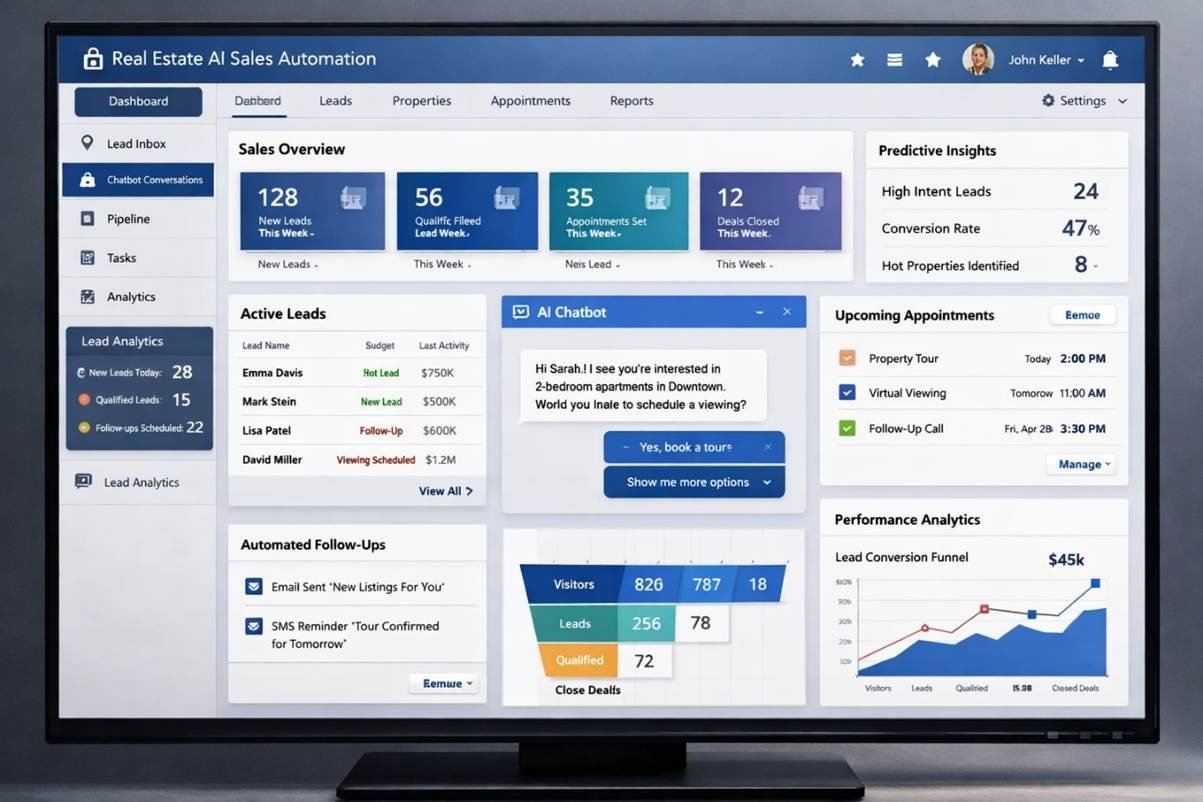
An AI sales automation system in real estate is an intelligent technology platform designed to automate and optimize sales activities using artificial intelligence, data analysis, and workflow automation. Instead of relying solely on manual input from agents, these systems use AI to capture leads, analyze customer behavior, automate communication, and guide prospects through the sales funnel more efficiently. For property management firms, developers, and real estate agencies, this means faster response times, improved lead management, and more consistent engagement with potential buyers or tenants.
A well-developed AI sales automation system includes several interconnected components that work together to streamline sales operations:
Traditional CRM systems primarily function as databases where sales teams manually update lead information, track interactions, and manage pipelines. While CRMs are essential for organizing data, they typically require significant manual effort.
AI sales automation goes beyond data storage by actively performing tasks. It can qualify leads automatically, initiate conversations, recommend properties, and trigger follow-ups without human intervention. Essentially, CRM platforms store information, whereas AI automation systems interpret data and take intelligent actions.
So by adopting AI sales automation, real estate teams can shift from reactive selling to proactive, data-driven decision making that improves efficiency and conversion rates.
Understanding the architecture for AI sales automation system development is essential for real estate companies that want to build scalable and intelligent sales operations. The working of Real Estate AI Sales Automation Systems involves multiple interconnected layers that collect data, process information using artificial intelligence, automate workflows, and deliver insights to sales teams. Unlike traditional systems that depend heavily on manual updates, AI-driven platforms operate continuously by analyzing incoming data and triggering automated actions based on predefined rules and machine learning models.
At a technical level, developing an AI sales automation software for real estate requires a structured workflow that begins with data capture and ends with actionable insights and agent support. Data sources typically include property websites, paid advertising campaigns, WhatsApp and messaging platforms, listing portals, CRM databases, and social media channels. Once data enters the system, it moves through AI processing layers that analyze user intent, engagement patterns, and behavioral signals. Automation logic then determines what action should be taken, such as sending follow-ups, assigning leads, or scheduling appointments.
CRM integration ensures that all interactions are synchronized with existing sales pipelines, while the agent interaction layer allows real estate teams to monitor, adjust, and optimize automated workflows. This structured architecture enables seamless AI workflow automation development for property sales and provides a clear understanding of how AI sales automation works in real estate environments.
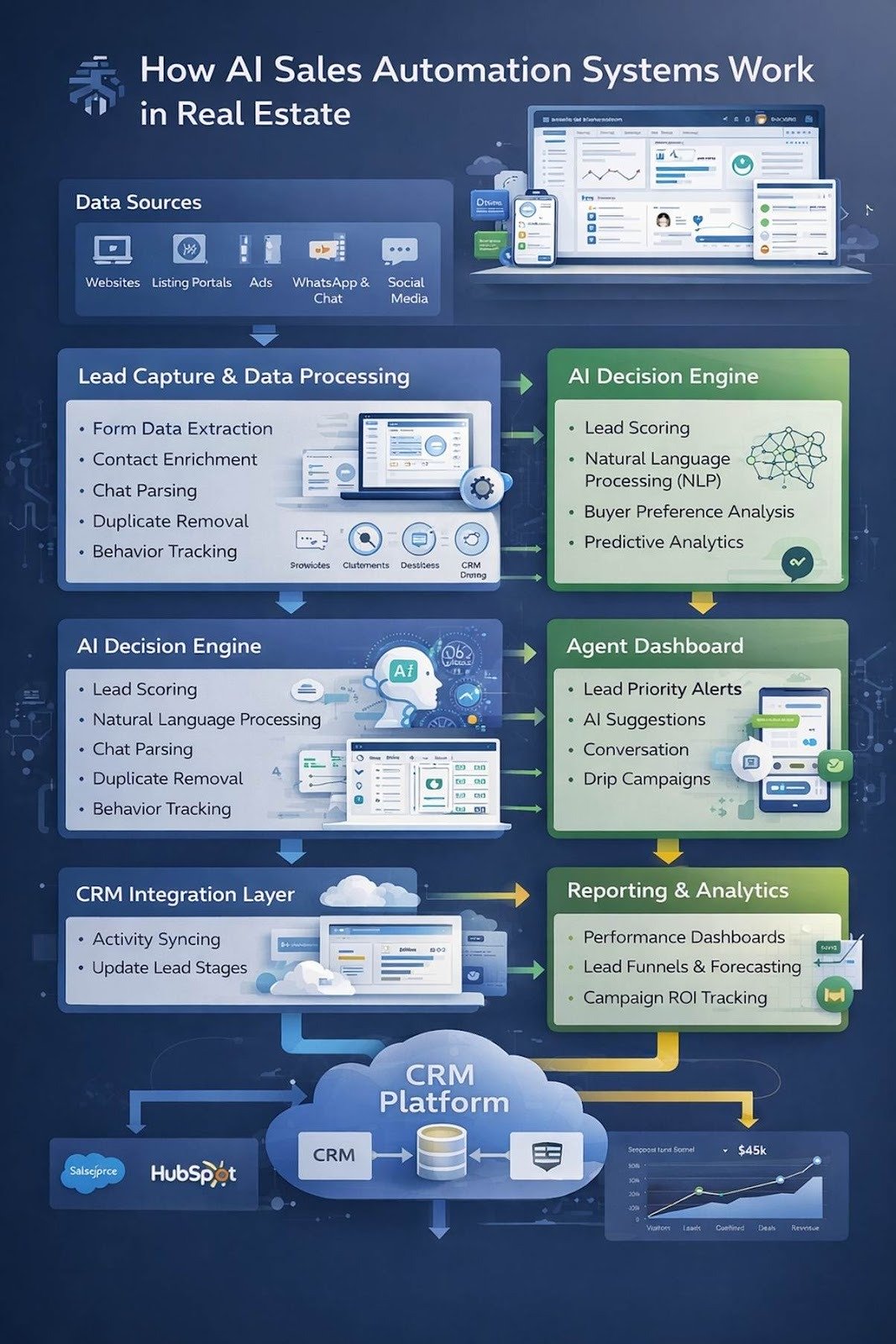
The first stage of AI sales automation involves collecting and organizing data from multiple channels. Real estate companies receive inquiries from website forms, property portals, paid ads, social media campaigns, and messaging apps like WhatsApp. AI systems automatically capture this information, normalize data formats, and store it in centralized databases.
Advanced lead capture mechanisms can include chatbot conversations, voice inputs, and behavior tracking such as page visits or property views. AI processing then categorizes leads based on interest level, property type, and buying intent, creating a structured dataset for further automation.
The AI decision engine is the core intelligence layer responsible for analyzing data and determining next actions. Using machine learning algorithms and predefined automation rules, this component evaluates lead quality, predicts conversion probability, and prioritizes prospects.
For example, high-intent leads may automatically receive personalized property recommendations or be assigned to specific agents based on expertise or location. Over time, the AI model learns from user behavior and historical outcomes, improving accuracy and decision-making efficiency.
Once decisions are made, the automation system executes communication workflows. These may include automated emails, SMS messages, chatbot responses, WhatsApp follow-ups, or reminders for property viewings. The goal is to maintain continuous engagement without requiring manual intervention from agents.
Automation sequences can be personalized using customer data, ensuring relevant messaging based on preferences, budget, and browsing history. This level of AI workflow automation development for property sales helps ensure that no lead is neglected and improves overall customer experience.
The final layer focuses on tracking performance and generating insights. AI-powered analytics dashboards provide real estate companies with detailed reports on lead sources, conversion rates, engagement metrics, and campaign effectiveness.
Predictive analytics can identify trends, forecast sales outcomes, and highlight areas for optimization. Agents and managers use these insights to refine strategies, adjust automation workflows, and make data-driven decisions that improve efficiency and revenue growth.
Together, these layers form the technical foundation behind developing an AI sales automation software for real estate, enabling businesses to build scalable systems that streamline operations and enhance the entire sales lifecycle.
Also Read: A Guide to Real Estate AI Software Development
The adoption of AI sales automation systems is no longer driven by hype. It is now backed by strong market data, competitive pressure, and measurable productivity improvements. In 2026, real estate companies that invest in developing an AI sales automation software for real estate are positioning themselves for long-term growth, operational efficiency, and faster response to changing buyer behavior.
Below are the actual reasons supported by current market trends and statistics.
AI adoption has accelerated significantly across industries, including real estate. According to recent research, 78% of organizations now use AI in at least one business function, showing how quickly automation is becoming a standard operational tool.
In real estate specifically, surveys show increasing adoption levels, with many firms actively piloting or implementing AI systems to improve workflows and decision-making processes.
This trend indicates that AI automation is shifting from experimentation to mainstream adoption, making early implementation a competitive advantage.
Market projections clearly demonstrate that AI is reshaping the real estate sector at scale. Research shows:
This level of investment and innovation signals that AI-powered sales automation will soon become a baseline capability rather than a differentiator.
Real estate companies adopting AI technologies are seeing measurable performance improvements:
Automation reduces repetitive administrative work, enabling agents and property managers to focus on strategic activities such as negotiation and relationship building.
Modern real estate marketing generates high volumes of digital inquiries from websites, social media, and listing portals. Manual handling is no longer scalable. AI automation helps businesses respond instantly, maintain consistent engagement, and prevent lost opportunities caused by delayed follow-ups. As competition increases, companies without automated systems risk falling behind in responsiveness and customer experience.
AI is actively reshaping the competitive landscape. Major real estate platforms are already integrating advanced AI features to enhance workflows and improve user experiences, indicating that automation is becoming a strategic necessity rather than an optional upgrade.
Businesses that delay adoption may struggle to match the efficiency and speed achieved by AI-enabled competitors.
The future of real estate sales is moving toward intelligent, data-driven ecosystems. Emerging enterprise predictions suggest that a significant percentage of applications will include AI-powered automation capabilities within the next few years.
This evolution means that adopting AI sales automation today helps organizations build scalable infrastructure capable of adapting to future innovations such as autonomous AI agents and predictive decision systems.
So, adopting AI sales automation is not simply about innovation. It is about staying competitive in an industry where data, speed, and intelligent automation increasingly define success. Businesses that invest in AI-driven sales architecture now are better positioned to scale efficiently, respond faster to market demands, and build sustainable competitive advantages.
AI sales automation is transforming how real estate organizations manage customer interactions, nurture leads, and optimize their sales funnels. As digital channels generate increasing inquiry volumes, businesses are moving toward building AI-powered real estate sales workflows that reduce manual work while improving conversion efficiency. Through custom AI real estate automation development, companies can implement intelligent systems tailored to specific operational needs and business models.
Below are some of the most impactful use cases where AI automation platform development for property companies delivers measurable business value.
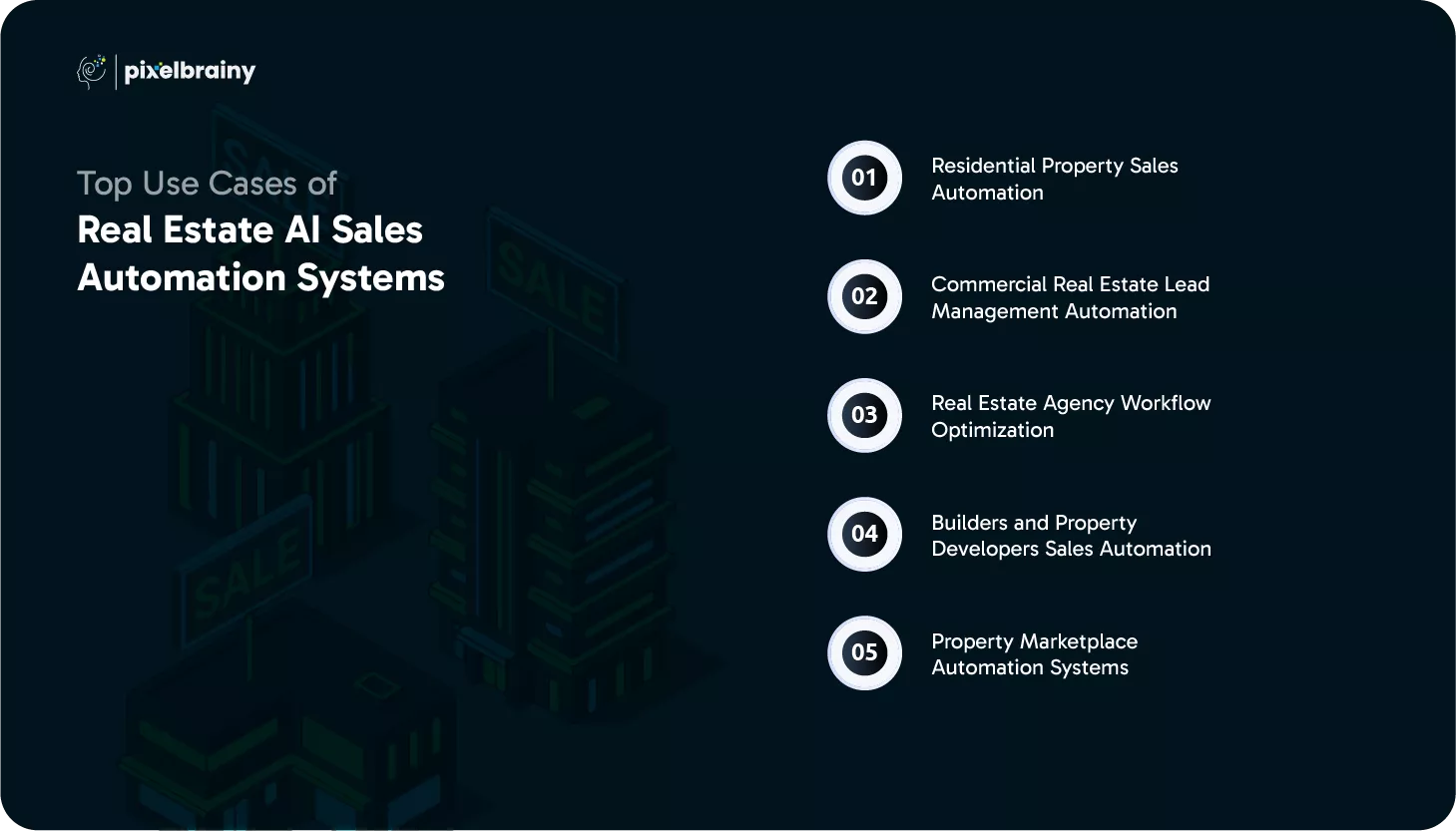
Residential property sales involve handling large numbers of inquiries from potential buyers across websites, listing portals, and advertising platforms. Managing these interactions manually can slow response times and reduce engagement quality. By choosing to build AI real estate sales automation software for real estate, companies can automatically capture leads, qualify prospects, and personalize communication at scale.
AI-powered workflows analyze user behavior such as property views, budget preferences, and location interests to deliver relevant recommendations. This ensures buyers receive accurate property suggestions without waiting for manual follow-ups from agents. Automated chatbots and messaging systems also help answer common questions instantly, improving customer experience during the early stages of the buying journey.
Additionally, AI systems can streamline scheduling by automatically booking property tours and sending reminders. Predictive analytics helps agents prioritize high-intent buyers, allowing teams to focus on closing deals rather than repetitive administrative tasks. As a result, residential sales teams achieve higher productivity and more efficient pipeline management.
Commercial real estate requires managing complex deals involving multiple stakeholders, longer decision cycles, and detailed property requirements. AI automation platform development for property companies allows commercial firms to create structured workflows that manage these complexities efficiently.
AI systems collect and analyze data from multiple communication channels to identify serious investors and decision-makers. Through intelligent lead scoring, companies can automatically prioritize prospects based on engagement level, investment potential, and inquiry patterns. This helps teams allocate resources effectively and avoid spending excessive time on low-priority leads.
Automation also ensures consistent communication throughout long sales cycles. AI-driven follow-up systems maintain engagement by delivering relevant information such as property updates, market insights, or investment opportunities. By building AI-powered real estate sales workflows, commercial firms gain greater visibility into pipeline progress while improving collaboration between sales, marketing, and investment teams.
Real estate agencies operate in fast-paced environments where agents must manage multiple clients, listings, and communication channels simultaneously. Custom AI real estate automation development helps agencies create centralized systems that automate routine tasks and improve operational efficiency.
AI tools can automatically assign leads to agents based on specialization, location, or availability, ensuring faster responses and better customer matching. Automated follow-up sequences maintain continuous engagement with prospects, reducing the risk of missed opportunities. Agencies that build AI real estate sales automation software for real estate can also track interactions and performance metrics in real time.
Another key benefit is improved collaboration. AI dashboards provide insights into agent performance, lead status, and conversion trends, enabling managers to make data-driven decisions. By developing structured automation workflows, agencies can scale operations without increasing manual workload, allowing teams to focus more on relationship building and closing deals.
Builders and property developers face unique challenges when managing large-scale projects, pre-launch campaigns, and investor communications. AI automation platform development for property companies enables developers to manage these processes with greater precision and efficiency.
AI systems automatically capture leads from multiple marketing campaigns and segment audiences based on behavior, demographics, and investment interest. This allows developers to deliver targeted messaging tailored to different buyer profiles. Automated workflows also support nurturing campaigns that maintain engagement throughout long project timelines.
Developers benefit from predictive analytics that identifies potential buyers likely to convert, helping sales teams prioritize efforts strategically. Building AI-powered real estate sales workflows ensures consistent communication during project launches and improves overall sales coordination between marketing and sales departments.
Property marketplaces operate at scale, managing thousands of listings and user interactions daily. Developing AI-driven automation solutions allows marketplaces to enhance user experiences while maintaining operational efficiency.
AI systems analyze browsing behavior, search patterns, and engagement signals to provide personalized property recommendations. Automated chat interfaces handle inquiries instantly, reducing response delays and improving user satisfaction. Marketplaces that build AI real estate sales automation software for real estate can also automate moderation, lead routing, and listing optimization processes.
Furthermore, AI-powered analytics helps marketplaces understand market demand trends, enabling smarter pricing strategies and better property matching. Building AI-powered real estate sales workflows ensures that buyers and sellers connect more efficiently, increasing transaction success rates while reducing manual management overhead.
So by implementing AI automation across different real estate sectors, businesses can build intelligent sales ecosystems that streamline workflows, improve lead engagement, and support scalable growth in an increasingly competitive market.

Developing a successful AI sales automation system requires more than basic automation tools. Real estate companies must focus on building intelligent platforms that combine data analysis, automation workflows, and user-friendly interfaces. When building AI lead management system for real estate agents, businesses should prioritize features that improve lead handling, communication efficiency, and decision-making accuracy while enabling scalable growth.
Below are the essential features required when developing AI chatbot automation for real estate sales and understanding how to build AI sales funnels for property companies.
| Feature | Explanation |
| Automated Lead Capture | Automated lead capture collects inquiries from websites, ads, listing portals, and messaging channels without manual entry. This feature ensures that no potential buyer is missed and forms the foundation of building AI lead management system for real estate agents by organizing data in real time. |
| AI Lead Scoring | AI lead scoring analyzes user behavior, engagement patterns, and demographic data to prioritize high-quality prospects. This helps sales teams focus on leads with higher conversion potential and improves overall pipeline efficiency. |
| Conversational AI Chatbot | Developing AI chatbot automation for real estate sales enables instant responses to inquiries through natural language interactions. Chatbots collect user information, answer questions, and guide prospects through early stages of the sales funnel automatically. |
| Smart Follow-Up Automation | Automated follow-ups maintain continuous engagement by sending personalized messages based on user actions. AI determines the best timing and communication channels to nurture leads effectively without manual intervention. |
| Property Recommendation Engine | AI-powered recommendation engines analyze buyer preferences and browsing behavior to suggest relevant properties. This enhances customer experience while helping agents deliver personalized options efficiently. |
| CRM Integration | CRM integration synchronizes automation workflows with existing customer databases. This ensures consistent lead tracking, automatic status updates, and seamless collaboration between AI systems and sales teams. |
| Multi-Channel Communication | AI automation platforms unify communication across email, chat, social media, and messaging apps like WhatsApp. This allows agents to manage conversations from a centralized dashboard while maintaining consistent messaging. |
| Appointment Scheduling Automation | Automated scheduling allows prospects to book property visits based on real-time agent availability. Reminders and confirmations reduce scheduling conflicts and improve operational efficiency. |
| Predictive Analytics | Predictive analytics uses historical data and behavioral insights to forecast lead conversion probability. Real estate teams can prioritize outreach strategies and make data-driven decisions for better results. |
| Sales Funnel Automation | Understanding how to build AI sales funnels for property companies involves automating each stage of the buyer journey. AI systems guide leads through awareness, consideration, and decision phases with personalized actions. |
| Workflow Automation Builder | A customizable workflow builder allows companies to create automation rules tailored to their business processes. This flexibility helps real estate firms adapt AI automation to different operational models. |
| Agent Performance Dashboard | AI-powered dashboards provide real-time insights into lead activity, conversion rates, and sales performance. Managers can track productivity and optimize strategies based on actionable data. |
| Personalization Engine | Personalization engines analyze customer behavior to deliver tailored communication and property recommendations. This increases engagement levels and enhances the overall customer journey. |
| Reporting and Analytics | Advanced reporting tools track campaign performance, lead sources, and funnel efficiency. Visualization dashboards help teams understand data trends and optimize marketing and sales strategies. |
| AI Training and Continuous Learning | AI systems improve over time by learning from new interactions and feedback. Continuous learning ensures that automation workflows, lead scoring, and recommendations become more accurate and effective. |
So by integrating these core features into AI automation platform development for property companies, businesses can build scalable systems that streamline operations and enhance real estate sales performance.
For property management firms, real estate agencies, developers, and technology-driven brokerage businesses, building a structured automation system requires careful planning and execution.
Successful AI sales automation development for real estate depends on aligning technology with real-world sales workflows rather than simply adding automation tools.
The following process outlines practical steps to help organizations understand how to make AI-based sales automation for real estate business environments while ensuring scalability and efficiency.
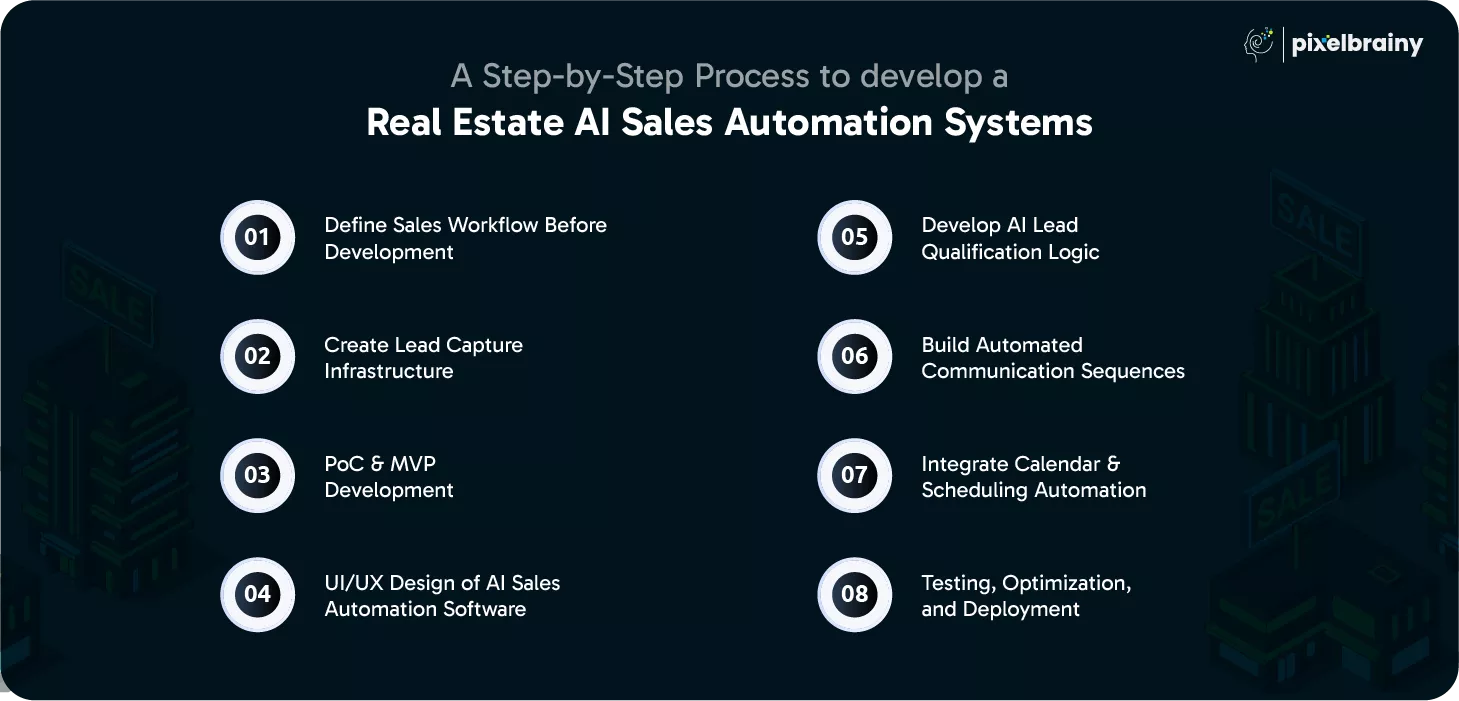
Aim/Goal: The main goal is to create a clear blueprint that guides development decisions and ensures automation enhances existing workflows instead of disrupting them.
Before starting development, companies must clearly define their existing sales processes. This involves mapping every stage of the customer journey, from initial inquiry and lead qualification to property visits and deal closure. Understanding where delays occur or where agents spend excessive manual effort helps identify automation opportunities.
Businesses should analyze how leads enter the system, how agents communicate with prospects, and what data is currently tracked. This stage ensures that developing AI sales systems for real estate aligns with operational realities rather than theoretical assumptions. Stakeholders from sales, marketing, and operations teams should collaborate to identify pain points and define automation priorities.
Aim/Goal: Establish a reliable foundation that ensures all incoming inquiries are captured, organized, and ready for automation workflows without manual intervention.
The next step involves building a robust infrastructure to capture leads from multiple digital touchpoints such as websites, property portals, paid ads, messaging apps, and social platforms. A centralized lead capture system ensures consistent data flow into the automation platform.
Companies should implement forms, chatbot integrations, and tracking scripts that collect relevant customer information while maintaining data accuracy. Proper data structuring is essential for later automation stages like segmentation and predictive analytics for real estate sales. Integration with marketing tools and CRM systems helps maintain continuity across departments.
Aim/Goal: Validate the concept quickly, gather real user feedback, and ensure the system delivers value before scaling to full deployment.
Before full-scale development, organizations often validate ideas through PoC development to test core automation concepts and confirm technical feasibility. A proof of concept allows teams to experiment with AI models, lead scoring mechanisms, or chatbot interactions on a smaller scale.
After validation, MVP Development focuses on building a minimal version of the system that includes essential features required for real-world testing. This phase helps identify usability issues, performance challenges, and integration needs early in the process. Iterative testing ensures resources are invested wisely while reducing long-term risks.
Aim/Goal: Create a seamless and accessible interface that enables teams to interact with automation tools efficiently while improving usability for both internal users and customers.
Designing an intuitive interface is crucial for adoption among agents and administrators. Working with a professional UI/UX design company ensures that dashboards, workflows, and automation controls are easy to understand and operate. Real estate professionals should be able to access lead information, automation settings, and analytics without complex navigation.
User-centered design principles help create interfaces that simplify complex automation tasks. Clear layouts, visual dashboards, and logical workflows improve productivity and reduce training time. Good design also enhances customer-facing interfaces such as chatbots and booking systems, improving overall user experience.
Aim/Goal: Implement intelligent decision-making that reduces manual evaluation while improving lead prioritization and conversion efficiency.
At this stage, developers build the intelligence layer responsible for evaluating and prioritizing leads. Machine learning models analyze customer behavior, engagement patterns, and historical data to determine lead quality. Predictive scoring algorithms help identify high-intent prospects, allowing agents to focus on opportunities with higher conversion potential.
Developers must define rules, data models, and training datasets carefully to ensure accurate predictions. Continuous learning mechanisms enable the AI to improve over time. This step represents a critical part of sales funnel automation development for real estate because it determines how efficiently leads progress through different stages.
Aim/Goal: Ensure every lead receives timely, personalized communication that nurtures engagement and moves prospects toward conversion.
Automation workflows should include personalized communication sequences tailored to customer behavior. These sequences may involve email campaigns, chatbot interactions, SMS reminders, or messaging platform notifications. AI systems determine optimal timing and messaging based on user engagement patterns.
By automating repetitive communication tasks, companies maintain consistent engagement with prospects without overwhelming sales teams. Personalization is key to ensuring messages remain relevant and valuable. Businesses working with a company that builds AI automation for real estate sales often focus on creating scalable communication frameworks that adapt to different customer journeys.
Aim/Goal: Streamline appointment management while minimizing administrative workload and improving operational efficiency.
Scheduling property visits, meetings, and follow-ups manually can create bottlenecks in the sales process. Integrating automated calendar systems allows prospects to book appointments based on agent availability in real time. AI Integration Solutions help synchronize scheduling tools with CRM systems and communication platforms.
Automation reduces coordination efforts by sending reminders, updating calendars automatically, and preventing scheduling conflicts. Real estate companies can also track appointment outcomes and adjust workflows accordingly. Efficient scheduling improves customer experience by reducing delays and ensuring smooth coordination.
Aim/Goal: Deploy a stable, high-performing automation system that delivers measurable results while remaining flexible for future enhancements.
The final stage involves rigorous testing to ensure system reliability, performance, and user satisfaction. Developers must test automation workflows, AI predictions, integrations, and user interfaces under real-world conditions. Feedback from agents and stakeholders helps identify areas for improvement.
Optimization includes refining automation rules, improving AI accuracy, and enhancing user experience. Continuous monitoring ensures that the system evolves with changing business needs. Many organizations consult Top AI development companies in USA or Top AI real estate software development companies in USA during this phase to ensure enterprise-level scalability and performance standards.
So, by following these structured steps to build AI automation for real estate sales, businesses can develop scalable, intelligent systems that streamline workflows, enhance lead management, and create a more efficient and data-driven sales process.
Also Read: How to Develop an AI Real Estate App for Realtors and Startups?
Understanding the financial investment required is essential before starting custom AI real estate sales automation development. The cost to develop AI sales automation system for real estate varies depending on system complexity, features, integrations, and scalability requirements. Businesses often ask, “How much will it cost to create a Real Estate AI Sales Automation System?” The answer depends on whether the goal is a basic automation platform or an enterprise-grade intelligent system.
On average, the cost of building an AI sales automation software for property management firms ranges between $30,000 to $300,000+. Smaller implementations may focus on core automation features, while advanced platforms include predictive analytics, AI-driven workflows, and complex integrations. The development budget of AI sales automation system for real estate company projects must consider long-term scalability, maintenance, and performance optimization.
| System Type | Estimated Cost Range | What You Will Get |
| Basic Real Estate AI Sales Automation System | $30,000 – $70,000 | Core automation features such as automated lead capture, simple AI chatbot, CRM integration, basic follow-up automation, and centralized dashboard for managing inquiries. Suitable for small agencies or property managers starting with automation. |
| Medium Real Estate AI Sales Automation System | $70,000 – $150,000 | Advanced workflows including AI lead scoring, personalized communication automation, multi-channel messaging integration, appointment scheduling automation, improved analytics dashboards, and scalable architecture for growing businesses. |
| Advanced Real Estate AI Sales Automation System | $150,000 – $300,000+ | Enterprise-level features such as predictive analytics, advanced AI decision engines, complex integrations, custom dashboards, automation workflows tailored to business needs, performance optimization, and scalable infrastructure for large real estate organizations. |
One of the biggest cost drivers is the level of customization required. Basic systems with standard automation workflows cost less compared to fully customized platforms designed around unique business processes. Adding features like AI lead scoring, dynamic property recommendations, or advanced analytics increases development time and overall investment.
Estimated impact: Custom feature development can add $10,000 to $80,000+ depending on complexity.
Developing machine learning models for predictive analytics for real estate sales requires data preparation, training, testing, and optimization. If companies need highly accurate prediction models or personalized recommendation engines, development costs increase significantly.
Estimated impact: AI model training and implementation can range between $15,000 to $60,000+.
Integrating with CRM systems, property portals, communication platforms, or marketing tools adds to development complexity. API integrations require careful configuration and testing to ensure smooth data flow.
Estimated impact: Integration costs typically range from $5,000 to $40,000 depending on the number of platforms.
A well-designed interface ensures high adoption rates among agents and administrators. Advanced dashboards and intuitive workflows require dedicated design and frontend development efforts.
Estimated impact: Design and frontend development may add $8,000 to $30,000.
Cloud hosting, database management, AI processing infrastructure, and security implementation contribute to ongoing costs. Scalable systems designed for high traffic and large datasets require more robust infrastructure.
Estimated impact: Initial setup may cost $5,000 to $20,000, with ongoing operational expenses.
The experience level of developers and agencies significantly influences pricing. Working with specialized teams experienced in AI automation development ensures better quality but may involve higher upfront investment.
Estimated impact: Development rates vary widely, typically $50 to $200 per hour depending on expertise and region.
So, by carefully planning the development budget and prioritizing scalable features, real estate companies can build cost-effective AI sales automation systems that deliver long-term value and measurable business impact.
Also Read: AI Real Estate App Development Cost: Factors and Examples
Building an intelligent automation platform requires selecting the right combination of AI models, development frameworks, and integration tools. Real estate companies focusing on scalable automation must choose technologies that support data processing, communication automation, and predictive decision-making.
The success of developing AI sales automation software depends on using reliable tools that enhance performance, flexibility, and long-term scalability.
| Category | Tools / Technologies | Explanation |
| AI Language Models | OpenAI, Anthropic, Google AI | AI language models power conversational chatbots, automated responses, and natural language understanding. These tools help systems interpret customer inquiries, provide personalized answers, and automate lead interactions. |
| Machine Learning Frameworks | TensorFlow, PyTorch, Scikit-learn | These frameworks are used to build predictive models, lead scoring algorithms, and recommendation engines. Developers train models using historical data to improve decision-making and automate sales processes. |
| Workflow Automation Platforms | Zapier, Make (Integromat), n8n | Automation platforms connect different tools and trigger actions automatically. They allow businesses to create automated workflows without building every integration from scratch. |
| CRM Systems | Salesforce, HubSpot, Zoho CRM | CRM platforms store customer data and manage sales pipelines. Integration with AI automation ensures real-time updates, centralized communication tracking, and improved lead management. |
| Messaging APIs | WhatsApp API, Twilio, SendGrid | Messaging APIs enable automated communication across SMS, email, and messaging apps. These tools help maintain consistent engagement with leads through automated follow-ups and notifications. |
| Cloud Infrastructure | AWS, Microsoft Azure, Google Cloud | Cloud platforms provide scalable infrastructure for hosting AI models, databases, and automation workflows. They ensure reliability, performance, and secure data storage. |
| Data Analytics Tools | Power BI, Tableau, Google Analytics | Analytics platforms visualize performance metrics and help businesses understand user behavior, lead sources, and conversion trends. Data-driven insights support optimization strategies. |
| Backend Development Frameworks | Node.js, Django, FastAPI | Backend frameworks handle server-side logic, API integrations, and data processing. They form the foundation for building scalable automation systems. |
| Frontend Technologies | React, Angular, Vue.js | Frontend frameworks enable intuitive dashboards and user interfaces that allow agents to manage leads, monitor automation workflows, and track performance easily. |
| Database Technologies | PostgreSQL, MongoDB, MySQL | Databases store structured and unstructured data such as lead details, communication history, and analytics results. Reliable database systems ensure fast access and data integrity. |
| AI Chatbot Platforms | Dialogflow, Rasa, Botpress | Chatbot frameworks help developers build conversational interfaces for real estate automation. They allow natural interactions and automate customer support processes. |
| Scheduling and Calendar APIs | Google Calendar API, Calendly API | Scheduling tools automate appointment booking and availability management. Integration ensures seamless coordination between agents and customers. |
Therefore, by combining the right AI technologies, automation tools, and scalable infrastructure, real estate companies can develop powerful sales automation systems that streamline workflows and enhance operational efficiency.

Also Read: AI Real Estate Website Development: Features and Steps
Developing an AI sales automation system for real estate offers powerful advantages, but the process comes with several technical, operational, and organizational challenges. Businesses often underestimate the complexity involved in integrating AI into existing workflows, managing data effectively, and ensuring user adoption. Understanding these challenges early helps companies avoid costly mistakes and build systems that deliver long-term value. Below are the most common issues faced during development along with practical solutions that support successful implementation.
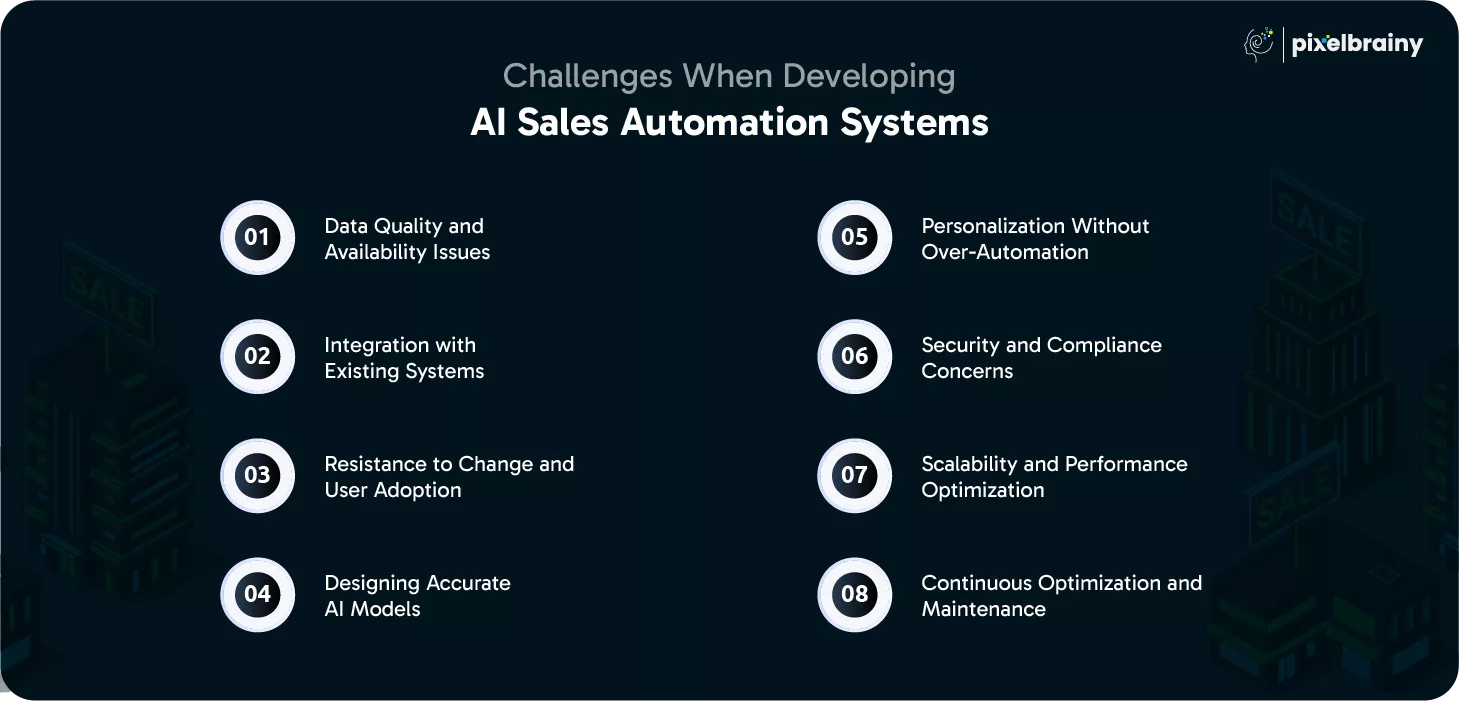
AI systems rely heavily on high-quality data to deliver accurate insights and automation decisions. However, real estate companies typically collect data from multiple sources such as property portals, CRM platforms, website forms, social media campaigns, and messaging applications. This data is often inconsistent, incomplete, or stored in different formats, which creates challenges when training AI models or building automation workflows.
Poor data quality can result in inaccurate lead scoring, irrelevant property recommendations, or ineffective automation sequences. Without structured data, even advanced AI algorithms may fail to deliver expected results.
Solution: Implement centralized data management systems that standardize information before processing. Use automated validation rules to remove duplicates and incomplete records. Establish clear data governance policies and regularly clean datasets to ensure consistency and reliability for AI-driven processes.
Most real estate organizations already use multiple software tools such as CRM platforms, marketing automation systems, scheduling tools, and property listing databases. Integrating AI automation with these existing tools can be complex, especially when legacy systems lack modern APIs or standardized communication protocols.
Poor integration planning may lead to data silos, workflow interruptions, and inconsistent reporting, which reduces the effectiveness of automation.
Solution: Adopt an API-first development approach and build modular architectures that allow seamless integration between systems. Middleware solutions can help bridge gaps between older tools and new AI platforms. Early technical planning and testing ensure smoother implementation and reduce future maintenance challenges.
Introducing AI automation often changes how sales teams and property managers perform daily tasks. Some employees may resist adoption due to fear of job displacement or concerns about learning new technologies. If users do not trust or understand the system, adoption rates decline and expected efficiency gains may not be realized.
Solution: Focus on user-centric design and involve end-users during development stages. Provide comprehensive training programs that highlight how AI enhances productivity rather than replacing human expertise. Gradual implementation strategies allow teams to adapt comfortably while building confidence in automation tools.
Creating effective AI models requires careful planning, proper training data, and continuous refinement. Real estate markets vary by region, property type, and buyer behavior, which makes developing universally accurate models challenging. Inaccurate lead scoring or poorly trained chatbots can negatively impact customer experience.
Solution: Begin with rule-based automation and gradually introduce machine learning models. Use real-world data from actual sales processes and incorporate feedback loops where agents can correct AI decisions. Continuous monitoring and retraining improve accuracy and ensure models adapt to changing market conditions.
Automation can streamline communication, but excessive automation may make interactions feel robotic or impersonal. Real estate transactions involve trust and emotional decision-making, so maintaining a human touch is critical.
Solution: Adopt hybrid workflows where AI manages repetitive tasks such as scheduling or initial inquiries, while human agents handle complex conversations and negotiations. Personalization engines should analyze customer behavior to deliver meaningful and context-aware communication rather than generic automated messages.
AI automation systems handle sensitive customer data including contact details, financial information, and transaction history. This raises security and regulatory concerns, especially when dealing with regional data protection laws.
Solution: Implement robust encryption protocols, secure authentication systems, and role-based access control. Ensure compliance with relevant privacy regulations and conduct regular security audits to identify vulnerabilities. Transparent data handling practices also build customer trust.
As real estate businesses grow, automation systems must handle increasing volumes of inquiries and data processing tasks. Systems that are not designed for scalability may experience slow performance or downtime, impacting customer experience and operational efficiency.
Solution: Use cloud-based infrastructure and scalable architectures such as microservices to handle increasing workloads efficiently. Performance monitoring tools should track system health and automatically adjust resources during peak usage periods.
AI automation is not a one-time implementation. Customer behavior, market trends, and business strategies evolve continuously, requiring ongoing updates and optimization. Without regular maintenance, automation workflows may become outdated or less effective over time.
Solution: Establish continuous improvement processes that include performance tracking, analytics review, and periodic workflow updates. Collect feedback from sales teams and customers to refine automation strategies and ensure long-term effectiveness.
So by proactively addressing these challenges with strategic planning and scalable solutions, real estate companies can successfully develop AI sales automation systems that deliver reliable performance, strong adoption, and long-term business growth.
Also Read: How Much Does it Cost to Build an AI Real Estate Website
Before investing time and resources into developing an AI sales automation platform, real estate companies must understand that technology alone does not guarantee success. High-performance systems are built on strong strategy, structured workflows, and continuous optimization. By following proven best practices, organizations can ensure their automation solutions deliver measurable results while supporting long-term scalability and efficient sales operations.
A high-performance AI system should be built around the complete buyer or tenant journey rather than isolated automation features. Understanding how prospects move from initial inquiry to final decision allows businesses to create automation workflows that feel natural and effective. This ensures the system enhances customer experience while supporting agents throughout each stage of the sales process.
Key practices:
Automation works best when it complements human expertise instead of replacing it. Real estate sales require relationship building, negotiation skills, and emotional intelligence, which AI alone cannot fully replicate. A balanced approach ensures AI handles repetitive tasks while agents focus on high-value interactions.
Key practices:
High-quality data is the foundation of effective AI automation. Without accurate and structured data, predictive models and automation workflows cannot perform reliably. Real estate companies should prioritize data governance and analytics strategies to ensure the system delivers meaningful insights.
Key practices:
A scalable architecture ensures the automation system can grow alongside the business. Real estate companies often expand into new markets or increase marketing efforts, which requires systems capable of handling higher volumes without performance issues. Modular design allows new features to be added without rebuilding the entire platform.
Key practices:
AI sales automation is an evolving process that requires ongoing improvement. Regular testing ensures workflows remain effective as market conditions and customer expectations change. Continuous monitoring helps identify inefficiencies, allowing businesses to refine automation strategies over time.
Key practices:
So, by following these best practices, real estate companies can build high-performance AI sales automation systems that improve efficiency, enhance customer experience, and support sustainable growth.
The future of real estate sales is being shaped by rapid advancements in artificial intelligence, automation frameworks, and data-driven decision systems. As technology evolves, AI sales automation will move beyond simple workflow automation toward intelligent systems capable of understanding customer intent, predicting behavior, and executing complex sales processes independently. Real estate companies that adopt these emerging trends early will gain a competitive advantage by improving efficiency, personalization, and scalability.
Below are the key future trends expected to redefine AI sales automation development for real estate.
Voice AI agents are becoming an important component of modern automation platforms. Instead of relying only on chat-based interfaces, businesses will increasingly use AI-powered voice assistants that can answer property inquiries, qualify leads, and schedule appointments through natural conversations.
These voice agents use advanced speech recognition and natural language processing to provide human-like interactions. For real estate companies, this means potential buyers can call or speak to AI systems that understand context, respond intelligently, and guide them through initial stages of the sales funnel. Voice automation reduces workload on sales teams while offering instant responses to customers at any time.
As voice technology improves, it will enable seamless multi-language communication and more natural conversational experiences, helping companies expand reach across diverse customer segments.
Predictive buyer matching is expected to become more sophisticated through advanced machine learning algorithms. Instead of simply filtering listings based on user input, AI will analyze behavioral patterns, browsing history, financial signals, and engagement trends to predict which properties a buyer is most likely to consider.
This approach enables highly accurate property recommendations, reducing search friction for customers while improving conversion rates for businesses. Predictive matching also helps sales teams prioritize leads by identifying buyers who are close to making purchasing decisions.
Future AI models may integrate real-time market data, pricing trends, and geographic insights to recommend properties proactively, allowing real estate companies to anticipate customer needs rather than react to them.
Traditional marketing automation often relies on generalized messaging. Future AI systems will focus on hyper-personalization, where communication is tailored to individual preferences, behaviors, and timing patterns.
AI will analyze data such as browsing habits, property interests, communication history, and engagement frequency to craft highly relevant messages. For example, automation systems may send personalized property updates, investment insights, or reminders based on specific customer behavior.
Hyper-personalized outreach improves engagement by making interactions feel more relevant and timely. Real estate companies using advanced personalization strategies will be able to nurture relationships more effectively and increase trust with potential buyers.
One of the most transformative trends is the emergence of autonomous AI sales agents capable of handling entire segments of the sales process independently. These systems will not only automate communication but also analyze data, make decisions, and execute tasks with minimal human supervision.
Autonomous AI agents may manage lead qualification, schedule property visits, follow up with prospects, recommend next actions to human agents, and continuously optimize workflows based on performance metrics. By learning from past interactions, these agents become more effective over time.
While human oversight will remain essential, autonomous systems will significantly reduce manual workload and enable real estate companies to operate at greater scale without proportionally increasing staff size.
So as AI continues to evolve, these future trends will reshape how real estate companies build intelligent automation systems that deliver faster responses, deeper personalization, and more efficient sales operations.Top of Form
Property management firms, real estate brokers, agencies, and developers are increasingly looking for intelligent systems that can manage high volumes of inquiries while improving conversion efficiency. PixelBrainy LLC focuses on custom AI development for real estate sales automation designed to align with real-world workflows and operational requirements. Instead of generic automation tools, their solutions are tailored to business-specific needs, enabling companies to streamline communication, automate repetitive tasks, and enhance customer engagement across the sales funnel.
As a Real Estate AI Software development company in USA, PixelBrainy LLC helps organizations implement scalable platforms by building intelligent real estate CRM automation with AI. These systems centralize lead data, automate follow-ups, and provide actionable insights that support data-driven decision-making. Through structured AI lead automation system development, property management teams and brokers gain tools that improve efficiency without sacrificing personalization.
The company also enables businesses to develop AI-powered real estate marketing and sales automation by integrating predictive analytics, automation workflows, and conversational AI technologies into unified platforms. As an experienced AI development company for real estate automation systems, PixelBrainy LLC delivers AI Solutions of Automation System for real estate that support growth, improve response times, and create measurable operational improvements.
Objective: A USA-based property management firm needed an advanced automation system to manage increasing tenant inquiries, leasing requests, and buyer leads efficiently. The goal was to improve response speed, reduce manual workload for brokers, and create a structured sales pipeline that supported scalable growth.
Challenges:
Solution: PixelBrainy LLC developed a customized AI automation platform that included conversational AI chatbots for handling initial inquiries, automated lead scoring for prioritizing prospects, and integrated scheduling automation for property tours. The system connected seamlessly with the existing CRM, enabling centralized management of leads and communication workflows.
Results:
So, by leveraging specialized AI expertise and real estate-focused development strategies, PixelBrainy LLC helps businesses build intelligent automation systems that transform sales workflows and support scalable success.

AI sales automation is transforming the way property management firms, real estate brokers, agencies, and developers manage their sales processes and customer interactions. As digital inquiries continue to grow, manual workflows are no longer sufficient to maintain efficiency or competitive advantage.
Developing intelligent automation systems enables real estate businesses to streamline lead capture, automate communication, improve lead qualification, and make data-driven decisions that enhance overall performance. From building structured workflows and implementing predictive analytics to creating personalized customer experiences, AI-driven solutions help organizations scale operations without increasing operational complexity.
Businesses that invest in advanced automation today position themselves to adapt faster to evolving market trends and customer expectations. By integrating intelligent tools into daily operations, real estate teams can focus more on strategic activities such as relationship building and closing deals, while automation handles repetitive processes behind the scenes.
Ready to transform your real estate sales operations? Book an appointment today to explore tailored AI automation solutions designed for your business goals.
An AI sales automation system is a technology platform that uses artificial intelligence to automate repetitive sales tasks such as lead capture, qualification, follow-ups, scheduling, and analytics. It helps real estate companies streamline workflows, improve response times, and manage large volumes of inquiries efficiently.
AI automation analyzes lead behavior, engagement patterns, and customer data to prioritize high-intent prospects. Automated workflows ensure consistent follow-ups and personalized communication, allowing agents to focus on closing deals rather than manual administrative tasks.
Development timelines vary based on complexity and features. A basic system may take 6 to 10 weeks, while advanced platforms with predictive analytics, custom workflows, and integrations can take 3 to 6 months or more depending on project scope.
The cost typically ranges between $30,000 and $300,000+ depending on customization level, AI capabilities, integrations, and scalability requirements. Basic automation solutions are more affordable, while enterprise-grade systems require higher investment.
No. AI automation is designed to support agents rather than replace them. It handles repetitive tasks such as answering common inquiries or scheduling appointments, allowing agents to focus on relationship building, negotiation, and closing deals.
Common technologies include AI language models, machine learning frameworks, workflow automation tools, CRM integrations, cloud infrastructure, messaging APIs, and data analytics platforms. These tools work together to create intelligent and scalable automation systems.
AI automation can be tailored to businesses of all sizes. Small agencies and property managers can start with basic automation features and gradually scale up as their needs grow, making it a flexible solution for both startups and large real estate organizations.

About The Author
Sagar Bhatnagar
Sagar Sahay Bhatnagar brings over a decade of IT industry experience to his role as Marketing Head at PixelBrainy. He's known for his knack in devising creative marketing strategies that boost brand visibility and market influence. Sagar's strategic thinking, coupled with his innovative vision and focus on results, sets him apart. His track record of successful campaigns proves his ability to utilize digital platforms effectively for impactful marketing efforts. With a genuine passion for both technology and marketing, Sagar continuously pushes PixelBrainy's marketing initiatives to greater success.

Working with the PixelBrainy team has been a highly positive experience. They understand the design requirements and create beautiful UX elements to meet the application needs. The dev team did an excellent job bringing my vision to life. We discussed usability and flow. Sagar worked with his team to design the database and begin coding. Working with Sagar was easy. He has the knowledge to create robust apps, including multi-language support, Google and Apple ID login options, Ad-enabled integrations, Stripe payment processing, and a Web Admin site for maintaining support data. I'm extremely satisfied with the services provided, the quality of the final product, and the professionalism of the entire process. I highly recommend them for Android and iOS Mobile Application Design and Development.

Great experience working with them. Had a lot of feedback and I found that unlike most contractors they were bugging me for updates instead of the other way around. They were extremely time conscience and great at communicating! All work was done extremely high quality and if not on time, early! They were always proactive when it comes to communication and the work is great/above par always. Very flexible and a great team to work with! Goes above and beyond to present us with multiple options and always provides quality. Amazing work per usual with Chitra. If you have UI/UX or branding design needs I recommend you go to them! Will likely work with them in the future as well, definitely recommended!

PixelBrainy is a joy to work with and is a great partner when thinking through branding, logo, and website layout. I appreciate that they spend time going into the "why" behind their decisions to help inform me and others about industry best practices and their expertise.

I hired them to design our software apps. Things I really like about them are excellent communication skills, they answer all project suggestions and collaborate right away, and their input on design and colors is amazing. This project was complex and needed patience and creativity. The team is amazing to do business with. I will be using them long-term. Glad to see there are some good people out there. I was afraid to try and outsource my project to someone but I am glad I met them! I really can't say enough. They went above and beyond on this project. I am very happy with everything they have done to make my business stand out from the competition.

It was great working with PixelBrainy and the team. They were very responsive and really owned the project. We'll definitely work with them again!

I recently worked with the PixelBrainy team on a project and I was blown away by their communication skills. They were prompt, clear, and articulate in all of our interactions. They listened and provided valuable feedback and suggestions to help make the project a success. They also kept me updated throughout the entire process, which made the experience stress-free and enjoyable.

PixelBrainy is very good at what it does. The team also presents themselves very professionally and takes care of their side of things very well. I could fully trust them taking up the design work in a timely and organised manner and their attention to detail saved us lots of effort and time. This particular project was quite intense and the team showed that they function very well under pressure. Very much looking forward to working with her again!

It's always an absolute pleasure working with them. They completed all of my requests quickly and followed every note I had for them to a T, which made our process go smoothly from start to finish. Everything was completed fast and following all of the guidelines. And I would recommend their services to anyone. If you need any design work done in the future, PixelBrainy should be your first call!

They took ownership of our requirements and designed and proposed multiple beautiful variants. The team is self-motivated, requires minimum supervision, committed to see-through designs with quality and delivering them on time. We would definitely love to work with PixelBrainy again when we have any requirements.

PixelBrainy was a big help with our SaaS application. We've been hard at work with a new UI/UX and they provided a lot of help with the designs. If you're looking for assistance with your website, software, or mobile application designs, PixelBrainy and the team is a great recommendation.

PixelBrainy designers are amazing. They are responsive, talented, and always willing to help craft the design until it matches your vision. I would recommend them and plan to continue them for my future projects and more!!!

They were awesome! Did a good job fast, and good communication. Will work with them again. Thank you

Creative, detail-oriented, and talented designers who take direction well and implement changes quickly and accurately. They consistently over-delivered for us.

PixelBrainy team is very talented and creative. Great designers and a pleasure to work with. PixelBrainy is an excellent communicator and I look forward to working with them again.

PixelBrainy has a very talented design team. Their work is excellent and they are very responsive. I enjoy working with them and hope to continue on all of our future projects.


Transform your ideas into reality with us.
Across these industries, each engagement brings unique challenges, from early-stage product development to scaling complex systems, helping us build a practical understanding of real-world product environments.