AI Summary Powered by PixelBrainy
What if your contact center could resolve more than 60% of repetitive customer inquiries without increasing headcount, extending wait times, or compromising customer experience?
For enterprises handling hundreds of thousands of monthly conversations, conversational AI is no longer just a chatbot initiative. It is an operational strategy for reducing support costs, improving response times, automating repetitive workflows, and helping human agents focus on complex customer issues. Choosing the right conversational AI development companies in USA is therefore a business decision that directly affects service quality, operational efficiency, and return on investment.
Consider a contact center that manages 240,000 monthly chats, with agents spending 65% of their time on tier-1 inquiries that AI could potentially resolve. That represents approximately 156,000 conversations requiring careful automation assessment each month. However, the objective should not be to automate every interaction. It should be to identify suitable use cases, implement reliable AI workflows, and measure verified resolution and ticket deflection rates.
This guide examines the capabilities enterprise buyers should look for when comparing conversational AI development services providers USA, from large-scale contact center platforms to specialist engineering firms building custom AI assistants. It also explores how custom conversational AI development companies USA approach enterprise integrations, retrieval-augmented generation (RAG), multilingual support, security, analytics, and agentic workflow automation.
According to Gartner, its published forecast anticipated that conversational AI would reduce contact center agent labor costs by $80 billion globally by 2026. You can review the original research and its forecast context in Gartner's customer service technology research. This is a forecast, not a verified final 2026 outcome, so it should not be interpreted as measured savings already achieved.
The following list of top 10 conversational AI development companies in USA is designed for enterprise decision-makers evaluating technical capabilities, implementation expertise, integration requirements, and evidence of business outcomes. Because documented ticket deflection above 60% depends on the use case and measurement methodology, buyers should request independently verifiable customer references instead of relying on unsupported marketing claims.

Conversational AI development companies in the USA build intelligent software that understands customer questions, maintains conversational context, retrieves relevant information, and completes business tasks through automated workflows. These solutions combine large language models (LLMs), enterprise knowledge bases, APIs, identity verification, and business process automation to deliver more than traditional rule-based chatbots.
For enterprise buyers, the main difference is between an AI assistant that answers a question and a conversational AI solution that resolves the customer's issue from beginning to end. The right conversational AI development services provider in the USA should support accurate responses, secure integrations, measurable ticket deflection, and seamless escalation to human agents.
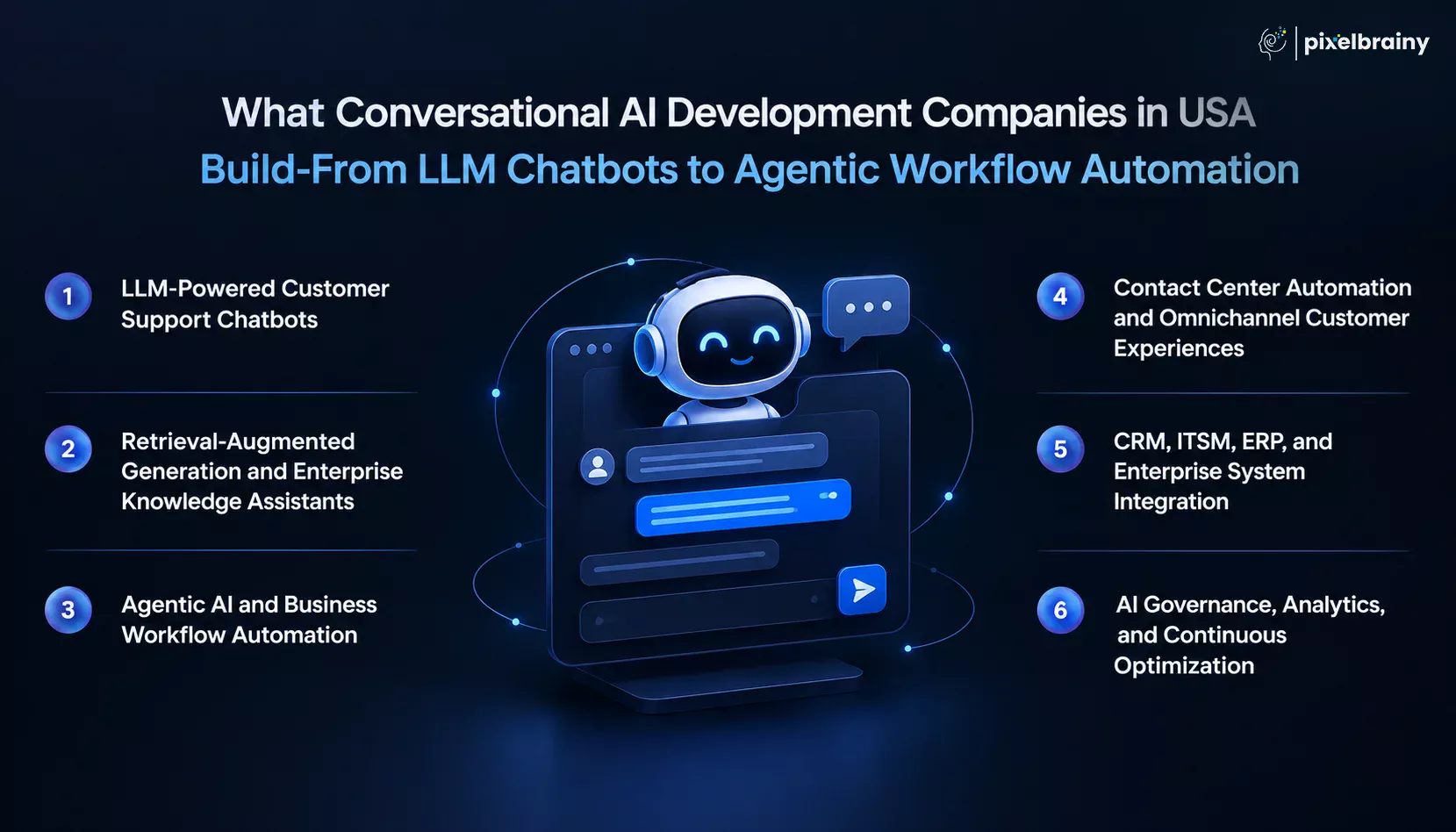
LLM-powered chatbots use natural language processing and large language models to understand customer intent, interpret complex questions, and generate contextually relevant responses. Unlike traditional scripted bots, they can handle variations in wording and support more natural conversations.
Common enterprise applications include:
For example, an ecommerce company can use a conversational AI chatbot to answer delivery questions, explain its return policy, and guide customers through eligible refund requests.
What enterprise buyers should evaluate: Response accuracy, knowledge grounding, escalation quality, integration capabilities, and the percentage of eligible support tickets resolved without human intervention.
Custom conversational AI development companies in the USA can tailor these chatbots to specific customer journeys, business rules, and enterprise systems rather than relying entirely on generic chatbot templates.
Retrieval-augmented generation (RAG) enables conversational AI systems to retrieve relevant information from approved enterprise sources before generating a response. These sources may include internal documents, product manuals, knowledge bases, policy libraries, and authorized databases.
For example, a telecommunications customer asking why their monthly bill increased could receive an explanation based on current billing policies and relevant account information, provided the system has the required authentication and permissions.
Enterprise conversational AI development experts can implement RAG with source citations, document-level access controls, updated knowledge indexes, and fallback responses when reliable information is unavailable.
Why it matters: Grounding responses in approved enterprise information can improve answer relevance and reduce reliance on unsupported model-generated claims. However, retrieval alone does not guarantee accuracy, so organizations should test responses against verified answers.
What enterprise buyers should evaluate: Knowledge retrieval accuracy, document freshness, source traceability, permission enforcement, and the system's ability to acknowledge when it cannot find a reliable answer.
Agentic conversational AI extends beyond answering questions by coordinating multiple steps to achieve a defined business objective. Depending on its permissions, an AI agent can retrieve account details, check eligibility, update records, create support tickets, or schedule appointments.
Consider a customer who wants to change a delivery address. A basic chatbot explains the policy. An advanced AI agent can authenticate the customer, check whether the order is eligible for modification, submit the change through an authorized API, and confirm the result.
Enterprise conversational AI development services providers in the USA can build these workflows by connecting LLMs with business APIs, validation rules, and approval mechanisms.
What enterprise buyers should evaluate: Successful task completion, authorization controls, audit trails, exception handling, transaction accuracy, and human approval for sensitive actions.
For complex enterprise use cases, agentic AI should operate within clearly defined permissions rather than being given unrestricted access to business systems.
Also Read: Top 10+ Agentic AI Development Companies in Florida
Conversational AI contact center solutions automate repetitive inquiries across website chat, mobile applications, messaging platforms, and voice channels. They can answer routine questions, retrieve customer information, summarize conversations, and route complicated issues to the appropriate human agent.
Platforms such as LivePerson and Amazon Connect support conversational customer engagement and contact center automation.
For an enterprise handling 240,000 monthly chats, contact center automation can help reduce repetitive agent workloads, improve response times, and create more consistent customer experiences. However, actual ticket deflection depends on the percentage of conversations eligible for automation and the system's ability to resolve those requests successfully.
What enterprise buyers should evaluate:
A vendor's reported containment rate should not automatically be interpreted as its ticket deflection rate. Buyers should verify whether customers' issues were actually resolved without human assistance.
Conversational AI delivers greater business value when it connects to systems that can retrieve information and execute approved transactions.
Common enterprise integrations include:
For example, an AI assistant integrated with an IT service management platform could answer an employee's question, check the relevant policy, create an approved access request, and provide a ticket reference.
What enterprise buyers should evaluate: API coverage, integration reliability, data permissions, transaction validation, error recovery, and the time required to connect existing systems.
Custom conversational AI development companies USA can be particularly valuable when an organization needs specialized integrations, legacy system connectivity, or workflows that standard chatbot platforms cannot support adequately.
Production-ready conversational AI requires continuous monitoring, testing, and improvement after deployment. Development teams need to evaluate response quality, successful task completion, escalation rates, latency, cost per resolution, customer satisfaction, and security incidents.
They should also test how the assistant handles ambiguous questions, malicious prompts, missing information, failed integrations, and requests outside its authorized scope.
For enterprise buyers, governance should include clear data handling rules, access controls, audit logs, human oversight, and documented procedures for reviewing incorrect responses.
What enterprise buyers should evaluate:
The objective is not simply to deploy an intelligent chatbot. It is to build a secure, measurable conversational AI system that improves customer service while maintaining appropriate human oversight.
To create this list of top 10 conversational AI development companies in USA for 2027, we evaluated each provider based on its publicly available service portfolio, enterprise implementation capabilities, customer success stories, technical expertise, and suitability for large-scale business automation. Our research focused on identifying companies that can help organizations move beyond basic chatbots toward secure, scalable conversational AI systems that deliver measurable customer service outcomes.
We considered the needs of enterprise buyers managing high conversation volumes, complex integrations, strict security requirements, and ambitious ticket deflection targets. We also distinguished between conversational AI platforms, custom development partners, and technology consulting firms to assess how each provider fits different business requirements.
Our evaluation followed six key criteria:
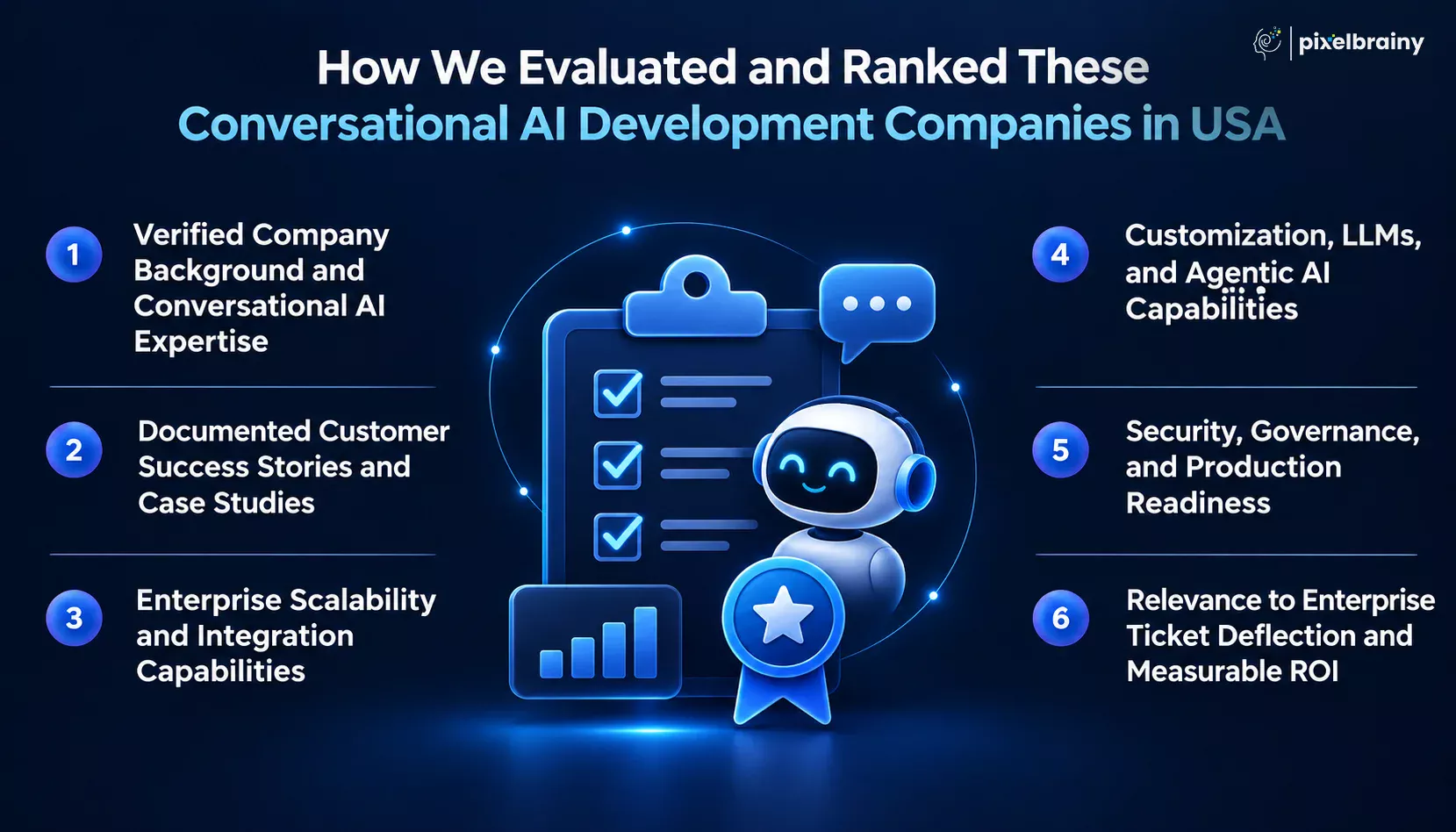
We reviewed official company websites, product documentation, and service portfolios to confirm each provider's conversational AI capabilities, enterprise focus, and relevant technology offerings. We assessed whether companies provide custom chatbot development, LLM integration, voice AI, AI agent development, or broader conversational AI implementation services.
This helped us identify established conversational AI development experts with capabilities relevant to enterprise customer support and workflow automation.
We examined publicly available customer case studies, implementation examples, and published business outcomes to understand how providers apply conversational AI in real-world environments.
Where available, we considered metrics such as ticket deflection, self-service containment, intent recognition, first-contact resolution, and agent productivity. We treated vendor-published results as reported evidence rather than independently audited performance.
We assessed each provider's ability to support high-volume conversational experiences and integrate AI solutions with CRM platforms, contact center infrastructure, IT service management systems, enterprise knowledge bases, and business APIs.
For companies handling hundreds of thousands of monthly customer conversations, these capabilities are essential for automating tier-1 inquiries and completing customer requests without unnecessary agent intervention.
We reviewed support for large language models, retrieval-augmented generation (RAG), conversational workflow design, enterprise knowledge retrieval, and agentic AI automation.
Our assessment considered whether a provider can build customized conversational AI solutions for specific business processes rather than offering only predefined chatbot templates. We also considered how AI agents handle authorization, exceptions, and escalation to human support.
We considered publicly documented security capabilities, data protection measures, access controls, governance features, and human handoff mechanisms. We also assessed the relevance of testing, monitoring, and ongoing optimization capabilities for enterprise deployments.
These factors matter particularly for organizations in healthcare, financial services, insurance, telecommunications, and other industries with sensitive customer information or regulated workflows.
We prioritized providers whose capabilities and published evidence are relevant to reducing repetitive support workloads, improving self-service resolution, and lowering operational costs.
For buyers asking which conversational AI development companies in the USA have documented ticket deflection above 60%, we treated that threshold as a specific evidence requirement. We did not equate containment with successful resolution or assume that every company could achieve the same results across different use cases.
Our final ranking reflects a comparative assessment of enterprise suitability, technical capabilities, and publicly available evidence, rather than an independently audited industry benchmark. We recommend validating customer references, metric definitions, and implementation assumptions before making a final vendor decision.
The best conversational AI development companies in USA for 2027 offer different approaches to enterprise automation, from custom LLM-powered chatbots and knowledge assistants to real-time agent coaching and autonomous voice agents. For enterprise buyers, the right partner depends on the complexity of customer interactions, the systems that must be integrated, the channels customers use, and the business outcomes the organization expects to achieve.
For example, a bank that wants to automate account inquiries, fraud-related questions, and loan guidance across WhatsApp, web chat, and mobile applications needs more than a conversational interface. It needs secure authentication, permission-controlled access to financial data, reliable integrations, clear escalation procedures, and consistent experiences across channels.
This list compares 10 conversational AI development services providersUSA with different strengths in conversational AI development, enterprise implementation, and customer service automation. It includes custom development companies, AI engineering firms, and established conversational AI platforms. The profiles cover their positioning, location, founding history, capabilities, integrations, customer references, industry focus, pricing considerations, and ideal use cases.
Positioning: Custom conversational AI development and AI product engineering for US enterprises that need tailored, integrated, and business-focused AI solutions.
Website: https://www.pixelbrainy.com/
Why it is on this list: PixelBrainy is positioned as the featured custom AI product development company in USA for organizations seeking tailored LLM applications, enterprise knowledge retrieval, and workflow automation. Its proposed combination of omnichannel conversational experiences and business system integrations is relevant to complex enterprise support requirements, subject to validation of its delivery portfolio, customer references, and security documentation.
Positioning: Enterprise conversational AI for contact centers, combining real-time agent assistance, AI agents, and conversation intelligence.
Why it is on this list: Cresta combines AI agent assistance with conversational intelligence and autonomous customer service capabilities. It is especially relevant to contact centers that want to improve agent productivity, consistency, and customer experience without making full automation the only route to operational improvement.
Positioning: Voice-first conversational AI for natural, multi-turn interactions across customer service, restaurants, automotive, and connected devices.
Why it is on this list: SoundHound AI specializes in voice-centric conversational experiences rather than treating voice as a simple text chatbot with speech added. Its published customer examples make it relevant to enterprises evaluating automated call handling and industry-specific voice workflows. Buyers should test latency, speech accuracy, and successful task completion under real operating conditions.
Positioning: AI-first engineering and consulting for enterprises building data-intensive conversational AI solutions.
Why it is on this list: Quantiphi's AI engineering focus makes it relevant to enterprises that need conversational AI built around proprietary data, complex business logic, and existing cloud infrastructure. Its suitability is strongest when the project requires substantial engineering and data expertise beyond standard chatbot configuration.
Positioning: Enterprise technology consulting and custom engineering for conversational AI initiatives that require strong architecture and integration planning.
Why it is on this list: CapTech is relevant to organizations that view conversational AI as an enterprise software initiative rather than an isolated chatbot deployment. Its consulting-led approach can be useful when architecture, system integration, governance, and business process design are central to implementation success.
Positioning: Enterprise AI agent management for orchestrating customer service conversations across voice and digital channels.
Why it is on this list: Parloa focuses on managing AI agents as part of a broader customer experience operation. It is particularly relevant to enterprises that need to coordinate multiple automated service journeys while maintaining centralized oversight, testing, and performance management.
Positioning: Enterprise voice conversational AI for complex customer service calls and natural, multi-turn spoken interactions.
Why it is on this list: PolyAI focuses on conversational quality in voice environments, where interruptions, changing topics, and natural speech patterns can make automation challenging. Its public customer portfolio supports its relevance to enterprise voice automation, although any claim that its agents outperform human agents should be validated against the specific benchmark and use case.
Positioning: Conversational AI for customer engagement across messaging, digital
Why it is on this list: Haptik is relevant to businesses prioritizing messaging-led conversational AI and digital customer engagement. Its enterprise customer portfolio provides useful industry context, but US buyers should verify local delivery coverage, relevant US client references, and performance data for comparable deployments.
Positioning: Custom software engineering and enterprise AI integration for organizations building tailored conversational applications.
Why it is on this list: EPAM's software engineering and integration focus makes it relevant to organizations that require customized conversational AI rather than an off-the-shelf platform alone. It is particularly worth evaluating when the project involves complex APIs, legacy modernization, specialized data pipelines, or demanding production requirements.
Positioning: AI-powered support automation for customer service, employee support, knowledge management, and repetitive business workflows.
Why it is on this list: Capacity combines AI-powered support automation with knowledge orchestration and workflow capabilities. It is a relevant option for organizations seeking to reduce repetitive support workloads across customer service and internal operations, particularly when knowledge access and system connectivity are central requirements.
These above are the best 10 conversational AI development companies in USA , offering capabilities ranging from custom AI product development and omnichannel chatbots to enterprise voice AI and intelligent workflow automation. The right partner depends on your business requirements, integration needs, security standards, and measurable customer service goals.
Also Read: Top 10 AI Voice Assistant Development Companies in USA (2027 Reviewed and Ranked)
Comparing conversational AI development firms USA requires more than reviewing company size, product features, or marketing claims. Enterprise buyers should evaluate each provider's production experience, channel compatibility, integration capabilities, security controls, and ability to demonstrate measurable business outcomes.
The table below compares the 10 shortlisted providers by specialization, headquarters, channel coverage, compliance considerations, pricing approach, and ideal use case. Pricing is indicative because most enterprise vendors use custom quotations, and security certifications or regulatory capabilities must be confirmed for the specific product and deployment.
For buyers comparing conversational AI developers USA, the most important question is whether a vendor has delivered production LLM-powered conversational AI in the same industry, with similar workflows, data requirements, and customer volumes. The comparison provides a starting point for narrowing the shortlist, not a substitute for technical due diligence.
| Company | HQ | Conversational AI specialization | Channel coverage | Compliance | Pricing range | Best fit for |
|---|---|---|---|---|---|---|
| PixelBrainy LLC | Sheridan, Wyoming, USA | Custom LLM chatbots, RAG, agentic AI | Web, voice, SMS, WhatsApp, subject to verification | HIPAA and SOC 2 readiness claims require validation | $25-$49/hr | Bespoke enterprise AI products |
| Cresta | Sunnyvale, CA, USA | Real-time agent assistance and conversation intelligence | Contact center voice and digital channels | Verify product-specific controls | Enterprise quote | Contact centers |
| SoundHound AI | Santa Clara, CA, USA | Voice AI and autonomous agents | Voice, automotive, supported digital channels | See trust center | Custom quote | Voice-heavy industries |
| Quantiphi | Marlborough, MA, USA | Custom AI engineering and RAG | Web, applications, APIs | Verify project-specific requirements | Custom quote | Data-intensive enterprises |
| CapTech | Richmond, VA, USA | Custom AI consulting and integration | Web, mobile, enterprise integrations | Verify applicable controls | Custom quote | Regulated industries |
| Parloa | New York, USA | Enterprise AI agent management | Voice and supported digital channels | Verify certifications and deployment scope | Enterprise quote | Multi-agent contact centers |
| PolyAI | New York, USA | Autonomous voice agents | Voice, chat, messaging | SOC 2, ISO 27001 and other controls | Custom quote | Complex voice interactions |
| Haptik | Los Angeles, USA | Messaging-led conversational AI | Web, WhatsApp, supported mobile channels | Verify applicable controls | Custom quote | Retail and digital engagement |
| EPAM Systems | Newtown, PA, USA | Custom conversational AI engineering | Web, mobile, enterprise APIs | Verify project-specific controls | Custom quote | Complex enterprise integration |
| Capacity | St. Louis, MO, USA | Knowledge-based support automation | Supported chat, voice, and helpdesk channels | Verify applicable controls | Custom quote | Customer and employee support |
Ultimately, the strongest conversational AI software development companies USA are those that can demonstrate relevant production deployments, measurable business outcomes, and reliable integration with your existing systems. Use this comparison to narrow your shortlist, then validate each provider's claims through technical demonstrations and customer references.
Also Read: AI Workflow Automation System Development: Architecture, Tools & Best Practices
Which industries benefit most from conversational AI development in the USA in 2027? Customer support, healthcare, banking, retail, insurance, HR, sales, and telecom are key sectors adopting AI chatbot development, voice assistants, and enterprise conversational AI solutions to automate routine tasks and improve customer experiences.
Results depend on the use case, integration quality, and implementation. Businesses should evaluate providers using documented case studies and measurable outcomes.
Conversational AI development services help contact centers automate FAQs, order tracking, appointment changes, and routine support requests. AI chatbots and voice assistants can also route complex issues to human agents.
Businesses should measure resolution rates, wait times, customer satisfaction, and cost per interaction. Ticket deflection alone does not prove successful resolution.
AI chatbot development for healthcare supports appointment scheduling, patient reminders, general healthcare FAQs, and administrative workflows.
Healthcare providers need secure integrations and appropriate safeguards for patient information. HIPAA compliance depends on the complete solution, its configuration, and applicable contractual requirements.
Banks use enterprise conversational AI solutions to answer account FAQs, guide customers through onboarding, explain financial products, and handle routine service requests.
Essential capabilities include identity verification, access controls, audit trails, and escalation for sensitive transactions.
Conversational AI solutions for insurance help customers understand policy information, submit initial claim details, check claim status, and receive renewal reminders.
Insurers can assess performance through processing time, customer satisfaction, and reduced manual work. Sensitive coverage decisions may still require human review.
AI chatbot development services help retailers deliver product recommendations, order tracking, return guidance, and personalized shopping assistance.
Integrating conversational AI with inventory systems, e-commerce platforms, and CRM software enables more relevant responses and smoother customer journeys.
Enterprise AI chatbot development helps employees access HR policies, benefits information, onboarding guidance, and IT support through platforms such as Microsoft Teams.
Businesses should prioritize accurate internal knowledge retrieval, role-based access, and secure integration with HR and IT service management systems.
Custom conversational AI development supports lead qualification, appointment scheduling, product inquiries, and automated follow-ups.
When integrated with CRM platforms, AI agents can capture lead details and assist sales teams with prioritization. Relevant metrics include qualified leads, conversion rates, and time saved.
Voice AI development and conversational AI automation help telecom providers and utility companies manage billing questions, service requests, outage updates, plan changes, and troubleshooting.
Multichannel AI assistants can support customers through voice, websites, and messaging platforms. Clear escalation paths remain important for urgent or technically complex issues.
Before selecting a provider, request documented case studies, production performance metrics, security information, and transparent pricing. These checks help businesses compare conversational AI development services in the USA based on evidence rather than marketing claims.
Finding the right conversational AI development company in the USA requires more than comparing prices or chatbot features. Buyers need a technology partner that understands their business workflows, integration requirements, security obligations, and long-term growth plans.
Before investing in conversational AI development services, evaluate these six factors to identify a provider that can deliver reliable, measurable business results.
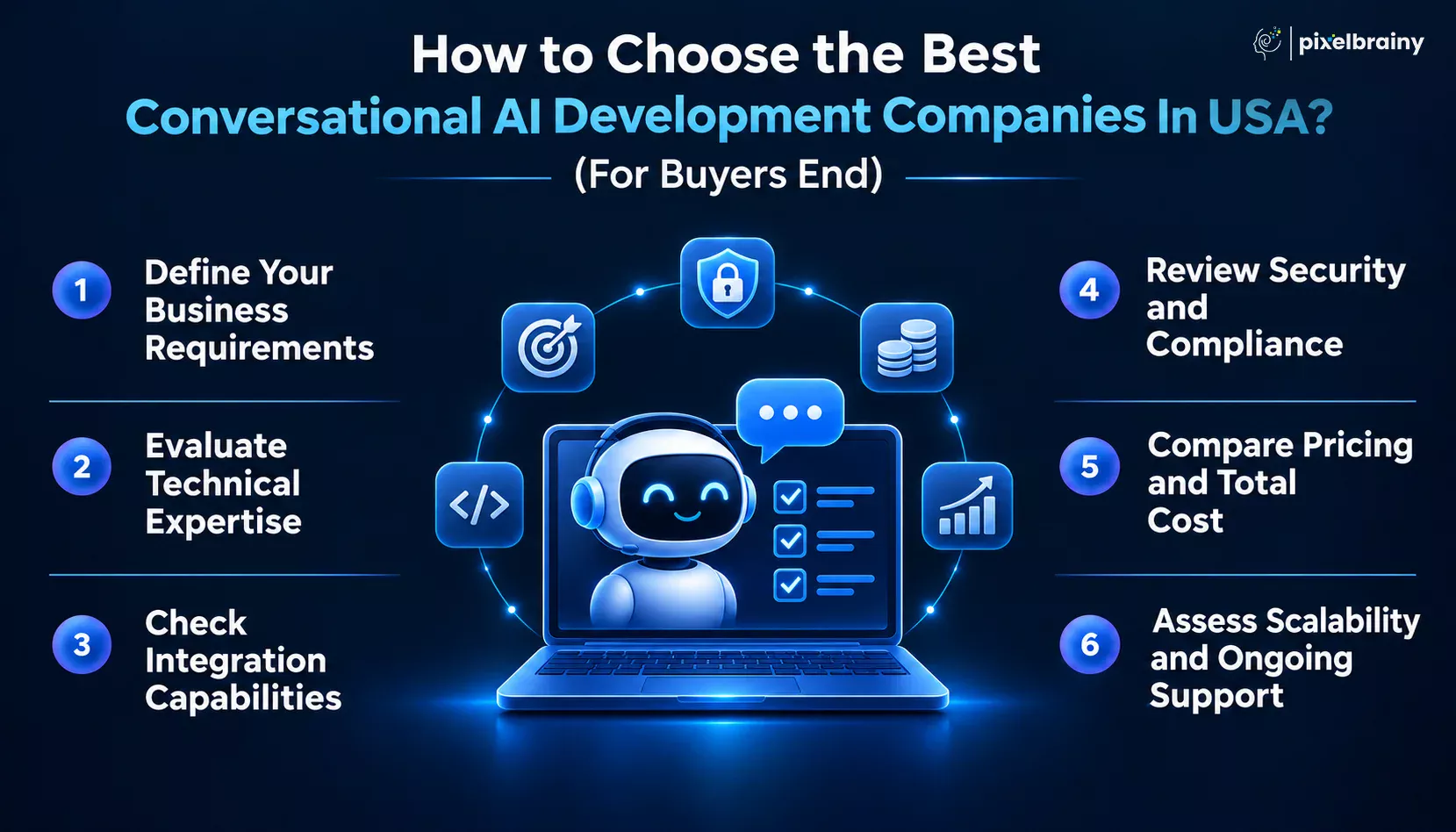
Start by identifying the problems your conversational AI solution should solve. Clear requirements help you compare vendors based on business value rather than attractive demonstrations.
Review each company's experience in custom AI chatbot development, large language models (LLMs), retrieval-augmented generation (RAG), and AI agent development.
An AI assistant delivers more value when it works with your existing business systems. Confirm that the provider can connect the solution to your current technology stack.
Security should be a core requirement, particularly for businesses handling customer, financial, or healthcare information.
The cost of conversational AI development in the USA depends on complexity, integrations, usage, deployment, and ongoing support.
Your conversational AI solution should adapt as customer demand, business processes, and technology requirements evolve.
Before signing a contract, request documented case studies, production performance metrics, security information, and transparent pricing. These checks help you identify a conversational AI development company in the USA that aligns with your business goals and budget.
Investing in the wrong conversational AI development company in the USA can lead to poor chatbot performance, expensive integrations, security risks, and disappointing business outcomes. Businesses should assess technical capabilities, real-world experience, and long-term support before committing to a vendor.
Here are six common mistakes to avoid when evaluating conversational AI development services.
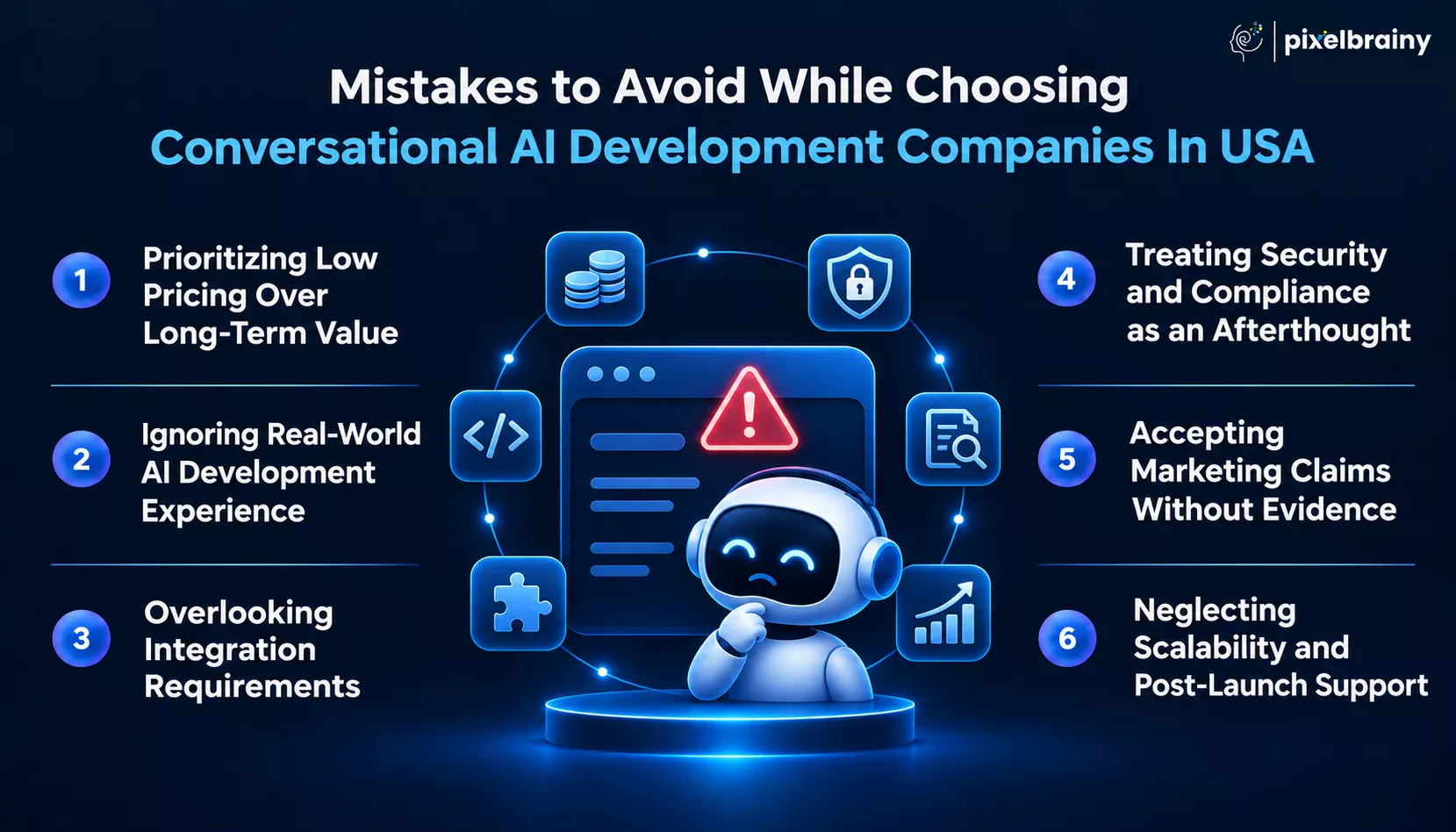
Low development costs may look attractive, but proposals might exclude integration, testing, maintenance, and ongoing AI model expenses. Compare the total cost of ownership before making a decision.
Building a basic chatbot is different from deploying a production-ready enterprise AI solution. Providers should demonstrate experience with complex workflows and real business requirements.
An AI chatbot that cannot connect with business systems may deliver incomplete answers and create additional work for employees. Integration planning should happen before development begins.
Conversational AI systems may handle sensitive customer, financial, or healthcare information. Inadequate safeguards can expose businesses to data risks and regulatory issues.
Claims about automation rates, response accuracy, or cost reductions should be backed by credible performance data. Results vary depending on data quality, conversation complexity, and implementation.
Conversational AI development continues after deployment. Models, integrations, company policies, and customer expectations evolve, requiring ongoing monitoring and improvements.
Before partnering with a conversational AI development company in the USA, verify its technical capabilities, integration experience, security practices, and documented results. This helps reduce implementation risks and improve the long-term value of your AI investment.
Conversational AI is becoming an important investment for US businesses looking to improve customer experiences, automate repetitive tasks, and scale operations efficiently. However, the success of an AI initiative depends on finding a development partner that understands your business objectives, technical requirements, and industry-specific challenges.
The top conversational AI development companies in the USA offer different strengths, from voice AI and customer support automation to enterprise AI agents, custom LLM development, and workflow integration. Before making a decision, compare their technical expertise, production experience, security practices, integration capabilities, and long-term support.
For businesses planning to invest in conversational AI development services, the priority should be measurable business value rather than simply deploying the latest AI technology. A well-designed solution can streamline operations, improve response times, and support sustainable growth when implemented with the right strategy.
Looking to build a conversational AI solution tailored to your business needs? Schedule a call with PixelBrainy LLC to discuss your requirements, explore potential use cases, and plan your next steps toward AI-powered automation.
The best conversational AI development company in the USA depends on your business goals, budget, integrations, and security needs. PixelBrainy is worth evaluating for custom conversational AI development, LLM-powered applications, RAG, and AI agents. Compare providers based on verified case studies, technical expertise, scalability, and measurable business outcomes.
The cost of conversational AI development services in the USA depends on chatbot complexity, integrations, AI models, security requirements, and deployment scale. Basic chatbots generally cost less than enterprise AI agents. Request a detailed quote covering development, hosting, API usage, maintenance, and support to estimate your total investment.
A rules-based chatbot follows predefined scripts and decision trees, while LLM-powered conversational AI development enables more flexible, natural-language interactions. Advanced solutions can use retrieval-augmented generation (RAG) to retrieve relevant business information. Companies such as PixelBrainy can be evaluated for custom AI chatbot development based on these requirements.
Businesses seeking HIPAA-compliant conversational AI development in the USA should verify healthcare project experience, security controls, data handling practices, and business associate agreements. PixelBrainy can be evaluated for custom healthcare AI requirements, subject to verification of relevant experience. HIPAA compliance depends on the complete solution, configuration, and applicable safeguards.
Omnichannel conversational AI development maintains context through shared conversation records, customer identity matching, session management, and CRM or contact center integrations. These capabilities allow customers to continue conversations across web chat, SMS, and voice with less repetition. Providers such as PixelBrainy can be evaluated for multichannel requirements and integration capabilities.
Look for omnichannel conversational AI development companies in the USA with verified deployments across WhatsApp, web chat, SMS, and voice. PixelBrainy can be evaluated for custom AI chatbot development across multiple channels. Before partnering, confirm production experience, supported integrations, channel continuity, and client references.
Enterprise conversational AI development services reduce hallucinations through RAG, trusted knowledge sources, grounded prompts, output validation, confidence thresholds, and human escalation. AI monitoring and regular testing help identify inaccurate responses. Companies such as PixelBrainy should be assessed on their ability to implement these controls and measure answer accuracy before deployment.
Businesses evaluating conversational AI companies for contact center automation should request evidence of improved containment, successful resolution, customer satisfaction, and reduced handling costs. Cresta and PolyAI are relevant providers to investigate, while PixelBrainy can be evaluated for custom support automation. Verify published case studies and how each vendor measures deflection.
The timeline for enterprise conversational AI development in the USA depends on data readiness, integrations, security reviews, testing, and workflow complexity. A focused pilot may take several weeks, while a complex deployment may require several months. Establish clear milestones for development, integration, user acceptance testing, and launch with your provider.
Businesses seeking white-label conversational AI development in the USA should evaluate providers offering custom branding, APIs, tenant isolation, usage controls, and scalable architecture. PixelBrainy can be approached to discuss custom AI product development for B2B SaaS platforms. Confirm white-label experience, multi-tenant capabilities, intellectual property terms, and ongoing support before signing a contract.

About The Author
Sagar Bhatnagar
Sagar Sahay Bhatnagar brings over a decade of IT industry experience to his role as Marketing Head at PixelBrainy. He's known for his knack in devising creative marketing strategies that boost brand visibility and market influence. Sagar's strategic thinking, coupled with his innovative vision and focus on results, sets him apart. His track record of successful campaigns proves his ability to utilize digital platforms effectively for impactful marketing efforts. With a genuine passion for both technology and marketing, Sagar continuously pushes PixelBrainy's marketing initiatives to greater success.

Working with PixelBrainy has been a great experience. They took our vision for an AI-powered platform and turned it into a fully functional product. What impressed me most was their strong understanding of both design and development, and their ability to handle complex requirements with ease. The team was responsive, cooperative, and always open to feedback. They kept things organized, communicated clearly, and delivered quality work on time. I highly recommend PixelBrainy to anyone looking for a skilled and reliable development partner.

Working with the PixelBrainy team has been a highly positive experience. They understand the design requirements and create beautiful UX elements to meet the application needs. The dev team did an excellent job bringing my vision to life. We discussed usability and flow. Sagar worked with his team to design the database and begin coding. Working with Sagar was easy. He has the knowledge to create robust apps, including multi-language support, Google and Apple ID login options, Ad-enabled integrations, Stripe payment processing, and a Web Admin site for maintaining support data. I'm extremely satisfied with the services provided, the quality of the final product, and the professionalism of the entire process. I highly recommend them for Android and iOS Mobile Application Design and Development.

Great experience working with them. Had a lot of feedback and I found that unlike most contractors they were bugging me for updates instead of the other way around. They were extremely time conscience and great at communicating! All work was done extremely high quality and if not on time, early! They were always proactive when it comes to communication and the work is great/above par always. Very flexible and a great team to work with! Goes above and beyond to present us with multiple options and always provides quality. Amazing work per usual with Chitra. If you have UI/UX or branding design needs I recommend you go to them! Will likely work with them in the future as well, definitely recommended!

PixelBrainy is a joy to work with and is a great partner when thinking through branding, logo, and website layout. I appreciate that they spend time going into the "why" behind their decisions to help inform me and others about industry best practices and their expertise.

I hired them to design our software apps. Things I really like about them are excellent communication skills, they answer all project suggestions and collaborate right away, and their input on design and colors is amazing. This project was complex and needed patience and creativity. The team is amazing to do business with. I will be using them long-term. Glad to see there are some good people out there. I was afraid to try and outsource my project to someone but I am glad I met them! I really can't say enough. They went above and beyond on this project. I am very happy with everything they have done to make my business stand out from the competition.

It was great working with PixelBrainy and the team. They were very responsive and really owned the project. We'll definitely work with them again!

I recently worked with the PixelBrainy team on a project and I was blown away by their communication skills. They were prompt, clear, and articulate in all of our interactions. They listened and provided valuable feedback and suggestions to help make the project a success. They also kept me updated throughout the entire process, which made the experience stress-free and enjoyable.

PixelBrainy is very good at what it does. The team also presents themselves very professionally and takes care of their side of things very well. I could fully trust them taking up the design work in a timely and organised manner and their attention to detail saved us lots of effort and time. This particular project was quite intense and the team showed that they function very well under pressure. Very much looking forward to working with her again!

It's always an absolute pleasure working with them. They completed all of my requests quickly and followed every note I had for them to a T, which made our process go smoothly from start to finish. Everything was completed fast and following all of the guidelines. And I would recommend their services to anyone. If you need any design work done in the future, PixelBrainy should be your first call!

They took ownership of our requirements and designed and proposed multiple beautiful variants. The team is self-motivated, requires minimum supervision, committed to see-through designs with quality and delivering them on time. We would definitely love to work with PixelBrainy again when we have any requirements.

PixelBrainy was a big help with our SaaS application. We've been hard at work with a new UI/UX and they provided a lot of help with the designs. If you're looking for assistance with your website, software, or mobile application designs, PixelBrainy and the team is a great recommendation.

PixelBrainy designers are amazing. They are responsive, talented, and always willing to help craft the design until it matches your vision. I would recommend them and plan to continue them for my future projects and more!!!

They were awesome! Did a good job fast, and good communication. Will work with them again. Thank you

Creative, detail-oriented, and talented designers who take direction well and implement changes quickly and accurately. They consistently over-delivered for us.

PixelBrainy team is very talented and creative. Great designers and a pleasure to work with. PixelBrainy is an excellent communicator and I look forward to working with them again.

PixelBrainy has a very talented design team. Their work is excellent and they are very responsive. I enjoy working with them and hope to continue on all of our future projects.


Transform your ideas into reality with us.
Across these industries, each engagement brings unique challenges, from early-stage product development to scaling complex systems, helping us build a practical understanding of real-world product environments.