AI Summary Powered by PixelBrainy
Are you underestimating the real AI app MVP development cost and setting your startup up for budget shocks?
In 2026, building an AI-powered product is more accessible than ever, yet the AI app MVP development cost continues to surprise founders. Many assume that creating a minimum viable product is a lean, predictable process. In reality, the cost of building an AI MVP app often expands due to hidden technical complexity, evolving data needs, and post-launch operational expenses.
If you are asking, what is the cost of developing an AI MVP app, the answer is rarely a single number. On average, the MVP cost for AI applications typically ranges between $10,000 to $80,000+, depending on the complexity, features, and AI capabilities involved. However, this estimate is just a starting point. The actual AI MVP development pricing includes multiple layers such as upfront development, AI model integration, infrastructure, testing, and continuous improvement.
The cost range can shift significantly based on your product scope and scalability goals. On top of that, ongoing expenses like model retraining, cloud usage, and monitoring systems are often overlooked, yet they play a major role in the total investment.
We are currently in the early stages of building an AI MVP and need a detailed cost estimate that includes both initial development and ongoing expenses after launch. This is exactly where most founders struggle. They budget for development but fail to account for iteration cycles, user feedback loops, and infrastructure scaling.
This blog is designed for startup founders, product managers, CTOs, and entrepreneurs who want a realistic and strategic understanding of AI MVP costs. Instead of rough guesses, you will gain clarity on where your money goes and how to plan effectively.
At last, in this blog you can explore the development budget of AI app MVP in depth and avoid the common pitfalls that cause budgets to spiral fast.
Understanding the AI app MVP development cost is crucial for businesses that want to launch intelligent products without overspending. Unlike full-scale AI applications, an MVP focuses on core functionality, but that does not mean costs are minimal or predictable. Proper estimation of the cost of building an AI MVP app helps businesses allocate resources wisely, validate ideas faster, and avoid unnecessary financial strain.
Careful financial planning is even more important in MVP development because this stage determines whether your idea is viable or not. Many AI initiatives fail before reaching scale due to poor cost management and unrealistic expectations. This makes it essential to evaluate the MVP cost for AI applications early and structure development in a controlled and strategic way.
Below are key reasons why businesses must consider AI MVP development pricing before starting.
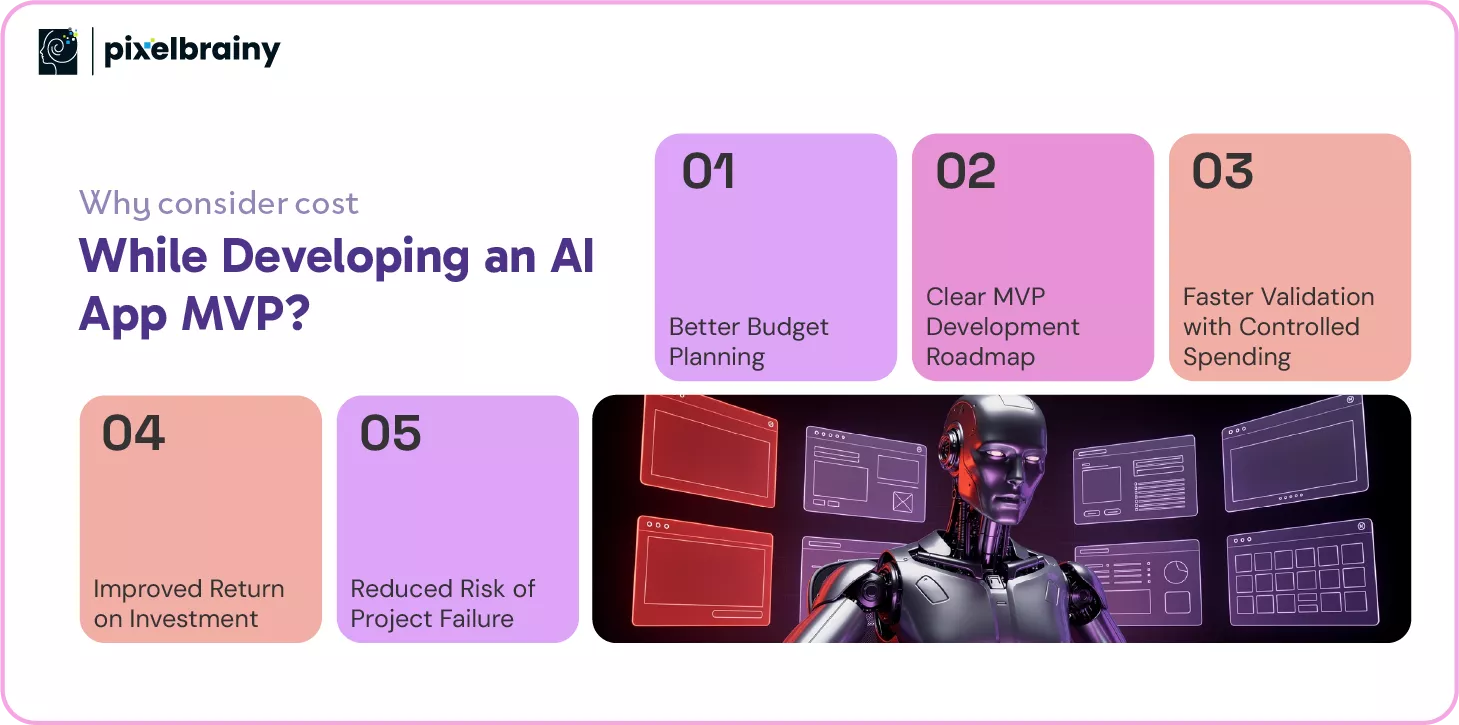
Estimating the cost of developing an AI MVP app allows businesses to define a clear and realistic budget. It helps founders decide whether to bootstrap, seek funding, or build the MVP in phases without exhausting resources too early.
Cost awareness enables teams to prioritize only the most critical features for the MVP. Instead of building a complex product, businesses can focus on solving one core problem effectively, reducing waste and speeding up time to market.
AI MVPs are built to test ideas quickly. When costs are planned properly, businesses can launch faster, gather feedback, and iterate without risking large financial losses.
Strategic cost allocation ensures that spending is directed toward high-impact areas like model performance, user experience, and data quality. This increases the chances of achieving meaningful ROI even at the MVP stage.
Many AI MVPs fail because teams try to overbuild in the early stages. Controlled budgeting encourages a lean approach, helping businesses validate assumptions before scaling further.
A typical AI app MVP development lifecycle includes the following stages:
Following this lean and phased MVP approach helps businesses manage the AI app MVP development cost effectively while building a product that is ready for real-world validation and scalable success.
With artificial intelligence accelerating innovation across industries, now is one of the most strategic moments to invest in AI app MVP development. Businesses are no longer waiting to build full-scale AI systems. Instead, they are launching MVPs to validate ideas quickly, reduce risk, and capture early market opportunities. This shift makes understanding the AI app MVP development cost not just important, but a competitive advantage.
The global AI market is expanding at an extraordinary pace. According to Grand View Research, the artificial intelligence market is expected to reach approximately $539.45 billion in 2026, growing at a CAGR of over 30% through 2033.
In addition, insights based on Statista data show that the global AI market is projected to reach around $312 billion in 2026 and grow to over $827 billion by 2030, reflecting a strong annual growth rate of nearly 27.7%.
This rapid growth is driven by widespread enterprise adoption, increasing demand for automation, and the rise of generative AI technologies. It also signals that the cost of building an AI MVP app is no longer just an expense but a strategic investment with high long-term returns.
For startups and enterprises, this creates a unique window of opportunity. The MVP cost for AI applications has become more manageable due to:
As a result, businesses can launch MVPs faster, validate ideas with real users, and iterate without committing to large-scale development budgets upfront.
Whether you are a founder testing a new concept or a CTO driving innovation, investing in an AI MVP today allows you to move quickly, reduce risk, and position your product ahead in a rapidly evolving intelligent app market.
The AI app MVP development cost in 2026 typically ranges between $10,000 and $80,000+, but this number only becomes meaningful when you understand what is actually being built. If you are asking what is the cost of developing an AI MVP app, the answer depends on how you define your product scope, the level of AI involved, and how scalable you want the system to be from the start.
Unlike traditional applications, the cost of building an AI MVP app is influenced by both development effort and intelligence complexity. Some teams build lean MVPs using existing AI APIs, while others invest more upfront to create differentiated capabilities. This is why the MVP cost for AI applications can vary so widely even for similar ideas.
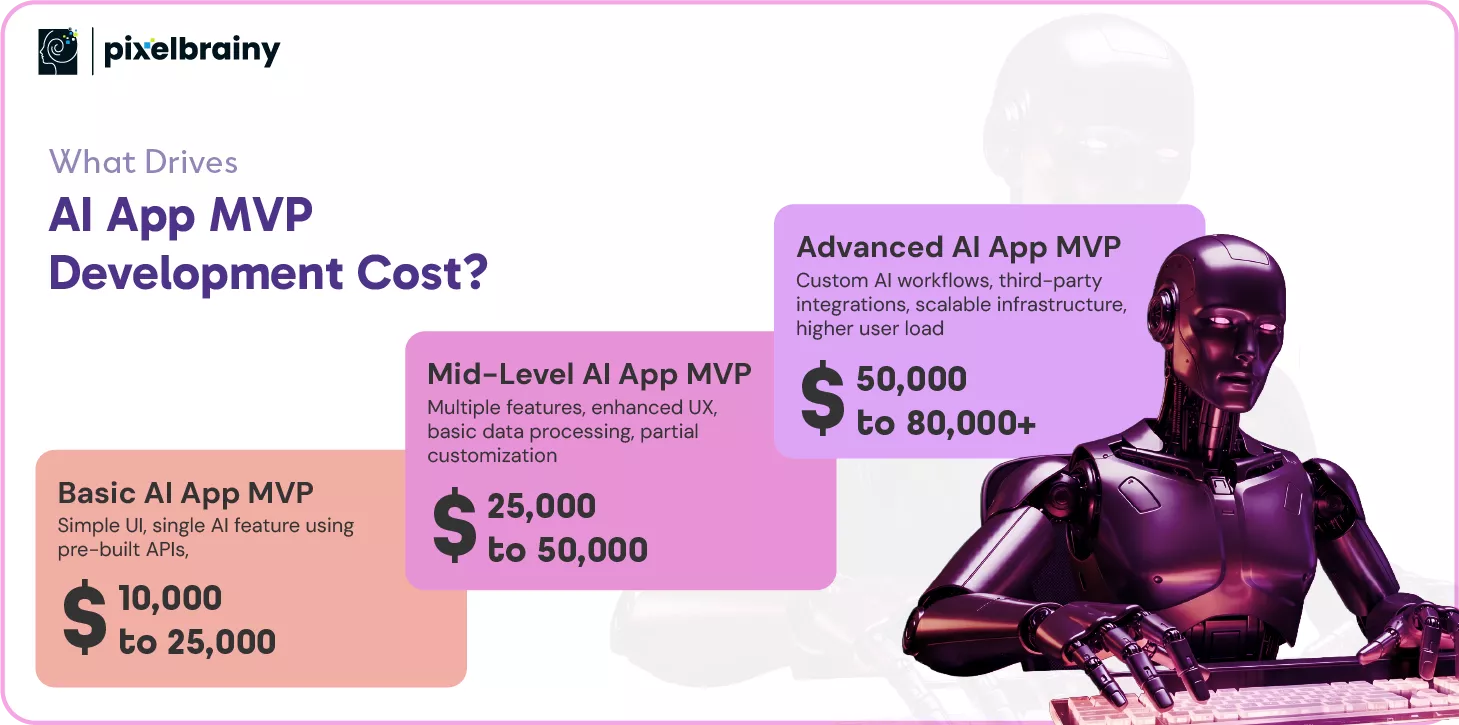
| Complexity Level | What It Usually Includes | Estimated Cost |
| Basic AI App MVP | Simple UI, single AI feature using pre-built APIs, minimal backend, limited user access | $10,000 – $25,000 |
| Mid-Level AI App MVP | Multiple features, enhanced UX, basic data processing, partial customization | $25,000 – $50,000 |
| Advanced AI App MVP | Custom AI workflows, third-party integrations, scalable infrastructure, higher user load | $50,000 – $80,000+ |
Most early-stage startups fall within the $15,000 to $40,000 range, especially when focusing on solving one specific problem effectively. However, costs increase quickly when teams expand scope, introduce multiple use cases, or plan for scale too early.
The wide variation in AI MVP development pricing is not random. It reflects how each decision, from feature selection to AI implementation, directly impacts the budget. A focused MVP designed for validation will always cost less than a product built with long-term scalability in mind from day one.
It is also important to understand that MVP development is only one part of the total investment. While the initial build gets your product to market, ongoing costs such as AI usage, performance optimization, and continuous improvements begin as soon as users start interacting with the system.
A simple way to think about it:
If you are currently planning your MVP and need a detailed estimate, the key is to clearly define your scope and align it with your budget. When every feature and technical choice is intentional, the AI app MVP development budget becomes predictable, manageable, and aligned with your business goals.
When businesses begin planning an AI product, one of the first and most important questions is: how much will it cost to build an MVP? In 2026, the AI app MVP development cost typically ranges between $10,000 and $80,000+, depending on the scope, AI capabilities, and level of customization involved.
However, early-stage founders often need more than a rough estimate. If you are thinking, we are currently in the early stages and need a clear cost estimate including development and ongoing expenses, then using a structured estimation approach can give you better clarity and control.
A simple way to calculate the cost of building an AI MVP app is:
Estimated MVP Cost = Base MVP Cost + (AI Feature Cost × Complexity Multiplier) + Integration Cost + UI/UX Cost + Data Cost
Let’s say a startup wants to build an AI-powered chatbot MVP with basic automation and CRM integration:
Estimated MVP Cost = ($12,000 + $8,000) × 1.2 + $5,000 + $5,000 + $3,000 = $34,000
This falls well within the typical MVP cost for AI applications, showing how different components combine to shape the final budget.
Adding a cost estimator or calculator helps businesses make faster and smarter decisions:
A simple estimator can include selectable inputs like:
The cost of creating an AI MVP app becomes much easier to manage when you break it into components instead of guessing a lump sum. A structured estimator not only helps you plan your budget but also ensures you build a product that is aligned with your goals and resources.
If you are in the early stage, getting a quick estimate using this approach can help you move forward with confidence and avoid unexpected cost escalations later.
Also Read: A Comprehensive Guide To AI Mobile App Development
If you are planning your MVP with a defined budget, you are probably thinking: We have allocated around $50K for our AI app MVP development, and we want a clear breakdown of how that budget will be spent. This is exactly the right approach, because the AI app MVP development cost for startups is not just about a total number. It is about how that budget is distributed across critical components.
Many founders also wonder: Why does AI app MVP development often end up costing much more than the initial estimate, especially for startups? The answer lies in how multiple cost drivers interact with each other. Small decisions in AI, data, or infrastructure can create a ripple effect that increases the overall real cost of AI MVP app development.
To give you clarity, here is a structured breakdown of the six key factors and how they typically influence budget allocation within the broader $10,000 to $80,000+ range.
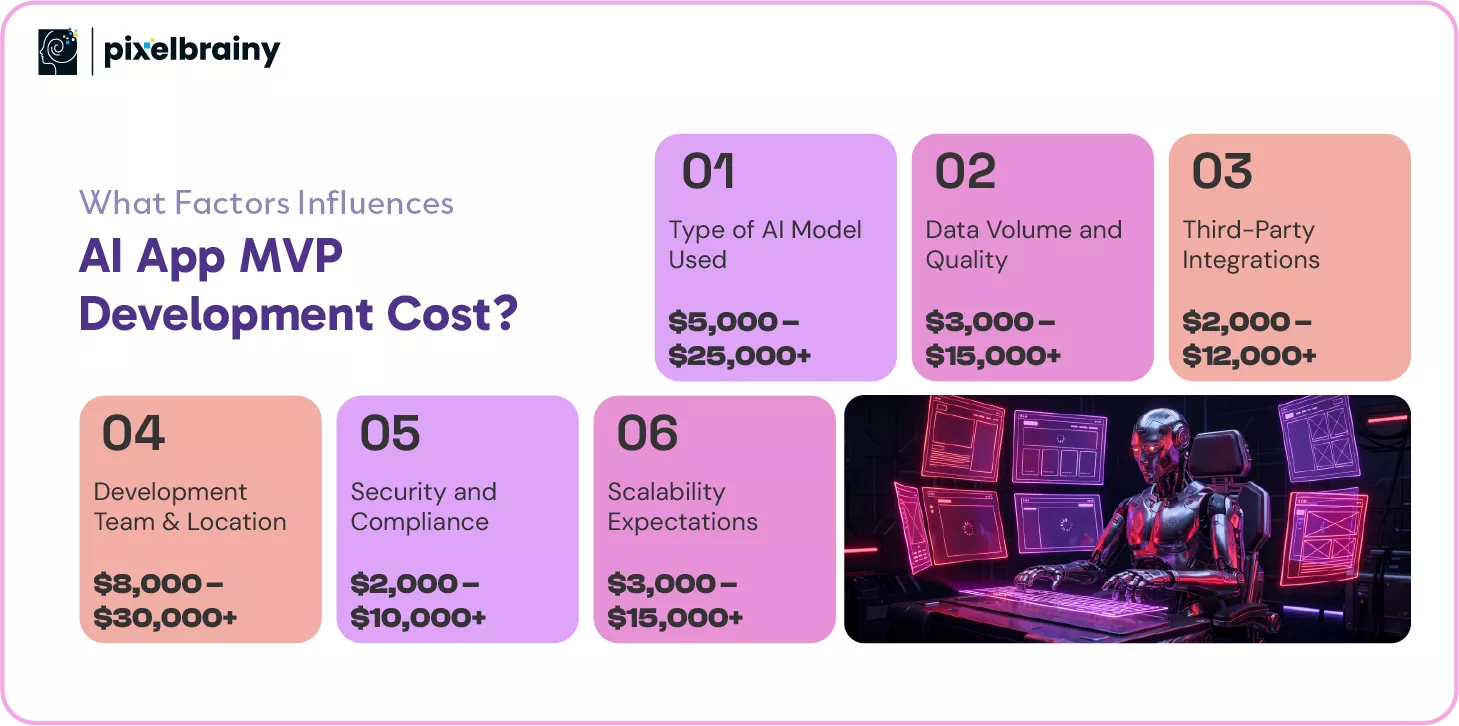
| Factor | Estimated Budget Range | What It Covers |
| Type of AI Model Used | $5,000 – $25,000+ | AI APIs, model selection, fine-tuning, or custom AI logic |
| Data Volume and Quality | $3,000 – $15,000+ | Data collection, cleaning, labeling, preprocessing |
| Third-Party Integrations | $2,000 – $12,000+ | CRM, APIs, payment systems, external tools |
| Development Team & Location | $8,000 – $30,000+ | Developers, AI engineers, designers, project management |
| Security and Compliance | $2,000 – $10,000+ | Authentication, encryption, compliance setup |
| Scalability Expectations | $3,000 – $15,000+ | Cloud infrastructure, performance optimization, scaling readiness |
Estimated Budget Impact: $5,000 – $25,000+
The type of AI you choose is one of the most influential cost drivers across the entire $10,000 to $80,000+ range. Using pre-trained APIs helps keep the minimum cost to build AI MVP app lower and allows faster development cycles, which is ideal for early validation. However, if your product requires fine-tuning models or building custom AI logic, costs increase due to additional engineering effort, experimentation, and testing cycles.
Many startups underestimate how quickly costs grow when moving from simple API usage to more tailored AI capabilities. This decision directly impacts performance, differentiation, and long-term scalability. Choosing the right level of AI sophistication ensures that your MVP remains within budget while still delivering meaningful value to users.
Estimated Budget Impact: $3,000 – $15,000+
Data is the backbone of any AI system, and its quality directly affects both performance and cost. If you already have structured and usable data, you can significantly reduce expenses. However, in most cases, data requires cleaning, formatting, labeling, and validation before it can be used effectively.
This process often becomes a hidden contributor to the real cost of AI MVP app development, especially when teams discover gaps in their datasets after development has started. As your MVP grows, data requirements also expand, which can increase storage, processing, and maintenance costs. Investing in proper data preparation early ensures better model accuracy and reduces costly rework later.
Estimated Budget Impact: $2,000 – $12,000+
AI MVPs typically need to connect with external systems such as CRMs, analytics platforms, payment gateways, or communication tools. Each integration adds to development time, testing effort, and long-term dependency management.
While basic integrations are relatively affordable, complex workflows that involve multiple systems can quickly increase costs across the MVP cost for AI applications spectrum. Additionally, many third-party services come with usage-based pricing, which adds to ongoing operational expenses after launch. Careful selection of integrations helps balance functionality with cost efficiency.
Estimated Budget Impact: $8,000 – $30,000+
The structure and expertise of your development team play a critical role in shaping your budget. Hiring experienced AI engineers, backend developers, and designers increases upfront cost but ensures better architecture, faster execution, and fewer errors.
On the other hand, smaller or less experienced teams may reduce initial spending but can lead to delays, inefficiencies, or expensive rework. This is a key area where startups try to cut costs, but it often impacts product quality. A well-balanced team ensures that your AI app MVP cost stays aligned with both performance expectations and delivery timelines.
Estimated Budget Impact: $2,000 – $10,000+
Security becomes essential when your MVP handles user data, transactions, or sensitive information. Implementing authentication systems, encryption, and secure APIs adds to development effort and cost.
For industries like healthcare or fintech, compliance requirements further increase the budget due to stricter regulations and validation processes. While some startups delay these considerations, doing so often leads to higher costs later when systems need to be redesigned. Investing in security early ensures trust, stability, and long-term scalability of your AI product.
Estimated Budget Impact: $3,000 – $15,000+
Scalability defines how well your MVP can handle growth in users, data, and usage. A basic MVP built for testing ideas will have lower infrastructure costs, while a scalable system designed for growth requires more advanced architecture and cloud resources.
This factor often determines whether your product remains efficient as it grows or requires costly restructuring later. Founders who plan for scalability early can avoid performance bottlenecks and unexpected expenses. Balancing current needs with future growth is essential to managing the real development budget of AI MVP app development effectively.
The key to managing your AI MVP successfully is not just knowing the budget, but understanding how each decision shapes the outcome. When you clearly map your priorities across AI capabilities, data readiness, integrations, team structure, security, and scalability, your MVP becomes far more predictable and strategically aligned.
Instead of treating cost as a limitation, treat it as a framework for smarter decision-making. A well-planned allocation ensures that every dollar contributes to validating your idea, improving user experience, and building a strong foundation for future growth.

When planning your product, one of the most practical ways to estimate the AI app MVP development cost is by looking at the specific use case you want to build. Not all AI applications are created equal. A chatbot MVP is far less complex than a computer vision system or a predictive analytics engine.
This is why founders often struggle to estimate the cost of building an AI MVP app accurately. The functionality, data requirements, and level of intelligence vary significantly across use cases, which directly impacts development effort and budget.
If you are in the early stage and trying to understand the MVP cost for AI applications, mapping your idea to a real-world use case gives you a much clearer picture. Below is a detailed breakdown of common AI MVP use cases and how costs typically fall within the $10,000 to $80,000+ range.
Estimated Cost: $10,000 – $25,000
AI chatbots are among the most common and cost-effective MVPs. They are typically built using pre-trained NLP models and integrated into websites or apps for customer support or lead generation.
Costs remain lower because:
This makes chatbots ideal for startups testing AI adoption with minimal investment.
Estimated Cost: $20,000 – $45,000
Recommendation engines suggest products, content, or services based on user behavior. These systems require more data handling and logic compared to chatbots.
Cost drivers include:
This type of MVP sits in the mid-range due to increased complexity and data dependency.
Estimated Cost: $30,000 – $60,000
Predictive analytics tools help businesses forecast trends, user behavior, or outcomes. These applications require structured datasets and more advanced model logic.
Costs increase because:
This use case is ideal for SaaS products and data-driven businesses.
Estimated Cost: $40,000 – $80,000+
Computer vision applications analyze images or videos for detection, classification, or recognition tasks. These MVPs are more resource-intensive and technically demanding.
Higher costs are due to:
This category often reaches the upper end of the AI app MVP cost range.
Also Read: Top 12 AI Computer Vision Software Development Companies in USA
Estimated Cost: $25,000 – $55,000
Automation tools use AI to streamline repetitive business processes such as document processing, customer onboarding, or task management.
Cost factors include:
These MVPs balance functionality and business value, making them a popular choice for enterprises.
Also Read: Top 10+ AI Automation Companies in USA
Estimated Cost: $30,000 – $70,000
Voice-enabled applications are increasingly popular in areas like virtual assistants and customer service automation. These systems require speech-to-text processing and natural language understanding.
Costs rise due to:
This makes voice-based MVPs more complex than basic chatbot solutions.
Also Read: How To Build An AI Voice Cloning App
The AI app MVP development cost varies significantly depending on the use case you choose. Each application type brings its own level of complexity, data needs, and infrastructure requirements.
By aligning your idea with the right use case and starting with a focused MVP, you can control costs while still building a product that delivers real value and scalability potential.
The AI application MVP development cost is not only influenced by features or technology choices but also heavily shaped by the industry you are targeting. Each sector brings its own level of complexity, compliance requirements, data sensitivity, and integration needs. This is why the cost of making an AI MVP app can vary significantly even for similar functionalities across industries.
For founders trying to estimate the MVP cost for AI app, understanding industry-specific benchmarks helps create a more accurate and practical budget. Below is a detailed breakdown of how costs typically fall within the $10,000 to $80,000+ range across different industries.
| Industry | Common AI MVP Use Cases | Estimated Cost Range |
| Healthcare | Diagnosis support, patient chatbots, medical data analysis | $40,000 – $80,000+ |
| Fintech | Fraud detection, AI assistants, credit scoring | $35,000 – $75,000+ |
| eCommerce & Retail | Recommendation engines, chatbots, demand prediction | $15,000 – $45,000 |
| Logistics | Route optimization, demand forecasting, tracking systems | $25,000 – $60,000 |
| Education (EdTech) | Personalized learning, AI tutors, content recommendations | $20,000 – $50,000 |
| Real Estate | Property recommendations, price prediction | $15,000 – $40,000 |
| Customer Support | AI chatbots, ticket automation, sentiment analysis | $10,000 – $30,000 |
| Marketing & Ads | Ad targeting, customer insights, campaign automation | $20,000 – $55,000 |
Healthcare AI MVPs are among the most expensive due to strict compliance, high accuracy requirements, and sensitive patient data handling. Applications such as diagnostic support tools or AI-powered patient assistants typically cost between $40,000 and $80,000+. The need for secure infrastructure, regulatory compliance, and reliable data processing pushes these projects toward the higher end of the AI app MVP cost spectrum.
Also Read: How to Develop an AI Health Companion App
Fintech AI applications focus on fraud detection, financial forecasting, and intelligent assistants. These MVPs generally cost between $35,000 and $75,000+ due to the need for strong security, encryption, and real-time data processing. Financial systems demand high reliability, which increases both development effort and overall AI app MVP development cost.
Also Read: AI Fintech App Development Cost
Retail AI MVPs are relatively more affordable and often fall between $15,000 and $45,000. Common use cases include recommendation engines, chatbots, and demand prediction systems. Since many of these solutions can leverage existing AI APIs and tools, the cost of building an AI MVP app in this industry remains manageable, making it a popular entry point for startups.
Also Read: AI In eCommerce: 15 Use Cases Artificial Intelligence is Transforming The eCommerce Industry
AI MVPs in logistics focus on route optimization, inventory forecasting, and delivery tracking. These applications typically cost between $25,000 and $60,000. The need for real-time data processing, integration with multiple systems, and operational efficiency increases the MVP cost for AI applications in this sector.
Also Read: AI Logistics Software Development
EdTech AI MVPs, such as personalized learning platforms and AI tutors, usually range from $20,000 to $50,000. These applications require adaptive algorithms, user engagement features, and scalable backend systems. While not as heavily regulated as healthcare or fintech, they still involve moderate complexity that impacts the AI app MVP cost.
Also Read: How to Build an AI Teaching Assistant
Real estate AI MVPs are generally simpler and cost between $15,000 and $40,000. Common applications include property recommendation engines and price prediction tools. These solutions often rely on structured datasets and existing APIs, which helps keep the AI app MVP development cost on the lower to mid-range side.
Also Read: AI Real Estate App MVP Development
Customer support AI MVPs are among the most cost-effective, typically ranging from $10,000 to $30,000. Chatbots, ticket automation systems, and sentiment analysis tools are widely used in this category. Because they rely heavily on pre-trained models, the cost of creating an AI MVP app remains relatively low while still delivering strong business value.
Marketing AI MVPs, including customer segmentation, ad targeting, and campaign optimization tools, usually cost between $20,000 and $55,000. These applications require integration with marketing platforms and data analytics systems, which increases complexity and contributes to the overall AI app MVP development cost.
That’s why an AI app MVP development cost varies significantly across industries because each sector has unique technical and operational demands. By aligning your product idea with the right industry and starting with a focused use case, you can better control your budget while building a scalable and high-impact AI MVP.
This is the part most teams only notice after the project is already underway. On paper, the cost to build AI app mvp looks manageable. Then, a few months in, unexpected expenses start showing up. These hidden layers are exactly what cause the AI app MVP development cost to go beyond initial projections, especially when they are not planned from the beginning.
Understanding these overlooked areas is critical if you want a realistic view of the cost of building an AI MVP app and avoid budget surprises as your product evolves.
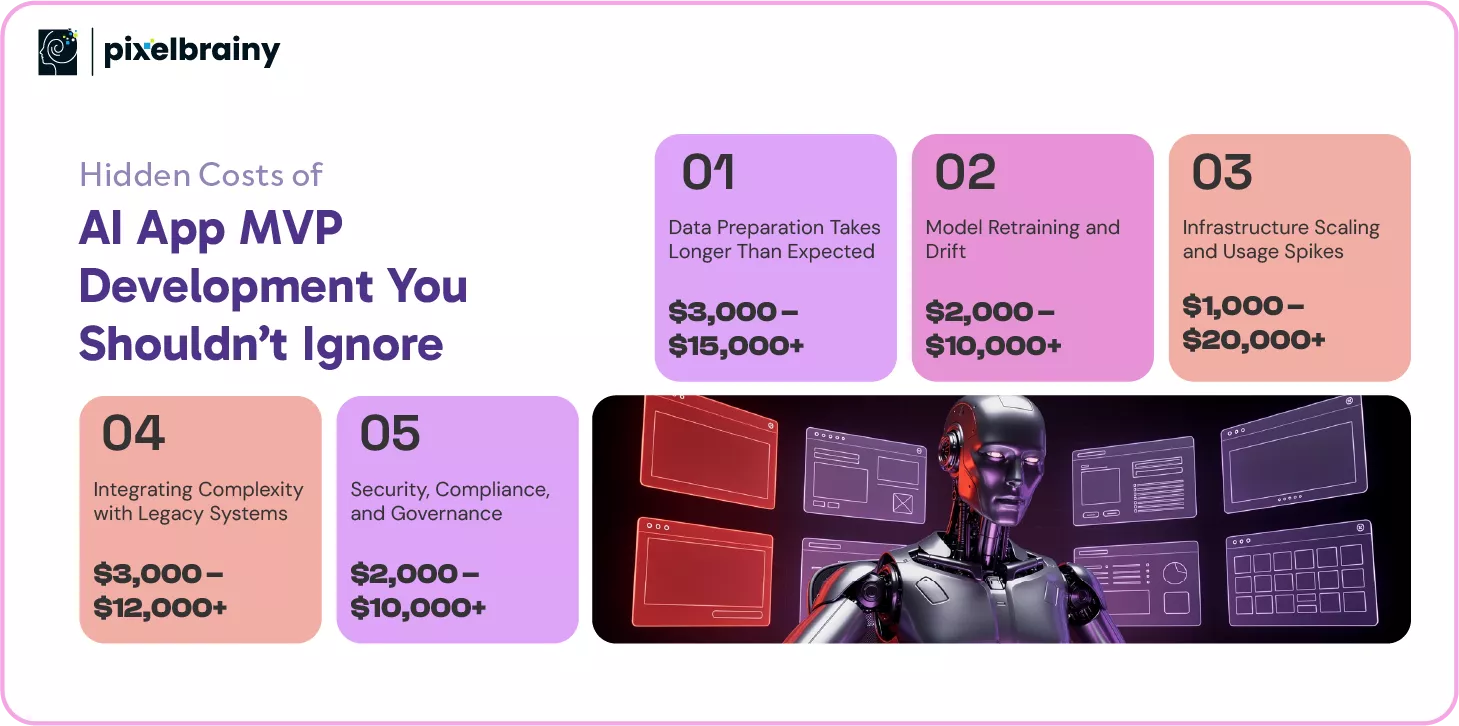
Estimated Hidden Cost: $3,000 – $15,000+
Data preparation is one of the most underestimated parts of AI development. While it seems like a preliminary step, it often consumes more time and budget than expected. Raw data usually requires cleaning, structuring, labeling, and validation before it becomes usable for AI models.
Many teams begin development assuming their data is ready, only to discover inconsistencies or missing information. This leads to delays, additional tooling, and manual effort. Over time, as your MVP scales, data requirements increase further, making this a continuous contributor to the AI app MVP cost rather than a one-time expense.
Estimated Hidden Cost: $2,000 – $10,000+ (ongoing)
AI models are not static systems. As user behavior and data patterns change, model performance can decline, a phenomenon known as drift. This requires ongoing monitoring and retraining to maintain accuracy and reliability.
Retraining involves updating datasets, reprocessing data, and running new training cycles, all of which require computational resources and engineering time. These recurring efforts are often overlooked during planning, yet they significantly impact the MVP cost for AI applications after launch.
Estimated Hidden Cost: $1,000 – $20,000+ (usage-based)
Cloud infrastructure costs are directly tied to usage. During development and early testing, expenses may appear minimal. However, once real users start interacting with your MVP, costs can increase rapidly due to higher compute demands, storage needs, and API usage.
Unexpected traffic spikes or increased AI processing requests can push infrastructure costs beyond expectations. This is where many teams realize that the real cost of AI MVP app development is not just about building the product, but also about sustaining it under real-world conditions.
Estimated Hidden Cost: $3,000 – $12,000+
Integrating your AI MVP with existing systems such as CRMs, ERPs, or internal tools can be far more complex than anticipated. Legacy systems often lack modern APIs, have inconsistent data formats, or require custom connectors.
This results in additional development effort, extended timelines, and increased testing requirements. These integration challenges are rarely visible in early estimates but can significantly raise the overall project cost once development begins.
Estimated Hidden Cost: $2,000 – $10,000+
Security and compliance are often treated as secondary priorities during MVP development, but they quickly become essential once real users and sensitive data are involved. Implementing authentication, encryption, and secure data handling adds both development and operational overhead.
In industries with regulatory requirements, additional costs arise from audits, documentation, and compliance checks. Governance practices such as monitoring, logging, and access control also require tools and infrastructure that are not always included in initial budgets.
Hidden costs are not exceptions. They are a natural part of building AI products. The difference is whether you anticipate them early or react to them later.
By factoring in these elements from the start, you gain a more accurate understanding of your total investment, reduce financial risk, and ensure your AI MVP remains stable, scalable, and ready for real-world usage.

Also Read: Top 10 AI MVP Development Companies in USA
The cost to build AI app MVP in 2026 is strongly influenced by evolving technology trends that shape how products are designed, developed, and scaled. For founders in the early stage, these trends play a major role in determining both initial investment and ongoing expenses.
Some advancements are making AI development faster and more accessible, while others are increasing expectations around performance, scalability, and compliance. Understanding these trends helps you make better decisions and manage your AI app MVP development cost more effectively.
Generative AI tools for text, image, and code generation are widely used in MVP development. These APIs allow teams to integrate advanced capabilities without building models from scratch.
This reduces initial development effort and speeds up product launch. However, most of these services follow usage-based pricing, which increases operational costs as user activity grows.
Most AI MVPs are built using pre-trained models that are customized for specific use cases. This approach reduces the cost of building an AI MVP app compared to developing models from scratch.
At the same time, fine-tuning requires quality data and optimization work, which adds to the overall development effort. The level of customization directly affects both cost and performance.
Low-code and no-code tools are helping startups build AI MVPs with less engineering effort. These platforms enable faster prototyping and reduce the need for large development teams.
While they help control initial costs, they may limit flexibility and scalability. As the product evolves, additional investment may be required to move toward more customized solutions.
Applications such as live chat, recommendations, and fraud detection require real-time AI responses. This demand increases the need for optimized infrastructure and faster processing systems.
Real-time capabilities raise both development complexity and infrastructure costs, which impacts the overall AI app MVP cost as user demand grows.
Edge AI focuses on processing data closer to the user device instead of relying entirely on cloud infrastructure. This approach helps reduce latency and can lower cloud usage costs over time.
For MVPs, implementing edge AI may require additional development effort, but it can improve performance and reduce long-term operational expenses.
Businesses are placing more importance on transparency and ethical AI systems. Explainable AI ensures that decisions made by models can be understood and trusted by users.
This adds extra layers of development, including monitoring tools, validation processes, and reporting mechanisms, which increase the MVP cost for AI applications.
Efficient use of infrastructure is becoming a priority for controlling costs. Teams are optimizing models, reducing unnecessary compute usage, and improving system performance.
This trend helps manage long-term expenses and ensures better scalability without excessive resource consumption. It plays a key role in maintaining a balanced and sustainable AI MVP budget.
The cost to build AI app MVP in 2026 is shaped by how effectively you adopt and balance these trends. Each decision, from using generative AI APIs to optimizing infrastructure, directly impacts your budget and product performance.
By choosing the right technologies and avoiding unnecessary complexity, you can build a strong AI MVP that aligns with both your goals and financial plan.
Now, the point is, as a businessperson how you can optimize AI app MVP development cost for your business. Here are some insights on how you can optimize the cost of AI app development:
Optimizing cost does not mean reducing quality. It means making smarter decisions that help you build a functional MVP, validate your idea quickly, and avoid unnecessary spending. If you are planning your MVP strategically, you can control your AI MVP development budget while still delivering a high-performing product.
Instead of building AI models from scratch, use pre-trained models and APIs for your MVP. This significantly reduces development time, complexity, and overall cost.
Pre-built solutions are already tested and optimized, which improves reliability and performance. For example, using NLP APIs for chatbots or recommendation systems allows you to launch faster while keeping your AI product MVP cost under control.
This approach is ideal for MVPs where the focus is validation rather than deep technical innovation.
Many startups try to include too many features in the MVP, which increases both time and cost. The smarter approach is to focus on solving one clear problem effectively.
By limiting scope, you reduce development effort, simplify testing, and speed up launch. This helps keep the AI startup MVP cost manageable while still delivering meaningful value to early users.
Once validated, additional features can be added in later phases.
Agile development allows you to build your MVP in smaller phases instead of one large release. Each phase focuses on a specific feature or improvement.
This approach helps identify issues early, reduces rework, and ensures better resource utilization. Continuous feedback from users also allows you to refine the product without overspending.
An iterative model is one of the most effective ways to control the AI MVP app development budget while maintaining product quality.
Cloud platforms offer a flexible and cost-efficient way to build and run AI MVPs. Instead of investing in expensive hardware, you can use pay-as-you-go services that scale based on usage.
This reduces upfront investment and allows you to manage costs as your user base grows. Cloud services also provide built-in tools for AI, security, and deployment, which further lowers development effort.
For MVPs, this is one of the most practical ways to optimize infrastructure spending.
More data does not always mean better results, especially at the MVP stage. Instead of collecting large datasets, focus on high-quality, relevant data that supports your core use case.
Efficient data usage reduces storage, processing, and preparation costs. It also speeds up model training and improves performance.
This approach helps control expenses while still achieving reliable AI outcomes.
Your team structure plays a major role in cost optimization. Hiring a full in-house team may not always be necessary for an MVP.
You can combine a small internal team with experienced external developers or AI specialists. This hybrid approach helps reduce cost while ensuring access to the right expertise.
The key is to balance affordability with quality execution.
Many founders focus only on development cost and ignore what happens after launch. However, AI MVPs require ongoing monitoring, updates, and optimization.
Planning for these expenses early helps you avoid unexpected financial pressure later. It also ensures your product continues to perform well as user demand increases.
Optimizing your AI MVP is about making intentional decisions at every step. When you focus on essential features, use existing technologies, and build in phases, you create a product that is both cost-efficient and scalable.
By following these strategies, you can manage your budget effectively while still delivering a high-quality AI MVP that is ready for real-world validation and future growth.
As a leading AI app development company, PixelBrainy LLC helps businesses build AI MVPs within budget through a strategic, transparent, and cost-efficient development approach. Acting as trusted advisors, we support clients at every stage of the journey, from idea validation and model selection to architecture design, development, deployment, and continuous optimization.
Our team combines deep technical expertise with strong business understanding, which enables us to guide startups and enterprises in making smarter decisions that directly reduce unnecessary spending. Instead of overbuilding, we focus on delivering only what is essential for a successful MVP, ensuring that every investment contributes to real business outcomes.
PixelBrainy’s approach is centered on optimizing development costs without compromising quality. We achieve this by using pre-trained AI models where possible, implementing agile development practices, leveraging reusable components, and building scalable cloud-based architectures. This allows us to reduce both initial development costs and long-term operational expenses while maintaining performance and flexibility for future growth.
We also provide strong post-launch support, including performance monitoring, model updates, feature enhancements, and infrastructure optimization. This ensures your AI MVP continues to evolve based on real user feedback while staying efficient and cost-effective over time.
PixelBrainy LLC has successfully delivered AI-driven applications across industries, helping businesses control costs, accelerate launch timelines, and build scalable digital products.
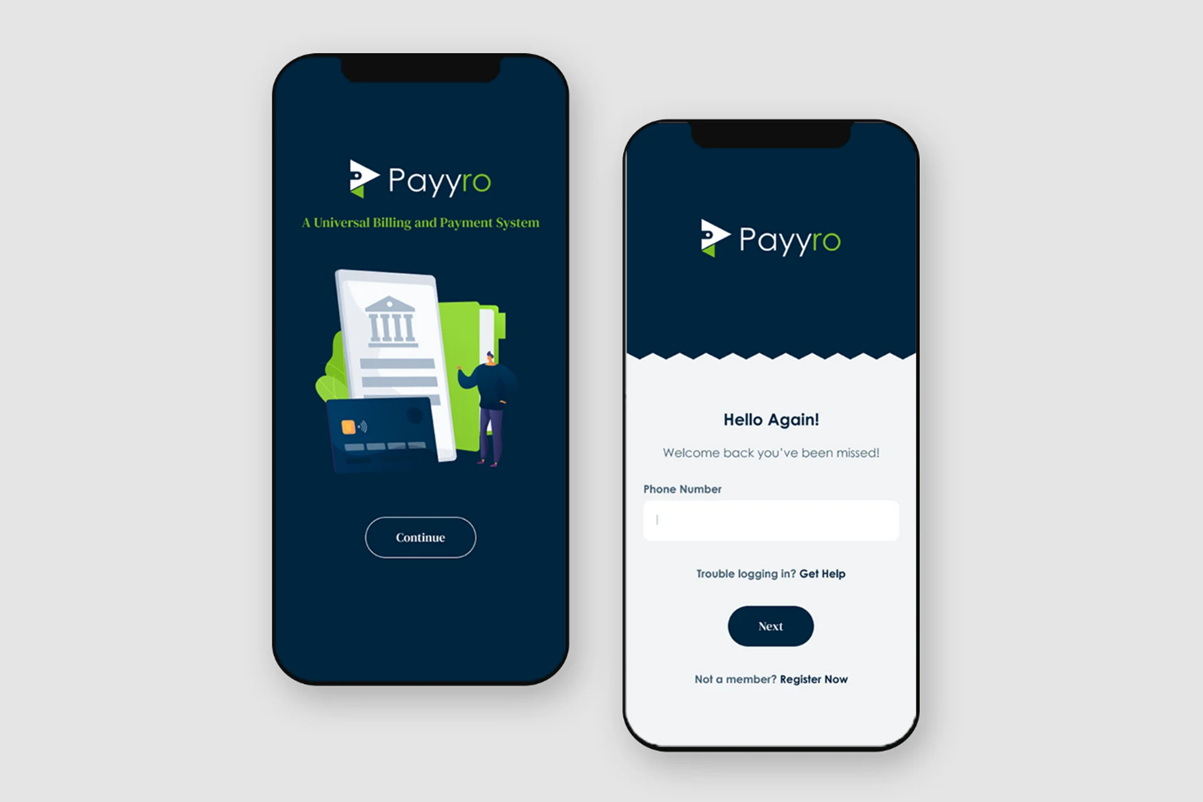
Designed Payyro’s mobile payment application with AI-powered features for seamless transactions, intuitive user experience, and secure financial management. The solution was built with a focus on efficiency and scalability, helping reduce development overhead while improving user satisfaction.
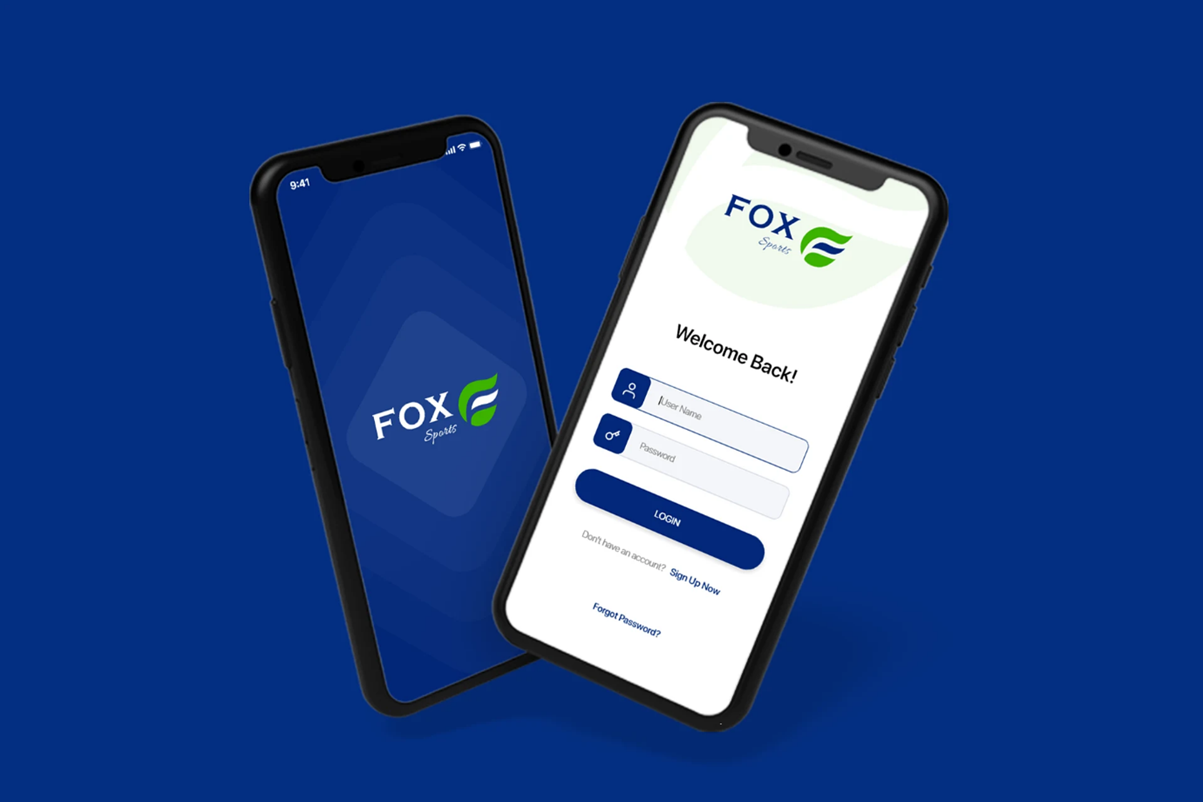
Developed an AI-powered coaching application for FoxSports that enhances player training through intelligent insights and performance tracking. The app was designed with a user-friendly interface and optimized architecture, ensuring high performance while keeping development costs under control.
Choosing the right development partner plays a critical role in controlling your AI MVP budget. With PixelBrainy, you gain a team that focuses not just on building your product, but on building it efficiently, strategically, and with long-term success in mind.
From this above, it is clear that managing the AI app MVP development cost is not about limiting your vision but about making smarter, well-informed decisions at every stage. From selecting the right AI approach to handling data, integrations, and scalability, each choice directly shapes your overall investment. Understanding the cost of building an AI MVP app early helps you stay in control and avoid unexpected budget overruns.
If you are currently planning your AI MVP and want clarity on how to allocate your budget effectively across development and ongoing operations, a structured approach is essential. The MVP cost for AI applications becomes easier to manage when you focus on building a lean, high-impact product that solves a specific problem first.
With the right strategy, your AI MVP can be both efficient and future-ready.
Book an appointment with our experts today to get a personalized cost breakdown and move forward with your AI MVP confidently.
The AI app MVP development cost usually ranges between $10,000 and $80,000+, depending on the complexity, features, AI capabilities, and integrations required. A simple MVP with one core feature will cost less, while advanced solutions with custom workflows and scalability needs will fall on the higher end.
The biggest cost drivers include the type of AI model used, data preparation requirements, third-party integrations, and scalability expectations. These elements significantly influence the cost of building an AI MVP app, especially when customization or large datasets are involved.
Startups can optimize costs by focusing on one core feature, using pre-trained AI models, adopting agile development, and leveraging cloud infrastructure. This approach helps control the AI app MVP cost while still delivering a functional and scalable product.
Yes, AI MVPs require ongoing investment. Post-launch costs include cloud usage, API calls, model retraining, monitoring, and feature updates. These recurring expenses are a key part of the MVP cost for AI applications and should be planned in advance.
The development timeline typically ranges from 6 to 16 weeks, depending on the complexity of the application, team size, and feature scope. Faster timelines may increase cost due to higher resource allocation.
For most MVPs, using pre-built APIs is the better choice because it reduces cost, speeds up development, and lowers technical risk. Custom AI models are usually recommended only when your product requires unique capabilities that cannot be achieved with existing solutions.

About The Author
Sagar Bhatnagar
Sagar Sahay Bhatnagar brings over a decade of IT industry experience to his role as Marketing Head at PixelBrainy. He's known for his knack in devising creative marketing strategies that boost brand visibility and market influence. Sagar's strategic thinking, coupled with his innovative vision and focus on results, sets him apart. His track record of successful campaigns proves his ability to utilize digital platforms effectively for impactful marketing efforts. With a genuine passion for both technology and marketing, Sagar continuously pushes PixelBrainy's marketing initiatives to greater success.

Working with the PixelBrainy team has been a highly positive experience. They understand the design requirements and create beautiful UX elements to meet the application needs. The dev team did an excellent job bringing my vision to life. We discussed usability and flow. Sagar worked with his team to design the database and begin coding. Working with Sagar was easy. He has the knowledge to create robust apps, including multi-language support, Google and Apple ID login options, Ad-enabled integrations, Stripe payment processing, and a Web Admin site for maintaining support data. I'm extremely satisfied with the services provided, the quality of the final product, and the professionalism of the entire process. I highly recommend them for Android and iOS Mobile Application Design and Development.

Great experience working with them. Had a lot of feedback and I found that unlike most contractors they were bugging me for updates instead of the other way around. They were extremely time conscience and great at communicating! All work was done extremely high quality and if not on time, early! They were always proactive when it comes to communication and the work is great/above par always. Very flexible and a great team to work with! Goes above and beyond to present us with multiple options and always provides quality. Amazing work per usual with Chitra. If you have UI/UX or branding design needs I recommend you go to them! Will likely work with them in the future as well, definitely recommended!

PixelBrainy is a joy to work with and is a great partner when thinking through branding, logo, and website layout. I appreciate that they spend time going into the "why" behind their decisions to help inform me and others about industry best practices and their expertise.

I hired them to design our software apps. Things I really like about them are excellent communication skills, they answer all project suggestions and collaborate right away, and their input on design and colors is amazing. This project was complex and needed patience and creativity. The team is amazing to do business with. I will be using them long-term. Glad to see there are some good people out there. I was afraid to try and outsource my project to someone but I am glad I met them! I really can't say enough. They went above and beyond on this project. I am very happy with everything they have done to make my business stand out from the competition.

It was great working with PixelBrainy and the team. They were very responsive and really owned the project. We'll definitely work with them again!

I recently worked with the PixelBrainy team on a project and I was blown away by their communication skills. They were prompt, clear, and articulate in all of our interactions. They listened and provided valuable feedback and suggestions to help make the project a success. They also kept me updated throughout the entire process, which made the experience stress-free and enjoyable.

PixelBrainy is very good at what it does. The team also presents themselves very professionally and takes care of their side of things very well. I could fully trust them taking up the design work in a timely and organised manner and their attention to detail saved us lots of effort and time. This particular project was quite intense and the team showed that they function very well under pressure. Very much looking forward to working with her again!

It's always an absolute pleasure working with them. They completed all of my requests quickly and followed every note I had for them to a T, which made our process go smoothly from start to finish. Everything was completed fast and following all of the guidelines. And I would recommend their services to anyone. If you need any design work done in the future, PixelBrainy should be your first call!

They took ownership of our requirements and designed and proposed multiple beautiful variants. The team is self-motivated, requires minimum supervision, committed to see-through designs with quality and delivering them on time. We would definitely love to work with PixelBrainy again when we have any requirements.

PixelBrainy was a big help with our SaaS application. We've been hard at work with a new UI/UX and they provided a lot of help with the designs. If you're looking for assistance with your website, software, or mobile application designs, PixelBrainy and the team is a great recommendation.

PixelBrainy designers are amazing. They are responsive, talented, and always willing to help craft the design until it matches your vision. I would recommend them and plan to continue them for my future projects and more!!!

They were awesome! Did a good job fast, and good communication. Will work with them again. Thank you

Creative, detail-oriented, and talented designers who take direction well and implement changes quickly and accurately. They consistently over-delivered for us.

PixelBrainy team is very talented and creative. Great designers and a pleasure to work with. PixelBrainy is an excellent communicator and I look forward to working with them again.

PixelBrainy has a very talented design team. Their work is excellent and they are very responsive. I enjoy working with them and hope to continue on all of our future projects.


Transform your ideas into reality with us.
Across these industries, each engagement brings unique challenges, from early-stage product development to scaling complex systems, helping us build a practical understanding of real-world product environments.