AI Summary Powered by PixelBrainy
Could your personal trainer be a lifelike AI avatar that knows when to push, modify a workout, or recommend recovery?
For a fitness app founder, the opportunity is bigger than placing a digital character over exercise videos. AI avatar fitness trainer apps combine personalized workout generation, conversational coaching, visual demonstrations, progress tracking, and adaptive recommendations. A well-designed product asks about goals, equipment, schedule, training history, energy, and limitations, then turns those signals into a plan that changes as the person improves.
Consider this product brief: "I am a fitness app founder and want an AI avatar trainer that builds personalized workouts, coaches by voice, and adapts to progress instead of serving static video programs. What does it cost to build, and which developers have delivered avatar coaching apps with documented retention gains?" Answering requires decisions about AI architecture, 3D character design, speech technology, exercise science, wearable integrations, privacy, and analytics. It also means separating verified outcomes from marketing claims. A retention lift reported for a fitness app does not prove that an avatar caused it.
The market opportunity is substantial. Statista projects worldwide fitness-app revenue at approximately US$9.12 billion in 2026, rising to US$15.45 billion by 2031, an 11.12% compound annual growth rate. See the original Statista market forecast. These are forecasts, not audited future results, but they indicate a growing category.
Products already demonstrate parts of this model. FitGPT: AI Fitness Trainer is an example of an AI-powered fitness coaching application available on Google Play. Core Direction describes phone-based body scanning, a 3D body avatar, and AI-generated training guidance. Neither example proves every feature in a proposed app is solved.
This guide explains how to create an AI avatar fitness trainer app with personalized workout plan generation features, which capabilities belong in an MVP, how to choose AI avatar fitness trainer app development services, and what to budget for a 2027 launch. It covers the build process, technology stack, compliance, monetization, and retention strategy.

An AI avatar fitness trainer app is a mobile or web-based fitness application that uses artificial intelligence, virtual characters, exercise science, and user activity data to deliver personalized digital fitness coaching.
Unlike conventional workout applications that primarily provide recorded exercise videos or static workout schedules, an AI avatar fitness trainer app introduces a virtual trainer who interacts with users, demonstrates exercises, answers fitness questions, provides verbal instructions, and adapts workout recommendations according to individual progress.
The avatar can be a realistic human-like 3D character, an animated fitness coach, or a customizable digital personality.
For example, a user interested in losing weight can interact with a virtual trainer that:
Both applications use AI, but their interaction models and capabilities differ.
| Comparison Factors | Standard AI Fitness App | AI Avatar Fitness Trainer App |
|---|---|---|
| Workout Planning | AI-generated workout schedules | Personalized schedules with interactive coaching |
| Trainer Experience | Chatbot or automated recommendations | Visual virtual trainer (AI avatar) |
| Exercise Demonstrations | Recorded videos or illustrations | Animated avatar demonstrations and videos |
| Communication | Primarily text-based interaction | Text, voice, and potentially real-time conversations |
| Personalization | Based on goals and activity data | Based on goals, activity, performance, feedback, and interaction |
| Exercise Guidance | Written instructions | Visual and verbal instructions |
| Engagement | Notifications and progress reports | Interactive coaching and personalized trainer experiences |
| Progress Monitoring | Workout logs and performance metrics | Workout analytics with adaptive coaching |
| User Experience | Primarily application-driven | Trainer-led and conversational |
There are five important distinctions.
Users can select a virtual trainer and receive demonstrations, instructions, and motivational feedback through an animated character.
Voice AI and natural language processing allow users to ask questions such as, "Can you replace squats because my knees feel uncomfortable?" The application can interpret the request and recommend an appropriate modification within its safety rules.
The AI engine can modify workout schedules based on completed exercises, fitness assessments, training consistency, and recovery information.
Users may select different coaching personalities, including supportive, energetic, professional, or goal-oriented trainers.
Computer vision can analyze body movements and provide feedback about exercise positioning, repetitions, and movement patterns when supported by a validated exercise-recognition model.
Therefore, a standard AI fitness application primarily recommends workouts, whereas an AI avatar fitness trainer application aims to deliver an interactive coaching experience through a personalized virtual trainer.
An AI avatar fitness trainer app works through the integration of several technologies, including artificial intelligence, machine learning, generative AI, computer vision, speech recognition, text-to-speech, and 3D avatar rendering.
These technologies work together to understand user requirements, generate workouts, deliver instructions, and improve recommendations through continuous performance monitoring.
Here is how the complete process works.
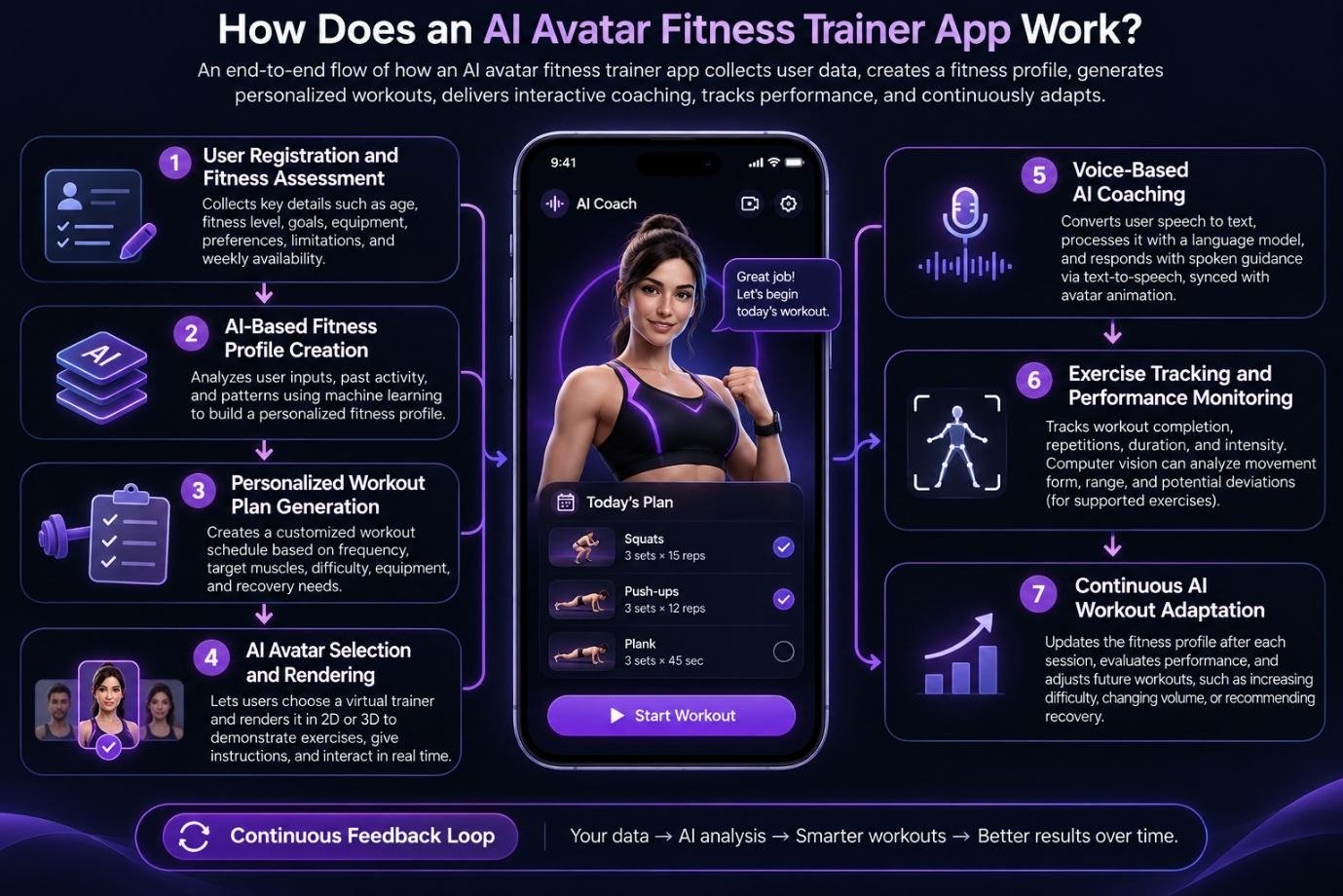
The process begins when users register and complete an onboarding assessment.
The application collects relevant information, such as:
Users can also connect supported wearable devices to share activity and recovery information.
After collecting onboarding information, the AI engine creates a personalized fitness profile.
Machine learning models and recommendation algorithms analyze user preferences, historical workouts, fitness assessments, and activity patterns.
For example:
A beginner who wants to build muscle and can exercise three days per week receives a different workout schedule from an experienced athlete who trains six days per week.
The system uses these differences to establish suitable workout recommendations.
The AI workout generation engine creates an exercise schedule according to the user's profile.
It considers:
A rules-based fitness engine should validate AI-generated recommendations before presenting them to users.
This is particularly important because generative AI should not independently invent exercise prescriptions or make unsupported medical recommendations.
Users select their preferred virtual fitness trainer.
The application loads the selected avatar and displays it through a 2D or 3D rendering environment.
Depending on the product architecture, the avatar can:
The speech recognition system converts spoken user questions into text.
A language model processes the question, retrieves relevant fitness information, and generates an appropriate response.
Text-to-speech technology converts the response into audio, while the avatar's animation and lip movements synchronize with the spoken instructions.
For example, a user can ask:
"How many repetitions should I complete?"
The virtual trainer responds with instructions based on the active workout plan.
The application records workout completion, repetitions, duration, intensity, and other available performance indicators.
Computer vision can use the smartphone camera to analyze movement patterns.
For supported exercises, the application may detect:
These features need exercise-specific validation because camera placement, lighting, clothing, and body visibility can affect accuracy.
Once users complete their sessions, the application updates their fitness profiles.
The AI recommendation engine evaluates their performance and adjusts upcoming workouts.
For example:
If a user consistently completes an exercise comfortably, the system may recommend a gradual progression. If the user reports fatigue or soreness, it may suggest a lighter session or recovery activity.
This feedback loop makes the application more personalized over time.
Overall, an AI avatar fitness trainer app collects user information, creates a fitness profile, generates workouts, delivers interactive coaching, monitors performance, and continuously updates recommendations.
The US fitness and wellness industry is experiencing a significant shift toward digital fitness platforms, wearable technology, personalized training, and AI-powered coaching experiences. Consumers increasingly expect fitness applications to understand their goals, recommend suitable workouts, and provide interactive guidance rather than simply displaying prerecorded exercise videos.
For fitness startups, gym chains, personal training businesses, and established wellness brands, AI avatar fitness trainer app development represents an emerging investment opportunity. By combining virtual trainers, personalized workout generation, conversational AI, and performance monitoring, companies can develop differentiated digital fitness products that align with changing market demands.
Here are six important market-driven reasons why fitness and wellness companies in the USA should consider investing in this technology.
According to Grand View Research's US Fitness App Market Report, the US fitness app market is estimated to generate $4.65 billion in revenue in 2026 and is projected to reach $10.30 billion by 2033, growing at a CAGR of approximately 12%.
This market expansion creates opportunities for businesses looking to develop innovative digital fitness solutions. Investing in AI avatar fitness trainer app development allows startups and established fitness brands to explore differentiated offerings, including interactive virtual coaching, personalized exercise programs, and AI-powered training experiences. Companies planning to build an AI avatar fitness trainer app can position their products within this expanding digital fitness ecosystem.
According to the ACSM Worldwide Fitness Trends 2026 Report, wearable technology ranked number one among global fitness trends for 2026. The report also highlights that approximately 36% to 44% of adults own wearable technology.
This growing adoption creates an opportunity for AI avatar fitness trainer apps to integrate with smartwatches, fitness trackers, and connected health platforms. Businesses can develop applications that use supported activity, heart rate, and workout information to inform personalized training recommendations. For companies making AI avatar fitness trainer apps, wearable integration is an important consideration when designing connected fitness experiences.
Mobile exercise applications ranked fourth in the ACSM 2026 fitness trends report. More recently, the ACSM 2027 Worldwide Fitness Trends Report ranked mobile exercise apps second globally, moving up from fourth position in 2026.
This continued industry recognition highlights the importance of mobile-first fitness experiences. Fitness companies can explore AI avatar fitness trainer app development to introduce interactive workout demonstrations, voice-based coaching, and personalized exercise schedules within a single mobile platform. It also creates opportunities for businesses to rethink traditional video-based fitness applications.
According to the Health & Fitness Association's 2026 US Consumer Report, 81 million Americans belonged to a gym, studio, or fitness facility in 2025, representing a 5.2% increase from 2024. More than 100 million Americans used fitness facilities through memberships and other access options.
This large customer base presents an opportunity for gym operators, fitness franchises, and wellness companies to extend their existing services through digital platforms. Businesses can build an AI avatar fitness trainer app that complements physical memberships with virtual training programs, digital exercise guidance, and personalized coaching outside gym premises.
Data-driven training technology ranked eighth in the ACSM fitness trends report. The 2027 report also recognizes data-driven training technology among the leading fitness industry trends.
This signals increasing professional interest in using measurable fitness information to guide exercise programming. AI avatar fitness trainer app development can incorporate workout history, exercise completion, wearable information, and user feedback to inform training recommendations. For fitness technology companies, this creates a relevant opportunity to develop applications that combine AI-powered coaching with structured fitness analytics.
The Fitness Trends Report by ACSM ranks wearable technology first and mobile exercise applications second, highlighting the continued importance of connected and technology-enabled fitness experiences.
For businesses planning their next digital fitness product, this provides a relevant foundation for exploring AI-powered virtual coaching. Investing in AI avatar fitness trainer app development services can help companies combine conversational AI, 3D avatar technology, voice interaction, and adaptive workout generation into a unified product. Businesses should evaluate these capabilities according to customer demand, development costs, and their long-term product roadmap.
Ultimately, developing an AI avatar fitness trainer app is an opportunity for US fitness and wellness companies to align their digital product strategies with evolving fitness technology trends. The key is to invest in a scalable, personalized, and interactive coaching platform that addresses genuine customer requirements.
An AI avatar fitness trainer app is not limited to fitness startups or workout platforms. Different businesses can use this technology to deliver personalized training, strengthen customer engagement, create new revenue streams, and expand their digital fitness services. From independent fitness creators to large gym franchises, each business has a different reason to invest in AI-powered virtual trainers.
Who should invest in an AI avatar fitness trainer app, and what features should they prioritize? The answer depends on the target audience, business objectives, level of personalization, and the environment in which the app will operate. For example, gyms may prioritize membership integration, while corporate wellness providers need stronger privacy controls and aggregate employee activity reporting.
Here are seven business categories that can benefit from AI fitness coach avatar app development.
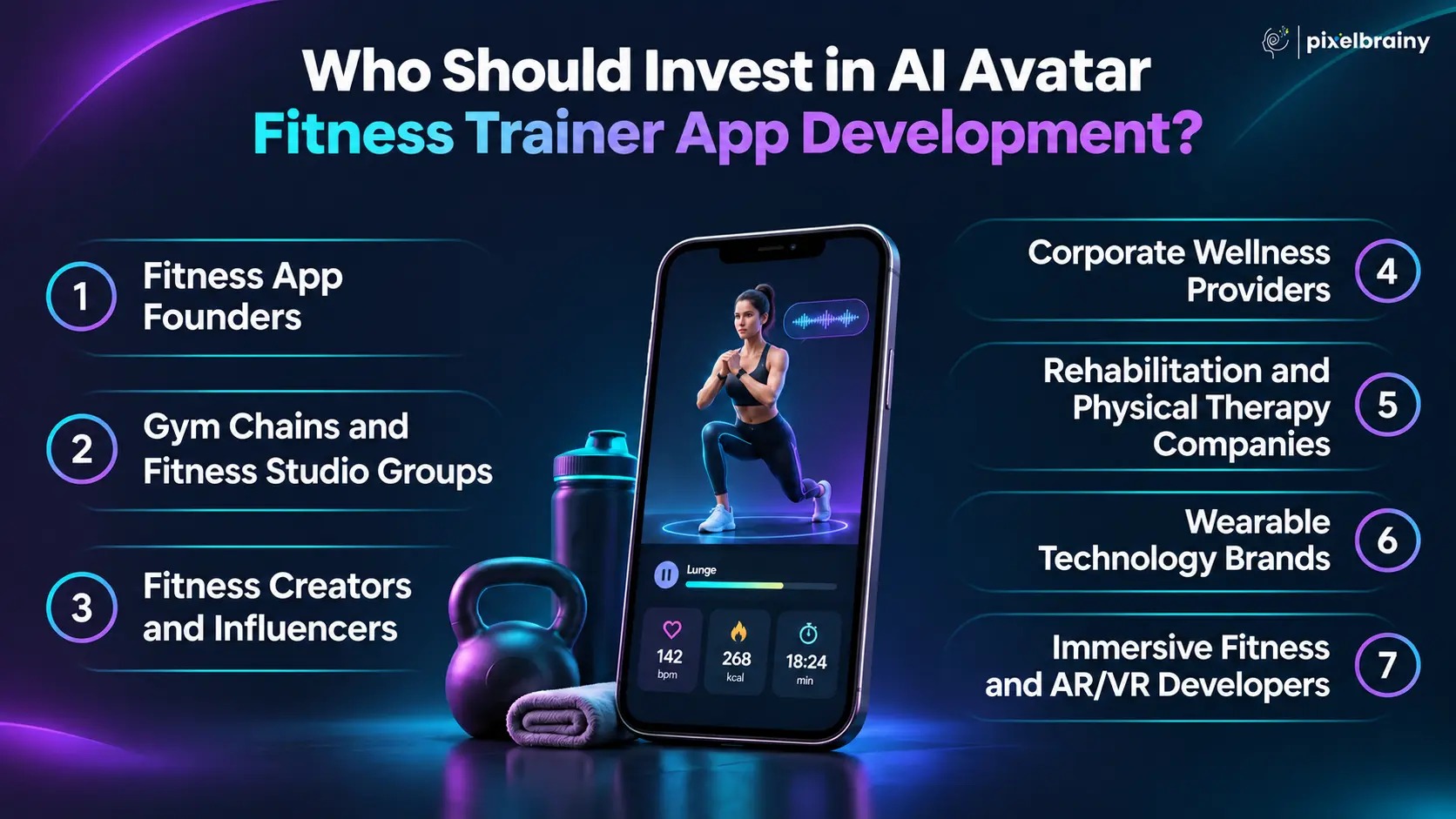
Fitness app founders can use AI avatars to differentiate their platforms in a competitive digital fitness market. Instead of relying entirely on pre-recorded workout videos, they can introduce interactive virtual trainers that guide users through exercises, provide real-time feedback, and recommend personalized workout plans.
For founders, the primary objectives are improving user retention, increasing subscription conversions, and encouraging consistent workout participation.
Features to prioritize:
This approach makes the creation of an AI avatar fitness trainer app a potential opportunity to build recurring revenue while delivering a more engaging fitness experience.
Gym chains and studio groups can use branded AI fitness trainers to extend their coaching experience beyond physical locations. Members can access virtual training sessions at home, while gyms can maintain a consistent coaching experience across multiple branches.
Businesses exploring how to create an AI avatar fitness trainer app for gyms, studios and corporate wellness in 2026 should focus on brand consistency, membership integration, and personalized member experiences.
Features to prioritize:
For example, a gym franchise can introduce its own virtual trainer to guide members through workouts between scheduled in-person sessions. This creates another digital touchpoint that supports member engagement and retention.
Fitness creators and influencers can turn their personal training identity into an always-available digital coaching experience. With custom avatar likeness and voice capabilities, creators can offer virtual workout guidance without personally recording every training session.
Businesses and creators looking to build an AI avatar fitness trainer app with custom trainer likeness and brand voice features should consider identity rights, voice permissions, and explicit consent as essential development requirements.
Features to prioritize:
This model allows creators to extend their personal brand, serve more users, and develop scalable digital fitness products.
Corporate wellness companies can use AI virtual trainers to deliver accessible fitness programs to distributed employees. An AI avatar can guide desk-based workouts, mobility sessions, stretching routines, and general physical activity programs.
However, enterprise adoption requires a privacy-first approach. Employee-level health and activity information should not be exposed to employers without an appropriate legal basis and user consent.
Features to prioritize:
For these providers, AI virtual workout coach avatar development should focus on accessibility, engagement, and responsible data management rather than individual employee surveillance.
Rehabilitation centers and physical therapy companies can explore AI avatar technology to support prescribed exercise routines and improve patient engagement between clinical appointments.
In this scenario, the avatar should complement professional care rather than replace a licensed clinician. Exercise recommendations must follow clinician-approved protocols, with appropriate safety escalation when users report pain, discomfort, or unexpected symptoms.
Features to prioritize:
The development approach should prioritize accuracy, clinical oversight, accessibility, and secure handling of sensitive health information.
Wearable brands can integrate AI fitness avatars with their existing fitness tracking ecosystems. By using authorized activity, sleep, and recovery data, virtual trainers can adapt workout suggestions to users' activity patterns and recovery status.
For example, an avatar might recommend a lighter session after a period of increased training load rather than automatically suggesting another high-intensity workout.
Features to prioritize:
For wearable companies, the goal is to make fitness tracking more actionable through AI-powered coaching experiences.
Immersive fitness developers can use AI avatars to create interactive training environments through augmented reality (AR) and virtual reality (VR). Users can exercise alongside virtual trainers in simulated gyms, interactive workout spaces, or gamified fitness environments.
Features to prioritize:
This category creates opportunities for AI virtual workout coach avatar development that combines fitness, immersive technology, and interactive entertainment.
The right business scenario determines the avatar fidelity, safety scope, required integrations, and business model. Whether targeting individual fitness users, gym franchises, healthcare providers, or enterprise brands, a successful AI avatar fitness trainer app should align its technology with the specific needs of its intended audience.
Building an AI avatar fitness trainer app offers fitness businesses more than an interactive workout experience. It creates opportunities to deliver personalized coaching, improve member engagement, automate routine training guidance, and develop new digital revenue streams. By combining artificial intelligence, computer vision, voice interaction, and personalized workout recommendations, businesses can make fitness coaching more accessible and scalable.
For example, We are a physical therapy and rehab company wanting an avatar coach that guides prescribed exercises, checks form, and reports adherence to clinicians. Which developers have built rehab exercise avatars with safety escalation and clinician dashboards? This is an important consideration because healthcare-focused fitness applications require clinician oversight, prescribed exercise workflows, secure data handling, and clearly defined safety boundaries.
So, what are the key benefits of AI avatar fitness trainer app development for gyms, fitness startups, healthcare providers, and enterprise wellness brands? Here are seven major advantages.
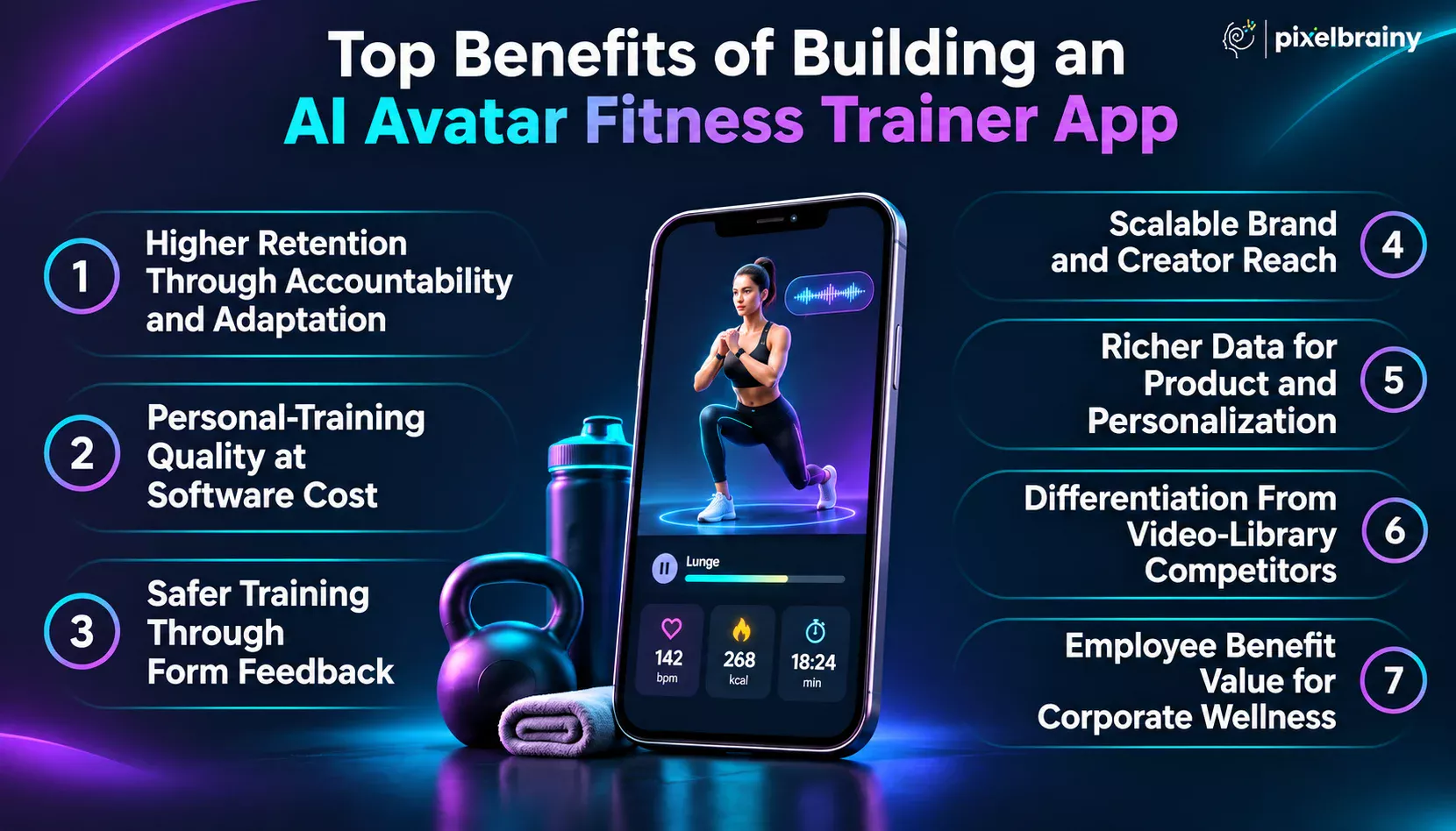
One of the biggest benefits of an AI avatar fitness trainer app is improved user retention through personalized coaching and consistent engagement. Unlike static workout libraries, AI-powered avatars can interact with users, provide exercise instructions, track progress, and recommend suitable workout adjustments.
Regular reminders, achievement tracking, and adaptive workout plans encourage users to maintain consistent fitness routines. When users receive coaching that reflects their progress and goals, they have more reasons to return to the app.
For fitness businesses, this can translate into better engagement, stronger subscription retention, and improved long-term customer relationships.
Hiring personal trainers for every user is expensive and difficult to scale. An AI avatar fitness trainer provides an alternative by delivering automated workout guidance, exercise demonstrations, and personalized training recommendations through software.
Users can follow guided sessions, receive voice-based instructions, and access workout plans without requiring a trainer to supervise every routine. Businesses can also offer different coaching experiences through subscription-based features.
Although AI avatars cannot fully replace qualified human trainers, they can make basic fitness guidance more accessible while helping businesses serve larger audiences without increasing coaching staff proportionally.
Incorrect exercise techniques can reduce workout effectiveness and increase the risk of injury. AI fitness trainer apps can use computer vision and supported motion-tracking technologies to analyze selected movements and provide corrective feedback during exercise sessions.
For example, an avatar can guide users through squats, lunges, or stretching routines while identifying detectable movement deviations. However, feedback accuracy depends on camera positioning, lighting, model validation, and exercise complexity.
For rehabilitation applications, developers should implement clinician-approved exercise protocols, conservative safety thresholds, and escalation workflows instead of allowing AI to independently modify prescribed treatment.
AI avatar technology allows fitness influencers, personal trainers, and gym brands to extend their coaching identity beyond physical training sessions. Businesses can build AI avatar fitness trainer apps featuring authorized trainer likenesses, branded voices, and personalized workout experiences.
A single digital trainer can guide thousands of users across different locations and time zones. Creators can also introduce multilingual coaching, premium workout subscriptions, and exclusive training programs.
This creates opportunities to expand audience reach, strengthen brand recognition, and generate recurring revenue without requiring trainers to personally deliver every session.
An AI avatar fitness trainer app can collect meaningful workout interaction data, including session completion, exercise preferences, training frequency, and user progress. When collected with appropriate consent, these insights help businesses understand how users engage with their fitness products.
Product teams can use aggregated behavioral patterns to improve workout recommendations, identify engagement gaps, and optimize the overall user experience.
Integration with supported wearables can provide additional activity and recovery context. For healthcare applications, access to patient-level information must follow applicable privacy requirements and authorized clinician workflows.
Traditional fitness apps often depend on pre-recorded workout videos and static exercise instructions. AI avatar fitness trainer app development introduces a more interactive approach by combining virtual trainers, conversational guidance, adaptive recommendations, and movement feedback.
Instead of simply watching an instructor demonstrate an exercise, users can interact with a digital coach that responds to supported inputs and guides them through structured workout sessions.
This creates a stronger product identity and gives fitness businesses additional opportunities to differentiate their offerings. Interactive coaching, branded avatars, and personalized experiences can also support premium subscription positioning.
Corporate wellness providers can use AI fitness avatars to deliver convenient workout guidance to employees across office locations, remote teams, and hybrid workplaces. Employees can access guided stretching, mobility exercises, desk workouts, and general fitness programs through a centralized digital platform.
Businesses can introduce organization-specific wellness programs, participation tracking, and aggregated engagement reports while maintaining appropriate employee privacy protections.
For employers, this adds value to existing wellness benefits without requiring trainers to conduct every session. For wellness providers, it creates an opportunity to deliver consistent fitness experiences across larger employee populations.
Ultimately, an AI avatar fitness trainer app helps businesses combine personalized coaching, scalable delivery, and interactive fitness experiences in one digital platform. The greatest value comes from aligning these benefits with measurable business goals and the specific needs of the target audience.
The success of an AI avatar fitness trainer app depends on the features that make virtual coaching practical, interactive, and easy to use. A well-designed application should combine personalized workout planning, realistic avatar interactions, exercise demonstrations, progress tracking, and secure user management. These foundational features help fitness businesses deliver consistent coaching experiences while making the platform suitable for individual users, gym members, and fitness communities.
When planning AI avatar fitness trainer app development, businesses should prioritize features that address everyday fitness activities rather than introducing unnecessary technical complexity. The objective is to create an application where users can select workout goals, follow guided exercises, interact with their virtual trainers, and monitor their fitness progress.
For example, What are the essential features required to develop an AI avatar fitness trainer app that provides personalized workout plans, real-time exercise guidance, progress tracking, and subscription-based coaching? The answer starts with building a strong foundation of user-facing features and an efficient administrative system.
The following 15 core features form the foundation of a functional AI avatar fitness trainer application.
| Core Feature | Description |
|---|---|
| User Registration and Profile Management | Allows users to create accounts, manage personal information, and maintain fitness profiles. Users can enter their age, weight, height, fitness experience, and other relevant details to personalize their training experience. |
| Fitness Goal Selection | Enables users to select specific fitness objectives, such as weight loss, muscle building, strength improvement, flexibility, or general fitness. These preferences help the application organize suitable workout recommendations and training programs. |
| AI Avatar Selection | Provides a selection of virtual fitness trainers with different appearances, personalities, and coaching styles. Users can choose an avatar that matches their preferences, making workout sessions more engaging and personalized. |
| Personalized Workout Plans | Generates workout schedules based on user goals, fitness levels, available time, and exercise preferences. The application organizes exercises into structured routines that help users follow consistent training schedules. |
| Avatar-Based Exercise Demonstrations | Displays exercises through animated virtual trainers that demonstrate movements, repetitions, and proper positioning. Users can follow visual instructions instead of depending entirely on traditional exercise videos or written descriptions. |
| AI Voice Instructions | Enables virtual trainers to communicate through spoken workout instructions, repetition counts, exercise reminders, and motivational messages. Voice guidance allows users to follow sessions without repeatedly checking their mobile screens. |
| Exercise Library | Provides an organized collection of exercises categorized by muscle groups, difficulty levels, workout types, and fitness goals. Users can explore individual exercises and understand their movements before starting training sessions. |
| Workout Session Management | Allows users to start, pause, resume, and complete workout sessions. It also displays exercise sequences, rest intervals, repetition targets, and session duration to maintain an organized training experience. |
| Workout Timer and Rest Intervals | Includes built-in timers for exercise duration, repetition intervals, and recovery periods between sets. These controls help users maintain workout consistency and follow structured training routines without external timing applications. |
| Basic Exercise Form Feedback | Uses supported camera-based movement analysis to identify selected exercise technique deviations and provide simple corrective suggestions. Feedback should be limited to validated movements and clearly communicate when automated assessment is uncertain. |
| Workout Progress Tracking | Records completed workouts, exercise frequency, session duration, and other relevant activity metrics. Users can review their training history to understand consistency, monitor improvements, and stay motivated toward fitness goals. |
| Fitness Dashboard | Provides a centralized overview of workout activity, fitness goals, completed sessions, and progress summaries. An easy-to-understand dashboard helps users access important fitness information without navigating multiple application screens. |
| Workout Reminders and Notifications | Sends scheduled workout reminders, training updates, and motivational notifications to encourage regular participation. Users can customize notification preferences according to their routines and preferred workout schedules. |
| Subscription and Payment Management | Supports paid fitness plans through subscription selection, secure payment processing, renewal management, and access to premium workout content. This feature helps businesses establish recurring revenue through digital coaching services. |
| Admin Dashboard and Content Management | Allows administrators to manage users, workout programs, exercise libraries, avatar content, subscriptions, and application activity. It provides operational control over the fitness platform without requiring direct access to application code. |
These 15 foundational features create the groundwork for an engaging, scalable AI avatar fitness trainer app that delivers personalized workout experiences while supporting business growth and user retention.
After you have finalized your core features, you can plan the next development phase by introducing advanced capabilities that make your AI avatar fitness trainer app more intelligent, interactive, and competitive. These features go beyond basic workout guidance and focus on deeper personalization, real-time interaction, predictive recommendations, and immersive fitness experiences.
During advanced AI avatar fitness trainer app development, businesses can explore technologies such as generative AI, computer vision, natural language processing (NLP), predictive analytics, and augmented reality (AR). Integrating the right capabilities can help fitness platforms deliver more responsive coaching experiences while creating opportunities for product differentiation.
For example, How can we develop an AI avatar fitness trainer app that uses real-time pose estimation, conversational AI, voice cloning, wearable data, and predictive analytics to deliver personalized coaching at scale? The answer depends on selecting advanced features that align with the application's target audience, technical requirements, and business objectives.
Here are 10 advanced features worth considering for the next phase of development.
| Advanced Feature | Description |
|---|---|
| Real-Time AI Pose Estimation | Uses advanced computer vision and pose estimation models to identify body landmarks during exercise sessions. It analyzes selected movements, joint positions, and movement patterns to provide more detailed feedback on exercise execution and technique. |
| Conversational AI Fitness Coach | Integrates large language models (LLMs) and natural language processing to enable natural conversations between users and virtual trainers. Users can ask fitness-related questions, discuss workout preferences, and receive context-aware responses within defined coaching boundaries. |
| Hyper-Personalized Adaptive Training | Uses machine learning algorithms to analyze workout history, user performance, preferences, and fitness progress. The system can recommend suitable changes to training intensity, exercise selection, and workout schedules based on supported data. |
| Custom AI Avatar Creation | Allows businesses or authorized trainers to create highly customized digital fitness personalities using 2D or 3D modeling, facial animation, and approved visual references. This supports distinctive branded coaching experiences across fitness platforms. |
| AI Voice Cloning and Multilingual Coaching | Enables authorized trainers and creators to use consent-based synthetic voice models for virtual coaching. Multilingual speech generation can deliver instructions in different languages, helping fitness businesses reach users across diverse geographic markets. |
| Predictive Injury Risk Indicators | Analyzes validated movement patterns, training history, and available activity data to identify potential warning signs that may require attention. The system can recommend pausing an activity or seeking professional assessment, but should not claim to diagnose or predict injuries with clinical certainty. |
| Wearable and IoT Ecosystem Integration | Connects the application with compatible smartwatches, fitness bands, heart rate monitors, and other supported devices. This allows the AI coach to incorporate activity, heart rate, and recovery-related information into personalized workout recommendations. |
| AR-Based Interactive Training | Uses augmented reality to overlay virtual exercise guidance, movement demonstrations, and visual training instructions within the user's physical surroundings. This can make home workouts more interactive while helping users understand exercise positioning and movement sequences. |
| VR-Based Immersive Fitness Experiences | Creates virtual workout environments where users can train alongside realistic AI avatars in simulated gyms, studios, or interactive fitness spaces. VR integration can combine avatar coaching, spatial interactions, and gamified workout experiences. |
| AI-Powered Performance Analytics and Predictions | Applies advanced analytics and machine learning to identify long-term workout patterns, performance trends, engagement behavior, and training consistency. Businesses can use these insights to improve personalization, evaluate program effectiveness, and make informed product decisions. |
Integrating these advanced capabilities can transform a standard AI avatar fitness trainer app into an intelligent, adaptive, and immersive fitness platform that delivers greater personalization and long-term engagement.
Also Read: Top 12 AI Avatar Development Companies in USA
Building an AI avatar fitness trainer app requires more than integrating an animated trainer into a mobile application. It involves identifying the target audience, selecting the right AI technologies, designing interactive user experiences, developing intelligent coaching capabilities, and testing the application before launch. A structured development approach helps businesses control costs, reduce technical risks, and build a product that meets actual fitness market requirements.
If you are exploring the steps to develop an AI avatar fitness trainer app from idea to launch, it is important to understand how each development phase contributes to the final product. From initial research and AI model selection to avatar creation, application development, and deployment, every stage requires careful planning.
Consider this real-world requirement: We want real-time form correction using the phone camera, with the avatar counting reps and cueing posture fixes. Which developers have built pose-estimation fitness apps with accurate on-device performance and low latency? This requirement highlights why businesses must evaluate computer vision capabilities, device compatibility, model performance, and real-time processing requirements before selecting their development approach.
Here are eight essential steps explaining how to build an AI avatar fitness trainer app from scratch.
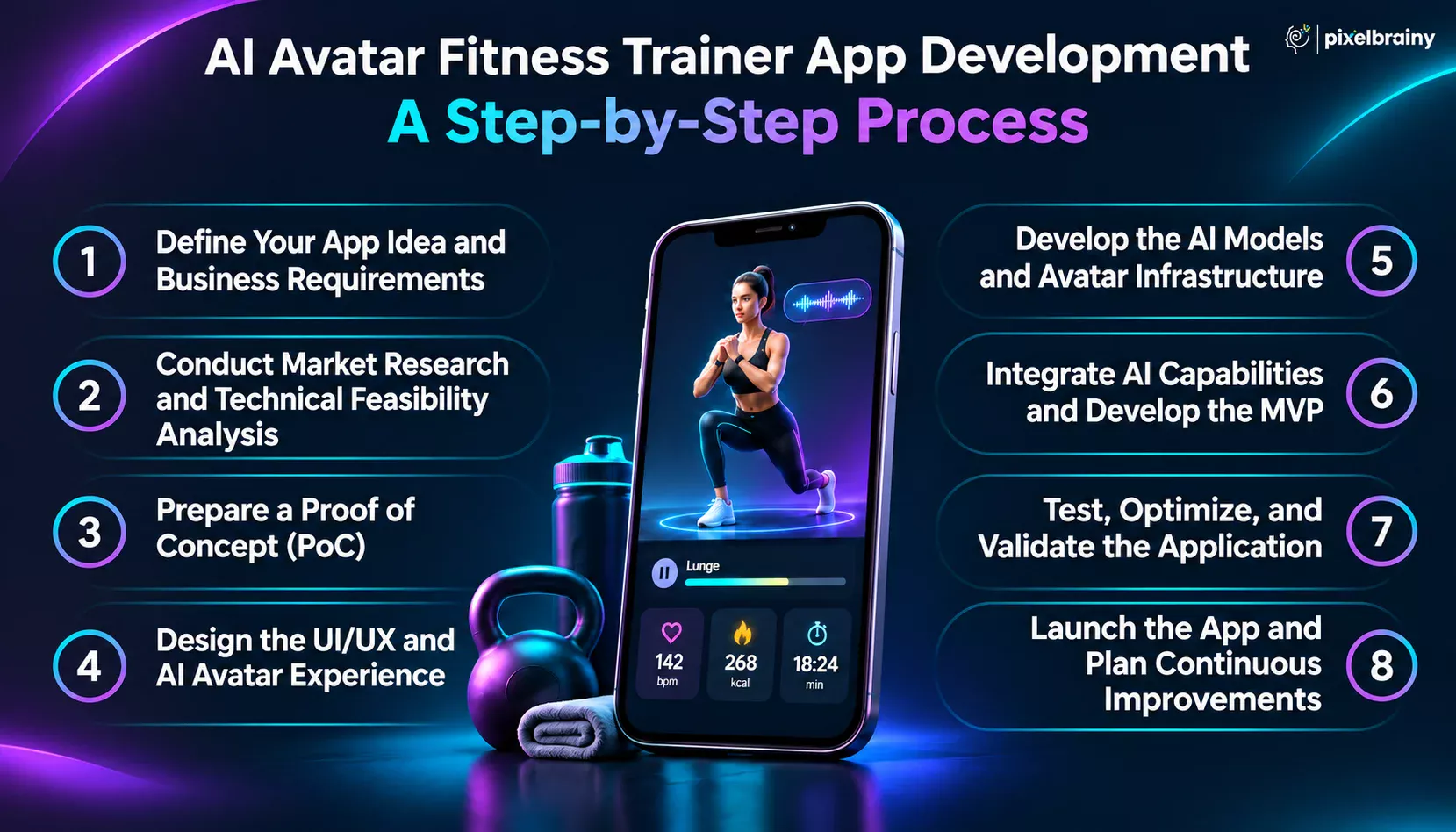
The first step in building an AI avatar fitness trainer app is defining what the application should achieve and whom it will serve. Identify whether your target audience includes individual fitness enthusiasts, gym members, personal trainers, rehabilitation providers, or corporate wellness companies.
Next, define the app's primary purpose, monetization strategy, and expected user experience. Decide whether you need personalized workout recommendations, avatar-based exercise demonstrations, voice interaction, or camera-based form feedback.
Prepare a detailed requirement document covering essential features, target platforms, user roles, and business objectives. This initial planning establishes a clear direction for subsequent development activities.
Once your requirements are defined, research existing fitness applications, competitor offerings, customer expectations, and emerging AI coaching technologies. Evaluate what competing platforms offer and identify opportunities to differentiate your product through interactive avatars, personalized training, or intelligent workout recommendations.
Next, assess the technical feasibility of your proposed features. Determine whether your application requires generative AI, computer vision, speech recognition, motion tracking, or wearable integrations. Businesses can consult top AI development companies to evaluate technology choices, infrastructure requirements, and implementation challenges.
This stage helps establish a realistic development roadmap, prioritize features, and avoid unnecessary technical investments.
Before investing in complete application development, validate the most technically challenging parts of your idea through a small proof of concept. For example, test whether a virtual trainer can demonstrate exercises, recognize selected body movements, count repetitions, and deliver basic voice instructions.
PoC development helps identify technical limitations involving camera positioning, pose estimation, avatar animation, processing speed, and device compatibility. It also allows stakeholders to evaluate whether the proposed AI capabilities can deliver the expected experience.
A successful proof of concept provides early technical validation and helps businesses make informed decisions before moving toward full-scale development.
Also Read: Top 10+ AI PoC Development Companies In USA
The next step is designing an intuitive application interface and creating an engaging virtual trainer experience. Focus on simple navigation, readable workout instructions, accessible controls, and clear progress visualizations.
Work with a UI/UX design company to develop user journeys, wireframes, interactive prototypes, and high-fidelity application screens. At the same time, define the avatar's appearance, movement style, voice, personality, and interaction patterns.
Pay particular attention to workout screens because users should be able to follow exercise demonstrations without unnecessary distractions. The design should also accommodate different screen sizes, accessibility requirements, and user fitness experience levels.
Also Read: Top 10+ UI/UX Design Companies in USA
After finalizing the design, begin developing the application's AI foundation and virtual trainer infrastructure. This stage may involve selecting existing AI models, customizing machine learning systems, and building specialized models for exercise recognition, pose estimation, or personalized recommendations.
AI model development should focus on the application's actual requirements rather than adding unnecessary intelligence. For example, computer vision models can identify selected body landmarks, while speech technologies support voice-based interactions.
Businesses can hire AI developers with relevant experience in machine learning, computer vision, speech processing, and real-time application development to build and optimize these capabilities.
Also Read: Top 12+ AI Model Development Companies in the USA
Once the foundational models and avatar assets are ready, integrate them into the mobile or web application. This is where AI integration connects virtual trainers with workout recommendations, voice instructions, movement analysis, and user progress data.
Start with MVP development by implementing the most important features required to deliver a usable fitness coaching experience. These may include user registration, avatar selection, workout planning, exercise demonstrations, basic form feedback, and progress tracking.
Keep the initial product focused on its core value proposition. This approach allows businesses to test the application with actual users, collect feedback, and prioritize improvements before investing in additional capabilities.
Also Read: Top 10 AI MVP Development Companies in USA
Before launch, thoroughly test the application to ensure that its features work reliably across supported devices and operating systems. Evaluate avatar animations, workout instructions, AI responses, subscription workflows, data synchronization, and camera permissions.
For applications offering real-time exercise correction, test pose-estimation accuracy, repetition counting, processing latency, and performance under different lighting and camera conditions. Healthcare-oriented fitness applications may also require specialized clinical validation and professional oversight. Businesses developing such products can evaluate top AI healthcare software development companies for relevant compliance and safety expertise.
Also conduct usability, performance, security, and compatibility testing to identify issues before public release.
Also Read: Top 10+ AI Healthcare App Development Companies in USA
After successful testing, prepare the application for release through the relevant app distribution platforms or enterprise deployment channels. Complete the necessary store listings, documentation, privacy disclosures, subscription configurations, and launch preparations.
Work with experienced AI product development companies when additional support is required for deployment, infrastructure optimization, and post-launch improvements. An AI consultation can also help identify future opportunities for model optimization and feature expansion.
After launch, monitor user retention, workout completion rates, subscription conversions, application crashes, and customer feedback. Use these insights to improve the coaching experience, optimize AI performance, and introduce new features based on actual user requirements.
Following these eight steps creates a structured development roadmap to turn your AI fitness trainer concept into a functional, scalable, and market-ready application.
Also Read: AI Fitness Trainer & Coach App Development: Features, Steps and Cost
The cost to build an AI avatar fitness trainer app in 2027 typically ranges from $40,000 to $300,000+, depending on AI capabilities, avatar realism, workout personalization, platform compatibility, and third-party integrations. A basic virtual fitness coach requires a smaller investment, while applications featuring real-time pose estimation, custom trainer likenesses, and advanced analytics demand higher development budgets.
For example, "I am comparing three proposals from $50,000 to $250,000 for similar avatar trainer features. What should I ask about pose-detection accuracy, personalization logic, avatar realism, and safety screening to tell a genuine AI coach from a video library with a cartoon character?"
This is an important question when evaluating the AI avatar fitness trainer app development cost breakdown for fitness startups in 2027. Businesses should compare vendors based on demonstrated AI capabilities, measurable performance, safety validation, and technical deliverables rather than feature lists alone.
The following table provides estimated component-wise development costs across three application tiers.
| Development Component | Basic MVP | Standard App | Full Platform |
|---|---|---|---|
| Avatar and animation | $5K-$12K | $12K-$25K | $25K-$60K |
| Voice integration | $2K-$5K | $5K-$10K | $10K-$20K |
| Pose and form models | $3K-$8K | $10K-$25K | $25K-$55K |
| Personalization engine | $3K-$7K | $8K-$18K | $18K-$35K |
| Wearable integrations | Limited or excluded | $8K-$15K | $15K-$30K |
| Mobile applications | $10K-$20K | $18K-$35K | $35K-$65K |
| Billing and subscriptions | $2K-$4K | $4K-$7K | $7K-$12K |
| Backend and admin dashboard | $8K-$15K | $15K-$25K | $25K-$45K |
| App Type | Estimated Development Cost |
|---|---|
| Basic Avatar Coach MVP | $40,000 to $100,000 |
| Standard App With Form Correction and Wearables | $100,000 to $260,000 |
| Full Platform With Custom Likeness and Analytics | $260,000 to $550,000 |
| Enterprise or Immersive Multi-Platform | $550,000 to $1,200,000+ |
The development budget of an AI avatar fitness trainer app primarily depends on avatar customization, computer vision accuracy, AI personalization, voice processing, and supported platforms.
Real-time movement correction requires additional model validation, device optimization, and safety testing. Custom 3D avatars, multilingual coaching, wearable integrations, and healthcare-specific requirements can further increase development costs.
The AI avatar fitness trainer app cost also includes recurring expenses for LLM and voice API usage, cloud hosting, AI inference, security monitoring, workout content updates, and software maintenance.
These expenses vary according to active users, workout session frequency, infrastructure requirements, and third-party service pricing.
| Development Team | Estimated Project Budget |
|---|---|
| Freelance Development Team | $40,000 to $100,000 |
| Specialized AI Development Agency | $80,000 to $300,000 |
| Enterprise AI Development Partner | $250,000 to $1,200,000+ |
Yes, the cost to make an AI avatar fitness trainer app within a $250,000 budget and 8-week timeline can be realistic for a carefully scoped standard application. This budget may cover mobile app development, customized avatar integration, workout personalization, selected real-time pose correction, wearable connectivity, subscription management, and an administrative dashboard.
However, businesses should confirm pose-detection accuracy targets, personalization logic, avatar animation quality, safety screening requirements, and acceptance criteria before selecting a development partner.
Highly realistic custom avatars, proprietary AI models, clinical validation, and immersive AR/VR experiences may require additional investment and development time.
Understanding how much AI avatar fitness trainer app development costs helps businesses select the right features, evaluate development proposals, and build a scalable fitness coaching platform within a realistic budget.
Also Read: AI Fitness App Development Cost: Factors & Examples
Developing an AI avatar fitness trainer app requires a combination of artificial intelligence, machine learning, computer vision, 3D animation, cloud infrastructure, and mobile application technologies. Each technology plays a specific role in creating realistic virtual trainers, delivering personalized workout recommendations, analyzing exercise movements, and enabling real-time interactions between users and AI avatars.
The technology stack for AI avatar fitness trainer app development depends on the application's complexity, target platforms, expected user experience, and business requirements. For example, a basic virtual coaching application may require pre-built AI models and 3D avatar assets, whereas an advanced fitness platform may need custom pose estimation, conversational AI, and real-time motion processing.
Consider this practical query: What technology stack is required to build an AI avatar fitness trainer app with real-time pose estimation, accurate repetition counting, voice-based coaching, personalized workout recommendations, and realistic 3D avatars?
The following table highlights the major tools and technologies required to create an AI avatar fitness trainer app in 2027.
| Technology Category | Tools and Technologies | Purpose and Application |
|---|---|---|
| Programming Languages | Python, JavaScript, TypeScript, Swift, Kotlin | Python supports AI and machine learning development, while JavaScript and TypeScript support application interfaces and backend services. Swift and Kotlin enable native iOS and Android development. |
| Frontend Development | React Native, Flutter, React.js | These frameworks help developers build responsive mobile and web interfaces. Flutter and React Native support cross-platform application development, while React.js is suitable for browser-based dashboards and administration panels. |
| Backend Development | Node.js, Django, FastAPI, NestJS | Backend technologies manage user accounts, workout sessions, subscriptions, application APIs, and communication between AI services and frontend applications. |
| AI and Machine Learning | TensorFlow, PyTorch, Scikit-learn | These frameworks support machine learning model development, exercise classification, personalized workout recommendations, and performance analysis using relevant user and activity data. |
| Computer Vision and Pose Estimation | MediaPipe, OpenCV, MoveNet | These technologies help detect body landmarks, track movements, identify exercise patterns, and support repetition counting and basic exercise form analysis through compatible cameras. |
| Generative AI and Conversational Coaching | OpenAI APIs, LangChain, Hugging Face | These technologies support conversational fitness assistants, natural language interactions, contextual workout guidance, and AI-generated coaching responses within predefined safety boundaries. |
| 3D Avatar Creation and Animation | Unity, Unreal Engine, Blender | These tools help create virtual trainers, realistic character models, exercise animations, facial expressions, and interactive 3D workout environments. |
| Voice Recognition and Speech Generation | Whisper, Azure Speech, Google Cloud Speech-to-Text, ElevenLabs | Speech technologies enable voice commands, speech recognition, spoken exercise instructions, and synthetic trainer voices for interactive coaching experiences. |
| Database Management | PostgreSQL, MongoDB, Redis | Databases store user profiles, workout histories, exercise libraries, application preferences, and session information. Redis can support caching and low-latency data access. |
| Cloud Infrastructure | AWS, Microsoft Azure, Google Cloud | Cloud platforms provide application hosting, storage, computing resources, database services, and infrastructure for scaling AI fitness applications as user demand increases. |
| Wearable and Device Integration | Apple HealthKit, Android Health Connect, Fitbit Web APIs | These integrations enable applications to access supported fitness and activity information, including workout records, heart rate, and other authorized health metrics. |
| Payment Integration | Stripe, Razorpay, Apple In-App Purchase, Google Play Billing | Payment technologies support subscription plans, premium workout packages, recurring payments, and secure transaction management across supported platforms. |
| Testing and Performance Monitoring | Firebase Crashlytics, Postman, Appium, Sentry | These tools help developers test APIs, identify application crashes, validate mobile functionality, monitor performance, and improve application reliability before and after launch. |
Therefore, the right combination of AI, computer vision, avatar development, and cloud technologies creates a strong technical foundation for building a scalable and interactive AI avatar fitness trainer app.
Data privacy, regulatory compliance, and security are essential considerations in AI avatar fitness trainer app development, particularly when applications collect personal information such as fitness profiles, workout history, camera-based movement data, voice recordings, and wearable metrics. Applications supporting rehabilitation may also process sensitive medical records, requiring additional privacy safeguards.
The applicable regulations depend on the target market, business model, and type of information collected.
For example, What compliance requirements and security controls are needed to build an AI avatar fitness trainer app that collects camera-based movement data, integrates wearables, and provides personalized health-related coaching across the US, UK, EU, and India?
To answer this, businesses must understand the major data protection regulations, AI governance requirements, and security practices involved in creating a compliant AI fitness coaching platform.
GDPR applies to businesses processing personal data of individuals in the EU under its territorial scope.
For an AI avatar fitness trainer app, GDPR compliance involves:
HIPAA applies to covered healthcare entities and their business associates handling protected health information (PHI).
If your AI fitness application works with hospitals, rehabilitation centers, or healthcare providers, assess whether HIPAA applies.
Important safeguards include:
Also Read: How to Develop HIPAA-Compliant AI Healthcare Software: Architecture, Use Cases, Steps & Challenges
Businesses meeting applicable thresholds may need to comply with California privacy requirements.
For AI avatar fitness trainer app development, relevant responsibilities include:
The FTC Health Breach Notification Rule can apply to certain health applications and personal health record providers not covered by HIPAA.
Businesses should establish procedures to detect, investigate, document, and report qualifying data breaches involving identifiable health information.
This is particularly important for applications integrating wearable devices and third-party health platforms.
India's Digital Personal Data Protection Act, 2023, and DPDP Rules, 2025, establish requirements for digital personal data processing.
Businesses planning to launch an AI avatar fitness trainer app in India should consider:
AI fitness applications should assess whether their functionality falls under additional AI or medical-device regulations.
The EU AI Act introduces requirements based on an AI system's intended purpose and classification. Similarly, FDA regulations may apply to applications qualifying as medical device software.
For example, general workout recommendations may have different regulatory implications from software intended to diagnose medical conditions or guide clinical rehabilitation.
Along with regulatory compliance, businesses should implement strong security controls during AI avatar fitness trainer app development.
An AI virtual fitness trainer app may process facial images, voice samples, and identifiable movement information.
Businesses should obtain appropriate authorization before replicating trainer likenesses or voices, explain camera permissions, protect movement data, and disclose AI-generated interactions.
For rehabilitation applications, clinician-approved exercise protocols, professional oversight, and safety escalation workflows are particularly important.
Overall, integrating privacy-first architecture, regulatory safeguards, and strong security controls helps businesses create a trustworthy, secure, and compliant AI avatar fitness trainer app.
Creating a successful AI avatar fitness trainer app requires more than integrating AI models and designing realistic virtual trainers. Businesses must focus on exercise recognition accuracy, personalized coaching, user experience, data privacy, and application performance to deliver a reliable digital fitness experience.
Following the right AI avatar fitness trainer app development best practices helps businesses reduce technical risks, improve user retention, and build scalable fitness platforms.
For example, what are the best practices for developing an AI avatar fitness trainer app that delivers accurate real-time exercise feedback, personalized workout recommendations, safe AI coaching, and consistent performance across different mobile devices?
Here are six important best practices to consider when planning and developing an AI-powered fitness coaching application.
Accuracy is essential when developing an AI avatar fitness trainer app that provides real-time exercise guidance. Use reliable computer vision and pose estimation models to recognize supported exercises, track body movements, count repetitions, and identify movement deviations.
Test models under different lighting conditions, camera angles, body types, and device configurations. Avoid providing corrective feedback when the system cannot confidently recognize a movement.
An AI fitness avatar should deliver an engaging coaching experience rather than function as a decorative animated character. Focus on natural movements, synchronized voice instructions, realistic exercise demonstrations, and consistent avatar behavior.
Provide customization options for avatar appearance, voice, personality, and coaching style. Obtain appropriate consent before using a real trainer's likeness or cloned voice.
Personalization is one of the most important features of AI avatar fitness trainer app development. Every user has different fitness goals, experience levels, physical capabilities, and workout preferences.
Use relevant workout history, user preferences, and authorized wearable information to recommend suitable exercise routines and training schedules. Keep automated adjustments within predefined safety boundaries and allow users to review or modify their preferences.
An AI virtual fitness coach app may process personal profiles, camera data, voice recordings, and sensitive health information. Apply privacy-by-design principles throughout the development lifecycle.
Implement data encryption, secure authentication, role-based permissions, transparent consent management, and appropriate data retention policies. Regularly assess vulnerabilities and restrict access to sensitive user information.
Real-time AI coaching requires efficient processing, particularly when smartphone cameras are used for exercise analysis and repetition counting.
Optimize AI models for supported devices, reduce unnecessary network requests, and use on-device processing where appropriate. Test application responsiveness, battery consumption, camera performance, and avatar animation quality across different mobile devices.
Successful AI avatar fitness trainer app development does not end with the initial launch. Monitor important performance indicators, including workout completion, user retention, exercise recognition accuracy, subscription conversions, and application crashes.
Collect user feedback, evaluate AI-generated recommendations, and regularly update models and application components. For rehabilitation-focused applications, include qualified clinical oversight and documented safety validation.
Closing Statement: Following these AI avatar fitness trainer app development best practices helps businesses create a reliable, secure, and scalable fitness platform that delivers personalized coaching and long-term user engagement.
Monetizing an AI avatar fitness trainer app requires a business model that generates recurring revenue while delivering measurable value to users and business customers. Depending on the target audience, businesses can generate income through subscriptions, licensing agreements, corporate wellness programs, creator partnerships, and white-label solutions.
The right AI avatar fitness trainer app monetization strategy depends on the application's features, target market, customer acquisition approach, and long-term growth objectives.
For example, how can fitness startups monetize an AI avatar fitness trainer app through individual subscriptions, gym partnerships, corporate wellness contracts, and customized virtual coaching experiences?
Here are seven effective monetization models to consider when planning your AI fitness application's revenue strategy.
A subscription-based model allows individual users to pay monthly or annually for access to AI-powered fitness coaching. You can offer free basic workouts while charging for premium features such as personalized training plans, advanced avatar interactions, voice coaching, and workout analytics.
This model creates predictable recurring revenue and encourages long-term user engagement. Different subscription tiers can accommodate beginners, fitness enthusiasts, and advanced users.
Gym chains and fitness franchises can license your AI avatar fitness trainer app to provide branded digital coaching experiences to their members. Charge licensing fees based on the number of locations, active members, or selected application features.
This B2B monetization approach helps expand your platform across multiple gym locations while generating recurring licensing revenue.
Fitness influencers, personal trainers, and content creators can use customized AI avatars to offer exclusive digital coaching experiences. Generate revenue through paid workout programs, premium subscriptions, and creator-specific fitness content.
You can share subscription or transaction revenue with creators based on agreed commercial terms. This model encourages creator participation while expanding your application's audience.
Corporate wellness providers can offer AI-powered fitness coaching as an employee benefit. Charge organizations a recurring fee based on the number of enrolled employees or active users.
Include features such as guided workouts, personalized fitness programs, and aggregated engagement reports. Enterprise contracts can create predictable revenue while helping businesses strengthen their employee wellness offerings.
Rehabilitation centers and physical therapy providers can license specialized AI avatar coaching applications to support clinician-prescribed exercise programs. Pricing can depend on the number of clinicians, patient accounts, locations, or platform capabilities.
Additional paid services may include clinician dashboards, rehabilitation program management, and secure patient reporting. Clinical oversight and appropriate regulatory safeguards should remain part of the service.
Partner with wearable manufacturers to bundle your AI avatar fitness trainer app with smartwatches, fitness bands, or other supported tracking devices. Generate revenue through partnership commissions, bundled subscriptions, or premium coaching packages.
Wearable integrations can make personalized training more valuable by incorporating authorized activity and recovery information into workout recommendations.
Offer a white-label version of your AI avatar fitness trainer app to gyms, fitness studios, wellness companies, and personal training businesses. Customers can customize the platform with their branding, trainer avatars, workout libraries, and membership offerings.
Generate revenue through initial setup fees, customization charges, and recurring licensing agreements. This model is particularly useful for expanding into multiple business segments without creating separate applications for every customer.
For sustainable growth, consider combining consumer subscriptions with B2B monetization channels such as gym licensing, corporate wellness contracts, and rehabilitation clinic partnerships.
Consumer subscriptions generate recurring individual revenue, while B2B agreements provide opportunities for larger contracts and broader market reach.
A diversified monetization strategy helps turn an AI avatar fitness trainer app into a scalable business with multiple recurring revenue streams and long-term growth opportunities.
An AI avatar fitness trainer app involves several technical, operational, and business challenges that can affect its performance, accuracy, and user experience. From maintaining accurate exercise recognition to creating realistic avatars and protecting sensitive user information, businesses must address multiple factors to deliver reliable virtual fitness coaching.
Identifying these challenges early helps businesses reduce development risks, control costs, and improve application performance.
For example, what are the biggest challenges in AI avatar fitness trainer app development, particularly with real-time pose estimation, inaccurate exercise feedback, AI hallucinations, avatar realism, and user data privacy?
Here are six common challenges and their practical solutions.
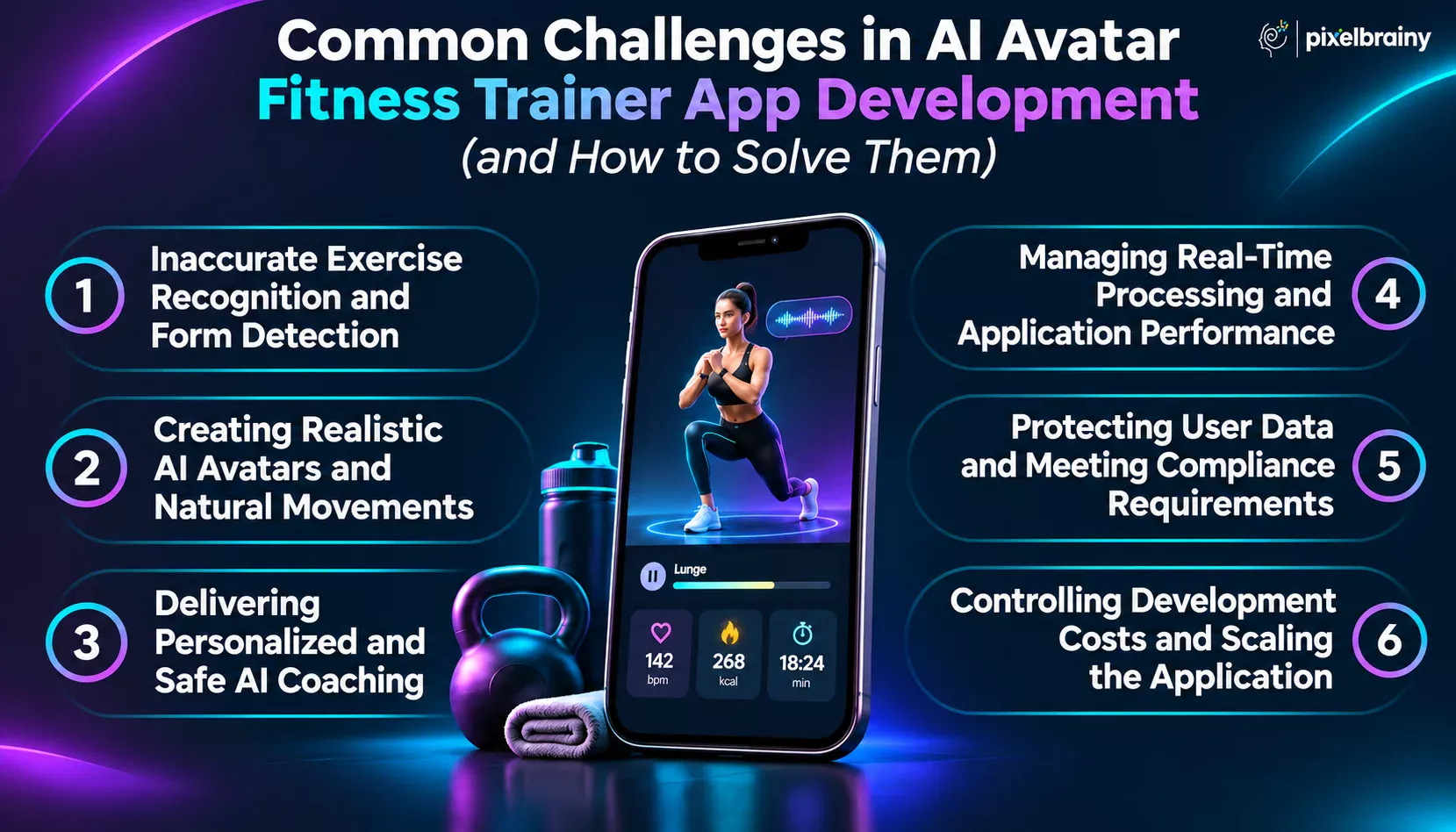
Challenge: Computer vision models may struggle to recognize exercises accurately under different lighting conditions, camera angles, clothing types, and body positions. Incorrect movement detection can result in misleading posture corrections and repetition counts.
Solution: Train and validate pose estimation models using diverse, representative datasets. Test supported exercises across different devices and environments. Introduce confidence thresholds and avoid providing corrective feedback when movement recognition is uncertain.
Challenge: Poor-quality animations, unnatural facial expressions, delayed lip synchronization, and robotic voice interactions can make virtual trainers less engaging.
Solution: Use suitable 3D modeling and animation technologies to create natural avatar movements. Optimize facial expressions, voice synchronization, and exercise demonstrations. Allow businesses to customize trainer appearance and communication styles according to their brand identity.
Challenge: Generic workout recommendations may not address individual fitness levels, physical limitations, or training goals. AI-generated responses can also contain inaccurate or unsuitable exercise suggestions.
Solution: Combine user profiles, workout history, validated exercise libraries, and predefined coaching rules. Introduce safety boundaries, confidence checks, and professional oversight for rehabilitation-related recommendations. Avoid allowing AI to independently prescribe medical treatments.
Challenge: Real-time pose estimation, avatar animation, and voice processing can consume significant computing resources. Delays in movement feedback may interrupt workout sessions and reduce user satisfaction.
Solution: Optimize AI models for supported devices and use on-device processing where practical. Apply efficient model architectures, caching, and asynchronous processing. Conduct performance testing across different mobile devices to maintain responsive coaching experiences.
Challenge: AI fitness applications may collect sensitive information through cameras, microphones, wearable integrations, and user profiles. Unauthorized access or improper data handling can damage user trust and create regulatory risks.
Solution: Implement encryption, secure authentication, role-based access controls, and transparent consent management. Minimize unnecessary data collection and establish clear retention policies. Evaluate applicable privacy regulations before launching in different markets.
Challenge: Custom AI models, realistic avatars, wearable integrations, and multi-platform development can increase the initial investment. Growing user numbers can also increase cloud hosting and AI inference expenses.
Solution: Start with a focused MVP containing essential coaching capabilities. Validate technically complex features before full implementation and use suitable existing AI models where possible. Monitor infrastructure usage and introduce scalable cloud architecture as the user base expands.
Addressing these challenges through careful technology selection, continuous testing, and responsible AI implementation helps businesses develop a reliable and scalable AI avatar fitness trainer app that delivers meaningful fitness experiences.
Businesses looking to enter the AI-powered fitness market need more than an application development team. They need a technology partner that understands artificial intelligence, healthcare software, fitness workflows, user experience, and scalable product architecture. PixelBrainy brings these capabilities together to help businesses turn their fitness app concepts into practical digital products.
As a best AI healthcare software development company in USA, PixelBrainy combines AI engineering expertise with healthcare technology knowledge to support businesses planning personalized and interactive fitness experiences. Whether you want to build an AI avatar fitness trainer app for individual users, gyms, fitness brands, or corporate wellness programs, our team can help define the right features, technology stack, and development roadmap.
Consider a confidential fitness technology project where the business wanted an interactive virtual coach to guide users through personalized exercise sessions. The proposed experience included avatar-led demonstrations, voice instructions, workout recommendations, progress tracking, and movement feedback through a device camera.
The project approach involved defining the MVP scope, designing the user journey, integrating AI capabilities, structuring workout data, and testing the experience across different devices. Special attention was given to the reliability of exercise feedback, response time, and the way users received coaching instructions. The objective was to make the experience engaging without presenting AI-generated feedback as a substitute for professional medical advice.
This type of structured approach helps businesses develop an AI avatar fitness trainer app around genuine user needs rather than adding AI features without a clear purpose.
If you are planning to create a avatar fitness trainer app integrating AI, PixelBrainy can help you evaluate the concept, identify the right technologies, and plan the development journey.
Connect with PixelBrainy to discuss your AI fitness product and turn your idea into a scalable application.
AI avatar fitness trainer apps are changing how people experience digital fitness through personalized workouts, interactive virtual coaching, real-time exercise feedback, and progress tracking. However, turning this concept into a successful product requires more than integrating AI. Businesses must carefully plan the app's features, development process, technology stack, budget, data security, compliance requirements, and monetization strategy.
A well-planned AI avatar fitness trainer app development strategy helps create a solution that delivers meaningful user experiences while supporting scalability and long-term business goals. Whether you are entering the fitness technology market or expanding an existing platform, choosing the right development approach and technology partner can make a significant difference.
PixelBrainy helps businesses transform AI-powered fitness concepts into practical, scalable digital solutions.
Ready to take the next step? Book an appointment with PixelBrainy to discuss your AI avatar fitness trainer app idea with our experts.
Start with an MVP that includes user onboarding, fitness assessments, personalized workout plans, avatar demonstrations, and voice instructions. Before investing in AI avatar fitness trainer app development services, define your target audience, business model, essential features, and expected AI capabilities.
Yes. You can build an AI avatar fitness trainer app with personalized workout plans, interactive avatar demonstrations, voice-based instructions, and progress tracking. AI models can analyze user activity and fitness goals to adjust recommendations, while safety rules help prevent unsuitable exercise guidance.
To develop an AI avatar fitness trainer app with posture detection, you need computer vision and pose estimation models. These technologies analyze body landmarks through the camera, identify movement deviations, count repetitions, and provide corrective prompts. Accuracy testing across different users and devices is essential.
Yes. You can create a avatar fitness trainer app integrating AI with custom 3D avatars, authorized facial likenesses, voice synthesis, and conversational AI. This allows businesses to offer branded virtual trainers that demonstrate exercises, deliver personalized instructions, and maintain a consistent coaching experience.
Use validated exercise content, predefined coaching rules, confidence thresholds, and safety restrictions. An AI fitness application should avoid uncertain corrections, communicate limitations clearly, and recommend professional guidance when necessary. Regular model testing helps improve movement recognition and coaching reliability.
Yes. A multi-tenant architecture allows one platform to support multiple gyms with separate branding, workout libraries, membership plans, and administrative dashboards. Businesses can manage their users independently while sharing the underlying AI infrastructure, reducing operational complexity as the platform expands.
Integrate Apple HealthKit, Android Health Connect, and supported wearable APIs to retrieve permitted activity, heart rate, and workout data. These integrations help personalize fitness recommendations, monitor user progress, and provide performance insights based on available wearable information and user permissions.
Evaluate the company's experience in AI model development, computer vision, 3D avatars, wearable integrations, mobile applications, and data security. Request a detailed estimate covering MVP development, advanced features, infrastructure, third-party services, maintenance, and post-launch technical support.

About The Author
Sagar Bhatnagar
Sagar Sahay Bhatnagar brings over a decade of IT industry experience to his role as Marketing Head at PixelBrainy. He's known for his knack in devising creative marketing strategies that boost brand visibility and market influence. Sagar's strategic thinking, coupled with his innovative vision and focus on results, sets him apart. His track record of successful campaigns proves his ability to utilize digital platforms effectively for impactful marketing efforts. With a genuine passion for both technology and marketing, Sagar continuously pushes PixelBrainy's marketing initiatives to greater success.

Working with PixelBrainy has been a great experience. They took our vision for an AI-powered platform and turned it into a fully functional product. What impressed me most was their strong understanding of both design and development, and their ability to handle complex requirements with ease. The team was responsive, cooperative, and always open to feedback. They kept things organized, communicated clearly, and delivered quality work on time. I highly recommend PixelBrainy to anyone looking for a skilled and reliable development partner.

Working with the PixelBrainy team has been a highly positive experience. They understand the design requirements and create beautiful UX elements to meet the application needs. The dev team did an excellent job bringing my vision to life. We discussed usability and flow. Sagar worked with his team to design the database and begin coding. Working with Sagar was easy. He has the knowledge to create robust apps, including multi-language support, Google and Apple ID login options, Ad-enabled integrations, Stripe payment processing, and a Web Admin site for maintaining support data. I'm extremely satisfied with the services provided, the quality of the final product, and the professionalism of the entire process. I highly recommend them for Android and iOS Mobile Application Design and Development.

Great experience working with them. Had a lot of feedback and I found that unlike most contractors they were bugging me for updates instead of the other way around. They were extremely time conscience and great at communicating! All work was done extremely high quality and if not on time, early! They were always proactive when it comes to communication and the work is great/above par always. Very flexible and a great team to work with! Goes above and beyond to present us with multiple options and always provides quality. Amazing work per usual with Chitra. If you have UI/UX or branding design needs I recommend you go to them! Will likely work with them in the future as well, definitely recommended!

PixelBrainy is a joy to work with and is a great partner when thinking through branding, logo, and website layout. I appreciate that they spend time going into the "why" behind their decisions to help inform me and others about industry best practices and their expertise.

I hired them to design our software apps. Things I really like about them are excellent communication skills, they answer all project suggestions and collaborate right away, and their input on design and colors is amazing. This project was complex and needed patience and creativity. The team is amazing to do business with. I will be using them long-term. Glad to see there are some good people out there. I was afraid to try and outsource my project to someone but I am glad I met them! I really can't say enough. They went above and beyond on this project. I am very happy with everything they have done to make my business stand out from the competition.

It was great working with PixelBrainy and the team. They were very responsive and really owned the project. We'll definitely work with them again!

I recently worked with the PixelBrainy team on a project and I was blown away by their communication skills. They were prompt, clear, and articulate in all of our interactions. They listened and provided valuable feedback and suggestions to help make the project a success. They also kept me updated throughout the entire process, which made the experience stress-free and enjoyable.

PixelBrainy is very good at what it does. The team also presents themselves very professionally and takes care of their side of things very well. I could fully trust them taking up the design work in a timely and organised manner and their attention to detail saved us lots of effort and time. This particular project was quite intense and the team showed that they function very well under pressure. Very much looking forward to working with her again!

It's always an absolute pleasure working with them. They completed all of my requests quickly and followed every note I had for them to a T, which made our process go smoothly from start to finish. Everything was completed fast and following all of the guidelines. And I would recommend their services to anyone. If you need any design work done in the future, PixelBrainy should be your first call!

They took ownership of our requirements and designed and proposed multiple beautiful variants. The team is self-motivated, requires minimum supervision, committed to see-through designs with quality and delivering them on time. We would definitely love to work with PixelBrainy again when we have any requirements.

PixelBrainy was a big help with our SaaS application. We've been hard at work with a new UI/UX and they provided a lot of help with the designs. If you're looking for assistance with your website, software, or mobile application designs, PixelBrainy and the team is a great recommendation.

PixelBrainy designers are amazing. They are responsive, talented, and always willing to help craft the design until it matches your vision. I would recommend them and plan to continue them for my future projects and more!!!

They were awesome! Did a good job fast, and good communication. Will work with them again. Thank you

Creative, detail-oriented, and talented designers who take direction well and implement changes quickly and accurately. They consistently over-delivered for us.

PixelBrainy team is very talented and creative. Great designers and a pleasure to work with. PixelBrainy is an excellent communicator and I look forward to working with them again.

PixelBrainy has a very talented design team. Their work is excellent and they are very responsive. I enjoy working with them and hope to continue on all of our future projects.


Transform your ideas into reality with us.
Across these industries, each engagement brings unique challenges, from early-stage product development to scaling complex systems, helping us build a practical understanding of real-world product environments.