AI Summary Powered by PixelBrainy
What if an AI assistant could remind aging parents to take their medications, check on their well-being every day, coordinate medical appointments, and alert family members when something unusual happens, without requiring caregivers to manage every task manually?
For millions of families, caring for aging parents involves more than providing emotional support. Family caregivers must manage medication schedules, monitor health routines, arrange doctor appointments, coordinate transportation, track daily activities, and respond to unexpected changes. Balancing these responsibilities with professional and personal commitments can quickly become overwhelming. This growing challenge creates a significant opportunity for healthcare businesses to invest in AI caregiver virtual assistants.
The demand is supported by an important demographic shift. According to the World Health Organization's update on healthy ageing, the global population aged 60 and older is projected to reach 2.1 billion by 2050, compared with more than 1 billion in 2020. This represents a substantial expansion of the population requiring accessible healthcare, long-term support, and assistance with independent living.
This changing demand makes AI caregiver virtual assistant development an attractive opportunity for healthtech startups, digital health companies, healthcare providers, and senior care organizations. A well-designed solution can combine conversational AI, medication reminders, automated appointment coordination, daily check-in conversations, family notifications, and behavioral monitoring within one connected platform.
However, building a production-grade solution requires more than integrating a chatbot with a reminder system. Founders must consider healthcare data security, medication adherence workflows, conversational accuracy, caregiver permissions, emergency escalation protocols, and integrations with existing healthcare systems.
For healthtech founders exploring how to create an AI caregiver virtual assistant with medication reminder and adherence features, understanding the development process, technology requirements, implementation costs, and measurable business outcomes is essential.
This guide explains how to build an AI caregiver virtual assistant, the features that matter most, the development stages, and the potential investment. It also examines real-world companies and documented care-sector outcomes to help businesses evaluate the commercial opportunity and make informed development decisions.

An AI caregiver virtual assistant is an intelligent digital healthcare solution designed to help family caregivers manage everyday responsibilities associated with caring for aging parents. It combines artificial intelligence, natural language processing (NLP), machine learning, voice recognition, and workflow automation to simplify medication management, daily check-ins, appointment coordination, and health routine monitoring.
Unlike traditional caregiving applications that rely on fixed reminders and manual updates, AI caregiver virtual assistants offer personalized, conversational support. They can understand voice or text instructions, track completed tasks, recognize changes in daily routines, and notify family members when attention is required.
For example, a daughter caring for her 78-year-old father remotely can use an AI assistant to monitor medication reminders, receive daily wellness updates, coordinate doctor appointments, and identify unusual changes in his routine.
An AI caregiver virtual assistant generally works through six interconnected stages.
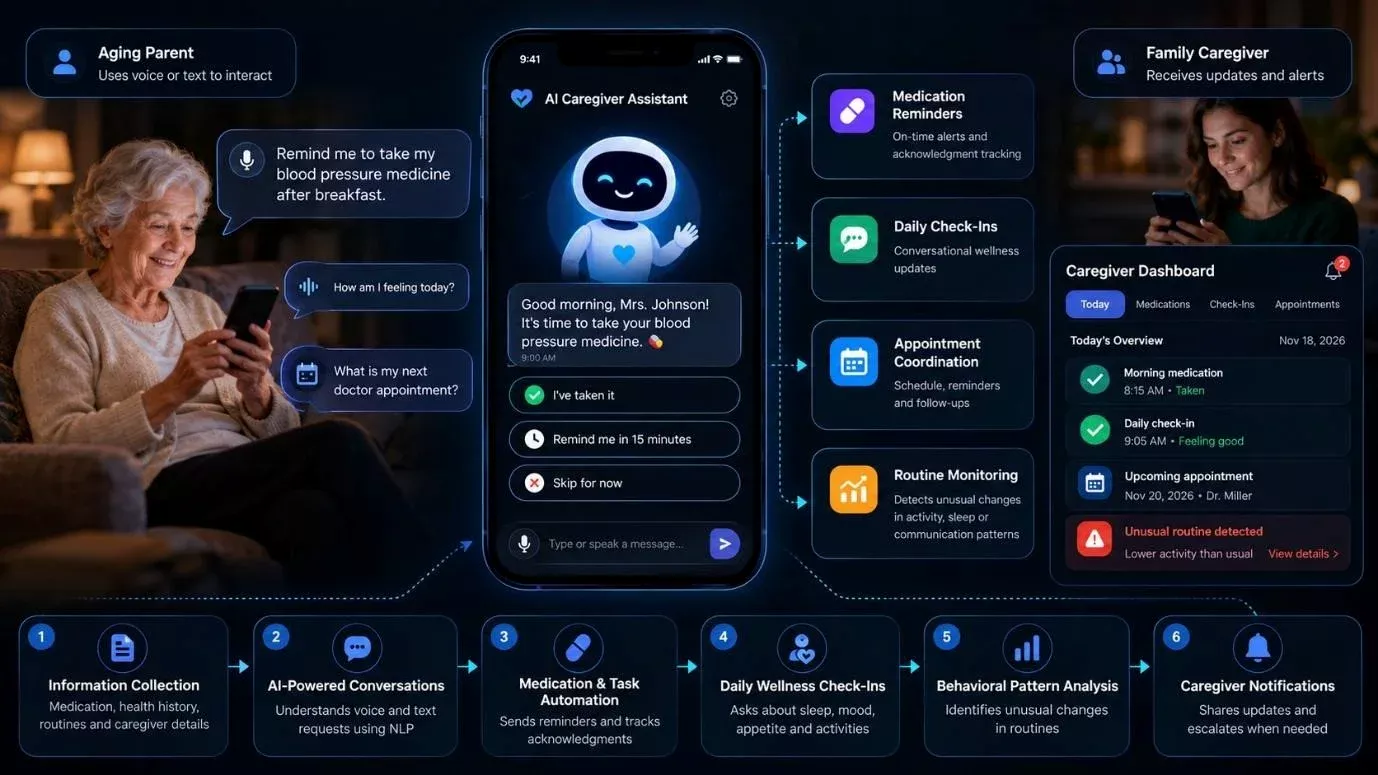
The assistant creates a personalized care profile using authorized information, including:
This information helps personalize reminders and caregiving workflows.
Using NLP and large language models (LLMs), the assistant understands voice and text requests.
For example, an older adult can say, "Remind me to take my blood pressure medicine after breakfast."
The assistant interprets the request and checks the authorized medication schedule before creating or confirming the reminder.
The system automates medication reminders, appointment notifications, and daily care tasks.
It can also track medication acknowledgments, identify missed reminders, and notify designated caregivers according to predefined rules.
The assistant initiates scheduled conversations to understand how the older adult is feeling.
It can ask about sleep, appetite, mood, discomfort, and daily activities. Responses are recorded and summarized for authorized family members.
Machine learning and rule-based analytics identify unusual changes in established routines.
For example, repeated missed check-ins, reduced activity, or changes in reported sleep patterns can trigger alerts for caregiver review.
These alerts indicate potential concerns, not medical diagnoses.
The assistant shares important updates through a family caregiver dashboard, SMS, or push notifications.
Caregivers can receive medication status, daily check-in summaries, upcoming appointments, and alerts requiring follow-up.
For urgent concerns, predefined escalation workflows direct users toward appropriate human or emergency assistance.
Therefore, AI caregiver virtual assistant development combines conversational AI, medication management, wellness monitoring, and automated notifications to help families coordinate elderly care more efficiently without replacing human caregivers or healthcare professionals.
The demand for elderly care services is increasing as populations age and family caregivers take on more responsibility for managing their loved ones' daily needs. At the same time, healthcare organizations are exploring AI-powered solutions to improve care coordination, communication, and remote support. This creates a promising opportunity for healthtech startups, digital healthcare companies, and care providers to invest in AI caregiver virtual assistant development.
Here are six important reasons why businesses should consider entering this growing market.
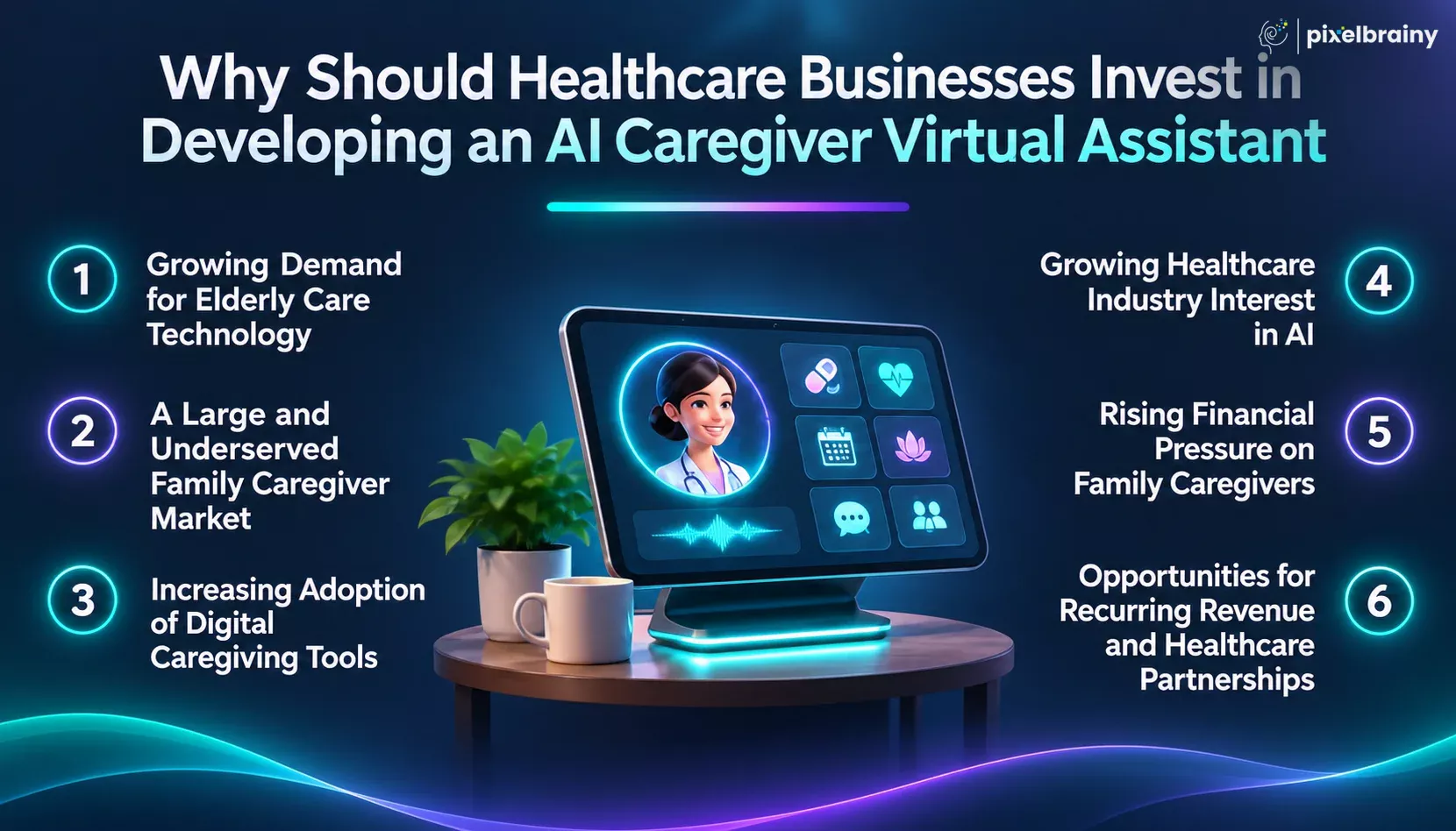
The global ageing population is creating a larger need for accessible and technology-enabled care services. According to the World Health Organization, the number of people aged 60 and above is projected to reach 2.1 billion by 2050.
As more families look for ways to support older adults living independently, demand for digital tools that help manage everyday care is likely to grow. AI caregiver virtual assistants can address this demand through medication reminders, daily conversations, appointment coordination, and routine monitoring.
Family caregivers represent a significant potential user base for digital caregiving products. A March 2026 AARP report estimates that 59 million Americans provide care to adults, contributing approximately 49.5 billion hours of unpaid care annually. The economic value of this contribution is estimated at $1.01 trillion.
These figures highlight the scale of family caregiving responsibilities. Businesses can develop AI family caregiver assistants that help coordinate care tasks, share updates with authorized family members, and make daily care routines easier to manage.
Caregivers are becoming more familiar with digital tools for managing health-related responsibilities. A February 2026 NORC survey found that 48% of unpaid caregivers use at least one digital technology to support caregiving. The survey also identified growing interest in AI-based conversational tools.
This creates an opportunity for businesses to build AI caregiver virtual assistants that bring multiple caregiving activities into one platform instead of requiring families to switch between separate reminder, communication, and scheduling applications.
Healthcare organizations are increasingly exploring AI for patient-centered services, operational support, and care delivery. The 2026 HIMSS AI Landscape Report indicates that approximately three-quarters of healthcare organizations plan to use AI to advance patient-centered care.
This wider adoption can create opportunities for AI caregiver platforms to connect with healthcare providers, senior care organizations, and digital health ecosystems. Businesses can explore integrations with patient portals, scheduling systems, and authorized health information platforms.
Caregiving can create considerable financial pressure, particularly when family members need to balance employment with ongoing care responsibilities. An 2026 AARP study reported that family caregivers spend an average of $11,508 annually on caregiving-related expenses, representing approximately 31% of their household income.
This financial pressure creates demand for accessible and scalable care coordination solutions. Businesses can explore affordable subscription models that provide families with practical tools for organizing recurring caregiving tasks.
AI caregiver virtual assistants can support several business models, including:
These models allow businesses to serve different customer segments while developing long-term commercial relationships.
Overall, AI caregiver virtual assistant development offers healthtech businesses an opportunity to address a growing caregiving need through AI-powered products. With rising demand for elderly care technology, increasing digital adoption, and multiple revenue opportunities, the market provides a strong foundation for developing scalable caregiver support platforms.
AI caregiver virtual assistant development is not limited to one type of healthcare business. Your ideal solution depends on who uses it, which care activities it supports, and how it connects with existing systems.
For example, imagine you run a home care agency with 650 caregivers serving 2,800 clients. You want an AI assistant that handles shift scheduling, care plan task reminders, visit documentation, and client check-ins between visits, so your staff can spend more time on hands-on care. In this case, you need more than a general-purpose chatbot. You need an operational assistant that works with your scheduling, care management, and Electronic Visit Verification (EVV) systems.
The same principle applies across other care settings. Here are seven deployment scenarios to consider before you build an AI caregiver virtual assistant.
If you are developing a consumer-facing caregiving platform, your challenge is making it simple enough for busy family members to use every day. Your users may need help managing medication schedules, appointments, care tasks, and conversations with aging parents without feeling overwhelmed by another complicated app.
Primary value metric: User activation, monthly active users, subscription conversion, and retention.
What your deployment requires: Simple onboarding, voice and text interaction, configurable reminders, shared family calendars, caregiver coaching, and subscription management. Your AI family caregiver assistant development strategy should prioritize an intuitive mobile experience and clear escalation options.
If you manage an agency with 650 caregivers and 2,800 clients, administrative coordination can consume valuable staff time. Scheduling changes, missed visits, care plan reminders, documentation, and between-visit client check-ins can create a substantial workload for your office team.
Primary value metric: Administrative hours saved per week, schedule fill rate, documentation completion time, EVV exception rate, and caregiver time available for direct care.
What your deployment requires: Integrations with your agency management system, scheduling platform, care plans, and EVV provider. Include caregiver shift matching, task reminders, voice-to-text visit notes, missed-visit alerts, and automated client check-ins. Your AI home care assistant app development project should support human approval for schedule changes and documentation before records are finalized.
For vendor discovery, examine platforms such as Rithma and Inferenz. Rithma describes AI-supported scheduling, task logging, visit documentation, and GPS EVV. Inferenz describes connecting its healthcare AI platform with agency systems and EVV providers such as Sandata and HHAeXchange. These are vendor-described capabilities, not independent proof of deployment at an agency of your size. Ask for customer references and demonstrations of your exact workflows.
If you manage one or more assisted living communities, residents may need regular interaction, reminders, and support between staff visits. Your challenge is maintaining consistent communication while helping staff identify changes that deserve attention.
Primary value metric: Resident engagement, staff response time, alert accuracy, and changes identified for staff review.
What your deployment requires: Voice companionship, personalized conversations, medication and activity reminders, routine tracking, and staff dashboards. For multi-community operations, include centralized reporting, role-based access, and configurable alert thresholds. Any cognitive change signal should prompt staff assessment, not an automated diagnosis.
If you coordinate dementia care or post-discharge support, gaps in communication can make it difficult to identify when a patient needs additional attention. Families may miss instructions, medication changes, or signs that recovery is not progressing as expected.
Primary value metric: Readmission rates, follow-up completion, escalation response time, and adherence to discharge plans.
What your deployment requires: EHR integration, discharge instruction management, authorized caregiver access, structured check-ins, and clinical escalation workflows. Your assistant should route concerning responses to qualified staff according to approved protocols, rather than making independent clinical decisions.
If you manage a health plan, you may want to offer caregiving support as a member service while identifying opportunities to improve care coordination and reduce avoidable utilization.
Primary value metric: Member engagement, avoidable emergency utilization, care gap closure, and relevant quality outcome measures.
What your deployment requires: Member eligibility checks, consent management, care navigation, medication and appointment reminders, and reporting that connects engagement with measurable outcomes. If you intend to evaluate Star Ratings impact, define the specific eligible measures and evidence requirements before deployment. Do not assume an assistant automatically improves a plan's rating.
If your company develops connected devices, you can extend your product beyond activity tracking by helping families understand meaningful changes in an older adult's routine.
Primary value metric: Anomaly detection precision, false alert rate, device engagement, and family response time.
What your deployment requires: Sensor fusion across approved devices, routine baselines, anomaly detection, consent-based data sharing, and configurable family alerts. Your AI senior care virtual assistant development project should distinguish unusual patterns from confirmed emergencies and allow users to control which signals are shared.
If your platform supports adults balancing work, children, and aging parents, your users may struggle with competing responsibilities and unevenly distributed family care tasks.
Primary value metric: Caregiver engagement, task completion, shared workload distribution, and self-reported caregiver strain.
What your deployment requires: Burnout check-ins, sibling task assignment, shared calendars, family notifications, and relevant respite resource recommendations. The assistant should help families coordinate responsibilities without making sensitive assumptions about an individual's mental health.
Before development begins: Your deployment scenario determines the integration scope, clinical oversight model, privacy architecture, and commercial model. Define these requirements first, then select the AI capabilities and technology stack. This helps ensure your AI caregiver virtual assistant development project solves a real operational problem instead of simply adding a chatbot to an existing service.
How can you determine whether an AI caregiver virtual assistant is actually improving care delivery? The answer lies in measuring changes in everyday caregiving activities, from medication follow-ups and wellness check-ins to staff productivity and care coordination.
For healthcare businesses, the impact depends on the users, workflows, and level of AI integration. A family caregiver may value fewer missed reminders and better communication, while a healthcare provider may prioritize documentation efficiency, timely escalation, and patient outcomes.
When planning AI caregiver virtual assistant development, define measurable performance indicators before implementation. Here are eight areas where the right solution can make a meaningful difference.
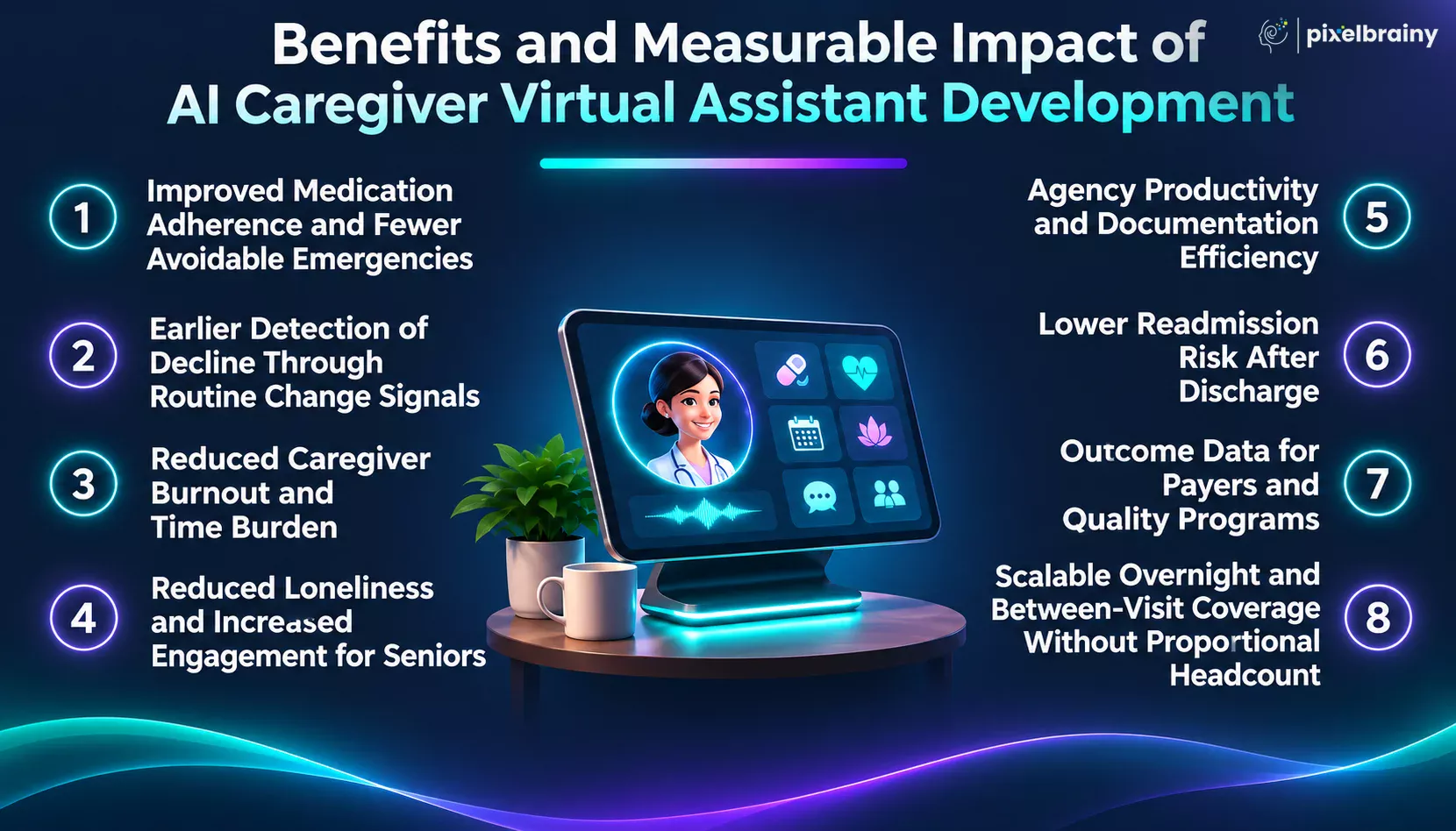
Medication schedules can become difficult to manage when older adults take multiple prescriptions or follow different dosing routines. An AI assistant can provide personalized reminders, ask users to confirm whether they have taken their medication, and notify authorized caregivers when reminders go unanswered.
It can also identify repeated missed confirmations and flag them for follow-up. This helps caregivers address potential medication management issues before they become more serious.
What to measure:
A confirmation response does not prove that medication was taken. The assistant should not recommend dosage changes or replace advice from healthcare professionals.
Small changes in an older adult's daily routine can indicate that additional attention may be needed. Your assistant can monitor patterns in check-in responses, sleep schedules, appetite, activity levels, and reported discomfort.
For example, if a senior who normally completes a morning check-in stops responding for several days or reports reduced appetite, the system can flag the change for caregiver review.
What to measure:
The system should identify patterns for human assessment, not diagnose health conditions.
Family caregivers often coordinate appointments, medications, transportation, and daily responsibilities alongside their personal and professional commitments. An AI assistant can organize these activities through shared calendars, automated reminders, task assignments, and daily care summaries.
It can also help families identify available respite services and distribute responsibilities among multiple caregivers.
What to measure:
Older adults who spend extended periods alone may benefit from regular conversations and reminders to participate in daily activities. An AI caregiver assistant can offer voice-based interactions, personalized activity prompts, wellness check-ins, and reminders to connect with family members.
It can also help seniors maintain consistent daily routines through friendly, accessible conversations.
What to measure:
AI conversations should complement human relationships and regular contact with family members and care professionals.
For home care agencies, AI can reduce repetitive administrative work that takes time away from direct care. Caregivers can receive task reminders, review assigned care plan activities, dictate visit notes, and submit structured updates through voice or text.
The assistant can also flag incomplete documentation, missed check-ins, scheduling conflicts, and potential EVV exceptions for coordinator review.
What to measure:
Patients returning home after hospitalization may need continued support with medication schedules, follow-up appointments, discharge instructions, and symptom reporting.
An AI caregiver virtual assistant can reinforce approved discharge instructions, conduct scheduled check-ins, remind patients about follow-up visits, and route concerning responses to the appropriate clinical team.
What to measure:
Readmission outcomes should be evaluated against a suitable baseline or comparison group because multiple clinical and social factors influence them.
Health plans and payers can use AI caregiver assistants to improve visibility into member engagement and ongoing care coordination. The platform can collect structured information about completed check-ins, medication confirmations, appointment follow-ups, and caregiver interactions.
With appropriate consent and data governance, these insights can support quality improvement initiatives and help identify members who may need additional support.
What to measure:
Data should be validated and mapped to the specific reporting requirements of each payer or program.
Care organizations cannot always have staff available for every routine interaction outside scheduled visits. An AI assistant can provide approved reminders, conduct automated check-ins, answer common nonclinical questions, and route exceptions to an on-call caregiver or designated contact.
This creates a way to extend routine communication without requiring a staff member to manually initiate every interaction.
What to measure:
Clear escalation procedures are essential. The assistant must communicate its limitations and direct emergencies to appropriate emergency services.
| Segment | Primary Benefit | Typical Metric | Time to Measurable Impact |
|---|---|---|---|
| Family Caregivers | Reduced coordination workload | Weekly hours spent coordinating care | 4 to 12 weeks |
| Home Care Agencies | Improved operational efficiency | Documentation time, administrative hours, EVV exceptions | 4 to 12 weeks |
| Assisted Living | Better resident engagement and staff awareness | Engagement frequency, actionable alerts | 6 to 16 weeks |
| Health Systems | Improved post-discharge follow-up | Follow-up completion, readmission rates | 3 to 12 months |
| Payers | Better member engagement and quality visibility | Care gap closure, utilization, quality measures | 6 to 18 months |
Ultimately, the success of an AI caregiver virtual assistant should be measured by the time it saves, the care activities it helps coordinate, and the issues it helps people identify sooner. Focus on measurable outcomes first, then expand the platform as its value becomes clear.
Also Read: How to Build an AI Virtual Assistant for Healthcare
What features should you include when developing an AI caregiver virtual assistant for family caregivers, home care providers, or senior care organizations? The platform should do more than send automated reminders. It should help users manage everyday care activities, communicate with family members, maintain care records, and stay informed about important tasks.
For example, if you are building an app for families caring for aging parents, users should be able to add medication schedules, receive appointment reminders, complete daily wellness check-ins, and share care updates with other family members. If your target customers include home care agencies, the same platform should also support care plan tasks, caregiver visit records, and client communication.
The right AI caregiver virtual assistant development strategy starts with these essential features. Each feature should address a specific caregiving requirement while keeping the experience simple for older adults and their caregivers.
| Feature | What It Does and Why It Matters |
|---|---|
| Natural Language AI Chat | Allows seniors and family caregivers to interact with the assistant through everyday language. Users can ask about upcoming appointments, request medication reminders, check daily tasks, and receive understandable responses without navigating complicated menus. |
| Medication Schedule Management | Lets users add medication names, prescribed dosage instructions, administration times, and frequency. Caregivers can update schedules when authorized, while the assistant organizes reminders according to the medication plan provided by the user or care team. |
| Automated Medication Reminders | Sends notifications when medication is scheduled and allows users to acknowledge reminders. If a response is missing, the assistant can send a follow-up notification or inform an authorized caregiver according to configured rules. |
| Daily Health and Wellness Check-Ins | Conducts scheduled conversations about appetite, sleep, mood, discomfort, hydration, and general well-being. Responses are recorded so caregivers can review changes and decide whether additional attention or follow-up is necessary. |
| Appointment and Calendar Management | Helps families organize doctor consultations, therapy sessions, medical tests, and other important appointments. Users can add events, receive advance notifications, and share schedules with authorized family members or professional caregivers. |
| Daily Care Routine Management | Organizes recurring activities such as meals, hydration, walking, personal care, and exercise. The assistant reminds users about planned activities and allows caregivers to review completed, pending, or skipped tasks. |
| Personalized Senior Care Profiles | Maintains individual profiles with relevant care instructions, medication schedules, communication preferences, daily routines, emergency contacts, and other authorized information. This context helps the assistant deliver more relevant reminders and responses. |
| Family Caregiver Dashboard | Provides a centralized view of the older adult's daily care activities. Family members can review check-in responses, upcoming appointments, medication acknowledgments, pending tasks, and recent updates without contacting every caregiver individually. |
| Shared Family Care Calendar | Allows multiple family members to coordinate appointments, visits, medication-related responsibilities, and other care activities. Each authorized member can view assigned responsibilities, helping families avoid scheduling conflicts and missed commitments. |
| Voice-Based Interaction | Enables seniors to communicate with the assistant using spoken commands instead of relying entirely on typing. Users can ask questions, request reminders, and respond to check-ins through a voice-enabled interface designed for convenient everyday interaction. |
| Multilingual Communication | Supports communication in multiple languages so seniors and caregivers can use the platform in their preferred language. This feature can include language selection, translated notifications, and conversational responses appropriate to supported languages. |
| Care Plan and Task Tracking | Allows professional caregivers or authorized family members to add care plan instructions and assign daily responsibilities. Users can review tasks, mark activities as completed, and identify unfinished care activities for follow-up. |
| Caregiver Visit Documentation | Provides a structured way to record visit start and end details, completed care activities, observations, and visit summaries. Voice-to-text entry can reduce manual typing, while caregivers review and approve notes before submission. |
| Emergency Contact and Communication Management | Keeps designated emergency contacts and important communication details accessible to authorized users. When a configured concern requires human attention, the assistant can notify the appropriate contact using predefined escalation instructions. |
| Care History and Progress Reports | Maintains a chronological record of check-ins, completed activities, medication acknowledgments, appointments, and caregiver notes. The assistant can generate readable summaries to help families and care teams review ongoing care activities. |
The right combination of essential features creates a reliable foundation for an AI caregiver virtual assistant that supports everyday care coordination while remaining simple for seniors, families, and professional caregivers to use.
After you have finalized your core features, you can plan the next development phase by introducing advanced capabilities that make your AI caregiver virtual assistant more intelligent, proactive, and connected. These features can help your platform move beyond everyday reminders and task management toward personalized care insights, predictive monitoring, and coordinated support across different healthcare environments.
For example, if you already have medication reminders, daily check-ins, and caregiver dashboards, you may want to add a system that identifies unusual changes in an older adult's routine, understands voice-based distress signals, or connects information from wearable devices. These capabilities can make your platform more useful for families and professional care teams, provided they are implemented with appropriate clinical oversight and privacy controls.
Real-world development query: How can you add predictive health monitoring, wearable device integration, AI-based fall detection, and automated caregiver escalation to an existing AI caregiver virtual assistant without generating excessive false alerts or replacing clinical judgment?
The following 10 advanced features can help you plan the next stage of AI caregiver virtual assistant development.
| Advanced Feature | What It Does and Why It Matters |
|---|---|
| Predictive Health Risk Analysis | Analyzes historical check-ins, activity records, medication acknowledgments, and other authorized data to identify patterns that may indicate increasing care needs. It can flag potential concerns for professional review instead of independently predicting or diagnosing medical conditions. |
| AI-Powered Fall Detection | Integrates with compatible wearable devices, smart sensors, or connected cameras to identify possible fall events. When a potential fall is detected, the system can trigger a configured alert, request user confirmation when appropriate, and notify designated contacts. |
| Wearable and IoT Device Integration | Connects the assistant with supported smartwatches, fitness trackers, blood pressure monitors, glucose monitors, and home sensors. This allows authorized users to view relevant readings and activity information within a centralized caregiving platform. |
| Routine Anomaly Detection | Uses machine learning and historical activity patterns to identify unusual changes in sleep, movement, meal routines, check-in frequency, or daily activity. Caregivers receive alerts when predefined thresholds are crossed and can investigate the situation. |
| Intelligent Caregiver Escalation Engine | Routes alerts according to configurable severity levels, response windows, contact preferences, and escalation rules. For example, an unanswered wellness check-in may first notify a family member before reaching an assigned care coordinator. |
| Personalized Conversational Memory | Uses authorized conversation history and user preferences to maintain relevant context across interactions. The assistant can remember preferred communication styles, recurring routines, and previously shared nonclinical details to make conversations more consistent. |
| Computer Vision for Activity Recognition | Uses compatible cameras or privacy-conscious vision systems to recognize selected activities, such as movement within designated areas or prolonged inactivity. Deployment requires explicit consent, restricted access, and clear rules about where visual monitoring is appropriate. |
| AI-Based Voice and Emotion Signal Analysis | Analyzes permitted voice characteristics and conversational patterns to identify possible changes in communication or emotional expression. Any inferred signal should be treated cautiously and presented as a prompt for human follow-up, not a reliable mental health assessment. |
| EHR and Healthcare Platform Integration | Connects the assistant with supported electronic health record systems, patient portals, and care management platforms through authorized APIs and healthcare interoperability standards. This can help synchronize approved care instructions, appointments, and relevant patient information. |
| Multilingual Speech and Translation Intelligence | Adds advanced speech recognition and translation capabilities so seniors and caregivers can communicate across supported languages. The system can process spoken requests, translate responses, and preserve important care instructions while accounting for language-specific terminology. |
Advanced capabilities should strengthen your AI caregiver virtual assistant development strategy by addressing real caregiving needs, improving system intelligence, and supporting proactive care coordination with appropriate human oversight.
Also Read: How to Build an AI Parenting Assistant App
Developing an AI caregiver virtual assistant requires a structured approach that combines healthcare workflow planning, AI engineering, application development, and connected device integration.
Whether you are creating a family caregiving app, a home care platform, or an intelligent senior monitoring solution, each development stage should address a specific product requirement.
Consider a smart home and wearable technology company that wants to add an AI caregiver virtual assistant to its existing product. The solution needs to interpret data from fall detection sensors, sleep trackers, and in-home motion sensors, learn each senior's normal routine, and alert family members when meaningful changes occur.
To achieve this, your development team must address sensor integration, personalized activity baselines, anomaly detection, alert accuracy, and caregiver communication.
So, how to build an AI caregiver virtual assistant from scratch that can handle these requirements reliably? Here are eight practical steps covering the development process of an AI caregiver virtual assistant, from initial planning to product launch.
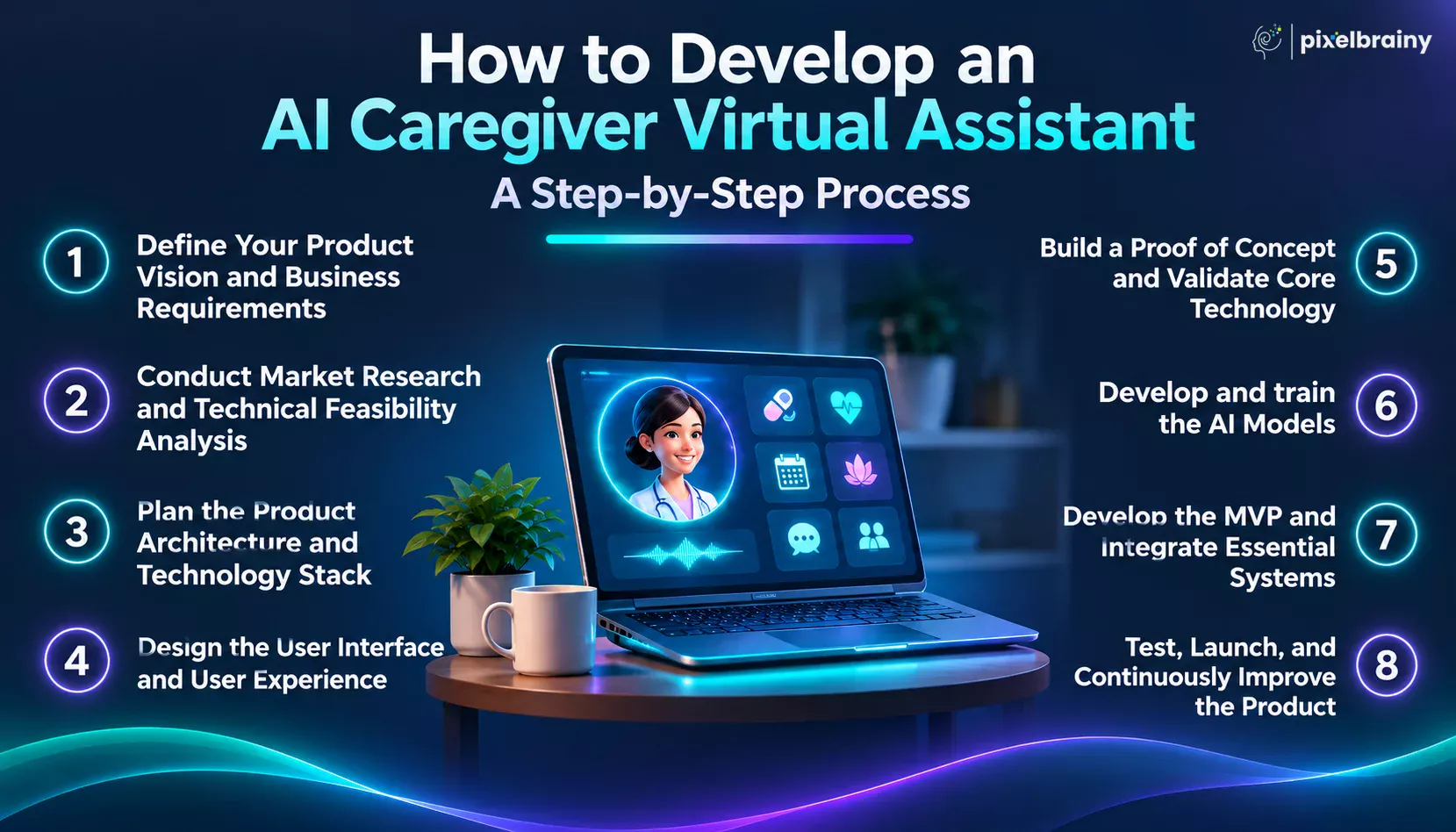
Start by identifying the caregiving problem your product will solve and the audience you intend to serve.
Determine whether your AI caregiver virtual assistant will support family caregivers, home care agencies, assisted living communities, or smart home users.
Document the essential workflows, such as medication reminders, daily check-ins, appointment coordination, sensor-based monitoring, and family notifications.
For an IoT-focused solution, identify which devices you want to connect and what information each device can provide. Define your product goals, target users, expected outcomes, budget, and launch requirements.
You can seek AI consultation to assess technical feasibility, prioritize requirements, and establish a realistic development roadmap.
Also Read: Top 10 AI Consulting Companies in USA
Once your product requirements are documented, research existing caregiver applications, senior monitoring solutions, wearable platforms, and competing AI assistants.
Study their features, device compatibility, integrations, pricing models, and customer feedback to identify opportunities for differentiation.
Next, evaluate whether your selected sensors and wearable devices provide accessible APIs, SDKs, or other integration options.
Check how frequently they transmit readings, how they handle connectivity interruptions, and whether their data can support reliable routine analysis.
You should also assess privacy, consent, and regulatory considerations relevant to your target market. When evaluating top AI development companies, examine their experience with healthcare applications, IoT ecosystems, and production AI deployments.
The next step is to design the architecture that connects your application, AI services, connected devices, databases, and notification systems.
A typical solution may include:
For sensor-based monitoring, plan how incoming readings will be collected, timestamped, normalized, and associated with individual users.
You should also define how the system will handle missing readings, duplicate events, device disconnections, and delayed notifications.
Select technologies according to your scalability, security, and integration requirements. If you need specialized engineering support, hire AI developers with experience in IoT connectivity, cloud architecture, and healthcare software.
Your application should be simple enough for older adults while providing caregivers with the information they need to coordinate support.
Begin by mapping separate user journeys for seniors, family members, and professional caregivers.
Design accessible screens with readable text, clear navigation, voice interaction, and straightforward controls.
Family dashboards can display device connectivity, routine summaries, recent alerts, check-in responses, and important care updates.
Create wireframes and interactive prototypes before starting full application development. Then test them with representative users.
A UI/UX design company can help translate these requirements into accessible interfaces and consistent experiences across mobile, web, and voice-enabled applications.
Also Read: Top 10+ UI/UX Design Companies in USA
Before investing in the complete product, test whether your most important technical assumptions work in a controlled environment.
This is where PoC development becomes valuable.
For example, connect a small set of fall detection sensors, sleep trackers, and in-home motion sensors to check whether the system can collect readings and identify selected changes in activity.
Test how accurately it recognizes routine deviations, how quickly alerts reach family members, and what happens when a device stops transmitting data.
Use sample scenarios to evaluate false alerts and missed events.
The results will help you validate the proposed architecture, identify integration challenges, and decide whether the technology is ready for broader development.
Also Read: Top 10+ AI PoC Development Companies In USA
After validating the core technology, develop the AI capabilities required to interpret conversations and analyze incoming sensor data.
Your solution may use natural language processing, speech recognition, conversational AI, classification algorithms, and time-series analysis.
For routine anomaly detection, the system should learn an individual's normal activity patterns over an appropriate observation period.
It can then identify deviations such as unusual inactivity, changes in sleep patterns, or missed daily check-ins. These signals should be evaluated against configurable thresholds and routed for human review.
AI model development should include representative datasets, model evaluation, bias testing, privacy safeguards, and continuous performance monitoring to ensure the system remains reliable across different users and device conditions.
Also Read: Top 10 AI MVP Development Companies in USA
Once the core models and architecture are validated, move toward building a functional first version of the application.
Your initial product can include:
The AI integration process should connect conversational capabilities and anomaly detection models with backend services, device APIs, and notification workflows.
Keep the first release focused on essential use cases rather than including every planned capability.
During MVP development, test the complete user journey, from receiving sensor readings to identifying a meaningful deviation and notifying an authorized family member. This helps you collect real user feedback and improve the product before expanding its capabilities.
Also Read: Top 10 AI MVP Development Companies in USA
Before launching, perform functional, integration, usability, performance, and security testing across supported devices and user roles.
Evaluate sensor accuracy, model performance, alert delivery time, false-positive rates, data synchronization, and application availability.
Conduct a controlled pilot with seniors and caregivers who have provided appropriate consent. Use their feedback to improve onboarding, notifications, dashboard usability, and routine detection.
When selecting top AI agent development companies, assess their experience in deploying conversational and task-oriented AI systems, along with their testing practices and post-launch support.
You can also compare AI product development companies based on their ability to manage the complete product lifecycle, from engineering and deployment to maintenance and scaling.
Following these steps to develop an AI caregiver virtual assistant helps you turn your product idea into a reliable solution that connects smart devices, intelligent monitoring, and timely caregiver support.
Also Read: AI Elder Care Companion App Development
The cost to develop an AI caregiver virtual assistant typically ranges from $40,000 to $300,000+, depending on the product's features, AI capabilities, integrations, security requirements, and development complexity. A basic solution with conversational AI, medication reminders, and caregiver notifications requires a smaller investment than an enterprise platform with wearable connectivity, predictive monitoring, EHR integration, and multi-user care management.
Understanding the AI caregiver virtual assistant development cost helps you prepare a realistic budget, prioritize features, and select the right development approach. Your development budget of AI caregiver virtual assistant should account for more than application coding. It may also include AI model development, third-party integrations, cloud infrastructure, testing, security implementation, and ongoing maintenance.
For example, if you are comparing three vendor proposals ranging from $60,000 to $200,000 for seemingly similar features, you need to understand what each company includes in its estimate. Does the proposal cover voice recognition testing with elderly speakers? Does it include clinical safety escalation workflows, HIPAA compliance requirements, and sensor integration? Or does it simply provide a chatbot interface with basic reminders?
To understand what is the development pricing of an AI caregiver virtual assistant, start with the following cost estimation and feature breakdown.
The following estimates represent indicative USD development budgets. Actual pricing depends on the scope, technology choices, integrations, and development team's location and expertise.
| Development Type | Estimated Cost | Typical Scope |
|---|---|---|
| Basic AI Caregiver Virtual Assistant | $40,000 to $80,000 | Includes user registration, senior profiles, conversational AI, medication reminders, appointment scheduling, daily check-ins, basic caregiver dashboards, and notifications. Suitable for startups validating a focused caregiving product. |
| Advanced AI Caregiver Virtual Assistant | $80,000 to $160,000 | Includes personalized AI conversations, voice interaction, care plan management, family collaboration, wearable integrations, routine tracking, activity reports, and configurable alert workflows. Suitable for products requiring more automation and connected care capabilities. |
| Enterprise AI Caregiver Virtual Assistant | $160,000 to $300,000+ | Includes multi-organization support, advanced AI workflows, extensive IoT and EHR integrations, sophisticated monitoring, role-based access, enterprise security, audit trails, custom reporting, and scalable cloud infrastructure. Suitable for healthcare providers, payers, and large care networks. |
The cost estimation of AI caregiver virtual assistant development depends on several technical and business decisions. Two products with similar feature lists can have very different budgets because their underlying implementation requirements may not be the same.
1. AI features and model complexity: A basic conversational assistant using an existing large language model generally costs less than a customized solution involving voice processing, personalized conversations, activity analysis, and anomaly detection.
2. Voice recognition and accessibility: Supporting older adults requires testing speech recognition across different accents, speaking speeds, background noise, and age-related voice variations. Voice interaction, text-to-speech, and accessibility improvements can increase development effort.
3. Third-party integrations: Connecting wearable devices, fall detection sensors, smart home systems, EHR platforms, scheduling software, and medication databases requires API development, data mapping, synchronization, and integration testing.
4. Clinical safety and escalation workflows: If your assistant handles missed check-ins, medication concerns, or potential emergencies, you need clearly defined alert thresholds, escalation paths, human review, and safeguards against unsupported medical recommendations.
5. Data security and HIPAA requirements: Products handling protected health information in the United States may require encryption, access controls, audit logging, secure data storage, vendor agreements, and appropriate HIPAA compliance processes. These requirements influence architecture, implementation, and testing costs.
6. Application platforms and user interfaces: Developing separate iOS, Android, web, and caregiver dashboard experiences can increase the budget. The number of user roles, accessibility requirements, and customization levels also affect design and engineering time.
7. Cloud infrastructure and data processing: Sensor data collection, AI inference, notifications, database storage, and real-time processing influence infrastructure requirements. Costs also depend on the number of users, connected devices, and frequency of data transmission.
8. Testing, deployment, and maintenance: Testing must cover application functionality, device connectivity, AI response quality, security, alert accuracy, and performance. After launch, you should budget for bug fixes, model monitoring, infrastructure, API changes, and feature improvements.
If three companies quote $60,000, $120,000, and $200,000 for similar stated features, do not compare them by price alone. Ask each vendor to explain what is included in the proposed AI caregiver virtual assistant development cost.
| Vendor Evaluation Area | Questions to Ask |
|---|---|
| Voice Recognition Accuracy | How will you test voice recognition with elderly speakers, different accents, speech difficulties, and background noise? What accuracy metrics will you report, and how will users correct misunderstood commands? |
| Clinical Safety and Escalation | How will the assistant handle missed medication confirmations, unusual sensor readings, possible falls, and unanswered check-ins? Can you demonstrate escalation rules, human review, and emergency limitations? |
| HIPAA and Data Security | Does your architecture support applicable HIPAA requirements? Which security controls, audit logs, encryption methods, access permissions, and Business Associate Agreements (BAAs) are included in the proposal? |
| Sensor and IoT Integration | Which wearable devices, fall detection sensors, and smart home systems have you integrated previously? Are API connections, device testing, data normalization, and integration maintenance included? |
| AI Model and Data Ownership | Are you using an existing AI model or building custom models? Who owns the application code, custom models, training data, and integration components after project completion? |
| Testing and Post-Launch Support | Does the quoted price include pilot testing, AI performance evaluation, deployment, documentation, maintenance, and technical support? What additional charges should we expect after launch? |
These questions help distinguish a purpose-built caregiving solution from a generic chatbot marketed with a senior-care label. Request a feature-wise cost estimate, technical architecture, integration list, testing plan, and clear project deliverables from every vendor.
Ultimately, the right AI caregiver virtual assistant development budget should reflect the product's actual technical complexity, integration requirements, and safety expectations, not simply the number of features listed in a proposal.
Developing an AI caregiver virtual assistant requires a technology stack that supports natural conversations, personalized reminders, secure data management, healthcare integrations, and reliable communication between seniors and caregivers. Each technology serves a different purpose, from understanding voice commands to connecting wearable devices and managing sensitive caregiving information.
For example, if you are developing an assistant that connects with smartwatches, fall detection sensors, and home monitoring devices, your technology stack must support real-time data collection, device interoperability, activity analysis, and caregiver notifications.
Real-world development query: Which AI models, cloud platforms, speech recognition tools, IoT technologies, and healthcare APIs should you use to build an AI caregiver virtual assistant that understands elderly users, connects with wearable devices, detects unusual routine changes, and securely shares alerts with family caregivers?
The AI caregiver virtual assistant development technology stack should align with your product requirements, expected user volume, integration needs, and security responsibilities. The following table covers recommended tools and technologies across the major development components.
| Development Component | Recommended Tools and Technologies | How They Are Used |
|---|---|---|
| AI and Large Language Models | OpenAI API, Anthropic Claude, Google Gemini, Meta Llama | Power conversational interactions, understand caregiver requests, summarize care updates, answer common questions, and generate context-aware responses. Model selection should consider accuracy, privacy requirements, latency, and operating costs. |
| Natural Language Processing (NLP) | spaCy, Hugging Face Transformers, Google Cloud Natural Language | Help the assistant understand user messages, identify medication-related requests, extract appointment details, and interpret everyday caregiving instructions. |
| Speech-to-Text Technology | OpenAI Whisper, Google Cloud Speech-to-Text, Azure AI Speech | Convert spoken conversations into text so seniors can request reminders, answer wellness questions, and communicate with the assistant without typing. Test accuracy with elderly speakers, accents, and background noise. |
| Text-to-Speech Technology | ElevenLabs, Amazon Polly, Azure AI Speech | Convert written responses into spoken language, enabling voice-based reminders, conversational assistance, and accessible interactions for older adults with visual or mobility limitations. |
| Backend Development | Python, FastAPI, Node.js, Django | Handle application logic, user authentication, medication schedules, caregiver permissions, notifications, AI requests, and communication between frontend applications and external services. |
| Frontend and Mobile App Development | React Native, Flutter, React.js, Swift, Kotlin | Build caregiver dashboards, senior-facing mobile applications, appointment screens, medication reminders, and interfaces for managing daily caregiving activities across supported devices. |
| Database Management | PostgreSQL, MongoDB, Redis, Firebase | Store user profiles, medication schedules, care plans, check-in records, caregiver information, and application settings. Redis can also support caching and time-sensitive application operations. |
| Cloud Infrastructure | Amazon Web Services (AWS), Microsoft Azure, Google Cloud Platform (GCP) | Provide scalable hosting, secure storage, application deployment, AI workloads, data processing, and infrastructure management as the number of users and connected devices increases. |
| IoT and Wearable Device Integration | MQTT, AWS IoT Core, Azure IoT Hub, Bluetooth Low Energy (BLE) | Connect compatible smartwatches, motion sensors, fall detection devices, and other connected equipment. These technologies support device communication and the transfer of sensor readings to the application. |
| Healthcare Interoperability | HL7 FHIR, SMART on FHIR, Health Level Seven interfaces | Support structured healthcare data exchange with compatible EHR systems and healthcare applications. They can help synchronize authorized patient information, appointments, and care-related records. |
| Machine Learning and Data Analysis | PyTorch, TensorFlow, Scikit-learn, XGBoost | Support activity classification, personalized routine analysis, anomaly detection, and pattern recognition using appropriately collected and validated data. |
| Notification and Communication Services | Firebase Cloud Messaging, Twilio, Amazon SNS, SendGrid | Deliver medication reminders, appointment alerts, caregiver notifications, SMS messages, and email updates through configurable communication channels. |
| Authentication and Security | Auth0, Amazon Cognito, OAuth 2.0, OpenID Connect | Manage user authentication, identity verification, session management, and role-based access for seniors, family members, caregivers, and administrators. |
| Analytics and Monitoring | Google Analytics, Mixpanel, AWS CloudWatch, Datadog | Monitor application usage, feature engagement, system performance, notification delivery, errors, and operational metrics to identify areas requiring improvement. |
| Testing and Deployment | Postman, Pytest, Jest, Docker, Kubernetes, GitHub Actions | Support API testing, automated quality checks, application packaging, deployment pipelines, and infrastructure scaling. These tools help maintain software reliability throughout development and after launch. |
A well-planned technology stack helps your AI caregiver virtual assistant remain secure, accessible, scalable, and ready to support evolving caregiving requirements.
Also Read: How to Build an AI Family Health Assistant App?
An AI caregiver virtual assistant can generate revenue through multiple business models depending on your target customers, product capabilities, and deployment strategy. Whether you are building a consumer caregiving app, a home care management platform, or an enterprise senior care solution, your revenue model should match how customers use and pay for the service.
For example, a family caregiver may prefer an affordable monthly subscription, while a home care agency managing hundreds of clients may need a per-client licensing arrangement. Healthcare organizations and insurance providers may prefer annual contracts that cover a defined population.
Here are seven business models to consider when commercializing your AI caregiver virtual assistant development project.
This model allows individual family caregivers to access the AI assistant through monthly or annual subscriptions. Users pay for features such as medication reminders, daily wellness check-ins, appointment management, family notifications, and shared caregiving calendars.
You can introduce multiple subscription tiers based on the number of supported seniors, family members, and available features. A basic plan can offer routine reminders, while premium plans can include voice conversations, detailed care reports, and additional family collaboration tools.
Revenue approach: Monthly or annual recurring subscriptions.
If your product targets home care agencies, you can charge organizations according to the number of active clients using the platform. Agencies can use the assistant for care plan reminders, caregiver task management, visit documentation, client check-ins, and family communication.
This model works well for organizations managing large client populations because licensing costs can scale with their operations. You can also offer different pricing tiers based on integrations, administrative features, and reporting requirements.
Revenue approach: Monthly or annual licensing fee per active client, potentially combined with an implementation fee.
Assisted living facilities and senior living communities can license your AI caregiver virtual assistant based on the number of residents supported. The platform can provide voice-based interactions, daily activity reminders, wellness check-ins, and communication between residents, families, and staff.
You can offer a centralized dashboard for administrators to review resident engagement, pending check-ins, and alerts requiring staff attention. Multi-location operators may also receive centralized reporting and management capabilities.
Revenue approach: Recurring per-resident, per-month subscription.
Hospitals, healthcare networks, and specialized care programs may purchase your solution through an organizational licensing agreement. The assistant can support discharge follow-ups, dementia care coordination, medication reminders, patient check-ins, and communication with authorized caregivers.
You can structure contracts around specific departments, patient populations, or care programs. Additional charges may apply for EHR integration, custom workflows, implementation, and technical support.
Revenue approach: Annual enterprise license, program-based contract, or implementation fee with recurring service charges.
Health insurance companies and healthcare payers can offer your AI caregiver virtual assistant as a member support service. The platform can help eligible members and their families organize care activities, receive reminders, coordinate appointments, and access approved caregiving resources.
You can negotiate contracts based on eligible members, enrolled users, or active participants. Performance-based arrangements may also be considered when measurable outcomes and reporting requirements are clearly defined.
Revenue approach: Per-member-per-month (PMPM) contract, annual member benefit agreement, or outcome-linked commercial arrangement.
If your product integrates with smartwatches, fall detection sensors, motion detectors, or other connected devices, you can partner with hardware manufacturers and smart home companies.
The AI caregiver virtual assistant can be bundled with compatible devices to provide a complete monitoring and communication experience. For example, a customer purchasing a senior safety monitoring package may receive access to the assistant's family dashboard, routine monitoring, and configurable notifications.
Revenue approach: Device and software bundles, partner revenue sharing, or recurring software subscriptions attached to hardware purchases.
Under this model, you license your AI caregiver platform to established healthcare companies, home care providers, senior living operators, or digital health businesses that want to offer the solution under their own brand.
You can provide customizable branding, application interfaces, administrative dashboards, and integrations. The partner manages the customer relationship, while your business maintains the underlying platform and technology.
Revenue approach: Initial white-label setup fee, recurring licensing charges, and additional fees for customization or integrations.
Your ideal revenue model depends on the customer segment and how your platform delivers value.
A sustainable AI caregiver virtual assistant business combines a suitable pricing model with recurring customer value, scalable delivery, and clear commercial agreements.
An AI caregiver virtual assistant handles sensitive information, including medication schedules, health-related conversations, appointment records, voice interactions, wearable readings, and daily activity data. Therefore, safety, privacy, and regulatory compliance must be considered from the beginning of AI caregiver virtual assistant development, rather than added after the application is built.
For example, if you are developing an AI assistant that monitors seniors through wearable devices and smart home sensors, the platform must protect personal information, interpret incoming data responsibly, and notify authorized caregivers when something requires attention.
A reliable AI caregiver virtual assistant development process should address the following safety, security, and regulatory requirements.
Your AI caregiver virtual assistant app may collect names, contact details, medication schedules, health information, appointment records, voice recordings, and wearable data. Implement encryption, secure authentication, role-based access, and protected data storage to prevent unauthorized access.
Collect only the information required to deliver caregiving services. Establish clear data retention, backup, and deletion policies to protect users' personal information.
If your AI caregiver virtual assistant software handles protected health information on behalf of US healthcare providers, health plans, or other covered entities, HIPAA requirements may apply.
According to the HHS HIPAA Security Rule, organizations must implement appropriate administrative, physical, and technical safeguards for electronic protected health information.
Important considerations include:
Using a cloud provider or AI API with security features does not automatically make your complete application HIPAA compliant. Compliance depends on the entire system and the responsibilities of the organizations handling the data.
HHS.gov+2
During AI caregiver virtual assistant development, define which activities the assistant can perform independently and which require professional involvement.
It can provide medication reminders, organize appointments, collect wellness responses, and share approved care instructions. However, it should not independently diagnose conditions, prescribe medication, recommend dosage changes, or replace clinical judgment.
Your AI safety framework should cover medical questions, medication-related requests, unusual health reports, and situations requiring professional assessment. When the assistant cannot provide a reliable answer, it should clearly communicate its limitations and direct users to qualified healthcare professionals.
A healthcare AI caregiver assistant should have predefined escalation procedures for potentially concerning situations.
For example, if a connected sensor detects a possible fall or a senior repeatedly misses scheduled check-ins, the assistant can notify an authorized caregiver according to configured rules.
Your escalation framework should define alert triggers, notification recipients, response times, backup contacts, and emergency procedures. Test the complete workflow to ensure alerts reach the appropriate people.
The platform should never promise emergency protection unless the complete monitoring and response system has been validated for that purpose.
Privacy protection in AI caregiver virtual assistant development requires clear consent procedures, particularly when applications use microphones, cameras, wearable devices, or in-home sensors.
Users should understand what information is collected, why it is collected, who can access it, and how it will be shared.
Include consent management for voice interactions, sensor monitoring, family access, and professional caregiver permissions. Allow users to review their settings and withdraw consent where applicable. Family relationships alone should not automatically grant access to all personal information.
If your AI-powered caregiver virtual assistant performs functions beyond routine reminders and communication, assess whether medical device regulations may apply.
For example, software that analyzes patient information to support clinical decisions or provides certain medical recommendations may fall under regulatory oversight depending on its intended purpose and functionality.
Review the FDA Clinical Decision Support Software Guidance to understand how different software functions are evaluated.
Document the intended use of each AI feature and obtain appropriate regulatory guidance before deployment. Calling an application a wellness or caregiving product does not automatically exempt it from medical software requirements.
An AI caregiver virtual assistant solution may process information from conversations, medication records, wearable devices, and home sensors. Inaccurate or incomplete information can lead to misleading responses and unnecessary alerts.
To improve reliability:
Users should understand when they are interacting with AI and when information requires human verification.
Your AI caregiver virtual assistant platform should have documented policies explaining how long it stores conversations, voice recordings, health information, sensor readings, and caregiver activity records.
Define who can access the information, when it can be shared, how it is backed up, and when it should be deleted.
Regular vulnerability assessments, access reviews, software updates, and security incident response procedures are also important. If your application operates internationally, evaluate the privacy and data protection laws applicable in each target market.
Human oversight is essential when an AI caregiver virtual assistant processes information that could influence caregiving or healthcare decisions.
For example, if the system identifies unusual changes in a senior's sleep or activity patterns, it should present those observations to an authorized caregiver rather than independently concluding that the person has a medical condition.
Establish human review procedures for high-priority alerts, uncertain AI responses, potential medication concerns, unusual activity patterns, and changes to care instructions.
For deployments in the European Union, assess whether the EU AI Act applies and whether the intended functions fall into a regulated risk category. Certain high-risk AI systems have additional requirements involving risk management, documentation, testing, transparency, and human oversight.
Before launching your AI caregiver virtual assistant application, validate its performance across everyday caregiving activities and unusual situations.
Your testing process should include:
Conduct controlled pilot testing with appropriate consent before expanding to a larger user population.
| Deployment Type | Important Requirements |
|---|---|
| Family Caregiver App | User consent, privacy controls, secure family sharing, medication safety, and clear AI limitations. |
| Home Care Agency Platform | Role-based access, secure visit documentation, EVV data handling, staff permissions, and audit trails. |
| Assisted Living Software | Resident consent, monitoring transparency, alert escalation, staff access controls, and incident documentation. |
| Healthcare System Integration | Applicable HIPAA obligations, EHR security, clinical oversight, patient consent, and regulatory assessment. |
| Smart Home and Wearable Platform | Sensor data protection, device security, monitoring permissions, data accuracy, and reliable alert delivery. |
A secure and compliant AI caregiver virtual assistant requires privacy-by-design, responsible AI capabilities, clearly defined clinical boundaries, and continuous safety testing throughout development and deployment.
Developing an AI caregiver virtual assistant involves more than adding a chatbot to a healthcare application. The system must understand seniors, protect sensitive information, connect with healthcare devices, and support caregivers with reliable information.
During AI caregiver virtual assistant development, businesses may face challenges related to AI accuracy, system integration, data security, user adoption, and operating costs. Addressing these issues early helps create a reliable and scalable solution.
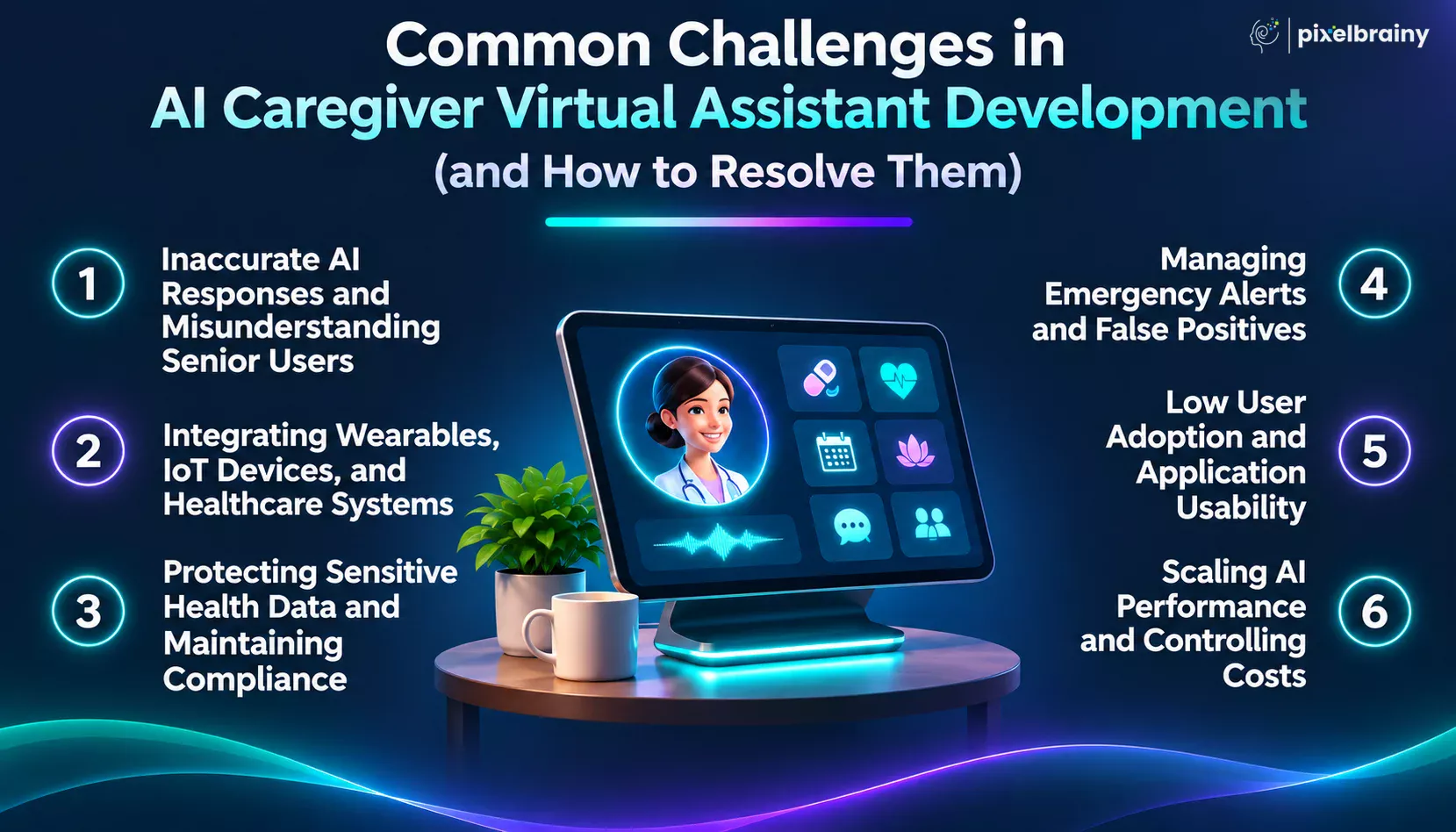
Challenge: Older adults may speak slowly, use different accents, repeat questions, or have difficulty explaining their needs. Background noise and speech variations can also affect voice recognition, leading to incorrect responses.
Solution:
These steps improve the accuracy and usability of an AI caregiver virtual assistant app.
Challenge: The assistant may need to connect with smartwatches, fall detection sensors, medication dispensers, and electronic health records. Different data formats and communication protocols can make integration difficult.
Solution:
A flexible integration architecture helps AI caregiver virtual assistant software maintain consistent data across devices.
Challenge: The platform may handle medication details, health records, personal information, and daily routines. Weak security or unclear consent practices can expose sensitive user data.
Solution:
Privacy and compliance must be considered from the beginning of the AI caregiver virtual assistant development process.
Challenge: Unusual activity, missed medication, or possible falls may trigger alerts. Too many false notifications can cause alert fatigue, while missed alerts may delay caregiver intervention.
Solution:
AI-generated alerts should support human decisions, not replace emergency services or clinical judgment.
Challenge: Seniors may struggle with complicated menus, small text, or frequent notifications. Family caregivers may also avoid applications that add unnecessary tasks to their routines.
Solution:
A senior-friendly design improves engagement and adoption of an AI-powered caregiver virtual assistant.
Challenge: More users, connected devices, and AI interactions increase computing requirements and operating costs. Voice processing, real-time monitoring, and third-party APIs can add further expenses.
Solution:
These practices help businesses scale their AI caregiver virtual assistant platform while maintaining performance and cost efficiency.
Successful AI caregiver virtual assistant development requires a balance of accuracy, security, usability, and human oversight. Addressing these challenges early helps businesses build reliable solutions that support caregivers and improve senior care.
Businesses entering the senior care and healthtech market need more than an AI chatbot. They need a technology partner that understands product strategy, AI capabilities, healthcare integrations, data security, and the practical needs of caregivers and older adults.
PixelBrainy brings these capabilities together to help businesses turn caregiving ideas into functional, scalable digital products. As a best AI product development company in USA, PixelBrainy supports businesses with product planning, technical architecture, AI engineering, application development, and ongoing improvements.
PixelBrainy provides AI caregiver virtual assistant development services aligned with your product goals and target users. Our approach covers the complete development lifecycle, from identifying user requirements to designing, integrating, testing, and deploying the solution.
Whether your goal is to support family caregivers, automate home care operations, or improve communication between seniors and care teams, we focus on practical features that address real caregiving challenges.
Every caregiving platform has different requirements. Our team can help you build an AI caregiver virtual assistant with capabilities such as conversational AI, medication reminders, voice interaction, caregiver dashboards, health check-ins, and automated notifications.
We also consider integrations with wearable devices, IoT sensors, healthcare APIs, and existing care management systems. This helps businesses create connected experiences while maintaining appropriate privacy controls and human oversight.
A senior care technology business wanted a virtual assistant that could help families monitor daily routines and stay informed about important changes.
The proposed solution included:
The project approach focused on simplifying family communication, organizing care information, and routing important alerts for human review.
This type of solution demonstrates how businesses can develop an AI caregiver virtual assistant around specific user needs instead of relying on generic chatbot functionality.
Whether you are launching a new senior care product or upgrading an existing healthcare platform, PixelBrainy can help create a caregiver virtual assistant integrating AI around your functional, technical, and commercial requirements.
Our team prioritizes scalable architecture, accessible interfaces, secure integrations, and continuous product improvement.
If you have a product concept, feature roadmap, or existing platform that needs AI capabilities, PixelBrainy can help you plan the next steps.
Connect with PixelBrainy to discuss your AI caregiver virtual assistant project and explore the right development approach.
AI caregiver virtual assistants are changing how families, home care agencies, and healthcare organizations support older adults. From medication reminders and daily wellness check-ins to predictive monitoring and caregiver coordination, these solutions can make care more accessible, organized, and responsive.
However, successful AI caregiver virtual assistant development requires more than advanced AI features. Businesses must consider user experience, healthcare integrations, data privacy, clinical safety, and human oversight to create a solution that people can trust.
Whether you want to launch a new senior care product, improve an existing platform, or streamline caregiving operations, the right development strategy can turn your idea into a practical, scalable solution. Working with an experienced technology partner like PixelBrainy can help you navigate product planning, AI integration, and application development with a clear direction.
The opportunity is to use AI not to replace human caregivers, but to give them better tools to deliver attentive and coordinated care.
Ready to discuss your idea? Book an appointment with PixelBrainy and explore your AI caregiver virtual assistant project.
An AI caregiver virtual assistant is an AI-powered solution that supports seniors, family caregivers, and care organizations. It manages medication reminders, wellness check-ins, appointment scheduling, and caregiver communication through voice or text. AI caregiver virtual assistant software can also connect with healthcare platforms and smart devices.
The AI caregiver virtual assistant development cost generally ranges from $40,000 to $300,000 or more. The cost to develop an AI caregiver virtual assistant depends on AI complexity, voice capabilities, healthcare integrations, wearable connectivity, security requirements, platform selection, and ongoing maintenance.
Essential AI caregiver virtual assistant features include AI chat, medication reminders, daily health check-ins, appointment management, voice interaction, caregiver dashboards, shared calendars, and care history tracking. Advanced features include fall detection, predictive health monitoring, wearable integration, and automated caregiver escalation.
The AI caregiver virtual assistant development timeline may range from three to twelve months, depending on product complexity. A basic application with reminders and AI chat takes less time than an enterprise solution involving healthcare integrations, IoT devices, predictive analytics, security testing, and multiple user roles.
Yes. AI caregiver virtual assistant development can include integrations with smartwatches, fitness trackers, fall detection sensors, and healthcare systems using APIs, Bluetooth, MQTT, and HL7 FHIR where applicable. These integrations support connected monitoring, health data exchange, and timely caregiver notifications.
An AI caregiver virtual assistant application can be designed to support HIPAA compliance when handling protected health information in the United States. This requires encryption, access controls, audit logs, risk assessments, and business associate agreements where applicable. Compliance depends on the complete implementation.
An AI-powered caregiver virtual assistant can use wearable devices, connected sensors, and activity monitoring to identify possible falls or unusual patterns. Detection accuracy depends on device capabilities and validation. Alerts should follow defined escalation workflows and involve human oversight rather than replace emergency services.
Choose an AI caregiver virtual assistant development company with experience in conversational AI, healthcare integrations, IoT connectivity, and data security. Review its project experience, technical architecture, testing methods, regulatory knowledge, maintenance approach, and ownership terms before selecting a development partner.

About The Author
Sagar Bhatnagar
Sagar Sahay Bhatnagar brings over a decade of IT industry experience to his role as Marketing Head at PixelBrainy. He's known for his knack in devising creative marketing strategies that boost brand visibility and market influence. Sagar's strategic thinking, coupled with his innovative vision and focus on results, sets him apart. His track record of successful campaigns proves his ability to utilize digital platforms effectively for impactful marketing efforts. With a genuine passion for both technology and marketing, Sagar continuously pushes PixelBrainy's marketing initiatives to greater success.

Working with PixelBrainy has been a great experience. They took our vision for an AI-powered platform and turned it into a fully functional product. What impressed me most was their strong understanding of both design and development, and their ability to handle complex requirements with ease. The team was responsive, cooperative, and always open to feedback. They kept things organized, communicated clearly, and delivered quality work on time. I highly recommend PixelBrainy to anyone looking for a skilled and reliable development partner.

Working with the PixelBrainy team has been a highly positive experience. They understand the design requirements and create beautiful UX elements to meet the application needs. The dev team did an excellent job bringing my vision to life. We discussed usability and flow. Sagar worked with his team to design the database and begin coding. Working with Sagar was easy. He has the knowledge to create robust apps, including multi-language support, Google and Apple ID login options, Ad-enabled integrations, Stripe payment processing, and a Web Admin site for maintaining support data. I'm extremely satisfied with the services provided, the quality of the final product, and the professionalism of the entire process. I highly recommend them for Android and iOS Mobile Application Design and Development.

Great experience working with them. Had a lot of feedback and I found that unlike most contractors they were bugging me for updates instead of the other way around. They were extremely time conscience and great at communicating! All work was done extremely high quality and if not on time, early! They were always proactive when it comes to communication and the work is great/above par always. Very flexible and a great team to work with! Goes above and beyond to present us with multiple options and always provides quality. Amazing work per usual with Chitra. If you have UI/UX or branding design needs I recommend you go to them! Will likely work with them in the future as well, definitely recommended!

PixelBrainy is a joy to work with and is a great partner when thinking through branding, logo, and website layout. I appreciate that they spend time going into the "why" behind their decisions to help inform me and others about industry best practices and their expertise.

I hired them to design our software apps. Things I really like about them are excellent communication skills, they answer all project suggestions and collaborate right away, and their input on design and colors is amazing. This project was complex and needed patience and creativity. The team is amazing to do business with. I will be using them long-term. Glad to see there are some good people out there. I was afraid to try and outsource my project to someone but I am glad I met them! I really can't say enough. They went above and beyond on this project. I am very happy with everything they have done to make my business stand out from the competition.

It was great working with PixelBrainy and the team. They were very responsive and really owned the project. We'll definitely work with them again!

I recently worked with the PixelBrainy team on a project and I was blown away by their communication skills. They were prompt, clear, and articulate in all of our interactions. They listened and provided valuable feedback and suggestions to help make the project a success. They also kept me updated throughout the entire process, which made the experience stress-free and enjoyable.

PixelBrainy is very good at what it does. The team also presents themselves very professionally and takes care of their side of things very well. I could fully trust them taking up the design work in a timely and organised manner and their attention to detail saved us lots of effort and time. This particular project was quite intense and the team showed that they function very well under pressure. Very much looking forward to working with her again!

It's always an absolute pleasure working with them. They completed all of my requests quickly and followed every note I had for them to a T, which made our process go smoothly from start to finish. Everything was completed fast and following all of the guidelines. And I would recommend their services to anyone. If you need any design work done in the future, PixelBrainy should be your first call!

They took ownership of our requirements and designed and proposed multiple beautiful variants. The team is self-motivated, requires minimum supervision, committed to see-through designs with quality and delivering them on time. We would definitely love to work with PixelBrainy again when we have any requirements.

PixelBrainy was a big help with our SaaS application. We've been hard at work with a new UI/UX and they provided a lot of help with the designs. If you're looking for assistance with your website, software, or mobile application designs, PixelBrainy and the team is a great recommendation.

PixelBrainy designers are amazing. They are responsive, talented, and always willing to help craft the design until it matches your vision. I would recommend them and plan to continue them for my future projects and more!!!

They were awesome! Did a good job fast, and good communication. Will work with them again. Thank you

Creative, detail-oriented, and talented designers who take direction well and implement changes quickly and accurately. They consistently over-delivered for us.

PixelBrainy team is very talented and creative. Great designers and a pleasure to work with. PixelBrainy is an excellent communicator and I look forward to working with them again.

PixelBrainy has a very talented design team. Their work is excellent and they are very responsive. I enjoy working with them and hope to continue on all of our future projects.


Transform your ideas into reality with us.
Across these industries, each engagement brings unique challenges, from early-stage product development to scaling complex systems, helping us build a practical understanding of real-world product environments.