AI Summary Powered by PixelBrainy
What if one AI-powered platform could become the intelligent health companion for an entire family, from children and working adults to elderly parents and people living with chronic conditions?
Imagine a digital health founder evaluating a new product opportunity. The founder sees a clear gap: “I am a digital health founder and I see a clear gap in the market for an AI family health assistant app that manages the complete health picture of every member of a family including children, elderly parents, and adults with chronic conditions.” Existing products often focus on individual fitness tracking, standalone symptom checking, medication reminders, or condition-specific monitoring. The opportunity is to bring these fragmented experiences together through one family-centered health intelligence platform.
This is where AI family health assistant app development becomes strategically important. A well-designed platform can connect family profiles, medical records, symptoms, medications, appointments, laboratory reports, wearable data, preventive-care requirements, and caregiver workflows, while AI helps users organize information and identify relevant next steps.
The market opportunity is also growing. According to The Business Research Company, the global digital health market is projected to reach $371.59 billion in 2026 and $664.65 billion by 2030, representing a projected 15.6% CAGR from 2026 to 2030. The Business Research Company: Digital Health Global Market Report
For a founder asking how to create an AI family health assistant app with symptom checking and health monitoring features, however, adding an AI chatbot is only one component. The product requires secure health-data architecture, family-level permissions, AI orchestration, healthcare interoperability, clinical safety controls, monitoring, and potentially medical-device compliance.
This guide explains the steps to make an AI family health assistant app from idea to launch, including features, development process, technology stack, cost, compliance, business models, challenges, and differentiation strategies for founders looking to build an AI family health assistant app for healthcare businesses. It also shows what founders need before committing capital.

An AI family health assistant app is a digital health platform that uses artificial intelligence to help families manage the health information, monitoring, care tasks, and healthcare activities of multiple family members through one secure application. Unlike an individual health app, it can create separate health profiles for children, adults, elderly parents, and other authorized dependents while providing personalized AI assistance for each person.
The defining capability of an AI-powered family health assistant app is its ability to combine health data with family-level context. It can organize medical records, symptoms, medications, appointments, laboratory reports, vaccinations, wearable data, and health-monitoring information while using AI to identify relevant information and support healthcare-related workflows.
A standard health app typically focuses on a specific individual and a limited objective, such as fitness tracking, calorie monitoring, medication reminders, sleep tracking, or symptom assessment. An AI family health assistant expands this model by connecting multiple health-management functions and family members within one platform.
| Feature | Standard Health App | AI Family Health Assistant App |
|---|---|---|
| User management | Individual | Multiple family profiles |
| Health records | Personal records | Family records with separate permissions |
| AI assistance | Limited | Context-aware AI assistant |
| Symptom checking | Basic assessment | Personalized AI-assisted assessment |
| Health monitoring | Individual | Multi-member monitoring |
| Medication management | Individual reminders | Family medication coordination |
| Caregiver access | Limited | Role-based access |
| Preventive care | Basic reminders | Personalized care workflows |
| Health insights | Basic analytics | AI-supported health insights |
Another important distinction is permission-based family health management. A family relationship should not automatically provide unrestricted access to another person's medical information. The platform should support role-based permissions, consent management, age-specific access, and secure sharing.
For healthcare businesses, the value of AI family health assistant app development lies in combining AI health assistance, symptom checking, remote health monitoring, medication management, digital health records, preventive care, caregiver coordination, and personalized health insights within one scalable platform.
This makes the AI family health assistant a broader family health intelligence platform, rather than another standalone fitness, symptom-checking, or health-tracking application.
An AI family health assistant app works by collecting authorized health data, creating individual family health profiles, analyzing relevant information with AI, and providing personalized health assistance, monitoring, reminders, and care-coordination support. The system connects family members, health records, wearable devices, healthcare information, and AI capabilities through one secure platform.
The typical workflow involves seven key stages:
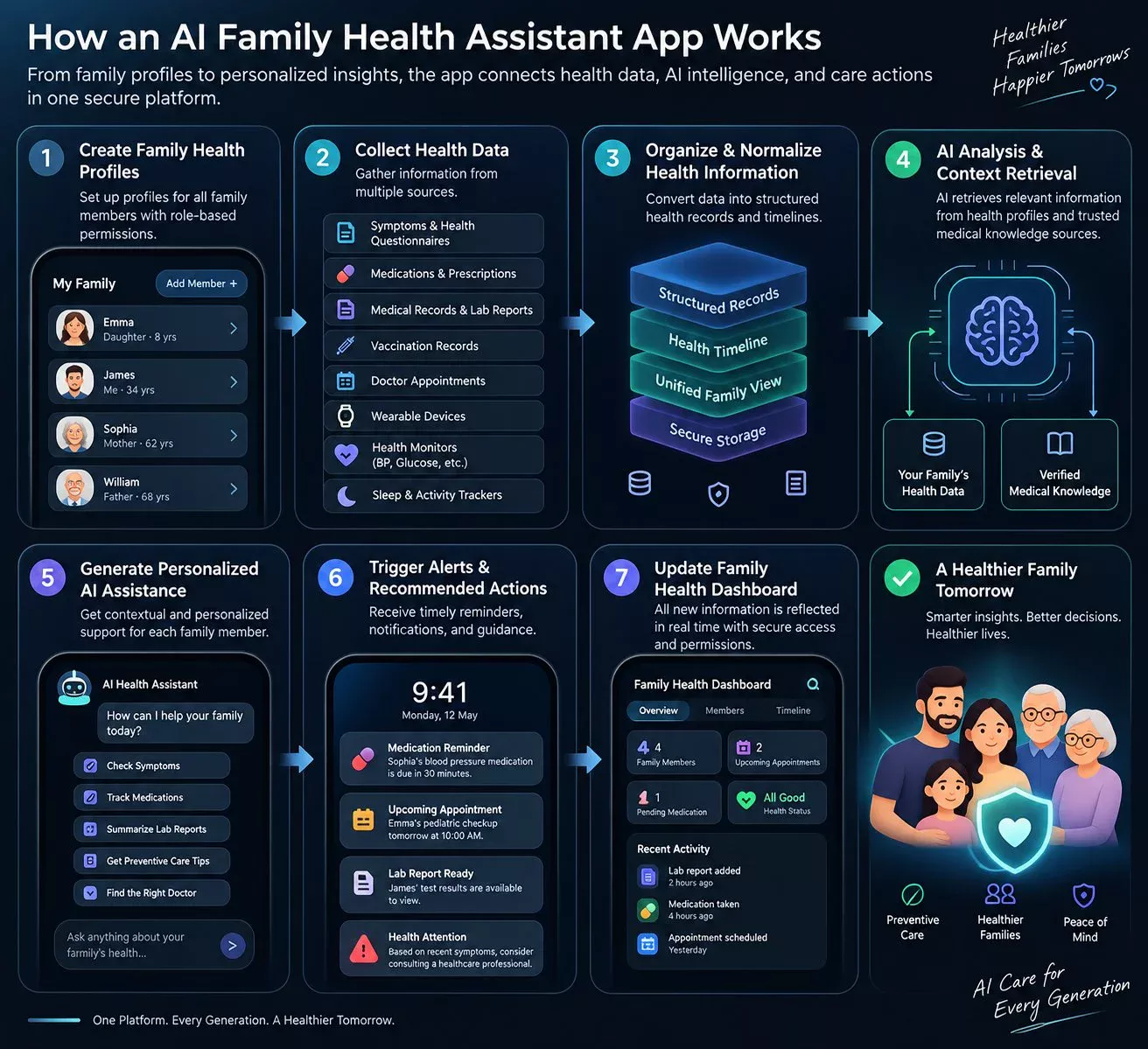
Users create separate profiles for children, adults, elderly parents, dependents, or other authorized family members. Each profile contains relevant health information and independent access permissions.
The application gathers authorized information from multiple sources, including:
The platform converts information from different sources into structured health records. This creates an ongoing health timeline containing symptoms, medications, measurements, appointments, reports, and other relevant events.
When a user asks the AI assistant a question, the system retrieves relevant information from the person's authorized health profile and approved healthcare knowledge sources. This allows the AI to provide responses based on available context rather than relying only on a generic answer.
The AI can support features such as AI symptom checking, health monitoring, medication management, health-record summarization, preventive-care reminders, health education, and caregiver coordination.
Based on configured rules and monitoring workflows, the application can provide medication reminders, appointment notifications, measurement prompts, or recommendations to seek appropriate professional care when a situation requires further evaluation.
New information continuously updates each authorized family member's health timeline and dashboard. Caregivers can see relevant tasks and information according to their permissions, while sensitive health information remains protected through authentication, authorization, consent management, and audit controls.
Technical workflow:
User Input → Health Data → Data Processing → Context Retrieval → AI Analysis → Safety Validation → Personalized Response → Alert or Action → Health Timeline Update
This architecture allows an AI family health assistant to function as a family health intelligence platform, while keeping clinical decisions and emergency care within appropriate professional healthcare pathways.
For healthcare founders, the investment opportunity in an AI family health assistant app is driven by the convergence of several rapidly expanding markets: artificial intelligence in healthcare, AI-powered patient engagement, remote patient monitoring, connected health devices, and digital caregiving. The opportunity is not simply to launch another health app. It is to build a platform that can sit between families, health data, healthcare services, and intelligent digital assistance.
Consider a healthcare entrepreneur asking: “What would it take to build a scalable AI healthcare platform that can serve an entire household, connect health data from multiple sources, and create recurring digital engagement with patients and caregivers?” That question changes the investment perspective from developing a single-purpose application to creating a broader family healthcare infrastructure.
The growth of healthcare AI provides one of the strongest market signals for investing in AI family health assistant app development.
According to a June 2026 MarketsandMarkets report, the global AI in healthcare market is projected to grow from $36.67 billion in 2026 to $194.79 billion by 2031, representing a 39.7% CAGR. The report identifies increasing AI adoption across healthcare organizations and applications as a major growth factor.
For founders considering how to create an AI family health assistant app with symptom checking and health monitoring features, this indicates that AI healthcare infrastructure itself is becoming a substantial technology market.
A family health assistant is fundamentally an ongoing patient engagement product. Users can interact with it repeatedly for health questions, records, reminders, monitoring, appointments, and caregiver coordination.
Grand View Research estimates that the global AI in patient engagement market will reach $23.1 billion by 2030, increasing from $10.6 billion in 2026, with a projected CAGR of 21.0% from 2024 to 2030.
This creates a relevant market direction for healthcare businesses looking to build an AI family health assistant app that can become a recurring digital touchpoint between patients, caregivers, and healthcare providers.
An AI family health assistant does not have to remain limited to conversational health support. It can evolve into a connected monitoring platform that receives information from approved medical devices and wearable technologies.
A February 2026 report from The Business Research Company estimates that the global AI in remote patient monitoring market will grow from $3.45 billion in 2026 to $8.02 billion by 2030, representing a projected CAGR of 23.5% during the forecast period.
For a founder, this supports a product roadmap that can progress from AI assistance and health tracking toward remote monitoring, connected devices, chronic-care workflows, and healthcare-provider integration.
Another investment consideration is the development of healthcare AI agents that can perform structured, multi-step workflows rather than simply generate conversational responses.
Grand View Research estimates that the global agentic AI in healthcare market will grow from $1.08 billion in 2026 to $4.96 billion by 2030, at a projected CAGR of 45.6% from 2025 to 2030.
For an AI family health assistant, this technology direction could eventually support controlled workflows such as organizing pending appointments, identifying incomplete health tasks, preparing a health summary for a consultation, or coordinating reminders across authorized family profiles.
Most digital health products are designed around the individual patient. Family healthcare introduces a different product structure.
A single household may contain:
This creates an opportunity to design the application around the family as a healthcare management unit, while maintaining separate health records and permissions for every individual.
That positioning can help differentiate a new product from applications focused primarily on fitness, individual symptom checking, or single-condition monitoring.
Investment becomes more attractive when the product can support multiple commercial models.
An AI family health assistant could potentially be monetized through:
This gives founders multiple routes to validate revenue rather than depending exclusively on consumer subscription income.
A founder does not need to launch every capability simultaneously.
A practical product evolution could be:
AI Health Assistant → Family Profiles → Symptom Assessment → Health Records → Medication Management → Wearable Integration → Remote Monitoring → Caregiver Coordination → Provider Integration
This creates a scalable foundation for AI family health assistant app development, where each additional capability can open another product or revenue pathway.
The investment case is ultimately based on market convergence. AI healthcare, patient engagement, remote monitoring, and intelligent healthcare automation are developing simultaneously, creating an opportunity for family-focused platforms that can connect these capabilities within one secure ecosystem.
An AI family health assistant app can serve very different healthcare audiences, and each audience requires a different product strategy, feature set, integration model, and technical architecture. A consumer startup may focus on family health tracking and AI assistance, while an insurer may need member engagement, a pediatric organization may require preventive-care workflows, and a health system may need EHR and telehealth integration.
Consider this real-world scenario: Our pediatric healthcare organization wants to build an AI family health assistant app that helps parents manage the complex preventive care schedule for their children, including vaccinations, wellness visits, developmental milestones, screenings, medications, and follow-up appointments.
For this organization, the application needs to do more than provide an AI chatbot. It should understand the child's age and health profile, organize preventive-care requirements, send appropriate reminders, provide trusted health information, coordinate appointments, and connect parents with pediatric care when necessary. This scenario illustrates why AI family health assistant app development can take several distinct forms depending on the healthcare business and its target population.
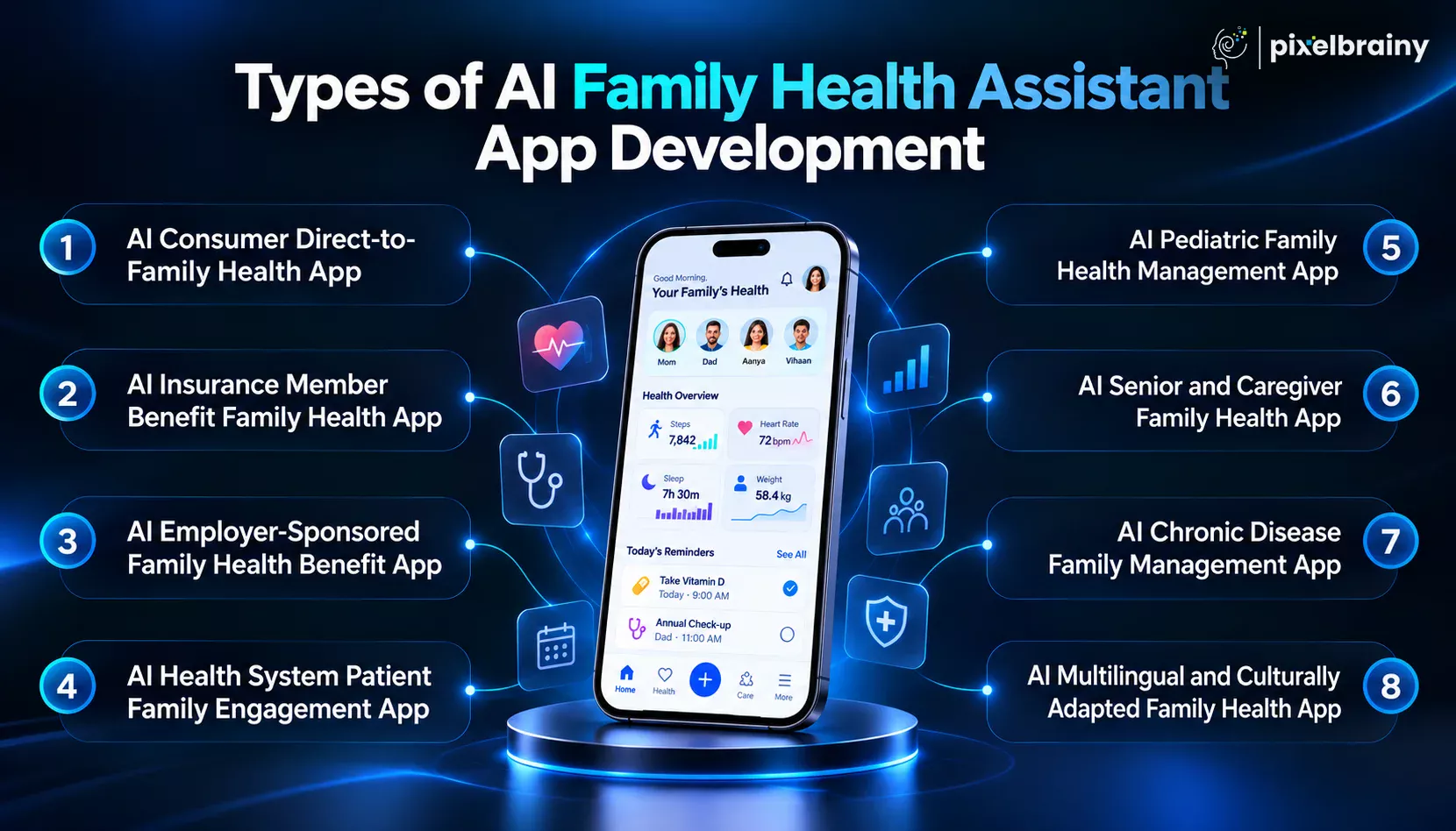
An AI consumer direct-to-family health app is built for households that directly download, use, and potentially subscribe to the application. The platform can create separate profiles for parents, children, elderly family members, and dependents while providing an AI assistant across the family ecosystem.
Core features may include:
This model is suitable for startups that want to build an AI family health assistant app as a direct-to-consumer healthcare product.
Health insurers can offer an AI family health assistant as a digital member benefit. Instead of functioning as a standalone consumer application, the platform becomes part of the insurer's digital healthcare ecosystem.
Potential capabilities include:
For insurers, AI family health assistant app development can create a digital engagement channel connecting members with relevant healthcare resources throughout the year.
Employers can provide family health assistant applications as part of employee healthcare and wellness programs. The platform can extend healthcare support beyond the employee to eligible dependents.
Features can include:
When building an AI family health assistant application platform for employers, strong privacy controls are essential. Employer access should remain appropriately separated from employees' private health information.
Hospitals and health systems can use an AI family health assistant to connect patients and authorized caregivers with their existing healthcare services.
The application can integrate with:
This model is particularly relevant for organizations looking to develop AI family health assistant app solutions that become part of an established healthcare delivery ecosystem.
The pediatric use case described above represents a specialized category of AI family health assistant app development.
A pediatric healthcare organization can use the application to help parents manage:
An organization planning to create an AI family health assistant app with telehealth and virtual care integration features can connect preventive-care reminders with virtual pediatric consultations and secure provider communication.
The AI can organize age-related healthcare tasks and surface relevant reminders while keeping clinical decisions within appropriate professional care pathways.
An AI senior and caregiver family health app focuses on elderly family members and the people who coordinate their healthcare.
Important capabilities can include:
Role-based permissions are particularly important because a caregiver may need access to medication or appointment information without receiving unrestricted access to the senior's complete medical record.
An AI chronic disease family health assistant can support households managing conditions such as diabetes, hypertension, asthma, COPD, or cardiovascular disease.
The platform can bring together:
AI can help organize longitudinal information and identify configured trends that users can discuss with their healthcare professionals.
Also Read: AI Chatbot Development for Chronic Disease Management: Steps, Cost and Challenges
A multilingual AI family health assistant is designed for populations where language, health literacy, accessibility, and cultural context affect healthcare engagement.
The platform can provide:
This approach is valuable for healthcare businesses expanding across countries or serving linguistically diverse populations.
The development of AI family health assistant app solutions therefore extends across consumer healthcare, insurance, employer benefits, hospitals, pediatrics, senior care, chronic disease management, and multilingual healthcare. Each category creates different requirements for AI capabilities, integrations, privacy controls, clinical workflows, compliance, and monetization, making the target healthcare ecosystem a foundational product-development decision.
For healthcare founders, the value of an AI family health assistant app comes from bringing several fragmented healthcare activities into one connected experience. Instead of managing children's care, adult health, elderly-parent care, medications, appointments, and health monitoring across separate tools, families can use one platform with personalized AI assistance and permission-based access.
Consider a founder asking: “Can an AI family health assistant help families coordinate everyday healthcare while giving each member personalized health support based on their age, conditions, medications, and health data?” This is where the strongest product value begins. The platform can combine AI health assistance, family health management, monitoring, caregiving, and healthcare navigation in a single digital ecosystem.
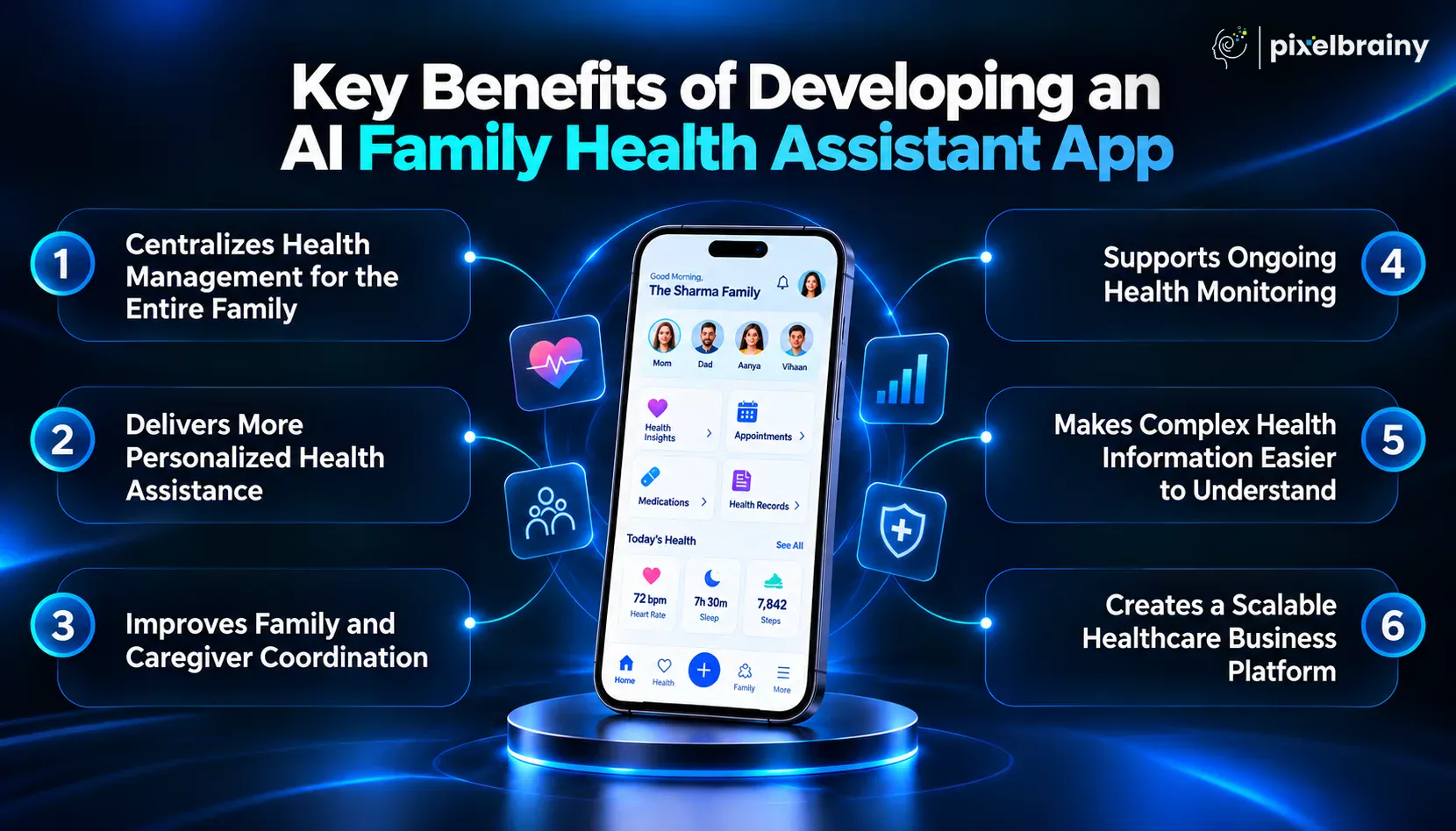
An AI family health assistant application can bring medical records, medications, symptoms, appointments, reports, vaccinations, and monitoring information into one platform.
Each person can maintain a separate health profile while authorized family members access relevant information according to their permissions.
This reduces fragmentation and creates a consistent digital environment for managing family healthcare.
AI can use relevant information such as age, health history, medications, symptoms, and monitoring data to personalize the user experience.
For example, a parent's healthcare workflow can differ significantly from a child's or an elderly family member's.
Research and healthcare initiatives increasingly explore AI-enabled, family-centered digital tools for more personalized care experiences. AHRQ highlighted the role of data, AI, and family engagement in advancing high-value pediatric care in 2026.
Healthcare responsibilities often involve several people. Parents manage children's healthcare, while adult children may coordinate care for elderly parents.
An AI family health assistant app can organize shared tasks, reminders, appointments, medication schedules, and relevant health information for authorized caregivers.
Recent 2026 research also identifies personalized digital support, integrated functions, and professional support as important needs among family caregivers.
An AI-powered family health platform can connect with compatible wearables and home-monitoring devices to collect health measurements.
The application can organize information such as:
Instead of displaying isolated numbers, the platform can present longitudinal trends and configured alerts for review.
Medical reports, prescriptions, laboratory results, and discharge documents can be difficult for families to interpret.
An AI assistant can help summarize documents, explain healthcare terminology, organize questions for appointments, and prepare concise health summaries.
A 2026 PubMed case study described how a family used generative AI to understand medical information, prepare for healthcare visits, summarize records, and communicate information with care teams.
For healthcare companies, AI family health assistant app development can extend beyond a consumer application.
The same platform architecture can support:
This gives businesses opportunities to build subscription services, member benefits, caregiver programs, telehealth workflows, or white-label healthcare platforms around the same core technology.
An AI family health assistant app therefore creates value at both the family and business level. It can connect health information, AI assistance, monitoring, caregiving, and healthcare navigation while creating a foundation for broader digital health services.
An effective AI family health assistant app should bring essential health information, daily care tasks, communication, and personalized assistance into one secure platform. When businesses build an AI family health assistant app, the core feature set should support different family members while keeping their health profiles, permissions, records, and care activities properly separated.
Consider this real-world query: “We want to develop an AI family health assistant app that allows parents to manage their children’s health, track their own medications, and coordinate care for elderly family members from one secure platform. What core features should we include?”
The following features address that requirement without moving into advanced capabilities, which can be covered separately in the next section. Interoperability is also important because modern health applications increasingly rely on APIs and standards such as HL7 FHIR to exchange health information across systems.
| Must-Have Feature | Explanation |
|---|---|
| Family Account and Member Profiles | A family account should allow users to create individual profiles for children, adults, and elderly members. Each profile can store age, gender, medical history, allergies, conditions, medications, and basic health preferences for personalized assistance. |
| Personalized AI Health Assistant | The AI health assistant should provide responses based on the selected family member’s profile and health context. It can answer general health questions, explain health information, and provide relevant guidance without treating every family member identically. |
| Health Records Management | Health records management should organize important information such as diagnoses, prescriptions, allergies, vaccination history, laboratory results, and medical documents. A structured health record gives families a centralized view instead of relying on scattered files and applications. |
| Medication Management and Reminders | Medication management should let users add medicines, dosage instructions, schedules, refill information, and treatment duration. Timely reminders can help family members remember routine medications while caregivers can monitor important medication-related tasks for dependents. |
| Appointment Scheduling and Reminders | Appointment management should allow families to record doctor visits, diagnostic appointments, vaccinations, therapy sessions, and follow-ups. Automated reminders can help reduce missed appointments while keeping upcoming healthcare activities visible within the family dashboard. |
| Health Timeline | A health timeline should organize important medical events chronologically, including appointments, medications, diagnoses, vaccinations, test results, and recorded symptoms. This gives users and authorized caregivers a clearer picture of how an individual’s healthcare journey has progressed. |
| Symptom Tracking | Symptom tracking should allow users to record symptoms, severity, duration, frequency, and relevant notes. The AI family health assistant can use this information as context when providing general educational guidance or helping users prepare information for healthcare consultations. |
| Vitals and Health Metrics Tracking | The app should support manual tracking of common health measurements such as weight, temperature, blood pressure, blood glucose, heart rate, or oxygen saturation where appropriate. Users can view historical measurements and identify changes worth discussing with healthcare professionals. |
| Family Health Dashboard | A centralized family health dashboard should summarize important information for authorized users, including upcoming appointments, medication schedules, recent health updates, and pending care tasks. Separate member views help families manage multiple people without mixing individual health information. |
| Caregiver Access and Permissions | Caregiver access should provide controlled visibility into another person’s health information based on authorization. Role-based permissions can allow parents, spouses, adult children, or other trusted caregivers to access only the information and functions they are permitted to manage. |
| Secure Health Data Sharing | Secure health data sharing should allow users to share selected records or health information with authorized family members, caregivers, or healthcare professionals. Sharing controls should make it clear what information is being shared, with whom, and for what purpose. |
| Health Document Upload and Storage | Users should be able to upload and organize prescriptions, laboratory reports, medical bills, discharge summaries, vaccination records, and other healthcare documents. Categorized storage makes important information easier to locate when preparing for appointments or sharing records. |
| Notifications and Alerts | Notifications should cover practical healthcare activities such as medication schedules, appointments, health tasks, and important updates. Users should be able to manage notification preferences so each family member receives relevant alerts without unnecessary messages. |
| Search and Health Information Retrieval | A search function should help users quickly find medications, medical documents, appointments, symptoms, health records, or family member information. AI-assisted retrieval can make large amounts of stored health information easier to locate and understand. |
| Telehealth and Healthcare Service Integration | Telehealth integration can connect users with virtual care services when supported by the business model and healthcare ecosystem. The app can provide access to consultations, provider information, appointment details, and relevant health records needed for a connected digital care experience. |
These core capabilities create the foundation for AI family health assistant app development, giving families one secure environment for health records, medication management, appointments, monitoring, caregiver coordination, and personalized AI assistance.
After covering the essential capabilities, an AI family health assistant app development strategy can introduce differentiated features that make the platform more intelligent, proactive, and useful across complex family healthcare situations. These capabilities should extend the core experience rather than simply repeat standard functions such as reminders, profiles, records, or appointment scheduling.
Consider this real-world query: “How can we develop an AI family health assistant app that does more than store health records and send reminders, while helping families understand patterns, coordinate care, and receive proactive support across different health needs?”
The following non-ordinary features can help businesses build AI family health assistant apps with stronger personalization and differentiation. Current healthcare AI development is increasingly moving toward connected workflows, predictive capabilities, multimodal health data, and agentic assistance, although these capabilities require careful validation, interoperability, privacy controls, and human oversight.
| Non-Ordinary Feature | Explanation |
|---|---|
| AI Family Health Pattern Detection | The app can analyze health information across individual family timelines to identify meaningful patterns, such as recurring symptoms, missed medications, repeated appointments, or changes in health measurements. This can give families a clearer view of ongoing health trends without presenting AI output as a medical diagnosis. |
| Multimodal Health Information Understanding | A more advanced AI family health assistant can process different information formats, including text, medical documents, images, voice inputs, and structured health data. This can help users interact naturally while allowing the platform to organize information from multiple healthcare sources into a usable family health context. |
| Proactive Family Care Recommendations | Instead of responding only after users ask questions, the application can identify relevant care tasks from available information and surface timely recommendations. Examples can include preparing for an upcoming consultation, reviewing an incomplete health record, or reminding a caregiver about a pending care activity. |
| AI-Powered Health Journey Summaries | The platform can automatically generate concise summaries of a family member’s recent health journey using authorized records, appointments, medications, symptoms, and measurements. A caregiver could use the summary before a consultation to quickly understand recent developments without manually reviewing multiple records. |
| Cross-Generational Care Coordination | This feature can connect care activities across children, adults, and elderly family members while maintaining separate profiles and permissions. The AI can organize overlapping responsibilities, helping caregivers understand which appointments, medications, follow-ups, or health tasks require attention across the household. |
| Personalized Health Context Memory | The AI can maintain an authorized contextual understanding of each family member’s preferences, recurring healthcare needs, relevant history, and previous interactions. This allows future conversations to become more personalized while privacy controls determine what information the AI can access and retain. |
| AI Health Data Normalization | Health information collected from different providers, documents, devices, or applications can use different formats and terminology. An AI-powered normalization layer can help organize this information into consistent categories, supporting cleaner health timelines and more useful personalization. FHIR-based interoperability is increasingly important for connecting digital health ecosystems. |
| Family Health Risk Trend Visualization | The application can convert longitudinal health information into easy-to-understand trend views for authorized users. Instead of displaying isolated measurements, it can show changes over time and provide contextual explanations, helping families discuss relevant observations with qualified healthcare professionals. |
| AI-Generated Consultation Preparation | Before a medical appointment, the app can create a structured preparation brief containing relevant symptoms, medications, recent measurements, questions, and previous care events. This can help users arrive better prepared and reduce the time spent reconstructing a family member’s recent health history. |
| Context-Aware Health Conversation Continuity | The AI assistant can maintain continuity between related conversations instead of treating every interaction as a completely new request. For example, when a user returns to discuss an ongoing symptom or medication question, the system can reference authorized previous context while clearly separating AI assistance from professional medical advice. |
These differentiated capabilities can help an AI family health assistant app development project evolve from a basic health management tool into a more contextual, connected, and proactive digital family healthcare platform.
The steps to develop AI family health assistant app from idea to launch should cover product strategy, healthcare workflows, family-specific data, AI architecture, clinical validation, application development, testing, and deployment. Unlike a conventional health application, an AI family health assistant needs to understand that the same symptom, medication, or care task can mean something different for different family members.
For example, a parent asking about fever for a seven-year-old child should not receive the same assessment pathway as an elderly family member with diabetes and hypertension. The system therefore needs structured health profiles, contextual AI, clinically reviewed decision logic, secure health data handling, and clearly defined escalation pathways.
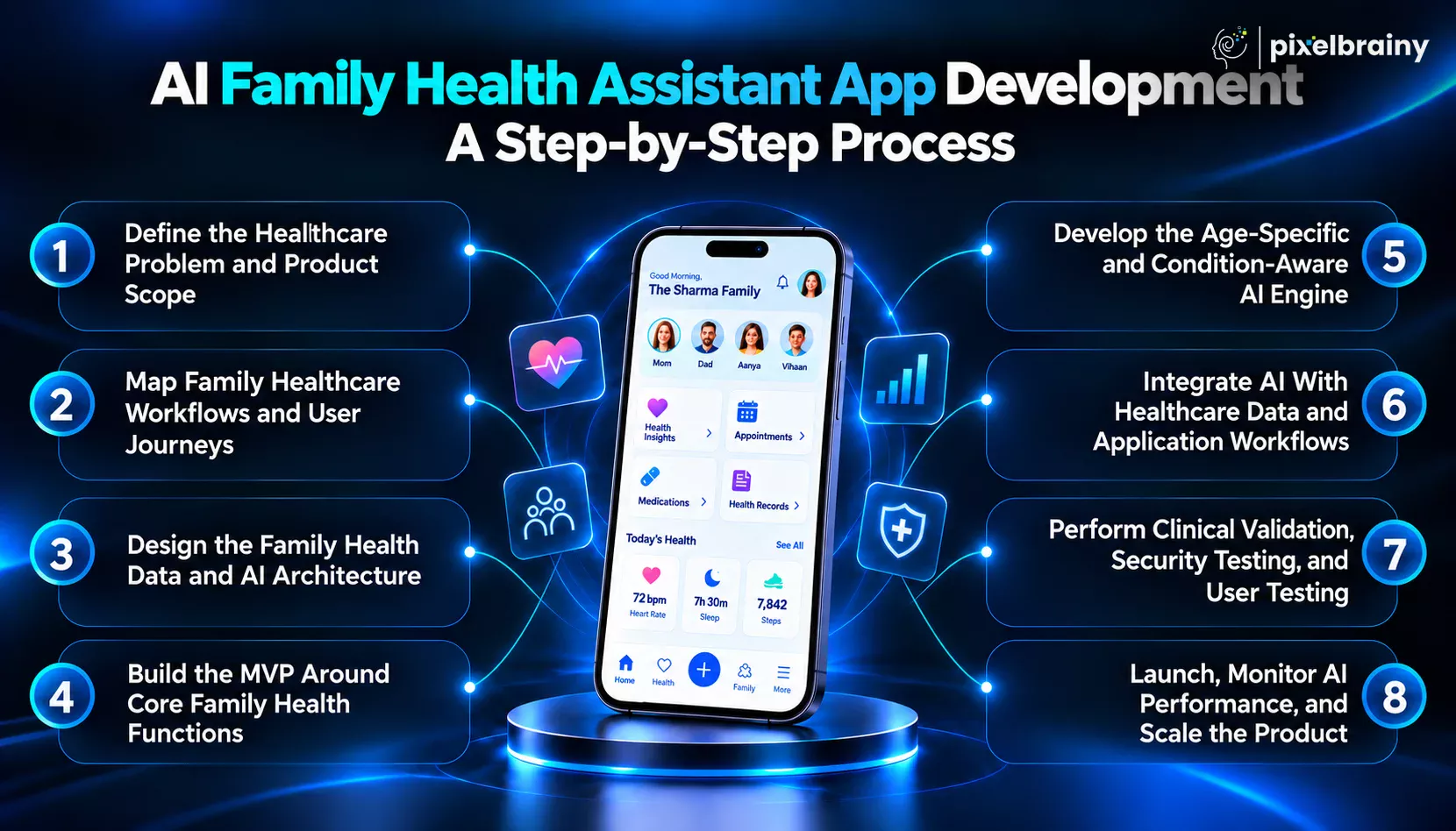
The first step in how to build AI family health assistant app from scratch is defining the exact healthcare problem the product will solve. Identify the target users, family structures, healthcare workflows, and situations where AI assistance will provide measurable value.
A healthcare business may focus on preventive care, medication management, chronic-condition support, symptom assessment, caregiver coordination, or a combination of these areas. Define what the AI can handle and where professional healthcare support is required. This prevents the product from becoming an unrestricted chatbot with unclear responsibilities. A detailed product scope should also establish target age groups, supported conditions, data sources, user roles, and expected outcomes before technical development begins.
The second step is converting the product concept into real family healthcare journeys. Map how different users will interact with the application from registration through everyday health management.
For example, a parent may create profiles for two children, add vaccination records, monitor symptoms, manage medications, and schedule pediatric appointments. An adult user may separately track blood pressure and medication, while an authorized caregiver manages an elderly parent's appointments. These workflows determine the screens, permissions, notifications, AI interactions, and data requirements. During this stage, AI consultation can help product teams examine healthcare workflows, identify gaps, and determine where AI should assist users rather than unnecessarily automate sensitive healthcare decisions.
Also Read: Top 10 AI Consulting Companies in USA
Once workflows are defined, design the technical architecture that will connect family profiles, health information, AI services, application features, and external healthcare systems. The architecture should maintain separate health contexts for every family member while allowing authorized caregivers to access permitted information.
For an AI symptom checker, the architecture should pass structured context such as age, symptoms, medical history, existing conditions, medications, allergies, and relevant measurements into the assessment workflow. This is essential because healthcare AI depends heavily on trustworthy and connected data. HL7's 2026 AI work emphasizes interoperability and the importance of reliable data foundations for healthcare AI systems.
The fourth step is MVP development, where the initial product is converted into a usable application with the most important workflows. Instead of attempting to develop every planned capability, prioritize features that directly support the defined healthcare use case.
A practical first version can include family member profiles, health records, medication management, appointments, symptom tracking, AI conversations, caregiver permissions, notifications, and essential healthcare integrations. The MVP should also include the underlying data structure required for contextual AI. This approach allows the product team to test real user behavior, identify usability issues, and validate the core family health experience before investing in a larger feature set.
Also Read: Top 10 AI MVP Development Companies in USA
This is the most important step when the application includes an AI symptom checker. AI model development should not simply connect a general-purpose language model to a symptom form. The system needs a controlled architecture that combines the user's health profile, structured clinical information, validated medical knowledge, safety rules, and AI-generated communication.
The real-world requirement is clear: “We are building an AI family health assistant app and the feature I want to get right is the AI symptom checker that serves multiple family members with very different health contexts. A symptom assessment for a seven-year-old child needs to work completely differently from the same symptom in a sixty-five-year-old adult with diabetes and hypertension. I want to understand how to build an AI symptom assessment engine that is genuinely age-specific, condition-aware, and produces triage recommendations that are clinically appropriate for each family member's specific health profile.”
The engine should therefore identify the selected family member first, retrieve relevant health context, ask appropriate follow-up questions, apply validated assessment logic, and determine the appropriate level of care or escalation. Patient-facing clinical decision support requires particular regulatory attention because FDA's January 2026 guidance distinguishes different types of clinical decision support software and notes that software intended for patients or caregivers can fall outside certain non-device CDS criteria.
Also Read: Top 12+ AI Model Development Companies in the USA
After establishing the AI architecture, connect it with the application's actual healthcare workflows. This is where AI integration becomes important. The AI should be able to retrieve the right family member's authorized health context and return its output to the correct part of the application.
Depending on the product, integrations may include EHR systems, laboratories, pharmacies, wearable devices, telehealth platforms, health information APIs, or healthcare provider systems. Interoperability should be considered early rather than added after the application is built. HL7 highlights fragmented data, inconsistent formats, and limited integration as important barriers to healthcare AI adoption, while standards such as FHIR are designed to support structured healthcare data exchange.
Also Read: Top 10+ AI Integration Companies in USA
Healthcare AI requires testing beyond normal software quality assurance. Test whether the application correctly identifies the selected family member, retrieves the right health context, protects sensitive information, and produces consistent responses across different healthcare scenarios.
For the symptom checker, create test cases involving children, adults, elderly users, chronic conditions, medications, allergies, multiple simultaneous symptoms, incomplete information, and situations requiring urgent escalation. Clinical professionals should review appropriate scenarios and assessment pathways. Security testing should cover authentication, authorization, encryption, API security, consent, and data isolation. FDA's current CDS guidance specifically discusses intended use, patient populations, required inputs, algorithm development, validation, and the basis for recommendations.
The final step in developing an AI family health assistant app is controlled deployment followed by continuous monitoring. Before opening the application to a large user base, launch with a defined audience and monitor technical performance, AI response quality, user behavior, failed workflows, safety issues, and support requirements.
Post-launch data can reveal where users abandon workflows, misunderstand AI responses, provide incomplete health information, or require additional guidance. Teams can then improve prompts, retrieval mechanisms, clinical rules, interfaces, integrations, and model behavior. Businesses can hire AI developers for dedicated product teams or work with AI product development companies when scaling requires additional AI, healthcare, and engineering expertise. The goal is to create a continuously improving healthcare product rather than treating launch as the end of development.
A structured AI family health assistant app development process connects healthcare requirements, family-specific context, responsible AI, clinical validation, and scalable technology into one product lifecycle.
The cost to develop an AI family health assistant app typically ranges from $40,000 to $300,000+, depending on the application's AI complexity, healthcare integrations, number of platforms, security requirements, clinical workflows, and level of customization. A basic application with essential family health management features can fall near the lower end, while an enterprise healthcare platform with an AI symptom checker, EHR integration, wearable connectivity, telemedicine, advanced security, and multiple user roles can move well beyond $300,000.
For healthcare businesses, the development budget of AI family health assistant app should therefore be estimated according to the actual product scope rather than a fixed per-app price. The cost estimation of AI family health assistant app development also needs to account for infrastructure, third-party APIs, AI usage, testing, compliance, maintenance, and post-launch improvements.
Consider this real-world query: “We are a digital health startup trying to understand what it realistically costs to build an AI family health assistant app in 2026. The cost estimates we have received range from $40,000 to $300,000+ for what appears to be similar feature sets and we cannot reconcile this range without understanding what drives the cost difference. We want an itemized cost breakdown covering every major component including the AI symptom checker, medication management, wearable integration, health records, telemedicine integration, and HIPAA-compliant infrastructure.”
For healthcare businesses, the AI family health assistant app development cost can be broadly divided into three product levels.
| Development Level | Typical Cost | What the Cost Covers |
|---|---|---|
| Basic AI Family Health Assistant App | $40,000 to $80,000 | Family profiles, health records, medication reminders, appointment management, basic AI health chatbot, symptom input, notifications, caregiver access, basic admin panel, secure cloud infrastructure, and essential application testing. |
| Advanced AI Family Health Assistant App | $80,000 to $180,000 | Everything in the basic version plus a more contextual AI symptom checker, personalized AI assistance, wearable integration, health data synchronization, telemedicine integration, health document management, advanced caregiver permissions, analytics, API integrations, stronger security architecture, and expanded testing. |
| Enterprise AI Family Health Assistant App | $180,000 to $300,000+ | Enterprise-grade AI symptom assessment, multiple healthcare integrations, EHR and FHIR connectivity, wearable ecosystem integrations, telemedicine infrastructure, complex family and caregiver roles, multilingual capabilities, advanced analytics, scalable cloud architecture, comprehensive security, clinical validation workflows, compliance support, monitoring, and enterprise administration. |
These figures are indicative development ranges rather than fixed industry pricing. The final development pricing of AI family health assistant app depends heavily on the technical architecture, development team location, AI approach, number of integrations, supported platforms, clinical requirements, and post-launch scope.
For a more practical cost estimation of AI family health assistant app development, the following ranges show how individual components can contribute to the overall budget.
| Development Component | Estimated Cost |
|---|---|
| Product discovery, healthcare workflow analysis, and UX planning | $4,000 to $12,000 |
| UI/UX design for family and caregiver workflows | $5,000 to $15,000 |
| Family profiles and account management | $4,000 to $10,000 |
| Health records and medical document management | $7,000 to $20,000 |
| AI health chatbot and conversational interface | $8,000 to $25,000 |
| AI symptom checker and contextual assessment engine | $15,000 to $45,000+ |
| Medication management and reminders | $4,000 to $10,000 |
| Wearable and health-device integration | $8,000 to $25,000+ |
| Telemedicine and virtual-care integration | $8,000 to $25,000+ |
| EHR, FHIR, and healthcare API integration | $10,000 to $30,000+ |
| Caregiver roles and permission management | $4,000 to $12,000 |
| HIPAA-focused security and infrastructure | $10,000 to $30,000+ |
| Backend, APIs, database, and cloud architecture | $10,000 to $30,000+ |
| Quality assurance and AI testing | $7,000 to $20,000 |
| Deployment, monitoring, and initial post-launch support | $5,000 to $15,000+ |
The components can overlap across development stages, so these individual ranges should not simply be added together to determine a final project quote. They are useful for understanding where the $40,000 to $300,000+ range comes from.
The symptom checker can become one of the most expensive components because it requires contextual patient data, structured assessment logic, AI integration, safety controls, testing, and potentially clinical validation. Supporting different age groups and chronic conditions increases the complexity substantially.
A basic AI assistant using third-party models can cost considerably less than a customized AI architecture with retrieval, healthcare knowledge sources, specialized prompts, evaluation systems, guardrails, and model monitoring. Ongoing AI API usage can also create recurring operational costs.
Health records require structured storage, document handling, search, permissions, auditability, and potentially interoperability with external healthcare systems. HL7 FHIR is a standard for exchanging healthcare information electronically and is designed to support structured health data exchange.
Connecting smartwatches, fitness trackers, glucose monitors, blood pressure devices, or other health devices increases development effort. Costs depend on the number of device ecosystems, APIs, data types, synchronization frequency, and whether the application needs real-time processing.
Telemedicine functionality may involve video consultation, provider availability, appointment workflows, patient-provider messaging, payment processing, notifications, and healthcare records. Building these capabilities internally generally costs more than integrating an established virtual-care platform.
Integration costs increase when the app must connect with multiple EHRs, laboratories, pharmacies, health information exchanges, or other healthcare systems. Each integration can have different authentication mechanisms, data structures, testing requirements, and commercial terms.
Healthcare businesses handling ePHI need appropriate administrative, physical, and technical safeguards. HHS states that the HIPAA Security Rule requires safeguards for the confidentiality, integrity, and availability of electronic protected health information.
Infrastructure costs can therefore include secure cloud configuration, access controls, authentication, audit logging, encryption, backups, monitoring, risk assessment, documentation, and security testing. HIPAA compliance is not simply the addition of one security feature. HHS describes it as an ongoing process involving risk analysis, appropriate safeguards, documentation, and periodic evaluation.
Developing for iOS, Android, web, tablets, and administrative dashboards increases the engineering workload. A single cross-platform application can have a different budget from separate native applications, particularly when healthcare integrations and device capabilities are involved.
An AI family health assistant serves multiple user types, including parents, children under parental management, adults, elderly users, and caregivers. Designing clear family-member switching, permissions, health timelines, notifications, and AI conversations can require substantial UX research and testing.
Security testing can include vulnerability assessment, penetration testing, access-control testing, audit-log verification, data-flow analysis, and privacy reviews. The exact requirements depend on the business model, jurisdiction, data handled, and healthcare relationships.
An application that provides health guidance or symptom assessment may require additional clinical review and validation. Testing can involve different ages, conditions, symptom combinations, medications, incomplete information, and escalation scenarios. This becomes particularly important when AI outputs could influence healthcare decisions.
Developer rates vary significantly by geography, specialization, seniority, and healthcare experience. A project requiring AI engineers, healthcare software engineers, UX designers, cloud engineers, QA specialists, and security professionals will generally have a higher budget than a basic application developed by a smaller generalist team.
After launch, businesses may pay for AI model usage, cloud hosting, databases, monitoring, communication services, video infrastructure, wearable APIs, healthcare APIs, analytics, security tools, and other third-party services. These recurring expenses should be included in the long-term development budget rather than considered separately from the product's economics.
The biggest difference is usually product complexity rather than the label “AI family health assistant.”
A $40,000 project may focus on a limited number of family profiles, basic AI conversations, medication reminders, health records, and a relatively small integration scope. A $300,000+ enterprise platform may require clinically contextual symptom assessment, multiple EHR integrations, wearable data, telemedicine, sophisticated permissions, multilingual support, extensive security controls, clinical validation, scalable infrastructure, and enterprise administration.
For healthcare businesses, the most useful way to establish the AI family health assistant app development cost is to first define the required feature set, healthcare integrations, AI complexity, compliance obligations, platforms, and expected user scale, then prepare an itemized technical estimate.
The right development budget depends on how deeply the AI family health assistant must integrate with real healthcare data, clinical workflows, connected devices, and enterprise infrastructure.
Also Read: AI Virtual Doctor Consultation App Development Cost ($30K-$150K+): A Complete Cost Guide
The best tech stack to develop an AI family health assistant app should be designed around the application's healthcare use cases rather than simply choosing popular programming technologies. A reliable architecture needs to connect the mobile application, backend, database, AI layer, healthcare APIs, wearable devices, telemedicine services, cloud infrastructure, and security controls.
For businesses planning AI family health assistant app development, the technology stack should also support multiple family profiles, permission-based health data access, personalized AI responses, symptom assessment, medical document management, and future healthcare integrations. HL7's current FHIR specification is specifically designed for electronic healthcare information exchange and uses standardized resources to make clinical information easier for different systems to exchange.
A practical question from a healthcare product team would be: “We want to develop an AI family health assistant app that supports parents, adults, elderly family members, and caregivers while connecting health records, wearables, telemedicine, and an AI symptom checker. Which technology stack can give us security, scalability, healthcare interoperability, and room for future AI capabilities?”
The answer is a layered technology architecture where every component has a defined responsibility.
| Technology Layer | Recommended Technology | Why It Fits an AI Family Health Assistant App |
|---|---|---|
| Mobile Application | Flutter / React Native | A cross-platform framework can support iOS and Android from a shared development foundation. It is suitable for family profiles, AI conversations, medication schedules, health timelines, notifications, caregiver workflows, and health dashboards. |
| Web Application | React.js / Next.js | Useful for caregiver portals, healthcare organization dashboards, administrative panels, support interfaces, and family members who prefer web access. Next.js can also support scalable web application architecture. |
| Backend | Node.js / NestJS or Python / FastAPI | The backend manages authentication, family relationships, permissions, health records, APIs, notifications, integrations, and AI workflows. Python is particularly suitable when the product has substantial AI and healthcare data-processing requirements. |
| Primary Database | PostgreSQL | Provides structured storage for family profiles, medications, appointments, health conditions, symptoms, permissions, health events, and other transactional healthcare data. |
| Healthcare Data Standard | HL7 FHIR | Provides standardized healthcare resources and APIs for exchanging information between compatible healthcare applications and systems. FHIR is designed specifically for electronic healthcare information exchange. |
| AI Layer | LLM APIs + Python AI Services | Supports conversational assistance, health information summarization, contextual responses, question answering, and other AI functions. Model selection should depend on intended use, accuracy requirements, data handling, and healthcare risk. |
| AI Retrieval Layer | pgvector / Pinecone / Weaviate | Enables retrieval of approved health knowledge and authorized contextual information before an AI response is generated. This can reduce reliance on unsupported model-generated information. |
| Healthcare Integration Layer | REST APIs / FHIR APIs / SMART on FHIR | Connects the application with compatible EHRs and other healthcare systems. FHIR provides standardized healthcare resources, while SMART on FHIR can support application authorization and EHR integration workflows. |
| Wearable Integration | Apple HealthKit / Android Health Connect / Device APIs | Allows permitted health and activity information to flow from supported devices and platforms into the family health application. |
| Cloud Platform | AWS / Microsoft Azure / Google Cloud | Provides scalable computing, databases, storage, networking, identity management, monitoring, and security services needed for a healthcare application. |
| File Storage | Amazon S3 / Azure Blob Storage / Google Cloud Storage | Stores medical reports, prescriptions, health documents, images, and other permitted healthcare files with appropriate access controls and encryption. |
| Authentication | OAuth 2.0 / OpenID Connect / JWT | Supports secure authentication and controlled access to different family-member profiles, caregiver accounts, administrators, and healthcare users. |
| Authorization | RBAC / ABAC | Role and attribute-based access controls can determine whether a parent, spouse, caregiver, healthcare professional, or administrator can access particular information or functions. |
| Telemedicine | WebRTC / Healthcare Video APIs | Supports virtual consultations, video communication, provider interactions, and telehealth workflows without requiring the entire communication infrastructure to be developed from scratch. |
| Caching and Queues | Redis | Helps handle caching, background jobs, temporary data, notification queues, rate limiting, and high-frequency application requests as usage increases. |
| Notifications | Firebase Cloud Messaging / APNs / SMS APIs | Supports medication reminders, appointment notifications, caregiver alerts, health tasks, and other user-approved communications. |
| Monitoring | Prometheus / Grafana / Cloud Monitoring | Tracks application health, infrastructure performance, API failures, latency, and operational issues. AI systems should additionally monitor response quality and failed AI workflows. |
| DevOps | Docker / GitHub Actions / GitLab CI/CD | Supports repeatable development environments, automated testing, continuous integration, controlled deployments, and faster release cycles. |
| Security | TLS / AES encryption / IAM / Secrets Management / Audit Logs | Protects sensitive healthcare information while providing identity controls, encrypted communication, secure credentials, and traceability of important system activity. |
| Product Stage | Suggested Stack |
|---|---|
| MVP | Flutter or React Native, React/Next.js, Node.js or FastAPI, PostgreSQL, cloud infrastructure, third-party AI API, REST APIs, basic FHIR integration |
| Advanced App | Cross-platform mobile app, scalable backend, PostgreSQL, Redis, AI orchestration, vector search, FHIR APIs, wearable integrations, telemedicine APIs, advanced monitoring |
| Enterprise Healthcare Platform | Dedicated AI services, FHIR infrastructure, multiple EHR integrations, SMART on FHIR, event-driven architecture, scalable cloud infrastructure, advanced IAM, comprehensive audit logging, AI evaluation systems, security monitoring, and clinical validation workflows |
The technology choices should ultimately follow the AI family health assistant app's intended use, healthcare data requirements, integration scope, user volume, security obligations, and AI complexity, rather than forcing every project into the same technology stack.
AI family health assistant app development requires privacy, security, consent, access control, and AI safety to be built into the product from the beginning. The requirements depend on the app's users, healthcare partnerships, data handled, intended use, and countries served.
HIPAA does not automatically apply to every health app. It generally applies when an organization is a covered entity or business associate handling protected health information. FDA requirements may also apply when the app performs certain clinical decision support or medical functions.
A practical vendor-evaluation query is:
“What HIPAA compliance, FDA regulatory, and multi-member health data architecture questions should I ask each vendor to evaluate whether their proposed app meets the safety and privacy standards required for a health app used by vulnerable family members, including children and elderly users, while securely managing separate health profiles, caregiver permissions, chronic disease information, AI-generated health guidance, and healthcare integrations?”
For businesses looking to build AI family health assistant app solutions, six areas require particular attention.
The foundation of AI family health assistant app development should be a secure architecture for handling sensitive health information. Where HIPAA applies, organizations need appropriate administrative, physical, and technical safeguards for electronic protected health information.
These safeguards can include authentication, access controls, encryption, audit logs, secure transmission, risk management, and incident response. HHS identifies these as important components of the HIPAA Security Rule.
For a family app, permissions should also be separated by member. A parent may access a child's records, while an adult family member controls their own information.
An application for building AI family health assistant app with chronic disease management and care plan features needs clear rules for who can access each person's health information.
Each family member should have an independent health profile with defined permissions. Parents, spouses, caregivers, healthcare professionals, and administrators may all require different access levels.
The AI should follow the same permissions. If a caregiver can access medications and appointments but not complete medical records, the AI should not expose information outside that authorization.
Consent and authorization workflows should also account for children and dependent adults.
FDA considerations become more important when an AI assistant provides patient-specific clinical recommendations.
An AI symptom checker that considers symptoms, age, medical history, medications, and chronic conditions and then provides diagnostic, treatment, prevention, or risk recommendations may require a different regulatory assessment from a general health-information chatbot.
The FDA's January 2026 Clinical Decision Support Software guidance explains how different software functions can fall under different regulatory considerations, including software intended for patients or caregivers.
Therefore, the intended use, target users, clinical claims, AI outputs, validation approach, and escalation process should be defined before launch.
AI family health assistant app development should include structured testing before AI features reach users. Testing should cover children, adults, elderly users, chronic conditions, medications, allergies, multiple symptoms, incomplete information, and urgent situations.
The AI should know when information is insufficient and guide users toward appropriate professional care instead of producing an overly confident response.
For clinical decision support, FDA guidance discusses factors such as intended use, patient population, inputs, algorithm development, validation, and the information supporting recommendations.
Users should also understand that AI assistance does not replace professional medical care.
How to create AI family health assistant app with HIPAA compliance and data privacy features also depends on the external services connected to the platform.
AI providers, cloud platforms, telemedicine services, wearable APIs, EHR systems, analytics tools, and storage providers may process or access sensitive information. Each vendor should be reviewed for data handling, retention, security, processing location, and applicable contractual requirements.
HHS notes that cloud providers and healthcare application developers can become business associates when they handle ePHI on behalf of covered entities.
Healthcare businesses should therefore understand exactly where family health data travels and which vendors can access it.
Compliance continues after the application launches. Businesses should monitor security, user permissions, AI performance, third-party integrations, and changes to the product's healthcare functionality.
The organization should have processes for detecting suspicious access, investigating incidents, responding to breaches, reviewing AI performance, updating risk assessments, and managing vendors.
HHS describes HIPAA compliance as an ongoing process that requires appropriate policies, procedures, documentation, and periodic evaluation rather than a one-time activity.
This becomes especially important when the application expands into chronic disease management, care plans, remote monitoring, telemedicine, or more advanced AI features.
Before starting AI family health assistant app development, ask the vendor:
A compliance-first architecture helps an AI family health assistant app protect sensitive family health data while supporting safe, scalable healthcare functionality.
The right business model for an AI family health assistant app depends on who receives the value and who pays for access. A consumer application may generate recurring revenue through subscriptions, while hospitals, insurers, and employers can fund access for their patients, members, employees, and families.
Consider this real-world query: “We are planning to build an AI family health assistant app and want to understand which business model can generate sustainable revenue while keeping the product affordable for families. Should we charge families directly, sell the platform to hospitals and insurers, offer it as an employee benefit, or combine multiple revenue streams?”
Healthcare businesses can structure the product around six major models, with each approach offering different customer acquisition, pricing, and scaling opportunities.
Under this model, families pay a monthly or annual subscription to access the AI family health assistant app. A free plan can introduce users to basic health management, while premium plans can provide more AI interactions, larger family profiles, advanced health tracking, wearable connectivity, or additional services.
A subscription model gives startups direct relationships with users and allows them to test pricing and product-market fit without depending entirely on enterprise contracts.
Key considerations:
Hospitals, clinics, pediatric organizations, and healthcare networks can license the platform for their patients and caregivers. The application can become an extension of the provider's digital healthcare ecosystem.
Revenue can come from annual licensing, implementation fees, per-user pricing, or customized enterprise agreements. The application can support patient engagement, medication management, family communication, care coordination, and post-visit follow-up.
Key considerations:
Health insurers can provide the application to members and their families as part of their digital health or care-management services. The platform can support preventive care, chronic-condition management, medication adherence, member engagement, and caregiver coordination.
The insurer can pay through per-member pricing, annual contracts, or other agreed commercial structures. Payer-funded digital health models can use fixed fees as well as arrangements connected to outcomes or service delivery.
Key considerations:
Employers can purchase the application as a healthcare benefit for employees and their eligible family members. Instead of employees paying individually, the employer covers access as part of its employee healthcare, wellness, or family support program.
This approach can expand the addressable user base because one employer contract can provide access to many households.
Key considerations:
A SaaS or white-label model allows healthcare companies to use the underlying technology under their own brand. Hospitals, insurers, pharmacy groups, digital health businesses, and healthcare service providers can launch their own branded family health assistant without developing the entire platform internally.
Revenue can include implementation, customization, recurring licensing, API usage, and technical support fees.
Key considerations:
This approach can also allow the technology provider to serve multiple organizations while maintaining separate environments, configurations, and user data.
A hybrid model combines multiple revenue streams instead of depending on a single customer segment. For example, a startup could offer a consumer subscription while also licensing an enterprise version to hospitals, employers, or insurers.
Partnerships can also connect the platform with telehealth providers, laboratories, pharmacies, wearable companies, and other healthcare organizations. Depending on the market and applicable rules, revenue may come from integration fees, bundled services, licensing, or permitted referral arrangements.
Key considerations:
A hybrid strategy can provide more than one path to monetization, but each customer segment brings different sales cycles, contracts, compliance requirements, integrations, and support expectations.
The appropriate model depends on the product's target audience and healthcare positioning:
A business can also start with one model and introduce additional revenue channels as its user base, healthcare partnerships, and product capabilities grow.
A well-defined business model helps an AI family health assistant app convert its healthcare value into sustainable revenue while keeping the product accessible to the families and organizations it serves.
AI family health assistant app development involves more complexity than building a conventional health or wellness application. The platform needs to manage multiple family members, sensitive health information, AI-generated responses, healthcare integrations, caregiver permissions, and different healthcare needs within one system.
Consider this real-world query: “We are developing an AI family health assistant app for parents, adults, and elderly family members. What are the biggest challenges we should expect around AI accuracy, health data privacy, multi-member profiles, healthcare integrations, clinical safety, and scaling the platform, and how can we address them before launch?”
Six challenges require particular attention when businesses build AI family health assistant app solutions.
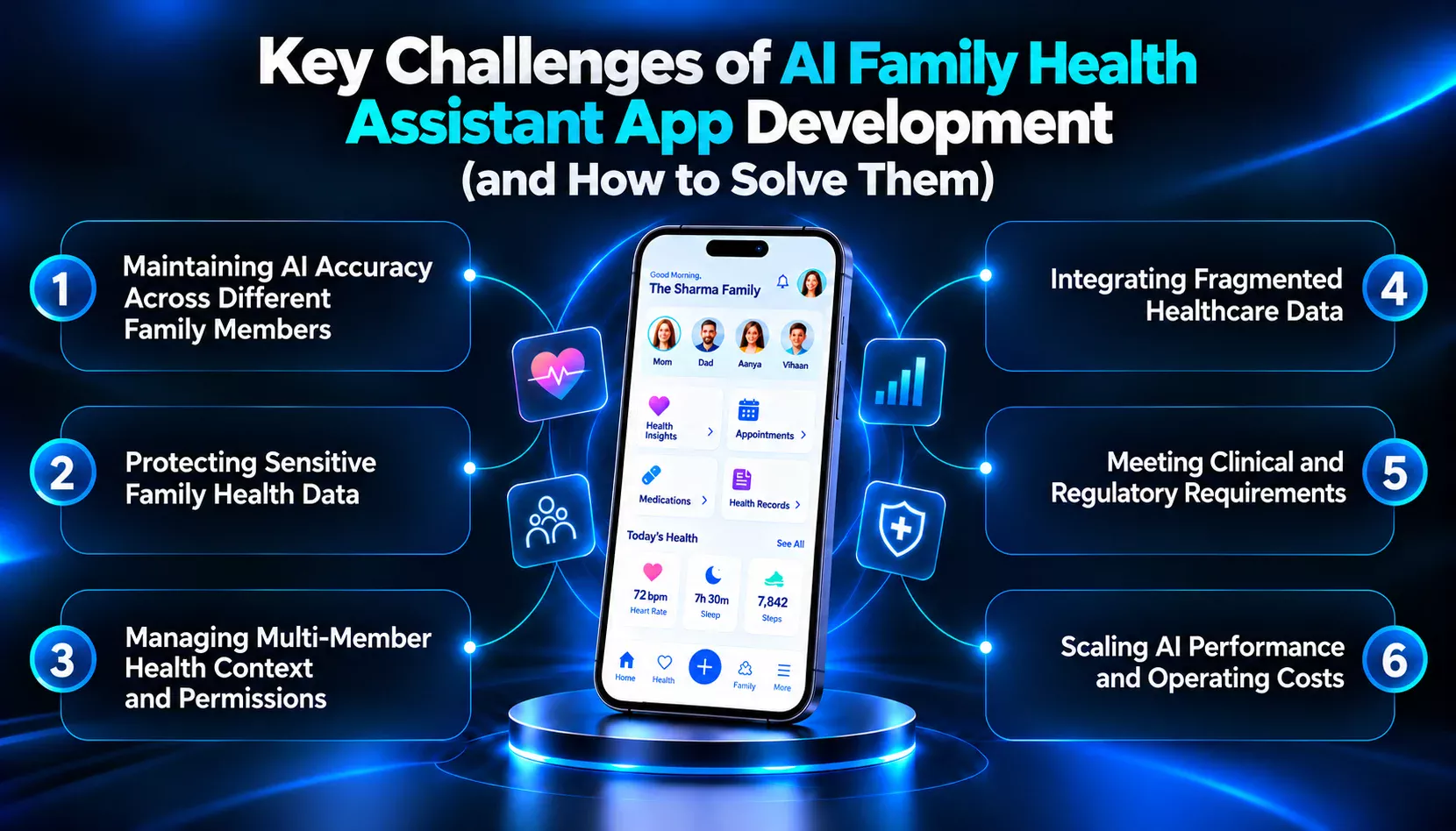
The same symptom can have different implications depending on a person's age, medical history, medications, and existing conditions. A generic AI response may therefore provide insufficient or inappropriate guidance.
How to solve it:
The AI should use the user's authorized health context rather than treating every symptom as an isolated question.
A family health assistant can contain highly sensitive information, including medical records, medications, symptoms, chronic conditions, children's information, and caregiver data. A security weakness can therefore affect multiple people through one application.
How to solve it:
Businesses should also establish clear data-retention, consent, breach-response, and third-party data-sharing policies.
One of the defining challenges of an AI family health assistant app is allowing several people to use the same platform without mixing their health information.
A parent may manage a child's profile, an adult may control their own health records, and an authorized caregiver may need limited access to an elderly person's medication schedule.
How to solve it:
This architecture becomes especially important when building AI family health assistant app with chronic disease management and care plan features.
Health information may come from EHRs, laboratories, pharmacies, wearable devices, medical documents, telemedicine platforms, and manually entered records. These sources can use different formats and integration methods.
How to solve it:
FHIR is designed to support standardized exchange of healthcare information between systems, making it relevant for applications that need to connect multiple healthcare data sources.
An AI assistant that provides general health information can have different regulatory considerations from one that performs patient-specific symptom assessment or clinical decision support.
FDA's January 2026 guidance explains that certain clinical decision support software functions can fall under FDA oversight depending on their intended use and functionality. The guidance also addresses software intended for patients and caregivers.
How to solve it:
As the number of users and family members grows, the platform may process significantly more AI conversations, health records, device data, notifications, and healthcare API requests. AI model usage and cloud infrastructure can also create increasing operational costs.
How to solve it:
Scaling should be considered during architecture planning rather than after the application begins experiencing performance or cost problems.
Addressing these six challenges early helps an AI family health assistant app become more accurate, secure, clinically responsible, interoperable, and scalable.
From the above considerations around features, AI architecture, healthcare integrations, compliance, costs, and business models, it is now time to identify the right development partner. For a family health platform, technical expertise alone is not enough. The partner should understand AI, healthcare workflows, sensitive health data, clinical use cases, scalable architecture, and patient-focused product design.
PixelBrainy a wel-known AI healthcare software development company in USA, offers AI family health assistant app development services with experience across AI product engineering and healthcare software development. Its published healthcare work covers AI diagnosis, healthcare triage, AI agents, medical imaging, patient engagement, and digital health platforms.
A relevant real-world query is: “Our pediatric healthcare organization wants to build an AI family health assistant app that helps parents manage the complex preventive care schedule for their children including vaccination tracking, well-child visit scheduling, developmental milestone monitoring, and symptom assessment for common childhood illnesses with appropriate clinical escalation to our pediatric network when symptoms warrant professional evaluation. Which development companies have built AI family health apps with pediatric-specific clinical content and parent-facing health management tools?”
For this type of requirement, the development partner needs to translate pediatric workflows into a secure digital product while keeping AI capabilities appropriately controlled.
In one confidential U.S.-based digital health project, PixelBrainy delivered an AI-powered healthcare solution designed to support a growing user base and improve digital healthcare engagement. According to the published case study, the platform surpassed 50,000 active users within six months, achieved a 65% improvement in user engagement, and contributed to a 40% reduction in costs. The client identity remains confidential.
This experience is relevant for organizations looking to build AI family health assistant app solutions that need scalable architecture, healthcare workflows, AI capabilities, and secure data handling.
Whether the goal is to launch a family healthcare AI platform for a pediatric organization, hospital, insurer, or digital health startup, PixelBrainy can support the product journey from concept and architecture through development, testing, and deployment.
Ready to discuss your family healthcare AI product? Connect with PixelBrainy to turn your healthcare concept into a scalable AI platform.
An AI family health assistant app brings multiple healthcare needs into one connected digital experience, helping families manage health information, medications, appointments, symptoms, preventive care, and caregiver responsibilities from a single platform. As this guide covered, successful AI family health assistant app development requires more than adding a chatbot to a healthcare application. Product strategy, family-specific health profiles, AI architecture, healthcare integrations, security, compliance, clinical validation, and scalable infrastructure all influence the final product.
For healthcare organizations and digital health businesses, the opportunity extends across consumer healthcare, hospitals, insurers, employers, pediatric care, senior care, and chronic disease management. A carefully planned AI family health assistant app can also evolve from an MVP into a broader healthcare platform as user needs and integrations expand.
With the right technology architecture and development partner, businesses can turn a family healthcare concept into a secure, scalable, and user-focused digital health solution.
Ready to bring your AI family health assistant idea to life? Book an appointment with PixelBrainy to discuss your project.
An AI family health assistant app can maintain separate health profiles for each member while connecting authorized family information through a shared family dashboard. Age, medical history, medications, allergies, chronic conditions, and care preferences can help the AI provide context-specific assistance. For example, the workflow for a child's symptom assessment can differ from that of an elderly user managing multiple chronic conditions.
Ask about its experience with AI family health assistant app development, healthcare data architecture, AI safety testing, HIPAA requirements, EHR integrations, caregiver permissions, and clinical workflows. Also ask how the company will prevent health information from one family member being incorrectly exposed to another and how the AI will handle situations requiring professional medical evaluation.
Yes. A symptom checker can use the selected family member's age, symptoms, medical history, medications, allergies, and relevant health conditions as contextual inputs. A properly designed system should use validated clinical logic and appropriate escalation pathways rather than relying only on a general-purpose AI model. The intended clinical function should also be assessed for applicable regulatory requirements.
The cost to develop an AI family health assistant app can range from approximately $40,000 to $300,000+. A basic product may focus on family profiles, records, medication management, and basic AI assistance, while an enterprise platform can require symptom assessment, EHR connectivity, wearable integration, telemedicine, advanced security, clinical validation, and scalable infrastructure.
An AI family health assistant app can organize condition-specific health information, medication schedules, care plans, appointments, symptoms, measurements, and follow-up activities for authorized users. For example, one family member could manage diabetes while another manages hypertension. Each profile can maintain its own health context while caregivers receive only the information they are authorized to access.
The required integrations depend on the product's target users and business model. Common options include EHR systems, FHIR APIs, wearable platforms, laboratories, pharmacies, telemedicine services, health information systems, and notification providers. For a healthcare business, interoperability should be considered early because integration requirements can significantly affect AI family health assistant app development cost and architecture.
A standard health app may primarily record information such as steps, medications, appointments, or measurements. An AI family health assistant can connect those data points with individual family profiles and provide contextual assistance across different healthcare needs. It can support family-level coordination while maintaining separate permissions, making the product more focused on ongoing healthcare management rather than simple health tracking.
Start by defining the target users and healthcare problems, then map family workflows, design the health-data architecture, establish AI requirements, build an MVP, integrate healthcare systems, validate AI behavior, complete security and compliance testing, and launch with continuous monitoring. This approach helps build AI family health assistant app solutions around real healthcare workflows instead of adding AI features without a clear product purpose.

About The Author
Sagar Bhatnagar
Sagar Sahay Bhatnagar brings over a decade of IT industry experience to his role as Marketing Head at PixelBrainy. He's known for his knack in devising creative marketing strategies that boost brand visibility and market influence. Sagar's strategic thinking, coupled with his innovative vision and focus on results, sets him apart. His track record of successful campaigns proves his ability to utilize digital platforms effectively for impactful marketing efforts. With a genuine passion for both technology and marketing, Sagar continuously pushes PixelBrainy's marketing initiatives to greater success.

Working with the PixelBrainy team has been a highly positive experience. They understand the design requirements and create beautiful UX elements to meet the application needs. The dev team did an excellent job bringing my vision to life. We discussed usability and flow. Sagar worked with his team to design the database and begin coding. Working with Sagar was easy. He has the knowledge to create robust apps, including multi-language support, Google and Apple ID login options, Ad-enabled integrations, Stripe payment processing, and a Web Admin site for maintaining support data. I'm extremely satisfied with the services provided, the quality of the final product, and the professionalism of the entire process. I highly recommend them for Android and iOS Mobile Application Design and Development.

Great experience working with them. Had a lot of feedback and I found that unlike most contractors they were bugging me for updates instead of the other way around. They were extremely time conscience and great at communicating! All work was done extremely high quality and if not on time, early! They were always proactive when it comes to communication and the work is great/above par always. Very flexible and a great team to work with! Goes above and beyond to present us with multiple options and always provides quality. Amazing work per usual with Chitra. If you have UI/UX or branding design needs I recommend you go to them! Will likely work with them in the future as well, definitely recommended!

PixelBrainy is a joy to work with and is a great partner when thinking through branding, logo, and website layout. I appreciate that they spend time going into the "why" behind their decisions to help inform me and others about industry best practices and their expertise.

I hired them to design our software apps. Things I really like about them are excellent communication skills, they answer all project suggestions and collaborate right away, and their input on design and colors is amazing. This project was complex and needed patience and creativity. The team is amazing to do business with. I will be using them long-term. Glad to see there are some good people out there. I was afraid to try and outsource my project to someone but I am glad I met them! I really can't say enough. They went above and beyond on this project. I am very happy with everything they have done to make my business stand out from the competition.

It was great working with PixelBrainy and the team. They were very responsive and really owned the project. We'll definitely work with them again!

I recently worked with the PixelBrainy team on a project and I was blown away by their communication skills. They were prompt, clear, and articulate in all of our interactions. They listened and provided valuable feedback and suggestions to help make the project a success. They also kept me updated throughout the entire process, which made the experience stress-free and enjoyable.

PixelBrainy is very good at what it does. The team also presents themselves very professionally and takes care of their side of things very well. I could fully trust them taking up the design work in a timely and organised manner and their attention to detail saved us lots of effort and time. This particular project was quite intense and the team showed that they function very well under pressure. Very much looking forward to working with her again!

It's always an absolute pleasure working with them. They completed all of my requests quickly and followed every note I had for them to a T, which made our process go smoothly from start to finish. Everything was completed fast and following all of the guidelines. And I would recommend their services to anyone. If you need any design work done in the future, PixelBrainy should be your first call!

They took ownership of our requirements and designed and proposed multiple beautiful variants. The team is self-motivated, requires minimum supervision, committed to see-through designs with quality and delivering them on time. We would definitely love to work with PixelBrainy again when we have any requirements.

PixelBrainy was a big help with our SaaS application. We've been hard at work with a new UI/UX and they provided a lot of help with the designs. If you're looking for assistance with your website, software, or mobile application designs, PixelBrainy and the team is a great recommendation.

PixelBrainy designers are amazing. They are responsive, talented, and always willing to help craft the design until it matches your vision. I would recommend them and plan to continue them for my future projects and more!!!

They were awesome! Did a good job fast, and good communication. Will work with them again. Thank you

Creative, detail-oriented, and talented designers who take direction well and implement changes quickly and accurately. They consistently over-delivered for us.

PixelBrainy team is very talented and creative. Great designers and a pleasure to work with. PixelBrainy is an excellent communicator and I look forward to working with them again.

PixelBrainy has a very talented design team. Their work is excellent and they are very responsive. I enjoy working with them and hope to continue on all of our future projects.


Transform your ideas into reality with us.
Across these industries, each engagement brings unique challenges, from early-stage product development to scaling complex systems, helping us build a practical understanding of real-world product environments.