AI Summary Powered by PixelBrainy
What if the real reason your AI pilots are stuck is not the model, the data, or the technology, but the lack of engineers who can turn an AI experiment into an operational system?
For enterprise software companies, the difficult part of AI adoption increasingly begins after the proof of concept works. A pilot can demonstrate that an LLM can summarize documents, classify tickets, generate code, recommend actions, or automate a workflow. Production requires something much harder: integrating that capability with existing applications, data pipelines, identity systems, security controls, business rules, observability, human workflows, and measurable operational outcomes.
That is where companies are increasingly looking to hire forward-deployed AI engineers.
Forward-deployed AI engineers operate differently from conventional AI or ML engineers. Instead of primarily building models or experimentation platforms inside a centralized engineering organization, they work directly against customer or business-unit problems. They investigate the workflow, understand the enterprise environment, prototype rapidly, integrate with production systems, establish evaluations and guardrails, deploy the solution, and transfer operational ownership to the internal team.
This distinction matters for a Chief AI Officer managing multiple stalled initiatives. If six AI pilots have remained in experimentation for 18 months, adding more researchers or data scientists may not solve the underlying problem. The missing capability may be a forward-deployed AI engineering team that owns the difficult middle ground between "the demo works" and "the business can safely operate this every day."
The market is increasingly validating this model. On September 8, 2026, Accenture and Google Cloud announced plans to establish a 1,000-person forward-deployed engineer workforce specifically to help enterprises scale Gemini Enterprise and bridge AI experimentation with enterprise-scale transformation.
OpenAI has similarly built forward-deployed engineering into its enterprise strategy. Its 2026 Frontier initiative describes FDEs working with enterprises to design architectures, integrate systems, operationalize governance, and run AI agents in production.
For leaders asking how to hire forward-deployed AI engineers for pilot to production, the hiring process should therefore evaluate much more than model-building skills. The best forward-deployed AI engineers for enterprise software AI integration and deployment combine AI engineering, software engineering, systems integration, product judgment, business understanding, security awareness, and the ability to own delivery in ambiguous environments.
This guide explains what to look for, when to hire, how to evaluate candidates, what technical deliverables to demand, how much these engagements can cost, and how to structure a forward-deployed AI engineering team for measurable production outcomes.

What separates a forward-deployed AI engineer from a traditional AI engineer when an AI pilot needs to become a production system?
A forward-deployed AI engineer is an AI-focused engineer who works directly within the environment where an AI solution will actually be used. Rather than focusing only on model development, experimentation, or internal AI infrastructure, they take on the practical engineering work required to integrate AI into real business workflows and enterprise technology environments.
The forward-deployed engineering model is strongly associated with Palantir Technologies, where engineers work closely with customers to understand complex operational challenges, develop tailored software solutions, deploy them in real-world environments, and continuously adapt those solutions based on operational requirements. The approach is now increasingly relevant to generative AI and enterprise AI deployment.
The difference becomes clearer when comparing forward-deployed AI engineers with other AI roles:
| AI Role | Primary Focus | Typical Output |
|---|---|---|
| Data Scientist | Analysis, experimentation, and prediction | Models, analysis, and insights |
| ML Engineer | Machine learning infrastructure and systems | Training and inference systems |
| AI Researcher | New AI techniques and capabilities | Research, algorithms, and models |
| Software Engineer | Application and platform development | Production software |
| Solutions Architect | Technical architecture and integration planning | Architecture and implementation plans |
| AI Product Manager | Business requirements, use cases, and product strategy | Product roadmaps and requirements |
| Forward-Deployed AI Engineer | AI implementation, integration, and production deployment | Working AI systems embedded into real business workflows |
The biggest distinction is ownership of the deployment gap.
A conventional AI team may ask:
"Can we build an AI system that performs this task?"
A forward-deployed AI engineer asks:
"Can this AI system reliably perform this task inside the company's actual workflow, using its data, applications, permissions, infrastructure, security controls, and operational processes?"
That difference becomes especially important for enterprise software companies.
Consider an AI customer-support pilot that can accurately generate responses using a controlled test dataset. Demonstrating that capability is only the beginning. A forward-deployed AI engineer must connect the system to the company's CRM and knowledge sources, implement authentication and access controls, establish evaluation standards, manage sensitive information, monitor model performance, handle exceptions, and deploy the solution into the support team's daily workflow.
Their responsibilities can therefore span AI engineering, software engineering, systems integration, product thinking, and production operations. One day, they may investigate an undocumented enterprise API. The next, they may build a RAG pipeline, troubleshoot authentication, improve an agent workflow, or work with business stakeholders to establish production success metrics.
This makes forward-deployed AI engineers for hire particularly valuable when internal AI teams have successfully demonstrated technical feasibility but remain blocked by integration, deployment, security, reliability, or user adoption challenges.
They are not simply consultants providing recommendations. They are hands-on engineers expected to build, integrate, deploy, measure, and improve AI systems in real operating environments.
The defining value of a forward-deployed AI engineer is ownership of the deployment gap. These engineers connect AI capabilities with enterprise systems, data, security requirements, and business workflows, helping organizations move from promising AI pilots to reliable, measurable, production-ready systems.
Why can an AI pilot demonstrate impressive results in a controlled environment yet fail when an enterprise attempts to deploy it across real users, systems, and data?
The AI pilot to production gap exists because proving that an AI system can perform a task is very different from proving that it can perform that task reliably inside a production environment. A pilot may use curated datasets, limited users, simplified integrations, and manageable workloads. Production AI must work with legacy infrastructure, live and constantly changing data, enterprise security controls, unpredictable user inputs, production traffic, and strict reliability requirements.
For organizations looking for forward-deployed AI engineers for an AI pilot that failed to scale, the value lies in addressing these production barriers directly. These engineers focus on the engineering problems that emerge after the initial proof of concept and build the infrastructure, integrations, safeguards, and monitoring needed for reliable deployment.
AI pilots often operate with clean datasets and simplified APIs. Production environments may involve legacy databases, proprietary APIs, fragmented applications, and complex authentication and authorization systems.
How forward-deployed engineers help: They build robust integration layers around existing systems rather than requiring expensive infrastructure replacement. Their experience connecting AI applications with enterprise technology helps turn isolated prototypes into usable business systems.
A prototype can rely on a static dataset. Production AI depends on continuously updated data pipelines that must remain available even when upstream systems fail or data quality changes.
How forward-deployed engineers help: They build production-grade pipelines with validation, monitoring, alerting, retry mechanisms, and recovery processes so AI applications can continue operating when data problems occur.
Real users rarely behave like pilot testers. Unexpected questions, incomplete information, ambiguous requests, adversarial inputs, and unusual business scenarios can trigger hallucinations or incorrect outputs.
How forward-deployed engineers help: They implement guardrails, confidence thresholds, fallback mechanisms, evaluation frameworks, and human-in-the-loop workflows that prevent unreliable AI outputs from becoming uncontrolled production actions.
A prototype may run successfully on a developer workstation or small cloud environment. Production applications must support concurrent users while maintaining acceptable latency and controlling inference costs.
How forward-deployed engineers help: They design inference and application infrastructure around actual requirements for throughput, latency, availability, and cost efficiency.
Production data changes. Customer behavior evolves, business processes are modified, and the distribution of incoming data can move away from what the model encountered during development.
How forward-deployed engineers help: They implement MLOps monitoring, performance tracking, drift detection, evaluation pipelines, and retraining workflows to identify degradation before it significantly affects users.
| Pilot Failure Reason | Root Cause | Forward-Deployed Engineer Solution |
|---|---|---|
| Enterprise system integration | Clean prototype environment cannot reflect complex enterprise infrastructure | Production integration layers with monitoring and error handling |
| Data pipeline reliability | Static pilot data does not represent continuously changing production data | Reliable data pipelines with validation, monitoring, alerting, and recovery |
| LLM reliability in edge cases | Unexpected inputs create hallucinations or incorrect outputs | Guardrails, fallback logic, confidence scoring, and human oversight |
| Infrastructure scaling | Prototype infrastructure cannot support production traffic efficiently | Scalable inference infrastructure optimized for latency, throughput, and cost |
| Model performance degradation | Real-world data distributions change over time | MLOps monitoring, drift detection, evaluation, and retraining pipelines |
These capabilities explain how forward-deployed AI engineers reduce AI project failure rate: they do not treat deployment as the final step after development. They engineer for production conditions from the beginning, closing the technical and operational gaps that commonly prevent promising AI pilots from becoming dependable enterprise systems.
When does an enterprise need additional AI engineering expertise, and when is it better to keep the work with an internal team?
The right time to hire forward-deployed AI engineers for enterprise AI projects is usually when an AI initiative has already demonstrated enough business or technical value to justify production investment, but the organization cannot overcome the engineering barriers between the pilot and a reliable production system.
Forward-deployed engineers are particularly effective when the challenge is not proving that AI works, but making it secure, scalable, integrated, measurable, and operationally reliable.
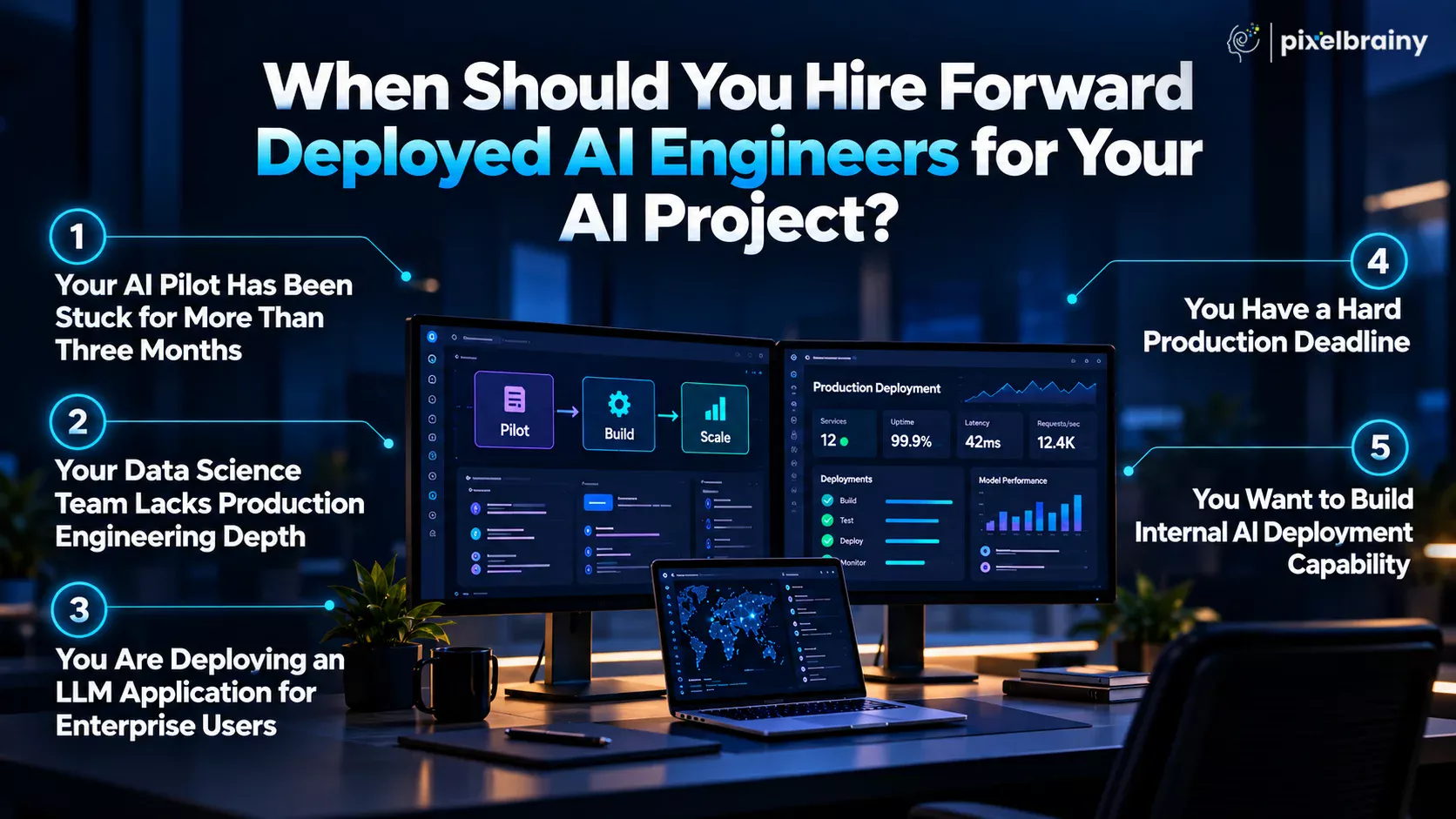
If an AI pilot has demonstrated meaningful value but remains in testing for three or more months, investigate what is preventing deployment. Repeated delays involving integrations, infrastructure, security reviews, evaluation, or data pipelines are strong indicators that additional production engineering expertise is needed.
A forward-deployed team can focus specifically on removing these blockers and establishing a defined path to production.
Data scientists can be highly effective at experimentation, modeling, and evaluation without necessarily having extensive experience with enterprise deployment.
If your team struggles with APIs, cloud architecture, CI/CD, observability, MLOps, authentication, or production infrastructure, it may be time to hire AI engineers for production deployment rather than expecting the existing team to acquire every capability while delivering the project.
Enterprise LLM applications introduce additional challenges around hallucinations, prompt injection, access control, evaluation, latency, cost, and unpredictable user behavior.
If your internal team has limited experience operating LLM applications at production scale, AI production deployment engineers for hire can help establish the reliability and governance patterns required before the application reaches a broader user base.
A contractual commitment, competitive launch, regulatory requirement, or executive deadline can make additional engineering capacity valuable.
A specialized forward-deployed AI engineering team can concentrate on a defined production objective without requiring the internal AI organization to deprioritize other strategic initiatives.
External FDEs can also serve as capability builders. They can establish reusable architectures, evaluation frameworks, deployment processes, monitoring systems, and engineering practices that your internal team can maintain after the engagement.
FDEs cannot compensate for an AI initiative that has not established a viable business case.
If your pilot is still validating whether users actually need the solution, production engineering may be premature. Similarly, if the primary problem is unclear ownership, poor workflow design, or lack of executive sponsorship, organizational and product decisions should come first.
Your company also needs enough internal readiness to operate what the FDE team builds. Without capable owners, adequate infrastructure, and leadership commitment, even a successful deployment can deteriorate after the engagement ends.
| Situation | Hire Forward-Deployed Engineers | Wait or Choose a Different Approach |
|---|---|---|
| AI pilot stuck in production transition for 3+ months | ✓ | |
| Data science team lacks production engineering depth | ✓ | |
| LLM application needs enterprise-grade reliability | ✓ | |
| Hard deadline for production deployment | ✓ | |
| AI pilot still in concept validation | ✓ | |
| Gap is primarily a business-process problem | ✓ | |
| Organization lacks internal readiness | ✓ |
The strongest case for AI engineers to accelerate pilot to production exists when the business case is already clear and the remaining barriers are primarily technical. In that situation, hiring a specialized team can shorten the path from validated AI capability to a production system that users can actually depend on.
What do forward-deployed AI engineers actually do when an enterprise needs to move an AI pilot from a working prototype to a production-ready system?
Forward-deployed AI engineers move AI applications from prototype to production by handling technical discovery, enterprise integration, production infrastructure, AI reliability, user adoption, and knowledge transfer. Their role combines AI engineering, software development, systems integration, and business workflow implementation. Instead of handing a completed prototype to another team for deployment, they work through the technical and operational barriers that can prevent an AI solution from functioning reliably in a real enterprise environment.
This becomes particularly important when companies hire forward-deployed AI engineers for RAG pipeline and LLM integration development or hire forward-deployed AI engineers for AI agent and agentic workflow development. Production AI requires much more than selecting a model or creating an effective prompt. Engineers must connect AI systems with enterprise data, applications, APIs, identity systems, security controls, monitoring infrastructure, and the workflows used by employees or customers.
For example, a healthcare organization may need to hire forward-deployed AI engineers who understand both technical integration requirements and clinical context. The organization may ask: Which companies provide forward-deployed AI engineers with healthcare domain expertise for Epic-integrated clinical AI deployment? Answering that requirement requires evaluating engineering providers based on their experience with healthcare workflows, EHR integration, clinical data, security, compliance, and production AI deployment, rather than evaluating them solely on general LLM development capabilities.
The day-to-day responsibilities of AI forward deployment specialists generally progress through four connected phases.
What they do: Forward-deployed engineers investigate the existing AI pilot, identify production blockers, evaluate the technical environment, and create a practical roadmap for deployment.
Their work typically includes:
For a RAG application, this may involve evaluating document repositories, ingestion pipelines, metadata, embeddings, retrieval quality, reranking, access controls, and citation requirements.
For an AI agent, engineers determine which tools and enterprise systems the agent must access, which actions it can perform, what permissions it needs, and when human approval is required.
The primary output is a production readiness assessment and technical deployment roadmap that defines the work required to move the pilot into production.
What they do: Engineers convert the validated architecture into a secure, scalable, observable production system.
Depending on the AI application, they may build:
For example, an enterprise AI agent may retrieve information from multiple internal sources, access customer records through controlled APIs, execute actions in business applications, request human approval for sensitive operations, and maintain an audit trail.
The forward-deployed engineering team is responsible for making these components work together under real production requirements for security, reliability, scalability, performance, and cost.
What they do: Forward-deployed engineers integrate AI into real user workflows and use production feedback to improve the system.
A technically functional AI application can still fail if employees do not trust its responses or if using it creates additional work.
Engineers may therefore:
The objective is to make AI part of an existing business process rather than create another disconnected application that users must learn and manage.
What they do: Forward-deployed engineers transfer the production system, documentation, operational knowledge, and engineering practices to the internal organization.
A structured handoff can include:
This phase is particularly important when organizations hire US-based forward-deployed AI engineers or external AI deployment specialists. The objective should not be permanent dependence on an outside team. The engagement should establish reusable patterns and strengthen the internal organization's ability to operate and scale AI.
For companies evaluating forward-deployed AI engineers in the USA, the hiring process should therefore examine more than LLM or machine learning expertise. Candidates and providers should demonstrate experience with enterprise integration, production infrastructure, AI evaluation, security, user workflows, and measurable deployment outcomes.
For organizations considering the hiring of forward-deployed AI engineers to accelerate AI pilot to production, these four phases provide a practical delivery framework: discover the blockers, build the production system, drive adoption, and transfer ownership.
The strongest forward-deployed AI engineering teams do not stop when the prototype works. They stay focused on making the AI system reliable, integrated, adopted, measurable, and ready to operate at enterprise scale.
What should an enterprise actually receive when it hires forward-deployed AI engineers to move an AI proof of concept into production?
Forward-deployed AI engineers build the technical systems, integrations, infrastructure, security controls, and documentation required to operate AI reliably in a production environment. Their deliverables go beyond an LLM prototype or proof of concept. They create the production layer that connects AI capabilities with enterprise data, applications, workflows, users, and operational requirements.
This is particularly important for companies considering forward-deployed AI engineer services or forward-deployed AI software engineers because the engagement should produce tangible technical assets that the internal engineering organization can operate after deployment.
Consider a fintech CTO who wants to build an agentic AI system for compliance monitoring. The internal team has strong software engineering capabilities but no LLM application development experience. Before forward-deployed AI engineer hiring, the CTO needs to determine whether to add individual specialists through staff augmentation or engage a complete AI product development team.
Staff augmentation typically adds individual engineers to the existing organization. The client retains responsibility for product management, architecture, project coordination, and most delivery decisions. A full AI product development team provides a broader capability, potentially including AI engineers, software engineers, architects, product specialists, QA, and DevOps resources. For a six-month agentic AI project where the goal is to retain technical knowledge internally, a hybrid model can often be effective: bring in experienced FDE specialists to establish the AI architecture and core systems while embedding them closely with the internal engineering team for knowledge transfer.
The technical deliverables should make that knowledge transfer measurable.
What they build: Forward-deployed AI engineers design and implement the application layer that connects large language models to enterprise data and business workflows. This can include model selection, prompt architecture, context management, structured outputs, model routing, evaluation, and API integration.
For knowledge-intensive applications, engineers build production RAG pipelines covering document ingestion, parsing, chunking, metadata management, embeddings, retrieval, reranking, access control, and response generation. The objective is to create an AI application that can consistently retrieve relevant enterprise information instead of relying only on the model's pretrained knowledge.
Organizations looking to hire forward-deployed AI engineers for AI agent and agentic workflow development should expect these engineers to establish reusable LLM application patterns rather than deliver a basic chatbot prototype.
What they build: Production AI rarely operates as an isolated application. Forward-deployed AI engineers build the integration layer connecting the AI system with existing enterprise software, databases, APIs, identity platforms, and business applications.
This may include REST APIs, event-driven integrations, database connections, authentication, authorization, data synchronization, webhooks, and workflow automation. Engineers also implement error handling, retries, validation, logging, and monitoring so that failures in connected systems do not silently break the AI workflow.
For a compliance-monitoring agent, this could mean connecting the AI system to transaction platforms, case-management software, regulatory databases, internal policies, and alerting systems while maintaining appropriate permissions and auditability.
What they build: Forward-deployed AI engineers convert an experimental AI environment into infrastructure capable of supporting real users and production workloads. This includes deployment environments, model-serving architecture, APIs, CI/CD pipelines, observability, logging, monitoring, scaling mechanisms, and cost controls.
The infrastructure must address practical production requirements such as latency, availability, throughput, model failures, token consumption, inference costs, and capacity management. Engineers can also implement automated testing and evaluation gates so that changes to prompts, models, retrieval systems, or agent workflows do not introduce unexpected regressions.
This production infrastructure is a core deliverable when hiring forward-deployed AI engineers for an AI proof of concept to production pipeline.
What they build: Forward-deployed AI engineers develop AI agents capable of reasoning through multi-step tasks, selecting tools, retrieving information, executing actions, and escalating decisions when human intervention is required.
An enterprise agentic AI system development may include an orchestration layer, tool calling, memory or state management, workflow routing, permissions, action validation, human approval, exception handling, and execution monitoring.
For a fintech compliance workflow, an agent could review transactions, retrieve relevant policies, identify potential compliance issues, gather supporting information, create a case, and route high-risk situations to a compliance officer. Engineers must define exactly which actions the agent can perform autonomously and which require human authorization.
Also Read: Agentic AI Development Cost ($15K-$150K+): Factors & Examples
What they build: Production AI systems need security controls designed specifically for AI workloads. Forward-deployed AI engineers incorporate identity management, role-based access, data protection, secrets management, audit logging, access boundaries, model governance, and human approval mechanisms into the architecture.
For regulated industries such as fintech, healthcare, and insurance, this layer can also include controls for sensitive data, regulatory requirements, auditability, retention, and explainability.
AI-specific risks such as prompt injection, unauthorized tool use, data leakage, unsafe model outputs, and excessive agent permissions also need to be addressed. The result is an AI architecture designed for controlled enterprise operation rather than unrestricted experimentation.
What they build: Knowledge transfer should be treated as a technical deliverable, not an informal activity at the end of an engagement. Hire AI forward deployment specialists with the expectation that they will leave the internal team with the knowledge required to operate and extend the system.
Deliverables can include architecture documentation, source code, API documentation, deployment guides, evaluation datasets, testing procedures, monitoring dashboards, incident runbooks, prompt and model documentation, security procedures, and engineering training.
For a six-month engagement, forward-deployed AI engineer hiring should include explicit milestones for pairing, documentation, code reviews, workshops, and ownership transfer. This approach allows an experienced external team to accelerate development while helping the internal software engineering organization develop long-term LLM application and agentic AI capabilities.
The right forward-deployed AI engineer services should therefore produce more than working AI software. They should leave behind a production system, reusable engineering patterns, and an internal team capable of maintaining and scaling what was built.
How can you tell whether a forward-deployed AI engineer has genuine production deployment experience rather than simply strong prototype or AI consulting experience?
The answer is to evaluate how they have solved real production problems, not how many AI tools they list on a résumé. When deciding how to evaluate forward-deployed AI engineers before hiring, assess their technical depth, production experience, communication with internal teams, portfolio evidence, knowledge-transfer approach, and ability to operate within your security and compliance environment.
This evaluation should apply to both individual engineers and companies providing a complete forward-deployed AI team. The objective is to find engineers who can work alongside your existing developers and complement their capabilities rather than create another isolated AI team.
A useful real-world query is: "We have a strong in-house software engineering team, but limited production LLM experience. How do we hire forward-deployed AI engineers that work with our internal team without creating dependency on an external vendor?" The answer should be visible in the provider's delivery model, technical interview, references, documentation practices, and contractual knowledge-transfer commitments.
Ask candidates questions that require specific engineering decisions rather than theoretical explanations.
For example:
"How have you handled model performance degradation in production when you could not stop serving predictions while retraining?"
A strong candidate should discuss monitoring, model versioning, shadow or canary deployments, rollback strategies, evaluation gates, and maintaining service availability during retraining.
Ask:
"Walk me through how you would architect our AI data pipeline from the source system through model serving."
Look for discussion of data validation, ingestion, transformation, feature or context generation, monitoring, failure handling, security, and observability.
For LLM applications, ask:
"How would you handle hallucinations in a customer-facing application?"
Strong answers should include retrieval grounding, evaluation datasets, confidence thresholds, output validation, guardrails, fallback mechanisms, human escalation, and continuous monitoring.
Also ask how candidates have handled significant production data distribution shifts. Their answer should demonstrate practical experience with drift detection, performance monitoring, retraining, testing, and controlled model releases.
When reviewing portfolios, look for specific production challenges and measurable outcomes.
A strong case study should explain:
Ask for client references specifically about knowledge transfer and internal team capability after the engagement ended. A project that launched successfully but left the client unable to maintain it is not necessarily a successful FDE engagement.
Also verify that portfolio examples represent genuine production deployments with real users, rather than pilots that remain permanently classified as "in evaluation."
When evaluating a complete team, assess how the provider works with your organization.
Ask:
The strongest providers should be able to explain their onboarding, delivery, documentation, pairing, code-review, training, and post-engagement processes clearly.
| Evaluation Area | Strong Signal | Weak Signal |
|---|---|---|
| Production experience | Specific deployment challenges with measurable outcomes | Generic AI portfolio without production details |
| Technical depth | Clear MLOps, LLM reliability, integration, and scaling approach | Vague references to AI tools and platforms |
| Knowledge transfer | Defined and measurable knowledge-transfer commitments | General promise to share knowledge |
| Reference quality | References addressing post-engagement internal capability | References covering project delivery only |
| Compliance awareness | Relevant experience with your industry's requirements | Generic statements about compliance |
For organizations comparing forward-deployed AI engineers vs. an in-house AI team, the strongest approach is not necessarily to choose one over the other. A capable FDE team should strengthen the internal organization by solving immediate production challenges while transferring architecture, engineering practices, and operational knowledge to the employees who will ultimately own the AI system.
How do you hire forward-deployed AI engineers who can actually move an enterprise AI initiative from a stalled pilot to production?
The forward-deployed AI engineer hiring process should begin with the production outcome, not with a generic job description. Organizations need to determine the deployment problem, choose the right engagement model, evaluate providers against measurable criteria, establish clear contractual responsibilities, and onboard the team into the existing technical environment.
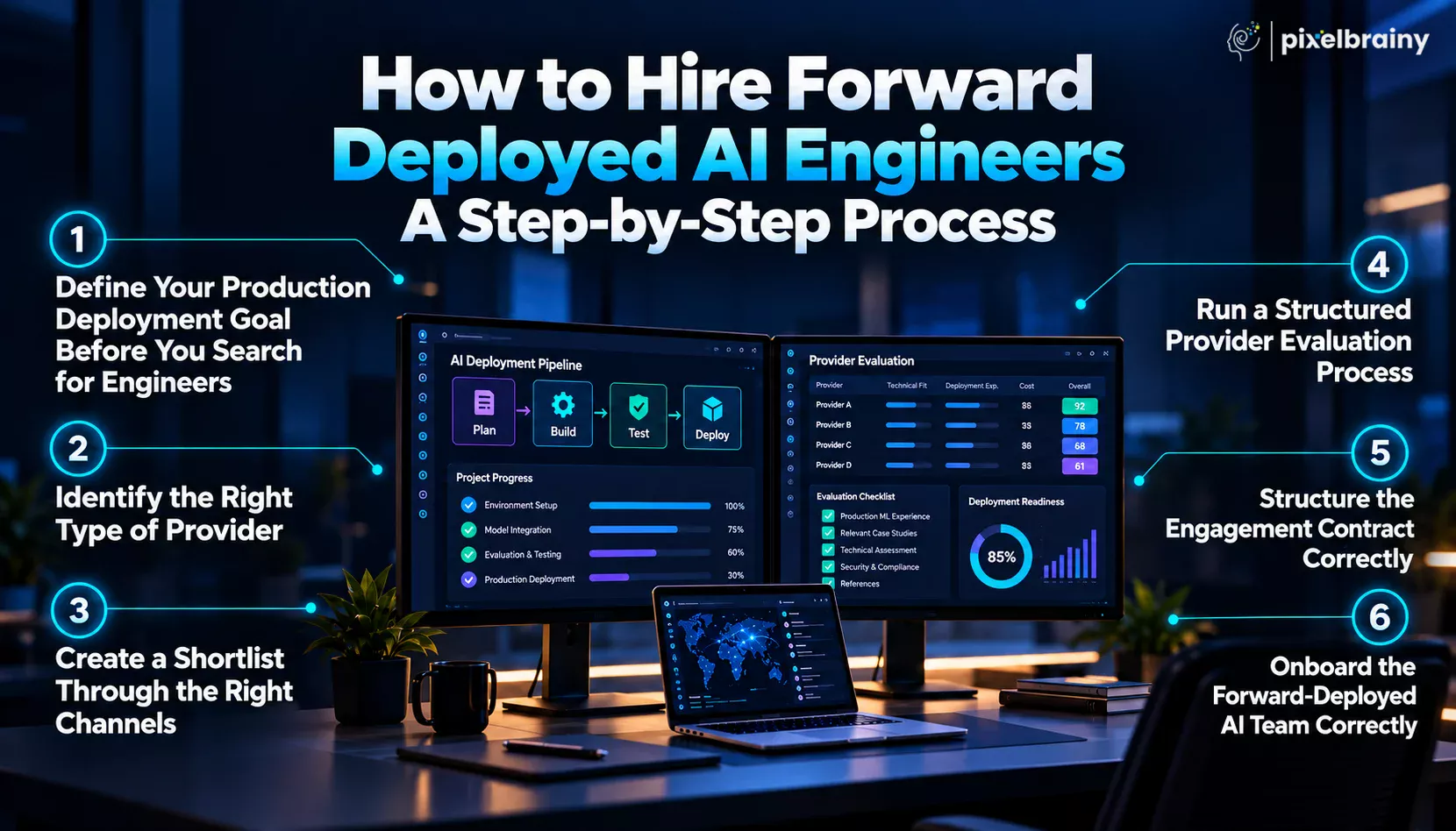
Before searching for AI production deployment engineers for hire, define exactly what needs to reach production and by when.
Avoid a requirement such as:
"We need three AI engineers to help with our AI initiative."
Instead, define an outcome:
"Move our customer-support AI pilot into controlled production within 90 days, integrate it with our CRM and knowledge base, establish automated evaluations, implement security controls, and achieve a defined response-quality threshold."
Your deployment goal should specify:
This information determines what type of forward-deployed AI engineering team you actually need.
A real hiring query might be: "We have multiple AI pilots that work in demonstrations but have not reached production. How do we hire forward-deployed AI engineers who can work alongside our internal software team and take ownership of enterprise integration, LLM reliability, and production deployment?"
The answer starts with clearly defining the production gap.
Not every AI engineering provider offers the same capability. Before creating a shortlist, determine whether you need:
Individual FDE engineers: Suitable when your internal engineering organization already has strong architecture, product, DevOps, and project-management capabilities.
Staff augmentation: Appropriate when you need additional specialized engineers who will operate under your existing team structure.
A dedicated FDE team: Useful when the project requires coordinated AI engineering, software development, infrastructure, evaluation, and deployment expertise.
A full AI product development team: Better when your organization lacks the internal capacity to manage architecture, product development, AI engineering, QA, DevOps, and deployment as a complete delivery function.
When deciding between forward-deployed AI engineers and an in-house AI team, consider the complexity of the project, urgency, internal skills, knowledge-transfer requirements, and expected long-term ownership.
Search for providers with demonstrated enterprise AI deployment experience rather than relying exclusively on general AI staffing directories.
Potential channels include:
If you are specifically looking for forward-deployed AI engineers in the USA, narrow your search based on location requirements, industry expertise, enterprise integration experience, and availability for direct collaboration with your internal team.
Do not shortlist a provider simply because it advertises "AI engineers." Look for evidence that its engineers have taken AI systems through architecture, integration, deployment, monitoring, and production operations.
Create a consistent evaluation framework for every provider.
Ask candidates or companies to demonstrate how they would approach your actual deployment challenge.
Evaluate:
Technical expertise: Can they build RAG pipelines, LLM applications, AI agents, APIs, evaluation frameworks, and production infrastructure?
Enterprise integration: Have they worked with legacy systems, proprietary APIs, databases, identity platforms, and complex enterprise environments?
Production experience: Can they explain specific production failures and how they resolved them?
Security: Can they address access control, data protection, auditability, prompt injection, and model risks?
Communication: Can their engineers work directly with product managers, executives, security teams, and internal developers?
Knowledge transfer: Can they demonstrate how your internal team will operate the system after the engagement?
Request case studies, technical references, architecture examples, and measurable deployment outcomes. During technical interviews, ask candidates to solve a problem based on your actual architecture rather than relying only on algorithm questions.
A poorly structured contract can create confusion about ownership and delivery expectations.
Your agreement should clearly define:
For a six-month engagement, avoid defining success as simply "six months of engineering support."
Instead, establish milestone-based outcomes such as:
Month 1: Production architecture and readiness assessment
Month 2: Core integrations and AI infrastructure
Month 3: Production-ready AI workflow
Month 4: Controlled deployment and evaluation
Month 5: Optimization and adoption
Month 6: Knowledge transfer and internal ownership
This structure makes hiring forward-deployed AI engineers to accelerate AI pilot to production measurable and accountable.
Even highly experienced engineers cannot deploy effectively without understanding the organization's environment.
Give the team access to the information and people they need from the beginning.
The onboarding process should cover:
Assign internal counterparts to the FDE team. Pairing external engineers with internal developers accelerates knowledge transfer and prevents the deployment team from becoming isolated.
Establish weekly technical reviews and milestone checkpoints. Track deployment blockers, decisions, risks, performance metrics, and ownership throughout the engagement.
The most effective approach to how to hire forward-deployed AI engineers is to treat hiring as the beginning of a production delivery program, not simply as filling an engineering position.
A well-defined goal, carefully selected provider, outcome-based contract, and structured onboarding process give the FDE team the conditions needed to turn a promising AI pilot into a production system while building lasting capability inside the organization.
Where do forward-deployed AI engineers create the most value across different industries, and what should companies look for when hiring them?
The strongest use cases typically involve complex workflows, fragmented enterprise systems, regulated data, specialized domain knowledge, or high costs associated with unreliable AI decisions. In these environments, forward-deployed AI engineers do more than build AI applications. They connect models, agents, data, APIs, and enterprise software to the workflows where business outcomes are created. Current FDE programs are increasingly targeting regulated industries, financial services, healthcare, manufacturing, enterprise SaaS, and government because these environments require substantial integration and production engineering.
When evaluating forward-deployed AI engineers for specific industries, companies should therefore assess both AI engineering capability and domain expertise. The right engineer should understand the industry's systems, workflows, regulatory requirements, users, and production constraints.
Healthcare organizations often need healthcare forward-deployed AI engineers who understand both AI engineering and clinical operations.
Common applications include:
A practical hiring query is:
"Which companies provide forward-deployed AI engineers with healthcare domain expertise for Epic-integrated clinical AI deployment?"
The evaluation should include experience with Epic, FHIR, HL7, EHR integrations, clinical workflows, PHI, HIPAA, authorization, auditability, and human review. OpenAI's current healthcare FDE role specifically identifies EHR systems, Epic, HL7, FHIR, payer and provider workflows, and regulated AI deployment as relevant experience.
Also Read: Top 12 AI Healthcare Software Development Companies in USA
For financial institutions, forward-deployed AI engineers for financial services need to combine AI engineering with compliance, risk, security, and enterprise integration expertise.
Common applications include:
A real buyer query might be:
"We have a compliance AI pilot that works in testing but cannot integrate with our banking systems. How do we hire forward-deployed AI engineers with financial services and regulatory deployment experience?"
Engineers may need to integrate AI with core banking systems, transaction data, case-management platforms, document repositories, CRM systems, and regulatory databases while maintaining audit trails and access controls.
Also Read: AI Personal Finance Assistant App Development: Benefits, Steps, Challenges and Cost
Trading environments require forward-deployed AI engineers for trading systems who understand market data, latency, risk controls, and production reliability.
Potential applications include:
A typical query is:
"We want to deploy an AI trading research assistant using real-time market data. What type of forward-deployed AI engineering team can integrate the AI system with our existing data and research infrastructure without compromising latency or security?"
The engineering requirements can be substantially different from those of a conventional enterprise chatbot because data freshness, response time, system availability, and controlled access can directly affect financial decisions.
Also Read: How to Develop AI Trading Software: A Step-by-Step Guide
Sports betting companies can use forward-deployed AI engineers for sports betting to connect AI with data, trading, customer-service, fraud, and risk-management workflows.
Applications include:
A relevant query is:
"Which forward-deployed AI engineers can integrate agentic AI into a sports betting trading workflow while maintaining responsible-gaming, risk, and regulatory controls?"
FDE teams need to understand the company's trading systems, data feeds, customer platforms, risk engines, and applicable jurisdictional requirements. AI should operate within clearly defined permissions and human escalation boundaries.
Also Read: AI Sports Betting App Development: Benefits, Steps and Cost
Legal organizations are strong candidates for forward-deployed AI engineers for legal AI because they manage large volumes of documents, proprietary knowledge, regulations, contracts, and case information.
Production applications include:
A practical query is:
"How do we hire forward-deployed AI engineers to deploy a legal RAG system that can search confidential documents, provide reliable citations, and maintain matter-level access controls?"
The engineering team should understand retrieval quality, document permissions, citation generation, confidentiality, auditability, and evaluation of AI-generated legal information.
Also Read: AI Compliance Software Development: A Complete Guide for Regulated Industries
Enterprise SaaS companies are a major market for forward-deployed AI engineers for enterprise SaaS because AI frequently needs to become part of an existing software product.
Use cases include:
A common query is:
"We have an enterprise SaaS AI copilot that works as a demo. Which forward-deployed AI engineering team can integrate it with our product APIs, customer data, identity system, and existing workflows?"
The FDE team may need to integrate CRM, ERP, billing, analytics, identity, ticketing, and proprietary application systems. Current FDE service offerings explicitly include enterprise SaaS use cases such as product copilots, customer-success automation, support deflection, and AI workflows integrated with existing products and tools.
Also Read: How to Build an AI Companion App Like Copilot: Features, Steps, and Cost
Manufacturers can benefit from forward-deployed AI engineers for manufacturing who understand both enterprise software and industrial environments.
Common applications include:
A typical query is:
"How do we hire forward-deployed AI engineers to connect an AI manufacturing assistant with our ERP, MES, equipment data, and factory-floor workflows?"
The technical challenge often involves integrating ERP, MES, IoT, sensor, maintenance, and operational systems. AWS reports examples of its FDE model being applied to manufacturing, including work with Jabil on a manufacturing assistant.
Also Read: Manufacturing AI Integration with Legacy Systems: Reducing Downtime Without Replacement
Insurance organizations can use forward-deployed AI engineers for insurance to automate document-heavy and decision-support workflows.
Applications include:
A relevant hiring query is:
"Which forward-deployed AI engineers have experience deploying AI for claims and underwriting while maintaining auditability and human approval?"
The engineering team should understand policy systems, claims platforms, customer data, document processing, compliance, and workflow approvals.
Also Read: Top 10 AI Insurance Software Development Companies in USA
Retailers can hire forward-deployed AI engineers for retail and e-commerce to connect AI with customer and operational systems.
Common applications include:
A real query could be:
"How do we hire forward-deployed AI engineers to integrate an AI shopping assistant with our product catalog, inventory, customer data, and order-management platform?"
The value comes from embedding AI directly into commerce workflows rather than operating it as an isolated chatbot.
Also Read: Retail AI Software Development: Use Cases, Benefits & Cost
Telecommunications companies can use forward-deployed AI engineers for telecom to connect AI with network and customer-service infrastructure.
Potential applications include:
A typical query is:
"Which forward-deployed AI engineering team can integrate an AI network operations assistant with our OSS, BSS, ticketing, and customer-service systems?"
These deployments require engineers who understand operational data, service-management systems, customer records, and real-time or near-real-time workflows.
Organizations can hire forward-deployed AI engineers for logistics and supply chain to deploy AI directly into operational processes.
Use cases include:
A buyer might ask:
"How do we hire forward-deployed AI engineers to connect an AI supply-chain agent with our ERP, warehouse, transportation, and shipment systems?"
The engineering challenge is making AI work with continuously changing operational data while ensuring recommendations can be executed within existing systems.
For energy companies, forward-deployed AI engineers for energy and utilities can develop AI systems for:
A relevant query is:
"Which forward-deployed AI engineers can deploy an AI field-service assistant using our asset-management, sensor, maintenance, and engineering data?"
The team must account for operational technology, asset systems, sensor data, enterprise applications, and the consequences of incorrect recommendations.
Pharmaceutical companies can use forward-deployed AI engineers for life sciences to deploy AI across research, clinical, regulatory, and commercial workflows.
Applications include:
A relevant query is:
"How do we hire forward-deployed AI engineers with life-sciences expertise to deploy a secure RAG system across scientific and regulatory documents?"
Engineers need to understand scientific data, document provenance, access controls, evaluation, and regulated workflows.
Also Read: AI Medical Diagnosis App Development: Features & Cost
Government organizations can use forward-deployed AI engineers for government and public sector to deploy:
A typical query is:
"Which forward-deployed AI engineers can deploy an AI agent inside a government environment with strict security, data residency, audit, and access-control requirements?"
Public-sector deployments often require specialized infrastructure, strong governance, strict permissions, and detailed auditability.
Automotive and transportation companies can hire forward-deployed AI engineers for automotive and transportation to build:
A practical query is:
"How do we hire forward-deployed AI engineers to connect an AI fleet-management agent with telematics, maintenance, logistics, and customer systems?"
The FDE team must integrate AI with operational platforms and continuously changing vehicle or fleet data.
Also Read: AI Automotive Diagnostics and Repair App Development: A Step-by-Step Guide for Auto Companies
Media organizations can hire forward-deployed AI engineers for media and entertainment to deploy:
A typical query is:
"Which forward-deployed AI engineers can integrate generative AI with our content-management, advertising, analytics, and customer-data platforms?"
The engineering focus is on connecting AI to high-volume content and audience systems while maintaining appropriate rights and access controls.
Educational institutions can use forward-deployed AI engineers for education technology to build:
A relevant query is:
"How do we hire forward-deployed AI engineers to deploy a secure student-support agent integrated with our LMS and student information system?"
Engineers need to understand educational workflows, identity, privacy, institutional data, and user access.
Also Read: Avatar-Based AI Education App Development: An Expert Insights
Real estate companies can use forward-deployed AI engineers for PropTech to build:
A typical query is:
"Which forward-deployed AI engineers can integrate a real estate AI assistant with our CRM, property database, document repository, and financial systems?"
The engineering team needs to connect AI with structured property information and large collections of contracts, reports, listings, and financial documents.
Also Read: Top 12+ AI Real Estate Software Development Companies in USA
Across all these industries, the strongest forward-deployed AI engineers for hire combine three capabilities:
AI engineering expertise: LLMs, RAG, agents, evaluation, model integration, AI infrastructure, and observability.
Enterprise engineering expertise: APIs, databases, identity, cloud infrastructure, legacy systems, security, deployment, and monitoring.
Domain expertise: The industry's workflows, regulations, data structures, users, operational constraints, and business metrics.
This distinction is becoming increasingly important as enterprises move from experimentation toward production AI. Current FDE programs from major technology providers are explicitly emphasizing embedded engineering, industry expertise, enterprise integration, and production deployment rather than standalone AI prototypes.
When you hire forward-deployed AI engineers, therefore, do not ask only, "Can they build an AI application?" Ask whether they have the technical and domain experience to make that application work inside your industry's real systems, workflows, regulatory environment, and production operations.
That is where industry-specific forward-deployed engineering creates its greatest value: turning general-purpose AI capabilities into reliable systems designed for the way a particular industry actually operates.
How much do forward-deployed AI engineers cost per month in 2026, and what should an enterprise realistically budget for moving an AI pilot into production?
The forward-deployed AI engineers cost in 2026 varies significantly based on engineer seniority, team size, technical complexity, industry requirements, geographic location, and the level of ownership expected from the provider. A single senior engineer working on one focused deployment can cost considerably less than a multidisciplinary team responsible for several enterprise AI systems.
For organizations evaluating forward-deployed AI engineering services, the right budgeting approach is to estimate the cost against the production outcome rather than comparing engineering rates alone. A company with a stalled AI pilot may spend more by keeping the project in experimentation for another six months than by investing in a specialized team that can move it into production within a defined timeframe.
A common buyer query is: "How much does it cost to hire forward-deployed AI engineers for a six-month enterprise AI project, and should we hire one engineer, an embedded team, or a complete AI engineering team?" The answer depends primarily on the complexity of the production environment and how much responsibility the external team will assume.
| Engagement Type | Monthly Cost Range | Team Size | Best For |
|---|---|---|---|
| Single senior AI engineer | $15,000 to $35,000 | One engineer | Focused single-use-case deployment |
| Two-engineer embedded team | $28,000 to $65,000 | Two engineers | Full-stack pilot-to-production program |
| Small forward-deployed team | $55,000 to $120,000 | Three to four engineers | Multi-use-case enterprise AI program |
| Full program team | $100,000 to $250,000+ | Five or more engineers | Enterprise AI transformation program |
These ranges are practical planning estimates rather than standardized market rates. Actual pricing can vary considerably between providers and engagement models.
| Cost Factor | Lower Cost | Higher Cost |
|---|---|---|
| Engineer seniority | Mid-level engineers with production experience | Principal-level engineers with extensive deployment track records |
| Technical complexity | Standard ML model deployment | LLM, RAG, agentic, or multimodal AI deployment |
| Industry compliance | Standard enterprise requirements | Healthcare, finance, legal, or other regulated environments |
| Knowledge transfer | Limited transfer, delivery focused | Intensive internal capability-building engagement |
| Engagement duration | Three to four months | Twelve-plus-month enterprise program |
| Geographic location | Offshore or nearshore delivery | Onsite or US-based engineering team |
The cost of an FDE team should be compared with the financial impact of keeping an AI project stuck in the pilot stage.
Development cost savings: Experienced forward-deployed engineers can potentially reduce the time required to address production integration, infrastructure, evaluation, and deployment challenges. Depending on project complexity, organizations may avoid several additional months of internal trial and error.
Opportunity cost recovery: Every month an important AI initiative remains out of production can delay expected efficiency improvements, revenue opportunities, customer benefits, or competitive advantages.
For example, if a production AI workflow is expected to generate $100,000 in measurable monthly value, a six-month deployment delay represents up to $600,000 in delayed potential value, before considering whether the estimate is actually achieved.
Internal capability-building value: A well-structured engagement can also create long-term value through architecture documentation, reusable AI components, evaluation frameworks, deployment processes, and employee training. This is particularly important when the goal is to hire forward-deployed AI engineers temporarily while developing permanent internal AI engineering capabilities.
For a six-month project, organizations should therefore budget not only for engineering delivery but also for knowledge transfer, production support, security, infrastructure, and ongoing AI operations. The most cost-effective engagement is rarely the provider with the lowest monthly rate. It is the team that can reach the required production outcome within a predictable timeframe while leaving the organization capable of maintaining and scaling the system.
How can an organization make sure a forward-deployed AI engineering engagement delivers a production AI system without creating long-term dependency on an external team?
The answer starts with engagement structure. Even highly experienced engineers can underdeliver when responsibilities, production goals, internal ownership, and knowledge-transfer expectations are unclear. For organizations that hire AI engineers for AI implementation, the engagement should be designed around measurable production outcomes and capability transfer from the beginning.
A useful buyer question is: "How can we hire forward-deployed AI engineers for LLM production deployment while ensuring our internal engineering team can operate and improve the system after the engagement ends?" The answer is to make production readiness and internal capability building explicit parts of the engagement rather than treating knowledge transfer as an optional final activity.
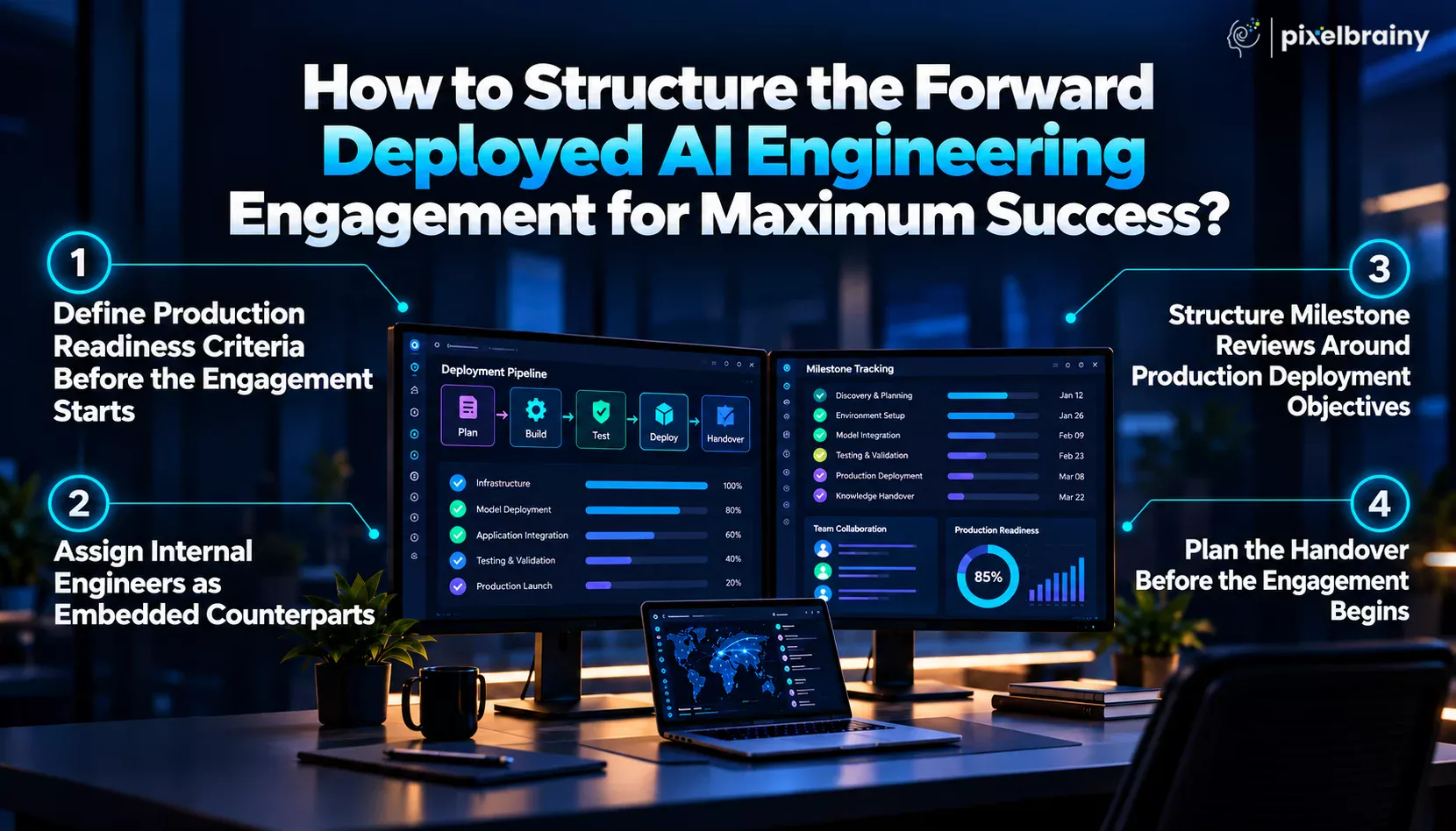
Before forward-deployed AI engineers for LLM production deployment begin development, both sides should agree on exactly what "production ready" means for the specific AI system.
The criteria may include:
For example, instead of saying "deploy the AI agent," define a measurable target such as: the agent must complete 90% of approved workflows successfully, maintain defined response-time limits, pass security testing, provide required audit logs, and operate within an agreed infrastructure budget.
These criteria eliminate ambiguity and help how forward-deployed AI engineers reduce AI project failure rate become a measurable question rather than a subjective claim.
Knowledge transfer works best when internal engineers participate directly in development.
For every forward-deployed engineer, assign an internal counterpart who joins architecture discussions, code reviews, debugging sessions, testing, deployment activities, and technical decisions.
A common enterprise query is: "How do we hire AI engineers for AI implementation without creating dependency on an external AI engineering company?"
The pairing model is one of the strongest answers. Internal engineers should not simply observe the external team. They should contribute to the implementation and gradually take ownership of components.
This approach transfers practical knowledge about LLM application architecture, RAG, agent orchestration, evaluation, monitoring, deployment, and troubleshooting while the actual system is being built.
Monthly or biweekly reviews should measure progress against production outcomes rather than hours worked or the number of tickets closed.
A useful milestone review can examine:
For example, a three-month engagement might have milestones such as:
Month 1: Production architecture and integration plan
Month 2: Core AI workflow and infrastructure
Month 3: Controlled production deployment
Knowledge transfer should be measured alongside technical delivery. If external engineers have completed 80% of the implementation but the internal team cannot deploy, troubleshoot, or modify the system independently, the engagement is not yet delivering its full intended value.
The handover should be designed before the first engineer starts.
Define the documentation, training, operational procedures, and ownership responsibilities required at the end of the engagement.
Expected deliverables can include:
These deliverables should be included in the contract and tied to engagement completion criteria. Otherwise, documentation and training can become lower priorities as production deadlines approach.
A strong engagement should also define who owns the system after handover. The internal team should know who maintains the AI application, manages model changes, reviews evaluations, responds to incidents, and approves future production releases.
This structure allows organizations to hire AI engineers for AI implementation while building sustainable internal capabilities at the same time.
The most valuable forward-deployed engagement does not end when the external engineers leave. It ends when the production system works reliably and the internal team has the knowledge, documentation, and confidence to own what was built.
What are the most common mistakes companies make when hiring forward-deployed AI engineers? The biggest mistake is evaluating these engineers like conventional AI or software developers instead of looking for people who can take an AI system from prototype to production inside a real enterprise environment.
Companies hiring forward-deployed AI engineers need to evaluate technical depth, enterprise integration experience, domain expertise, production ownership, communication skills, and knowledge-transfer capabilities. Avoiding the following mistakes can significantly improve the chances of turning an AI pilot into a reliable production system.
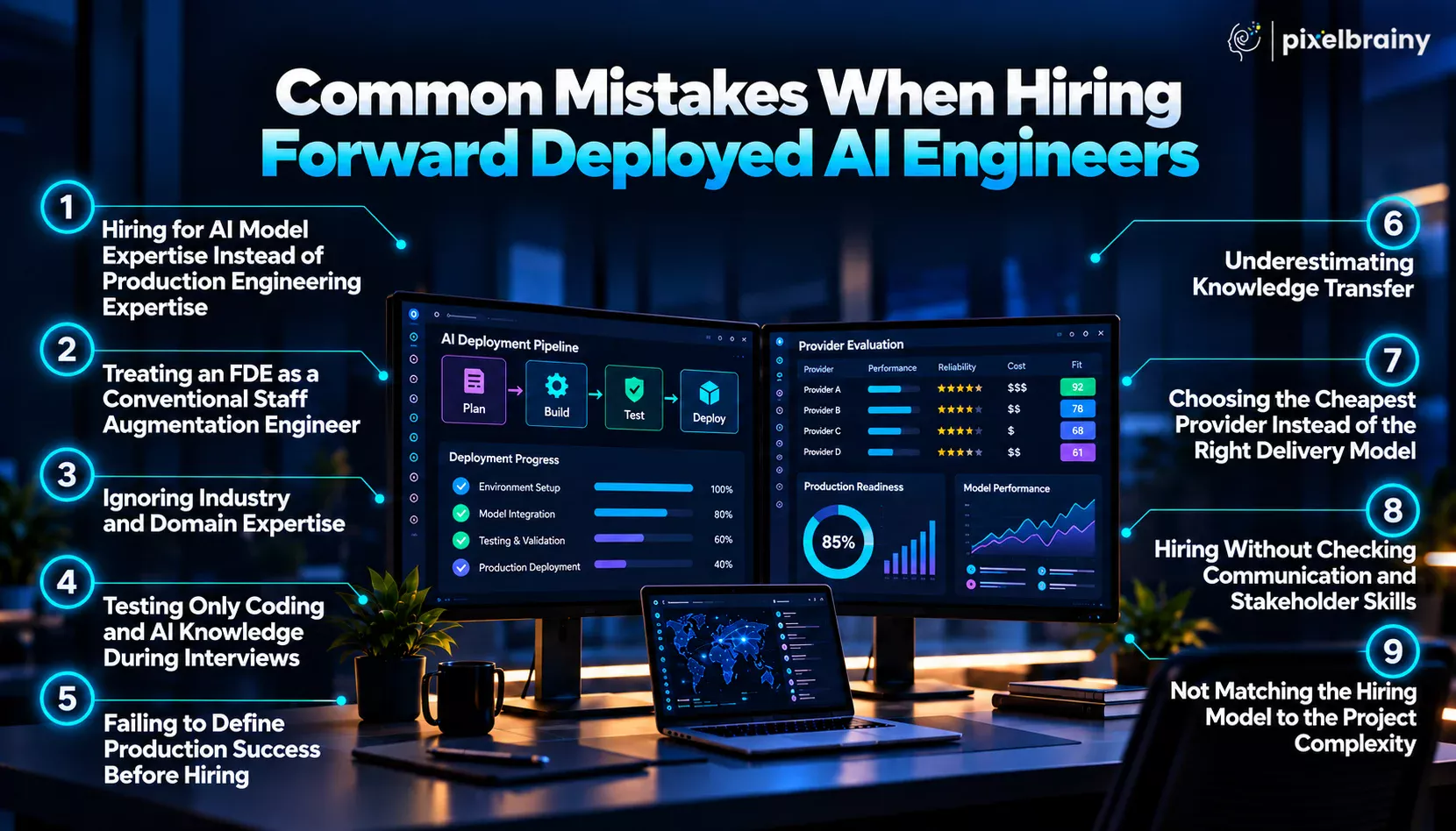
A candidate may have strong experience with machine learning, LLMs, or model development but still struggle to deploy an AI application into a complex enterprise environment.
This is particularly important when companies hire forward deployed AI engineers for RAG pipeline and LLM integration development. Building a RAG pipeline is only one part of the problem. The engineer may also need to connect the system to enterprise databases, APIs, identity systems, observability platforms, security controls, and existing applications.
When evaluating forward deployed AI software engineers, assess experience with:
The key interview question should be: “Can this engineer make an AI system work reliably inside our existing technology environment?”, not simply, “Can this engineer build an AI model?”
Another common mistake is hiring a forward-deployed AI engineer and assigning isolated development tickets without giving that person ownership of the deployment challenge.
A forward-deployed engineer typically needs to work across product, engineering, data, operations, and business teams. Their role can include understanding the existing workflow, identifying technical constraints, developing the AI solution, integrating it with enterprise systems, validating it with users, and addressing production issues.
Consider this real search query:
“Should we hire forward deployed AI engineers on a staff augmentation basis if we need someone to take ownership of our LLM production deployment?”
The answer depends on the engagement structure. If the organization needs end-to-end ownership, an embedded FDE team or specialized forward deployed AI engineer services provider may be more appropriate than simply adding another developer to the engineering backlog.
AI systems operate within specific business workflows, regulations, and operational constraints. Technical AI expertise alone may not be enough.
For example, companies hiring healthcare FDEs may need engineers who understand Epic integrations, HL7, FHIR, PHI, HIPAA requirements, clinical workflows, and healthcare data security. Financial institutions may need experience with compliance workflows, transaction systems, auditability, and financial data governance.
A realistic query a buyer might search is:
“How do I hire AI forward deployment specialists with healthcare or financial-services experience for an enterprise AI deployment?”
This is why forward deployed AI engineer hiring should evaluate both technical capabilities and relevant domain experience.
A useful interview question is:
“Tell us about an AI system you deployed into a real business workflow. What had to change between the prototype and the production implementation?”
The answer can reveal whether the candidate understands the difference between demonstrating AI capability and deploying AI reliably.
Traditional technical interviews often emphasize algorithms, coding challenges, machine learning theory, or model architecture.
Those skills matter, but companies that hire AI engineers for AI implementation should also test production engineering judgment.
Give candidates a realistic deployment scenario. For example:
“We have an LLM application that performs well in demonstrations, but retrieval quality drops with enterprise documents, latency increases under load, and users occasionally receive unsupported answers. How would you take this application to production?”
A strong candidate should discuss evaluation frameworks, retrieval optimization, grounding, observability, fallback mechanisms, latency management, security, testing, deployment architecture, and ongoing monitoring.
This type of assessment is particularly useful when hiring forward-deployed AI engineers for AI proof of concept to production pipeline work because it tests the exact skills required to close the deployment gap.
Another mistake is starting the hiring process before defining what the AI project must achieve in production.
Before you hire forward deployed AI engineers, establish measurable production requirements such as:
For example, instead of saying, “We want an AI customer-support assistant,” define the target as: “Deploy an AI support assistant integrated with our CRM that resolves 40% of eligible Tier 1 requests with defined accuracy, latency, security, and escalation thresholds.”
Specific requirements allow the FDE team to prioritize engineering work around measurable business outcomes.
A successful deployment can still become an expensive dependency if the external FDE team remains the only group capable of maintaining the system.
This is one of the most important considerations when hiring of forward deployed AI engineers to accelerate AI pilot to production.
Internal engineers should work alongside the FDE team throughout the engagement. They should participate in architecture decisions, code reviews, infrastructure deployment, evaluation design, incident management, and production releases.
Knowledge-transfer documentation should include:
The objective is not simply to get an AI application into production. It is to ensure the internal team can operate, troubleshoot, evaluate, and improve the system after the FDE engagement ends.
Cost is an important factor when you hire forward deployed AI engineers, but comparing providers only on hourly rates or monthly fees can produce the wrong decision.
A lower-cost provider may require more internal management, take longer to reach production, or lack the specialized expertise needed for complex LLM, RAG, agentic AI, or enterprise integration projects.
Compare forward deployed AI engineer services based on:
| Evaluation Factor | What to Look For |
|---|---|
| Production experience | Evidence of deploying AI systems in real environments |
| Technical expertise | LLMs, RAG, agents, APIs, cloud, DevOps |
| Domain expertise | Experience in your industry and workflows |
| Integration capability | ERP, CRM, data platforms, legacy systems, APIs |
| Security | Identity, access controls, governance, compliance |
| Delivery model | Individual FDE, embedded team, or complete engineering team |
| Knowledge transfer | Documentation, pairing, training, internal ownership |
| Business outcomes | Deployment speed, reliability, adoption, measurable ROI |
The right provider should reduce the time and engineering risk required to move from AI proof of concept to production, rather than simply provide additional development capacity.
Forward-deployed AI engineers often operate between technical teams and business stakeholders. They may need to explain model limitations to executives, translate business requirements into technical architecture, work with security teams, and troubleshoot production issues with internal developers.
That makes communication a core FDE skill.
A technically excellent engineer who cannot understand business workflows or communicate deployment risks can slow down an AI program considerably.
When interviewing candidates, ask:
“How would you explain to a non-technical business leader why an AI pilot that works in a demo is not yet ready for production?”
The best candidates should be able to explain technical constraints in business terms while still making practical engineering decisions.
Not every AI deployment requires the same type of FDE engagement.
A relatively contained LLM integration may require one senior forward deployed AI engineer. A complex enterprise deployment involving RAG, multiple APIs, AI agents, security, data engineering, and production infrastructure may require an embedded team.
A useful real-world query is:
“Should we hire one forward deployed AI engineer or a full AI engineering team for a six-month enterprise AI deployment?”
The answer depends on the number of systems involved, production requirements, technical complexity, deadline, internal engineering capacity, and required knowledge transfer.
Therefore, choosing the right engagement model before hiring prevents both under-resourcing and unnecessary spending.
What makes PixelBrainy different from a standard AI consulting company? PixelBrainy provides embedded forward deployed AI engineers who work directly with client teams to move AI systems from pilot to production. Instead of stopping at architecture recommendations or proof-of-concept development, the team takes hands-on ownership of LLM production deployment, RAG system optimization, MLOps infrastructure, enterprise system integration, AI reliability engineering, and production hardening of data pipelines.
For enterprises with AI pilots ready for deployment, startups building AI products for enterprise buyers, and organizations developing internal AI capabilities, PixelBrainy provides a forward deployed AI engineering company model built around measurable production outcomes.
The engagement begins with the existing AI system, technology stack, data environment, and production requirements. PixelBrainy's engineers then embed with the client's engineering and product teams to identify deployment blockers, strengthen the architecture, integrate enterprise systems, improve reliability, and prepare the AI application for production use.
Knowledge transfer is treated as a delivery outcome, not an afterthought. Engineers pair with internal teams throughout the engagement, document production architecture, share implementation practices, and transfer operational knowledge so clients can independently maintain and extend the resulting systems.
For organizations evaluating the best companies offering forward deployed AI engineers in USA, the critical comparison is not simply the number of AI specialists a provider has. It is whether those engineers can take ownership of the production problem and leave the client with both a working AI system and stronger internal engineering capability.
| Evaluation Factor | Standard AI Consulting | PixelBrainy Forward Deployed AI Engineers |
|---|---|---|
| Primary engagement | Advisory recommendations | Embedded engineering with hands-on ownership |
| Production ownership | Advisory role | End-to-end production deployment accountability |
| LLM reliability | Often limited to recommendations | Guardrails, fallbacks, evaluation, and reliability engineering |
| RAG optimization | Architecture guidance | Production RAG optimization and accuracy validation |
| MLOps infrastructure | Recommendations | Built, deployed, and operationalized |
| Enterprise integration | Architecture recommendations | Hands-on integration with enterprise and legacy systems |
| Knowledge transfer | Reports and presentations | Paired engineering and structured capability transfer |
| Post-engagement sustainability | Varies by provider | Internal teams can operate and extend delivered systems |
PixelBrainy also extends these capabilities through its broader AI development company expertise and RAG solutions, connecting forward deployment with the engineering required to build, optimize, and scale production AI applications.
If the objective is to hire a forward deployed AI team, PixelBrainy's model combines production execution with internal capability building, helping organizations turn AI investments into systems their teams can operate, improve, and scale. So let’s connect!
Moving an AI initiative from pilot to production requires more than a strong model or a successful proof of concept. It requires engineers who can solve integration challenges, harden data pipelines, improve LLM reliability, build production infrastructure, and work within the realities of enterprise technology environments.
That is where forward deployed AI engineers make a measurable difference. By combining AI engineering expertise with hands-on deployment ownership, organizations can reduce the gap between experimentation and production while building systems that are reliable, secure, and scalable.
Whether you need to hire forward deployed AI engineers for an existing pilot, hire a forward deployed AI team for a complex enterprise deployment, or build internal AI capabilities through structured knowledge transfer, choosing the right engineering partner is critical to long-term success.
PixelBrainy helps enterprises and growing AI companies turn production-ready AI ambitions into operational systems through embedded engineering, technical execution, and capability transfer.
Ready to move your AI pilot into production? Book an appointment with PixelBrainy and discuss your forward-deployed AI engineering requirements.
A forward deployed AI engineer is a hands-on technical specialist who works directly with an organization to move AI systems from pilot to production. Unlike an AI consultant who primarily provides recommendations, forward deployed AI engineers build, integrate, test, deploy, and optimize production AI systems within the client's environment.
The cost to hire forward deployed AI engineers in 2026 depends on seniority, project complexity, geography, compliance requirements, and engagement size. Planning estimates can range from $15,000 to $35,000 per month for one senior engineer, while embedded teams can cost $28,000 to $65,000 or more monthly.
A typical forward deployed AI engineering engagement can last three to six months for a focused production deployment, while complex enterprise programs may continue for six to twelve months or longer. Duration depends on AI maturity, integration complexity, infrastructure requirements, security needs, production deadlines, and the level of knowledge transfer required.
Forward deployed AI engineers address production challenges that internal teams may lack specialized experience or capacity to solve quickly. These include LLM reliability, RAG optimization, enterprise integrations, MLOps infrastructure, production data pipelines, AI observability, security controls, and agentic workflow deployment. They supplement internal expertise without requiring organizations to replace existing teams.
Choose forward deployed AI engineers who make knowledge transfer a formal engagement objective. Internal developers should participate in architecture, implementation, testing, and deployment through paired engineering. Documentation should cover infrastructure, models, RAG pipelines, integrations, monitoring, evaluation, security, and troubleshooting so the internal team can independently operate and extend the production system.
Hiring forward deployed AI engineers typically involves ownership of a defined production outcome, while AI staff augmentation primarily adds development capacity to an existing team. An FDE may identify deployment blockers, design solutions, integrate systems, improve reliability, and deploy the application. Staff augmentation resources generally execute tasks defined by the client's engineering organization.
Evaluate a forward deployed AI engineers company based on documented production deployments, not prototypes or demonstrations alone. Ask about enterprise integrations, LLM reliability, RAG optimization, MLOps, security, observability, production incidents, measurable outcomes, and knowledge transfer. Request relevant case studies and examples showing how the provider moved AI systems from pilot to production.
Yes. Forward deployed AI engineers are often most effective when embedded alongside an organization's existing engineering, product, data, and security teams. They bring specialized AI production expertise while internal engineers provide business and technical context. This collaborative model also supports knowledge transfer, enabling the internal team to maintain and extend the deployed system.
Security arrangements for forward deployed AI engineering typically include least-privilege access, role-based permissions, secure development environments, identity controls, encrypted data handling, audit logging, secrets management, and controlled production access. Requirements vary by organization and industry. Regulated deployments may also require additional governance, compliance controls, data isolation, and security reviews.
Forward deployed AI engineers can support organizations across healthcare, financial services, trading, insurance, legal, manufacturing, retail, enterprise SaaS, telecom, logistics, energy, pharmaceuticals, government, and transportation. The strongest use cases generally involve complex workflows where AI must integrate with enterprise systems, proprietary data, operational processes, security requirements, and production infrastructure.
PixelBrainy combines forward deployed AI engineering services with hands-on production ownership and structured knowledge transfer. Its capabilities include LLM production deployment, RAG optimization, AI reliability engineering, MLOps, enterprise integration, and data pipeline hardening. Rather than providing advisory recommendations alone, PixelBrainy embeds engineers with client teams to deliver production outcomes and build internal capability.
The timeline depends on project scope, technical requirements, team availability, security approvals, and access to required systems and data. PixelBrainy forward deployed AI engineers can begin with a focused discovery and production-readiness assessment, followed by implementation. The engagement can then scale according to integration complexity, deployment deadlines, and internal team requirements.

About The Author
Sagar Bhatnagar
Sagar Sahay Bhatnagar brings over a decade of IT industry experience to his role as Marketing Head at PixelBrainy. He's known for his knack in devising creative marketing strategies that boost brand visibility and market influence. Sagar's strategic thinking, coupled with his innovative vision and focus on results, sets him apart. His track record of successful campaigns proves his ability to utilize digital platforms effectively for impactful marketing efforts. With a genuine passion for both technology and marketing, Sagar continuously pushes PixelBrainy's marketing initiatives to greater success.

Working with the PixelBrainy team has been a highly positive experience. They understand the design requirements and create beautiful UX elements to meet the application needs. The dev team did an excellent job bringing my vision to life. We discussed usability and flow. Sagar worked with his team to design the database and begin coding. Working with Sagar was easy. He has the knowledge to create robust apps, including multi-language support, Google and Apple ID login options, Ad-enabled integrations, Stripe payment processing, and a Web Admin site for maintaining support data. I'm extremely satisfied with the services provided, the quality of the final product, and the professionalism of the entire process. I highly recommend them for Android and iOS Mobile Application Design and Development.

Great experience working with them. Had a lot of feedback and I found that unlike most contractors they were bugging me for updates instead of the other way around. They were extremely time conscience and great at communicating! All work was done extremely high quality and if not on time, early! They were always proactive when it comes to communication and the work is great/above par always. Very flexible and a great team to work with! Goes above and beyond to present us with multiple options and always provides quality. Amazing work per usual with Chitra. If you have UI/UX or branding design needs I recommend you go to them! Will likely work with them in the future as well, definitely recommended!

PixelBrainy is a joy to work with and is a great partner when thinking through branding, logo, and website layout. I appreciate that they spend time going into the "why" behind their decisions to help inform me and others about industry best practices and their expertise.

I hired them to design our software apps. Things I really like about them are excellent communication skills, they answer all project suggestions and collaborate right away, and their input on design and colors is amazing. This project was complex and needed patience and creativity. The team is amazing to do business with. I will be using them long-term. Glad to see there are some good people out there. I was afraid to try and outsource my project to someone but I am glad I met them! I really can't say enough. They went above and beyond on this project. I am very happy with everything they have done to make my business stand out from the competition.

It was great working with PixelBrainy and the team. They were very responsive and really owned the project. We'll definitely work with them again!

I recently worked with the PixelBrainy team on a project and I was blown away by their communication skills. They were prompt, clear, and articulate in all of our interactions. They listened and provided valuable feedback and suggestions to help make the project a success. They also kept me updated throughout the entire process, which made the experience stress-free and enjoyable.

PixelBrainy is very good at what it does. The team also presents themselves very professionally and takes care of their side of things very well. I could fully trust them taking up the design work in a timely and organised manner and their attention to detail saved us lots of effort and time. This particular project was quite intense and the team showed that they function very well under pressure. Very much looking forward to working with her again!

It's always an absolute pleasure working with them. They completed all of my requests quickly and followed every note I had for them to a T, which made our process go smoothly from start to finish. Everything was completed fast and following all of the guidelines. And I would recommend their services to anyone. If you need any design work done in the future, PixelBrainy should be your first call!

They took ownership of our requirements and designed and proposed multiple beautiful variants. The team is self-motivated, requires minimum supervision, committed to see-through designs with quality and delivering them on time. We would definitely love to work with PixelBrainy again when we have any requirements.

PixelBrainy was a big help with our SaaS application. We've been hard at work with a new UI/UX and they provided a lot of help with the designs. If you're looking for assistance with your website, software, or mobile application designs, PixelBrainy and the team is a great recommendation.

PixelBrainy designers are amazing. They are responsive, talented, and always willing to help craft the design until it matches your vision. I would recommend them and plan to continue them for my future projects and more!!!

They were awesome! Did a good job fast, and good communication. Will work with them again. Thank you

Creative, detail-oriented, and talented designers who take direction well and implement changes quickly and accurately. They consistently over-delivered for us.

PixelBrainy team is very talented and creative. Great designers and a pleasure to work with. PixelBrainy is an excellent communicator and I look forward to working with them again.

PixelBrainy has a very talented design team. Their work is excellent and they are very responsive. I enjoy working with them and hope to continue on all of our future projects.


Transform your ideas into reality with us.
Across these industries, each engagement brings unique challenges, from early-stage product development to scaling complex systems, helping us build a practical understanding of real-world product environments.