AI Summary Powered by PixelBrainy
What if your trading system could uncover market patterns your analysts overlook—and act on a validated signal within milliseconds, without emotional decision-making?
For hedge funds, quantitative researchers, asset managers, and institutional investors, AI stock trading bots offer a way to turn large-scale market data into systematic trading decisions. But building a competitive system takes more than adding a machine learning model to a trading platform. It requires a robust strategy, reliable data pipelines, rigorous validation, risk controls, and execution infrastructure designed around your trading objectives.
The market is moving in this direction. According to Mordor Intelligence’s 2026 algorithmic trading market report, the global algorithmic trading market reached an estimated $20.23 billion in 2026 and is projected to reach $29.54 billion by 2031. This growth reflects increasing demand for automated trading capabilities, including faster execution and more sophisticated quantitative strategies.
For institutional teams working with years of historical market data, the opportunity lies in identifying signals that hold up beyond the training dataset. Effective AI stock trading bot strategy development should combine feature engineering, machine learning-based signal generation, walk-forward testing, out-of-sample evaluation, and transaction-cost analysis. Historical patterns alone do not establish a reliable edge; performance must be tested against relevant benchmark strategies and realistic trading conditions.
This guide explains how to create an AI stock trading bot from strategy to real time execution, covering the architecture, tools, development process, costs, and technical challenges involved. We’ll also examine what matters when developing an AI stock trading bot with high frequency and low latency execution features, from market-data processing to broker or exchange connectivity.
Whether you are planning AI automated stock trading bot development or evaluating specialist development companies, the goal is to understand what it takes to build, validate, and deploy a system suited to institutional requirements not simply produce another trading algorithm.

An AI stock trading bot is a software system that uses artificial intelligence, machine learning, and market data to identify trading opportunities, generate signals, manage risk, and execute orders automatically. Unlike a basic rule-based bot that follows predefined conditions, an AI-powered system can learn statistical relationships from historical data, evaluate changing market conditions, and update its predictions when appropriately retrained and validated.
The demand for automated trading technology continues to grow. According to Grand View Research’s algorithmic trading market report, the global algorithmic trading market is estimated to reach $26.3 billion in 2026 and is projected to grow to $64.3 billion by 2033, at a compound annual growth rate of 13.6%. These figures cover the broader algorithmic trading market, not AI stock trading bots alone, but they illustrate the growing investment in automated trading infrastructure.
For hedge funds, quantitative trading firms, asset managers, and proprietary trading desks, the value of AI stock trading bots goes beyond automation. A well-engineered system can process years of market history, combine price and volume data with technical indicators or news sentiment, and identify patterns that may be difficult for human analysts to detect consistently.
However, AI does not automatically create a profitable trading edge. Models can overfit historical data, misinterpret changing market conditions, or lose their effectiveness after deployment. Institutional systems therefore need rigorous validation, ongoing monitoring, compliance controls, and reliable execution infrastructure.
For firms planning AI stock trading bot development, the objective is not simply to build a bot that predicts market movements. It is to develop a custom system that can generate testable signals, execute trades reliably, manage risk, and demonstrate performance under realistic market conditions.
The key question is: can your trading system identify opportunities that hold up beyond historical testing and execute them efficiently enough to support your investment strategy? That is where the right combination of machine learning expertise, quantitative research, and trading-system engineering becomes essential.
In 2026, trying to build a winning trading strategy without automation is like entering a Formula 1 race on a bicycle. As the stock market becomes more efficient and competitive, intelligent tools such as AI Stock Trading Bots are no longer a luxury, they are essential for staying ahead.
Today, developing AI Stock Trading Bot systems is a priority for hedge funds, proprietary trading firms, retail algorithmic traders, and fintech innovators. Here’s how they are transforming modern trading strategies and giving traders a decisive edge.
The stock market may close each day, but opportunities arise at the open, close, and even in pre-market and after-hours sessions.
A well-optimized AI Stock Trading Bot is like having a full trading desk that never loses focus.
AI-powered bots do not guess trades, they learn what works and adapt.
This approach ensures your bot becomes smarter with each market cycle.
An effective AI Stock Trading Bot does not just chase profits, it safeguards capital.
This layer of control is critical in AI Stock Trading Bot development for serious capital deployment.
One bot can execute multiple trading styles in parallel.
This multi-strategy framework makes developing AI Stock Trading Bot solutions ideal for traders managing diversified portfolios.
An AI stock trading bot converts market data into trading decisions through a structured workflow involving data collection, machine learning-based signal generation, risk assessment, order execution, and performance monitoring. Each stage plays a role in helping the system identify potential opportunities, manage exposure, and execute trades according to predefined investment objectives.
For hedge funds, quantitative trading firms, and institutional investors, understanding this workflow is essential when developing a custom AI stock trading bot that can analyze historical market data, identify potential alpha-generating patterns, and execute trades with low latency.
Here is how the process works in practice.
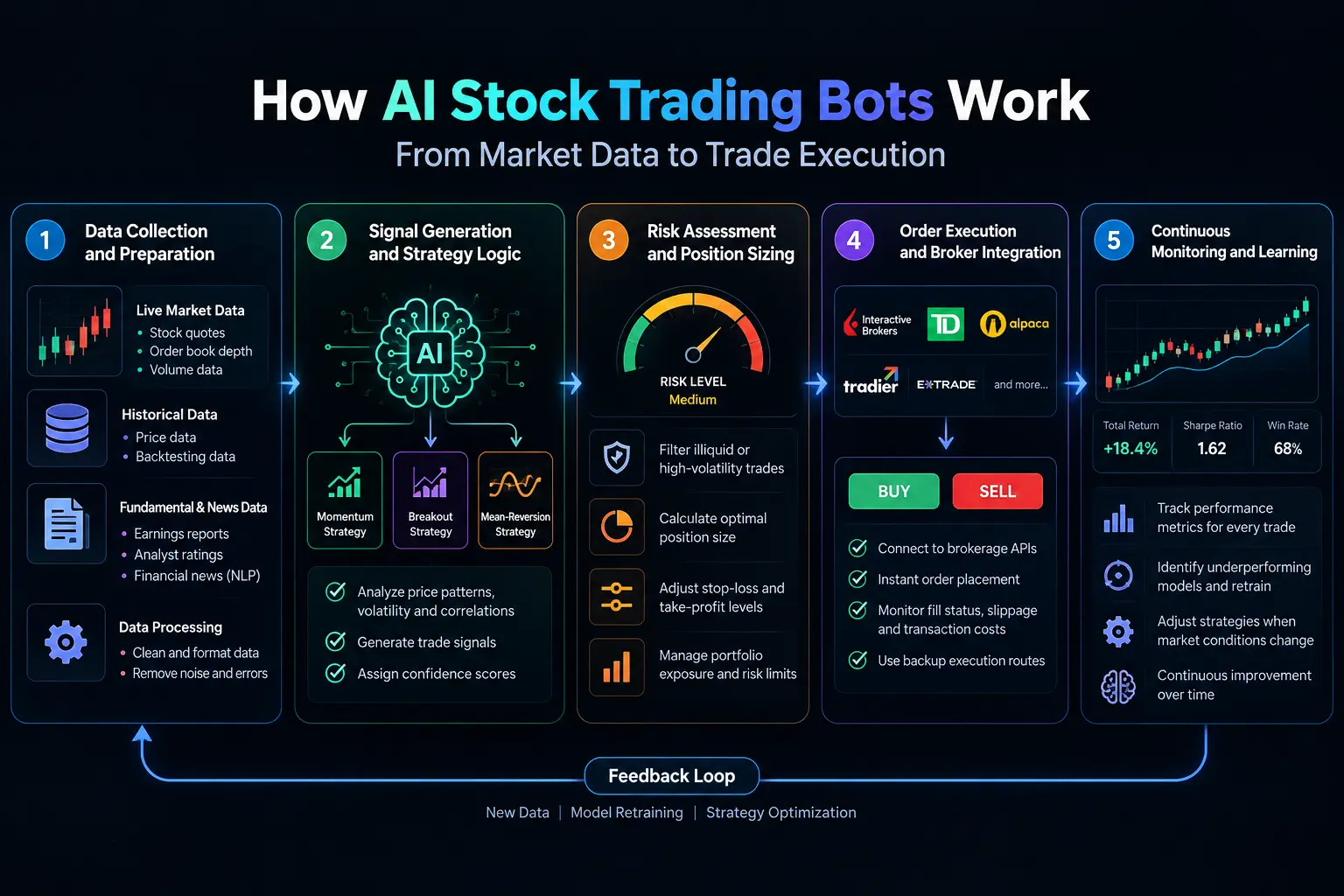
Market data provides the foundation for every AI-driven trading decision. The bot collects, cleans, and organizes historical and real-time information so its models can identify meaningful patterns and generate reliable inputs.
In AI stock trading bot development, data quality, timestamp accuracy, and consistency are critical. Missing values, incorrect prices, or poorly aligned datasets can distort model predictions and produce misleading backtesting results.
Once the data is prepared, machine learning models analyze it to identify patterns associated with potential trading opportunities. The strategy engine converts these model outputs into actionable signals based on the bot's objectives and trading rules.
Professional AI stock trading bot strategy development may combine multiple models or independent signals to evaluate trade opportunities. These signals should be validated against unseen data and relevant benchmark strategies before being used in live trading.
Before an order is submitted, the bot evaluates whether the proposed trade fits the portfolio's risk limits. This stage helps control exposure and prevent individual signals from triggering positions that exceed the investment strategy's risk tolerance.
The development of an AI stock trading bot should include risk controls alongside signal generation. Position limits, exposure thresholds, drawdown controls, and predefined trading halt conditions help manage risk, although they cannot eliminate market losses.
After a signal passes the required risk checks, the execution engine submits the order through a connected broker or exchange interface. Execution quality matters because latency, slippage, liquidity, and transaction costs can reduce a strategy's realized performance.
Advanced AI stock trading bot development can incorporate multi-broker connectivity, order-routing logic, and execution monitoring where the strategy and infrastructure require them. For latency-sensitive strategies, performance testing should measure the time from signal generation to order submission and fill, rather than relying on model inference speed alone.
Deployment is not the final step. A production AI stock trading bot needs continuous monitoring to determine whether its models, execution processes, and risk controls are performing as expected.
Retraining and strategy adjustments should follow controlled validation procedures rather than occur automatically without oversight. Monitoring for model drift, unexpected losses, execution failures, and changes in market behavior helps teams decide when to retrain, recalibrate, pause, or retire a model.
Ultimately, an AI stock trading bot connects data engineering, machine learning, quantitative strategy design, risk management, and trade execution in one system. For institutional investors, success depends not only on identifying promising signals but also on validating their performance, controlling risk, and executing consistently under real market conditions.
What if you could analyze hundreds of stocks, identify potential trading signals, and execute orders without relying on constant manual monitoring? That is one of the main reasons traders, hedge funds, and quantitative investment firms are investing in AI stock trading bot development.
Unlike traditional trading tools that rely on fixed rules, AI-powered systems can use machine learning to analyze historical and real-time market data, detect patterns, and support decisions across multiple trading strategies. For institutional investors, a custom-built bot can also be designed around specific investment objectives, proprietary datasets, execution requirements, and risk limits.
The challenge is turning these capabilities into a reliable trading system. Building an AI stock trading bot requires more than a predictive model. It involves strategy development, data processing, risk management, and execution infrastructure that work together under real market conditions.
Here are five key reasons traders are investing in AI-powered trading automation.
While the stock market has set trading hours, opportunities can emerge in pre-market and after-hours sessions, as well as through global markets. An AI Stock Trading Bot can monitor price gaps, breaking news, and sudden sector movements around the clock, ensuring that no opportunity slips away due to human downtime. By reacting in seconds to corporate announcements or macroeconomic events, these bots give traders a timing edge that manual trading cannot match.
Emotions like fear and greed can sabotage even the best human traders. A well-built AI Stock Trading Bot follows a predefined logic and data-driven models, ignoring market noise and emotional impulses. It does not panic during a sell-off or overextend during a rally. This discipline is critical in developing AI Stock Trading Bot solutions that maintain consistency even in turbulent markets.
Stock prices can move in milliseconds. AI-powered bots can scan hundreds of tickers, evaluate real-time indicators, and execute trades almost instantly. They can also scale strategies across multiple stocks and trading accounts without loss of performance. In professional Stock Trading Bot development with AI, this combination of speed, scale, and precision is often the key to outperforming traditional approaches.
Instead of manually switching between momentum, breakout, swing, or news-based strategies, an AI Stock Trading Bot can run several strategies in parallel. It can diversify across sectors, market caps, and volatility levels, automatically adjusting to different market conditions. This strategic flexibility reduces risk while keeping profit potential high.
Building an AI Stock Trading Bot requires an upfront investment, but once deployed, it runs at a fraction of the cost of maintaining a large trading team. There are no recurring salaries, overtime costs, or human fatigue. Updates to trading logic can be deployed quickly, especially when working with an experienced team specializing in the development of Stock Trading Bot systems using artificial intelligence.
Therefore, developing an AI stock trading bot can help traders automate strategies, identify market patterns, and execute trades more consistently, provided the system is backed by validated signals, low-latency execution, and robust risk management.
What features should a custom AI stock trading bot include to meet the demands of institutional investors and quantitative trading teams? The answer goes beyond machine learning and automated order placement. A reliable system needs real-time market data, validated trading signals, robust risk controls, low-latency execution, and performance monitoring to support its strategy from research through live deployment.
For hedge funds and trading firms planning AI stock trading bot development, these capabilities should align with specific investment objectives, historical data requirements, broker integrations, and execution targets. The right combination of features helps build a system that can be tested against benchmark strategies, monitored in live markets, and refined as market conditions change.
Below are the essential components to consider when developing a custom AI stock trading bot.
| Feature | Description |
| Real-Time Market Data Integration | The bot must connect to live data feeds from exchanges and brokers, ensuring every decision is based on the most current market conditions. This enables precise trade timing and avoids missed opportunities |
| Multi-Asset and Multi-Strategy Support | A robust bot can handle multiple stocks, sectors, and strategies simultaneously. This diversification increases profit potential and spreads risk across different market scenarios |
| AI-Powered Signal Generation | Machine learning models analyze patterns, technical indicators, and news sentiment to generate buy/sell signals. This ensures trading decisions are based on deep market insights rather than fixed rules |
| Risk Management Engine | Includes volatility filters, adaptive stop-loss, and position sizing rules to protect capital. This layer ensures that even profitable strategies avoid catastrophic losses |
| Backtesting and Simulation Tools | Allows traders to test strategies against historical data before going live. It helps validate profitability and identify weaknesses in strategy logic |
| Auto-Adaptive Learning | The bot continuously learns from new market data, refining strategies over time. This adaptability keeps it relevant in changing market conditions |
| High-Speed Order Execution | Integration with low-latency broker APIs ensures trades are placed in milliseconds. Faster execution reduces slippage and improves profitability |
| Performance Analytics Dashboard | Real-time reporting of profit/loss, win rates, and strategy performance. This transparency helps traders fine-tune parameters for better results |
| Multi-Broker Compatibility | Ability to connect with several brokers for redundancy and broader market access. This feature is vital for traders managing diverse portfolios |
| Security and Compliance Layer | Implements encryption, API authentication, and compliance checks. This protects sensitive data and ensures trades follow regulatory guidelines |
Therefore, a well-engineered AI stock trading bot should combine machine learning, reliable execution, and disciplined risk management to support scalable trading strategies. For institutional investors, these core features provide the foundation for evaluating performance through rigorous testing rather than assuming profitability from automation alone.
What advanced capabilities can help an AI stock trading bot identify market signals, respond to changing conditions, and meet institutional trading requirements? Beyond core functionality, features such as news sentiment analysis, reinforcement learning, volatility detection, and portfolio optimization can help trading systems evaluate a wider range of market information and support more sophisticated strategies.
For hedge funds, quantitative trading firms, and institutional investors, advanced AI stock trading bot development often involves tailoring these capabilities to proprietary datasets, investment strategies, risk limits, and execution requirements. For example, a firm working with 15 years of historical market data may combine machine learning-based signal generation with regime detection and intermarket analysis to investigate patterns that could be missed by simpler models. These patterns still require rigorous out-of-sample testing to establish whether they provide a measurable advantage over benchmark strategies.
Below are advanced features to consider when developing a custom AI stock trading bot for complex trading strategies and real-time market environments.
| Advanced Feature | Description |
| Natural Language Processing (NLP) for News | Processes headlines, press releases, and analyst reports in real time to detect market-moving sentiment. This enables instant reaction to news before manual traders can respond |
| Sentiment Analysis from Social Media | Scans platforms like Twitter, Reddit, and financial forums to gauge retail sentiment. Helps anticipate crowd-driven volatility and adjust positions accordingly |
| Reinforcement Learning Models | Continuously improves strategies by rewarding profitable trades and penalizing losses. Adapts decision-making to evolving market conditions without manual reprogramming |
| Event-Driven Trading Logic | Executes trades based on corporate earnings, dividends, mergers, or macroeconomic events. Ensures the bot is aligned with impactful, time-sensitive catalysts |
| Volatility Regime Detection | Identifies whether the market is trending, ranging, or experiencing high volatility. Automatically adjusts strategy parameters to suit the current environment |
| Intermarket Analysis | Monitors related assets like ETFs, commodities, and bonds to predict stock price moves. Useful for sector rotation and correlation-based trading |
| Portfolio Optimization Algorithms | Allocates capital across multiple strategies and assets for maximum return-to-risk ratio. Reduces drawdowns through intelligent diversification |
| Advanced Order Types Support | Integrates with brokers to use bracket orders, iceberg orders, and trailing stops. Enhances control over trade execution and profit capture |
| Customizable Risk Profiles | Allows traders to set unique risk thresholds per strategy, sector, or asset. Provides flexibility to match different trading styles and capital requirements |
| Cloud-Based Scalability | Deploys the bot on scalable cloud infrastructure for high availability and rapid computation. Supports multi-market, multi-strategy execution without hardware constraints |
Therefore, integrating advanced capabilities into AI stock trading bot development can help institutional teams analyze richer data, adapt strategies to market conditions, and refine portfolio decisions. The right features should be driven by measurable strategy requirements, validated performance, and reliable execution rather than complexity alone.
How do you turn a trading strategy into a custom AI stock trading bot that can analyze years of market data, generate machine learning-based signals, and execute trades with low latency? The process involves much more than developing an AI model. It requires a structured approach that connects quantitative strategy design, data engineering, risk management, broker integration, and real-time execution.
For hedge funds, quantitative trading firms, and institutional investors, AI stock trading bot development should begin with clearly defined investment objectives and measurable performance requirements. For example, a fund seeking to identify alpha-generating patterns across 15 years of historical data needs a development process that prioritizes data quality, out-of-sample validation, realistic transaction-cost modeling, and execution speed.
Whether you are building an MVP to validate a trading concept or developing an institutional-grade automated trading system, each stage should address a specific technical and business requirement. This helps control development costs, identify weaknesses early, and establish a reliable foundation for future improvements.
Follow these seven steps to understand how to build an AI stock trading bot, from defining the strategy to deploying and monitoring it in live trading environments.
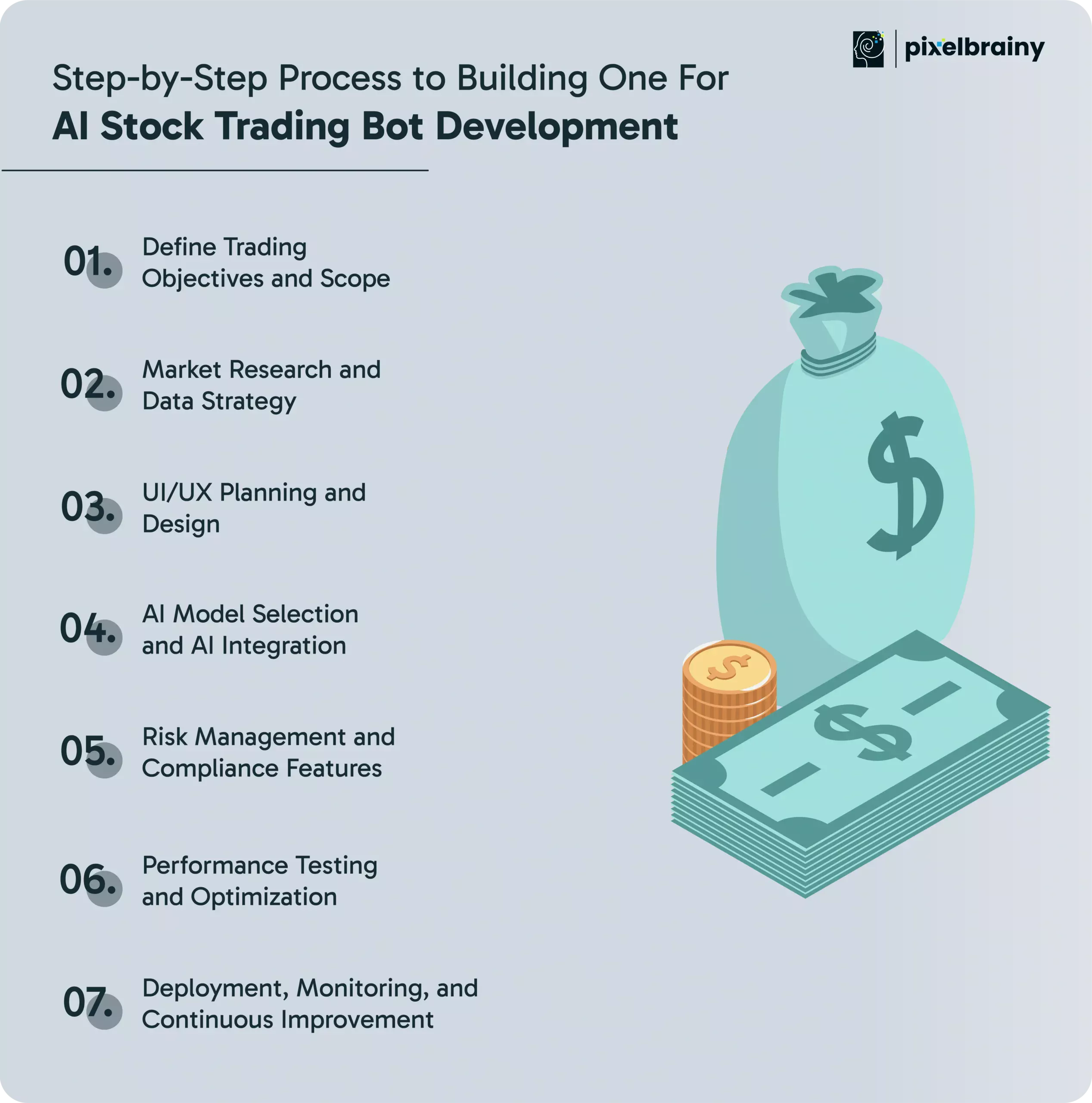
Before writing a single line of code, clearly define what your bot should achieve. Decide whether you want it to focus on intraday trades, swing trading, or long-term investments. Outline the asset classes, markets, and risk parameters to set the foundation for Stock Trading Bot development utilizing AI.
Why this matters:
Gather historical market data, real-time price feeds, and relevant financial news sources. Identify which technical and fundamental indicators your bot will track. A well-structured data strategy ensures your AI models have the clean, reliable information they need to generate accurate signals.
Why this matters:
Partner with a UI/UX design company to create intuitive dashboards, trade monitoring tools, and configuration panels. The interface should be easy to navigate for both technical and non-technical traders, offering clarity on performance metrics and trading decisions.
Why this matters:
Start with an MVP development approach to test your core strategy quickly. The Minimum Viable Product should include essential trading functions like order execution, data ingestion, and basic risk controls. This allows you to validate the concept before scaling into a full production-ready bot.
Why this matters:
Also Read: Top 10 AI MVP Development Companies in USA
Choose the right algorithms such as LSTM, reinforcement learning, or gradient boosting for price prediction and decision-making. Work with top AI development companies in USA to ensure robust AI integration that processes live market data efficiently and adapts to changing conditions.
Why this matters:
Also Read: Top 12+ AI Model Development Companies in the USA
Incorporate adaptive stop-losses, position sizing rules, and volatility filters. Make sure the bot adheres to relevant trading regulations and broker-specific compliance standards. These safeguards are vital in building AI Stock Trading Bot systems that protect both capital and reputation.
Why this matters:
Run backtesting on historical data, followed by paper trading in simulated live conditions. Evaluate performance metrics like win rate, drawdown, and risk-adjusted returns. Continuously optimize the logic to maximize efficiency and profitability.
Why this matters:
Deploy the bot on a secure, scalable infrastructure. Integrate advanced AI solutions for automated monitoring, performance analytics, and troubleshooting. Consider AI chatbot development to allow traders to interact with the bot via conversational interfaces, retrieving updates or executing trades through chat commands.
Why this matters:
Therefore, following a structured AI stock trading bot development process helps align machine learning, strategy validation, risk controls, and low-latency execution with your trading objectives. The goal is to build a reliable, scalable system whose performance can be evaluated against benchmark strategies under realistic market conditions.
Also Read: How to Build AI Crypto Trading Bot
How much does it cost to build a custom AI stock trading bot that can analyze years of historical market data, generate machine learning-based trading signals, and execute orders with low latency? The investment depends on the complexity of the trading strategy, the AI models involved, data licensing, broker integrations, infrastructure, and the level of testing required before deployment.
For hedge funds, quantitative trading firms, and institutional investors, AI stock trading bot development costs can vary significantly between a basic proof of concept and a production-grade system. A bot designed to test a single strategy with one broker integration typically requires fewer resources than an institutional platform with multiple strategies, high-frequency execution requirements, portfolio-level risk controls, and extensive historical data processing.
As a preliminary budgeting estimate, the cost to develop an AI stock trading bot can range from $10,000 to $100,000 or more, depending on the project's scope and technical requirements. These figures are indicative estimates, not fixed industry prices. Data subscriptions, ongoing maintenance, cloud infrastructure, and specialized low-latency engineering may increase the total investment.
The following breakdown outlines common development components and their estimated costs, along with examples of how requirements can affect the overall budget.
| Component | Details | Cost Range (USD) |
| Core Trading Logic | Development of trading strategies, execution rules, and order handling | $3,000 – $15,000 |
| AI Model Development | Machine learning models for signal generation, prediction, and optimization | $5,000 – $30,000 |
| Data Feeds & API Integration | Real-time market data, broker APIs, and news sources | $2,000 – $15,000 |
| UI/UX Design | Interactive dashboards and configuration panels by a UI/UX design company | $2,000 – $12,000 |
| Risk Management & Compliance | Stop-loss, volatility filters, margin checks, and regulatory alignment | $1,500 – $8,000 |
| Cloud Hosting & Infrastructure | Scalable deployment, low-latency servers, and backups | $1,500 – $10,000 |
| Testing & Optimization | Backtesting, simulation, and performance tuning | $2,000 – $10,000 |
| Security Layer | Encryption, authentication, and intrusion protection | $1,000 – $8,000 |
Therefore, estimating AI stock trading bot development costs starts with defining your strategy, data requirements, execution targets, and risk controls. A clear scope helps prioritize essential capabilities, allocate resources effectively, and plan for both initial development and ongoing operating expenses.

Also Read: AI Trading Platform Development Cost
What technology stack do you need to build a custom AI stock trading bot that processes live market data, generates machine learning-based signals, and executes trades with low latency? The answer depends on your trading strategy, data volume, execution requirements, and reliability targets.
A production-ready trading system requires a coordinated stack spanning frontend dashboards, backend services, machine learning frameworks, market-data pipelines, broker APIs, and deployment infrastructure. Systems trained on years of historical market data may also need efficient data storage, scalable model training, rigorous backtesting, and real-time monitoring to support their trading objectives.
For projects involving high-frequency trading and low-latency execution, technology decisions become even more critical. Network latency, data-processing overhead, order-routing efficiency, and infrastructure location can all affect execution performance. The fastest machine learning model alone does not guarantee faster or more effective trade execution.
The following table outlines commonly used tools and frameworks for building an AI-powered stock trading system, from model development and data processing to broker integration, testing, and production monitoring.
| Parameter | Example Tools / Frameworks | Description |
| Frontend (User Interface) | React.js, Angular, Vue.js | Used to build interactive dashboards where traders can monitor performance, configure strategies, and view analytics in real time. A clean, intuitive UI ensures smooth user experience |
| Backend (Server-Side Logic) | Node.js, Django, Flask | Handles order execution, business logic, and AI model integration. Manages communication between the frontend, databases, and external APIs for seamless operation |
| AI & Machine Learning Frameworks | TensorFlow, PyTorch, Scikit-learn | Powers predictive models for price forecasting, sentiment analysis, and decision-making. Essential for Stock Trading Bot development utilizing AI |
| Data Streaming & Processing | Apache Kafka, Redis, RabbitMQ | Ensures real-time ingestion and processing of market data with minimal latency. Supports continuous signal updates for fast execution |
| Database | PostgreSQL, MongoDB, MySQL | Stores trade history, market data, and configuration settings. Enables backtesting and performance analysis over large datasets |
| Broker & Market APIs | Interactive Brokers API, Alpaca, Tradier | Provides access to live market data and order execution directly from the bot to the stock exchange |
| Cloud Hosting & Deployment | AWS, Google Cloud, Microsoft Azure | Offers scalable infrastructure with high availability for running trading bots 24/7. Supports global deployment and redundancy |
| Security & Compliance Tools | OAuth 2.0, SSL/TLS, JWT | Protects sensitive data, manages user authentication, and ensures compliance with financial regulations |
| Testing & Simulation | Backtrader, QuantConnect, Zipline | Allows strategy backtesting against historical data and simulating trades in paper trading mode before live deployment |
| Monitoring & Logging | Prometheus, Grafana, ELK Stack | Tracks performance, system health, and trade execution logs in real time for rapid troubleshooting and optimization |
Therefore, the right technology stack should match your bot's strategy, data requirements, execution targets, and risk controls. Combining suitable AI frameworks with reliable data pipelines, broker integrations, and robust monitoring provides a solid foundation for a scalable, production-ready trading system.
What does it take to build an AI stock trading bot that performs reliably beyond historical backtests? A successful system needs more than sophisticated machine learning models. It requires high-quality market data, robust validation, low-latency execution, layered risk controls, and continuous performance monitoring.
For teams developing custom AI trading systems, these practices are particularly important when training models on years of historical data to identify potentially profitable patterns that may not be obvious through conventional analysis. The challenge is ensuring those patterns remain useful on unseen data and under changing market conditions. That means evaluating strategies against relevant benchmarks, accounting for transaction costs, and testing execution behavior before committing real capital.
Whether your objective is AI stock trading bot development for a single strategy or an institutional platform supporting multiple strategies, following a disciplined development process can help reduce technical risks and improve operational reliability.
Here are six best practices to follow when building and deploying an AI-powered stock trading system.
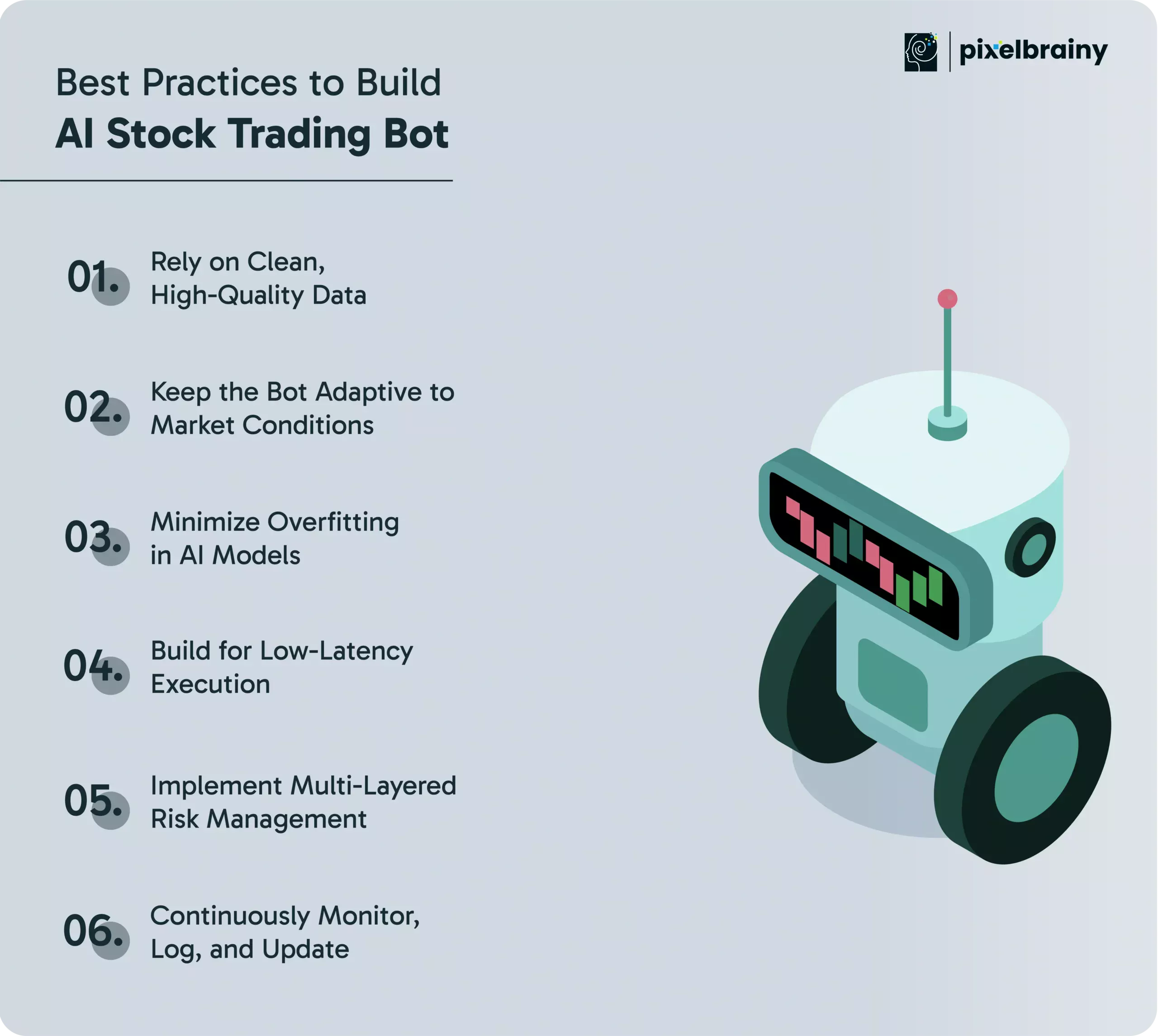
Your bot’s intelligence is only as good as the data it consumes. Use reliable market data sources with minimal latency, and ensure that both historical and live feeds are free from errors and gaps. Poor data quality can lead to false signals, bad entries, and unnecessary losses.
Markets change, and so should your trading bot. Implement AI models that can retrain periodically, update parameters automatically, and adjust strategies based on volatility, trend shifts, and macroeconomic events. An adaptive bot stays relevant while static models quickly lose their edge.
Overfitting happens when your AI model becomes too tailored to historical patterns, performing well in backtests but failing in live trading. Use cross-validation techniques, out-of-sample testing, and diverse datasets to ensure your bot can handle future, unseen market conditions.
In stock trading, milliseconds matter. Optimize your infrastructure for fast data processing and order execution by choosing low-latency APIs, efficient algorithms, and scalable hosting solutions. This reduces slippage and ensures you capture opportunities before prices move.
A smart bot does more than chase profits; it protects your capital. Include multiple safeguards such as volatility filters, dynamic position sizing, and maximum drawdown limits. This layered approach reduces exposure to catastrophic losses during sudden market swings.
Even the best-designed bot needs ongoing oversight. Monitor trades in real time, keep detailed logs of every decision and execution, and schedule regular performance audits. Updating your strategies and retraining AI models ensures the bot evolves alongside the market.
Therefore, applying these best practices when developing an AI stock trading bot helps create a more reliable, testable, and risk-aware system. Consistent validation, secure execution, and ongoing monitoring are essential to assessing whether its trading strategy can withstand real-world market conditions.
Also Read: Top Trading Software Development Companies in USA
What are the biggest challenges in building an AI stock trading bot that can analyze historical market data, generate reliable trading signals, and execute orders with low latency? For businesses developing custom AI trading systems, the difficulties extend beyond machine learning. Data quality, regulatory requirements, model bias, execution speed, and decision transparency can all affect how reliably a bot operates in live markets.
These challenges become especially important when developing institutional-grade trading systems that use years of historical data to identify potential alpha-generating patterns. A model that performs well during backtesting may struggle with unseen market conditions, while delays in data processing or order execution can reduce a strategy's effectiveness. Strong risk controls, realistic testing, secure integrations, and ongoing monitoring are therefore essential parts of AI stock trading bot development.
Understanding these obstacles early helps development teams build systems that are more resilient, auditable, and aligned with their trading objectives. Below are five common challenges in AI-powered stock trading bot development, along with practical ways to address them.
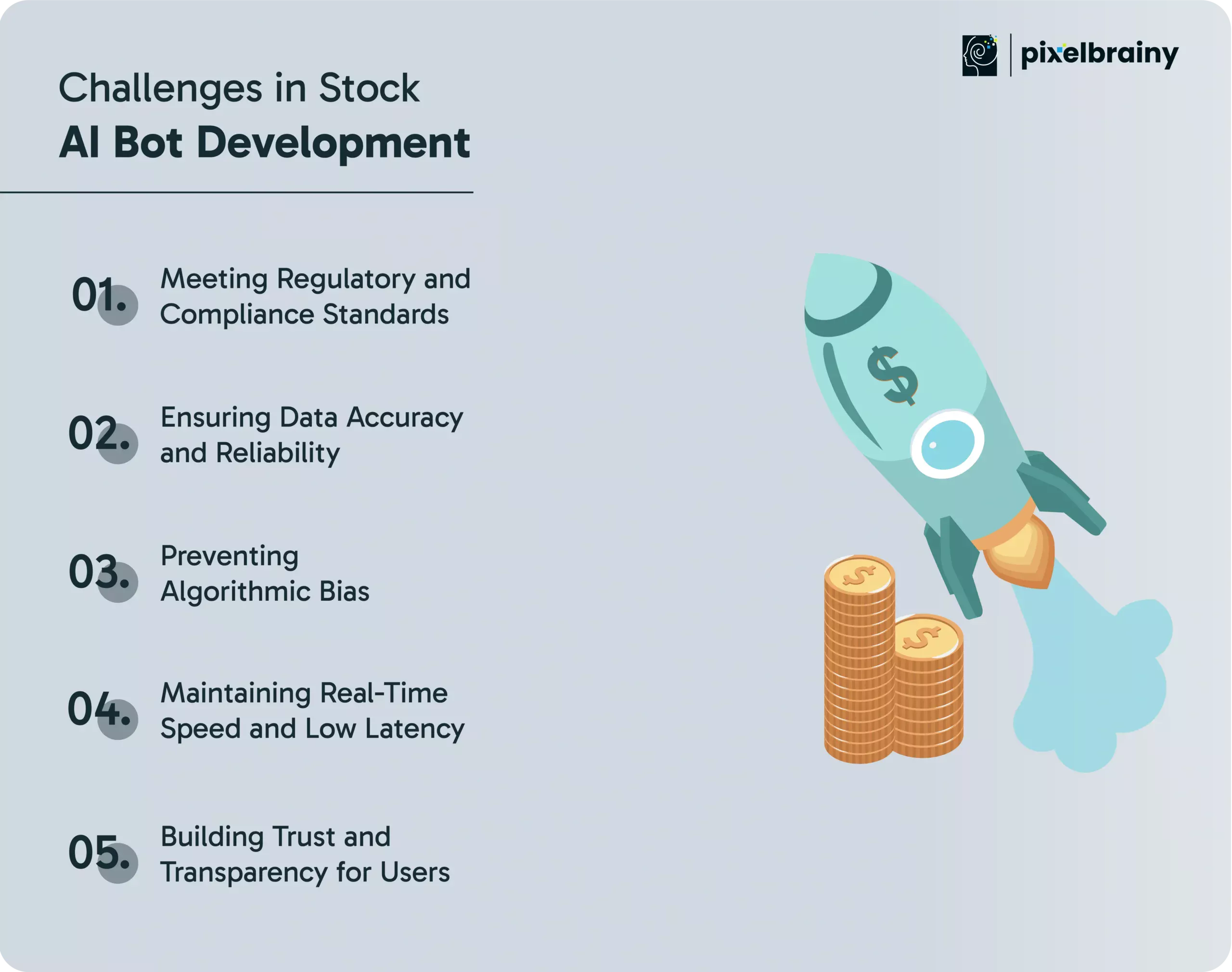
The challenge: Stock trading operates under some of the strictest financial regulations in the world. Developers must ensure their bot complies with domestic and international laws.
Risks: Non-compliance can lead to penalties, trading bans, or reputational damage.
Solutions:
The challenge: An AI model is only as good as its input data. In fast-moving stock markets, real-time feeds can contain errors, latency, or incomplete information.
Risks: Flawed data can cause false signals, poor trades, and financial losses.
Solutions:
The challenge: AI trained on narrow or skewed datasets can develop unbalanced trading strategies.
Risks: Bots may overemphasize certain stock categories, neglect emerging sectors, or ignore ESG factors.
Solutions:
The challenge: In stock trading, milliseconds can make or break a trade. Any lag in analysis or execution can erode profits.
Risks: Missed trade entries, increased slippage, and reduced strategy effectiveness.
Solutions:
The challenge: Traders are hesitant to rely on “black box” AI without understanding how it makes decisions.
Risks: Low adoption, user skepticism, and potential reputational harm.
Solutions:
Therefore, addressing these challenges through reliable data pipelines, rigorous model validation, low-latency infrastructure, and appropriate compliance controls helps build a more robust AI stock trading bot. The goal is to create a system that can be evaluated transparently, manage operational risks, and perform reliably under real-world market conditions.
Building a high-performance AI stock trading bot requires more than coding expertise. It demands a combination of machine learning, quantitative strategy development, real-time data processing, low-latency execution, and secure software architecture. PixelBrainy is an AI trading software development company that helps businesses turn trading concepts into custom software solutions aligned with their technical and operational requirements.
Whether you are building a trading platform from scratch, modernizing an existing system, or developing machine learning-powered trading capabilities, PixelBrainy can support your project across the software development lifecycle.
From technical planning and system architecture to AI model integration, broker connectivity, deployment, and maintenance, PixelBrainy supports the development process. Solutions can be tailored to your trading strategies, data sources, portfolio requirements, and execution workflows.
AI trading systems depend on reliable data pipelines and models designed around specific trading objectives. Development may include historical data processing, machine learning-based signal generation, technical indicator analysis, and performance monitoring. Models should be validated against unseen data and relevant benchmarks before being relied on in live trading.
For strategies sensitive to execution delays, system architecture matters. PixelBrainy can help design data-processing workflows, API integrations, monitoring tools, and execution components with latency and scalability requirements in mind. Actual execution performance depends on the broker, market connectivity, infrastructure, and trading strategy.
Trading software needs safeguards that extend beyond predictive models. Essential capabilities include secure API authentication, access controls, trade logging, position limits, exposure monitoring, and operational alerts. Ongoing maintenance helps address software issues, evolving infrastructure needs, and changes to system requirements.
PixelBrainy has worked on a confidential, USA-based AI trading project involving high-volume data processing and automated trade execution. The system was designed to process millions of data points daily, execute trades in under 50 milliseconds, and adjust strategies in response to market volatility. The client's identity and project name remain confidential.
This project illustrates the importance of combining AI capabilities with execution engineering and responsive system architecture. Past project performance should not be interpreted as a guarantee of future trading results.
Whether you need a custom AI stock trading bot, machine learning-based signal generation, or a scalable trading platform, PixelBrainy can help translate your requirements into a development roadmap.
Ready to discuss your trading software requirements? Connect with PixelBrainy to explore your project.

Developing an AI stock trading bot is a strategic investment that brings together machine learning, market data analysis, automated execution, and risk management. From defining your trading strategy and selecting the right technology stack to validating models, integrating broker APIs, and optimizing real-time performance, every step plays a role in building a reliable trading system.
As discussed throughout this guide, successful AI stock trading bot development is not just about predicting market movements. It is about building a complete solution that can process data efficiently, execute strategies within defined risk limits, and adapt to changing market conditions through continuous testing and monitoring. While no bot can guarantee profits, the right development approach can help you automate trading workflows and make more informed, data-driven decisions.
If you are ready to turn your trading idea into a custom solution, PixelBrainy can help you plan and develop an AI-powered stock trading bot tailored to your business goals.
Schedule a call with PixelBrainy to discuss your AI stock trading bot development project.
To create an AI stock trading bot from scratch, define your trading strategy, collect historical and real-time market data, develop machine learning models, and integrate a broker API for automated execution. A reliable AI stock trading bot development process also includes backtesting, risk management, paper trading, and continuous performance monitoring before live deployment.
The cost of AI stock trading bot development typically ranges from $10,000 to $100,000 or more, depending on complexity. Key cost factors include AI model development, market data licensing, broker API integration, cloud infrastructure, security, testing, and ongoing maintenance. Institutional-grade trading systems may require significantly higher investment.
Essential AI stock trading bot features include real-time market data processing, machine learning-based trading signals, automated order execution, portfolio monitoring, position sizing, risk controls, and performance analytics. Advanced systems may also incorporate sentiment analysis, volatility detection, and adaptive strategies, depending on the trading objectives.
The right AI stock trading bot technology stack depends on strategy complexity, data volume, and execution requirements. Python is commonly used for machine learning and backtesting, while frameworks such as PyTorch and TensorFlow support model development. Databases, streaming tools, broker APIs, and cloud infrastructure help manage market data and production workloads.
An AI stock trading bot with real-time execution collects live market data, processes relevant indicators, generates trading signals, applies risk rules, and submits orders through a broker API. Its effectiveness depends on data quality, model validation, market liquidity, infrastructure, and execution latency.
Building a potentially profitable AI stock trading bot starts with a measurable trading hypothesis, reliable data, realistic backtesting, and strict risk management. Testing should account for transaction costs, slippage, overfitting, and changing market conditions. No AI trading strategy can guarantee profits, so performance must be continually evaluated against suitable benchmarks.
Common AI stock trading bot development challenges include poor-quality market data, overfitted machine learning models, latency, unexpected execution failures, changing market conditions, and regulatory requirements. Developers can address these issues through data validation, out-of-sample testing, robust broker integrations, automated safeguards, and continuous monitoring.
Hiring an AI trading software development company can help when you need custom machine learning models, proprietary trading strategies, broker integrations, or scalable trading infrastructure. Evaluate the company's technical expertise, security practices, testing methodology, and relevant project experience before choosing a development partner.

About The Author
Sagar Bhatnagar
Sagar Sahay Bhatnagar brings over a decade of IT industry experience to his role as Marketing Head at PixelBrainy. He's known for his knack in devising creative marketing strategies that boost brand visibility and market influence. Sagar's strategic thinking, coupled with his innovative vision and focus on results, sets him apart. His track record of successful campaigns proves his ability to utilize digital platforms effectively for impactful marketing efforts. With a genuine passion for both technology and marketing, Sagar continuously pushes PixelBrainy's marketing initiatives to greater success.

Working with the PixelBrainy team has been a highly positive experience. They understand the design requirements and create beautiful UX elements to meet the application needs. The dev team did an excellent job bringing my vision to life. We discussed usability and flow. Sagar worked with his team to design the database and begin coding. Working with Sagar was easy. He has the knowledge to create robust apps, including multi-language support, Google and Apple ID login options, Ad-enabled integrations, Stripe payment processing, and a Web Admin site for maintaining support data. I'm extremely satisfied with the services provided, the quality of the final product, and the professionalism of the entire process. I highly recommend them for Android and iOS Mobile Application Design and Development.

Great experience working with them. Had a lot of feedback and I found that unlike most contractors they were bugging me for updates instead of the other way around. They were extremely time conscience and great at communicating! All work was done extremely high quality and if not on time, early! They were always proactive when it comes to communication and the work is great/above par always. Very flexible and a great team to work with! Goes above and beyond to present us with multiple options and always provides quality. Amazing work per usual with Chitra. If you have UI/UX or branding design needs I recommend you go to them! Will likely work with them in the future as well, definitely recommended!

PixelBrainy is a joy to work with and is a great partner when thinking through branding, logo, and website layout. I appreciate that they spend time going into the "why" behind their decisions to help inform me and others about industry best practices and their expertise.

I hired them to design our software apps. Things I really like about them are excellent communication skills, they answer all project suggestions and collaborate right away, and their input on design and colors is amazing. This project was complex and needed patience and creativity. The team is amazing to do business with. I will be using them long-term. Glad to see there are some good people out there. I was afraid to try and outsource my project to someone but I am glad I met them! I really can't say enough. They went above and beyond on this project. I am very happy with everything they have done to make my business stand out from the competition.

It was great working with PixelBrainy and the team. They were very responsive and really owned the project. We'll definitely work with them again!

I recently worked with the PixelBrainy team on a project and I was blown away by their communication skills. They were prompt, clear, and articulate in all of our interactions. They listened and provided valuable feedback and suggestions to help make the project a success. They also kept me updated throughout the entire process, which made the experience stress-free and enjoyable.

PixelBrainy is very good at what it does. The team also presents themselves very professionally and takes care of their side of things very well. I could fully trust them taking up the design work in a timely and organised manner and their attention to detail saved us lots of effort and time. This particular project was quite intense and the team showed that they function very well under pressure. Very much looking forward to working with her again!

It's always an absolute pleasure working with them. They completed all of my requests quickly and followed every note I had for them to a T, which made our process go smoothly from start to finish. Everything was completed fast and following all of the guidelines. And I would recommend their services to anyone. If you need any design work done in the future, PixelBrainy should be your first call!

They took ownership of our requirements and designed and proposed multiple beautiful variants. The team is self-motivated, requires minimum supervision, committed to see-through designs with quality and delivering them on time. We would definitely love to work with PixelBrainy again when we have any requirements.

PixelBrainy was a big help with our SaaS application. We've been hard at work with a new UI/UX and they provided a lot of help with the designs. If you're looking for assistance with your website, software, or mobile application designs, PixelBrainy and the team is a great recommendation.

PixelBrainy designers are amazing. They are responsive, talented, and always willing to help craft the design until it matches your vision. I would recommend them and plan to continue them for my future projects and more!!!

They were awesome! Did a good job fast, and good communication. Will work with them again. Thank you

Creative, detail-oriented, and talented designers who take direction well and implement changes quickly and accurately. They consistently over-delivered for us.

PixelBrainy team is very talented and creative. Great designers and a pleasure to work with. PixelBrainy is an excellent communicator and I look forward to working with them again.

PixelBrainy has a very talented design team. Their work is excellent and they are very responsive. I enjoy working with them and hope to continue on all of our future projects.


Transform your ideas into reality with us.
Across these industries, each engagement brings unique challenges, from early-stage product development to scaling complex systems, helping us build a practical understanding of real-world product environments.